They Arrested an Aging Farmer Over a Gun Threat, but the Irrigation Line Told a Different Story
Chapter 1: The Deputies Arrived While the Water Was Still Running
“Get on the ground! Hands where I can see them!”
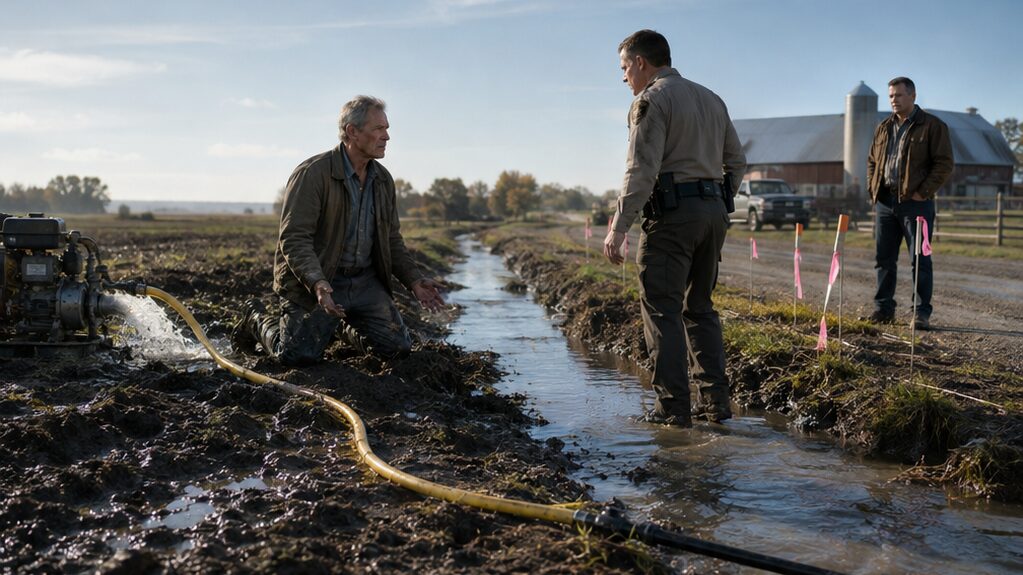
Kevin Martin froze with one boot sunk ankle-deep in mud.
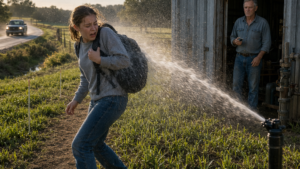
The irrigation pump thudded behind him, steady and mechanical, pushing water through the yellow hose that ran from the ditch to the lower field. In his right hand he held a long black irrigation wand. Water still streamed from its end, cutting a shallow groove through the soil.
Two sheriff’s deputies stood near the county road with their hands close to their holsters.
Kevin looked from them to the wand.
“You mean me?”
“Drop it.”
He let the wand fall.
It landed in the mud with a dull slap, still spraying.
“Now get down.”
Kevin was sixty-nine years old. His left knee had been bad since he fell from a hay wagon twelve winters ago, and getting onto the ground had become something he did carefully, with a fence post or tractor tire nearby.
There was nothing nearby now except wet soil.
He lowered himself slowly.
“The pump,” he said. “Somebody needs to shut the pump off.”
“Hands behind your head.”
“If that lower valve stays open, you’ll flood—”
“Hands behind your head.”
Kevin obeyed.
Across the ditch, Michael Clark stood beside his pickup.
His jeans were clean above the boots. His arms were folded. He did not look frightened.
That was the first thing Kevin noticed.
The second was the bright orange survey flag leaning near the edge of the narrow crossing between their properties.
Michael had driven over that flag three times in the past two weeks.
One deputy approached Kevin while the other watched the ditch and the equipment shed beyond it.
“Any weapons on you?”
“No.”
“Any weapons in the barn?”
“I’ve got a twelve-gauge locked in a cabinet. Haven’t opened that cabinet since spring turkey season.”
The deputy paused.
Kevin heard Michael say from behind them, “That’s the one.”
Kevin twisted his head.
“What?”
The deputy pressed a hand between Kevin’s shoulders.
“Stay still.”
Michael pointed toward the black irrigation wand in the mud.
“He was holding it like that, then he went back toward the barn. Came back with the shotgun.”
Kevin stared at him.
For several seconds, even the pump seemed quieter.
“You told them I had a shotgun?”
Michael’s face tightened.
“You threatened me.”
“I told you to stop driving your equipment across my flags.”
“You told me I’d regret it.”
“That isn’t what you just told them.”
The deputy beside Kevin said, “No more talking.”
Water was spreading now.
Kevin could see it slipping over the shallow berm and moving toward the low end of his vegetable rows. The ground there had been dry enough that morning. In another twenty minutes, it would not be.
“Deputy,” he said, forcing his voice flat, “turn the red handle on the pump clockwise. All the way. Please.”
The younger deputy looked toward the equipment.
“Is that safe?”
“Yes.”
Michael stepped forward. “Don’t touch anything. That line feeds my side too.”
Kevin lifted his head.
“No, it doesn’t.”
“It always has.”
“Not from that valve.”
The deputies exchanged a look.
Kevin understood it instantly. Two men. One argument. Property line. Gun accusation. Conflicting instructions.
To them, the farm was not a history. It was a scene.
The younger deputy finally walked toward the pump.
“Red handle?”
“On the left.”
Michael called after him, “He moved the line yesterday.”
Kevin shut his eyes for a moment.
The deputy found the handle and turned it.
The pump’s rhythm changed, then slowed. The spray from the wand weakened to a narrow stream and stopped.
Kevin felt a ridiculous rush of relief.
At least the lower field would not drown.
The deputy returned.
“We’re going to check the barn.”
“Go ahead.”
“Do you have keys?”
“Front pocket.”
The deputy removed them.
Michael moved closer to the road as the deputies searched the shed and barn. Kevin remained kneeling in mud with his hands behind his head.
A truck passed on the county road, slowed, then continued.
Kevin knew the driver. He recognized the truck from the feed store.
That bothered him more than he expected.
One deputy came back ten minutes later carrying nothing.
“There’s a shotgun locked in the cabinet.”
“I told you.”
“Unloaded.”
“I told you.”
“Cabinet was locked.”
“Yes.”
Michael said, “He put it back.”
Kevin looked at him again.
Michael would not meet his eyes this time.
The senior deputy crouched beside Kevin.
“Mr. Clark says you raised a firearm during an argument, threatened him, then returned it to the barn before we arrived.”
“That didn’t happen.”
“He says you told him you’d shoot him if he crossed the ditch again.”
“I did not.”
“You acknowledge there was an argument?”
Kevin hesitated.
There had been several.
He could still see Michael’s combine wheel flattening the orange flag three mornings earlier. He could still hear his own voice louder than it should have been.
But not today.
“Today I told him the surveyor had marked the line and he needed to keep his equipment off it.”
“That’s all?”
Kevin looked toward Michael.
Michael was watching him now.
“Yes,” Kevin said.
Something in Michael’s expression changed, almost too small to catch.
The senior deputy stood.
“Mr. Martin, I’m placing you under arrest pending investigation of a reported threat involving a firearm.”
Kevin stared at him.
“You found the gun locked up.”
“That doesn’t establish where it was earlier.”
“You found mud on the wand.”
“Sir.”
“I’ve been standing in that ditch all morning.”
“Turn around.”
Kevin slowly pushed himself upright.
His knee nearly gave out.
The deputy caught his elbow before he fell, then guided both arms behind his back and fastened the cuffs.
They were not rough.
That somehow made the humiliation worse.
Michael stood beside his pickup while Kevin was walked toward the patrol vehicle.
As Kevin passed, he stopped.
The deputy tightened his grip.
Kevin said, “You know what I was holding.”
Michael’s jaw shifted.
“You threatened me.”
Kevin waited for something else.
Nothing came.
The patrol car door shut behind him.
From the back seat, he could see his farm through the dusty glass: the equipment shed, the lower field, the irrigation hose lying across the mud like something abandoned in a hurry.
The orange survey flag moved slightly in the breeze.
At the county jail, Kevin surrendered his belt, wallet, boots, and phone. By early afternoon, he was sitting on a molded bench beneath fluorescent lights trying to understand how an argument about twelve feet of land had turned into handcuffs.
Near dusk, a deputy came to the holding area with papers.
“You’ve also been served.”
Kevin took them.
The top page was an emergency petition for a protection order.
He read Michael Clark’s name.
Then his own.
Then the temporary exclusion map.
The marked zone did not stop at Michael’s house or the disputed crossing.
It extended along the irrigation ditch and cut directly through the only practical route Kevin used to reach the lower-field valve.
Kevin read the map twice.
The criminal accusation could have kept him out of trouble.
This order could keep him off his own working ground.
For the first time that day, he stopped thinking about the shotgun Michael claimed to have seen.
He began wondering why Michael needed him away from that exact piece of land.
Chapter 2: Two Nights Away Cost More Than Freedom
At five the next morning, Kevin woke to the sound of a steel door opening instead of the pump kicking on.
For twenty-three years, he had started irrigation before sunrise.
Now someone else would have to decide whether the lower field needed water.
He sat up on the narrow bunk and pressed both palms against his knees before standing.
The county had given him a blanket, a cup, and three meals the day before. None of those things could tell him whether the cattle trough float was sticking again or whether the beans on the south row had taken too much water before the deputy closed the valve.
His phone was locked with his other belongings.
His farm was eight miles away.
That distance had never seemed important until he could not cross it.
By midmorning, a jail officer allowed him to make another call.
He called the feed store because he knew the owner would answer early.
“I need a favor,” Kevin said.
There was a pause.
“Kevin?”
“Yeah.”
“I heard something happened.”
Of course he had.
Kevin looked at the gray wall.
“I need somebody to check the cattle trough and make sure the lower line is closed.”
Another pause.
“I can send the delivery driver past there.”
“Don’t send him across the west strip.”
“Why?”
“Just don’t.”
Kevin hung up before the man could ask more.
By the second night, the practical list in his head was longer than the criminal one.
Cattle.
Pump.
Valve.
Greenhouse vent.
Diesel delivery.
The south fence.
He had spent most of his life believing that being needed by a farm was a kind of freedom.
From inside county lockup, it felt more like a chain.
Sandra Thompson met him the next afternoon after his release hearing.
She was waiting outside the courtroom with a leather folder under one arm.
Kevin knew her by reputation. She handled boundary disputes, water contracts, and farm succession cases in three counties.
She looked at him once and said, “You look terrible.”
“My knees agree with you.”
“That wasn’t a compliment.”
“I know.”
She handed him a copy of the temporary order.
“Your criminal attorney will handle the threat allegation. I’m looking at the civil side because this order is affecting your property access.”
Kevin looked down at the map again.
“I can’t reach my lower valve.”
“I noticed.”
Sandra led him to a bench outside the courtroom.
The map had been copied from a county parcel sheet. Someone had drawn a shaded exclusion zone over it.
Sandra tapped the narrow strip between the Clark property and Kevin’s irrigation ditch.
“This is interesting.”
“What?”
“The boundary of the requested protection area tracks this access lane almost exactly.”
“That lane is mine.”
“According to you.”
Kevin looked at her sharply.
Sandra did not react.
“That’s not an insult,” she said. “It’s what court will care about. According to the recorded deed, this is part of your parcel. According to historical use, Clark equipment has crossed here for years.”
“His father crossed it. With permission.”
“Written?”
“No.”
“Recorded?”
“No.”
“Annual agreement?”
“We didn’t need one.”
Sandra gave him a long look.
Kevin knew that look. He had gotten versions of it from accountants and insurance agents for thirty years.
“You’re about to tell me I should’ve put it on paper.”
“I don’t need to. The map already did.”
Kevin leaned back.
Michael’s father had begun using the strip before either of them had gray hair. At harvest, when the eastern approach turned soft, he would bring machinery across Kevin’s ground and cut toward the Clark fields.
No rent.
No contract.
No problem.
When Michael took over, the machines got wider.
The crossings got deeper.
Then he added more acreage and began treating the route less like a favor and more like infrastructure.
Kevin had objected.
Michael had called it tradition.
Neither had written anything down.
Sandra slid another sheet toward him.
“The temporary order prevents you from coming within the marked area until the hearing.”
“How long?”
“Several days at least.”
“My lower irrigation control is inside it.”
“I know.”
“My vegetables don’t care about court schedules.”
“I know that too.”
“What am I supposed to do?”
“For now, get someone else to operate anything you legally can’t approach.”
Kevin hated the answer because it was sensible.
He hated it more because it required help.
By late afternoon, he was finally back at the farmhouse.
His dog met him halfway down the porch steps, whining hard enough to shake.
Kevin knelt slowly and let the animal push its head under his arm.
For a minute, he stayed there.
Then he saw the hose.
It had been coiled beside the equipment shed, dry now, its black irrigation wand resting on top.
The same wand Michael had apparently described as part of a gun threat.
Kevin stood.
Across the fields, an engine started on the Clark side.
A large machine moved slowly toward the disputed lane.
Kevin took one step off the porch before remembering the order in his pocket.
He stopped.
The machine crossed.
Not far. Not dramatically.
Just enough.
Kevin watched one tire pass beside the orange survey flag.
He could do nothing.
Sandra arrived an hour later with more papers.
She spread them across Kevin’s kitchen table while he stood at the window.
“I called the irrigation district,” she said. “They can provide your delivery records and pump allocation schedule.”
“That won’t show what Michael said.”
“No. But it may show what your system was doing.”
Kevin turned.
Sandra placed the protection-order map beside an irrigation layout he kept folded in a drawer.
The two diagrams overlapped almost perfectly at the west strip.
She traced a line with her finger.
“If Michael’s concern was simply physical safety, there are several ways this zone could have been drawn.”
Kevin said nothing.
“But this version,” Sandra continued, “gives him uninterrupted movement through the crossing while preventing you from reaching the control that affects it.”
“He planned it.”
“I didn’t say that.”
“You’re thinking it.”
“I’m thinking we need evidence before we call motive a fact.”
Kevin sat down.
Sandra looked around the kitchen.
“Do you have anything recording that part of the farm?”
“Recording?”
“Trail camera. Security camera. Equipment camera.”
Kevin frowned.
Then he remembered the small camera above the equipment shed door.
He had installed it the previous winter after fuel disappeared twice from an unlocked tank.
It faced west.
Toward the ditch.
Toward the crossing.
Sandra saw his expression.
“What?”
Kevin stood so quickly the chair scraped back.
“There’s a camera on the shed.”
“Does it record continuously?”
“Motion, mostly. Maybe more.”
“Does it see the ditch?”
“Part of it.”
Sandra closed her folder.
“Then before anybody touches that camera, we make a copy.”
Kevin looked through the window toward the equipment shed.
For the first time since the deputies had arrived, the order in his pocket felt slightly lighter.
But he could not remember the camera angle.
And he could not remember whether Michael had been standing inside it when the argument happened.
Chapter 3: The Camera Saw Less—and More—Than Kevin Expected
The first recording began eleven minutes before Michael called the sheriff.
Kevin watched himself walk into the frame carrying the black irrigation wand.
Sandra paused the video.
“There.”
Kevin leaned closer to her laptop.
The image was grainy but clear enough.
His right hand held the wand by the grip. The yellow hose trailed behind him across the mud. No shotgun. No case. No second object.
Sandra let the recording continue.
Kevin crossed from the pump to the ditch, disappeared for several seconds behind a stack of irrigation pipe, then came back into view.
Michael’s pickup appeared at the far edge of the frame.
Kevin felt his stomach tighten.
“There he is.”
Sandra said nothing.
Onscreen, Michael got out of the truck.
There was no audio.
He walked toward the ditch.
Kevin could see his own body angle change.
Shoulders squared.
Chin raised.
Even without sound, he recognized the posture.
He looked angry.
Michael pointed toward the survey flags.
Kevin pointed back toward the lane.
Then he lifted the irrigation wand.
Sandra froze the frame.
Kevin stared.
The wand was held across his body at waist height, one hand near the grip and the other steadying the hose.
In a single still image, it looked worse than Kevin wanted it to.
Not like a shotgun exactly.
But long.
Dark.
Rigid.
Sandra zoomed in.
“The object is clearly connected to the hose.”
“To us.”
“To anyone who studies it.”
“That deputy wasn’t studying anything.”
“No. He was responding to a report involving a firearm.”
Kevin leaned back.
“So this proves Michael lied.”
“It proves that at this point you were holding an irrigation wand.”
“That’s what I’ve been saying.”
Sandra resumed the recording.
Michael stepped closer.
Kevin moved out of frame to the left.
Michael followed.
Then both disappeared.
The camera showed only the hose sliding through the mud.
For nearly ninety seconds, nothing else was visible.
Kevin watched the empty section of ditch.
“This is when we were arguing.”
“How long?”
“Minute. Two maybe.”
“Where were you?”
“By the old culvert.”
“Camera can’t see it?”
“No.”
Michael reappeared first.
He walked backward into frame, still facing the direction Kevin remained hidden.
Then Kevin emerged.
Still holding the wand.
Still no gun.
Michael returned to his pickup.
Kevin walked toward the pump.
Sandra checked the timestamp.
“Six minutes before the 911 call.”
“That’s it.”
“Not quite.”
She advanced the footage.
Kevin bent near the pump.
Then disappeared toward the equipment shed.
Sandra stopped.
Kevin’s hope cooled.
“How long are you off camera?”
“Let it run.”
Two minutes and sixteen seconds later, Kevin reappeared from behind the shed.
His hands were empty.
Sandra looked at him.
“Where did you go?”
“To get a wrench.”
“Can we see that?”
“No.”
“Could you have entered the barn from there?”
Kevin’s irritation returned.
“I didn’t.”
“That isn’t what I asked.”
“Yes. I could’ve.”
Sandra wrote something on a legal pad.
“So Michael’s version will be that you argued with him, disappeared in the direction of the barn, retrieved the gun, threatened him somewhere outside camera view, returned it, then came back to the pump.”
“That’s ridiculous.”
“It is also a timeline we have to disprove.”
Kevin pushed away from the table.
The equipment shed smelled of oil, dust, and cut metal. Outside, sunlight came through the open door in a hard rectangle.
He had imagined the camera would settle everything.
Instead it had given them most of the truth and left a hole exactly where Michael needed one.
Sandra closed the laptop.
“We still have something useful.”
“He said I had a shotgun at the ditch.”
“And the footage shows the object visible during your confrontation is an irrigation wand.”
“He’ll say the gun came later.”
“He already has.”
Kevin looked at the black wand lying against the wall.
Mud had dried along its lower half.
“You think they’ll believe him?”
“I think people believe coherent stories until another story fits the facts better.”
“My story is the facts.”
Sandra looked at him.
“Then stop treating those as the same thing.”
Kevin’s jaw tightened.
She held his gaze.
“Is there anything else?”
“No.”
“Kevin.”
“What?”
“Anything Michael can point to and say you’re leaving something out?”
Kevin looked toward the door.
A survey flag outside moved in the wind.
“No.”
Sandra did not answer immediately.
She gathered the laptop and camera storage card and slid both into her bag.
“We’ll request the sheriff’s call log. Irrigation district records too. If the pump was running continuously, that may help establish what you were doing.”
Kevin nodded.
Sandra remained seated.
“What started this between you two?”
“The crossing.”
“I know what the dispute is about. I asked what started it.”
Kevin frowned.
“His combine tore up the strip.”
“When?”
“Last month.”
“And?”
“And I told him to stop.”
“Calmly?”
Kevin looked away.
Sandra waited.
He could hear the small ticking sound of cooling metal somewhere near the workbench.
“Kevin.”
“He’d knocked down the survey flags.”
“So?”
“I put them back.”
“What did you say?”
Kevin rubbed a thumb across the edge of the workbench.
There it was.
Not the gun.
Not the camera.
The part he had decided did not matter because it had happened days earlier and because, in his mind, he knew what he meant.
Michael’s combine had crossed the strip after Kevin had warned him twice.
Kevin had walked into the lane and planted himself beside the orange flag.
Michael had climbed down from the cab.
They had shouted.
Kevin remembered every word now because Sandra’s question made it impossible not to.
“You cross that flagged line again,” Kevin had said, “and you’ll regret it.”
Sandra’s expression did not change.
“You said that?”
“Days before.”
“Why didn’t you tell me?”
“Because I didn’t threaten to shoot anybody.”
“That wasn’t my question.”
Kevin felt heat climb up his neck.
“I meant I’d have him cited. Or take him to court.”
“Did you say that?”
“No.”
“So you told a man you were already fighting with that he would regret crossing the line again.”
“It wasn’t a gun threat.”
“No. But if he tells a magistrate he was afraid of you, that sentence matters.”
Kevin turned toward the open shed door.
The camera above it suddenly looked less like protection and more like an eye that had recorded only what he was willing to admit.
Sandra stood.
“I can work with an ugly fact,” she said. “I cannot work around one you hide from me.”
Kevin looked down at the hose on the floor.
He had spent three days angry that Michael had turned an ordinary tool into something it was not.
Now he had to face the smaller, harder truth that he had done something similar with his own words.
He had called them harmless because he knew what he meant.
Michael would be free to call them a threat because he knew how they sounded.
Sandra reached the door.
“Next time I ask if there’s anything else, I need the whole answer.”
Kevin nodded once.
She stepped outside.
Then he said, “Sandra.”
She turned.
“I told him exactly this: ‘Cross that flagged line again and you’ll regret it.’”
Sandra held his gaze.
“Good,” she said. “Now we know what the other side is going to build around.”
Kevin looked past her toward the orange flags along the ditch.
For the first time, he understood that clearing his name would require more than proving Michael had lied.
It would require telling the truth about himself before Michael got the chance to tell it for him.
Chapter 4: The Words Kevin Hid Changed the Case
Sandra did not sit down when Kevin entered her office.
She stood beside the conference table with both hands resting on a stack of papers, the same way a person might steady something that had already begun sliding.
“You understand what the problem is now?” she asked.
Kevin closed the door behind him.
“The problem is Michael lied.”
“That is one problem.”
“He said I had a shotgun.”
“Yes.”
“I didn’t.”
“Yes.”
Kevin looked at the papers.
Sandra pulled out a chair for him but remained standing.
“The other problem,” she said, “is that you told me there was nothing else he could use to make you sound threatening.”
Kevin sat.
“I told you exactly what I said.”
“After I asked three times.”
“It happened days before.”
“That does not make it disappear.”
Kevin looked toward the window. From Sandra’s second-floor office, he could see the courthouse roof across the street and the top of the grain elevator farther out.
He had spent most of the drive there rehearsing why the earlier argument was irrelevant.
Now every explanation sounded like another omission.
Sandra pushed a typed statement toward him.
“This is what I want you to sign for our file. Full chronology. Every argument. Every disputed crossing. Every time you raised your voice. Every time Michael did. No polishing.”
Kevin scanned the first page.
“You’re making me look guilty.”
“I’m making sure I know where the weak boards are before somebody else steps on them.”
He set the paper down.
Sandra finally sat.
“You have a good fact pattern on the firearm,” she said. “You have video showing the irrigation wand. You have a locked shotgun cabinet. You have no firearm visible where Michael says one appeared.”
“So why are we talking like I’m the one on trial?”
“Because credibility is the case.”
She tapped the statement.
“If Michael is lying, we need to prove it with facts. If you start looking selective with the truth, we hand him room to survive.”
Kevin picked up a pen.
He signed.
Then Sandra slid another document across the table.
“This came in this morning.”
It was a civil filing.
Michael Clark was claiming historical access across the disputed strip and asking the court to preserve continued use while the property dispute was resolved.
Kevin read the first paragraph twice.
“He filed this after getting the protection order?”
“Yes.”
“So he gets me arrested, keeps me away from the lane, then tells another court he needs the lane.”
Sandra nodded.
Kevin felt anger rise quickly.
“That was the plan.”
“Maybe.”
“You still won’t say it.”
“I’ll say it when we can prove it.”
Kevin stood and paced once to the window.
“His father crossed that strip because mine let him.”
“Then we need to establish that.”
“We shook hands on it.”
Sandra gave him a tired look.
Kevin stopped.
“Yeah. I know.”
The surveyor met them that afternoon at the west strip.
Orange flags ran along the narrow band of ground between Kevin’s lower field and the Clark property. Tire impressions cut diagonally across several of them.
The surveyor walked the line slowly, checking measurements against the parcel description.
Michael was not there.
Kevin preferred it that way.
“This is your recorded boundary,” the surveyor said, pointing to the flagged line. “The traveled path crosses onto your parcel here, runs roughly one hundred eighty feet, then returns.”
“Always has.”
“Use is not the same thing as ownership.”
“I know that now.”
The surveyor glanced at him.
Sandra heard it too.
She said nothing.
Near the irrigation ditch, the yellow hose still lay along the edge of the lane. It had been moved several feet after Kevin’s arrest so another person could reach the lower valve without entering the exclusion zone.
The orange flags and the hose crossed like two arguments drawn on the ground.
Sandra photographed them.
Kevin said, “His father used to ask.”
The surveyor looked up.
“For permission?”
“Every season. Not formal. He’d come over, tell me when he needed to bring equipment through.”
“Any letters?”
“No.”
“Texts?”
“Wasn’t texting then.”
“Checks?”
Kevin shook his head.
“Nothing.”
Sandra said, “Did you ever tell Michael his access was temporary?”
“I told him the ground was mine.”
“That isn’t the same thing.”
Kevin exhaled.
There it was again.
Thirty years of being clear in his own mind had produced almost nothing useful on paper.
The irrigation-district office was their next stop.
A clerk pulled Kevin’s account and printed several weeks of pump-delivery data.
“These times are automatic?” Sandra asked.
“System logs start and stop activity when the pump draws through the district meter.”
“Minute-specific?”
“Close enough for billing.”
Kevin leaned over the counter.
The clerk pointed to the morning of the arrest.
“Pump started at 7:42.”
Sandra traced down the page.
“And stopped?”
“8:31.”
Kevin looked at her.
“That deputy shut it off.”
The emergency call had been placed at 8:19.
Sandra checked her notes.
Michael’s statement claimed Kevin had returned to the barn, retrieved a shotgun, come back toward the ditch, threatened him, then carried the gun back before deputies arrived.
The camera showed Kevin entering the shed-side blind area for two minutes.
But the pump records showed continuous flow.
Sandra’s expression sharpened.
“What does that prove?” Kevin asked.
“Not enough by itself.”
Kevin frowned.
She pointed at the sheet.
“But it gives us a clock.”
The irrigation wand required pressure from the running system. Its hose position in the video showed it still connected and stretched toward the ditch during the period Michael claimed Kevin had supposedly gone back and forth with a firearm.
It was not a complete answer.
But it made Michael’s version tighter.
Less room.
More detail to explain.
Back at Sandra’s office, Kevin signed the chronology.
This time he added the sentence himself.
Five days before the arrest, during a dispute over machinery crossing the surveyed strip, I told Michael Clark, “Cross that flagged line again and you’ll regret it.” I meant legal action and removal from the lane. I did not mention a gun or physical harm.
Sandra read it.
“Good.”
“Doesn’t feel good.”
“It isn’t supposed to.”
Kevin looked at the signed page.
For the first time since the arrest, he understood that telling the whole truth could cost him something and still be the only useful choice.
Sandra’s phone rang.
She answered, listened, then wrote down several numbers.
When she hung up, she was quiet for a moment.
“What?”
“Michael’s attorney sent financial records supporting their request for emergency access.”
Kevin waited.
Sandra turned the page toward him.
A crop-backed operating loan.
Repayment tied to harvest proceeds.
Equipment scheduled to move through the disputed strip.
A deadline less than three weeks away.
Kevin looked at the amount owed and felt his anger hesitate.
Not disappear.
Just hesitate.
“If he can’t use the lane?” he asked.
Sandra folded her hands.
“Rerouting the equipment may delay harvest and require work he says they cannot afford right now.”
Kevin looked again at Michael’s loan documents.
For days he had asked why Michael needed him legally removed from that strip.
Now he had part of the answer.
The more dangerous question was what Michael had been willing to do because of it.
Chapter 5: Michael Clark Was Desperate Before He Became Dishonest
Emma Clark did not begin by defending her father.
She began with a number.
“If we miss the harvest window by ten days, we can’t cover the December payment.”
The mediation room went quiet.
Kevin sat across from her and Michael at a narrow rectangular table. Sandra sat beside him. Michael’s attorney had a folder open but had not spoken in several minutes.
Emma pushed a spreadsheet into the center.
Kevin did not reach for it.
“I’m not asking you to forgive anything,” she said.
Michael looked at her.
“Emma.”
“No. He needs to understand why the lane mattered.”
Kevin looked at Michael.
“I understand the lane mattered.”
Emma continued anyway.
“The east access washed out twice this summer. We can repair it, but not before harvest unless we take another short-term loan. The west crossing is the only route that lets the larger equipment move straight into the lower acreage.”
Kevin said, “Your grandfather asked before he crossed.”
“I know.”
“Your father stopped asking.”
Michael shifted in his chair.
“Because we’ve used it for forty years.”
“With permission.”
“It became customary.”
“That doesn’t make it yours.”
Michael leaned forward.
“And you knew what closing it in September would do.”
Kevin felt the old anger return.
“You knocked down survey markers.”
“I was trying to get equipment through.”
“You widened the track.”
“The equipment is wider now.”
“You treated my land like I was in your way.”
Michael’s mouth tightened.
Sandra said quietly, “Stay with the access issue.”
Kevin looked at Emma again.
She was not angry.
Tired, mostly.
There were dark half-moons beneath her eyes. Her hands stayed folded on the spreadsheet.
“My father should have worked out a written agreement years ago,” she said.
Michael turned toward her.
She did not look at him.
Kevin noticed that.
It did more than the loan papers had.
Michael was not sitting beside an unquestioning ally.
He was sitting beside someone who knew exactly how much trouble they were in.
Emma said, “But you should have too.”
Kevin almost answered.
Then stopped.
Because she was right.
He had refused every suggestion to formalize the crossing.
Michael’s father had once joked about putting the arrangement on paper.
Kevin had told him paperwork was what people used when they did not trust each other.
At the time, it had sounded principled.
Now four people were sitting in a mediation room because nobody had written down what trust actually allowed.
Michael broke the silence.
“I didn’t want any of this.”
Kevin looked at him.
“That’s an interesting thing to say after having me arrested.”
“I called because you threatened me.”
Sandra’s pen stopped moving.
Kevin said, “With what?”
Michael’s eyes shifted toward his attorney.
“With a gun.”
“What kind?”
Michael’s attorney said, “We’re not retrying the criminal allegation here.”
Kevin ignored him.
“What kind of gun, Michael?”
“You know what you had.”
Kevin leaned back.
“No. I know what you said I had.”
Emma looked at her father.
Michael’s face hardened.
“I saw a long black barrel.”
“You saw an irrigation wand.”
“You were angry.”
“That’s not a firearm.”
“You told me I’d regret crossing again.”
“Days before.”
“You were standing there with that thing pointed across the ditch.”
Kevin felt Sandra’s hand lightly touch his forearm under the table.
A warning.
He lowered his voice.
“The video shows where I held it.”
“The video doesn’t show everything.”
“No,” Kevin said. “It doesn’t.”
Michael seemed to take strength from that.
“There you go.”
Kevin watched him carefully.
Not loud now.
Not smug.
Cornered.
That was different.
Sandra asked, “Mr. Clark, when did you decide to request the emergency protection order?”
Michael looked at his attorney.
“You can answer,” the attorney said.
“After the sheriff came.”
“Why did your proposed exclusion zone follow the disputed equipment crossing?”
“Because that was where the conflict happened.”
“Why not request separation around your residence and work areas instead?”
Michael’s jaw tightened.
“I needed space.”
“For safety?”
“Yes.”
“And continued equipment access?”
Michael looked at Emma.
There was the pause.
Small.
But real.
Finally he said, “We couldn’t lose the lane right then.”
Kevin felt the room shift.
Sandra did not smile.
She simply wrote the sentence down.
Michael saw her do it.
“That doesn’t mean I made anything up.”
Sandra said, “No one said it did.”
Michael looked at Kevin.
“You were trying to shut us down before harvest.”
“I was trying to stop you from using my land like it belonged to you.”
“You knew what that meant.”
“I knew what you should’ve done. Asked.”
Michael laughed once, without humor.
“You wanted me to come over hat in hand every season.”
“I wanted you to remember whose permission you were relying on.”
Emma closed her eyes briefly.
Kevin heard himself.
The words were true.
The satisfaction in them was not something he liked.
For several minutes, neither side spoke.
Then Michael’s attorney made an offer.
Michael would withdraw the new civil access claim.
In exchange, Kevin would waive any demand that Michael cover legal expenses or damages connected to the protection order.
Kevin looked at Sandra.
She gave nothing away.
Michael said, “We both walk away.”
Kevin looked through the mediation-room window.
Outside, the disputed lane was visible beyond the parking area where the meeting had been arranged near the Clark property.
The yellow irrigation hose ran along one side.
Fresh tire tracks ran along the other.
Water and machinery competing for the same narrow ground.
Kevin thought about two nights in jail.
About his dog alone.
About kneeling in mud with deputies behind him.
Then he thought about Emma’s spreadsheet.
The loan.
The harvest.
Michael’s fear of losing the operation.
He could understand the pressure.
Understanding it did not alter the choice Michael had made.
“No,” Kevin said.
Michael’s face stiffened.
Sandra turned slightly toward him.
Kevin continued.
“You don’t get to buy your way out by giving up a claim you might lose anyway.”
Michael’s attorney said, “Mr. Martin—”
“I’m not asking to ruin his farm.”
Michael stared at him.
Kevin looked directly back.
“But I’m not pretending the arrest was just another boundary argument.”
Emma lowered her gaze.
Michael said, “Then what do you want?”
Kevin thought about that longer than he expected.
A week earlier he would have said everything.
Costs.
Damages.
A locked gate.
No crossing.
No favors.
He could still choose that.
Instead he said, “I want the truth settled first.”
Michael shook his head.
“You can’t prove what I saw.”
Kevin looked at Sandra.
“Can we prove what he had time to see?”
Sandra’s expression changed.
Kevin continued.
“The pump log. The camera. The hose. His call time. Everything.”
Sandra closed her folder.
“Yes.”
“All of it?”
“If we reconstruct it carefully.”
Kevin nodded.
“Then do that.”
Michael watched him.
Kevin understood now that proving there had been no gun was only half the fight.
The harder part was proving that Michael had known what he was looking at when he called it one.
Chapter 6: The Irrigation Timeline Left No Room for a Shotgun
“Only two people know what happened beside that ditch.”
Michael Clark said it calmly.
He was sitting at the opposite table in the civil hearing room, wearing a pressed work shirt instead of field clothes. His attorney had just asked why the security footage should not be treated as incomplete.
Michael looked toward Kevin.
“He knows. I know.”
Kevin felt every face in the room turn toward him.
Two weeks earlier, that sentence might have frightened him.
Now Sandra had a six-foot timeline mounted on foam board behind her.
At 7:42, the irrigation pump started.
At 8:08, Kevin entered the shed-camera frame carrying the black irrigation wand attached to the yellow hose.
At 8:11, Michael’s pickup arrived.
At 8:13, the argument moved partly outside camera view.
At 8:16, Michael returned toward his truck.
At 8:17, Kevin appeared beside the pump.
At 8:19, Michael placed the emergency call.
At 8:31, a deputy shut the pump down.
Simple times.
Ordinary movements.
Together they made Michael’s story harder to fit.
Sandra stood.
“Mr. Clark, you told the sheriff Kevin returned from the barn with a shotgun after your argument.”
“Yes.”
“And you said he threatened you near the ditch.”
“Yes.”
“You estimated this occurred several minutes before your call.”
“That’s right.”
Sandra pointed to the enlarged image from the camera.
“What is Mr. Martin holding here?”
Michael stared at it.
“A black object.”
“Attached to?”
He did not answer.
Sandra enlarged another frame.
The yellow hose was unmistakable.
“Attached to his irrigation line,” she said.
Michael’s attorney stood.
“Counsel is testifying.”
Sandra nodded.
“Withdrawn. Mr. Clark, what do you see attached to the object?”
Michael’s mouth tightened.
“A hose.”
“Did you mention an irrigation wand in your original statement?”
“No.”
“Why not?”
“Because that wasn’t what scared me.”
Sandra moved to the next image.
Kevin was partly outside frame.
The hose ran behind him toward the ditch.
“You say the shotgun appeared after this.”
“Yes.”
Kevin listened.
His hands rested flat on the table.
He remembered how badly he had wanted the camera to be enough.
It was not.
Sandra went through the pump records next.
The irrigation-district clerk had authenticated them.
The pump had run continuously.
The hose remained pressurized.
The camera showed its position before and after the argument.
Then Sandra displayed measurements taken from the ditch.
The hose could reach the old culvert, where Michael said the threat occurred, without being disconnected.
Michael’s version required Kevin to leave the confrontation, walk back toward the barn, retrieve the shotgun, return, threaten him, replace the firearm, retrieve his wrench, and return to the pump within a narrow span partly accounted for on camera.
Not impossible.
Just increasingly unnatural.
Michael’s attorney emphasized exactly that.
“None of these records prove a gun could not have existed.”
Sandra said, “Correct.”
Kevin looked at her.
She had warned him this would happen.
Evidence could narrow a lie without physically removing every possible corner where it might hide.
The magistrate looked toward Kevin.
Sandra called him to testify.
Kevin walked forward.
His bad knee complained when he sat.
Sandra began with the farm.
The crossing.
Michael’s father.
The handshake arrangement.
The survey.
Then she asked about the morning of the arrest.
Kevin described the wand.
The hose.
The pump.
Michael arriving.
The argument.
“What did you say to Michael that morning?”
“I told him the survey line was marked and he needed to keep the equipment off my side.”
“Did you threaten to shoot him?”
“No.”
“Did you possess a firearm outside the barn?”
“No.”
Sandra paused.
Kevin knew what came next.
She had offered to ask it later.
Kevin had told her not to.
He looked toward the magistrate.
“There’s something else I said before that day.”
Sandra did not move.
Michael’s attorney looked up immediately.
Kevin continued.
“Five days earlier, we argued in the crossing. I told Michael, ‘Cross that flagged line again and you’ll regret it.’”
A murmur moved somewhere behind him.
Michael stared.
Kevin kept going.
“I should’ve told my attorney that the first time she asked. I didn’t because I knew what I meant. I meant court. Survey enforcement. Stopping his equipment.”
Michael’s attorney stood for cross-examination.
“But those weren’t the words you used, were they?”
“No.”
“You said he would regret it.”
“Yes.”
“You were angry?”
“Yes.”
“You raised your voice?”
“Yes.”
“You considered Michael’s continued use of the lane trespassing?”
“Yes.”
“So Mr. Clark had reason to believe you were hostile toward him.”
Kevin looked at Michael.
“Hostile isn’t armed.”
The attorney paused.
Kevin knew immediately the answer had helped.
Not because it was clever.
Because it was plain.
The magistrate asked several questions about the shotgun cabinet.
Then the hearing returned to Michael’s emergency petition.
Sandra introduced the map showing the protection-order zone and Michael’s later civil access claim.
The same narrow strip appeared in both.
Michael’s attorney argued that the overlap was natural because the argument occurred there.
Sandra agreed that Michael had legitimate reasons to worry about farm access.
Kevin looked at her, surprised.
Then she continued.
“Financial necessity explains why this strip mattered. It does not explain why an irrigation tool became a shotgun in the report.”
Emma sat behind Michael.
Her face did not move.
Michael did.
Barely.
The magistrate asked him one question.
“When you placed the emergency call, were you seeking to keep Mr. Martin away from the disputed crossing?”
Michael hesitated.
“I was seeking safety.”
“That was not my question.”
Michael looked toward his attorney.
Then toward Emma.
“Yes,” he said.
The room seemed to settle around the word.
The magistrate did not accuse him of fabrication.
Instead, he separated the issues.
There was a real land dispute.
There had been an angry statement by Kevin.
Michael’s anxiety about losing harvest access was credible.
But the evidence supporting an immediate firearm-based protection order was not.
The temporary order was dissolved.
Kevin heard the ruling and felt something inside him release.
Not triumph.
More like pressure leaving a pipe.
He could return to the valve.
He could walk his land.
He could stop arranging his work around an order built from a claim the evidence could not sustain.
Outside the hearing room, Sandra handed him the signed copy.
“You got your access back.”
Kevin read his name.
Then Michael’s.
The civil access claim remained unresolved.
“So he can still fight for the lane.”
“Yes.”
“And the legal-cost claim?”
“Still available.”
Kevin looked down the hallway.
Michael stood with Emma near the exit.
He looked older than he had at the ditch.
Not defeated.
Just worn down.
Kevin remembered Emma’s spreadsheet.
The December payment.
The harvest window.
He also remembered the cuffs.
Sandra said, “We can seek an order blocking the crossing while the civil case proceeds.”
Kevin folded the ruling.
“That would hurt him.”
“Yes.”
“He still lied.”
“Yes.”
Kevin looked at her.
“What if we stop pretending the lane has to be either his or mine to use?”
Sandra narrowed her eyes.
“It is legally yours.”
“I know.”
“That’s a new sentence from you.”
Kevin almost smiled.
“Write something.”
“What?”
“Seasonal access. Paid. Specific dates. Equipment width. Maintenance responsibility. No widening. No crossing survey markers.”
Sandra studied him.
“And legal expenses?”
“Part of them.”
“You want him accountable.”
“Yes.”
“But not shut down.”
Kevin looked toward Michael again.
“I want him to know exactly where the line is.”
Sandra tucked the ruling into her folder.
“For the first time in this case,” she said, “I think you mean that in more than one way.”
Chapter 7: A Written Boundary Saved What Pride Nearly Ruined
Michael Clark arrived at the ditch without a lawyer, a deputy, or a piece of machinery behind him.
Kevin saw him from the pump house and stopped with one hand on the valve wheel.
Six weeks had passed since the protection order was dissolved. The criminal investigation tied to the firearm allegation had narrowed into paperwork, interviews, and consequences Kevin no longer needed to chase personally. Sandra had handled the civil negotiations. The county’s risk-management representative had contacted her about Kevin’s detention. Michael had agreed to cover a substantial portion of Kevin’s legal expenses rather than force another hearing over damages.
But none of that changed the fact that Michael was standing twenty yards away on a cold morning, waiting beside a row of new survey stakes.
Kevin walked toward him.
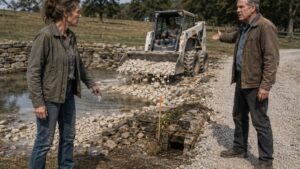
The stakes were taller than the old orange flags and set firmly enough that a tractor tire would not erase them by accident. A strip of fresh gravel marked the seasonal crossing. Beside it, the yellow irrigation hose ran along Kevin’s side of the line.
For the first time, the ground itself seemed to know what belonged where.
Michael held a folded document.
“Sandra said you’d be here.”
“She said you signed.”
“I signed.”
Kevin stopped several feet away.
Michael offered the papers.
Kevin did not take them.
“I have my copy.”
Michael lowered his hand.
For a moment, neither man spoke.
The agreement was not complicated.
Michael could cross the strip during specified planting and harvest windows. Equipment width was limited. He would pay an annual access fee and share maintenance costs for the gravel surface. He could not widen the route, relocate markers, or use the strip for storage. Damage had to be repaired within a fixed period. Emergency exceptions had to be documented afterward.
Most important, permission no longer lived inside anyone’s memory.
It lived on paper.
Michael looked toward the new stakes.
“My father would’ve laughed at this.”
Kevin almost smiled.
“Mine too.”
“They’d say we made a simple thing complicated.”
“They left us a simple thing and we complicated it ourselves.”
Michael rubbed one thumb along the folded edge of the document.
Kevin watched him.
There had been a time when seeing Michael uncertain would have satisfied him.
It did not now.
Michael said, “Emma says the bank will accept the revised harvest plan.”
“Good.”
“We had to move two loads around the east side.”
Kevin nodded.
“Cost more.”
“I figured.”
Michael looked at him.
“You could’ve shut the lane completely.”
“Yes.”
“Why didn’t you?”
Kevin glanced at the hose.
Weeks earlier, he had imagined the answer would be generosity.
It was not.
“I didn’t want to spend the next ten years proving I could make your life harder.”
Michael looked down.
Kevin continued.
“But don’t mistake that for going back to how it was.”
“I’m not.”
“No more assumptions.”
“I know.”
“No more moving markers.”
“I know.”
“And if you need something outside the agreement, you ask.”
Michael’s jaw shifted.
The old version of him might have argued that he should not need permission for a road his family had used longer than Emma had been alive.
Instead he said, “I’ll ask.”
Kevin studied him.
“That hard?”
Michael gave a short laugh.
“Apparently.”
They stood with the marked boundary between them.
The irrigation hose curved toward the ditch. On Michael’s side, tire tracks from the final harvest runs ended neatly before the posts.
Kevin pointed at one section of gravel.
“You’ll need another load there before spring.”
“I saw it.”
“Water’s going to collect.”
“I’ll grade it.”
“Within the agreement.”
Michael looked at him.
“Within the agreement.”
It was almost ridiculous how much weight four words could carry.
Kevin had spent years thinking contracts were what people used when trust failed.
Now he understood them differently.
Sometimes a written line was not an accusation.
Sometimes it prevented ordinary disagreement from becoming a test of memory, pride, and power.
Michael unfolded the document again.
“There’s one thing I wanted to say.”
Kevin waited.
Michael stared at the page instead of at him.
“I was afraid we’d lose the crop.”
Kevin said nothing.
“I thought if you blocked the crossing then, we were done. Maybe not forever. But enough that the bank would pull back.”
“That explains the lane.”
Michael nodded.
“Not the rest.”
“No.”
The word came quietly.
Kevin looked at him.
Michael finally raised his eyes.
“I knew the wand was connected to the hose.”
There it was.
Not a courtroom finding.
Not a timeline.
Not an attorney’s argument.
Just the sentence Kevin had waited weeks to hear.
Michael continued before Kevin could answer.
“You were angry. You’d made that comment about regretting the crossing. When you lifted the wand, I thought about the shotgun in your barn.”
“You knew the thing in my hands wasn’t it.”
“Yes.”
“And you called anyway.”
Michael swallowed.
“Yes.”
Kevin felt the old heat rise in him, quick and familiar.
He saw the mud again.
The deputy’s hand between his shoulders.
The cuffs.
The jail door.
His dog alone.
Michael said, “I told myself you could have gone for the gun. I told myself I was preventing something before it happened.”
“You told the sheriff it already happened.”
Michael’s face tightened.
“I know.”
“You didn’t make a mistake identifying an object.”
“No.”
“You used the fear to get me out of the way.”
Michael looked across the lane toward his fields.
“Yes.”
Kevin let the silence stay.
This was the apology he might once have demanded.
Now that it had arrived, it did not repair anything by itself.
Michael said, “I’m sorry.”
Kevin looked at the survey stakes.
“I believe you.”
Michael seemed surprised.
Kevin added, “That doesn’t mean I trust you.”
Michael nodded slowly.
“I understand.”
“That’s the part you live with.”
“I know.”
A pickup appeared on the distant Clark lane, then stopped well short of the crossing. Emma was behind the wheel.
She did not get out.
Michael glanced back at her.
“We’re supposed to move one empty wagon through.”
Kevin looked at his watch.
The agreement allowed it.
“Go ahead.”
Michael walked toward the pickup, then stopped.
“Kevin.”
Kevin turned.
“My father really did think that crossing was permanent.”
“I know.”
“And I did too.”
“I know that too.”
Michael looked at the marked ground.
“Should’ve asked.”
Kevin nodded once.
“Yes.”
After Michael joined Emma, Kevin returned to the pump.
The empty wagon rolled slowly toward the crossing. When it reached the new boundary markers, Emma reduced speed.
Michael climbed down and walked beside the wheel.
He checked the clearance himself.
The wagon stayed on the gravel.
No post bent.
No tire crossed the hose.
Kevin put his hand on the valve wheel.
For years he had turned it without thinking. Water came because the system worked, because the pipe held, because people upstream and downstream followed rules most of them rarely bothered to name.
He turned the valve.
The pump caught.
Pressure moved through the yellow hose until it stiffened along the ground.
Water began flowing toward the lower field.
Across the marked line, Michael waited until the wagon had cleared before signaling Emma forward.
He did not wave at Kevin.
Kevin did not wave at him.
That was all right.
The lane did not belong to friendship anymore.
It belonged to an agreement both men could read.
Kevin watched water darken the first stretch of soil.
Then he looked at the survey stakes standing straight beside it.
For most of his life, he had believed trust meant not needing a line.
At sixty-nine, after handcuffs, hearings, cameras, pump records, and a lie built from something as ordinary as an irrigation wand, he had learned the harder version.
A clear line did not always keep people apart.
Sometimes it was the only reason they could stand on opposite sides of one and keep working.
The story has ended.