When the New Farm Gate Trapped an Ambulance, the Quiet Neighbor Finally Marked the Old Right-of-Way
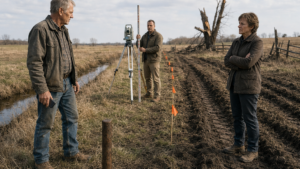
Chapter 1: The Morning Nobody Could Leave the Farm Lane
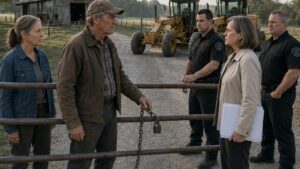
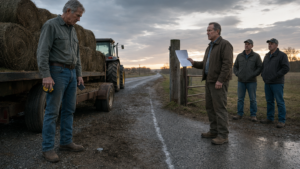
By six forty-five Monday morning, the school bus was backed halfway into Dennis Clark’s gravel turnout, a feed truck was idling behind it, and seven pickups were lined nose-to-tail along the shared farm lane.
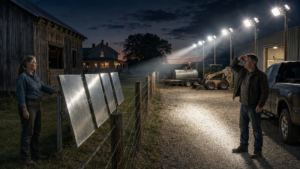
At the front of them all stood a new galvanized cattle gate wrapped in a heavy chain.
Dennis eased his old work truck onto the shoulder and shut off the engine.
The gate had been there for months. The keypad had not.
Someone had bolted the black box to the left post over the weekend, just above the level of a driver’s window. A fresh cable ran down the post toward a steel housing. The chain was new too—bright zinc against the older gray metal.
Karen Wilson stood on the road side of the gate with a clipboard tucked under one arm.
She wore jeans, work shoes, and a canvas jacket that looked too clean for the ditch she was standing beside. Her pickup was parked beyond the gate, facing the county road.
Heather Torres had already gotten out of her car.
She was still wearing teal scrubs under an open sweatshirt.
“This code doesn’t work.”
Karen did not look at the keypad.
“It works for active accounts.”
Heather stared at her.
“My account is active.”
Karen glanced down at her clipboard. “You have an outstanding road assessment.”
“I paid the spring assessment.”
“The culvert surcharge was separate.”
Behind Heather, a pickup horn sounded once.
The school-bus driver leaned out the window. “I’ve got two stops past this lane.”
Karen raised one hand without turning around.
“The gate will be opened when the access issue is settled.”
Dennis stayed beside his truck.
That was his habit when people began talking louder than the problem required. He had spent enough years hauling gravel, patching washouts, and grading private drives to know that most arguments lost useful information once everybody wanted witnesses.
He looked instead at the gate.
The association had installed the first version after somebody dumped two mattresses and a washing machine near his south pasture. Later, someone stole fuel from a tractor belonging to one of the neighbors. Then came a string of late-night vehicles using the lane as a shortcut between two county roads even though the far end had never been a public road.
Dennis had not complained when Karen suggested a gate.
He had even said it might save everybody trouble.
But the first gate had used a simple latch. People who lived along the lane knew how to open it.
This was different.
A feed-delivery driver climbed down from his cab and walked forward.
“I’ve got twelve tons that need to be unloaded before eight.”
Karen answered without looking at him. “You’ll have to contact your customer.”
“My customer is standing right there.”
One of the neighboring farmers lifted both hands.
Karen turned toward him.
“This isn’t about one delivery. We’ve been covering repairs for people who refuse to pay. The board voted. Access codes are tied to accounts now.”
“There are six houses back there,” Heather said.
“Eight properties.”
“And you can’t lock people on their own land.”
Karen’s mouth tightened.
“No one is locked on their land. The association controls this entrance.”
Dennis looked down.
The gravel around the new gatepost had been freshly worked. The contractor had widened the pad and packed pale limestone around the base.
Something dark showed through the gravel near Dennis’s boot.
A crescent no bigger than his thumbnail.
He shifted his foot and looked closer.
Iron.
Old iron, almost black with rust.
He knew what it might be before he bent down.
He did not touch it.
“Dennis.”
Heather had turned toward him.
“You’re on the board’s maintenance list. Tell her this is ridiculous.”
Karen looked at him too.
For several seconds Dennis regretted parking where anybody could see him.
“I’m not on the board.”
“You do half their road work,” Heather said.
“Used to do more than half,” Karen added.
The line was quiet now.
Dennis looked toward the ditch instead of either woman.
The gatepost sat several feet west of where he remembered the old fence corner.
Maybe he remembered wrong.
His father had moved fences more than once. So had everybody else along that lane.
Property on paper and property under boots did not always look identical after forty years of machinery, erosion, and neighborly agreements.
Dennis lifted his gaze toward the line of vehicles.
“How long are you planning to keep it closed?”
Karen’s answer came immediately.
“Until the delinquent accounts are addressed.”
“Today?”
“If necessary.”
The school-bus driver opened the folding door and stepped down.
“I can’t hold the route here.”
A parent near the second pickup took a child by the hand and started walking toward the gate.
Karen unlocked the pedestrian latch beside the main gate.
“People can walk out.”
Heather laughed once, without humor.
“I’m supposed to walk six miles to my patient?”
Karen’s face showed strain then, not triumph.
“You think I wanted this? We spent eleven thousand dollars last year repairing that lane. People want gravel, drainage, snow clearing, and culvert work, but somehow nobody wants the bill.”
“That doesn’t make this legal.”
“It makes it necessary.”
Dennis looked again at the dark edge in the gravel.
He remembered his father kneeling beside that same ditch years before, when the lane was narrower and the mailboxes stood on wooden posts.
Never lose the pin just because everybody knows where the line is.
At the time, Dennis had been twenty-eight and more interested in getting a baler back together before dark.
He could still hear the sentence.
He had not thought about it in years.
A low mechanical sound drifted from behind the line of pickups.
At first Dennis assumed another diesel truck had started.
Then the vehicles began pulling toward the ditch.
One by one, mirrors folded in.
People turned around.
Red light flashed against the side of the school bus.
Heather stepped into the lane.
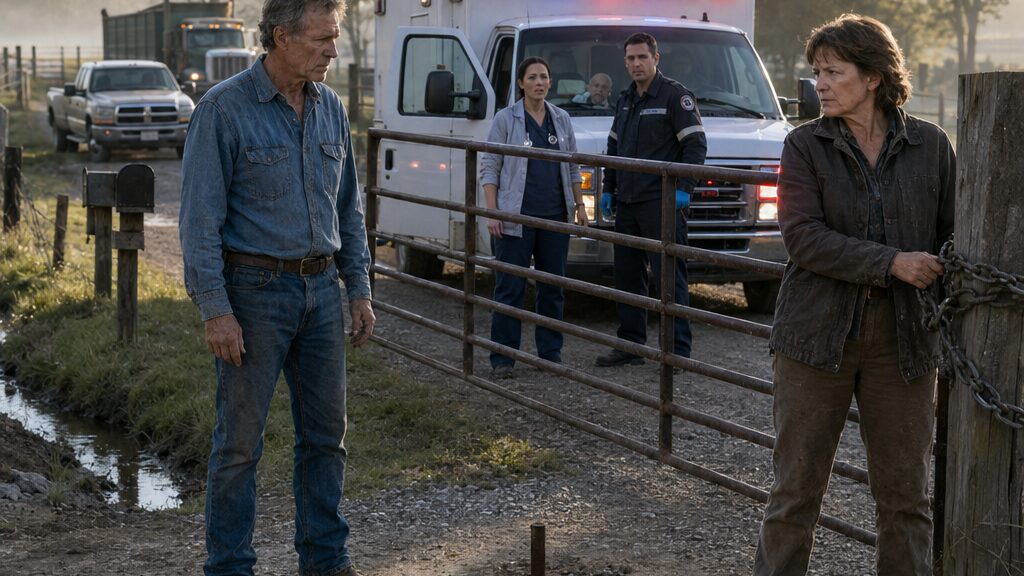
An ambulance was moving slowly toward them from the direction of Thomas Hill’s place.
Dennis felt the argument change before anyone spoke.
The ambulance came as far as the backed-up vehicles allowed, then stopped.
A paramedic climbed out, looked toward the chained gate, and started walking fast.
Karen lowered her clipboard.
Dennis looked down at the sliver of rusted iron beside his boot.
For the first time that morning, he wished he had dug it out years ago.
Chapter 2: The Ambulance Waiting Behind a Cattle Gate
“Open the gate.”
The paramedic did not raise his voice.
He did not have to.
The line of people parted for him as he came forward carrying a portable radio. Behind him, the ambulance lights continued pulsing against fence wire, windshields, and the pale gravel lane.
Karen reached toward the keypad.
“What code did dispatch give you?”
The paramedic stopped.
“We weren’t given a code.”
“They were supposed to have the emergency code.”
“I’m telling you we don’t.”
Heather moved closer. “Then open it manually.”
Karen hesitated.
Dennis watched her hand settle over the clipboard instead.
“There’s a procedure.”
The paramedic stared at the chain.
“What procedure is faster than unlocking it?”
Karen’s jaw tightened.
“The association notified emergency services last week.”
“Then somebody missed the notification. Open the gate.”
One of the neighbors swore under his breath.
Karen looked toward the vehicles, then back to the paramedic.
“Who is the patient?”
“Thomas Hill.”
That landed harder on Dennis than the ambulance itself.
Thomas was seventy-eight and had spent most of his life running cattle on the rough ground beyond the creek. He had sold the herd two years earlier but kept enough acreage to complain when anybody called him retired.
“What happened?” Dennis asked.
The paramedic glanced at him.
“Breathing trouble. He’s on oxygen. We need to move.”
Heather stepped closer to Karen.
“You heard him.”
Karen’s face had gone pale, but she did not move toward the chain.
“The lock has an emergency bypass.”
“Use it,” Heather said.
“I don’t have the override key with me.”
The feed driver turned away and said something sharp under his breath.
Karen snapped toward him.
“The system was installed because people ignored every other rule we tried.”
Dennis felt the old familiar instinct rise in him: stay out of the middle.
He had used it with neighbors fighting over gravel bills. With customers arguing over driveway widths. With his own father when the older man had insisted on correcting property records nobody else seemed worried about.
Most disputes became smaller if you did not feed them.
That belief had served Dennis well.
Until now.
The paramedic lifted his radio and stepped aside.
Dennis heard fragments.
Additional oxygen.
Gate obstruction.
Alternate access not suitable.
The far end of the lane technically connected to another farm track, but it crossed a creek on an old timber bridge that had not carried anything heavier than a pickup in years.
The ambulance could not use it.
Karen knew that.
Dennis knew she knew.
Heather pointed toward the ambulance.
“You’re going to make them sit here over dues?”
“That is not what I’m doing.”
“It is exactly what you’re doing.”
“I’m trying to follow the system we put in place.”
Dennis looked down.
The iron crescent was still there beneath his boot.
He crouched.
Gravel pressed against his knee as he brushed loose stone aside with one hand.
Karen noticed.
“What are you doing?”
Dennis ignored her.
He scraped another handful of gravel away.
A rust-darkened iron rod appeared, its flattened top no wider than a quarter. It had been driven nearly flush with the ground decades earlier.
He sat back on his heel.
For a second, the noise around him seemed to pull away.
He remembered a fence stretched from this point toward an old sycamore that no longer stood.
He remembered his father checking a paper survey while Dennis held a tape.
And he remembered the number.
Not perfectly.
Enough.
Heather crouched beside him.
“What is that?”
“Property pin.”
Karen looked over.
“That has nothing to do with the gate.”
Dennis stood.
“Maybe.”
“Dennis, don’t start.”
He brushed gravel dust from his palms.
The words bothered him more than they should have.
Don’t start.
As if he had spent the morning looking for a fight instead of avoiding one.
He walked several paces toward the ditch and looked back along the lane.
The newer gatepost stood west of the iron pin.
Not a few inches.
Several feet.
“How wide was the old right-of-way?” he asked.
Karen folded her arms.
“This is association property.”
“That wasn’t my question.”
“Twenty feet, thirty feet, I don’t know. The road has moved over the years.”
Dennis nodded.
“That part’s true.”
Heather looked between them.
“What are you saying?”
Dennis pointed to the pin.
“My father showed me this one when I was young. There used to be another marker across the lane.”
Karen laughed once, but there was nervousness in it.
“That does not make you a surveyor.”
“No.”
“Then stop acting like one.”
Dennis looked at the gatepost.
“I’m not surveying anything.”
The paramedic returned.
“We have a second oxygen bottle coming from the volunteer unit, but I still need this gate opened.”
Karen’s shoulders stiffened.
“I’m contacting the installer.”
“You can contact whoever you want after you open it.”
She pulled out her phone.
Dennis watched her search through the screen.
Heather looked at him.
“What does the pin mean?”
“It means this gate may not be standing where Karen thinks it is.”
Karen looked up sharply.
“You supported this gate.”
The sentence cut through every other voice.
Dennis said nothing.
She stepped toward him.
“You told us the old setup wasn’t controlling traffic. You delivered the base gravel. Your truck spread it.”
Several faces turned toward Dennis.
Heather slowly stood.
“You helped build this?”
“I hauled gravel.”
“For the gate.”
“For the pad.”
Karen gave a short, disbelieving shake of her head.
“You were perfectly happy when it kept dumpers out of your pasture. Now you want to act like this is some surprise?”
Dennis felt heat move up the back of his neck.
That was the part he had hoped not to discuss while ambulance lights flashed behind them.
Not because it was false.
Because it was true.
He had liked the gate when it solved his problem.
He had not asked enough questions about what else it could become.
The paramedic stepped between them.
“I don’t care who built it. I need it opened.”
Dennis looked once more at the pin.
Then at the post.
“I think there’s an easement.”
Karen gave him a flat stare.
“You think.”
“I know there was one.”
“Was.”
Dennis let that word sit.
The distinction mattered.
So did proof.
He did not have proof in his hand.
Not yet.
Heather said, “Can you prove it?”
Dennis looked toward his truck.
In the metal toolbox behind the cab, under invoices, equipment manuals, and a plastic folder of old farm papers, was a copy of a plat his father had insisted he keep.
Dennis had carried it from truck to truck for years without opening it.
“I might.”
Karen folded her arms tighter.
“Might isn’t enough to override an association vote.”
Dennis walked past her.
He did not reach for the chain.
He did not touch the keypad.
He headed toward his truck.
Behind him, the ambulance continued flashing against the locked cattle gate.
Chapter 3: The Map Dennis Should Have Shown Months Ago
Dennis spread the old plat across the hood of his truck and held one corner down with his thermos.
The paper had yellowed along the folds.
Oil from some long-forgotten repair had stained the lower margin, and one corner had been reinforced with clear tape his father must have added before Dennis inherited the folder.
Karen stood opposite him.
Heather came to his left.
The paramedic remained near enough to hear while speaking into his radio.
Dennis traced the western edge of his property with a finger.
“Here.”
Karen leaned forward.
“That map is ancient.”
“Nineteen eighty-three.”
“Exactly.”
Dennis ignored the tone.
A dashed strip ran across the lower portion of the plat. Beside it were words in small survey lettering.
PRIVATE ACCESS EASEMENT.
Thirty feet.
He followed the dashed boundaries toward the lane entrance.
The line crossed the place where the current gate stood.
Heather bent closer.
“So the road belongs to Dennis?”
“No,” Dennis said.
Karen answered at the same time.
“No.”
Dennis looked up.
“It means ownership and access aren’t the same thing.”
Karen tapped the paper.
“It also means you’re trying to use a forty-year-old survey against a road association formed long after this.”
“That doesn’t erase an easement.”
“You don’t know that.”
“No. I don’t.”
The answer seemed to surprise her.
Dennis had no interest in pretending to be a lawyer.
His father had taught him property lines, drainage, and enough survey language to understand when he needed somebody better qualified.
What Dennis did know was more limited.
And more uncomfortable.
“This marker here,” he said, pointing to a small notation, “matches the pin by the gate.”
Heather looked back toward the ditch.
“You remembered that?”
“My father made me hold the tape.”
Karen straightened.
“That still doesn’t prove the current entrance violates anything.”
“No.”
“Then stop presenting it like it does.”
Dennis folded his arms over the hood.
“I’m presenting it like something we should’ve checked before anybody put a lock on the lane.”
Karen’s eyes narrowed.
“We did check.”
“With who?”
“The association.”
“That’s not what I asked.”
The feed driver had joined the edge of the group. So had two neighbors.
Karen looked around and lowered her voice.
“Dennis, you know why this was done.”
“I know why the first gate was done.”
“Same reason.”
“No. The first gate kept strangers from driving through at night. This one keeps residents from leaving if you shut their code off.”
“They had months of notices.”
Heather said, “A notice doesn’t make this road yours.”
Karen turned toward her.
“Neither does wearing scrubs make you an expert on property law.”
Heather’s expression changed, but Dennis spoke before she could answer.
“This isn’t helping.”
Karen looked back at him.
“You want to help? Tell them how many times you found trash in your ditch. Tell them about the diesel siphoned out of equipment. Tell them how much washed stone you spread last year because nobody else could get here after that storm.”
Dennis knew exactly what she was doing.
It was also exactly what he would have said six months earlier.
The paramedic crossed the few steps between them.
“I need a decision on this gate now.”
Karen looked toward the ambulance.
The confidence in her face had thinned.
“My installer is not answering.”
“Then unlock the chain.”
“The manual key is at my house.”
Dennis stared at her.
Her house was less than four miles away, but it was outside the gate.
“You don’t have a key here?”
“The keypad was supposed to make keys unnecessary.”
The paramedic closed his eyes for one second.
Heather said, “Cut it.”
Karen spun toward her.
“No.”
Dennis looked at the chain, then at the plat.
“This paper doesn’t give me authority to cut your lock.”
Heather turned on him.
“So what good is it?”
He felt the accusation more sharply because he had asked himself the same question.
The map proved enough to raise doubt.
Not enough to settle anything while Thomas waited inside an ambulance.
Dennis looked toward Karen.
“Open it under protest.”
“What?”
“Call it temporary emergency access. Say you’re not giving up your position.”
Karen stared at him.
“That sounds like something a lawyer would say.”
“It sounds like a way to get Thomas through without you pretending the whole question is settled.”
For the first time that morning, Karen’s anger loosened.
She looked toward the ambulance.
Then toward the line of vehicles.
The people watching her were no longer arguing.
That silence seemed to weigh more.
Karen took out her phone again.
“I can have the chain removed and replaced.”
“Do it,” the paramedic said.
She called the road-association maintenance contractor.
He was already working several miles away.
Ten minutes later, his truck arrived with bolt cutters and replacement hardware.
Karen stood beside him while he cut one link.
No one cheered.
The chain dropped against the gravel with a heavy metallic slap.
The paramedic waved the ambulance forward.
Vehicles pulled tight into the ditch.
The ambulance squeezed through first, red lights washing over Dennis’s old plat.
Dennis expected relief.
Instead he felt the shape of a larger problem.
Karen did not look at him as the ambulance turned onto the county road.
“This doesn’t mean you were right.”
“I know.”
Heather studied him.
“You really don’t care about winning this argument, do you?”
Dennis folded the plat.
“I care whether that gate can be locked again tomorrow.”
A new voice came from behind them.
“Then you’d better look at this.”
Susan Moore, the road-association treasurer, had arrived carrying a thick folder.
Dennis knew Susan mostly through checks.
For years she had approved invoices when he supplied gravel, graded washboards, or cleaned culverts for the association.
She placed the folder on his truck hood.
“I didn’t know Karen was going to deactivate codes this morning,” she said. “But the board does have a road agreement.”
Karen’s posture changed immediately.
“Show him.”
Susan pulled out a document dated eleven years earlier.
Dennis read slowly.
The agreement authorized the association to maintain the lane, assess shared costs, install traffic-control devices, and regulate certain nonresident vehicle use.
Karen tapped that paragraph.
“There.”
Heather frowned.
“Does that cancel the old easement?”
Susan shook her head.
“I don’t know.”
Dennis read the section again.
The words were broader than he liked.
Not broad enough to answer the whole question.
Then he reached the signature page.
His own name was not there.
But Susan was watching him oddly.
“There’s something else,” she said.
She opened another sleeve.
Inside was an invoice on Dennis’s old company letterhead.
Delivered and spread: crushed limestone at entrance gate pad.
At the bottom was his signature.
Susan placed it beside the plat.
“You didn’t just know there was going to be a gate,” she said. “You helped build the entrance for it.”
Heather looked at Dennis.
Karen said nothing.
She did not need to.
Dennis stared at his signature and understood that the next argument would not be about what Karen had done.
It would be about why he had waited until an ambulance was trapped before objecting.
Chapter 4: The Part Dennis Had Never Told the Neighbors
Heather found Dennis in his hay barn just after one that afternoon, standing beside a workbench with the old plat folded into a square beside his thermos.
She did not say hello.
“Why didn’t you tell anybody?”
Dennis kept tightening the cap on a hydraulic fitting that did not need tightening.
“About what?”
“You know exactly what.”
Outside, his loader ticked as its engine cooled. Dust floated through a blade of light from the open barn door.
Heather stepped closer.
“That gate. The easement. The pin. Any of it.”
Dennis put the wrench down.
“I wasn’t sure what still applied.”
“That isn’t what you said this morning.”
“This morning I said there was an easement.”
“And you remembered where the marker was.”
“I remembered where I thought it was.”
Heather crossed her arms.
“You also remembered enough to dig it out in front of everyone.”
Dennis looked past her toward the lane.
From the barn, he could not see the entrance gate, but he could hear trucks on the county road beyond the fields. The association had replaced the cut chain before noon. Karen had sent a temporary code to residents whose accounts were current.
Others had been told to contact Susan.
The emergency had passed.
The problem had not.
Heather placed a folded copy of Dennis’s invoice on the bench.
Susan must have given it to her.
“You hauled the gravel.”
“Yes.”
“You spread it.”
“Yes.”
“And then today you stood there acting surprised that a gate was sitting on top of an old easement.”
“I wasn’t surprised there was a gate.”
“That’s not better.”
Dennis felt irritation rise, mostly because she was right.
He turned the invoice around with one finger.
“When they put in the first gate, there wasn’t a keypad. No account shutoffs. Nobody was trapped.”
“You still knew the easement existed.”
“I knew there had been one.”
Heather stared at him.
He could hear the distinction failing between them.
Dennis leaned against the bench.
“Three summers ago, somebody dumped roofing shingles in my ditch. The year after that, somebody siphoned diesel from equipment. Last fall, trucks started cutting through after dark.”
“So?”
“So when Karen said a gate would stop it, I didn’t object.”
“You liked it.”
“Yes.”
The answer quieted her.
Dennis continued before he could soften it.
“I liked not finding beer cans in the pasture. I liked not waking up when headlights came through at two in the morning. I liked not replacing fence wire because somebody decided this lane was a shortcut.”
Heather looked down at the invoice.
“And when the keypad went in?”
Dennis did not answer immediately.
That silence gave her the answer.
“You still didn’t object.”
“No.”
“Why?”
He rubbed a thumb across the edge of the old plat.
“Because it wasn’t my code they were shutting off.”
Heather looked at him then, and the anger in her face changed shape.
Not gone.
Sharper.
“That’s what this was.”
Dennis nodded once.
He could have told her he had been busy with first cutting.
He could have mentioned equipment repairs, fuel prices, rain, invoices, all the practical things men like him used when they wanted to make avoidance sound responsible.
Instead he said, “I figured if people paid what they owed, it would settle down.”
Heather looked toward the barn door.
“And this morning?”
“This morning proved I was wrong.”
She let out a slow breath.
“You know, I thought you were on Karen’s side because you never said anything.”
“I was on the quiet side.”
“There isn’t always a quiet side.”
Dennis met her eyes.
“No.”
By three o’clock, that private admission had become public pressure.
The road association met in a small room attached to the volunteer fire hall whenever something could not wait for the regular quarterly meeting. Folding tables had been pushed into a rectangle. Susan sat at one end with the ledger and road agreement.
Karen stood rather than sat.
Eight property owners were present.
Dennis took a chair near the wall.
He had hoped Karen might start with the ambulance.
She started with accounts.
“The emergency passage this morning does not change the assessment policy,” she said. “Effective immediately, codes connected to unpaid road balances will be deactivated until arrangements are made.”
Heather leaned forward.
“You learned nothing.”
Karen’s mouth tightened.
“I learned that emergency services need a physical override key. That will be corrected.”
“That’s not the problem.”
“It is one problem.”
Susan looked down at the ledger.
“Karen, we should probably suspend any deactivations until we confirm the easement issue.”
Karen turned.
“The maintenance agreement gives us authority to regulate access.”
“Nonresident traffic,” Dennis said.
Everyone looked at him.
Karen’s expression hardened.
“There he is.”
Dennis stayed seated.
“I’m not arguing the whole agreement. I’m saying the section you showed this morning was written around traffic control and maintenance.”
“And you’re an attorney now?”
“No.”
“Then maybe we should stop making legal conclusions in a room full of farmers.”
Dennis almost smiled.
On that point, they agreed.
Susan opened another folder.
“The county office can pull the original instrument tomorrow.”
Karen shook her head.
“In the meantime, we still have bills.”
One of the neighboring farmers spoke from across the table.
“I’m behind because I disputed the culvert charge.”
Karen pointed toward him.
“And the culvert still had to be replaced.”
“On the north fork. I don’t use the north fork.”
“Everyone benefits from a functioning road system.”
The argument shifted.
Dennis listened.
For the first time, he heard how the dispute had grown.
Some owners believed charges were uneven.
Some had stopped paying after Karen began requiring permission for heavy deliveries.
Karen believed unpaid dues proved voluntary cooperation had failed.
Susan had kept sending invoices because the gravel company still expected payment.
Everyone had a piece of the problem.
Karen had simply taken the piece she controlled and tightened it until it became a lock.
Then she said, “Anyone with an unresolved balance will lose gate access Friday.”
Heather pushed back from the table.
“That includes families.”
“It includes accounts.”
Dennis looked at Karen.
“You’re doing it again.”
“No. I’m making the rule clear.”
“Clear doesn’t mean lawful.”
“You don’t know whether it’s unlawful.”
Dennis looked at Susan.
“Can we verify the original easement tomorrow?”
“Yes.”
Karen gave a small, tired laugh.
“You all want to act like some forty-year-old paper solves everything. It won’t pay for grading. It won’t replace stolen fuel. It won’t stop people using the lane who don’t belong here.”
“No,” Dennis said. “But it might tell us what you’re allowed to lock.”
Karen gathered her papers.
The meeting ended without a vote.
Dennis returned to the farm before dark.
He went to the small office built into the corner of the barn and pulled open the bottom drawer of an old steel file cabinet.
His father’s notebooks filled most of it.
They were not diaries. They contained field measurements, seed calculations, repair dates, cattle weights, and notes about fences.
Dennis flipped through three before finding one from the early eighties.
A page near the middle carried a rough sketch of the shared lane.
Two marks represented survey pins.
Beside the entrance his father had written a short line in block letters:
EMERGENCY PASSAGE NEVER OBSTRUCTED — SEE DEED BOOK.
Dennis read it twice.
The words were not proof.
They could have been nothing more than his father’s interpretation.
But beneath them was a deed-book number.
Dennis copied it onto the back of Susan’s meeting notice.
Tomorrow morning, he would find out whether his father had been remembering a rule—or quoting one.
Chapter 5: The Clause Karen Thought She Could Ignore
The county recorder clerk set the enormous deed book on the counter and said, “Don’t pull on the binding.”
Dennis had arrived ten minutes after the office opened Tuesday morning.
The book looked older than half the barns along his lane.
Its pages were thick, the typed entries broken by handwritten corrections and stamped recording marks. Dennis unfolded his father’s note beside it.
Deed book number.
Page number.
Both matched.
The clerk turned the book carefully.
“There.”
Dennis leaned over the counter.
The easement description began with bearings and distances he could barely follow without the plat beside him.
Then came the language that mattered.
A thirty-foot shared right-of-way serving the listed tracts.
Ingress and egress.
Successors and assigns.
Maintenance apportioned among users.
Dennis read further.
Near the bottom of the page was the sentence his father had reduced to five words in a notebook:
Passage shall remain reasonably continuous and shall not be obstructed in a manner preventing emergency access.
Dennis straightened.
“So that survived when the road association was formed?”
The clerk shook her head.
“I can show you what’s recorded. I can’t interpret it for you.”
“Fair enough.”
She looked at the newer agreement Dennis had brought.
“This document references maintenance of the existing easement.”
Dennis pointed to a paragraph.
“It says traffic controls.”
“It says the association may install reasonable controls consistent with recorded property rights.”
That phrase had been buried in the middle of a longer section neither Karen nor Dennis had read aloud the day before.
Dennis felt no triumph.
Only embarrassment.
The answer had not been hidden.
They had simply been arguing around it.
The clerk returned to her computer.
“You’re not the first person from that road to ask for these.”
Dennis looked up.
“Who else?”
She hesitated.
“Public records requests are logged.”
She clicked twice.
“Karen Wilson requested copies in February.”
Dennis said nothing.
“Original easement, amendments, and the road agreement.”
“Six months ago?”
“February seventeenth.”
Dennis folded his father’s note.
Until that moment, he had been willing to believe Karen had overreached because she misunderstood the documents.
Now he knew she had seen them.
He drove back to the farm lane with certified copies lying on the passenger seat.
The gate was open when he arrived, but the replacement chain hung looped around the post.
Karen’s pickup was parked near the mailboxes.
She stood in the ditch examining a broken reflector.
Dennis stopped beside her.
“You went to the recorder’s office in February.”
Karen did not look surprised.
“So did you.”
“Today.”
She straightened.
“You want to accuse me of something, Dennis, do it.”
He held up the certified copy.
“You read the emergency-access clause.”
Karen looked at the paper.
“I read all of it.”
“And still locked the gate.”
“I installed a controlled gate.”
“You disabled resident codes.”
“For delinquent accounts.”
“And the ambulance?”
Her face tightened.
“The ambulance was supposed to have the emergency code.”
“It didn’t.”
“That was a failure in implementation.”
Dennis stared at her.
“You sound like an insurance letter.”
Karen turned away.
For several seconds, neither spoke.
Then she pointed toward the ditch.
“You see that?”
Dennis looked.
A section of woven-wire fence had been patched with newer wire.
“Cut last winter,” she said. “Somebody came through looking for equipment. The association paid for that.”
She pointed farther down the lane.
“You remember the culvert that washed out?”
“Yes.”
“Eight thousand dollars.”
“Closer to seven.”
“After your discount.”
Dennis waited.
Karen looked tired now in a way she had not allowed anyone to see Monday morning.
“We had owners three years behind on assessments. We had delivery trucks tearing up soft shoulders. We had one insurance company asking what we were doing about uncontrolled access. We had people calling me every time a strange vehicle showed up.”
“So you decided control mattered more than the easement.”
“I decided an easement doesn’t mean everyone gets to use the road however they want.”
“I agree.”
That stopped her.
Dennis continued.
“But that isn’t the same as deciding who gets to leave.”
Karen looked toward the open gate.
“You know what happens when nobody enforces anything. You were one of the people complaining.”
“I know.”
“You wanted the dumping stopped.”
“I did.”
“You wanted the night traffic stopped.”
“Yes.”
“You took money from this association to build the gate pad.”
“Yes.”
Her voice sharpened.
“Then don’t stand there pretending you arrived yesterday with clean hands.”
Dennis felt the old defensive answer rise.
He let it pass.
“I’m not.”
Karen studied him.
That seemed to unsettle her more than denial would have.
Dennis handed her the copy.
“Read the line.”
“I’ve read it.”
“Then tell me what you thought it meant.”
She did not take the page.
“That emergency access had to be available.”
“It wasn’t.”
“It was supposed to be.”
“Through a code.”
“Yes.”
“A code the ambulance didn’t have.”
“That doesn’t mean the system itself was unlawful.”
“No. But when the system failed, you still wouldn’t open the gate.”
Karen looked down.
There it was.
Not the documents.
Not the assessments.
The choice.
Dennis waited.
She spoke quietly.
“I thought if I opened it the second people pushed hard enough, that would be the end of enforcement.”
“Thomas was in an ambulance.”
“I know that.”
“Did you know it then?”
“Yes.”
Dennis looked toward the fields.
His anger had been simpler before she answered honestly.
Karen rubbed a hand across her forehead.
“My husband handled most of the road bills before he died. After that, everybody started calling me because I had the records. Then I became chair because nobody else wanted it. Every month there was another repair, another argument, another person saying their part shouldn’t count.”
Dennis had known her husband handled road matters.
He had not thought much about what happened afterward.
Karen said, “February was when the insurer asked about access controls. That’s why I pulled the records.”
“And you saw the clause.”
“Yes.”
“Why didn’t you bring it to the board?”
“Because I thought the newer agreement gave us enough authority.”
“You thought.”
“Yes.”
“The same word you threw at me yesterday.”
Karen gave a humorless smile.
“Apparently neither of us likes hearing it.”
Dennis looked at the chain hanging from the post.
“You could’ve unlocked it under protest.”
“I know.”
That was the first time she had said it.
Not explained.
Not defended.
Knew.
Dennis could take the certified copy to every neighbor before dinner.
He could call a special meeting and make Karen explain herself in front of them.
She seemed to know that too.
“What are you going to do with this?” she asked.
Dennis looked at the easement in his hand.
Then at the gate.
“I haven’t decided.”
Karen nodded.
“If you want me removed, say it plainly.”
“This isn’t about what I want done to you.”
“It will be by tonight.”
Dennis folded the copy.
Karen took one step toward her truck, then stopped.
“For what it’s worth, I didn’t think anybody would challenge the interpretation.”
Dennis looked at her.
She did not soften it.
That was worse than ignorance and more believable than malice.
She had known there was a boundary.
She had simply expected everyone else to accept where she drew it.
Dennis drove away with the certified easement on the seat beside him, no longer wondering whether Karen had understood the rule.
Now he had to decide whether correcting her required exposing the choice she had knowingly made.
Chapter 6: The Meeting Where Dennis Included His Own Name
Karen was already standing at the front of the volunteer fire hall when Dennis walked in Tuesday evening.
She had arranged the road-agreement copies in a neat stack beside Susan’s ledger.
The certified easement Dennis had obtained from the county sat alone on the center table.
No one spoke to him as he entered.
Heather sat near the back.
Two neighboring farmers occupied the folding chairs beside her. Susan was checking figures with a calculator.
Karen looked at Dennis.
He could see she expected an accusation.
Dennis took the marked survey copy from his folder, laid it beside the ledger, and remained standing.
“I should’ve objected before yesterday.”
The room went quiet.
Karen’s expression changed first.
Heather leaned forward.
Dennis kept his hands on the back of an empty chair.
“I knew there was an old easement. I didn’t know every word in it, and I didn’t know exactly what the newer agreement changed. But I knew enough to ask.”
He looked toward the certified copy.
“I didn’t ask.”
One neighbor shifted in his seat.
Dennis continued.
“I hauled gravel for the entrance. I thought a gate would stop dumping and night traffic. It did. That benefited me.”
Karen watched him carefully.
Dennis looked at Heather.
“When the keypad went in, I still didn’t object.”
“Because your code worked,” Heather said.
Dennis nodded.
“Because my code worked.”
The room stayed silent.
He had spent most of the afternoon thinking about how to explain Karen’s decision.
At some point, he understood that beginning with her failure would make his own sound like strategy.
So he started where the problem had actually started for him.
“I treated quiet like it was neutral,” he said. “It wasn’t.”
Susan set the calculator down.
Karen folded her arms.
“Are we going to discuss the documents?”
“Yes.”
Dennis sat.
Susan opened the ledger.
Before she could begin, one of the farmers across the table said, “I stopped paying because Karen charged me for the north culvert.”
Karen turned.
“You use the lane.”
“I don’t use that fork.”
“You use the drainage system feeding it.”
“Not eight hundred dollars’ worth.”
Another neighbor said, “My heavy-delivery permission got denied twice last year.”
Karen looked at him.
“Because the road was soft.”
“The second time it was dry.”
“You wanted a loaded concrete truck in there after three days of rain.”
“It was six days.”
Dennis watched the discussion widen.
The unpaid dues were not one problem.
Neither was the gate.
The association had spent years replacing conversation with decisions, then decisions with rules, then rules with enforcement.
Susan raised her voice just enough to cut through.
“We are behind almost fourteen thousand dollars in assessments.”
The room quieted.
She turned the ledger around.
“Some of that is disputed. Some is simply unpaid.”
Heather looked at the figures.
“So Karen wasn’t making that part up.”
“No,” Susan said.
Karen’s face hardened.
“I have never made up the road bills.”
Susan looked at her.
“No one said you did.”
“That’s what this has turned into.”
Dennis spoke carefully.
“No. This turned into whether you could block legal access to collect them.”
Karen looked at him.
“And according to you, I can’t.”
“According to the easement, emergency passage can’t be obstructed.”
“What about regular access?”
“That’s what we need the county to interpret.”
Karen pushed a copy of the later agreement across the table.
“It gives us authority to regulate traffic and install controls.”
Susan tapped another paragraph.
“Consistent with recorded property rights.”
Karen closed her mouth.
Dennis did not enjoy the moment.
That surprised him.
A day earlier he might have.
Heather asked, “Did you know about the emergency clause before Monday?”
Karen looked at Dennis.
He could have answered for her.
He did not.
Karen faced the room.
“Yes.”
A small shift went through the chairs.
One neighbor muttered something.
Karen lifted her chin.
“I believed the emergency code satisfied it.”
Heather said, “And when the code didn’t work?”
Karen’s hands tightened against the table.
“I made the wrong decision.”
No one spoke.
The sentence took some of the room’s anger with it.
Not all.
Enough.
One farmer said, “Then resign.”
Another said, “What does that fix?”
“It fixes her deciding everything herself.”
Karen looked toward Susan.
“I’m not resigning tonight.”
Heather gave a sharp laugh.
Karen continued.
“But I will agree to an outside access review.”
Susan looked at Dennis.
He said, “That should’ve happened before the keypad.”
“Yes,” Karen said. “It should have.”
The lack of argument unsettled the room again.
Susan pulled a blank page from her folder.
“We need two separate decisions. One about the gate. One about money.”
Dennis nodded.
That distinction mattered.
“If the easement protects access,” he said, “that doesn’t erase maintenance obligations.”
One of the delinquent owners frowned.
“You’re taking her side now?”
“No.”
“Sounds like it.”
Dennis looked at the ledger.
“If we want the association to follow the easement, then we don’t get to ignore agreements we don’t like either.”
Heather glanced at him.
The farmer leaned back.
“So after all this, we still pay.”
“If the charges are valid.”
“And who decides that?”
“Not one person.”
Susan nodded.
“We can create a review process for disputed assessments.”
Karen looked at her.
“We already have one.”
Susan met her eyes.
“No. We have you.”
The statement was quiet.
It landed harder than any accusation that evening.
Karen looked down at the papers.
For the first time, Dennis saw the real weakness in the association.
It was not merely that Karen had collected too much authority.
Everybody else had handed it to her because road meetings were tedious, invoices were annoying, and someone had to answer calls when culverts failed.
Then they had resented her for using what they gave her.
That did not excuse Monday.
It explained how Monday became possible.
Susan called the county road office from the hall.
She put the phone on speaker.
The road inspector listened to the short version without reacting to the emotion around it.
“You have recorded easement documents?”
“Yes,” Susan said.
“Existing gate?”
“Yes.”
“Survey monument located?”
Dennis answered. “At least one old pin.”
“Don’t disturb it.”
“I haven’t.”
“Emergency-access dispute?”
Karen said, “Yes.”
A pause followed.
“I can be there at six thirty tomorrow morning.”
Karen looked toward the windows.
“That early?”
“I’ve got bridge inspections after eight.”
Susan wrote the time down.
The inspector continued.
“I’ll review the recorded width, physical gate location, and practical access conditions. I’m not settling private monetary disputes.”
“Understood,” Susan said.
“And nobody moves that gate or marker before I arrive.”
Dennis looked at Karen.
She nodded.
The call ended.
People began gathering papers.
No one looked satisfied.
That felt more promising than satisfaction.
Heather waited until most of the room had emptied.
She stopped beside Dennis.
“You could’ve buried her tonight.”
Dennis glanced toward Karen, who was helping Susan stack chairs.
“Wouldn’t have fixed the gate.”
Heather studied him.
“You didn’t let yourself off easy either.”
“No.”
“Why?”
Dennis folded the survey copy.
“Because I was there before the lock ever got a code.”
Outside, Karen stood beside her pickup while Susan locked the fire hall.
Dennis walked toward his truck.
Karen called after him.
“Six thirty.”
He turned.
“I’ll be there.”
She looked down the dark road.
“So will I.”
Wednesday morning, the argument would leave the folding tables and return to the ditch where it had begun.
This time, the county inspector would measure from the iron pin.
Chapter 7: The County Line Was Older Than Their Argument
The county road inspector planted one boot beside the exposed iron pin and told everyone to move back.
Dennis had reached the gate before six twenty Wednesday morning. Karen arrived five minutes later. Susan came carrying a folder thick enough to bend under its own weight.
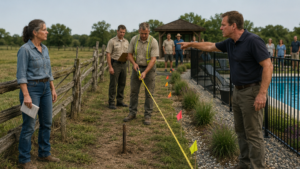
By six thirty, Heather and three other property owners were standing along the ditch while the inspector stretched a measuring tape from the rust-darkened pin toward the opposite side of the lane.
The gate remained open.
Its replacement chain hung loose from the post.
Nobody touched it.
The inspector checked Dennis’s old plat against the certified easement copy, then crouched and brushed another inch of gravel away from the iron.
“This monument is consistent with the recorded survey.”
Karen folded her arms.
“Consistent isn’t the same as confirmed.”
“No.”
The inspector stood.
“That’s why I’m measuring.”
Dennis almost smiled.
Karen heard the answer the same way he did.
Facts first.
Argument later.
The inspector walked the ditch line, took two measurements, then asked Dennis where the second historic marker had been.
“Across there. Near the old fence corner.”
“That fence still original?”
“No. Rebuilt twice.”
The inspector nodded.
He used the recorded bearings instead.
The tape crossed the gate opening.
Then it continued several feet beyond the western gatepost.
The inspector marked the spot with temporary paint.
Karen watched him.
“So the gate is inside the easement.”
“Part of it crosses the easement corridor.”
“That doesn’t mean the gate has to come out.”
“No.”
Heather looked surprised.
“You can leave a gate across a right-of-way?”
The inspector rolled up the tape.
“You can have gates across easements in plenty of rural situations. Livestock control is normal. Reasonable traffic control can be normal. The issue is whether the gate substantially interferes with the access rights that were recorded.”
Karen pointed to the keypad.
“So if everyone has a code—”
“If everyone entitled to use the easement has reliable access.”
“And emergency services?”
“Reliable access.”
Karen looked toward the chain.
The inspector continued.
“A system that depends on one person’s account status for physical passage is going to be difficult to reconcile with continuous ingress and egress.”
One of the farmers said, “So the lock comes off.”
The inspector held up a hand.
“I’m not here to design your association rules. I’m telling you what the physical condition is and what the recorded language requires you to respect.”
Dennis said, “Could the gate stay if there’s an emergency override and resident access can’t be disabled over billing?”
The inspector looked at him.
“That would be closer to the sort of arrangement I see on working agricultural access roads.”
Karen turned toward Dennis.
“You already decided the solution?”
“No.”
“Sounds like it.”
Dennis looked at the gate.
“I’m trying to keep cattle where they belong without keeping people where they don’t.”
Heather gave him a quick look.
Karen did not answer.
The inspector walked toward the keypad.
“Who installed this?”
Karen gave him the contractor information.
He opened the box housing and examined the mechanism.
“It has a keyed manual release.”
“The installer has one,” Karen said.
“Anyone local?”
Karen shook her head.
The inspector looked over his shoulder.
“That needs to change.”
Susan wrote it down.
“Two locally secured override keys,” she said.
The inspector nodded.
“Fire department access if they accept the arrangement. Sheriff access if appropriate. And you need a procedure that doesn’t strand lawful users because of a payment dispute.”
Karen exhaled.
“You understand we still have people who haven’t paid for years.”
The inspector faced her.
“That’s a collection issue.”
“It becomes an access issue when they use the road we maintain.”
“It can become an enforcement issue. That doesn’t mean every enforcement method is available to you.”
Dennis watched Karen absorb that.
Not defeat.
A boundary.
He knew something about boundaries.
The inspector returned to the pin and drove a bright survey flag beside it.
Then he added a temporary marker stake so graders and mowers would not bury it again.
Dennis stared at the flag.
His father had once guarded that point with a tape measure and stubbornness.
Dennis had spent years driving past it without looking.
The inspector handed Susan a short written field note.
“I’ll file the site observations this afternoon. If the association wants a formal legal opinion beyond the recorded language, that’s for counsel. But from an access standpoint, I would not recommend using the gate as leverage for delinquent assessments.”
Susan nodded.
Karen said, “So we leave it open indefinitely.”
“No.”
Everyone looked at the inspector.
He pointed toward the pasture.
“This is still farm country. If a gate is serving a legitimate livestock-control purpose, there’s no reason to remove useful infrastructure just because the locking policy was poorly designed.”
Karen’s shoulders dropped slightly.
It was the first relief Dennis had seen in her since Monday.
The gate did not have to disappear.
Her work had not all been foolish.
Only the part that turned control into exclusion.
Susan said, “Could we replace the current system with an opener that automatically releases for emergency transmitters and individual codes that cannot be suspended without board review?”
The inspector shrugged.
“That’s an association decision. But mechanically, yes.”
Heather said, “And unpaid dues?”
Susan looked at her ledger.
“They’re still unpaid.”
One of the neighbors muttered, “There it is.”
Dennis turned toward him.
“If the county says the gate can’t be used to collect them, that doesn’t make the bills vanish.”
The farmer frowned.
“You said that last night.”
“Still true this morning.”
Karen gave Dennis a strange look.
Maybe she had expected him to use the inspection as a weapon.
He had expected that of himself, a little.
Instead the measurements had done something cleaner.
They had separated what Karen was wrong about from what she was not.
The road still washed.
Gravel still cost money.
Culverts still failed.
A locked gate could be improper and an unpaid bill could still be owed.
Both facts could exist without cancelling each other.
Susan closed the ledger.
“Then we vote tonight.”
Karen looked at her.
“On what?”
“Unilateral control.”
The words were plain.
Karen’s jaw tightened.
Susan continued.
“No chairperson should be able to deactivate residential access alone. Not you. Not me. Not whoever comes next.”
One of the farmers nodded.
Heather did too.
Karen looked toward Dennis.
He said nothing.
This was not his decision to make for them.
The inspector packed his measuring tape.
Before leaving, he pointed toward the chain.
“You can keep the gate closed for livestock if users can open it reliably. I would not lock that chain again under the current system.”
Karen reached for it.
For one second Dennis thought she might argue.
Instead she lifted the heavy chain off the post and laid it in the bed of her pickup.
The gate remained standing.
Open.
Useful.
No longer pretending to be something more than a gate.
That evening, Susan called the road-association meeting to order with one motion already written on a sheet of paper.
Remove unilateral authority to suspend lawful access.
Dennis sat near the back.
Karen read the sentence twice.
Then she looked around the room.
“All right,” she said. “Call the vote.”
Chapter 8: The Iron Pin Left Where Everyone Could See It
Three weeks later, Dennis heard the gate motor before he saw the school bus.
He was standing beside his grader at the edge of the hayfield, checking a shallow wash where rain had pulled limestone toward the ditch.
The mechanical arm lifted the cattle gate smoothly as the yellow bus approached.
It did not stop.
It did not wait for someone to enter a code.
A sensor registered the authorized vehicle and opened the lane before the driver reached the entrance.
The bus passed through.
The gate lowered behind it.
Dennis watched until the red lights disappeared beyond the bend.
Then he went back to the wash.
The association vote had passed.
Karen had lost unilateral control of the access system, though she remained chair until the next scheduled election. Any future suspension of privileges unrelated to physical access required board review. Easement holders received permanent credentials that could not be disabled over billing disputes.
Two mechanical override keys had been placed in secured local lockboxes.
The volunteer fire department received emergency access.
Susan posted monthly road expenses with each assessment instead of sending numbers nobody could trace.
None of it made the arguments disappear.
Two owners still disputed the north culvert bill.
Karen believed the association should recover the cost of the replacement chain that had been cut for the ambulance.
Heather believed charging anybody for that chain would be insulting.
Dennis believed both of them could argue it without trapping anyone behind steel.
That counted as improvement.
He lowered the grader blade and pulled a thin layer of stone toward the road edge.
When he reached the entrance, he lifted the blade.
The old iron pin stood beside the ditch with the inspector’s temporary stake still marking it.
Dennis had replaced the fading flag with a plain wooden marker.
Nothing fancy.
Just enough that nobody running a mower or grader could claim they had not seen it.
A pickup slowed behind him.
Dennis recognized Thomas Hill before the truck stopped.
Thomas climbed down carefully.
He looked thinner than he had before the ambulance ride, but he was standing on his own.
“That machine of yours getting any quieter?”
Dennis shut off the grader.
“No.”
“Shame.”
Thomas walked toward the ditch.
His eyes went to the iron pin.
“So that little piece of rust caused all the trouble.”
Dennis climbed down.
“No. People did most of that.”
Thomas smiled.
“Good answer.”
They stood beside the road.
For a while Thomas watched the gate open for a resident’s pickup and close again.
“Works better now.”
“So far.”
Thomas nodded.
He did not say anything about the hospital until Dennis asked.
“You doing all right?”
“Better than Monday made it look.”
“That was three Mondays ago.”
“When you get hauled out in an ambulance, they all feel like Monday.”
Dennis smiled.
Thomas nudged a loose stone with his boot.
“The paramedic said I was never as close to running out of oxygen as everybody thought.”
Dennis looked at him.
“That supposed to make me feel better?”
“No.”
Thomas glanced toward the gate.
“Because it shouldn’t.”
Dennis waited.
Thomas had always been good at letting silence do work other men assigned to speeches.
Finally he said, “Thank you.”
Dennis looked down.
“You don’t owe me that.”
“I wasn’t asking.”
“I should’ve dealt with it sooner.”
“Yes.”
Dennis looked up.
Thomas’s face was calm.
No comfort added.
No denial.
Just yes.
The word landed more cleanly than praise would have.
Dennis leaned against the grader tire.
“I knew about the easement.”
“I figured.”
“I helped with the gate.”
“I knew that too.”
“You know everything?”
“Only the parts people tell me while assuming I’m not listening.”
Dennis gave a short laugh.
Thomas looked back toward the marker.
“Your father used to worry about that pin.”
Dennis turned.
“You remember?”
“He worried about everything with a recorded line.”
“That sounds like him.”
“He told me once that neighbors are generous right up until memory gets different.”
Dennis could hear his father saying something close enough to it.
Thomas continued.
“He wasn’t saying not to trust people. He was saying not to make trust do the job of records.”
Dennis looked at the pin.
“I made quiet do the job of judgment.”
Thomas shrugged.
“Didn’t work.”
“No.”
“You fixed what you could.”
“We fixed some of it.”
Thomas looked toward Karen’s property.
“She still mad at you?”
“Depends on the day.”
“Good. Means everybody survived.”
He started back toward his pickup.
At the door he stopped.
“You spoke when it mattered.”
Dennis thought about Monday morning.
The ambulance lights.
Karen’s hand on the clipboard.
The chain.
The time he had spent looking at the ground instead of saying what he knew.
“Later than it should have.”
Thomas nodded.
“That too.”
Then he got in and drove home.
Dennis returned to the grader.
By noon he had repaired the wash and spread fresh stone along the lane entrance.
Karen arrived while he was making the final pass.
She parked beyond the gate and waited until he shut the machine down.
“You put the culvert labor on this month’s invoice?” she asked.
“Yes.”
“Three hours?”
“Two and a half.”
Susan had begun requiring exact entries.
Karen glanced toward the ditch.
“I still think the north properties should pay a larger share.”
“Put it on the agenda.”
“I did.”
“Then argue it there.”
She looked at him for a moment.
“You enjoy saying that now.”
“A little.”
Karen almost smiled.
Almost.
She walked toward the gatepost and examined the new access box.
“The installer says we can add another emergency receiver next year if the fire department changes equipment.”
“Good.”
She looked toward the iron pin.
“You’re really leaving that thing exposed?”
“Yes.”
“It’ll catch a mower.”
“Not with the stake.”
“It looks ugly.”
Dennis looked at the new wooden marker.
“Ugly is doing useful work.”
Karen shook her head.
Then her expression became more serious.
“I meant what I said at the meeting.”
Dennis waited.
“I thought I was protecting the road.”
“I know.”
“That doesn’t excuse Monday.”
“No.”
She nodded once.
Neither of them offered more.
Dennis preferred it that way.
She returned to her pickup.
The gate opened for her automatically.
As she drove through, she raised one hand through the window.
Dennis did the same.
That was as close to reconciliation as either of them needed.
Late that afternoon, Dennis made one final grading pass along the entrance.
The blade pulled loose gravel away from the ditch.
As he approached the marker, he slowed.
A few inches of stone had rolled over the iron pin again.
For years, he would have driven straight across it.
The grader was heavy enough to bury the thing completely.
Dennis stopped.
He climbed down, took a shovel from the machine, and cleared the gravel by hand.
The old iron appeared slowly.
Dark.
Worn.
Still exactly where it had been.
He packed the stone around it and straightened the wooden stake.
Then he stepped back.
Beyond it, the cattle gate opened for an approaching pickup and closed again after the vehicle passed.
No horn.
No argument.
No chain striking gravel.
Just a working gate on a working farm road, standing across land whose boundaries no longer depended on everybody remembering them the same way.
Dennis left the iron pin uncovered.
The story has ended.