The Night the Geese Led Them Back to the Truth Beneath Harper Farm
Chapter 1: The Wire Beneath the Mud
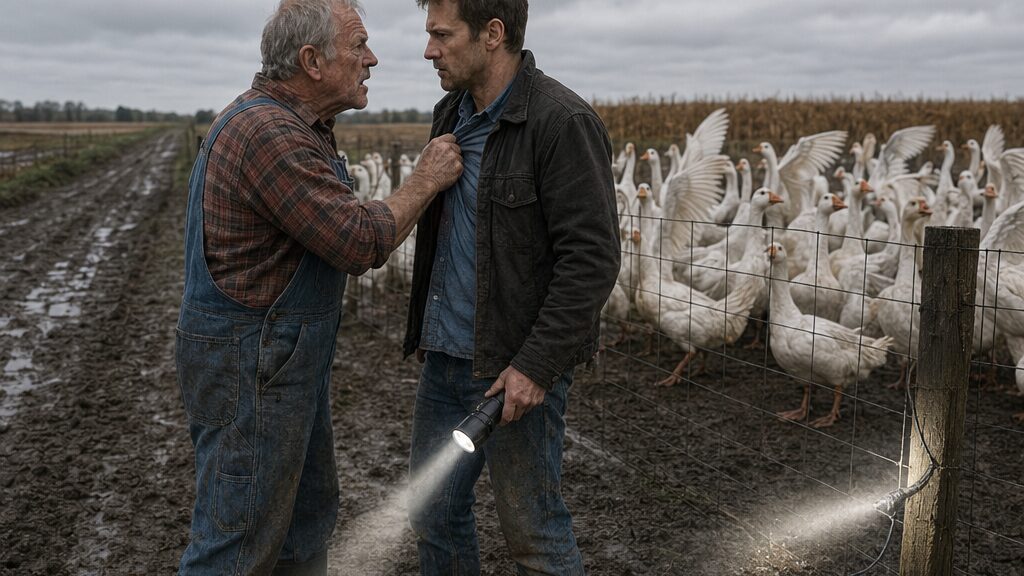
Thomas Harris was already pointing at Jason when the geese began to explode against the fence.
White wings struck wire. Mud flew beneath orange feet. The flock crowded toward the far end of the enclosure as if something invisible had entered among them.
“Turn that thing off,” Thomas shouted.
Jason looked down at the black inspection flashlight in his right hand. It was not switched on.
“It isn’t doing anything.”
“You’ve been waving it around since breakfast.”
“I’ve been checking the fence.”
“You’ve been looking for something to find.”
Thomas stood between him and the north corner post, boots planted in the lane. His plaid shirt showed dark patches beneath the arms despite the cold afternoon. One strap of his overalls had twisted against his shoulder, but he had not noticed.
Behind him, the geese kept calling.
Jason counted again through the moving bodies. Twenty-six near the shelter. Eleven by the trough. Seven pressed behind the nesting boxes.
Forty-four.
There should have been forty-seven.
“Three are gone,” Jason said.
Thomas’s finger dropped.
For a moment, the old man looked toward the enclosure. Then his face tightened again.
“You counted wrong.”
“I counted this morning.”
“You’ve been back six weeks and now you know every bird?”
“I know how many we own.”
“We own.” Thomas gave a short, humorless laugh. “That come with the suitcase?”
Jason felt the answer rise and held it behind his teeth. He had learned that much in the years away: silence could keep a thing from becoming worse.
At least for a minute.
He stepped toward the north post.
Thomas shifted with him.
“Move.”
“You stay out of that field.”
“There’s something running under the mud.”
“There’s drainage pipe everywhere.”
“It’s wire.”
Thomas glanced down too quickly.
Jason saw it then: a narrow black line, barely visible where rain had opened a seam in the lane. It came from beneath the goose fence and disappeared under the lowest rail toward the north field.
He crouched and scraped mud away with the edge of the flashlight. The covering was fresh. Beneath it lay insulated cable, not part of any fence system Jason had ever installed.
The geese surged again.
Thomas caught Jason by the shoulder and pulled him upright.
“I said leave it.”
Jason turned. “Why?”
“Because it’s my ground.”
“And my birds are missing.”
“Your birds?”
The words landed harder than the grip.
Thomas moved closer, his breath sharp with coffee. “You come home because the bank sends a letter, and now every loose hinge is evidence I can’t manage my own place.”
“I didn’t say that.”
“You don’t have to. You carry that phone around. Take pictures. Make lists. Walk behind me correcting things.”
“The south pump was leaking.”
“It still pumped.”
“The feed bill was three months late.”
“It got paid.”
“By who?”
Thomas’s jaw worked.
Jason tried to step past him. Thomas seized the front of his work shirt and twisted the cloth in his fist.
The geese fell into a sudden, frightened roar.
Jason’s body remembered before his mind did. He caught Thomas’s wrist, not hard enough to hurt him, only hard enough to stop the shaking. Thomas’s face was close now, lined and red, but underneath the anger Jason saw something that did not belong there.
Fear.
“Let go,” Jason said quietly.
“You think you can put me on paper and that makes you right?”
“I’m trying to keep something from killing the birds.”
“You’re trying to prove you were smart to leave.”
Jason released Thomas’s wrist first.
The old man still held the shirt for another second. Then his fingers loosened.
Jason raised the flashlight over Thomas’s shoulder and switched it on.
The beam crossed the muddy lane, climbed the warped fence post, and settled on a strip of silver hidden behind the wood.
A splice.
Fresh electrical tape wrapped around exposed copper. The improvised line had been tied into the lower fence lead, close enough to the wet ground that a goose brushing it could take the full charge.
Thomas turned toward it.
His anger did not disappear. It collapsed inward.
“You know about that?” Jason asked.
“No.”
“You looked at the mud before I did.”
“I looked where you were looking.”
“Who ran it?”
Thomas stared at the wire.
Jason waited.
The only answer came from the flock. One goose pressed its breast against the mesh, neck extended, watching the two men with one dark, fixed eye.
Thomas stepped backward.
“Cut the power at the barn,” Jason said.
“No.”
Jason thought he had misheard him.
“What?”
“You don’t touch the north line.”
“That splice isn’t ours.”
“I’ll handle it.”
“When?”
Thomas bent, picked up a clod of mud, and pressed it over the exposed section as if covering it could make the question disappear.
Jason stared at his father’s hand.
“You already knew something was here.”
“I knew people have been working north of the equipment shed.”
“What people?”
Thomas straightened slowly. “That’s none of your business.”
“The wire runs into the goose yard.”
“I said I’ll handle it.”
Jason looked beyond him toward the north field. Rows of harvested corn ended at a low equipment shed and an old access road that connected to the county gravel. The road had not been used in months. Weeds grew through the center track.
Or had, until recently.
“Who’s been driving in?”
“Nobody.”
Jason took one step toward the field.
Thomas blocked him again, but this time he did not touch him.
“You go up there,” he said, “you can take your truck and keep going.”
The words came without volume. That made them worse.
Jason looked at the farmhouse roof beyond the cottonwoods, then at the barn where his mother’s cracked enamel sign still hung above the door. HARPER FARM, it said, the old family name from Thomas’s mother’s side, kept long after the legal business became Harris Produce.
Jason had grown up beneath that sign. He had left beneath it too.
“You called me home,” he said.
“I asked for help.”
“This is help.”
“No. This is inspection.”
Thomas turned away and walked toward the barn, favoring his right knee.
Jason watched him go. The geese began to settle, though none returned to the north side.
He cut power to the enclosure anyway.
Then he followed the black cable beneath the mud until it crossed the fence line and vanished under flattened weeds. He did not enter the field. Not yet.
Near the gate, a patch of churned earth caught his eye.
Jason crouched and held the flashlight low so the beam traveled across the surface instead of down into it. Shadows rose along the impression.
A tire tread.
Wide trailer tires, with a broken outer block that left a clean notch every eighteen inches.
The track came from the north access road, stopped beside the goose enclosure, and turned back.
Thomas had said no vehicle had entered.
Jason took out his phone.
He photographed the tread before the next rain could erase it.
Chapter 2: The Crates Marked for Another Buyer
The crate behind the feed store had HARPER FARM burned into its side.
Jason saw it before he shut off the truck.
It sat upside down beside a stack of fertilizer pallets, one corner split, the old black letters darkened by years of dirt and handling. Harper crates were not unusual around the county. Thomas had sent produce in them for decades. But the farm had stopped using that size two years ago, after the cooperative changed its packing rules.
Jason crossed the gravel lot and turned the crate over.
White down clung to a splinter near the bottom slat.
Not chicken feathers. Too soft. Too clean.
He took the flashlight from his coat pocket and angled the beam into the cracks. A line of reddish mud had dried inside the base. The north field was the only place on Harper Farm with that clay-heavy soil.
“You planning to buy feed or examine the furniture?”
The feed-store clerk stood in the loading doorway with a clipboard tucked beneath one arm.
Jason straightened. “Where’d this come from?”
The clerk glanced at the brand. “Been here a while.”
“How long?”
“A week. Maybe two.”
“Who brought it?”
The clerk’s eyes moved toward the store windows. “You’ll have to ask the manager.”
“You are the manager.”
“Then I guess I’m busy.”
Jason had known him since high school, which meant the man’s refusal was not uncertainty. It was caution.
Jason lowered his voice. “Three geese are missing. Somebody wired the enclosure wrong. That crate has feathers in it.”
The clerk looked again, this time longer.
“Thomas know you’re asking?”
“No.”
“That figures.”
“What does?”
“He called yesterday. Said you might come by with ideas.”
Jason felt something cold settle below his ribs. “What kind of ideas?”
“That you’d been away too long. Didn’t understand how things are done. That you were worked up over a count.”
“He called before I found this?”
“I didn’t say that.”
“You didn’t have to.”
The clerk shifted the clipboard. “I don’t want trouble with your family.”
“This isn’t family trouble if somebody’s taking livestock.”
“No,” the clerk said. “Then it’s worse.”
A delivery truck rolled past the loading dock, forcing them closer to the wall. When the engine noise faded, the clerk looked toward the yard entrance.
“Kevin Nelson picked up damaged crates after closing last Thursday.”
“From here?”
“Some from here. Some he brought himself.”
“Why after closing?”
“Said he needed them for scrap.”
“With what vehicle?”
“Flatbed trailer. Dual axle.”
Jason showed him the photograph of the tread.
The clerk did not touch the phone, but his mouth flattened.
“Could be anybody’s.”
“It could.”
“Kevin buys produce from half the county.”
“He buy from us?”
“You’d have to ask Thomas.”
Jason carried the crate to his truck before the clerk could object. Under the bottom slat, pressed into dried mud, was a thin groove with two parallel edges.
Cable.
He placed the crate in the bed and drove to Kevin’s equipment yard on the edge of town.
The gate stood open. Two rusted combines faced the road like stripped animals. A flatbed trailer was parked beside the repair shed, its tires coated in pale road dust.
Jason stopped several feet away.
The broken tread block was visible without the flashlight.
He crouched anyway, illuminating the outer tire. One rectangular lug was missing from the pattern.
The notch matched the photograph.
A metal door banged behind him.
Kevin Nelson came out wiping grease from his hands. He was broad through the shoulders, with a brown work jacket zipped high against the wind.
“You lost?” Kevin asked.
“Your trailer was on our north road.”
Kevin glanced at the tire, then at Jason’s phone. “That what Thomas told you?”
“Thomas said nobody was there.”
“Then I guess nobody was there.”
Jason stood.
Kevin smiled without warmth. “You always did ask questions like you knew the answer.”
“You always answered like somebody owed you one.”
“That attitude play better in the city?”
“I didn’t live in a city.”
“Close enough to forget your own ground.”
Jason looked past him into the repair shed. Along one wall sat lengths of insulated wire, cable clamps, and an aluminum trapping loop used for moving livestock through narrow gates. All common equipment. None of it proved anything.
Then he saw a second Harper crate beneath a workbench.
Kevin stepped sideways, blocking the view.
“Thomas gave you permission to take our crates?”
“Thomas and I have business.”
“What kind?”
“The kind he doesn’t discuss with hired help.”
Jason’s face stayed still.
Kevin knew exactly where to put the knife.
“I’m not hired help.”
“Then maybe you ought to ask why your name isn’t on the farm account.”
Jason slipped the flashlight into his pocket.
“When were you last on our property?”
Kevin’s smile faded. “Talk to your father.”
“That seems to be everybody’s answer.”
“Maybe because he owns it.”
Kevin walked back into the shed and pulled the door shut.
Jason remained beside the trailer until he heard the lock turn.
On the drive home, he stopped at the north access road. The soil was still damp beneath the surface, and the tire track ran between the weeds exactly as he remembered. He measured the spacing of the notches with a tape from his truck.
Eighteen inches.
At the packing shed, Thomas was nowhere in sight. Jason set the recovered crate on a worktable and examined every seam.
The inside smelled faintly of birds and machine oil.
One slat had been replaced recently. The nail heads were bright. Beneath the new board, something thin protruded from the gap.
Jason used his pocketknife to ease it free.
A folded carbon copy, damp at the edges.
The top lines were blurred, but the lower half remained readable.
NORTH EQUIPMENT ACCESS.
After-hours entry permitted for removal and service work.
Contractor: Kevin Nelson.
At the bottom was a signature.
Thomas Harris.
The date was six weeks earlier—the same week Jason had returned to the farm.
A second signature line had been left blank beneath a warning that access did not include livestock areas.
Jason read the page twice.
Then he noticed a handwritten note in the margin.
Gate key issued.
He heard boots outside the shed.
Thomas paused in the doorway when he saw the paper in Jason’s hand.
Neither man spoke.
The fear Jason had seen beside the goose yard returned to Thomas’s face, but this time there was no anger covering it.
Chapter 3: What Thomas Refused to Explain
Thomas burned the duplicate receipt before Jason could reach the stove.
He snatched the page from the kitchen table, folded it once, and shoved it into the blue flame beneath the coffeepot. The edge curled black immediately.
Jason caught Thomas’s arm.
“What are you doing?”
Thomas jerked free and dropped the burning paper into the sink. By the time Jason turned on the faucet, the signature had dissolved into gray pulp.
For several seconds, only water moved.
The black flashlight lay on the table between two untouched plates, its lens aimed toward Thomas’s chair.
“You signed it,” Jason said.
Thomas shut off the tap. “You had no right going through Kevin’s property.”
“The receipt was in our crate.”
“You took that too?”
“It had goose feathers in it.”
“Feathers get everywhere.”
“Not inside a crate behind the feed store.”
Thomas dried his hands slowly on a dish towel. “Kevin was repairing the north tractor.”
“That tractor hasn’t moved since July.”
“Because the transmission went.”
“So you gave him a gate key?”
“I gave him access to the machinery lane.”
“At night.”
“He works when he works.”
“He ran wire into the enclosure.”
“You don’t know that.”
“His trailer tread is in the mud.”
“Half the county owns those tires.”
“Three birds are missing.”
Thomas threw the towel onto the counter. “And you decided Kevin stole them because you found a feather?”
“No. I decided somebody entered because there are tracks, altered fencing, and missing birds. Kevin is connected to all three.”
“You sound like a deputy.”
“I sound like the person who counted them.”
“You counted them one morning.”
“Every morning since I got back.”
That stopped Thomas.
Jason had not meant the admission to sound like an accusation. It did anyway.
Thomas looked at the flashlight, then at Jason.
“You came home taking inventory.”
“I came home because you said you needed help.”
“I needed hands.”
“You needed money.”
Thomas’s face changed.
Jason saw that he had reached the hidden place before understanding what was inside it.
“How much do you owe him?” he asked.
Thomas turned toward the dark kitchen window.
“How much?”
“It isn’t your concern.”
“The farm account is short. The feed bill was late. Kevin has after-hours access and you’re burning paperwork.”
“I didn’t ask you to audit me.”
“No. You asked me to come back without telling me why.”
Thomas gripped the counter with both hands. The knuckles had grown thick over the years, but the fingers seemed smaller than Jason remembered.
“The tractor transmission was twenty-eight thousand,” Thomas said. “Then the irrigation pump failed. Kevin carried the repair invoice.”
“For what?”
“For time.”
“What did you give him?”
“Storage access. Scrap rights. Use of the north lane.”
“And livestock?”
“No.”
Thomas answered so quickly Jason believed him.
Not completely. But enough to make the room feel less simple.
“Did you know he was entering the goose yard?”
“No.”
“Did you suspect it?”
Thomas did not answer.
Jason pulled out a chair but remained standing behind it. “The wire could kill one.”
“It was low voltage.”
“You knew about it.”
“I knew he had a temporary line near the tank.”
“The tank is thirty yards from the fence.”
“He said he needed power for a pump.”
“And you didn’t check?”
Thomas looked at him then. “I checked this farm before you could reach the gate latch.”
“That was thirty years ago.”
The words left Jason before he could blunt them.
Thomas’s shoulders stiffened.
There it was—the old wound, opened with the same tool they had used the night Jason left. Then, Jason had said Thomas would rather work himself into the ground than admit the farm needed to change. Thomas had said a man who wanted a different life should stop pretending he cared about this one.
Jason had packed before dawn.
Now Thomas pulled out his chair and sat heavily.
“You think I don’t know what I can’t do?” he asked.
Jason said nothing.
Thomas rubbed his right knee. “You think I don’t notice how long it takes me to cross the yard? How I wait until you’re in the south field before lifting feed because I don’t want you watching?”
“I wasn’t—”
“You watch everything.”
“I’m trying to keep the place running.”
“You’re waiting for me to fail where you can write it down.”
Jason looked at the flashlight. At his phone beside it. At the small notebook protruding from his coat pocket.
He had meant each of them as protection.
From Thomas’s side of the table, they looked different.
“I should’ve told you about the camera,” Jason said.
Thomas’s eyes narrowed. “What camera?”
Jason regretted the sentence immediately.
“By the north gate. Motion activated.”
“You put surveillance on my land?”
“I put it near the road after the first bird went missing.”
“You never told me a bird was missing.”
“I wasn’t certain then.”
“But you were certain enough to record me.”
“I wasn’t recording you.”
“You didn’t know who you were recording.”
The anger returned, but weaker now. Hurt carried more of it.
Jason sat across from him. “That was wrong.”
Thomas looked away.
“But burning the receipt was wrong too,” Jason continued. “Lying about the road was wrong. Letting Kevin move around here because you were ashamed to tell me what the farm owed—that put the flock at risk.”
“I did what kept the tractor running.”
“You kept a tractor running and left the gate open.”
Thomas stood so quickly the chair legs scraped backward.
A sharp, broken call came from outside.
Both men froze.
Another call followed, lower and harsher than the normal noise of the flock.
Jason grabbed the flashlight.
They reached the goose yard together.
One bird lay near the north post, wings beating weakly against the mud. A thin steel loop had tightened around its right leg. The cable ran beneath the fence and disappeared into the grass.
Thomas stopped at the gate.
Jason killed the fence power, climbed over, and knelt beside the goose. Its heart hammered beneath his palm. The cable had cut through feathers and into the skin.
“Get the cutters,” he said.
Thomas did not move.
“Dad.”
Thomas turned toward the machinery shed at last.
Jason held the bird still until he returned. Together they cut the loop and wrapped the injured leg in a clean shop towel. Thomas carried the goose against his chest while Jason called the veterinarian.
At the clinic, the veterinarian examined the wound beneath a bright steel lamp. Thomas stood against the wall, mud drying on his boots.
“Fence wire didn’t do this,” the veterinarian said.
Jason looked at the narrow groove around the leg.
“What did?”
“A restraint cable. Small-animal size, though I wouldn’t use one on a bird.” The veterinarian glanced between them. “Someone set it deliberately.”
Thomas’s grip tightened on the brim of his cap.
Jason thought of the missing geese. The crates. Kevin’s trailer. The after-hours access Thomas had traded for time.
The veterinarian cleaned the wound and said the bird would likely live.
It was the first good news they had received.
It also made the larger question unavoidable.
If Kevin had not been taking scrap or equipment from the north field, what had he been taking?
Chapter 4: The Deal That Kept the Tractor Running
“Did you install a camera on property you do not legally own?”
Rebecca Allen did not raise her voice. She did not need to.
The county office was small enough that every question seemed to remain in the room after she asked it. Jason sat across from her metal desk with his phone face down between them. Thomas occupied the chair beside him, arms folded, mud still packed into the seams of his boots from the veterinarian’s lot.
“It covers the north access road,” Jason said. “Not the house. Not any private area.”
“That wasn’t my question.”
Jason glanced at Thomas. His father looked straight ahead.
“Yes,” Jason said. “I installed it.”
“Did Mr. Harris know?”
“No.”
Rebecca wrote something on a yellow legal pad.
Thomas shifted in his chair. “There. You heard him.”
Rebecca looked up. “I also heard that someone placed a restraint cable near a livestock enclosure and altered an electrical line. I’m not deciding who is the injured party based on who admits fault first.”
Thomas’s mouth tightened.
Rebecca turned the phone over. “Do you have recordings?”
“Motion clips. A trailer entering twice after midnight. No visible plate.”
“Audio?”
“No.”
“Did the camera record any area where Mr. Harris or his employees had a reasonable expectation of privacy?”
“It faced the road.”
“That answer will matter later.”
Jason understood the warning. What he had treated as proof might become a problem of its own.
Rebecca connected the phone to her computer and opened the first clip. Grainy night vision showed a truck moving between the trees. The trailer passed close enough for its rear tire to catch the infrared light. The broken outer tread block appeared as a pale interruption in the pattern.
The second clip showed the same trailer three nights later.
Thomas leaned forward despite himself.
Rebecca paused the image. “You recognize it?”
“No,” Thomas said.
Jason looked at him.
Rebecca did too. “You permitted Kevin Nelson access to the north machinery lane.”
“I permitted repair work.”
“After hours?”
“When necessary.”
“Did he use that trailer?”
“I never checked his tires.”
The answer was careful enough to be a lie without containing one.
Rebecca removed Jason’s black flashlight from the evidence bag at the edge of her desk. She had taken it that morning after photographing the improvised splice. A smear of red clay remained around the grip.
“This was used to uncover the wire?”
“Yes.”
“And to inspect the crate?”
“Yes.”
“I’ll need to keep it until we finish documenting where it was used.”
Thomas looked at the flashlight as if it had betrayed him.
Rebecca slid an access form across the desk. “You both need to understand something. Mr. Nelson having permission to enter one part of the farm does not give him permission to enter another. But if that arrangement was informal, undocumented, or broader than either of you is telling me, the distinction becomes difficult to prove.”
“It was documented,” Jason said.
Thomas turned toward him.
“The copy was destroyed,” Jason continued, “but I photographed it first.”
That was not true.
He had photographed the tire tread, the crate, the splice. Not the receipt. He had found it moments before Thomas entered the shed and had been too focused on the signature to take out his phone.
Rebecca watched him.
Jason felt the lie sitting between them, small and immediate.
Then Thomas spoke.
“There wasn’t a contract.”
Rebecca’s attention moved to him. “What was there?”
“A service receipt.”
“For what?”
“The tractor.”
“And what did you promise in exchange?”
Thomas looked toward the window.
Rebecca waited.
“Storage,” he said. “Access. Some scrap metal.”
“Anything from the livestock operation?”
“No.”
“Any produce?”
“No.”
“Any birds?”
Thomas’s head snapped around. “No.”
For the first time, the answer carried no hesitation.
Rebecca closed the file. “I need bank records, repair invoices, and any messages between you and Mr. Nelson. Until then, the livestock area remains closed except for essential care.”
Thomas stood. “You’re not closing my farm.”
“I’m closing one enclosure because someone set a cable in it.”
“You don’t have authority to shut down the whole operation.”
“I didn’t say I did.”
“That’s where this goes.”
Rebecca remained seated. “Where it goes depends on what you have not told me.”
Outside, Thomas walked past Jason without waiting.
They drove separately to the bank.
The representative met Jason in a glass office while Thomas stayed in the truck. The account statements showed what Thomas had hidden in plain sight: overdue equipment notes, a nearly exhausted operating line, and a pending review triggered by two missed payments.
“How close?” Jason asked.
The representative folded her hands. “If the next payment is not made, the loan can be accelerated.”
“How long?”
“Thirty days after formal notice.”
Jason looked through the office window. Thomas sat behind the wheel with both hands resting at the top, staring toward the road.
“Did Kevin Nelson make any payments on our behalf?”
The representative hesitated. “I can’t discuss another customer’s accounts.”
“Did he delay collection on a repair invoice?”
“That would be between your father and Mr. Nelson.”
Which meant yes, or close enough to it.
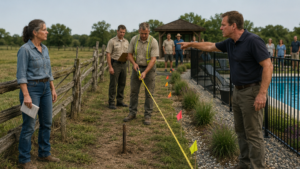
Back at the farm, Rebecca met them at the north field with a deputy. She had obtained permission to inspect the access lane and the equipment area. The earth had dried since the rain, preserving the trailer marks in layers.
Jason walked beside her as she measured the repeated impressions.
“One pass in,” she said. “One pass out. More than once.”
Thomas stood near the machinery shed, his cap pulled low.
Rebecca followed the tracks to the old tank. A temporary power line ran from a portable pump toward the fence. The visible section appeared legitimate. The dangerous splice had branched from it beneath the mud.
“Somebody extended this later,” Jason said.
Rebecca nodded. “The question is who.”
She asked Thomas when he had last inspected the line.
“Last week.”
Jason looked at him. “You told me you didn’t know it was there.”
“I knew about the pump line.”
“Not what you said.”
Thomas turned to Rebecca. “I never agreed to anything near the birds.”
“Did you inspect the full route?”
“No.”
“Did you see Mr. Nelson enter after dark?”
“No.”
“Did you know he was using the north road repeatedly?”
“No.”
Each denial came flatter than the one before.
Rebecca did not challenge him. She recorded the answers.
Jason understood then that Thomas was not merely protecting Kevin. He was protecting the version of himself who had made the arrangement and still believed he could control it.
The deputy’s radio crackled.
Rebecca stepped away to answer her phone. She listened, asked two short questions, then looked toward Jason.
“We found Nelson’s trailer.”
Thomas lifted his head.
“Where?” Jason asked.
“Behind a repair shed outside town. He consented to an inspection of the exterior, then withdrew consent when the deputy opened the rear gate.”
Kevin’s yard.
Rebecca slid the phone into her coat pocket. “A warrant was approved twenty minutes ago.”
They arrived as the rear doors of the trailer were being opened.
The inside held cable, stained blankets, empty feed sacks, and two Harper crates. Rebecca climbed onto the deck without touching anything.
Near the front wall, beneath a folded tarp, fresh white feathers clung to a dark smear.
The deputy shone his light over it.
Blood.
Thomas took one step backward.
Rebecca looked from the trailer to him.
The evidence no longer pointed only toward Kevin.
It pointed through the gate Thomas had opened.
Chapter 5: Red and Blue Across the Goose Yard
The geese began screaming before the patrol car reached the yard.
Jason was halfway across the barn when the sound rose from the enclosure—forty-four voices breaking at once, harsher than hunger and sharper than alarm. He grabbed the spare barn flashlight from its hook, but the beam flickered and died.
Then headlights swept across the windows.
Rebecca’s county vehicle entered first. A sheriff’s cruiser followed, red and blue light rolling over the white barn, the farmhouse, and the wet roofs of the equipment sheds.
Thomas came from the kitchen without his coat buttoned.
“What happened?”
Jason was already moving.
At the goose yard, the flock had crushed itself against the southern fence. Several birds stood with wings extended, necks low, refusing to move toward the north corner.
Rebecca met Jason at the gate and handed him a sealed evidence bag.
Inside was his black flashlight.
“We finished the surface documentation,” she said. “Use gloves. Don’t touch anything you don’t have to.”
“Why are you here now?”
“A deputy saw movement off the north road ten minutes ago.”
Thomas stopped beside them. “Kevin?”
“We don’t know.”
The cruiser lights turned the mud purple, then red, then black again. Every shadow seemed to move when the color changed.
Jason pulled on work gloves, removed the flashlight, and switched it on. The beam was steady.
Thomas looked at it but said nothing.
They entered the enclosure together.
Jason followed the birds’ line of sight. The beam crossed the trough, the repaired fence post, and the dark strip of grass beyond it. Near the tank, something metallic reflected.
A cable loop lay half buried beneath straw.
Rebecca raised her phone and photographed it before anyone approached.
“There,” Jason said.
A second loop was anchored to a stake near the nesting shelter. The cable had been disguised beneath feed and chaff, positioned where a bird would step into it while moving toward water.
Thomas swore under his breath.
“You knew these were here?” Rebecca asked.
“No.”
Jason crouched without touching the loop. A few white feathers were caught inside the twisted strands.
The cable led through the fence, under the mud, toward the machinery lane.
They followed it.
The flashlight exposed fresh scrapes on the tank valve. Someone had used the valve housing as an anchor point. Beyond it, tire marks crossed the lane and ended near a stack of wooden crates partly covered by a tarp.
A sound came from behind the machinery shed.
The deputy moved first, hand near his holster but not drawing it.
“County sheriff. Come out where I can see you.”
No one answered.
The deputy rounded the corner. A moment later he called back, “Clear.”
A side gate stood open toward the fields. Whoever had been there had left on foot or had gone before the patrol car arrived.
Rebecca photographed the gate.
Jason swept the flashlight across the crates. Three bore the faded HARPER FARM brand. One had a new lid nailed over the top. Air holes had been drilled through the slats.
Thomas reached for it.
“Don’t,” Rebecca said.
“I’m moving it out of the rain.”
“It has been raining for an hour. Thirty more seconds won’t change it.”
Thomas gripped one end anyway.
Rebecca stepped between him and the crate. “Take your hands off.”
The deputy returned from the shed.
Thomas released the wood, but only after his fingers had shifted it several inches. Mud beneath the base showed a pale rectangle where the crate had rested.
Jason watched his father’s face.
“Why did you move it?”
“I told you.”
“No.”
Thomas looked toward the flock.
Rebecca knelt to photograph the newly exposed ground. A narrow channel ran beneath the crate. Inside it lay a cable end and a metal clamp.
“Open it,” Jason said.
Rebecca looked at the deputy. He used a flat bar to lift the lid without disturbing the sides.
The crate was empty.
For a second, disappointment moved through Jason. He had expected proof large enough to end the questions: feathers, blood, perhaps one of the missing birds.
Then the flashlight caught pencil marks inside the lid.
Numbers.
47
46
45
44
Dates beside each count.
Jason held the beam steady.
He knew the handwriting.
Rebecca did too. She had seen Thomas’s signature, his notes, his farm records.
“Mr. Harris,” she said, “did you write this?”
Thomas’s mouth opened, but no answer came.
The deputy photographed the lid.
Jason’s chest tightened. “You counted them.”
Thomas looked at him.
“You knew they were disappearing.”
“I knew the number was changing.”
“That is the same thing.”
“No.”
“What did you think was happening?”
Thomas took off his cap and pressed the brim between both hands.
The red and blue lights crossed his face, changing him every second from pale to shadowed.
“I thought Kevin was taking equipment,” he said.
Jason stared at the empty crate.
“Equipment does not need air holes.”
“I never saw the holes.”
“You wrote counts inside it.”
“I wrote them because I found the crate by the shed.”
“When?”
“Two weeks ago.”
“Before I said anything?”
Thomas’s silence answered.
Rebecca stood. “Why didn’t you report it?”
Thomas looked toward the north field. “Because I owed him.”
“Owing money does not explain this.”
“It does when the man can call every repair bill at once.”
Jason felt the first clean piece of vindication turn sour.
Kevin had entered the farm. Kevin had set the cables. Kevin had taken the geese. Jason had been right about all of it.
But Thomas had seen enough to suspect harm and had chosen silence.
The deputy’s radio sounded. He stepped aside to answer, then returned.
“Nelson’s truck was stopped on County Twelve. There are two empty livestock carriers in the bed.”
Rebecca nodded. “Hold him until I get there.”
Thomas looked up sharply. “You found him?”
“Possibly.”
“Then go.”
Rebecca studied him. “We are not done here.”
A faint rustle came from behind the crate stack.
Jason raised the flashlight.
The beam found a transport sack wedged between two pallets. Something moved inside.
He crossed the mud and cut the tie with his pocketknife. A white goose pushed its head through the opening, blinking against the light. Its wing feathers had been clipped, but it was alive.
Thomas made a sound Jason had never heard from him.
Not relief. Not quite grief.
He knelt and took the bird carefully, holding it against his coat. The goose struck once at his wrist, then settled.
One missing bird recovered.
Two still gone.
Rebecca photographed the sack and the transport crate. The deputy began marking each item.
Jason looked again at the handwritten counts.
“You watched the flock drop from forty-seven to forty-four,” he said.
Thomas did not lift his head.
“I counted them because I thought he was taking equipment,” he said.
Jason glanced at the air holes, the cables, the bird in Thomas’s arms.
For the first time, he did not know whether his father’s explanation made the lie smaller or worse.
Chapter 6: The Lie He Thought Would Save the Farm
“Remove that page before you give the records to Rebecca.”
Thomas placed the ledger on the kitchen table and pushed it toward Jason.
Morning light came through the window in a narrow strip, stopping before it reached either man. The black flashlight lay between them, switched off. Mud still marked the ridges around its lens.
Jason opened the ledger to the page Thomas had folded.
Three entries were written in blue ink.
Transmission repair deferred.
Pump service deferred.
North access granted until balance satisfied.
Beneath them, in Thomas’s handwriting, was a fourth line.
Livestock count irregular. Speak to Kevin.
No date followed it.
“You knew enough to write this down,” Jason said.
“I knew something was wrong.”
“And you still let him in.”
“I told him the birds were off limits.”
“After you suspected he was taking them?”
“I suspected he was taking scrap he had not earned.”
“The count says livestock.”
Thomas sat across from him. He looked older than he had beneath the patrol lights, not because of the hour but because there was nothing left to push against.
“Take the page out,” he repeated.
“No.”
“If Rebecca sees it, she’ll tell the bank the access agreement was part of the collateral problem.”
“She will see it.”
“The bank will call the repair debt.”
“They may do that anyway.”
“Not if Kevin carries it through winter.”
“Kevin is in custody.”
“For now.”
Jason closed the ledger. “You are still planning around him.”
“I’m planning around keeping this place.”
“By hiding what happened?”
“By not handing the bank a reason.”
Jason leaned back.
For weeks, he had imagined that truth would behave like light: aim it correctly and the shape of the problem would become clear. But light only showed what stood in front of it. It did not choose what a man would do after seeing.
Thomas tapped the folded page. “One sheet. That is all.”
“One sheet becomes another.”
“You already lied to Rebecca.”
Jason’s gaze lifted.
Thomas had noticed.
“I heard you say you photographed the receipt.”
Jason said nothing.
“You didn’t.”
“No.”
“Why?”
“To keep her from thinking the evidence disappeared with it.”
“You mean to keep her from thinking I destroyed the only copy.”
“Yes.”
“So don’t sit there like your hands are clean.”
Jason felt the accusation strike because it was true.
Thomas pushed back from the table and walked toward the window. Outside, the recovered goose stood alone in a temporary pen near the barn, bandaged leg tucked beneath it. The rest of the flock moved restlessly beyond the fence.
“I put the camera up because I didn’t trust you,” Jason said.
Thomas did not turn.
“I told myself it was because you would be angry. Because you might move it. Because the road needed watching.”
“All true.”
“But not all of it.”
Thomas waited.
“I thought you were hiding something before I knew what.”
“You were right.”
“That doesn’t make how I did it right.”
Thomas looked over his shoulder.
Jason continued before silence could protect him again.
“When you grabbed me, I thought it was because you knew Kevin was stealing.”
Thomas’s face tightened.
“Was it?”
“No.”
“Then why?”
Thomas looked back through the window. “Because you were walking past me.”
“That’s not an answer.”
“It is.”
Jason waited.
Thomas rubbed his thumb along the edge of the windowsill, following an old groove in the wood.
“You came home and started fixing things,” he said. “The pump. The feed orders. The south fence. Everybody at the cooperative started asking you questions instead of me.”
“They asked whoever was there.”
“They asked you because you had answers.”
“That’s the job.”
“It used to be my job.”
Jason said nothing.
Thomas turned from the window. “I saw the phone in your hand. Saw that light. Saw you looking at the wire like you had already reached the conclusion.”
“What conclusion?”
“That I had let the place go.”
Jason thought of the notebooks, the photographs, the camera hidden by the road. He had never said those words, but he had built a case around them.
“I grabbed you because I thought you had come back to replace me,” Thomas said. “Not help. Replace.”
The confession was quieter than an apology and harder to dismiss.
Jason looked at the folded ledger page.
“I came back because the bank letter said you were thirty days from losing the operating line.”
Thomas’s eyes narrowed. “You opened my mail?”
“It was addressed to the business.”
“My business.”
“Our name is on the barn.”
“Not on the loan.”
“There it is again.”
“What?”
“The part where you think ownership is the only thing that makes this yours.”
Thomas’s jaw flexed.
Jason stood, but he did not leave the table.
“You called me because you needed hands,” he said. “I came because I thought you needed saving. Neither one of us told the truth.”
Thomas looked toward the barn.
A vehicle entered the driveway.
Both men watched a white bank car stop near the house.
The representative stepped out carrying a document envelope.
Thomas closed his eyes.
The envelope contained notice of a foreclosure review scheduled in nine days. The bank cited missed payments, instability in the operating account, and pending liability involving unauthorized access to secured property.
The language was clean. The consequence was not.
After the representative left, Thomas carried the ledger to the packing shed. Jason followed.
The building was empty except for stacked pallets and the smell of old onions in the floorboards. Without the seasonal workers, every movement echoed.
Thomas set the ledger on the sorting table.
“If you submit that page,” he said, “they will know I traded access against debt.”
“Yes.”
“They will say I impaired the property.”
“Probably.”
“They may freeze the operating line before the review.”
“Yes.”
“And your camera?”
“I will submit those records too.”
Thomas stared at him. “They may throw the footage out.”
“They may fine me. Rebecca may decide it complicates the case.”
“Then why give it to her?”
“Because asking you to tell the truth while I hide my part would be the same thing we’ve been doing.”
Thomas ran one hand along the edge of the sorting table. The wood had been polished smooth by decades of crates.
“You think honesty saves farms?”
“No.”
The answer seemed to surprise him.
Jason picked up the ledger.
“I think it tells us what is left to save.”
Thomas did not stop him.
At the county office, Rebecca read every page. Jason corrected his earlier statement about the receipt photograph and described where he had placed the camera, when, and why.
She listened without approving or condemning.
When he finished, she placed the surveillance drive, the ledger, and the access records into separate evidence bags.
“This may weaken portions of your case,” she said.
“I understand.”
“It may also strengthen the timeline.”
Jason nodded.
“And the bank will receive the relevant property report.”
“I understand that too.”
Rebecca sealed the final bag.
Outside, Thomas waited in the truck.
Jason paused on the courthouse steps with the empty flashlight holster at his belt and nothing left hidden in his hands.
Then he walked down to face whatever the truth had cost them.
Chapter 7: The Farm They Could Only Keep Together
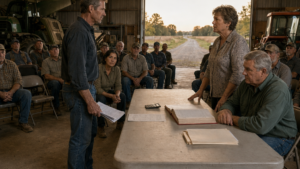
“The cooperative will help,” the board chair said, “but not if one man keeps sole authority.”
Thomas pushed his chair back before she finished the sentence.
The folding legs scraped across the meeting-room floor, sharp enough to turn every head around the table. Six neighboring farmers sat beneath humming fluorescent lights with paper cups, loan summaries, and copies of the county report arranged before them.
Jason did not reach for his father.
Thomas stood with one hand braced against the chair. “Then we are done here.”
The board chair kept her voice level. “Mr. Harris, sit down and hear the full proposal.”
“I heard it.”
“You heard one condition.”
“The only one that matters.”
The packet in front of Thomas required two signatures on operating debt, equipment sales, and access agreements. It also placed Harper Farm under cooperative financial review for three years.
Jason had read the terms twice before the meeting. He knew which clauses Thomas would hate.
He had not expected his father to make it as far as the chair.
“Sit down,” Jason said.
Thomas looked at him.
Not angry. Not yet.
“You brought me here to hand over my own place.”
“I brought you here because the bank’s review is Friday.”
“The land is still mine.”
“The debt is too.”
A neighboring farmer lowered his eyes to his paperwork.
Thomas noticed.
Public shame moved through him like current.
He reached for his cap on the table.
Jason could have let him leave. A month earlier, he might have followed, waited until Thomas cooled, then returned with another plan and another set of facts. He had spent most of his life mistaking delay for patience.
This time he stayed seated.
“If you walk out,” he said, “the bank takes the choice from both of us.”
Thomas’s hand stopped above the cap.
The board chair slid the proposal closer. “The cooperative can refinance the operating line, purchase the remaining equipment note, and advance feed costs through spring. Restitution from Mr. Nelson’s case would be assigned against the balance when available.”
“When available,” Thomas repeated.
“The criminal case is not a farm plan.”
That came from the bank representative seated at the far end. Her tone was not cruel, only final.
Kevin had been charged with livestock theft, property damage, and unlawful trapping. The evidence from his trailer, the cable loops, the altered wiring, and the recovered goose had been enough to hold him. A second missing goose had been found at a buyer’s property two counties over. The third had not been recovered.
Justice had arrived in invoices, evidence forms, and hearing dates. It had not repaired the operating account.
Thomas lowered his hand.
“What do we sell?” he asked.
The board chair opened a survey map.
Jason watched his father’s face as the page unfolded.
“The north field,” she said.
Thomas sat down.
For several seconds, no one spoke.
The north field was the poorest ground on the farm. It flooded in spring and hardened early in summer. It was also the first parcel Thomas had bought without help from his father, forty-two acres acquired one payment at a time.
Jason knew the story because Thomas had told it whenever they crossed the ridge.
Now the field was colored yellow on the map.
“Who buys it?” Thomas asked.
“The cooperative will list it with neighboring members first. The proceeds satisfy the default and reduce the refinanced balance.”
“And the access road?”
“Transferred with the parcel.”
Thomas studied the boundary line.
Jason could see him measuring what would disappear: the equipment shed, the old tank, the road where Kevin’s trailer had entered, and the field where Thomas had believed every problem could still be contained if he worked harder and spoke less.
“Read the terms,” Thomas said.
Jason looked at him.
“All of them,” Thomas added.
The board chair passed Jason the agreement.
He read without softening the language. Shared operating authority. Quarterly reporting. Prohibition against unrecorded service exchanges. Sale of the north parcel. Mandatory safety inspection of livestock fencing. Two signatures for secured transactions.
Thomas interrupted only once.
“Does he get to sell without me?”
“No,” Jason said. “Neither of us can sell without the other.”
Thomas considered that.
When Jason reached the signature page, the room remained quiet.
The board chair placed two pens on the table.
Thomas picked up one, but did not write.
“You leave again,” he said to Jason, “what happens then?”
The question did not belong to the paperwork.
Jason set the agreement down.
“I don’t know what happens in ten years.”
“I asked about you.”
“I know.”
Thomas waited.
Jason looked around the room. The cooperative board, the bank representative, the farmers who knew every version of the Harris family except the private one.
He kept his answer plain.
“I am staying through the refinance. After that, we decide before either of us makes plans alone.”
“That is not a promise.”
“It is the one I can keep.”
Thomas’s thumb moved along the pen.
Then he signed.
Jason signed beneath him.
Three weeks of pressure released without celebration. The board chair collected the agreement. The bank representative outlined the closing schedule. A neighboring farmer offered to lend temporary fencing panels until the county approved the repaired enclosure.
No one applauded.
Jason was grateful.
At the county office, Rebecca met them with the final safety clearance. The unauthorized line had been removed, the fence rewired, and the north lane sealed pending sale.
She handed Thomas a copy of the report.
“The restitution request includes the missing livestock, veterinary costs, damaged fencing, and investigation expenses,” she said.
“Will we get it?” Thomas asked.
“Some of it, probably. Not soon.”
He nodded.
Rebecca returned Jason’s flashlight across the counter.
The evidence label had been removed, leaving a pale rectangle on the black casing. Jason turned it once in his hand.
“You documented enough to establish the route,” Rebecca said. “Your camera footage helped with timing, though the county will not rely on it alone.”
“And the unauthorized installation?”
“Recorded as part of the property report. No separate action, given the location and circumstances.”
Thomas glanced at Jason.
Rebecca closed the file. “Do not take that as permission to install another one without agreement.”
“I won’t.”
Outside, Thomas held the safety clearance while Jason carried the flashlight.
They crossed the parking lot without speaking.
The new fence panels went up two days later.
The recovered goose returned first. Its bandaged leg had healed into a slight hitch, but it crossed the enclosure under its own strength. The second recovered bird arrived from the county animal facility that afternoon.
When the pair saw each other, they called across the yard and moved together toward the water trough.
The rest of the flock followed.
For the first time since Jason had begun counting, the birds spread evenly through the enclosure. None crowded away from the north corner. None struck the wire.
Thomas stood beside the gate with both hands in his coat pockets.
“Forty-six,” Jason said.
Thomas nodded.
They did not speak of the one that had not returned.
The north field sold before winter. The buyer planned to rotate soybeans through the low ground and tear down the machinery shed. On closing day, Thomas walked the boundary alone, then brought the old gate key into the barn and dropped it into a drawer.
He did not keep it.
That evening, Jason finished checking the repaired fence as the light faded behind the cottonwoods. When he entered the barn, Thomas was standing beneath the Harper Farm sign with a hammer and two small hooks.
On one hook hung two rings of keys.
On the other, Thomas placed the black flashlight.
Jason stopped inside the doorway.
The pale rectangle where the evidence label had been was still visible.
Thomas tested the hook with one finger. “Keeps disappearing into your truck.”
“I know where I leave it.”
“That has not been my experience.”
Jason looked at the keys. One ring held the farmhouse, machinery shed, and feed-room keys. The second was newer, cut from bright brass.
Thomas removed it from the hook and held it out.
Jason took it.
Neither man called the gesture an apology.
Outside, the geese murmured near the shelter. The sound was low and ordinary, settling rather than warning.
Thomas reached for his coat.
“You check them before dark?” he asked.
“I was just there.”
“Check them again.”
Jason slipped the new keys into his pocket.
Thomas turned toward the house, then paused.
“North corner gets soft after rain,” he said. “Even with the new post.”
“I’ll watch it.”
Thomas gave one small nod.
Jason took the flashlight from the hook. For a moment, its weight carried every way they had used it against each other: inspection, accusation, proof.
Then he stepped into the yard and switched it on.
The beam moved across the repaired fence, the quiet water trough, and forty-six white birds resting safely on the ground they still had.
The story has ended.