The Farm Consultant Ordered the Sprayer Forward—Then Linda Refused to Open the Field Gate
Chapter 1: The Gate Linda Would Not Open
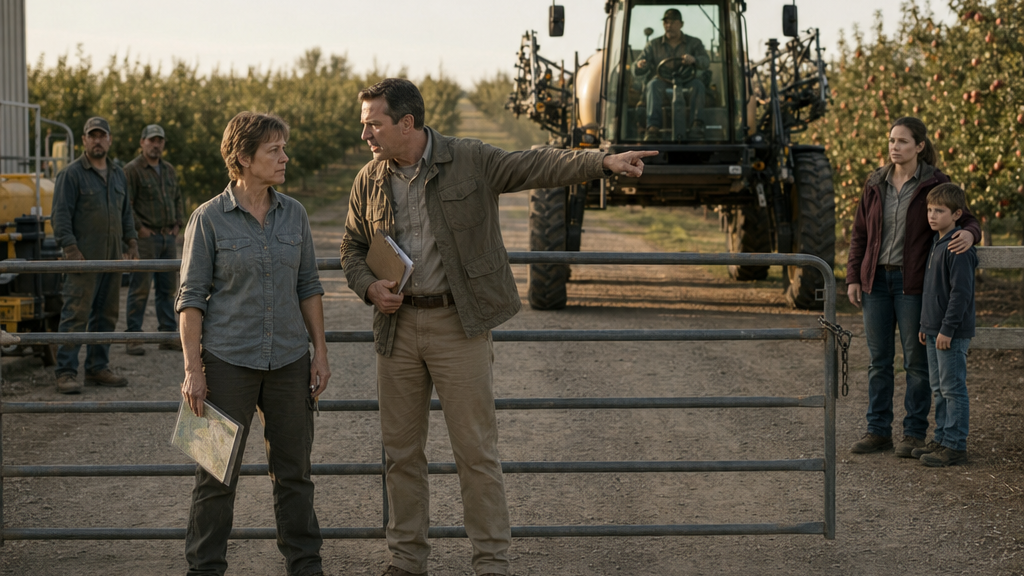
“Drive it through.”
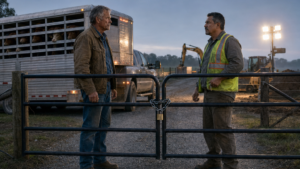
The spray-rig operator looked at James Williams, then at Linda Green, who was standing directly in front of the locked steel gate with the key in her fist.
The diesel engine idled behind them, low and heavy. A folded boom stretched above the machine like a pair of metal arms. The tank had already been mixed for the east orchard, and every minute mattered if the crew wanted the treatment on before the afternoon wind picked up.
James pointed toward the gate.
“Linda. Open it.”
She did not move.
Two field hands had stopped stacking empty chemical jugs near the wash pad. The orchard mechanic leaned against the service truck. Nobody said anything.
Linda held the laminated field map against her thigh and looked once more at the application sheet clipped to James’s board.
“The number on that sheet doesn’t match the rate you gave the operator.”
James’s jaw tightened.
“It was recalculated.”
“For what acreage?”
“The east block.”
“That’s not an acreage.”
His face changed just enough for her to notice.
He stepped closer. “You run field operations. I make agronomy decisions.”
Linda looked past him at the rig.
The operator kept both hands on the wheel.
“Then tell me which number is right.”
James lowered his voice. “We have a treatment window closing.”
“And I have two different numbers.”
“Open the gate.”
Linda had worked the Campbell orchard fourteen years. She knew which rows held water after rain, which valves lost pressure, which tractor would start cold and which one needed persuasion. She also knew that familiarity could become arrogance if you let it.
That was why she kept looking at the page.
James had written one application rate in the upper box.
A second figure appeared lower down beside the tank calculation.
The second was nearly twice the first.
Maybe there was an explanation.
Maybe the total had been adjusted for concentration.
Maybe the operator’s verbal instructions were correct and the paper was stale.
But nobody had shown her which.
“Linda.”
James’s voice was louder now.
The two field hands were openly watching.
“Field operations doesn’t get to rewrite the spray program because you don’t like the numbers.”
“I didn’t rewrite anything.”
“You’re holding up a loaded rig.”
“Yes.”
The word landed harder than if she had raised her voice.
James stared at her.
At the edge of the equipment yard, a car door shut.
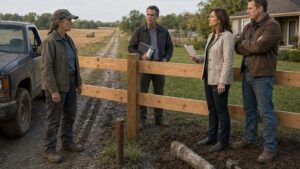
Linda glanced toward the packing shed and saw Jennifer Roberts walking toward them with her son, Jacob. Jennifer had stopped by to speak with the packing-shed supervisor about a fall harvest feature for the county weekly. Jacob, nine years old and restless whenever adults talked too long, carried a small paper sack and was kicking at loose gravel.
He waved when he saw Linda.
She did not wave back.
Her eyes went to the east orchard.
The marked route on the map brought the sprayer down the service lane nearest the packing shed before turning into the first rows.
Jennifer and Jacob should not have been anywhere near an active application area.
That could be fixed easily enough.
The numbers could not.
“Jennifer,” Linda called. “Take Jacob back to your car for a few minutes.”
Jennifer stopped.
James turned. “They’re outside the application zone.”
“Not according to this map.”
He gave a short, humorless laugh.
“That map is a field reference, Linda. It’s not a legal boundary.”
“It shows the route.”
“And I said they’re clear.”
Linda lifted the application sheet.
“You also said this is the rate.”
She tapped the upper figure.
“Then the operator says you gave him this.”
Her finger moved lower.
Nobody spoke.
The diesel engine seemed suddenly louder.
James took the clipboard from her hand and looked at the page.
For half a second, Linda thought he would stop.
Instead he said, “Those figures are not interchangeable.”
“Then explain the difference.”
“I don’t need to explain an agronomic calculation in the equipment yard.”
“No. But somebody needs to explain it before that gate opens.”
Jennifer had drawn Jacob closer. The boy’s attention had shifted from the machinery to the adults.
James noticed.
His face reddened.
“You’re making this into something it isn’t.”
Linda felt the old instinct rise in her: fix it quietly. Pull James aside. Send everyone away. Find the answer herself and spare him the embarrassment.
She had done that for years.
Loose fittings. Misread work orders. Workers who skipped steps because they were tired. She corrected the problem, kept the day moving, and rarely wrote down who had made the mistake.
Most days, that looked like competence.
Once, years ago, it had looked like silence until an injured hand was wrapped in a towel and driven to urgent care.
Everybody had said the same thing afterward.
Probably fine.
Linda closed her fingers around the gate key.
“I’ll open it when we know which number is correct.”
James looked toward the operator.
“Stay in the cab.”
Then back to Linda.
“Edward put me in charge of crop treatment for a reason.”
“I know.”
“You are refusing a direct operational instruction.”
“I’m refusing to move that rig until the sheet makes sense.”
The mechanic looked down at his boots.
One of the field hands walked away.
James took a breath through his nose.
“Fine. Show me the current field map.”
Linda held up the laminated sheet.
“This one.”
He reached for it.
His eyes moved to the lower right corner.
Linda followed them.
There, beneath the plastic lamination, was the revision box she had stopped noticing months ago.
East Orchard Operations Map.
Revision: Previous Season.
James tapped the date.
“This is your current map?”
Linda said nothing.
He turned it toward the others.
“You’ve stopped a loaded rig based on last year’s field plan.”
The confidence that had carried her through the confrontation thinned at once.
She remembered the irrigation reroute.
Three lines had been moved after harvest.
She had marked the changes by hand on a working copy in the office.
She could see the red pen in her memory.
She could not remember submitting the revised sheet.
James handed the map back.
“Now,” he said quietly, “are you going to open the gate?”
Linda looked at the old date beneath the plastic.
For the first time that morning, she was no longer certain who had made the dangerous mistake.
Chapter 2: The Map With Last Year’s Date
The red corrections were gone.
Linda stood over the open operations binder in the farm office and turned the page again, though she already knew what she would find.
Nothing.
The official east-block map showed the irrigation layout exactly as it had existed the previous fall.
Behind her, James closed the office door.
“You said you updated it.”
“I did.”
“Not here.”
Linda pulled another binder from the shelf.
“I made the changes after the November reroute.”
“Where?”
“Working copy.”
“That isn’t what I asked.”
She ignored him and searched the narrow drawer beneath the map table.
Carbon copies. Fertilizer records. Repair receipts. A stack of faded scouting reports.
No revised map.
Edward Campbell entered without knocking.
He had come in from the orchard wearing work boots and an old canvas jacket despite owning the place. That was one of the things Linda had always respected about him. He knew the difference between running a farm from a spreadsheet and running one when equipment broke during harvest.
This morning, he looked tired.
“The rig is still sitting?”
“Yes,” James said.
Edward looked at Linda.
She nodded.
“Why?”
James answered first.
“Because the map Linda used to challenge the application is outdated.”
Linda shut the drawer.
“That part is true.”
Edward’s eyebrows lifted.
James folded his arms.
Linda went on before either man could speak.
“The irrigation reroute isn’t on the official copy. I marked it after the work was done, but I don’t see a filed revision.”
“You don’t see one,” James said, “because there isn’t one.”
Linda looked at him.
“I said it’s on me.”
The words cost more than she expected.
For years, she had been the person people called because she remembered what paperwork forgot.
Now the gap in the paperwork belonged to her.
Edward rubbed the bridge of his nose.
“What does the reroute change?”
“The service lane boundary and where the operator can safely turn near the first rows.”
“So James was right about the route?”
“Possibly.”
James gave a small exhale.
Linda continued.
“But the application-rate discrepancy has nothing to do with the map.”
Silence returned to the room.
She took the clipboard from the table and laid the sheet beside the binder.
“Here.”
Edward leaned closer.
Linda indicated the first figure.
“This is the block rate.”
Then the second.
“This is the tank calculation the operator says he was given.”
Edward looked at James.
James did not immediately answer.
“That can still be explained by concentration and total volume,” he said.
“Can it?”
“Yes.”
“Show me.”
His expression hardened.
Edward stepped between them verbally before either could push farther.
“Stop.”
He looked at Linda.
“You held the rig because of both the route and these numbers?”
“Yes.”
“And you didn’t tell James the map might be outdated?”
“I didn’t know it was.”
“That’s the problem.”
Linda accepted that without defending herself.
Edward turned to James.
“And you can’t explain the second figure right now?”
“I can explain the program. I need the calculation sheet.”
“Then get it.”
James left.
Edward remained.
Through the office window, Linda could see the spray rig still waiting beside the locked gate.
“You put me in a bad position,” he said.
“I know.”
“I gave him authority because we lost almost a quarter of the west block last year.”
“I know that too.”
“I can’t have people deciding which orders count based on who they trust.”
Linda looked at the binder.
“No.”
“And I can’t have outdated field records.”
“No.”
Edward studied her.
“You exceeded your authority this morning.”
She lifted her eyes.
“I stopped a machine.”
“That’s what I said.”
“If the rate is wrong, stopping it was my authority.”
“If.”
Linda felt that single word settle between them.
Edward was not wrong.
That was what made it worse.
He left her to find the irrigation crew records.
Linda walked out to the edge of the east orchard with the old map folded under her arm.
The relocated line was exactly where she remembered it. The service turn had been shifted enough that the old route no longer described the ground accurately.
She crouched beside a valve box and stared at the red-painted pipe disappearing beneath the grass.
A year earlier, she had corrected the working map because she knew every crew member who needed the information.
She had told the mechanic.
She had told the irrigation workers.
She had told the spray operator.
She had not filed the revision.
At the time, filling out another form had seemed less important than making sure the people actually doing the work knew.
Now she understood the weakness in that logic.
People changed.
Consultants arrived.
Copies got replaced.
Memory did not belong to the farm.
Paper did.
When she returned to the office, James had left a calculation packet on the table.
Edward was gone.
Linda began comparing the pages.
The original recommendation was there.
So was a revised treatment plan made three days later after the western block inspection.
The figures were close enough to confuse someone moving quickly, but not identical.
She traced the numbers with a pencil.
The map problem was hers.
This was something else.
The application sheet at the gate had combined the revised treatment name with a figure from the earlier plan.
Linda checked the initials at the bottom.
The preparer’s line was unreadable.
The approval line was not.
J. Williams.
She looked at the time beside the initials.
6:12 a.m.
The operator had been ordered forward shortly after seven.
Linda sat back.
James had approved the sheet after both figures were already on it.
The question was no longer whether he had seen the page.
It was what he had understood when he signed his name.
Chapter 3: What James Was Trying to Save
“I saw it.”
James said the words before Linda finished asking.
They were standing at the edge of the western block that afternoon, beside rows of apple trees carrying the damage everyone had been trying not to talk about.
Leaves had browned early on several limbs. Fruit had been stripped from the worst trees weeks before. Empty branches made gaps in the row where there should have been weight.
Linda held the application sheet.
“You saw both numbers?”
“I saw that something was off.”
“And you signed it.”
“Yes.”
The answer came so quickly that her anger lost its clean edge.
James walked to a wooden harvest crate and set the laminated field map on top of it.
“I thought the lower number was a carryover from the first program.”
“You thought?”
“I had the revised recommendation.”
“Then why didn’t you compare them?”
His mouth tightened.
“Because I was trying to get the treatment on.”
“That doesn’t answer me.”
“It does if you understand what happens if we miss another window.”
Linda looked around them.
“I understand what happens to trees.”
“No. You understand operations.”
There was no insult in his tone this time. That made the distinction sharper.
James pointed down the row.
“Edward hired me because last season got away from them. Disease pressure, wet weeks, delayed applications. Then the market softened. He told me when I came in that this crop had to carry the farm.”
Linda had heard pieces of that.
Not all of it.
James continued.
“The lender extended them through harvest. Equipment payments got pushed. The packing contract matters more this year than it has in ten.”
“That doesn’t make a bad number safe.”
“I know.”
The admission stopped her.
James stared at the damaged trees.
“I know that now.”
Linda folded her arms.
“You knew enough this morning to notice it.”
He gave a tired laugh.
“You want me to say I knew the order was wrong?”
“I want you to tell me what happened.”
He rubbed soil from the toe of his boot.
“I saw the mismatch. I assumed I understood it. I had the revised recommendation in my head, the operator was ready, the wind window was good, and Edward had spent the whole weekend asking whether we were going to lose another block.”
“So you didn’t check.”
“No.”
“And when I stopped you?”
James looked at her.
“That was different.”
“How?”
“Because then it wasn’t just a number.”
Linda waited.
“It was you stopping the entire operation in front of the crew.”
There it was.
Not crop science.
Not calculation.
Pride.
James seemed to hear it too.
He looked away.
“I’d already had one client this year question whether I was moving fast enough. They replaced me halfway through the season.”
Linda’s anger shifted again, unwillingly.
“Edward knew?”
“He knew why I was available.”
“And he told you another bad block could cost you this job.”
James looked toward the orchard office in the distance.
“He told me he couldn’t afford hesitation.”
“That’s not the same as telling you not to verify.”
“No.”
For several seconds they stood without speaking.
A tractor moved somewhere beyond the rows.
Linda put the map flat on the crate.
“You thought if you stopped in front of everybody, you’d look uncertain.”
“Yes.”
“And if I stopped you, you looked worse.”
“Yes.”
“So you pushed.”
James nodded.
It did not excuse him.
But Linda could now see the shape of the mistake.
It was not a man who did not care what happened.
It was a man who cared so much about proving he could save the crop that he had decided uncertainty itself was the threat.
Linda knew enough about pride to recognize that.
Her own version had been quieter.
She had spent fourteen years believing that if she personally remembered the rerouted lines, the missing signatures did not matter.
Both of them had trusted themselves more than the system around them.
The difference was what happened when someone challenged that trust.
“You were right to stop the rig,” James said.
Linda looked at him.
He added, “On the rate.”
“Not the map.”
“No.”
There was no satisfaction in the partial victory.
She folded the old laminated sheet once, then stopped herself. The plastic resisted.
“What happens now?”
James’s expression closed again.
“I filed the incident report.”
“When?”
“Before lunch.”
Linda looked up sharply.
“What did you put in it?”
“What happened.”
“That can mean a lot of things.”
He hesitated.
“The initiating cause is listed as inaccurate field documentation.”
Linda stared at him.
“My map.”
“Yes.”
“And the conflicting rate?”
“Listed as a contributing discrepancy pending review.”
The understanding between them vanished almost as quickly as it had appeared.
“You just told me you saw it before I stopped you.”
“I told you I saw something off.”
“You approved it.”
“I also relied on operational documents your department is responsible for maintaining.”
Linda stepped closer.
“So this is how you save yourself.”
“No. This is how an incident report works.”
“That’s not what I asked.”
James’s face hardened, but there was strain behind it now.
“I am not taking sole responsibility for a failure that had multiple causes.”
“I never asked you to.”
“You were ready to let everyone at that gate think I nearly poisoned an orchard while you were holding an obsolete map.”
Linda felt the words hit because there was truth mixed into them.
“I stopped the rig.”
“And that may have been the right call. But you don’t get to turn the rest of this into a clean story.”
She looked down at the laminated map between them.
Last year’s revision date sat in the corner.
James gathered his papers.
“Edward will have the report by five.”
He started toward the office.
Linda remained beside the crate.
The first page of the incident report was visible beneath his arm.
At the top, under Primary Cause, she could read the words before he walked out of sight.
Outdated field documentation.
By evening, the official version of the morning might already have a shape.
And Linda’s name would be holding most of the weight.
Chapter 4: The Error Neither Side Could Ignore
The second work order was sitting under a coffee mug.
Linda found it Tuesday morning in the mixing shed, its top edge stained brown and one corner curled from damp. She had gone there looking for the operator’s original tank notes, not another version of the treatment plan.
The paper was dated three days earlier than the sheet James had approved.
She read the rate once.
Then again.
It was different.
Not slightly different.
Different enough that the number from the first plan could have been copied into the later order without anyone noticing where it came from.
Linda took both sheets to the long steel counter beneath the shed window.
The newer order listed the revised product and timing recommendation.
The older one carried the earlier rate.
On James’s approved sheet, those two versions had been combined.
She laid a pencil across the lines to keep her place.
The mixing area smelled faintly of detergent, rubber hose, and the sharp chemical trace that never entirely left the concrete.
The seasonal operator came in carrying a box of gloves.
“You need something?”
Linda pointed to the old work order.
“Where’d you get this?”
He looked at it.
“That was in the cab Monday.”
“Before James handed you the new sheet?”
“Yeah.”
“What did he tell you to load?”
The operator hesitated.
Linda saw the calculation happen in his face: how much trouble answering might create, and for whom.
“I loaded what was on the mix ticket.”
“Which number?”
He tapped the older rate.
Linda nodded.
“And when you saw the newer sheet?”
“I didn’t.”
“You never looked at it?”
“James gave me the tank total. I already had most of it loaded.”
That answered one question and opened another.
Linda carried both orders back to the office.
James was already there.
He saw the papers and leaned back in his chair.
“Where did you find that?”
“Mixing shed.”
He looked at the older sheet.
Then at the newer one.
His eyes stayed on the numbers longer than Linda expected.
“This was superseded.”
“The product recommendation was.”
“Yes.”
“The rate wasn’t transferred correctly.”
James said nothing.
Linda pulled a chair out but did not sit.
“You approved the later sheet.”
“I know.”
“Did you compare it to this one?”
“No.”
The answer was quieter than it had been the day before.
Linda studied him.
“You said yesterday you thought the lower figure was a carryover.”
“It was.”
“You didn’t verify that.”
“No.”
“And you ordered the rig forward anyway.”
James pushed the papers together.
“You’ve made that point.”
“I’m trying to understand the sequence.”
“I’ve given you the sequence.”
“No. You’ve given me reasons.”
His head lifted.
Linda kept her voice even.
“The sequence is what matters now.”
For a moment she thought he would argue.
Instead he took a pen.
“Original recommendation came in Friday. Revised recommendation came Sunday evening. I updated the product and timing section Monday morning.”
“You copied the rate?”
“I thought I did.”
“You didn’t.”
“No.”
“Then you signed.”
“Yes.”
Linda wrote the times on the margin.
The mistake had a shape now.
Not one bad number appearing from nowhere.
A revision.
A partial transcription.
A rushed approval.
A loaded rig.
An outdated map.
Several ordinary failures stacked closely enough to become dangerous.
James watched her write.
“You look relieved.”
“I’m not.”
“You were right about the rate.”
“That doesn’t erase the map.”
“No.”
Linda circled the revision time.
“That’s the part you keep expecting me to do.”
“What?”
“Choose one failure and make it the whole story.”
James gave a short laugh.
“That’s rich.”
She met his eyes.
“Maybe.”
He looked away first.
By late morning, Linda had walked the east block herself.
She took the current irrigation measurements, marked the relocated valve line, and traced the corrected service turn on a clean copy of the field map.
This time she did not use memory alone.
She measured.
She dated the page.
She initialed each correction.
At the first turn, she stopped where the old route and new route diverged.
The difference was only a matter of yards.
On paper, it had looked small.
On the ground, it changed which side of the service lane the rig would use and how close it would pass to the occupied packing area before entering the rows.
She stood there for a long moment.
Her instinct Monday had been right.
Her paperwork had not been.
Both things could be true.
Back at the office, Edward was waiting with the application sheets spread out before him.
James stood near the window.
Edward tapped the older order.
“This is confirmed?”
“Yes,” Linda said.
“And this figure carried into the later sheet by mistake?”
“Yes.”
He looked at James.
James nodded.
Edward exhaled slowly.
“So Linda stopped a wrong application.”
“She stopped an application with a wrong rate on the sheet,” James said. “The operator had verbal instructions.”
The operator, called in from the yard, shook his head.
“I had the tank total you gave me.”
James looked at him.
“That was based on the revised plan.”
“No, sir. It matched the old ticket.”
The room changed.
Not dramatically.
No one raised a voice.
But James’s shoulders dropped a fraction.
Edward stared at the papers.
Linda felt no satisfaction.
She remembered Jennifer pulling Jacob away from the gate.
She remembered the rig idling.
A mistake did not become safer because nobody had yet driven it forward.
Edward gathered the sheets.
“I’m calling the insurer.”
James turned.
“For what?”
“For a formal review.”
“That’s excessive.”
“No. What’s excessive is arguing over who was almost right.”
Edward looked at Linda.
“The map failure is part of it.”
“I know.”
“You’ll be reviewed too.”
“I know.”
James folded his arms.
“What exactly are you asking them to review?”
“Authority. Documentation. Mixing procedure. Field verification. All of it.”
Edward’s voice stayed level.
“If they decide either of you can’t keep doing your job the way you’ve been doing it, that’s where this goes.”
Linda felt the words settle.
She had spent most of Tuesday proving that James’s approved sheet was wrong.
Now that proof had made the situation larger, not safer.
Edward picked up the phone.
“The reviewer will be here Friday morning.”
Linda looked down at the clean field map she had finished less than an hour earlier.
Her initials were visible beside every corrected line.
For the first time in years, she had written down exactly what she knew.
On Friday, she would also have to write down exactly where she had failed.
Chapter 5: The Witness Who Could Not Stay Neutral
Jennifer found Linda beside the packing line Wednesday afternoon.
“I was asked for a statement.”
Linda stopped tightening the strap around a stack of empty bins.
Jennifer held her phone in one hand but was not recording.
“By who?”
“Edward’s insurer. They want anybody who was at the gate.”
Linda nodded once.
“What are you going to tell them?”
“That’s why I’m asking you.”
Linda straightened.
“No.”
Jennifer frowned.
“No what?”
“No, I’m not telling you what to say.”
The conveyor behind them rattled as workers sorted early fruit into bins. Jacob sat at a folding table near the supervisor’s office doing schoolwork, his pencil moving over a worksheet.
Jennifer lowered her voice.
“I’m not trying to help you cheat an investigation.”
“I know.”
“I’m trying to understand what matters.”
“All of it.”
“That’s not useful.”
“It’s true.”
Jennifer glanced toward Jacob.
“When James told you to open the gate, I thought you were being stubborn.”
Linda gave a small nod.
“So did a few people.”
“I thought he was the expert.”
“He is an expert.”
Jennifer looked surprised.
Linda continued.
“He was wrong Monday. That doesn’t mean he doesn’t know his job.”
“And you were right.”
“About stopping the rig.”
“Not about the map.”
Linda looked at her.
“You already know more than most people talking about it.”
Jennifer’s expression tightened.
“That’s the other reason I came.”
She unlocked her phone and showed Linda a message thread.
A neighboring grower had heard that a consultant had ordered an unsafe application.
Another message said an employee had used outdated field records and nearly caused a shutdown.
A third claimed Edward’s orchard had been mixing chemicals without proper controls.
None of the versions was accurate.
All of them had enough truth in them to spread.
“It’s already moving,” Jennifer said.
Linda handed the phone back.
“That doesn’t make it your job.”
“I work for a newspaper.”
“That doesn’t make every mess a story.”
Jennifer watched the line of apples roll past.
“My husband works seasonal maintenance here.”
Linda knew that.
She also knew the work usually carried through the busiest months and helped keep the Roberts household steady through winter.
Jennifer went on.
“If this turns into a big safety story, contracts get nervous. Buyers ask questions. Edward cuts hours. My family doesn’t watch that from a distance.”
There it was.
Not fear of James.
Not fear of Linda.
Fear of what truth could cost after it left the farm.
Linda understood that too well.
“What do you want me to say?” she asked.
Jennifer looked at her.
“That it’s serious enough to write.”
“I can’t.”
“Why not?”
“Because if I tell you to publish it, then everything I say after that sounds like I was building a case.”
Jennifer crossed her arms.
“So you want me silent?”
“No.”
“Then what?”
Linda picked up the strap she had dropped.
“Tell them exactly what you saw.”
Jennifer did not move.
“Even if it hurts you?”
“Especially then.”
That answer seemed to bother Jennifer more than a request for loyalty would have.
“You really think the map is on you.”
“It is.”
“And the rate?”
“That’s not.”
“And James ordering the rig forward?”
“He made that choice.”
Jennifer looked toward Jacob again.
“He said something in the car Monday.”
Linda waited.
“He asked me why you didn’t just do what the boss said.”
Linda almost smiled, but there was nothing funny about the question.
“What did you tell him?”
“That sometimes adults disagree.”
“That’s probably enough for nine.”
“He asked which adult was right.”
Linda set the strap aside.
“What did you say?”
“I told him I didn’t know.”
The packing line clattered between them.
Jennifer’s voice softened.
“I hated saying that.”
“You shouldn’t.”
“He was standing there.”
“I know.”
“If you had opened the gate—”
“But I didn’t.”
Jennifer nodded.
That was the first small piece of peace Linda had felt all week.
Not vindication.
Just the fact of the gate remaining closed.
Jennifer asked to see the documents.
Linda took her to the office after the line slowed.
She laid the old laminated map beside the corrected one, then placed the two work orders above them.
Jennifer studied the differences without touching anything.
“This is uglier than one person making one mistake.”
“Yes.”
“That’s not how people are telling it.”
“No.”
Jennifer took out her phone.
“Can I photograph these?”
Linda hesitated.
Then nodded.
“Don’t crop out the dates.”
Jennifer looked at her.
“I wasn’t going to.”
“I know. I’m saying it anyway.”
By Thursday morning, rumors had widened.
A neighboring grower stopped Edward at the fuel supplier and asked whether his consultant was being fired.
One worker heard Linda had been suspended.
Another heard James had deliberately doubled a chemical rate.
Neither was true.
Linda found Jennifer in the packing shed again near noon.
“I haven’t published anything,” Jennifer said before Linda could ask.
“I didn’t ask.”
“I know.”
She had dark circles under her eyes.
“My editor wants the obvious version. Consultant makes dangerous call, veteran employee stops him.”
“That happened.”
“It’s not the whole thing.”
“No.”
Jennifer leaned against a stack of flattened cartons.
“If I write the whole thing, some people are going to think I’m protecting Edward because my family gets income from here.”
“If you write the easy version, somebody else gets used as the explanation.”
“James.”
“Probably.”
Jennifer was quiet.
Linda thought of James in the western block admitting that he had seen something off and pushed anyway.
He had made a bad decision.
He had also entered a farm already full of weak habits.
Linda had been one of those habits.
“I don’t need you to make me look good,” Linda said.
Jennifer’s eyes lifted.
“I need Friday’s review to have facts. After that, write whatever survives them.”
That afternoon, Jennifer sat at her desk at the county weekly with the photographs open on her screen.
The headline her editor suggested was sharp.
She deleted it.
She wrote again.
She centered the first paragraphs not on Linda’s refusal or James’s mistake, but on how one spray order had passed through several people without a required cross-check.
She included the outdated field map.
She included the transcription error.
She included James’s decision to proceed despite noticing a discrepancy.
She included Linda’s failure to file the irrigation revision.
Then she stopped before sending it.
Her husband’s maintenance hours were written on a paper calendar beside the computer.
She looked at them for a long time.
Finally she opened a new message to her editor.
The subject line contained only two words:
Revised draft.
Jennifer attached the article and pressed Send.
Chapter 6: Linda Puts Her Own Name on the Failure
The insurance reviewer opened the meeting with one question.
“What did you get wrong?”
Linda had expected dates, procedures, signatures.
Not that.
She sat at the long office table Friday morning with Edward on one side and James across from her. The county extension specialist had joined by request, and the corrected field map lay beside the old laminated one.
Linda looked at the reviewer.
“My documentation.”
“Be specific.”
“I changed the east-block working map after the irrigation reroute. I did not submit the revision into the official binder.”
“Why?”
“Because I told the people using the route directly, and I thought that was enough.”
“Was it?”
“No.”
The reviewer wrote something.
Linda felt James watching her.
She continued before the next question came.
“I also let informal corrections become normal over time. If I saw something wrong, I fixed it myself and moved on. That kept work going, but it meant the farm depended on what I remembered instead of what anyone could verify.”
Edward shifted slightly in his chair.
The reviewer looked at the two maps.
“And Monday?”
“I stopped the spray rig because the application figures conflicted and the route near the packing area did not match what I knew was on the ground.”
“Using an outdated map.”
“Yes.”
“Would you make the same decision again?”
Linda thought before answering.
“I would stop the rig again. I would not defend the map again.”
The extension specialist looked up.
The reviewer nodded once.
“Those are different answers.”
“They’re different problems.”
For the first time that morning, Linda saw Edward’s expression ease.
The reviewer turned to James.
“What did you get wrong?”
James sat still.
His incident report was on the table between them.
“I relied on an obsolete operational document.”
Linda said nothing.
The reviewer waited.
James looked at her.
Then at the papers.
“That isn’t all,” he said.
“No,” the reviewer replied.
James’s jaw flexed.
“I saw a discrepancy in the application figures before the rig moved.”
“Did you verify it?”
“No.”
“Why not?”
“I believed I understood the source of it.”
“Did you?”
“No.”
“Then why proceed?”
James looked toward Edward.
Edward did not rescue him.
James leaned back.
“Because I was trying to keep the treatment window.”
“That is an operational reason. I’m asking about your decision.”
Silence stretched.
James rubbed one thumb over the edge of his notebook.
“I didn’t want to stop in front of the crew after I’d already given the instruction.”
Linda felt something in the room settle.
Not forgiveness.
Truth.
The reviewer asked, “If Ms. Green had opened the gate, would the application have proceeded?”
“Yes.”
“At what rate?”
James glanced toward the operator’s written statement.
“The wrong one.”
No one spoke for several seconds.
The reviewer turned pages.
“Then we have an incorrect transcription, an incomplete verification process, outdated field documentation, verbal instructions that were not independently checked, and an authority structure that made stopping work socially difficult.”
Edward nodded grimly.
“That sounds about right.”
The reviewer looked at Linda.
“Your decision prevented the final failure.”
Linda did not answer.
“Your documentation helped create the conditions for it.”
“Yes.”
Then James.
“Your technical approval moved those conditions toward action.”
“Yes.”
The sentence was simple.
It carried more weight than anything James had said all week.
The reviewer closed the incident report.
“This is not a case where one person’s removal fixes the system.”
James looked surprised.
Linda did too.
“That does not mean there are no consequences,” the reviewer added.
James would temporarily lose unilateral authority over disputed crop-treatment orders. Any mismatch between a recommendation, tank ticket, and field map would require a second sign-off.
Linda would remain in field operations, but every hand correction she had been using informally would have to be reconciled with the official records.
Edward would be responsible for ensuring the process existed instead of assuming experienced people would catch mistakes.
The reviewer pushed a blank form toward Linda.
“Your statement needs a signature.”
Linda read it.
The paragraph describing her map failure was plain.
No excuses.
No context that softened it.
For a moment, she remembered the old accident from years before: the damaged guard, the worker who had said it would probably hold through one more job, Linda noticing it and saying nothing because the shift was already behind.
The machine had caught a glove.
The injury had not been catastrophic.
That had almost made the lesson easier to forget.
Linda picked up the pen.
She signed.
Across from her, James watched.
When the meeting broke, Edward asked Linda to stay.
James paused at the door.
“I’m not asking you to forgive the report,” he said.
Linda looked at him.
“Good.”
He almost smiled.
“I changed the primary cause this morning.”
“To what?”
“Multiple process failures.”
She nodded.
“That’s closer.”
He left.
Edward remained at the table with the two maps between them.
“I thought bringing James in would make things clearer,” he said.
Linda folded her hands.
“He knows crops.”
“I know.”
“And you know this farm.”
“That’s been the problem.”
Edward looked at her.
Linda touched the old laminated map.
“You built the whole operation around people knowing things. Me. The mechanic. The packing supervisor. Whoever had been here longest.”
Edward frowned.
“That kept us alive for years.”
“It did.”
“And now?”
“Now it nearly put a loaded rig through that gate on a bad order.”
Edward looked out the window toward the equipment yard.
“So what do we replace it with?”
Linda shook her head.
“Not replace. Back it up.”
“With what?”
“Two-person verification on spray orders. Current maps at the point of use. No verbal rate change without a written correction. Anybody can call a stop if the numbers don’t match.”
“Anybody?”
“If it only works when I’m standing at the gate, it doesn’t work.”
Edward considered that.
Then he slid a clean yellow legal pad across the table.
“Write it.”
Linda looked down.
“You want me to design it?”
“I want you to build the procedure before the next treatment window.”
Outside, the same steel gate stood at the edge of the yard.
Locked.
Waiting.
Linda picked up the pen.
Chapter 7: The Next Time the Gate Opened
The sprayer was waiting at the same steel gate when the younger operator stopped Linda with one raised hand.
“Don’t open it yet.”
Two weeks earlier, those words would have come from Linda.
This morning, she was already reaching for the lock.
She let her hand fall.
Behind them, the diesel engine idled at a low rumble. The orchard beyond the gate was heavy with fruit now, branches bending toward the grass. Harvest crews would begin moving into the nearby blocks within days.
The younger operator held the new verification sheet against the hood of the service truck.
“I’ve got a mismatch.”
James Williams, standing beside the mixing log, looked up.
“What kind?”
“Field designation.”
He pointed to the top line.
“Work order says East Four.”
Then to the laminated map clipped beside it.
“Route sheet says East Three.”
James walked over.
Linda stayed where she was.
That took effort.
She could already see what had happened. East Three and East Four shared the same service lane before splitting at the second irrigation crossing. She knew which block James meant. She knew which route the rig should take.
Her old instinct was almost automatic.
Tell them.
Fix it.
Keep moving.
Instead she folded her arms.
“What do you need?” she asked the operator.
He glanced at her, perhaps surprised that she had not supplied the answer.
“Confirmation before we move.”
“Then get it.”
James took the work order and compared it with the map.
For the last two weeks, every treatment packet had required three matching pieces before a loaded rig could enter a block: the agronomy recommendation, the field map, and the mixing ticket. Any handwritten change had to be dated and initialed. Any mismatch stopped movement until two people verified the correction.
The first few days had been painful.
Workers complained about extra paper.
The mechanic said they were going to need a filing cabinet mounted to every tractor.
Edward had quietly asked Linda whether they had gone too far.
Linda had told him they would know when the first mistake was caught.
Now one sat on the hood between them.
James traced the route sheet with his finger.
“This should be East Four.”
The younger operator did not move.
James looked at him.
“That’s the correction.”
“Need a second sign-off.”
There was no challenge in the young man’s tone.
Only procedure.
For a second, Linda saw the old irritation move across James’s face. Not anger exactly. The reflex of a man accustomed to having his answer end the discussion.
A field hand nearby stopped coiling hose.
Linda noticed him watching.
So did James.
Two weeks earlier, an audience had made him push harder.
This time, he breathed out and handed the map to Linda.
“Verify it.”
She shook her head.
“Not me.”
James frowned.
“You’re field operations.”
“So is he, for this job.”
She nodded toward the operator.
“He caught it. Let him verify the route against the block marker.”
The operator looked from one to the other.
Then he took the map and walked through the pedestrian opening beside the main gate.
James watched him go.
“You could answer it in ten seconds.”
“Yes.”
“We’re standing here anyway.”
“Yes.”
He looked at Linda.
She almost smiled.
“That bothering you?”
“A little.”
“Good.”
His mouth twitched despite himself.
They waited.
That was part of the new system too.
Waiting without treating delay as failure.
The operator returned carrying the route sheet.
“East Four,” he said. “Marker and irrigation crossing match Four. Route sheet header is wrong.”
He crossed out the old designation with a single line, wrote the correction beside it, then added the time and his initials.
He handed the page to James.
James read it.
Signed beneath the correction.
Then held the clipboard toward Linda.
She did not take it.
“You don’t need me.”
“Second verification.”
“He already verified field conditions. You verified the agronomy order.”
James looked at the two signatures.
For years, Linda had believed responsibility meant being the person whose name appeared on everything important.
Now she was learning that sometimes responsibility meant knowing when not to add it.
James nodded.
“Fair enough.”
The operator clipped the corrected sheet back into the packet.
“Now?”
Linda glanced toward the packing shed.
No visitors stood near the lane. The crew board showed the east block clear. The wind reading had been logged less than ten minutes earlier.
She looked at the operator.
“What do you think?”
He checked the sheet one final time.
“We’re good.”
“Then open it.”
He reached for the gate key.
Linda stepped aside.
The movement felt strange.
For fourteen years, she had carried the farm in pieces inside her head: valves, routes, repairs, names, habits, shortcuts. People trusted her because she knew things before they had to ask.
She still knew them.
But knowledge no longer had to disappear when she went home at night.
The updated map hung inside the service truck.
Another copy was in the office.
The operator had one in his packet.
James had signed beside someone whose job title carried far less weight than his own.
The gate swung inward.
The sprayer rolled forward slowly.
James remained beside Linda as it passed.
“Edward told me about the operations position.”
She looked at him.
The insurer’s review had recommended that Linda take broader responsibility for field coordination and safety procedures. Edward had made the offer three days earlier.
She had accepted, but only after changing one line in the job description.
The original wording said she would have final authority over operational stops.
Linda had replaced it with something simpler.
Every worker had stop authority when records, conditions, or instructions conflicted.
“I took it,” she said.
“I heard.”
James watched the rig enter the correct lane.
“My restrictions stay through harvest.”
“I heard that too.”
“You agree with them?”
Linda considered lying politely.
“Yes.”
He nodded.
“So do I. Most days.”
“That’s probably enough.”
He gave a quiet laugh.
There had been no grand reconciliation between them.
Jennifer’s article had run after the review. It named no hero and offered no villain. It described the documentation failure, the incorrect treatment order, the stopped application, and the changes that followed.
Some growers thought Edward had overreacted.
Others called asking for copies of the new verification sheet.
Jennifer’s husband was still working his scheduled maintenance hours.
The farm had not collapsed under the truth.
Neither had James.
Jacob returned with Jennifer that morning while the sprayer was deep in the orchard.
He stopped beside the gate.
“Mom said this is the one you wouldn’t open.”
Linda looked down at him.
“This is it.”
Jacob studied the steel bars as though expecting them to look important.
“It just looks like a gate.”
“It is.”
“Were you scared?”
Jennifer started to interrupt, but Linda answered.
“Yes.”
Jacob seemed surprised.
“You didn’t look scared.”
“That’s different.”
He considered this, then pointed to the new laminated map hanging inside the gate cabinet.
“Is that the right one now?”
Linda looked at it.
Fresh revision date.
Corrected irrigation route.
Two signatures at the bottom.
“Yes.”
Jacob nodded as if that settled the matter and followed his mother toward the packing shed.
Later, when the sprayer returned empty, the younger operator parked beside the wash pad and brought the completed packet to Linda.
“You want this?”
She looked at the signatures.
His.
James’s.
No missing fields.
“No,” she said. “File it where the next person can find it.”
He headed toward the office.
Linda walked back to the gate.
For a moment she rested her hand on the cool steel where she had stood two weeks before with the old map pressed against her leg and half the yard watching.
That morning, keeping the gate closed had required her to trust what she knew.
What came afterward had required something harder.
Admitting what she did not.
Behind her, James called to the operator about the afternoon schedule.
The operator answered with a question.
James stopped, checked the paperwork, and answered only after he had looked.
Linda unlocked the gate for the next empty tractor.
The younger operator signed the movement sheet beside James’s name.
Linda checked neither signature twice.
She swung the gate open, stepped clear of the lane, and let somebody else drive through.
The story has ended.