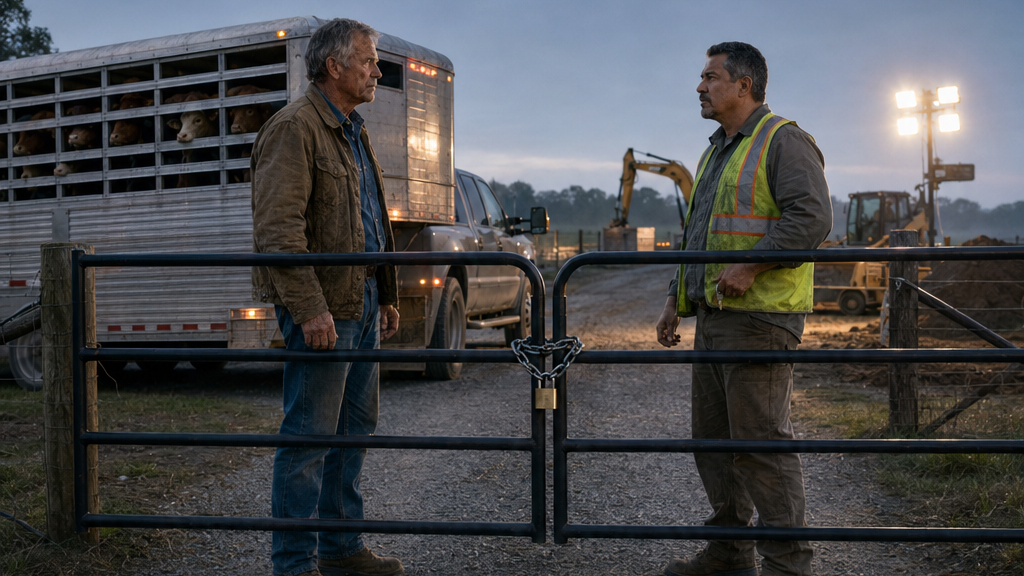
They Locked the Only Road to His Cattle Farm—Then He Found What the Old Easement Actually Required
Chapter 1: The Gate Was Locked Before the Cattle Truck Arrived
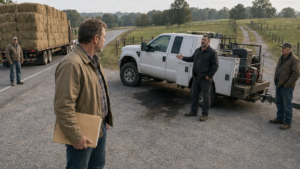
Anthony Walker stopped his pickup so hard that the thermos on the passenger seat rolled into the footwell.
Where the gravel lane had been open the night before, a black steel gate now stretched between two fresh posts. A bright chain looped through the center bars. The padlock hanging from it still looked clean enough to belong on a hardware-store shelf.
Anthony left the engine running.
For several seconds, he simply stared.
Beyond the gate, portable lights washed the neighboring construction yard in white glare. A compact excavator sat beside stacked pipe. Two work trailers stood where an old equipment shed had been torn down earlier that month. Tire tracks crossed the lane Anthony had driven nearly every day for more than forty years.
He looked at his watch.
The livestock hauler was due in twelve minutes.
Anthony stepped out and wrapped one hand around the cold steel.
“Morning.”
He turned.
Michael Torres came from between the construction trailers wearing work boots, a reflective vest, and the expression of a man who had already been awake long enough to consider the day underway.
Anthony pointed at the chain.
“Open it.”
Michael stopped a few feet away. “Can’t.”
Anthony waited, expecting the rest.
Michael gestured toward the equipment yard. “Site’s secured now. Insurance requirement.”
“This road goes to my farm.”
“I know where it goes.”
“Then open it.”
Michael’s mouth tightened slightly. He had been superintendent on the project for less than a month, but Anthony had seen him enough to know he rarely raised his voice. That morning he didn’t.
“We had instructions to secure the east entrance overnight.”
“This isn’t your entrance.”
“It’s inside our work perimeter.”
Anthony looked past him at orange fencing running along the edge of the construction parcel. The gate had been placed exactly where the narrow gravel lane passed between the two properties.
“No,” Anthony said. “Your work perimeter crosses my access.”
Michael folded his arms. “You’ve got another entrance on the west side.”
Anthony looked at him.
The western opening was a pair of weathered pasture gates almost half a mile away. A farm pickup could get through. So could Anthony’s tractor in dry weather.
A loaded cattle trailer was another matter.
“You ever pull forty thousand pounds through that field?” Anthony asked.
“No.”
“Then don’t tell me it’s an entrance.”
A low diesel rumble reached them from the county road.
Anthony closed his eyes for half a second.
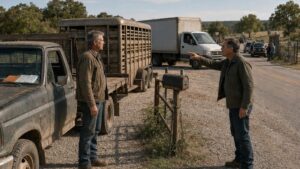
The livestock truck appeared through the trees, a long silver trailer turning slowly toward the farm. Cattle shifted inside it, hooves thudding against the floor.
The driver rolled forward until his headlights illuminated Anthony, Michael, and the locked gate.
He lowered his window.
“What happened?”
Anthony didn’t answer immediately.
Michael said, “Site access changed.”
The driver looked from him to Anthony. “Am I getting through?”
Anthony held Michael’s eyes.
“Open it.”
Michael shook his head. “I don’t have authorization.”
“You have a key.”
“That isn’t what I said.”
The cattle moved again inside the trailer. One bawled sharply, then another.
Anthony felt heat climb his neck.
There was a bolt cutter in the tool chest behind his pickup seat. There was also a tractor forty yards away capable of pulling the new posts out of the ground if he chained onto them correctly.
For one hot second, both options seemed simpler than continuing the conversation.
Then he looked at the trailer.
Animals did not care which man was right. They cared that the truck had stopped.
Anthony pulled out his phone.
Michael’s expression changed. “What are you doing?”
“Taking pictures.”
He photographed the gate, chain, padlock, posts, Michael’s construction vehicles behind them, and the livestock trailer waiting on Anthony’s side.
Then he photographed his watch.
5:48 a.m.
He stepped sideways and took another image showing the entire width of the lane.
Michael let out a breath. “You don’t need to turn this into something.”
Anthony lowered the phone.
“You put a steel gate across the road I use to move cattle.”
“We secured a construction site.”
“You secured my road with it.”
“Your road?”
“Shared road.”
Michael glanced toward the trailers behind him. “Then show me something that says that.”
Anthony stared at him.
His father had called it the lower lane. His grandfather had called it the lower lane. Trucks had used it before Anthony was old enough to reach the pedals of the farm pickup.
Nobody had ever stood there asking him to prove it.
“County records,” Anthony said.
“Fine. Bring me the record.”
The driver climbed down from his cab and walked toward them.
“We can’t sit here long,” he said quietly to Anthony. “Not loaded.”
Anthony knew.
They had twenty-two head scheduled for a sale barn two counties over. Miss their unloading window and the hauler would either charge a waiting fee or abandon the trip. Worse, the cattle would spend unnecessary hours confined.
Anthony looked once more at the padlock.
Then he stepped away.
“We’re turning them around.”
The driver frowned. “You sure?”
“No. But we’re doing it.”
Backing a loaded trailer out of the narrow lane took twelve slow minutes. Anthony stood beside the fence, guiding the driver until the rear wheels cleared the drainage ditch. Michael remained by the gate, saying nothing.
When the truck finally rolled back toward the highway, Anthony entered the arrival and departure times into his phone.
5:47 arrival.
6:11 departure.
Michael watched him.
“You keeping a diary now?”
Anthony pocketed the phone.
“I’m keeping track of what this costs.”
That landed differently.
Michael glanced down the lane.
“Look, I’m not trying to hurt your operation.”
“Then open the gate.”
“I can’t.”
“Won’t.”
Michael’s jaw shifted. “Corporate signed off on the security plan. There was equipment stolen from another project last month. They’re not leaving this site open overnight.”
“I’m not asking you to leave your equipment open. I’m asking you not to lock me out of my farm.”
“There has to be a way to work around it.”
“There was. Yesterday.”
Anthony walked back to his truck.
Michael called after him.
“If you’ve got an easement, bring it.”
Anthony stopped with his hand on the door.
“And until then?”
Michael hesitated.
Anthony turned.
“Until then?”
“The gate stays locked.”
“For how long?”
“I can get management involved Monday morning.”
Anthony stared at him.
It was Friday.
Behind the construction fence, a diesel engine started. Somewhere across the pasture, his own cattle answered with low restless calls as feeding time approached.
“Monday,” Anthony repeated.
Michael nodded.
“Unless you bring me something before then that proves you’ve got the right to use this lane.”
Anthony climbed into the pickup without replying.
As he turned toward the barns, the black gate remained in his rearview mirror, straight and new between the posts.
For the first time in Anthony’s life, somebody had put a lock between him and a road he had never imagined needing permission to use.
Chapter 2: Two Missed Loads Turned a Boundary Fight Into Payroll
The feed supplier called before Anthony reached the barn.
“I’m not taking the west entrance.”
Anthony put the phone on speaker and continued across the yard.
“It’s firm enough.”
“For your pickup, maybe.”
“A tandem truck’s been through there.”
“When?”
Anthony did not answer immediately.
“Exactly,” the supplier said. “We got rain Tuesday. Driver says there’s a soft shoulder and a slope into that crossing.”
Anthony looked toward the western field.
From where he stood, the old opening seemed harmless: two wooden gates, a grass track, and a shallow dip before the lane reached the barn lot.
He knew what the supplier was seeing that he didn’t want to.
A loaded feed truck carried weight differently from a tractor. If the rear wheels slid off the packed center, it could bury itself to the axle.
“So what are you saying?” Anthony asked.
“I can come Monday if your regular lane’s open.”
“We need feed today.”
“I know.”
“You’re already out this way.”
“And I’d rather be late than stuck sideways in your pasture.”
The call ended with no argument left to make.
Anthony lowered the phone.
Across the yard, an empty feed bay stood beneath the metal roof. Beyond it, through the fence and a line of cottonwoods, he could just see the top rail of the new steel gate.
Emma Clark crossed the yard carrying a clipboard.
“The cattle hauler called me.”
Anthony kept walking.
“I handled it.”
“He charged us for the trip.”
“I know.”
“And now the feed truck isn’t coming.”
“I know that too.”
She followed him into the barn office.
Anthony removed his cap and set it on the desk. The office smelled faintly of dust, leather gloves, and the burnt coffee he had forgotten to turn off earlier.
Emma closed the door.
“We can stretch what’s in the bins through tomorrow.”
“That’s what I figured.”
“Then what?”
“I’ll get the road open.”
“How?”
Anthony looked at her.
She leaned one hip against the filing cabinet.
“You told Michael it’s shared access.”
“It is.”
“Where’s the easement?”
Anthony turned toward the window.
Workers were moving equipment on the neighboring project. He could hear backup alarms whenever the wind shifted.
“It’s recorded.”
“That’s not what I asked.”
“I heard you.”
“Where is it?”
Anthony opened the desk drawer and began moving papers he knew had nothing to do with the question.
Emma watched him.
“Uncle Anthony.”
“I said it’s recorded.”
“So you have a copy.”
He stopped moving papers.
Emma’s expression changed.
“You don’t know where it is.”
“I know approximately.”
She gave a short breath that was almost a laugh but carried no humor.
“How approximately?”
Anthony shut the drawer harder than necessary.
“My father kept the land records.”
“He died nine years ago.”
“I’m aware.”
“And you’ve run everything since.”
“I ran most of it before.”
“That still doesn’t answer where the papers are.”
Anthony felt the argument sliding somewhere he did not want it to go.
“We have cattle waiting, two missed deliveries, and a construction company blocking the road. This isn’t the time for a lecture about filing cabinets.”
“No. It’s exactly the time.”
He looked at her sharply.
Emma did not retreat.
“I asked you last winter to show me where the deeds were.”
“I remember.”
“You said I didn’t need them.”
“You didn’t.”
“Apparently I did.”
Silence settled between them.
Outside, one of the seasonal farmhands started the loader.
Anthony picked up his cap but did not put it on.
Emma lowered her voice.
“If you got sick this morning, I wouldn’t know where the access papers were. I wouldn’t know who to call about the lane. I wouldn’t even know whether Michael was right.”
“He isn’t.”
“You know that because you’ve been here sixty years.”
“Sixty-two.”
“That’s not a record.”
Anthony looked away.
The worst part was that she had not said it cruelly.
That made it harder to dismiss.
He went outside before he answered.
By midday, the damage had become harder to treat as a temporary nuisance. The sale barn could not guarantee the same unloading slot if Anthony rescheduled the cattle. The hauler had another run booked Saturday. The feed supplier offered Monday morning but only if the normal entrance was restored.
Anthony walked the western track himself.
The ground near the shallow crossing gave slightly beneath his boot.
Halfway along it, he stopped.
A set of old tire ruts had filled with rainwater beneath the grass. He imagined a loaded truck dropping a wheel into one of them.
Michael had called this an alternate entrance.
Maybe from a site plan, it looked like one.
Anthony returned to the barn with mud on his boots and found Emma balancing invoices.
“How bad?” he asked.
She turned the sheet toward him.
The cattle trip charge. Lost sale slot. Rescheduling fee. Feed delivery delay. Hours they were already paying the farmhands to reorganize work around the blocked lane.
None of it would destroy the farm.
That almost made it worse.
A farm rarely died from one spectacular loss. It died from enough smaller ones arriving close together.
Emma tapped the page.
“If this goes past Monday, we start moving money.”
“From where?”
“Hay revenue.”
“That’s for equipment repairs.”
“I know.”
Anthony sat opposite her.
For the first time that morning, the gate no longer felt like something Michael had done to him.
It felt like something reaching past him toward everyone who depended on the operation.
Emma slid the invoices aside.
“Where did your dad keep land papers?”
Anthony stared at the desktop.
Then an image surfaced.
Not the office.
The farmhouse.
His father seated at the dining table years ago, property maps spread beneath a yellow lamp. A weathered expanding folder with frayed brown edges.
Anthony had once joked that the thing probably contained every argument the Walker family had ever had with a neighbor.
His father had replied, “That’s why you keep it.”
Anthony stood.
“The upstairs closet.”
Emma blinked. “What?”
“At the farmhouse. Hall closet. There’s a box behind the old tax files.”
“You sure?”
“No.”
It was the first honest answer he had given her all day.
They went together.
The box was farther back than Anthony remembered, beneath extension cords and a folded wool blanket. Dust coated the lid.
Emma carried it downstairs.
Anthony sat at the kitchen table while she opened it.
Inside were property-tax statements, old survey sketches, handwritten notes, receipts, and the weathered brown folder Anthony remembered.
He touched its edge.
For a moment he could see his father’s broad fingers flattening maps on this same table.
Emma sat across from him.
“You’ve looked through this since he died?”
Anthony shook his head.
“Not all of it.”
She did not press him.
They worked in silence.
Twenty minutes later, Anthony found a folded photocopy stamped by the county recorder.
He opened it carefully.
A legal description occupied most of the first page.
He followed the typed lines with one finger until the words resolved into something familiar.
A strip of land.
A gravel access route.
The Walker parcel.
Anthony read the paragraph twice.
Emma leaned closer.
“What is it?”
He slid the paper toward her.
Near the top, in faded type, were words neither of them had needed that morning until suddenly they needed them more than anything else.
Grant of Access Easement.
Chapter 3: The Old Easement Gave Anthony More Than Michael Expected
“Successors and assigns.”
Anthony read the phrase aloud a second time.
Emma was already searching the county recorder’s online system on her laptop, comparing the document number from the old photocopy to the digital index.
“What does that mean?” she asked.
“It means it wasn’t just between Dad and whoever owned that ground back then.”
“You sure?”
“No.”
Anthony looked at the telephone.
“That’s what we’re going to find out.”
It was after six on Friday evening when George Adams returned his call.
Anthony had known George for years in the way rural people sometimes knew attorneys: not socially, exactly, but through closings, fence questions, estate paperwork, and the occasional dispute that everybody hoped would disappear before anyone sent a formal letter.
George listened without interrupting.
“Start again with where the gate sits,” he said.
Anthony described the lane.
“Recorded easement?”
“I have a copy.”
“Send it.”
Emma scanned the pages while Anthony remained at the kitchen table. Through the window he could see the distant construction lights coming on as evening settled over the pasture.
The gate itself was hidden behind the trees.
Knowing it was there was enough.
George called back fourteen minutes later.
“This is better than your first explanation made it sound.”
Anthony sat straighter.
“How much better?”
“The easement is recorded against both parcels. It identifies the access strip, and yes, it says the rights and obligations run to successors and assigns.”
Emma looked up from across the table.
Anthony said, “So they can’t lock it.”
“I didn’t say that yet.”
Anthony’s shoulders tightened.
George continued.
“I’m saying the neighboring property changing ownership didn’t make the easement disappear. Based on what you sent, your parcel appears to retain a right of ingress and egress over that lane.”
“That’s what I told him.”
“I know.”
“He wants proof.”
“Now you have it.”
Anthony stood and crossed to the counter, energy returning to his movements.
“I’ll take it over there.”
“Tomorrow.”
“Tonight.”
“Anthony.”
He stopped.
George knew that tone worked better on him than raising his voice.
“Don’t go over there at night waving a paper at a construction superintendent.”
“I’m not waving anything.”
“Good. Then send me the current parcel records first.”
Emma had already begun pulling them up.
George continued, “I want to confirm that the easement wasn’t released, relocated, amended, or extinguished by something you haven’t shown me.”
Anthony looked back toward the dark window.
“It wasn’t.”
“You haven’t read that box in nine years.”
The sentence landed with uncomfortable precision.
Anthony sat again.
Emma kept her eyes on the laptop.
George said, “Let’s prove what you know before you act like we proved everything.”
For the next hour, Emma downloaded current parcel records while Anthony sorted through the old folder.
The easement had been created decades earlier, when the neighboring tract still belonged to a family that stored grain equipment there. The Walker parcel received access across a defined strip roughly following the lane exactly where it ran now.
Anthony remembered the old owners.
Nobody had discussed legal language then.
If a truck needed through, somebody opened a gate.
If grading washed out, somebody brought a tractor.
If a culvert plugged, whoever saw it first cleared it.
Anthony had always considered that evidence that the arrangement was simple.
Now the paperwork on the table suggested the simplicity had been constructed, recorded, and preserved by people who understood that memory alone was not enough.
Emma turned the laptop.
“The neighboring parcel changed hands twice.”
Anthony leaned closer.
“And?”
“No release that I can find.”
George called again at eight.
“I’ve checked what I can tonight,” he said. “I don’t see anything terminating the access.”
Anthony felt the first clean relief of the day.
“So we’re right.”
George was silent for a beat.
“About access, likely yes.”
Anthony caught the qualifier.
“Likely?”
“Courts like facts. Attorneys like facts. Farmers like facts until facts start charging by the hour.”
Emma smiled despite herself.
Anthony did not.
“What happens now?”
“I can send notice tonight. Tomorrow morning, you give Michael a copy. Tell him counsel has reviewed it and you’re demanding access be restored.”
“And if he doesn’t?”
“We decide how quickly to escalate.”
Anthony looked at the faded paper.
That morning Michael had been standing beside a locked gate telling him to prove the road was his to use.
Now Anthony had the answer.
It felt good.
Too good, perhaps.
He allowed himself to imagine walking to the gate at sunrise, handing Michael the document, watching him read the controlling language, then hearing the chain fall loose.
Emma gathered the remaining pages.
“Wait.”
Anthony looked at her.
She held up a second sheet attached behind the recorded easement.
“This part references maintenance.”
Anthony reached for it.
The language was denser than the access grant.
Each benefited parcel would contribute proportionately to reasonable maintenance, grading, drainage, and repair of the shared access.
Anthony read it once.
Then again.
“That’s normal,” he said.
Emma did not answer.
He flipped deeper into the folder.
There were old receipts clipped together.
Gravel.
Culvert work.
Grading.
Half paid by the neighboring owner. Half marked Walker.
Anthony relaxed slightly.
“See?”
Emma took the receipts and arranged them by date.
“They stop.”
Anthony looked at them.
“What?”
She laid out the last three.
Same contractor.
Same lane.
Same handwriting.
Then nothing.
“What year?” Anthony asked.
Emma told him.
Anthony’s relief disappeared.
That was before his father died.
Years before Anthony had taken over every part of the farm’s daily management.
George was still on speaker.
“What did you find?” he asked.
Anthony stared at the final receipt.
Emma answered.
“A maintenance clause.”
There was a short silence.
George said, “Read it to me.”
Emma did.
Anthony remained standing beside the table, one hand resting on the brown folder.
When she finished, George asked, “Do you have evidence those payments continued?”
Anthony looked at the neat row of old receipts ending in the middle of a decade.
“No.”
“Then before you march over there tomorrow thinking that document proves only their failure,” George said, “you need to understand something.”
Anthony’s jaw tightened.
“What?”
“The same paper that gives you rights may also show obligations your side stopped meeting.”
Anthony looked toward the dark pasture.
For the first time since finding the easement, the locked gate no longer seemed like proof that one side had ignored the rules.
It looked like the beginning of a question about whether both of them had.
Chapter 4: The Paper That Proved His Right Also Proved His Neglect
The receipts stopped six years before Anthony had taken over every part of the farm’s daily management.
He spread them across the kitchen table Saturday morning in a line from oldest to newest. Gravel deliveries. Culvert work. Grader hours. Each one carried some version of the same arrangement: half charged to the neighboring parcel, half to the Walker farm.
Then, abruptly, nothing.
Emma stood beside him with a mug cooling between both hands.
“You ever see invoices after these?”
“No.”
“Did your dad pay cash?”
“Sometimes.”
“For road work?”
Anthony looked at the final receipt again.
“No.”
The answer bothered him more than he wanted Emma to see.
He went back through the brown folder, slower now. The night before he had searched for proof that Michael was wrong. This morning, every page seemed capable of proving something about Anthony instead.
There were handwritten notes from his father. A contractor estimate for drainage work. A copy of a letter from the previous neighboring owner disputing the cost of grading after a spring washout.
Then Anthony found a page with two sentences underlined in pencil.
The neighboring owner had objected to paying for work Anthony’s father arranged without prior approval.
His father had written in the margin: Then let them maintain it.
Anthony recognized the handwriting immediately.
Emma read over his shoulder.
“So they fought.”
“Looks like it.”
“And after that?”
Anthony did not answer.
Outside, a tractor started near the hay barn. The ordinary sound only made the paperwork feel stranger.
At ten, George called.
“I looked through the easement again,” he said. “Nothing in it says failure to pay maintenance automatically cancels access.”
Anthony sat straighter.
“So Michael still can’t lock us out.”
“Probably not on that basis.”
“Probably.”
“You keep wanting absolute answers before we have all the facts.”
“I have a gate across my road.”
“And you may also have unpaid obligations attached to that road.”
Anthony pressed his thumb against the edge of the table.
“How much?”
“That’s what you need to figure out.”
By noon, Emma had made a list of years without receipts.
Anthony hated the list.
Not because of the amount—it was impossible to know that yet—but because it exposed a blank space he had never considered important enough to investigate.
Emma turned the paper around.
“We should ask the old owner.”
Anthony shook his head.
“We should deal with Michael first.”
“Why?”
“Because the gate is still locked.”
“And the maintenance issue doesn’t disappear because we don’t like the timing.”
Anthony stared at her.
“You sound like George.”
“That’s probably not an insult.”
He stood.
“I’m going over there.”
Emma picked up the folder.
“I’m coming.”
“No.”
“Yes.”
He looked at her.
She kept the folder against her chest.
“You said I didn’t need these papers. Then yesterday we nearly lost a feed delivery because neither of us could prove what we were entitled to. I’m coming.”
Anthony opened his mouth, then closed it.
Ten minutes later they stood beside the steel gate.
Michael was outside the construction trailer with a tablet in one hand.
Anthony held up the easement.
“Found it.”
Michael came closer but did not reach for the paper.
Anthony handed him a copy.
Michael read silently.
His face gave very little away until he reached the clause binding successors.
Then his eyes moved back to the top.
“This old?”
“Old enough to still be recorded.”
Michael continued reading.
Anthony waited.
Finally Michael said, “It also says maintenance.”
“I know.”
Michael looked up.
“So you haven’t been paying your share.”
Anthony felt Emma beside him.
“We’re checking that.”
“That sounds like no.”
“It sounds like we’re checking records.”
Michael gave a short nod.
“We’ve been grading that lane since we took possession.”
“For how long?”
“Eight months.”
“And you sent me an invoice?”
Michael paused.
“No.”
“Asked me to approve work?”
“No.”
“Then don’t pretend this is simple.”
Michael folded the copy once.
Anthony stepped forward and rested his hand on the gate.
The metal was already warm from the sun.
“My access is recorded.”
“And your obligations are recorded.”
“I said I know.”
Michael’s expression hardened slightly.
“Then maybe we stop acting like my company woke up and decided to steal your road.”
Anthony felt the old anger return.
“You put a lock on it.”
“Because we had to secure the site.”
“Across my access.”
“Across a lane your side hasn’t helped maintain.”
Emma spoke before Anthony could.
“Does your company believe unpaid maintenance extinguishes the easement?”
Michael looked at her.
“I’m not the attorney.”
“Neither are we.”
“That’s why I’m waiting on management.”
Anthony turned toward him.
“You’ve had the document since ten minutes ago. Open the gate while management reads it.”
Michael shook his head.
“No.”
“Why?”
“Because if I open it, I’m overriding the security plan.”
“And if you keep it closed?”
“I’m following the plan until someone above me changes it.”
Anthony laughed once, without humor.
“So that’s it.”
“That’s it for now.”
“You know there’s an easement.”
“I know there’s a document with access language and a maintenance clause neither of us has fully sorted out.”
Michael handed the copy back.
“I’m not making a legal call.”
“You already made one when you locked it.”
The words landed hard enough that even Michael looked away.
For a moment, nobody spoke.
Then Michael said quietly, “You think I enjoy this?”
Anthony almost answered yes.
Michael gestured toward the equipment yard.
“Three weeks ago another site had copper stolen, fuel drained, and two machines stripped overnight. Insurance put us on notice. My regional manager told me if this project wasn’t secured, I’d be the one answering for it.”
“That doesn’t give you my road.”
“I didn’t say it did.”
“Then open it.”
Michael’s jaw tightened again.
“I can’t.”
Anthony stepped back from the gate.
The conversation had changed, but the result had not.
Emma waited until they were halfway across the yard before speaking.
“You remember last winter?”
Anthony kept walking.
“What about it?”
“I asked you to put all the land agreements in one place.”
He stopped.
Emma stopped too.
“You told me there was nothing in those papers I needed to worry about.”
Anthony looked toward the barns.
“I remember.”
“No, I don’t think you do.”
He turned toward her.
She held his gaze.
“I wasn’t asking because I wanted control. I was asking because I manage half the things that depend on those agreements.”
Anthony felt something sharper than anger because he knew exactly where it came from.
He had treated knowledge like ownership.
As long as the records stayed in his head, or in boxes only he knew about, the farm still felt unquestionably his to manage.
“Fine,” he said.
Emma frowned.
“Fine what?”
“Fine. I should’ve shown you.”
The admission sounded thin compared with what it cost him to say it.
Emma nodded once.
“That’s all I wanted you to say.”
That afternoon, George called again.
Anthony told him what Michael had said.
George listened.
“Maintenance is a real issue,” he said. “Don’t minimize it.”
“I’m not.”
“You were twelve hours ago.”
Anthony said nothing.
George continued.
“But absent language saying nonpayment terminates the easement, unpaid maintenance generally doesn’t turn access into no access overnight.”
“So he still has to open it.”
“He may have to restore reasonable access. That’s different from me promising what a judge will order.”
Anthony looked through the barn-office window toward the distant black gate.
“What do we do?”
“We establish what they knew, what they planned, and whether they had notice of the easement before installation.”
Anthony frowned.
“Why does that matter?”
“Because there’s a difference between accidentally blocking a right you didn’t know existed and knowingly taking the risk that someone else’s access didn’t matter.”
Anthony’s grip tightened around the phone.
“If Michael already knew,” George said, “then the maintenance argument may be less of an explanation and more of an excuse.”
Chapter 5: Michael Had Seen the Access Warning Before the Gate Went Up
The surveyor did not hesitate.
“Yes,” he said. “The access issue was on the plan.”
Anthony stood beside the county office counter Saturday afternoon with Emma on one side and the surveyor on the other.
“You marked it?”
“I marked the lane as existing access.”
“For my parcel?”
The surveyor slid a copy of the site exhibit across the counter.
A narrow strip ran along the edge of the construction property. Beside it was a notation referencing potential shared access rights and recorded-title review.
Anthony read it twice.
“So they knew.”
The surveyor shook his head.
“I said it was flagged. I don’t know what their legal team concluded.”
“Michael saw this?”
“He was copied on the revised site package.”
Emma looked at Anthony.
That was enough to make his chest tighten.
Not proof that Michael had read every line. Not proof he understood the easement. But it destroyed the cleanest version of Michael’s explanation—that nobody on the construction side had any reason to suspect the lane mattered.
Back at the farm, Anthony called George.
George asked for the document, then said, “Useful. Not decisive.”
Anthony paced the barn office.
“You say that about everything.”
“Because everything isn’t decisive.”
“The access was flagged.”
“Yes.”
“They installed the gate anyway.”
“Yes.”
“And they’re still keeping it locked.”
“That part concerns me most.”
Anthony stopped pacing.
George continued.
“They now have the easement. They now know your parcel claims access. They know the alternate route may not accommodate commercial traffic. At some point, waiting becomes a choice.”
Anthony looked toward Emma.
She had heard.
“What do you need from me?” Anthony asked.
“One more attempt to resolve it. Calmly.”
Anthony almost laughed.
“I’ve been calm.”
Emma raised an eyebrow.
George said, “Be calmer.”
They met Michael beside the construction trailer late that afternoon.
This time Michael had no coffee, no tablet, no casual expression.
He already knew about the survey exhibit.
Anthony laid it on a folding table between them.
“You saw this before the gate went up.”
Michael looked down at it.
“I saw the site package.”
“That means yes.”
“It means I saw hundreds of pages.”
“Did you see the access notation?”
Michael exhaled.
“Yes.”
Emma remained quiet.
Anthony leaned both hands against the table.
“And you still installed the gate.”
“I believed the west entrance served your property.”
“You believed.”
“That’s what the civil plan showed.”
“The civil plan showed a field opening.”
Michael looked at him.
“It showed vehicular access.”
“Bring one of your loaded semis through it.”
“That isn’t my decision.”
“No, apparently none of this is.”
Michael’s face tightened.
Anthony knew he had hit something personal, but he kept going.
“You saw the warning. You didn’t ask me. You didn’t ask for the easement. You just decided another entrance was good enough.”
Michael was silent for several seconds.
Then he said, “You want to know what happened?”
Anthony waited.
Michael pointed toward the equipment yard.
“Another project lost almost eighty thousand dollars in equipment and materials. Regional management tore the superintendent apart over it. Insurance threatened higher deductibles on every unsecured rural site.”
Anthony said nothing.
“I was told this place would be locked down before the next billing cycle. I asked about the lane. Planning said there was west access to your parcel and no active objection on file.”
“You could’ve walked over and asked me.”
“Yes.”
The answer came so quickly Anthony lost his next line.
Michael looked directly at him.
“I could have.”
Emma shifted slightly beside Anthony.
Michael continued.
“I also could’ve delayed the security work, kicked it back to legal, and told my regional manager I wasn’t comfortable with the access note.”
“Why didn’t you?”
Michael looked toward the yard.
“Because I’ve been doing this twenty-three years, and lately every delay becomes somebody asking whether I can still manage a project.”
There it was.
Not innocence.
Not justification.
Fear.
Anthony recognized it because it sounded uncomfortably familiar.
Michael had treated uncertainty as a threat to his authority.
Anthony had spent years doing the same thing with the farm.
Michael tapped the survey exhibit.
“I saw another entrance. I saw no formal objection. I made the call.”
“And after Friday morning?”
Michael’s expression changed.
“That’s different.”
“You knew then.”
“Yes.”
“You knew livestock couldn’t use the west route.”
“I knew you said they couldn’t.”
“You watched the trailer turn around.”
Michael looked away.
Anthony waited.
Finally Michael said, “Yes.”
“Then why is the gate still locked?”
Michael rubbed one hand across the back of his neck.
“Because once I told management we might’ve blocked a recorded access right, nobody wanted me changing anything without counsel.”
Anthony stared at him.
“So you made the decision quickly when it hurt me, and now you need three layers of approval to undo it.”
Michael did not argue.
That silence was more honest than anything he had said before.
Emma spoke.
“What would happen if you opened it tonight?”
Michael looked at her.
“I’d be violating the current site-security directive.”
“You’d lose your job?”
“I don’t know.”
Anthony looked at the gate.
For two days he had wanted Michael to become simpler.
A man who knew exactly what he was doing and did it because Anthony’s farm didn’t matter.
That would have been easier.
Instead Michael looked tired.
But tired men could still make harmful choices.
Anthony picked up the survey exhibit.
“I understand why you installed it.”
Michael looked surprised.
Anthony continued.
“I don’t agree with it.”
“I know.”
“And now you understand why keeping it closed is different from installing it.”
Michael’s eyes held his.
“Yes.”
“Then open it.”
Michael’s answer was almost quiet enough to miss.
“No.”
Anthony felt whatever sympathy had appeared inside him settle into something harder and cleaner.
Not rage.
Responsibility.
Michael had reasons.
He also had a choice.
By Sunday afternoon, George had assembled what he needed: the recorded easement, current parcel records, the survey notation, Anthony’s photographs, livestock-hauler records, feed-delivery cancellation, and written notice that the construction company still refused access.
Emma placed copies into a new folder.
Anthony looked at it.
“You bought that?”
“Yesterday.”
Unlike his father’s weathered brown file, this one was plain, labeled, and easy to find.
Anthony almost made a joke.
He stopped himself.
“What happens if George gets the order?” Emma asked.
“Gate opens.”
“And the maintenance?”
“Still there.”
She nodded.
Anthony knew what she was asking without saying it.
Would he tell the court only the part that favored him?
He had spent most of Saturday wishing the maintenance clause did not exist. By Sunday, he had begun to understand that pretending it did not exist would make him no better at stewardship than when the papers sat unopened in the farmhouse closet.
George called just before five.
“I’m filing for emergency relief first thing Monday.”
Anthony sat on the edge of the barn-office desk.
“What are you asking for?”
“Immediate restoration of reasonable access pending resolution of the underlying dispute.”
“Not removal of the gate?”
“Not necessarily.”
Anthony looked toward it through the distant trees.
“That gate’s the problem.”
“The lock is the problem. Control is the problem. A gate can serve both properties if nobody gets unilateral power over it.”
Anthony had not considered that.
For two days he had imagined victory as the gate coming down.
George continued.
“And Anthony?”
“Yes.”
“If this gets in front of a judge, I am not hiding the maintenance clause.”
“I know.”
“Good.”
Anthony looked at the new folder Emma had prepared.
“I don’t want you to.”
There was a brief silence.
George said, “All right.”
Monday morning, before dawn had fully lifted, George sent a message.
Filed.
For the first time since Friday, Anthony did not drive straight to the gate.
He waited.
At 7:18, George called.
“We have temporary relief.”
Anthony stood.
“What exactly?”
“The order requires access be restored while the parties sort out maintenance and permanent controls.”
Anthony exhaled.
Then George added, “A deputy will be there shortly to document compliance.”
Anthony reached for his coat.
Emma was already standing.
Neither of them said what both were thinking.
The next time they reached the gate, Michael would no longer be the only man deciding whether the chain stayed locked.
Chapter 6: The Sheriff Arrived, but Anthony Refused the Easy Victory
The deputy’s cruiser was already parked beside the steel gate when Anthony arrived.
Michael stood near the construction trailer with four workers behind him. Nobody was operating equipment. The entire staging yard seemed to be waiting on one small padlock.
Anthony stopped his pickup on his side of the lane.
Emma stepped out beside him carrying the new folder.
George was there too, standing near the deputy with several sheets clipped together.
Michael looked at Anthony but did not speak.
The deputy did.
“Mr. Walker?”
Anthony nodded.
“I’m here to document compliance with a temporary civil order. I’m not here to decide your property dispute.”
“Understood.”
The deputy glanced toward Michael.
“Mr. Torres has a copy.”
Michael held the papers loosely at his side.
George came toward Anthony.
“The order is straightforward. Reasonable access restored immediately. Maintenance, damages, and permanent configuration remain unresolved.”
Anthony looked at the gate.
The chain was still there.
“So open it.”
George lowered his voice.
“They will.”
Michael approached.
For the first time since Friday, he looked less like a man guarding something and more like a man standing beside a decision that had moved beyond him.
“Our attorney says we comply,” he said.
Anthony almost answered with something sharp.
Three missed deliveries. Extra hauling charges. Feed disruption. Two days of being told to prove a road his family had used for decades.
He could have made Michael say it.
Could have demanded an apology.
Could have asked the deputy to stand there while the whole security system came apart.
Instead Anthony asked, “Who has the key?”
Michael pulled it from his pocket.
The same key he had possessed Friday morning.
That fact carried more weight than Anthony expected.
Michael crossed to the gate.
The workers watched.
So did Emma.
Michael pushed the key into the padlock and turned.
The mechanism clicked.
He removed the chain slowly, metal scraping across metal.
For a moment Anthony was back at dawn Friday with the livestock trailer idling behind him and cattle shifting inside.
Then the chain fell free.
Michael opened one side of the gate.
The lane beyond it was exactly where it had always been.
Anthony could have driven through immediately.
Instead he stayed where he was.
George looked at him.
“You’ve got access.”
“I know.”
Michael stood beside the open gate.
“What now?”
Anthony walked forward.
He stopped close enough to touch the steel but didn’t.
“I don’t want the gate torn out.”
Michael’s eyebrows lifted.
George said nothing.
Anthony looked toward the equipment yard.
“You need security.”
Michael waited.
“I need access.”
“Yes.”
“Then the gate can stay if neither of us controls it alone.”
The deputy shifted his stance, listening but remaining outside the negotiation.
Michael looked at George.
George said, “That’s something you can discuss as interim terms.”
Michael looked back at Anthony.
“What are you proposing?”
“Shared lock system. Emergency access. Nobody chains the other side out.”
Michael’s expression remained guarded.
“You’d agree to that?”
“If the road stays open to my operation.”
“And maintenance?”
There it was.
Anthony felt Emma watching him.
He could have said that was separate.
Legally, perhaps it was.
Instead he opened the folder she carried and removed the maintenance clause.
“My side hasn’t been paying what the easement says we’re supposed to pay.”
Michael’s expression changed.
Anthony continued.
“I don’t know the amount yet. I don’t know which work qualifies. I’m not agreeing to whatever number your company writes down.”
“That’s fair.”
“But if there’s a legitimate share we owe, we’ll pay it.”
One of the workers behind Michael glanced toward another.
Anthony did not care.
The admission was not for them.
It was for Emma.
And, unexpectedly, for himself.
Michael looked at him for a long moment.
“You don’t have to settle that today.”
“I know.”
“Then why say it now?”
Anthony folded the paper once.
“Because I spent Friday telling you a recorded agreement mattered.”
Michael gave a slight nod.
Anthony finished.
“I don’t get to mean only the paragraph I like.”
Silence held for a moment.
George finally said, “That will make the next conversation easier.”
Anthony looked at him.
“Don’t sound so surprised.”
“I’m an attorney. Surprise is billable.”
Emma laughed once under her breath.
Even Michael smiled faintly.
The tension did not disappear.
It changed shape.
The deputy documented the open gate and spoke briefly with both sides. No one celebrated. No worker clapped. No one apologized in front of an audience.
The road was simply open.
That was enough.
A feed truck arrived less than an hour later.
Anthony stood beside the lane while it rolled through the gate.
The driver slowed and leaned out the window.
“This staying open?”
Anthony looked at Michael.
Michael answered first.
“Yes.”
Anthony added, “From now on, somebody besides him gets a key.”
Michael accepted that without argument.
By midmorning, George had drafted temporary terms allowing both parcels continuous access while a surveyor and accountant reviewed maintenance responsibilities.
Michael’s company installed a second authorized lock in the system so either side could open the gate without the other.
It was not elegant.
It worked.
Anthony spent the next several hours trying to catch up on the farm work Friday had disrupted.
Near noon, Emma found him at the feed yard.
She held the old brown folder.
“I found something else.”
Anthony shut off the loader.
“What?”
“Loose envelope in the back.”
She handed it to him.
His name was written across the front.
Anthony recognized the handwriting before he saw the return address.
His father’s.
The envelope had never been sealed.
Inside was a folded letter dated eight years earlier.
Anthony did not open it immediately.
“Where was this?”
“Behind the survey plats.”
He looked at her.
“You read it?”
“First line.”
Anthony frowned.
Emma held out the letter.
“You should probably read the rest.”
Anthony unfolded it.
The first sentence was written in the same square handwriting that appeared on decades of feed orders, tax notes, and fence measurements.
Anthony,
Handshake arrangements die with the men who made them.
He stopped reading.
For a moment the barnyard noise seemed to recede.
Emma stood quietly beside him.
Anthony looked toward the shared lane.
The steel gate was closed again now, but the chain was different.
Two locks.
Two keys.
No single man controlling passage.
He lowered his eyes to the letter.
His father had understood the problem years before Michael ever arrived.
The question was why Anthony had never allowed himself to understand it too.
Chapter 7: His Father Had Warned Him About the Road Years Earlier
Anthony recognized his father’s handwriting before he finished the first paragraph.
The letters leaned slightly to the right, blocky and deliberate, the way they had appeared for decades on feed invoices and notes taped to tractor dashboards.
Anthony,
Handshake arrangements die with the men who made them.
He read the line again.
Emma stood across the kitchen table without speaking.
The rest of the letter was only two pages.
His father had written it after the maintenance dispute with the previous neighboring owner. He described how the lane had worked for years because both families understood what it was for, who needed it, and what each side was expected to contribute.
Then ownership had begun changing.
People retired. Land sold. Contractors arrived who had never known the original arrangements.
His father had written that the road itself was not the dangerous part.
Assumption was.
Anthony lowered the page.
“He knew.”
Emma pulled out the chair opposite him.
“Knew what?”
“That this could happen.”
He read another paragraph.
His father had wanted the easement reviewed, the maintenance responsibilities updated, and a permanent system created for future owners. He had even written that Anthony should not depend on personal relationships to preserve something essential to the farm.
Anthony found one sentence underlined twice.
Make it clear enough that Emma won’t have to ask permission from people who never met us.
Anthony stopped.
Emma looked up.
“What?”
He handed her the page.
She read the sentence.
Neither spoke for several seconds.
“You were already thinking I’d run it?” she asked.
“That’s what he was thinking.”
“That’s not what I asked.”
Anthony looked toward the window.
The shared gate stood beyond the pasture, too far away to see clearly from the farmhouse.
He folded his hands on the table.
“I suppose I was thinking it too.”
Emma waited.
“I just never said it.”
“Why?”
Anthony rubbed his thumb along the edge of the letter.
Because saying it meant admitting there would be a day when he would not be the one making every decision.
Because giving Emma the records meant accepting that the farm needed to function without his memory.
Because his father had aged in front of him slowly enough that Anthony had mistaken refusing to talk about succession for loyalty.
He did not say all of that.
Instead he said, “I thought there was time.”
Emma leaned back.
“There’s always time until there isn’t.”
Anthony looked at her.
“That sounds like something my father would’ve said.”
“No. He apparently wrote his things down.”
The line was sharper than her usual tone.
Anthony could have taken offense.
A week earlier, he probably would have.
Instead he nodded.
“That was deserved.”
Emma’s expression softened, but she did not apologize.
The next morning, Anthony carried three boxes from the upstairs closet into the farm office.
Tax records went into one cabinet.
Equipment titles into another.
The brown folder went on the desk.
Emma watched him label a new drawer.
“Land records?”
“Deeds. Easements. Surveys. Agreements.”
“And I get access?”
Anthony handed her a key.
“You get access.”
She looked at the key in her palm.
“You know this isn’t about me wanting to take over tomorrow.”
“I know.”
“You sure?”
“No.”
That made her smile.
“Better answer.”
Later that afternoon, George met Anthony and Emma at the county recorder’s office.
The temporary access order was working. Both sides could open the steel gate. Feed deliveries had resumed. The livestock hauler had rescheduled the cattle.
But the permanent agreement was harder.
The construction company wanted a formal security protocol.
Anthony wanted unrestricted agricultural access.
Both sides disagreed over the amount of past lane maintenance that qualified under the easement.
George spread the preliminary figures across a table.
Anthony looked at the total.
“That much?”
“That’s their number.”
“They resurfaced portions I never requested.”
“Which is why we review it.”
Emma pointed to another line.
“What about drainage work?”
“That likely benefits both parcels.”
Anthony frowned.
“So we owe some of this.”
George looked at him.
“Yes.”
A week earlier Anthony would have felt cornered by the admission.
Now he felt something else.
Relief, almost.
The argument no longer required him to be completely right.
It required him to decide what responsibility looked like once the facts were clear.
The meeting with Michael happened at the gate the following day.
The temporary system had left two authorized locks linked through the chain so either party could release it independently.
It was clumsy.
It was also the first version of the gate that did not belong entirely to one side.
Michael arrived carrying his own folder.
“Our office will accept a shared-access protocol,” he said.
Anthony nodded.
“Conditions?”
“Gate stays. Both sides maintain access. Construction security after working hours. Your farm gets continuous authorized entry.”
“Livestock trucks?”
“Any legitimate farm traffic.”
“Emergency services?”
“Independent access code once we replace the locks.”
Anthony looked toward George.
George gave no signal.
This part belonged to Anthony.
Michael continued.
“We still expect contribution on maintenance.”
Anthony looked at the road beneath his boots.
Fresh gravel covered parts of it. Other sections were older, worn smooth by decades of tires and weather.
“I’ll pay what the agreement says I owe.”
Michael’s posture shifted slightly.
“But,” Anthony continued, “not work your company chose for construction convenience and then decided to call shared maintenance.”
“That’s reasonable.”
“We audit it.”
“Agreed.”
Emma glanced between them.
The easiest part of the conversation was over.
Anthony knew the harder part had nothing to do with money.
“I want something else.”
Michael waited.
“No unilateral changes to access.”
“That’ll be in the protocol.”
“I mean either direction.”
Michael frowned slightly.
Anthony explained.
“If I decide five years from now I want to move the road, block it, narrow it, whatever—I don’t get to do that just because I’ve been here longer.”
Michael looked at him carefully.
“You want the restriction to bind you too.”
“Yes.”
George finally spoke.
“That’s the point of recording it.”
Anthony looked at the gate.
His father had spent years trusting relationships to carry responsibilities that belonged on paper.
Anthony had inherited that habit.
Then he had blamed Michael for relying on a plan that failed to ask enough questions.
Both mistakes came from different kinds of certainty.
Michael opened his folder.
“I can work with that.”
Anthony nodded.
Emma said, “Then there should be a contact protocol too. Before anyone changes anything.”
Michael looked at her.
“Who’s the farm contact?”
She glanced toward Anthony.
He did not answer for her.
“Me,” Emma said.
Michael wrote it down.
Anthony felt the significance of that small act more strongly than he expected.
Not because Emma had replaced him.
Because the farm had finally stopped depending on one person being available forever.
They spent the next hour going through practical details.
Access widths.
Gate clearance.
Snow removal.
Drainage.
Emergency entry.
Maintenance notices.
None of it felt dramatic.
That was exactly why Anthony understood its value now.
At the end, George gathered the draft pages.
“If everyone approves the final language, we record it.”
Michael nodded.
Anthony looked at the steel gate.
“We’ll sign.”
George looked at him.
“After review.”
Anthony almost smiled.
“After review.”
As they walked back toward the farm, Emma held the draft agreement under one arm.
Anthony said, “You keep a copy.”
“I planned to.”
“And the permanent records binder.”
She stopped.
“What binder?”
Anthony looked toward the farmhouse.
“The one we’re putting together.”
Emma studied him.
“You’re serious.”
“I’m learning.”
She nodded slowly.
Behind them, the gate remained closed.
But neither side possessed the only key anymore.
Chapter 8: The Same Steel Gate Stayed, but Nobody Controlled It Alone
The livestock trailer appeared at the end of the county road just after sunrise.
Anthony saw it from the barnyard.
For a moment, the sight pulled him backward several weeks—to the first truck idling helplessly before a locked gate, cattle shifting inside while Michael refused to release the chain.
This trailer slowed at the turn.
Then kept coming.
Anthony did not move.
Emma was already at the gate.
The new access system had been installed two days earlier. The heavy chain was gone. In its place, the steel gate carried a coded agricultural latch with separate authorized access for the farm and construction property.
Emma entered the code.
The gate swung open.
No phone call.
No superintendent.
No lawyer.
No Anthony.
The truck passed through.
The driver lifted two fingers from the steering wheel as he went by.
Emma closed the gate behind him and walked back toward the farm.
Anthony waited beside the fence.
“You could’ve let me get that,” he said.
“I know.”
He nodded.
That was the point.
The permanent agreement had been recorded the previous afternoon.
It did not erase the old easement.
It clarified it.
The Walker farm retained access for livestock, feed, equipment, service vehicles, and emergencies. The neighboring parcel retained the right to secure its construction and future operational area without obstructing that access.
Both sides had emergency contacts.
Both sides had notice requirements.
Both sides shared defined maintenance costs.
Neither could change the route or access system alone.
The document was longer than Anthony thought a road should require.
He no longer considered that a weakness.
Later that morning, Emma placed an envelope on his desk.
“What’s this?”
“Our first maintenance payment.”
Anthony opened it.
The number was lower than the construction company’s original demand but higher than he had hoped.
George’s review had separated true shared maintenance from work performed primarily for the construction project.
The resulting amount was fair.
Anthony disliked it anyway.
Emma noticed.
“You can still complain.”
“I am complaining.”
“You’re very quiet about it.”
“I’m getting older.”
She laughed.
Anthony signed the check.
His pen paused over the signature line for a fraction of a second.
The money represented gravel, drainage, grading, and several years of obligations that had become invisible because nobody had forced the issue.
He thought about his father’s note in the margin.
Then let them maintain it.
At the time it had probably felt like pride.
Years later it had become a debt neither father nor son had properly addressed.
Anthony handed the check back.
“Send it.”
Emma put it in the envelope.
“Done.”
He leaned back.
“That hurt more than the attorney bill.”
“George would be offended.”
“He’ll recover.”
The construction project continued next door.
For the first week after the agreement, Anthony still noticed every time Michael’s crew used the gate.
He noticed when equipment came through.
When workers closed it.
When someone tested the new latch.
Gradually, he stopped.
One afternoon Michael walked over while Anthony was replacing a broken board on the cattle fence.
“Got a minute?”
Anthony set down the hammer.
Michael handed him a photocopy.
“What’s this?”
“Final maintenance schedule.”
Anthony scanned it.
“Emma already has this.”
“I figured.”
Anthony looked up.
Michael shrugged.
“Old habit.”
“Giving everything to the old guy?”
“Giving everything to whoever complained first.”
Anthony laughed despite himself.
Michael looked toward the gate.
“My project manager asked why we didn’t just remove it.”
“What’d you tell him?”
“That removing it would solve the argument, not the problem.”
Anthony nodded.
“You get that from George?”
“No.”
“Good. I was about to charge you.”
Michael smiled.
The relationship between them had not become friendship.
Anthony did not need it to.
Michael had admitted his decision.
Anthony had admitted his own neglect.
Both men had paid for parts of the mistake.
That seemed more useful than an apology neither would entirely know how to phrase.
Michael started back toward the construction yard.
Anthony called after him.
“You ever get anything else stolen?”
Michael turned.
“Not yet.”
Anthony pointed toward the gate.
“Guess it works.”
Michael looked at him for a moment.
“Works better when both sides can open it.”
Then he walked away.
By the end of the month, Anthony and Emma had finished organizing the farm records.
The permanent binder was thicker than Anthony expected.
Deed.
Easements.
Survey plats.
Insurance information.
Equipment titles.
Emergency contacts.
Operating agreements.
Maintenance records.
A copy of the newly recorded access protocol.
Anthony added his father’s letter last.
Emma watched him slide it into a clear protective sleeve.
“You want that in there?”
“Yes.”
“It isn’t legally important.”
“No.”
He closed the rings.
“That’s why I want it there.”
That afternoon another livestock trailer arrived.
This one was empty, scheduled to collect a small group of heifers.
Anthony and Emma stood near the barn as it approached.
The gate opened.
The truck rolled through.
Nothing stopped.
Nobody argued.
The driver followed the lane toward the loading pens, exactly as drivers had done for decades.
Anthony realized that for most of his life he had mistaken that ease for permanence.
It had never been permanent.
People had maintained it.
Agreements had maintained it.
Attention had maintained it.
Even trust, when it worked, required somebody to remember what had been promised.
Emma called to one of the seasonal farmhands and walked toward the loading pens.
Anthony went into the office.
The permanent binder sat on the desk.
For a moment he thought about putting it into the cabinet himself.
Instead he carried it outside.
Emma was checking the trailer gate when he reached her.
“Here.”
She looked at the binder.
“What?”
“Permanent records.”
“I know what it is.”
“I mean they’re yours too.”
Emma wiped one hand against her jeans before taking it.
“You sure you’re ready for that?”
Anthony looked toward the shared lane.
The black steel gate stood in the distance.
Weeks earlier, it had looked like someone else claiming authority over his land.
Now it looked different.
It still secured the neighboring property.
It still marked a boundary.
It still required rules.
But it no longer decided who belonged on the road.
“I should’ve been ready before you asked,” Anthony said.
Emma held the binder against her side.
“That almost sounded like an apology.”
“Don’t get greedy.”
She smiled.
The livestock trailer finished loading.
A few minutes later it came back down the gravel lane.
Emma did not look toward Anthony for permission.
She walked ahead and opened the gate.
The truck passed through, tires crunching over the shared gravel.
Anthony stood beside the fence until it reached the county road.
Then Emma closed the gate again.
Not locked against them.
Not left open carelessly.
Simply closed, exactly as the agreement required.
She returned with the binder still under one arm.
Anthony watched her approach and thought of his father sitting at the kitchen table years earlier, preserving documents his son had once considered unnecessary.
Keeping the farm, Anthony finally understood, was not the same as keeping everything unchanged.
Sometimes keeping it meant making sure the next person would never have to rely on what only you remembered.
Emma stopped beside him.
“Anything else?”
Anthony looked once more at the gate.
“No.”
Then he nodded toward the binder.
“You know where everything is.”
“I do.”
“Good.”
They walked back toward the barns together while the road behind them remained open to both sides.
The story has ended.