My Neighbor Used Our Farm Easement as His Dumping Ground—Then I Checked What the Deed Actually Allowed
Chapter 1: The Bags Were Back by Monday Morning
The paint can was lying on its side in the gravel, its lid bent inward and a dry gray crescent stuck to the rim.
Thomas Mitchell stopped his pickup halfway between the cattle lot and the equipment barn and stared at it through the windshield.
He had cleaned that exact stretch of ground on Saturday.
Now six black contractor bags leaned against the barn siding, along with three lengths of broken vinyl paneling, a splintered cabinet door, a roll of stained insulation, and enough loose renovation debris to cover the bottom of his utility trailer.
For several seconds, Thomas kept both hands on the steering wheel.
Then he shut off the engine.
Monday again.
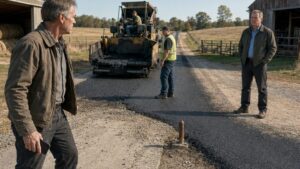
He climbed out and crossed the gravel slowly, not because he needed more time to understand what he was seeing, but because he knew what happened when anger got ahead of facts. Eleven years working county land-use and code cases had taught him that much.
The lesson had apparently not taught him when to speak up.
Six Mondays.
The first time, there had been two bags beside the barn.
Thomas had assumed somebody helping with one of the neighboring farms had set them down temporarily. He moved them away from the lane and waited.
The second Monday brought four bags.
The third brought broken shelving and a cracked plastic sink.
After that came old paint cans, warped boards, strips of roofing material, fast-food wrappers mixed with renovation waste, and pieces of an old machine shed that looked increasingly familiar.
Eric Carter had been rebuilding the shed at the far end of the shared lane all summer.
Thomas could see its stripped metal frame from his north pasture.
He could also see the fresh replacement panels stacked beside it.
The broken pieces at Thomas’s barn matched the old ones almost exactly.
He crouched beside one of the black bags without touching it.
A torn corner exposed a strip of corrugated siding and a piece of brittle insulation. Nothing mysterious about it now.
Proper disposal of construction debris cost money. So did hauling it to the county transfer station.
Leaving it beside someone else’s barn cost nothing.
A tractor engine sounded from beyond the pasture. Thomas glanced toward the fence, then back at the bags.
The problem was not merely that the trash was ugly. The barn sat beside the narrowest part of the gravel approach, where Thomas backed his hay wagon before turning toward the field road. Every pile pushed him farther into the grass.
Last week a broken board with two nails had ended up under his trailer tire.
He had told himself then that if the debris appeared one more time, he would stop guessing.
Now it had.
Thomas took out his phone and photographed everything before moving a single object.
Wide shot first.
Then the bags.
The paint cans.
The broken siding.
The distance from the barn wall to the gravel track.
He caught himself measuring the scene the way he had once measured hundreds of complaint sites for people who insisted their dispute was perfectly obvious.
Obvious was a dangerous word.
By eight-thirty, he had fed the cattle, moved the sharp debris into a safe pile, and left the black bags where they were.
He did not call Eric.
That choice bothered him more than he wanted to admit.
There had been opportunities before this.
At the mailbox three weeks earlier, Eric had complained about disposal costs for the old shed. Thomas had said nothing.
At the private-road meeting, Eric had mentioned that everyone along the lane needed to “be flexible” while his renovation was underway. Thomas had let that pass too.
He had believed silence was restraint.
Standing beside six bags on his own ground, it looked more like avoidance.
That evening, Thomas went into the small office off his kitchen and pulled up the camera system.
The camera was mounted under the equipment barn eave, mostly for fuel theft and stray cattle. Its night view reached partway down the lane.
He selected the previous night.
11:47 p.m.
Nothing.
11:52.
A moth streaked across the infrared view.
11:58.
Headlights appeared briefly at the far edge of the frame, then vanished.
Thomas leaned closer.
At 12:03 a figure walked into view.
The image was grainy but clear enough.
Eric.
He wore a ball cap and work jacket Thomas had seen a hundred times. One black contractor bag hung from each hand.
Eric crossed from the gravel lane onto Thomas’s side, walked directly to the barn, set both bags against the siding, straightened, and looked once toward Thomas’s farmhouse.
Then he walked back the way he had come.
No hurry.
No hesitation.
No attempt to hide his face.
Thomas watched the clip twice.
The second viewing bothered him more than the first.
Not because Eric had dumped the bags.
Because of how ordinary he made it look.
As though he were placing feed sacks in his own shed.
As though six weeks had turned trespass into routine.
Thomas froze the frame where Eric’s face was turned slightly toward the camera. One bag was still in his hand; the other already sat against the barn.
He saved the image.
Then he went back through the previous Monday.
There Eric was again.
Different jacket. Same walk.
Thomas found another clip from two weeks earlier.
Another bag.
He sat back.
He had proof now, but the proof did not give him the satisfaction he had expected. It gave shape to something more uncomfortable.
Eric had not mistaken the property line.
He had not hired someone who misunderstood directions.
He was doing it himself.
And Thomas had given him six weeks to decide there would be no consequence.
The printer hummed on the shelf beside him.
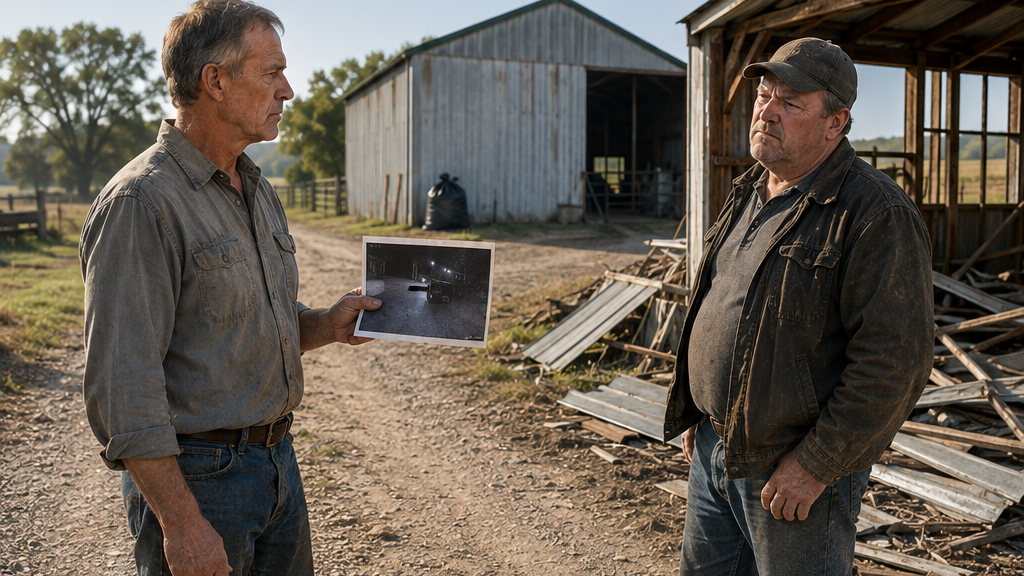
Thomas selected the clearest image and printed it on ordinary white paper.
The page slid into the tray.
Eric, caught mid-step.
Black bag in hand.
Thomas picked up the photograph and looked at it for a long moment.
Years ago, when someone came into the county office furious about a fence, drainage pipe, easement, shed, or junk pile, Thomas used to ask the same question before anything else.
What exactly happened?
Not what did you assume.
Not what did your neighbor say.
What can you prove?
He folded the bottom edge of the paper once so it would fit against the passenger seat without blowing away.
Then he took his truck keys from the hook.
The fresh bags were still against the barn when he drove past them.
He turned onto the shared gravel lane and headed toward Eric Carter’s machine shed.
Chapter 2: He Called the Easement His Permission
Eric looked at the photograph and said, “That doesn’t prove anything.”
Thomas had not yet told him what he wanted.
They stood outside the half-renovated machine shed with the morning sun slanting through its exposed framing. A compressor sat silent near the doorway. Stacks of new metal panels were covered with a tarp, while old broken sections lay in a heap beside a flatbed trailer.
Thomas held the printed camera image at chest height.
Eric did not take it.
“You’re carrying the bag,” Thomas said.
“Looks like a bag.”
“It’s you.”
Eric glanced toward the lane. “You came down here to argue about trash?”
“I came down here to tell you to stop putting it beside my barn.”
“I’m not putting trash beside your barn.”
Thomas lowered the photograph slightly.
He had expected denial. People often denied the easiest fact first. Sometimes it gave them time to think.
So Thomas waited.
Eric’s mouth tightened.
Thomas raised the paper again.
The timestamp was visible at the bottom of the image. Eric’s face was imperfect in the night footage, but his jacket, cap, build, and the outline of the two bags were unmistakable.
“I have three nights,” Thomas said. “Different weeks.”
That changed Eric’s expression.
Not much.
Just enough.
He finally took the picture.
Behind him, the machine shed looked as if someone had peeled one side open. Old framing showed through where rusted panels had been removed. Thomas noticed a stack of the same pale-gray siding that had appeared beside his barn.
Eric studied the page, then handed it back.
“All right.”
Thomas waited.
Eric rubbed his thumb across the edge of his belt.
“I set a couple things over there.”
“Six weeks’ worth.”
“That’s not six weeks’ worth.”
“It started six weeks ago.”
“You counting every bag?”
“Yes.”
Eric gave a short laugh, but there was no humor in it.
“Of course you are.”
Thomas folded the photograph once along the crease he had already made.
“I want it removed. All of it.”
Eric looked past him toward the shared gravel lane.
“That strip isn’t just yours.”
Thomas said nothing.
“It’s a shared easement,” Eric continued. “Always has been.”
“For access.”
“For use.”
Thomas felt the old instinct surface immediately: correct the term, define the instrument, separate ownership from easement rights, explain dominant and servient estates, explain permissible use.
He pushed the instinct down.
Eric mistook the silence for uncertainty.
“You know how long that lane’s been used by everybody?” he asked. “Before you bought your place. Before I bought mine. Trucks park there. Hay wagons sit there. Equipment gets staged there. Nobody ever treated it like some private driveway.”
Thomas looked at the lane.
That part was not entirely false.
During harvest, wagons sometimes waited along the wider sections. Snow equipment was left there during storms. Years earlier, before Thomas owned the farm, neighboring operators had apparently used parts of the lane in ways that had never been written down.
But there was a large distance between temporary farm traffic and six weeks of renovation debris stacked against somebody else’s building.
“You believe the easement gives you the right to store material beside my barn?” Thomas asked.
Eric’s shoulders shifted.
“It gives me the right to use the lane.”
“That wasn’t my question.”
“It’s all part of the same access.”
Thomas looked toward the heap of old siding beside Eric’s trailer.
“What about the paint cans?”
“What about them?”
“They’re access too?”
Eric’s jaw moved once.
“You always do this.”
Thomas frowned. “Do what?”
“Make everything into language.”
Thomas almost laughed, but didn’t.
Eric pointed toward the lane.
“That whole strip has been shared working ground for years. You don’t get to wake up one morning and decide every inch is sacred because it suits you.”
There it was.
Not an apology.
Not even a denial anymore.
A claim.
Thomas opened the photograph flat again.
“Do you want me to include that in writing?”
Eric stared at him.
“Include what?”
“That you’re placing the material there because you believe the easement authorizes it.”
A faint change came over Eric’s face.
For the first time since Thomas arrived, he looked less irritated than cautious.
“What writing?”
“If I file a complaint, I’d rather describe your position accurately.”
Eric scoffed. “A complaint with who?”
Thomas did not answer.
That silence was different from the ones he had used over the previous six weeks. This one had purpose.
Eric studied him.
“You going to call the county because there are some bags beside a barn?”
“I asked you to remove them.”
“And I told you that strip is shared.”
“You told me what you think the easement means.”
“I know what it means.”
Thomas folded the photograph again.
“Then putting that in writing shouldn’t bother you.”
Eric stepped closer, though not enough to make the moment physical.
“You threatening me with paperwork now?”
“No.”
“Sounds like it.”
“I’m asking whether you’re standing by what you just said.”
For several seconds, neither man spoke.
A sheet of loose metal knocked softly against the shed frame in the breeze.
Eric finally looked away.
“I’ve got work to do.”
“So do I.”
“Then go do it.”
Thomas remained where he was.
“The bags need to be gone.”
Eric shook his head.
“You were fine with everybody using that lane until suddenly you weren’t.”
“That isn’t what we’re talking about.”
“It’s exactly what we’re talking about.”
Eric turned toward the shed.
Thomas had known enough enforcement disputes to recognize the moment when a conversation stopped producing information and began producing only repetition.
He could force another round.
He could tell Eric that an easement did not erase ownership.
He could mention his former job.
He could quote the language he remembered from similar access instruments.
Instead he said, “All right.”
Eric looked back, apparently surprised by the lack of argument.
Thomas walked toward his pickup.
At the driver’s door, Eric called after him.
“You ought to read the easement before you start sending complaints around.”
Thomas stopped.
He turned halfway.
“I intend to.”
Then he climbed into the truck.
The drive back to his barn took less than two minutes.
The black bags were still there.
Thomas parked, carried the photograph inside, and set it on the workbench.
For most of his career, people had assumed code officers liked catching violations.
Thomas never had.
The easier cases were the ones where everyone was clearly wrong or clearly right. The hard ones started with a sentence such as, Everybody knows, or We’ve always done it this way.
Those words had kept county offices busy for decades.
By late morning Thomas had photographed the remaining debris again. He moved nothing.
After lunch, he went into the farmhouse office and stood in front of the narrow cabinet beside his desk.
The bottom drawer stuck halfway, as it always had.
He pulled harder.
Old notebooks lay beneath tax records and equipment manuals. Most were from his county years, their covers bent and their edges softened by use.
He had not opened them since retirement.
Thomas found the one marked PROPERTY / ACCESS.
Inside were handwritten references, case numbers, reminders about drainage disputes, shared drives, permissive use, encroachments, and the phrase he had repeated to property owners more times than he could count:
Read the instrument. Not the argument.
Thomas rested his hand on the page.
Eric had told him to read the easement.
Thomas intended to do exactly that.
Chapter 3: Eleven Years Behind the County Counter
Thomas knew better than to trust his own memory, which was precisely why he distrusted how certain he felt.
By nine Tuesday morning, the printed camera photograph lay on one side of his farmhouse desk and an old copy of his deed lay on the other.
Between them sat the notebook from his county years.
He did not open it.
Not yet.
For eleven years, Thomas had worked behind the county counter and out in fields, yards, ditches, and access roads where two people could look at the same twenty feet of ground and see entirely different truths.
He had investigated junk accumulation, illegal dumping, drainage complaints, unpermitted structures, obstructed rights-of-way, and more easement arguments than he could remember.
That experience told him Eric’s claim sounded weak.
Experience was not the same thing as evidence.
Thomas logged into the county records portal and pulled up the recorded instruments tied to his parcel.
The easement document appeared as a scanned image, older than either man’s ownership.
He read it once.
Then again.
The wording was ordinary.
Ingress.
Egress.
Maintenance necessary for continued access.
Rights to pass with vehicles, agricultural equipment, livestock trailers, service vehicles, and other reasonable traffic associated with the properties served.
Nothing about storage.
Nothing about placing materials on the underlying property.
Nothing that turned the lane into common ownership.
Thomas leaned back.
There was the answer he had expected.
He should have felt satisfied.
Instead, he opened the next record.
An amendment concerning drainage.
Then a maintenance agreement.
Then an older plat.
By noon, he had built a timeline rather than a victory.
That was another habit left over from the county.
A single sentence rarely survived contact with twenty years of neighboring behavior.
The next morning he drove to the county records office.
The building had changed since his retirement. New security glass. Different signs. Same dry paper smell when the interior door opened.
Cynthia Roberts was behind the records counter.
She looked up from her monitor and smiled briefly.
“Thomas Mitchell.”
“Cynthia.”
“You lost?”
“Trying not to be.”
“That usually means property records.”
He placed the parcel numbers on the counter.
Cynthia read them.
“Yours?”
“And the adjoining easement parcels.”
Her expression changed by half a degree.
“Personal matter?”
“Yes.”
“Then you get the same service everybody else gets.”
“I was hoping for worse.”
“That I can arrange.”
Thomas smiled.
That was why he had come to her rather than asking someone he barely knew. Cynthia had always been careful about the line between helping and doing someone’s work for them.
She searched the index.
Thomas watched the screen from the public side of the counter.
“I’ve got the deed and recorded easement,” he said.
“Then why are you here?”
“I want the older references.”
“Meaning?”
“Anything tied to access use before the current maintenance agreement.”
Cynthia looked at him over her glasses.
“You already decided what happened?”
“No.”
“Good. Retirement helped.”
“Marginally.”
She turned back to the screen.
They found an older filing tied to the lane, then another reference in a parcel-history note. Most of it dealt with culvert work, gravel costs, and drainage responsibilities.
Then Cynthia stopped scrolling.
“What’s that?” Thomas asked.
She enlarged a scanned notation attached to an older correspondence index.
The document itself was not a deed amendment. It appeared to be a property-management note created during an earlier transfer.
Thomas read the typed line.
TEMPORARY FARM STAGING PERMITTED DURING HARVEST BY PERMISSION OF SERVIENT OWNER.
He read it again.
Cynthia said nothing.
Thomas felt the clean certainty he had carried into the building loosen.
“Is there more?”
“There’s a referenced file number.”
“Can we pull it?”
“We can request it.”
“Do that.”
Cynthia entered the number.
Thomas looked again at the phrase.
Temporary farm staging.
That sounded uncomfortably close to part of Eric’s argument.
Not the dumping.
Not six weeks of contractor waste.
But enough to explain where a broader belief might have started.
“Before you get too excited either direction,” Cynthia said, “that note isn’t necessarily a recorded right.”
“I know.”
“And ‘by permission’ matters.”
“I know.”
She gave him a look.
Thomas exhaled.
“I heard it the first time.”
“You used to tell people to stop reading the nouns and start reading the verbs.”
“I was irritating.”
“You were often correct and irritating.”
“Still am.”
“Yes.”
The requested file took nearly forty minutes to arrive from archived records.
Thomas spent the time studying the easement map.
The shared lane crossed his parcel before branching toward Eric’s and Ruth Anderson’s properties. The legal right was drawn clearly enough. Traffic passed through.
The land beneath the central portion remained Thomas’s.
He traced the boundary with one finger.
Access did not equal possession.
He knew that.
But the old staging note meant Eric had not necessarily invented the idea that portions of the lane had been used as common working space.
When the archived folder arrived, Cynthia placed it on the public table rather than handing it to him.
“Usual rules.”
Thomas washed his hands at the restroom sink before opening it.
The file contained old correspondence associated with a farm transfer decades earlier. Most of it was routine.
Then he found a one-page memorandum.
A former owner had described allowing neighboring operators to park wagons and stage equipment temporarily along the widened section of the access lane during harvest.
Thomas read carefully.
Permission was requested each season.
Equipment could remain only long enough to keep active harvest traffic moving.
No fuel, waste, disabled machinery, or stored material was to remain overnight unless separately approved.
Thomas sat still.
There was no ambiguity about garbage.
Eric’s renovation debris did not fit any reasonable reading of the old arrangement.
But there was also no ambiguity about something Thomas had not wanted to see.
The lane really had been used more flexibly than the recorded easement alone suggested.
Courtesy had existed beside the legal instrument.
And over time, people might have forgotten which part was permission and which part was right.
Cynthia came past the table carrying another file.
“Find something?”
“Yes.”
“Good something?”
“Complicated something.”
“That’s usually the real kind.”
Thomas looked at the memorandum again.
Near the bottom was the former owner’s signature.
He recognized the surname.
Not because he knew the man personally, but because the same name appeared in one of the road-maintenance records still kept by the three current landowners.
Thomas pulled out his phone and photographed the page as permitted.
Then he photographed the index reference.
By the time he left the records office, his complaint was stronger in one sense and weaker in another.
Eric had no recorded right to dump anything.
That much was clear.
But Thomas could no longer dismiss Eric’s entire understanding of the lane as pure invention.
Someone had allowed temporary staging there before.
Someone had trusted neighbors to ask.
Thomas sat in his pickup with the file reference written on a yellow note beside him.
For the first time since seeing Eric on the camera, he wondered whether this conflict had started with more than disposal fees.
At the top of the old memorandum, beside the former owner’s name, was a second notation linking the permission to the private-road maintenance file.
Thomas read that line twice.
Then he folded the note and put it in his shirt pocket.
The next thing he needed to understand was not what the easement said.
It was what everyone along that lane had come to believe it meant.
Chapter 4: The Old Permission Was Not What Eric Claimed
The phrase Eric had left out was only three words long.
With owner consent.
Thomas read it again at the records office Friday morning, then copied the sentence into his notebook exactly as it appeared in the old memorandum.
Temporary farm staging permitted during harvest by permission of servient owner.
The rest of the document made the distinction even sharper. Wagons could wait along the widened shoulder when harvest traffic backed up. Equipment could be staged briefly if the owner of the ground agreed. Nothing was to be left overnight unless separately approved.
Thomas closed the folder.
The easement itself gave access.
The old custom had added courtesy.
Neither gave Eric the right to stack renovation debris beside Thomas’s barn.
That should have settled something inside him.
Instead, Thomas felt less triumphant than he had expected.
Cynthia Roberts stood at the far end of the counter helping another landowner find a plat. When she finished, she walked over.
“You look disappointed.”
“I found what I needed.”
“That usually cheers people up.”
“It confirms he’s wrong.”
Cynthia waited.
Thomas tapped the memorandum.
“It also confirms he didn’t invent all of it.”
“No.”
“He’s stretching it.”
“Yes.”
“But there was a practice.”
“There was permission.”
Thomas nodded.
Cynthia leaned one hand on the counter.
“You know the difference.”
“I do.”
“Does he?”
Thomas looked toward the old page again.
That was now the question.
On the drive home, he stopped at the lane entrance and studied the ground as if he had never seen it before.
The gravel road came off the county blacktop, crossed his property, passed his equipment barn, then widened slightly before dividing toward Eric’s place and Ruth Anderson’s. Over the years, the wider patch had become practical shared space without anyone naming it that.
During corn harvest, wagons waited there.
When heavy snow came, one of them might leave a blade or tractor there for an hour.
Once, Ruth had parked a stock trailer along the grass while a tire was repaired.
Thomas had never objected.
Neither had Eric.
The difference had seemed obvious to Thomas.
Temporary use while work was happening was one thing.
Making somebody else’s ground your disposal site was another.
But obvious, he reminded himself, was the word he distrusted.
That afternoon he began tagging the debris instead of moving it.
Small paper tags went beneath clear tape on the outside of each black contractor bag.
MONDAY.
WEDNESDAY.
FRIDAY.
He photographed each group from the same angle, with the barn corner in frame and a measuring rod showing how far the pile encroached toward the travel surface.
The bags looked different now.
Less like trash.
More like dates.
Ruth Anderson arrived while Thomas was photographing a broken strip of metal siding.
She stopped her pickup beside the pasture fence and lowered the window.
“You starting a museum?”
Thomas straightened.
“Documentation.”
“That’s what I was afraid of.”
He walked toward her truck.
Ruth was in her late sixties, with the permanent squint of someone who had spent most of her life watching animals, roads, and weather for trouble before it arrived.
“You talked to Eric?” she asked.
“Yes.”
“And?”
“He says the easement lets him use the strip.”
Ruth sighed.
“I heard.”
“From him?”
“He called me.”
Thomas was not surprised.
“What did he say?”
“That you’re making a county case out of a few bags.”
“There are more than a few.”
“I can see that.”
She looked past him toward the barn.
Thomas waited.
Ruth drummed two fingers against the steering wheel.
“He also says everybody’s always used that lane.”
“That part’s true.”
“There you go.”
“For passing and temporary farm work.”
“Mostly.”
Thomas caught the word.
“Mostly?”
Ruth gave him an irritated look.
“You know what I mean.”
“I’m asking what you mean.”
“That right there.” She pointed at him. “That’s what makes people stop talking to you.”
Thomas said nothing.
Ruth shook her head.
“Everything becomes testimony.”
“It matters what actually happened.”
“It also matters how people remember it.”
She turned off the truck engine.
“When my husband was still alive, we staged hay wagons along that shoulder half a dozen times. Eric’s old place did too. Somebody would call, somebody would wave, somebody would say leave it there till morning. Nobody pulled documents.”
“I’m not disputing that.”
“Then don’t act like Eric pulled the idea out of thin air.”
Thomas looked back at the tagged bags.
“I found the old permission record.”
Ruth’s expression changed.
“What permission record?”
“Temporary staging. During harvest. With owner consent.”
She considered that.
“That sounds right.”
“Did anybody ever leave demolition waste?”
“No.”
“Paint cans?”
“No.”
“Contractor bags for six weeks?”
Ruth frowned.
“No.”
“Then we agree.”
“On the trash, yes.”
Thomas waited for the rest.
Ruth looked toward Eric’s distant machine shed.
“What worries me is winter.”
Thomas understood immediately.
When snow drifted across the lane, the three farms depended on one another more than any written easement suggested. One tractor got through where another did not. Somebody always had chains. Somebody had diesel. Somebody had a blade wide enough to open the road.
Ruth said, “You make this into a war, and January gets longer.”
“So I should leave the bags?”
“I didn’t say that.”
“What are you saying?”
“I’m saying being right about the bags doesn’t mean every way of handling them is smart.”
The words irritated Thomas because they landed too close to something he already suspected.
He had spent years watching neighbors arrive at county offices after months of silence, each carrying photographs, plats, letters, and a private history of conversations they should have had earlier.
He had thought retirement had removed him from that pattern.
Instead he was standing in the middle of his own version of it.
Ruth restarted her pickup.
“For what it’s worth, I told Eric to move his junk.”
Thomas looked at her.
“He listen?”
“He told me you’d already decided to make an example out of him.”
“That’s not what I said.”
“Maybe not.”
Ruth put the truck in gear.
“Just remember you all still own farms after the paperwork’s done.”
She drove away.
Thomas returned to the barn.
He photographed two more bags.
Then he filed his complaint.
He attached the camera clips, the dated photographs, the deeded easement language, and the old memorandum. He did not omit the historical staging practice. If the county was going to look at the matter, they could look at the whole thing.
That evening he felt better about that choice than about anything else he had done.
Saturday passed without new debris.
Sunday too.
Thomas began to think Eric had finally understood the direction things were moving.
Monday morning, before breakfast, Thomas stepped outside and heard plastic shifting against metal.
He stopped.
Three fresh black contractor bags sat against the barn wall.
On top of them lay a broken machine-shed panel.
Thomas did not need the camera this time.
He stood in the gravel staring at the new pile.
Eric knew about the photographs.
He knew Thomas had checked the easement.
He knew Ruth had spoken to him.
And still he had carried more debris across the lane.
Thomas took out his phone and photographed the bags.
For the first time, disposal costs no longer seemed like a sufficient explanation.
Chapter 5: The Dumping Was About More Than Disposal Fees
The complaint arrived before breakfast.
Thomas found the folded notice clipped inside his mailbox, a photocopy from the private-road maintenance file with Eric Carter’s name at the bottom.
The allegation was simple.
Obstruction of shared access.
Thomas read it twice.
Then he looked toward the three groups of black contractor bags he had moved the previous evening.
They were no longer beside his barn.
They were beside Eric’s machine shed.
Thomas had sorted the material by type—metal, general debris, sealed paint cans—rebagged what needed containing, and carried everything back along the lane.
He had told himself he was returning property to its source.
Now the bags had become evidence against him.
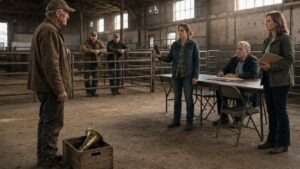
At ten that morning, the three landowners met beside Ruth Anderson’s kitchen table with the private-road maintenance treasurer seated at one end.
No one called it a hearing.
It felt close enough.
Eric had brought photographs.
The first showed four black bags sitting beside the wider portion of the lane near his loading area.
The second showed his flatbed trailer angled around them.
The treasurer studied the page.
“Were these placed there by you, Thomas?”
“Yes.”
Eric shifted in his chair.
Thomas continued before the movement became a victory.
“They were material Eric had placed on my property. I sorted it and returned it.”
“Returned it into the shared access area,” Eric said.
Thomas looked at him.
“You’re concerned about shared access now?”
Ruth closed her eyes briefly.
The treasurer lifted a hand.
“We’re not doing this that way.”
Thomas leaned back.
He had already made the mistake. He could hear it in his own voice.
Eric slid another photograph across the table.
“You put them where I load equipment.”
“For one afternoon.”
“Does the agreement say you can obstruct it for an afternoon?”
Thomas did not answer.
Because it did not.
The satisfaction he had felt while tying the bags closed came back to him differently now.
He had known better.
Not legally, perhaps, in the narrowest sense of where the bags sat. But strategically. Morally, even.
He had wanted Eric to see his own mess waiting for him.
That had been the point.
The treasurer asked, “Can we separate the waste complaint from the road-use complaint?”
“I’d appreciate that,” Thomas said.
Eric laughed quietly.
Thomas looked at him.
“What?”
“Nothing.”
“Say it.”
Eric folded his arms.
“You love separating things when it helps you.”
Ruth glanced between them.
The treasurer said, “Eric.”
But Eric kept looking at Thomas.
“You want to talk about agreements? Fine. Let’s talk about agreements.”
Thomas knew what was coming before Eric reached into his folder.
The road-maintenance proposal.
Two months earlier, Eric had asked the three owners to increase their annual contributions because gravel, grading, and culvert work had risen sharply in cost.
Thomas had opposed the proposed formula.
Not the increase itself.
The formula.
Eric’s place sat farthest from the county road and generated more heavy equipment traffic during the machine-shed renovation. Thomas had argued that the added cost should not be split evenly.
At the time, he had considered that position simple fairness.
Eric slapped the old proposal onto the table.
“You wouldn’t pay another dollar until every foot was calculated.”
“I said usage mattered.”
“You said the agreement mattered.”
“It does.”
“And now suddenly everybody’s supposed to care about courtesy.”
Thomas frowned.
“I haven’t asked for courtesy.”
“No. You ask for rules when the rules save you money.”
“That isn’t what this is about.”
Eric leaned forward.
“It’s exactly what this is about.”
His voice stayed controlled, but Thomas heard something underneath it that had not been present during the confrontation at the machine shed.
Not just defensiveness.
Resentment.
Eric tapped the road proposal.
“I’ve paid for two extra gravel loads this year because the lower section washed out. I paid the grader when nobody else could get him scheduled. I’ve got a shed half torn apart because every contractor price doubled from what I budgeted, and when I asked for a fair increase you turned the whole thing into a survey exercise.”
“That doesn’t give you permission to dump on my property.”
“No.”
The word came so quickly that Thomas stopped.
Eric looked at the table.
“No, it doesn’t.”
Ruth’s head lifted.
Eric continued.
“I knew you’d hate it.”
The room went quiet.
Thomas stared at him.
“What?”
“I knew those bags would bother you.”
There it was.
Not an accident.
Not merely cheap disposal.
Eric rubbed a hand across his jaw.
“I was mad.”
“You dumped renovation waste beside my barn because you were mad about road money.”
“At first I put two bags there because I needed them out of the shed and figured I’d haul everything together later.”
Thomas said nothing.
Eric looked at him now.
“Then you never said a word.”
“That made it acceptable?”
“No. It made me think you were doing what you always do.”
“What’s that?”
“Waiting until you had enough paper to win.”
The sentence hit harder than Thomas expected.
Eric continued.
“You never come over and say, ‘This is bothering me.’ You document it. You measure it. You pull records. Then you show up after you already decided what everybody else did wrong.”
Thomas felt Ruth watching him.
He wanted to reject the description.
It was unfair.
Mostly.
And that was the problem.
Eric leaned back.
“You want the truth? After that road meeting, every time I carried another bag over there, part of me knew exactly how much it would irritate you.”
“That’s supposed to help your case?”
“No.”
“Then why tell me?”
“Because you keep acting like this is just about disposal fees.”
Thomas looked down at the photographs.
For six weeks, he had treated Eric’s behavior as a straightforward violation.
Now the violation remained, but the motive had changed shape.
It was uglier in one way.
More human in another.
The treasurer cleared his throat.
“The county can handle the waste issue. We’re handling the lane.”
Thomas nodded slowly.
“My bags shouldn’t have been placed where they interfered with loading.”
Eric looked at him.
Thomas continued.
“I should have returned them somewhere that didn’t affect access. Or not returned them at all.”
Ruth’s expression softened slightly.
Eric said nothing.
The meeting ended without resolving the larger dispute.
Thomas agreed to move anything remaining out of the access strip. Eric agreed not to place additional material on Thomas’s side while the county complaint was pending.
It was less than Thomas wanted.
More than they had managed the week before.
That afternoon, an email arrived from county solid-waste enforcement.
Thomas opened it at his desk.
The inspector had reviewed the preliminary materials.
No citation would be issued from photographs alone.
A joint site visit was scheduled for Friday morning.
Thomas read the final paragraph twice.
Both property owners were requested to be present.
All disputed material was to remain available for inspection.
Thomas looked through the office window toward the barn.
For the first time since filing the complaint, the county was not treating him merely as the reporting landowner.
They wanted to inspect what both men had done.
Chapter 6: The Inspector Drew the Line Neither Man Wanted
The inspector’s first question was for Thomas.
“Why are there bags on both properties?”
Eric stood ten feet away with his arms folded.
Thomas could have answered carefully enough to make himself sound better.
He did not.
“I returned some of his debris.”
The inspector looked from Thomas to the black bags near Eric’s machine shed.
“Returned how?”
“I sorted what had been placed beside my barn, rebagged it, and moved it back.”
“Into the easement area?”
“Partly.”
Eric said, “Right where I load.”
Thomas looked at him but did not argue.
The inspector wrote something on a clipboard.
Friday morning had begun with all three landowners present. Ruth stood near her pickup, invited because her property was also served by the lane. The inspector had already measured the gravel track, photographed Thomas’s barn wall, reviewed the camera timestamps, and compared the site to the easement map Thomas had submitted.
Now he walked toward Eric’s side.
“Show me where the returned bags were.”
Eric pointed.
“Along there.”
The inspector measured from the lane edge.
“Could vehicles pass?”
“Yes,” Eric said. “But I couldn’t swing the trailer properly.”
Thomas added, “That’s accurate.”
Eric looked at him sharply.
The inspector glanced up.
“You agree?”
“They interfered with his normal loading area for part of the day.”
“And you placed them there intentionally.”
“Yes.”
The inspector wrote again.
Thomas felt the old reflex inside him—the urge to explain context, distinguish causes, show why one action came before another.
He had spent enough years interviewing complainants to know what explanation sounded like when it was really an attempt to escape ownership.
So he waited.
The inspector finally said, “All right. Now show me where the material originally accumulated.”
They walked back to Thomas’s barn.
The clean wall still carried dirt marks where the bags had leaned against it. Thomas had left two later bags in place, tagged by date.
The inspector opened one carefully.
Inside were broken building panels, packaging, insulation, and pieces of trim.
“These yours?” he asked Eric.
Eric looked inside.
“Yes.”
“The paint cans?”
“From the shed.”
“Metal pieces?”
“Yes.”
“How did they get here?”
Eric hesitated.
“I put some here.”
“Some?”
Thomas stayed silent.
The inspector looked toward him.
“You submitted footage from multiple dates.”
“Yes.”
“And this is the same location?”
“Yes.”
The inspector turned back to Eric.
“Why here?”
Eric glanced toward the lane.
“Because I understood this to be shared working space.”
“Do you own this ground?”
“No.”
“Do you have written permission to store waste here?”
“No.”
“The easement document you referenced grants ingress, egress, and maintenance access. Do you have another recorded instrument?”
“No.”
Eric shifted his weight.
“There’s an old practice.”
Thomas watched the inspector.
He already had that document too.
“Yes,” the inspector said. “Temporary farm staging by owner permission during harvest.”
Eric’s mouth tightened.
“That shows the lane’s always been used.”
“It shows the landowner sometimes permitted temporary agricultural staging.”
The inspector closed the bag.
“It does not create a general waste-storage right.”
No one spoke.
The sentence was clean.
Not dramatic.
Not satisfying in the way Thomas had imagined during the first week.
But it was the line he had expected all along.
The inspector walked several yards down the lane and looked back toward both properties.
“I’m separating three things,” he said. “Access rights. Historic permissive use. Waste disposal.”
Thomas almost smiled at the wording.
Instead he listened.
“The access easement remains shared. Historic permissive use may explain why people treated the shoulder flexibly, but permission is not ownership and it’s not permanent authorization.”
He turned toward Eric.
“Repeatedly placing renovation debris on another owner’s property without permission is improper disposal. Based on the footage and your acknowledgment today, I’m issuing a notice of violation.”
Eric’s face hardened, though he said nothing.
“You’ll need to arrange lawful removal of all remaining renovation waste by the compliance date. There will also be a civil penalty.”
“How much?” Eric asked.
The inspector named an amount modest enough to sound administrative rather than theatrical.
Eric exhaled through his nose.
“And his bags?”
The inspector looked at Thomas.
“Those were also placed in a way that interfered with access.”
Thomas nodded.
“I understand.”
“I’m not treating that as the same violation. But if you repeat it after today, you may create a separate access complaint.”
“I won’t.”
Eric looked disappointed by how quickly Thomas answered.
The inspector returned to his truck and brought out several forms.
For the next twenty minutes, the conflict became paperwork.
Compliance date.
Removal documentation.
Disposal receipts.
Photographs.
A note regarding the easement.
Thomas watched Eric sign the acknowledgment.
There was no victory in his face.
Only fatigue.
When the inspector finished, he gathered his clipboard and looked at both men.
“One recommendation that isn’t part of the citation.”
Neither answered.
“Write down how you’re going to use this lane.”
Eric gave a humorless laugh.
“There’s already an easement.”
“That’s why I said how you’re going to use it, not who has access.”
He pointed toward the widened shoulder.
“Equipment staging. Snow removal. Temporary breakdowns. Deliveries. Waste. Parking. If three owners have been running those things by custom for years, put the custom into language before the next disagreement.”
Thomas felt Ruth glance at him.
The inspector continued.
“The county can tell you what this document does not allow. We’re not going to manage your neighbor relationship for you.”
That sentence stayed with Thomas after the county truck left.
Ruth remained beside her pickup.
Eric stood near the machine shed holding his copy of the notice.
Thomas walked toward the barn and began removing the dated tags from the bags that remained for inspection.
Ruth joined him.
“You got what you asked for,” she said.
“Mostly.”
“You don’t sound pleased.”
Thomas peeled off another tag.
“I wanted the dumping stopped.”
“It will be.”
“That isn’t the same as being pleased.”
Ruth watched him.
“Good.”
Thomas looked at her.
“That was almost supportive.”
“Don’t get used to it.”
She drove away.
Eric remained at the far end of the lane.
For several minutes, neither man approached the other.
Then Eric walked over carrying the county notice folded in half.
Thomas straightened.
Eric stopped a few feet away.
“So that’s it?”
“What?”
“You got your ruling.”
Thomas looked at the paper.
“I got the county’s ruling on the waste.”
“Same thing.”
“No.”
Eric’s expression tightened.
Thomas continued.
“The lane still has to work.”
Eric stared at him for a moment.
“You planning to make the county letter the last word?”
Thomas thought of the old memorandum.
With owner consent.
He thought of the returned bags blocking Eric’s loading area.
He thought of eleven years spent behind a counter watching people arrive too late with documents that could define property lines but not repair trust.
“No,” Thomas said.
Eric seemed almost surprised.
Thomas looked down the gravel lane that still belonged to one man in places, served three farms, and depended on all of them behaving as if paper alone would never be enough.
“No,” he said again. “I don’t think it can be.”
Chapter 7: The Lane Stayed Shared, but the Burden Did Not
The bulk-waste truck arrived just after eight on a Wednesday morning and backed down the shared lane with its warning beeper echoing between the barns.
Thomas stood beside his equipment shed while the driver lowered the hydraulic bed.
Across the lane, Eric watched from beside his machine shed.
Ruth had parked near the widened shoulder, close enough to see but far enough to make it clear she was not there to referee.
The black contractor bags went first.
Then the broken siding.
The old paint cans were placed separately.
The driver checked each pile against the disposal list, loaded the remaining debris, and handed Eric a receipt.
Eric folded it once and slid it into his shirt pocket.
No one said much.
There was nothing ceremonial about watching garbage disappear.
Still, when the truck pulled away and the diesel sound faded toward the county road, Thomas looked at the barn wall and noticed how strange the empty space seemed.
For six weeks, black bags had occupied that ground.
Now there was only a dusty line where they had leaned against the siding.
Eric glanced toward Thomas.
“The county’s happy now.”
Thomas nodded.
“They should be.”
Eric waited, perhaps expecting more.
Thomas had spent the previous evening at his kitchen table with the easement map, the private-road agreement, and a single sheet of paper.
Not a complaint.
Not a demand.
A proposal.
He took the folded page from his back pocket.
“We still need to deal with the lane.”
Eric’s expression closed slightly.
“So we’re not done.”
“With the county, mostly.”
“That’s not what I asked.”
Thomas looked toward Ruth.
She shut her pickup door and walked over.
“I told him the same thing,” she said.
Eric gave her a tired look.
“Of course you did.”
Ruth ignored it.
The three of them met later that morning around the same kitchen table where the maintenance dispute had surfaced.
This time there was no treasurer.
No inspector.
No county forms.
Thomas placed one page in the middle of the table.
Eric read the heading.
“Lane-use agreement.”
“Working rules,” Thomas said. “Not a new easement.”
Eric kept reading.
The page was short.
No permanent or overnight storage in the access corridor without consent from the underlying landowner.
Temporary agricultural staging allowed when necessary for active work, provided the owner was notified.
Disabled equipment could remain long enough for safe removal.
Snow equipment could be staged during storms.
Deliveries could use the widened shoulder temporarily.
No household, construction, or agricultural waste could be left on another parcel.
Nothing placed in the lane could materially obstruct normal access.
Eric reached the bottom and looked up.
“You wrote this.”
“Yes.”
“Sounds like something from your old office.”
“It probably does.”
Ruth smiled faintly.
Thomas slid a pen across the table.
“But there’s another part.”
Eric looked back down.
Below the lane-use section was a revised road-maintenance contribution.
Thomas had changed his own position.
Instead of insisting that every increase be tied strictly to measured traffic and distance, he had proposed a base share paid equally by all three landowners, with extraordinary costs allocated according to who caused them when that could reasonably be identified.
Eric read the numbers twice.
“You’re agreeing to the increase?”
“A smaller one than you proposed.”
“But an increase.”
“Yes.”
Eric leaned back.
“Why?”
Thomas could have answered with calculations.
He had them.
He had compared invoices, gravel deliveries, grader hours, and the portion of the lane each property depended on.
Instead he said, “Because I was too rigid about it.”
Ruth looked at him.
Eric did too.
Thomas continued before the admission became harder.
“You were wrong about the dumping. You knew you were wrong after I confronted you, and you kept doing it.”
Eric’s jaw tightened.
“I know.”
“But you weren’t wrong that the road costs changed.”
Eric said nothing.
“I treated that meeting like the only question was whether your formula could be defended on paper. I didn’t spend much time on whether the old contribution was still fair.”
Ruth folded her hands on the table.
Eric looked toward the window.
“That doesn’t make what I did right.”
“No.”
Thomas let the word stand by itself.
He had learned that much.
Eric looked back at the proposal.
“What happens the first time someone needs to leave a wagon overnight?”
“They call.”
“And if nobody answers?”
“If it’s an actual access or safety problem, use the lane and explain afterward.”
Ruth pointed to the page.
“Put that in.”
Thomas took the pen and added a sentence in the margin.
Eric watched him write.
“Funny.”
“What?”
“You finally found a rule that says talk to somebody.”
Thomas looked at him.
There was enough edge in the sentence to sting, but not enough to start another fight.
“That may be the useful part.”
Ruth laughed once.
Eric almost did.
Almost.
They worked through the page line by line.
Eric wanted twenty-four hours allowed for disabled equipment.
Thomas wanted “as soon as reasonably practical.”
Ruth insisted both phrases could coexist.
They changed the snow-removal clause so equipment could remain during an active weather event.
They added that any nonroutine staging lasting overnight required a call or text.
The work was slow.
It was also the first time in weeks that they disagreed without trying to win something larger than the sentence in front of them.
When they reached the maintenance contribution, Eric tapped Thomas’s proposed share.
“This should be more.”
“I expected you to say that.”
“You’re closer to the county road.”
“I know.”
“You use the lane every day.”
“So do you.”
“With heavier equipment.”
“Especially this year.”
Eric looked at him.
Thomas met his eyes.
“That’s why extraordinary wear is separate.”
Ruth pointed between them.
“There. Stop. That sentence works.”
Eric read it again.
Then he nodded.
Not happily.
But enough.
Ruth signed first.
Thomas signed second.
Eric held the pen for several seconds.
“You know this doesn’t mean I agree with how you handled the county.”
Thomas said, “I don’t agree with everything I did either.”
That seemed to disarm Eric more than an argument would have.
He signed.
There was no apology.
Thomas had stopped expecting one.
Two days later, Thomas drove a hay wagon down the shared lane.
At the widened shoulder, Eric’s pickup was parked well clear of the travel path. A small stack of new metal panels sat beside his machine shed, entirely on his own property.
Eric was outside working.
Thomas slowed.
Eric raised one hand.
Not a wave exactly.
More acknowledgment than greeting.
Thomas returned it and kept driving.
That evening, he walked past the equipment barn after checking the cattle.
The wall was bare.
No black bags.
No broken siding.
No taped dates.
The gravel lane curved past the barn and continued toward the other farms exactly as it always had.
Still shared.
Still imperfect.
Still requiring three people to decide, over and over, where convenience ended and permission began.
Thomas stopped near the place where the first bags had appeared.
For years, he had believed clear records could prevent most property disputes.
Now he understood the part he had spent eleven years seeing from behind a county counter and somehow missed on his own land.
Paper could define a boundary.
It could not speak it for you.
He looked down the unobstructed lane, then turned toward home.
The story has ended.