The Promise at the Corner
Part I — The Picture on the Screen
Emily saw the photograph before she saw herself in it.
It appeared behind Patricia Whitmore in a wash of blue-white light, projected thirty feet high above a ballroom full of donors holding champagne glasses. At first, Emily noticed only the old ice-cream cart in the corner of the picture—the chipped red awning, the silver machine, the hand-painted letters along the side.
Then she saw the girl.
Small. Dirty sneakers. Tangled dark hair. One hand lifted toward the cart like she was asking the world for permission to exist.
Emily’s smile stayed on her face because Daniel’s hand was warm against the small of her back, pressing gently.
Guiding her.
Holding her in place.
“And here,” Patricia said into the microphone, her voice soft enough to sound gracious and sharp enough to enter every corner of the room, “is why this work matters. Some children are born into circumstances that would make most people invisible. But with the right charity, the right structure, the right community investment, even a hungry little girl can become someone like Emily.”
A polite laugh moved through the room.
Not cruel. Worse.
Comfortable.
Emily felt Daniel’s fingers tighten once against her spine.
The photo was old, grainy, probably taken by some neighborhood volunteer or city archive intern. But she knew that cart. She knew the yellow stripe on the wheel. She knew the crooked E in the painted word Cream. She knew the angle of that little hand because it had once belonged to her.
On the screen, eight-year-old Emily stood with one quarter in her palm.
In the ballroom, thirty-year-old Emily stood in a gray silk gown Patricia had chosen for her, wearing pearl earrings Daniel had given her, while two hundred people applauded her transformation.
Proof, Patricia had called her.
Not a person. Proof.
Daniel bent slightly toward her without looking away from his mother. “Just breathe,” he murmured.
Emily did.
She breathed through the old hunger rising in her throat.
Patricia turned from the microphone and smiled at her as if offering a gift.
“Emily, sweetheart,” she said, holding out one elegant hand. “Come say a few words.”
The applause grew.
Daniel leaned closer. His voice remained tender. “You don’t have to make it emotional. Just thank them.”
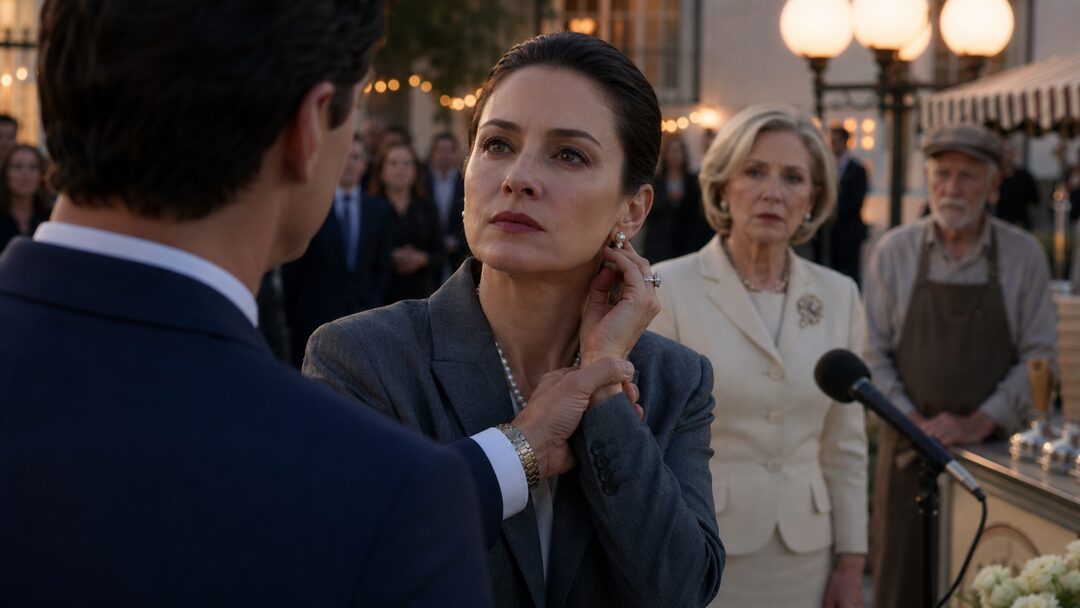
Emily touched one pearl earring.
It was a habit she hated. A small betrayal of control.
She walked to the stage because refusing would have made a scene, and Patricia had built her whole life around knowing which women would rather bleed quietly than make a scene.
At the podium, Emily looked out at the black gowns, white shirts, silver hair, glittering wrists. She saw the developers, the donors, the board members, the people who spoke about communities they never entered without drivers.
Then she looked again at the photograph behind her.
The little girl on the screen was reaching up with her whole body.
Emily remembered only fragments.
A summer sidewalk.
Her stomach hurting.
A man’s hand turning a white swirl of ice cream into a cone.
Her own voice, cracked and small: “I’m still hungry.”
The room waited.
Emily found the speech Patricia’s assistant had placed on the podium. Three paragraphs. Safe. Grateful. Polished.
She read the first line.
“I am honored to stand here tonight as a reflection of what generosity can make possible.”
Her voice did not shake.
That was the part that frightened her.
Part II — The Old Cart
After the gala, Daniel’s town car smelled like leather, roses, and the expensive silence of people pretending nothing had happened.
“You did beautifully,” Daniel said.
Emily watched the city lights slide across the window. “Where did your mother get that photo?”
Daniel paused just long enough.
“I assume from the campaign team.”
“She didn’t ask me.”
“She was trying to honor you.”
Emily turned. “By putting up a picture of me begging?”
Daniel’s expression softened in the way it always did before he corrected her.
“Em, no one saw it that way.”
“I saw it that way.”
His hand covered hers. His thumb moved once over her knuckles. “Because you’re close to it. Everyone else saw resilience.”
There it was. The soft cage. The voice that made disagreement feel like ingratitude.
Emily pulled her hand back slowly. “I want the file.”
“For what?”
“I want to know where it came from.”
Daniel looked out his own window. “I’ll ask.”
But by morning, Emily had already asked someone else.
The archive coordinator was young, overworked, and thrilled that Emily Whitmore-to-be had called personally. Within an hour, Emily had the source: a redevelopment survey from twenty-two years ago, cataloging small street vendors in the West Halden corridor.
The corridor Daniel’s family company was now preparing to replace with glass storefronts, luxury apartments, and a pedestrian plaza named after Patricia’s late husband.
Emily opened the scanned folder at her office with the door locked.
There were permits. Vendor maps. Old storefronts. Notes written in block letters.
One line stopped her.
Cart 17. Michael Reeves. Ice cream vendor. Corner of Halden and Third.
Michael.
She had not known his name.
All those years, he had lived in her memory as the man with the clean apron and kind eyes. The man who had not asked where her mother was. The man who had looked at the quarter in her dirty palm and had not laughed.
The man who gave her the cone anyway.
Emily sat back in her chair and opened her wallet.
Behind her credit cards, behind the building access badge and a folded emergency bill, there was a quarter sealed inside a thin plastic sleeve. Not the same one. That coin had vanished sometime between shelters and laundromats and the apartment with the broken heater.
But when Emily was sixteen, after winning a debate tournament in a blazer from a thrift store, she had put a quarter away and told herself it was a reminder.
Later, it became something else.
A warning.
Never be that girl again.
By noon, she was standing at Halden and Third.
The corner had changed, but not enough.
The laundromat was now a juice bar. The discount shoe store was papered over with coming-soon signs. Construction fencing lined half the block, printed with glossy renderings of Patricia’s new plaza.
And near the curb, smaller than Emily remembered, sat an ice-cream cart with a faded red awning and a strip of tape holding one side together.
The painted letters had worn nearly white.
Michael stood behind it, older than time should have allowed.
He wore a cap pulled low over white hair. His hands moved carefully as he wiped the counter, though there were no customers. A folded notice lay half-hidden under a napkin dispenser.
Emily walked closer.
The old man looked up and gave her a practiced smile.
“Afternoon. Vanilla’s working. Chocolate’s being stubborn.”
Emily could not answer.
He glanced at her suit, then at her face. “You all right, miss?”
Miss.
Not Emily.
Of course not.
Twenty-two years had turned a hungry child into a woman with clean nails and court shoes and a calendar full of meetings. Why would he know her?
“I used to come here,” she said.
Michael smiled politely. “A lot of people did. Before the coffee shops started selling cones for nine dollars.”
She almost laughed. It came out too thin.
“How much for vanilla?”
“Three fifty.”
Emily opened her wallet and pulled out a hundred.
Michael looked at it and shook his head. “I can’t break that.”
“Keep it.”
His smile disappeared.
“No.”
“I didn’t mean—”
“I know what you meant.” His voice stayed gentle, which made it worse. “But no.”
A mother with a stroller approached. Michael turned away, grateful for the interruption. He made a small cone for the child, apologized twice that prices had gone up, and accepted a handful of coins with visible embarrassment.
When the mother left, Emily saw the notice clearly.
Vacate by Friday.
She picked up a napkin.
Her hand knew the words before her mind allowed them.
One day I’ll pay you back.
She folded the napkin and placed it on the counter.
Michael stared at it.
For a long second, the street went silent around them.
Then he looked at her again.
Not at the suit. Not at the earrings. Not at the woman who knew how to stand straight in rooms that wanted her smaller.
At her.
His mouth opened, but no sound came.
Emily whispered, “I came back.”
Michael gripped the edge of the cart.
“Oh,” he said, and his eyes filled before he could hide it. “Oh, sweetheart.”
The word broke something in her that Patricia’s speech had only cracked.
Part III — The Price of Belonging
Daniel came to Emily’s apartment that evening with white lilies and an expression of careful patience.
“I heard you went to Halden,” he said.
Emily left the flowers on the kitchen island.
“You knew about the cart?”
“I knew there was a vendor issue.”
“His name is Michael.”
Daniel removed his coat. Hung it on the chair instead of the hook, which meant he was upset and trying not to show it.
“I’m aware.”
Emily stared at him. “He fed me when I was a kid.”
Daniel’s face changed, but not enough.
“I didn’t know that part until recently.”
“Recently when?”
He loosened his tie. “Emily.”
“Recently when?”
“A few weeks ago.”
She felt the answer land, but not all the way. Some betrayals take a moment to unpack because the heart refuses to understand them too quickly.
“You knew before the gala.”
Daniel reached for her. “I didn’t want to upset you.”
She stepped back.
His hand fell.
“That’s not protection,” she said.
“It is when you’re already under pressure.” His voice remained low. “My mother was trying to present your story as part of the foundation’s work. I should have told you, yes. But I was trying to keep this from becoming personal.”
“It is personal.”
“That’s the problem.”
The room felt suddenly smaller.
Daniel moved closer, not touching her now, which somehow made the control more visible.
“Listen to me. We can compensate him. Quietly. More than fairly. But we cannot carve out exceptions for one cart in the middle of a major development because you had an emotional memory.”
Emily laughed once. “An emotional memory?”
“You know what I mean.”
“I know exactly what you mean.”
His jaw tightened. Then softened again. He was good at softening. It had made her trust him early.
“You’ve worked too hard to let people drag you backward,” he said.
“Michael isn’t dragging me backward.”
“Standing on a sidewalk over an ice-cream cone from twenty years ago is not moving forward.”
The words were not loud.
They did not need to be.
Emily touched her earring and hated herself for it.
Daniel saw. His face changed with regret.
“Em,” he said quietly. “I love you. But my family is not going to survive public embarrassment over one vendor.”
“One old man,” she said.
He closed his eyes for a moment. “I didn’t say that.”
“You didn’t have to.”
The next morning, Patricia invited Emily to lunch.
Not asked. Invited, in the way some women issued summons through linen stationery and calendar holds.
They met at a restaurant where the menus had no prices and the waiters knew Patricia’s water preference. Patricia wore cream, diamonds, and a smile that had never once been surprised by another person’s pain.
“My son says you’ve become concerned about a cart,” Patricia said.
Emily placed her napkin on her lap. “A man.”
“Of course. A man with a cart.”
“He’s being pushed out.”
Patricia tilted her head. “Progress displaces nostalgia. That is not cruelty. That is civilization.”
Emily looked at her. “You used my photo without asking.”
“I used a public archive image in support of a charitable initiative.”
“You used me.”
Patricia’s smile stayed perfect. “Darling, everyone uses their story. The intelligent ones learn to use it before someone else does.”
There was the knife, wrapped in silk.
Emily kept her voice even. “Why that photo?”
Patricia took a slow sip of water.
“Because it was honest.”
“No. It was convenient.”
“Both can be true.”
Emily’s pulse moved into her hands.
Patricia leaned back. “You are going to marry into a family that lives publicly. There will be moments when your past is discussed. Better by people who love you than by people who don’t.”
“People who love me don’t put my worst day on a screen.”
Patricia’s eyes cooled.
“It was not your worst day, Emily. It was the day someone helped you. Try not to confuse gratitude with shame.”
For a second, Emily could not speak.
That was Patricia’s gift: she could step on your throat and accuse you of making footprints on her shoe.
Then Patricia placed a cream envelope beside Emily’s plate.
“The vendor has been offered a settlement. More generous than required. He declined. This creates complications.”
Emily did not touch the envelope.
Patricia’s voice lowered. “Daniel adores you. But adoration is not a strategy. If you want this family, learn the difference between a private feeling and a public problem.”
Emily stood.
Several diners looked over.
Patricia smiled up at her as if Emily had dropped a fork.
“Sit down, sweetheart. People are watching.”
Emily thought of the girl on the screen.
People had always been watching.
The difference was that now Emily could leave.
So she did.
Part IV — What Her Mother Remembered
Lisa opened her apartment door in slippers, with a cardigan pulled tight around her shoulders and the television too loud behind her.
She looked older whenever Emily arrived upset.
That was unfair, but it was true.
“What happened?” Lisa asked before Emily said hello.
Emily stepped inside and handed her the archive photo.
Lisa looked at it for half a second.
Then she turned away.
“You remember,” Emily said.
Lisa placed the photo on the coffee table as if it were hot. “I remember a lot of things I don’t like revisiting.”
“His name is Michael.”
Lisa closed her eyes. “Oh, Emily.”
“He still has the cart. Daniel’s family is removing him.”
Lisa sat down slowly.
For a moment, she was not the mother who reminded Emily to wear lipstick to firm dinners or to write thank-you notes to Patricia. She was the woman who had once washed Emily’s socks in gas station sinks and pretended not to be hungry so Emily could finish the soup.
“Don’t do this,” Lisa said.
Emily blinked. “Don’t do what?”
“Risk everything.”
“Everything?”
“Daniel. The wedding. That family. That life.”
Emily stared at her mother.
Lisa’s voice shook. “You think I don’t know what they are? I know. But I also know what it means not to have anyone standing between you and the cold.”
Emily sat across from her. “He stood between me and hunger once.”
“A cone is not a life.”
“No,” Emily said. “But it was the first time I understood I didn’t have to earn kindness.”
Lisa pressed her fingers to her mouth.
The silence changed.
Emily leaned forward. “What?”
Lisa would not look at her.
“What aren’t you saying?”
Her mother’s face folded inward, not with guilt exactly. With shame that had been practicing for twenty-two years.
“I saw him give it to you,” Lisa whispered.
Emily went still.
“I was across the street,” Lisa said. “I had gone into the assistance office. They told me to come back Monday. We had nowhere to go until evening. I came out and saw you at that cart.”
Emily remembered searching for her mother afterward. Remembered Lisa grabbing her wrist too hard and walking fast.
“You pulled me away.”
“I was embarrassed.”
The words were small. Barely there.
Lisa looked at the old photo. “He looked at you like you were just a child. Not a problem. Not a failure. Just a child. And I hated him for seeing what I couldn’t give you.”
Emily’s throat tightened.
“You never told me.”
“What was I supposed to say?” Lisa’s voice sharpened, then broke. “That a stranger was kinder to you for two minutes than I knew how to be that day?”
Emily reached for her, but Lisa shook her head.
“No. Listen to me. Shame makes you stupid. It makes you choose the wrong things because they look like shelter.”
“Mom.”
“If Daniel’s family wants you to smile, then smile. You can do good after you’re inside. You can help people when you’re secure.”
Emily looked at her mother’s tired hands.
She understood then that Lisa was not choosing Patricia.
She was choosing the room with heat. The paid bill. The door that locked. The world where her daughter would never again stand on a sidewalk with a quarter and an empty stomach.
That made it harder to be angry.
It also made obedience impossible.
Emily picked up the photo.
“Being safe isn’t the same as being free.”
Lisa wiped her face quickly, as if tears were rude. “No. But being free can get lonely.”
Emily thought of Daniel’s hand on her back.
“It already is.”
That night, Emily returned to her office and searched deeper.
Permits. Community feedback. Vendor notices. Legal memos. Settlement drafts.
Then she found Daniel’s name.
Not on a final approval.
On a strategy note.
Subject: Reeves Cart Removal — Noncompliance Positioning.
Her hands went cold.
The memo described Michael as “uncooperative,” “emotionally volatile,” and “unlikely to generate public sympathy if documented properly.” It recommended recording every refusal, avoiding direct mention of Emily’s childhood connection, and moving before the donor event.
At the bottom, Daniel had written one sentence.
Proceed, but keep Emily insulated.
Insulated.
Not informed.
Not respected.
Not trusted.
Insulated.
Emily sat in the glow of her office monitor until the cleaning staff began moving through the hallway.
Then she took Patricia’s safe speech from her bag.
And beneath it, on a clean page, she began writing the dangerous one.
Part V — The Speech She Did Not Read
The donor event took place on Halden and Third under a white tent wrapped in string lights.
By sunset, the block looked almost beautiful if you did not know what had been removed to make room for beauty.
There were renderings on easels. Champagne trays. A small stage. Cameras from two local stations. A temporary sign reading WHITMORE HALDEN PLAZA: HONORING COMMUNITY, BUILDING TOMORROW.
Michael’s cart had been placed near the edge of the tent beside a display of “legacy neighborhood vendors.” Someone had polished one side and hidden the cracked wheel behind a planter.
Michael stood behind it in his faded apron, hands folded, looking like a man who had been invited to his own replacement.
Emily arrived with Daniel.
He was quiet in the car. Too quiet.
At the curb, he stopped her before the cameras could see them.
“I know you found the memo,” he said.
Emily looked at him.
For once, he did not pretend.
“I should have told you.”
“Yes.”
“I was trying to protect our future.”
She almost laughed, but there was no humor left.
“Our future required me not knowing who you were hurting?”
Daniel’s face tightened. “That’s not fair.”
“Neither was putting him in a memo as a problem to manage.”
“I didn’t write the language.”
“You approved it.”
He looked past her at the tent. His mother stood near the stage, radiant in cream, greeting donors as if she had personally invented mercy.
Daniel lowered his voice. “Please. We can fix this quietly after tonight.”
“No.”
His eyes came back to hers.
“Emily.”
There was love in the way he said her name. Real love. That was the cruelest part.
He did not love her falsely.
He loved her within borders.
“Do not make our life small over one old man,” he said.
The line entered her softly.
Then it stayed.
Emily looked through the tent at Michael. He was trying to serve a cone to a little boy while a staff member hovered nearby, warning him not to accept cash because the ice cream was “complimentary for the event.”
Michael smiled anyway.
He still made the swirl carefully.
Even when they turned his work into decoration, he gave the child the best cone he could.
Emily turned back to Daniel.
“He was never small to me.”
She walked inside before Daniel could answer.
Patricia saw her and came over with both hands extended.
“Beautiful,” she said, kissing the air beside Emily’s cheek. “Poised, controlled, exactly right.”
Emily felt the folded note in her clutch.
Not the napkin.
A real note this time, written that morning on thick white paper.
One day I’ll pay you back.
Beneath it was a check large enough to pay Michael’s debts, replace the cart, and lease him a permanent place if he wanted one.
But the check was not the hard part.
The truth was.
Patricia guided Emily toward the stage. “You’ll speak after Daniel. Keep it warm. Brief. Personal, but not too personal.”
“Of course,” Emily said.
Patricia smiled.
She believed obedience had a sound.
Daniel spoke first.
He was good. He always was. He spoke of investment, renewal, honoring the past, creating access. The crowd nodded. Cameras blinked red.
Then Patricia introduced Emily.
“Our future daughter-in-law,” she said, glowing at the audience, “whose own journey reminds us why this work matters.”
Applause rose.
Emily stepped to the microphone.
The safe speech waited on the podium.
She looked down at it.
I am honored.
She looked up.
Michael stood at the edge of the tent, half-hidden beside the cart. Lisa had come after all and stood near the back, clutching her purse with both hands. Daniel watched from the side of the stage, his expression still, warning and pleading at once.
Patricia smiled in the front row.
Emily folded the safe speech once.
Then again.
Then she set it aside.
The applause died strangely, piece by piece.
“When I was eight,” Emily said, “I stood on this corner with one quarter in my hand.”
Patricia’s smile did not move, but her eyes did.
Daniel took one step forward.
Emily kept going.
“I was hungry. Not the kind of hungry people mention before dinner. The kind that makes your hands shake. The kind that makes you ask strangers for things and hate yourself for needing them.”
The tent was silent now.
“An ice-cream cone cost more than I had. I asked anyway.”
Michael’s hands moved to the cart handle.
Emily looked at him.
“The man at that cart did not ask where my mother was. He did not ask if I deserved it. He did not tell me to come back when I had enough. He gave me the cone.”
A camera shifted toward Michael.
He lowered his head.
Emily’s voice stayed clear because if it broke, Patricia would know where to press.
“I told him, ‘One day I’ll pay you back.’”
Lisa covered her mouth.
Emily took the folded note from her clutch.
“For twenty-two years, I thought that meant I had to become someone impressive. Someone polished. Someone who could stand in rooms like this and never look hungry again.”
She turned slightly toward Patricia.
“But I was wrong. Paying someone back is not pretending their kindness was a charming detail in your success story. It is not putting poverty on a screen and calling it inspiration. It is not inviting a man to stand beside his own erasure and asking him to smile.”
A ripple moved through the donors.
Patricia stood.
“Emily,” she said softly.
The microphone caught it.
Emily looked at her. “Not every debt should be paid quietly.”
Daniel’s face changed.
There was the quote she had not planned. The truth her body had carried before her mind wrote it.
Emily removed the second page from her clutch.
“This project’s legal team drafted a strategy to remove Michael Reeves from this corner by portraying him as unstable and noncompliant. I have copies of the notices, the internal memo, and the approval chain.”
Daniel closed his eyes.
Patricia’s mouth tightened.
Emily did not look away.
“The family presenting this project knew who he was to me before I did. They knew because they investigated my past. They used my childhood photograph at a gala. They used his cart tonight as scenery. They believed both of us would be grateful enough to stay quiet.”
The cameras kept recording.
No one reached for champagne.
Emily stepped down from the stage and walked to Michael’s cart.
The crowd parted badly, awkwardly, with the shame of people who had just realized they were in the wrong photograph.
Michael looked terrified.
“Miss Emily,” he whispered.
That nearly undid her.
She placed the folded note on the counter. Then the check.
“This isn’t charity,” she said.
He shook his head immediately. “I can’t take—”
“Yes,” she said gently. “You can.”
His eyes filled.
“I gave you ice cream.”
“You gave me a way to remember the world was not only cruel.”
He looked down at the note.
His fingers trembled as he unfolded it.
One day I’ll pay you back.
Michael pressed the paper flat with both hands.
For a moment, no one in the tent seemed to breathe.
Then he looked at Emily, and recognition moved through his face completely, not as shock this time, but as blessing.
“You already did,” he said.
Emily shook her head. “No. I spent years trying to become someone who didn’t need that cone.”
Michael’s voice was rough. “And did you?”
She looked back once.
Patricia stood rigid near the stage. Daniel had not moved. Lisa was crying silently in the back of the tent.
Emily touched the pearl earring.
Then she removed it.
One pearl in her palm. Then the other.
“No,” she said.
Michael gave a small, broken smile. “Good.”
A sound moved through the crowd then. Not applause. Something less useful. Murmurs, phones, a donor whispering to another donor, Patricia’s assistant rushing toward the side exit.
Emily did not wait to see what shape the damage took.
She turned and walked out of the tent.
Daniel followed her only as far as the edge.
“Emily,” he called.
She stopped.
For one terrible second, she wanted him to cross the distance. To choose her publicly. To let love become braver than reputation.
He stood beneath the white lights, beautiful and frozen.
“I can still fix this,” he said.
Emily looked at him with the strange calm that comes when a heart finally stops begging.
“That was always the problem.”
Then she walked to the curb alone.
Behind her, Daniel did not follow.
Part VI — What She Left on the Cart
The fallout arrived the way public consequences always arrived for powerful people: first as concern, then as statements, then as distance.
Patricia’s foundation postponed its campaign. The development review reopened. Donors expressed disappointment in language that sounded rehearsed. Daniel called twice the next day and once the day after that.
Emily did not answer.
On the fourth day, he sent a message.
I loved you. I still do.
She read it at her kitchen table with the engagement ring beside her coffee cup.
For a while, she let herself believe both sentences were true.
Then she placed the ring in its box.
Love could be real and still ask you to disappear.
That was the part nobody warned you about.
Two weeks later, Emily returned to Halden and Third.
No tent. No cameras. No champagne. Just traffic, warm pavement, and the ordinary impatience of a city that never admitted what it had almost erased.
Michael’s cart stood near the corner, repaired but not new. The red awning had been restitched. The cracked wheel replaced. The letters along the side had been repainted by hand, still slightly crooked.
Cream.
The E still leaned.
Michael looked up when she approached.
“Chocolate’s working today,” he said.
Emily smiled. “That sounds like progress.”
He made her a cone without asking for payment.
She gave him a look.
He sighed. “Fine. Three fifty.”
Emily opened her wallet.
The quarter was still there in its plastic sleeve.
She took it out.
For years, she had hidden it behind cards that proved she belonged somewhere better. Bar license. Office badge. Platinum credit card. Proof after proof after proof.
Now it looked small and ordinary.
Just a coin.
Just a memory.
Just the shape of a hand reaching up.
Emily placed it on the counter beside the folded note Michael had kept under the glass.
He looked at it, then at her.
“That the same one?”
“No.”
“But close enough?”
She nodded. “Close enough.”
Michael did not touch it right away.
Across the street, Lisa stood near the crosswalk, uncertain. Emily had invited her and expected her not to come. But there she was, cardigan buttoned wrong, purse held tight, looking at the cart as if it might forgive her too.
Emily lifted one hand.
Lisa crossed slowly.
When she reached them, she could not look at Michael.
“I remember you,” Michael said gently.
Lisa flinched.
Not because he was cruel.
Because he wasn’t.
“I’m sorry,” Lisa whispered.
Michael nodded once, accepting only what she could give.
Emily did not rush to soften the moment. Some things needed to stand in the air without being rescued.
Then Michael handed Lisa a small vanilla cone.
Lisa stared at it.
“I can pay,” she said quickly.
“I know,” Michael replied.
That was all.
Lisa took the cone with both hands.
Emily looked down at the quarter, the note, the clean glass, the old cart alive on the corner.
She had thought coming back would feel like closing a circle.
It did not.
It felt like standing inside one.
Daniel was gone. Patricia’s rooms were gone. The future Emily had rehearsed was gone too, with its perfect invitations and polished name cards and doors that opened because she had learned how to smile correctly.
But the girl in the photograph was still here.
Not trapped.
Not displayed.
Here.
Emily took the cone Michael offered her and stood beside her mother on the sidewalk where she had once believed needing something made her lesser.
The ice cream was too sweet.
The sun was in her eyes.
No one applauded.
That was what made it feel honest.
Michael tapped the glass above the note. “You want this back?”
Emily looked at the words.
One day I’ll pay you back.
Then she looked at the quarter beside it.
“No,” she said. “Leave it there.”
“For how long?”
Emily watched a child run up to the cart with coins clutched in one fist, already smiling, already sure the world would give him something good.
She stepped aside to make room.
“As long as you want,” she said.
Michael began making the cone carefully, the way he always had.
Emily stayed at the corner until the light changed.