The Room That Remembered
Part I — The Girl at the Door
Mia entered the ballroom barefoot, and every rich person in the room turned to watch her ruin the evening.
The Astor Grand Hotel had never held silence like that before. Not in its gold-ceilinged ballroom. Not beneath its chandeliers. Not between the polished tables where donors sat with champagne flutes and practiced smiles.
A string quartet stopped mid-note.
A photographer lowered his camera.
Onstage, Ryan Hale sat in his navy suit beside his father, hands folded neatly in his lap, his wheelchair angled toward the crowd like part of the display.
Charles Hale had just placed one hand on Ryan’s shoulder.
“My son,” Charles had said, voice warm enough for the cameras, “is the reason this work exists.”
Then the ballroom doors burst open.
Mia ran in wearing a torn brown dress that hung off one shoulder. Her long hair was loose and tangled. Her feet were dirty. One of them left a faint red mark on the marble as she crossed the floor.
Security moved too late.
She was fast because she had been running long before she reached the hotel.
“Mia?” someone whispered, though Ryan did not know yet whether the voice belonged to him or his memory.
She darted between tables, nearly knocking over a silver stand of white roses. A woman gasped when Mia brushed past her silk gown. A man stood, offended before he was frightened.
Charles’s hand tightened on Ryan’s shoulder.
“Stop her,” he said softly.
That was the first thing that scared Ryan.
Not the girl.
His father’s voice.
Mia reached the stage before the guards reached her. She climbed the two steps without looking at Charles. Her eyes found Ryan and stayed there, as if the whole shining room had been built only to keep him from seeing her.
She dropped to her knees in front of his wheelchair and grabbed his hand with both of hers.
Her fingers were cold.
“Come with me,” she said. “Get away from him. I can make you walk again. I’m not joking.”
The words hit the room harder than her entrance.
Someone laughed once, nervous and ugly, then stopped.
Ryan stared at her face.
He should have pulled away. He should have called for help. He should have done what he had always done in rooms full of donors and board members and cameras: smile as if discomfort were gratitude wearing a different coat.
But Mia’s hand felt familiar.
Not safe.
Familiar.
Charles stepped forward. “Young lady, let go of my son.”
Mia did not look at him. “He’s not yours like that.”
The room inhaled.
Ryan felt something old move inside him. Not memory exactly. A pressure. A door with light under it.
He looked at Mia’s torn sleeve. Her hair. Her brown eyes, wet but furious.
And then he heard himself say, barely above a whisper, “I know what he forgot.”
Charles went still.
Ryan’s mouth had gone dry. “You stood up for me when they took me away… Mia?”
Mia’s face broke for half a second.
Not into relief.
Into proof.
“Yes,” she said. “Yes. Ryan, listen to me. The doctors never heard the whole story. He paid everyone to stop asking.”
Charles’s hand left Ryan’s shoulder.
Two guards reached Mia from behind. One gripped her arm. She fought once, not wildly, but with the panic of someone being removed from the only place she had managed to reach.
“Don’t touch her,” Ryan said.
His voice did not carry.
Charles’s did.
“Everyone, please remain calm.” He stepped between Mia and the crowd with the smoothness of a man who had saved worse moments with better lighting. “This young woman is unwell. Our family once tried to help her.”
Mia laughed, breathless and bitter, while the guard pulled her down the steps.
“Tried to help me?” she said. “You erased me.”
The cameras flashed.
Charles smiled sadly at the donors.
Ryan watched Mia being dragged toward the service doors, her bare heels scraping the marble.
She looked back once.
Not pleading now.
Accusing.
Ryan’s hand remained open on his lap long after hers was gone.
Part II — The Hallway Behind the Gold
The service hallway smelled like lemon cleaner and expensive food.
Mia stood under a fluorescent light with two guards blocking the exit and one hand wrapped around her own wrist where they had grabbed her. The glamour of the ballroom ended at the double doors. Back here, the walls were plain. The carpet was thin. The world told the truth faster without chandeliers.
“Call the police?” one guard asked.
“No.”
Mia turned.
Elizabeth Hale stood at the far end of the hall in a black gown, pearls at her ears, her blond hair pinned so tightly it looked like discipline. She had Charles’s posture and none of his warmth.
She looked at Mia as if seeing a ghost would have been easier.
“Don’t call anyone yet,” Elizabeth said.
Mia’s mouth twisted. “You remember me.”
Elizabeth’s face did not change.
But her hands did.
They clenched once at her sides, then relaxed.
“I remember a lot of people,” she said.
“No,” Mia said. “You remember me crying outside his room.”
The guards glanced at Elizabeth.
Her chin lifted. “Wait outside.”
“Ms. Hale—”
“Outside.”
They obeyed because people obeyed Hales in that hotel.
When the hallway emptied, Elizabeth stepped closer. Mia could smell her perfume, something quiet and expensive.
“You shouldn’t have come here,” Elizabeth said.
“That’s what people say when they mean, ‘You shouldn’t have survived the part where we left you.’”
Elizabeth flinched. It was small, but Mia saw it. She had learned to live off small truths.
Before Elizabeth could answer, the ballroom doors opened again.
Charles entered first, expression composed. Ryan followed in his motorized wheelchair, jaw tight, eyes fixed on Mia. A young assistant hovered behind him until Ryan snapped, “Leave.”
The assistant looked to Charles.
Ryan noticed.
For the first time, so did everyone else.
“Leave,” Ryan said again.
The assistant left.
Charles kept his voice gentle. “Ryan, we are not doing this in a hallway.”
“I want to talk to her.”
“She disrupted an event honoring children who need our help.”
Mia looked at Ryan. “He does that. He puts other people’s pain in front of yours so yours sounds selfish.”
Charles’s smile thinned.
Ryan turned his chair toward Mia. “Tell me what you meant.”
Charles stepped in. “No.”
Ryan did not look at him. “Then I’ll ask her in front of everyone.”
That landed.
Charles’s public face tightened, not enough for donors to see, but enough for family. Enough for Mia.
“Five minutes,” Charles said. “With me present.”
“No,” Ryan said.
Mia’s heart stumbled.
He had not said it loudly. He had not said it bravely. But he had said it.
Charles stared at his son for a long second, then looked at Elizabeth. “Stay with them.”
Elizabeth’s throat moved.
Charles left.
The hallway seemed colder after he was gone.
Ryan rolled closer to Mia. Up close, he looked older than he had onstage. Pale and careful, with the kind of stillness people mistook for peace.
“Who are you?” he asked.
That should not have hurt. Mia had known he might not remember. She had built whole years around that possibility.
Still, the question found the softest place.
“I’m the girl who held the door shut so they couldn’t take you,” she said. “I’m the girl your sister told to go home.”
Ryan looked at Elizabeth.
Elizabeth looked away.
Mia swallowed the rest of her anger because she had five minutes and no power.
“After your mother died,” she said, “your father left you with Mrs. Lowell upstate. Six months. She fostered me. You were sick when you came, but you could stand if someone held your hands. You hated oatmeal. You slept with the hall light on. You called me Mouse because I stole crackers from the pantry.”
Ryan’s face changed at the word.
Mouse.
It was not a memory. Not fully.
It was the feeling of a blanket pulled to his chin. Rain on a farmhouse roof. A girl whispering that monsters could not cross salt, then pouring half the kitchen shaker across his doorway.
Elizabeth whispered, “Stop.”
Mia ignored her.
“The night your father came back, you didn’t want to go. You were screaming. I stood in front of the car.”
Ryan’s breathing shifted.
“You stood,” he said.
“So did you,” Mia said. “For a second. You were trying to get to me.”
His hands tightened on the arms of his chair.
Elizabeth stepped forward. “That is not what happened.”
Mia turned on her. “Then say what happened.”
Elizabeth said nothing.
Ryan looked at his sister. “Say it.”
Her silence became its own confession.
Mia’s voice dropped. “They dragged me away. You collapsed. After that, your father told everyone your body had failed because it was always going to fail.”
Ryan stared down at his legs.
For years, his father had told the story with a lowered voice and a hand on his shoulder.
The doctors did everything.
Your body was tired.
You were so brave.
“You’re saying he lied,” Ryan said.
Mia shook her head. “I’m saying he chose the version where he got to keep you.”
The hallway door opened.
Charles returned before the five minutes were up.
“Enough,” he said.
Ryan looked at him, and for the first time in years, saw the hand on his shoulder as weight.
Not comfort.
Weight.
Part III — The Video in the Study
Charles did not yell in the car.
That made it worse.
He sat beside Ryan in the back seat while Manhattan slid past the tinted windows, all lights and reflections. Elizabeth sat across from them, hands folded around her phone. Nobody spoke until the hotel disappeared behind them.
Then Charles sighed.
Not angry.
Disappointed.
Ryan hated that sound. It made him feel twelve years old and ungrateful.
“You were embarrassed tonight,” Charles said. “So was I. But embarrassment passes.”
Ryan looked at him. “Does truth?”
Charles turned his head slowly.
“Careful,” he said.
There it was. The edge under the velvet.
Ryan looked out the window. His own reflection looked expensive and trapped.
“What happened at Mrs. Lowell’s house?”
“You were a child.”
“That is not an answer.”
“It is the only answer that matters. You were fragile. You had just lost your mother. I made decisions to protect you.”
“From Mia?”
Charles’s mouth tightened. “From instability.”
Elizabeth closed her eyes.
Ryan saw it.
That tiny betrayal of expression. The kind people gave before they decided not to save you.
At home, he went straight to his room. He waited until midnight, until the house settled into its museum silence. Then he unlocked his door and rolled down the hall to his father’s study.
He had never entered without permission.
That alone made his pulse race.
Charles’s study smelled like leather, old paper, and power. Awards lined the shelves. Photos of Ryan with senators, doctors, donors. Ryan at eight in a hospital bed. Ryan at ten cutting a ribbon. Ryan at thirteen smiling beside a child in leg braces.
So many pictures of his pain doing good work.
He searched the desk first. Locked.
The cabinets. Locked.
Then he saw the archive boxes stacked behind the far curtain, marked in Elizabeth’s careful handwriting.
FOUNDATION LAUNCH FOOTAGE.
His hands shook as he lifted the lid.
USB drives. MiniDV tapes. Printed transcripts. Contact sheets.
He almost stopped there.
Not because he was afraid of finding nothing.
Because he was afraid of finding himself.
The third drive worked.
The video opened on a hospital corridor ten years earlier. The footage was raw, unedited. Someone was testing angles for an early foundation documentary. The camera panned across a door with balloons tied to the handle.
Ryan, age eight, lay inside the room.
Charles stood beside the bed, speaking to a doctor.
The audio was muffled.
Then movement flashed near the window at the far end of the corridor.
A little girl.
Dirty brown hair. Thin arms. Hands pressed to the glass.
Mia.
She was crying so hard her whole face seemed broken by it.
Ryan leaned closer to the screen.
Young Elizabeth appeared in the frame. Seventeen, tall, beautiful, scared. She moved between Mia and the room. Mia said something the camera did not catch. Elizabeth shook her head.
Then the audio cleared.
“He doesn’t remember you,” Elizabeth said.
Mia’s mouth opened.
Elizabeth leaned closer. “Go home. You’re making it worse.”
Mia did not move.
Elizabeth looked over her shoulder toward Charles, then back at Mia.
“If you care about him,” she said, “leave him alone.”
Ryan stopped the video.
The room seemed to tilt.
He played it again.
He watched Mia’s face collapse again.
He watched Elizabeth choose the family.
Again.
He found the medical report in the same box, folded inside a donor prospectus. The phrase he had never seen before sat in the middle of the page, clinical and calm.
Trauma response complicating mobility.
Not permanent loss.
Not irreversible.
Not the clean sentence Charles had built a foundation around.
Ryan heard the door open behind him.
Elizabeth stood there in a robe, face pale.
“I wondered when you’d find it,” she said.
Ryan could barely look at her. “You told her I forgot.”
Elizabeth wrapped her arms around herself. “I was seventeen.”
“You told her I forgot.”
“She was making you worse. That’s what Dad said.”
“What did you say?”
Elizabeth’s eyes filled, but she did not let the tears fall. “I said what I had to say to stay in the room.”
Ryan laughed once. It came out wrong.
“The room?”
“You don’t know what it was like after your mother died. Everything was about bloodlines and lawyers and whether I counted. Dad was fighting your grandparents for control of the estate. I was his daughter when he needed me and his mistake when he didn’t.”
“So you made Mia disposable first.”
Elizabeth looked down.
That was her answer.
Ryan turned back to the frozen image of Mia outside the hospital room.
All his life, people had called him brave for enduring pain.
No one had told him how much of that pain had been arranged.
Part IV — The Price of a Statement
Charles found Mia two days later.
Not himself. Men like Charles rarely arrived first.
A woman in a cream coat came to the diner where Mia washed dishes and asked for her by full name. Mia almost lied, but the woman already knew too much. Her shift schedule. Her shelter history. The room she rented in Queens with the radiator that knocked all night.
The woman left a card and said Mr. Hale only wanted to help.
Mia laughed so sharply the cook looked up.
Still, she went.
Not because she trusted him.
Because hunger made every insult worth hearing once.
Charles had rented a private meeting room in a midtown office building. No chandeliers this time. Just glass walls, filtered water, and a view of people who would never know her name.
He stood when she entered.
That was his first performance.
“Mia,” he said. “Thank you for coming.”
“You didn’t leave me much room not to.”
He gestured to a chair. She stayed standing.
A folder waited on the table.
Charles touched it with two fingers. “There is an apartment available for you. Clean. Safe. Six months paid. A job placement, if you want it. Some money to help you start again.”
Mia looked at the folder.
Her body betrayed her before her pride could stop it.
She wanted it.
A clean apartment. A door that locked. Shoes that fit. A shower where she did not have to keep one eye open. A bed that did not belong to someone else by morning.
Charles saw the wanting.
His voice softened.
“You have had a hard life,” he said. “No one is denying that.”
“People like you deny things by naming them gently.”
His eyes cooled.
“There is only one condition. You sign a statement saying your claim about Ryan walking was emotional, not factual. You were overwhelmed. You regret disrupting the event. You appreciate the Hale family’s past efforts.”
Mia picked up the papers.
The words were already written for her.
I invented the claim for attention.
Her throat closed.
Charles watched her read. “This protects Ryan.”
“No,” Mia said. “It protects the version of Ryan that keeps you important.”
“You think you love him?” Charles asked.
The question was quiet enough to be cruel.
Mia looked up.
Charles stepped closer. “You love the idea of being necessary to him. You love being the only one who remembers a version of him no one can prove. But I have cared for my son every day while you were nowhere.”
“I was nowhere because you put me there.”
“I was his father.”
“You were his owner.”
His hand struck the table, not loud enough to be called violence, but loud enough to remind her she was alone.
Mia did not move.
Charles breathed in, recovered himself, and smiled.
“If you refuse, I will not chase you. I will simply tell the truth about you in the language people understand.”
“What truth?”
“That you are unstable. That you have a history of running away. That you made a medical claim you cannot support. That my son, who has suffered enough, was targeted by someone desperate to matter.”
There it was.
The room. The glass. The folder.
A cleaner way to drag her away.
Mia pushed the statement back toward him.
“You can buy quiet,” she said. “You can’t buy what happened.”
Charles’s smile disappeared.
When Mia left, she took nothing.
Not the apartment.
Not the money.
Not even the pen.
That night, Ryan found her under the awning of a closed flower shop near the hotel. Elizabeth had given him the address with the expression of someone trying to return stolen property after years of using it.
Mia stood when she saw him.
“You shouldn’t be here,” she said.
“Everyone keeps saying that to you.”
A tired smile almost touched her mouth.
Then Ryan saw the folder in her hand.
“What is that?”
“Your father’s kindness.”
She gave it to him.
He read the statement once. Then again, slower.
His face changed with every line.
“He offered you all this?”
“For a lie.”
Ryan looked at her. “Did you lie?”
Mia’s answer did not come fast enough.
The silence hurt them both.
“I can’t make you walk like magic,” she said.
Ryan stared at her.
“I know you stood once,” she said quickly. “I know you were different when you were away from him. I know your body remembered fear before anyone gave it permission to remember anything else.”
“You said you could make me walk.”
“I said what would make you listen.”
His voice went cold. “So you used it too.”
Mia stepped back as if he had struck the air between them.
“No.”
“Yes.” Ryan’s hands tightened on his wheels. “He uses my chair to make people adore him. You used my legs to make me believe you.”
The line landed exactly where he aimed it.
Mia’s eyes filled, but she did not cry.
“I came back for you,” she said.
“You came back for the boy who remembered you.”
“That’s not fair.”
“Neither was promising me a miracle.”
For a moment, traffic filled the silence. Horns, tires, a siren far away.
Then Mia folded her arms around herself.
“You’re right,” she said.
Ryan looked up.
She swallowed. “I was scared you wouldn’t come for the truth. So I brought you hope with a knife under it.”
He wanted to stay angry. It was easier than needing her.
But she had just handed him the kind of honesty his family had spent ten years avoiding.
Mia looked toward the hotel’s bright entrance across the street.
“I don’t know if you’ll walk,” she said. “I know you shouldn’t have to be grateful for a cage because it has velvet on it.”
Ryan closed his eyes.
That was the worst part.
He still wanted to believe her.
Part V — The Second Invitation
Charles announced the donor presentation the next morning.
It was not called a correction. It was not called damage control.
It was called An Evening of Grace.
The invitation went out with a photo of Ryan smiling beside his father.
By noon, every major donor had confirmed.
By three, Ryan received the prepared remarks.
I ask that no anger be directed toward the young woman who interrupted our anniversary gala. She is someone our family has known, and while her actions were distressing, we respond with compassion.
Ryan read the words until they blurred.
Compassion, in his father’s hands, looked a lot like burial.
Charles entered without knocking.
“You’ll read it as written,” he said.
Ryan looked at the speech. “And if I don’t?”
Charles closed the door.
No cameras. No staff. No Elizabeth.
Only the father remained.
“If you don’t,” Charles said, “Mia loses the apartment offer, the job offer, and any chance of walking away from this with privacy.”
“She already refused.”
“She refused because she thinks refusal makes her noble. Poverty will correct that.”
Ryan felt sick.
Charles came closer, voice lower now. “I have protected you from people who attach themselves to pain because it gives them purpose.”
Ryan looked at him. “Is that what you did?”
For the first time, Charles looked wounded.
Real wounded.
That almost worked.
“Everything I built,” Charles said, “I built because I could not fix you.”
Ryan flinched.
Charles saw it and softened his tone too late.
“I mean—”
“No,” Ryan said. “You meant it.”
Charles knelt in front of the wheelchair, a gesture Ryan had once mistaken for tenderness.
“I am your father.”
Ryan looked at him carefully.
For eighteen years, that sentence had been treated as proof.
Now it sounded like a locked door.
Elizabeth warned Mia not to attend.
She found her outside the diner after closing, wearing the same black coat from the gala, though in that streetlight she looked less powerful and more tired.
“If you go,” Elizabeth said, “he will make you apologize in front of everyone.”
Mia kept walking.
Elizabeth followed. “He’ll smile while he does it.”
“I know.”
“He’ll make Ryan part of it.”
Mia stopped then.
Elizabeth’s breath fogged in the cold air.
“He’ll put a microphone in Ryan’s hand,” Elizabeth said. “And if Ryan reads what Dad wrote, it will destroy you.”
Mia looked at her. “You already tried that once.”
Elizabeth took the hit without defending herself.
“I know.”
“No,” Mia said. “You don’t get to say it like that. You were the last face I saw before I believed he forgot me.”
Elizabeth’s eyes shone. “I was afraid.”
“So was I.”
“I thought if I kept the family calm, I could protect him.”
“You protected your place near him.”
Elizabeth looked away.
Mia started walking again.
“Mia,” Elizabeth said.
Mia stopped, but did not turn.
“I can get him the file system access. The original footage. The report. All of it.”
“Why?”
Elizabeth’s voice cracked for the first time.
“Because partial truth is still a lie when you use it to sleep at night.”
Mia turned.
Elizabeth held out a small drive.
For a moment, neither of them moved.
Then Mia took it.
Not forgiveness.
Something more useful.
Evidence.
Part VI — Where the Story Changed
The ballroom looked the same the second time.
That was the insult of it.
Same chandeliers. Same marble. Same white roses. Same polished faces ready to admire whatever pain was arranged beautifully enough before them.
Only Mia was different.
She did not run.
She walked through the double doors in a plain dark dress Elizabeth had sent without a note. The shoes were borrowed and half a size too small. Each step hurt, but she kept her face calm.
This time, the whispers came before she reached the stage.
That’s her.
The girl from the gala.
Poor thing.
Is he really letting her speak?
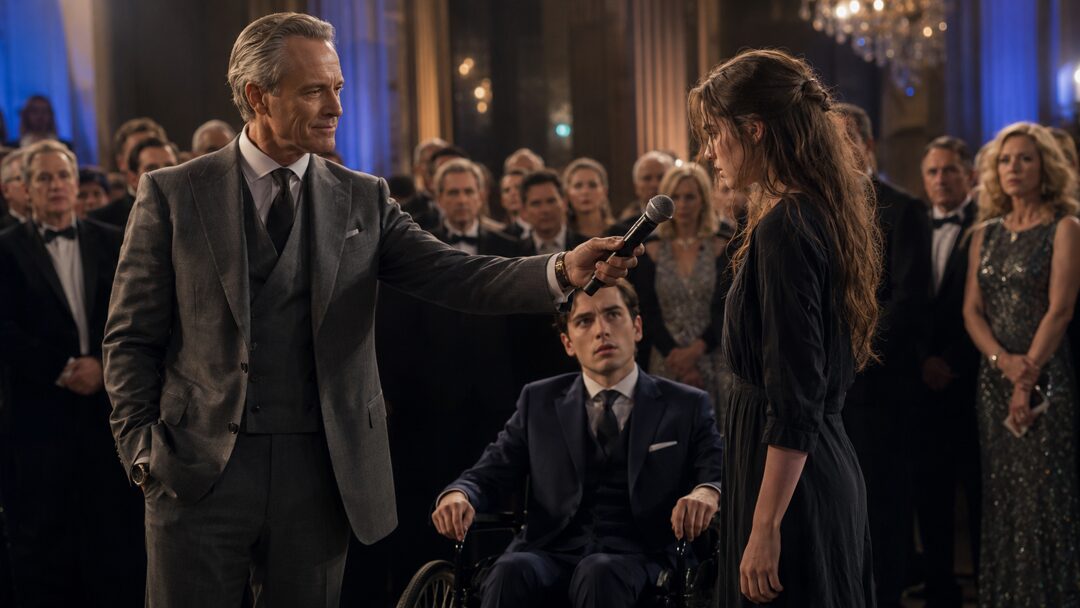
Charles waited at the podium, silver hair perfect, gray suit immaculate. Ryan sat beside him, expression unreadable.
Mia searched his face for warning.
He gave her nothing.
Charles opened his arms slightly as she approached, the image of mercy.
“Mia,” he said warmly into the microphone. “Thank you for having the courage to join us tonight.”
The audience softened at the word courage.
Mia understood then how easily kindness could be staged by someone with better lighting.
Charles turned to the crowd. “Our family believes in compassion, especially when someone is in pain.”
He placed a hand over his heart.
Mia looked at Ryan.
Still nothing.
Charles held out a second microphone to her. “Would you like to say what you came here to say?”
There it was.
The public room. The expected apology. The graceful lowering of her own head.
Mia took the microphone.
Her hand shook once.
Then she lowered it.
“No,” she said.
The room stirred.
Charles’s smile held, but his eyes sharpened.
Ryan moved.
“Give it to me,” he said.
Charles turned slightly. “Ryan.”
“The microphone.”
A pause.
Too long.
Everyone saw it.
Charles had built a life out of knowing what rooms could and could not see. That pause was his first mistake.
He handed Ryan the microphone.
Ryan’s fingers trembled around it. His voice, when it came, was quieter than Charles’s but carried farther because it had no polish to hide behind.
“My father told you this foundation began with love,” Ryan said. “That is true.”
Charles relaxed by one breath.
Ryan looked at Mia.
“It did not begin with love alone.”
Charles’s face changed.
Ryan reached into the side pocket of his chair and pulled out a small remote. The screen behind him flickered. For a moment, the foundation logo appeared.
Then the old hospital footage filled the wall.
A corridor.
A child’s room.
A little girl outside the glass, crying.
The room went utterly still.
Young Elizabeth appeared in the frame, blocking the door.
He doesn’t remember you.
Go home.
You’re making it worse.
In the ballroom, adult Elizabeth closed her eyes.
Charles stepped toward Ryan. “Turn that off.”
Ryan kept the microphone.
“This is Mia,” he said. “She knew me before I became the story you donated to.”
Charles reached for the remote.
Mia stepped between them.
Not touching him.
Just standing there.
Again.
Charles looked at her with open contempt now. No more warmth. No more grief for the audience.
“You have no idea what you are doing,” he said.
Mia met his eyes. “I do. That’s why you’re scared.”
The microphone caught it.
A ripple moved through the crowd.
Ryan locked the wheels of his chair.
The sound was small.
Mia heard it anyway.
“Ryan,” Charles said, no longer performing. “Don’t.”
Ryan put one hand on the podium.
Then the other.
His face drained of color almost immediately. His arms shook. His body fought him, memory and muscle and fear all tangled together.
Mia’s breath stopped.
He pushed.
For one impossible second, nothing happened.
Then Ryan rose.
Not gracefully.
Not fully.
Not like the end of a fairy tale.
He dragged himself upward with both hands on the podium, legs trembling beneath him, jaw clenched so hard the tendons in his neck stood out. The room gasped, but he was not doing it for them.
He was looking at his father.
“I am not your proof,” Ryan said.
His knees buckled.
Mia caught him before Charles could.
They went down together beside the podium, her borrowed shoes slipping on the marble, his body heavy against hers. The crowd surged halfway to its feet.
Charles moved toward them.
Ryan lifted his head.
His voice was clear enough for the microphone still lying near his hand.
“Don’t touch her,” he said. “She was the only one who came back.”
That sentence ended the evening.
Not the applause that did not come.
Not the cameras.
Not Charles standing frozen in the room he no longer owned.
That sentence.
Mia held Ryan on the marble while the chandeliers burned above them, and for the first time, nobody could drag her away quietly.
Part VII — The Rail Between Them
Three weeks later, the Hale Children’s Mobility Foundation removed Charles’s name from its homepage.
The announcement used careful words.
Transition.
Review.
Independent inquiry.
Ryan did not read past the first paragraph.
Charles resigned publicly and wrote privately through lawyers. The messages arrived in clean envelopes and said things like concern, privacy, recovery, misunderstanding.
Ryan kept them unopened in a drawer.
Some days, that felt like strength.
Other days, it felt like missing a father he was still angry enough to need.
Elizabeth visited Mia once at the diner.
She wore jeans instead of black silk. Her hair was tied back. Without pearls, she looked younger and less certain.
“I’m sorry,” Elizabeth said.
Mia wiped down the counter and did not answer.
Elizabeth nodded, as if she had expected that.
“I know it doesn’t fix anything.”
“No,” Mia said. “It doesn’t.”
“I told the investigators what I knew.”
“Good.”
Elizabeth waited.
Mia looked up then. “That’s all you get from me.”
Elizabeth’s mouth trembled, but she accepted it.
For once, she did not ask to be comforted by the person she had harmed.
Ryan moved into a small rehabilitation center outside the city, one with fewer donors and no portraits of him on the walls. The first time Mia visited, she stood at the entrance too long, holding a paper cup of coffee gone lukewarm.
He saw her from between the parallel bars.
“You came,” he said.
She shrugged. “You’re hard to get rid of.”
His smile was small and tired.
He looked different there. Less polished. More real. His shirt was wrinkled at the collar. His hair needed cutting. His hands were wrapped where the bars had rubbed the skin raw.
Mia glanced at the bars. “Does it hurt?”
“Yes.”
“Do you want me to say something hopeful?”
“No.”
“Good. I’m bad at it.”
That made him laugh, and the sound loosened something in her chest she had not known she was still holding.
Ryan placed both hands on the bars and pulled himself upright.
It took effort. It took breath. It took the therapist standing close without touching him. His legs shook, but he stood for three seconds.
Four.
Then he sat back hard, face pale and furious.
Mia did not clap.
She understood that much.
Instead, she stepped closer.
There was a metal rail between them. She rested her hand on it. After a moment, Ryan placed his hand over hers from the other side.
Not grabbing.
Not begging.
Not pulling anyone anywhere.
Just there.
“I’m sorry I promised it wrong,” Mia said.
Ryan looked at their hands. “I’m sorry I needed it to be magic.”
Outside the window, late afternoon light moved across the floor in a long pale stripe. Not ballroom gold. Not stage light. Just day.
Mia squeezed his hand once.
Ryan did not ask her to stay forever.
She did not promise she would.
That was how they knew something had changed.
Love, they were learning, could not be another room with locked doors.
Sometimes it was only a rail between two people, and both of them choosing not to let go.