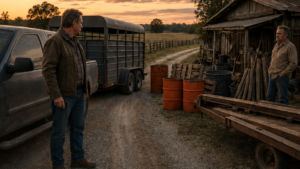
When She Cut Down His Mother’s Sunflowers, the Whole Valley Learned What the Field Was Hiding
Chapter 1: The Morning the Sunflowers Fell
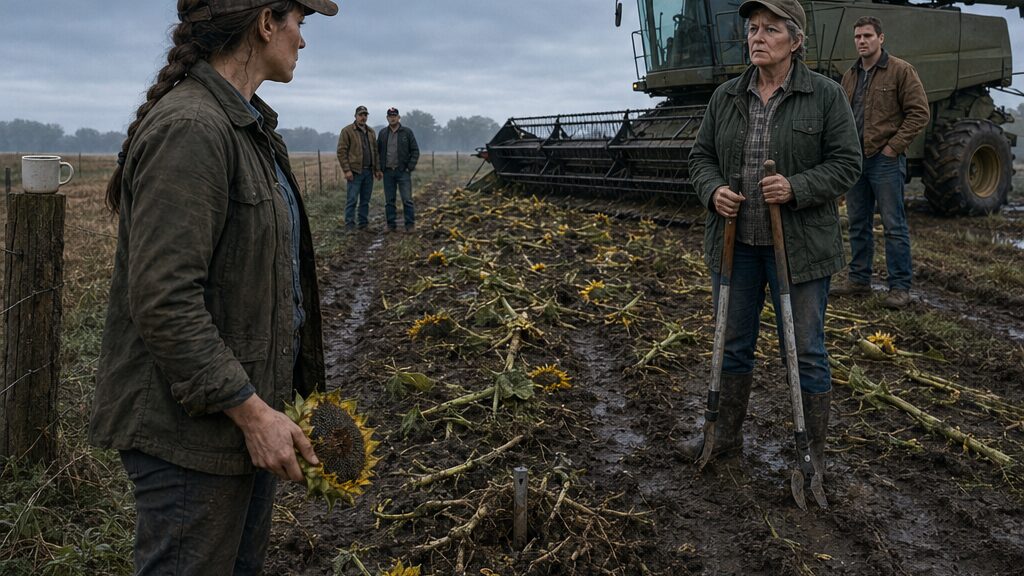
Yellow petals lay in the tractor ruts like scraps of torn cloth.
Rachel Hill stopped halfway down the back steps, one hand wrapped around a coffee mug, the other still holding the screen door open behind her. At first, her mind refused to assemble what she was seeing. The lane was there. The fence posts were there. The old walnut at the far bend stood dark against the paling sky.
But the sunflowers were gone.
Not bent by wind. Not flattened by deer.
Cut.
The stalks that had stood higher than Rachel’s shoulders the evening before were now jagged green stumps. Their broad heads lay face-up in the damp soil, yellow rims bruised with mud, black centers spilling seeds beneath the tires of a combine parked on the Wright side of the lane.
Catherine Wright stood beside it holding long-handled loppers.
Rachel set the mug on the step because her fingers had begun to loosen.
Kevin Moore leaned against the combine’s front tire, cap pulled low. He looked toward the eastern sky rather than at her.
Catherine did look at her.
“We needed the turn,” she said.
Rachel walked down the steps.
Each pace made the damage clearer. Stalks had been dragged aside and crushed into the lane. The lowest leaves were slick with mud. One flower head, the largest of the row, had been cut so close to the crown that a length of stem remained attached. Her mother had tied a strip of faded blue cloth around that stalk in June, after telling Rachel it was the first one strong enough to face west without leaning.
The cloth was still there.
Rachel knelt and lifted the flower by the stem.
“You knew what these were,” she said.
Catherine’s grip tightened around the loppers. “I knew what you said they were.”
Rachel looked up.
“My mother planted them.”
“I remember.”
“Before she died.”
“I remember that too.”
The flatness of Catherine’s voice struck harder than anger would have. Rachel rose slowly, holding the broken head against her thigh.
Kevin pushed away from the tire. “There’s rain coming. Two days, maybe less. We can’t get the header through the south field without this turn.”
“This is my lane.”
“That’s the question,” Catherine said.
Rachel stared at her. “You came across the boundary before daylight and cut down my mother’s flowers because you had a question?”
“I came across a lane our families have used for forty years.”
“My family stopped calling it shared when your husband moved the fence.”
Catherine’s face shifted, not much, but enough. “That is not how it happened.”
“You could have called.”
“I did call.”
“You left one message telling me to move them.”
“I left four.”
Rachel had heard all four. She had deleted none of them. They sat on her phone beneath two notices from the county drainage office and one unopened voicemail from the agricultural lender who had financed her spring planting.
She had told herself she would answer after the weekend.
After she harvested the tomatoes.
After she found the right words.
After she stopped hearing her mother say, Don’t let people take a little and call it nothing.
Rachel looked down at the flower in her hands.
“You ordered this?”
Kevin glanced at Catherine.
Catherine did not look at him. “Yes.”
“Before sunrise?”
“Yes.”
Rachel expected satisfaction in the answer. Instead, she saw the pulse beating fast at the base of Catherine’s throat. There were dark crescents beneath her eyes. Mud covered one knee of her work pants, and one sleeve of her shirt had been torn at the cuff.
She looked less triumphant than cornered.
That did not make the flowers stand again.
Rachel stepped past her into the torn row. Near the center, the soil had been churned deeper than the rest. A root ball had come up whole, carrying a rusted length of metal beneath it.
She set the flower down and brushed the mud away.
A square iron cap emerged, tilted at an angle. Faint stamped numbers crossed its top.
Catherine moved before Rachel had finished uncovering it.
“Leave that.”
Rachel looked over her shoulder.
The fear on Catherine’s face was gone almost at once, but Rachel had seen it.
“What is it?”
“Old scrap.”
Kevin said, “Mom.”
Catherine’s head snapped toward him.
Rachel dug around the cap with her fingers. The earth was cool and wet beneath the dry surface. The metal extended downward, fixed in place.
“This is a survey marker.”
“It might be,” Catherine said.
“You knew it was here.”
“No.”
“You just told me to leave it.”
“Because you don’t know what you’re digging around.”
Rachel wiped her muddy fingers on her jeans and took out her phone. She photographed the marker, the uprooted stalk beside it, the tire tracks and the cut row.
Kevin crossed his arms. “You planning to put us on display?”
“I’m planning to call the county.”
“The county won’t get here before the rain.”
“That isn’t my problem.”
The words came out cold and immediate. Catherine flinched as if Rachel had thrown something.
For one second, Rachel heard how closely they resembled another sentence, one she had imagined Catherine saying over the flowers: Your grief is not my concern.
Kevin climbed onto the combine’s lower step. “If we don’t move today, we lose the back acres.”
Rachel faced him. “Then use another route.”
“The soybean ground won’t hold the weight.”
“Then don’t drive over it.”
“That crop pays the operating note.”
Catherine lowered the loppers. “The lender gave us until harvest. If the grain sits wet, we lose more than a few plants.”
Rachel looked at the severed heads scattered through the lane.
“A few plants.”
Catherine closed her eyes briefly.
Kevin turned away.
The eastern sky had brightened enough to show the clouds gathering beyond the ridge, low and gray above the fields. Rachel knew what two hard days of rain would do. She knew how quickly a harvest window closed. She knew the sound of a lender asking whether sentiment could be listed as collateral.
She also knew what it had cost her mother to stand in this row the previous spring, thin from treatment, pressing seeds into shallow holes with two fingers because her hands no longer had the strength for a trowel.
Rachel picked up the flower with the blue cloth and carried it to the center of the lane.
She placed it directly in front of the combine’s tire.
Kevin stared at her. “Rachel.”
“No one drives through.”
Catherine’s mouth hardened. “You cannot block established access because you’re angry.”
“I’m not blocking anything. You cut the row. You uncovered a marker. Now the county can tell us where the line is.”
“We don’t have time for that.”
“You should have thought of time before you came here with those.”
Rachel nodded toward the loppers.
Catherine looked down at them as if she had forgotten they were in her hands.
Rachel retrieved her coffee mug from the step, though the coffee had gone untouched and cold. Then she dragged an old steel gate panel from beside the shed and pulled it across the lane. The metal legs scraped through the dirt.
Kevin climbed down from the combine.
“You know this isn’t just about a view or flowers,” he said quietly.
Rachel locked the chain through the post.
“No,” she said. “It stopped being about flowers when she cut them.”
She faced Catherine across the gate.
“This lane stays closed until the county verifies that stake.”
Catherine’s eyes went past Rachel to the torn row, then to the mud-dark marker rising between the roots.
For the first time that morning, she seemed afraid not of the rain, but of what the ground had exposed.
Chapter 2: The Lane Everyone Remembered Differently
“There is no registered easement.”
The county records clerk turned the computer monitor slightly, although the pale lines and parcel numbers meant little to Rachel from across the counter.
“No recorded access agreement, no right-of-way attached to either deed, and nothing under the Wright parcel number that crosses yours.”
Rachel rested both hands on the counter.
“So the lane is mine.”
“The land beneath most of it appears to be yours according to the current parcel map.” The clerk lifted one finger. “That is not the same as saying nobody has an access claim.”
“What would make the difference?”
“Historic use. Prior agreements. Survey corrections. A court order. Facts I don’t have.”
The clerk printed two pages and slid them across.
Mud from Rachel’s boots had dried in flakes around the hem of her jeans. She had changed shirts but not slept. At home, the broken sunflower heads were spread across the porch table. She had shaken loose seeds into a brown paper feed sack and folded the top twice to keep the birds out.
Now the bag sat beside the plat map, leaving a faint green stain on the county counter.
The clerk pointed to a thin dotted line.
“The mapped boundary runs west of the lane here, then angles east near the lower field. But these maps are for assessment. They are not surveys.”
“And the marker I found?”
“You need the county road commissioner or a licensed surveyor.”
“Samuel Roberts did the old work.”
The clerk’s expression changed. “Samuel retired.”
“I know.”
“He still has records sometimes. Not official ones.”
Rachel folded the printouts. “I only need to know what he marked.”
Outside, the parking lot shimmered with late-morning heat. The gray clouds from dawn had thinned but not disappeared. Her phone showed three missed calls from Catherine and one message from Kevin.
WE ARE TAKING THE SOUTH ROUTE. IF IT RUTS, THAT IS ON YOU.
Rachel read it twice.
The south route crossed a low soybean field Catherine had planted late after spring flooding. The ground there stayed soft beneath the surface. A loaded grain cart could sink to its axle before anyone understood what was happening.
Rachel put the phone away.
At the feed store, two neighboring farmers stood near the mineral blocks talking in low voices. They stopped when she entered, then resumed badly.
The feed-store clerk glanced at the sack under Rachel’s arm. “Seeds?”
“What’s left of them.”
One of the farmers removed his cap. “Heard about the row.”
Rachel set the bag on the counter. “News runs faster than machinery.”
The second farmer shifted his weight. “Catherine says she had no choice.”
“She had loppers. That looks like a choice.”
Neither man answered.
The clerk rang up baling twine Rachel did not need. She had picked it off the shelf to avoid standing there empty-handed.
The older farmer cleared his throat. “That lane was used before you were born.”
“By permission.”
“Sometimes.”
“Whose?”
He looked toward the front window. “Your grandfather let the Wrights through during harvest.”
“My mother stopped it.”
“Not exactly.”
Rachel’s hand stilled over her wallet.
“What does that mean?”
The farmer rubbed the brim of his cap. “Kathleen let them use it after the drainage work. Said they had one more season.”
“One more season of what?”
“That was how she said it. ‘One more season, then we’ll fix it proper.’”
“When?”
He looked at the other farmer, searching for help that did not come.
“Two years ago, maybe three.”
Rachel’s mother had been sick two years ago. Three years ago, Rachel had still been living in the city, telling herself weekly calls were enough.
“She never told me.”
The farmer gave a small, regretful shrug. “Your mother didn’t tell everybody everything.”
Rachel lifted the sack from the counter too quickly. A few seeds escaped through a crease and scattered across the worn wood.
The clerk helped gather them.
“Careful,” she said.
Rachel pinched one between her fingers. It was pale, not fully mature. Her mother had always waited until the backs of the flower heads browned before saving seed. These had been cut too early.
Outside, an engine roared from the direction of the Wright farm.
Rachel drove there by the county road instead of the closed lane. Kevin had parked the combine near the south field. A grain cart waited behind it, and two lengths of timber had been laid over the softest ground.
Catherine stood with a phone pressed to her ear, her back to Rachel.
“No,” she was saying. “I understand the terms. I’m telling you we can move the grain if the rain holds.”
She listened.
Her shoulders lowered.
“Yes. I know what happens if it doesn’t.”
She ended the call and turned.
Rachel held up the printed map. “No easement.”
Catherine glanced at the pages. “No recorded easement.”
“That is what I said.”
“No, it isn’t.”
Kevin climbed down from the combine. “We’re going south.”
“You’ll ruin the field.”
“We’ll ruin more if we wait.”
Rachel looked at the timber laid over the dark soil. “You want me to feel responsible.”
“I want you to understand numbers,” Kevin said. “One wet week and we lose the operating line. No operating line, no seed next spring.”
Catherine shot him a warning look.
He ignored it. “You think she got up before sunrise because she wanted to hurt you?”
“She knew exactly what she was cutting.”
“Yes,” Catherine said.
The admission silenced them.
Catherine’s voice was low. “I knew what they meant to you. I also knew what that lane meant to us.”
Rachel felt the legal printouts soften in her grip.
“Then you should have waited.”
“For you to answer another voicemail?”
Rachel said nothing.
Catherine looked at her for a long moment. “That is what I thought.”
The combine engine started again, forcing the conversation apart. Kevin climbed into the cab and eased the machine toward the south field.
The first tire compressed the soil without sinking. The second left a deep shining groove.
Catherine watched it with both hands clenched.
Rachel returned home and carried the feed sack into the kitchen. She spread the seeds across newspaper beside the mud-marked plat map. The page showed her boundary in clean black lines, certain in a way the land itself had never been.
Her phone rang.
Samuel Roberts’s name appeared on the screen.
She answered immediately. “I need to ask you about a marker.”
“I heard.”
“Then you know which one.”
A pause.
“Bring me the photograph.”
“I can do that now.”
“And Kathleen’s farm box.”
Rachel looked toward the hallway leading to her mother’s closed bedroom.
“What box?”
“The green metal one. She kept tax receipts in it. Old plats too.”
Rachel had seen it beneath the bed after the funeral. She had pushed it farther into the shadows because opening it had felt like entering a room her mother had locked.
“Why do you need it?”
“Because I won’t discuss that survey without it.”
“You made the survey.”
“I made more than one.”
Rachel gripped the phone. “What did you leave out of the county file?”
Samuel breathed out slowly.
“Bring the box,” he said, and ended the call.
Chapter 3: What the Surveyor Would Not Sign
Samuel recognized the survey stake before Rachel finished enlarging the photograph on her phone.
He took off his glasses, wiped them on his shirt, and put them back on.
“That cap should not be standing at that angle.”
Rachel set the green metal farm box on his workbench.
“So it is yours.”
“My mark is on it.”
Samuel’s workshop smelled of sawdust, machine oil, and the bitter coffee he had always boiled too long. Rolled maps filled a rack along one wall. Old transits and leveling rods stood in corners like instruments from a profession the county had outgrown.
Rachel pushed the phone closer.
“Why was it under the sunflowers?”
Samuel looked at the box instead of the image. “Did you open that?”
“No.”
“Why not?”
“Because you told me to bring it, not read it.”
His mouth tightened. “You always did take instructions literally when you wanted to prove a point.”
“My mother said the same thing.”
“I know.”
Rachel slid the box toward him. “Open it.”
Samuel did not touch the latch.
“First tell me what Catherine has said.”
“That the lane was shared. That my mother promised access. That the marker might be scrap.”
“At least one of those things is false.”
“Which one?”
He finally opened the box.
Inside were folders labeled in Kathleen’s compact handwriting: TAX, SEED, WELL, DRAINAGE, WRIGHT. Beneath them lay two folded plats secured with a rubber band. Samuel lifted the first and spread it across the bench.
The paper showed the Hill and Wright parcels divided by a straight penciled line. The lane ran mostly on Hill land.
Rachel felt something inside her loosen.
“This proves it.”
“It proves the original survey.”
“That is the legal boundary.”
“It is the recorded boundary.”
She looked up sharply. “You are doing the same thing as the clerk.”
“Because words matter when land is involved.”
Samuel unfolded the second sheet.
The line on this one curved near the lower field. Several measurements had been crossed out and rewritten. A red X marked the location where Rachel had found the stake.
There was no signature.
“What is this?”
“A correction sketch.”
“Correcting what?”
“The drainage work shifted the practical line.”
“Land does not move because someone digs a ditch.”
“No. Markers do.”
Rachel stared at him.
Samuel placed one broad finger beside the red X. “Your mother hired a crew to deepen the upper drainage channel. They used the old stake as a reference, pulled it to get equipment through, then reset it wrong.”
“How wrong?”
“Nearly eleven feet at the widest point.”
“Toward us or toward them?”
“Toward the Wright property.”
Rachel looked again at the curved line. If Samuel was right, the corrected boundary gave her more land near the lane, not less.
“So Catherine’s marker was on my side.”
“Yes.”
“And the lane is still mine.”
“Most of it.”
The relief came fast and hot. Rachel stepped away from the bench, nearly laughing.
Catherine had cut the flowers, hidden the marker, and accused Rachel of blocking access across land that did not belong to her.
“I’m calling the county.”
Samuel caught the edge of the sketch before she could take it.
“This is not filed.”
“It should have been.”
“Yes.”
“Why wasn’t it?”
His hand remained on the paper.
“Kathleen asked me to wait.”
The relief vanished.
“For what?”
“Until she and Catherine reached an agreement.”
“An agreement about my land?”
“Her land then.”
Rachel’s voice sharpened. “Why would she delay a correction that favored her?”
Samuel’s eyes moved toward the workshop window. Beyond it, corn leaves turned their pale undersides in a rising wind.
“Because the correction made another problem harder to ignore.”
“What problem?”
He removed his hand from the page, but Rachel no longer reached for it.
Samuel took a folder from the farm box marked DRAINAGE. Inside were photographs of standing water across a field Rachel recognized as Catherine’s lower acreage. In one, soybean plants rose barely above brown water. In another, a culvert mouth was packed with silt.
Dates were written on the backs.
Three years ago.
Two years ago.
The summer before Kathleen died.
Rachel flipped through them. “Why did my mother have these?”
“Catherine gave them to her.”
“She never showed me.”
“You weren’t here for most of it.”
The words landed without force, which made them worse.
“I came back.”
“When she got sick.”
Rachel closed the folder.
Samuel looked tired suddenly. Older than he had at the funeral, when he had stood beside the church door shaking hands and telling everyone Kathleen had been tougher than the county deserved.
“Your mother intended to fix the lane and the drainage together,” he said. “She did not want the corrected boundary filed until they settled how the Wrights would get equipment through.”
“So she let Catherine believe the lane was hers?”
“No. Catherine knew the legal line was uncertain.”
“Did Kevin?”
“I don’t know.”
“Did you tell anyone?”
“I told both women to put it in writing.”
“But you did not file your work.”
“No.”
“Why?”
Samuel folded his glasses and set them down.
“Because Kathleen was my friend. Because Catherine’s husband had just died. Because both of them said they could settle it without dragging the county into it.” He looked at the unsigned sketch. “And because I was close enough to retirement to confuse avoiding trouble with keeping peace.”
Rachel paced once across the narrow floor.
“You let a false marker sit there.”
“I let an uncertain marker sit there.”
“You knew where the line was.”
“I knew where the measurements placed it. I did not know what agreement would follow.”
She turned on him. “Catherine cut down the flowers and tried to bury this.”
“I did not say she was right.”
“You are working hard not to say she was wrong.”
Samuel’s face tightened. “She was wrong to cut them. She was wrong to hide the cap if she hid it. But she did not invent the lane.”
Rachel looked toward the open farm box.
The WRIGHT folder remained unopened.
Her mother had labeled it in the same neat hand she used for seed orders and tax receipts, as if a family dispute could be contained between two metal tabs.
A truck door slammed outside.
The county road commissioner entered without knocking, followed by a younger staff inspector carrying a tablet.
“Rachel,” the commissioner said. “Catherine called for an emergency site review. We can be at the lane tomorrow morning.”
Rachel looked at Samuel. “She called the county?”
“After you did,” the commissioner said. “She says harvest access is blocked. You say a marker was disturbed. We need everyone present.”
Samuel picked up the unsigned sketch.
The commissioner noticed it. “Is that related?”
Samuel hesitated.
Rachel watched the hesitation move through the room.
“Yes,” she said. “It is.”
Samuel closed his eyes briefly.
The commissioner held out his hand. “Then I need a copy.”
Samuel did not give it to him.
“It is unfinished,” he said.
“So is the dispute.”
The commissioner waited.
At last, Samuel carried the sketch to the copier in the back room. The machine clicked and hummed while Rachel stood beside the farm box, looking at her mother’s handwriting.
When Samuel returned, he gave the copy to the commissioner and the original to Rachel.
“You wanted the truth,” he said.
“I still do.”
He glanced at the DRAINAGE folder.
“The real dispute was never the lane.”
Rachel held the unsigned survey between both hands.
Samuel’s voice dropped.
“It was the water.”
Chapter 4: The Water Below the Lower Field
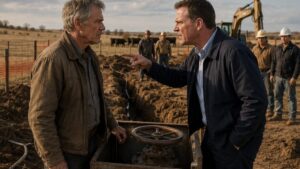
The inspector drove a steel probe into the ditch bank and struck packed silt less than a foot beneath the surface.
“There,” he said. “That is where the water stops.”
Rachel stood above him with her arms folded, the unsigned survey sketch tucked beneath her jacket. Across the ditch, Catherine watched from the edge of the Wright lower field. Kevin remained near the pickup, speaking quietly into his phone.
The county road commissioner crouched beside the inspector. “And the source?”
The inspector pulled the probe free. Mud clung to its lower half. “The upper channel drains from Hill ground. This culvert should carry it east, but the grade is wrong and the mouth is nearly sealed.”
Rachel looked uphill.
From that angle, the line was undeniable. The shallow ditch began beneath her mother’s old hayfield, crossed the lane near the buried survey marker, then dropped toward Catherine’s soybeans. The upper channel had been cut straight and deep. The lower section had not.
“Rain did that,” Rachel said.
“Rain exposed it,” the inspector replied. “It did not set the grade.”
Catherine gave a short laugh without humor.
Rachel turned. “Say what you came to say.”
“I already said it three summers ago.”
“You said the ditch was flooding.”
“It was.”
“You never said our work caused it.”
“I sent photographs. I sent bills. I stood in your mother’s kitchen with mud to my knees.”
Rachel felt the DRAINAGE folder inside the green box as clearly as if she were still holding it. “She did not tell me.”
Catherine’s expression hardened. “You were not here.”
The words had become a tool everyone seemed willing to use.
“I came back.”
“When there was no one else.”
Rachel stepped down the bank before she could answer. Wet clay slid beneath her boot. She caught herself against a fence post, and several sunflower seeds escaped from her closed fist.
She had carried them without thinking, taking them from the paper sack that morning before leaving the house. Now they landed in the mud, pale shells darkening almost at once.
The inspector followed the ditch farther down.
“Someone deepened the upper run with machinery,” he said. “See the straight cut? Water gained speed here. When it reached the old culvert, it spread across the lower field.”
The commissioner looked at Rachel. “Who ordered the work?”
“My mother.”
“Do you know when?”
“Three years ago.”
Catherine walked to her truck and returned with a plastic folder. She removed several invoices, each protected in a clear sleeve.
“Pump rental,” she said, placing the first on the hood. “Gravel. Culvert cleaning. Replanting the lower eight acres after the first flood.”
Rachel did not reach for them.
Catherine placed another page down.
“This one is for the trench we dug to save the equipment shed.”
Kevin ended his call and came over. “Show her the last one.”
Catherine hesitated, then added a handwritten estimate from a drainage contractor. Kathleen Hill’s name appeared beneath Catherine’s in the customer line.
Rachel picked it up.
Across the bottom, in her mother’s handwriting, were four words: Split after harvest. K.H.
The letters were unmistakable. Kathleen’s K always leaned backward, as if resisting the rest of the name.
“This is not an agreement,” Rachel said.
“No,” Catherine replied. “It is a promise.”
“An estimate is not proof she accepted blame.”
“The standing water was proof.”
The commissioner raised a hand. “We are not deciding liability today.”
Kevin gave him a bitter look. “The lender is.”
Everyone turned toward him.
He held up his phone. “They called again. If the grain is not moving by tomorrow afternoon, they reduce the operating line.”
Catherine’s face went still.
Rachel looked between them. “Reduce it by how much?”
“Enough,” Catherine said.
Kevin answered anyway. “Enough that there is no spring planting without selling ground.”
The wind moved through the soybeans, making the leaves flash silver-green. Several rows near the ditch were shorter than the rest. Rachel had noticed the difference from the road but assumed the soil there was poor.
Now she saw the faint lines where water had once stood.
Catherine gathered the invoices. “You wanted to know why the lane mattered.”
“I wanted you not to cut the flowers.”
“And I wanted your mother to finish what she started.”
“My mother is dead.”
Catherine’s jaw tightened. “I am aware.”
The cruelty of the answer was quieter than the one at dawn, but Rachel heard the hurt beneath it. Catherine was not speaking about Kathleen as a stranger. She was speaking about someone who had left her with an unfinished debt.
The commissioner unfolded the copied survey sketch on the truck hood.
“The recorded boundary favors Hill,” he said. “The historical use favors Wright. The drainage problem connects both parcels. None of that authorizes anyone to destroy property.”
Catherine looked away.
“Nor,” he continued, “does it allow one owner to ignore runoff damage because the paperwork is incomplete.”
Rachel felt the words settle over her.
Legal leverage had seemed clean in the records office. Here, with silt packed inside the culvert and drowned rows visible beyond it, the line on the map no longer felt like an answer.
The inspector pointed toward the lane. “A temporary route could be opened if the turn is widened, but the marker needs verification first. And no loaded equipment should cross that south field.”
Kevin swore under his breath.
“How long for verification?” Catherine asked.
“Tomorrow at best.”
“We do not have tomorrow at best.”
“You have no safe route today,” the inspector said.
Kevin walked back toward the combine without another word.
Rachel watched Catherine follow him with her eyes. The fear Rachel had seen at dawn returned, stripped now of pride. It was the look of someone measuring acres against debt and finding no room left.
That evening, Rachel carried the green farm box to the kitchen table.
She opened every folder except WRIGHT.
Tax receipts. Seed orders. A hospital statement folded inside a fertilizer invoice. Notes in Kathleen’s hand about calf vaccinations, roof leaks, and the exact week to turn the compost.
The ordinary records hurt more than the photographs.
At last, Rachel lifted the WRIGHT folder.
It contained copies of the repair invoices, two rough sketches of a curved access lane, and a list of figures written on the back of an envelope. Kathleen had calculated gravel, culvert pipe, fencing, and the value of a narrow strip of land.
At the bottom she had written: Rachel will think I gave it away.
Rachel sat back.
Beneath the folder lay one final envelope, sealed and yellowed at the edges.
Catherine Wright was written across the front.
Chapter 5: The Letter Neither Family Received
The envelope contained two unsigned copies of the same agreement.
Rachel laid them side by side beneath the kitchen light.
The first page described a relocated machinery lane curving around the corrected boundary. The second divided the cost of a new culvert and drainage repairs between the Hill and Wright farms. A final clause reduced the sunflower strip to a smaller arc near the upper fence.
Kathleen had initialed each page but had not signed the last line.
Neither had Catherine.
A packet of sunflower seeds fell from the envelope and struck the table with a dry rattle.
Rachel picked it up.
Her mother had written one season on the front.
A folded letter remained inside.
Catherine—
I have waited too long because I kept thinking the right time would arrive without me making it. It has not.
Rachel stopped reading.
The house was silent except for the refrigerator motor and the faint tap of a branch against the kitchen window. Her mother’s handwriting narrowed as the letter continued, the later lines more uneven than the first.
Kathleen admitted the drainage cut had sent water onto Wright land. She acknowledged the repair costs and agreed the old lane could not remain where local habit had placed it. She proposed moving it along the curve Samuel had measured.
Then the letter changed.
I planted the sunflowers because I wanted one last full row before we moved the lane. That was selfish, but not because I meant to claim the ground forever. I wanted to see them from the kitchen one more summer.
Rachel pressed her thumb against the page.
She remembered that summer. Kathleen sitting beneath the porch fan with a blanket over her knees despite the heat. The sunflowers turning one by one toward the afternoon light. Rachel had believed they were a declaration: the farm remained theirs, unchanged.
The letter said otherwise.
I have not told Rachel because she hears compromise as surrender. That is partly my fault. I taught her to hold on before I taught her how to decide what was worth holding.
Rachel stood so quickly the chair scraped backward.
She walked to the sink, then back to the table.
The sentence remained.
She read the rest standing.
Kathleen wanted Catherine to wait until harvest. She wanted time to explain the reduced acreage, the drainage debt, and the fact that the farm could no longer support every promise attached to it. She feared Rachel would inherit it as an obligation rather than choose it as a life.
The final paragraph was shorter.
If I cannot finish this, do not let our children turn it into a war over which of us was wrong. We were both proud, and the water did not care.
Rachel folded the letter along its old crease.
For months she had treated every unchanged object as evidence of what her mother wanted. The jars on the pantry shelf. The broken gate latch. The row of sunflowers. She had preserved them because making a choice felt too much like editing the dead.
A truck came up the drive.
Headlights swept across the kitchen wall.
Catherine knocked once and opened the screen door before Rachel answered.
“We need access tonight.”
Rachel placed one hand over the letter.
Catherine stood on the porch in the same mud-marked clothes she had worn at the inspection. “The storm shifted east. It will reach us before dawn.”
“The county has not verified the stake.”
“Kevin can make the turn if we remove the gate panel.”
“No.”
Catherine gripped the doorframe. “Rachel.”
“There was an envelope for you.”
Catherine’s eyes moved to the table.
Rachel carried the letter and agreements to the porch but kept them in her hand.
“My mother planned to move the lane.”
Catherine closed her eyes.
“You knew.”
“I knew what she proposed.”
“She admitted the drainage damage.”
“Yes.”
“She agreed to pay part of it.”
“Yes.”
“And you still cut the flowers.”
Catherine opened her eyes. “The agreement was never signed.”
“That did not answer me.”
“The row sat exactly where the machinery needed to turn.”
“You could have gone to the county.”
“We did that three years ago. Samuel asked us to settle it privately. Your mother asked for one season. Then another. Then she got sick.”
“And after she died?”
“You would not discuss it.”
Rachel felt the accusation find its place because it was true. Catherine had come to the farm twice after the funeral. Rachel had left her standing near the barn while pretending to check a water line. Later, she had returned the proposed lane map unopened.
“I did not know about this letter.”
“You knew there was a problem.”
“I knew you wanted land.”
“I wanted a route we had already been promised.”
Rachel held up the seed packet. “She planted them for one final season.”
Catherine’s mouth trembled, barely. “I know.”
“How?”
“She told me.”
The answer cut through Rachel’s remaining defense.
Catherine looked toward the dark lane. “She stood there the summer before she died and said she wanted the whole row once more. I told her she could have until harvest.”
“Then why did you act as though they meant nothing?”
Catherine’s face closed again. “Because meaning does not move grain.”
“That is not the truth.”
A low roll of thunder sounded beyond the ridge.
Catherine glanced toward the yard. “Whatever truth you want, we can have it after the crop is out.”
“No.”
“Do not make this another delay.”
Rachel stepped down from the porch, carrying the papers.
Catherine followed.
At the damaged row, the cut stalks had begun to wilt. Their leaves hung limp, and the exposed roots had dried pale around the survey marker.
Rachel stopped beside the gate.
“I will not hand you this letter so you can wave my mother’s guilt at the county.”
“I did not ask for that.”
“You came demanding access.”
“Because we need it.”
“You also need to tell me what happened before sunrise.”
“I told you. I ordered the row cut.”
“You hid the marker.”
Catherine said nothing.
Rachel unfolded the letter but held it against her chest.
“My mother does not get to carry all of this because she is not here to answer. Neither do I.”
Thunder sounded again, closer now.
Rachel met Catherine’s eyes.
“You want the letter, tell me the whole truth about the cutting.”
Chapter 6: What Catherine Chose Before Sunrise
Catherine placed the metal survey cap on the porch rail.
Mud filled the stamped grooves. One side bore a fresh scrape where it had been pried from the stake.
Rachel stared at it.
“You removed this.”
“After we found it.”
“And left the stake in the ground.”
“Yes.”
“Why?”
Catherine kept her hands at her sides. “Because Kevin said if the county saw the marker before we got the equipment through, the lane would be closed.”
Rachel looked toward the Wright farm. The combine’s work lights glowed beyond the trees.
“So he told you to hide it.”
“He told me what would happen if we did not.”
“That is not the same thing.”
“No.” Catherine’s voice roughened. “It is not.”
She walked to her truck and returned with a burlap sack. When she set it beside the steps, several severed sunflower heads pressed against the fabric.
“We gathered what had not been crushed.”
Rachel did not touch the sack.
Catherine leaned against the porch post. “Kevin wanted to push through last night. I told him to wait until morning. He said waiting was what had put us here.”
“And you agreed.”
“I took the loppers.”
The simple admission carried more weight than blame shifted onto Kevin would have.
Catherine looked at the dark yard. “I thought if the flowers were gone, you would see the lane as a lane.”
“They were never only flowers.”
“I know.”
“You said otherwise.”
“I said what I needed to say to keep from stopping.”
Rachel felt the letter beneath her hand. “That is not a defense.”
“No.”
For the first time, Catherine did not add anything after the word.
The storm wind lifted loose dust from the drive. The sack rustled at Rachel’s feet.
Catherine nodded toward it. “Kathleen used to dry the heads in her smokehouse. Said the mice could climb anything except a coffee tin hung from wire.”
Rachel remembered the tins turning slowly from the rafters.
“You loved her,” Rachel said.
Catherine’s expression sharpened as if the word itself were an intrusion.
“We worked beside each other for twenty-six years.”
“That was not what I said.”
Catherine looked past her toward the kitchen window.
“She knew my husband was dying before Kevin did,” she said. “She drove him to treatments when I could not leave the cattle. After he died, she came every morning for a month and checked the lower pasture before I got out of bed.”
Rachel said nothing.
“I loved her enough to believe her when she said she would fix the water. I loved her enough to wait when she asked for one more season.” Catherine’s voice dropped. “And I resented her for dying before she kept the promise.”
The sentence seemed to change the air between them.
Rachel had guarded Kathleen’s memory as if grief belonged to one household. She had never considered Catherine watching the same kitchen light go dark.
“That does not excuse what you did,” Rachel said.
“I know.”
“You cut down the last row she planted.”
“I know.”
“And hid the cap.”
“Yes.”
Rachel unfolded the letter.
Catherine did not reach for it.
“My mother wrote that both of you were proud.”
“She was kinder to me on paper than she was in person.”
A sound rolled from the lane—not thunder this time, but a diesel engine.
Both women turned.
The combine lights moved between the trees.
Catherine stepped off the porch. “Kevin.”
The machine advanced slowly toward the closed gate, header raised. Its tires pressed deep into the soft ground. Kevin sat high in the cab, face pale in the instrument light.
Catherine waved both arms. “Shut it down.”
The engine continued.
Rachel ran after her.
At the gate, Kevin lowered the window. “Move the panel.”
“The county inspection is tomorrow,” Catherine called.
“The rain is tonight.”
“We are not crossing.”
“You said the agreement gave us access.”
“It does not give us permission to force it.”
Kevin looked at Rachel. “You got what you wanted. The survey favors you. The letter says she promised the lane. What else is left?”
“The damage,” Rachel said.
“We can pay for flowers.”
“No, you cannot.”
He gripped the steering wheel. “Then name a number.”
Catherine climbed onto the lower step. “Kevin, turn it off.”
He looked down at her. “The lender will take the farm.”
“Maybe.”
“You told me we would not lose it the way Dad did.”
Catherine’s hand remained on the cab rail.
Rachel saw then what Kevin had been protecting beneath his impatience. Not profit. Not pride alone. A promise made after another death, as rigid and dangerous as Rachel’s promise to preserve everything Kathleen had touched.
The combine edged forward.
The gate panel shook from the vibration.
“Kevin,” Catherine said. “I chose wrong this morning. Do not make me choose wrong twice.”
His face changed.
Then the front tire crossed the shallow rut before the gate.
Rachel stepped into the lane.
Catherine shouted her name.
Rachel planted herself in front of the raised header, the letter clenched in one hand. The machine was still several yards away, moving barely faster than a walk, but its size filled the lane.
Kevin hit the brake.
The combine rocked to a stop.
For a moment, only the engine remained, loud enough to flatten every other sound.
Rachel looked up at the cab.
“Shut it off.”
Kevin stared down at her.
“The crop is not worth another trespass,” she said. “And my grief is not worth destroying your field. We find another way, or we lose together.”
Catherine stood beside the tire, one hand still on the rail.
Kevin’s shoulders lowered.
The engine died.
In the sudden silence, rain began tapping against the metal header.
Rachel turned toward the damaged lane, the blocked culvert beyond it, and the severed flowers waiting in Catherine’s sack.
By morning, the county would ask who owned the ground.
Before then, Rachel would have to decide what ownership required.
Chapter 7: The Boundary Rachel Chose to Move
Rachel read only the paragraph in which her mother accepted responsibility.
She stood beside the damaged lane with Kathleen’s letter held in both hands while the county road commissioner, the inspector, Samuel, Catherine, Kevin, and two neighboring farmers listened in the damp morning air.
“My drainage work increased the flow into the Wright lower field,” Rachel read. “I agreed to share the cost of correcting it and to relocate the machinery lane after one final sunflower season.”
She stopped there.
The next lines belonged to grief, not the county.
The commissioner glanced at the unsigned agreement spread across the hood of his truck. “You are willing to honor this proposal?”
“I am willing to honor the responsibility,” Rachel said. “Not every line on this page.”
Catherine’s mouth tightened. “The route was already measured.”
“It was measured before the corrected boundary was confirmed.”
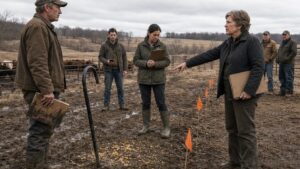
The inspector had driven fresh stakes into the ground shortly after sunrise. White flags now showed the recorded Hill line. Red flags marked Samuel’s corrected measurements. The disputed iron stake stood between them, no longer hidden but no longer trusted.
The corrected line favored Rachel by almost eleven feet near the turn.
Kevin looked at the flags and then at the combine waiting beyond the gate. “That makes the original route wider.”
“It also puts more of it on Hill ground,” the commissioner said.
Rachel crouched beside the plat map she had pinned beneath two stones. During the night, she had drawn a third line in pencil. It began on the Wright side of the lane, curved around the corrected boundary, then crossed a narrow corner of Hill land before joining the upper track.
The inspector studied it.
“This bend is too tight for the full header.”
“Not if the inside fence moves six feet.”
Catherine looked up. “That is orchard ground.”
“Two old pear trees and a section of failed fence.”
“They still belong to you.”
“Yes.”
The word seemed to unsettle Catherine more than refusal would have.
Rachel pointed lower on the sketch. “The lane narrows here, then widens after the culvert. The combine can pass without crossing the sunflower ground or the soft soybean field.”
Kevin came closer. “The grain cart will cut the corner.”
“Then unload before the turn.”
“That costs time.”
“So did cutting my property.”
Catherine folded her arms. “You are offering access designed to punish us.”
“No. I am offering access designed around what the land can hold.”
Rachel moved her finger to the ditch.
“The blocked culvert gets replaced before the next planting. The upper channel is regraded. Costs are split according to the agreement, except the Wright farm pays for the destroyed row and the emergency survey.”
Kevin gave a sharp breath. “We cannot afford all of that now.”
“You can pay the flower damages after harvest.”
Catherine’s eyes narrowed. “How much?”
Rachel had spent part of the night calculating mature plants, saved seed, labor, and replacement fencing. Every number had felt insulting beside the memory of Kathleen kneeling in the dirt.
She named a figure anyway.
Catherine did not argue that it was too high.
Instead, she said, “Money will not replace them.”
“No.”
The answer left no place for bargaining.
Samuel stood apart from the others, hands deep in his coat pockets. The commissioner turned toward him.
“Would this route work with your corrected line?”
Samuel looked at Rachel rather than the map. “It could.”
“Could?”
“If the culvert is widened and the turning radius is marked correctly.”
Rachel pointed to the red flags. “Then mark it correctly.”
Samuel removed his hands from his pockets.
“I am retired.”
“You were not retired when you left the sketch unsigned.”
The words struck him cleanly. He looked toward the ground.
Rachel regretted the public edge in her voice but did not take it back.
Samuel walked to the truck, picked up a pencil, and adjusted the curve by several inches.
“Here,” he said. “Move the inner edge west. It saves the pear trees and gives the rear axle room.”
The inspector measured the change on the ground.
“It is narrow,” he said, “but workable.”
Kevin shook his head. “Workable is not the same as safe.”
“Neither is driving a combine through a closed gate,” Catherine said.
He looked at her.
She held his gaze until he turned away.
The agricultural lender arrived near midmorning, stepping carefully around the mud in polished boots. He examined the proposed route, asked for harvest estimates, then spoke privately with Catherine beside the pickup.
Rachel watched Catherine’s shoulders stiffen.
When they returned, Catherine said, “They will hold the operating line through harvest if the temporary access agreement is signed today.”
Kevin stared at her. “And after?”
“After depends on yield and repair costs.”
He looked toward the lower field, where the soybean leaves had begun to curl under the approaching storm front.
Rachel felt the old instinct rise in her—the need to withdraw the offer before someone treated it as weakness. The legal boundary was hers. The county had confirmed it. She could close the lane and let the Wright farm absorb the result.
Then she saw Kathleen’s sentence in her mind: Rachel will think I gave it away.
Perhaps her mother had understood her too well.
Rachel took the unsigned agreement from the truck hood.
“This version does not stand,” she said.
Catherine’s face closed.
Rachel tore the first page across the middle.
Kevin stepped forward. “What are you doing?”
“Removing the part that pretends the old route still exists.”
She placed a blank temporary-access form on the hood and began writing.
The commissioner watched over her shoulder.
Temporary use through harvest. Curved route only. No loaded grain cart across the lower bend. Wright farm responsible for damage to the sunflower row and half the culvert replacement. Hill farm responsible for correcting the upper drainage grade. Permanent access contingent on completed repairs and a recorded survey.
Rachel added one final condition.
“No machinery before daylight without notice to both owners.”
Catherine read the page.
“You want control of every crossing.”
“I want a record of them.”
“This is a farm lane, not a border station.”
“It became both when you hid the marker.”
Catherine looked toward the iron cap resting on the truck hood. Then she nodded once.
Kevin did not.
“The turn will slow us down.”
“Yes,” Rachel said.
“We could still lose part of the crop.”
“Yes.”
“And you call that a solution?”
Rachel met his eyes. “A solution is not the same as getting everything you wanted.”
The commissioner placed the form between them.
Catherine signed first.
Her hand paused after her surname, as if the ink carried more weight than she had expected. Then she passed the pen to Rachel.
Rachel signed beneath her.
The seasonal farmhand and Kevin moved the steel gate panel aside. Samuel and the inspector set temporary markers along the curved route. At the inner edge, Rachel took the paper packet from Kathleen’s letter.
She opened it and poured several sunflower seeds into her palm.
Catherine watched.
“You are planting them now?”
“No.”
Rachel pressed one seed into the mud beside the first red flag, then another beside the last.
“What are those for?” Kevin asked.
“To remember where the temporary line is.”
He almost smiled, but the expression did not hold.
The combine started.
This time, Rachel stood clear of the lane. Kevin eased the machine forward, following Samuel’s flags. The rear tire passed within inches of the damaged row. At the bend, he slowed, reversed once, and corrected the angle.
The pear branches scraped lightly across the cab but did not break.
When the machine cleared the upper track, Catherine let out a breath.
Rachel had not realized she had been holding hers too.
By afternoon, the first grain was moving. The lane showed fresh ruts, but none crossed the white boundary flags. Water from a brief shower ran down the ditch and pooled behind the blocked culvert, reminding them that the agreement had solved only the immediate danger.
Catherine folded her copy and placed it in her jacket.
“I will bring the first payment after the grain sells.”
Rachel nodded.
“And Kevin will help replace the culvert.”
Kevin looked at Catherine, then at Rachel.
“I will.”
The commissioner and inspector drove away. Samuel gathered the survey flags he no longer needed, leaving only those that marked the temporary curve.
Catherine remained beside the torn sunflower row.
“What will you plant here?” she asked.
Rachel looked at the jagged stalks, the new wheel marks, and the two seeds she had pressed into the mud.
“I do not know yet.”
It was the first time since Kathleen’s death that the answer did not feel like failure.
Chapter 8: The Seeds That Crossed the New Line
Only seven of the salvaged seeds germinated.
Rachel counted them twice before accepting the number.
They stood in small soil blocks on the greenhouse bench, thin stems bent toward the eastern glass. Three still wore black seed shells like tiny helmets. The others had opened their first leaves, pale and uncertain.
The rest of the tray remained empty.
Rachel pressed a finger into one bare square. The soil was moist and warm. Nothing waited beneath it.
She had saved hundreds of seeds from the severed heads, dried them in hanging coffee tins, and stored them through winter exactly as Kathleen had taught her. Most had been cut too early to mature. Others had rotted before Catherine gathered them.
Seven had survived.
Outside, the repaired lane curved between the farms instead of running straight through the old row. Fresh gravel covered the worst ruts. The inner fence had been moved, the pear trees pruned, and a wider concrete culvert carried spring runoff beneath the track.
Catherine had maintained it through winter.
After every hard rain, Rachel found the culvert mouth cleared of branches and silt. No note appeared on the gate. No one claimed credit. But Catherine’s boot prints crossed the mud, narrow at the heel and worn along the right edge.
The damage payments had arrived in three installments after harvest. The first check was exact to the dollar. The second included interest Rachel had not requested. The third came with an invoice showing Kevin’s labor deducted from Catherine’s half of the drainage repair.
Rachel had signed each receipt and returned it without comment.
Settlement was not forgiveness. Maintenance was not friendship.
Still, the lower field had not flooded once.
She carried the seven seedlings outside in a shallow wooden tray.
The old sunflower line remained visible as a faint ridge where the roots had once held the soil. Rachel had considered rebuilding it exactly, tall and straight along the original edge.
Instead, she had marked a curved bed that followed part of the new lane before bending away from it. The flowers would stand on Hill land, but anyone traveling between the farms would pass close enough to see them.
She set the tray down and began digging.
The first hole went near the upper fence, where Kathleen could once see the flowers from the kitchen window. The second went beside the corrected survey marker. The third stood near the culvert, where the water now ran clear.
By the fifth hole, a truck approached from the Wright side.
Catherine stopped beside the lane and climbed out.
Two flats of sunflower seedlings rested in the truck bed.
Rachel straightened slowly.
Catherine lowered the tailgate. “These came from the heads I brought back.”
Rachel looked at the flats. At least thirty seedlings stood in neat rows, taller and darker than hers.
“You planted them?”
“In January.”
“You do not start sunflowers in January.”
“I learned that.”
Several had been transplanted into larger pots after outgrowing their first containers. Others leaned sideways where Catherine had tied them to wooden sticks.
Rachel touched one leaf.
“You kept the seeds.”
“I did not know whether yours would grow.”
“You could have told me.”
Catherine looked toward the lane. “I thought you might say no before you saw them.”
Rachel almost did.
The old reflex came quickly: protect the row, protect Kathleen, protect the one thing Catherine had no right to repair.
Then she looked at the seedlings.
They were not replacements. Nothing could make them that.
They were living consequences of what Catherine had cut.
“How many?” Rachel asked.
“Thirty-four.”
“Some will not survive transplanting.”
“I know.”
Rachel picked up one flat.
Catherine took the other.
They carried them to the curved bed without speaking.
At the corrected boundary marker, Catherine stopped. “Does the row cross here?”
“The bed does.”
“That puts some flowers near the lane.”
“Near it. Not in it.”
Catherine nodded.
Together they set the seedlings along the curve. Rachel spaced them wider than Kathleen had, leaving room for each plant to turn without crowding the next. Near the culvert, she planted three on the Wright side of the drainage edge.
Catherine noticed.
“I thought you wanted them on your land.”
“They are on my land.”
Catherine looked at the red survey cap, then at the curve.
Rachel had followed the legal boundary precisely. The flowers crossed the old assumed line, not the corrected one.
Catherine gave a small breath that might have been a laugh.
Kevin arrived with a load of gravel before noon. He parked beside the lower bend and watched them planting.
“You two calling this settled?” he asked.
Catherine looked at Rachel.
Rachel pressed soil around a seedling. “No.”
Kevin’s face tightened.
“The agreement is settled,” Rachel continued. “The culvert is repaired. The damages are paid.”
“But?”
Rachel stood.
“What happened is still what happened.”
Catherine wiped dirt from her palms. “She is right.”
Kevin looked between them. “Then what is this?”
Rachel glanced at the curved row.
“This is what comes after.”
He considered that, then unloaded the gravel.
By afternoon, the bed was planted. Some seedlings stood straight. Others leaned despite their supports. Rachel watered each one from a dented metal can Kathleen had used for years.
Catherine gathered the empty flats.
“I told the lender the permanent easement will not follow the old route,” she said.
Rachel looked up. “What did they say?”
“That they lend money, not opinions.”
“That does not sound like them.”
“They had several opinions first.”
Rachel set down the watering can.
Catherine hesitated beside her truck. “Kathleen would have liked the curve.”
“You do not know that.”
“No.”
The answer was careful.
Rachel looked toward the farmhouse window, where the old row had once filled the view.
“She would have complained it was harder to cultivate.”
Catherine smiled faintly. “That sounds more likely.”
For a moment, the distance between them narrowed.
Rachel did not close it completely.
“You still should have waited,” she said.
Catherine’s smile disappeared, but she did not turn defensive.
“I know.”
“And I should have answered.”
“Yes.”
Rachel nodded once.
It was not an apology that erased either choice. It was simply the truth left standing between them without disguise.
The seedlings struggled through a cold week, then strengthened when the days warmed. Several failed. Others were taken by rabbits until Kevin installed a low wire guard without being asked.
By midsummer, twenty-six sunflowers followed the lane in a broad arc.
They did not form the wall Kathleen had planted. There were gaps where plants had died and differences in height between Rachel’s seven seedlings and Catherine’s later starts. The unevenness bothered Rachel until she realized she could identify each group from the kitchen window.
After a heavy July rain, she walked down to inspect the culvert.
Water moved beneath the lane in a steady brown stream. No pool formed in the lower field. Catherine had cleared the intake that morning, leaving fresh shovel marks along the bank.
Rachel pulled two branches from the grate and tossed them aside.
A combine track from the previous week curved safely around the bed. No tire had crossed the stones marking the boundary.
As she turned back, the tallest sunflower shifted in the wind.
It had grown from one of the seven salvaged seeds.
Its stem stood near the place where Rachel had found the buried stake, but the flower itself did not face the farmhouse or the Wright field. The afternoon sun had drawn it toward the shared lane.
Rachel touched the blue strip of cloth tied loosely beneath its head.
She had saved it from the first broken stalk.
The fabric lifted in the breeze while water passed cleanly under the road and the flower turned above the ground both families now maintained.
The story has ended.