They Put a Lien on His Family Farm, So He Read Every Rule They Thought He Would Ignore
Chapter 1: The Stakes Appeared Before Breakfast
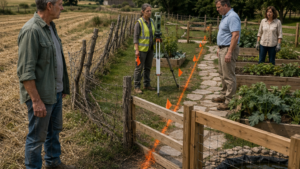
The first orange stake went into Stephen Davis’s hayfield before he had finished feeding the cattle.
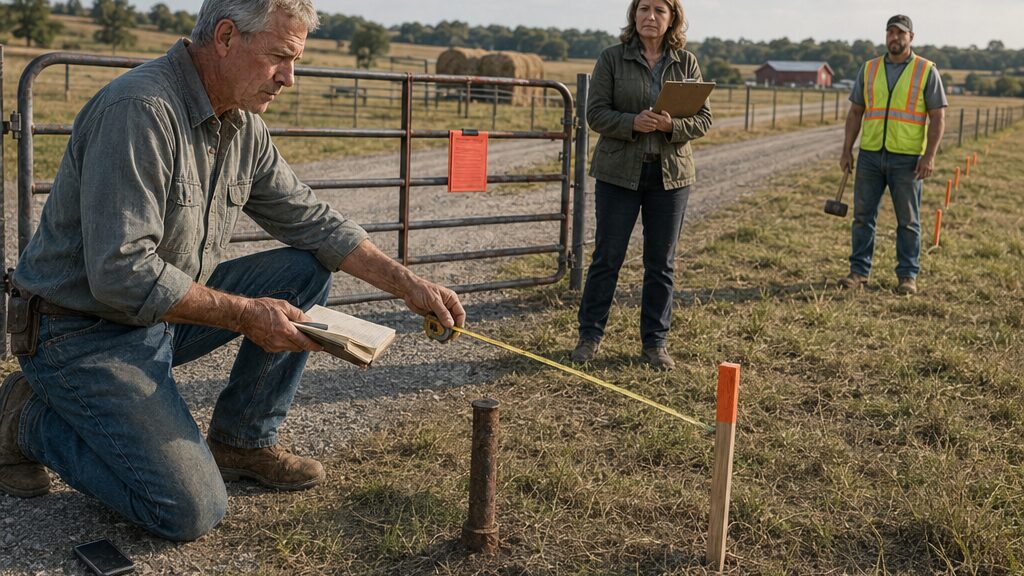
He heard the steel driver before he saw the men—a hollow, ringing blow from beyond the metal gate, then another. By the time he crossed the gravel lane, one contractor was stretching a bright line between fresh stakes while the other measured toward the small equipment shelter Stephen had built beside the fence.
Virginia Hill stood near their pickup with a folder tucked against her side.
Stephen stopped at the gate. “What are you marking?”
Virginia looked toward the shelter instead of at him. “The corrected road corridor.”
“Corrected by who?”
“The association.”
One of the contractors slowed his measuring wheel. Stephen recognized him from road work the previous spring. The man gave Stephen a small nod but kept moving.
Virginia opened her folder. “Your shelter sits inside the required setback. The fence line interferes with the widening. Both need to be corrected before work starts.”
Stephen looked from the newest stake to the edge of his hay. The line ran farther into his ground than any road marker he remembered.
“How far?”
“Twelve additional feet from the present traveled edge.”
Stephen’s face stayed still.
For thirty years he had measured walls, slabs, foundations, drainage falls, and property offsets for customers who remembered dimensions differently once money was involved. He had learned early that arguing before measuring was mostly a way to lose twice.
He reached into his shirt pocket and took out a battered black field notebook.
Virginia watched him open it.
“Monday,” he said quietly. “Seven forty-two.”
He wrote the time, the truck description, the number of workers, then paced to the nearest orange stake.
Virginia let out a breath. “Stephen, writing things down doesn’t change the covenant.”
“No.”
He crouched and pressed two fingers into the turf beside the stake.
“But lines do.”
The grass there had been cut short enough that he could see a shallow depression beneath the roots. He scraped soil aside with the heel of his hand until rust-colored metal appeared.
An old iron survey pin.
Stephen brushed it clean.
The contractor with the measuring wheel stopped completely.
Virginia came closer. “That may not be current.”
“May not be.”
Stephen measured from the pin to the new orange stake. Six feet and several inches separated them.
He wrote the number down.
Virginia said, “The association survey uses the road centerline.”
“Which recorded instrument?”
Her jaw tightened slightly. “The board approved the corridor.”
“That wasn’t my question.”
Stephen took out his phone, photographed the iron pin, the stake, and the measuring tape between them. Then he photographed the line running toward his shelter.
Virginia folded her arms.
“The road has to be widened,” she said. “You know that as well as anyone.”
Stephen did know the road had problems. Spring runoff chewed at the lower shoulder every year. Grain trucks increasingly rode the ditch when they met another vehicle. But a bad road and a twelve-foot claim across his land were not the same thing.
“What document gives you twelve feet?” he asked.
Virginia looked toward the contractors.
“Keep marking.”
Neither man moved for a second.
Then the taller one resumed driving stakes.
Stephen wrote that down too.
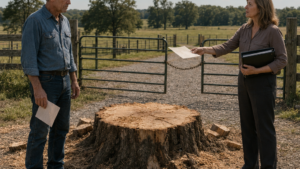
Virginia walked to the metal gate and removed a yellow sheet from her folder. She held it against one of the vertical bars and fastened it with two plastic ties.
The paper was large enough to be seen from the county road.
Stephen stepped closer.
The heading identified it as an association violation. Below that were references to obstruction, noncompliance, and assessment authority. The amount printed near the bottom was large enough to make him read it twice.
“You’re fining me for asking what line you’re using?”
“I’m fining you for refusing access and maintaining structures inside the required corridor.”
“I haven’t refused anybody access.”
“You told the board last month you wouldn’t move that shelter.”
“I said I wouldn’t move it without seeing what required me to.”
Virginia’s voice sharpened. “You’ve been given notice.”
Stephen looked at the paper again.
“And if I leave it where it is?”
“The penalty increases daily after tomorrow.”
One contractor looked away.
Stephen felt anger move through him clean and hot, but he kept his hands at his sides. The shelter held fencing tools, mineral tubs, chain, and parts for the old hay rake. He had built it on concrete blocks fifteen years earlier after checking the setback himself.
He remembered the measurement because he remembered all measurements that had cost him a Saturday.
Virginia seemed to mistake his silence for uncertainty.
“This isn’t personal,” she said. “The road serves everybody uphill.”
“Then everybody ought to know where the line is.”
“They elected the board to handle that.”
Stephen looked at her.
“No. They elected the board to handle the road.”
Virginia’s expression changed—not much, but enough.
Stephen noticed.
He turned back toward the field and followed the orange stakes north. At the last one, the string line came within a few feet of the equipment shelter. If the new corridor were accepted, the shelter would indeed sit inside it.
But if the iron pin still controlled, the numbers did not work.
By eight-thirty, the contractors were gone.
Virginia left the yellow notice on his gate.
Stephen did not tear it down.
He photographed it, copied every rule number into his notebook, and wrote the amount beside the time she had posted it.
That afternoon he searched the farm office for the old property file. The cabinet held machinery receipts, insurance papers, soil reports, and decades of folded documents that smelled faintly of dust and mouse bait.
He found the plat after sunset.
The paper had yellowed along the creases. Stephen spread it beneath the desk lamp and weighted the corners with a wrench, a coffee mug, and two socket sets.
He traced the private road with one finger.
Then he found the recorded access width.
He measured it against the scale twice.
The association’s orange stakes claimed several feet more than the plat showed.
Stephen sat back.
A mistake would have been easy enough to correct.
But Virginia had posted a fine before showing him a survey.
He opened the notebook again and wrote one question beneath the morning’s measurements.
If the recorded corridor was narrower, what exactly had Virginia Hill decided she was entitled to take?
Chapter 2: The Fine Became a Claim Against the Farm
The bank loan officer called Stephen Tuesday morning and asked whether he knew there was a lien against the farm.
For a moment Stephen thought he had misheard him.
“What lien?”
There was a pause on the line.
“The road association filed one yesterday afternoon.”
Stephen stood beside the kitchen counter with his coffee untouched.
The annual operating renewal was already being processed. Fuel, seed, veterinary bills, fertilizer—most of the spring and summer expenses moved through that line before cattle checks came in.
“How much trouble does that make?”
“I can’t tell you until underwriting reviews it. But I need the document from you, and I need to know whether it’s disputed.”
“It’s disputed.”
“All right. Send me everything you have.”
Stephen hung up and looked toward the farm office.
Everything he had was exactly what he had not told Rachel.
She handled most of the bookkeeping now. Not because Stephen could not do it, he told himself, but because she was faster and less irritated by online accounts. He had intended to settle the association matter before it touched anything that mattered.
The bank call told him that chance was gone.
At the gate, the yellow notice from Monday had been replaced.
The new penalty was double the first amount.
Stephen stared at it until the numbers stopped looking absurd and started looking deliberate.
He wrote the date and time in his notebook.
Then he drove to the county office.
The records clerk helped him pull the permit history for the equipment shelter and the county setback map. The documents did not settle the private easement issue, but they did settle something important: the shelter met the county requirements that Virginia had referenced in her first notice.
Stephen pointed to the map. “So the county isn’t saying this building has to move.”
“No,” the clerk said. “Not from what I’m looking at.”
“What about that private road line?”
“That’s a different question. You’d need the recorded easement and whatever governing documents the association has.”
Stephen almost smiled.
Different question.
That was exactly what Virginia had avoided saying.
He returned to the farm shortly after noon and found Rachel’s truck beside the office.
She was sitting at his desk with the bank portal open.
The lien notice lay beside his notebook.
Stephen stopped in the doorway.
Rachel looked up.
“When were you going to tell me?”
“I was handling it.”
“The bank froze the renewal review.”
“They haven’t frozen anything.”
“They flagged it. Same difference if they decide we can’t draw next month.”
“It won’t get that far.”
She pushed the lien across the desk.
“You don’t know that.”
Stephen set the county papers beside it. “The shelter is compliant.”
Rachel barely looked at them.
“I’m not asking about the shelter.”
That irritated him because she was right.
He pulled out the chair opposite her.
“The association is claiming a wider private-road corridor. Their measurement doesn’t match the old plat.”
“And this?”
She tapped the lien.
“They escalated.”
“You mean Virginia escalated.”
“The board signed it.”
Rachel leaned back. “How long have you known?”
“Since this morning.”
“And the fines?”
“Yesterday.”
She gave him a flat look.
Stephen corrected himself. “The first one yesterday. They doubled it today.”
Rachel closed her eyes for a second.
“You were going to keep all of that to yourself.”
“I was going to fix it.”
“You’re not the only person whose name is tied to this farm.”
The sentence landed harder than he expected.
Technically, the farm remained in Stephen’s name, but Rachel had built her livelihood around it. She managed records, cattle sales, feed contracts, and increasingly the decisions Stephen used to make without discussing them.
Years earlier, after his wife died, Stephen had promised himself Rachel would never inherit confusion. No unpaid messes. No unanswered claims. No box of papers nobody understood.
Yet here she sat, learning about a lien from the bank.
He looked at his notebook.
“I didn’t want you worrying over something that might amount to nothing.”
Rachel’s voice softened, which made it worse.
“Dad, a lien is already something.”
Neither spoke for a while.
Finally Stephen slid the county papers toward her.
“This part is wrong.”
Rachel read them carefully.
“The county setback?”
“Yes.”
“So Virginia knew?”
“I don’t know what she knew.”
“What did she cite?”
Stephen opened the notebook and showed her the copied rule numbers from the notices.
Rachel compared them with the papers.
“These aren’t county codes.”
“No.”
They were internal association provisions—maintenance access, obstruction, enforcement costs.
Virginia’s language on Monday had made them sound broader.
Rachel looked at him.
“So the county isn’t ordering you to move anything.”
“No.”
“But the association is using its own rules to say it can.”
“That’s what it looks like.”
Rachel pushed the lien back across the desk.
“Then stop treating this like an argument at the gate.”
Stephen was about to tell her he knew that.
Instead, he turned the lien over and looked at the authorization page attached behind it.
He had read the amount. He had read the description.
He had not studied the signatures.
There were three.
Virginia Hill had signed first.
George Miller, the association treasurer, had signed beneath her.
The third belonged to another board officer whose name Stephen recognized from annual road meetings.
Three approvals.
Three people had put the farm into a legal filing over a disputed line that did not match the county plat.
Stephen copied each name into the notebook.
Rachel watched him.
“You know George.”
“I do.”
“Well enough to ask him?”
Stephen closed the notebook.
“Well enough to know I don’t want to ask him yet.”
The question had changed again.
It was no longer simply why Virginia had pushed so hard.
Now Stephen wanted to know what three board members had seen before they signed—and what they had chosen not to see.
Chapter 3: The Rule Book Opened Both Ways
The county records clerk slid a larger plat across the counter and placed her finger beside the private road.
“There,” she said. “Recorded width.”
Stephen leaned closer.
He had brought his old copy from home, but this one was clearer. The easement description, survey references, and later filings all sat in the same chain.
He measured the corridor from the centerline.
Then he measured again.
Virginia’s stakes were off by several feet.
Not inches. Not a drafting ambiguity.
Feet.
Stephen wrote the measurement in his field notebook and boxed it.
“Any amendment widening it?”
The clerk shook her head. “Not in the land records I found.”
“Could the association vote one in?”
“They can vote on their own rules. Changing a recorded property interest is another matter.”
Stephen nodded.
That distinction was becoming familiar.
Everyone kept trying to make one kind of authority sound like another.
He spent the rest of the morning tracing documents. The equipment shelter remained clear under county setback requirements. The old easement remained narrower than the association’s field markers.
By noon, the first question had an answer.
Stephen was not standing inside some newly discovered county violation.
He should have felt relieved.
Instead, he felt more uneasy.
If Virginia had nothing simple to enforce, why had she rushed to penalties and a lien?
Back at the workshop, Stephen spread the association papers over the scarred workbench where he once rebuilt carburetors and sharpened mower blades.
He started building an index in the notebook.
Notice date.
Rule cited.
Penalty amount.
Lien filing.
Board signatures.
Recorded easement.
County setback.
He left two blank pages between sections.
Rachel appeared in the doorway carrying a cardboard folder.
“You missed lunch.”
“I ate.”
“You ate crackers.”
“They count.”
“They don’t.”
She placed the folder on the bench.
Inside were copies of association statements from previous years—documents Stephen had shoved into farm files without much attention.
“Look at the dues notices,” she said. “They keep referencing road reserves.”
Stephen glanced through them.
Annual road maintenance. Drainage work. Gravel. Emergency repairs.
He looked toward the association handbook lying open beside his notebook.
“How much do you remember about member inspection rights?”
Rachel frowned. “Inspection of what?”
“Records.”
She pulled up a chair.
For the next hour they read.
The association governing documents were tedious, repetitive, and more useful than Stephen expected. One provision allowed members to inspect meeting minutes and certain financial records upon reasonable written request. Another required accounting for special assessments and reserve expenditures.
Stephen read both twice.
Then he started a new notebook page.
BOARD MINUTES.
ROAD RESERVE.
SPECIAL ASSESSMENTS.
CONTRACTOR PAYMENTS.
He added four years beside each category.
Rachel watched him write.
“You’re asking for all of it?”
“I’m asking for what they say I’m allowed to see.”
“You think this is bigger than the road line.”
Stephen closed the handbook.
“I think people who are confident in their paperwork usually show you the paperwork.”
That afternoon he delivered a written request to the association secretary and sent a second copy by certified mail.
Virginia called before he reached home.
“You’re requesting four years of financial records?”
“Yes.”
“This is a boundary dispute.”
“That’s what I thought Monday.”
“It still is.”
“Then the records shouldn’t bother you.”
Silence.
When Virginia spoke again, her tone had changed from irritation to something more controlled.
“You are entitled to specific association records, Stephen. You are not entitled to turn this into an open-ended fishing expedition.”
“I listed what I want.”
“Reserve accounts have nothing to do with your shelter.”
“Then send the minutes about my shelter.”
Another pause.
“The board’s concern is not limited to the structure anymore.”
Stephen looked through the windshield toward the private road climbing beyond his pasture.
“What is it limited to?”
“Access.”
“You said setback Monday.”
“I said the structure interfered with the required corridor.”
“You referenced county compliance.”
“And now you’ve apparently decided to make this a legal seminar.”
Stephen ignored that.
“What changed?”
“The road has to function.”
“It functioned last week.”
“Barely.”
Her answer came too quickly to be invented on the spot.
Virginia continued.
“We have larger farm trucks. Delivery vehicles. Emergency access. That lower section has been inadequate for years, and everyone knows it.”
Stephen glanced toward the creek crossing in the distance.
That part was true.
He had complained about the shoulder himself.
But complaining about a bad shoulder did not create new acreage.
“Then show me the approved widening plan.”
“The board has authority to maintain access.”
“Maintain or widen?”
Virginia exhaled.
“You are making this harder than it needs to be.”
“No. I’m asking you which word applies.”
She ended the call without answering.
Stephen wrote the time down.
By Friday, the original setback argument had become surprisingly thin. The county records supported him. The recorded easement supported him. Even the association’s own language did not plainly grant the twelve feet Virginia had marked.
But her new argument bothered him more than the old one because some of it was true.
The road did have problems.
Which meant somebody could be wrong about his land and right about the danger at the same time.
Late Friday afternoon, a courier envelope arrived from the association.
Inside were copies of meeting minutes, annual summaries, and several years of road-reserve statements.
Not everything Stephen had requested.
Enough to begin.
He and Rachel spread the pages over the kitchen table.
At first, the numbers looked ordinary: gravel, grading, ditch clearing, culvert materials.
Then Rachel pointed to one transfer.
“What’s that?”
Stephen followed the line.
A large withdrawal from the road reserve had moved into a temporary account.
Months later, part of it came back.
He turned the page.
Another transfer appeared the next year.
Then a third.
Different amounts. Similar descriptions. No explanation in the minutes lying beside them.
Stephen opened the notebook and wrote each date.
Rachel pulled the calculator closer.
Together, the three movements approached eighty thousand dollars.
Stephen checked the meeting minutes again.
No matching assessment.
No clear vote.
No explanation for where the money had gone between withdrawal and return.
He looked at the three board signatures he had copied after the lien.
Virginia.
George.
The third officer.
Rachel’s finger rested on the largest transfer.
“So now what?”
Stephen stared at the number.
The orange stakes in his hayfield had brought him here.
A shelter dispute had become an easement dispute. The easement dispute had become a lien. The lien had led him into the association’s rules.
And the rules had opened a door Virginia clearly had not expected him to walk through.
Stephen turned to a clean page in his notebook.
At the top, he wrote one question.
Where did the road money go?
Chapter 4: Eighty Thousand Dollars Was Not the Whole Truth
Three transfers sat in Stephen’s notebook beneath three dates, and beside each date he had written the same thing: no vote found.
He added the amounts again Saturday morning.
The total was just under eighty thousand dollars.
Rachel sat across the kitchen table with the association statements arranged by year. “That’s not a bookkeeping mistake.”
“No.”
“And none of these meeting minutes mention borrowing from the reserve?”
“Not that I’ve found.”
Stephen turned another page.
The language around the transfers was vague. Temporary advance. Road stabilization. Reimbursement. One entry moved money out of the reserve. Another moved part of it back months later. The third disappeared into an operating account and surfaced only as a line under contractor expenses.
Rachel touched the largest figure.
“If somebody took money out of a farm account like this, you’d want to know exactly where it went.”
“I do.”
“You think Virginia did it?”
Stephen looked at the name he had written in the margin.
Virginia Hill.
Then George Miller.
Then the third board officer.
“I think somebody approved it.”
“That isn’t what I asked.”
Stephen closed the notebook.
Rachel had a way of noticing when he was trying to make uncertainty sound like caution.
“I don’t know yet.”
She nodded once. “Better.”
He ignored that.
By ten, Stephen was at the association equipment shed, a weathered metal building near the road junction where the members kept a blade, culvert pipe, traffic cones, and the small trailer used for ditch work.
George Miller was already there.
He stood beside the workbench sorting invoices into piles.
Stephen had known George for almost twenty-five years. They had traded hay equipment, helped each other pull stuck trucks, and once spent half a night moving water away from George’s lower orchard during a storm.
That history made the conversation harder, not easier.
Stephen set copies of the statements on the bench.
George saw the highlighted transfers.
His shoulders dropped.
“So you got the reserve records.”
“Some of them.”
George kept his eyes on the invoices.
Stephen tapped the first amount.
“What is this?”
“Road work.”
“There’s no vote.”
“There wasn’t time.”
Stephen waited.
George rubbed the back of his neck. “You remember the washout four winters ago?”
“The lower culvert.”
“It was worse than people knew. Water took half the shoulder. The contractor wouldn’t start without money up front.”
Stephen remembered the week. Two days of freezing rain, then a hard warm front that sent runoff down every hollow in the county.
“Where did the money come from?”
George looked at him.
“Me.”
Stephen said nothing.
George went to an old filing cabinet and pulled out a folder thick with bank copies. He laid one check on the bench.
Personal account.
George Miller.
Payable to a grading contractor.
Stephen read the amount twice.
“That’s your money.”
“It was.”
“Why isn’t that in the minutes?”
George gave a tired laugh without humor.
“Because everybody wanted the road fixed and nobody wanted another special assessment.”
“That doesn’t answer the question.”
“No. It doesn’t.”
George pulled out a second check.
Then a third.
“I advanced what I could. The reserve paid me back later.”
Stephen looked at the transfer dates again.
At least one now made sense.
Not cleanly. Not properly.
But differently.
“You should have had a vote.”
“Yes.”
“You should have documented the reimbursement.”
“Yes.”
“Why didn’t you?”
George looked toward the open shed door.
“Because Virginia said we’d straighten it out at the annual meeting.”
“And did you?”
“No.”
“Why?”
“Because by then there was another project.”
Stephen felt the clean shape of his theory begin to bend.
He had expected George to deny the transfers or hide behind the board. Instead, George was standing in front of him admitting bad procedure and showing evidence that at least some of the suspicious money had started in his own pocket.
Stephen opened his notebook.
Under the first transfer he wrote: possible reimbursement to George—personal funds advanced after washout.
He did not cross out no vote found.
George noticed.
“You still think we stole it.”
“I think you moved association money without proper approval.”
“That’s not the same thing.”
“No.”
Stephen looked at him.
“But it’s not nothing either.”
George’s jaw tightened.
“No.”
For the next hour they worked through records.
Some pieces matched.
George had paid contractors. Association funds later reimbursed him. A culvert replacement really had happened.
But other amounts remained unexplained.
One invoice referred to grading on an “upper access approach.” Another listed machine hours without a parcel number. A third included gravel quantities far beyond what Stephen remembered seeing on the shared road.
Stephen copied every invoice number.
George grew quieter.
“What’s the upper access approach?” Stephen asked.
George did not answer immediately.
“You know.”
Stephen looked up.
“No. I want you to say it.”
George leaned both hands on the bench.
“Virginia’s entrance.”
The shed seemed suddenly smaller.
Stephen pulled the invoice closer.
Machine hours. Base stone. Drainage cut. Finish grading.
Paid through the road account.
“How much of this work was on her property?”
“I don’t know exactly.”
“You’re the treasurer.”
“I know what the bill says.”
“That isn’t what I asked.”
George looked irritated now.
“The road drainage runs downhill from her entrance. Some of that work was tied together.”
“Some.”
“Yes.”
“How much?”
“I said I don’t know.”
Stephen wrote that down.
George watched the pencil move.
“You write everything like it’s testimony.”
“Lately it has a habit of becoming that.”
George turned away.
For the first time Stephen noticed how old he looked.
Not guilty. Tired.
That distinction bothered him.
If all the money had simply been stolen, the story would have been easy. People took it. Stephen found proof. The board fell apart.
But the cancelled checks on the bench said otherwise.
Some money had saved the road.
Some had repaid a man who had fronted money when nobody else would.
And some seemed to have benefited Virginia’s private entrance.
The truth was not cleaner than the paperwork.
It was messier.
Back home, Rachel found Stephen at the kitchen table again.
“Well?”
“George advanced money personally after the washout.”
She stopped.
“So the eighty thousand isn’t stolen?”
“I didn’t say that.”
“What did you say?”
“Some of the transfers were reimbursements. There were no proper votes. The books are sloppy. Maybe worse than sloppy.”
“But he really paid contractors himself?”
Stephen pushed copies of the checks toward her.
Rachel studied them.
“That changes things.”
“Yes.”
He disliked how much.
Then he showed her the upper-access invoice.
She read it slowly.
“Virginia’s?”
“George says yes.”
“Paid by the association?”
“That’s what it looks like.”
Rachel leaned back.
“So not simple theft.”
“No.”
“Still private benefit.”
“Maybe.”
She gave him a look.
“You hate that word.”
“Which one?”
“Maybe.”
Stephen picked up the notebook.
He had circled the three transfer dates hard enough to score the paper.
Beside them he now added two notes.
Emergency work legitimate.
Private-benefit allocation unclear.
The next morning, Stephen drove the shared road uphill.
He stopped near Virginia’s property and walked the shoulder.
Her entrance had been widened with a deep base of compacted stone. A drainage swale cut cleanly along one side. The work was older, but not old enough to predate the invoice.
He stood where the shared road met her private drive.
The association’s equipment could reasonably have worked there if the job protected the road.
It could also have improved her property at everybody else’s expense.
Both could be true.
Stephen returned to his truck.
Before leaving, he looked once more at the invoice.
In the approval box sat Virginia’s initials.
But that was not what caught his attention.
At the bottom was a notation directing that the expense be entered under general road stabilization.
Not upper access.
Not Hill entrance.
General road stabilization.
Stephen opened his notebook.
For the first time, the question was no longer whether association money had gone somewhere it should not.
The question was how much had been hidden inside work that could almost be justified.
Chapter 5: The Road Really Was Failing
The loaded cattle trailer dropped its right wheels off the gravel shoulder before Stephen could wave the driver slower.
The trailer leaned.
For one sharp second, Stephen thought it was going over.
The driver corrected, eased forward, and climbed back onto the road with less than a foot between the trailer tires and the ditch.
Stephen stood beside the lower creek crossing with his notebook in one hand.
The driver stopped fifty yards uphill and climbed out.
“That edge is soft.”
“I saw.”
“Been soft awhile?”
“Worse this year.”
The man looked back at the narrow lane. “Two trucks meet down here, somebody’s backing a long way.”
Stephen knew that too.
He had spent two weeks proving Virginia’s marked corridor was wrong. Now he was standing beside a road that was also wrong.
The shoulder had slumped near the culvert. Water had cut channels along the edge. A larger emergency vehicle would have little room to pass if another truck blocked the bend.
Stephen opened his notebook.
For the first time, he began recording defects that supported Virginia’s argument.
Soft shoulder—south side.
Drainage erosion.
Insufficient passing width at creek.
He disliked writing every word.
He wrote them anyway.
Virginia’s truck appeared before noon.
She parked on the uphill side and walked down carrying no folder.
“You checking my work now?” she asked.
“Checking the road.”
She glanced at his notebook. “Same thing, apparently.”
Stephen pointed toward the damaged shoulder.
“This isn’t twelve feet of problem.”
“No. It’s thirty years of problem.”
“Then why did you make my shelter the issue?”
“Because widening has to start somewhere.”
“On my land.”
“Your side is the side we can work.”
“Can work, or thought you could take?”
Virginia looked at him for a long moment.
Then she stepped off the road and walked toward the creek.
“Do you remember the ambulance three winters ago?”
Stephen frowned.
“Which one?”
“The night after the ice storm.”
He remembered flashing lights uphill. He had assumed the call had been to one of the newer houses.
Virginia pointed at the narrow bend.
“It got stuck here.”
Stephen said nothing.
“Not for an hour. Not some catastrophe. Maybe six minutes. Seven. But there was a pickup coming downhill. The driver tried to move aside and slid into the ditch. The ambulance couldn’t get around.”
“Who were they going to?”
“That doesn’t matter.”
“It matters if you’re asking me to give up land because of it.”
Virginia’s expression hardened, then softened again.
“One of the older residents uphill. Breathing trouble.”
“Did they make it?”
“Yes.”
Stephen waited.
Virginia rubbed dirt from the toe of her boot against the gravel.
“But I stood here while they tried to get past. Afterward everybody told me we needed to fix the road.”
“And?”
“And when the estimate came in, nobody wanted the assessment.”
Stephen looked uphill.
“How many times?”
“Twice.”
He remembered one vote. Vaguely. He had voted no.
The proposed assessment had seemed excessive, wrapped around language that gave the board too much discretion.
Virginia seemed to read his face.
“You voted against it.”
“I voted against a blank check.”
“That’s what everybody said.”
“Maybe everybody meant it.”
“And maybe roads still fail while people debate wording.”
The line had bite, but not theater.
Stephen looked again at the shoulder.
Virginia continued.
“George fronted money after the washout because the association didn’t have enough available cash. We fixed what we could. Then people complained that we had spent without permission.”
“You did.”
“Yes.”
The admission stopped him.
She crossed her arms.
“Sometimes there isn’t a clean choice.”
“There’s still a record.”
“I know.”
“Then why hide the Hill entrance work inside general road stabilization?”
Her face changed.
Not surprise.
Recognition.
“You’ve been through George’s invoices.”
“I’ve been through the records I was entitled to see.”
“The drainage from my entrance was dumping water onto the shared road.”
“Did the association pay to widen your driveway?”
“It paid to correct drainage tied to the road.”
“That isn’t what the invoice says.”
“It says machine hours and stone.”
“It says upper access approach.”
Virginia looked away toward the creek.
Stephen opened the notebook.
“I’m not saying the road doesn’t need work.”
“That’s new.”
“I’m saying needing work doesn’t give you permission to invent a boundary.”
Virginia’s voice dropped.
“And waiting for everybody to agree doesn’t keep an ambulance moving.”
For once, Stephen had no quick answer.
That evening Rachel found him transferring road measurements onto a clean notebook page.
She looked over his shoulder.
“You’re documenting her case now?”
“I’m documenting the road.”
“That bad?”
“At the creek, yes.”
Rachel sat across from him.
“So maybe we give them some width.”
Stephen stopped writing.
“No.”
“You didn’t even think about it.”
“I’ve thought about it since Monday.”
“You’ve thought about stopping them.”
“It’s our land.”
“And if six feet of marginal edge fixes the turn?”
“It won’t be six once a board decides twelve is easier.”
“Then negotiate six.”
Stephen looked at her.
Rachel did not move.
“You always say the farm has to work,” she said. “Not just belong to us.”
The sentence stayed between them.
Stephen closed the notebook harder than necessary.
“I promised your mother I’d leave this place intact.”
Rachel’s expression changed.
“You promised her you’d leave it workable.”
Stephen looked away.
He had not expected Rachel to remember the wording.
His wife had said it during one of their last long conversations about the farm, when illness had forced them to discuss things they had spent decades postponing.
Workable.
Not untouched.
He stood and went to the file stack.
“If we give anything, it’s because we choose to. Not because Virginia invents a line.”
“I agree.”
Stephen pulled out the meeting minutes covering the year of the upper-access invoice.
He had read them before.
This time he knew exactly what he was looking for.
The minutes listed culvert repair.
Shoulder stabilization.
Emergency grading.
There was no mention of Virginia’s private entrance.
He checked the next meeting.
Nothing.
Then the annual summary.
Nothing.
Yet the invoice existed, approved and paid.
Stephen compared its date with the minutes.
The work had been discussed.
Just not the part that benefited Virginia.
He found a handwritten note attached to an earlier draft of the secretary’s minutes. A short phrase had been crossed out before the final copy:
upper Hill approach drainage.
Stephen stared at it.
Someone had known enough to describe the work accurately.
Someone had then removed that description from the permanent minutes.
Virginia’s fear about the road might be real.
The ambulance story might be true.
The road might genuinely need more room.
None of that explained why a private-benefit expense had been cleaned out of the official record.
Stephen opened his notebook and wrote the date of the altered minutes.
Necessity, he thought, could explain a shortcut.
It could not explain why the shortcut had to disappear.
Chapter 6: What the Treasurer Had Been Too Afraid to Say
George Miller placed six cancelled checks on his orchard-office desk before Stephen had asked his first question.
“They’re mine,” George said.
Stephen remained standing.
The office was little more than a heated room attached to the packing shed. Through the window, rows of trees ran down toward the shared road.
George tapped the checks.
“Personal account. Contractor, gravel supplier, culvert company. You wanted the beginning of the money trail. That’s it.”
Stephen sat.
“Why show me now?”
“Because you found enough to make the wrong version believable.”
Stephen looked at him.
“The wrong version?”
“That Virginia and I took eighty thousand dollars.”
“Did you?”
“No.”
George’s answer came without hesitation.
“Did association money improve Virginia’s private entrance?”
George looked at the desk.
“Yes.”
“How much?”
“I don’t know exactly. Some drainage work had to happen there to protect the road. Some of the widening went farther than it needed to.”
“And you approved reimbursement.”
“Yes.”
“Without a vote.”
“Yes.”
“Without disclosure.”
George’s jaw tightened.
“Yes.”
Stephen opened his notebook.
Several earlier pages carried phrases he had written before George showed him the first checks.
Possible diversion.
Undocumented personal advances.
Private benefit.
He had stopped just short of writing theft.
At the time, the difference had felt technical.
Now it felt important.
George leaned back.
“The first advance was clean in purpose, if not procedure. The culvert failed. We needed cash. I wrote the checks.”
“And the second?”
“More complicated.”
“The third?”
George gave a tired nod.
“Worse.”
Stephen waited.
George rubbed both hands over his face.
“Virginia kept pushing projects through because she thought if we stopped, nothing would ever get fixed. She wasn’t entirely wrong.”
“That doesn’t make it legal.”
“I didn’t say it did.”
“Then why sign?”
“Because I was tired of being the man who said no after everybody complained the road was failing.”
There it was.
Not greed.
Not innocence either.
Cowardice, Stephen thought.
George seemed to know it.
“The association members voted down assessments,” George continued. “Then they called Virginia every time a ditch flooded. Called me when the grader didn’t show. Called both of us when the snowplow couldn’t get through.”
“So you stopped asking.”
“We started calling things maintenance.”
“Even when they weren’t.”
“Yes.”
Stephen turned to a blank page.
“Did Virginia know the Hill entrance work was omitted from the minutes?”
George looked toward the window.
“George.”
“Yes.”
The word was almost inaudible.
Stephen stopped writing.
“She told the secretary to remove it?”
“She said the entrance drainage was part of the road system and didn’t need to be separated.”
“That’s not what I asked.”
George’s mouth tightened.
“Yes. She told her to simplify the minutes.”
Stephen wrote that sentence carefully.
Then he looked up.
“Why the lien?”
George did not answer.
Stephen waited.
Outside, a forklift beeped twice somewhere in the packing shed.
Finally George said, “You started requesting old road records.”
“That happened after the lien.”
“No. You started asking questions before that.”
Stephen frowned.
“At the gate?”
“You asked about the recorded authority. You asked what survey supported the new line. Virginia knew where that could lead.”
“To county records?”
“To all of it.”
Stephen sat very still.
George continued.
“She told the board you’d turn one boundary argument into a challenge against years of road decisions.”
“So she filed against my farm to shut me up.”
“I didn’t say that.”
“You just did.”
“No. I said she thought stronger enforcement would make you settle the corridor.”
“What did you think?”
George looked ashamed.
“I thought you’d pay the fine, move the shelter six feet, and complain about us for the next ten years.”
Stephen gave a short, humorless laugh.
“You’ve known me twenty-five years.”
“That should’ve told me better.”
George reached for one of the checks.
“I signed the lien authorization.”
“I know.”
“I could have refused.”
“Yes.”
“I didn’t.”
Stephen closed the notebook.
The admission gave him what he had been seeking: motive.
Virginia’s sudden escalation had not simply been about a road.
Once Stephen questioned the source of her authority, she had recognized a risk. If he followed the paper trail, he could uncover years of board shortcuts, hidden reimbursements, and the private work folded into public expenses.
But George’s checks were still on the desk.
That changed the shape of the accusation.
Stephen could walk into court and say eighty thousand dollars had disappeared under Virginia and George.
The statements would make it look possible.
The missing votes would make it sound worse.
The private entrance invoice would give it teeth.
And it would not be the complete truth.
Stephen opened the notebook again.
He found the line where he had written likely diversion.
He did not cross it out.
Instead he wrote beside it:
Partly emergency reimbursement; amount and allocation disputed.
On the next page, beside personal advance, he added:
George used personal funds first.
George watched him.
“You correcting your own notes?”
“I’m correcting what I know.”
“You could leave the first version.”
Stephen looked at him.
“That what Virginia did with the minutes?”
George flinched.
Stephen regretted the cruelty as soon as he said it, though he did not take the words back.
On his way home, he called Nicholas Green.
The attorney had expected an easement case when Stephen first contacted him. By the end of the call, he was silent for several seconds.
“Bring everything Monday,” Nicholas said.
“I have a lot.”
“Bring the things that hurt your argument too.”
Stephen looked through the windshield at the road.
“I was planning to.”
“Good.”
Monday afternoon, Nicholas spread Stephen’s notebook, the cancelled checks, the road statements, the altered draft minutes, and the lien authorization across a conference table.
He read for nearly an hour.
Then he pushed the notebook back.
“You know what opposing counsel is going to say?”
“That I’m difficult.”
“That too.”
Stephen waited.
“They’re going to say the reserve movements were emergency reimbursements, the road is dangerous, and your records request is retaliation because you don’t want to contribute land.”
“Some of that’s true.”
Nicholas nodded.
“That’s what makes it useful.”
He tapped the private-drive invoice.
“This is stronger.”
Then the altered minutes.
“This is stronger still.”
Finally, he tapped Stephen’s earliest notebook entry accusing the board of possibly diverting funds.
“But if you present the eighty thousand as theft after seeing George’s checks, they’ll use your own notes to show you decided what happened before you knew.”
Stephen stared at the page.
Nicholas leaned back.
“So you have a choice.”
“I know.”
“No, I don’t think you do yet.”
Stephen looked up.
Nicholas pointed to the stacks.
“You can put the strongest-looking version in front of the judge. Eighty thousand moved. No votes. Private work. Lien after you questioned the boundary.”
He paused.
“Or you can put the complete version in front of the judge. George fronted legitimate emergency money. The board handled reimbursement badly. Some road work was necessary. Some private benefit was hidden. Virginia used enforcement pressure when scrutiny started.”
Stephen said nothing.
Nicholas folded his hands.
“The first version sounds worse.”
Stephen looked down at his notebook.
“And the second?”
“The second has a better chance of being believed.”
For years Stephen had told himself that writing everything down kept other people honest.
He had never considered that someday the notebook might have to keep him honest too.
Nicholas pushed it toward him.
“Which story are you planning to tell the court, Stephen?”
The strongest one, Stephen thought.
Or the true one.
Chapter 7: He Used Their Rules Without Becoming Like Them
Virginia Hill’s attorney opened the hearing by calling the missing eighty thousand dollars “Mr. Davis’s accusation of theft.”
Stephen looked at Nicholas Green.
Nicholas did not react.
Across the courtroom, Virginia sat with her hands folded over a legal pad. George Miller was several seats behind her, staring at the floor.
Stephen opened his field notebook to the pages he had marked with paper tabs.
The county civil-court judge looked over the filings.
“Mr. Green, is your client alleging that association officers stole eighty thousand dollars?”
Nicholas stood.
“My client is alleging that association funds were moved without properly documented authorization, that some expenditures benefited private property without transparent disclosure, and that enforcement against his farm escalated after he began questioning the authority for a proposed road expansion.”
Virginia’s attorney leaned forward.
“So the theft claim is gone.”
Stephen felt the temptation immediately.
One sentence could make the room turn.
Eighty thousand dollars moved. No clean votes. Private work. Altered minutes.
He could almost hear how simple it would sound.
Nicholas sat down.
The judge looked toward Stephen.
“You’ll have an opportunity to explain what you found.”
Stephen nodded.
When he was called, Nicholas began with the boundary.
Stephen described the orange stakes, the old iron survey pin, the recorded easement, and the county plat. He gave measurements from his notebook and explained his former work as a construction contractor without embellishing it.
Virginia’s attorney rose on cross-examination.
“You opposed widening before any of this happened, correct?”
“I opposed the width they proposed.”
“You did not want to give up any land.”
“That’s correct.”
“You voted against an earlier road assessment.”
“Yes.”
“So you were already resistant to road improvements.”
Stephen looked toward the judge, then back at the attorney.
“I was resistant to an assessment that didn’t say clearly what the board could spend.”
“Yet now you complain the road was underfunded.”
“No.”
The attorney paused.
Stephen continued.
“I’m saying those are two different problems.”
The judge glanced up.
The attorney moved on.
By late morning, the hearing had shifted to finances.
Nicholas handed Stephen copies of the reserve statements.
“Did you initially believe these transfers represented missing association funds?”
“Yes.”
“Do you believe that now?”
Stephen looked across the room at George.
“Not in the way I first thought.”
Virginia’s attorney turned slightly, surprised.
Nicholas asked, “Explain.”
Stephen opened his notebook.
“The statements showed three large movements with no clear matching votes in the minutes I had. When I first saw them, I wrote that they might be diversions.”
He turned the notebook toward the court.
“Later George Miller showed me personal checks he wrote to contractors after the lower road washed out.”
The judge looked toward George.
Stephen continued.
“Some association transfers reimbursed him for real work he paid for himself.”
Virginia’s attorney was already on his feet.
“Then the financial allegation collapses.”
“No,” Stephen said.
The attorney stopped.
Stephen looked at the judge.
“The first assumption changes. The records problem doesn’t.”
Nicholas handed him another document.
Stephen identified the private upper-access invoice.
“Association money paid for grading and stone at Virginia Hill’s entrance. Some drainage there may have protected the shared road. I can’t honestly say none of it served the association.”
Virginia looked at him for the first time that morning.
Stephen continued.
“But the work was entered under general road stabilization. The draft minutes referred to the Hill approach. The final minutes did not.”
Nicholas placed the draft and final versions side by side.
The judge read them.
Virginia’s attorney said, “Board minutes are summaries. They are not transcripts.”
“I agree,” Stephen said.
That answer produced another small silence.
The attorney frowned.
Stephen could feel Nicholas watching him.
He had spent the previous night reviewing the notebook line by line. Whenever later evidence changed an early conclusion, he had added a note rather than tearing the page out.
That now mattered.
Virginia’s attorney took the notebook on cross-examination.
“You wrote ‘possible diversion,’ correct?”
“Yes.”
“You suspected my client of taking association money.”
“Yes.”
“And you were angry because of the lien.”
“Yes.”
“Yet you now admit some of those funds repaired a road you personally agree is unsafe.”
“Yes.”
The attorney looked toward the judge as though Stephen had finished the argument for him.
Then Stephen said, “That’s why I corrected the entry.”
The attorney looked back.
Stephen pointed to the annotation.
“Right there.”
The judge asked for the notebook.
She read the original sentence and the later correction.
“When did you make this note?”
“After George showed me his checks.”
“Before this hearing?”
“Yes.”
“Why didn’t you simply remove the earlier page?”
Stephen hesitated.
“Because that was what I thought when I had less information.”
The judge gave the notebook back.
Something changed in the room after that.
Not dramatically.
No one smiled.
No one applauded.
But Virginia’s attorney stopped treating Stephen’s notes as carelessly as before.
The strongest moment came after lunch.
George testified that the board had approved enforcement against Stephen after concerns were raised about the widened road corridor.
Nicholas asked him when Virginia first expressed concern that Stephen might inspect old road records.
George swallowed.
“At the meeting after he questioned the field staking.”
“And what did she say?”
Virginia’s attorney objected, but the judge allowed George to answer.
George looked toward Virginia.
“She said if Stephen turned it into a records fight, every old road decision would get reopened.”
“What happened next?”
“We discussed stronger enforcement.”
“The doubled penalty?”
“Yes.”
“The lien?”
George looked down.
“Yes.”
Virginia closed her eyes briefly.
Nicholas did not ask whether that made her a thief.
He did not need to.
By late afternoon the judge had heard enough to separate the issues.
The association had a legitimate interest in maintaining a safe private road.
It did not have clear authority, on the current record, to impose the widened corridor Virginia had staked across Stephen’s property.
The lien, tied to that disputed enforcement, was on uncertain ground.
The financial records required independent reconstruction because legitimate emergency expenditures had been mixed with undocumented reimbursements and private-benefit work.
Then the judge said the one thing Stephen had not expected.
“I am not dissolving this association.”
Virginia’s attorney relaxed slightly.
Stephen did not.
The judge continued.
“These properties require a functioning road-maintenance structure. Destroying that structure does not solve the road.”
Rachel’s words came back to him.
The farm has to work. Not just belong to us.
The judge directed the parties to attempt a settlement addressing the lien, the corridor, financial review, and a transparent road-improvement plan.
Outside the courtroom, Stephen stood beside a stone wall while Nicholas packed documents into his case.
“You did the right thing in there,” Nicholas said.
Stephen looked at him. “By admitting they fixed the road?”
“By not asking the court to believe more than you knew.”
Virginia came through the doors alone.
For several seconds none of them spoke.
Then she looked at Stephen.
“I’ll authorize the lien release.”
Nicholas stopped packing.
Virginia continued.
“If you agree to discuss a revised road easement.”
Stephen’s first answer rose immediately.
No.
The same answer he had given Rachel.
The same answer he had carried since the first orange stake appeared.
But the judge had not given either side what it wanted.
The road still needed room.
The farm still needed protection.
Virginia looked exhausted rather than victorious.
Stephen closed his notebook.
“I’ll discuss it.”
Virginia nodded.
“Not twelve feet,” he added.
“I know.”
“And nothing gets staked before the lien is released.”
She hesitated.
Then said, “Agreed.”
Stephen watched her walk away.
For three weeks he had been fighting to prove that nobody could take his land simply because they had written a rule saying they could.
Now the harder question waited outside the courtroom.
How much land could he choose to give without surrendering what he had fought to protect?
Chapter 8: The New Line Was Drawn With Everyone Watching
Six weeks later, surveyors returned to Stephen’s gate.
This time he had invited them.
The old iron pin was already exposed in the grass. Rachel stood beside it holding Stephen’s field notebook, while the surveyor checked the recorded easement against a new proposed line.
Virginia arrived carrying two folders.
No contractors followed her.
No bright violation notice appeared on the gate.
Stephen watched her approach.
“Before anything goes in the ground,” he said.
Virginia handed one folder to Nicholas.
The attorney opened it, checked the recording information, and passed it to Stephen.
Lien release.
Signed.
Recorded.
Stephen read every line anyway.
Virginia noticed.
“I expected you would.”
He folded the document and gave it to Rachel.
“Put that with the permanent farm papers.”
Rachel smiled faintly. “Not in your truck?”
“Permanent papers.”
That earned a more obvious smile.
The settlement had taken five meetings to shape.
An outside accountant would reconstruct the road reserve and publish a member-accessible report. Future reimbursements above a set amount required recorded approval. Work that benefited a private parcel had to be separately described and allocated.
Virginia remained chair until the next election, but emergency authority was narrowed.
George stayed treasurer long enough to help rebuild the accounts.
No one pretended any of that erased what had happened.
The road question proved harder.
The surveyor and a road engineer determined that twelve feet across Stephen’s field was unnecessary. At the creek bend, a smaller widening combined with drainage work and a designated passing area would provide most of the needed clearance.
Part of that smaller widening touched Stephen’s property.
Not twelve feet.
Still land.
Rachel stood beside him while the surveyor stretched the tape.
“Four feet here,” the surveyor said. “Then it tapers back after the bend.”
Stephen looked toward the hayfield.
Four feet did not sound like much until it was measured against something that had belonged to his family longer than the association had existed.
Virginia stayed several yards away.
She did not speak.
Stephen appreciated that more than he wanted to.
The surveyor waited.
Rachel opened the notebook.
Stephen saw the first pages from six weeks earlier.
Monday. Seven forty-two.
Truck description.
Orange stakes.
Virginia Hill present.
Six feet, four inches from old pin.
Every step of the fight was there.
He reached for the notebook.
Rachel handed it to him.
Stephen looked at the proposed line one more time.
His late wife’s voice returned without sound.
Workable.
Not untouched.
He handed the notebook back.
“Write four feet at the bend.”
Rachel looked at him.
“You sure?”
“No.”
The surveyor glanced away politely.
Stephen added, “Write it anyway.”
Rachel did.
The first new stake went into the ground.
It was not orange.
Just a plain wooden survey stake with temporary flagging.
Stephen still felt something tighten in him when the hammer struck.
Virginia must have seen it.
“This is voluntary,” she said.
He looked at her.
“It better stay that way.”
“It will.”
She paused.
“I should have brought the road problem to you differently.”
Stephen waited.
Virginia looked toward the creek.
“I thought if I gave everyone another proposal, they’d vote it down again.”
“They might have.”
“I know.”
“So you decided that meant you could stop asking.”
Virginia nodded once.
“That was the mistake.”
Stephen glanced at her.
“Only one?”
She almost smiled.
“No.”
They stood in silence while the surveyor moved downhill.
There would be no warm reconciliation between them.
Stephen did not need one.
Virginia had been right that the road could fail.
She had been wrong to treat urgency as permission.
Stephen had been right about his boundary.
He had been wrong to believe protecting the farm meant refusing every change.
Those truths could occupy the same ground.
By noon, the new corridor was marked.
It took less land than Virginia’s original plan and solved more of the actual problem. The road engineer had moved the passing area toward a wider common section rather than forcing the entire burden onto Stephen’s hayfield.
The neighboring cattle farmer came through with his empty trailer and stopped at the creek bend.
He looked at the flags.
“That going to be enough?”
“Engineer says so,” Stephen said.
The man nodded. “Better than what was there.”
Then he drove on.
That was the closest thing the settlement received to public celebration.
Stephen preferred it that way.
The association meeting the following week was held in the equipment shed.
The accountant’s preliminary review confirmed what Stephen had come to believe.
George’s original advances had covered legitimate emergency work.
Later reimbursements had been badly documented.
Several expenditures had mixed common-road work with private benefits.
The failures were serious enough to require corrections and repayment adjustments, but the story was not one of eighty thousand dollars simply disappearing into three people’s pockets.
Virginia agreed to reimburse the portion attributed solely to her entrance.
George agreed to correct the accounting and document the old advances.
Members approved a smaller road assessment tied to a specific list of work.
Stephen voted yes.
Rachel noticed.
After the meeting, she caught him beside the door.
“You know I wrote that down.”
“What?”
“You voting for an assessment.”
“Don’t get used to it.”
She laughed.
At home, the lien release went into the permanent farm file.
Stephen watched Rachel label the folder and place it in the cabinet.
He had once imagined keeping the farm safe by making sure she never had to deal with its worst problems.
Now that idea embarrassed him.
He pulled the field notebook from his pocket and set it on the kitchen table.
Rachel looked at it.
“What?”
“Keep it.”
She stared at him.
“You’ve carried that thing everywhere since I was a kid.”
“I can buy another.”
“That isn’t what I meant.”
Stephen opened it to a fresh page.
“The new survey needs the final measurements after the drainage work.”
“You want me to do them?”
“You already handle half the records.”
“More than half.”
He ignored that.
Rachel picked up the notebook.
The cover was worn smooth where Stephen’s thumb had rested for years.
Two days later they walked to the gate together.
The drainage crew was finished. Fresh gravel curved through the improved bend, and the new ditch carried a thin stream away from the road rather than across it.
The old iron survey pin remained exactly where it had always been.
Rachel hooked the tape to it.
Stephen held the far end near the new line.
“Four feet, three inches,” she called.
He checked.
“Four feet, three.”
Rachel wrote it down.
Stephen leaned over automatically to inspect the number.
Her handwriting was smaller than his.
Cleaner too.
He started to reach for the notebook.
Then stopped.
Rachel looked up.
“Wrong?”
“No.”
She closed it.
For the first time since the orange stakes appeared, Stephen looked down the shared road and did not see a threat crossing his land.
He saw a road that still belonged to everybody who needed it, and a boundary that had changed because he had agreed to change it.
Rachel tucked the notebook under her arm.
Stephen opened the gate.
This time, he let her walk through first.
The story has ended.