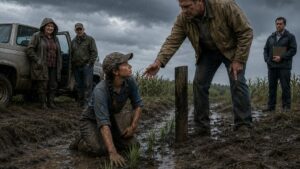
They Paved Over Her Farm Road, Then Learned Every Truck Still Needed Her Permission
Chapter 1: The Truck She Refused to Move
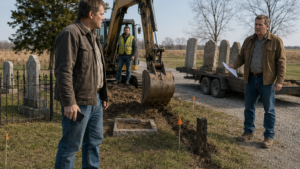
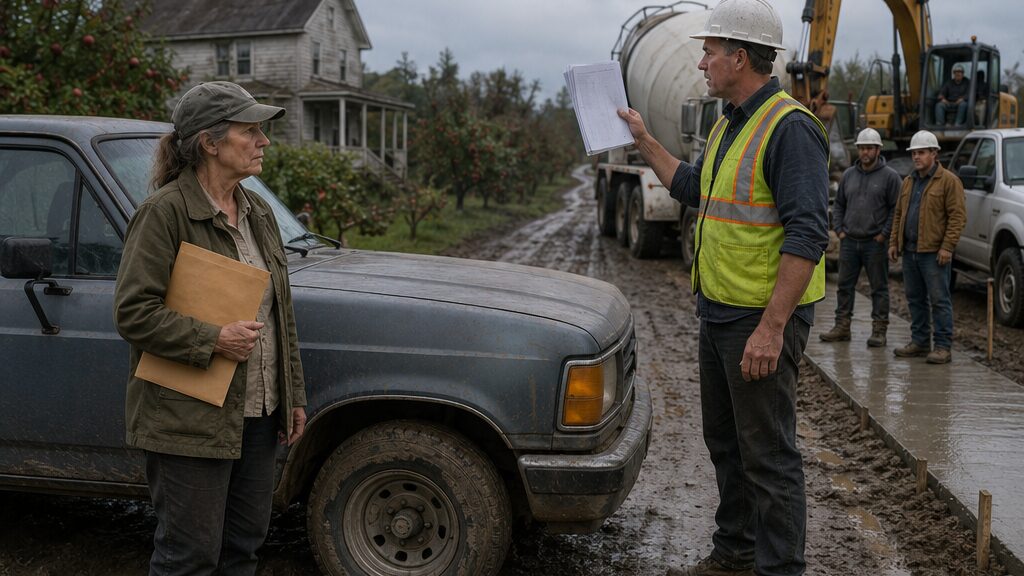
The bulldozer blade stopped six inches from Elizabeth King’s mailbox.
The operator lifted both hands from the controls as if the machine had surprised him. Behind him, a concrete mixer idled on the county road, its drum turning with a low metallic churn. Two dump trucks waited behind it. Orange flags ran from the new shopping-center site toward Elizabeth’s gravel drive, then continued between the pear trees as though someone had already decided where the road belonged.
Elizabeth stepped off her porch without closing the door.
She wore her work jacket over the clothes she had slept in. Mud pressed cold through the cracked soles of her boots. Her truck sat crosswise at the mouth of the drive, where she had left it after seeing the first survey crew arrive before sunrise.
The front tire pinned one orange flag flat against the gravel.
A man in a white hard hat came around the bulldozer. He carried a clipboard beneath one arm and moved with the clipped impatience of someone already late.
“You need to move the truck,” he said.
Elizabeth looked past him at the mixer.
“No.”
The man stopped several feet away. His vest was clean except for a dark smear near the pocket. The name printed across his chest read MICHAEL ANDERSON.
“We have a pour scheduled.”
“You have it scheduled somewhere else.”
He glanced at the farmhouse, then at the orchard rows extending behind it. “Ma’am, this entire frontage was included in the Roberts purchase.”
“Not this road.”
“The survey says otherwise.”
Elizabeth pointed toward the mailbox. “Your machine nearly took that post out.”
“The operator stopped.”
“That doesn’t answer me.”
Michael drew a breath through his nose. Workers stood near the mixer, trying not to look interested. One of the truck drivers leaned against his door with a paper cup in his hand.
Michael opened the clipboard. “The development has approved grading plans, site permits, and access authorization. We have a crew and loaded concrete waiting. Move the truck.”
Elizabeth watched the mixer drum rotate. Every turn shortened the time before the load began to harden.
“That road has its own parcel number,” she said.
Michael’s eyes rose from the papers. “No, it doesn’t.”
“Parcel seventeen-C.”
He flipped through several pages, faster now. “The recorded development map shows a continuous access lane.”
“The road was recorded before that map.”
“We have attorneys who reviewed this.”
“Then one of them can show me where I signed.”
Michael closed the clipboard.
“This isn’t a negotiation at the gate.”
“It is my gate.”
“There’s no gate.”
“There was one until your excavator pulled the post yesterday.”
That silenced the workers. Michael looked toward the splintered cedar post lying beside a pile of dirt.
He lowered his voice. “Mrs. King, delays on a concrete pour cost money. If you block authorized work, those costs can be charged back to you.”
Elizabeth felt the heat rise beneath her collar. For one dangerous second, she wanted to tell him exactly what she thought of his permits, his trucks, and the men standing on land her husband had kept graded by hand for thirty-eight years.
Instead, she held out her palm.
“Show me the page.”
“What?”
“The page that gives commercial vehicles permission to cross parcel seventeen-C.”
“It’s incorporated into the site approval.”
“Then show me.”
Michael reopened the clipboard. He turned through engineering sheets, drainage diagrams, traffic notes, and stamped county forms. His movements grew sharper.
Elizabeth waited.
The mixer continued turning.
Finally, Michael held out a page covered in boundary lines. “There. Primary construction access.”
Elizabeth did not take it. “What parcel does the line cross?”
“It connects the county road to the site.”
“That wasn’t my question.”
“You’re looking at the approved plan.”
“And you’re standing on my road.”
His jaw tightened. “I’m telling you this project has legal access.”
“Put that in writing.”
Michael stared at her.
“Write that you were told parcel seventeen-C is private,” Elizabeth said. “Write that I denied permission. Then write that you ordered your trucks through anyway.”
The driver with the paper cup looked down.
Michael’s face changed—not into doubt, exactly, but into calculation. He stepped away and called someone. His words were too low to hear over the engines.
Elizabeth turned toward her truck.
“Don’t move it,” she told the excavator operator.
The operator looked at Michael.
Michael ended the call. “The grading crew can continue along the eastern edge without crossing your vehicle.”
“That edge is still part of the road.”
“Our survey stakes say it isn’t.”
“Your stakes appeared this morning.”
He pointed toward the excavator. “Cut along the shoulder. Stay clear of the truck.”
The machine started forward.
Elizabeth moved beside the mailbox and pulled out her phone. Her hands were steady until she opened the camera. Then her thumb trembled once against the screen.
She photographed the orange flags. The broken gatepost. The bulldozer tracks. Michael’s clipboard. The concrete mixer waiting on the county road.
The excavator lowered its bucket into the strip of grass beside her truck.
The first bite tore through chicory and gravel. The second scraped against something hard.
Elizabeth knew that sound.
“Stop,” she called.
The operator hesitated but did not lift the bucket.
Michael raised one arm, signaling him onward.
The third pass exposed the rounded top of a gray fieldstone, set deep at the edge of the road. Elizabeth’s husband had shown it to her when they bought the north orchard. The county surveyor had painted a white cross on it, though most of the paint had worn away.
“That is the boundary marker,” she said.
Michael walked toward it, looked down, and then back at his plan.
“It’s not on our survey.”
“It’s under your machine.”
He studied the stone for another moment.
Then he told the operator to keep going.
The bucket crossed the marker and dragged a line of dark soil onto the gravel.
Elizabeth raised her phone and took the photograph.
Chapter 2: The Map Beneath the New Survey
The county records clerk found two maps of Elizabeth’s property, and the boundary was different on each one.
The newer map filled most of the computer screen. It showed Daniel Roberts’s development in clean black lines: retail pads, parking rows, drainage basins, and a broad access lane entering from the county road. Elizabeth’s farmhouse appeared as a small rectangle outside the project boundary.
The lane passed across the mouth of her drive without interruption.
“That’s the map they showed me,” Elizabeth said.
The clerk enlarged the image. “Recorded eighteen months ago.”
“And the other one?”
The clerk glanced toward the open archive room. “That will take a minute.”
Elizabeth had arrived carrying the envelope she kept in the bottom drawer of her husband’s desk. Inside were the original deed, tax maps, an old survey certificate, and three folded letters she had not opened in nearly two years.
She had told herself the letters belonged to another problem.
Now she kept the envelope pressed beneath her hand.
The clerk returned with a flat archival folder. She cleared a table and unfolded a linen-backed map yellowed along its creases. Hand-drawn parcel lines spread across it in brown ink.
The farmhouse parcel sat at the center. A narrow strip extended from the public road to the house, then widened near the orchard gate.
The clerk traced the strip with one finger. “This is seventeen-C.”
Elizabeth leaned closer.
Her road was not merely drawn as access to the farmhouse. It was outlined as a separate recorded parcel attached to the farm deed.
“Can you overlay them?” she asked.
The clerk carried the old map to a light table and placed a transparent printout of the development survey over it. The new commercial access lane lay directly across seventeen-C for almost forty feet.
The difference was not subtle.
“Why didn’t this show on the new survey?” Elizabeth asked.
“It may have.” The clerk adjusted the overlay. “Survey drawings don’t always display every underlying ownership interest. Sometimes those are handled in title work.”
“Would the county approve a plan across land the developer didn’t own?”
“The planning office approves plans based on the documents submitted. Ownership disputes are separate.”
Elizabeth looked at the neat lines of the parking lot. Eighty spaces, Michael had said. Every one depended on trucks entering where her husband had once pulled wagons loaded with apples.
“Can you print both?”
“I can certify the recorded copies.”
The clerk lifted the old map, then paused. “There’s a notation here.”
Along the lower margin, written in pencil, were six words:
Permissive passage for farm and emergency use.
A date followed. Twelve years earlier.
Elizabeth read it twice.
“Whose note is that?”
“Could be a survey technician’s field annotation. It isn’t an easement by itself.”
“Who gave permission?”
“The record doesn’t say.”
The clerk turned the page. A reference number led to a separate file containing correspondence associated with the road.
Elizabeth knew before the clerk opened it.
The first copy was a letter addressed to Daniel Roberts’s previous land company. The signature at the bottom belonged to her husband.
Jerry King.
The name struck her with the same physical force as the excavator bucket crossing the boundary stone.
She read only the first paragraph.
I have no objection to temporary agricultural or emergency passage over the lower road, provided such use does not interfere with orchard operations or establish permanent commercial access.
Relief came first. The words did not grant an easement.
Then she saw the final line.
Elizabeth and I will discuss permanent conditions after the fall harvest.
The clerk asked, “Would you like a certified copy of that too?”
Elizabeth folded the page closed. “Yes.”
By the time she returned to the farm, the concrete mixer was gone, but the work had not stopped. Fresh gravel covered the exposed boundary stone. The excavator had cut a shallow trench along the road’s edge. No vehicle had crossed her truck, yet the site looked as if it had begun flowing around her.
She parked beside the barn and carried the certified records into the kitchen.
The house had always sounded different after machinery stopped. The refrigerator hummed. A loose vent clicked above the stove. Somewhere behind the wall, the old clock marked each second too loudly.
Elizabeth spread the new survey across the kitchen table and placed the historic map on top. She aligned the county road, the farmhouse corner, and the orchard fence.
The commercial lane crossed her parcel exactly where she had said it did.
She took a marker and circled the permit numbers printed along the development plan. None referenced seventeen-C. None described an easement. None bore her signature.
Her phone rang.
Rebecca.
Elizabeth let it ring twice before answering.
“I heard there was a concrete truck sitting out there half the morning,” her daughter said.
“People talk.”
“I work in county dispatch. Truckers call when roads are blocked.”
“The road wasn’t blocked. It was occupied by its owner.”
There was a pause. “Mom, did they threaten you?”
Elizabeth looked at Michael’s name on the photograph she had printed from her phone.
“No.”
“You always say no when the true answer is something you don’t want me involved in.”
“I handled it.”
“That wasn’t my question.”
Elizabeth almost smiled despite herself. Rebecca had learned that method somewhere close to home.
“They said I could be charged for the delay.”
“And you didn’t call me?”
“You’re not my attorney.”
“I’m your daughter.”
“That doesn’t make you responsible for every hard thing that happens here.”
“No. You decided that for both of us years ago.”
A vehicle came up the drive before Elizabeth could answer. Rebecca’s gray sedan passed the orchard gate and stopped beside the porch.
“You’re here,” Elizabeth said into the phone.
“I was already halfway there.”
Rebecca entered without knocking. She still wore her county work shirt beneath a navy jacket. Her eyes moved from the certified maps to the photographs and then to the written note Elizabeth had made of Michael’s threat.
“This is what you call handling it?”
“I found the parcel.”
Rebecca pulled out a chair. “Then call a property lawyer.”
“With what money?”
The question landed between them.
Rebecca looked toward the window, where the tops of the pear trees moved in the wind. “How bad is it?”
“The orchard account is fine.”
“That wasn’t what I asked.”
Elizabeth began gathering the loose pages. “The current permits don’t include my road. That’s what matters tonight.”
Rebecca reached for the historic correspondence.
Elizabeth moved first.
She slipped the signed letter beneath the old survey and folded both into the envelope.
Rebecca watched her. “What was that?”
“An old record.”
“Whose signature?”
Elizabeth closed the metal clasp.
“Mom.”
Outside, an engine started on the construction site. The sound traveled across the fields, low and steady.
Elizabeth set the envelope in her lap.
The letter inside bore her dead husband’s signature and promised a conversation they had never had.
Chapter 3: A Stop Order Is Not a Victory
By Tuesday morning, fresh concrete covered half of the old boundary stone.
Elizabeth stood beside it while Susan Brown, the county land-use inspector, scraped gray slurry away with the edge of a folding ruler. The white survey cross was still visible beneath the wet film.
Susan photographed it, then straightened.
“Who ordered the pour?”
Michael stood several yards away with his clipboard. His vest was no longer clean.
“The concrete stayed within the approved access alignment,” he said.
Susan pointed at the stone. “I asked who ordered it.”
“I did.”
“After Mrs. King identified this as a property marker?”
Michael glanced at Elizabeth. “She identified it as a marker. It wasn’t shown on our field plan.”
“That isn’t the same answer.”
Elizabeth said nothing. She held the certified map against her jacket to keep the wind from bending it.
Behind the chain-link fence, the site had gone quiet except for a generator. Workers waited near parked equipment. A line of orange flags ended abruptly at Elizabeth’s truck.
Susan asked Michael for the full permit package.
He handed it over. “The project was reviewed for access, drainage, and traffic flow. We didn’t invent the lane Monday morning.”
“No one said you did.”
“You’re treating this like we drove through somebody’s living room.”
Elizabeth looked toward the farmhouse. From where Michael stood, the new lane aimed almost directly at it.
Susan opened the plans across the hood of her county vehicle. She checked the planning stamp, engineering approval, drainage notes, and construction access sheet.
Then she turned to Elizabeth.
“Show me seventeen-C.”
Elizabeth laid the historic map beside the approved plan. Susan aligned the county road and parcel corners exactly as the clerk had done.
Michael came closer.
The access lane crossed the old strip.
“That notation could be obsolete,” he said.
“The parcel isn’t,” Elizabeth replied.
Susan examined the certified deed. “Mrs. King, do you have a title report?”
“No.”
“Any recorded easement agreements?”
“None that I found.”
Michael tapped the development plan. “Our title review showed access rights.”
“Show me where,” Susan said.
His hand stopped.
“I don’t carry title binders in the field.”
“Then call your office.”
Michael walked aside and made the call. His voice remained controlled at first, then sharpened. He turned away from the group.
Rebecca stood near Elizabeth’s truck with her arms folded. She had taken the morning off without asking permission from either Elizabeth or herself.
“You brought the letter?” she whispered.
“No.”
“You should tell her.”
“I brought the recorded documents.”
“That letter is part of the history.”
“It is not an easement.”
“That doesn’t mean it doesn’t matter.”
Elizabeth kept her eyes on Susan.
Michael returned. “Project counsel says access was included in the land acquisition.”
“Was parcel seventeen-C acquired?” Susan asked.
“They’re checking.”
“Was an easement recorded?”
“They’re checking.”
Susan closed the permit folder. “Until they finish checking, no commercial or construction traffic crosses this strip.”
Michael’s mouth tightened. “You’re shutting down a permitted project over a map from forty years ago.”
“I’m stopping work on a disputed parcel. Work can continue elsewhere if the approved plan allows it.”
“It doesn’t. This is the construction entrance.”
“That is your logistical problem.”
One of the subcontracted drivers started his truck, then switched it off again.
Michael looked toward the workers. “Every hour costs somebody here.”
Elizabeth heard the truth beneath the accusation. The people waiting were not Daniel Roberts. They were operators, drivers, finishers, men and women paid by days completed and loads delivered.
For the first time, her victory felt less clean.
Michael saw her looking at them.
“You think this only hurts a developer?” he asked. “The concrete company charges for rejected loads. The grading subcontractor has equipment rented by the week. Two tenants hired employees for openings next month.”
“You should have secured the road,” Elizabeth said.
“We were told it was secured.”
“By whom?”
Michael did not answer.
Susan removed a red notice from her vehicle and filled it out against the hood. Her handwriting was small and deliberate. She attached the notice to the temporary construction gate.
STOP WORK—ACCESS PARCEL UNDER REVIEW.
The paper moved in the wind.
Rebecca let out a breath.
Elizabeth did not.
Susan returned the certified map. “This confirms the permits don’t authorize work on seventeen-C. It does not resolve every possible access claim.”
“What claim could there be without a signed easement?” Rebecca asked.
“Historic use. Permission. Estoppel. Emergency-access requirements. I’m not deciding those from the roadside.”
Michael’s phone rang again.
He answered, listened, and looked directly at Elizabeth.
“Our attorney is sending records,” he said. “Decades of trucks used this road. Farm equipment, utility crews, emergency vehicles. Nobody was stopped.”
“Those weren’t commercial deliveries to a shopping center,” Elizabeth said.
“Access is access.”
“No,” Susan said. “It isn’t always.”
Michael stepped closer to the plans. “Her husband gave permission. We have correspondence.”
Rebecca turned toward Elizabeth.
Elizabeth felt the sealed envelope in her mind as clearly as if she held it against her chest.
Susan’s attention shifted to her. “Is that true?”
“My husband allowed some vehicles through.”
“What kinds?”
“Farm trucks. An ambulance once. Fire equipment during the barn fire across the creek.”
“Did he discuss permanent access with the developer?”
Elizabeth heard Rebecca inhale.
Michael watched her with a look that was no longer dismissive. It was wary now, and angry in a different direction—as if he had just discovered the ground beneath his own position was also unstable.
“He discussed conditions,” Elizabeth said.
“Were any accepted?” Susan asked.
“No permanent agreement was signed.”
“That wasn’t my question.”
Elizabeth looked at the red notice on the gate. Ten minutes earlier it had seemed like proof that the county understood the situation. Now it looked temporary, almost fragile.
Susan lowered her voice.
“Mrs. King, did your husband ever grant permission that Daniel Roberts reasonably believed would continue?”
Chapter 4: The Permission Her Husband Never Finished
Rebecca laid the hidden letter beside the stop-work order before Elizabeth had poured the coffee.
The two papers touched at one corner: the county’s red notice, sharp and official, and Jerry King’s old letter, softened at the folds from years inside the metal envelope.
“You told Susan there was no agreement,” Rebecca said.
“There wasn’t.”
“You didn’t tell her this existed.”
“She asked whether he granted permanent access.”
“She asked whether Daniel reasonably believed permission would continue.”
Elizabeth set the kettle back on the stove without filling either cup. Through the kitchen window, the construction site stood dark. No engines. No backup alarms. The silence should have felt like relief.
Instead, it made Rebecca’s voice carry farther.
“The letter says you and Dad would discuss permanent conditions after harvest.”
“We never did.”
“Why?”
Elizabeth picked up the stop-work order and squared it with the edge of the table. “He got sick.”
“That was later.”
“Not much later.”
“Mom.”
Elizabeth looked at the road beyond the orchard. The temporary fence cut across its entrance, and Susan’s red notice fluttered against the wire.
Rebecca tapped the letter. “Did you know he was talking to Daniel?”
“I knew people asked about the lower road.”
“That isn’t what I asked.”
“He mentioned letting farm trucks through. Emergency vehicles. Things that had always happened.”
“And commercial access?”
Elizabeth’s hand closed around the back of a chair. “He knew how I felt.”
“That still isn’t an answer.”
The words came too quickly. “I told him I would not watch the farm get divided into convenient pieces for people who had already bought everything around us.”
Rebecca went still.
Elizabeth heard the old sentence in her own voice, not as she had spoken it, but as Jerry must have heard it—from the hospital bed in the downstairs room, when he had tried to bring up the road and she had refused to discuss property while he could barely finish his soup.
She had thought refusing the conversation was a form of loyalty.
Rebecca lowered herself into the chair. “So he tried.”
“He suggested we review the boundaries after harvest.”
“And you wouldn’t.”
“I said there would be another harvest.”
The kettle clicked as the burner heated beneath it.
Neither woman moved.
Elizabeth finally turned off the flame.
Rebecca folded the letter once, following the old crease. “We need to know what else he said.”
“There is nothing else in the county file.”
“That doesn’t mean there’s nothing else.”
The orchard shed stood near the north rows, a low building with weathered green siding and a roof Jerry had patched three different ways. Elizabeth had avoided the desk inside since his death. It still held his pruning records, fuel receipts, and sharpened pencils in a coffee tin.
Rebecca followed her across the yard without speaking.
Inside, dust hung in the narrow bars of light between the boards. Elizabeth opened the desk drawers one at a time. The first held twine and staplers. The second held spray schedules. The third stuck halfway.
She pulled harder.
The drawer came free with a wooden groan.
Beneath an orchard ledger lay a thin folder marked LOWER ROAD.
Rebecca reached for it. Elizabeth put her hand over the cover.
“I’ll open it.”
Her daughter stepped back.
Inside were copies of utility notices, two sketches of the farm entrance, and three short letters between Jerry and Daniel Roberts. None was signed as an agreement. None granted permanent access.
The earliest thanked Daniel for repairing a washout after an ambulance crossed during a spring storm. The second allowed temporary delivery passage to a neighboring farm while a county bridge was closed.
The third was unfinished.
Jerry had written conditions in pencil beneath a typed paragraph:
No heavy trucks during harvest.
Maintain drainage.
No cutting orchard trees.
Emergency use always open.
Commercial terms require Elizabeth’s approval.
Rebecca read the final line twice.
“He put your name on it.”
“He should have spoken to me.”
“He tried.”
“He wrote it in a folder.”
“He was sick.”
Elizabeth closed the folder harder than necessary. “So was I, in a different way.”
Rebecca flinched, and Elizabeth regretted the words immediately.
She carried the papers outside.
Jerry Mitchell lived beyond the creek on the last piece of pasture not purchased by Daniel. He answered the door in a wool vest and work pants, his white hair flattened on one side.
When he saw the folder, his expression changed.
“You knew,” Elizabeth said.
Jerry stepped onto the porch and closed the door behind him. “I knew he was looking at options.”
“Did he tell Daniel he could use my road?”
“He told Daniel he would consider a limited agreement.”
“Did he say I had agreed?”
“No.”
“Did Daniel believe I would?”
Jerry rubbed his thumb across the porch rail. “Jerry thought you might, if the orchard was protected.”
Elizabeth stared at him.
“He talked like the future was already settled,” Jerry continued. “Not the legal part. The part where you’d still be here, and the county would change around you.”
“He had no right to settle my future.”
“No,” Jerry said. “But he was scared of leaving you with no plan.”
The anger in Elizabeth lost its clean edge.
Jerry looked toward the orchard. “He figured the shopping center was coming whether he liked it or not. He wanted the road to pay for drainage, taxes, maybe help you keep the farm. He also knew you’d reject anything that sounded like selling.”
“So he went around me.”
“He waited for a better time.”
“There wasn’t one.”
“No.”
That answer hurt more than defense would have.
Jerry opened the folder and examined the pencil conditions. “He expected you to negotiate after harvest. I assumed he told you.”
“You assumed wrong.”
“I did.”
A county vehicle turned into Elizabeth’s drive before they returned. Susan stood near the temporary gate with the fire marshal, both studying an aerial plan spread over the hood.
Michael was there too, several feet apart from them, phone pressed to his ear.
Susan waved Elizabeth over.
“The stop-work order remains,” she said. “But we have another problem.”
The fire marshal pointed to the plan. “The approved secondary emergency entrance is on the east side.”
“That’s Daniel’s land,” Elizabeth said.
“It is. It’s also narrow, steep, and partly blocked by the drainage basin. A ladder truck can enter, but it may not turn under wet conditions.”
“And my road?”
“Straight approach. Better surface. Direct access to both the commercial buildings and your farmhouse.”
Elizabeth looked at Susan. “You said emergency access wasn’t the same as commercial access.”
“It isn’t. But the county cannot ignore the safest route once it’s identified.”
“So my road can be private until somebody decides they need it.”
The fire marshal’s voice stayed even. “In an actual emergency, we use what we must. The question is whether formal emergency access should be planned now instead of improvised later.”
Rebecca came to stand beside Elizabeth. “That would protect the farmhouse too.”
Elizabeth heard the practical truth in her daughter’s voice and resented it because it was true.
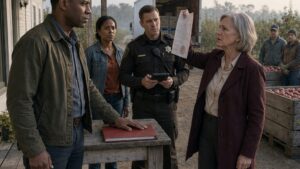
Michael ended his call. “Daniel is requesting a meeting tomorrow morning.”
“I didn’t agree to one.”
“He’s coming anyway.”
A black pickup turned from the county road before Michael finished speaking.
Daniel Roberts stepped out wearing a dark coat over an open-collared shirt. He did not carry a lawyer’s briefcase. He carried a narrow cardboard tube and a folder with Jerry King’s handwriting across the front.
Elizabeth recognized the words before he reached the gate.
Proposed Lower Road Conditions.
Daniel stopped on the other side of the red notice.
“Mrs. King,” he said, “I think your husband intended you to finish this.”
Chapter 5: The Offer That Would Erase the Orchard
Daniel’s offer would pay every remaining debt attached to the farm.
The number sat at the top of the first page, larger than the surrounding print. It included payment for a permanent commercial easement, reimbursement for the damaged gate and boundary marker, and an additional amount for construction delay claims Daniel agreed not to pursue.
Rebecca read it once and looked away.
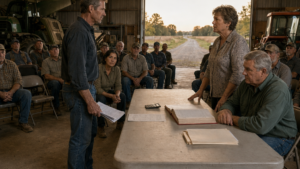
Michael remained standing near the dining-room door. Daniel had taken the chair opposite Elizabeth. Between them, the table held the offer, Jerry’s draft conditions, the certified parcel map, and two engineering drawings rolled beneath a coffee mug.
“You came prepared,” Elizabeth said.
“I should have come prepared two years ago.”
“Instead, you brought machines.”
Daniel accepted the rebuke without lowering his eyes. “I believed the access issue was resolved in principle.”
“With a dead man.”
“With a landowner I had negotiated with for eight months.”
“I was also a landowner.”
“He said you would review final conditions together.”
“And when he died, you decided that meant yes?”
Daniel’s jaw shifted. “I decided it meant the process had stopped, not that the answer had changed.”
“That decision poured concrete over my marker.”
Michael spoke from the doorway. “The field team was told access was cleared.”
Daniel looked at him. “Not now.”
“No,” Michael said. “Now is exactly when.”
The room tightened.
Michael stepped closer to the table. “Project counsel marked the access as complete. The title summary called it an existing farm route with continuing permission. Nobody told me there was no recorded easement.”
Daniel’s voice cooled. “You had the approved plans.”
“I also had your notice to proceed.”
Elizabeth watched them. Michael’s anger was not staged for her. He had believed the papers protected him because believing that was easier than asking the woman at the gate.
Daniel turned back to Elizabeth. “The mistake is mine to resolve.”
He pushed the offer forward.
Rebecca touched the lower corner. “This would clear the equipment loan.”
Elizabeth looked at her.
“And the property tax balance,” Rebecca added quietly. “You said the orchard account was fine.”
“It is operating.”
“It is losing money.”
Daniel did not react, but the figure on the page seemed to grow heavier.
Elizabeth had not told Rebecca about the late tax notice in the desk or the second repair estimate for the irrigation pump. She had planned to sell another row of apples directly to the orchard buyer and make up the difference by winter.
Plans were easy when no one else saw the numbers.
“What exactly are you buying?” she asked.
Daniel unrolled the first engineering sheet.
“A twenty-four-foot commercial access lane from the county road to the south edge of the development. Service deliveries only. No customer entrance.”
The route ran across seventeen-C, then widened beside the pear orchard.
Elizabeth pointed to the curved section. “Why does it bend there?”
“Truck-turning radius.”
“For what size?”
“Tractor trailers.”
“No.”
Daniel kept his hand on the paper. “The tenants require scheduled deliveries.”
“Then schedule smaller trucks.”
“Some suppliers won’t divide loads.”
“That isn’t my problem.”
“It becomes everyone’s problem if the project cannot open.”
Elizabeth studied the widened curve. Six small circles stood inside its edge, each marked with an X.
She knew which trees they were without counting.
“You plan to cut the pears.”
“Six trees,” Daniel said. “We included replacement value.”
“They were planted the year Rebecca started school.”
Rebecca looked at the plan again.
Daniel continued carefully. “We would plant twelve elsewhere.”
“They would not be these six.”
“No.”
The answer was plain enough to be almost respectful, which made it worse.
Elizabeth rose and carried the plan outside.
The others followed her down the farm road. Orange flags still marked the developer’s preferred alignment. At the orchard edge, the proposed curve entered the oldest pear row.
Elizabeth touched the bark of the first tree. The trunk was thick and dark, scarred where a ladder had slipped years earlier. Jerry had wrapped the wound himself. The tree still bore fruit, though less each season.
Daniel stopped several yards behind her. “The alternative route removes twelve parking spaces and cuts through the stormwater design.”
“Then remove twelve spaces.”
“The lender’s valuation is tied to the approved count.”
“There it is.”
“What?”
“The part where your problem becomes proof that I should lose something.”
Daniel took a breath. “Mrs. King, I bought seven failing parcels and two vacant houses. The feed-store owner wants a larger building. The pharmacy tenant has already hired staff. This is not a tower owned by people three states away.”
“No. It is a local project that crossed a local woman’s land without asking her.”
“I believed your husband had begun that permission.”
“Begun is not finished.”
Behind them, Rebecca said, “Mom, the farm can’t keep carrying debt because the trees have memories.”
Elizabeth turned.
Rebecca’s face had gone pale, but she did not take the words back.
“The trees are not the debt,” Elizabeth said.
“No. But pretending everything can stay exactly where Dad left it is.”
Silence moved through the orchard.
Michael walked away toward the road, giving them distance.
Elizabeth looked from Rebecca to the marked trees. “You think I’m doing this because I can’t bear to change anything.”
“I think you are so afraid of losing the farm that you won’t admit what is already being lost.”
Daniel rolled the plan loosely. “The offer remains open until tomorrow.”
“No.”
Rebecca closed her eyes.
Daniel nodded once, as if he had expected the answer. “Then the project stays stopped, and the legal teams take over.”
He began walking toward the gate.
Michael did not follow.
When Daniel was beyond hearing, Michael pulled a folded email printout from his vest pocket.
“You didn’t get this from me,” he said.
Elizabeth did not take it. “What is it?”
“The access clearance I received before mobilization.”
She read the first lines. Daniel’s legal counsel had described the road as subject to an existing consensual easement awaiting administrative recording.
“That isn’t true,” Rebecca said.
Michael’s mouth hardened. “It’s what I was told.”
“You still continued after I objected,” Elizabeth said.
“Yes.”
“Why?”
“Because crews stop listening when every person beside a project claims a line is wrong. Most times, the survey controls.” He looked toward the concrete over the boundary stone. “This time I should have stopped.”
It was not an apology. It was more useful than one.
Michael pointed to the engineering tube under Daniel’s arm. “There are alternatives. None are cheap.”
“Show me.”
“I can’t authorize a redesign.”
“I didn’t ask you to.”
He studied Elizabeth for a moment, then returned to the site office.
That evening, Rebecca sat at the kitchen table while Elizabeth reviewed the offer again. The debt figures waited in the desk drawer. The six marked pear trees stood outside in darkness.
Rebecca spoke first. “I shouldn’t have said it that way.”
“You meant it.”
“That doesn’t make it fair.”
Elizabeth folded the offer.
“Would you take it?” she asked.
Rebecca did not answer immediately. “I would be afraid not to.”
“That is not the same thing.”
“No.”
At nine, Daniel emailed the full engineering package Michael had requested be released. Alternate routes, turning diagrams, drainage elevations, delivery schedules.
Elizabeth printed every page.
She placed the broad commercial easement in one pile and Jerry’s penciled conditions in another.
Then she called Daniel.
“I reject your offer,” she said.
“I understood that this afternoon.”
“I want the truck specifications, drainage calculations, and every alternate access drawing.”
There was a pause.
“Why?”
Elizabeth looked through the dark window toward the road.
“Because you drew only the road you wanted.”
Chapter 6: The Road She Chose to Draw Herself
The unsent sketch fell from the orchard ledger when Elizabeth lifted it off the shed desk.
It landed facedown between her boots.
She nearly placed it back without looking. Then she saw Jerry’s pencil marks through the thin paper.
The drawing showed the lower road, the farmhouse, the pear rows, and the development parcels before Daniel had assembled them. A narrow route left the existing drive near the broken gate, followed the drainage swale, and curved behind the equipment shed.
It avoided all six old pear trees.
At the bottom, Jerry had written:
Let Elizabeth set width and hours. Emergency gate never locked to responders.
Rebecca stood in the shed doorway holding two cups of coffee. “What did you find?”
Elizabeth handed her the page.
Her daughter read it slowly. “He expected you to decide.”
“He expected me to agree.”
“No. Look.”
Rebecca pointed to the measurements. Jerry had left the lane width blank. Vehicle limits blank. Payment terms blank. Beside orchard protection, he had written Elizabeth knows root spread.
The empty spaces changed the drawing more than the pencil lines did.
Elizabeth sat at the desk.
For two years she had remembered Jerry as a man trying to begin a conversation she had refused. She had not imagined that he might also have stopped because the final decision was not his to make.
Rebecca put the coffee beside her. “He wasn’t giving away the road.”
“He was preparing to move the shed.”
They both looked at the wall behind them.
The equipment shed held the small sprayer, ladders, pruning tools, fuel cans, and the old sorting table. Moving it would cost money and take part of the winter. It was not a pear tree. It was not nothing.
Elizabeth traced Jerry’s route. “He chose the one thing we could rebuild.”
By midmorning, she had spread the engineering plans across the dining-room floor. Rebecca brought graph paper from the county office. Jerry Mitchell arrived with an old measuring wheel and did not offer advice until Elizabeth asked.
They walked the road repeatedly.
The broad commercial route required a twenty-four-foot paved lane and a large turning apron. Jerry’s route could be narrowed if deliveries used shorter trailers and entered only from one direction. The drainage swale would need reinforcement. The equipment shed would have to move forty feet north.
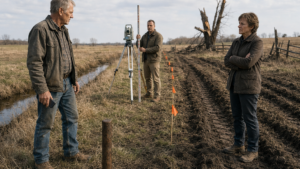
At the orchard edge, Elizabeth drove a wooden stake into the ground.
“Sixteen feet,” she said.
Jerry looked doubtful. “Fire equipment may need more clearance.”
“Driving surface sixteen. Reinforced shoulders on both sides.”
Rebecca wrote it down.
“No overnight deliveries,” Elizabeth continued. “No idling beside the house. No vehicles over the stated weight except emergency equipment.”
“What weight?” Jerry asked.
Elizabeth looked at the specifications Michael had provided. “Thirty-three thousand pounds for routine service.”
“That excludes full tractor trailers,” Rebecca said.
“It is supposed to.”
She walked farther and placed another stake before the pear roots began.
The developer’s orange flags formed a wide arc through the orchard. Elizabeth pulled the first one from the ground. Its bright plastic was clean. The next had been crushed beneath her truck tire and bent near the wire stem.
She kept that one.
By afternoon, her narrower line ran behind the equipment shed. It cost Daniel parking spaces and a portion of his delivery flexibility. It cost Elizabeth the shed, some fence, and the right to say the road would remain untouched.
At the county planning room, Susan studied the revised drawing.
“This is not a complete engineering plan,” she said.
“It is a set of conditions.”
“The county cannot approve conditions without dimensions, drainage review, fire access, and legal language.”
“That is why Daniel has engineers.”
Susan looked at the proposed restrictions. “A revocable commercial license is going to concern his lender.”
“It can convert to a term easement after five years if there are no violations.”
Rebecca glanced at Elizabeth. That condition was new.
Susan noticed. “You’re offering a path to permanence.”
“I am offering them a reason to behave.”
“And emergency access?”
“Permanent, limited to emergency vehicles and required inspections. No fee.”
Susan tapped the paper. “You understand that means the gate cannot physically delay responders.”
“I understand.”
The word tasted different now.
Daniel arrived with Michael and a civil engineer. He read Elizabeth’s conditions standing up.
“No,” he said when he reached the vehicle limit.
“Then use the east entrance.”
“It cannot handle routine delivery traffic.”
“Then redesign it.”
Daniel moved to the next page. “Restricted hours. Penalties for idling. Drainage maintenance at our expense. Restoration bond. Twelve parking spaces removed.”
“Fourteen,” Michael said.
Daniel looked at him.
“The turning geometry takes two more if we stay outside the roots.”
Daniel set the papers down. “This makes the anchor tenant’s supply schedule unworkable.”
Michael shook his head. “It makes their current supply schedule unworkable.”
The distinction hung in the room.
Daniel turned to him. “Whose project are you managing?”
“The one that needs a road it actually has permission to use.”
Elizabeth saw the flash of anger in Daniel’s face, followed by restraint. He was not a man accustomed to being corrected by his superintendent in a county meeting room.
The civil engineer pointed to Jerry’s line. “A medium box truck can make this turn. A short semi can with a modified apron, but not at sixteen feet.”
“Eighteen,” Daniel said.
“Sixteen driving surface,” Elizabeth replied. “Reinforced shoulders.”
“Twenty-foot clear zone.”
“Outside the pear roots.”
The engineer studied the map. “Possible.”
Daniel sat at last. “Five-year revocable access is not financeable.”
“Then ask for three years.”
“That is worse.”
“Then earn the conversion.”
He pushed the papers away. “You’re asking me to invest in roadwork you can close.”
“I can close commercial access for violations. Emergency access remains.”
“So one disagreement shuts down deliveries.”
“One violation triggers notice. Three documented violations in twelve months allow suspension.”
Rebecca placed a typed page on the table. “With an appeal process through the county.”
Daniel looked at her. “You work for the county.”
“In dispatch. Not land use. I drafted plain language for my mother.”
Elizabeth heard the emphasis and let it stand.
Daniel turned back to her. “The project cannot operate under this plan.”
“Then it cannot operate through my farm.”
He gathered his folder. “You have until tomorrow morning to reconsider the permanent easement.”
“No,” Elizabeth said. “You have until tomorrow morning to accept the road I am willing to allow.”
Daniel left without another word.
Michael remained long enough to roll the engineering sheets.
“He may walk away,” he said.
“From the project?”
“From this route. He’ll spend months fighting for another one.”
“Can he survive months?”
Michael did not answer.
That evening, Elizabeth and Rebecca returned to the equipment shed. The light had thinned between the boards.
“I thought you would refuse everything,” Rebecca said.
“So did I.”
“What changed?”
Elizabeth looked at Jerry’s sketch on the desk. “I kept hearing your father say the farm should not be cut apart. I decided that meant nothing could move.”
“And now?”
“Now I think he meant no one else should choose the cuts.”
Rebecca’s eyes filled, but she turned toward the shelves and began sorting empty containers from usable tools.
They worked until dark, deciding what could be moved and what should be discarded. The shed seemed smaller with every cleared shelf.
At the bottom of the desk, Elizabeth found a plain envelope addressed to her in Jerry’s handwriting. It had never been sealed.
Inside was one page.
If the road changes, make them build it so you can still walk home on it.
There was no instruction to agree. No request to forgive him for planning ahead. Only the assumption that she would remain the one who decided.
Elizabeth folded the note into her pocket.
At ten-thirty, she returned to the kitchen and revised the agreement.
She added restoration costs for the damaged marker and gate. She specified drainage repairs before commercial use. She required Daniel to fund relocation of the shed and install removable bollards controlled by Elizabeth and emergency services.
She attached the route drawing with the orange flags she had placed herself.
At the end, she added one sentence:
No access begins until all prior damage is acknowledged in writing.
Rebecca read it over her shoulder. “That may be the line he rejects.”
“Then the gate stays closed.”
Elizabeth sent the agreement to Daniel, Susan, and Michael.
The message contained no argument, only a deadline.
Acceptance required by 8:00 a.m. Saturday.
Outside, the development remained dark. Across the orchard, Elizabeth’s new flags formed a narrow line that bent around the pear trees and disappeared behind the equipment shed.
For the first time, the road no longer looked like something being taken from her.
It looked like a choice someone else would have to accept.
Chapter 7: What Was Allowed to Pass
The first delivery truck waited behind the locked gate at 7:42 Saturday morning.
Its engine idled on the county road, sending pale exhaust across the ditch. Behind it stood Michael’s pickup, Daniel’s black truck, Susan’s county vehicle, and the fire marshal’s SUV. The line looked less like a grand opening than an inspection no one wanted to fail.
Elizabeth stood inside the gate with the key in her jacket pocket.
The road beyond her had changed during the night. Gravel had been rolled over the damaged shoulder. Steel plates protected the drainage swale. Temporary markers showed the narrower route behind the equipment shed. None of the work crossed the locked gate.
Daniel approached carrying a document folder.
“We accepted the route,” he said.
“Most of it.”
“All operational conditions. Weight limits. Delivery hours. Emergency access. Restoration bond. Shed relocation.”
Elizabeth held out her hand.
Daniel gave her the agreement.
She read the final pages first.
The commercial license could be suspended after three documented violations. Emergency access remained permanent. The developer would maintain drainage, reinforced shoulders, gate controls, and the service surface. Fourteen planned parking spaces had been removed. No commercial vehicle could enter before seven in the morning or after six at night.
The restoration clause was missing.
Elizabeth closed the folder.
“No.”
Daniel looked toward the delivery truck. “The damage compensation is covered in the payment schedule.”
“The payment schedule covers repairs going forward.”
“It includes a lump sum.”
“It does not say what the sum is for.”
“It does not need to.”
“It does if you want the gate open.”
Daniel’s face tightened. “The lender needs the first tenant delivery logged by eight.”
“That is not written on my road either.”
Rebecca stood several feet away beside the new emergency-access box. She had said little since arriving. Jerry Mitchell held a bundle of wooden stakes near the pear row. Michael watched Daniel, not Elizabeth.
Daniel lowered his voice. “You have the road you wanted.”
“I have the road I allowed. I do not have an acknowledgment that you damaged it before permission existed.”
“You want language that sounds like an admission of liability.”
“I want language that states what happened.”
“Counsel will not approve that.”
Elizabeth looked past him at the truck.
The driver rested both hands on the steering wheel. He did not rev the engine or lean on the horn. He simply waited.
“You can use the east entrance,” she said.
Daniel gave a short, humorless laugh. “You know we can’t.”
“Then you should have brought the right paper.”
He walked back toward Michael and Susan. Their voices stayed low at first. Susan opened her own copy of the agreement. Michael pointed toward the concrete-covered boundary marker beside the ditch.
Daniel shook his head.
Michael reached inside his pickup and returned with a thick project log.
He brought it to Elizabeth.
“What is this?” Daniel asked.
“My daily report.”
Michael opened to Monday’s entry. His handwriting filled half the page, followed by printed photographs and time stamps.
Homeowner identified access parcel as private at 7:18 a.m. Requested written authorization. Boundary stone exposed at 8:03. Directed grading to continue pending confirmation from office.
Daniel read the entry without touching the book.
Michael turned to the next page.
Work proceeded beyond identified marker at superintendent’s direction.
“You documented that?” Daniel asked.
“I document delays, disputes, and field decisions.”
“You sent this to the office?”
“Every night.”
Daniel’s eyes moved to the photographs. Elizabeth’s truck. The flattened orange flag. The excavator bucket beyond the boundary stone.
“You told me legal had cleared it,” Michael said. “I believed you. Then I made the choice to continue after she objected. Both things can be true.”
No one answered.
Michael closed the log.
“I’ll sign a statement accepting responsibility for my order,” he said. “But the company should acknowledge the work happened without verified access.”
Daniel stared at him. “You understand what that could cost us.”
Michael looked toward the waiting driver. “Less than pretending it didn’t happen.”
The fire marshal checked his watch.
Susan spoke quietly. “The county does not require the restoration admission for emergency approval. This is between the parties.”
“That is why it matters,” Elizabeth said.
Daniel stepped away and called his attorney. He paced beside the temporary fence, speaking in fragments. No, not general language. Yes, a factual acknowledgment. No, not intentional trespass. Verified access had not been completed. Prior to written consent.
The delivery truck’s engine shut off at 7:55.
The sudden silence settled over the road.
Daniel returned at 7:58 with a revised page sent to his phone. Susan printed it from her vehicle.
Elizabeth read the added paragraph.
Roberts Development acknowledged that grading and concrete work crossed parcel seventeen-C before commercial access had been verified or granted in writing. The company accepted responsibility for restoring the boundary marker, gate, drainage edge, and disturbed surface under the attached schedule.
Michael’s order was acknowledged in a separate field report.
Elizabeth read the paragraph again.
Daniel uncapped a pen. “This is as far as counsel will go.”
“It is far enough.”
He signed first.
Michael signed the field report. Susan witnessed the access document. Rebecca signed only the emergency-control acknowledgment, keeping her role separate from Elizabeth’s decision.
The driver started the engine at 8:06.
Elizabeth still did not unlock the gate.
She walked to the edge of the pear row, where the developer’s old orange flags curved toward the six marked trees. The crushed flag from Monday lay on the hood of her truck. She picked it up, straightened the bent wire against her palm, and carried it beyond the roots.
Jerry handed her a mallet.
“You want it here?” he asked.
Elizabeth measured the distance with her eyes. The new route passed behind the shed, close enough that its relocation would be necessary, far enough that the trees would remain.
“Six inches farther south.”
Jerry moved the stake.
Elizabeth drove the orange flag into the ground herself.
The small strip of plastic shook in the truck’s exhaust. It no longer marked the route someone else had drawn across her land. It marked the limit she had chosen.
She returned to the gate.
Daniel stood aside.
Elizabeth inserted the key and opened the padlock. The chain came loose with a dry scrape. She swung the gate inward until the road lay clear.
The delivery truck moved slowly.
Michael walked beside it through the first turn, signaling the driver away from the reinforced shoulder. The truck passed the farmhouse without idling, followed the new markers, and curved behind the equipment shed. Its tires never touched the pear roots.
Rebecca came to stand next to Elizabeth.
“You all right?” she asked.
Elizabeth watched the truck disappear toward the commercial buildings.
“No,” she said.
Rebecca waited.
“But I will be.”
Three months later, the equipment shed stood forty feet north on a new foundation. The restored boundary stone bore a fresh white survey cross. Drainage water ran cleanly through the repaired swale instead of pooling near the orchard entrance.
The commercial buildings had opened with fewer parking spaces than planned. Deliveries arrived in smaller trucks during the permitted hours. Two violations had been documented in the first month—one driver idled too long, another arrived early—and neither happened again after Michael enforced the penalties.
Daniel paid the restoration costs on schedule.
The orchard did not become profitable because of the agreement. It became possible to keep working.
On the last delivery afternoon before winter, Elizabeth waited beside the gate as a box truck rolled out beneath the fading light. The driver raised one hand. She returned the gesture.
After the truck reached the county road, she closed the gate and fastened the chain.
Rebecca had mounted a small metal plate on the post that morning.
KING FARM — PRIVATE ROAD
AUTHORIZED ACCESS ONLY
Elizabeth ran her thumb across the raised letters.
Then she turned toward the farmhouse.
The road beneath her boots carried fresh tire marks, old wagon ruts, and the pale edge of new gravel. It had changed. It still led home.
She walked its full length under her own name.
The story has ended.