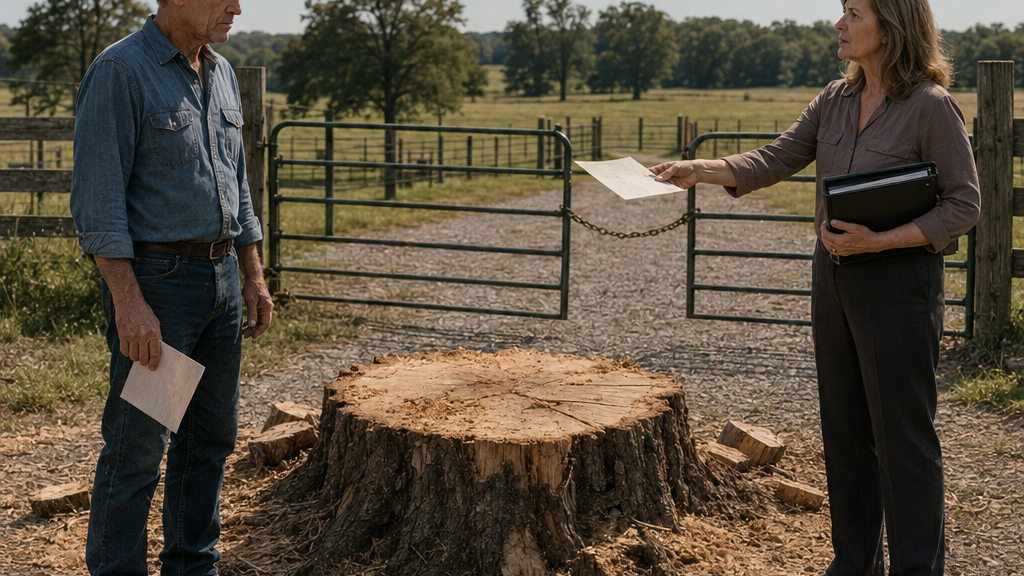
They Cut Down His Family Oak for a Better View, Then He Followed the Farm Association’s Money
Chapter 1: The Oak Was Down Before Breakfast
The chainsaw started before Edward Hill finished his first cup of coffee.
At first he assumed the sound came from the upper pasture, where a neighbor had been clearing storm-damaged cedar. Then he heard the hydraulic whine of a bucket truck and the hard metallic clatter of equipment directly beyond his kitchen window.
Edward set down the mug.
Nobody was supposed to be cutting anything on his place.
By the time he reached the farm entrance, a section of oak canopy was already lying across the grass beside the shared gravel lane. Fresh leaves trembled against the ground as if the tree had not yet understood what had happened.
“Shut it down,” Edward called.
The tree-service foreman looked toward the bucket operator and raised one hand.
The saw stopped.
Edward stepped around a pile of branches. “Who hired you?”
The foreman removed his hearing protection. “Landowners’ association.”
“Who at the association?”
“I’ve got a work order.”
“That isn’t what I asked.”
The foreman hesitated, then glanced toward the truck. “Chair’s name is on it.”
Edward already knew whose name that meant.
The oak stood—or had stood—where his private fence line came close to the association’s gravel lane. It was broad enough that two grown men could not have reached around the trunk. Its lowest branches had shaded the gate since Edward was a boy.
Now the trunk leaned at an unnatural angle, a deep wedge cut into its base.
“You’re on my parcel,” Edward said.
“We were told the association has maintenance authority along the access corridor.”
“Not thirty feet into my fence line.”
The foreman’s expression tightened. He was not interested in becoming part of somebody else’s property dispute.
“I can call the office.”
Edward looked up.
Half the crown was gone.
Calling anybody would not put it back.
The second cut had already weakened the trunk. Leaving it half-felled beside a cattle lane would create a hazard worse than the one they claimed they were fixing.
Edward moved away from the saw.
“Finish what you made unsafe,” he said quietly. “But don’t take a stick off this property.”
The foreman studied him for a moment, then nodded.
The final cut lasted less than a minute.
The oak came down with a cracking sound Edward felt through the soles of his boots.
Dust rose from the dry grass. A branch shattered against the fence. Cattle in the nearest pasture moved away from the noise.
Edward stood still.
The crew began limbing the tree.
He should have photographed everything immediately. He knew that. Nineteen years of forensic accounting had trained him to preserve the condition of evidence before people cleaned, moved, explained, corrected, or forgot it.
Instead, he watched a man sever a limb where his father had once hung a rope swing.
That failure irritated him almost as much as the cutting itself.
Only after several minutes did he pull out his phone.
He photographed the stump, the truck, the work order visible through the windshield, the tire tracks, the fence, and the distance from the lane.
Then he saw the carving.
A section of bark had rolled upward when the trunk split. Beneath it, weathered but still visible, were two initials and four numbers:
Edward crouched.
His father had shown him that carving when Edward was eight. His grandfather and grandmother had cut their initials there when they were young, before the farm had a paved county road, before electricity reached the back shed, before anybody called the gravel lane an association asset.
Edward touched the edge of the cut wood.
The exposed heartwood was pale and wet.
The foreman approached more carefully now.
“You want us to leave the trunk whole?”
“Cut enough to clear the lane. Stack everything else inside my fence.”
“We were supposed to haul it.”
“You’re not hauling it.”
The man nodded without arguing.
A white pickup appeared at the far end of the lane just before nine.
Sharon Adams parked beside the gate.
She came toward Edward carrying a thick association binder and a pink sheet of paper clipped to a board.
Her boots stopped at the edge of the sawdust.
“I expected you’d have questions,” she said.
Edward looked at the tree.
“You expected questions after cutting it?”
“The sightline had been discussed.”
“Not with me.”
“It was an association safety issue.”
She held out the pink sheet.
Edward took it.
The amount printed near the bottom was $3,200.
He read it twice.
“Tree removal assessment?”
“The association paid the contractor. Under the maintenance provisions, costs caused by a member’s obstruction can be charged back to that parcel.”
Edward raised his eyes.
“You cut my tree without permission, and now you’re billing me for it.”
Sharon’s mouth tightened. “The tree interfered with safe access.”
“Show me the vote.”
“The board acted under existing authority.”
“Show me the notice.”
“You received general notice about vegetation along the lane.”
“I received a newsletter telling people to trim brush.”
Sharon tapped the binder.
“The governing agreement is very clear.”
Edward looked past her toward the opening the oak had left.
For the first time in his life, he could see almost straight through to the adjoining field.
Richard Adams’s field.
The bend in the lane was suddenly open. So was the narrow entrance to Richard’s parcel beyond it.
Edward looked back at the pink invoice.
Near the middle of the description was a line he had skipped the first time.
Removal of sight obstruction affecting shared access and adjoining parcel entrance.
“Adjoining parcel,” Edward said.
Sharon did not answer immediately.
Edward pointed through the gap where the oak had stood.
“You mean Richard’s.”
“The access corridor serves multiple parcels.”
“Richard’s preparing to do something over there?”
“That’s not relevant.”
Edward folded the invoice once.
Carefully.
For the first time that morning, his anger stopped feeling like grief.
It became a question.
Chapter 2: The New View Across Richard’s Field
Two mornings later, a photographer stood where Edward’s oak had been and aimed a camera through the opening toward Richard Adams’s field.
Edward saw him from the cattle gate.
The man moved three steps left, checked the screen, then crouched to frame the gravel lane curving toward the adjoining parcel.
A real-estate agent waited beside a dark SUV.
Edward walked over.
“Morning.”
The photographer lowered his camera.
The agent smiled automatically. “Good morning.”
“You selling Richard’s place?”
The smile changed.
“We’re preparing marketing materials.”
Edward looked through the empty space above the stump.
Without the oak, the front portion of Richard’s property appeared wider. The lane entrance, previously screened by branches, was visible from nearly the county road.
“New angle?” Edward asked.
The photographer said nothing.
The agent glanced at the stump. “It certainly opens things up.”
That was all Edward needed from her.
He went home before he said something less useful.
At the kitchen table he placed Sharon’s invoice beside photographs of the cut tree. For two days he had resisted opening his old accounting habits all the way. He had told himself this was land, not a corporate fraud examination. A tree was gone. He wanted an explanation, not a case.
The photographer changed that.
By ten, Edward was at the county records office.
The clerk helped him pull the recorded plats for his parcel, Richard’s parcel, and the shared agricultural access easement. Edward traced the boundaries with one finger.
The association had maintenance rights over the lane.
Those rights did not reach the oak.
More interesting was Richard’s entrance.
The recorded access crossed the association lane at an angle. Equipment turning into Richard’s field had always been able to make the movement, but large trucks needed a wider approach.
Edward compared the plat with a photograph on his phone.
The oak had not blocked the lane.
It had blocked the cleanest line of sight into Richard’s entrance.
He requested recent filings on the parcel.
There was no completed sale, but there had been preliminary activity consistent with a planned transfer or commercial agricultural lease.
Edward leaned back.
That did not prove Sharon had cut the tree for her brother.
It proved Richard benefited.
Those were not the same thing.
He wrote the distinction in the margin of his notes.
That evening Matthew Torres stopped his pickup beside Edward’s gate.
“You planning to sue everybody?” Matthew asked.
Edward rested his arms on the fence.
“Who said I was suing?”
“Half the lane.”
“Half the lane talks too much.”
Matthew looked at the stump.
“It did make that turn tight.”
“For what?”
“Trailers.”
“Whose trailers?”
Matthew exhaled. “You know what I mean.”
“I’d like to hear you say it.”
“Richard’s been trying to make that parcel more useful.”
Edward nodded.
Matthew frowned. “That doesn’t mean Sharon did something crooked.”
“I didn’t say it did.”
“You’re looking like you want it to.”
The remark landed harder than Edward expected.
Matthew had known him for twenty years. He also knew Edward had once made a living finding things people preferred not to have found.
“I want the approval,” Edward said.
“Then ask for it.”
“I did.”
“And?”
Edward looked toward the lane.
“She gave me a bill.”
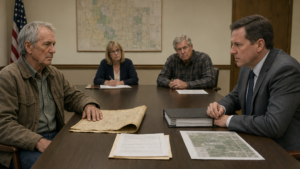
The association meeting was held the following evening in a converted equipment room beside the old cooperative shed. Folding chairs faced a scarred wooden table. Sharon sat at the center with Emily Lewis, the treasurer, on one side and two board members on the other.
Edward waited until routine road maintenance was finished.
Then he stood.
“I have four questions about the oak removal.”
Sharon looked at him without surprise.
“Go ahead.”
“Date of the board vote.”
“It was handled under maintenance authority.”
“So there was no vote?”
“I didn’t say that.”
Edward kept his voice even.
“Date of notice to me.”
“General vegetation notices were distributed.”
“Specific notice.”
Sharon shifted one hand onto the binder.
“Edward, the association cannot hold a special hearing every time vegetation interferes with access.”
“Contractor authorization date.”
A pause.
Emily glanced down.
Edward noticed.
“And the conflict disclosure,” he continued, “for a project that improved access to the chair’s brother’s parcel.”
Several chairs creaked.
Richard, standing near the back wall, folded his arms.
“That tree was a hazard,” he said.
Edward turned toward him.
“Then the paperwork should be simple.”
Sharon opened the binder.
She produced the maintenance rule. She produced the contractor invoice. She produced a map of the access corridor.
She did not produce a dated vote.
She did not produce specific notice.
And she did not produce a conflict disclosure.
“Rules are not optional because you have sentimental attachment to a tree,” Sharon said.
Edward looked at the map.
“The rule may be valid. I’m asking whether you followed it.”
The room went quiet.
Sharon closed the binder.
“If you believe records are missing, submit a records request.”
Edward nodded.
“All right.”
At home, he spread the county plats beside the association minutes he already possessed from the previous year.
He read six months of meeting notes.
Culverts. Gravel. Gate repairs. Assessment delinquencies. Fence replacement.
No oak.
No Richard entrance project.
No tree-service authorization.
Just one vague line in the most recent month:
Access improvements discussed.
Edward stared at it.
Then he opened his laptop and drafted a formal request for meeting minutes, contractor bids, invoices, bank statements, reserve-account summaries, access-project correspondence, related-party disclosures, and payment approvals.
He removed three angry sentences before printing it.
At the bottom he added the applicable state records provision and the response period.
The next morning he delivered the request by certified mail and email.
As he returned through the farm gate, he stopped beside the stump.
Through the empty space above it, Richard’s field looked almost staged for a photograph.
Edward rested a hand on the rough cut surface.
The question was no longer whether the tree had helped Richard.
It had.
The question was how many records Sharon would have to avoid before that benefit stopped looking accidental.
Chapter 3: Twenty-Two Days for Ten Days of Records
On the eleventh business day, Edward’s mailbox contained feed invoices, a tractor-parts catalog, and nothing from the landowners’ association.
He carried the mail to his farm office and wrote the date at the top of a yellow legal pad.
Deadline passed.
He disliked how satisfying the words felt.
A missed deadline did not prove wrongdoing. People delayed records for ordinary reasons: disorganization, vacations, poor filing, volunteer boards that treated statutory obligations like optional chores.
Edward knew that.
He also knew he wanted the delay to mean something.
That bothered him.
On day thirteen, Emily Lewis emailed a short message saying the association was “assembling responsive materials.”
Edward replied with one sentence asking when production would be complete.
No answer.
On day sixteen, Sharon called.
“You requested almost everything we’ve touched for five years.”
“I requested records tied to access work, reserves, and contractors.”
“You included bank statements.”
“Yes.”
“That’s excessive for a tree dispute.”
Edward looked through the office window toward the stump near the lane.
“It stopped being only a tree dispute when the board couldn’t produce the authorization.”
Sharon was silent for a moment.
“You always did like paperwork.”
“You say that like paperwork cut the oak.”
She ended the call soon after.
On day twenty-two, two boxes arrived.
Edward placed them on the worktable where he normally rebuilt small pumps and sorted cattle records. He moved the tools aside, washed grease from his hands, and opened the first box.
Minutes.
Invoices.
Copies of checks.
Bank statements.
Reserve summaries.
Vendor lists.
Some pages were organized by year. Others appeared to have been dropped into folders in the order somebody found them.
Edward worked until after dark.
At first, the records were merely messy.
Then he found the reserve summary.
The annual association report presented one total for accumulated road, drainage, fencing, bridge, and emergency reserves.
The bank records showed substantially less cash held in accounts carrying those descriptions.
Edward took out a calculator, then laughed once at himself.
He had spent nineteen years investigating numbers that companies insisted were too complicated to understand. He did not need a calculator to recognize that two totals separated by millions did not belong on the same date without an explanation.
He built a spreadsheet.
At midnight, the difference remained.
The next morning he started again from zero.
He checked dates.
He checked duplicate accounts.
He checked whether one statement was accrual-based and the other cash-based.
He traced interest income.
He looked for certificates of deposit, restricted deposits, investment balances, or construction escrow.
Nothing fully reconciled the figures.
On the corner of the desk sat a section of oak Edward had saved from the tree crew. The piece was too small to contain the entire carving, but part of the old “1952” remained in the bark.
Edward had put it there without deciding why.
Now he used it to hold down a stack of copied statements.
By afternoon his old professional rhythm had returned.
Do not begin with a theory.
Begin with the transaction.
Who approved it?
Who received it?
What account funded it?
What document supports it?
He repeated the questions until the farm office stopped feeling like a farm office.
One invoice caught his attention.
Road resurfacing.
The amount was far larger than Edward remembered the work being worth.
Another invoice listed culvert replacement.
Another listed emergency drainage.
Several payments had been made to businesses with similar mailing information.
He created a vendor table.
The same address appeared twice.
He leaned closer.
The name attached to one operation was unfamiliar, but the mailing address was not.
He searched county business records.
Richard Adams.
Edward sat back.
For a few seconds he felt exactly what he had been trying not to feel: vindication.
Then he forced himself to continue.
A related vendor did not prove inflated pricing. A brother doing association work was not automatically illegal. Rural associations often hired whoever had equipment nearby because waiting three weeks for a formal contractor could leave a washed-out road unusable.
But related parties were supposed to be disclosed.
He found no disclosure.
He searched the minutes.
Nothing.
He searched check approvals.
Sharon’s initials appeared repeatedly.
At the next association office hour, Edward carried copies rather than originals.
Emily was alone behind the desk.
“I need the transfer schedules supporting these reserve totals.”
She looked at the pages.
“You have the summaries.”
“I have two summaries that disagree.”
“They’re prepared differently.”
“Then give me the reconciliation.”
Emily rubbed her thumb along the edge of a folder.
“I’ll see what we have.”
Edward placed a second page in front of her.
“And I need procurement support for this vendor.”
Her face changed only slightly.
That was enough.
“Richard’s company,” Edward said.
Emily looked up.
“He’s done work for the association for years.”
“I’m not asking whether he worked.”
“What are you asking?”
“Where the bids are. Where the conflict disclosure is. Why Sharon approved payments to her brother without putting the relationship into the minutes.”
Emily closed the folder.
“You’re making this bigger than the tree.”
“No. The records are.”
She looked toward the door before lowering her voice.
“You should be careful with the reserve number.”
Edward heard the warning but interpreted it as defensiveness.
“How careful?”
“Careful enough not to say money is missing until you know where it went.”
“If the association reported it as reserves and the accounts don’t contain it, I’m entitled to ask.”
“Yes.”
“Then where is it?”
Emily did not answer.
That silence stayed with him all afternoon.
By evening Edward had built a preliminary schedule showing a reserve discrepancy large enough to make the tree removal look trivial.
He printed the first page.
Then the vendor table.
Then copies of checks tied to Richard’s company.
He placed the oak fragment on top of the stack.
For years he had thought he was finished with this kind of work.
Now the same instincts that once found hidden liabilities in corporate ledgers were pointing toward the people who graded his road, repaired his culverts, and controlled the gate outside his pasture.
At the bottom of the vendor report was one line Edward circled twice.
Authorized by: Sharon Adams.
He looked from her name to Richard’s.
The tree had opened a view across one field.
The records were beginning to open something much larger.
Chapter 4: The Number Edward Got Wrong
Edward placed the reserve summary on the meeting table and heard chairs scrape closer before he said a word.
The equipment room was fuller than usual. News of his records request had traveled faster than any official association notice. Farmers stood along the back wall. A few spouses had come. Matthew Torres sat near the aisle with his cap resting on one knee.
Sharon Adams remained at the center of the board table.
Edward had prepared three pages.
The first showed what the association had reported as reserves.
The second showed the balances he could trace.
The third showed the difference.
He slid copies down both sides of the room.
“The reports provided to members and the bank records provided to me do not reconcile,” he said.
A board member looked at the figure and swore under his breath.
Sharon did not look down.
“How much are you claiming is missing?” Matthew asked.
Edward had promised himself he would use careful language.
Then he saw Sharon sitting behind the same binder she had carried to his freshly cut oak.
“The unexplained difference is substantial,” he said. “Several million dollars across the reserve categories.”
The room changed.
People stopped shifting in their chairs.
Someone at the back asked, “Several million where?”
“That is what I’m asking.”
Sharon leaned forward.
“No, Edward. You’re suggesting something.”
“I’m showing your reports.”
“You’re showing part of our accounting.”
“They were the records you produced.”
Emily Lewis had been silent since the meeting began. Now she opened a thin folder.
Edward noticed it too late.
She removed a stack of transfer schedules.
“We didn’t provide these in the first box,” she said.
Edward stared at them.
“Why not?”
“They were archived with project accounts.”
Sharon’s expression remained unreadable.
Emily passed the first page to Edward.
He scanned it.
Reserve transfer: emergency drainage.
Another.
Bridge approach stabilization.
Another.
Culvert replacement.
The amounts were large.
Edward turned to the next page faster.
The transfers continued.
Not all of them, but enough.
Enough to destroy the number he had just put before the room.
“These aren’t in the reserve summaries,” he said.
“No,” Emily replied.
“Then the summaries are misleading.”
“I agree they should have been clearer.”
“But the money wasn’t missing.”
“Some of the difference was moved.”
A neighbor near the wall spoke sharply.
“So he got it wrong?”
Edward felt heat rise under his collar.
He checked the schedules while thirty people watched him do arithmetic he should have completed before he stood up.
The project accounts reduced the unexplained balance dramatically.
Not to zero.
But dramatically.
Matthew leaned back.
“You said millions.”
“I said the records didn’t reconcile.”
“You let everybody hear missing millions.”
Edward looked at the papers.
Matthew was right.
That was the worst part.
Sharon folded her hands.
“We had two floods in four years. The lower culvert failed twice. The north bridge approach washed out. Members demanded repairs and then complained about assessments. We moved reserve money where it was needed.”
“Without reporting it properly,” Edward said.
“We kept the roads open.”
“You presented reserves that were no longer sitting in reserve accounts.”
“We maintained association assets.”
The argument sounded different now.
Not clean.
Not innocent.
But different.
Edward glanced toward Emily.
“Did the board approve these transfers?”
“Most of them.”
“Most?”
Emily hesitated.
Sharon answered for her.
“Emergency authority applies when access is threatened.”
Edward heard murmurs of agreement.
People in that room remembered mud to their axles. They remembered hauling cattle around washed-out crossings. They remembered the week the milk truck could not reach one property.
For years Sharon had been the person who called gravel trucks at dawn and found somebody with an excavator before county offices returned messages.
Edward had treated that history as background noise.
He had wanted the numbers to confirm the shape of his anger.
Now the room was making him pay for it.
He gathered his copies.
“I overstated what the available records support.”
Sharon raised an eyebrow.
“That’s a polite way to put it.”
Edward looked directly at her.
“It’s the accurate way.”
He turned to the members.
“The transfer schedules explain a large part of the discrepancy. I should have traced them before presenting that number.”
No one applauded.
He had not expected them to.
Matthew gave a small nod, nothing more.
Edward sat down.
The rest of the meeting moved to grading schedules and winter gravel estimates. Sharon answered questions with renewed confidence. By adjournment, the pressure Edward had spent weeks building seemed to have drained out of the room.
Outside, Matthew caught him near his truck.
“You might want to leave it alone for a while.”
Edward opened the door.
“Because I was wrong about one number?”
“Because people don’t know what to believe now.”
Edward looked toward the association building.
“That’s fair.”
Matthew studied him.
“You don’t say that easy.”
“No.”
“Maybe practice.”
Edward almost smiled.
Then he drove home.
In his office he placed the transfer schedules beside the formal reserve reports.
The difference was obvious.
One set showed what the association wanted members to believe existed for future needs.
The other showed money already spent on present emergencies.
Sloppy reporting, perhaps deliberately misleading.
But not theft.
Edward picked up the oak fragment from his desk.
The cut edge had begun to dry and darken.
He thought about his father teaching him to measure twice before cutting a board.
Edward had measured once.
Then accused.
A truck turned into the farm lane after nine.
Emily stepped out carrying a canvas document bag.
Edward met her by the office door.
“I thought you might come looking for more records tomorrow,” she said.
“I was planning to.”
“I’d rather not do this there.”
She entered without waiting for an invitation.
Edward cleared a chair.
Emily remained standing.
“You were wrong about the reserve number.”
“I know.”
“Sharon’s going to use that.”
“I know that too.”
Emily set the bag on the worktable.
“But those transfers don’t explain the vendor invoices.”
Edward looked at her.
She unzipped the bag.
“There are things I signed because I told myself the roads mattered more than how we got there.”
She placed a folder beside the oak fragment.
“And I’m not sure I can keep telling myself that.”
Chapter 5: The Work Was Real, the Numbers Were Not
Edward started at the north bridge before sunrise and drove every project named in the disputed invoices.
He carried a clipboard, a measuring wheel, printed payment schedules, and no assumptions he was willing to admit to himself.
The first culvert existed.
So did the second.
The drainage cut listed on the emergency transfer schedule ran exactly where the paperwork said it did, though weeds had already softened its edges.
At the bridge approach, patched stone and fresh riprap showed where floodwater had eaten into the lane.
The work was real.
Edward wrote that down every time.
REAL.
After the previous meeting, he no longer trusted himself to leave favorable facts unstated.
By midmorning he reached the resurfaced section.
The invoice showed a broad stretch of lane repair, material delivery, grading, compaction, and equipment mobilization.
He measured the distance.
Then he measured it again.
At the farm shop he called the road-grading contractor listed as a subcontractor.
“I’m verifying association work,” Edward said. “I have your company tied to the resurfacing two summers ago.”
“That job on the east lane?”
“Yes.”
“You got a problem with it?”
“No. I need the amount you billed.”
Silence.
“Who’s asking?”
“Edward Hill.”
Another pause.
Then, “You the man with the tree?”
Apparently everybody knew.
“I’m the man checking the invoice.”
The contractor gave him the original amount after Edward explained that he already had the association payment records.
Edward wrote it down.
He looked at the number twice.
The association had paid more than four times that amount through Richard’s vendor operation.
There could be legitimate additions: material, trucking, mobilization, equipment rental, management.
Four times still required support.
He asked for the subcontractor’s scope.
By afternoon a copy arrived.
Edward laid it beside the association invoice.
The line descriptions were nearly identical.
He felt the old surge of certainty and stopped himself.
Not yet.
He traced material receipts.
Two existed.
One matched.
One had already been billed under a different drainage project.
Edward marked it DUPLICATE SOURCE and continued.
For the next ten days he drove roads, photographed culverts, measured shoulders, matched check dates to bank withdrawals, and called vendors.
Some suspicious payments collapsed under verification.
A fence invoice that looked inflated included emergency weekend labor and replacement posts Edward had not known about.
A drainage bill covered rented pumps used during a flood.
He removed both from his list.
Others got worse.
A gravel delivery appeared twice under slightly altered descriptions.
Equipment charges ran through Richard’s company even when another contractor had supplied the machine.
Three projects lacked competitive bids despite being scheduled work rather than emergencies.
At the bottom of one worksheet, Edward wrote:
Smaller case. Better case.
Richard found him measuring the lane shoulder on the eleventh day.
His pickup stopped beside Edward.
“You taking inventory of every rock now?”
“Just the expensive ones.”
Richard got out.
“You think I stole from these people?”
Edward lowered the measuring wheel.
“I think your company got paid without the records it should have had.”
“My company got called when nobody else would show.”
“For every job?”
“For enough.”
Richard pointed toward the drainage ditch.
“You know who dug that when it blew out on a Sunday? Me. You know who hauled stone before the school bus came through Monday? Me.”
“That doesn’t answer the invoices.”
“No. It answers why Sharon used me.”
Edward waited.
Richard’s anger looked less theatrical up close. There was fatigue beneath it.
“For years,” Richard said, “I worked jobs and waited months to get paid because the association was short. Sometimes I used my own fuel. Sometimes my equipment sat broken after association work and nobody covered it.”
“Then invoice it.”
“I did.”
“Accurately?”
Richard’s jaw moved.
Edward let the silence remain.
That was answer enough to keep looking, not enough to convict him.
“You benefited from the tree coming down,” Edward said.
Richard looked toward the distant stump.
“It made my entrance better.”
“Did you ask Sharon to remove it?”
“I told her the entrance needed improving.”
“That wasn’t my question.”
Richard stared at him.
Then he got back into his truck.
“I didn’t tell anybody to cut your father’s tree.”
Edward’s hand tightened around the measuring wheel.
“My grandfather’s.”
Richard looked briefly ashamed.
Then the truck rolled away.
That evening Emily returned to the farm office.
This time she brought no bag.
Edward showed her the resurfacing comparison.
“Subcontractor billed this,” he said. “Association paid this.”
Emily closed her eyes for a moment.
“I know.”
“You knew?”
“I knew the numbers didn’t match cleanly.”
“That’s different from knowing why.”
“I stopped asking why often enough.”
Edward leaned against the workbench.
“Why?”
“Because the association was nearly broke.”
He said nothing.
Emily looked at the folders covering his table.
“You think those transfers were just accounting shortcuts. They weren’t. We were moving money because people weren’t paying assessments and the roads kept failing.”
“So you hid the weakness.”
“We delayed admitting it.”
“That’s hiding it.”
“Yes.”
The directness surprised him.
Emily touched one of the reserve summaries.
“Sharon said if members saw how low the actual unrestricted balance was, they’d refuse every new assessment and start fighting every repair. She wanted the annual reports to show the reserve plan, not the cash position after emergency transfers.”
“That isn’t what those reports say.”
“I know.”
“You signed them.”
Her eyes met his.
“I know that too.”
Edward thought of the meeting and the humiliation of presenting the wrong number.
“You let me do that.”
“I told you to be careful.”
“You could have given me the schedules before I stood up.”
“I should have.”
Emily’s voice thinned, but she did not look away.
“That’s one of the things I’m trying to stop doing.”
Edward pulled out the vendor list.
“Was Sharon protecting the association, or Richard?”
Emily looked toward the dark office window.
“At first?”
She folded her arms.
“The association.”
“And later?”
Emily was silent long enough that Edward heard cattle shifting in the barn lot outside.
“Later,” she said, “I stopped being able to tell.”
Chapter 6: Sharon’s Reason for Hiding the Shortfall
Sharon called Edward at seven the next morning and said, “Bring your questions. I’m done answering them one page at a time.”
An hour later, the association office door was open and three archive boxes sat on the floor.
Edward stopped in the doorway.
“You withheld these.”
“Yes.”
“That’s an interesting way to begin.”
“It’s an accurate one.”
She pushed a chair toward the table.
“Sit down.”
Edward remained standing.
Sharon looked tired. Not defeated. Tired.
There was a difference.
She opened the first box.
Inside were maintenance ledgers older than the current accounting system. Handwritten entries tracked washouts, grading, cattle-grid repairs, culvert failures, emergency fuel, and unpaid assessments.
“You want to know why the reports look the way they do?” Sharon asked. “Start there.”
Edward sat.
The early years were orderly.
Then the entries became denser.
Flood.
Culvert.
Temporary bridge repair.
Assessment delinquent.
Second notice.
Payment deferred.
The same problems repeated.
One year, nearly a quarter of association members had been late paying assessments. Another year, the lower lane washed out twice in six months.
Edward recognized some of the dates.
He had driven those roads.
He simply had not asked who had paid to keep them open.
Sharon placed a bank copy beside him.
It showed a contractor payment from years earlier.
The association checking account had been nearly empty.
The payment source was Sharon’s personal account.
Edward looked up.
“You covered this?”
“Until assessments came in.”
“How long?”
“Four months.”
“Why isn’t it in the minutes?”
“Because I didn’t want every member knowing we couldn’t cover a repair bill.”
“That should have been exactly what they knew.”
Sharon gave a humorless laugh.
“You haven’t sat in this chair.”
“No.”
“You send a letter saying the reserve is short, half the membership demands to know why. You propose a special assessment, the other half threatens lawyers. Meanwhile, a culvert is hanging open and somebody’s hauling cattle across it.”
“So you decided what people were allowed to know.”
“I decided the lane had to stay open.”
Edward turned another ledger page.
There it was: Richard’s equipment, used during an emergency without charge.
Again months later.
Then fuel.
Then labor.
The history complicated him more than he wanted.
Richard had helped.
Sharon had advanced money.
Emily had kept records together while people complained about every increase.
None of that justified misleading reports.
But it explained how shortcuts became habits.
“You got used to being the person who fixed things,” Edward said.
Sharon’s eyes narrowed.
“I got used to nobody volunteering until something went wrong.”
“And then you stopped asking permission.”
“Sometimes there wasn’t time.”
“Was there time before you cut my oak?”
Her face changed.
Only slightly.
Edward closed the ledger.
“That wasn’t a flood.”
“No.”
“Was the lane closed?”
“No.”
“Was there an emergency?”
“Not in the same sense.”
“Then don’t use emergency history to excuse it.”
Sharon stood and crossed to a filing cabinet.
“I’m not.”
She removed another folder.
“Richard had complained about that entrance for two years.”
“Richard.”
“And others had complained about sight distance.”
“Show me.”
She placed written notes on the table.
Two landowners had mentioned the bend.
One noted poor visibility when hauling wide equipment.
Edward read every word.
None requested removal of the oak.
“Pruning would have addressed this.”
“Possibly.”
“Moving Richard’s entrance would have addressed it.”
“At greater cost.”
“To Richard.”
“Yes.”
There it was.
Not a confession.
Something more believable.
A decision weighted toward the person Sharon knew best.
Edward pushed the notes back.
“You saved your brother money.”
“I solved an access problem.”
“You solved it on my land.”
“I believed the maintenance provision allowed us to.”
“Did you ask the association attorney?”
“Afterward.”
Edward almost laughed.
Sharon did not.
“The attorney told us the authority was arguable,” she said.
“Afterward.”
“Yes.”
“And the conflict?”
She looked away.
“I should have disclosed it.”
The words came quietly.
They did not restore the tree.
They did not erase the invoice.
But Edward felt something inside the case settle into a clearer shape.
Sharon had not begun with a plan to steal an association blind.
She had begun by deciding that keeping things functioning mattered more than making every decision visible.
Then she had learned how convenient invisibility could be.
Edward spent the next hour reviewing the older ledgers.
One pattern became unmistakable: genuine emergencies had slowly blurred into ordinary projects. Richard’s equipment moved from unpaid help to paid work. Paid work became preferred work. Preferred work became invoices approved without bids.
Crisis management had become governance by habit.
Sharon returned to the table with one final packet.
“These are access-project files.”
Edward opened it.
Survey sketches.
Equipment estimates.
A note about widening Richard’s approach.
Then a contractor authorization.
He read the date.
It had been signed before the tree crew arrived.
The description was brief:
Remove oak obstruction to improve turning radius and visibility for Adams parcel access.
Edward read it again.
There was no mention of a general lane hazard.
No reference to emergency authority.
No disclosure that “Adams parcel” belonged to the chair’s brother.
At the bottom was Sharon’s signature.
She saw where his eyes stopped.
“I should have handled that differently.”
“You billed me for it.”
“The association incurred the cost.”
“For improving Richard’s entrance.”
“For an access improvement.”
“On my property.”
Sharon did not answer.
Edward closed the packet.
For weeks he had wanted a page that made everything simple.
This was close.
Close enough to hurt.
But not enough to make every accusation he had imagined true.
He gathered the relevant documents and left the rest.
At the door Sharon said, “What are you going to tell them?”
Edward turned.
A month earlier he would have known immediately.
Everything.
Every ugly interpretation.
Every number that sounded largest.
Now he looked at the authorization in his hand.
“I’m going to tell them what I can prove.”
For the first time since the oak came down, Sharon looked uncertain about which answer would have been worse.