They Charged Him to Use His Own Farm Road—Then the Access Ledger Exposed What They Had Been Collecting
Chapter 1: The Gate Tag on Daniel’s Own Road
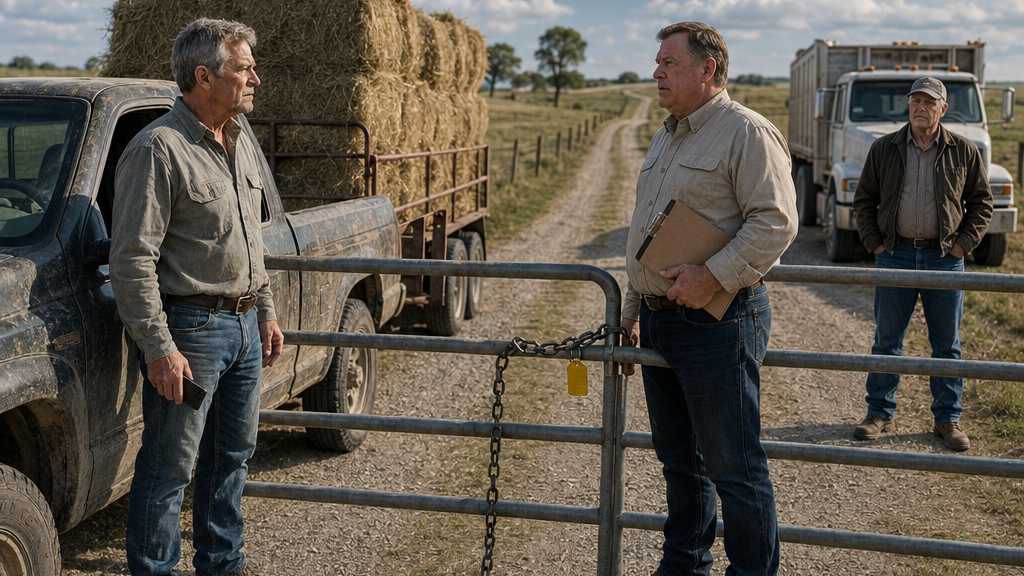
The chain had not been there when Daniel Clark left before sunrise.
Now it stretched across the gravel lane at hood height, bright galvanized links pulled tight between the old pipe gate and a cedar post Daniel had set with his father thirty-six years earlier.
Daniel eased off the accelerator.
Behind him, the hay wagon creaked under twelve square bales. Dust drifted past the mirrors of his weathered truck and settled over the windshield. He stared at the chain for several seconds before noticing the small metal tag clipped beside the padlock.
A three-digit number had been stamped into it.
Richard Nelson stood on the other side of the gate with a clipboard tucked beneath one arm.
Daniel rolled down his window.
“What’s this?”
Richard looked at the truck, then at the hay wagon.
“New heavy-use policy.”
Daniel waited.
Richard seemed to mistake the silence for confusion.
“Anything over the standard axle weight needs clearance before using the association road.”
Daniel glanced down the lane. It ran between his lower hay field and the creek pasture before crossing onto neighboring parcels farther north.
“My wagon’s gone through here twice this week.”
“The policy took effect yesterday.”
Daniel killed the engine.
The sudden quiet made the cattle bawling from the lower pasture sound closer.
“What’s clearance cost?”
“Forty-five dollars per trip.”
Daniel looked again at the chain.
“And who approved that?”
“The road association.”
“That isn’t what I asked.”
Richard’s jaw tightened slightly. “It was adopted as an operating rule.”
Daniel opened the truck door and climbed down.
Richard was dressed as though he had expected company—clean work shirt, boots without much dust, association clipboard. Daniel wore jeans grayed at the knees and a shirt darkened with sweat between his shoulders.
He walked to the gate.
The metal tag clicked faintly against the chain.
“Where’s the rule written?”
Richard turned a page on the clipboard. “Daniel, I’m not doing this all morning. You’re either cleared or you’re not.”
Daniel looked past him toward the shallow bend where the road disappeared behind walnut trees.
The entire gate stood inside the Clark parcel.
Not near the boundary.
Not partly across it.
Inside.
His father had put it there when cattle still moved between the upper and lower pastures. The neighbors had been given road access long before there was any association to collect money for gravel and culverts.
Daniel tapped the tag.
“What’s the number for?”
“Tracking access.”
“Whose access?”
“Everybody’s.”
Richard unhooked a second tag from his clipboard and reached toward Daniel’s truck mirror.
Daniel caught his wrist—not hard, just enough to stop him.
Richard looked down.
Daniel released him immediately.
“Don’t hang anything on my truck.”
Richard’s face changed.
It was a small change, but Daniel saw it.
Not anger exactly.
Embarrassment.
Two engines sounded behind Daniel.
He turned.
Thomas Green’s feed truck had pulled in behind the hay wagon, and another pickup was slowing beyond it. Within half a minute, what could have been a private disagreement had become a line of waiting vehicles.
Thomas leaned out his window.
“Problem?”
Richard raised the tag so Thomas could see it.
“Daniel hasn’t paid the heavy-use fee.”
Thomas gave Daniel a puzzled look.
“You hauling farther north?”
“My lower barn.”
Thomas frowned.
Richard said, “Doesn’t matter where he’s going. He’s using the road.”
Daniel turned back to him.
“My road.”
The words came out quieter than he intended.
Thomas heard them anyway.
Richard let out a short breath.
“You know what I mean.”
“No,” Daniel said. “I’m starting to think I don’t.”
Richard stepped closer.
“For years everybody has contributed to keeping this lane usable. Gravel isn’t free. Culverts aren’t free. Grading isn’t free. You know that better than anybody.”
Daniel did know.
He had written checks when the road washed after spring storms. He had hauled stone himself when contractors could not get there quickly enough. His argument had never been that roads maintained themselves.
But a maintenance contribution was not the same thing as being stopped at his own gate.
“Show me where the agreement lets you charge the underlying landowner by the trip.”
Richard’s expression hardened.
“You want to turn this into a legal discussion?”
“I asked for a page number.”
One of the drivers behind Thomas tapped his horn.
Richard looked past Daniel toward the waiting vehicles.
Then he clipped the numbered metal tag directly onto the gate chain.
“Until the fee is paid, you’re not cleared.”
For the first time that morning, Daniel felt the sting of being made into an example.
Not because of the money.
Because Richard had said it loudly enough for everyone to hear.
Daniel took out his phone.
Richard gave him a tired look. “Really?”
Daniel photographed the tag.
Then the chain.
Then Richard’s clipboard.
He did not photograph Richard’s face.
“What are you doing?”
“Keeping track.”
“Of what?”
Daniel slipped the phone back into his pocket.
“I haven’t decided yet.”
He returned to the truck.
Thomas got out and walked beside the driver’s door before Daniel could start the engine.
“You’re turning around?”
“Looks that way.”
“Daniel, don’t make this bigger than it is.”
Daniel looked at him.
Thomas lowered his voice.
“Richard’s been trying to keep the road funded. People skip assessments. Contractors tear it up. Everybody complains when the ditch fills, nobody wants the bill.”
“I’m not arguing about maintenance.”
“Then pay the forty-five.”
Daniel stared ahead through the dusty windshield.
That was exactly how he had handled things for years.
A fee appeared. Pay it.
A notice came. Toss it on the desk.
Someone used the lane a little differently than agreed. Let it go.
Keeping peace had always seemed cheaper than proving a point.
His father used to say a road only mattered if people could get where they needed to go.
Daniel had remembered that sentence.
He had forgotten all the conditions that made it work.
He started the truck.
Thomas stepped back.
Daniel reversed slowly until he could turn the wagon at the wide equipment entrance near the county road. The maneuver took several minutes and forced both waiting vehicles to back up.
No one laughed.
That almost made it worse.
By the time Daniel reached the equipment yard from the opposite field entrance, his irritation had cooled into something more useful.
Suspicion.
He parked beside the machine shed and reached across the seat for the registration folder he kept in the glove box.
The folder caught on something.
Daniel pulled harder.
A small metal object dropped onto the floor mat.
He leaned down.
Another gate tag.
Older, scratched along one edge.
He remembered getting it after a contractor-delay charge the previous year. At the time, he had tossed it into the glove box without thinking.
The number was different from the tag on the chain.
So was the handwritten notation on its back.
Not forty-five dollars.
Twenty-five.
Daniel sat motionless behind the steering wheel.
The rule had not simply appeared yesterday.
It had been changing.
And he had been paying long enough not to notice.
Chapter 2: Two Charges Daniel Should Have Questioned
By noon, Daniel had three years of road notices spread across the farmhouse office floor.
They had been hiding in plain sight.
Some were folded into feed invoices. One was clipped to a veterinary receipt. Another had been shoved between equipment-parts statements and a property-tax envelope.
Daniel sat cross-legged beside the old metal filing cabinet and arranged them by date.
Twenty-five dollars.
Thirty dollars.
Sixty dollars.
One page described the payment as a temporary access surcharge.
Another called it an after-hours road-use fee.
A third charged him for delaying a contractor because his pickup had supposedly occupied a restricted section of the lane.
Daniel read that one twice.
Then he laughed once under his breath.
The location listed on the notice did not exist.
He carried the paper outside.
From the equipment yard he could see nearly the entire disputed stretch of road: the gate, the shallow ditch, the curve by the walnut trees, the lower pasture fence.
The notice claimed his truck had blocked a designated passing turnout near marker four.
There was no marker four.
There was no designated turnout.
There was a patch of widened gravel where his father used to pull tractors aside for milk trucks, but nobody had ever named it, numbered it, or restricted parking there.
Daniel went back inside.
He found two canceled checks payable to the association.
He remembered both now.
The first had arrived during calving season. He had looked at the amount, decided arguing would cost more time than paying, and signed it.
The second came while he was trying to repair a baler before rain.
Same decision.
Pay it.
Move on.
The contractor-delay penalty had been taken from a maintenance credit already sitting on his account, so he had not even written a check.
Three disputes.
Three opportunities to ask what authority stood behind them.
Three times he had chosen silence.
Daniel leaned against the desk.
It was easier to be angry at Richard when he pretended he had played no part in creating the situation.
That version was becoming harder to maintain.
He opened the bottom drawer of the filing cabinet and pulled out a thick envelope labeled with the farm parcel number.
Inside were copies of his deed, old survey sheets, and the road documents his father had insisted on keeping.
Daniel spread the deed map on the desk and placed the newer gate tag beside it.
The road corridor was unmistakable.
It crossed the Clark parcel before reaching the Green property and two smaller farms beyond.
He found the first association document next.
The language was dry but clear enough: members would coordinate maintenance, share ordinary costs, arrange grading, and address drainage structures serving the participating parcels.
Daniel read it again.
Then a third time.
Nothing about charging the landowner to enter.
Nothing about locking him out.
Nothing about numbered access tags.
Nothing granting the association control of the underlying road.
The phone rang.
Thomas.
Daniel nearly let it go.
Instead, he answered.
“You went home and started reading, didn’t you?” Thomas said.
Daniel looked at the papers.
“What makes you think that?”
“Because you always get quiet before you decide something bothers you.”
“It bothered me at the gate.”
“You know what I mean.”
Daniel picked up the notice describing marker four.
“Do you remember the association creating restricted road sections?”
There was a pause.
“Restricted how?”
“Parking, standing, blocking. Anything like that.”
“Not formally.”
“I got charged sixty dollars for blocking marker four.”
Another pause.
Thomas said, “There isn’t a marker four.”
“I know.”
“That may just be how Richard labels maintenance points.”
“Then why fine me for it?”
Thomas sighed.
“Daniel, I’m not defending every piece of paper he’s ever sent.”
“You defended him this morning.”
“I defended the road.”
The distinction landed.
Thomas continued.
“Two winters ago that lower culvert nearly went. You remember that.”
Daniel did.
Water had eaten half the shoulder away before anyone realized how hollow the roadbed had become.
“We were short almost eight thousand dollars,” Thomas said. “Three people hadn’t paid assessments. Richard got gravel trucks in anyway. He convinced the contractor to wait on payment. He kept that lane open.”
“I’m not denying it.”
“If you start challenging every fee, people are going to think you’re challenging the whole arrangement.”
Daniel looked through the window toward his cattle.
“Maybe the arrangement needs challenging.”
“And then what?”
Thomas’s tone sharpened.
“You maintain everything yourself? Decide who crosses? Send every neighbor an invoice? Because I need that lane, Daniel. So do other people.”
That was the first argument all day that Daniel could not dismiss.
Thomas had a recorded right to use the road.
His feed deliveries depended on it.
So did livestock hauling.
Daniel’s father had understood that before any association existed.
“I’m not closing the road.”
“You say that now.”
Daniel stiffened.
“You think that’s what I’m after?”
“I think people get protective when they start talking deeds.”
After the call ended, Daniel stood at the desk without moving.
The gate tag no longer looked like simple proof that Richard had overstepped.
It looked like the beginning of a harder problem.
Daniel could prove where his property line ran.
That did not tell him what obligations crossed it.
He opened the oldest folder.
Several easement agreements sat behind the deed.
Daniel had assumed, without looking closely, that the road association had eventually absorbed them into one shared arrangement.
It had not.
Each easement was separate.
One for the Green parcel.
One for the northern pasture tract.
One for a smaller residence farther up the lane.
Different dates.
Different language.
Different rights.
There was no single blanket grant giving the road association control over all of them.
Daniel pulled his chair closer.
If the association did not own the road, and the easements belonged to individual properties, then Richard’s authority was narrower than everyone had been acting as though it was.
But Thomas’s warning remained.
A deed could establish ownership.
It could not explain how eight families and working farms had come to trust one man with the gate.
Daniel placed the first metal tag beside the map.
For the first time, he wondered whether Richard had taken authority that was never given to him—
or whether everyone, Daniel included, had slowly handed it over because it was easier than asking who actually held it.
Chapter 3: The Agreement That Never Gave Away the Gate
The county copy was cleaner than Daniel’s, but it did not contain the sentence Richard needed.
Daniel stood at the records counter Monday morning while the clerk turned another page of the scanned agreement toward him.
“Anything else attached to this filing?” Daniel asked.
The clerk checked the index.
“Two amendments.”
Daniel read both.
One adjusted annual maintenance shares after a parcel was divided.
The other authorized the association to contract for grading and drainage work without obtaining signatures from every member for each individual job.
Neither gave it control of the gate.
Neither authorized access fees.
Neither allowed it to exclude the owner of the road corridor.
Daniel requested copies.
By late afternoon, those pages sat inside a plain folder on the association meeting table.
Richard arrived last.
Katherine Moore was already there with a calculator, a laptop, and a stack of folders. Thomas sat across from Daniel. Two neighboring landowners occupied chairs near the wall.
Richard noticed Daniel’s county folder immediately.
“I suppose we’re doing this formally now.”
Daniel kept his hands on the table.
“You told me to read the rule.”
“I told you there was a rule.”
“I read the agreement.”
Richard pulled out his chair.
“And?”
“It gives the association maintenance authority.”
“Yes.”
“It doesn’t give you the right to lock me out.”
Richard sat.
“Daniel, that document is twenty-two years old.”
“So is my signature.”
“The road doesn’t operate the way it did twenty-two years ago.”
“That doesn’t rewrite the paper.”
One of the neighboring landowners shifted uncomfortably.
Richard looked around the table.
“This is exactly the problem. Everybody wants the road functioning, but nobody wants anyone empowered to make decisions.”
Thomas said, “He’s got a point on the access language.”
Richard turned toward him.
“A point about language. Fine. Meanwhile we have feed trucks, construction deliveries, recreational traffic, livestock haulers, contractors, and people who don’t live here using the lane harder than the original agreement anticipated.”
Daniel tapped the county copy.
“Then amend it properly.”
“With unanimous cooperation?”
Richard gave a humorless smile.
“You know how long it took to get signatures on the drainage schedule?”
Daniel did.
Months.
One owner had refused because he thought the new culvert benefited another farm more than his own.
Richard continued.
“You can hold up a piece of paper and say I exceeded what was written. Maybe I did. But when the road washed two winters ago, that paper didn’t bring gravel.”
The room changed.
Daniel had expected defensiveness.
He had not expected Richard to lean directly into the worst year the association had faced.
One neighboring landowner spoke.
“He’s right about that winter.”
Thomas nodded slowly.
“We had maybe three thousand in reserve.”
“Less,” Katherine said without looking up. “After the ditch work.”
Richard pointed toward her.
“And the culvert estimate was over ten.”
Daniel remembered the washed shoulder but not the numbers.
He had been dealing with a sick cow that week and had sent his maintenance check without attending the emergency meeting.
Richard looked at him.
“You know what the contractor told me? Cash deposit or no trucks. I got him to come anyway.”
“How?”
“I told him we would make good on it.”
“With what money?”
“With whatever we could collect.”
The word collect settled heavily over the table.
Daniel glanced at Katherine.
She was looking at Richard now.
Richard continued.
“Special-use charges. Contractor fees. Temporary access permits. Call them whatever you want. People paid because they needed the road.”
“Were they voluntary?” Daniel asked.
Richard hesitated.
“Mostly.”
“That isn’t an answer.”
“They knew what the money was for.”
Thomas leaned forward.
“I paid extra that winter.”
Daniel looked at him.
“So did I,” one of the other landowners said. “Seventy-five, maybe a hundred. I don’t remember.”
“Why?” Daniel asked.
“Because the feed truck couldn’t get through if that shoulder went.”
The second neighbor nodded.
“I paid too.”
Daniel looked from one face to another.
The story he had built over the weekend began to shift.
He had imagined Richard inventing fees because no one stopped him.
That might still be partly true.
But the first fees had apparently arrived when people were scared of losing the road.
Richard had not created that fear.
A collapsing culvert had.
And he had solved the immediate problem.
Daniel sat back.
“What happened after the emergency?”
Richard’s expression tightened again.
“The road still needed money.”
“That isn’t what I asked.”
“We were behind on maintenance.”
“So the temporary charges stayed.”
“Some did.”
“Who authorized that?”
“We discussed it.”
“At a board meeting?”
Richard looked toward Katherine.
She lowered her eyes.
Daniel caught the movement.
“What?”
Katherine straightened a stack of papers.
“Nothing.”
Richard said, “We’re getting off track.”
Daniel turned toward her.
“Katherine?”
She looked at him for a moment, then at the metal gate tag lying beside his county copies.
He had brought both tags.
The old scratched one sat beside the newer photograph he had printed from Saturday.
Katherine reached across the table but stopped before touching them.
“Where did you get the older one?”
“Glove box.”
“What number?”
Daniel slid it closer.
She read the three digits.
Her face did not change much, but the hand resting beside her calculator went still.
Richard noticed.
“Katherine.”
She ignored him.
Daniel said, “What is it?”
She looked at the newer tag.
“That one has three digits too?”
“Yes.”
“What number?”
Daniel told her.
Katherine closed the folder in front of her.
The sound was soft, but everyone heard it.
Richard said, “This isn’t relevant to the road agreement.”
Katherine finally looked at him.
“I’m not sure about that.”
Daniel felt the room tighten again.
He had spent two days trying to determine whether Richard had authority to issue the tags.
Katherine seemed interested in something else entirely.
Not who issued them.
Their numbers.
She turned toward Daniel.
“Before you throw either of those away, bring them to my office Wednesday.”
“Why?”
Katherine glanced once at Richard, then back at Daniel.
“Because I want to see whether those numbers are in a ledger I haven’t been able to reconcile.”
Chapter 4: The Numbers Katherine Could Not Reconcile
Katherine Moore had Daniel’s old gate number written in the margin of a yellow ledger before he even sat down.
He saw it from the doorway.
Three digits, circled twice.
Beside them was a dollar amount.
Daniel stopped with one hand still on the office door.
“That’s mine.”
Katherine closed the ledger halfway.
“I know.”
Her bookkeeping office occupied the rear room of the small association building, a converted utility shed near the county road. Two filing cabinets stood against one wall. A printer hummed beside a window overlooking the gravel equipment lot.
Daniel set both metal tags on her desk.
The newer one made a sharper sound.
Katherine looked from one to the other.
“Those came from different batches.”
“I figured that much.”
“Richard ordered the first batch after the culvert failure.”
“And the second?”
She rubbed one thumb along the ledger’s worn edge.
“Later.”
Daniel waited.
He had learned during three days of dealing with Richard that silence could be useful when it was chosen instead of avoided.
Katherine finally opened the ledger again.
The page held dates, initials, vehicle descriptions, tag numbers, and handwritten amounts.
Daniel found his old number.
Twenty-five dollars.
The date matched the check he had found Sunday.
“What am I looking at?”
“Money collected outside the regular maintenance assessments.”
“I gathered that.”
“No.” Katherine shook her head. “I mean outside the statements.”
Daniel looked at her.
She turned the laptop toward him and opened a spreadsheet.
The annual association statements were painfully ordinary: gravel, grader rental, culvert pipe, ditch clearing, insurance, postage. Income came from member assessments and occasional special contributions.
Daniel pointed to the ledger.
“Where’s that twenty-five?”
“That’s the problem.”
Katherine searched the spreadsheet.
It was not there.
She checked the following month.
Nothing.
Daniel leaned closer.
“Could it have been grouped with other receipts?”
“That’s what I kept telling myself.”
She turned several ledger pages.
Numbers marched down the columns.
A feed contractor.
A fencing crew.
Two pickups identified only by license plate endings.
A delivery truck.
Several entries marked weekend access.
Another marked horse trailer.
Then a cluster of tag numbers followed by cash amounts.
Daniel frowned.
“These aren’t all association members.”
“No.”
“Who were they?”
“Some were contractors working on parcels up the road. Some were people using the creek access beyond the Green place. Richard started charging outside traffic after the washout.”
“Did the association authorize that?”
Katherine’s mouth tightened.
“Not in any vote I recorded.”
Daniel ran one finger down the numbers.
One hundred twelve.
One hundred thirteen.
One hundred fourteen.
The sequence continued for pages.
The bright pieces of metal had looked almost childish when clipped to the gate.
Now they seemed different.
They were receipts without being receipts.
“Every tag had a payment?”
“Not every one. Some were warnings. Some were temporary clearance. But enough of them did.”
“How many?”
“I don’t know yet.”
“You’ve had the ledger.”
“I’ve had this ledger.”
Daniel looked at her.
Katherine opened the bottom drawer of her desk and removed another book, thinner and newer.
“This is the official receipt log.”
The numbers did not match.
Daniel pulled his chair closer.
For the next hour they compared dates.
A gravel contractor listed in the handwritten access ledger had paid eighty dollars for repeated heavy-truck entry. No corresponding revenue appeared in the official books.
A fencing crew had paid forty.
A recreational vehicle had paid a weekend-use charge.
Then Daniel saw Thomas Green’s name beside a special contribution from the winter of the culvert failure.
“That one is in the statements,” Katherine said.
“Why?”
“Because it went through the normal association account.”
“So some payments did.”
“Yes.”
“And some didn’t.”
“Yes.”
The word hung between them.
Daniel sat back.
“How long have you known?”
Katherine looked toward the window.
“I knew the numbers didn’t reconcile.”
“That wasn’t my question.”
“I didn’t know what they meant at first.”
“When did you know there was money missing from the statements?”
Her eyes returned to him.
“Last year.”
Daniel felt heat rise behind his collar.
“You’ve been keeping books for the association.”
“I know what I’ve been doing.”
“Apparently not all of it.”
She flinched, and Daniel regretted the sentence before it had fully left his mouth.
Katherine pushed the ledger toward him.
“If you came here looking for one guilty person, you’re going to be disappointed.”
“I came here because you asked about my tag.”
“And I’m showing you.”
She stood and crossed to a file cabinet.
From a drawer she removed a folder of contractor invoices.
“The first winter Richard collected these fees, the association was close to broke. That isn’t an excuse. It’s a fact.”
She laid out three invoices.
Emergency gravel.
Culvert pipe.
Equipment rental.
Each was stamped paid.
Daniel recognized the dates.
“They were paid from the association account?”
“Some.”
“Some?”
Katherine produced another receipt.
“This one wasn’t.”
Daniel studied it.
The contractor had been paid directly.
“By Richard?”
“By an account he controlled.”
Daniel looked at the ledger again.
“How much went through it?”
“I don’t know.”
“You’re the bookkeeper.”
“For the association account.”
It was the first time she sounded angry.
“The emergency happened fast. Richard told us he had opened a temporary collection account because the regular account couldn’t cover the deposit and payments were coming in from nonmembers. He said it kept everything separate until we could reconcile it.”
“Did you?”
“At first.”
Katherine pointed to several early entries.
“Here. Gravel. Pipe. Equipment. Those numbers line up close enough.”
Daniel followed the page.
Then the expenses thinned.
The access payments did not.
“That’s why you asked about my tag.”
“Yes.”
The original irritation that had driven Daniel from the locked gate was changing into something he did not like nearly as much.
Uncertainty.
If the first money had repaired the road, then the system had not begun as simple theft.
It had begun as a workaround.
A shortcut.
Possibly even a necessary one.
Daniel knew something about shortcuts taken during emergencies. A temporary fence became permanent. A borrowed gate stayed where it had been dropped. A handshake arrangement survived until nobody remembered what had actually been agreed.
“When did you ask Richard about this?”
Katherine hesitated.
“More than once.”
“And?”
“He said the charges were still covering extraordinary use.”
“Were they?”
“Some probably were.”
“That’s not bookkeeping.”
“No.”
Daniel looked again at the rows of numbered tags.
“How many of these people thought they were paying the association?”
Katherine did not answer.
That silence bothered him more than anything she had said.
He gathered the two tags, but she put her hand on the older one.
“Leave that here tonight.”
“Why?”
“I want to trace the sequence.”
“To what?”
Katherine opened a drawer and removed a bank deposit slip.
At the top was the name of an account Daniel had never seen on any association statement.
He read it once.
Then again.
“This isn’t the association account.”
“No.”
“Whose is it?”
Katherine folded her hands.
“It was supposed to be temporary.”
Daniel looked at the name printed above the deposit line.
The gate dispute had just stopped being about a gate.
Chapter 5: The Emergency That Became a Permanent Rule
The earliest deposit into the second account was dated three days after the lower culvert collapsed.
Daniel stared at the date from his kitchen table while Katherine’s copied records sat beside his coffee.
That mattered.
He had wanted the timing to condemn Richard cleanly.
Instead, it defended him.
Daniel remembered that week now with uncomfortable clarity.
Rain had fallen for nearly two days. The creek climbed into the lower pasture, and water cut beneath the gravel lane until a section of shoulder dropped away. A loaded feed truck would have broken through.
Richard had closed the road for half a day.
By evening, a contractor had dumped stone.
By the next afternoon, equipment was setting new pipe.
No committee had spent weeks debating it.
No one had waited for every property owner to sign something.
Richard had moved.
And the road had stayed open.
Daniel carried the records to the washed-out culvert site later that morning.
The replacement pipe was still there beneath the road, grass grown thick around both ends. Trucks crossed it now without slowing.
Thomas pulled up while Daniel was standing beside the ditch.
“You planning to dig it up to see if Richard stole that too?”
Daniel glanced at him.
“That what people are saying?”
“People are saying plenty.”
“I haven’t accused him of stealing.”
Thomas shut his truck door.
“You’re looking at accounts.”
“I’m looking at fees.”
“Same difference once rumors start.”
Daniel held out a copy of the first deposit.
“This money came in three days after the culvert failed.”
Thomas studied it.
“So?”
“So Richard may have done exactly what he says he did.”
Thomas looked surprised.
Daniel pointed toward the road.
“He found money when we didn’t have enough.”
“I told you that.”
“You told me he kept the road open. You didn’t tell me he created a second account.”
“I didn’t know.”
They stood in the road while a light breeze moved dried grass along the ditch.
Thomas handed the paper back.
“Does that change things?”
“It changes the beginning.”
“And the end?”
Daniel folded the copy.
“I don’t know yet.”
That afternoon, Katherine met him in the board records room.
They worked through invoices chronologically.
The pattern was almost reassuring at first.
A special-use payment came in.
A gravel bill went out.
Several contractor-access payments arrived.
A culvert invoice was paid.
More temporary permits.
Ditch work.
Equipment rental.
For approximately four months, the money behaved like emergency money.
Then the road stabilized.
Annual assessments caught up.
The regular reserve rebuilt.
The second account kept receiving deposits.
Daniel pointed to a cluster nearly a year after the washout.
“What was the emergency here?”
Katherine searched the invoice folder.
“None that I can find.”
“Three hundred and twenty dollars in tag payments that month.”
“I see it.”
“The next month is more.”
“I see that too.”
“Where did it go?”
“Some of it may have covered grading.”
“May have?”
Katherine closed her eyes briefly.
“I don’t have invoices for all of it.”
Daniel walked to the window.
Across the lot, Richard’s pickup was parked beside the association grader.
For years Daniel had regarded that truck as evidence that Richard was always the first one to deal with road problems.
Maybe it still was.
That was what made the rest harder.
“You warned him,” Daniel said.
Katherine did not reply.
He turned.
“You told me you asked him about the account.”
“Last winter.”
“What did you say?”
“That we needed to stop taking access money through it.”
“And what did he say?”
“That the regular board process was too slow.”
Daniel waited.
Katherine pressed her lips together.
“He said everybody loved procedures after the emergency was over.”
That sounded enough like Richard that Daniel could hear him saying it.
“And you let it continue.”
Katherine looked down at the table.
“Yes.”
“Why?”
“Because the bills were getting paid.”
“That simple?”
“No.”
She sat.
“My husband had been sick that winter. I was handling the association books at night. Every meeting turned into people arguing over twenty dollars while Richard was the one getting calls when trucks got stuck. He took care of things. I convinced myself the separate account was ugly bookkeeping, not something worse.”
Daniel leaned against a cabinet.
“When did you stop believing that?”
“When he refused to bring it into the annual report.”
There it was.
Not a missing document.
A choice.
Katherine had known enough to object.
Then she had backed down.
Daniel understood the shape of that failure because it resembled his own.
He had received charges he did not recognize and paid them because challenging them felt inconvenient.
Katherine had seen an account she disliked and tolerated it because the road worked.
Richard had solved a crisis and then discovered how easy it was to operate without permission.
Three different forms of the same mistake.
Convenience had replaced consent.
“How much can you match to actual road expenses?” Daniel asked.
“Not enough yet.”
“How many transactions?”
“Hundreds if we count every tag and temporary permit.”
Daniel picked up one of the old tags from the table.
The scratched metal had once meant something reasonable: help keep the road open.
The newer tags meant something else.
Permission.
Richard had taken an emergency tool and turned it into a badge of authority.
The office door opened.
Richard entered holding a packet of papers.
His gaze moved from Katherine to Daniel to the open ledgers.
“So this is what we’re doing.”
Daniel said, “We’re reconciling the account.”
“I already told Katherine those charges funded road operations.”
“Then reconciliation should help you.”
Richard set the packet on the table.
“You’re treating a working arrangement like misconduct because the paperwork isn’t pretty.”
“The paperwork isn’t the part that locked me out.”
Richard’s face tightened.
“And if I hadn’t controlled access, half the people using this road would never have paid a dime toward it.”
“You don’t own the road.”
“And you don’t run it.”
The room went still.
Daniel looked at him.
Richard seemed to realize how the sentence sounded, but he did not take it back.
Instead, he pushed the packet forward.
“Special meeting. Friday.”
Daniel read the first page.
The proposed resolution authorized the association to impose access charges, issue permits, restrict heavy vehicles, and administer the gate for the protection of shared road infrastructure.
Then he saw the clause near the bottom.
Effective authority was described as confirming the association’s established practices.
Not beginning Friday.
Confirming what it had already done.
“You’re trying to approve it backward.”
“I’m trying to put in writing what everyone has relied on for years.”
Katherine said quietly, “Not everyone agreed to it.”
Richard looked at her.
“They used the road.”
Daniel closed the packet.
That sentence clarified more than any ledger could.
Richard still believed use was consent.
Silence was consent.
Need was consent.
If the road worked, then whatever had kept it working must have been justified.
Daniel placed the special-meeting notice beside the old gate tag.
The question was no longer whether Richard had once done the right thing during an emergency.
He had.
The question was whether that act had entitled him to keep the power after the emergency ended.
On Friday, Richard intended to make sure the answer became yes.
Chapter 6: The Meeting Where Ownership Was Not Enough
By the time Daniel entered the volunteer fire hall Friday evening, Richard appeared to have enough votes to win.
Chairs had been set in uneven rows facing two folding tables. Coffee steamed from a metal urn near the wall. Work shirts, feed-store caps, and dusty boots filled most of the room.
Daniel recognized the problem immediately.
Richard had spent years being the person people called when the road failed.
Daniel had spent those same years mostly staying out of meetings.
Ownership did not erase that difference.
Richard stood behind the front table.
“We all know why we’re here.”
Daniel sat beside Katherine.
Thomas took a chair two rows back.
Richard held up the proposed resolution.
“The road has grown beyond what the original agreement anticipated. Heavier vehicles, more contractors, more outside traffic. We need clear authority to protect it and collect fair costs from the people using it.”
Several heads nodded.
Richard continued.
“This resolution formalizes procedures already in place.”
Daniel heard the careful wording.
Formalizes.
Not excuses.
Not corrects.
Katherine placed the weathered access ledger between them.
Daniel set his first numbered gate tag beside it.
The small piece of metal looked insignificant beneath the fluorescent lights.
Richard opened the floor.
A neighboring landowner spoke first.
“I don’t like surprise fees. But I like washed-out roads less.”
Another said, “If Daniel’s argument kills the association, who calls the grader?”
Daniel looked down at his hands.
That was the trap he had created partly for himself.
He had arrived with proof that Richard’s authority was limited.
But proving someone lacked authority did not automatically build a replacement for the work they had been doing.
Richard knew it.
He looked directly at Daniel.
“You wanted the agreement followed. Fine. Tell everyone what happens if this fails.”
Daniel stood.
“The road doesn’t close.”
A few people shifted.
Richard said, “That isn’t something you can promise for everybody.”
“I can promise it for my parcel.”
Daniel unfolded copies of the recorded easements.
“Every valid easement stays valid. Green parcel. Northern pasture tract. Residence at the upper end. I’m not challenging any of them.”
Thomas spoke from the second row.
“What about deliveries?”
“If they serve an easement holder, they cross under that easement.”
“And maintenance?”
“Shared.”
Richard gave a short laugh.
“So after a week of telling us what we can’t do, your answer is the same thing we already have.”
“No.”
Daniel picked up the metal tag.
“This is what we already have.”
He set it on the ledger.
“A maintenance association decided that maintaining the road meant controlling the gate. Then controlling the gate meant charging for permission. Those aren’t the same thing.”
Richard crossed his arms.
“And when somebody brings twenty gravel trucks through in two days?”
“We establish a written heavy-use contribution.”
“That’s a fee.”
“Yes.”
The room quieted.
Richard had expected Daniel to reject every charge.
Daniel continued.
“A fee people agreed can be assessed under a written rule is different from a fee somebody invents and hangs on a gate.”
Thomas leaned forward.
“Would you have agreed to one before Saturday?”
Daniel looked at him.
The question hit harder than anything Richard had said.
“Probably not.”
Thomas’s eyebrows rose.
Daniel went on.
“That’s part of the problem.”
He could feel people listening differently now.
“I got notices I didn’t understand. I paid two of them. Another charge came out of a credit. I told myself it wasn’t worth arguing over.”
He glanced at Katherine.
“She saw things in the books she didn’t like and told herself the road was getting repaired.”
Katherine lowered her eyes but did not object.
“And Richard got us through a real emergency. Nobody here should pretend otherwise.”
Richard’s expression shifted slightly.
Daniel looked at him.
“You kept that road open when we needed it.”
For a moment, the conflict lost its clean edges.
Then Daniel touched the ledger.
“But the emergency ended.”
Katherine opened the book.
She had prepared totals, not accusations.
Hundreds of tag and temporary-access transactions appeared across the records. Some could be matched to gravel, culvert, grading, and other legitimate costs.
Some could not yet be matched cleanly.
More importantly, many had never appeared on the regular statements members were supposed to review.
Richard interrupted.
“The money was used for road purposes.”
Katherine said, “Then we should have been able to show that every year.”
“You knew about the account.”
“Yes.”
“And now you’re acting surprised?”
“No.”
Katherine’s voice remained steady.
“I’m saying I should have pushed harder when you refused to close it.”
That changed the room.
Daniel saw it in the way several people stopped looking only at Richard.
There would be no convenient innocent group and one guilty man.
Thomas stood.
“I’ve got a question for Daniel.”
Daniel nodded.
“If we vote this down and you prove the association can’t control your gate, are you putting your own lock on it?”
The room became completely still.
That was the question beneath all the others.
Not who owned the gravel.
Who would control passage tomorrow morning?
Daniel thought of his father beside the same road, waving a neighbor’s milk truck through while cattle crowded the fence.
He thought of Saturday, Richard telling him he was not cleared.
He had spent most of the week imagining how satisfying it would be to remove Richard’s lock.
He had not noticed how easily that fantasy could become the same mistake in different hands.
“No,” Daniel said.
Richard studied him.
Daniel continued.
“I don’t want Richard’s authority transferred to me.”
Thomas sat back.
“What do you want?”
Daniel pulled another sheet from his folder.
“Take gate control away from the association.”
Voices rose immediately.
Richard shook his head.
“That’s reckless.”
“Hear the rest.”
Daniel waited until the room settled.
“Keep the association for maintenance. Written annual assessments. Written extraordinary-use rules. Recorded easements honored. Contractors serving those parcels have access. Any new fee requires the vote the agreement calls for.”
“And the gate?” someone asked.
Daniel looked at the numbered tag.
“The gate returns to what it was built for.”
“Livestock?”
“Yes.”
“No association padlock?”
“No association padlock.”
Richard stared at him.
“You think paperwork will keep that road functional?”
Daniel met his eyes.
“No. People will.”
He paused.
“But people need to know what they agreed to.”
For the first time that evening, Richard had no immediate answer.
Daniel slid the proposed replacement framework across the folding table.
It did not give him complete control.
That was precisely the point.
If the neighbors accepted it, every person who had once complained that Richard held too much responsibility would have to accept some responsibility themselves.
The old arrangement had been convenient because one man decided.
The new one would be slower.
Clearer.
Shared.
Thomas picked up the first copy.
Katherine placed the full ledger beside it.
Richard remained standing behind the table.
No vote had been taken yet.
But the choice in front of the room had changed.
They were no longer deciding whether Daniel owned the road.
They were deciding whether they wanted the obligations that came with no longer letting one man act as though he did.
Chapter 7: The Road Stayed Open, but the Rules Changed
Richard Nelson arrived at the farm gate without a key.
Daniel noticed because Richard stopped beside the chain out of habit, reached toward his right pocket, and then let his hand fall.
Three weeks earlier, that small motion would have ended with a padlock opening under Richard’s control.
Now the association lock was gone.
The old pipe gate stood closed only because cattle were grazing in the lower pasture.
Daniel walked toward it carrying a pair of bolt cutters.
Richard watched the tool.
“You could use a wrench.”
“I know.”
“Bolt cutters make more of a statement.”
Daniel looked at the numbered tag still clipped to one end of the chain.
“That’s the only thing I’m cutting.”
Richard gave a faint nod.
Behind them, two folding tables had been set beside the equipment shed. Katherine Moore had already spread out the final account reconciliation. Thomas Green was reading the new road-use agreement for what Daniel suspected was the fourth time.
The special meeting at the fire hall had not ended with anyone cheering.
It had ended with a motion to postpone Richard’s resolution, appoint a temporary review group, and let the association attorney compare the proposed rules with the recorded easements.
That had been enough.
Once people stopped asking whether Daniel was trying to close the road, they began asking questions about the account.
Those questions had taken three weeks to answer.
Not perfectly.
But well enough.
Daniel set the bolt cutters against the thin metal loop holding the tag.
Richard said, “Before you do that.”
Daniel paused.
Richard looked toward Katherine’s table.
“They found another six payments yesterday.”
“I heard.”
“Two cash. Four checks.”
“Undocumented?”
“Not completely. Just not entered where they should’ve been.”
Daniel rested the cutters against his leg.
Richard had lost the chairmanship four days earlier.
He had not been removed in disgrace. He had resigned before the vote on new officers, saying the association needed someone who could operate under the revised structure.
Some people called that accountability.
Others called it avoiding defeat.
Daniel had decided it did not matter enough to argue about.
“What happened to the six?” he asked.
“Three get credited back. Two belong against contractor road damage. One Katherine still can’t identify.”
“So it stays unresolved.”
Richard looked at him.
“You can live with that?”
“I don’t have much choice.”
A strange expression passed across Richard’s face.
For years he had treated uncertainty as something to eliminate through control.
Daniel had treated conflict as something to eliminate through silence.
Neither method had worked particularly well.
Katherine called from the table.
“Daniel, I need you on this one.”
He left the tag hanging and walked over.
The reconciliation had divided the old collections into four categories: documented road expenses, authorized contributions, charges that could not be tied to any approved rule, and payments still lacking enough information to classify.
The totals were not as dramatic as rumors had made them.
They were worse in another way.
They were messy.
Some money had unquestionably kept the road open.
Some had been collected under rules nobody could produce.
Several payments had been deposited without appearing in association statements.
And a smaller group remained impossible to reconstruct because receipts had never been issued properly.
Katherine tapped a line.
“This was one of your charges.”
Daniel recognized the amount.
“Sixty.”
“We’re crediting it against your next maintenance assessment.”
“What about the twenty-five?”
“Same.”
“And the contractor-delay penalty?”
“Refund.”
Daniel looked at her.
“Why not credit all three?”
“Because the penalty came out of money already on your account. Cleaner to return it.”
She said it with the tired precision of someone who had spent three weeks rebuilding records she wished she had demanded sooner.
Daniel signed beside the entries.
Katherine hesitated before taking the page back.
“I should’ve stopped this earlier.”
Daniel looked at her.
She had said some version of that twice already, but never when Richard was close enough to hear.
Richard was close enough now.
Katherine continued anyway.
“I knew the separate account was becoming something different from what it started as. I told myself that if the road bills were being paid, I could fix the paperwork later.”
Richard stared toward the lane.
Daniel said, “I paid fees I knew didn’t make sense because I didn’t want an argument.”
Katherine gave him a small, humorless smile.
“That doesn’t make my part better.”
“No.”
He let the word stand.
“It makes it familiar.”
Thomas folded the agreement and walked over.
“There’s one section I still don’t like.”
Daniel almost laughed.
“Only one?”
“The emergency clause.”
Richard turned back toward them.
Thomas pointed to the page.
“It lets the maintenance committee authorize repairs immediately if the road is unsafe, but there’s no spending cap until the next meeting.”
Katherine said, “There’s a reporting deadline.”
“Seven days.”
“Correct.”
Thomas shook his head.
“That’s still a lot of authority.”
Daniel read the clause again.
The association attorney had drafted it after hearing the culvert story.
It preserved the one thing Richard had done well: the ability to act when delay could close the road.
But it required written disclosure afterward, including costs and funding source.
Daniel handed the page back.
“Keep it.”
Thomas frowned.
“You’re comfortable with that?”
“No.”
“Then why keep it?”
“Because emergencies don’t care whether we’re comfortable.”
Richard looked at Daniel for the first time with something other than defensiveness.
Thomas said, “That’s what Richard argued.”
“I know.”
Silence settled around the table.
Daniel added, “He was right about needing authority to act. He was wrong about treating temporary authority like ownership.”
Richard rubbed the heel of his hand across his jaw.
“I didn’t think of it that way at first.”
Daniel said nothing.
Richard looked at the gate.
“During the washout, everybody called me. Everybody wanted something done. Nobody asked whether I had a vote recorded before I ordered stone.”
“Because the road was failing.”
“Exactly.”
“And then it stopped failing.”
Richard nodded slowly.
“That’s the part I didn’t adjust to.”
It was not an apology.
Daniel had stopped expecting one.
Richard continued.
“Once people got used to calling me, I got used to deciding. After a while, every heavy truck looked like another problem I was going to be blamed for.”
“So you charged them.”
“I made them contribute.”
“Without asking whether you had the right.”
Richard looked at him.
“No.”
The admission was plain.
No excuse behind it.
For Daniel, it was enough.
Thomas returned to the agreement.
The new system was less elegant than Richard’s.
That was probably healthy.
Maintenance assessments would be approved annually.
Extraordinary road damage could be billed only under written criteria.
Heavy-use contributions required advance notice and a recorded vote unless an actual emergency made delay unreasonable.
Recorded easements remained untouched.
Contractors serving those parcels could pass.
The gate itself belonged to Daniel as part of the Clark parcel, but no association lock could control it.
A simple access register would replace numbered tags when temporary outside use needed tracking.
No one person controlled both permission and money.
Thomas tapped the signature lines.
“So if Daniel gets mad at me next year, he can’t shut me out.”
Daniel said, “Your easement says that already.”
“I know.”
Thomas looked at him.
“But I want to hear you say it.”
Daniel understood.
“No. I can’t shut you out because I’m mad at you.”
Thomas nodded.
“And if my feed truck tears up the shoulder?”
“You contribute to the repair under the same rule everybody signed.”
“Fair enough.”
Richard picked up the agreement.
“What if you sell?”
“The easements remain.”
“And the gate?”
“The next owner buys land subject to them.”
Richard read another page.
For years he had acted as though certainty came from holding the key.
Now certainty came from something less personal.
That seemed to bother him.
Daniel understood that too.
Katherine gathered the final signature pages.
“Once these are signed, the temporary review group recommends closing the second account. Remaining funds transfer into the association reserve, except amounts set aside for refunds and credits.”
Richard asked, “How much remains unexplained?”
She gave him the figure.
His mouth tightened.
Not large enough to prove some grand theft.
Large enough that it should never have existed without an answer.
“I’ll cover it if you want,” Richard said.
Katherine shook her head.
“No.”
Daniel agreed.
“That would make it look like this is about making a number disappear.”
Richard’s eyes narrowed.
“What do you want me to do?”
“Nothing special.”
Daniel looked at the open ledger.
“We record what we know. We record what we don’t. We stop pretending uncertainty becomes truth because somebody pays it.”
Richard considered that.
Then he signed the agreement.
Thomas signed next.
The remaining landowners added their names during the afternoon as they came through.
There was no ceremony.
One man signed from the hood of his pickup.
Another complained about the assessment formula before signing anyway.
Someone asked whether the register could be kept in a weatherproof box.
Katherine said she had already ordered one.
By late afternoon, Daniel carried the old ledger into the farmhouse office and placed it in the cabinet with his deed records.
He did not hide it.
He did not throw it away.
A bad system could become useful evidence if people remembered what it had cost them.
When he returned outside, Richard was standing alone beside the gate.
The numbered metal tag moved lightly against the chain.
Daniel lifted the bolt cutters.
Richard stepped aside.
Daniel closed the jaws.
The thin loop snapped.
The tag dropped into Daniel’s palm.
For three weeks he had imagined that moment as a victory.
It did not feel like one.
It felt smaller.
Better, perhaps.
He opened his hand.
A piece of stamped metal.
Nothing more.
Daniel set it on the table beside the new access register.
Then he unhooked the livestock chain and swung the gate open.
Richard watched him.
“You leaving it open?”
“For now.”
“Cattle?”
“Moved them to the upper field this morning.”
Richard nodded.
He started toward his pickup, then stopped.
“Your father would’ve hated all those pages.”
Daniel smiled despite himself.
“He would’ve hated the meetings more.”
Richard almost smiled back.
“He was never much for rules.”
“No.”
Daniel looked down the gravel lane.
“He was particular about promises, though.”
Richard said nothing to that.
After he left, Daniel backed the truck out of the equipment shed.
The hay wagon was loaded again.
Same truck.
Same lane.
Same gate.
But there was no padlock hanging from the chain and no bright numbered tag declaring whether he was cleared to pass.
Thomas’s feed truck approached from the county road and slowed beside him.
“You going down?”
Daniel nodded.
Thomas motioned for him to take the lead.
Daniel shifted into gear.
The tires rolled from packed dirt onto gray gravel.
At the gate, he slowed automatically.
For years there had been nothing there worth noticing.
Then, for a few weeks, the gate had seemed to contain the entire argument: ownership, obligation, pride, money, permission.
Now it was simply open.
Daniel drove through.
In the mirror, Thomas followed at a respectful distance.
Farther up the lane, the repaired culvert carried both trucks without a sound.
Daniel thought of the first fee he had paid because it was easier.
The first question Katherine had swallowed.
The first emergency decision Richard had made because waiting would have failed everyone.
None of those choices had looked dangerous by themselves.
That was how the trouble had grown.
Not from one dramatic betrayal.
From useful shortcuts nobody forced back into their proper limits.
At the lower barn, Daniel turned the hay wagon toward the unloading pad.
Thomas continued north toward his own farm.
Neither man had needed permission from the other.
Both had rights.
Both had obligations.
That distinction felt less satisfying than winning.
It also felt more durable.
Daniel glanced once toward the gate.
The new register box stood beside it, plain and weatherproof, for the occasional outside vehicle that actually needed temporary access.
No numbered tags hung from the chain.
No one person held a special key.
Daniel put the truck in low gear and eased the wagon into place.
His father had wanted the road kept open.
For years Daniel had mistaken that promise for a reason not to draw boundaries.
Now he understood the difference.
A boundary did not have to close a road.
Sometimes it was the thing that kept one open fairly.
The story has ended.