They Fined His Daughter’s Farm Birthday, So He Measured Every Party at the Association Barn
Chapter 1: The Citation Arrived Before Pamela Cut Her Birthday Cake
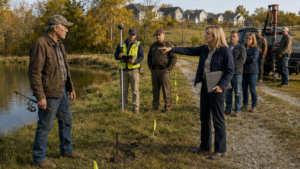
Catherine Miller pointed at Pamela before the birthday candles stopped smoking.
“There,” she said, her finger cutting past the paper lanterns and the row of children gathered around the picnic table. “That is exactly the problem.”
Ryan Carter stepped between her and his daughter.
Pamela still had her cheeks puffed from blowing out eight candles. A thin gray ribbon rose from the cake. Behind her, six children stood frozen with paper plates in their hands, waiting to cheer.
Ryan lowered his voice. “What problem?”
Catherine stood outside the garden fence in a dark green jacket too formal for a farm lane. A leather clipboard rested against one hip. Dust from the gravel road had settled on the toes of her shoes, but otherwise she looked as if she had come from a bank meeting rather than crossed half a mile of soybean fields.
“The association received a nuisance complaint,” she said. “Excessive noise. Repeated shouting. Amplified music.”
The only speaker was a small blue box on the picnic table playing a children’s song low enough that Ryan could hear the bees in the pumpkin blossoms.
One of the parents began gathering empty cups. Another touched her son’s shoulder and pulled him closer.
Ryan heard the change in the yard before he saw it. The party had become something adults were apologizing for.
“You received a complaint during a Saturday afternoon birthday party?” he asked.
“I’m enforcing the rules.”
Catherine opened the clipboard and tore off a pale yellow sheet.
Pamela looked at the cake, then at Ryan. The excitement had left her face so quickly that it frightened him more than Catherine’s presence did.
Catherine pushed the notice through the wire fence.
“Two hundred dollars,” she said. “And the children need to move indoors.”
Ryan did not take it.
The paper fluttered against the fence.
Catherine’s mouth tightened. “Mr. Carter, I’m not debating this in front of guests.”
“You started it in front of guests.”
A few children looked toward the barn. Ryan felt every parent in the yard deciding whether to intervene or leave.
Catherine glanced past him toward Pamela again. “People buy acreage here for peace, working land, and stable values. Families who turn farms into playgrounds make it harder for serious landowners.”
The words landed harder than the fine.
Pamela lowered her head. A streak of blue frosting marked one thumb.
Ryan gripped the fence rail until a rusted edge pressed into his palm.
His first instinct was to open the gate, step onto the lane, and tell Catherine exactly what kind of person attacked a child on her birthday. He could already hear the argument spreading through the association by evening: Ryan Carter lost control again. Ryan Carter refused compliance. Ryan Carter did not understand shared standards.
He had spent four years staying out of meetings precisely so no one could drag him into that machinery.
Now it had come to his fence.
“You’re not ordering children into my house,” he said.
Catherine’s eyes hardened. “Then the violation remains active.”
“The party ends at four. We’re not near the county limit.”
“You don’t determine the limit.”
“Did anyone measure it?”
She hesitated only a fraction, but Ryan saw it.
“The complaint was credible.”
“That wasn’t my question.”
A bass note rolled faintly across the fields.
Everyone heard it.
The association barn stood beyond the windbreak, nearly a quarter mile from Ryan’s property line. Someone was testing speakers for that evening’s private event. The sound came in a low pulse, then a brighter burst of music, clear enough that one of the children turned toward it.
Ryan looked at Catherine.
She did not look toward the barn.
“The association event is permitted,” she said.
“It hasn’t started yet.”
“That is not relevant.”
“It’s louder than this party.”
Catherine lifted the clipboard against her chest. “We can discuss your concerns at the next board session. We can also discuss the access strip along your east lane. Cooperation on that matter would make several ongoing issues easier to resolve.”
The east lane.
Ryan’s anger shifted.
The strip was barely wide enough for a produce truck, running between his pumpkin field and the drainage ditch before joining the association road. Catherine had raised it twice in letters over the past year, calling it a practical route for maintenance vehicles. Ryan had answered once: no permanent easement.
She had not mentioned it since.
Until now.
“Are you saying the fine has something to do with my lane?”
“I’m saying responsible members solve problems together.”
“That sounds like an answer.”
“It is advice.”
Catherine slid the citation through the fence and let it fall onto the grass.
Pamela flinched when it landed beside the cake table.
Ryan opened the gate.
For one second Catherine stepped back, and he hated the satisfaction that gave him.
He bent, picked up the paper, and walked it to the picnic table. He laid it beside the cake where everyone could see the printed amount.
$200.00.
Below it, under the association seal, someone had checked a box marked UNREASONABLE SOUND DISTURBANCE.
There was a space for a measured level.
It was blank.
Ryan tapped it with one finger.
“You didn’t measure anything.”
Catherine remained at the fence. “I will not continue this performance.”
“No. You won’t.”
He turned off the small speaker.
The field became quiet except for children shifting their shoes in the grass and the distant thump from the association barn.
Then Ryan looked at Pamela.
“Cut the cake.”
She blinked. “Are we allowed?”
The question hollowed him out.
“This is our farm,” he said. “You’re allowed to have your birthday.”
One of the parents found the cake knife. Another began passing plates. The children did not cheer this time, but slowly they gathered again.
Catherine stood by the fence long enough to make her disapproval visible, then turned toward her SUV.
Ryan followed her only as far as the gate.
“You’ll receive collection instructions by mail,” she said.
“And I’ll receive the rule you used.”
“You already have the bylaws.”
“Then I’ll read them.”
She gave him a look that suggested he had threatened her with a dull tool.
“That would be a welcome change.”
Her SUV rolled away, leaving a pale cloud over the gravel.
Ryan returned to the table. Pamela had cut one crooked slice and was trying to smile while her friends waited.
He moved the citation away from the cake.
For the next hour, he kept the party going by force of attention. He relit the game table. He found the missing bag of balloons. He carried cups, opened presents, and laughed when Pamela laughed, though each sound felt borrowed.
After the last family left, Pamela sat on the barn step with her new sketchbook in her lap.
“Dad?”
Ryan was folding the plastic tablecloth.
“Yeah?”
“Are they taking our farm?”
He stopped.
“Who told you that?”
“The lady said you had to cooperate about the lane.”
“She doesn’t get to take anything.”
“But could she?”
Ryan wanted to say no without qualification. He wanted to give his daughter the kind of answer children deserved.
Instead he sat beside her.
“No one gets to take our land because you had a birthday party.”
Pamela picked at dried frosting on her thumb. “I wasn’t that loud.”
“I know.”
“I can have the next one inside.”
“No.”
She looked at him.
He kept his tone even. “You didn’t do anything wrong.”
That evening, after Pamela went upstairs, Ryan opened the association binder at the kitchen table.
His late wife had organized it years earlier with labeled tabs: roads, drainage, shared well, events, voting. Ryan had not opened it since her death. Dust had settled along the spine.
The noise provision appeared under Conduct and Nuisance Standards.
No amplified or sustained sound exceeding county residential limits. No enforcement action without a documented complaint and supporting observation. Measurement recommended where disputed.
He read the paragraph three times.
Then he unfolded the citation envelope.
A second sheet slipped out.
It was a photocopied parcel map. A red line ran through Ryan’s east lane from the association road to the rear service entrance of the event barn.
At the bottom, in Catherine’s handwriting, were four words:
Proposed permanent shared access.
Chapter 2: The Friday Barn Was Louder Than Every Child Combined
The association bylaws repeated the county’s nighttime sound limit almost word for word.
Ryan sat at the kitchen table Monday morning with the binder open, the county code on his laptop, and Pamela’s yellow citation between them.
After ten at night, sound measured at a residential property boundary was not to exceed sixty-five decibels except for narrow agricultural exemptions. Those exemptions covered machinery necessary for planting, harvest, animal care, and emergencies.
They did not cover music.
The association rule used the same threshold and added a requirement that complaints be documented with time, location, and the nature of the disturbance.
Pamela’s citation listed only “children yelling and amplified entertainment.”
No time.
No reading.
No complainant.
Ryan photographed every page.
By noon he had ordered a certified sound-level meter from an equipment supplier outside Aurora. It arrived Wednesday in a black plastic case with calibration instructions, a foam windscreen, and a certificate stating accuracy within one and a half decibels.
Pamela watched him test it at the kitchen table.
“What does it do?”
“It tells us how loud something is.”
She whispered, “How loud am I?”
The display showed thirty-eight.
“Not very.”
She leaned closer and shouted, “Pumpkin!”
The number jumped to seventy-one, then fell.
Pamela covered her mouth, startled. Ryan almost laughed. Then he remembered the blank box on the citation.
“One shout isn’t the same as constant noise,” he said.
“Did the lady have one of these?”
“No.”
“Then how did she know?”
“She decided.”
Pamela considered that, then returned to coloring.
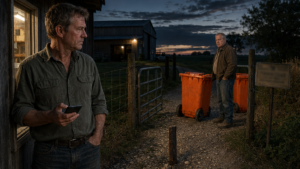
Friday night, Ryan placed the meter, a notebook, and his phone in a canvas tool bag. He walked the inside edge of his property, staying west of the drainage ditch where the surveyed line ran.
The association barn glowed beyond the trees.
It had once been a machinery shed shared by six farms. Over the years, the association had added restrooms, a catering kitchen, polished concrete floors, and a broad deck facing the fields. Event rentals had begun as a way to cover road gravel and pump maintenance. Lately there were private dinners nearly every other Friday.
Ryan had heard them for months.
He had never complained.
At 9:42 p.m., the meter averaged fifty-eight decibels at his boundary. At 9:57, sixty-two.
At 10:06, the music changed.
A bass line crossed the ditch in steady waves. Conversation and laughter rose above it. A microphone squealed, followed by applause.
Ryan lifted the meter.
Sixty-eight.
Seventy.
Seventy-two.
He watched the number hold.
For the first time since Catherine had walked into Pamela’s party, something in him loosened. Not because the sound pleased him, and not because it proved everything, but because it proved one thing exactly.
The rule was measurable.
He photographed the display with the barn lights visible in the distance and wrote the time in his notebook.
At 10:18, a truck slowed on the association road.
Donald Rivera leaned out the driver’s window.
“You hunting coyotes with a calculator?”
Ryan lowered the meter. “Measuring the event.”
Donald’s expression changed.
He parked on the shoulder and walked over, boots crunching on the gravel. He was broad through the chest from years of hauling feed bags, though age had begun to bend one shoulder lower than the other.
“You planning to file something?”
“I’m planning to know what the rule says.”
Donald glanced toward the barn. “Catherine told us about the birthday.”
“Did she tell you she measured it?”
Donald rubbed the back of his neck.
“That’s what I thought.”
“Ryan, listen.” Donald kept his voice low. “You’ve got a right to challenge a fine. I’m not saying you don’t. But those events are carrying more than people know.”
“What does that mean?”
“Road work. Pump service. Drainage.”
“We pay dues.”
“Dues don’t cover what they used to.”
“Then show the members the books.”
Donald looked toward the barn again. “It’s not that simple.”
“It usually isn’t when nobody will explain it.”
The meter climbed to seventy-three.
Ryan held it where Donald could see.
Donald stared at the display.
“That’s over,” Ryan said.
“I can see the number.”
“Did the board measure Pamela’s party?”
Donald’s silence lasted too long.
“Did anyone even stand at the property line?”
“No.”
The answer was barely audible beneath the music.
Ryan felt the small satisfaction of having his suspicion confirmed. It vanished when Donald added, “If the event permits get pulled, the repair schedule stops.”
“What repair schedule?”
Donald stepped back. “Ask at a meeting.”
“I haven’t been welcome at those for years.”
“You haven’t shown up.”
The words struck cleanly because they were true.
Ryan had thrown every association notice into a drawer since his wife died. He had told himself the meetings were theater, that Catherine had already counted the votes, that his time belonged to Pamela and the farm.
Avoiding a rigged table had felt like refusing to be used.
It had also left his chair empty.
Donald returned to his truck. “Be careful what you shut down.”
Ryan watched him drive toward the barn.
At 11:34, the meter read seventy-one.
At 12:08, sixty-nine.
The event ended at 12:41.
Ryan returned home and set the meter on the kitchen counter beside the white cardboard box holding the last two pieces of Pamela’s birthday cake. Blue frosting had dried along one corner.
He opened the association’s online records archive.
Meeting minutes were available by date, but complaint logs required member access. His password had expired. He reset it, waited for the email, and entered the records portal shortly after one in the morning.
There were nine nuisance complaints from the previous eighteen months.
Three concerned barking dogs. One concerned a grain dryer. One involved a wedding held at a private farm.
Six concerned the association barn.
Ryan opened the first.
Complaint received: music after midnight.
Disposition: resolved internally.
The second said the same.
The third included a note that no inspection was necessary because the event was “association authorized.”
The fourth had been submitted twice by an unnamed household.
The fifth mentioned windows vibrating.
The sixth listed a date only three weeks earlier.
Every one had been closed without a sound reading.
At the bottom of each entry appeared the same approval initials.
C.M.
Chapter 3: Six Night Readings Exposed a Much Older Agreement
The certified letter gave Ryan ten days to pay the two hundred dollars or face collection action against his property account.
It arrived the following Tuesday in a white envelope stamped ASSOCIATION COUNSEL. The language was cautious, but the threat was not. Unpaid assessments, fines, and enforcement costs could be recorded as a lien according to the governing documents.
Pamela found him reading it at the kitchen counter.
“Is that about me?”
“No.”
She looked at the association seal.
Ryan folded the letter. “It’s about adults making bad decisions.”
“Are you going to pay it?”
“Not yet.”
She nodded as though she had asked about weather, then carried her cereal bowl to the sink.
Ryan watched her go. The week before, she would have asked three more questions. Since the party, she had become careful whenever Catherine’s name or the association came up.
That afternoon Ryan created a formal log.
Date. Time. Location. Weather. Meter distance from the property boundary. Minimum, maximum, and sustained readings. Type of sound. Photographs indexed by file number.
He had documented soil moisture and crop disease for years. He knew that memory became unreliable the moment someone challenged it. Numbers needed context. Photographs needed times. A pattern needed repetition.
For six Fridays, he stood at the same fence post.
The readings ranged from sixty-nine to seventy-four decibels after ten at night. Every event continued beyond midnight. Twice, the music stopped briefly when a vehicle passed, then resumed louder. Once, a board member came outside and looked directly toward Ryan’s lane.
Ryan did not move.
By the fourth week, Catherine sent an email questioning whether his device was properly calibrated.
By the fifth, the association attorney demanded that he stop “conducting surveillance of lawful private gatherings.”
Ryan replied with one sentence: All measurements were taken from my property.
By the sixth Friday, he had enough entries to make excuses difficult.
He still did not know why Catherine wanted the east lane.
The answer appeared in the records room at the association office.
Members were permitted to inspect minutes and financial summaries by appointment. Catherine scheduled him for eight on a Thursday morning, when she knew he would normally be loading produce for market. Ryan rearranged the delivery and arrived five minutes early.
The records room had one metal table, two chairs, and shelves of binders organized by year.
Catherine placed three folders before him.
“These are the responsive records,” she said.
“I requested all event authorizations, nuisance complaints, and access proposals from the last two years.”
“These are the records considered relevant.”
“That’s not the same thing.”
“It is the determination of the records officer.”
“You’re the records officer.”
“I’m president.”
“And the person who closed the complaints.”
Catherine’s face remained composed. “You may inspect the documents provided. No photographs of confidential member information.”
She left the door open and sat at a desk outside.
Ryan began with event authorizations. Rental income had increased sharply. The barn brought in more than twice what it had the previous year.
Expenditures had risen too.
Pump repair.
Drainage excavation.
Emergency road grading.
The numbers were large enough to support Donald’s warning, but the summaries lacked invoices.
Ryan moved to board minutes.
Most were thin: approvals, maintenance updates, rental schedules. Then, in a meeting held four months before Pamela’s birthday, he found a section titled Access Negotiations.
The paragraph named his parcel.
The board discussed obtaining permanent shared access through the Carter east lane to support event deliveries, maintenance vehicles, and larger agricultural equipment. Catherine reported that the owner had been “unresponsive to reasonable compromise.”
Ryan had answered every letter.
In the next month’s minutes, the language sharpened.
Continued resistance may require enforcement review regarding member compliance and property use.
Ryan read the sentence twice.
Then he found the meeting held three days after Pamela’s birthday.
Under Access Negotiations, Catherine reported that a nuisance citation had been issued to the Carter property and might create “new leverage toward cooperative resolution.”
His hands went still.
The citation had not merely followed the lane dispute.
The board had discussed it as leverage.
Ryan copied the sentence into his notebook.
Catherine appeared in the doorway. “Your appointment ends in ten minutes.”
“Who wrote these minutes?”
“The secretary.”
“Did you approve them?”
“The board approved them.”
“Did Donald?”
Her eyes narrowed slightly. “The minutes speak for themselves.”
“No. People speak. Minutes hide who did it.”
Catherine stepped into the room. “You have spent six weeks trying to embarrass this association over a birthday party.”
“You used my daughter’s citation in an access negotiation.”
“You are isolating language from a broader discussion.”
“Then broaden it.”
“The east lane would reduce heavy traffic on the residential loop, lower maintenance costs, and provide safer entry to the barn. Your refusal affects every member.”
“So you fined an eight-year-old.”
“I cited your property.”
“You pointed at her.”
For the first time, Catherine looked away.
Only briefly.
Then she gathered the folders. “Your time is over.”
At the feed store that afternoon, Donald found Ryan beside a pallet of mineral blocks.
“You’ve been reading minutes,” he said.
Ryan did not ask how he knew.
“You approved them.”
Donald shifted his weight. “We approve a packet. Not every word.”
“You’re treasurer.”
“That doesn’t make me secretary.”
“It makes you responsible.”
A delivery driver pushed a cart between them. Donald waited until it passed.
“I told Catherine the birthday citation was a mistake.”
“Before or after the meeting?”
Donald’s silence answered.
Ryan took out his phone and showed him a photograph of the blank measurement field on the citation.
“No one tested the sound,” Ryan said. “You already admitted that.”
“I did.”
“And the board still discussed the fine as leverage.”
Donald’s jaw tightened. “Catherine has been trying to solve a real problem.”
“By manufacturing another one.”
“The shared well has a cracked casing.”
Ryan stared at him.
Donald continued, quieter now. “The temporary repair isn’t holding. The pump is pulling sediment. If it fails during the hottest part of harvest, my livestock operation goes first. Then the growers on the north line.”
“Why wasn’t that in the member notice?”
“Because the estimate would scare people.”
“They should be scared if it’s true.”
“And then what? Half the members refuse a special assessment. Two larger farms threaten to withdraw. The event revenue disappears. We have no repair.”
Ryan thought of the invoices missing from the financial summaries.
“How long?”
Donald looked down the aisle before answering. “Maybe two months. Maybe less.”
The certainty Ryan had carried for six weeks shifted under him. Catherine had abused the rule. The minutes proved intent. But beneath the pressure campaign sat a failing well and farms that could not wait for a clean moral resolution.
Donald studied his face.
“You thought this was only about her,” he said.
“It’s about what she did.”
“Yes. And what happens after you stop her.”
Ryan put the phone away.
That evening, Catherine’s SUV came up the east lane just before sunset.
She did not enter the yard. She parked near the gate and waited beside the red line painted on the survey stakes.
Ryan walked out to meet her.
She held a folder, not a clipboard.
“I understand you found the access minutes,” she said.
“I found enough.”
“You found fragments.”
“I found my daughter’s citation described as leverage.”
Catherine’s expression tightened, but her voice stayed controlled. “The association needs permanent access. Your lane is the safest and least expensive route. The alternative requires rebuilding a culvert and acquiring additional right-of-way.”
“That doesn’t make the citation lawful.”
“No. It makes your refusal consequential.”
Ryan looked past her toward the narrow lane. Evening light lay across the packed gravel where Pamela rode her bicycle and where produce trucks backed toward the barn during harvest.
Catherine opened the folder.
Inside was a prepared easement agreement.
“Sign this,” she said, “and I will recommend immediate reversal of the fine. No collection costs. No enforcement notation on your account.”
Ryan looked at her.
“You’re saying it out loud now.”
“I’m offering a resolution.”
“You’re trading enforcement for land.”
“I am giving you a chance to act like a member of a community instead of a man defending a fence line from everyone who needs to cross it.”
The insult was quieter than the one at Pamela’s birthday, which made it more revealing.
Ryan took the document.
Catherine’s shoulders eased, as though she believed the argument had finally entered the stage she understood.
He read the first page.
Permanent, nonexclusive access.
Commercial deliveries.
Association maintenance.
Authorized agricultural equipment.
No fixed limit on frequency.
No restoration bond.
No expiration.
He closed the folder and handed it back.
“The fine stays,” Catherine said.
“So does my land.”
Her face hardened.
“You have ten days.”
Ryan glanced toward the house. Pamela stood behind the kitchen screen door, watching them.
He looked back at Catherine.
“So do you.”
Chapter 4: The County Inspector Came Before the Music Reached Midnight
The association barn lowered its music twenty minutes earlier than usual.
Ryan stood at the boundary post with his meter raised, watching the number fall from sixty-seven to fifty-nine. Across the ditch, the barn doors remained open, but the speakers had gone soft enough that he could hear tires grinding over the gravel road.
Cynthia Walker’s county vehicle had not yet turned in.
Someone had warned Catherine.
Ryan checked his phone. 9:41 p.m.
He had given the county his six-week log, photographs, calibration certificate, copies of the closed complaints, and the exact boundary location. Cynthia had thanked him, then spent fifteen minutes explaining what his evidence did not prove.
It did not prove who ordered the music.
It did not prove retaliation.
It did not prove that Pamela’s citation was invalid.
It justified an inspection.
Nothing more.
A pair of headlights appeared beyond the windbreak. The county vehicle slowed near the barn entrance, then continued past without signaling.
Ryan felt the disappointment before he understood the move.
The vehicle stopped half a mile down the association road and went dark.
Cynthia emerged carrying a hard equipment case and walked back along the drainage shoulder.
“You said unannounced,” Ryan whispered when she reached him.
“I didn’t say obvious.”
She wore work boots, a county jacket, and her hair pulled close at the back of her neck. She set the case on the grass and removed a calibrated meter larger than Ryan’s.
“Show me your measurement point.”
He placed his boot beside the survey cap. “Property line runs north from here.”
“And the barn?”
“Two hundred and ninety yards, approximately.”
Cynthia noted the distance.
The barn’s low music drifted over the field. Her display held between fifty-eight and sixty-one.
“You told anyone I was coming?” she asked.
“No.”
“Anyone know you filed?”
“Catherine. The board attorney. Probably every member by now.”
Cynthia looked toward the barn. “Then we wait.”
At ten, the music remained controlled.
At ten fifteen, a truck left.
At ten thirty, two couples crossed the deck and climbed into separate vehicles. Ryan could see Catherine standing near the open doors, speaking to someone inside.
At ten forty-seven, she stepped onto the deck and scanned the dark field.
Ryan stayed behind the hedge line.
Cynthia did not move.
“She knows,” he said.
“She suspects.”
“If they keep it below the limit, there’s no citation.”
“That would mean tonight’s complaint is resolved.”
“And the other six weeks?”
“Evidence for a pattern. Not tonight’s violation.”
Her calm irritated him, though he knew it was the reason he had called her.
The music stopped at ten fifty-three.
Cynthia lowered her meter.
Ryan looked at the barn. “They shut it down.”
“Maybe.”
Catherine walked across the parking lot toward her SUV. She stood beside it for a moment, phone to her ear, then drove onto the association road.
Her headlights passed the field and continued toward the main highway.
Ryan exhaled through his nose.
“So she wins tonight.”
Cynthia closed the meter case but did not latch it.
“Give it ten minutes.”
At eleven four, a light switched on behind the machinery annex attached to the rear of the barn.
A low electrical hum traveled across the ditch.
Then music burst from a second set of speakers.
It was not the polished dinner music from earlier. The bass was heavier, the volume immediate. Someone inside shouted into a microphone, and a wave of laughter followed.
Ryan’s meter jumped.
Sixty-eight.
Seventy.
Cynthia already had hers raised.
“Boundary reading,” she said into a small recorder. “Eleven oh-five p.m. Sustained level seventy decibels.”
The numbers on their displays matched.
For weeks Ryan had imagined this moment as clean satisfaction. Instead, he felt the strange weight of being believed after preparing himself not to be.
Cynthia took three readings at measured intervals, then walked toward the public association road.
“You stay here,” she said.
“I can show you the entrance.”
“I know where the entrance is.”
Ryan watched her cross the culvert and disappear behind the row of parked vehicles.
The music continued for another two minutes.
Then it cut off so abruptly that the night seemed to recoil.
Voices rose near the rear doors.
A board member came outside first. Catherine arrived less than five minutes later, her SUV moving too fast over the gravel. She parked beside Cynthia’s county vehicle and crossed the lot without closing her door.
Ryan could not hear the first exchange, only see Catherine’s hands moving in short, controlled gestures.
Cynthia listened.
Then she opened her clipboard and began writing.
Catherine turned toward the field.
Even at that distance, Ryan knew she had found him.
He did not lower the meter.
By eleven thirty, Cynthia returned to the boundary.
“County citation will be issued to the association as operator of the premises,” she said. “There may also be a permit review.”
“Did Catherine admit she knew about the second system?”
“No.”
“Did she deny it?”
“She said a private rental party activated equipment without authorization.”
“Do you believe her?”
“My report doesn’t contain belief.”
Ryan looked at the dark barn.
“What does it contain?”
“That I independently measured sustained amplified sound above the county limit after ten p.m. at a residential boundary. It also notes the system resumed shortly after the president left the premises.”
“That’s enough to show selective enforcement.”
“No. It’s enough to show a county violation.”
Ryan turned toward her. “You saw the complaint files.”
“I saw copies you provided. I did not audit the association.”
“The same person who closed six complaints fined my daughter without measuring anything.”
“That may matter at an association hearing or in civil court. It does not expand tonight’s citation.”
Her refusal to carry the argument for him felt almost hostile.
Then Cynthia added, “Keep your claims narrower than your anger. Narrow claims survive.”
She handed him a receipt showing the inspection number.
Before leaving, she pointed toward his meter.
“Your equipment was within one decibel of mine.”
It was the closest thing to praise she offered.
By morning, the association email list had erupted.
One larger grower demanded to know why event revenue had been endangered during peak repair season. Another member accused Ryan of using county enforcement to settle a personal dispute. A third asked whether the fall rental schedule would be canceled.
Donald called shortly after seven.
“You got your citation,” he said.
“The county got it.”
“Same difference to people who need the pump fixed.”
“Then show them the numbers.”
“I’m trying to keep them from panicking.”
“That’s what you said before.”
A long pause followed.
“The event permit may be suspended,” Donald said. “That means the next two deposits don’t clear. Catherine says the well contractor won’t hold the date.”
“Is that true?”
“I don’t know yet.”
“Then find out.”
Ryan ended the call and looked through the kitchen window.
Pamela was outside feeding carrot tops to the neighbor’s goats through the fence. She had not asked about the county inspection. She had stopped asking about most of it.
At ten, a courier delivered an emergency meeting notice.
The association board would convene Sunday evening to consider temporary disciplinary action against Ryan Carter for conduct harmful to shared operations, interference with authorized revenue activity, and refusal to participate in good-faith infrastructure planning.
Proposed action: suspension of voting privileges pending member review.
Ryan read the notice twice.
Attached was a statement from Catherine.
She had not disputed the county reading.
She had made Ryan the violation.
Chapter 5: The Rule That Could Remove Catherine Also Protected Her
“The reserve can fund the shared well for nineteen more days.”
Catherine delivered the number before anyone had fully settled into the folding chairs.
The machinery shed smelled of dust, hydraulic fluid, and damp work coats. Nearly forty members had come to the emergency session, more than Ryan had seen at any association meeting since his wife’s funeral.
He sat at the end of the second row with the county inspection receipt in one pocket and Pamela’s citation in the other.
On the table before the board, his sound-level meter rested beside a stack of financial summaries.
Catherine did not look at it.
“The contractor requires a forty-percent deposit,” she continued. “The remaining reserve is insufficient. Event income was expected to close that gap.”
A board member adjusted his glasses. “Why are we learning this now?”
“To avoid unnecessary alarm while financing options remained available.”
A murmur crossed the shed.
Ryan watched Donald. The treasurer sat two chairs away from Catherine with his hands folded over a closed ledger. He had not looked at Ryan since the meeting began.
Catherine moved to the next page.
“The county citation may suspend two scheduled rentals. Those losses result directly from Mr. Carter’s decision to escalate an internal matter rather than use association procedures.”
Ryan stood.
“You closed six internal complaints without inspection.”
“This is not the public-comment period.”
“You brought my name into the opening statement.”
“You will have time to respond.”
“When?”
“After the motion.”
The association attorney leaned toward Catherine and whispered something. Her jaw tightened.
She nodded. “Mr. Carter may speak for three minutes.”
Ryan stepped into the aisle.
He had spent the morning preparing a precise argument about the county violation, the closed complaints, and the bylaw clause he had found at the clerk’s office. Article Seven, Section Three stated that an officer receiving a municipal code citation while serving could be disqualified upon a finding of conduct inconsistent with association duties.
When he first read it, the sentence had felt like a blade Catherine had sharpened for herself.
He had imagined laying it on the table and watching the room turn.
Now forty people were staring at him after hearing that the well might fail in nineteen days.
“My complaint was not about event revenue,” he said. “It was about one standard being used against my daughter and another standard being used for this board.”
Catherine clasped her hands. “The county citation concerns one rental event.”
“It concerns sound above the legal limit.”
“Which was caused by renters using unauthorized equipment.”
“And the six earlier complaints?”
“Resolved according to board discretion.”
“Without measurements.”
“The board is not required to purchase laboratory equipment for every complaint.”
“You didn’t need equipment to fine an eight-year-old.”
A stir moved through the room.
Catherine’s face sharpened. “The property was cited, not the child.”
“You pointed at her while you did it.”
The attorney raised one hand. “Personal characterization is not helpful.”
Ryan took Pamela’s citation from his pocket and unfolded it.
“The measured-level field is blank. The complaint time is blank. The complainant is blank. Three days later, the board minutes discussed this fine under access negotiations involving my east lane.”
Several people turned toward Catherine.
She did not deny it.
“The Carter lane is central to the association’s infrastructure plan,” she said. “Mr. Carter has refused every proposal.”
“I refused a permanent easement without limits.”
“You refused to attend negotiations.”
That struck harder than Ryan expected.
Catherine continued. “You did not attend budget meetings. You did not attend the pump briefing. You did not propose alternative access. You answered one letter with one word.”
“No.”
A few people laughed nervously.
Ryan felt heat rise in his face.
He could explain his reasons. He could tell them that meetings under Catherine became decisions announced after the votes were secured. He could tell them his wife had once handled the association work, and sitting in those rooms after she died felt like entering a conversation where her chair remained permanently empty.
None of that changed the fact that he had stayed away.
Catherine looked down the row. “This is what I mean by harmful conduct. He refuses collective responsibility, then invokes county action when consequences reach his property.”
Donald moved for the first time.
“The deficit wasn’t disclosed,” he said.
Catherine turned slowly.
Donald opened the ledger.
“I recommended we notify the members after the second pump estimate.”
“You agreed delay would protect negotiations.”
“I agreed for two weeks. Not three months.”
The room went quiet.
Catherine’s voice dropped. “Be careful.”
Donald looked at the ledger rather than at her. “The reserve estimate is accurate. Nineteen days at current draw, maybe fewer if the heat holds. But the members should have known.”
“Why didn’t we?” someone asked.
Donald swallowed.
“Because the event deposits were covering emergency invoices while we negotiated permanent access and a special assessment. We did not want withdrawals or land-value concerns before the plan was complete.”
“You hid it,” Ryan said.
Donald’s eyes met his. “Yes.”
The admission did not vindicate Ryan. It made the room more dangerous.
A livestock farmer near the back stood. “If the well fails, my animals don’t wait for a governance lesson.”
Another member said, “And if officers can hide this, what exactly are we funding?”
Voices rose.
Catherine struck the table with the flat of her hand.
“We have a repair plan. We have a contractor. We have revenue. What we do not have is cooperation.”
Ryan looked at the meter sitting unused before her.
He had brought it expecting numbers to organize the room. But the crisis was no longer about volume alone.
The attorney called for the disciplinary motion.
The proposal would suspend Ryan’s voting privileges for ninety days due to interference with association operations.
Ryan raised the bylaw copy.
“Before you vote, read Article Seven, Section Three.”
The attorney took the page, scanned it, and passed it to Catherine.
For the first time that evening, something like concern moved across her face.
A member asked, “Does that remove her?”
“Not automatically,” the attorney said.
Ryan felt the clean victory he had expected collapse.
The attorney continued. “A municipal citation permits disqualification only after a member finding that the conduct was inconsistent with officer duties. Notice and a hearing are required. The officer may remain in place pending that process.”
Catherine placed the page down.
“So this accusation changes nothing tonight.”
“It changes what gets heard,” Ryan said.
“It also demonstrates why suspension is necessary. Mr. Carter is attempting to destabilize leadership during an infrastructure emergency.”
The vote began by raised membership cards.
Ryan counted silently.
The motion needed a simple majority.
The first row split evenly. The larger growers favored suspension. Several small acreage owners opposed it. Two members abstained.
Donald held his card in his lap.
Catherine looked at him.
He closed his eyes, then raised it against suspension.
The motion failed by three votes.
Ryan remained standing while the result was recorded.
It was a small victory, and it tasted nothing like he had imagined.
A grower in the front row turned toward him.
“You kept your vote. Fine. What are you voting for?”
Ryan said nothing.
“What’s your repair plan?”
“I’m not the board.”
“You stopped their revenue.”
“The county stopped an illegal event.”
“And the pump?”
Ryan looked toward Donald’s ledger.
Nineteen days.
Catherine leaned back in her chair. She no longer appeared cornered. She appeared tired, which was somehow worse.
“You wanted the whole truth,” she said. “Now you have part of it.”
The members voted to schedule a formal misconduct hearing and easement decision in seven days. Until then, the board would seek emergency financing.
As people filed out, several avoided Ryan. One man who had quietly supported him at the start of the meeting passed without speaking.
Donald stayed behind.
“I’m sorry,” he said.
“For which part?”
Donald had no quick answer.
When Ryan returned home, the kitchen light was on.
Pamela sat on the floor beside an open cedar storage box. Papers surrounded her knees: seed invoices, old association newsletters, survey copies, and handwritten maps.
“I was looking for my blue markers,” she said. “They used to be in Mom’s box.”
Ryan crouched.
One sheet lay across her lap.
A narrow route had been drawn from the association road along the east edge of their farm. The line resembled Catherine’s proposed access, but it stopped before the produce barn and curved away from Pamela’s garden.
Beside it, in his wife’s handwriting, were the words:
Temporary licensed access only. Seasonal dates. Restoration required. No permanent easement.
Ryan touched the paper.
At the bottom was a blank signature line with his name typed beneath it.
Pamela looked up.
“Did Mom want them to use the lane?”
Chapter 6: His Wife Had Drawn a Fairer Road Through Their Land
Ryan recognized his wife’s handwriting before he trusted what it said.
The letters leaned slightly forward, neat even where she had revised the route in pencil. She had marked a twelve-foot travel width, spring closure dates, weight restrictions, and a restoration bond for crop or drainage damage.
It was not Catherine’s easement.
It was not Ryan’s refusal either.
Pamela sat across from him at the kitchen table, watching his face.
“Did you know about it?” she asked.
Ryan folded the map along an old crease.
“I knew she had discussed access.”
“That means yes.”
“It means I didn’t remember this version.”
Pamela traced the blank signature line. “Why didn’t you sign it?”
He looked toward the window. The east lane ran beyond the pumpkin field, pale under the morning sun.
“Your mom and I disagreed.”
“About the farm?”
“About what protecting it meant.”
Pamela waited.
Ryan could hear his own answer forming into something too easy: Catherine had pushed too hard. The board could not be trusted. Permanent access reduced control. All true.
None explained the unsigned proposal in front of him.
His wife had brought it to him during her final year, when hospital appointments had begun taking more time than farm work. She had said the association would need a safer maintenance route eventually. She had also said they could share use without surrendering title.
Ryan had heard only the first part.
At the time, every concession felt like preparation for a future in which she would not be there to help him defend the next boundary. He had rejected the paper, then buried the conversation so thoroughly that he remembered Catherine’s demand but not his wife’s compromise.
“I thought saying no was safer,” he said.
“For who?”
He looked at Pamela.
She lowered her eyes. “I’m going to feed the goats.”
At the shared well site that afternoon, the truth smelled of rust and wet soil.
Donald removed the access panel while Ryan watched sediment cloud a sample jar. The pump cycled with a rough vibration that traveled through the concrete pad.
“The casing leak is below the first joint,” Donald said. “Temporary sleeve shifted.”
“What’s the repair estimate?”
Donald handed him a photocopy.
The number was worse than Ryan expected.
A second estimate included trench work, electrical upgrades, and emergency water hauling if the pump failed before replacement.
“Event revenue doesn’t cover all this,” Ryan said.
“No.”
“Even with the permanent easement?”
“The easement lowers contractor access costs. The special assessment covers the rest.”
“Which Catherine hasn’t announced.”
“She wanted the access vote first.”
“So members would feel trapped.”
Donald closed the panel. “She would call it sequencing.”
Ryan walked the perimeter of the well site. The current service route came through the residential loop, where heavy trucks had to make two tight turns beside smaller homes. His east lane would be shorter and safer.
He hated that Catherine had been right about that.
He hated more that being right about the route did not excuse how she had pursued it.
Ryan unfolded his wife’s map against the hood of Donald’s truck.
Donald stared at it.
“She drew this?”
“Years ago.”
“This would work for the contractor.”
“Temporary license. Limited dates. Weight cap. Restoration bond.”
“No event deliveries?”
“Not unless separately approved.”
Donald ran a finger along the curve near the drainage ditch. “They wanted a straight route.”
“The straight route crosses my irrigation line.”
Donald nodded. “Catherine said you refused access altogether.”
“I did.”
“Why?”
Ryan folded the paper again. “Because I was afraid one yes would become every yes after it.”
Donald leaned against the truck.
“That’s not entirely irrational.”
“No. Just incomplete.”
They spent two hours measuring turning clearance, ditch setbacks, and the distance from the lane to the nearest house. Ryan used the sound-level meter differently this time.
He measured the ambient level near the residences at six in the evening, then calculated where event speakers could be positioned without pushing sound across the property boundary. He marked a possible equipment route that avoided the garden and closed during wet planting weeks.
The meter no longer felt like a weapon.
It felt like a line anyone could see.
Back at the farmhouse, Pamela was sitting on the barn step with her sketchbook closed.
Ryan showed her the revised map.
“This keeps the land ours,” he said. “It lets repair trucks use the lane for a limited time.”
She looked at the page but did not touch it.
“And parties?”
“Not automatically.”
“Will the loud ones stop?”
“They’ll have the same hours and limits as everyone else.”
Pamela picked at a splinter in the step.
“I told the girls at school I didn’t want another party.”
Ryan sat beside her. “You don’t have to decide now.”
“I said it because of Catherine.”
He waited.
Pamela’s voice became smaller. “I thought maybe laughing here makes trouble.”
Ryan looked toward the place where the picnic table had stood.
The grass still showed four pale squares where its legs had blocked the sun.
“You didn’t cause this.”
“You keep saying that.”
“Because it’s true.”
“But you started measuring after my party.”
“Yes.”
“And everybody’s mad now.”
Ryan rested his hands between his knees.
He could blame Catherine. He could explain the well, the bylaws, the lane, the hidden records.
Pamela was not asking for the history of the conflict.
She was asking whether her joy had cost the community something.
“I should have gone to the meetings before this,” he said. “I should have known about the well. I let other people make decisions, then acted surprised when those decisions reached us.”
Pamela looked at him.
“That part is mine,” he continued. “The fine is not yours. Catherine’s choice is not yours. The well is not yours.”
“Are you going to fix it?”
“I’m going to try without giving away the farm.”
She finally took the map.
“Mom’s road curves.”
“She knew where the irrigation line was.”
“She knew everything.”
Ryan smiled despite himself. “She made lists.”
Pamela studied the route. “Can the road close on my birthday?”
“If you want.”
“No.” She handed it back. “Just no trucks during cake.”
By evening Ryan had drafted a proposal.
A temporary licensed access agreement for well replacement and specified maintenance.
No transfer of property rights.
No commercial event traffic without separate member approval.
Defined hours.
Restoration requirements.
Independent sound monitoring for association events.
A special assessment divided by acreage and water use, reduced by documented event revenue.
Full publication of invoices, reserves, and complaint dispositions.
It was more cooperation than Ryan had offered in four years.
It was also more protection than Catherine’s plan allowed.
At 7:12 p.m., an association notice arrived by email.
Catherine had moved the permanent easement vote forward to the same night as the misconduct hearing. Ballots and proxy forms were already being distributed. Members would vote before Ryan’s proposal could be formally placed on the agenda unless he gathered enough signatures for an amendment.
He called Donald.
“They’re voting before anyone sees the alternative.”
“I know.”
“You approved the schedule?”
“No.”
“Will you open the ledger?”
Donald did not answer immediately.
“If you stay quiet,” Ryan said, “Catherine gets the easement and calls the rest necessity.”
“She can remove me as treasurer before the vote.”
“Maybe.”
“She can tell every livestock member I risked their water.”
“She might.”
Ryan looked at his wife’s map spread across the table.
“I’m putting my lane in the plan,” he said. “Not permanently. Not without limits. But I’m putting it in.”
Donald breathed out.
“You’re serious.”
“I should have been serious before.”
Another silence.
Then Donald said, “Bring copies of your proposal.”
“That isn’t what I asked.”
“I know.”
Ryan waited.
At last Donald said, “I’ll bring the full ledger. Not the summaries. Everything.”
The line went quiet after they hung up.
On the table, Ryan placed Catherine’s permanent easement beside his wife’s curved route and the new licensed-access proposal.
For the first time, the hearing would not ask only whether Catherine had abused power.
It would ask whether Donald was willing to admit how he had helped her keep it.
Chapter 7: Ryan Refused the Easy Victory and Opened Every Record
Catherine offered to erase Ryan’s fine before the hearing had officially begun.
She stood beside the board table in the machinery shed, one hand resting on Pamela’s yellow citation.
“Withdraw the misconduct motion,” she said, “and this disappears tonight.”
The room had filled early. Folding chairs ran between parked implements and stacks of seed pallets. Members held proxy forms, repair estimates, and copies of the permanent easement Catherine wanted approved before adjournment.
Ryan remained beside the display table he had set up near the center aisle.
On it lay his sound-level meter, a copy of Cynthia Walker’s county report, six weeks of readings, his wife’s curved access map, and the temporary license proposal he had drafted.
“No collection costs?” he asked.
“None.”
“No notation on my account?”
“None.”
“And the other complaints?”
Catherine’s fingers tightened on the paper. “We are discussing yours.”
“That’s the problem.”
The association attorney shifted in his chair. “Mr. Carter, a private resolution remains available until the member hearing begins.”
Ryan looked toward Pamela, seated near the back beside a stack of unused chairs. She had insisted on coming, though he had warned her the meeting might run late.
She was watching the citation.
Not Catherine.
The piece of paper that had turned her birthday into evidence.
Ryan faced the room.
“I’m not withdrawing.”
Catherine lifted the citation. “Then this remains active pending appeal.”
“Put it back on the table.”
For a moment, neither moved.
Then she laid it down.
The attorney called the hearing to order.
Catherine spoke first.
She described the well failure risk, the repair estimate, the lost event deposits, and the cost difference between using Ryan’s east lane and rebuilding the old culvert. Her numbers were specific. Her tone never rose.
“The association did not target Mr. Carter,” she said. “It attempted to bring an absent member into a necessary planning process. He chose outside enforcement instead.”
Several heads turned toward Ryan.
Catherine continued. “The county citation resulted from unauthorized use of a secondary sound system by renters. It was corrected. Removing elected leadership over that single occurrence would be disproportionate and harmful.”
Ryan could hear the strength of her argument because part of it was true.
He had been absent.
The well was failing.
The route through his property was cheaper.
If he pretended otherwise, Catherine would make every fact he omitted look like dishonesty.
When his turn came, he did not begin with the citation.
“I skipped four years of meetings,” he said.
The room quieted.
“I answered access letters with refusals and no alternative. I told myself the decisions were already made, so attending would only help people claim I agreed with them.”
Catherine watched him carefully.
Ryan placed his wife’s map on the display board.
“That was a mistake.”
A board member leaned forward.
Ryan explained the temporary route, seasonal closures, weight limits, restoration bond, and prohibition on commercial event deliveries unless separately approved. He passed out copies row by row.
“The repair contractor can use my lane,” he said. “The land remains mine. The license expires when the well work and specified maintenance are finished.”
A livestock farmer raised his hand. “What about the funding gap?”
Ryan turned to Donald.
For several seconds, Donald did not move.
The full ledger sat closed before him.
Catherine spoke without looking his way. “The treasurer’s summary is already in your packets.”
Donald’s thumb moved along the ledger’s worn edge.
Ryan felt the entire proposal narrowing toward one man’s fear.
Then Donald stood.
“I certified those summaries,” he said. “They were accurate as far as they went.”
Catherine’s face changed.
Not surprise.
Recognition.
“Donald,” she said quietly.
He opened the ledger.
“They did not show deferred invoices, deposits applied before events occurred, or the second pump estimate.”
Someone near the front swore under his breath.
Donald carried the book to the center table.
“I agreed to delay disclosure because I believed we could replace the money before members needed to know. I believed panic would stop the repair. I also approved minutes that connected the Carter citation to access negotiations.”
The room broke into overlapping questions.
Catherine struck the table once.
“Those minutes reflected a discussion of member compliance.”
Donald looked at her. “You said the fine might make him easier to negotiate with.”
“That is your interpretation.”
“It is what I wrote.”
The room went still again.
Donald opened to a marked page.
He read the entry aloud.
The wording was restrained, almost bureaucratic. That made it worse.
Nuisance enforcement may provide leverage toward resolution of the Carter access refusal.
Ryan saw several members look toward Pamela.
Catherine did too.
Her composure tightened around the edges.
“The board was under pressure to secure access,” she said. “I used poor language. That does not change the need.”
“No,” Ryan said. “It changes whether the rule was applied honestly.”
He placed Pamela’s citation beside his meter.
“The association measured none of the birthday noise. The form has no time, no reading, and no named complainant. Six prior complaints against the association barn were closed without inspection. When the county measured the same barn, it was over the legal limit.”
He set Cynthia’s calibrated report beside his own log.
Two devices.
Matching numbers.
One standard.
Catherine folded her arms.
“You are presenting retaliation as reform.”
“No. I’m presenting a repair plan that costs me something.”
Ryan pointed toward the temporary license.
“My lane opens to the well contractor. I accept restoration risk under written terms. I pay the same assessment formula I’m asking everyone else to pay. But the permanent easement is withdrawn. Event sound is monitored at the boundary. Complaints are logged publicly. No officer closes a complaint involving association property without independent review.”
A larger grower stood. “Your assessment formula charges by water use.”
“Yes.”
“That increases mine.”
“You use more water.”
“We also produce more.”
“Then the well matters more to you.”
The grower sat without agreeing.
The attorney asked whether Ryan’s proposal had enough member signatures to be considered as an amendment.
Hands rose across the room.
More than required.
Catherine looked over the chairs, counting.
For the first time, Ryan saw the fear beneath her control. Not fear of punishment. Fear that the system she had held together by force would come apart the moment she loosened her grip.
“You think transparency pays invoices?” she asked him.
“No.”
“You think a temporary license gives contractors long-term certainty?”
“No.”
“You think members who refuse every increase will suddenly act responsibly because you published a spreadsheet?”
“No.”
His answers unsettled her more than a speech would have.
Ryan lowered his voice.
“I think hiding the problem made every option worse.”
Catherine’s gaze shifted toward Pamela.
The child was standing now, though Ryan had not seen her rise.
“Why did you point at me?” Pamela asked.
No one moved.
Catherine’s face lost its prepared expression.
Pamela continued, “You could have talked to my dad.”
Ryan wanted to protect her from the silence, but she had already crossed it.
Catherine looked down at the citation.
“I was angry,” she said.
“At me?”
“At the situation.”
“That’s not the same.”
“No,” Catherine said. “It isn’t.”
The admission did not repair the birthday. It did not erase the threat or the ledger.
But it removed one place for Catherine to hide.
The votes were taken in order.
First, the permanent easement.
It failed.
Second, Ryan’s temporary licensed-access and funding plan.
It passed after two amendments: quarterly review and an independent contractor estimate.
Third, the misconduct finding under Article Seven, Section Three.
The cards rose slowly.
Donald voted in favor.
The tally was counted twice.
Catherine was removed from the presidency by one vote.
There was no applause.
One member covered his face with both hands. Another immediately asked who would contact the well contractor. Catherine gathered her papers one page at a time.
The board then voted to void Ryan’s citation and review all nuisance fines issued during Catherine’s term under the new independent standard.
Ryan should have felt finished.
Instead, the association attorney turned to him.
“The bylaws require an interim compliance chair until the special election.”
Ryan looked around the room.
Several members avoided his eyes. Others looked directly at him.
Donald said, “You wrote the policy.”
“That doesn’t mean I should run it.”
Catherine closed the ledger and pushed it toward Donald.
“No,” she said. “It means you don’t get to walk away from it.”
The statement held no kindness, but it was not wrong.
The nomination passed before Ryan found a convincing refusal.
When the meeting ended, Catherine stopped beside Pamela.
She did not apologize.
She said, “Your mother understood shared land better than most of us.”
Then she walked out carrying one cardboard file box.
Ryan stood beneath the machinery-shed lights with Pamela’s canceled citation in one hand and the interim compliance binder in the other.
He had entered the hearing determined to prevent someone else from using rules as a weapon.
He left responsible for deciding what those rules would become.
Chapter 8: The Next Birthday Used the Same Rule for Everyone
The first sound warning under Ryan’s new policy came from Pamela’s own music.
Three months after the hearing, the association barn stood open for the community farm day, its repaired electrical system humming behind the walls. Produce tables lined the deck. Children painted small pumpkins beneath the shade awning. The shared well pump ran steadily beyond the lane, quieter than the old unit had ever been.
Near the refreshment table, Ryan’s sound-level meter displayed sixty-six decibels.
The limit for the afternoon event was sixty-five at the nearest residential boundary.
Pamela stood beside the speaker with her hands on her hips.
“It’s one number.”
“It’s been over for three minutes.”
“No one complained.”
“That isn’t the standard.”
Her friends watched from the cake table. Pamela’s face colored.
Ryan felt the old scene pressing against the new one: Catherine at the fence, adults going silent, a child made into a problem.
He did not raise his voice.
He did not take out a citation.
He walked to the speaker and lowered the volume two marks.
The meter settled at sixty-three.
“That’s it?” Pamela asked.
“That’s it.”
“No fine?”
“Warnings correct things. Fines are for refusing to correct them.”
A parent nearby nodded and returned to cutting vegetables for the grill.
Pamela looked at the meter, then at Ryan.
“You could have waited until after the song.”
“I could have.”
“But you didn’t.”
“No.”
She gave him a look that contained both annoyance and reluctant understanding.
Then she carried the speaker farther from the boundary without being asked.
The new policy was printed on a single page and clipped beneath the meter.
Event hours.
Measurement location.
Warning process.
Appeal procedure.
The complaint log sat open beside it, visible to any member.
Ryan had resisted the public log at first. He worried it would become another instrument for neighbors to monitor one another. Donald had suggested adding outcomes, not just complaints.
Resolved by lowering volume.
No violation observed.
Agricultural exemption confirmed.
Referred for independent review.
The entries made the system less dramatic and more useful.
Most problems ended with a conversation.
The temporary lane license had worked the same way. The well contractor used the route for nine days. Ryan closed it once after heavy rain. The association paid to regrade two ruts and replace a crushed irrigation coupling. No event trucks used it.
The land remained his.
The road had still served others.
Near noon, Donald approached with two paper cups of lemonade.
“Pump pressure held overnight,” he said.
Ryan took one cup. “You check it every morning?”
“Every three hours.”
“That seems healthy.”
Donald looked toward the well. “I’m working on trust.”
“You’re doing it loudly.”
They stood together while a group of children carried painted pumpkins toward the display table.
Donald had remained treasurer under monthly reporting requirements and an independent review. Some members wanted him removed with Catherine. Ryan had voted against automatic removal, then required every deferred invoice and reserve transfer to be published.
Donald had not thanked him.
Ryan had not expected him to.
“Contractor records came in,” Donald said.
“From where?”
“Catherine.”
Ryan looked at him.
“She found the missing drainage invoices and the original casing report. Dropped copies at the office yesterday.”
“Did she say anything?”
“She said incomplete records would hurt the repair audit.”
That sounded like Catherine: useful without yielding.
“Is she coming today?” Ryan asked.
Donald glanced toward the parking area. “She’s here.”
Catherine’s SUV stood near the far end of the barn.
She had arrived without Ryan noticing and was carrying another file box from the small office she had once used as president. She wore jeans and a gray work shirt instead of the green jacket.
Pamela saw her too.
The child’s shoulders stiffened.
Ryan started toward her, then stopped himself.
Pamela set down a paintbrush and walked to Catherine alone.
They met near the open barn doors.
Ryan stayed close enough to intervene but not close enough to claim the exchange.
Catherine placed the box on the tailgate of her SUV.
“I brought the contractor records,” she said.
Pamela nodded.
“The well works now.”
“Yes.”
“My dad’s road worked too.”
“Yes.”
Pamela looked toward the cake table. “We’re having the birthday part again.”
“I heard.”
“Music has to stay under the number.”
Catherine’s gaze moved to the meter.
“That is probably wise.”
Pamela studied her. “Are you sorry?”
The question carried no accusation. That made it harder.
Catherine looked across the field toward Ryan.
“I am sorry I used your birthday to pressure your father.”
Pamela waited.
“And I am sorry I spoke about you as if you were the problem.”
Pamela nodded once.
She did not hug Catherine. She did not invite her to stay.
“Okay,” she said.
Then she returned to the other children.
Catherine closed the tailgate.
Ryan walked over.
“The audit needed those records,” she said before he could speak.
“I know.”
“The permanent route would still have been cheaper over twenty years.”
“Maybe.”
“You’ll be renegotiating licenses every time major work comes up.”
“Then we’ll have to keep talking.”
Catherine looked toward the repaired well, where the pressure gauge held steady.
“You enjoy that more than you used to.”
“No.”
The corner of her mouth moved, almost a smile.
Then it disappeared.
“I’m not asking to come back,” she said.
“I didn’t think you were.”
“The event policy is workable.”
“That sounds painful for you.”
“It has weaknesses.”
“I’m sure you’ll send a list.”
“I already did.”
Ryan nodded.
That was as close to reconciliation as either of them could manage.
Catherine drove away before the cake was cut.
In the afternoon, Pamela’s friends gathered around a new cake decorated with small orange pumpkins. The adults stayed back. No one held a clipboard. No one watched the children as if joy required permission.
Pamela lit the candles herself.
Before she blew them out, she looked toward Ryan.
“What’s the number?”
He checked the meter.
“Sixty-two.”
“Can we cheer?”
“Yes.”
“How loud?”
“As loud as the rule allows.”
She rolled her eyes.
Then she blew out the candles.
The children cheered. The meter climbed to sixty-eight for less than a second and dropped again.
Ryan left it alone.
After the cake was served, Pamela wandered to the public sound log.
The first entry was Ryan’s boundary reading from the night the second speaker system had started after Catherine believed the inspector was gone.
Below it were months of ordinary corrections and uneventful checks.
Pamela picked up the pen.
“What are you writing?” Ryan asked.
“My party.”
She printed carefully:
Birthday cheering. Brief. No action needed.
Then she signed her name beneath Ryan’s original entry.
Pamela Carter.
Ryan looked at the two names on the page.
The meter rested beside them, no longer hidden in a tool bag or raised across a dark field. Anyone could read it. Anyone could question it. The same line applied whether the sound came from a board event, a larger grower, or his own daughter.
Pamela closed the log and ran back toward her friends.
Ryan remained at the table while their laughter crossed the barnyard, rose above the repaired pump, and faded before it reached the boundary.
The story has ended.