Everyone Thought David Was Wasting the Harvest Until the Farm’s Real Debt Came Due
Chapter 1: The Pumpkin David Would Not Put in a Box
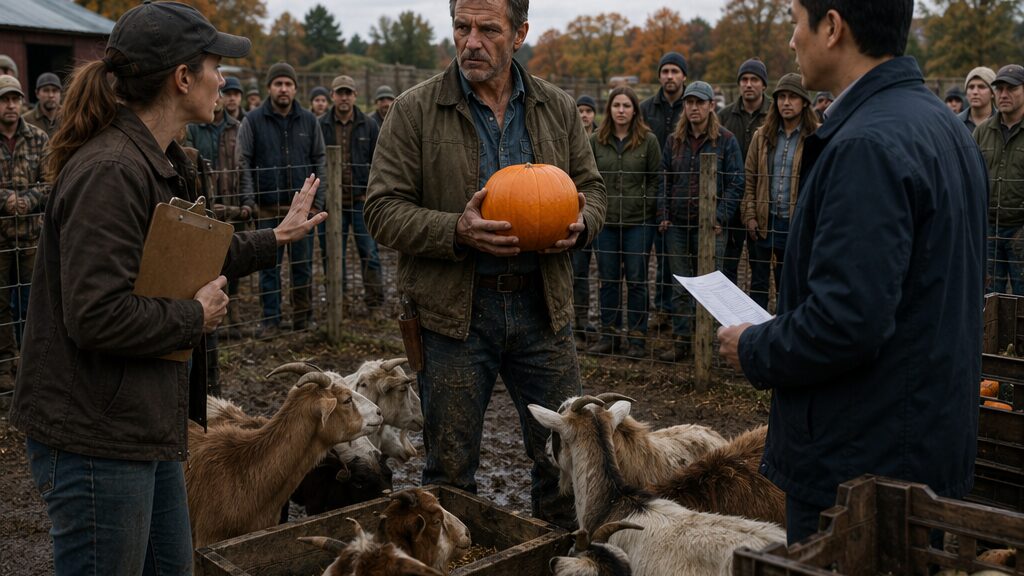
David carried the best-looking pumpkin past the packing tables and headed straight toward the goats.
It was round, deep orange, and nearly unmarked. One of the visiting families stopped beside the fence to watch him. A child pointed at the pumpkin, then at the cardboard produce boxes stacked beneath the shed roof.
“That one looks perfect,” the child said.
David kept walking.
Mud pressed around his boots as he crossed the farmyard. Behind him, seasonal workers sorted cabbage, apples, squash, and late greens beneath hanging work lights. The sale crates went on blue pallets. Damaged produce went into gray tubs. Twenty-eight sealed cardboard boxes sat apart beneath the shadow of the old barn.
The goats heard him coming and crowded the trough.
David rested the pumpkin on its edge. He could feel the softness through his glove before he even raised the knife.
“Dad.”
Heather’s voice carried across the yard.
He did not turn. He drove the blade into the pumpkin’s stem end.
Heather came through the gate with Benjamin Lee beside her. Benjamin wore clean work boots that had already lost their shine in the mud. A cooperative folder was tucked beneath his arm. Several customers and workers followed at a careful distance, pretending not to listen.
Heather stopped beside the trough.
“That’s contract produce.”
David pulled the knife downward. The skin split with a dry crack.
One of the goats butted the boards. Another stretched its neck toward the pumpkin.
Heather glanced at the people near the fence. “We have invoices sitting unpaid, and you’re feeding sale inventory to livestock.”
A few faces shifted toward David. Stephen Brown stood near the wagon with his hands in his jacket pockets. He had come to pick up empty field bins, but he did not look away.
David opened the pumpkin.
The inside sagged.
A dark patch spread through the flesh beneath the bright shell, soft from the hard frost three nights earlier. Clear liquid collected around the seeds. The smell was sweet, but wrong.
The child at the fence lowered his hand.
David cut away the firm section and placed it in a clean tub. He tipped the spoiled half into the trough. The goats surged forward, scraping horns against wood.
“That one was gone,” Benjamin said.
David wiped the knife on a rag. “That one was obvious.”
Heather’s jaw tightened. “And the cabbage? The carrots? The squash you put in yesterday?”
David walked back to the sorting cart. He picked up a cabbage with a split base and set it in the gray tub. A crooked but solid carrot went into one of the cardboard boxes. Three clean squash went into a cooperative crate.
“Feed,” he said, touching the gray tub.
Then the cardboard box. “Edible.”
Then the blue crate. “Contract.”
Benjamin watched his hands. “Who set those categories?”
“Common sense.”
“The contract doesn’t list common sense as a grade.”
“No,” David said. “It lists measurements.”
Heather stepped closer. “Measurements that decide whether we get paid.”
The farmyard had gone quiet except for the goats chewing and the low rattle of a conveyor inside the packing shed.
David knew the looks around him. He had seen them at equipment auctions, bank counters, and church suppers after bad harvests. People rarely asked whether a farmer had made a hard choice. They asked whether he had made a foolish one.
Stephen nodded toward the trough. “Looks like a lot of food going through those boards.”
David met his eyes. “It is food.”
“That’s not what I meant.”
“I know.”
Heather let out a slow breath. “You cannot keep making inventory decisions without recording them.”
David picked up another pumpkin. Its shell carried a pale pressure bruise near the bottom. He placed it in the cardboard box.
Heather reached for it. “That meets the visual grade.”
“It won’t travel.”
“You don’t know that.”
“I grew it.”
“And I signed the delivery schedule.”
The words landed harder than her raised voice would have.
Benjamin opened his folder. “We need to settle this before tomorrow’s pickup. The cooperative has already assigned the Martin Farm volume to three buyers.”
David looked toward the fields. Rows of cut vines lay black against the soil. They had harvested everything they could before the second frost, working past midnight under tractor lights. The yard looked abundant because all the season’s labor had been compressed into one crowded place. It did not mean the abundance would survive a truck ride, a warehouse, and four days beneath supermarket lights.
“How much are we short?” David asked.
Heather answered too quickly. “We don’t know.”
David looked at her.
Benjamin’s attention shifted between them. “Then we count.”
Heather folded her arms. “We started counting this morning.”
“No,” Benjamin said. “I mean everything. Packed, rejected, donated, fed, stored, and already committed.”
The word donated moved through the silence almost unnoticed.
Almost.
David picked up his knife. Pumpkin seeds clung to the blade.
Heather saw them, then looked toward the sealed boxes beneath the old barn. “Nothing leaves this property until the count is finished.”
One of the workers glanced at David. He gave no instruction.
Benjamin called two workers over and asked them to begin with the cooperative pallets. Heather moved toward the office to retrieve the inventory sheets. The visitors slowly resumed walking, though they kept looking back at the trough.
Stephen remained.
“You might explain yourself once in a while,” he said quietly.
David scraped the seeds from his knife into his palm. “Would it change the pumpkin?”
“Might change what people think.”
David scattered the seeds into a bucket. “People came ready to think something.”
Stephen studied him, then walked toward his truck.
By noon, every pallet had been numbered. The workers counted forty-three cooperative crates in the shed, eleven cooling in the wash room, and six still on the field wagon. Heather entered each figure into her laptop while Benjamin checked the previous week’s shipping records.
David continued sorting.
He could feel Heather watching whenever he put edible produce into the cardboard boxes. He did not explain the boxes, and she did not ask in front of Benjamin. Their silence became its own argument.
Near one o’clock, Benjamin disappeared behind the old barn.
David heard the scrape of cardboard before he saw him return.
Benjamin came around the corner with one of the sealed boxes in his arms. A handwritten collection date was marked on the side. Beneath it were David’s initials.
Heather stood so quickly her chair tipped backward.
Benjamin set the box on the packing table. “There are twenty-seven more.”
Heather stared at her father.
“Who are these for?”
Chapter 2: The Boxes Waiting Behind the Old Barn
The pantry truck arrived ten minutes after Heather locked the loading gate.
Its white paint was streaked with road salt and dust. A magnetic sign on the driver’s door named three rural food distribution sites. Carolyn Davis sat behind the wheel, looking from the chain across the gate to the boxes visible under the old barn roof.
Heather walked out before Carolyn could sound the horn.
“We’re not loading today.”
Carolyn lowered the window. “David said one-thirty.”
“David did not clear it with operations.”
Carolyn’s expression changed, but only slightly. She switched off the engine and climbed down with a clipboard tucked beneath her arm.
David came from the packing shed carrying an empty gray tub. He saw the truck, the chain, and Heather standing between them.
He set the tub on the ground.
Carolyn looked at him. “Is there a problem?”
Heather answered. “There’s an inventory dispute.”
“They’re not contract grade,” David said.
Heather turned. “That hasn’t been determined.”
“It was determined when we sorted them.”
“By you.”
“By the same standards we used last year.”
Benjamin stepped out of the office. “Last year’s agreement was different.”
Carolyn looked from one face to another. “I have volunteers waiting at two distribution points. If the load isn’t coming, I need to call them.”
Heather held out her hand. “May I see the pickup paperwork?”
Carolyn gave her the clipboard.
The list contained twenty-eight boxes: cabbage, winter squash, carrots, apples, and mixed greens. Beside each category was an estimated weight. David’s initials appeared at the bottom, along with the date and the words surplus collection.
Heather read it twice.
“You promised more than twelve hundred pounds.”
“Estimated,” David said.
“Of inventory.”
“Of food.”
Benjamin took the sheet. “Under this year’s contract, anything harvested from the listed acreage counts toward minimum volume unless it’s documented as unmarketable.”
David nodded toward the boxes. “Then document it.”
“It doesn’t work after the fact.”
Heather looked at Carolyn. “How long has this arrangement been going on?”
“Seven years.”
Heather’s eyes flicked toward David.
Carolyn continued carefully. “Usually once a week during peak harvest. Less in lean seasons.”
“And no one thought I should know?”
“I assumed you did.”
Heather gave a short laugh without humor. “Of course.”
David picked up the gray tub again. “The truck can take what’s listed.”
“No,” Heather said.
The word stopped him.
Seasonal workers had gathered near the shed doors. No one pretended to be working now. Even the goats seemed quieter, nosing through pieces of pumpkin in the trough.
Heather pointed toward the sealed boxes. “Until Benjamin confirms the grade and I reconcile the contract count, nothing leaves.”
Carolyn stepped closer to her. “Those boxes won’t improve while you reconcile them.”
“That doesn’t make them yours.”
“I didn’t say it did.”
“It was promised without authority.”
David’s fingers tightened around the tub handle. “I have authority on my own farm.”
Heather turned to him. “Then why am I the one whose name is on every late notice?”
The workers looked down.
Benjamin closed his folder. “We should move this inside.”
“No,” Heather said. “I’m tired of finding out inside, after the decision has already been made.”
David saw the color high in her cheeks. He had expected anger. He had not expected fear.
Carolyn handed the clipboard back. “We can leave the truck and return tomorrow.”
“The greens won’t hold,” David said.
“We’ll take only those if Heather approves.”
Heather studied the boxes. Some were darkened along the bottom where damp cardboard had absorbed moisture from the barn floor. The labels were simple, written in black marker. North Ridge Pantry. County Line Church. East Hollow Center.
“How much did this hurt us before?” she asked.
Benjamin checked the records on his tablet. “In prior years, probably nothing. The cooperative bought by accepted shipment weight. Rejected produce never entered the calculation.”
“And this year?”
“This year the Martins received a volume advance.”
Carolyn looked at David. “You didn’t mention an advance.”
David kept his eyes on Heather. “I didn’t sign one.”
“I did,” Heather said.
The admission settled between them.
Benjamin spoke quietly. “The advance helped cover seed, fertilizer, and spring labor. In return, the farm committed a minimum harvested volume. The cooperative can reject damaged produce, but the farm still has to document where it went.”
David pointed to the boxes. “There it is.”
“Not soon enough,” Heather said. “Not with weights, grade reports, or disposal records.”
Carolyn’s voice softened. “How short are you?”
Heather looked at the waiting workers before answering. “Short enough.”
David heard what she would not say. He looked toward the packing shed, where empty cardboard boxes were stacked almost to the rafters. Each one represented something they had expected to fill.
Carolyn stepped beside the nearest sealed box and opened the top. Inside were crooked carrots, small cabbages, and squash with surface scars. None would have looked right in a produce display. None was rotten.
She lifted a carrot. “This won’t sell?”
“It might at the farm stand,” Heather said.
“The stand closes Sunday.”
“Then we discount it.”
“To whom?” David asked. “The families who already came? The ones who drove forty miles to buy pumpkins?”
Heather faced him. “Every dollar matters.”
“So does every meal.”
“That sentence doesn’t pay fuel.”
“No. Fuel keeps the truck moving. The food is why it moves.”
Carolyn placed the carrot back in the box. “Stop.”
Both Martins looked at her.
“I came for produce, not permission to stand in the middle of a family fight.” She closed the flaps. “The boxes stay.”
David frowned. “Carolyn—”
“They stay until both of you agree they can leave.”
Heather’s shoulders lowered a fraction.
Carolyn walked back toward the truck, then stopped beside the chain. “But the greens need refrigeration before dark. Decide something about those.”
Benjamin offered to inspect the greens immediately. For the next hour, he and two workers opened boxes, weighed contents, photographed damage, and separated produce according to cooperative rules.
The result pleased no one.
Nine boxes contained vegetables too fragile for commercial shipment but sound enough for immediate use. Seven could be regraded for discount sale. Five needed trimming. The rest belonged in feed or compost.
David’s sorting had not been careless.
It had been incomplete.
Heather stood at the packing table entering figures while David cleaned his knife. Several pale pumpkin seeds remained lodged near the handle.
“Seven years,” she said.
He did not answer.
“Did Mom start it?”
His hand paused.
Heather saw the answer in that pause. “Why didn’t you tell me?”
“You had enough.”
“You don’t get to decide what I have enough of.”
“I was trying to keep one thing from becoming another bill.”
“It already became one.”
Benjamin approached with the final weights. “If the nine immediate-use boxes leave today, they still count against the volume until the board approves the rejection documentation.”
Heather looked at the total.
David watched her face.
She closed the laptop.
“The greens can go,” she said. “Nothing else.”
Carolyn loaded the nine approved boxes with help from two volunteers who had arrived in another car. There was no triumph in it. The chain remained across the gate until Heather unlocked it herself.
Before climbing into the truck, Carolyn touched David’s sleeve. “Call me tonight.”
He nodded.
Heather waited until the truck disappeared down the road. Then she turned toward the workers gathered beside the time clock.
“If the other boxes leave,” she said, loud enough for all of them to hear, “we miss payroll Friday.”
No one moved.
David looked at the sealed boxes beneath the old barn and understood that Heather had not been exaggerating.
Chapter 3: The Contract That Counted Every Crate Twice
The farm account held less money than Heather needed for fuel, and less than half of what she needed for wages.
She refreshed the banking page twice before accepting the figure.
Outside the office window, David drove the small loader toward the compost area with a gray tub balanced on the forks. The morning sun made the frost on the barn roof look clean and harmless. By noon, the yard would be mud again.
Heather opened the payroll file.
Four seasonal workers. Two packers. One driver. Friday’s total sat in a red cell at the bottom of the screen.
She had until tomorrow afternoon.
Benjamin knocked once and entered without waiting. “The board moved the review to ten.”
“I thought it was at the warehouse.”
“It is.”
She closed the payroll file before he could see it.
David came through the side door carrying a paper sack and set it beside the coffee maker. “Egg sandwiches.”
Heather did not look at him. “We’re leaving in five minutes.”
“I’m coming.”
“This is a contract meeting.”
“My farm is in the contract.”
“Your name isn’t on the operating agreement.”
The sentence came out sharper than she intended.
David unwrapped one sandwich, took a bite, and leaned against the counter. “That supposed to make me less interested?”
Benjamin looked at the floor.
Heather gathered the inventory sheets. “Bring every disposal record you have.”
“I don’t have disposal records.”
“I know.”
At the cooperative warehouse, forklifts moved pallets beneath fluorescent lights. The place smelled of cardboard, diesel exhaust, and crushed apples. Empty produce boxes were stacked along one wall, rising in uneven columns that made Heather think of rooms being emptied.
Three cooperative board members sat at a folding table. None of them looked hostile. That made the meeting worse.
Benjamin presented the count.
The Martin farm had enough harvested produce to appear close to its commitment. After grading, spoilage, livestock feed, and undocumented pantry boxes, it was far short.
David listened with both hands resting on his knees.
A board member tapped the report. “You received an advance based on projected volume.”
“We had a late frost,” David said.
“So did eleven other farms.”
“Not on our north slope.”
Heather stepped in before his tone hardened. “We’re requesting a temporary volume adjustment based on documented weather damage.”
“And the undocumented diversion?” another member asked.
“The pantry pickup was stopped.”
“After part of it left.”
“Nine boxes,” Heather said. “All inspected.”
David turned toward her. “You make it sound stolen.”
“I’m trying to keep this meeting useful.”
Benjamin slid another page across the table. “There is an extension option.”
Heather read the first paragraph. The cooperative would defer the volume penalty and extend repayment for twelve months in exchange for exclusive purchase rights over the next harvest and stricter control of secondary sales.
For a moment, relief loosened the muscles in her neck.
Then she reached the property clause.
David saw the change in her face. “What?”
Heather kept reading.
If the farm failed to meet the revised obligation, the cooperative’s lending partner could enforce existing collateral guarantees.
David held out his hand.
She did not give him the paper.
“Existing what?” he asked.
Benjamin answered because she did not. “Collateral guarantees.”
David looked at Heather.
One board member cleared his throat. “The advance was secured through the emergency operating note.”
“What secured it?” David asked.
Heather placed the document facedown. “We should discuss that at home.”
He did not raise his voice. “What secured it?”
The warehouse noise continued around them. A forklift beeped in reverse. Someone dropped a wooden pallet at the far end of the building.
Benjamin opened a separate file. “The lower field.”
David’s face did not change at first.
Heather had imagined this moment many times. In every version, he shouted. He accused her of stealing land, of treating generations of work like a line on a spreadsheet. She had prepared answers for anger.
His stillness left her with none.
“How much?” he asked.
“The note is ninety-two thousand,” Heather said.
“That’s not what I asked.”
“The lower field and the access easement.”
His eyes lifted to hers. “The farmhouse road?”
“Only as part of the legal parcel description.”
“Only.”
“We needed spring money.”
“You pledged the road to the house.”
“I pledged collateral to keep the farm operating.”
One board member shifted uncomfortably. Benjamin closed the file.
Heather lowered her voice. “We had seed invoices, fertilizer, equipment repairs, and no credit left under the old line. You wouldn’t sit down with me.”
“You didn’t tell me this was the paper.”
“I sent you the documents.”
“You left folders on the kitchen table.”
“I asked you six times to review them.”
David looked away.
The board chair folded his hands. “We can reconvene after you examine the extension.”
Heather forced herself back to the immediate problem. “Will you waive the current shortfall?”
“No.”
“Reduce it?”
“Not without complete documentation.”
David stood. “You want records showing every cabbage the goats ate?”
“We want records showing how secured inventory was used.”
“Secured inventory,” he repeated.
Benjamin spoke before David could leave. “Your sorting saved you money.”
David stopped.
Benjamin pointed to the disposal estimate. “If the rejected volume had gone to landfill or commercial composting, hauling and tipping fees would have cost several thousand dollars. Feeding safe produce to livestock reduced purchased feed too.”
One board member nodded. “That can be documented going forward.”
It was the first acknowledgment that David’s choices had value.
It was also too small to solve anything.
Heather gathered the papers. “What exactly do you require?”
“Collateral documents, complete harvest records, pantry receipts, livestock-use logs, and a revised plan by Friday.”
“Tomorrow?”
“Tomorrow.”
In the parking lot, David walked past Heather’s truck.
“Get in,” she said.
“I’ll ride with Benjamin.”
Benjamin had already driven away.
David kept walking toward the road.
Heather pulled alongside him and lowered the window. “It’s eight miles.”
“I know where the farm is.”
She stopped the truck. “I did not pledge the house.”
“You pledged the way to it.”
“The lender required a contiguous parcel.”
“And you said yes.”
“I said yes because everyone else had already said no.”
David turned toward her then.
Heather gripped the steering wheel. “The bank said no. The equipment lender said no. The seed company cut our terms. The cooperative offered the advance, and you told me we’d make volume because you always say we’ll make volume.”
“You should have told me.”
“I tried.”
“No. You tried to get my signature between chores.”
“I tried mornings, evenings, Sundays, and once while you sat in the emergency room with six stitches in your hand. You kept saying later.”
David’s mouth tightened.
Heather reached across the seat and lifted the collateral map from the folder. She unfolded it against the steering wheel.
The lower field was outlined in yellow. A narrow strip ran from the county road past the farmhouse and down toward the creek.
David stared at the map.
His finger touched the access strip, then moved toward the field where his father had taught him to set irrigation pipe.
“You knew what this was,” Heather said. “You just didn’t want to know how close we were.”
He looked at her, and for the first time she saw something beneath his anger that resembled recognition.
Then he folded the map along the wrong crease and handed it back.
“We’ll talk at home.”
Heather watched him climb into the passenger seat.
Neither spoke during the drive.
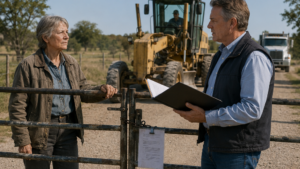
When they reached the farm, David did not go to the packing shed. He carried the collateral map across the yard toward the lower field, where survey stakes were already visible beside the farmhouse access road.
Chapter 4: What Heather Signed to Keep the Farm Open
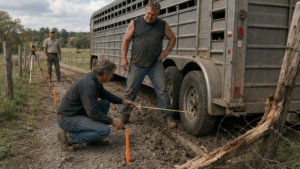
David found the first survey stake twelve feet from the farmhouse road.
Its orange ribbon snapped in the morning wind, too bright against the dead grass. A second stake stood near the drainage ditch. Farther down, another marked the edge of the lower field, where a volunteer pumpkin vine had climbed through the fence and wrapped itself around the wire.
He pulled the nearest stake from the ground.
“Put it back.”
Heather stood by the gate with the collateral map beneath one arm.
David held the stake across his body. “Who put these here?”
“The lender’s survey crew.”
“Without asking?”
“They called yesterday.”
“They didn’t call me.”
“They called the number on the loan.”
He looked toward the farmhouse, then down the narrow road that connected it to the county blacktop. The yellow line on the map had looked thin inside the warehouse. On the ground, it contained the driveway, the mailbox, the old maple, and the strip where his mother had once planted daffodils.
“How long?” he asked.
Heather came through the gate. “How long what?”
“How long have you known they could take it?”
Her face tightened. “They can’t take anything unless we default.”
“We are in default.”
“We’re in danger of default.”
Benjamin’s distinction, spoken through her mouth.
David drove the stake back into the soil harder than necessary. The ribbon trembled.
Heather unfolded the map against the fence. “The lower field secured the spring operating note. The access easement was required because the field doesn’t touch a public road.”
“You signed away the road to make the field valuable.”
“I pledged a parcel. I didn’t sell it.”
“You made it available.”
“I made seed available. Fertilizer. Diesel. Payroll.”
“By putting land under somebody else’s name.”
“It’s still under ours.”
“For now.”
Heather folded the map again. “You think I wanted this?”
David looked at the pumpkin vine crossing the fence. One small fruit hung beneath the leaves, green and hard, months too late to ripen.
“I think you knew I’d say no.”
“I knew you wouldn’t answer.”
The kitchen table was covered when they returned to the house.
Loan statements. Cooperative reports. Seed invoices. Equipment repair bills. A stack of unopened envelopes David recognized from the counter where he had left them. Heather arranged the papers by month without sitting down.
“Six times,” she said.
He remained near the doorway.
“January tenth. I asked you to review the previous year. February third, after the tractor transmission estimate. March first, when the bank reduced the line. March seventeenth, before I signed the seed order. April sixth, when the cooperative offered the advance. And April ninth, the morning you cut your hand.”
David looked at the scar across his palm.
“You said later every time,” Heather continued. “Then later became planting.”
“I was working.”
“So was I.”
“You could have told me the land was collateral.”
“I left the note on this table.”
“You left a hundred pages on the table.”
“I marked the pages.”
“With yellow paper?”
“With signatures required.”
David pulled out a chair but did not sit. “My signature isn’t on it.”
“The farm operates through the company. You made me managing member three years ago because you said paperwork was choking you.”
“I didn’t give you the right to risk the lower field.”
“You gave me the obligation to pay for it.”
The refrigerator motor clicked off. In the sudden quiet, David heard workers moving crates outside.
Heather opened a ledger. “Three poor seasons. One flood year. Two frost losses. The farm stand made less each summer after the highway project changed traffic. We replaced the cooler. The loader needed a hydraulic pump. The north well had to be redrilled.”
“I know what broke.”
“You know the machines. You don’t know what they cost us.”
He looked at the columns of figures and saw her handwriting compressed into every margin.
“No salary,” he said.
Heather closed the ledger.
He opened it again and followed the payroll entries. Seasonal workers. Drivers. David’s draw. Insurance. Fuel. Nothing beside her name for nine months.
“You paid yourself before,” he said.
“Until February.”
“How were you living?”
“I had savings.”
“Had?”
Her silence answered.
David pushed the ledger away. His anger did not disappear. It changed weight.
That afternoon they sat across from a lending manager in a small office above the county branch. A framed photograph of wheat fields hung behind the desk, though no wheat grew within fifty miles.
The manager explained the cooperative extension in a voice trained to make consequences sound procedural.
Twelve additional months. Reduced immediate payment. Exclusive delivery rights. No unapproved secondary sales. No charitable diversion from contracted acreage without written release. If projected volume failed again, the lower field would be listed before the following winter.
Heather leaned forward. “Would pantry donations from noncontract acreage be permitted?”
“If documented and separated.”
“How much acreage can be removed from the agreement?”
The manager looked at the file. “Under the extension? None.”
David turned a page. “So the land stays collateral, and you decide where every vegetable goes.”
“The cooperative determines what secures its advance.”
“You won’t buy what fails grade.”
“No.”
“But you count it until we prove where it went.”
“That is correct.”
“And we can’t give it away without permission.”
“Not from secured production.”
David closed the folder.
Heather touched the corner of it. “This gives us time.”
“It gives them next year too.”
“It keeps the auction from happening now.”
“At the price of promising a harvest we haven’t planted.”
The manager waited. He had likely heard versions of this argument from other families.
Heather lowered her voice. “We don’t have another offer.”
David looked at the signature line.
He pictured the old barn stacked with cardboard boxes. Carolyn’s truck outside the chain. The goats chewing through frost-softened pumpkin. Heather’s name absent from nine months of payroll.
“No,” he said.
Heather’s hand left the folder. “Dad.”
“No.”
“You haven’t heard an alternative.”
“There isn’t one in that paper.”
“There isn’t one anywhere else.”
David stood. “Then we make one.”
Outside, Heather followed him into the parking lot.
“With what?” she demanded. “Another promise? Another truck I don’t know about? More produce sorted by rules that exist only in your head?”
“They’re not only in my head.”
“They aren’t in the records.”
He turned toward her. “Not everything worth keeping fits a record.”
“And not everything worth keeping can be saved.”
The words struck them both silent.
Heather looked away first. Cars moved along the county road beyond the lot. No one slowed.
When they returned to the farm, the survey stakes were still visible from the kitchen window. David placed the unsigned extension on the table.
Heather did not remove her coat.
“You think refusing makes this brave,” she said. “It doesn’t.”
“I didn’t say it did.”
“If we cannot replace the advance or reduce the debt, the lender can begin enforcement after the next missed payment.”
“When?”
She stared at him.
“Heather.”
“Before spring.”
The packing conveyor started outside, vibrating faintly through the floor.
She placed both hands on the back of a chair.
“If Friday’s payment fails,” she said, “this farm may be scheduled for auction before we plant another seed.”
Chapter 5: The Promise Buried Beneath the Sorting Table
Carolyn returned the boxes before sunset.
The pantry truck backed beneath the old barn roof, and two volunteers unloaded the same produce David had expected them to carry away. The cardboard had softened at the corners. One box of cabbage split when it touched the ground.
David caught it against his knee.
“What are you doing?” he asked.
Carolyn climbed down from the truck. “Returning disputed property.”
“It’ll spoil.”
“Then you and Heather decide together what happens to it.”
“She froze the load.”
“And you promised it without telling her.”
David set the broken box on the sorting table. “People are waiting.”
“They can wait for another shipment.”
“Some of them can’t.”
Carolyn’s face hardened. “Do not use them to end this argument.”
He looked toward the volunteers. They had moved away to give them privacy, though the barn carried every word.
“Your wife never did,” Carolyn said.
David’s hands stopped on the cabbage.
Heather stood in the office doorway across the yard, a phone pressed to her ear. She was speaking with someone about extension terms, reading figures from the unsigned papers.
Carolyn followed his gaze. “She called me this afternoon.”
“What for?”
“To ask how much we could accept if the weekly delivery were reduced.”
David looked back at her.
“She also asked whether donations can be documented for tax and disposal purposes,” Carolyn continued. “She’s trying to find a number that doesn’t break either side.”
“She’s arranging the extension.”
“She’s trying not to lose her home.”
“It’s my home too.”
“Then stop making her fight for it alone.”
David lifted the cabbage box and carried it into the packing shed. Carolyn followed.
The sorting table had been built from thick oak planks. Its legs were scarred by pallet forks, and the lower shelf sagged beneath old scales, twine, and seed catalogs. David set the cabbage down and began trimming the split heads.
Carolyn pulled a crate beside him. “Tell me why you never told her.”
“She knew we donated.”
“She knew some surplus went somewhere. That is not the same as knowing you committed twelve hundred pounds during a contract year.”
“It wasn’t always twelve hundred.”
“That does not answer me.”
David cut away a bruised outer leaf. The knife made a soft scrape against the board.
Carolyn waited.
Years earlier, before the pantry network had three locations and refrigerated trucks, there had been one church basement and a borrowed van. David’s wife had packed the boxes herself, writing family counts on paper taped to the wall.
The arrangement began after a neighboring farm failed during a summer drought. The family left quietly. Months later, David’s wife learned that their children had been eating crackers for dinner while adults at church discussed whether the father had been too proud to ask for help.
“She said hunger didn’t become less real because it stayed private,” David said.
Carolyn leaned against the table.
“The next harvest was good,” he continued. “Better than we could sell. She put the first boxes together. I told her we couldn’t become responsible for everybody.”
“What did she say?”
“She said we were already responsible for what we chose to throw away.”
He lifted another cabbage.
“When she got sick, she made me promise the route wouldn’t stop just because she did.”
Carolyn’s expression softened, but not in the way he expected.
“And what else did she make you promise?”
David looked at her.
“She talked to me near the end,” Carolyn said. “Not about pounds of cabbage.”
“That was between you and her.”
“She said you would turn grief into work if no one stopped you.”
He set down the knife.
“She wanted the food used,” Carolyn continued. “She also wanted Heather to have a father she could talk to. Keeping half the promise while breaking the other half isn’t loyalty.”
David turned away from her.
On the table, a pumpkin with a sunken side waited in the feed pile. He pressed the skin. The damaged section yielded beneath his thumb, but most of the flesh remained firm.
Carolyn lifted it. “This can still make soup.”
“Not after tomorrow.”
“Then come with me.”
At the pantry kitchen, steam clouded the windows. Volunteers washed greens and trimmed vegetables at stainless steel counters. Nothing looked abundant there. Every usable piece occupied a labeled tray.
Carolyn cut open the damaged pumpkin.
The soft section went into a waste bucket. The seeds were rinsed for roasting. Firm orange flesh dropped into a stockpot with onions and broth.
David watched a volunteer scrape the shell clean.
“We can accept less,” Carolyn said. “Half the old amount, maybe less than that. We can record every pound. We can schedule pickups after your contract grading, not before.”
“You need more than half.”
“We need many things.”
He looked at the simmering pot.
“You are not the only farm,” she said. “You are not the only person responsible. That belief may feel generous, but it is also pride.”
David almost argued.
Then he remembered Heather saying she had asked six times.
Carolyn placed a folder beside him. It contained donation logs, mileage records, estimated fair-market values, and sample receipts.
“This won’t save the farm,” she said. “But it may keep the donations from being treated as missing inventory.”
He turned the pages.
“Why didn’t we do this before?”
“Because your wife kept records, and after she died you told me not to burden you with forms.”
The answer was so simple that David had nowhere to put his anger.
When he returned after dark, light shone from the farm office. Heather sat at the desk with the cooperative extension open on her computer. She had made notes in the margins and highlighted the signature deadline.
David placed Carolyn’s folder beside the keyboard.
Heather looked at it, then at him.
“The pantry can take less,” he said. “After grading. With receipts.”
“That doesn’t cover the shortfall.”
“No.”
“The extension still might.”
“Yes.”
She studied his face. “Are you agreeing to it?”
“Bring every debt record to the barn before sunrise.”
Her eyes narrowed. “Why?”
“Because I can’t make a choice from the pieces you leave on the kitchen table.”
A trace of anger returned. “And I’m supposed to trust you with all of it now?”
“No,” David said. “You’re supposed to make me look at it.”
He left the office before she answered.
At the barn door, he stopped beside the three empty spaces where the next morning’s produce would be sorted.
By sunrise, he would have to decide what could still be sold, what could still be given, and what part of the farm—or himself—he was finally willing to surrender.
Chapter 6: Three Piles on the Barn Floor
Before dawn, David laid the farm ledger, the collateral map, and three pumpkins on the barn floor.
Heather arrived carrying two banker’s boxes. She set them down without speaking.
One pumpkin was clean and hard, with a stem trimmed short for shipment. The second was small and scarred but sound. The third had a frost-softened patch near its base.
David placed the first beside a blue cooperative crate.
The second went beside Carolyn’s documentation folder.
The third went into a gray livestock tub.
Heather looked at the arrangement. “You woke me before five to show me sorting?”
“I woke you because I’ve been using sorting to avoid numbers.”
She glanced at him.
David sat on an overturned field bin. “Show me the debt.”
For the next hour, she did.
Not the totals alone. The dates. Interest changes. Repair costs. The advance. Payroll weeks covered by transfers from her savings. The equipment note that remained after the machine itself had lost half its value. The months when the farm stand barely paid its own staffing.
David interrupted often at first.
Why had fuel cost that much? Why had she approved the replacement cooler? Why was the insurance premium higher?
Each time, Heather produced an invoice, a photograph, or an email.
Eventually, he stopped asking questions meant to prove the figures wrong.
“How much do we need to avoid enforcement?” he asked.
Heather wrote the amount on the back of an empty box label.
It was smaller than the total debt and larger than anything they could raise quickly.
David studied it. “What can be sold?”
“The packing line.”
“We need it.”
“Not at the volume we can realistically grow next year.”
“The larger tractor?”
“We still owe too much on it.”
“The north wagon.”
“Maybe.”
He looked at the collateral map. “What if the lower field earns something without being planted?”
Heather opened another folder. “I spoke with the county conservation officer last summer.”
He stared at her.
“You said the program was government interference.”
“I said the buffer requirement was too wide.”
“You refused to attend the site visit.”
David rubbed his forehead. “What does it pay?”
“Not enough by itself. But a conservation lease would restrict development, protect the creek corridor, and provide an annual payment. More important, the protected status may make the lender willing to separate the access road from the collateral if we reduce the balance.”
“You’ve already checked?”
“I checked everything.”
The exhaustion in her voice made him look at her differently.
They built a plan on the barn floor.
A smaller cooperative volume based only on their best acreage. Direct farm-stand sales on weekends, with no projections beyond proven traffic. Pantry donations limited to graded surplus and recorded by weight. Livestock feed logs for safe rejects. Paid use of cold storage from another farm during peak harvest, allowing them to sell their oversized cooler and part of the packing line.
“Stephen has space,” David said.
Heather shook her head. “Stephen thinks we’re unstable.”
“He also has a cooler running half empty.”
“He won’t do us a favor.”
“I won’t ask for one.”
David called him just after six.
Stephen answered on the fourth ring. “Something on fire?”
“Not yet.”
“What do you need?”
“Cold storage next season. Paid by pallet and day.”
There was a pause.
“You giving up your cooler?”
“Considering it.”
“Then you’re serious.”
“I was serious before.”
“You were quiet before. That’s not the same thing.”
David looked at Heather.
“What rate?” he asked.
Stephen named one lower than commercial storage and high enough not to be charity.
“Send it in writing,” Heather said from across the barn.
Stephen heard her. “Morning, Heather.”
“Send insurance terms too.”
He laughed once. “Now I know which Martin I’m dealing with.”
When the call ended, Heather added the rate to the plan.
The numbers moved closer.
Not close enough.
They would still need to sell the packing line, the north wagon, and two pieces of field equipment. David stared at the list.
Heather closed her calculator. “The extension is cleaner.”
“It costs the lower field next year if the weather turns.”
“The smaller plan could fail sooner.”
“Yes.”
“And if it does, we lose equipment and still owe money.”
“Yes.”
She looked at him sharply. “You don’t get to agree with every bad part and call that a decision.”
David picked up the small scarred pumpkin.
“Your mother would have put this in the pantry box,” he said.
“I know.”
“I would have put it there without telling you.”
“I know that too.”
He set it beside Carolyn’s folder. “What would you do?”
Heather examined the scar. “Grade it. Record it. If it won’t ship but it keeps, sell it at the stand. If it won’t sell by pickup day, donate it.”
“And if the pantry doesn’t need it?”
“Feed.”
David nodded.
She looked at him. “That answer doesn’t fix us.”
“No. But it means the decision belongs to more than one person.”
He unfolded the operating agreement. Three years earlier, he had given Heather management authority while retaining final control over land sales and major debt. He had used that final authority mostly by refusing to discuss anything until she acted around him.
“I knew something was tied to the lower field,” he said.
Heather went still.
“I saw the survey request in April.”
“You said you never read the documents.”
“I didn’t read all of them.”
“But you saw that.”
“Yes.”
“Why didn’t you ask?”
Because asking would have meant admitting the farm could not carry itself. Because he had wanted Heather to solve the numbers while leaving him untouched by what they required. Because he could then blame her for whatever she chose.
He forced himself to answer plainly.
“I wanted you to be responsible for the decision without making me responsible for needing it.”
Heather stared at him.
“That’s worse,” she said.
“I know.”
She turned away and walked to the barn doors. The sky beyond them had begun to lighten.
“I was going to leave,” she said.
David did not move.
“After the debt was paid,” she continued. “I had an offer from an agricultural supply company last winter. I told them I needed one more year.”
“You wanted to leave the farm?”
“I wanted to stop being the person who had to keep it from ending.”
He looked down at the three piles.
“Would you still go?”
“I don’t know.”
A truck entered the yard. Benjamin stepped out carrying the extension documents.
“We have until closing,” he said when he reached the barn. “The board needs a signed acceptance or formal rejection.”
Heather handed him their revised plan.
He read it standing between the produce piles. His expression changed at the reduced acreage, then again at the conservation lease.
“This volume is almost forty percent below your current commitment.”
“It’s a volume we can meet,” Heather said.
“The cooperative has buyer obligations.”
“Then release the acres you cannot responsibly count,” David said.
Benjamin continued reading. “Pantry donations after grading. Livestock records. Direct sales excluded from cooperative acreage. Third-party cold storage.”
“Paid storage,” David said.
Benjamin reached the financial page. “This does not cover the entire overdue amount.”
“We know,” Heather said.
“The board may revise the purchase agreement. It cannot rewrite the lender’s note.”
“Will they accept the reduced volume?” David asked.
Benjamin looked at him. “Possibly. If you formally reject the extension before closing.”
“And if they refuse the new plan?”
“The current default process continues.”
Heather looked toward the unsigned extension.
For a moment, the easy choice existed between them: twelve months of time, a full harvest promised, the lower field waiting at the end if they failed.
David took the extension from Benjamin.
He signed the rejection page.
Then he opened the company agreement and placed it before Heather.
“What is that?” she asked.
“Shared approval for land, debt, contracts, donations, and equipment sales.”
“You’re changing the management rules now?”
“I’m changing the part where one of us can hide behind them.”
She read the amendment. “This removes your sole veto.”
“Yes.”
“It also removes my ability to secure operating debt alone.”
“Yes.”
Benjamin checked the time. “I need to take the rejection now.”
David handed it to him.
At the cooperative office that afternoon, the board accepted the reduced harvest volume, the grading protocol, and the documented-use plan. Stephen’s storage agreement satisfied the handling requirement. Carolyn’s records made the limited pantry program defensible.
Then the lender’s representative rejected the full payment delay.
Heather closed her eyes.
“How much time?” David asked.
“Thirty days to reduce the overdue balance,” the representative said. “The conservation application may help restructure the collateral, but until the payment is made, enforcement remains available.”
Outside, Benjamin stood beside them in the parking lot.
“The cooperative did what it could,” he said.
David nodded. “I know.”
Heather held the approved revised contract in one hand and the unpaid balance notice in the other.
They had saved the next harvest from an impossible promise.
They had not yet saved the farm from the debt already due.
Chapter 7: What the Goats Ate After the Last Truck Left
The auction trailer arrived before breakfast and took the largest packing machine first.
Its steel frame groaned as the winch pulled it across the barn floor. The machine had stood there for eleven years, long enough for dust to collect in the places no brush could reach and for workers to learn its sounds better than its controls. When the rear wheels struck the trailer ramp, the whole barn seemed to flinch.
Heather signed the release form beside the open doors.
David stood near the sorting table with his hands in his jacket pockets. He did not tell the driver to watch the hydraulic line. He did not explain that the left guard had to be lifted before transport. He had written both instructions on a tag and tied it to the frame the night before.
The driver checked the chain. “That everything?”
“The north wagon too,” Heather said.
David looked toward her.
She did not apologize. The wagon was already parked beside the trailer.
Three months earlier, the sight would have started an argument. Now David walked outside and removed the weather cover himself.
By noon, two pieces of field equipment and the packing machine were gone. Empty rectangles remained on the barn floor, darker than the boards around them.
Heather swept around the marks.
“You don’t have to do that now,” David said.
“If I leave it, the dust will blow into the crates.”
“There are no crates in that section anymore.”
She kept sweeping.
David picked up the second broom.
They worked without speaking until a truck horn sounded at the road.
The cooperative driver backed toward the loading shed. The truck was smaller than the ones that had collected from the farm in previous years. Its cargo space held six blue crates instead of twenty. Heather checked the seals, the weights, and the new grading forms before she signed anything.
The driver handed her a payment receipt.
It was not enough to erase the debt. It was not enough to replace the machine that had just left. It was the first payment under the revised agreement, and every crate listed on it had already been sold.
Heather read the figure twice.
David waited beside her. “Right amount?”
“Yes.”
“On time?”
“Yes.”
He nodded as if those two facts were a harvest of their own.
The conservation lease had been approved the week before. The lower field would remain grassed along the creek, with a wide buffer planted in native cover. They could still graze part of it under seasonal limits, but they could not build on it, divide it, or use it as ordinary crop ground.
The annual payment was modest. Combined with the equipment sale, it had reduced the overdue balance enough for the lender to restructure the note and release the farmhouse access road from collateral.
The field itself remained pledged.
Survival had not meant keeping everything.
That afternoon, Heather carried the receipt into the office and placed it in the new binder labeled Cooperative. Beside it sat three other binders: Direct Sales, Pantry, and Livestock Use.
David had complained about the labels until she caught him correcting a weight entry in the pantry log.
Her phone rang before she closed the cabinet.
The agricultural supply company had called twice since December. This time, the hiring manager offered her a regional purchasing position with regular hours, health insurance, and a salary that made the farm’s monthly figures look smaller than they felt.
Heather listened from the office doorway while David sorted winter squash at the table outside.
The offer remained open for forty-eight hours.
When she ended the call, David did not ask who it was.
“You heard,” she said.
“Enough.”
“They want me full-time.”
He placed a scarred squash in the farm-stand crate. “You should consider it.”
“I have.”
“And?”
“I offered them three days a week during the off-season and two during harvest.”
David looked up.
“They said they’ll try it for six months.”
“You’d still manage here?”
“Part-time.”
“That’s two jobs.”
“It’s one job that pays and one that owns land.”
A corner of his mouth moved, not quite a smile.
Heather leaned against the table. “I’m not staying because I think the farm needs rescuing.”
“Good.”
“I’m staying because this version might be worth running.”
He examined the next squash. “That sounds almost hopeful.”
“Don’t make too much of it.”
A white pantry van entered the yard at three.
Carolyn stepped out carrying a clipboard. The weekly pickup had become twice monthly, limited to documented surplus after cooperative grading and direct-sale review. Some weeks the pantry received twenty boxes. Some weeks it received four.
No one called the difference a failure.
Heather and Carolyn checked each box together. Small cabbage. Crooked carrots. Apples marked by hail. Greens that would not last through another market day.
At the bottom of the last box lay a pumpkin.
Its shell was deep orange and nearly flawless. Heather lifted it onto the sorting table.
David pressed one thumb against the base.
Soft.
He cut it open.
A dark crescent ran through one side of the flesh, but the remaining half was firm. Seeds clung to the knife and dropped onto the table.
Carolyn touched the good section. “Soup.”
David looked toward the goat enclosure. “The rest is safe for feed.”
Heather brought over the scale.
Together they cut away the damaged flesh, weighed the usable portion, and entered it in the pantry log. Carolyn carried the clean half to the van.
David dropped the softened section into the gray tub.
“Different ending for the same pumpkin,” Carolyn said.
“Same ending,” Heather replied. “Nothing wasted. Just recorded.”
Carolyn smiled and closed the van doors.
After the pantry truck left, the yard became quiet. The goats gathered at the fence when David and Heather carried the gray tub toward them.
A young goat pushed its nose between the boards.
David set the tub beside the trough but did not empty it.
Heather looked at him. “What?”
He lifted the next crate from the cart. Mixed vegetables rested inside: two clean squash, damaged cabbage, several carrots, and one pumpkin with a shallow scar.
He placed the crate on the fence rail between them.
Three months earlier, he would have sorted it before anyone could question him. Three months earlier, Heather would have counted it before asking what any piece was worth.
Now David took his knife from his pocket and waited.
Heather examined the pumpkin first. She pressed the scar, checked the stem, and turned it over.
“Sale pile,” she said.
He set it in the blue crate.
She picked up the cabbage. The outer leaves were torn, but the head beneath them was solid.
“Pantry.”
David placed it in a cardboard box.
The carrots had gone rubbery near their tips. Heather bent one until it nearly folded.
“Goats.”
He dropped them into the gray tub.
The animals jostled at the trough as David emptied the feed. Hooves struck the boards. Orange peel and green leaves disappeared beneath moving heads.
Heather watched them eat.
The farm looked smaller without the packing machine, the wagon, and the long rows planned for next season. The lower field beyond the barn had gone pale beneath winter grass. Survey stakes no longer marked the access road, but the conservation signs stood along the creek.
Nothing about the place suggested victory.
It remained theirs.
David lifted another crate onto the rail. He opened it, then stepped back instead of reaching inside.
“Which pile?” he asked.
Heather looked at the vegetables, then at him.
He waited for her answer.
The story has ended.