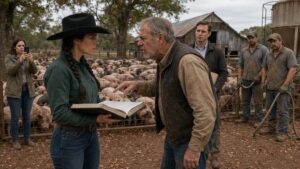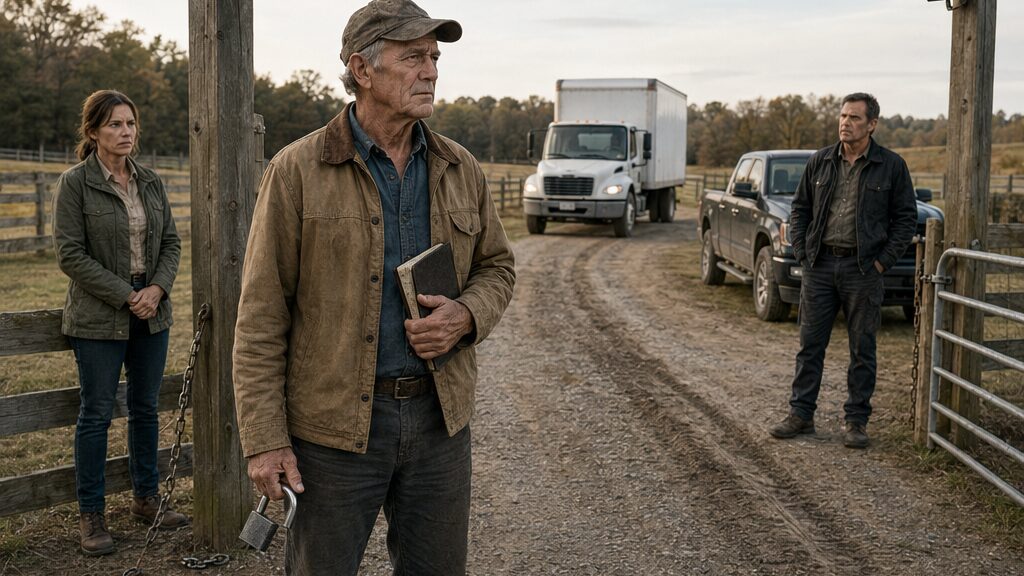
They Kept Cutting His Farm Gate Until the Old Road Started Counting Every Truck
Chapter 1: The Morning Someone Cut Thomas Carter’s Gate
The bolt cutters were already around Thomas Carter’s chain when he stepped out of the pickup.
He heard the handles close before he reached the gate.
The chain gave with a hard metallic crack.
For a second, nobody moved.
The man holding the cutters looked toward Thomas. Behind him, a white tractor-trailer idled on the county shoulder, its engine shaking the damp morning air. The trailer sat heavy on its axles. Mud marked the tires. Its nose pointed directly toward the narrow gravel lane that crossed Thomas’s pasture and disappeared behind a line of cedar trees.
Thomas shut his pickup door slowly.
“That gate was locked.”
The driver glanced down at the severed chain as though Thomas had pointed out a loose fence staple.
“Yeah.”
Thomas walked closer. At sixty-nine, he no longer moved as quickly as he once had, especially first thing in the morning, but there was nothing uncertain about where he stopped: directly between the truck and the opening.
“This is private property.”
The driver set the cutters in the grass.
“We were told we could come through.”
“By who?”
The driver shrugged. “Dispatch.”
“That isn’t a person.”
The truck engine continued its low rumble. Thomas could smell diesel over the wet weeds along the ditch.
The driver looked past him toward the gravel road.
“We’re just cutting across to the aggregate site. Saves us going around.”
“How much?”
“What?”
“How much road does it save?”
The man gave a short laugh, not cruel enough to be called mocking, but casual enough to make Thomas’s jaw tighten.
“Twenty minutes, maybe.”
Thomas looked at the broken chain.
The gate had stood there since before he was born. His father had replaced the original wooden one with galvanized pipe in the seventies, but the opening was the same, the posts were the same, and the road beyond it still followed the old rise past the lower field.
Twenty minutes.
The driver seemed to read Thomas’s silence as permission.
He picked up the cutters and started toward the cab.
Thomas stepped into his path.
“No.”
The man stopped.
“You’re going back the way you came.”
“We got a loaded truck.”
“You brought it here.”
“The road’s wide enough.”
“That isn’t the question.”
The driver exhaled and looked toward the truck again.
“Look, sir, I don’t decide the route.”
“And I don’t decide where your company owns land. I decide where I do.”
The driver stared at him for a moment, then pulled a phone from his vest.
Thomas waited.
He could feel the anger coming up through him, but he kept his hands loose. Thirty years earlier, he might have raised his voice. Ten years earlier, he might have dragged the broken gate closed and dared the truck to touch it.
Now he simply stood there.
The driver spoke briefly into the phone, turned away, listened, then came back.
“My manager says we’ve used this cut-through before.”
Thomas’s expression changed.
“When?”
“Don’t know.”
“Who gave permission?”
“Don’t know that either.”
“But you’re cutting locks.”
The driver looked down at the cutters.
“I was told the gate would be chained.”
“That answer bother you at all?”
The man’s mouth flattened.
“I’m trying to do my job.”
“So am I.”
Thomas pointed toward the county road.
“Back it out.”
It took almost fifteen minutes.
The truck had little room to turn, so the driver reversed slowly along the shoulder while Thomas stood beside the broken gate. Once the trailer finally straightened, the engine rose and the truck pulled away in the direction it had come.
Thomas watched until the sound disappeared.
Only then did he bend and pick up the padlock.
One side of the steel shackle had been cut cleanly.
He held it in his palm.
It looked smaller than it had the night before.
At the farm-supply store that afternoon, Thomas bought a heavier chain and a larger weather-resistant padlock.
The clerk ran the chain through the cutter twice before handing it across the counter.
“Gate trouble?”
“Something like that.”
“You want hardened chain?”
“This is hardened.”
The clerk looked at the size Thomas had chosen.
“Then I guess you want more hardened.”
Thomas almost smiled.
“Something they’ll remember.”
He installed the new chain before supper.
Ashley arrived while he was tightening it.
She parked beside the barn and walked down carrying two grocery bags.
“What happened to the old one?”
Thomas nodded toward the bed of his pickup, where the broken chain lay in a coil.
“Truck driver cut it.”
Ashley stopped.
“He what?”
“Company’s been using the road.”
“What company?”
“Didn’t ask the name.”
Her face changed in the way that always irritated him because it meant she was about to ask the question he already knew he should have asked.
“You didn’t get the truck number?”
“No.”
“License?”
“No.”
“Did you take a picture?”
“Ashley.”
“I’m asking.”
“I made him leave.”
“That wasn’t my question.”
Thomas pulled the new chain tight.
She set the grocery bags on the tailgate.
“You need to document this.”
“I need them to stop.”
“Those aren’t different things.”
He snapped the lock shut.
The steel click felt satisfying.
“There.”
Ashley looked at the chain, then at him.
“You think that fixes it?”
“It tells them what they need to know.”
“The first lock told them.”
Thomas did not answer.
She lowered her voice.
“Dad, call the company. Put it in writing.”
“I already told the driver.”
“The driver isn’t the company.”
“He can tell whoever sent him.”
Ashley studied him for another second, then picked up the groceries.
“You hate paperwork until paperwork is the thing you need.”
“I have owned this road longer than their dispatcher has probably been alive.”
“That doesn’t mean the dispatcher knows it.”
Thomas turned toward the house.
“It means the gate does.”
The next morning, he woke before six.
He made coffee, poured it into the same dented stainless mug he had carried for years, and stood at the kitchen window while the first pale light reached across the field.
Nothing moved near the road.
He felt faintly foolish for checking.
By six-thirty, he had fed the cattle and started toward the equipment shed.
Then he heard an engine.
Not on the county road.
On his road.
Thomas stopped.
A white truck appeared beyond the cedar line, coming toward the farm from the far end of the property.
For a moment, he could not understand what he was seeing.
Then he drove toward the gate.
By the time he arrived, the truck was already disappearing down the highway.
The gate stood open.
Thomas got out.
The new chain hung from one post.
The new padlock lay in the gravel.
Its hardened shackle had been cut clean through.
He stared at it for a long time.
Yesterday, he had been angry.
This morning, something colder replaced the anger.
Someone had not misunderstood him.
Someone had decided his answer did not matter.
Thomas bent, picked up the second broken lock, and closed his hand around it.
Chapter 2: Every New Lock Lasted Less Than a Day
The third padlock was lying in rain-soaked grass before Thomas had finished his first cup of coffee.
He saw the silver body from twenty feet away.
He did not hurry toward it.
The gate leaned inward, one side dragging where a truck tire had pushed the lower rail. Fresh tracks cut through the soft shoulder and continued down the gravel lane.
Thomas picked up the lock.
Another clean cut.
He carried it back to the barn and placed it beside the first two on his workbench.
Three locks.
Three mornings.
By the end of the week, there were five.
Thomas changed brands. He changed chains. He looped one chain twice through the gate and around the cedar post. He bought a lock with a covered shackle.
The covered shackle lasted until Thursday.
On Friday morning, he found half the chain in the ditch.
The trucks did not come at the same time. That made it worse.
Some mornings one appeared just after dawn. Other days Thomas heard nothing until midafternoon. Once, while he was repairing a water line behind the barn, two trucks crossed twenty minutes apart.
He reached the gate in time to stop the second.
The driver stayed in the cab.
Thomas stood below the window.
“You know this is private.”
The driver nodded reluctantly.
“My boss says we have access.”
“Who is your boss?”
“Anthony Davis.”
“Phone number?”
The driver hesitated, then gave it to him.
Thomas wrote it on the back of a feed receipt.
That afternoon, he called.
A man answered over the sound of machinery.
“Davis.”
“Anthony Davis?”
“Yes.”
“This is Thomas Carter. Your trucks are crossing my farm.”
A pause.
Then, “Carter Road?”
“It isn’t Carter Road. It’s my lane.”
“We’ve been running that cut for years.”
“Not with my permission.”
“Well, somebody gave permission.”
“Who?”
“I’d have to look.”
“You look. Until you find it, keep your trucks off.”
Anthony’s tone remained controlled.
“Mr. Carter, I’m not trying to get into a fight with you. That road has been used for deliveries a long time.”
“Deliveries to my farm are one thing. Running loaded trucks through because it saves you twenty minutes is another.”
“I hear you.”
“Good.”
Thomas hung up.
Two hours later another truck crossed.
That one bothered him more than the cut locks.
He drove to the hauling yard the next morning.
It sat six miles away beyond a fertilizer warehouse and a row of metal storage buildings. Several trucks were parked along a gravel lot.
Anthony Davis came out of a small office after Thomas asked for him.
He was younger than Thomas had expected, perhaps late forties, broad through the shoulders, wearing work boots and a dark jacket with dust along the cuffs.
“You Thomas Carter?”
“You Anthony?”
They shook hands once, without warmth.
Anthony nodded toward the office.
“You want coffee?”
“No.”
“All right.”
Thomas held up the newest broken padlock.
“Tell your drivers to quit doing this.”
Anthony looked at it.
“I never told anybody to cut your lock.”
“Yet they keep knowing they’re allowed through.”
“I told you. We’ve used that road before.”
“And I told you to stop.”
Anthony folded his arms.
“I’m trying to figure out what the history is.”
“Figure it out on your own road.”
Anthony’s jaw tightened.
“You know the public route adds almost forty miles round trip for some of those loads.”
“Then bid your jobs using the public route.”
“That isn’t how this started.”
Thomas watched him carefully.
“How did it start?”
Anthony looked toward the parked trucks.
“I inherited the route from the guy before me. It was already on our sheets. Local cut-through. Farm access.”
“Whose farm?”
“I don’t know.”
“That’s the problem.”
Anthony looked back at him.
“No, Mr. Carter. The problem is we both think the other one is changing something that already existed.”
For the first time, Thomas had no immediate answer.
He disliked that more than he disliked Anthony.
He left without another word.
By the tenth day, six broken locks sat on the workbench.
Ashley found Thomas standing over them on Sunday afternoon.
She picked one up.
“You’re collecting these now?”
“They cost enough. I’m not throwing them away.”
She set it down.
“Did you send the letter?”
“What letter?”
Her eyes closed briefly.
“The one telling the company in writing to stay off the road.”
“I spoke to Anthony.”
“That is not a letter.”
“He knows.”
“You know he knows. You can’t prove what he knows.”
Thomas turned away.
“I’m not going to spend three hundred dollars talking to a lawyer just to explain what a gate means.”
Ashley followed him toward the kitchen.
“No. You’re going to spend three hundred dollars every week buying locks because you’d rather be right than organized.”
He stopped.
“That’s enough.”
She stopped too.
The room went quiet.
Ashley did not apologize.
Instead she pulled a thick folder from the cabinet where Thomas kept tax statements, crop receipts, and insurance papers.
“What are you doing?”
“Finding the parcel map.”
“I know where my road is.”
“I know you do.”
She sat at the kitchen table and began sorting.
Thomas almost told her to put everything back.
Then she unfolded an old county tax sheet and leaned closer.
“What’s this?”
Thomas came over.
At the bottom of the property description was a notation referencing an older recorded instrument.
He squinted.
“That might be from when Dad divided the north field.”
Ashley read the line again.
“It mentions access.”
Thomas took the paper from her.
A book number and page number appeared beside the notation.
He recognized neither.
Ashley looked at him.
“You ever seen that?”
“No.”
“Could Anthony be talking about this?”
“He doesn’t know what this is.”
“You don’t know what it is.”
Thomas looked again at the number.
The sentence irritated him because it was true.
On Monday morning he called the county recorder.
A clerk answered.
Thomas gave his parcel information, then the book and page number Ashley had found.
There was a pause while a keyboard clicked.
“Yes,” the clerk said. “I have something.”
“What is it?”
“Recorded access agreement. Older one.”
“How old?”
Another pause.
“Looks like several decades.”
Thomas sat straighter.
“Who signed it?”
“I’d rather not read the whole instrument over the phone.”
“I just need to know whether it gives commercial trucks the right to cross my land.”
“I can’t interpret it for you.”
“Can you tell me whose names are on it?”
The clerk read two surnames Thomas knew immediately.
One belonged to his father.
The other belonged to the family that had once owned the neighboring acreage.
Thomas looked toward the window.
Outside, the farm lane ran pale between the fields.
He had spent ten days treating the road’s history as if he already knew every inch of it.
The clerk spoke again.
“Mr. Carter?”
“Yes.”
“You may want to come in and see this.”
“Why?”
“Because the agreement was recorded before the property was transferred into your name.”
Thomas’s grip tightened around the phone.
For the first time since the first chain had been cut, the question was no longer why the trucks thought they could use his road.
It was whether someone in his own family had once given them a reason.
Chapter 3: The Old Agreement Was Not What Thomas Remembered
Thomas recognized his father’s parcel number before he understood a single sentence on the page.
The county recorder had placed a photocopy of the old instrument in front of him beneath the fluorescent lights of the records office.
There it was near the top.
The same tract.
The same gravel road.
The same farm.
Thomas put on his reading glasses.
“This is the whole thing?”
“That’s the recorded document,” the clerk said. “There are references to two later filings, but this is the original.”
The paper was older than Thomas had expected.
His father had signed it before Thomas was old enough to drive.
The neighboring owner had needed access across part of the Carter property to reach fields that had once been landlocked during wet months. The agreement permitted agricultural access and ordinary service vehicles connected to those parcels.
Thomas read that portion twice.
Then he found the restriction.
Commercial use outside the described farm purposes required permission from the Carter property owner.
He sat back.
“So they don’t have it.”
The clerk gave him the practiced expression of someone who had spent years being asked legal questions she could not answer.
“I can tell you what the document says. I can’t tell you what a court would decide.”
Thomas tapped the paragraph.
“It says permission.”
“Yes.”
“I never gave it.”
The clerk turned to the two later references.
“One of these appears to concern a parcel transfer. The other may clarify continued access.”
“Print both.”
Twenty minutes later Thomas walked out with a folder tucked under his arm.
For the first time in almost two weeks, he felt ahead of the trucks.
He drove directly to Ashley’s place of work and waited until she came outside during her lunch break.
She climbed into his pickup.
“You found it?”
Thomas handed her the folder.
“They have farm access. Not commercial hauling.”
Ashley read silently.
Thomas waited.
He wanted her to say he had been right.
Instead she reached the same paragraph the clerk had shown him and said, “It says commercial use needs owner permission.”
“Exactly.”
“Did anybody else ever give permission?”
“No.”
“You sure?”
Thomas looked at her.
“I would know.”
Ashley held his gaze for a second too long.
“Dad.”
“What?”
“Uncle Scott handled the north fields for years.”
Thomas’s shoulders stiffened.
“He handled crops. He didn’t give away roads.”
“I didn’t say he gave it away.”
“He wouldn’t have.”
“You need to ask.”
Scott had been dead four years.
Thomas turned toward the windshield.
For most of his life, he and his younger brother had divided work without writing much down. Thomas handled cattle and equipment. Scott handled seed orders, grain contracts, delivery schedules, and half the people Thomas preferred not to talk to.
Permission for a truck to cross during harvest would have been exactly the sort of small arrangement Scott might have made without mentioning it.
That did not mean he had.
Thomas started the pickup.
“I know somebody who might remember.”
David Nelson was fixing a gate hinge when Thomas pulled into his place that afternoon.
He looked up from the post.
“Haven’t seen you out this way in a while.”
“I need to ask you something.”
David saw the folder under Thomas’s arm and set down the wrench.
“That sounds expensive.”
“Did Scott ever let trucks cross our road?”
David did not answer immediately.
Thomas felt the answer before hearing it.
“What kind of trucks?” David asked.
“You know what kind.”
David rubbed his jaw.
“Years back, during harvest, maybe.”
“How many?”
“Thomas—”
“How many?”
“I don’t know. A handful.”
“For who?”
“Feed deliveries. Lime. Once or twice a hauler when the south road washed out.”
Thomas stared at him.
“You used it too?”
“My fertilizer man crossed there one wet spring. Scott said it was fine.”
“That was farm use.”
“Mostly.”
“Mostly?”
David leaned against the post.
“There was a hauling outfit years ago. Not the one running now. They moved equipment through for a couple weeks.”
Thomas felt heat rise behind his collar.
“Scott allowed that?”
“I believe so.”
“You believe.”
“I wasn’t standing there when they shook hands.”
“Then how do you know?”
“Because Scott told me to leave the gate unchained while they were working.”
Thomas turned away.
Beyond David’s pasture, the hills rolled toward the county road.
His brother had not given the road away.
Thomas knew that.
But certainty no longer came as easily as it had that morning.
David picked up the wrench again but did not resume working.
“Thomas, nobody around here ever thought that road was public.”
“That’s not what Anthony Davis says.”
“Anthony probably heard trucks had used it and filled in the rest.”
“That excuse ended when I told him to stop.”
David nodded.
“That part, I agree with.”
Thomas looked back at him.
“Why didn’t you tell me this earlier?”
David’s expression tightened.
“Because I figured you knew.”
The answer landed harder than Thomas expected.
He had spent days furious that other people behaved as though they understood his road better than he did.
Now he was discovering that, in one narrow way, they might have.
That evening, he spread the county documents across the kitchen table.
Ashley sat opposite him.
Between them lay one of the broken padlocks.
Thomas had brought it inside without thinking.
Ashley noticed.
“That one special?”
“They all look the same after somebody cuts them.”
She read the access agreement again.
“So where does this leave you?”
“With a private road.”
“I know.”
“And no permanent commercial easement.”
“I know.”
Thomas frowned at her repetition.
“But?”
“But Anthony can say he inherited a route people had used before.”
“He can say the moon belongs to him.”
“He can say he reasonably thought there was permission.”
Thomas leaned back.
“He kept going after I told him there wasn’t.”
“Verbally.”
He looked at her.
Ashley did not soften it.
“You still haven’t sent anything.”
Thomas stared down at the padlock.
Six times he had replaced steel with heavier steel.
Six times somebody had defeated it.
Each time he had treated the next lock as a stronger version of the same answer.
Maybe that was the problem.
The following morning, Thomas met with a property attorney in town.
The attorney read the documents, asked about Scott, asked about prior truck traffic, asked exactly what Thomas had said to Anthony and exactly when.
Thomas grew impatient.
“The paper says commercial traffic needs permission.”
“It does.”
“So that’s it.”
“No.”
Thomas stared at him.
The attorney folded his hands.
“You have a strong argument that the current hauling exceeds the recorded access. But if your brother permitted similar use, even informally, that history matters. Not necessarily enough to give them permanent rights, but enough that you should stop treating this as obvious.”
“They cut my locks.”
“That matters too.”
“They keep entering after I told them not to.”
“That matters more if we can establish when they were formally told.”
Thomas looked toward the window.
“You sound like my daughter.”
“That usually means somebody should listen.”
Thomas almost objected.
Instead he asked, “What do I do?”
The attorney slid a legal pad toward himself.
“First, we give written notice. Clear, dated, delivered. We identify what use you allow and what use you withdraw.”
“And then?”
“We document what happens afterward.”
Thomas looked down at his hands.
“What about the gate?”
“You can lock your gate.”
“They’ll cut it.”
“Then document that too.”
Thomas imagined another trip to the farm-supply store. Another chain. Another morning walking through wet grass looking for another broken piece of steel.
Something in him resisted the idea.
Not because he feared losing another lock.
Because he suddenly understood that the locks had become an argument he was having with himself.
He had been trying to prove nobody could cross.
The trucks had been proving they could.
Neither fact answered whether they had the right.
That afternoon Ashley met him at the farm.
She opened the bed of his pickup and found no new chain.
“You forgot the store?”
“No.”
“You need another lock.”
Thomas walked into the barn.
The broken ones remained lined along the workbench.
He picked up the first—the small one cut on Monday morning—and rolled it once in his palm.
Ashley stood in the doorway.
“What are you doing?”
“Changing the way I’m asking.”
She waited.
Thomas set the old lock down beside the county documents and a fresh blank notebook.
“Tomorrow we send the notice.”
“And the gate?”
Thomas looked through the barn doors toward the gravel lane.
For nearly two weeks, he had wanted nothing more than to make that opening impossible to cross.
Now the thought of another locked chain seemed almost useless.
Ashley followed his gaze.
“You’re still going to secure it, right?”
Thomas closed the notebook.
“No.”
She stared at him.
He picked up the broken padlock.
“Don’t buy another lock.”
Chapter 4: Then Thomas Left the Farm Gate Open
The first truck slowed so abruptly at Thomas Carter’s gate that its trailer tires hissed against the county pavement.
The gate stood wide open.
No chain crossed it. No padlock hung from the latch. Nothing blocked the gravel lane.
Thomas sat twenty yards inside the property on an overturned feed bucket with a stainless mug beside his boot and a small notebook open across one knee.
The driver leaned out his window.
“You leaving it open now?”
Thomas looked at his watch.
“Six forty-three.”
“What?”
Thomas wrote the time down.
The driver waited.
Thomas lifted one hand.
“Morning.”
The truck rolled forward.
Above the gate, fixed to a cedar post beneath the shelter of a small metal hood, a weatherproof camera recorded the cab as it entered. A second camera farther down the lane caught the trailer and rear plate.
The driver glanced up at the first camera.
Thomas watched him notice it.
The truck did not stop.
By the time the trailer disappeared beyond the cedars, Thomas had written the date, time, truck description, and direction of travel in his notebook.
He closed it.
His hand was shaking slightly.
Not from fear.
From the effort of doing nothing.
For nearly two weeks, every truck had demanded a response from him. Close the gate. Replace the chain. Drive down the lane. Stand in front of the cab. Argue with somebody who claimed somebody else had given permission.
Now he had done the opposite.
He had stepped aside.
Ashley arrived at seven-fifteen carrying a paper cup of coffee she did not need and an expression that said she had spent the whole drive reconsidering his plan.
“You actually left it open.”
Thomas nodded toward the gate.
“You thought I wouldn’t?”
“I hoped you’d think about it overnight.”
“I did.”
“That usually makes you more stubborn.”
He ignored that.
The attorney had sent the formal notice the previous afternoon by certified mail and email. It described the recorded agreement, acknowledged the old agricultural access, and stated plainly that Thomas was withdrawing any permission for unrestricted commercial hauling across the Carter property.
Anthony Davis had received the emailed copy before five.
The certified copy would follow.
Ashley looked toward the camera.
“You sure these work?”
“I tested them.”
“And the clock?”
“Matched it to my phone.”
She picked up the notebook.
Thomas reached for it automatically.
Ashley held it away.
“I’m not changing anything.”
“I know how to write.”
“I know.”
She turned several pages.
Thomas had made columns: time, direction, truck description, distinguishing marks.
“What about photographs?”
“The cameras have them.”
“What about drivers?”
“If I know them, I’ll note it.”
Ashley looked toward the open gate again.
“This feels wrong.”
“That makes two of us.”
“I mean legally.”
“The attorney said not to obstruct them while we’re documenting.”
“He said you could keep the gate locked.”
“And buy another lock.”
“That’s not the point.”
“It became the point.”
Thomas took the notebook from her.
The broken padlock from the first morning was in his jacket pocket. He had brought it down without deciding why.
He could feel its weight against his ribs.
At eight-oh-two, another truck appeared.
This driver slowed even more than the first.
Thomas stood.
The truck crept through the opening.
The driver stared at him.
Thomas raised his hand.
The man raised his own, almost reluctantly.
Thomas smiled just enough to be polite.
The driver smiled back.
That bothered Ashley.
She waited until the truck was halfway down the lane.
“You’re enjoying this.”
“No.”
“You smiled.”
“I wave at people driving through my farm.”
“You’ve spent two weeks trying to keep them out.”
“That was before yesterday.”
Ashley looked at him carefully.
“What changed yesterday?”
Thomas tapped the notebook.
“I quit trying to prove they could break a lock.”
He wrote down the time.
“Now I’m letting them prove something else.”
By noon, four commercial trucks had crossed.
One came back empty.
Thomas recorded that too.
At one-thirty, his phone rang.
Anthony.
Thomas let it ring twice.
“Carter.”
“You sent me a letter.”
“My attorney did.”
“I read it.”
“Good.”
Anthony paused.
“So you’re saying nobody can use that road anymore?”
“No. Read it again.”
“It says commercial traffic.”
“That’s what your trucks are.”
“We’ve already been over this.”
“Now we’ve put it in writing.”
Another pause.
Anthony’s voice lowered.
“You know we’ve been using that cut.”
“I know you have.”
“Then why is the gate open?”
Thomas looked at Ashley.
She was listening.
“Because you know what I’m asking.”
“That doesn’t answer my question.”
“It answers mine.”
Thomas ended the call.
Ashley stared at him.
“You could have told him.”
“He has the notice.”
“You could have told him about the cameras.”
“They’re sitting on posts.”
“That isn’t what I mean.”
Thomas put the phone down.
“You think I’m tricking him.”
“I think if your goal is to make them stop, you should make it impossible for them to say they didn’t understand.”
Thomas’s first reaction was irritation.
Then he remembered the attorney’s questions.
Exactly what did you say?
Exactly when?
He looked toward the lane.
Ashley had been right about the written notice.
He disliked the possibility that she might be right again.
At three-fifteen, Thomas called Anthony back.
The conversation lasted forty seconds.
“You got the notice?”
“Yes.”
“You understand I am not giving permission because the gate is open?”
Silence.
Then Anthony said, “I understand what you’re claiming.”
“That isn’t what I asked.”
“I understand you don’t want the trucks there.”
Thomas wrote the time beside the sentence while Anthony was still talking.
“Good.”
He hung up.
The next truck crossed at three-forty-one.
Thomas watched it pass beneath the camera.
For the first time, the open gate did not feel like surrender.
It felt like a line drawn somewhere stronger than steel.
Over the next four days, the routine settled into something Thomas had not expected.
He stopped chasing engines.
He stopped waking in the night wondering whether a chain had been cut.
He sat near the gate at the busiest hours, made notes, checked the cameras, and went back to his farm work.
The trucks kept coming.
Some drivers waved.
Some stared straight ahead.
One slowed and called from the cab, “Guess we wore you down.”
Thomas wrote the time.
“That what they told you?”
The driver grinned and drove on.
Thomas did not explain.
On Friday morning, Ashley brought printouts from the camera system.
She spread them across the kitchen table beside the county documents.
Each image carried a date and time.
Thomas matched them to his notebook.
Six forty-three.
Eight oh-two.
Eleven seventeen.
One thirty-four.
Three forty-one.
The list grew.
Ashley ran a finger down the page.
“This is cleaner than the first week.”
Thomas knew what she meant.
The first week was anger, memory, and damaged locks.
This was dates.
Times.
Vehicles.
Notice.
Still, she frowned.
“What?”
“I keep thinking about what the judge might see.”
“We don’t have a judge.”
“Yet.”
Thomas leaned back.
“What would you see?”
“A man who says he doesn’t consent, but leaves his gate open.”
Thomas looked at the photographs.
“You think I should close it?”
“I think we should ask the attorney again.”
Thomas did not argue.
That surprised them both.
The attorney called an hour later.
“Open gate doesn’t automatically mean permission,” he said. “Especially after explicit notice. But Ashley is right to be careful. Keep your communication consistent. Don’t wave people in. Don’t give directions. Don’t create anything that looks like invitation.”
Thomas glanced toward Ashley.
She raised one eyebrow.
“I waved.”
The attorney paused.
“How?”
“With my hand.”
“I assumed that.”
Thomas sighed.
“I mean I said morning.”
“That probably doesn’t decide a property case. Still, stop being charming.”
Ashley covered her mouth to hide a smile.
Thomas looked away.
That afternoon he moved the feed bucket farther from the gate.
He did not wave at the next two trucks.
At five-twenty, a dark pickup turned from the county road and stopped before entering.
Anthony Davis stepped out.
No reflective vest.
No clipboard.
No truck behind him.
He walked to the open gate and looked up at the camera.
Then he looked at Thomas, who stood beside the cedar post with the old broken padlock in one hand and the notebook under his arm.
Anthony nodded toward the empty entrance.
“For two weeks you were ready to fight over every inch of this road.”
Thomas said nothing.
Anthony stepped closer.
“Now you’re sitting here letting every truck through.”
Thomas slipped the padlock into his pocket.
Anthony’s eyes followed the movement.
“What changed?”
Thomas looked past him toward the public road.
Then back at the man whose trucks had kept crossing after the locks were cut, after the phone calls, and now after the written notice.
“You tell me.”
Anthony’s expression tightened.
“No. I came here because I want to know what you’re doing.”
Chapter 5: Anthony Davis Finally Admitted What the Shortcut Cost
Anthony Davis returned the next morning without a truck and asked Thomas for ten minutes.
Thomas checked his watch.
“You already used two yesterday.”
Anthony did not smile.
“I’m serious.”
“So am I.”
They stood just inside the open gate. The cameras remained above them, but Anthony glanced at both before speaking.
“This being recorded?”
“Video.”
“Audio?”
“No.”
Anthony looked relieved enough that Thomas noticed.
“You want coffee?” Thomas asked.
Anthony shook his head.
“I want to solve this before lawyers turn it into something neither of us can control.”
Thomas folded his arms.
“Your trucks can stop.”
“That isn’t a solution.”
“It’s the first one I offered.”
Anthony looked down the gravel road.
The morning was quiet. No engines yet.
“We have a delivery contract west of here. Six weeks left on it.”
Thomas waited.
Anthony rubbed the side of his jaw.
“The public route adds thirty-seven miles to some trips. Depends where the load starts.”
“You told me forty.”
“Close enough.”
“Not when you’re charging by the mile.”
Anthony glanced at him.
“That’s part of the problem.”
Thomas understood before Anthony finished.
“You bid the job using my road.”
Anthony’s face hardened.
“I bid the job using the route our company had been using.”
“You priced land you didn’t own.”
“I priced a route on our dispatch sheets that had been there before I took over.”
Thomas almost interrupted.
He stopped himself.
Anthony continued.
“My predecessor showed it as established farm access. Drivers had used it. Nobody had a complaint in the file.”
“My brother was alive then.”
“I know that now.”
Thomas’s jaw tightened at the word now.
Anthony looked toward the barn.
“I’m not saying cutting locks was right.”
“But you didn’t stop it.”
“I told the drivers not to damage anything after you called me.”
“They crossed anyway.”
“Yes.”
“Through a locked gate.”
Anthony exhaled.
“The first few days, I thought somebody on your side was locking a route that had been open for years.”
Thomas stared at him.
“My side?”
“You know what I mean.”
“No. Explain it.”
Anthony’s patience thinned.
“I thought this was a family-property disagreement or a new-owner problem or somebody changing an old arrangement without knowing what it was. That happens.”
“I’ve owned this place twenty-three years.”
“I know that now too.”
Thomas felt the old anger gathering.
He reached into his jacket and took out the cut padlock.
Anthony’s eyes dropped to it.
Thomas turned it once in his hand.
“This was Monday.”
He took a second from the pocket on the other side.
“This was Tuesday.”
Anthony looked toward the barn.
“There are more?”
“Six.”
“I didn’t tell anybody to cut six locks.”
“You kept sending trucks.”
“I kept operating on what I believed was an existing route.”
“After I told you to stop.”
Anthony rubbed his forehead.
“Yes.”
The answer came without excuse.
That made Thomas listen.
Anthony continued more quietly.
“Because if I rerouted every load the day you called, we would have missed delivery windows until I figured out whether you had the right to close it.”
“You could’ve called a lawyer.”
“So could you.”
Thomas almost laughed, though there was nothing funny in it.
“That your defense?”
“No. That’s the problem.”
For several seconds neither man spoke.
Then an engine sounded on the county road.
A loaded tractor-trailer approached.
Anthony watched it slow at the open gate.
Thomas took out his notebook.
The driver looked from Thomas to Anthony.
Anthony gave no signal.
The truck entered.
Thomas wrote down the time.
Anthony watched the pencil move.
“So that’s what this is.”
Thomas closed the notebook.
“That’s what what is?”
“The gate.”
Thomas said nothing.
Anthony gave a short breath.
“You’re counting trucks.”
“I’m writing down what happens.”
“You sent the notice, opened the gate, and started counting.”
“I opened nothing that wasn’t already mine.”
Anthony’s eyes narrowed.
“You’re trying to build damages.”
Thomas put the notebook under his arm.
“I’m trying to build facts.”
The distinction seemed to bother Anthony.
He stepped closer.
“Thomas, listen to me. Six weeks. Let us finish the contract. I’ll pay to regrade the road.”
Thomas looked at him.
“And the ditch?”
“What ditch?”
“The west shoulder is collapsing because your loaded trailers keep cutting the turn.”
Anthony looked toward the entrance.
“We’ll repair that too.”
“The gate?”
“Yes.”
“The chains?”
Anthony’s mouth tightened.
“Yes.”
“And then what?”
“Then we stop using it.”
Thomas studied him.
“Why not stop now?”
Anthony looked away.
That was the answer Thomas had been waiting for.
Not the old agreement.
Not his brother.
Money.
“How bad?”
Anthony did not respond.
Thomas waited.
Finally Anthony said, “Bad enough.”
“That isn’t a number.”
“You don’t need the number.”
“I need to know why you keep making this choice.”
Anthony’s face changed.
The frustration remained, but something under it gave way.
“I priced the contract wrong.”
Thomas said nothing.
“The margins were thin from the beginning. Fuel moved. Two trucks went down for repairs. The public route makes the remaining loads barely worth running.”
“And that’s my problem?”
“No.”
Anthony’s answer was immediate.
“But it became mine, and I handled it like it had to stay yours.”
Thomas had expected another argument.
Instead he got the first thing that sounded like an admission.
Anthony kicked a small stone off the gravel.
“I thought the road was established. Then I thought you were overreacting. Then the drivers were already using it, and every day I waited made it harder to change the schedule.”
“So you kept going.”
“Yes.”
“Even after the letter.”
Anthony hesitated.
“Yes.”
Thomas could hear Ashley’s voice in his mind.
Make it impossible for them to say they didn’t understand.
“When did you understand the letter?”
Anthony’s head came up.
“What?”
“When did you understand that I was withdrawing permission for commercial trucks?”
“You trying to get me to say something?”
“I’m asking you a question.”
Anthony looked at the cameras.
“They don’t have audio, you said.”
“They don’t.”
Anthony seemed embarrassed that he had checked.
He looked back at Thomas.
“I understood what you wanted when you called me the first time.”
Thomas felt something inside him settle.
Not victory.
Something heavier.
Because Anthony had not been confused for as long as Thomas had wanted to believe.
And because Anthony was not laughing.
He was a man who had made one bad business decision and kept making smaller bad decisions to avoid admitting the first one.
Thomas knew something about that pattern.
Six locks sat in his barn because he had done his own version of it.
Anthony spoke again.
“I’m asking you to give me until the contract ends.”
Thomas shook his head.
“No.”
“You don’t even want to think?”
“I’ve been thinking for three weeks.”
“I’ll put the repairs in writing.”
“No.”
“Then what do you want?”
Thomas looked toward the road.
“I wanted you to stop before any of this.”
“That time’s gone.”
“Yes.”
That afternoon, Thomas and Ashley drove to the attorney’s office with the notebook and a folder of camera stills.
The attorney laid the entries in chronological order.
He compared them to the delivery receipt showing when Anthony had received the formal notice.
Then he drew a line across a yellow legal pad.
“Before this line,” he said, “the history is messy.”
Thomas did not like that word.
The attorney tapped the photographs after the line.
“After this, it gets cleaner.”
“How clean?”
“Cleaner. Not magical.”
Ashley leaned forward.
“What about the verbal call?”
“Useful, but disputed conversations are disputed conversations. The written notice helps.”
Thomas looked at the sequence.
There were more post-notice crossings than he had realized.
The days had blurred while he sat at the gate.
On paper, they looked deliberate.
One after another.
The attorney pointed to an image from Friday afternoon.
“Do you recognize this pickup?”
Thomas did.
“Anthony’s.”
“And this?”
A camera still fifteen minutes later showed another commercial truck entering.
Thomas looked at Ashley.
Anthony had been at the gate.
He had asked what Thomas was doing.
Then another truck had crossed afterward.
The attorney leaned back.
“If your goal is to stop the traffic, I recommend seeking an injunction. That gets the central issue in front of a judge without pretending every historic crossing is automatically worth a fortune.”
Thomas stared at the padlock he had placed beside the papers.
For days he had imagined making the company pay for every load that had ever rolled over his family’s gravel.
That anger had kept him moving.
Now the records told a different story.
Some older traffic might have been allowed.
Some might have been tolerated.
Some could never be reconstructed clearly.
But what happened after the warning was different.
Thomas picked up the padlock.
“I don’t want another chain.”
The attorney nodded.
“I know.”
“I want them stopped.”
“Then that’s what we ask for first.”
Thomas looked at Ashley.
She waited.
He felt the old instinct to handle one more thing himself, to make one more trip to the gate, to have one more conversation with Anthony without anyone else involved.
Instead he pushed the camera folder toward the attorney.
“File it.”
The attorney placed a hand on the folder.
“For an injunction?”
Thomas nodded.
“For the road.”
Chapter 6: The Case Turned on What Happened After the Warning
Anthony Davis’s attorney began by proving Thomas wrong about his own road.
The first photograph displayed in the county courtroom was not recent.
It showed a truck crossing the Carter property years earlier.
Then came another.
A fertilizer delivery.
A flatbed carrying farm equipment.
An older hauling truck near the north field.
Thomas sat beside his attorney and watched each image appear.
Across the aisle, Anthony kept his eyes on the table.
“This is not a road that suddenly saw its first commercial vehicle last fall,” Anthony’s attorney said. “The evidence shows a long pattern of practical access known to the Carter family.”
Thomas shifted in his chair.
His own attorney leaned close.
“Let him finish.”
“I know.”
But his voice came out tighter than he intended.
Months had passed since the first lock was cut.
During that time, temporary restrictions had reduced the hauling traffic while the property dispute moved through the court. Surveyors had measured the lane. Lawyers had collected records. David had given a statement about Scott’s old permissions.
The simple story Thomas once carried in his head had not survived contact with any of it.
His road had always been private.
It had also never been quite as closed as he remembered.
Anthony’s attorney called David’s statement into the record.
Scott Carter had allowed seasonal deliveries.
Scott had once permitted equipment hauling during a period when another road was washed out.
Nobody had signed a permanent commercial easement.
Nobody had charged tolls.
Nobody had posted schedules.
Permission had often been a conversation beside a truck or a call to the farmhouse.
Thomas could feel the judge listening more carefully to those details than to his six broken locks.
When Thomas finally took the stand, Anthony’s attorney approached with a copy of the old agreement.
“Mr. Carter, you have testified that commercial trucks had no right to use your road.”
“Not without permission.”
“That’s not quite what you said when this began, is it?”
Thomas knew where the question was going.
“No.”
“You said nobody had ever permitted commercial use.”
“Yes.”
“And that was incorrect.”
His attorney shifted beside him.
Thomas looked at the old document.
Then at Anthony.
“Yes.”
The answer seemed to surprise the other attorney.
“So your initial understanding was wrong.”
“Yes.”
“Your brother had permitted trucks.”
“Some trucks. For specific reasons.”
“But trucks.”
“Yes.”
“And you were unaware of that history when you first confronted my client’s driver.”
“Yes.”
Thomas heard the faint scratch of the judge’s pen.
Anthony’s attorney returned to the table.
For months, Thomas had feared that admitting the old permissions would make him look weak.
Now that the words were out, the opposite happened.
The room felt simpler.
Anthony’s attorney tried again.
“So Mr. Davis had reason to believe the route was legitimate.”
“At first.”
The attorney stopped.
“At first?”
Thomas nodded toward the evidence folders.
“He had reason to ask questions. He didn’t have reason to keep using it after I answered them.”
The courtroom quieted.
Anthony’s attorney looked toward the judge, then back to Thomas.
“You are not a lawyer.”
“No.”
“You cannot personally determine the legal scope of an easement.”
“No.”
“So when you told Mr. Davis to stop, that did not settle the legal question.”
“No.”
Thomas paused.
“But it settled whether he had my permission.”
His own attorney did not smile.
Neither did the judge.
But Thomas saw the judge write something down.
Later that morning, Thomas’s attorney introduced the formal notice.
Not the old family agreement.
Not the tax map.
The notice.
Date sent.
Date received.
Language withdrawing consent for unrestricted commercial hauling.
Then the camera records.
The first image showed the open gate and a truck crossing the following morning.
The second showed another.
The third showed Anthony’s pickup at the property.
Then came the truck that crossed fifteen minutes after Anthony had stood at the gate asking Thomas why he was documenting traffic.
Thomas’s handwritten ledger was placed beside the images.
The times matched.
The dates matched.
The vehicles matched.
Anthony’s attorney challenged the open gate.
“If Mr. Carter truly objected, why did he remove the physical barrier?”
Thomas’s attorney looked at him.
Thomas answered only when directed.
“Because the locks weren’t stopping anything.”
“Instead you allowed trucks to enter.”
“I stopped fighting steel with steel.”
“That sounds convenient.”
“It was cheaper.”
A few people in the courtroom shifted, but nobody laughed.
The judge raised a hand before the lawyers could turn the exchange into something larger.
“The question,” the judge said, “is not whether an open gate can be driven through. The question is what legal rights existed after notice was given.”
Thomas looked down at his hands.
That was the sentence he had spent months trying to find.
Not whether a truck could cross.
Whether it had the right to.
Anthony testified that afternoon.
He described the inherited route sheets.
The old pattern of farm access.
The contract.
When asked whether he initially believed the road could be used, he said yes.
Thomas believed him.
Then Thomas’s attorney asked when that belief changed.
Anthony hesitated.
“Changed is strong.”
“When did you understand Mr. Carter objected to continued commercial hauling?”
“The first call.”
“And did trucks continue afterward?”
“Yes.”
“When did you receive written notice?”
Anthony gave the date.
“Did trucks continue afterward?”
“Yes.”
“Why?”
Anthony looked toward Thomas.
For a moment Thomas saw the same man who had stood at the gate asking for six weeks.
“We had a contract to complete.”
“That was not my question.”
Anthony’s shoulders lowered.
“Because rerouting would have cost us money.”
The answer stayed in the room.
There was no dramatic reaction.
No one gasped.
Thomas felt no pleasure hearing it.
Only confirmation.
When arguments turned to damages, Thomas expected the strongest part of his case to become the most satisfying.
Instead it became the hardest.
His initial filing had included estimates for historical commercial use extending years backward.
Anthony’s attorney attacked them immediately.
Which crossings had Scott permitted?
Which were agricultural?
Which involved the neighboring parcels?
Which records showed vehicles actually crossing the Carter road rather than merely delivering somewhere nearby?
The answer, too often, was unclear.
The judge rejected the broadest retroactive theory.
Thomas felt his face heat.
Outside the courtroom during recess, he turned on his attorney.
“So they get all those years free?”
“That isn’t what happened.”
“You said we had a case.”
“We do.”
“You just let him erase half of it.”
Ashley stood several feet away.
The attorney waited until Thomas finished.
Then he said, “You want me to argue facts we can’t prove?”
Thomas said nothing.
“The recent crossings are documented. The road damage is documented. The notice is documented. The historic claim is weaker because the history is mixed.”
Thomas looked through the courthouse window at the parking lot.
Months earlier, that answer would have sounded like surrender.
Now it sounded uncomfortably familiar.
The attorney lowered his voice.
“You can be right about what matters without being right about everything.”
Thomas looked at Ashley.
She did not say anything.
She did not need to.
Back inside, the judge issued findings from the bench on the immediate property question.
The recorded agreement permitted limited access connected to neighboring agricultural use.
It did not establish unrestricted commercial hauling rights for Anthony’s company.
Prior informal permission did not automatically become permanent authorization.
Most importantly, after explicit notice, continued commercial crossings could not be justified merely by pointing to past tolerance.
Thomas had the right to exclude the hauling traffic.
The court would also consider verified road damage, drainage repairs, costs, and other relief.
Thomas should have felt triumphant.
Instead he thought of Scott.
Of the trucks his brother had waved through.
Of all the times Thomas had insisted nobody had ever been allowed there because that version made the conflict easier to carry.
The judge had given him his road.
The judge had also taken away the cleaner story.
Anthony sat motionless across the aisle.
When the hearing moved to remedies, Thomas’s attorney presented repair estimates for the gravel surface, the damaged shoulder, the drainage ditch, and the gate.
Anthony’s side contested portions but not all.
Legal fees were discussed.
Future written-access requirements were discussed.
Then Thomas’s attorney paused.
“There is also the question of additional monetary damages for the knowing post-notice use.”
Thomas looked at the figures.
They were substantial.
Not enough to destroy Anthony’s company outright.
Enough to hurt it badly.
A year earlier, Thomas would have said that was the point.
The judge looked over the papers.
Then looked toward Thomas’s table.
“You have established a right to exclude this commercial traffic,” the judge said. “You have also established a basis for documented property damage and certain costs.”
Thomas listened.
“The historic record is less clear, and I will not treat every prior crossing as wrongful when some forms of access were plainly permitted or tolerated.”
Thomas nodded once.
The judge continued.
“Before I determine final relief, I want both sides to address a practical question.”
Thomas’s attorney stood.
“Yes, Your Honor.”
The judge looked directly at Thomas.
“If the purpose of this action is to make the property whole and prevent unauthorized commercial use, what remedy actually accomplishes that?”
Thomas glanced down at the photographs.
Then at the old padlock sitting inside the evidence bag.
For months he had counted trucks.
Now the court was asking him to count something harder.
Not how much Anthony could be made to lose.
How much Thomas actually needed to get back.
Chapter 7: He Asked for His Road Back, Not Their Ruin
Thomas crossed out the largest number on the settlement sheet before his attorney finished explaining it.
The pen left a dark line through the proposed additional damages.
His attorney looked at him.
“Thomas.”
“I heard you.”
“That number is negotiable.”
“I know.”
“You have leverage now.”
Thomas set the pen down.
Across the conference table, Ashley watched him without interrupting. The hearing had ended three days earlier with the judge giving both sides one final opportunity to resolve the remaining damages and future access terms before a formal order was entered.
Thomas had spent those three days thinking about the judge’s question.
What would actually make the property whole?
The first answer had been money.
Enough money to make Anthony Davis remember every cut lock.
Enough to make the company regret every shortcut.
But whenever Thomas tried to attach a number to that feeling, he found himself picturing the same things instead.
The gravel road without ruts.
The shoulder rebuilt.
The drainage ditch carrying water properly again.
A gate that belonged to him in practice, not merely on paper.
His attorney tapped the crossed-out figure.
“This is compensation for the knowing crossings after notice. The court indicated it would consider some amount.”
“I’m not waiving all of it.”
“No. But you’re cutting it substantially.”
“Yes.”
“Why?”
Thomas looked at the repair estimates.
“Because if they pay the road damage, the ditch, the gate, the legal costs, and enough for the crossings the court already found were improper, then I have what I came for.”
Ashley leaned forward.
“Is that true?”
Thomas looked at her.
Months earlier, the question would have irritated him.
Now he understood why she asked it.
“I came in wanting more than that.”
“That’s what I mean.”
Thomas picked up the pen again.
“I wanted him to lose.”
Neither Ashley nor the attorney spoke.
Thomas continued.
“I thought if it hurt enough, that proved I wasn’t somebody he could push aside.”
Ashley’s expression softened, but Thomas lifted a hand.
“Don’t.”
“I didn’t say anything.”
“You were about to.”
She almost smiled.
Thomas looked back at the settlement sheet.
“The court already answered the part that mattered. It’s my road. Commercial traffic doesn’t get to use it because somebody put a shortcut on an old route sheet.”
His attorney nodded slowly.
“And the money?”
“The money should fix what they damaged.”
He tapped the reduced figure.
“And remind them the notice meant something.”
The attorney gathered the pages.
“I can work with that.”
Anthony arrived for the settlement meeting that afternoon.
He came with his attorney but no one else.
The two men sat across from Thomas and Ashley in the same small conference room.
There was no courtroom formality now.
No witness stand.
No photographs on a screen.
Just paper, coffee, tired faces, and the knowledge that both sides already understood most of the facts.
Anthony read the revised demand.
His eyes stopped on the reduced damages figure.
He read it again.
Then he looked up.
“You changed this.”
Thomas nodded.
“Why?”
Anthony’s attorney touched his sleeve.
“We don’t need to—”
Anthony shook him off.
“No. I’m asking.”
Thomas leaned back.
“You think it’s too low?”
Anthony gave a short, humorless laugh.
“I think three months ago you wanted to charge me for every truck that ever crossed that road.”
“I did.”
“And now?”
“Now I know some of those trucks had permission.”
Anthony glanced down.
Thomas continued.
“I also know some didn’t.”
The room went quiet.
Anthony looked at the repair terms.
Full grading of the damaged lane.
Reconstruction of the west shoulder.
Drainage work based on the surveyor’s specifications.
Replacement of the gate and hardware.
Payment of agreed legal costs.
A defined amount for verified post-notice commercial crossings.
Future commercial access prohibited without written permission from the Carter property owner.
Anthony turned another page.
“This will hurt.”
Thomas nodded.
“It should.”
Anthony looked up sharply.
Thomas did not change his tone.
“It shouldn’t ruin you.”
That seemed to unsettle Anthony more than anger would have.
He sat back.
“You’re leaving money on the table.”
“So I’ve been told.”
“Why?”
Thomas looked at him.
“Because I don’t need your company gone.”
Anthony waited.
“I need my road back.”
The words sounded smaller than the months behind them.
That was why Thomas trusted them.
Anthony rubbed a thumb along the edge of the paper.
“If I sign this, the trucks stop permanently.”
“Commercial hauling stops unless I give written permission.”
“You won’t.”
“Not for your contract.”
Anthony nodded.
“That contract’s almost finished anyway.”
Thomas looked at him.
“How much did the shortcut really save you?”
Anthony stared at the table.
“Enough that I kept making a bad decision after I knew it was bad.”
Thomas thought of six broken locks.
He thought of buying heavier chain each time because admitting the method was failing had felt too much like admitting weakness.
“Yeah,” he said quietly. “I know something about that.”
Anthony looked up.
For a moment neither man needed the rest explained.
The settlement was signed two hours later.
The repair crews arrived the following week.
Thomas stood with the surveyor while gravel was stripped from the worst section and the damaged shoulder rebuilt. The ditch was reshaped so runoff no longer spilled toward the pasture. Fresh stone went down in compacted layers.
Anthony came once during the work.
He stayed near the county road while a machine reshaped the entrance.
Thomas noticed him but did not walk over immediately.
Eventually Anthony crossed the shoulder.
“They doing it right?”
Thomas looked along the graded lane.
“So far.”
Anthony nodded toward the old gate, which had been removed and leaned against the fence.
“New one comes tomorrow.”
“That’s what they said.”
Anthony shoved his hands into his jacket pockets.
“My drivers know the route’s closed.”
Thomas said nothing.
“I changed the dispatch sheets too.”
“Good.”
Anthony looked toward the old gate.
“I should’ve done that the first time you called.”
“Yes.”
No apology followed.
Thomas found that he did not need one as badly as he once had.
Anthony nodded once and left.
By early spring, the road looked better than it had before the dispute.
The rebuilt gate swung cleanly between new posts. The drainage ditch held after two heavy rains. The cameras remained, but Thomas no longer checked them every morning.
One afternoon Ashley found him in the barn holding the first broken padlock.
The workbench had been cleared.
The other damaged locks were gone.
“You finally throwing that one out?”
Thomas looked at the cut shackle.
“No.”
He drove a small nail into the inside wall beside the workbench and hung the padlock from it.
Ashley folded her arms.
“That sentimental now?”
“No.”
“What’s it for?”
Thomas stepped back.
“To remind me that a heavier lock isn’t always a better answer.”
Ashley smiled.
“That’s dangerously close to admitting I was right.”
“Don’t ruin it.”
She laughed.
Thomas did too.
A week later, David Nelson stopped at the gate.
Thomas was adjusting the latch.
David nodded toward the new hardware.
“Looks good.”
“It closes.”
“That’s generally the idea.”
David hesitated.
“I wanted to ask you something.”
Thomas waited.
“My north pasture entrance gets bad in flood weather. If there was an emergency—livestock trailer, fire truck, something like that—could we still cross?”
Months earlier, Thomas might have heard only the word cross.
Now he heard emergency.
Neighbor.
Specific purpose.
He looked down the road.
“My father’s agreement allowed farm access for a reason.”
David nodded.
“I figured I should ask.”
“That’s the part everybody skipped.”
David gave him a faint smile.
“So?”
Thomas reached into his jacket and pulled out the small notebook he still carried.
“Emergency and necessary farm access. No commercial through-hauling. Call first when you can.”
“You putting it in writing?”
Thomas looked at him.
David laughed.
“Had to ask.”
“Yes,” Thomas said. “We’re putting it in writing.”
Ashley helped him draft the simple access agreement that evening.
No grand legal language.
No attempt to control every possible situation.
Just clear boundaries.
Thomas signed it.
David signed it.
A copy went into the farm records.
Another stayed with David.
Thomas found he liked knowing exactly what had been agreed.
The realization would once have annoyed him.
Now it felt like relief.
Two mornings later, Thomas was repairing fence near the entrance when he heard a tractor-trailer approaching.
The old tension returned before he could stop it.
His shoulders tightened.
He looked toward the county road.
A white commercial truck slowed at the junction.
For half a second, its front wheels angled toward the Carter lane.
Thomas stood still beside the open gate.
The driver looked down the gravel road.
Then he straightened the truck.
The turn signal flashed.
The trailer continued along the public highway.
Thomas watched it disappear beyond the curve.
No confrontation.
No engine coming down his lane.
No cutters.
No notebook.
No need to prove anything.
He walked to the gate.
The new latch settled into place with one quiet metallic click.
Thomas reached automatically toward the post where a chain once hung.
His hand stopped.
There was no chain now.
No padlock.
He looked through the bars toward the road his father had used, his brother had shared, and Thomas had once believed he had to defend by making it impossible for anyone else to touch.
The road was still his.
Not because nobody could cross it.
Because the terms no longer belonged to whoever was bold enough to ignore him.
Thomas closed the gate and left it unlocked.
The story has ended.