He Cut Down the Old Oaks for a Better View, Then the Boundary Stake Told a Different Story
Chapter 1: The Chainsaw Was Already in the Oak
Robert Carter heard the chainsaw before he saw the tree.
The sound came from below the pasture, beyond the equipment shed, where his land dropped through a stand of old oaks toward the lake.
Nobody had permission to cut there.
He left the gate half-latched and started downhill.
The chainsaw stopped.
Then it screamed again.
Robert broke through the brush and froze.
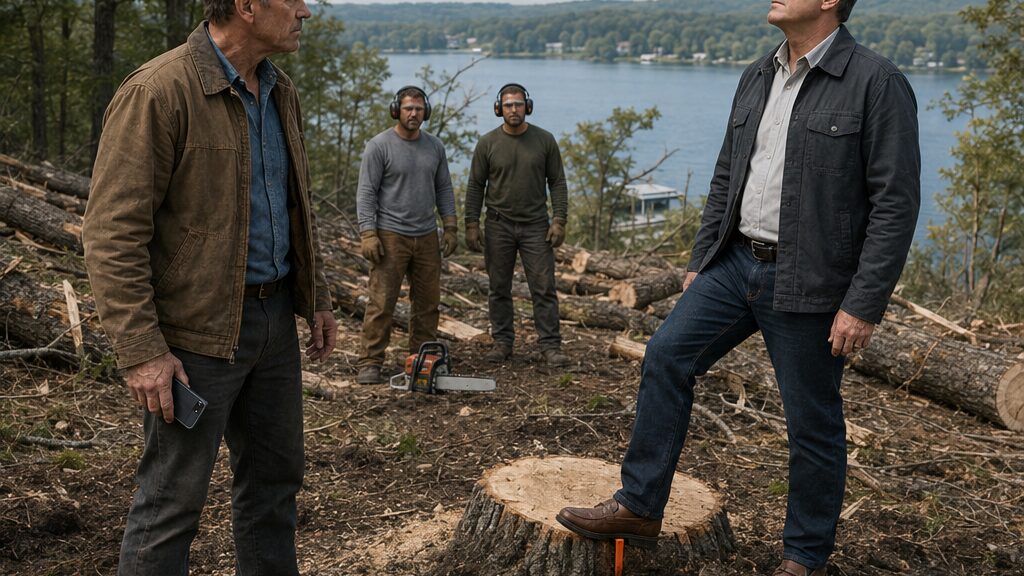
A mature oak leaned toward the lake, its trunk opened by a fresh wedge cut. Anthony Wilson stood beside it with the saw in his gloved hands.
Behind him, sunlight poured through gaps that had not existed that morning.
Robert counted three fresh stumps before he stopped counting.
“Shut it off.”
Anthony looked over.
“What?”
“The saw. Shut it off.”
Anthony killed the engine.
The sudden quiet made the damage worse. Robert could hear branches settling against the ground and water tapping the rocks below.
Anthony lifted his hearing protection.
“You need something?”
Robert stared at him.
“You’re on my property.”
Anthony gave a short laugh.
“No, I’m not.”
He gestured toward the slope as if Robert had interrupted ordinary yard work.
Bright orange survey stakes ran unevenly through the disturbed soil.
Robert had seen orange markers before, but not those.
“Who put those in?”
“Boundary crew.”
“What boundary crew?”
Anthony set the chainsaw beside a stump.
“The people who know where the property line is.”
Robert stepped closer to the nearest cut.
The oak had been healthy. The heartwood was pale and clean, the growth rings tight near the center.
His father had once told him that this particular stand had been mature when Robert’s grandfather bought the acreage.
Robert looked toward the lake.
Anthony’s house now had a broad opening through the trees.
“You cut these for the view.”
Anthony shrugged.
“They needed thinning.”
“They weren’t yours to thin.”
“According to you.”
Robert felt his hands tighten.
His father had warned him about that temper—not because Robert shouted often, but because when he finally did, he stopped listening.
He forced his fingers open.
“Don’t cut another tree.”
Anthony glanced uphill toward his house.
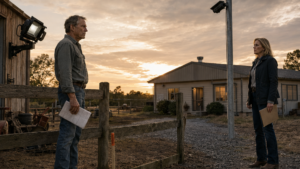
Betty Wilson stood near the back porch, watching them.
“We’ve been trying to talk to you about this slope for two years,” Anthony said. “Branches everywhere. Brush everywhere. Half the lake blocked.”
“You talked about trimming.”
“I talked about cleaning it up.”
“On your side.”
Anthony pointed at the orange stakes.
“This is my side.”
Robert followed the line.
Something was wrong.
The Carter boundary had never run that close to the water at this angle.
He walked past Anthony toward the largest stump.
“Robert.”
Robert ignored him.
Near the stump, an old rock protruded through the leaves.
Robert knew that rock.
When he was seventeen, his father had stretched fence wire past it after a storm dropped two posts. Robert had held the spool while his father worked.
The boundary Robert remembered ran several feet beyond it.
Maybe more.
Robert turned.
“This stump is inside my line.”
Anthony folded his arms.
“Your memory isn’t a survey.”
“No. But I know where I’ve been fixing fence for forty years.”
“That fence was never the legal line.”
The answer came too quickly.
Robert studied him.
“You already knew about the fence?”
“I knew enough to hire somebody instead of guessing.”
Robert looked again at the stakes.
“Then show me the survey.”
Anthony’s jaw shifted.
“I don’t carry paperwork around the woods.”
“Who surveyed it?”
“The markers are right there.”
“That isn’t what I asked.”
Anthony picked up the chainsaw.
Robert moved between him and the leaning oak.
“You start that again, I call the sheriff.”
Anthony stared at him.
For the first time, his easy confidence thinned.
Then he exhaled through his nose.
“You really want to turn a property-line disagreement into that?”
“You already turned it into something.”
Robert pointed toward the stumps.
Anthony looked past him toward the lake.
From here the reason for the clearing was undeniable. The Wilson house sat higher on the neighboring ridge. Where Robert’s oaks had blocked much of its view, blue water now stretched almost uninterrupted beneath the porch.
Anthony’s voice softened.
“You know what that place cost us.”
Robert said nothing.
“We put everything into it. The lake is the value.”
“So my trees were in the way of your investment?”
“That’s not what I said.”
“It’s what you did.”
Anthony’s face hardened again.
“You don’t own every tree you can see.”
Robert nearly answered, then stopped.
He took out his phone.
Anthony looked at it.
“What are you doing?”
“Taking pictures.”
“For what?”
Robert photographed the largest stump, then the next one, making sure the orange markers appeared in the frame.
Anthony shook his head.
“Go ahead.”
Robert moved toward another marker.
This one bothered him most.
It stood near the old rock, but several feet closer to Robert’s field than he remembered the line ever being.
Anthony came beside him.
“There,” he said. “That’s your answer.”
Robert crouched without touching it.
The soil around the stake was loose.
Freshly loose.
He looked up.
“Who set this?”
“I told you.”
“No, you didn’t.”
Anthony stepped forward.
His brown loafer came down beside the marker.
Then over it.
The orange plastic bent beneath his sole and sank almost flat into the soft earth.
Anthony looked directly at Robert.
“The line is the line.”
Robert stared at the shoe.
A minute earlier, he had wanted to grab the chainsaw and throw it down the hill.
Now he wanted something else.
He wanted Anthony to move his foot.
Chapter 2: The Marker Under Anthony’s Shoe
When Anthony finally stepped away, only an inch of orange plastic remained above the dirt.
Robert did not touch it immediately.
He raised his phone.
One photograph showed the stake almost buried beside Anthony’s fresh shoe print.
Another included the stump.
A third captured the wider slope, including two additional markers and the Wilson house above them.
Anthony watched.
“You done?”
“No.”
Robert photographed the chainsaw where Anthony had left it.
Then the remaining stumps.
“You’re making this look like something it isn’t.”
Robert lowered the phone.
“Then you shouldn’t have anything to worry about.”
Anthony picked up the saw.
For a moment Robert thought he might start it again.
Instead, Anthony walked uphill.
“Have your lawyer call mine if that’s where you’re taking this.”
“I asked for your survey.”
Anthony kept walking.
“Get your own.”
Robert waited until Anthony had crossed back toward the Wilson property.
Then he crouched beside the marker.
He took another photograph before touching anything.
The soil was soft enough that he could see where the stake had folded. Robert carefully lifted the exposed end until the plastic was visible again, without pulling its buried point from the ground.
He photographed that too.
Then he found another impression.
A heel mark.
Beside it, churned soil ran toward a second stake.
Robert’s anger returned, but differently now.
He photographed everything.
By the time he reached the farmhouse, his phone held forty-seven images.
He washed the dirt from his hands, made coffee he forgot to drink, and went to the small office beside the kitchen.
The deed papers were in the bottom drawer of a steel filing cabinet.
Robert had not opened the folder in years.
He found the recorded survey his father had given him when Robert took over the property.
The paper was yellowed along the folds.
Robert spread it beneath the desk lamp.
There was the shoreline.
The pasture.
The corner monument near the county road.
And the boundary running down toward the lake.
Robert leaned closer.
According to the dimensions, Anthony was wrong.
He felt relief so quickly that he almost laughed.
Then he noticed the angle.
Robert pulled up one of his photographs.
He compared the survey line with the row of orange stakes.
They were different.
Not wildly different.
Enough.
He took a ruler from the drawer and followed the measurements again.
The recorded line should have passed farther toward the Wilson side at the upper end of the slope. Near the lake, however, the difference narrowed.
Robert sat back.
He had expected the paper to end the argument.
Instead, it had created another one.
His phone rang.
Anthony.
Robert let it ring twice before answering.
“What?”
“You went digging around those markers after I left.”
Robert looked toward the window.
From his office, he could see only the roofline of Anthony’s house.
“I photographed them.”
“You moved one.”
“I lifted the piece you stepped on. I didn’t pull the stake.”
“That’s not how it looked.”
“To who?”
Silence.
Then Anthony said, “Just stay on your side until this gets sorted.”
Robert almost laughed.
“My side is what we’re arguing about.”
Anthony hung up.
Robert set the phone down carefully.
That afternoon he drove to the county records office.
The clerk pulled the parcel file and disappeared into a back room.
Robert waited beneath fluorescent lights while a printer clicked somewhere behind the counter.
When the clerk returned, she carried several copies.
“This is the recorded survey you already have,” she said. “And these are later filings tied to the adjoining parcel.”
Robert spread them out.
One showed a transfer.
Another referenced an easement unrelated to the lake.
Then he saw a notation beside a document number.
“What’s that?”
The clerk leaned over.
“Reference to a boundary understanding.”
“Can I see it?”
She typed the number.
Her expression changed slightly.
“It’s old.”
“How old?”
“More than thirty years.”
Robert felt something tighten beneath his ribs.
“My father owned it then.”
The clerk nodded.
“And the adjoining owner would have been the Wilson property’s previous owner.”
She printed another page.
Robert read the heading twice.
It was not a new deed.
It was not a formal boundary survey.
It referred to an existing fence being used for maintenance access between the two properties.
Robert knew the fence.
Or what remained of it.
His father had repaired that fence for years.
Robert had repaired it too.
The clerk pointed to a handwritten reference at the bottom.
“There may be a sketch attached to the original filing.”
“May be?”
“It isn’t scanned.”
“Where is it?”
She looked toward the records room.
“I’ll have to pull the paper file.”
Robert stared at the document.
All those years he had treated the fence as something practical—posts, wire, cattle, repairs after storms.
Anthony had said the fence was never the legal line.
Robert had assumed that meant Anthony was bluffing.
Now he wasn’t sure.
The clerk returned several minutes later carrying a thin folder.
She placed it on the counter but did not open it.
“There’s an attachment.”
Robert looked at the faded file.
“What kind?”
“A hand-drawn boundary sketch.”
Chapter 3: The Fence Line Nobody Recorded Clearly
The sketch looked like something two farmers might have drawn at a kitchen table.
A crooked line represented the fence.
Two property corners were marked with small circles. Beside the fence, someone had written a note in faded ink about access and maintenance.
Robert recognized his father’s signature at the bottom.
For several seconds he said nothing.
The county clerk waited.
“This doesn’t transfer land, does it?”
“I can’t give you a legal interpretation.”
“I know.”
“You’ll need a surveyor or attorney.”
Robert nodded.
He took the copy.
Outside, he sat in his truck with the sketch on the passenger seat.
His first impulse was to find some reason it meant nothing.
Instead, he called a licensed surveyor.
The surveyor met him the following morning.
They started at the road monument, not the lake.
Robert wanted to go directly to the stumps, but the surveyor refused.
“If we’re checking a boundary, we start with things we can establish.”
So Robert followed while the surveyor located recorded corners, checked measurements, and compared old descriptions with current conditions.
Near noon they reached the wooded slope.
The surveyor stopped at the first orange stake.
“Who set these?”
“Anthony says a boundary crew.”
“That isn’t a name.”
“I asked.”
The surveyor crouched.
“Don’t assume every piece of orange plastic is a legal boundary marker.”
Robert felt a brief surge of satisfaction.
Then the surveyor added, “And don’t assume your fence was meaningless.”
The satisfaction disappeared.
They continued downhill.
Rotted posts emerged among vines and leaves, some barely more than dark wood at ground level.
The old fence wandered.
That was the problem.
At one point it ran close to Robert’s recorded line. Farther downhill it drifted toward his property before bending back.
The surveyor studied the old sketch.
“This looks like they were acknowledging the fence for practical use.”
“So it wasn’t the boundary.”
“I didn’t say that.”
Robert frowned.
“What are you saying?”
“I’m saying people treat lines informally for years, and later everybody remembers the arrangement differently. The recorded deed matters. Monuments matter. Surveys matter. Conduct can matter too.”
“My father knew where his property ended.”
The surveyor looked at him.
“Did he ever tell you why the fence wasn’t on the deed line?”
Robert opened his mouth.
Nothing came.
He remembered repairing wire.
Driving posts.
His father saying, Leave that corner alone, it works where it is.
Robert had never asked why.
The surveyor continued toward the stumps.
At the first two, he took measurements and notes.
Robert watched his expression, trying to read an answer from it.
Finally he asked, “Are they on my property?”
“I need to finish.”
“You’ve measured them.”
“And I’m going to finish.”
Robert turned toward the lake.
Through the missing canopy, the Wilson house looked closer than before.
He could see Betty moving behind the porch railing.
Anthony was nowhere in sight.
An hour later the surveyor called Robert over.
He had marked several reference points with temporary flags.
“The upper section is messy,” he said.
“How messy?”
“If somebody relied on that old practical fence line, I can understand how they’d believe the first part of the clearing was theirs.”
Robert stared at him.
“Understand?”
“That’s not the same as saying they’re right.”
“But it’s not as simple as I thought.”
“No.”
Robert looked toward the oldest stump.
For two days he had imagined showing Anthony a clean survey and watching the argument collapse.
Now his own father’s signature sat in Robert’s truck.
“When Anthony bought the place,” Robert said, “he asked me once about that fence.”
“What did you tell him?”
“That it was old and needed replacing.”
“Did you tell him it wasn’t the recorded boundary?”
Robert looked down.
“No.”
“Did he ask?”
“Not directly.”
There it was.
Not guilt exactly.
Something more irritating.
Responsibility.
Robert had known for years that the posts were failing. A surveyor had even suggested refreshing the boundary when Robert subdivided a hayfield farther north.
Robert had decided it wasn’t necessary.
He knew his land.
That had been enough.
Until it wasn’t.
The surveyor moved downhill again.
Robert followed.
They reached the largest oak stump, then two smaller ones beyond it.
The surveyor measured from two established points.
He checked the numbers.
Then he walked farther toward the lake.
Robert waited.
The surveyor returned to the largest stump and drove a temporary flag into the ground.
“This one is different.”
“How?”
“Even if I give the old fence interpretation every reasonable benefit, this stump is beyond it.”
Robert looked at the pale rings.
“How far?”
“Enough.”
The surveyor pointed downhill.
“And those two.”
Three stumps.
Robert felt his certainty returning, but the feeling was no longer clean.
“What about the first ones?”
“I’ll put everything in the report.”
Robert walked to the nearest of the three.
Fresh sawdust remained in a hollow beside the roots.
He remembered where Anthony had been standing when Robert first reached the slope.
Not up near the ambiguous section.
Down here.
Robert took out his phone and opened the photographs.
He found the first wide image.
Anthony beside the chainsaw.
The leaning oak.
The orange markers.
Robert enlarged it.
The timestamp was visible in the file information.
He moved to the next photograph.
Then the next.
The sequence showed where Anthony had been after Robert had told him to stop.
Robert looked back toward the disputed fence.
The question had changed.
It was no longer whether Anthony could have misunderstood the boundary at the beginning.
He could have.
Robert had to admit that now.
But three trees stood beyond even the most generous version of that misunderstanding.
And Robert had warned him before the last cutting stopped.
The surveyor was packing his equipment when Robert approached.
“Can you tell from the stumps which were cut first?”
“Not precisely enough from appearance alone.”
Robert nodded.
“But your photos might establish sequence.”
Robert looked down at his phone.
A photograph could show where Anthony stood.
It could show a marker under his shoe.
It could show what existed at a particular minute.
But it could not explain what had been in Anthony’s head.
Robert looked uphill toward the Wilson house.
For the first time since hearing the chainsaw, he no longer wanted to prove Anthony had been wrong from the beginning.
He wanted to know why Anthony had kept going after he knew he might be wrong.
Chapter 4: Six Oaks Had More Than One Value
Rachel Hill crouched beside the largest stump and ran two fingers across the cut surface.
Robert stood above her with his arms folded.
“So what does it cost to replace it?”
Rachel looked up.
“You don’t replace this.”
Robert’s jaw tightened.
“I know it won’t be the same tree.”
“No. I mean you don’t calculate it like a fence post or a broken gate.”
She stood and brushed sawdust from her knee.
“This tree took decades to become what it was. The question isn’t what a sapling costs. The question is what was lost, what it did here, and what it will take to restore the site responsibly.”
Robert looked toward the open water.
Without the oaks, the lake seemed too close.
The slope looked exposed in a way he had never noticed before.
Rachel opened a case and took out measuring tools.
“How many are we documenting?”
“Six.”
“All on the disputed side?”
Robert hesitated.
“Three are unquestionably across even the old fence interpretation. The others are more complicated.”
Rachel nodded once.
“Good.”
Robert frowned.
“Good?”
“Good that you said complicated.”
She moved to the next stump.
“People get themselves into trouble when they decide the number first and make everything fit around it.”
Robert followed her.
“I’m not asking for a made-up number.”
“I didn’t say you were.”
“You were thinking it.”
Rachel gave him a quick look.
“I was thinking you’re angry.”
Robert did not answer.
She measured the diameter of another stump.
“Species matters. Size matters. condition matters. Location matters. Replacement feasibility matters. Sometimes restoration cost matters more than what people think of as tree value.”
Robert stared at the rings.
His father used to count them with him whenever a storm brought one down.
Wide ring, wet year.
Narrow ring, dry year.
Robert had always liked the idea that a tree kept a record without needing anyone to write it down.
Rachel tapped the stump with her pencil.
“This one was healthy.”
“Anthony said they needed thinning.”
“Not this one.”
She moved to the next.
“Probably not this one either.”
That answer satisfied Robert more than it should have.
He caught himself.
“So what happens now?”
“I finish the inventory. I note condition. I look at the slope. Then I give you a defensible assessment.”
“Defensible to who?”
“To whoever disagrees with it.”
By noon, Rachel had measured all six.
Then she walked the cleared strip from top to bottom.
Halfway down, she stopped.
“Come here.”
Robert joined her.
She pointed to the bare soil.
“What?”
“See how loose this is?”
“Yes.”
“You’ve got runoff coming off the upper grade. Those roots helped hold this bank.”
Robert looked toward the lake.
“If we get a hard rain?”
“You could lose soil.”
“How much?”
“I’m not predicting a landslide. I’m telling you the trees weren’t only scenery.”
That landed differently.
Robert had been thinking in terms of property line and ownership.
Rachel was looking at the slope as a system.
“Can it be stabilized?”
“Yes.”
“How?”
“Depends on what the site will support. Ground cover. Native plantings. Maybe erosion control in the short term.”
“More money.”
“Yes.”
Robert looked at the exposed earth.
Anthony had wanted a clearer view.
The view was certainly clearer now.
It just came with the possibility of Robert’s soil washing downhill.
That afternoon, Robert sat at his kitchen table with Rachel’s preliminary notes beside the surveyor’s report.
His civil attorney sat across from him.
“Don’t get attached to one number,” the attorney said.
“I’m attached to six trees.”
“That’s exactly what I mean.”
Robert leaned back.
The attorney pointed to the papers.
“You have a stronger case if every number is supportable.”
“What would weaken it?”
“Trying to punish him through arithmetic.”
Robert stared at him.
“You think that’s what I’m doing?”
“I think you watched someone cut trees you promised your father you would protect.”
Robert’s expression changed.
He had not told the attorney about that promise.
Then he remembered mentioning it during their first meeting.
The attorney continued.
“That makes you human. It does not make every emotional loss compensable.”
Robert looked down.
The sentence bothered him because it was true.
“What is compensable?”
“Actual damage. Restoration. Diminution where appropriate. Possibly enhanced damages depending on intent and state law. But the cleanest case is the honest one.”
“The honest one is that he crossed my line.”
“The honest one is also that the historic fence creates ambiguity in part of the area.”
Robert looked toward the window.
Anthony’s roof was visible through the gap in the trees.
“I hate that part.”
“I know.”
“But the three lower stumps?”
“Different problem for him.”
Robert looked back.
“Because I warned him?”
“Because the surveyor says they fall beyond even the practical fence interpretation, and because your photographs help establish timing.”
Robert felt the old anger sharpen again.
The attorney closed the folder.
“Just don’t overreach.”
Robert did not like the word.
Overreach.
Anthony had cut the trees.
Robert was the one being warned not to go too far.
But as the attorney left, Robert looked again at Rachel’s notes.
Not replacement.
Restoration.
The distinction stayed with him.
Near dusk, he walked back down the slope.
The largest stump caught the last light.
Robert knelt beside it.
He put his palm against the cut surface.
The wood was cooling.
He counted several rings without meaning to.
Then he stopped.
A voice came from behind him.
“Robert?”
He turned.
Betty Wilson stood near the disputed line.
She had crossed only far enough to be heard.
Robert rose.
“What do you need?”
She looked toward her house before answering.
“Did Anthony tell you about the refinance?”
Robert stared at her.
“What refinance?”
Betty’s face tightened.
And in that moment, Robert understood that the trees had never been only about the view.
Chapter 5: The View Anthony Could Not Afford to Lose
Betty did not come any closer.
“He knew the survey wasn’t finished,” she said.
Robert felt the words before he understood them.
“What do you mean, wasn’t finished?”
“The people he hired had been out once. They marked some reference points. Anthony kept calling them boundary stakes.”
Robert looked toward the orange plastic near the old fence.
“They weren’t final?”
Betty shook her head.
“He said they were close enough.”
Robert said nothing.
She crossed her arms.
“We had an appraisal scheduled.”
“For the house?”
“Yes.”
“When?”
“The week after he started clearing.”
Robert looked toward the Wilson porch.
The lake spread beyond it in a wide blue band.
Anthony had been right about one thing.
The view was worth money.
Betty continued.
“We refinanced after the renovation. Or we were supposed to.”
“Supposed to?”
“The numbers were tight.”
Robert studied her face.
This was not the expression of someone defending her husband.
It was the expression of someone explaining damage she had helped ignore.
“Anthony thought the house would appraise low?”
“He was afraid it would.”
“So he cut my trees.”
“He thought they were ours.”
“Did you?”
“At first.”
Robert stepped closer to the line, but not across it.
“Then what changed?”
Betty looked down.
“The survey company told him they needed to come back.”
“When?”
She hesitated.
“Before the lower trees came down.”
Robert felt his pulse rise.
“You’re sure?”
“Yes.”
“And he kept cutting.”
Betty pressed her lips together.
“He said they were being overly cautious.”
Robert looked toward the exposed slope.
A mower started somewhere across the lake.
The ordinary sound made the conversation feel more unreal.
“Why are you telling me this?”
Betty took time before answering.
“Because he told me you moved the stakes.”
Robert’s face went still.
“What?”
“He said you pulled them after the argument.”
“I photographed them before and after.”
“I know.”
“How?”
“I saw you.”
Robert watched her.
“So why believe him?”
“I didn’t say I did.”
That was the first moment he saw the full shape of her position.
She had wanted the view too.
She had believed the clearing would help their home.
She had stayed quiet while Anthony told himself the stakes were enough.
But somewhere between the unfinished survey and the accusation against Robert, the story had become too false for her to carry comfortably.
Betty looked toward her house again.
“He’s scared.”
“That doesn’t change what he did.”
“I know.”
“Does he?”
She did not answer.
Robert’s anger softened for exactly one second.
Not forgiveness.
Recognition.
He knew what fear could do when someone wrapped pride around it.
He had done something smaller but related when he refused to update his own boundary markers.
He had told himself certainty was cheaper than checking.
Anthony had taken that same habit much farther.
Robert said, “If he knew the survey wasn’t complete, why not wait?”
“The appraisal date.”
“That important?”
“We had contractor balances. A loan adjustment. He thought if the property came in low, everything would tighten at once.”
Robert exhaled.
“So the view had to be open before the appraiser came.”
Betty looked at him.
“Yes.”
The answer made Anthony easier to understand.
It did not make him easier to excuse.
Two days later, Robert met his attorney with Betty’s disclosure still in his head.
“You understand she may deny saying any of that later,” the attorney said.
“I know.”
“And we are not building the case around her.”
“I know.”
“What we already have matters more.”
The attorney spread the timeline across the desk.
“Here is the useful distinction.”
He tapped the first set of stumps.
“Possible initial boundary confusion.”
Then the second group.
“Then notice.”
Then the third.
“Then continued cutting.”
Robert stared at the sequence.
The case no longer looked like one clean act of trespass.
It looked like a series of choices.
That was harder.
It was also more honest.
“So we don’t claim all six were deliberate.”
“Not unless the evidence supports it.”
Robert looked at the papers.
He could already imagine Anthony’s argument.
Old fence.
Confusing stakes.
Unclear line.
Robert himself had once thought the recorded survey ended the question.
It did not.
“What happens next?”
“Formal notice.”
Robert nodded.
“And if he keeps coming onto the property?”
“Call law enforcement. Do not escalate.”
Robert almost smiled.
“You think I need that reminder?”
“Yes.”
The attorney said it without humor.
Robert did not argue.
The notice was delivered three days later.
Anthony arrived at Robert’s house that evening.
Not with a running chainsaw.
But with one in the bed of his pickup.
Robert saw him through the kitchen window and stepped onto the porch.
Anthony came up the walk fast.
“You served me.”
Robert stayed near the door.
“My attorney sent notice.”
“You’re claiming I knowingly trespassed.”
“I’m claiming what I can prove.”
Anthony laughed once.
“Can prove?”
Robert did not respond.
Anthony pointed toward the slope.
“You moved those stakes.”
There it was.
The exact accusation Betty had mentioned.
Robert felt something inside him settle.
“You should go home.”
“No. You took pictures after you messed with the line.”
“I took pictures before I touched anything.”
“That’s what you say.”
“And the timestamps say.”
Anthony’s face changed.
Just slightly.
Robert noticed.
“The old fence is on my side,” Anthony said.
“Part of it may matter.”
“You finally admitting that?”
“I’m admitting what the record shows.”
Anthony seemed almost disappointed.
He had come ready for denial.
Robert continued.
“The lower trees are still beyond it.”
“You don’t know that.”
“The surveyor does.”
Anthony stepped closer.
“You think a surveyor is going to save you?”
Robert held his ground.
“No.”
“Then what?”
“The truth probably will.”
Anthony’s face hardened.
“That your plan? Act calm and make me look crazy?”
“I didn’t ask you to come here.”
Anthony looked past Robert into the house.
Then back toward the slope.
“I’m not paying you some inflated number because you got sentimental about trees.”
“I haven’t given you a number.”
“You will.”
Robert thought of Rachel’s warning.
Do not decide the number first.
Anthony pointed toward the property line.
“You touched those stakes. I saw where they were after you got done.”
Robert said, “You stepped on one.”
Anthony’s expression went flat.
“That proves nothing.”
“No. Not by itself.”
Robert watched him.
That answer seemed to unsettle Anthony more than an accusation would have.
Robert was no longer pretending one photograph solved the whole case.
Anthony turned toward his truck.
Then he stopped.
“When this goes to court, I’m telling them you moved the line.”
Robert said nothing.
Anthony looked back.
“I mean it.”
Robert folded his arms.
“That’s your choice.”
Anthony left.
Robert stood on the porch until the truck disappeared.
He was angry.
But underneath the anger was something cleaner now.
The case would not be won by pretending his father’s fence never existed.
It would not be won by pretending every tree had the same legal story.
And it could not be won by pretending Anthony had started with perfect knowledge.
Robert had one harder option.
Tell the whole truth.
Then make Anthony answer for the part that remained after all the excuses were stripped away.
Chapter 6: Robert Refused the Easy Version
Anthony’s attorney began with the fence.
Not the chainsaw.
Not the three lower stumps.
The fence.
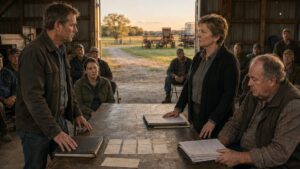
“Mr. Carter, you knew for years that the physical fence did not perfectly match the recorded deed line, correct?”
Robert sat at the witness table and looked toward the old sketch displayed on the monitor.
“Yes.”
“And you did not replace it.”
“No.”
“You did not commission a fresh boundary survey before this dispute.”
“No.”
“You continued maintaining portions of that fence.”
“Yes.”
Anthony sat across the room.
He did not look at Robert.
His attorney continued.
“So a neighboring owner could reasonably have believed the fence represented the practical boundary.”
Robert’s own attorney had prepared him for this question.
Still, the answer felt like swallowing gravel.
“Yes.”
Anthony looked up.
The attorney paused.
“You agree?”
“I agree someone could have thought that.”
The room went very still.
Robert could feel his attorney watching him.
This was the place where it would have been easy to qualify.
To explain.
To push back.
Robert did not.
Anthony’s attorney stepped closer.
“And your father signed the old maintenance sketch.”
“Yes.”
“Meaning your family participated in the ambiguity.”
Robert looked at the faded signature on the screen.
“Yes.”
The word hurt more than he expected.
For years, Robert had carried his father’s habits as if they were instructions carved into stone.
The fence worked where it was.
The line was understood.
Everybody knew.
Except everybody no longer did.
Anthony’s attorney turned toward the judge.
“No further questions on that point.”
Robert’s own attorney stood.
“Mr. Carter, when did you first tell Mr. Wilson to stop cutting?”
Robert gave the time as closely as he could.
“And what happened after that?”
Robert described the argument.
The orange stakes.
The request for a survey.
Anthony’s shoe coming down over the marker.
The photographs.
The lower trees.
“Did you move the buried point of the stake?”
“No.”
“What did you do?”
“I lifted the exposed end so it could be seen. Then I photographed it again.”
“Why?”
“Because I wanted a record of what I found.”
The attorney displayed the image.
Anthony’s brown loafer beside the bent orange stake.
Robert had looked at that picture so many times it had lost some of its force.
In the hearing room, enlarged on the screen, it looked different.
Not like proof of a conspiracy.
Not like a magic answer.
Just a moment.
A man.
A shoe.
A marker.
A fresh stump.
“Does this photograph prove where the legal boundary was?” the attorney asked.
“No.”
Anthony looked up again.
“Then why does it matter?”
Robert answered without looking at him.
“Because it shows what was happening after I told him the line was disputed.”
The attorney changed the image.
Another photograph.
Then another.
Timestamp information.
A wider frame.
The surveyor’s later measurements.
The sequence did what Robert could not do by anger alone.
It separated the trees into time.
Before warning.
After warning.
Ambiguous area.
Unambiguous area.
The licensed surveyor testified next.
He explained the deed line, the historic fence, the old practical use arrangement, and the lower stumps.
The first group, he said, sat near enough to the old fence interpretation that a genuine misunderstanding was possible.
The final three did not.
Anthony’s attorney challenged the measurements.
The surveyor did not get defensive.
He simply returned to monuments, recorded distances, and the physical points on the ground.
Rachel testified about the trees.
She refused dramatic language.
That helped Robert more than he expected.
She described species, size, health, location, soil retention, replacement limits, and restoration cost.
When asked whether six mature oaks could simply be replaced with six nursery trees, she said, “You can replace the count. You cannot replace the condition that existed the day before they were cut.”
Robert looked down.
That sentence was the closest anyone came to saying what he actually felt.
Then Betty testified.
She looked pale.
Anthony finally looked at her.
She said the survey work had not been finalized when the lower clearing continued.
She said Anthony knew there was uncertainty.
Anthony’s attorney pressed her.
“You wanted the view improved too.”
“Yes.”
“You understood it would help the home’s value.”
“Yes.”
“You did not stop the work.”
“No.”
“Then why are you placing responsibility entirely on your husband now?”
Betty’s hands tightened in her lap.
“I’m not.”
The attorney paused.
Betty continued.
“I should have pushed harder. I didn’t.”
Robert watched Anthony.
For the first time, his expression changed from anger to something closer to shame.
Betty looked toward him.
“But he was the one who said to keep going after they told us the survey wasn’t finished.”
That was the character truth Robert had not expected.
She did not save herself by condemning Anthony completely.
She admitted her part.
It made the rest harder to dismiss.
The final ruling did not give Robert everything.
The judge found the early portion of the clearing complicated by the historic fence use and the failure of both properties to maintain clear markers.
Damages tied to those first trees were limited.
Robert felt disappointment rise.
Then the judge turned to the later cutting.
The warning mattered.
The professional uncertainty mattered.
The decision to continue mattered.
The lower three trees were treated differently.
So was the cost of stabilizing and restoring the slope.
The final amount was substantial.
Less than the largest figure Robert had once imagined.
Enough to repair the land properly.
Outside the courthouse, Anthony passed him without speaking.
Betty followed several steps behind.
Robert did not feel triumphant.
He felt tired.
His attorney handed him the final paperwork.
“You did better by admitting the weak part.”
Robert looked at him.
“I know.”
“You could have tried to deny the fence meant anything.”
“I thought about it.”
“What stopped you?”
Robert folded the papers.
“If I have to lie about my side to prove what he did, then I’m not protecting anything.”
The attorney nodded.
Robert looked toward the parking lot.
The money would pay for erosion control.
It would pay for replanting.
It would pay for permanent survey monuments.
But it would not put the old crowns back over the slope.
It would not put forty or sixty years into young trunks.
For the first time, Robert understood the judgment exactly for what it was.
Not replacement.
A chance to decide what came next.
Chapter 7: The New Line Would Outlast Them Both
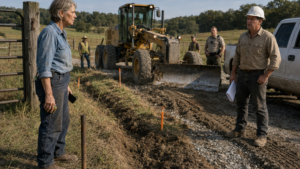
The restoration crew arrived with erosion blankets, bundles of young trees, and a surveyor’s case.
Robert stood where the chainsaw had been months earlier.
The ground still looked wrong.
Grass had begun to creep into the raw soil, but the open space between the pasture and the lake remained wider than his eyes expected. Every time he looked downhill, he still anticipated trunks that were no longer there.
Rachel Hill walked the slope with the crew foreman, stopping every few yards to point out where runoff had cut shallow channels after the winter rains.
Robert followed behind them.
“Those spots held?” he asked.
“Mostly,” Rachel said. “Better than they would have without the temporary stabilization.”
“Mostly isn’t the word I wanted.”
“It’s the accurate one.”
Robert gave her a look.
She smiled.
“You hired me for accurate.”
The restoration plan had taken weeks longer than Robert expected.
The settlement money had been enough to make choices.
That had turned out to be different from having enough to erase what happened.
Rachel had rejected his first instinct—to plant the largest trees he could afford as quickly as possible.
“Big nursery stock isn’t automatically better,” she had told him. “You want trees that establish well here, not trees that make the hill look finished for six months.”
So they chose younger native oaks, mixed with other species suited to the slope.
Not six replacements in six holes.
A system.
Roots for the soil.
Canopy for the future.
Something that might still be standing when Robert was not.
Near the old fence, the licensed surveyor called him over.
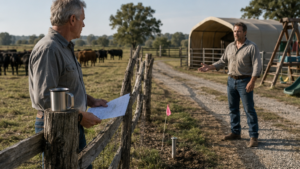
A bright orange temporary stake stood beside a small metal monument newly set in the ground.
“This is the permanent corner.”
Robert stared at it.
It did not look important enough.
Months of arguments, surveys, attorneys, photographs, and testimony had narrowed down to a piece of metal that barely rose above the earth.
“That’s it?”
“That’s it.”
The surveyor handed him the updated plat.
Robert unfolded it.
The line was clean now.
No old practical fence wandering one direction.
No remembered route through trees.
No orange plastic interpreted by whoever happened to be standing closest.
Recorded measurements.
Permanent monuments.
Both parcels tied to the same points.
Robert looked toward the Wilson house.
Anthony was standing near his side of the line.
Robert had not heard him approach.
For a moment, neither man moved.
Anthony wore a work jacket and jeans instead of the clothes Robert remembered from the day of the cutting.
No gloves.
No chainsaw.
Betty stood farther uphill near their porch.
Anthony looked at the young trees waiting beside the crew truck.
“How many are you putting in?”
Robert almost said, Enough.
Instead he answered, “More than were cut.”
Anthony nodded.
“Rachel’s idea?”
“Partly.”
Another silence.
The surveyor walked downhill to the next monument, leaving them alone.
Anthony looked at the metal marker.
“So that’s the official one.”
“Yes.”
“No argument now.”
“No.”
Anthony put his hands in his jacket pockets.
Robert noticed that he remained several feet on his own side.
Months earlier, Robert would have taken satisfaction in that.
Today, the gesture felt heavier than satisfaction.
Anthony looked toward the lake.
The view from his house was still open.
The young trees would not change that for years.
Maybe decades.
“You know,” Anthony said, “the appraisal didn’t come in as low as I thought.”
Robert looked at him.
Anthony gave a humorless smile.
“Not that it matters now.”
Robert said nothing.
Anthony rubbed his thumb against one knuckle.
“I kept thinking if I could get the view opened before they came, the number would solve everything.”
“Did it?”
“No.”
Robert waited.
Anthony glanced uphill at Betty.
“We refinanced. Barely.”
There was no victory in his voice.
Robert looked at the new metal monument.
“You could have waited for the survey.”
“I know.”
It was the first time Anthony had said it without adding something after.
No explanation.
No fence.
No property value.
No accusation.
Just the words.
Robert found he did not know what to do with them.
Anthony looked toward the slope.
“I was wrong about the lower section.”
Robert said, “Yes.”
Anthony winced slightly, but nodded.
“I thought you’d enjoy saying that.”
“I did months ago.”
“And now?”
Robert looked at the young trees.
“Now I have work to do.”
Rachel called from below.
“Robert, I need you down here.”
He turned to go.
Anthony said, “For what it’s worth, I’m sorry about the trees.”
Robert stopped.
The apology did not bring the oaks back.
It did not give him the sound of leaves over the slope or restore the years written inside the old rings.
But it was not nothing.
Robert looked at Anthony.
“For what it’s worth,” he said, “I should have fixed that line years ago.”
Anthony seemed surprised.
Robert continued downhill.
By noon, the first section was planted.
Rachel showed Robert how the root flare should sit above grade and warned the crew against burying it.
“Too deep and you create another problem,” she said.
Robert watched a young oak settle into the soil.
Its trunk was barely thicker than his wrist.
He imagined the old stump beside it.
For months he had measured the loss in money, feet, photographs, and legal findings.
Standing there, he finally understood why none of those measurements had ever felt complete.
Time had been taken.
That was the part nobody could repay.
The crew moved downhill in a slow line.
Each tree went into prepared soil.
Each trunk received protection.
Ground cover went between them.
Erosion fabric disappeared beneath mulch and straw.
By late afternoon, the slope looked less wounded.
Not healed.
Started.
The surveyor returned to the upper corner.
He gripped the orange temporary stake beside the new metal monument.
“You want this?”
Robert looked at it.
It was not the same stake Anthony had stepped on. That one remained part of the photographic record and had long since disappeared from the ground.
But the orange plastic had come to mean the entire dispute to Robert.
Bright.
Temporary.
Easy to bend.
Easy to misunderstand.
“No,” Robert said.
The surveyor pulled it from the soil.
Then Robert changed his mind.
“Actually, give it here.”
The surveyor handed it to him.
Robert turned it over in his hand.
A little dirt clung to the pointed end.
“You keeping a souvenir?”
Robert looked at the permanent monument.
“A reminder.”
“Of him?”
Robert shook his head.
“Of me.”
The surveyor seemed to understand well enough not to ask.
The crew left before sunset.
Rachel stayed long enough to walk the site one last time.
“Water schedule is in the folder.”
“I know.”
“Protection stays on those trunks.”
“I know.”
“And you’re going to monitor runoff after the first heavy rain.”
Robert looked at her.
“You enjoy repeating yourself.”
“I enjoy not being called back to fix avoidable mistakes.”
That made him laugh.
It surprised him how normal the sound felt.
After Rachel drove away, Robert walked the new boundary alone.
The permanent monuments were difficult to see from more than a few yards away.
That was fine.
A boundary did not need to be loud to be real.
At the lower corner, he stopped.
Across the line, Anthony was repairing a section of his own fence.
He looked up.
Robert gave a small nod.
Anthony returned it.
Neither man crossed.
Robert continued toward the barn.
Inside, the light was fading through the open doors.
He passed the tractor, the old hay tools, and a shelf where his father had kept fence staples in coffee cans.
For years Robert had believed taking care of the land meant remembering how his father had done things.
Where the fence ran.
Which oak leaned after storms.
Which corner stayed wet in spring.
He understood now that memory was not the same as maintenance.
His father had solved problems for his own time.
Robert had inherited the responsibility, not every solution.
He carried the orange stake to the workbench.
For a moment he considered throwing it in the trash.
Instead, he set it against the wall beneath the old coffee cans.
Outside, the young oaks were too small to make any sound in the wind.
Someday they would.
Robert closed the barn door halfway, leaving the evening light across the floor.
Then he looked once at the orange stake.
Not proof that he had been right.
Not proof that Anthony had been wrong.
Proof that unclear things left unattended had a way of becoming expensive.
He turned toward the house.
Behind him, the permanent line remained in the ground, measured and recorded, ready to outlast both men.
The story has ended.