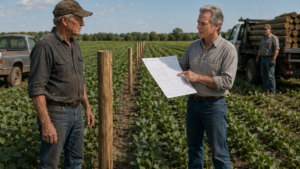
They Dug Across His Farm Boundary Before Sunrise, but the Old Survey Marker Told a Different Story
Chapter 1: The Excavator Was Already Inside the Fence Line
The excavator bucket was already tearing through Charles Hill’s field when he came around the machine shed.
For half a second, he simply stopped.
Yellow steel dropped into the grassy edge below his hayfield, curled, and lifted a load of black earth. Roots hung from the bucket. Water seeped into the fresh cut.
Charles had owned that strip for thirty-one years.
His family had worked it longer.
“Shut it down!”
The operator looked over.
Charles raised both hands, palms forward.
“Shut the machine down. Right now.”
The bucket froze halfway through another bite.
The engine stayed running, but the operator pulled his hands away from the controls.
Charles crossed the field quickly, boots sinking into the torn soil.
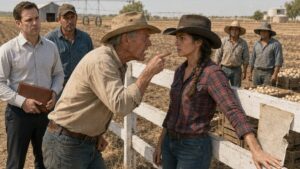
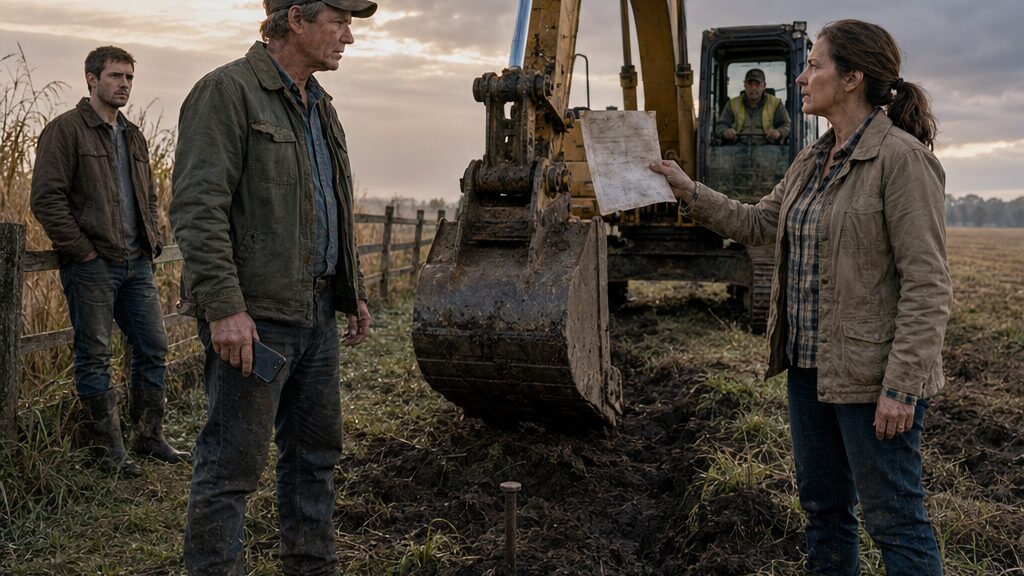
Rebecca Moore stood twenty yards farther down the ditch line in a canvas jacket and muddy work boots. She had a rolled plan under one arm.
“Charles.”
“Did you hire this machine?”
“Yes.”
“You’re digging on my ground.”
Rebecca looked toward the shallow channel the excavator had begun opening.
“We’re restoring the drainage run.”
“No. You’re digging on my ground.”
“It’s been a drainage run since before either one of us owned these farms.”
Charles pointed at the excavator.
“That doesn’t make it yours.”
The operator killed the engine.
Suddenly the field became quiet enough that Charles could hear loose dirt dropping from the bucket.
Rebecca walked closer.
“The lower acres flooded twice in four years. You know that.”
“I know where my property line is.”
“And I know where that ditch used to run.”
Charles felt anger tightening his jaw.
He wanted to tell the operator to turn around and take the machine back through Rebecca’s gate. Instead, he pulled his phone from his pocket.
He photographed the fresh excavation.
Then the tracks.
Then the bucket.
Rebecca watched him.
“You can take all the pictures you want.”
“I intend to.”
“This isn’t some fence I moved in the night, Charles.”
“That machine crossed my line before sunrise.”
“We told you we needed the drainage opened.”
“You told me you wanted it opened. I told you we needed a survey first.”
Rebecca’s expression hardened.
“We don’t have three weeks.”
“That doesn’t change the line.”
Charles moved toward the place where the excavator had taken its deepest bite.
Something dark protruded from the loose earth.
At first he thought it was an old piece of wire.
He crouched.
Only an inch or two showed above the soil: rust-dark metal, round and solid.
Charles brushed dirt away with his glove.
His pulse changed.
He knew that piece of iron.
Or believed he did.
Years earlier, his father had warned him not to disturb the old boundary pins even when machinery worked close to them.
Charles cleared another handful of earth.
The iron pin stood almost directly beside the excavator bucket.
“Don’t touch that,” he said.
Rebecca came nearer.
“What?”
“That pin.”
She looked down.
Charles photographed it before brushing away any more soil. Then he took another picture wide enough to show the pin, the fresh cut, and the bucket together.
The operator climbed down from the cab.
“You want me out of here?”
“Don’t move the machine yet,” Charles said. “Not until I’ve documented where it is.”
Rebecca gave a short breath.
“You’re treating this like I came over here to steal acreage.”
“I’m treating it like somebody put an excavator across a disputed boundary after I said not to.”
“It isn’t disputed.”
Charles stood.
For the first time that morning, Rebecca looked genuinely irritated.
“You think that pin settles everything?”
“If it’s the original marker, it settles where we start.”
“No. It tells you where a pin is.”
“My survey will tell us the rest.”
Rebecca studied him for several seconds.
Then she unzipped the document pouch she had been carrying.
“I hoped we wouldn’t have to do this.”
“Do what?”
She removed a clear plastic sleeve.
Inside was a yellowed photocopy of a typed letter.
Rebecca held it out.
Charles didn’t take it immediately.
“What is that?”
“The reason my father maintained this drainage for years without your father stopping him.”
That landed harder than Charles expected.
He took the sleeve.
The copy was old enough that some letters had blurred around the edges. He read the first few lines, then skipped downward.
The Hill name appeared near the bottom.
His father’s name.
Charles read the paragraph above it again.
Permission.
Maintenance.
Drainage.
The wording was formal enough to matter and vague enough to bother him.
“This is a copy.”
“Yes.”
“Where’s the original?”
“I don’t know.”
“Was it recorded?”
“My father kept it with the farm papers.”
“That isn’t what I asked.”
Rebecca stepped closer.
“You said we had no permission to be here. I’m showing you that your father gave it.”
Charles looked back toward the exposed iron pin.
Five minutes earlier, it had felt like the end of the argument.
Now it looked like the beginning of one.
He read the signature again.
There was a particular slant in the H, followed by the compressed final letters Charles had seen on checks, equipment receipts, school forms and cattle-sale papers throughout his childhood.
He could have denied it.
He didn’t.
“That’s his signature,” Charles said.
Rebecca’s shoulders eased slightly.
Charles looked at her.
“But I don’t know what he agreed to.”
The relief disappeared from her face.
“He agreed to the drainage.”
“Maybe.”
“Charles—”
“No more digging.”
He handed the sleeve back.
“Not another bucket until we know what that paper actually gave your family.”
Rebecca stared at him across the churned strip.
Behind them, the excavator stood silent with its bucket suspended beside the old iron pin.
And Charles could no longer tell which of the two objects worried him more.
Chapter 2: His Father’s Signature Changed the Argument
Charles put Rebecca’s copied letter on the kitchen table beside his deed and immediately disliked how convincing it looked.
Not legally convincing.
Personally convincing.
His father’s signature sat at the bottom like a voice Charles could no longer question.
Benjamin Carter leaned over the table.
“You sure that’s his?”
“Yes.”
“No chance somebody copied it?”
Charles looked at him.
Benjamin lifted both hands.
“Had to ask.”
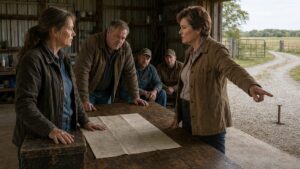
Charles opened an old survey he kept rolled inside a cardboard tube.
The paper resisted flattening, so he anchored one corner with his coffee mug and another with the plastic sleeve Rebecca had allowed him to photograph.
There it was.
The southern boundary ran along the field edge before turning near the old road.
The measurements put the exposed iron pin almost exactly where Charles remembered it.
Rebecca’s proposed drainage cut crossed inside that line.
Benjamin traced the map without touching it.
“So the land’s yours.”
“According to this survey.”
“And her letter?”
“According to her, it lets her dig.”
“That isn’t what I asked.”
Charles glanced up.
Benjamin had inherited that irritating habit from his mother—Charles’s younger sister—of asking the second question when the first answer was easier.
“I don’t know what the letter does.”
By eight-thirty, Charles was back beside the damaged strip with a shovel, a roll of orange flagging and his phone.
He worked carefully around the iron pin until several inches were visible.
He did not pull it.
He did not straighten it.
He tied bright flagging to a thin wooden stake and drove the stake several feet away so nobody could claim he had disturbed the marker itself.
Then he photographed everything again.
The excavator had been removed.
Its tracks remained.
So did the cut.
Fresh soil made the intrusion look larger than it had at dawn.
Charles photographed the tracks crossing from Rebecca’s side toward the pin, then followed the excavation farther along the edge.
He found crushed grass, disturbed gravel and a place where the new trench wandered away from the shallow depression he remembered as the old ditch.
That bothered him.
He drove to the county offices before noon.
Sandra Lewis listened without interrupting as Charles laid out the deed, survey, photographs and copy of Rebecca’s letter.
When he finished, she adjusted the survey so the parcel number was visible.
“You want me to tell you who owns the strip?”
“Yes.”
“I can tell you what our recorded documents show.”
“That’s what I mean.”
“No,” Sandra said. “It isn’t.”
Charles sat back.
She turned her monitor slightly.
“The deed describes your parcel. This survey appears consistent with the recorded description. But I’m not a surveyor, and this office doesn’t adjudicate boundary disputes.”
Charles tapped Rebecca’s letter.
“And that?”
Sandra read it carefully.
“A permission letter isn’t the same thing as ownership.”
“I know that.”
“It also isn’t automatically meaningless because it wasn’t recorded.”
Charles stopped tapping.
Sandra continued.
“What matters is what was granted, for what purpose, for how long, under what conditions, and whether anything later changed it. That’s not something I can decide at this counter.”
“Is there an easement?”
“We can search.”
For nearly forty minutes, Sandra moved through recorded documents associated with both parcels.
Old deeds.
Transfers.
Mortgages.
A road agreement.
A utility easement.
Nothing identifying a recorded drainage easement across Charles’s strip.
Charles felt some of the pressure leave his chest.
“So there isn’t one.”
Sandra looked at him over the monitor.
“I said I haven’t found one in the records we searched.”
“That’s close enough.”
“No, Mr. Hill. It’s exactly the kind of sentence people regret saying in property disputes.”
He almost smiled.
Almost.
Sandra printed the references she could provide.
“If this becomes a legal matter, get a current licensed survey. And keep the original condition documented.”
“I already photographed it.”
“Good.”
On the drive home, Charles felt steadier.
The land description supported him.
The old survey supported him.
No recorded drainage easement had appeared.
Rebecca had a letter, but a letter granting permission to maintain drainage was not a deed to the land beneath it.
By evening, Charles had arranged everything on the kitchen table in rows.
Benjamin came in carrying two sandwiches wrapped in paper.
“You planning to eat?”
“Eventually.”
Benjamin set one beside him.
Charles had enlarged the photograph of the exposed iron pin.
He placed it next to the survey.
Pin.
Line.
Excavator track.
Letter.
For the first time since dawn, the pieces seemed to be moving back into order.
Benjamin studied the old survey.
“What year?”
“Twenty-eight years ago.”
“You ever have it redone?”
“Never needed to.”
Benjamin nodded toward Rebecca’s letter.
“Until now.”
Charles said nothing.
Benjamin ate half his sandwich standing up.
Then he walked to the window overlooking the lower field.
“You remember that ditch being open when Grandpa was alive?”
Charles kept his eyes on the survey.
“It was low ground.”
“That’s not what I asked.”
“There were drainage cuts all over these farms.”
Benjamin turned.
“Did Rebecca’s dad maintain that one?”
Charles looked at the yellowed copy again.
Something old moved at the edge of his memory.
A shovel handle.
Summer heat.
His father standing waist-deep in weeds.
Another man farther down the ditch.
Charles folded the survey too quickly.
“We need a current survey,” he said.
Benjamin did not move.
“Uncle Charles.”
“What?”
“Do you remember them maintaining it?”
Charles met his nephew’s eyes.
The county records had given him an answer about the land.
Benjamin had just asked a question about the truth.
And Charles knew those were no longer the same thing.
Chapter 3: The Memory Charles Did Not Want to Confirm
Benjamin found the notebook the next morning.
He carried it out of the farmhouse storage room with dust on his shirt and one finger holding a page open.
“You need to see this.”
Charles was sorting old fence invoices at the workbench.
“What now?”
“Grandpa’s.”
The notebook was small, black and warped from years of humidity. Charles recognized it immediately.
His father used to keep one in the breast pocket of his work shirts.
Benjamin laid it down.
Halfway down the page, between a note about diesel delivery and a veterinary appointment, were five words:
Moore ditch — clear after hay.
Charles stared at them.
Benjamin waited.
“That could mean anything.”
“No, it can’t.”
Charles looked up sharply.
Benjamin did not back away.
“It might not mean what Rebecca says it means,” he continued. “But it doesn’t mean anything.”
Charles closed the notebook.
“Get the surveyor called.”
“I already left a message.”
“Then we wait.”
Benjamin rested both hands on the bench.
“Were you there?”
Charles looked toward the open storage-room door.
Beyond it, sunlight crossed the yard.
For a moment he was nineteen again.
His father had handed him a shovel and told him to clear willow shoots from a shallow ditch along the Moore place.
Rebecca’s father had been there with a tractor.
Nobody had argued.
Nobody had measured anything.
They had worked until afternoon, and water had begun moving through the cleaned channel.
Charles had forgotten the day because, at the time, it had seemed too ordinary to remember.
Or maybe he had remembered it exactly as long as remembering remained convenient.
“Yes,” he said.
Benjamin’s expression changed.
“You were there?”
“Once.”
“Doing what?”
“Clearing it.”
“With Rebecca’s father?”
Charles nodded.
Benjamin stepped away from the bench.
“And you didn’t tell her yesterday?”
“I didn’t know what I remembered yesterday.”
“You knew something.”
Charles’s temper rose.
“I knew my father didn’t give away land.”
“Nobody said he did.”
“She’s acting like he did.”
“No. She’s acting like he gave them a right to use something.”
“Which is not the same thing.”
“Exactly.”
Benjamin gave him a tired look.
“That’s what Sandra told you.”
Charles picked up the notebook.
“I’m not going to let somebody turn one afternoon with a shovel into a permanent right across this farm.”
“Then don’t. But don’t pretend the afternoon never happened.”
The words followed Charles outside.
He walked down toward the disputed strip alone.
The old iron pin still carried its orange flag.
A few yards away, the abandoned excavation held a thin line of brown water.
Farther east, the old drainage course nearly disappeared beneath grass and weeds.
Charles followed it.
Once he knew what he was looking for, the shape became obvious.
A shallow depression.
A break in the vegetation.
A line running toward Rebecca’s lower acreage.
He could suddenly remember where the water had flowed that summer.
He could remember his father telling him not to deepen the ditch.
“Just clean it,” he had said.
Charles stopped.
That sentence had survived.
Why?
He crouched near the old channel.
His father had been particular about land. Particular enough to argue over fence posts six inches out of place.
Yet he had allowed the Moores to drain water across this edge.
That did not sound like surrender.
It sounded like an arrangement.
The distinction unsettled Charles more than Rebecca’s letter had.
A truck door closed behind him.
Rebecca was walking from the road.
“You found the old ditch.”
Charles stood.
“I found where it ran.”
She looked toward the orange flag.
“Your nephew called me.”
Charles’s jaw tightened.
“He had no business doing that.”
“He asked if my father ever maintained the ditch with you.”
Charles looked toward the farmhouse.
“He shouldn’t have called.”
“But he did.”
Rebecca waited.
Charles could lie.
Not well, perhaps, but enough to make her prove everything.
Instead he said, “I helped clear it once.”
Rebecca stared at him.
“When?”
“I was nineteen. Maybe twenty.”
“With my dad?”
“Yes.”
Her face hardened slowly.
“You stood here yesterday and acted like you’d never heard of an arrangement.”
“I said I didn’t know what that letter authorized.”
“You knew we used the ditch.”
“I remembered pieces.”
“After I showed you the letter?”
Charles said nothing.
Rebecca laughed once, without humor.
“That’s convenient.”
“You crossed my boundary with an excavator.”
“And you knew my family had been allowed to maintain drainage here.”
“Allowed,” Charles said. “That word matters.”
“So does the fact that you left it out.”
The accusation struck because it was true enough to hurt.
Charles looked at the unfinished trench.
“You still had no right to bring that machine in before the boundary was established.”
Rebecca’s voice dropped.
“I have eighty acres below this grade. We lost part of the planting two springs ago. Last year I paid to pump water for four days because this route had closed.”
“That doesn’t give you my land.”
“I’m trying to save mine.”
For the first time, Charles heard fear beneath her anger.
It did not excuse the excavator.
But it changed the sound of the argument.
Rebecca pulled a folded paper from her jacket.
“I filed for emergency access this morning.”
Charles looked at it but did not reach for it.
“On what basis?”
“The historical drainage use, the letter, and the storm forecast.”
“You’re taking this to court?”
“I’m asking the court to stop you from blocking a drainage route our farms used for decades.”
Charles looked past her toward the Moore acreage.
Clouds were beginning to build in the west, but he refused to let the sky decide what was true.
“When?”
“Preliminary hearing is in three days.”
Rebecca held the paper toward him.
This time Charles took it.
“If you tell the judge you never knew about that ditch,” she said, “I’ll tell them you just admitted standing in it with my father.”
Charles folded the notice once.
“I won’t say I never knew.”
Rebecca seemed surprised.
He looked at the old iron pin, then at the shallow channel disappearing through the weeds.
“But remembering a favor isn’t the same as knowing its limits.”
Rebecca turned toward her truck.
Charles remained beside the ditch with the court notice in his hand.
For three days he had been preparing to prove where his property ended.
Now he had three days to explain why he had not told the whole truth about what once crossed it.
Chapter 4: The Old Agreement Had One Missing Word
Sandra Lewis called Charles before eight the next morning.
“I found something attached to the old correspondence file.”
Charles stopped halfway through fastening a gate chain.
“What kind of something?”
“A second page.”
He tightened his grip on the phone.
“To Rebecca’s letter?”
“To the county copy of the same correspondence. It wasn’t indexed separately.”
Charles looked across the lower field toward the orange flag marking the iron pin.
“What does it say?”
“I’d rather you read it here.”
That was enough to send him to the county office without finishing breakfast.
Sandra had the pages waiting under a clear protective sheet.
The first page matched Rebecca’s copy closely: permission from Charles’s father for the Moore family to enter the edge of the Hill property for drainage maintenance.
The second page changed the shape of the agreement.
Charles read it once.
Then again.
One phrase held him.
For maintenance of the existing shallow drainage cut.
Existing.
Not a new ditch.
Not any route the Moore family chose.
Not unrestricted access.
The page also described the permission as continuing only while the channel remained necessary for drainage between the two farms and while maintenance stayed within the established course.
Charles placed both hands flat on the counter.
“So she can’t just dig wherever she wants.”
Sandra answered carefully.
“This document does not read like permission for unrestricted excavation.”
“That’s what I said.”
“It’s not exactly what you said.”
He exhaled through his nose.
Sandra tapped the page.
“It also does not say the drainage arrangement never existed.”
Charles looked at her.
“I know.”
“Do you?”
The question irritated him because Benjamin had asked versions of it for two days.
Charles looked back down.
His father’s language was plain.
Protect the land.
Allow the drainage.
Keep it where it belonged.
Not complicated.
Until people stopped remembering the whole thing.
Sandra slid a copy toward him.
“The court will decide what weight this carries. You still need the current survey.”
“The crew is coming this afternoon.”
“Good.”
Charles folded the pages into his document folder.
Before leaving, he hesitated.
“If my father wanted to protect the property, why didn’t he record this properly?”
Sandra gave a small shrug.
“People often think a written understanding between neighbors is enough.”
“For thirty years?”
“Sometimes longer.”
Charles almost said that his father should have known better.
Then he remembered how many times he himself had relied on a handshake for hay deliveries, equipment storage, pasture access, fence repairs.
Paper seemed unnecessary when trust was working.
It became necessary only after trust stopped working.
By early afternoon, the survey crew had set equipment along the field edge.
Charles stood back while they located reference points and worked from the legal description instead of from either family’s memory.
Rebecca arrived before they reached the old iron pin.
She carried no papers this time.
“You found something at the county,” she said.
Charles looked at her.
“Sandra called you?”
“No. I called her.”
“And?”
“She said I should get my own legal advice.”
“That sounds like Sandra.”
Rebecca glanced toward the survey crew.
“What did you find?”
Charles handed her the copy.
She read the second page slowly.
He watched her face change at the word existing.
She went back to the first page and read forward again.
“My father never showed me this part.”
“Maybe he didn’t have it.”
“He kept the first page.”
“So did mine, apparently.”
Rebecca lowered the paper.
“This still proves there was access.”
“Yes.”
The answer surprised her.
Charles continued before pride could change his mind.
“It proves your family maintained the ditch.”
“And you knew that.”
“I knew some of it.”
“You remembered enough.”
“Yes.”
Rebecca looked away.
The admission seemed to take some of the force out of the fight, but not enough to make either of them comfortable.
One of the surveyors called Charles over.
The old iron pin had been located and verified against the surrounding control points.
It was where the old survey indicated it should be.
Charles felt a small wave of relief.
Then the surveyor walked farther along the fresh excavation.
Bright temporary stakes appeared one after another.
The historical drainage course stayed close to the boundary.
The excavator cut did not.
At one point, the fresh trench swung several feet deeper into Charles’s parcel.
Rebecca followed the line in silence.
“How far?” Charles asked.
The surveyor gave him the measurement.
Charles looked at Rebecca.
She looked at the machine tracks.
“That wasn’t where the old ditch ran,” he said.
“I can see that.”
“You told the operator where to cut.”
“I told him where I thought the route was.”
“That’s the problem.”
Rebecca’s mouth tightened.
“The old ditch was half gone.”
“Then you should have waited for the survey.”
“The rain wasn’t waiting.”
“No. But the property line wasn’t moving either.”
The survey crew continued working.
For several minutes neither of them spoke.
Charles expected satisfaction.
He had the missing page.
He had the old pin.
He had a professional crew showing that the excavator had crossed well inside his land.
Instead, he kept thinking about the first line of the second page.
Existing shallow drainage cut.
His father had written a boundary into the arrangement.
Not just where land ended.
Where cooperation ended.
Rebecca folded the copy and handed it back.
“What are you going to ask for?”
“Restoration.”
“What else?”
“Costs.”
“And no drainage?”
Charles looked down the marked line toward the nearly vanished ditch.
A clean legal answer came easily.
No.
He could close it, fence it, and force Rebecca to solve the water problem elsewhere.
But the old channel existed for a reason.
He remembered water running through it when he was young.
He remembered his father refusing to deepen it but still helping clear weeds.
Charles slipped the document back into the folder.
“I haven’t decided.”
Rebecca studied him.
“That worries me more than if you’d just said no.”
The lead surveyor called again.
He had finished marking the relevant segment.
A row of bright stakes now showed the difference plainly: old ditch on one path, excavator tracks on another.
The last stake stood well inside Charles’s parcel.
Charles walked to it.
The fresh machine tread crossed directly beside his boot.
For the first time since the dispute began, the question was no longer whether Rebecca had crossed his land.
She had.
The harder question was what Charles intended to do now that he could prove it.
Chapter 5: Winning the Boundary Would Not Stop the Water
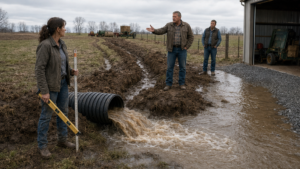
By midnight, the unfinished excavation had become a narrow brown pond.
Charles stood under the barn overhang listening to rain strike the metal roof while water collected along the marked boundary.
The survey stakes glowed pale whenever lightning flashed.
The storm had arrived earlier than forecast.
By morning, the lower edge of Charles’s field was saturated.
Benjamin drove down in the utility vehicle and stopped beside him.
“You see Moore’s south field?”
Charles nodded.
Water had begun spreading across Rebecca’s planted acreage in shallow silver sheets.
The old drainage path was easy to see now.
Rainwater sought it naturally, moving toward the clogged low area before backing up where years of grass and sediment had narrowed the channel.
Benjamin looked at the half-cut trench.
“If they’d finished?”
“They would’ve moved more water.”
“Onto your side.”
“And through my side.”
Benjamin waited.
Charles knew what he was asking.
“You think that means she was right?”
“No.”
“Good.”
“I think it means the water doesn’t care.”
Charles gave him a sideways look.
Benjamin pulled his hood tighter.
“Court can decide where she was allowed to dig. It can’t make the field higher.”
They drove along the edge in silence.
Near the boundary, water swirled around the iron pin but did not cover it.
Charles stopped.
A ridiculous little piece of rusted metal.
The first morning, he had looked at it like a weapon.
Proof.
Something that could end an argument.
Now water was flowing around both sides of it.
Rebecca’s truck appeared beyond the fence.
She parked near the road and walked toward them through the rain.
Her jeans were wet to the knees.
“You need to see something,” she said.
Charles did not answer.
She pointed toward her acreage.
They followed her through the gate.
The lower section was worse up close.
Rows of young growth vanished under standing water.
A portable pump sat near the field edge with a hose stretched toward a ditch, but the discharge was barely keeping pace.
Rebecca crouched and lifted a handful of wet soil.
“This was underwater two years ago.”
Charles looked across the field.
“How much did you lose?”
“Enough.”
“That isn’t a number.”
She stood.
“Enough that the lender wanted a new operating plan before spring.”
Benjamin glanced at Charles but stayed silent.
Rebecca continued.
“Last year I spent money pumping. This year I tried to fix the drainage before another storm did this.”
“You tried to fix it with an excavator on my land.”
“Yes.”
The answer came without defense.
Charles looked at her.
Rebecca rubbed rain from her face.
“I should have waited for the survey.”
“That would’ve been wise.”
“I didn’t.”
“No.”
“I also wasn’t trying to take your acreage.”
Charles looked toward the water.
“I know.”
It was the first time he had said that.
Rebecca seemed to hear it.
They walked to the old drainage course.
Water sat behind a collapsed section thick with roots and sediment.
The original shallow route was still visible beneath the rain.
Rebecca pointed.
“That’s why my father kept clearing it.”
Charles stared at the flow.
His own father had understood this.
That bothered him more than he wanted to admit.
Not because his father had been wrong.
Because he had been practical.
Charles had spent three days defending the line as though practicality weakened ownership.
His father had apparently believed the opposite.
A truck horn sounded from the road.
The county road supervisor had stopped near the culvert to inspect runoff.
Charles watched water gather along the roadside.
Rebecca said, “My attorney sent you a proposal.”
“I saw it.”
“You didn’t answer.”
“It asks for permanent access across a strip wider than the original ditch.”
“We need room for equipment.”
“You need more room than your father used?”
“Modern equipment is bigger.”
“That isn’t my problem.”
“It becomes your problem if the only workable drainage crosses this ground.”
Charles turned toward her.
“No. That’s exactly the thinking that got the excavator here before sunrise.”
Rebecca went still.
Charles lowered his voice.
“You don’t get to turn necessity into permission.”
For a moment, he expected another argument.
Instead Rebecca said, “Then tell me what you think is workable.”
The question caught him off guard.
He looked toward Benjamin.
His nephew had the good sense to pretend he was studying the water.
Charles returned to the farm after noon and spread Rebecca’s proposed settlement beside the survey.
Her requested corridor was broad.
Permanent vehicle access.
Maintenance access at reasonable times.
Rights to deepen or modify the channel as needed.
Charles crossed out three lines immediately.
Then stopped.
The easy response would be to write no across the top.
He could take the case into court, establish the boundary, seek restoration, and leave Rebecca to design another system.
He stood and went to the window.
Rainwater continued collecting along the field edge.
If he forced the ditch completely closed, the water would still go somewhere.
Maybe back across Rebecca’s crops.
Maybe toward the county road.
Maybe eventually across Charles’s own low ground during a bigger storm.
Ownership did not make gravity negotiable.
Benjamin came in carrying two wet jackets.
“You writing something?”
“No.”
“You’ve been standing over that legal pad twenty minutes.”
Charles sat again.
He drew a narrow line following the historical drainage route.
Not the excavator cut.
The old route.
He wrote conditions beside it.
Licensed survey.
Defined width.
No expansion without written consent.
Notice before maintenance.
Restoration of the unauthorized cut.
Responsibility for damage.
Formal recording.
Benjamin read over his shoulder.
“You’re giving her access?”
“I’m proposing access.”
“You could probably win without doing that.”
“I know.”
Benjamin looked toward the window.
“Then why?”
Charles set down the pen.
“Because winning the line doesn’t stop the water.”
Late that afternoon, Rebecca’s attorney sent a revised message rejecting Charles’s verbal objections and insisting that the broader corridor was necessary.
Charles read it twice.
Then he took Rebecca’s original proposal, drew a clean line through the excessive access language, and attached his narrower terms.
At the bottom, he left one blank line for something he had not yet decided how to say in court.
His own admission.
He remembered the ditch.
He had helped maintain it.
He had withheld that fact at first.
If he told the judge, Rebecca could use it against him.
If he did not, everything he was asking the court to trust would rest beside one deliberate silence.
Charles folded the proposal.
Tomorrow, he could protect the boundary with paperwork.
Whether he could protect his credibility depended on what he chose to say before anyone forced him to say it.
Chapter 6: The Question Was Not Who Remembered Best
Rebecca’s attorney began with Charles’s father’s signature.
The first exhibit was not the fresh excavator track.
Not the survey.
Not the iron pin.
It was the old permission letter.
Charles sat at the table and watched the attorney place the enlarged copy before the judge.
Rebecca sat across the aisle.
She did not look at him.
The courtroom was smaller than Charles expected.
No dramatic gallery.
No crowd waiting for somebody to win.
Just wood benches, file folders, the judge, the parties, and the dry sound of paper moving across a table.
Rebecca’s attorney summarized the history.
For decades, the Moore property had relied on drainage crossing the Hill edge.
Charles’s father had granted written permission.
The route had been maintained openly.
Rebecca had acted, the attorney argued, to restore an existing agricultural drainage path threatened by blockage and approaching storms.
Then came the sentence Charles knew was coming.
“Mr. Hill himself participated in maintaining that drainage course as a young man.”
The judge looked toward him.
Charles felt Benjamin shift on the bench behind him.
His own attorney had told him not to volunteer anything until asked.
Charles understood the advice.
He also understood how that silence would look.
The judge turned to the documents.
“Mr. Hill, before we discuss the present excavation, do you dispute that historical maintenance occurred?”
Charles could have answered narrowly.
Instead he stood.
“No, Your Honor.”
Rebecca looked at him.
Charles continued.
“I helped clear the ditch once when I was young.”
His attorney glanced up.
The judge said, “You personally participated?”
“Yes.”
“With the Moore family?”
“With Rebecca’s father and mine.”
“And you remembered this before today?”
Charles paused.
“Yes.”
The room seemed to narrow around that word.
“When?”
“Not clearly at first. The letter brought pieces back. By the next day, I knew I had been there.”
“And did you tell Ms. Moore immediately?”
“No.”
“Why not?”
Charles looked down at the table.
Because I was angry would have been true.
Because she brought an excavator onto my property would also have been true.
Neither was the whole answer.
“I thought admitting the old drainage use would make it easier for her to claim the land.”
Rebecca finally turned toward him.
The judge said, “Did it?”
“No.”
“How do you know?”
Charles looked toward the survey exhibit waiting beside his folder.
“Because I was confusing two different things.”
The professional survey came next.
The surveyor’s map showed the parcel boundary, verified monument locations, historical drainage depression, and modern excavator path.
The old iron pin appeared as a coordinate point on the exhibit.
Charles recognized it immediately.
The tiny piece of metal that had stopped the first morning’s argument now sat on a clean diagram surrounded by measurements.
The surveyor explained that the pin corresponded with the recorded parcel description.
Then he showed where the recent cut diverged from the historical shallow drainage course.
The difference was not subtle.
Rebecca leaned forward.
Her attorney asked whether the old ditch crossed Charles’s parcel.
Yes.
Whether water historically drained that way.
Evidence suggested it had.
Whether the modern trench remained within the old course.
No.
The surveyor traced the deviation.
Several feet inside Charles’s land at the widest point.
The judge looked at Rebecca’s attorney.
“Your position is that the historical letter permitted this excavation?”
The attorney returned to the two-page correspondence.
That was when the second page mattered.
Existing shallow drainage cut.
Maintenance.
Established course.
The judge read the language twice.
Rebecca’s attorney argued that maintenance necessarily allowed machinery appropriate to modern farming.
Charles’s attorney answered that the issue was not whether machinery could ever be used, but whether Rebecca could unilaterally create a wider route outside the historical channel before confirming the boundary.
The judge turned to Rebecca.
“Why didn’t you wait for the survey?”
Rebecca’s answer was quieter than Charles expected.
“The storm forecast. We’d already lost acreage in prior years. I believed the old permission covered the work.”
“Did Mr. Hill tell you not to excavate until the line was established?”
“Yes.”
“And you proceeded?”
“Yes.”
No one smiled.
That mattered to Charles.
For days he had imagined this moment as vindication.
Rebecca exposed.
His land proven.
Her certainty broken.
Instead, he saw a woman who had made a bad decision for reasons he now understood.
The judge reviewed the photographs.
The excavator bucket beside the pin.
Machine tracks.
The new trench.
Standing water.
Then the court separated the questions one by one.
The recorded evidence supported Charles’s ownership of the disputed strip.
The historical correspondence supported prior permission to maintain a specific drainage course.
That history complicated any claim that Rebecca had invented the drainage use.
But it did not establish unlimited authority to excavate wherever she believed the route should be.
And it did not excuse ignoring Charles’s demand for a survey before entering disputed ground with heavy equipment.
Rebecca was responsible for the unauthorized portion of the excavation and the reasonable restoration tied to it.
The exact scope of damages would be handled through the documented costs and settlement process.
Charles listened without moving.
He had won the point he came to court to protect.
The land remained his.
But the judge was not finished.
“The parties would be wise,” he said, “to distinguish ownership from drainage before the next storm makes that decision for them.”
Charles looked at Rebecca.
She was staring at the survey.
After the hearing, people moved out quietly.
Benjamin waited near the hallway.
Rebecca stood with her attorney near the courthouse steps.
Charles’s lawyer began talking about repair estimates.
Charles barely heard him.
He reached into his folder and removed the proposal he had written the night before.
He walked toward Rebecca.
Her attorney looked ready to intervene.
Charles held out the pages.
Rebecca did not take them immediately.
“What is it?”
“A drainage proposal.”
She frowned.
“You just won.”
“I established the boundary.”
“That’s what I meant.”
“No,” Charles said. “It isn’t.”
Rebecca looked at him for several seconds, then took the document.
She scanned the terms.
A narrow recorded corridor following the historical ditch.
Surveyed limits.
Notice before maintenance.
No unilateral widening.
Restoration of the fresh cut.
Shared review if future engineering required changes.
Her eyes stopped near the bottom.
“You’d allow this?”
“I’d allow this version.”
“Why?”
Charles looked back toward the courthouse doors.
“My father didn’t give away the land.”
“No.”
“He also didn’t pretend your water problem wasn’t real.”
Rebecca folded the proposal.
“My attorney will look at it.”
“I expect him to.”
She started to turn.
Charles spoke again.
“Rebecca.”
She stopped.
“I should’ve told you sooner that I remembered the ditch.”
She watched him carefully.
“Yes,” she said. “You should have.”
Charles nodded.
She did not apologize for the excavator.
He did not ask her to.
Not there.
Not yet.
The proposal remained in her hand as she walked away.
Charles stood on the courthouse steps beside Benjamin.
For the first time, the old iron pin no longer felt like proof that one family had beaten the other.
It felt like a line both of them would now have to choose whether to respect.
Chapter 7: He Kept the Line and Changed Its Meaning
The excavator came back to Charles Hill’s field three weeks later.
This time, Charles had invited it.
The same yellow machine waited near the drainage edge with its bucket resting flat on the ground. A survey tripod stood twenty yards away. Fresh stakes marked a narrow corridor through the grass, each one tied with bright flagging.
Rebecca Moore stood beside the operator holding a folded set of signed plans.
Charles noticed the difference before anyone spoke.
No engine running.
No bucket in the soil.
No assumptions.
Benjamin parked the utility vehicle near the fence and climbed out carrying two steel witness posts and a post driver.
“Feels strange seeing that thing back here,” he said.
Charles looked at the excavator.
“Different reason.”
“Same machine.”
“That’s why it matters.”
Rebecca walked toward them.
The weeks since the hearing had been filled with estimates, survey revisions and terse exchanges between attorneys. Charles had insisted the unauthorized cut be restored outside the approved drainage route. Rebecca had insisted the new corridor be wide enough for ordinary maintenance without requiring a fresh negotiation every time grass or sediment clogged it.
They had argued over feet.
Then inches.
Eventually, the final plan followed the historical shallow ditch as closely as practical while avoiding the wider path the first excavator had carved.
The easement would be recorded.
Rebecca would pay for restoration of the unauthorized excavation and the survey costs attached to correcting it.
Future maintenance required notice.
No widening without written agreement.
No machinery beyond the marked corridor.
Simple rules.
Rules their fathers could probably have written on one page if either family had imagined their children would someday need them.
Rebecca handed Charles the plan.
“Last check.”
He unfolded it even though he had reviewed the same version the night before.
Old habit.
Or maybe not old enough.
He traced the boundary line with one finger.
Then the drainage corridor.
Then the note identifying the permanent monument.
“Looks right.”
Rebecca glanced toward the iron pin.
“So we start?”
Charles nodded to the surveyor.
“After they mark the centerline one more time.”
Rebecca almost smiled.
“Of course.”
Charles looked at her.
“You drove an excavator onto my property before sunrise.”
“I remember.”
“I’m allowed to be careful.”
“You are.”
There was no sarcasm in it.
That, more than the signed document, told Charles something had changed.
The survey crew finished setting the final markers. The operator started the machine only after Charles and Rebecca both stepped clear.
The bucket lowered into the old drainage course.
This time, it removed only accumulated sediment and overgrowth.
Charles watched every movement.
So did Rebecca.
At first he assumed she was watching him, measuring whether he would object.
Then the bucket swung close to one of the flagged stakes.
“Stop.”
Rebecca shouted it before Charles could.
The operator froze.
Rebecca walked forward and pointed.
“You’re crowding the west limit.”
The operator leaned from the cab.
“I’m still inside it.”
“Barely.”
He looked toward Charles.
Charles said nothing.
Rebecca pointed again.
“Shift east. We agreed to the corridor.”
The machine repositioned.
Benjamin, standing beside Charles, spoke quietly.
“That was new.”
Charles kept his eyes on Rebecca.
“Yes.”
The work continued.
By noon, water had begun moving through the restored shallow channel.
Not dramatically.
No sudden rush.
Just a steady brown ribbon finding a path that had once existed and now existed again under written limits.
The unauthorized trench farther inside Charles’s parcel had already been filled, graded and reseeded. In another season, if the grass took properly, the scar would be difficult to see.
Charles was not sure he wanted to forget where it had been.
Rebecca joined him at the old iron pin.
The rusted top still showed above the soil.
A surveyor had recommended installing a witness post nearby so future crews could locate the monument without disturbing it.
Benjamin brought over the first steel post.
“Where do you want it?”
Charles pointed several feet away.
“Not on top of the pin.”
Benjamin positioned it.
Charles steadied the post while his nephew drove it into the ground.
Metal struck metal in slow, heavy blows.
When it was secure, Benjamin attached a small marker identifying the survey monument nearby.
Rebecca watched.
“You could cover the pin again,” she said. “Protect it from machinery.”
Charles shook his head.
“Then somebody forgets what’s underneath.”
“It’s rusty.”
“Still works.”
Rebecca crouched, brushing loose soil from around it without touching the metal itself.
Charles remembered the first morning.
Her excavator bucket suspended inches away.
His anger.
His certainty that finding the pin had ended the dispute.
He had been wrong about that.
The pin established a location.
It had not explained his father’s promise.
It had not explained the water.
It had not explained why Rebecca had acted recklessly or why Charles had withheld what he remembered.
A boundary could answer only the question it was designed to answer.
Rebecca stood.
“The recording should be finished this week.”
“Sandra said she’d call when it’s indexed.”
“I never thought I’d be happy to see an easement recorded against my neighbor’s property.”
Charles gave her a dry look.
“I’m not exactly celebrating.”
“But you signed it.”
“I did.”
“Why?”
She had asked him the same question outside the courthouse.
This time Charles had a better answer.
“Because I can know where my land ends without pretending your problem starts there.”
Rebecca looked toward the drainage channel.
“And I can have a drainage route without acting like that makes it mine.”
Charles nodded.
“That sounds expensive.”
“It was.”
For the first time since the argument began, they both smiled.
Only briefly.
There was too much history for easy friendship and too much damage for an instant reset.
Charles preferred it that way.
A clean apology would have felt dishonest.
Rebecca still believed the storm had left her little time.
Charles still believed she had chosen entitlement when caution would have cost less.
Both things could remain true.
The excavator worked another two hours.
When the final section was finished, the operator shut down and climbed from the cab.
Charles walked the entire corridor with the plan in his hand.
Rebecca walked the opposite edge.
Neither crossed the marked limits.
Near the road, water flowed cleanly through the restored channel and toward the existing culvert.
At the field end, the shallow route caught runoff without cutting farther into Charles’s ground.
It was narrower than Rebecca had first demanded.
Wider than Charles would once have tolerated.
It worked.
Benjamin joined Charles after the others began packing equipment.
“You good with it?”
Charles looked across the field.
The new witness post stood upright beside the old iron pin.
“I’m getting there.”
“You could’ve made her find another route.”
“Maybe.”
“You could’ve fought the easement entirely.”
“Probably.”
Benjamin waited.
Charles glanced at him.
“You trying to tell me I went soft?”
“I was going to say practical.”
“That sounds worse.”
Benjamin laughed.
Charles did too.
Then Benjamin headed toward the utility vehicle.
Rebecca was the last to leave.
She stopped beside her truck.
“Charles.”
He turned.
“The restoration invoice will be handled this week.”
“All right.”
“And if the channel needs work next season, I’ll call first.”
“Before bringing machinery?”
“Before bringing a shovel.”
“That’ll do.”
She opened the truck door, then paused.
“My father always said your dad was difficult about boundaries.”
Charles raised an eyebrow.
“My father said the same thing about yours.”
Rebecca smiled.
“Maybe that was why the arrangement worked.”
“Maybe.”
She drove away.
Charles remained at the field edge until the sound of her truck disappeared.
The ditch carried water quietly through the grass.
He walked back to the survey monument.
The old pin looked unimpressive beside the bright new witness post.
Rust-dark.
Worn.
Only a few inches visible.
Charles crouched and cleared one final clump of loose dirt from its base.
He could have covered it.
Instead, he left it exposed.
For years, he had thought a boundary mattered because it showed people where they had to stop.
Now he understood another use.
A good boundary also showed them exactly where agreement had to begin.
Charles stood, looked once along the restored drainage course, and walked back toward the farm.
The iron pin remained behind him in plain sight.
The story has ended.