He Moved the Fence Eleven Feet Into Samuel’s Farm—Then the Buried Iron Pin Changed Everything
Chapter 1: The New Fence Was Already Inside Samuel’s Pasture
Samuel Hill stopped the tractor because the left front tire had nowhere to go.
A cedar post stood directly in the track.
For a few seconds he remained behind the wheel, one hand resting on the gear lever, staring at the clean yellow wood planted in soil his tires had packed hard over twenty years.
Then he looked south.
A new livestock fence ran from the road toward the lower pasture, straight and tight and wrong.
Samuel shut off the engine.
The sudden silence made the fence seem even more out of place.
He climbed down and walked beside it. Fresh dirt ringed every post. The wire was new enough to shine. Whoever had installed it had finished recently.
Samuel reached the first pear tree in the windbreak and stopped.
The tree was now on Timothy Wilson’s side of the fence.
“Morning.”
Samuel turned.
Timothy was walking toward him from the neighboring cattle lot. He wore work boots and gloves and carried himself with the easy satisfaction of a man inspecting a completed job.
Samuel pointed toward the post blocking his tractor lane.
“You put this here?”
“Contractor did.”
“You know what I mean.”
Timothy looked along the fence.
“The old one was about finished.”
“It wasn’t here.”
“No. This one’s straight.”
Samuel glanced toward the grass behind Timothy.
The old fence had wandered. Everybody knew that. Some posts leaned east, others west. His father had repaired stretches of it with whatever was available.
But it had never crossed Samuel’s tractor track.
“You’re inside my pasture.”
Timothy gave a short laugh.
“No, Sam. I’m finally on the line.”
Samuel felt heat climb beneath his collar.
He kept his voice level. “What line?”
“The property line.”
“According to who?”
“According to where it’s always been.”
Samuel looked at him.
Behind Timothy, cattle pressed lazily against a feeder. Beyond them stood newer steel panels Samuel hadn’t paid much attention to during the summer.
“You moved it ten feet at least.”
“You’ve been using part of our ground all these years.”
That stopped Samuel.
Timothy said it casually, as though correcting an old accounting mistake.
Samuel walked back toward the tractor.
He ignored the new fence and studied the ground instead.
The old posts had been pulled, but they had left evidence. Depressions marked the earth. One rotten stump remained near the pear trees, dark at the center and gray around the edges.
Samuel placed his boot beside it.
The new fence stood several long strides west.
“There’s your old line.”
Timothy came closer.
“There’s an old fence,” he said. “That doesn’t make it the property line.”
Samuel looked up.
“Then what does?”
Timothy shrugged. “Records. Markers. Survey. Whatever you want.”
“Did you survey before you built?”
For the first time, Timothy’s expression shifted.
Only slightly.
“No need.”
Samuel almost laughed, but nothing about the post in his tractor lane felt funny.
“You just said records and markers matter.”
“And I’m telling you I know where the line is.”
Samuel’s hand tightened around his glove.
His father would have handled this differently.
At least Samuel liked to believe he would have.
Two men at a tailgate. Coffee cooling between them. Ten minutes of plain talk. Maybe somebody moved a post. Maybe somebody admitted being wrong.
No courthouse. No lawyers. No county truck coming down the lane.
Samuel had spent most of his life believing that was how neighbors stayed neighbors.
So he tried again.
“Move the fence back while we figure it out.”
Timothy shook his head.
“I’m not paying twice because you don’t remember where your property ends.”
There it was.
Not uncertainty.
Not even irritation.
Certainty.
Samuel turned toward the pear tree trapped behind the wire. His mother had planted that row when he was a boy. Half the trees were gone now, but the remaining trunks still broke the winter wind before it reached the barn.
“This isn’t about remembering.”
Timothy folded his arms.
“Then get it surveyed.”
Samuel studied him.
“You’re comfortable with that?”
“Sure.”
“If the survey says you’re over?”
“It won’t.”
“And if it does?”
Timothy smiled.
“Surveys aren’t cheap, Sam. Seems like a lot of money to spend proving a fence is where it belongs.”
Samuel heard a gate clang behind the Wilson barn.
He thought of answering.
Instead he walked back to the tractor.
The lane had once been wide enough to bring the hay wagon through without thinking. Now the fence pinched it so tightly near the irrigation ditch that he would have to back out and approach the lower field from the north.
Timothy called after him.
“You want the contractor’s number? He did a good job.”
Samuel stopped.
For one dangerous second, he wanted to give Timothy exactly the argument he seemed to be asking for.
Then he noticed something beside the tractor tire.
A shallow brown circle in the grass.
Another old post scar.
He followed the line with his eyes.
One scar.
Then another.
Then the rotten stump near the pears.
The former fence might have wandered, but the new one had not replaced it.
It had claimed a different strip altogether.
Samuel climbed onto the tractor.
He reversed slowly until he could turn away without clipping Timothy’s new post.
At the farmhouse, he left his muddy boots by the door and sat at the kitchen table with his phone.
The survey company was two counties over. Samuel had used them once years earlier when Christine needed a parcel description for paperwork.
He found the number.
His thumb hovered over it.
His father had disliked paying outsiders to settle things neighbors ought to settle themselves.
Samuel could almost hear him.
Talk first.
Samuel had talked.
He looked through the kitchen window toward the south pasture.
From here the new fence was only a thin line.
That was the trouble with boundaries. From far enough away, eleven feet could disappear.
Samuel pressed the number.
When a woman answered, he said, “I need a boundary survey.”
Chapter 2: The Iron Pin Under Forty Years of Grass
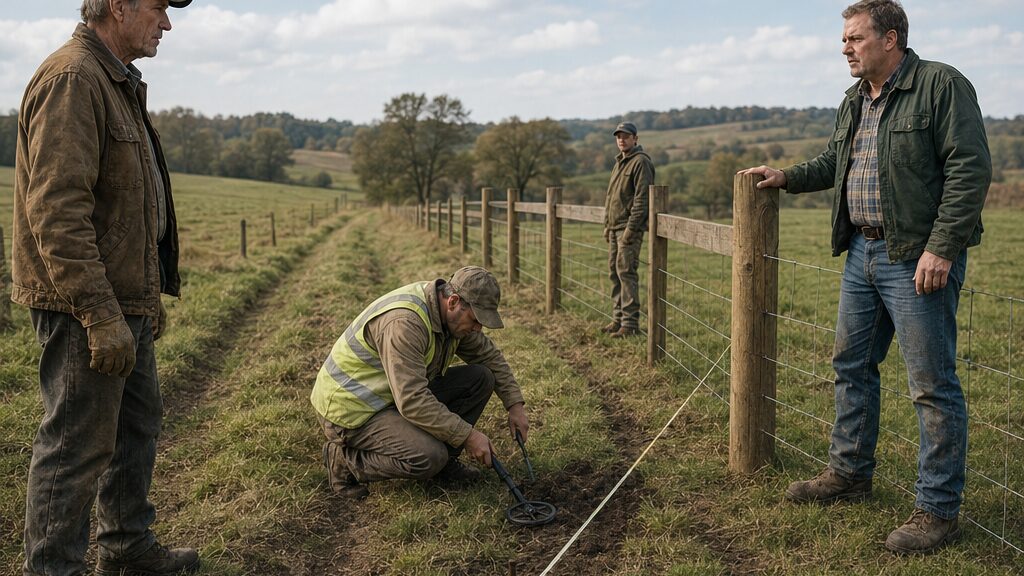
The detector chirped once beside Timothy’s newest corner post.
Then it screamed.
The surveyor stopped walking.
Samuel, standing ten feet away, felt something tighten in his chest.
Timothy leaned against the new fence.
“Probably junk,” he said.
The surveyor ignored him.
He swept the detector slowly back across the packed grass. The tone sharpened over one patch no larger than a dinner plate.
“Something’s here.”
Timothy gave Samuel a sideways glance.
“This is what you paid for?”
Samuel kept his hands in his jacket pockets.
“I paid to find the line.”
Two days had passed since their argument.
The new fence looked more permanent already. Timothy had moved cattle into the adjoining lot, and hoof marks covered the ground on his side.
The surveyor knelt and cut carefully through the sod.
The detector sounded again.
He scraped away another layer.
Samuel saw rust.
Not much at first.
Then the round top of an iron pin emerged from the dark soil.
Nobody spoke.
The surveyor cleaned around it.
“That’s an old one.”
Samuel crouched beside him.
The iron was stained nearly black and buried deeply enough that decades of grass had hidden it completely.
Samuel wiped loose dirt from its top with his glove.
Timothy straightened from the fence.
“You don’t know that’s the boundary marker.”
The surveyor stood.
“No. That’s why I measure.”
He set his equipment and began working.
Samuel stepped away.
He had imagined this moment several times since making the call. In those versions, the surveyor found exactly what Samuel expected, Timothy admitted the mistake, and the fence moved.
Standing there now, Samuel understood how much wishful thinking had been packed into that picture.
The surveyor moved toward the road, then back toward the lower pasture. He checked deed information against physical points and placed temporary flags.
The line appeared one piece at a time.
And every new flag landed west of Timothy’s fence.
Timothy stopped making jokes.
Near the tractor lane, the surveyor stretched a tape perpendicular from the verified boundary toward the cedar posts.
Samuel watched the numbers pass.
Eight feet.
Nine.
Ten.
The surveyor adjusted the tape.
“Eleven feet, two inches here.”
Samuel stared at the fence.
Eleven feet.
He had known it was wrong.
Hearing the number was different.
Eleven feet was enough for a wagon tire, a mower deck, a section of windbreak. Eleven feet carried down the length of a pasture was not an accidental lean.
Timothy pushed away from the fence.
“Measure it again.”
The surveyor looked at him.
“I’ll verify every point before I issue anything.”
“I’m asking about this one.”
“I heard you.”
Samuel said nothing.
Timothy looked toward him as if silence itself were an accusation.
“You think you’ve won something?”
“No.”
“Looks like you do.”
Samuel shook his head.
“I think your fence is eleven feet onto my place.”
Timothy’s jaw worked.
The surveyor continued toward the lower end.
Half an hour later he returned with his field notes.
“The deed boundary is consistent with the monuments I’ve located.”
Samuel exhaled slowly.
“So the fence is over.”
“The new fence is over.”
Timothy stepped forward.
“What does ‘new fence’ mean?”
The surveyor looked toward the shallow scars where the old posts had been.
“It means there’s another issue.”
Samuel’s relief stalled.
“What issue?”
The surveyor walked toward the pear windbreak.
He pointed to the rotten remains of an old post.
“This prior fence wasn’t on the deed line either.”
Timothy’s expression changed immediately.
“How far?”
“Varies.”
“Which direction?”
“Mostly east of the recorded boundary through this section.”
Timothy gave a humorless laugh.
“There you go.”
Samuel frowned.
“That doesn’t put this fence where it belongs.”
“I didn’t say it did.”
Timothy pointed at the old post scars.
“But that’s the fence our families lived with.”
The surveyor continued explaining, careful not to take sides. Old agricultural fences often followed terrain, drainage, convenience, or whatever could be built economically at the time. A fence could be evidence of occupation without automatically changing a recorded deed.
Samuel heard only part of it.
He was looking at the rotten stump.
His father had repaired that fence.
Samuel remembered helping him once after spring flooding. He would have been seventeen or eighteen. They had carried posts through mud because the truck couldn’t reach the low ground.
But Samuel couldn’t remember where the damaged fence had stood before that repair.
Timothy came closer.
“My dad always said that strip was ours.”
Samuel looked at him.
“Your dad said a lot of things.”
“And yours never objected.”
The words landed harder than Samuel expected.
Timothy pointed toward the old fence scars.
“Forty years, Sam. Your father farmed right beside that line. So did you.”
“The deed says something else.”
“The deed wasn’t feeding cattle.”
Samuel glanced at the surveyor.
The man had already returned to his equipment.
This part was not his problem.
Timothy lowered his voice.
“You wanted proof. There’s your proof.”
Samuel almost answered that the iron pin was the proof.
Then he understood what Timothy meant.
Not legal proof.
History.
The inconvenient kind.
By late afternoon, temporary flags marked the recorded boundary from the road to the lower pasture.
The new fence was plainly wrong.
But the old fence had been wrong too.
Before leaving, the surveyor handed Samuel a preliminary sketch.
“The final report will show the deed line, monuments, and the fence locations.”
Samuel traced the lines with his thumb.
One straight line represented ownership.
Another showed the former fence.
A third showed Timothy’s new construction.
Three lines where Samuel had spent most of his life imagining there was only one.
Timothy stood across the wire.
“You going to apologize now?”
Samuel folded the sketch.
“For what?”
“For acting like I stole eleven feet from you.”
“Your new fence is eleven feet over.”
“Because the old boundary was already over.”
“Not eleven feet.”
Timothy’s face hardened.
“Maybe your dad understood something you don’t.”
Samuel said nothing.
Timothy nodded toward the pear trees.
“My father said your father let that strip go years ago.”
The statement hung between them.
Samuel looked down at the rusted iron pin, newly exposed after decades underground.
For the first time since Monday, he wasn’t wondering whether Timothy had moved the fence.
He was wondering what his own father had promised.
Chapter 3: What Their Fathers Never Put on Paper
Christine Davis found the map folded inside a fertilizer receipt from 1987.
“You’re going to want to see this.”
Samuel looked up from the farmhouse desk.
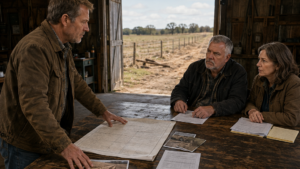
Paper covered nearly every clear surface: deed copies, tax maps, the surveyor’s preliminary sketch, old farm receipts and a cardboard folder that still smelled faintly of the machine shed where it had been stored.
Christine unfolded the yellowed sheet carefully.
It was a hand-drawn farm map.
Samuel recognized his father’s blocky handwriting immediately.
Fields were labeled by use rather than number.
North hay.
Lower pasture.
Pear row.
Along the southern edge, a pencil line wandered beside the Wilson property.
Three words had been written near the low ground.
Fence around wet.
Christine tapped them.
“That’s it.”
Samuel leaned closer.
“Maybe.”
“Come on, Dad.”
“It doesn’t say when.”
“It says why.”
Samuel took the map.
The pencil line curved around a shaded patch where drainage had always been poor.
He remembered that ground.
Spring water used to sit there for weeks before his father deepened the ditch.
Christine placed the modern survey sketch beside the old map.
The recorded boundary was straight.
The hand-drawn fence bent around the wet area.
For years Samuel had treated the old fence as something nearly sacred because his father had maintained it.
Now he saw something much more ordinary.
His father had put the fence where a fence could stand.
Christine watched him.
“Timothy doesn’t own that strip.”
“We don’t know everything yet.”
“We know your deed.”
“We know a map.”
“And a survey.”
Samuel folded his arms.
Christine sighed.
“This is what you do.”
“What?”
“You keep waiting for enough information that nobody has to be wrong.”
Samuel looked at her.
She didn’t retreat.
“You did it when the irrigation ditch backed up two years ago. You did it when Timothy’s cattle got through the old fence. You fix things first and talk about whose responsibility they were never.”
“Usually gets the problem solved.”
“Until somebody mistakes it for permission.”
That irritated him because he could not dismiss it.
They drove to the county records office that afternoon.
The clerk brought out recorded deeds and parcel descriptions. Samuel followed transfers through decades of ownership.
The language changed.
The boundary did not.
There was no deed conveying the disputed strip to the Wilson family.
No recorded boundary adjustment.
No easement granting ownership.
Christine sat beside him as the clerk turned another page.
“So it’s ours.”
The clerk gave her a practiced look.
“The records show the parcel boundary. I’m not giving you legal advice.”
Samuel almost smiled.
Outside, Christine held the copied documents against the wind.
“You heard her.”
“I heard exactly what she said.”
“Dad.”
Samuel stopped beside the truck.
“The old fence was still over.”
“Because Grandpa built around wet ground.”
“Probably.”
“And Timothy moved it farther.”
“Yes.”
“So what are we debating?”
Samuel looked across the parking lot.
His father had been dead nine years.
Samuel had never asked him why the fence wandered because there had never seemed to be a reason.
That was the price of informal arrangements. They felt simple while everyone remembered them.
Then memory died.
Back home, Samuel spread the old map beside the survey.
He aligned the pear row.
The ditch.
The road.
The iron pin marked on the modern sketch sat outside the old fence line exactly where the straight deed boundary said it should.
He remembered another piece then.
Not a conversation.
An action.
His father opening the old wire gate so Timothy’s father could drive a wagon around the flooded low ground.
Samuel had been young, but he remembered his father saying, “Use it till it dries.”
Not give.
Use.
Temporary language for a temporary problem.
Somewhere across the years, the distinction had disappeared.
Samuel sat back.
Christine saw the change in his face.
“What?”
“I think Dad knew.”
“Knew what?”
“That the fence wasn’t the boundary.”
Christine waited.
Samuel touched the handwritten words.
Fence around wet.
“He wasn’t giving anything away. He was making the place workable.”
“Then Timothy’s wrong.”
Samuel looked toward the south window.
“Timothy may have been told something different.”
That evening he walked to the pasture alone.
The survey flags moved slightly in the breeze.
He stopped beside the iron pin.
It seemed ridiculous that something so important had spent forty years under grass while two families built assumptions over it.
Samuel heard footsteps behind him.
He expected Timothy.
It was Sharon Wilson.
She stopped on her side of the new fence.
For several seconds neither spoke.
Sharon glanced toward the survey flag.
“I saw you at the county building.”
Samuel didn’t ask how.
“We checked the deeds.”
“I figured.”
“There’s no transfer.”
Sharon pressed her lips together.
Samuel waited for an argument.
None came.
Instead she looked toward the Wilson cattle lot.
“Are you reporting the fence?”
“I haven’t decided.”
Her eyes returned to him.
“Don’t. Not yet.”
Samuel studied her.
Two days earlier Sharon had stood beside Timothy while he insisted the fence was staying.
Now there was no confidence in her face.
“Why?”
She gripped the top wire, then released it.
“Give me a couple days.”
“For what?”
“I need to talk to Timothy.”
“You’ve had time.”
“This isn’t just about a fence.”
Samuel glanced past her toward the newer steel panels and the expanded cattle lot.
He remembered Timothy’s insistence. The speed of the construction. The certainty that Samuel would eventually let the matter go.
“What is it about?”
Sharon looked back toward her house before answering.
“Those eleven feet.”
Her voice dropped.
“We need them more than you think.”
Chapter 4: Eleven Feet Were Holding Up a Bigger Bet
Samuel saw why Timothy wanted the eleven feet before Sharon ever explained it.
A feed trailer came around the Wilson barn that Tuesday morning and nearly stopped dead between the cattle panels and the new fence.
The hired farmhand eased the pickup forward an inch at a time.
The trailer cleared one post by less than a foot.
Samuel stood beside his irrigation lane with a wrench in one hand and watched the driver fold the mirror in to gain another few inches.
Timothy was directing him from the ground.
“Come left.”
The driver leaned out the window.
“Can’t.”
“You’ve got room.”
“I don’t.”
Timothy slapped the side of the trailer in frustration.
Samuel looked from the trailer to the new fence.
Then he looked toward the flagged survey line.
If the fence moved eleven feet east, where the deed said it belonged, the passage Timothy was using would shrink sharply.
The reason for the fence was no longer difficult to see.
Timothy noticed Samuel watching.
“What?”
Samuel set the wrench on the irrigation box.
“You built your cattle setup too close.”
Timothy glanced at the trailer.
“It’s fine.”
“Your man can’t get through it now.”
“He got through yesterday.”
The pickup moved another six inches.
Metal creaked somewhere along the trailer.
The driver stopped again.
Samuel nodded toward the survey flags.
“And that’s with eleven feet of my ground.”
Timothy’s face tightened.
“Don’t start.”
Samuel walked closer to the fence.
“When did you put those steel panels in?”
“Summer.”
“Before you checked the line.”
“I knew the line.”
“No. You knew where you wanted it.”
Timothy stepped toward him.
For a moment Samuel expected the old certainty—the laugh, the folded arms, the insistence that everyone else was wasting his time.
Instead Timothy looked tired.
There were dark crescents beneath his eyes.
“I’ve got cattle to move.”
“So move them.”
“I am.”
“Then put the fence where it belongs.”
Timothy shook his head.
“You don’t understand how this place works anymore.”
Samuel stared at him.
“I’ve farmed beside you for thirty years.”
“Not my operation.”
“No.”
Samuel looked at the new handling alley, the heavier gates, the fresh gravel and newer equipment.
“That’s becoming clear.”
Timothy turned away before Samuel could say more.
The trailer finally squeezed through.
That afternoon Sharon crossed the lane carrying a folder under one arm.
Samuel was replacing a leaking fitting when she stopped beside him.
“You saw the feed trailer.”
He wiped his hands on a rag.
“Hard not to.”
Sharon looked toward her property.
“We expanded too fast.”
Samuel waited.
She opened the folder but didn’t hand it over.
“We financed the handling system. New panels, concrete, part of the feeder setup.”
“That’s between you and the bank.”
“I know.”
“Then why tell me?”
“Because Timothy won’t.”
Samuel leaned against the fence post.
Sharon stared at the survey flag marking the actual boundary.
“When they laid out the expansion, Timothy used the old fence as his reference.”
“The old fence that wasn’t the boundary.”
“He believed it was close enough.”
“Then the survey came.”
Her mouth tightened.
“Yes.”
Samuel looked at her.
“And he still built farther over.”
“He’d already committed to the layout.”
That answer sat badly with him.
“So instead of fixing his mistake, he moved the problem onto me.”
“I’m not saying it was right.”
“Sounds close.”
Sharon looked down.
Samuel regretted the sharpness almost immediately, but he didn’t take it back.
She said, “If that fence moves to the surveyed line, the trailer route doesn’t work. Part of the handling alley may have to move. We’re already stretched.”
“How stretched?”
She hesitated.
“Enough.”
Samuel understood that word.
Farm people rarely used exact numbers when the number frightened them.
He looked past her toward the cattle lot.
The new steel panels had seemed like ordinary improvement from his side of the fence.
Now he noticed details he had ignored: newer equipment, fresh concrete, the feeder installation, the expanded lot.
Timothy had not stolen eleven feet because he wanted a prettier boundary.
He had built an operation that needed those eleven feet to function.
Samuel felt sympathy arrive despite himself.
It did not change the survey.
“I can give him temporary access.”
Sharon looked up.
“What?”
“Not ownership. Access.”
Samuel pointed toward the tractor lane.
“If he moves the fence to the legal line, I can let the trailer swing through my lane for a while. Put it in writing. Give you time to change the setup.”
For the first time since she had approached him, Sharon looked hopeful.
“How long?”
“Long enough to make a real plan.”
“Timothy might agree to that.”
Samuel nodded.
“Then bring him over.”
She did.
An hour later Timothy stood beside the exposed iron pin while Samuel explained the proposal.
Timothy listened without interrupting.
Samuel finished.
“The fence goes back to the surveyed line. You acknowledge the land is mine. We write down limited access for equipment until you can rework the lane.”
Timothy looked at the flagged boundary.
Then at the new fence.
“Temporary access.”
“Yes.”
“So every time I need through, I ask permission.”
“We can write reasonable terms.”
“And you can cancel it.”
“Not if the agreement says I can’t.”
Timothy laughed once, but there was no humor in it.
“That’s not a solution.”
“It’s more than you offered me.”
“I offered to leave things where they’ve always been.”
“No. You moved them.”
Timothy’s jaw tightened.
Sharon said quietly, “Tim.”
He ignored her.
Samuel continued.
“I’m trying to keep this from costing either of us more than it already has.”
Timothy looked at him.
“You think because you found one rusty pin, you get to decide how both farms operate.”
“It’s not the pin deciding.”
“Sure sounds like it.”
“It’s the deed.”
Timothy took one step toward the fence.
“My father used that ground.”
“With my father’s permission.”
“You don’t know that.”
Samuel thought of the handwritten map.
Fence around wet.
Use it till it dries.
He could not prove the spoken words. He knew that.
But he no longer needed to pretend uncertainty where the records were clear.
“The land didn’t transfer.”
Timothy’s voice hardened.
“And I’m not tearing out a fence and rebuilding a cattle lane because you suddenly care about eleven feet.”
Samuel looked at Sharon.
Her hope disappeared.
He turned back to Timothy.
“I didn’t suddenly care.”
“You didn’t care for forty years.”
“That’s not the same thing.”
“It is to me.”
Samuel felt something shift inside him.
For days he had worried that formal action would make him the man who broke a neighbor relationship.
Standing there, he began to understand that the relationship was already being used as leverage against him.
He had offered Timothy time.
He had offered access.
What Timothy wanted was not help.
He wanted Samuel to absorb the mistake.
Samuel picked up the survey flag Timothy had knocked sideways with his boot and pushed it upright again beside the iron pin.
Timothy watched him.
“If you want that fence moved so bad,” he said, “call the county.”
Sharon closed her eyes briefly.
Samuel pressed the flag deeper into the soil.
When he straightened, he looked directly at Timothy.
“All right.”
Chapter 5: The Orange Notice on the Cedar Post
Samuel held the pen over the complaint form long enough for the county clerk to glance at him twice.
“You need another minute?”
“No.”
But he did.
The form was simple.
Property owner.
Parcel number.
Nature of complaint.
Supporting survey attached.
Samuel had filled out loan papers worth more than the farmhouse without this much hesitation.
The difference was that loans did not feel like accusations.
He could still hear his father saying that once a disagreement went to an office, it stopped belonging to the two men who had started it.
Samuel signed his name.
The clerk took the form.
“Survey’s attached?”
“Yes.”
“Photographs?”
He slid them across the counter.
The clerk checked the pages.
“You understand this starts a formal review.”
Samuel nearly smiled.
“I’ve spent ten days understanding it.”
She stamped the top sheet.
The sound was small.
It felt final.
Christine was waiting outside.
“You did it.”
Samuel folded his copy and put it in his jacket.
“Don’t sound so pleased.”
“I’m not pleased.”
“You look pleased.”
“I look relieved.”
They walked toward the truck.
Christine stopped before opening the passenger door.
“You gave him another chance.”
“I know.”
“And access.”
“I know.”
“Then quit acting like filing a form is worse than moving a fence onto somebody else’s farm.”
Samuel looked at her.
“You’ve been waiting to say that.”
“Since Monday.”
He opened the truck.
“Get in.”
Three days later a county zoning officer drove down the gravel lane.
Timothy saw the vehicle before Samuel did.
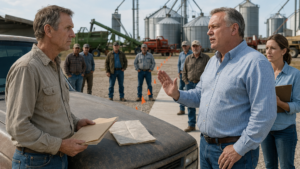
By the time Samuel reached the south pasture, Timothy was already standing beside the cedar fence with his arms crossed.
The officer carried a clipboard and a bright orange notice.
Timothy looked at Samuel.
“You really did it.”
“You told me to.”
“Didn’t think you’d run to the county.”
Samuel almost answered.
Then he stopped.
That was exactly the language he had feared.
Run to the county.
As if using the only formal process left to him were somehow cowardly.
The officer introduced himself by role and asked to see the survey markers.
Samuel showed him the iron pin and the flags.
The officer compared them with the submitted documents and walked the fence.
Timothy followed.
“This has been an agricultural boundary forever.”
“The placement I’m reviewing is this new fence,” the officer said.
“It’s replacing an existing fence.”
“Not on the same alignment.”
“Close enough.”
The officer looked at the measurement notes.
“Eleven feet isn’t close enough for what I’m reviewing.”
Timothy’s mouth flattened.
They continued toward the road.
At the corner post, the officer asked, “Where’s your county review?”
Timothy frowned.
“For what?”
“The fence placement.”
“It’s livestock fence.”
“Along an established boundary, certain agricultural fencing is treated differently. This is a newly placed boundary structure associated with an expanded handling area.”
Timothy stared at him.
“I need a permit for wire and posts?”
“You needed a placement review before relocating the boundary fence in connection with the new facility.”
Samuel saw the moment Timothy realized the survey was no longer his only problem.
The officer returned to his truck, completed paperwork, then walked back with the orange notice.
He fastened it to the nearest cedar post.
The paper looked almost absurd against the clean wood.
Timothy stepped forward.
“What does that say?”
“Correction required. You’ll receive the full notice by mail.”
“Correction meaning what?”
“Remove or relocate the encroaching section within the stated period.”
“That’s my fence.”
“Yes.”
“On a line that’s been used for decades.”
The officer pointed toward the survey flag.
“That issue is documented separately. I’m addressing the current placement.”
Timothy looked at Samuel.
“You happy now?”
Samuel looked at the orange notice.
“No.”
It was the truth.
He felt no satisfaction seeing it there.
Only relief that the argument no longer depended on who could speak with more confidence.
The officer handed Timothy a copy.
“Read the deadline carefully.”
Timothy snatched it.
“What happens if I dispute it?”
“Instructions are included.”
“And if I don’t move it while I’m disputing?”
“Depends on whether you file the proper appeal and whether enforcement is stayed.”
Timothy unfolded the paper.
Samuel said nothing.
The officer left.
For several seconds the two men stood on opposite sides of the same fence.
Timothy finally said, “You brought government people onto my farm over eleven feet.”
Samuel looked at him.
“No. I brought a survey to my farm. You told me to call the county.”
“Don’t play word games.”
“I’m not.”
Timothy slapped the paper against the post.
“This is exactly why people don’t involve officials. One complaint turns into ten rules.”
Samuel felt the old guilt pull at him.
Then his eyes settled on the tractor track disappearing beneath the new fence.
The guilt weakened.
“You could’ve moved it.”
“I couldn’t.”
“You wouldn’t.”
Timothy stepped closer.
“You think those are different because it doesn’t cost you anything.”
Samuel remembered Sharon’s folder. The equipment loan. The narrow feed-trailer route.
“I offered access.”
“On your terms.”
“On my land.”
Timothy had no answer to that except anger.
He tore the orange notice loose from one corner.
Samuel said, “I’d leave that up.”
Timothy stared at him.
“You giving county advice now?”
“No. Just seems expensive to ignore things because you don’t like looking at them.”
Timothy shoved the paper flat again and walked away.
The deadline was twelve days.
Samuel marked it on the kitchen calendar despite himself.
On the ninth day he saw no contractor.
On the tenth, cattle still stood behind the same fence.
On the eleventh, Sharon drove past without looking toward his house.
On the twelfth, Timothy moved feed through the disputed lane exactly as before.
Samuel stood beside the iron pin that evening.
The orange notice had faded slightly in the sun.
Nothing else had changed.
The next morning the county truck returned.
The officer inspected the fence, wrote something on his clipboard, and placed another sheet in Timothy’s mailbox.
Samuel walked over only after the truck had left.
Timothy was standing at the box with the notice in his hand.
“What now?” Samuel asked.
Timothy folded the paper once.
“Daily penalties.”
Samuel said nothing.
Timothy looked toward the cedar posts.
Then toward Samuel.
“You could still withdraw this.”
Samuel felt the old instinct immediately.
Fix it quietly.
Give him another week.
Keep the peace.
He looked down the line until he found the small survey flag beside the iron pin.
“No,” he said.
Timothy’s expression changed.
Not anger this time.
Surprise.
Samuel understood why.
For years, Timothy had known which man would eventually yield.
That man was no longer standing there.
Chapter 6: Every Morning Made the Fence More Expensive
The contractor took one look at the orange notice and started walking back to his truck.
Timothy followed him.
“You haven’t even measured.”
“Don’t need to.”
“I called you to move the fence.”
The contractor opened his truck door.
“Then call me when the county tells me where I’m allowed to put it.”
“I’ve got a survey.”
“Then get the placement cleared.”
Timothy held out both hands.
“The whole reason you’re here is to fix the violation.”
“And I’m not stepping into a boundary dispute with an active enforcement file unless the new location is approved.”
“It’s not a dispute anymore.”
The contractor glanced toward Samuel, who was standing fifty yards away near the irrigation box.
“Sure looks like one.”
He got into the truck and drove off.
Timothy remained in the lane as dust settled around him.
Samuel returned to his work.
A week earlier, he might have crossed over and tried to smooth things out.
He did not.
The penalties had begun small enough that Timothy treated them like an irritation.
Then the notices accumulated.
One appeared after another.
Inspection.
Continued violation.
Additional penalty.
Samuel knew the amounts only because Timothy told him loudly one afternoon while repairing a gate.
“Every morning,” Timothy said. “They add another one.”
Samuel tightened a bolt.
“You knew the deadline.”
“That’s easy for you to say.”
Samuel looked up.
“It was written on the fence.”
Timothy stared at him, then walked away.
The exchange bothered Samuel for the rest of the day.
Not because Timothy had accused him unfairly.
Because a part of Samuel still wanted to prevent the damage.
He could imagine calling the county office and asking whether enforcement could pause.
He could imagine offering Timothy another month.
He could imagine doing exactly what he had always done—absorbing inconvenience to keep another man from facing consequences.
That evening Christine found him at the kitchen table staring at his copy of the complaint.
“Don’t.”
Samuel looked up.
“I didn’t say anything.”
“You don’t need to.”
She sat across from him.
“You’re thinking about withdrawing it.”
“I’m thinking about whether this has gone far enough.”
“Has the fence moved?”
“No.”
“Then apparently not.”
“It’s costing them.”
“It was costing you before.”
Samuel looked toward the window.
“Not money.”
“No. Just land.”
He rubbed a hand over his face.
Christine softened.
“You don’t have to enjoy this.”
“I don’t.”
“But you also don’t have to rescue him from a choice he’s still making.”
Samuel folded the complaint and put it away.
Two days later Sharon came to the barn.
She did not knock on the open door. She simply stood there until Samuel noticed her.
“You got a minute?”
He set down the feed scoop.
“Sure.”
She looked thinner than she had the week before.
“The penalties crossed a thousand.”
Samuel said nothing.
“Timothy won’t tell you that.”
“I didn’t ask.”
“I know.”
She stepped farther inside.
“He thinks if he gives in now, he’s admitting he tried to take your property.”
Samuel leaned against the stall gate.
“Didn’t he?”
Sharon looked at the floor.
“Not at first.”
That caught him.
“What does that mean?”
“When we started planning the expansion, he used the old fence as the line. He really believed it.”
Samuel waited.
“But before the contractor set the new posts,” Sharon continued, “I asked whether we should check.”
“And?”
“He said we didn’t have time.”
Samuel felt his jaw tighten.
Sharon kept going.
“Then he shifted the new fence farther because the trailer needed the turn.”
There it was.
Not in a deed.
Not in a survey.
A choice.
Samuel’s voice stayed quiet.
“He knew he was moving beyond the old fence.”
“Yes.”
“How far did he think?”
“I don’t know.”
“Did he care?”
Sharon closed her eyes.
“I think he told himself you’d never make an issue of it.”
Samuel looked toward the barn opening.
The south pasture was visible beyond the yard.
The new fence cut cleanly across it.
For weeks he had tried to understand whether Timothy was confused, proud, desperate, or simply dishonest.
The answer was worse because it was ordinary.
Timothy had been all four at different moments.
Sharon said, “I told him to stop after the survey.”
Samuel looked back at her.
“He said you’d cool off.”
A bitter smile touched Samuel’s mouth.
“He’s known me too long.”
“That’s what I told him.”
She left without asking Samuel to withdraw anything.
That mattered.
The next afternoon Timothy approached the iron pin alone.
He carried no papers.
No gloves.
He stopped on the other side of the fence.
“I’ve got a proposal.”
Samuel waited.
“Split it.”
“What?”
“Eleven feet. We split the difference. Move the fence five and a half feet toward me. You withdraw the complaint.”
Samuel stared at him.
Timothy continued quickly.
“You get most of your lane back. I keep enough room for the trailer. Nobody spends another month fighting county people.”
A month earlier, Samuel might have considered it reasonable.
That realization frightened him.
Not because compromise was wrong.
Because this particular compromise required pretending ownership itself was negotiable whenever enforcing it became uncomfortable.
“No.”
Timothy’s face hardened.
“Think about it.”
“I have.”
“Five and a half feet isn’t going to make or break your farm.”
Samuel looked at him.
“Then five and a half feet shouldn’t make or break yours.”
“That’s different.”
“That’s been the problem from the start.”
Timothy gripped the top wire.
“So that’s it?”
“The fence goes to the surveyed line.”
“And I redesign everything.”
Samuel shook his head.
“I already offered you another option.”
Timothy frowned.
“Access.”
“Temporary equipment access. Written down. Specific route. Specific period.”
“So I sign something saying the ground is yours.”
“Because it is.”
Timothy looked toward the exposed iron pin.
For once he did not challenge it.
Samuel continued.
“I’m not offering half my land so neither of us has to feel uncomfortable. I’ll help you get through while you fix your layout. That’s the offer.”
Timothy’s mouth tightened.
“You sound like a lawyer.”
“No.”
Samuel pushed the survey flag upright where a tire had bent it.
“I sound like somebody who finally learned to write things down.”
Timothy stood silent for a long time.
Then he released the wire.
He did not accept.
He did not refuse.
He simply walked back toward his cattle lot.
Samuel watched him go.
The fence was still standing.
The penalties would rise again the next morning.
But for the first time, Timothy had walked away without claiming the eleven feet were his.
Chapter 7: The Fence Came Down on the Line It Crossed
The removal crew arrived before Samuel had finished his first cup of coffee.
He saw the truck from the kitchen window, headlights moving slowly along the Wilson lane, a flatbed trailer rattling behind it.
For a moment he simply stood there.
Then a second truck followed.
Samuel set the mug in the sink and pulled on his jacket.
By the time he reached the south pasture, Timothy was already beside the fence.
He had both hands in his coat pockets.
Sharon stood farther back near the cattle lot.
Neither of them looked toward Samuel.
Two workers unloaded a post puller and a stack of tools. The fence contractor who had refused the earlier job walked the line with a copy of the approved placement in his hand.
This time there was no argument about where the fence belonged.
Bright flags marked the surveyed boundary.
The old iron pin remained uncovered beside one of them.
The contractor stopped at the first cedar post.
“This one?”
Timothy nodded.
“Start there.”
The hydraulic puller clamped around the post.
Samuel had expected satisfaction.
Instead he felt an uncomfortable pressure beneath his ribs.
The machine groaned.
Fresh cedar lifted slowly out of the ground Timothy had claimed only weeks earlier.
Packed soil broke loose around it.
The post came free with a wet sucking sound.
Timothy looked away.
Samuel did too.
The crew worked methodically.
Wire loosened.
Staples came out.
Posts rose one after another.
Nothing about it was dramatic.
That made the cost feel larger.
Each piece had been bought, hauled, installed and paid for. Now Timothy was paying again to undo it.
When the section across the tractor lane came down, Samuel walked to the tractor and started the engine.
He did not need to move hay that morning.
He drove through anyway.
For the first time in weeks, the left tire followed its old track without forcing him toward the irrigation ditch.
The tractor passed the pear windbreak with room to spare.
Samuel stopped beyond the former fence line and looked back.
The open lane felt wider than eleven feet.
It felt like something returned.
Timothy stood watching.
Samuel shut off the engine.
“You proved your point,” Timothy said.
Samuel climbed down.
“Wasn’t trying to prove a point.”
“Could’ve fooled me.”
The old irritation rose in Samuel, then passed.
He looked at the workers instead.
“They’re putting it where the survey says.”
“I know what they’re doing.”
Timothy kicked at a clod of dirt.
“The county penalties stop once they confirm correction.”
Samuel nodded.
“That’s what they told me.”
Timothy glanced sharply at him.
“You’ve been keeping track.”
“I wanted to know when this was finished.”
“Finished.”
Timothy repeated the word as though testing it.
Behind him, the cattle shifted against the steel panels. The narrow equipment route that had started the whole problem was shrinking before their eyes.
One worker drove a stake on the surveyed line.
Timothy watched it go in.
“My father always said that strip was ours.”
Samuel looked at him.
“I believe he thought that.”
Timothy’s face tightened.
“That’s different from what you’ve been saying.”
“No.”
Samuel walked toward the exposed iron pin.
“My father let your father use it because that low ground stayed wet. I’ve got his old map. Fence bent around the bad ground.”
Timothy said nothing.
Samuel pointed toward the pasture.
“He didn’t transfer anything. He made room.”
Timothy stared at the pin.
“Same difference after forty years.”
“That’s what got us here.”
The words came out quieter than Samuel expected.
Timothy looked at him.
Samuel continued.
“My father probably figured everybody knew what he meant.”
A faint bitterness entered his voice.
“I did the same thing. Every time something crossed the line, I let it go because I thought making an issue out of it was worse.”
Timothy looked toward the removed posts.
“And now?”
“Now I think leaving things unclear can be worse.”
For once, Timothy did not argue.
The contractor called him over to approve the next section.
Timothy walked away.
Samuel remained beside the iron pin.
He had spent weeks treating it as proof.
Now it felt more like a warning.
A boundary could exist for decades and still become useless if everyone preferred assumptions to saying plainly what it meant.
By afternoon, the new fence followed the marked deed line.
The tractor lane was open again.
The pear trees stood fully on Samuel’s side.
But the Wilson feed trailer no longer had enough room to make its old turn.
Samuel watched Timothy try it once.
The driver stopped before committing to the narrow gap.
Timothy waved him back.
He looked across the fence toward Samuel.
There was no anger in the look this time.
Only a question neither man had finished answering.
Samuel walked to the farmhouse.
Christine was at the kitchen table when he came in.
She had brought the draft access agreement Samuel had asked her to help organize.
He read it slowly.
Temporary agricultural equipment access.
Defined route.
Limited duration.
No transfer of title.
No adverse claim.
Access could not expand beyond the written purpose.
Christine watched him reach for the pen.
“You don’t have to give him anything.”
Samuel looked up.
“I know.”
“He moved the fence knowing he hadn’t checked.”
“I know that too.”
“And he made you fight for your own ground.”
Samuel nodded.
Christine leaned back.
“So why help?”
Samuel looked at the document.
“Because the lesson wasn’t that neighbors shouldn’t help each other.”
He tapped the paragraph preserving ownership.
“It was that help shouldn’t be mistaken for ownership.”
Christine was quiet for a moment.
Then she nodded.
“That sounds more like Grandpa than refusing him completely.”
Samuel smiled faintly.
“Probably why it took me so long to get here.”
That evening he carried two copies of the agreement to the boundary.
Timothy met him beside the new fence.
Samuel handed one across.
“Read it.”
Timothy did.
His eyes paused at the line confirming that all temporary access remained on Samuel’s property.
“This part stays.”
Samuel nodded.
“Yes.”
“And after the term ends?”
“You’ve got to have your own route fixed.”
Timothy looked toward his cattle lot.
“That’s going to cost me.”
“I know.”
“You could extend it.”
“If there’s a reason, we can talk before it expires.”
Timothy gave him a tired look.
“Another piece of paper?”
“If we agree to something, yes.”
For the first time in weeks, Timothy almost smiled.
“Your father would hate that.”
Samuel looked toward the iron pin.
“No. I think he’d hate where guessing got us.”
Sharon walked over from the house.
She read the agreement more quickly than Timothy had.
“Sign it,” she said.
Timothy looked at her.
She held his gaze.
“We’ve paid enough for pretending this wasn’t Samuel’s.”
Timothy’s shoulders lowered slightly.
He took the pen.
Before signing, he looked at Samuel.
“My dad wasn’t lying to me.”
“I didn’t say he was.”
“He believed it was ours.”
Samuel nodded.
“And my dad believed letting him use it didn’t make it his.”
Timothy looked down at the signature line.
“Guess neither one thought we’d be standing here arguing about it.”
“No.”
Timothy signed.
Samuel signed beneath him.
No handshake followed.
Not yet.
The agreement did not repair everything a fence had exposed.
But the next week, Timothy’s trailer crossed Samuel’s lane under terms both men could point to.
Several weeks later, the survey flags were removed.
Samuel left one thing alone.
The iron boundary pin remained visible beside the rebuilt fence.
He cleared the grass around it whenever he passed.
One morning Timothy stopped his truck there while Samuel was checking the irrigation line.
He lowered the window.
“Feed trailer coming through around three.”
Samuel nodded.
“I’ll keep the lane clear.”
Timothy started to drive away, then stopped.
“Thanks.”
Samuel rested one hand on the fence.
“That’s what neighbors are for.”
Timothy glanced at the iron pin.
This time neither man pretended not to understand the rest.
Samuel watched the truck disappear toward the cattle lot.
Then he turned back toward his pasture.
The fence stood exactly where it belonged.
And for the first time, so did the agreement between the men on either side of it.
The story has ended.