They Told Him His Farm Mailbox Broke the Rules—So He Measured Every One on the Road
Chapter 1: The Notice Nailed Beside the Cattle Gate
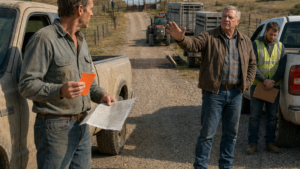
Ronald White had Daniel Green’s mailbox flag in his hand when Daniel came down the lane.
The little red piece of metal looked ridiculous between Ronald’s thick fingers. He had already pulled it loose from the black mailbox and was turning toward the cattle gate with a clipboard tucked under one arm.
“Put that back,” Daniel said.
Ronald stopped.
Daniel had been checking the north pasture fence when he saw the white pickup parked crooked on the gravel shoulder. He still had fencing pliers in one hand and a steel tape measure clipped to his belt. Mud from the low field had dried gray along his boots.
Ronald looked at the mailbox flag, then at Daniel.
“It isn’t part of the approved design.”
“It was there yesterday.”
“That doesn’t make it approved.”
Ronald set the flag on top of the mailbox instead of reinstalling it. Then he pulled a sheet from the clipboard and held it against the wooden post beside Daniel’s gate.
Daniel heard the first strike of the staple gun before he understood what Ronald was doing.
“What are you putting on my property?”
“A compliance notice.”
The second staple snapped into the wood.
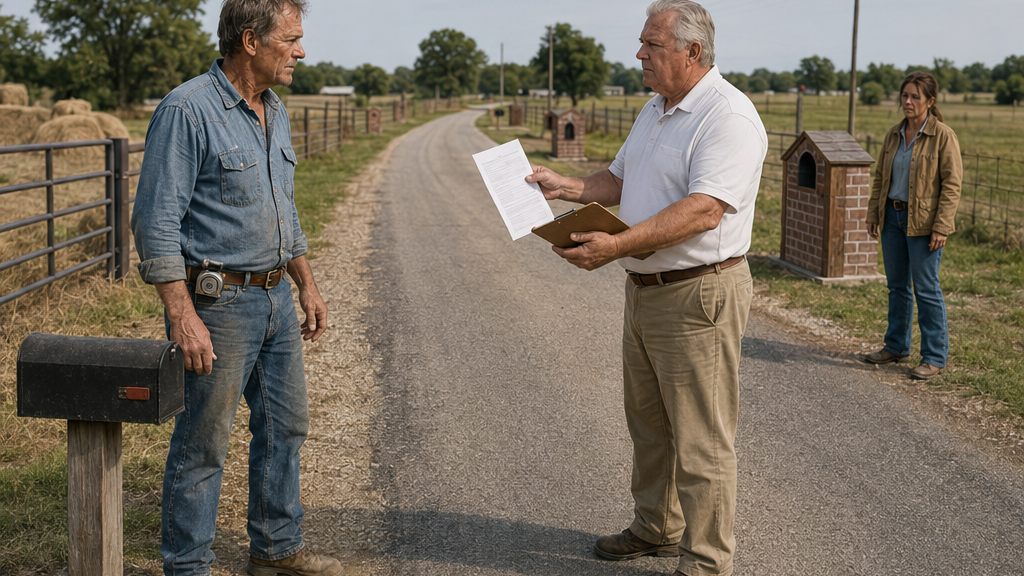
Daniel walked the last few yards without hurrying. Beyond the gate, his cattle had lifted their heads from the hay ring. Across the road stood one of the new association mailboxes: red brick base, heavy timber cap, black metal box recessed into the front. It looked more like a short monument than something meant to receive bills and seed catalogs.
Ronald stepped away so Daniel could read the notice.
Daniel did not.
He looked at Ronald instead. “You could have handed it to me.”
“You haven’t responded to the other notices.”
“I responded.”
“You wrote three sentences saying you disagreed.”
“That’s a response.”
Ronald’s mouth tightened. He was in his late sixties, broad through the chest, silver hair combed neatly back. He ran more cattle than most families on the road and had chaired the private road association for six years. People listened when he spoke, partly because he was organized and partly because he spoke as though disagreement were an administrative error.
“The standard passed,” Ronald said. “You had your chance.”
Daniel finally read the page.
The heading referred to roadside uniformity and maintenance. Below that, several paragraphs required mailboxes along the shared rural road to conform to the association’s newly adopted “heritage farm” design. Brick base. Timber trim. Approved stain. Standard setback. Daniel’s plain pressure-treated post and galvanized crossarm violated almost every cosmetic requirement.
His mailbox, however, worked.
The mail carrier reached it without trouble. Snowplows cleared it. Feed trucks passed. Daniel had replaced the post twice in twenty years, both times after someone slid off the road in winter.
“How much?” Daniel asked.
Ronald seemed prepared for an argument, not the question. “What?”
“The penalty.”
“If you don’t correct it within ten days, twenty-five dollars a day.”
Daniel looked up.
Ronald shifted the clipboard against his side. “It was in the meeting packet.”
“I wasn’t at the meeting.”
“That was your decision.”
Daniel said nothing.
He had thrown the meeting notice onto his kitchen counter two weeks earlier and never gone. Road-association meetings had a way of turning forty-minute questions into two-hour grievances about culverts, gravel invoices, weed trimming, and whose tractor had tracked mud over whose driveway.
Daniel had written his objection and mailed it. He had assumed that was enough.
Now the decision was stapled to his gate.
Ronald nodded toward the mailbox. “Everybody else is making the change.”
Daniel glanced down the road. Two new brick structures were visible before the bend. One had fresh mortar still pale around the joints.
“Everybody?”
“Most.”
“That isn’t everybody.”
“This is exactly why people get tired of dealing with you, Daniel.”
The words landed harder than Daniel expected.
He had heard variations before. Difficult. Stubborn. Set in his ways. Usually from people who wanted something changed quickly and thought silence meant ignorance.
Daniel slipped the fencing pliers into his back pocket.
“What’s wrong with the post?”
Ronald exhaled. “It doesn’t match the standard.”
“I asked what’s wrong with it.”
“It looks temporary.”
“It’s been there eleven years.”
“That isn’t the point.”
“Then what is?”
Ronald looked across the road toward the new brick mailbox. “People have put money into this road. New drainage, shoulder gravel, entrance markers. We’re trying to make it look maintained instead of patched together.”
Daniel followed his gaze.
That part he understood more than he wanted to admit. Three farms farther west had rusted barrels near their entrances. Another had used an old wagon wheel as a mailbox support until a windstorm flattened it. A roadside could look neglected long before the land behind it actually was.
But Daniel’s post was plumb, painted, and sound.
“You’re asking me to tear out something that works,” he said.
“I’m asking you to follow what the association approved.”
“Who designed it?”
Ronald’s expression changed by half a degree.
“Committee recommendation.”
“Who checked it?”
“It was reviewed.”
“By whom?”
“You’re doing it again.”
“Doing what?”
“Turning a simple matter into a trial.”
Daniel looked at the notice, then at the brick box across the road.
The face of the metal mailbox seemed close to the travel lane. Closer than his.
He could not have said why he noticed it then. Maybe because Ronald had used the word standard so many times. Maybe because Daniel had spent forty years judging whether equipment could clear a gate by an inch.
His fingers touched the tape measure clipped to his belt.
Ronald noticed.
“Don’t start measuring things,” he said.
Daniel looked back at him.
That was the first thing Ronald had said all morning that made Daniel genuinely curious.
“Why not?”
“Because the issue is your mailbox.”
“Then the numbers ought to help.”
“The board voted.”
“A vote doesn’t change a measurement.”
Ronald’s jaw flexed. “Ten days.”
He walked toward his pickup.
Daniel pulled the notice loose from one staple and caught it before the wind folded it against the gate.
“Ronald.”
Ronald stopped at the driver’s door.
“I want the standard.”
“You’ve got the notice.”
“The actual standard. Drawings. Dimensions. Whatever you voted on.”
“It won’t change anything.”
“Then there’s no reason not to give it to me.”
Ronald stood still for a moment.
Then he opened his truck, reached across the seat, and came back carrying a glossy packet in a clear plastic cover.
He crossed the road, slapped it onto the hood of Daniel’s old pickup, and tapped the front page.
“There. Everything approved. Heights, dimensions, materials. Exactly what we gave everybody else.”
Daniel put one hand on the packet before the wind could take it.
Ronald walked away without another word.
The truck door slammed. Gravel popped beneath the tires as he pulled out.
Daniel remained beside his pickup.
He had meant only to carry the packet back to the house.
Instead he opened it.
The first page showed the brick-and-timber mailbox in clean black lines. The second listed materials. The third showed side measurements from the road edge.
Daniel stared at one number.
Then he looked across the road at the new brick mailbox.
His hand went again to the tape measure on his belt.
Chapter 2: The Measurements Nobody Thought to Check
The number on the drawing bothered Daniel before he finished his coffee.
He had carried the glossy packet into the farm workshop and spread it across the scarred plywood bench between a box of grease fittings and an old vise. Morning light came through the dusty west windows in pale rectangles.
Daniel flattened the dimension sheet with two wrenches.
The association drawing showed the mailbox face positioned much closer to the road edge than Daniel expected.
He checked it again.
Then a third time.
On paper, it looked tidy.
On a working road, it looked wrong.
Daniel had backed stock trailers through gates with six inches to spare. He had driven tractors with folded hay rakes past culverts he could not afford to hit. Distance was not theoretical to him. A foot could be the difference between clearing an obstacle and buying a new fender.
He found an old county road-maintenance sheet in a filing cabinet, then pulled up another guidance page on the computer he used mostly for cattle records.
The wording differed between documents. Some referred to delivery access, others to clear roadside zones and obstruction. None gave him a single magical sentence declaring Ronald wrong.
That irritated him.
He preferred bolts to rules. Bolts either fit or they did not.
Still, the pattern was enough to make him put on his jacket.
He took the tape measure, a small digital camera, and Ronald’s packet.
His own mailbox was first.
Daniel hooked the end of the tape near the compacted edge of the lane and stretched the steel toward the box. He measured the face, the post, the gravel shoulder behind it, and the distance needed to swing a wide trailer from his driveway.
He wrote each number on the back of an old feed receipt.
Then he crossed the road.
The association-approved mailbox opposite his farm had been installed two weeks earlier. Brick base. Timber cap. Black box. Decorative metal plate with no wording Daniel could read from where he stood.
He hooked the tape at the same reference point.
The result made him crouch and measure again.
The brick face sat farther toward the usable shoulder than his post.
Not by inches.
By enough that a wide vehicle hugging the edge would notice.
Daniel stepped back and studied both mailboxes together.
His looked cheap beside the brick one.
It also looked far less likely to remove a mirror from a feed truck.
He raised the camera.
Click.
He photographed the tape stretched to the brick face.
Click.
Then the shoulder.
Click.
He returned to his own mailbox and repeated the photographs from identical angles.
A pickup slowed behind him.
Daniel turned.
One of the neighboring association members lifted two fingers from the steering wheel.
“What are you doing?”
“Measuring.”
The neighbor glanced toward the brick mailbox.
“For Ronald?”
“No.”
That answer earned Daniel a longer look.
“You planning to fight the board over a mailbox?”
Daniel reeled the tape back into its case.
“I’m trying to find out what they approved.”
The neighbor shook his head with the faint smile people used when they had decided somebody else was volunteering for unnecessary trouble.
“Looks like a mailbox to me.”
Daniel watched the pickup continue down the road.
That was the problem. It did look like a mailbox.
Until somebody had to get around it.
By noon, Daniel had measured three.
Every approved structure was different by an inch or two because no contractor set brick perfectly alike. But each one shared the same basic placement from the association drawing.
Each one crowded the shoulder more than his plain post.
At the third farm, Daniel found tire marks in the gravel beside the structure. They curved away sharply, as if a driver had corrected late.
He photographed those too.
A woman came out onto the porch.
Sarah Lee.
She wore a canvas coat over a sweatshirt and carried a coffee mug in one hand.
“Daniel?”
He straightened.
Sarah looked from him to the tape stretched beside her mailbox.
“Should I be worried?”
“No.”
“That sounds exactly like something somebody says before I should be worried.”
He let the tape retract.
“I’m checking dimensions.”
“Why mine?”
“Because it’s one of the approved ones.”
Sarah walked down the path toward him. Her property was smaller than Daniel’s, mostly hay ground with a few acres leased for cattle. The brick mailbox at her entrance was new enough that the mortar joints were still clean.
“You know I voted for the change,” she said.
“I know.”
“I wasn’t voting against you.”
“I didn’t say you were.”
“You didn’t say much of anything.”
Daniel looked at her.
There it was again.
He could have told her that he had skipped the meeting because he was tired of spending evenings listening to people argue about appearances when he had a waterer leaking in the south lot. He could have told her he had assumed his letter would be read aloud.
Instead he said, “I sent my objection.”
Sarah gave him a tired look. “Three sentences.”
“Three accurate sentences.”
“That’s very Daniel of you.”
He almost smiled.
Almost.
Sarah glanced at the tape measure. “What did you find?”
Daniel hesitated.
He did not yet know enough to make an accusation.
“The new boxes sit farther into the usable shoulder than mine.”
Her eyes shifted to the road.
“Is that against something?”
“I don’t know yet.”
“Then why photograph them?”
“Because I’d rather have the pictures before somebody tells me I measured wrong.”
A familiar white pickup appeared beyond the bend.
Sarah noticed it first.
“Oh.”
Daniel turned.
Ronald’s truck came fast enough to throw dust from the road edge. It stopped partly on the shoulder twenty yards away.
Ronald got out before the engine finished settling.
“What are you doing?”
Daniel looked at the tape in his hand.
“Measuring.”
“I told you yesterday this was about your property.”
“And your standard is on everybody’s property.”
Ronald walked toward him, face already reddening. “You don’t have permission to conduct inspections.”
“I’m standing on the road shoulder.”
“You’re photographing private property.”
“I’m photographing mailboxes.”
Sarah raised one hand. “Ronald, he’s not bothering me.”
Ronald barely looked at her.
“Daniel, this isn’t helping you.”
“I haven’t decided what helps me.”
“You have eight—nine days now. You should be getting a contractor.”
Daniel pointed toward Sarah’s mailbox.
“Do you know how far that brick face sits from the travel lane?”
Ronald’s eyes moved to the tape.
“No.”
Daniel told him.
For the first time since the dispute began, Ronald did not answer immediately.
Daniel noticed.
So did Sarah.
Daniel continued. “Mine sits farther back.”
“The board standard was reviewed.”
“You keep saying that.”
“Because it was.”
“By somebody who drives this road with a stock trailer?”
Ronald stepped closer.
“You think this is clever.”
“No.”
“Walking around taking pictures, trying to embarrass people because you lost a vote?”
Daniel felt the old instinct rise in him—the instinct to shut down, turn away, and let another man’s opinion die from lack of oxygen.
Usually it served him well.
This time, silence would look like surrender.
“I’m not trying to embarrass anybody,” he said. “I’m trying to understand why the box you say is wrong leaves more room than the ones you say are right.”
Ronald stared at him.
The wind clicked the loose tape hook against Daniel’s hand.
Sarah spoke quietly.
“Ronald, who actually checked these dimensions before we approved them?”
Ronald looked at her then.
And Daniel saw something he had not expected.
Not anger.
Fear.
It lasted less than a second.
Then Ronald recovered.
“We’re not doing this on the roadside.”
He turned toward Sarah.
“Association meeting tomorrow night. Bring your questions there.”
“I wasn’t planning to go,” Daniel said.
Ronald opened his truck door.
“You should.”
The answer was too quick.
Daniel watched him drive away.
Sarah stood beside the brick mailbox with both hands around her coffee mug.
“You saw that too,” she said.
Daniel clipped the tape measure back onto his belt.
“Yes.”
“Think he knows something?”
Daniel looked down the road at the row of expensive new mailboxes.
“I think I’m going to that meeting.”
Chapter 3: The Rule Ronald Needed Everyone to Trust
Daniel arrived at the equipment shed five minutes after the meeting started.
That alone turned heads.
He had not attended an association meeting in almost a year.
The shed belonged to the road association jointly, though it looked more like a machine bay than a meeting hall. Folding chairs faced a scarred table beneath fluorescent lights. A road grader blade sat against one wall. Coffee steamed from an old metal urn near the door.
Ronald stopped speaking when Daniel entered.
“You decided to join us.”
Daniel took the empty chair nearest the back.
“I decided to listen.”
One of the association members gave a short laugh.
Ronald did not.
On the table before him lay the same glossy mailbox packet Daniel had received Monday.
“Fine,” Ronald said. “We were discussing compliance deadlines.”
Daniel set his own copy on his knees.
Sarah sat near the end of the table with a notebook open. She gave him a small nod but said nothing.
Ronald continued.
“The roadside improvement program was adopted properly. Contractors were given the approved specifications. Most households have either completed installation or scheduled it. We cannot administer shared standards if individual owners decide which parts apply to them.”
Daniel listened.
This was why he avoided meetings.
Ronald was good at making disagreement sound like disorder.
When the chairman finished, Daniel raised one hand.
Ronald looked surprised by the formality.
“Yes?”
“How much has everybody spent?”
The room went still.
Ronald leaned back. “That isn’t relevant to your violation.”
“It’s relevant to whether people are going to want to hear there might be a problem.”
Sarah closed her notebook.
“I can answer that.”
Ronald turned toward her.
She looked down at several figures.
“The association paid for design work and contractor coordination out of the road account. Individual installations varied. Lowest was around eleven hundred. Highest was just over twenty-four hundred where the old concrete had to be removed.”
Daniel stared at her.
“Per mailbox?”
“Yes.”
He looked around the room.
A few people avoided his eyes.
Daniel had assumed the brick structures were expensive. He had not understood how expensive.
Ronald said, “Which is exactly why we’re not going to undermine the entire program because Daniel doesn’t like the design.”
Daniel reached into the folder beside his chair.
“I don’t care how it looks.”
He placed three photographs on the table.
Then four more.
Each showed the extended tape measure beside an approved mailbox.
Ronald’s expression hardened.
Daniel laid the association drawing beside them.
“This dimension here puts the face farther into the usable shoulder than mine.”
One association member leaned forward.
“How much farther?”
Daniel told him.
The man whistled softly.
Ronald put one finger on the specification.
“You are interpreting a design drawing as if it were a road regulation.”
“No. I’m comparing it to the actual road.”
“That’s not the same thing.”
“I know.”
Daniel pulled out another page.
“That’s why I checked the county shoulder guidance and rural-delivery recommendations.”
Ronald looked at the page but did not touch it.
“Recommendations.”
“Some of them.”
“So this isn’t a violation.”
“I didn’t say it was.”
That irritated Ronald more than an accusation would have.
“Then what exactly are you doing?”
Daniel paused.
The truthful answer was uncomfortable.
He had come hoping to prove Ronald wrong.
After hearing what people had spent, that no longer felt like enough.
“I’m saying you’re fining me to replace something that leaves more working clearance than the approved replacement.”
A man near the coffee urn shifted in his chair.
“My feed truck clipped mine last week.”
Everyone looked at him.
He rubbed one hand over his jaw.
“Just the mirror. Didn’t break anything.”
Ronald said, “Why wasn’t that reported?”
“Because nothing broke.”
Another member spoke from the far side.
“Milk hauler came close to ours too.”
Sarah looked at Ronald.
“You knew about that?”
“No.”
Daniel watched the room change.
Until then, the issue had belonged to him.
Now it did not.
Ronald saw it too.
“Large drivers come too close to roadside fixtures all the time,” he said. “That doesn’t make the fixture defective.”
Daniel leaned forward.
“It does if the new fixture sits where the old one didn’t.”
Ronald pointed toward him.
“And this is what I meant yesterday. You are turning isolated incidents into an argument against a project everybody agreed to.”
“Not everybody.”
“You chose not to participate.”
There was enough truth in that to sting.
Daniel sat back.
“I should’ve come.”
Ronald blinked.
Daniel continued before pride could stop him.
“I thought sending a letter was enough. It wasn’t.”
Sarah looked at him, surprised.
“But that doesn’t make the measurements disappear.”
Nobody spoke for a moment.
Then Sarah said, “There’s another issue.”
Ronald turned toward her sharply.
“What issue?”
“If Daniel asks the county for a road-access review, they may not look at only his mailbox.”
A chair scraped.
One member said, “Meaning what?”
Sarah folded her hands.
“Meaning they could look at every installation along the maintained shoulder.”
The room changed again.
Daniel felt it physically, like pressure dropping before a storm.
The man whose feed truck had clipped his mailbox stared at Daniel.
“You contacted the county?”
“Not yet.”
“Don’t.”
The word came fast.
Another member frowned. “If these are wrong, shouldn’t we know?”
“Easy to say if you’ve got another two grand.”
Ronald spread both hands on the table.
“This is exactly why I wanted this handled through the association.”
Daniel looked at him.
“You wanted my mailbox handled through the association.”
“Because that’s where it belongs.”
“And if the approved design has a problem?”
“It can be adjusted.”
“Then pause my penalty.”
Ronald did not answer.
Daniel waited.
Sarah watched him too.
Finally Ronald said, “The compliance schedule remains in effect until the board changes it.”
Something inside Daniel tightened.
“You can change it tonight.”
“Not without proper notice.”
“You found enough procedure to fine me.”
“Daniel.”
“No. That’s the part I don’t understand. You’re willing to admit the design might need adjusting, but you’re still charging me for not installing it.”
Ronald’s face went red.
“I have never admitted the design is defective.”
Nobody moved.
Daniel looked down at his photographs.
A year earlier, he would have stood up then. He would have taken the papers home, fixed his own problem somehow, and let everyone else discover theirs later.
The temptation was still there.
It was easier to be alone than publicly difficult.
Sarah broke the silence.
“There was something before the vote.”
Ronald turned.
She did not look at him. She looked at Daniel.
“What?”
Sarah closed the notebook, then opened it again as if buying time.
“When we tested the first mailbox—the prototype down near the east bend—there was a complaint.”
Daniel felt the room narrow.
“From who?”
“I don’t remember exactly how it came in. It was months ago.”
Ronald said, “Sarah.”
She ignored him.
“It involved clearance. A delivery vehicle.”
Daniel looked toward Ronald.
Ronald’s face had gone still.
“Was it in the meeting minutes?” Daniel asked.
Sarah shook her head slowly.
“No.”
“Why not?”
She looked at Ronald then.
“I thought it had been resolved.”
Ronald pushed his chair back.
“This meeting is finished.”
Daniel did not move.
Around him, no one else did either.
Sarah’s voice dropped.
“I still have my draft notes.”
Ronald stared at her.
Daniel understood, in that instant, that the problem was no longer whether Ronald’s mailbox rule was poorly designed.
The question was whether Ronald had known that before he demanded everyone trust it.
Chapter 4: The Complaint That Never Reached the Minutes
Sarah’s draft notes were waiting on her desk when Daniel arrived the next morning.
She had spread three sheets beside an adding machine, a stack of seed invoices, and the association binder. One line midway down the second page had been circled in pencil.
Daniel read it twice.
Carrier concern at prototype—roadside clearance. Chairman to review.
The official minutes beside it contained nothing about the complaint.
Sarah stood across the desk with her arms folded.
“I remembered writing it,” she said. “I didn’t remember it disappearing.”
Daniel looked from the draft to the clean typed minutes.
“Who prepared the final copy?”
“I did.”
He raised his eyes.
Sarah’s face tightened.
“Ronald sent corrections after the meeting.”
“Did he tell you to remove this?”
“Not exactly.”
“That sounds like exactly.”
“He said the carrier issue had been handled and didn’t belong in the permanent minutes because it wasn’t an association matter.”
Daniel tapped the circled line.
“And you accepted that.”
“Yes.”
The answer came without defense.
For a moment, neither spoke.
Sarah turned toward the window. Her hay field ran behind the office, the cut rows pale against dark soil.
“I voted for the standard,” she said. “I need you to understand why.”
Daniel waited.
“My mother’s mailbox got knocked down three times in five winters. Snowplow once. Somebody sliding off the road twice. Every time, she called me because she couldn’t reset the post herself.”
Daniel said nothing.
“When Ronald started talking about stronger structures and cleaner entrances, I thought maybe we were fixing something. I wasn’t thinking about your mailbox. I was thinking about her standing in January with a broken post.”
“That makes sense.”
Sarah looked back at him, almost suspicious of the easy answer.
“Does it?”
“Yes.”
“You’re still angry.”
“At Ronald.”
“And me?”
Daniel considered lying.
“A little.”
She nodded. “Fair.”
He picked up the draft note again.
“This only proves somebody raised a concern.”
“There’s more.”
Sarah pulled a folded sheet from the back pocket of the association binder. It was a photocopy of an older handwritten service note. No dramatic language. No official warning. Just a date, the east-bend location, and a short description of difficulty approaching the prototype box safely with a delivery vehicle.
Daniel felt a brief rush of satisfaction.
It died almost immediately.
“Who saw this?”
“Ronald did.”
“You’re sure?”
Sarah pointed at the bottom.
A handwritten notation said inspected with chairman.
Daniel leaned closer.
There it was.
Not proof that Ronald had intentionally designed something unsafe. Not proof of corruption. But proof that the first complaint had not been imaginary.
“What happened after the inspection?”
“I wasn’t there.”
Daniel folded his arms.
“Then I need to know before I accuse him of anything.”
Sarah studied him.
“You’re being careful now.”
“I was careful before.”
“You were quiet before. That isn’t the same thing.”
He did not answer.
By late morning, Daniel was back on the county road with his camera and tape measure.
The east-bend prototype stood beside a shallow ditch where the road narrowed between two fence lines. Its brick corners were scuffed. One dark mark ran along the timber cap.
Daniel measured from the compacted travel edge.
Then from the shoulder.
Then from the mailbox face to the ditch slope.
A feed truck came around the bend while he was writing.
Daniel stepped well off the road.
The driver slowed anyway.
His window came down.
“You Green?”
“Yes.”
The driver nodded toward the prototype. “That the one everybody’s fussing over?”
“Part of it.”
The driver leaned across the wheel.
“I caught that thing with a mirror last spring.”
Daniel looked at the mark on the timber.
“You reported it?”
“To White. Saw him at the co-op a day later.”
“What did he say?”
“Said the mailbox was inside the association setback and I should’ve given it more room.”
The driver shrugged.
“He wasn’t completely wrong. I was over because a pickup came wide around the curve. But that box wasn’t there the winter before.”
Daniel looked toward the bend.
“Anybody else complain?”
“Mail carrier mentioned it. That’s all I know.”
Daniel thanked him.
The truck pulled away.
He stood beside the mailbox and felt the shape of the problem change again.
Ronald had not invented the danger.
He had minimized it.
That difference mattered.
At noon Daniel found Ronald near the association gravel pile, checking the blade on a tractor.
Ronald saw him coming and shut the engine off.
“If you’re here to accuse me, get it over with.”
Daniel stopped several feet away.
“I’m here to ask what happened at the east-bend prototype.”
Ronald’s jaw moved.
“You’ve been talking to Sarah.”
“Yes.”
“And the feed driver.”
“Yes.”
Ronald climbed down from the tractor.
“The prototype passed the dimensions we adopted.”
“That wasn’t my question.”
“I looked at it.”
“After the complaint.”
“Yes.”
“What did you find?”
Ronald took off one glove and slapped it against his thigh.
“I found a mailbox built to the plan.”
“And the clearance?”
“I thought it was adequate.”
“You still think that?”
Ronald glanced toward the road.
Daniel watched his face.
“No,” Ronald said finally. “Not in every situation.”
It was the first clean concession Daniel had heard from him.
“Then why keep fining me?”
“Because your case and that design issue are separate.”
“They aren’t.”
“They were when the standard passed.”
Daniel almost snapped back.
Instead he asked, “Why wasn’t the complaint in the minutes?”
Ronald’s expression hardened again.
“Because one driver clipping a structure wasn’t enough to derail a project.”
“So you removed it.”
“I told Sarah it had been addressed.”
“That’s not the same thing.”
Ronald looked tired suddenly.
Not defeated. Tired.
“You know what this road looked like five years ago? Broken posts. Rusted boxes. Gravel washed into ditches. Half the entrances looked abandoned. Every time we asked for money, somebody said nothing ever improved.”
“That doesn’t excuse hiding a problem.”
“I wasn’t hiding a problem. I was trying not to let one complaint kill a project before it had a chance.”
“And now?”
Ronald met his eyes.
“Now you want the county involved.”
Daniel had drafted the inquiry but not yet sent it.
He had expected Ronald to be afraid of embarrassment.
Instead Ronald sounded afraid of consequences.
“If the county says the placement is fine, that helps you,” Daniel said.
“And if they don’t?”
“Then we fix it.”
“With whose money?”
Daniel had no answer.
That afternoon he submitted the inquiry anyway.
Not an accusation. Measurements, photographs, the association drawing, and a request for review of roadside access and delivery clearance.
By Wednesday evening, a county road technician had called him back.
The technician was careful.
The road itself had mixed maintenance responsibilities. The association controlled some roadside improvements, the county certain drainage and safety conditions, and mail delivery added another layer.
“No one’s declaring anything from photographs,” the technician said. “We’d need to look.”
“When?”
“Soon.”
Daniel glanced through the workshop window toward the road.
“What happens if you find a problem?”
“That depends on the problem.”
The answer sounded harmless.
It was not.
The rural mail carrier arrived near dusk while Daniel was closing the cattle gate.
She stopped her vehicle beside his mailbox instead of driving on.
“You’re the one who sent the measurements?”
“Yes.”
“I heard the county may come out.”
Daniel nodded.
She looked toward the brick box across the road.
“I need you to understand something before they do.”
He waited.
“If access is judged unsafe at some of these stops, we may have to suspend delivery until it’s corrected.”
Daniel stared at her.
“To the association boxes?”
“To any stop we can’t service safely.”
“How many?”
“I don’t know yet.”
“Temporary?”
“Until corrected.”
Daniel looked down the road.
Sarah’s mailbox stood beyond the bend.
So did the boxes of families who had spent money because Ronald told them the design was approved.
The mail carrier shifted her hands on the steering wheel.
“You did the right thing asking the question,” she said. “But once the question’s official, it doesn’t belong only to you.”
She drove away.
Daniel remained beside his plain wooden post.
For three days he had wanted somebody with more authority to look at the numbers.
Now somebody would.
And for the first time, he wondered whether proving himself right might cost his neighbors more than being wrong ever would.
Chapter 5: When Being Right Became the Expensive Choice
The yellow warning card appeared on Sarah’s mailbox before Daniel finished feeding cattle Thursday morning.
Two more stood farther down the road.
Daniel saw them from his pickup and knew what they meant before he parked.
Sarah was already outside.
She held the card between two fingers.
“Temporary access concern,” she said. “Pending correction.”
Daniel climbed out.
“The county came early?”
“County and the carrier.”
She handed him the card.
It did not threaten permanent loss of service. It did not order immediate demolition. It simply said that if safe approach could not be maintained, delivery might be held until the obstruction was corrected.
The wording was measured.
The consequence was not.
A neighbor’s pickup stopped in the road.
The driver lowered the window.
“This because of your complaint?”
Daniel looked at him.
“My inquiry.”
“Whatever you call it.”
The pickup rolled on.
Sarah watched it go.
“That’ll be the story by noon.”
Daniel handed back the notice.
“What did they tell you?”
“That mine can probably be modified.”
“Probably?”
“They need clearance restored.”
Another truck approached, slowed, and continued without stopping.
Daniel felt eyes on him even where there were none.
He had imagined this part differently.
The county would measure. Somebody would tell Ronald the design was wrong. Daniel’s penalty would disappear. The matter would end.
He had never pictured Sarah standing beside a mailbox she had already paid to build, holding a warning because he had forced the question into the open.
She looked at him.
“Come with me.”
They walked toward the brick structure.
Daniel unclipped the tape measure.
Sarah noticed.
“Still proving your point?”
The question was sharper than her tone.
Daniel stopped.
“What would you like me to do?”
“I don’t know.”
“That makes two of us.”
She looked toward her house.
“My mother gets medication by mail.”
Daniel’s irritation vanished.
“She can pick it up?”
“Yes. If I drive her.”
He nodded.
Sarah turned back.
“But that’s the problem, Daniel. Everybody keeps saying temporary, reasonable, fixable. Those words are easy if you’ve got time, a truck, and money.”
Daniel said nothing.
“You were right about the clearance,” she continued. “I’m not arguing that. But you walked into this thinking the best outcome was proving Ronald wrong.”
He felt the accusation because it was true.
“I wanted him to stop fining me.”
“I know.”
“And he should.”
“Yes.”
She stepped closer to the brick base.
“But some of us already spent eighteen hundred dollars because we trusted the association.”
Daniel looked at the structure.
“You want me to pretend it’s safe?”
“No.”
“Then what?”
“I want you to stop looking at these like evidence.”
Her eyes dropped to the tape measure in his hand.
“Look at them like something we have to fix.”
Daniel stood very still.
Then he hooked the tape against the brick face.
This time, instead of measuring how far the structure violated the working shoulder, he measured how much material would have to move.
The box itself could shift back.
The timber cap could be shortened.
The brick base was the expensive part—but maybe it did not need to come out completely.
He crouched.
Sarah watched.
“What?”
Daniel measured again.
“If the face moves back without rebuilding the whole base…”
“Can it?”
“I don’t know.”
He walked around the structure.
The box had been set into a timber sleeve anchored above the brick. The sleeve was decorative as much as structural.
Daniel measured its depth.
Then the road clearance.
Then the available setback behind the box.
A possibility began to form.
Not elegant.
But cheaper.
By noon Daniel had measured five installations differently than he had the day before.
He stopped photographing defects.
He began sketching adjustments.
At one farm, the timber support could be cut and reset.
At another, the brick base was positioned badly enough that partial removal might still be necessary.
At Sarah’s, the box could likely move several inches back with a new bracket.
His tape measure no longer felt like a weapon.
It felt like a tool again.
Ronald found him at Daniel’s gate shortly after lunch.
He carried another envelope.
Daniel saw the association letterhead.
“You’re joking.”
Ronald held it out.
“Compliance reminder.”
“Three houses have delivery warnings.”
“That doesn’t change your deadline.”
Daniel stared at him.
“You know the county found problems.”
“They found access concerns.”
“And you’re still charging me if I don’t install the same design.”
“The board hasn’t formally suspended the policy.”
Daniel took the envelope but did not open it.
“You can call a meeting.”
“There’s already one tomorrow.”
“Then suspend the penalty until then.”
Ronald shook his head.
Daniel laughed once, without humor.
“You’d rather be procedurally right for twenty-four more hours?”
Ronald’s expression tightened.
“You think I enjoy this?”
“I’m past caring what you enjoy.”
“That’s your problem.”
Daniel stepped closer.
“No. My problem is you knew there was a warning before the vote.”
Ronald’s face hardened.
“And my problem is that if we rip up this program now, people who trusted me lose thousands.”
“They’re already losing money.”
“Because you forced an outside review.”
There it was.
Daniel felt the words land.
For one second, anger offered him an easy answer.
You built the thing. You hid the complaint. This is yours.
He could have said it.
Instead he looked at the road.
At Sarah’s warning card in the distance.
At the new brick boxes standing like expensive mistakes.
“I didn’t design them,” he said quietly.
“No.”
“But I did make the problem official.”
Ronald seemed surprised.
Daniel looked back at him.
“That means I have some responsibility for what happens next.”
Ronald’s shoulders lowered slightly.
“You withdrawing the complaint?”
“No.”
The brief softness disappeared.
“I’m fixing the problem.”
Daniel walked toward his workshop.
Ronald called after him.
“With what?”
Daniel raised the tape measure in one hand without turning.
By evening, the workshop bench was covered with sketches.
Daniel used scrap lumber first.
He built a crude mock-up of the association’s timber sleeve, then shifted the mailbox farther back while keeping the brick base outside the critical approach area.
He measured.
Adjusted.
Measured again.
The first version failed.
The second made the door awkward to reach.
The third left enough clearance for the carrier while avoiding a full rebuild.
Daniel stared at it.
He calculated materials.
Bracket steel. Treated timber. Fasteners. Labor if neighbors helped each other.
A fraction of the replacement cost.
He went back to the paper.
For each mailbox type he had measured, he drew a possible modification.
He did not notice the workshop growing dark until he could no longer read his own pencil marks.
Daniel turned on the overhead light.
Ronald’s unopened penalty notice still sat at the edge of the bench.
Daniel moved it aside.
Then he placed Sarah’s measurements in front of him and began the final sketch.
By the time he stopped, the page no longer showed how to prove the association wrong.
It showed how to keep most of the association’s mailboxes standing.
Chapter 6: The Meeting Where Daniel Changed His Argument
Daniel carried Ronald’s violation notice into the equipment shed Friday night in one hand and a roll of drawings in the other.
His tape measure hung from his belt.
The room was fuller than Tuesday.
Nobody laughed when he entered.
On the table lay copies of the county technician’s preliminary observations, three temporary delivery notices, and the association’s original mailbox specification.
Ronald sat at the front.
Sarah had taken a chair beside him, not behind him.
Daniel stopped at the table.
Ronald looked at the drawings.
“What are those?”
“Why don’t we start the meeting?”
Ronald’s mouth tightened, but he nodded.
The first ten minutes were ugly.
One member wanted the county inquiry withdrawn.
Another wanted the association to pay for every correction.
A third said nobody had yet proved full replacement was necessary.
Ronald tried to keep the discussion procedural.
“We need to separate the enforcement question from the access review.”
Daniel finally stood.
“No.”
The room quieted.
Ronald looked at him.
Daniel placed his original violation on the table.
“This started because you said my mailbox didn’t meet the association standard.”
Then he put the glossy approved drawing beside it.
“The problem is the standard.”
A man near the wall started to speak.
Daniel raised one hand.
“I know what some of you think. I know I made the county look. I know that means people who already paid for these things are dealing with warnings.”
He glanced at Sarah.
“I also know being right about the measurements doesn’t pay to rebuild somebody else’s mailbox.”
That stopped the room more effectively than an accusation would have.
Daniel unrolled his drawings.
“So I stopped measuring what was wrong.”
He set his tape measure on the paper.
“I measured what we could save.”
People stood and moved closer.
Daniel showed them Sarah’s design first.
“The brick stays. This timber sleeve comes off. New bracket sets the box farther back. Shorten the cap. Same basic look.”
“What does it cost?” somebody asked.
“If you do the labor, not much. If you hire it, still nowhere near replacement.”
He moved to another drawing.
“This one needs more work because the brick is too far forward. But not all of them do.”
Sarah leaned over the plans.
“You checked mine with the carrier approach?”
“Yes.”
“And the county clearance?”
“As close as I can without their final determination.”
Ronald had not spoken.
Daniel looked at him.
“This doesn’t excuse what happened.”
“I didn’t say it did.”
“No. I’m saying it.”
Ronald’s eyes narrowed.
Daniel tapped the original specification.
“You had a complaint before the vote.”
The room shifted.
One association member looked directly at Ronald.
“Is that true?”
Ronald did not answer immediately.
Sarah opened the binder.
“I found the draft note.”
Ronald stared at the table.
When he finally spoke, his voice had lost the chairman’s practiced firmness.
“Yes.”
No one moved.
He continued.
“There was a complaint at the prototype.”
“Why wasn’t it in the minutes?” somebody asked.
Ronald rubbed one hand across his forehead.
“Because I thought it had been addressed.”
Daniel said nothing.
Ronald looked around the room.
“We had already spent money on the design. People had been complaining for years that the road looked neglected. Every improvement proposal died because one person objected to cost or another objected to style.”
His eyes went to Daniel.
“When the carrier concern came up, I inspected the prototype. It was inside the dimensions we had approved. I convinced myself the complaint was about one bad approach.”
“Then the feed truck hit it,” Sarah said.
“Later.”
“And you still didn’t revisit it.”
Ronald’s face tightened.
“No.”
The single word did more than any apology could have then.
A member near the door said, “You knew enough to check.”
“Yes.”
“And you didn’t tell us.”
Ronald looked down.
“I thought if I reopened the issue, the whole project would collapse. People had paid deposits. Some had already built. I thought correcting one installation later would be cheaper than stopping everything.”
Daniel understood him then in a way he had not wanted to.
Ronald had not been protecting a secret fortune or some private scheme.
He had been protecting his own judgment.
Every mailbox was a brick monument to a decision he had persuaded people to trust.
Admitting uncertainty early would have made him look incompetent.
So he had chosen certainty.
And everyone else had paid for it.
Sarah pulled Daniel’s retrofit drawing closer.
“What are you proposing?”
Daniel answered without looking at Ronald.
“Pause penalties. Pause new installations. Get the county and carrier to review these modification dimensions. Fix the worst boxes first. Everybody else gets time.”
“Association pays?” someone asked.
Daniel shook his head.
“Not all of it.”
A few faces hardened.
He continued.
“The association paid for design coordination. It should cover new standardized brackets and shared materials if the numbers work. Labor can be voluntary where people want it. Full rebuild only where there’s no safe modification.”
One member frowned.
“So the people who followed the rule still pay something.”
“Yes.”
“That’s not fair.”
“No.”
The room went silent again.
Daniel met his gaze.
“But there isn’t a version where nobody pays. We can spend the next six months deciding who deserves the whole bill, or we can keep mail moving.”
Sarah said, “I support the phased correction.”
Ronald looked at her.
She held his gaze.
“I supported the original standard too. That means I own part of this.”
Daniel felt something in the room loosen.
Not forgiveness.
Responsibility.
Ronald picked up Daniel’s violation notice.
“You still haven’t complied.”
Daniel almost smiled.
“No.”
“Under the current policy, your penalty continues.”
“Yes.”
Ronald turned the page over in his hands.
Then he looked at Daniel’s drawings.
“How confident are you in the retrofit?”
“Confident enough to build one. Not confident enough to pretend I don’t need the county to check it.”
The answer made Sarah exhale a small laugh.
Ronald did not.
But his posture changed.
He reached toward Daniel’s tape measure.
“Show me Sarah’s setback again.”
Daniel looked at his hand.
Then pushed the tape across the table.
Ronald extended it over the drawing.
For the first time, the measure sat between them instead of belonging to one side.
The discussion lasted another hour.
They drafted a motion: suspend mailbox penalties immediately, halt new construction, submit Daniel’s retrofit dimensions for review, and create a correction schedule based on actual access risk rather than appearance.
The vote began around the table.
Yes.
Yes.
One no.
Another yes.
Sarah voted yes.
Daniel was not a board member and had no vote.
Ronald voted last.
He stared at the paper in front of him for several seconds.
Then he raised his hand.
“Yes.”
Nobody applauded.
Daniel was grateful for that.
Ronald folded Daniel’s violation notice in half.
“The policy is suspended.”
Daniel looked at the man who had stapled it to his gate four days earlier.
The satisfaction he had imagined did not come.
What came instead was something quieter.
Work.
Ronald pushed the tape measure back across the table.
“County technician can meet Monday.”
Daniel clipped it onto his belt.
“I’ll be there.”
Ronald nodded once.
The rule was no longer standing between them.
Daniel realized that did not mean anything else had disappeared.
Chapter 7: The Red Flag Stayed on the Mailbox
The mail carrier lifted Daniel’s red flag with one finger before she drove away.
For a second, he simply watched it.
The little piece of metal had been bent slightly where Ronald had pulled it off weeks earlier. Daniel had straightened it in the vise and reattached it himself. He had not painted over the scratch.
Now it stood upright against the black mailbox while the carrier’s vehicle rolled toward Sarah’s place without slowing.
That mattered more than Daniel expected.
The route had returned to normal three days earlier.
Not all the mailboxes were finished, but the county technician and carrier had approved a correction schedule. The worst roadside obstructions had been handled first. Some timber caps had been shortened. Several mailbox faces had been shifted back on steel brackets. Two brick bases near the east bend had needed partial removal because there was no safe way around their original placement.
Nobody had been happy about those.
But nobody had lost delivery.
Daniel closed the cattle gate and looked down the road.
The repaired structures no longer matched perfectly.
That pleased him more than it should have.
Sarah’s still had the same brick base, but the mailbox itself sat farther back now. Another neighbor had left the timber unstained after the modification. The east-bend structure showed a line of newer mortar where the front corner had been rebuilt.
The road looked less uniform.
It worked better.
Daniel heard tires on gravel behind him.
Ronald’s pickup stopped beside the gate.
For a moment Daniel assumed there was another association matter.
Then Ronald got out holding Daniel’s tape measure.
Daniel had lent it to him two days earlier when they were checking the final retrofit near the west pasture. Ronald had needed to confirm a bracket depth and Daniel had handed it over without thinking.
Now Ronald walked toward him and extended it.
“You left without this.”
Daniel took it.
“Figured I’d get it back eventually.”
Ronald glanced toward the mailbox.
“Flag works.”
“Always did.”
A trace of embarrassment crossed Ronald’s face.
“I shouldn’t have pulled it off.”
Daniel clipped the tape measure onto his belt.
“No.”
Ronald looked down the road.
For several seconds, neither man spoke.
They had spent enough time together during the repairs that silence no longer felt like open hostility, but it had not become comfortable either.
Ronald put his hands in his jacket pockets.
“I owe you an apology.”
Daniel waited.
Ronald seemed to notice that Daniel was not going to help him with it.
“I’m not apologizing because the vote went against me.”
“It didn’t exactly go against you.”
“You know what I mean.”
Daniel did.
Ronald looked at the repaired mailbox across the road.
“I should have taken the first carrier complaint seriously.”
The words came slowly.
“I saw the prototype. I knew the approach was tighter than what we’d had before. I told myself it was acceptable because the measurements matched what we’d approved.”
Daniel said nothing.
“I was more worried about keeping the project moving than asking whether the project was right.”
That was closer to what Daniel had wanted to hear than any general apology could have been.
Ronald continued.
“And I shouldn’t have kept your penalty running after the problem was obvious.”
“No.”
“I thought if I paused yours, everyone would assume the whole thing had failed.”
“It had.”
Ronald looked at him.
Daniel added, “Part of it had.”
Ronald gave a quiet breath through his nose.
“Fair enough.”
A feed truck appeared at the far bend.
Both men instinctively turned to watch it.
The truck approached the east-bend mailbox first.
It passed without edging toward the centerline.
Then it came toward Daniel’s farm.
The driver stayed at a steady speed.
The trailer cleared the repaired roadside structures with room to spare.
Neither man said anything until the truck disappeared beyond the next rise.
Ronald nodded toward Daniel’s belt.
“Those measurements saved us a lot of money.”
“The first set nearly cost everybody more.”
“That wasn’t your fault.”
Daniel looked at him.
“It wasn’t only yours either.”
Ronald seemed surprised.
Daniel rested one hand on the cattle gate.
“I could’ve come to the first meeting.”
Ronald started to object.
Daniel stopped him.
“I’m not saying I would’ve changed the vote. But I sent three sentences because I didn’t want to sit in a room and explain myself.”
“That sounds like you.”
“So I’ve been told.”
Ronald almost smiled.
Daniel looked toward Sarah’s farm.
“I’ve spent a long time thinking if I can handle something alone, I should. Sometimes that just means nobody knows there’s a problem until I’m angry about it.”
Ronald nodded once.
“That sounds familiar too.”
Daniel looked at him.
This time they both smiled, barely.
Ronald cleared his throat.
“There’s another thing.”
Daniel waited.
“The association wants to rewrite the roadside maintenance standards before winter.”
Daniel’s expression flattened immediately.
Ronald raised one hand.
“I know.”
“No committees named after heritage anything.”
“I already suggested that.”
“Nothing about stain color.”
“Agreed.”
“Nothing that costs two thousand dollars because someone thinks brick looks respectable.”
Ronald rubbed the back of his neck.
“That may have been directed at me.”
“It was.”
Ronald nodded.
“We could use somebody who actually measures before we vote.”
Daniel looked down at the tape measure clipped to his belt.
“You asking me to join the board?”
“No.”
“Good.”
“I’m asking you to help with the standards.”
Daniel considered it.
His first instinct was no.
It came automatically, the same way he had ignored the original meeting notice.
He could already picture fluorescent lights, coffee going stale in the urn, arguments over wording.
Then he looked at the patched mailbox across the road.
People had followed Ronald because Ronald showed up.
Daniel had been right from his workshop.
That had not been enough.
“I’ll help,” he said.
Ronald nodded.
“Doesn’t mean we’re going to agree.”
“I’d be concerned if we did.”
Daniel opened the cattle gate.
Ronald took two steps toward his truck, then stopped.
“We’re probably never going to be friends, are we?”
Daniel looked at him.
“No.”
Ronald gave a short laugh.
“Fair enough.”
“But if your feed truck gets stuck in January, call me.”
Ronald nodded.
“Same to you.”
He drove off.
Daniel stood beside the gate until the white pickup disappeared.
Then he reached up and touched the red mailbox flag.
He could have replaced it.
A new one cost almost nothing.
Instead he left the scratched metal where it was.
Behind him, cattle shifted along the fence.
Ahead, the road ran between fields marked by repaired posts, imperfect brick, fresh brackets, and enough clearance for people to keep working.
Another feed truck appeared in the distance.
Daniel stepped back from the shoulder.
The truck came through without braking.
The red flag stayed up.
The story has ended.