They Buried a Sewer Line Under His Farm, Then Asked Him to Sign Away the Ground
Chapter 1: The Paper Came After the Excavators
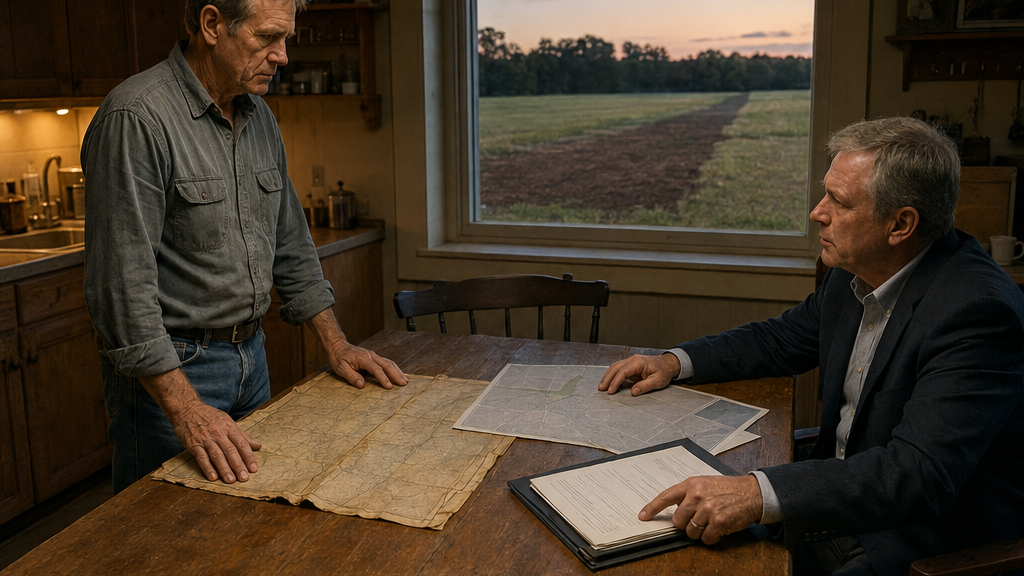
The permanent easement agreement lay across Gregory Carter’s kitchen table, covering the lower corner of a survey plat he had owned for twenty-seven years.
Richard Moore tapped the signature line with one finger.
“If you don’t want to sign voluntarily,” Richard said, “the utility can move forward with condemnation.”
Gregory looked at the paper, then through the window behind Richard.
Beyond the glass, the back field rolled toward a line of trees nearly half a mile away. From the kitchen, nothing about it looked disturbed. The grass had begun to stand upright again. The gravel lane was empty. No excavators. No dump trucks. No men in reflective vests.
That was almost worse.
“You’re asking for permission now,” Gregory said.
Richard shifted in the chair. He wore a clean blue shirt beneath a dark jacket that looked too formal for a farmhouse kitchen. Beside his elbow sat a rolled project map and a thick packet clipped together at the top.
“I’m asking you to formalize the right of way.”
Gregory kept his hands flat on the table.
“You already put the line in.”
“The project had prior authorization.”
“From me?”
Richard paused.
“From the previous owner, according to our property file.”
Gregory’s jaw tightened. “I’ve owned this place twelve years.”
“The route planning goes back farther than that.”
“And the digging happened three weeks ago.”
Richard leaned back slightly. “Mr. Carter, the line is public infrastructure. It serves a large service area. Nobody is trying to take your farm.”
Gregory looked again at the agreement. Twenty feet of permanent easement, additional temporary construction access, broad language for inspection, maintenance, repair, replacement.
It was not the whole farm.
It did not need to be.
A strip could divide the way machinery moved. A right of access could become tire tracks in wet ground. A buried utility could decide where a future barn could not stand.
Richard spoke again, softer this time.
“There is a process if we cannot reach an agreement. I would rather not use it.”
Gregory heard the sentence for what it was.
Sign, or we make you.
He pulled the easement packet toward himself but did not pick up the pen.
“When your crew came through here,” he said, “I was working two counties west.”
Richard said nothing.
“A neighbor called me. Said there were excavators in my back field. By the time I got home, most of the trench was already closed.”
“The contractor was working an approved alignment.”
“Approved by who?”
Richard unrolled his project map.
The paper was newer than Gregory’s plat, glossy and clean, with colored lines running through parcel shapes. Richard turned it so Gregory could see the route.
“There.”
Gregory did not look at the colored line first.
He looked at the parcel boundary.
Then at the road.
Then at an old fence corner that the project map placed several feet farther east than Gregory knew it stood.
He pulled his own plat free from beneath the agreement.
The sheet was creased into eighths, its fold lines soft from years of use. He opened it carefully.
Richard watched him.
Gregory put the two maps beside each other.
“Which survey did your right-of-way description use?”
Richard frowned. “Excuse me?”
“The easement. Which survey did the legal description come from?”
“I’d have to check the project file.”
Gregory traced the line of his western boundary with one blunt fingernail.
“You said the previous owner authorized it.”
“That’s correct.”
“So give me the recording reference.”
Richard’s expression changed just enough for Gregory to notice.
“What do you mean?”
“Book and page. Instrument number. Recording date. Whatever system the county used when it was filed.”
“I don’t carry the recorder’s index with me.”
“You brought condemnation papers.”
“I brought documents necessary to resolve this.”
“But not the document that says you already had the right.”
Richard closed his mouth.
For the first time since entering the house, he looked at Gregory as though he were reconsidering who sat across from him.
Gregory folded his hands.
“I surveyed land for thirty-one years.”
Richard’s eyes dropped to the old plat.
“Boundary work?”
“Boundary, construction layout, subdivisions, road rights-of-way. Enough deed research to know that somebody telling me an easement exists is not the same thing as an easement existing.”
Richard’s tone cooled. “I’m not here to debate your professional background.”
“No. You came here for my signature.”
“The prior owner was notified.”
“Notification isn’t a conveyance.”
“There was consent in the file.”
“Then where was it recorded?”
Richard gathered the edge of his project map, but Gregory held one corner down.
“What instrument number?”
“I said I’d have to verify it.”
“What deed book?”
“I don’t know.”
“What date?”
Richard pulled the map free.
“You’re treating a routine property matter like someone stole acreage from you.”
Gregory felt heat climb into his face.
He nearly answered with the first thing that came to mind. Nearly told Richard to get out. Nearly tore the agreement in half and dropped it into the trash.
Instead he looked through the window again at the smooth field.
“You dug a trench across my ground without asking me.”
“The contractor relied on the project authorization.”
“And now you want me to sign something saying you can keep what’s already there.”
Richard stood.
“If we cannot reach voluntary agreement, the utility has statutory options.”
Gregory stood too, slower.
“Then use the right option.”
Richard picked up his folder.
“The purpose of condemnation is to acquire property needed for public use at fair compensation.”
“I know what condemnation is.”
“Then you know this line is not going to disappear because you’re upset about procedure.”
That sentence landed harder than the threat.
Not because Richard was entirely wrong.
Because he said procedure as if it were a loose hinge on a barn door.
Gregory looked down at his old plat.
For thirty years, people had hired him because procedure mattered. Where a line began. Which monument controlled. What was recorded. What was merely shown. Whether the words in a deed matched the ground.
A few inches on paper could become thirty feet in a field.
“Leave the agreement,” Gregory said.
Richard hesitated, perhaps hearing concession.
“I won’t sign it tonight.”
“That’s reasonable.”
“I didn’t say I was considering it.”
Richard’s face hardened.
Gregory pulled a yellow legal pad from the end of the table.
“What’s your parcel reference for the acquisition file?”
Richard stared at him.
“The number.”
After a moment, Richard read it from the folder.
Gregory wrote it down.
Then he copied his own parcel identification number from the tax sheet clipped beneath his plat.
Richard moved toward the door.
“I’ll give you a few days.”
Gregory looked at the two numbers.
“You give me until I find the document you should have brought.”
Richard opened the door.
“If you make this unnecessarily difficult, Mr. Carter, the next paperwork you receive may not be voluntary.”
Gregory finally looked up.
“Then make sure that paperwork has the right recording reference on it.”
Richard left without answering.
The screen door shut behind him. A moment later, tires cracked against the gravel and faded down the lane.
Gregory remained at the table.
The easement agreement was still there.
So was the line on Richard’s map.
A clean stripe crossing the back of Gregory’s property as if it had always belonged there.
He folded his own plat along its worn creases, then stopped.
Instead, he opened it flat again.
Beside the parcel number on the legal pad, he wrote four words.
Find the deed chain.
Chapter 2: The Ground Looked Normal Again
The field looked normal until Gregory walked it with a level rod in one hand and realized the ground had been taught to lie.
The grass along the rear acreage was greener in a strip about twelve feet wide. The difference was slight enough that a driver passing on the county road would never have noticed it. Gregory noticed because the soil settled differently over a trench, and because machinery never left land exactly as it found it.
He drove a wooden stake into the first point near the fence.
Then another seventy feet away.
He sighted between them.
The line continued southwest.
Exactly where Richard’s project map said it did.
Gregory stood still, listening.
No machinery ran that morning. Only insects in the weeds and the low mechanical pulse of his own tractor idling near the lane.
Three weeks earlier, the phone had rung while Gregory was eating lunch in the cab of a survey truck two counties away.
His neighbor had not bothered with hello.
“You know there’s a trackhoe behind your place?”
Gregory had put his sandwich down.
“What trackhoe?”
“Big one. Utility crew, looks like. They’ve got pipe strung out near your lower field.”
Gregory had initially assumed the neighbor meant road work along the edge.
“On my side of the fence?”
“They’re well on your side.”
By the time Gregory reached the farm that evening, the open trench nearest the gravel lane had already been filled. Steel road plates covered one section where the crew had not finished compacting. Farther toward the woods, an excavator sat with its bucket lowered in dark earth.
Gregory had walked straight toward the foreman.
“Who authorized you to cross this property?”
The foreman had looked at the parcel sheet on his clipboard.
“We’re on the approved sewer alignment.”
“I asked who authorized you.”
“I don’t handle right-of-way.”
“Then stop until somebody who does gets here.”
The foreman had looked uncomfortable rather than defiant.
“We’re under schedule.”
“That isn’t an answer.”
Within twenty minutes, phone calls had begun moving through offices Gregory could not see. The crew stopped digging for the evening, but Gregory later learned they had already installed most of the line crossing his acreage.
The next morning, another utility supervisor had arrived with drawings and assurances.
The project had property clearance.
The route had been approved.
There was paperwork.
Gregory had demanded copies.
None came.
Now, in the quiet field, he set another stake.
Then another.
A dotted row of wood began to appear across the land, making visible what the buried pipe tried to hide.
At midmorning, the neighbor’s pickup rolled slowly down the gravel lane and stopped beside Gregory’s tractor.
“You figuring out where they put it?”
Gregory nodded.
The neighbor climbed out and looked across the stakes.
“They worked fast.”
“How many days were they here before you called me?”
“Maybe two. I thought you knew the first day.”
“I didn’t.”
“They had trucks lined clear back to the road. Pipe, stone, two excavators.”
Gregory looked toward the lower field.
“Anybody from the utility with them?”
“Man in a white pickup came and went. Didn’t know him.”
“Did they show you anything?”
The neighbor laughed once. “Wasn’t my land.”
Gregory bent to adjust the rod.
The neighbor’s expression changed.
“I should’ve called you sooner.”
“You called.”
“I figured big county project like that, they’d have permission.”
“So did they.”
Neither man said anything for a moment.
That was the problem with official-looking work. Machines arrived. Vests appeared. Trucks had unit numbers. People assumed somebody somewhere had signed something.
Gregory had made the same assumption on other jobs.
Not often.
But enough to feel the sting of it now.
He continued toward the southwest corner.
Near noon, he found an old iron pin beneath grass beside a hedge row. He scraped the top clean with his boot and checked his measurements.
The pin controlled the corner.
From there he calculated backward along the course he had established.
The sewer crossed his property for just under two thousand feet.
He wrote the figure in his field book.
1,984 ft.
The number made the problem feel larger than the kitchen-table argument.
This was not a service connection clipped across a corner. It was a long permanent occupation through ground Gregory used to move equipment between two fields.
He returned to the house for the plats.
His filing cabinet held copies of every survey he had commissioned, inherited, or performed on the tract after buying it. He spread them over the kitchen table where Richard’s agreement still waited.
One plat from fifteen years earlier showed a power easement near the road.
Another showed an old drainage right near the eastern edge.
A deed reference from two owners back mentioned a farm-access agreement that had later expired.
Nothing followed the sewer alignment.
Gregory pulled the most recent boundary survey closer.
He compared monuments.
Distances.
Bearings.
No corridor.
He opened Richard’s project map.
The colored sewer line sliced diagonally across five acres and continued toward a residential development beyond his woods.
Gregory took a pencil and traced where an easement would need to be if it existed.
Nothing in his records matched.
Late that afternoon, he drove back to the field.
He had marked enough points now that the route could be seen from the rise near the barn: pale stakes marching across green ground, passing through the hay edge, over the low swale and toward the timber.
The sight gave him a satisfaction he did not like.
He had made the invisible problem visible.
But visibility did not mean control.
Near the south boundary, he found a small utility marker newly installed beside the fence. He crouched, brushed soil away, and followed the disturbed ground with his eyes.
On the far side of his property, the line continued.
Beyond the trees were houses.
Not one or two.
Dozens.
He knew the development. More had gone up in the past five years, each with narrow lots and small backyards. He had heard there were problems with old septic systems farther downhill.
He stood and stared through the trees.
If the sewer line was already carrying service from those houses, it was no longer merely a pipe buried beneath his field.
It was functioning infrastructure.
That complicated things.
Gregory disliked complications when the line on the ground seemed so simple.
His land.
Their pipe.
No permission he remembered granting.
He returned to the farmhouse just before dark and opened the easement agreement again.
The legal description attached to it referred to a centerline that generally resembled the route he had staked.
But the supporting reference bothered him.
It cited a project drawing.
Not a previously recorded easement.
Gregory checked his plats one last time.
Power easement.
Drainage right.
Old farm access.
Nothing.
He drew a rectangle around the sewer corridor on Richard’s map, then laid his oldest plat over it.
The lines did not agree because the old plat contained no such corridor at all.
The utility had not merely used an existing strip.
As far as Gregory’s records showed, they had created one on the ground before creating it on paper.
The next morning he would go to the county recorder.
He wanted Richard to be right about one thing.
He wanted there to be a document.
Because if there was not, somebody had sent excavators across nearly two thousand feet of private ground relying on something else.
Chapter 3: Nothing Recorded Under the Parcel
The county recorder’s clerk searched Gregory Carter’s parcel number twice before she looked up from the monitor.
“I’m not seeing a utility easement.”
Gregory rested both hands on the counter.
“Search the prior parcel identifier.”
“I did.”
“The owner before me?”
“Already checking.”
She typed again.
The recorder’s office had changed since Gregory’s working years. Fewer deed books stood openly on shelves. More records lived behind computer screens. But the logic had not changed.
Grantor.
Grantee.
Parcel.
Instrument.
Date.
A right affecting land had to come from somewhere.
Gregory slid Richard’s project reference across the counter.
“Try the utility name.”
The clerk searched.
Several results appeared.
Road crossings.
Temporary construction rights.
A pump-station parcel.
Nothing tied to Gregory’s tract.
The clerk frowned.
“Could it have been recorded under a predecessor company?”
“Possibly.”
They tried that too.
Nothing.
Gregory felt vindication rise in him and forced it back down.
A good surveyor did not decide the answer before exhausting the record.
“Can you pull the full deed chain?”
The clerk nodded.
For the next forty minutes, they worked backward.
Gregory recognized familiar names from his title documents, though he had never met most of them. Each conveyance carried its own language: exceptions, reservations, old fence descriptions, acreage estimates from eras when measuring had been less precise.
There were easements.
Just not the one Richard needed.
At last the clerk turned the monitor slightly toward Gregory.
“If this is the parcel, I don’t have a recorded permanent sewer easement.”
“Not one?”
“Not that I can find.”
Gregory read the screen himself.
He searched the index fields.
Nothing.
The words were not dramatic. There was no red warning, no stamp announcing that someone had trespassed. Only an absence where a record should have been.
That absence mattered more to him than any headline could have.
“I want certified copies of the relevant deeds,” he said. “And the easements that are recorded.”
“All of them?”
“The ones affecting this tract.”
She began making the request.
Then she stopped.
“There is something else.”
Gregory looked up.
“Not an easement.”
“What?”
“A project reference attached to an older scanning batch. It isn’t indexed as a conveyance.”
She opened another record.
The document appeared as a faded image.
Gregory leaned closer.
It was connected to the previous owner and a utility planning file. A sketch showed an approximate route across the back of the property. Beneath it was language acknowledging that representatives had discussed a possible sewer corridor.
Gregory read the first page twice.
Then the second.
His initial satisfaction cooled.
The prior owner had known about the proposed route.
There was a signature.
Richard had not invented that.
“What exactly is this filed as?” Gregory asked.
The clerk checked.
“Project correspondence.”
“Not land records?”
“No.”
Gregory continued reading.
The language allowed survey crews to enter for preliminary investigation. It acknowledged receipt of a proposed alignment. It said permanent property rights, if required, would be documented separately.
Gregory pointed to the sentence.
“There.”
The clerk leaned closer.
Gregory read it again silently.
Permanent property rights would be documented separately.
He flipped the page.
No legal description.
No easement width.
No granting language.
No consideration.
No notarized conveyance.
No recording data.
No separate instrument attached.
He felt the story rearranging itself.
Richard’s statement had contained a piece of truth.
The prior owner had been notified.
The prior owner had even acknowledged the route.
But that was not the same as granting a permanent property interest.
Gregory had spent enough years reading bad deeds to know how dangerous partial truth could be. Sometimes the mistake was deliberate. More often, someone copied a note into a project file, another person summarized it, a third assumed the summary meant something stronger, and ten years later everybody called the assumption a fact.
“Can I get a copy of this too?”
The clerk hesitated. “It’s in the scanned project archive. I can print what’s public.”
“Please.”
While she worked, Gregory examined the first deed in the certified stack.
His own conveyance was clean. It transferred the property subject to easements of record.
That phrase mattered.
Of record.
He traced it with one finger.
If a valid unrecorded interest existed somewhere, the dispute could become more complicated. But so far he had found no executed grant at all.
The clerk returned with the project pages.
“You used to do title work?” she asked.
“Surveying.”
“That explains why you keep asking for the ugly documents.”
Gregory almost smiled.
“Pretty maps are usually where trouble starts.”
She stamped the certified copies and placed them in a large envelope.
Outside, Gregory sat in his pickup without starting the engine.
He spread the preliminary acknowledgment across the passenger seat.
The utility’s route sketch was rough. Approximate. A thick line across a parcel outline.
He imagined how it might have moved through an office.
Prior owner aware.
Route discussed.
Access allowed for survey.
Then, somewhere between planning and construction:
Property cleared.
It was easy to see how it could happen.
Too easy.
Gregory disliked that possibility because anger preferred cleaner stories.
Richard had come to his kitchen with condemnation papers and spoken as if the utility’s right already existed. That remained true.
But if Richard had inherited a bad file, then the question changed.
Who first treated this acknowledgment as an easement?
And when had anyone realized the difference?
Gregory drove home and placed the county documents beside Richard’s agreement.
Three sets of paper now covered the table.
His old survey plat.
The utility’s proposed permanent easement.
The prior owner’s preliminary acknowledgment.
He aligned them by parcel boundary.
The preliminary sketch did not even define the corridor precisely. It showed a proposed route, nothing more.
Gregory picked up a ruler.
He followed the line.
No width.
No bearings.
No monument ties.
No legal description.
He looked at the signature again.
A signature could mean many things.
On this page, it meant the previous owner had seen a proposal and allowed preliminary access.
It did not mean what Richard had said it meant.
Gregory turned to the final page.
At the bottom, beneath the prior owner’s signature, was a blank block labeled for later right-of-way documentation.
Blank.
No instrument number.
No recording date.
Nothing.
Gregory sat back.
The county record had answered his first question.
There was no recorded permanent easement.
But the old project file had opened a harder one.
Somebody had looked at a preliminary acknowledgment that explicitly required later documentation and decided the later documentation could be skipped—or had assumed someone else completed it.
Either way, the pipe was now buried beneath Gregory’s farm.
He slid Richard’s agreement beside the blank block.
The utility was trying to create today the right it had behaved as though it possessed weeks earlier.
Gregory picked up the phone.
This time, when Richard answered, Gregory did not mention condemnation.
“I found your prior-owner paperwork,” he said.
There was a pause.
Richard replied carefully.
“Then you see the route was authorized.”
Gregory looked at the empty recording block.
“No,” he said. “I see exactly what was never finished.”
Chapter 4: The Signature That Was Never Enough
Richard Moore arrived at the utility meeting room with the missing document in a clear plastic sleeve.
He placed it in front of Gregory as though the dispute had finally been reduced to one page.
“This is what I was referring to.”
Gregory did not touch it.
He recognized the paper immediately.
The same faded route sketch. The same prior-owner signature. The same language allowing preliminary entry and acknowledging a proposed alignment.
Richard sat across from him. A utility engineer occupied the far end of the table, silent behind a closed notebook.
Gregory looked at Richard.
“You brought me the document I already found.”
“It shows the owner was aware of the route.”
“I never said he wasn’t.”
“It shows cooperation.”
“It shows permission to survey.”
Richard’s mouth tightened.
“It shows more than that.”
Gregory finally pulled the page closer.
He laid a ruler over the approximate line shown on the sketch.
“Where’s the easement width?”
Richard did not answer.
Gregory tapped the signature block.
“Where’s the granting language?”
“We’ve already established that the permanent instrument wasn’t recorded.”
“No. We established that no permanent instrument was recorded. I’m asking whether one was ever executed.”
Richard leaned forward.
“The project team understood this as approval to proceed.”
Gregory looked at the engineer.
The engineer avoided his eyes.
Gregory turned the page.
The sentence he had marked at home remained there in plain language: permanent property rights, if required, would be documented separately.
He pushed it toward Richard.
“Read that.”
“I know what it says.”
“Then tell me what ‘separately’ means.”
Richard exhaled through his nose.
“This is becoming a semantic exercise.”
Gregory sat back.
“No. A semantic exercise is arguing over whether a fence is five inches off. This is whether your company owns a permanent right across my ground.”
“The utility serves a public need.”
“That wasn’t my question.”
“You keep reducing this to paperwork.”
Gregory glanced at the utility engineer.
“Is the pipe paperwork?”
The engineer looked up.
“No.”
“Is the easement?”
The engineer hesitated.
Richard cut in. “We are not here to cross-examine staff.”
Gregory’s temper flashed.
He had spent the previous two days forcing himself not to come into the room angry. He had told himself he wanted facts, not satisfaction.
Richard made that difficult.
Gregory opened his own folder and removed three certified county documents.
“I checked every recorded easement affecting my parcel. Power. Drainage. An old access agreement. Nothing matching your sewer corridor.”
Richard’s expression stayed controlled.
“We are prepared to cure that.”
“After the line was installed.”
“Yes.”
“That matters.”
“We disagree on how much.”
Gregory looked at the newer project drawing spread across the table. It showed a clean route through his five-acre rear field, then continued toward the development beyond the timber.
“How did construction get released?”
Richard’s eyes flicked toward the engineer.
“There were multiple property files.”
“That isn’t an answer.”
“The project had dozens of parcels.”
“Mine is one parcel.”
“And the project had a service deadline.”
There it was.
Gregory waited.
Richard seemed to realize he had opened a door, but he continued.
“The existing wastewater capacity in that service area was failing. Several homes had recurring problems. The county had already extended the schedule twice. We were under pressure to put the trunk line in service before another wet season.”
Gregory had expected deflection.
The explanation was worse because it made sense.
Not as permission.
As pressure.
The engineer finally spoke.
“We were trying to keep systems from backing up into homes.”
Richard turned toward him, annoyed.
But Gregory kept his eyes on the engineer.
“How many?”
“Potentially dozens at immediate risk. More connected over time.”
Gregory thought about the houses beyond his woods.
He had seen service trucks there after heavy rain. He remembered one winter when a roadside ditch had smelled wrong for days.
Richard folded his hands.
“You see the context.”
“I see why you wanted the line built.”
“That is what I’ve been trying to explain.”
“It doesn’t tell me why you crossed my land without the right.”
Richard’s expression hardened again.
“Because the file reflected prior-owner approval.”
“No. The file reflected prior-owner discussion.”
“You are drawing a distinction that project staff did not draw at the time.”
“That’s not my mistake.”
“No.”
The word came quickly.
It surprised Gregory.
Richard looked down at the table.
“No,” he repeated. “It isn’t.”
For a moment, the room changed.
Gregory had expected resistance to every point. Instead Richard admitted one.
Then he ruined it.
“But the practical reality remains. The line is installed. The service is active. We can acquire the necessary interest now, either voluntarily or through the legal process.”
Gregory felt the old anger return.
“You still think this is just catching up.”
“I think it is a correctable property issue attached to a necessary public project.”
“You call digging across two thousand feet of somebody else’s land a property issue?”
Richard met his gaze.
“I call it a failure that needs to be corrected.”
“With my signature.”
“With compensation.”
Gregory pulled Richard’s draft easement from his folder and dropped it on the table.
The first version still contained broad access rights.
No meaningful restoration standard.
No limitation on future surface use beyond general reasonableness.
No specific notice provision.
Nothing about crop damage beyond standard language.
And no admission that the utility had entered without a completed permanent right.
“You’re offering to correct your mistake by getting everything you wanted in the first place.”
Richard’s voice lowered.
“What is it you want, Mr. Carter?”
Gregory heard the question and answered too fast.
“I want the line out.”
The utility engineer shifted in his chair.
Richard stared at him.
Gregory knew the words were driven partly by anger. That knowledge did not make him take them back.
“You installed it without a right,” Gregory said. “Remove it.”
“That is not a reasonable outcome.”
“Neither was entering my farm first and negotiating later.”
“You understand what removal would involve.”
“I understand excavation.”
“You understand service interruption?”
Gregory’s jaw tightened.
Richard stood and gathered the project pages.
“This is exactly why condemnation exists. One property owner cannot hold an entire public system hostage.”
The word hostage struck something in Gregory.
He stood too.
“You came to my house threatening condemnation before you could even tell me what right you supposedly owned. Don’t stand there and make me the one who created this.”
The engineer closed his notebook.
Richard did not answer.
Gregory left before he said something he would regret.
At home that evening, he walked the staked route again.
The wooden markers he had driven into the soil were beginning to lean after two windy days. He straightened one near the swale.
The survey line was simple.
The moral line was getting harder.
He told himself the houses beyond the trees were not his responsibility.
The utility had created the problem.
The utility could solve it.
If removal cost more, that was not his doing.
If schedules slipped, that was not his doing either.
He repeated those thoughts until they began to sound rehearsed.
At dusk, his phone rang.
A woman introduced herself as Sarah Nelson, counsel for the utility.
“I understand you met with Richard today.”
“I did.”
“And that you demanded removal.”
“I did.”
There was a short pause.
“I’m not calling to argue about whether your easement position has merit.”
“That’s a change.”
“I’m calling because we need to know whether removal is actually the remedy you intend to pursue.”
Gregory looked through the kitchen window toward the invisible buried line.
“You already heard my answer.”
“Yes. I’m asking whether you understand what that answer would mean.”
“For your budget?”
“For the households connected to the system.”
Gregory said nothing.
Sarah continued.
“If the line had never been installed, this would be a property-acquisition dispute. But it is installed. It is carrying flow. Removing or rerouting it is not a paper exercise.”
“That wasn’t my choice.”
“No.”
Again, the admission came without argument.
Sarah’s voice stayed calm.
“But what happens next may be.”
Gregory gripped the phone a little tighter.
“What exactly are you asking me?”
“I’m asking whether you want your rights recognized,” Sarah said, “or whether you want the consequences to hurt.”
The question angered him because he did not know the answer.
Chapter 5: The Threat Was Sent Before the Search
Sarah Nelson turned a single page toward Richard Moore and asked him for the date.
They were seated in a small conference room at the utility’s administrative office the following Monday. Gregory sat across from them with the certified county records stacked beside his elbow.
Richard looked at the page.
“What date?”
“The first date the right-of-way team flagged the Carter parcel as missing a recorded permanent instrument.”
Richard’s face changed.
Not much.
Enough.
Gregory leaned forward.
Sarah waited.
Richard picked up the page.
“I’d have to check the email chain.”
“It’s printed underneath.”
He read it.
Gregory watched his eyes stop.
Sarah tapped the line.
“Friday.”
Richard placed the paper back down.
Gregory felt something cold settle in his stomach.
Richard had come to his farmhouse Monday evening.
Three days later.
No.
Three days after the utility already knew the easement could not be located.
Gregory looked at Sarah.
“You knew this before I did?”
“I learned it during document review last week.”
He turned to Richard.
“You knew before you sat at my kitchen table.”
Richard’s jaw tightened.
“I knew staff had not located the recorded instrument.”
“That’s the same thing.”
“No. It isn’t.”
Gregory almost laughed.
Richard continued before he could answer.
“We had reason to believe the underlying authorization existed. The prior-owner file had route acknowledgment, survey access, project correspondence, and internal property-clearance notation.”
“You knew the deed record was missing.”
“I knew it had not been found.”
“And you told me the previous owner had authorized the line.”
“That was the project understanding.”
“You threatened condemnation.”
“I informed you of the acquisition process.”
Gregory pushed his chair back an inch.
“Don’t clean up the language now.”
Sarah lifted one hand.
“Gregory.”
He looked at her.
“Let him answer.”
That restrained him more effectively than an argument would have.
Sarah turned back to Richard.
“Why did you go to the property before the record search was complete?”
Richard stared at the page.
For several seconds, the room held only the faint buzz of the overhead lights.
“Because the project was already in service,” he said.
“That doesn’t answer the timing.”
“It does.”
Sarah waited.
Richard looked at Gregory.
“We had spent months trying to close right-of-way files while construction moved. Most were routine. Some involved heirs. Some had old descriptions that needed correction. This parcel had a signed route acknowledgment and an internal notation showing property clearance.”
“But no easement,” Gregory said.
“I know that now.”
“You knew it might not have one.”
Richard rubbed one hand across his forehead.
“Yes.”
It was the first clean admission.
Gregory felt no satisfaction.
Only a deeper anger.
“Then why threaten me?”
Richard looked directly at him.
“Because if I stopped and treated your parcel as an unresolved acquisition after the line was operating, I would have had to notify management that construction crossed property without a completed right.”
“You mean admit it.”
“Yes.”
The simplicity of the answer silenced the room.
Richard went on.
“The county was already angry about delays. Contractors had claims pending. We had commitments tied to service dates. Homes downstream had been told the project was complete. If I reopened a major acquisition issue, everything attached to that route would be reviewed.”
“Your career.”
Richard gave a short, humorless breath.
“That too.”
Gregory had wanted this moment.
He had imagined Richard exposed as someone who knew exactly what he had done.
But sitting across from him, Gregory saw something less satisfying than a villain.
A tired man who had found a mistake beneath a completed project and tried to push it forward until the paperwork matched reality.
That did not excuse him.
It made the choice worse.
“You decided I was easier to pressure than your own bosses.”
Richard did not deny it.
“I thought you would sign once you understood the public purpose.”
“You thought I wouldn’t know the difference.”
Richard looked at him.
“Yes.”
There it was.
Not contempt exactly.
An assumption.
Gregory was an older farmer standing in a kitchen. Richard had seen mud on his boots, feed invoices on the counter, equipment beyond the window.
He had not seen thirty years of boundary work.
Sarah closed the document folder.
“That is why we are not proceeding with the original agreement.”
Gregory looked at her.
“What are you proceeding with?”
“Negotiation, if you are willing.”
“I said I wanted removal.”
“And we had engineering evaluate it.”
She nodded toward the door.
A utility engineer entered with a rolled set of drawings and took the empty chair.
Gregory recognized him from the previous meeting.
The engineer spread the drawings across the table.
“There are two physical options if the existing segment has to come out,” he said. “Remove and replace on another route, or abandon it in place and construct a bypass.”
“Which is cheaper?” Gregory asked.
“Neither is cheap.”
“Numbers.”
The engineer pointed to a line following the county road.
“Road route requires deeper excavation, traffic control, utility conflicts, additional rights from several properties.”
“And removal?”
“We would have to maintain service during transition. Temporary pumping, staged connections, reconstruction of disturbed ground.”
“Possible?”
The engineer nodded.
“Possible.”
Richard folded his arms.
“But?”
Gregory asked.
The engineer looked at him.
“Months of work. Significant cost. And there would be service risk during cutover.”
“How many houses?”
“Roughly two hundred connections depend directly or indirectly on this trunk segment.”
Gregory looked down at the drawing.
Two hundred.
He imagined two hundred kitchens.
Two hundred bathrooms.
Two hundred people who had never met him and had no idea their waste crossed his field.
Sarah spoke carefully.
“We are not saying public inconvenience cancels your rights.”
“Sounds close.”
“It doesn’t.”
“Then what are you saying?”
“That remedies have consequences.”
Gregory stared at the road-route drawing.
He wanted to dislike her for making the problem broader.
Richard had made it easy to be angry.
Sarah did not.
She gave his anger somewhere harder to stand.
Gregory pointed to the utility’s original corridor.
“How much would rerouting cost?”
The engineer glanced at Richard, then Sarah.
Sarah nodded.
The figure he gave was not exact, but the range was high enough that Gregory understood immediately why the utility wanted his signature.
Far beyond what Richard’s first paperwork had suggested the property right was worth.
Gregory sat back.
“So when you came to my house,” he said to Richard, “you knew you had a line you couldn’t cheaply move, and you knew you couldn’t find the easement.”
Richard’s face went still.
“Yes.”
“And you thought condemnation would scare me into fixing it.”
Richard looked at the table.
“Yes.”
Gregory waited for the pleasure of winning.
It did not come.
Later that afternoon, he stood alone beside one of his stakes in the back field.
The line disappeared into the grass in both directions.
He could force the utility to fight.
Maybe even force removal.
For days, that had been the clean answer.
Make them undo what they did.
Now he could see the houses beyond the timber differently.
Not as part of the utility’s leverage.
As people attached to a mistake they had not made.
His phone rang.
Sarah.
Gregory answered.
“We can put a compensation proposal together,” she said.
“How much?”
“We need an appraisal basis.”
“You already had a number in mind.”
A pause.
“Yes.”
“What is it?”
“Fifteen thousand for the permanent easement, subject to final terms.”
Gregory looked down at the stake beside his boot.
Fifteen thousand dollars.
For a line that might remain beneath his land longer than he would.
“For forever?” he asked.
“For a permanent easement.”
Gregory’s gaze followed the invisible route toward the houses.
The utility finally understood it needed something from him.
Now Gregory had to decide what that something was worth.
Chapter 6: Fifteen Thousand Dollars for Forever
Sarah Nelson slid the offer across the conference table.
The number looked smaller in print.
$15,000.
Gregory read the first page, then the second.
Permanent easement.
Specified corridor.
Access for inspection, repair, replacement and maintenance.
Standard restoration.
Standard damage provisions.
He set the packet down.
“Fifteen thousand dollars for forever.”
Sarah folded her hands.
“For the permanent property interest described.”
Richard Moore sat two seats away. He had spoken little since Gregory entered.
Gregory looked at him.
“Is this your number?”
“It’s based on the appraisal framework.”
“Whose appraisal?”
“The utility’s.”
Gregory nodded once.
“Of course.”
Sarah did not react.
“We can discuss valuation.”
Gregory opened his own notebook.
“I’m not valuing the dirt.”
“That’s part of it.”
“It’s the cheapest part.”
He drew a line down the center of a blank sheet.
Then two parallel lines around it.
“This is your pipe.”
He widened the space between the parallels.
“This is the permanent corridor you want.”
He shaded outside it.
“This is where you want temporary access if you have to repair it.”
Sarah watched him.
Gregory continued.
“You want the right to enter. You want the right to excavate. You want restrictions on what I can build above it. If the pipe fails in July, you want to drive across whatever crop is standing there.”
“The easement includes restoration obligations.”
“Standard restoration.”
“Yes.”
Gregory looked at Richard.
“Who decides what ‘restored’ means?”
Richard said, “There are construction standards.”
“That wasn’t the question.”
Sarah leaned forward.
“What would you require?”
Gregory closed the notebook.
“Before I answer that, I want to know what happens if I say no.”
Richard looked annoyed.
“We’ve covered this.”
“No. You’ve threatened condemnation and you’ve priced rerouting. I want the real answer.”
Sarah glanced toward the engineer seated near the end of the table.
The engineer had brought revised route drawings.
Gregory pointed at them.
“What would you spend if I refused?”
The engineer did not answer immediately.
Sarah said, “You understand we are not going to negotiate against ourselves using worst-case construction estimates.”
“I’m not asking what you’ll pay me. I’m asking what your alternative costs.”
“That isn’t the same valuation.”
“No. It tells me whether fifteen thousand is a serious attempt to solve your problem.”
Richard shifted forward.
“This is not ransom.”
Gregory turned to him.
“I didn’t bury the pipe there.”
“I know.”
“You’re the one who needs it to stay.”
Richard’s face tightened, but he stopped.
The engineer gave a cautious estimate based on the route studies.
Even the lower end was many multiples of the offer.
Gregory let the number sit in the room.
Then he asked, “And the service?”
The engineer looked down at the plans.
“About two hundred homes are tied into this segment.”
“How long for a bypass?”
“Design, property work, permitting, construction—months.”
“And during cutover?”
“We’d manage it.”
“That means risk.”
“Yes.”
Gregory leaned back.
For the first time since Richard had walked into his kitchen, the utility was speaking to him as someone whose answer mattered.
He had imagined that moment.
He thought it would feel like vindication.
Instead, he could see how easily power could reverse direction without improving anyone.
Richard had used the project’s importance to pressure him.
Gregory could now use the same importance to pressure them.
The fact that he had earned the leverage did not automatically make every use of it right.
Sarah broke the silence.
“What are you asking for?”
Gregory looked at the $15,000 packet.
“I don’t know yet.”
Richard frowned.
“You’ve had days to think about this.”
“I’ve had days to think about how angry I am.”
“That is not the same thing.”
Gregory met his gaze.
“No. It isn’t.”
Richard seemed almost surprised by the agreement.
Gregory turned the paper sideways and took out a pencil.
He drew the line again.
This time he marked a specific width.
Then he drew a narrower temporary-access strip along one side.
“If there is going to be an easement, it will have a surveyed legal description. Not ‘approximately along existing line.’”
Sarah nodded.
“Reasonable.”
“No unrestricted access except emergencies.”
“What notice?”
“We’ll discuss it.”
“Restoration?”
“Not ‘reasonable restoration.’ Actual standard. Topsoil depth. Compaction repair. Drainage repair. Reseeding or crop loss.”
The engineer began writing.
Gregory continued.
“No using the easement as a general travel lane. No storage. No widening because some future contractor finds it convenient.”
Richard said, “Access has to be workable.”
“So define workable.”
Sarah looked at Gregory for several seconds.
“This sounds like you’re considering allowing the line to remain.”
The words felt heavier spoken by someone else.
Gregory looked down at the pencil line.
A week earlier, he had told Richard to remove the pipe.
He had meant it.
Part of him still wanted to watch the machines return, dig up every foot, load the pipe onto trucks and carry the mistake away.
That image satisfied something in him.
It did not satisfy the part that had spent thirty years telling clients that boundaries were not weapons.
They were agreements about where one person’s right stopped and another’s began.
“I’m considering making you earn the right you skipped,” he said.
Richard’s face hardened.
“We did not intentionally skip—”
Gregory held up a hand.
“I’m not doing that argument again.”
Richard stopped.
Sarah glanced toward him, then back to Gregory.
“What about compensation?”
“It has to reflect permanency, use restrictions, access burden, and the fact that this is resolving an existing unauthorized occupation.”
“That last part will be disputed.”
“Then dispute it.”
Sarah almost smiled, but did not.
Gregory closed the $15,000 packet and pushed it back.
“This number is not close.”
“What number is?”
“I’ll give you one after I have an independent valuation.”
Richard exhaled.
“So now we wait.”
“You waited until after construction to get my permission. You can wait long enough to get the terms right.”
No one answered.
The meeting ended without a settlement.
Two days later, Gregory stood at his kitchen table with the old survey plat spread flat again.
The same table where Richard had first dropped the permanent easement.
The same worn fold down the center.
Only now Gregory was not looking for what was missing.
He was drawing what he would allow.
He marked the exact centerline from his field measurements.
Defined the corridor.
Noted the access side least damaging to farm operations.
Wrote notice requirements in the margin.
Emergency exception.
Crop damages.
Drainage restoration.
Surface repair.
Advance coordination when possible.
No expansion beyond the defined area without a new agreement.
He stopped with the pencil above the page.
At the top of the legal pad, he had written two headings.
REMOVE IT.
LET IT STAY.
He stared at them, then crossed both out.
Neither described what he wanted anymore.
Removing the line would prove the utility could not ignore him.
Letting it stay sounded like surrender.
He wrote a third heading.
TERMS.
The word felt plain.
Almost dull.
That was what made it right.
Gregory gathered the papers into a folder.
The next morning, he returned to the utility office.
Sarah and Richard were already seated when he entered.
Richard looked at the folder in Gregory’s hand.
“A counteroffer?”
Gregory sat down.
“No.”
He opened the folder and placed his own surveyed corridor on the table.
“Conditions.”
Sarah pulled the drawing closer.
Richard stared at the precise line.
Gregory rested one hand on the old plat beside it.
“If that pipe stays under my farm,” he said, “this time we are going to write down exactly where your right begins—and exactly where it ends.”
Chapter 7: This Time the Boundary Is Written Down
Gregory Carter placed his own legal description on the utility conference table and left Richard Moore’s original agreement unopened beside it.
The difference between the two documents was visible before anyone read a word.
Richard’s version described a permanent easement in broad language, tied loosely to an existing sewer line.
Gregory’s version began at a known monument.
From there it moved by bearing and distance.
Every turn was fixed.
Every width was defined.
Every right stopped somewhere.
Sarah Nelson read the first page in silence.
Richard looked at the survey exhibit attached behind it.
“You prepared this yourself?”
“I prepared the field description. The independent surveyor checked it.”
Richard ran one finger along the corridor.
“It’s narrower than what we requested.”
“It’s wide enough to maintain the line.”
The utility engineer, seated at the end of the table, leaned closer.
“For ordinary maintenance, yes.”
Richard looked at him.
“And replacement?”
The engineer studied the drawing.
“If we stage from the south side, it works.”
Gregory nodded toward the temporary-access provision.
“That’s what the additional strip is for. Temporary. Not permanent.”
Sarah turned another page.
“Forty-eight hours’ notice before non-emergency entry.”
“Minimum.”
“That won’t always be practical.”
“That’s why the next sentence says except genuine emergencies.”
Richard crossed his arms.
“Who defines genuine?”
“A condition requiring immediate access to prevent service failure, property damage or danger. Not a contractor who forgot to schedule.”
The engineer looked down, concealing what might have been a smile.
Sarah continued reading.
Topsoil segregation where excavation occurred.
Compaction repair.
Drainage restoration.
Crop-loss compensation.
No material storage beyond the defined temporary area.
No widening without written agreement.
No unrelated access across the farm.
The provisions were not dramatic.
They were specific.
Gregory had spent most of his career watching disputes grow from words people considered too small to matter. Reasonable access. Approximate line. As needed. Existing route.
Those phrases were comfortable until two people needed them to mean different things.
Richard tapped the compensation page.
“This figure is considerably higher than fifteen thousand.”
“Yes.”
Sarah had already seen the independent appraisal. She opened a second folder containing the utility’s revised valuation.
“We’re closer than we were.”
“But not there.”
“No.”
Gregory looked at the revised amount.
It was serious now.
Not a fortune.
Not punishment disguised as valuation.
It accounted for the permanent burden, the defined access right, limitations on future use, restoration risk, and the fact that the utility was resolving a problem it had created rather than negotiating before construction.
Richard said, “You’re still pricing in the unauthorized installation.”
“I am.”
“We cannot characterize it that way in the instrument.”
“I didn’t ask you to.”
Richard looked surprised.
Gregory pushed a separate settlement page toward him.
“I need the property right priced honestly. I don’t need you to write a confession into the deed.”
Sarah looked up from the paper.
That was the moment Gregory realized how much he had changed since Richard’s first visit.
Weeks earlier, he would have demanded the admission.
He would have wanted the utility to put its mistake into language no one could soften later.
Now he understood that an easement was supposed to govern what happened next.
Accountability could exist in the settlement.
The land record needed clarity.
Sarah pointed to a paragraph.
“This release addresses the prior entry and construction.”
“With the restoration inspection left open until the fall field check.”
“Yes.”
“And future damage remains outside the release.”
“Yes.”
Gregory nodded.
Richard looked between them.
“So removal is off the table?”
Gregory rested his palm on the old survey plat he had brought from home.
The same plat had sat beneath Richard’s first agreement at the kitchen table.
“No.”
Richard frowned.
“No?”
“It was never your choice to take off the table.”
Silence tightened the room.
Gregory let it sit for a moment.
“Removal becomes unnecessary if we reach a valid agreement.”
Richard’s shoulders eased slightly.
Gregory continued.
“That isn’t the same as me admitting it was never an option.”
“I understand.”
For once, Richard sounded as if he did.
Sarah turned to the compensation sheet.
After another hour, numbers moved.
So did language.
Gregory gave ground on the notice period for certain scheduled inspections.
The utility accepted tighter limitations on heavy-equipment access.
The engineer proposed a designated entrance point that avoided Gregory’s main equipment lane.
Gregory accepted it after moving the approach several yards to protect drainage.
Nothing about the meeting felt like winning.
That surprised him.
Winning, as he had imagined it, would have been Richard defeated across the table.
Instead it looked like pencil marks, revised paragraphs and two people occasionally saying no until they found the exact place where no could become yes.
Late in the afternoon, Richard reached the provision concerning future construction.
“If we ever have to upsize the line, this language requires a new agreement.”
“That’s right.”
“Even within the same corridor?”
“If the physical burden changes materially, yes.”
“That could become a problem thirty years from now.”
Gregory looked at him.
“Then thirty years from now, whoever owns this farm and whoever runs your utility can discuss that problem.”
Richard stared at the page.
Gregory added, “You don’t get to buy every future possibility because you made one mistake today.”
Richard slowly nodded.
“Fair.”
The word was quiet.
Gregory glanced at him.
Richard’s expression carried no friendliness, but the defensive edge was gone.
Sarah closed her pen.
“I think we have terms.”
Not final documents.
Terms.
That distinction mattered.
Over the following weeks, drafts moved between offices. Gregory read every one.
Twice he returned pages because a broad access phrase had reappeared.
Once Sarah called and told him he was reading a standard clause too harshly.
Gregory told her standard clauses were how they had reached his kitchen in the first place.
She was silent for a second.
Then she revised it.
The final meeting took place at Gregory’s farmhouse.
Richard arrived without a condemnation packet.
Sarah carried the execution copies.
The utility engineer brought the final survey exhibit rolled inside a tube.
They used the same kitchen table.
Gregory noticed that before anyone mentioned it.
His old plat lay on one side.
The new permanent easement lay beside it.
This time, the two lines agreed.
Sarah reviewed the essential terms once more.
The compensation amount.
Defined permanent width.
Restricted temporary access.
Advance notice except emergencies.
Restoration standards.
Crop and surface damages.
No expansion without a new agreement.
Gregory listened.
When she finished, Richard looked toward him.
“You want time alone with it?”
Gregory had already read the execution draft three times.
“No.”
Sarah turned the signature page toward him.
For a moment, Gregory did not pick up the pen.
He remembered Richard’s finger tapping another signature line weeks earlier.
Sign voluntarily or face condemnation.
He remembered the anger that had risen through him.
He remembered telling them to remove the pipe.
Part of that man still sat at the table.
But not all of him.
Gregory looked through the window.
The field beyond it appeared ordinary again.
Somewhere beneath the soil ran a sewer line serving people who would probably never know what had happened over the ground above it.
That no longer bothered him.
Rights did not have to be visible to be real.
Neither did responsibility.
He signed.
Not because the utility had worn him down.
Not because the line was already there.
Because the paper now said what he was willing to grant.
Sarah signed where required.
Richard signed the settlement acknowledgment.
Then he remained standing beside the table while Gregory gathered the documents.
“I handled the first meeting wrong,” Richard said.
Gregory looked at him.
Richard did not decorate the sentence.
No explanation about deadlines.
No mention of project pressure.
Just the sentence.
Gregory considered making him say more.
Once, he would have.
Instead he nodded.
“You did.”
Richard accepted that.
The following morning, Gregory carried the executed easement into the county recorder’s office.
The same clerk who had helped him search the records recognized him.
“So you found your missing easement?”
Gregory set the documents on the counter.
“No.”
She raised an eyebrow.
“We made one.”
The clerk smiled faintly and began checking the pages.
Legal description.
Survey exhibit.
Signatures.
Acknowledgments.
Required forms.
Fees.
Everything that should have existed before the first excavator entered the field now sat in one complete packet.
Gregory watched her scan the survey exhibit.
His centerline.
His monuments.
His defined corridor.
The survey line that had started as evidence of where authority had crossed too far was now defining a right he had chosen to give.
The clerk stamped the document and entered information into the system.
Gregory waited.
Then a recording reference appeared on the receipt.
Book.
Instrument.
Date.
The exact kind of number Richard had been unable to provide in Gregory’s kitchen.
The clerk slid the receipt across the counter.
“There you go.”
Gregory picked it up.
For several seconds, he simply looked at the number.
It did not feel like surrender.
It did not feel like revenge.
It felt smaller and steadier than either.
A boundary recognized.
A mistake corrected.
A right granted instead of assumed.
Gregory folded the receipt once and placed it inside his folder.
Then he walked out of the recorder’s office carrying proof that the line beneath his farm finally had a place in the record because this time, before anyone called it theirs, he had decided exactly where his right ended and theirs began.
The story has ended.