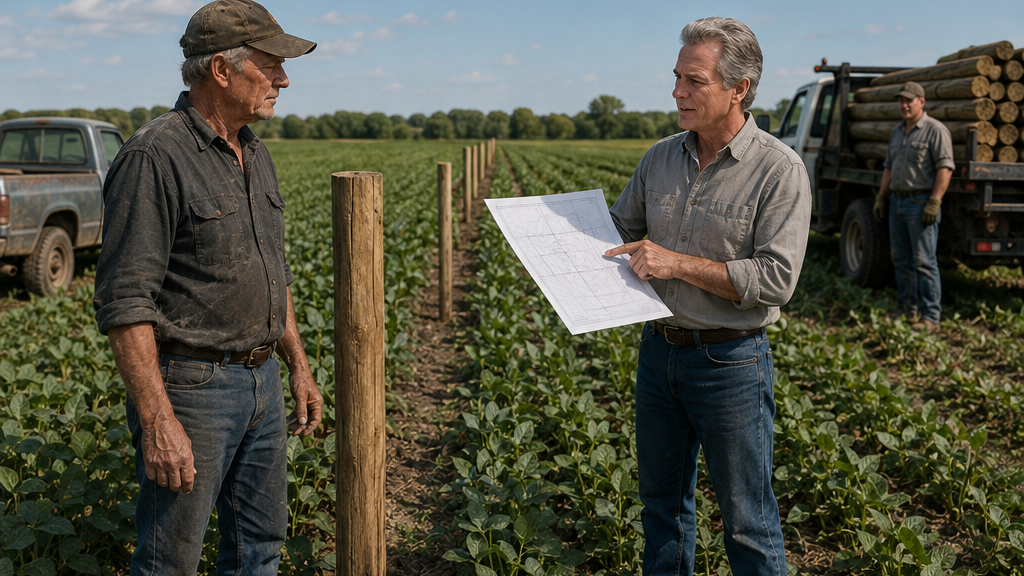
They Moved the Fence Two Feet Into His Soybeans, but the Old Iron Pin Had Never Moved
Chapter 1: The Cedar Post Standing Between His Soybean Rows
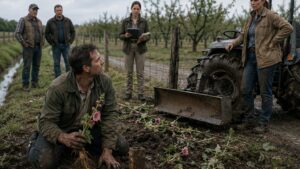
The cedar post was standing where Larry Harris expected soybeans.
He stopped his pickup at the end of the row and let the engine idle. For several seconds, he did nothing except stare through the windshield.
The post was new—clean cedar, square-cut, pale where the auger had bitten through the soil. It rose from a patch of black Missouri dirt between young soybean plants that should have run uninterrupted toward the tree line.
Larry shut off the truck.
By the time his boots reached the post, he already knew it was wrong.
He had farmed that edge since he was old enough to keep a tractor straight. His father had farmed it before him. The boundary itself had never been marked by a clean modern fence, but Larry knew the line by the slope of the ground, an old hedge break, and a corner his father had pointed out so many times that Larry could still hear the sentence.
Don’t trust what looks straight. Trust the corner.
He crouched beside the post.
Fresh auger dirt covered several crushed soybean plants. Twenty yards farther north stood another post. Then another.
Larry straightened slowly.
A truck door slammed on the neighboring property.
Andrew Nelson came across the grass carrying a rolled sheet of paper. He wore clean work boots and a ball cap that still looked new enough to hold its shape. Six months earlier, when he and Nicole had bought the old place next door, Larry had figured they would be easy neighbors.
They waved. They kept their dogs in. Andrew asked before crossing the field once to retrieve a loose piece of siding.
There had been no reason to expect trouble.
“Morning,” Andrew called.
Larry looked at the post. “You putting in a fence?”
“Getting started.”
“This one’s on me.”
Andrew stopped a few yards away.
“No,” he said. “It isn’t.”
Larry looked toward the other posts.
Andrew unrolled the paper.
“We had the place surveyed before closing,” he said. “I meant to come over sooner.”
Larry said nothing.
Andrew stepped closer and held the survey open between them. Heavy black boundary lines crossed the page. There were bearings, distances, stamps, dates, and a signature at the bottom.
Larry did not need to understand every mark to understand what Andrew was showing him.
The line on the paper cut inside the strip Larry had planted.
Andrew tapped it with one finger.
“The survey says the property comes farther west than everybody thought.”
“How far?”
“Right about here.”
Larry looked from the paper to the cedar post.
“That’s near two feet.”
“Depends where you’re measuring.”
“I know where I’m measuring.”
Andrew’s mouth tightened slightly.
“I’m not trying to take anything from you, Larry. I’m following the survey.”
Larry accepted the paper.
The stamp was recent. So was the survey date.
He followed one bearing down to a corner notation, then back to a distance along the southern line.
Something felt wrong.
Not because the number was unfamiliar.
Because it was familiar enough to be wrong.
Larry read it again.
His father had used a different distance whenever they talked about that side of the farm. Not by inches. By enough that the difference would carry the line into the beans.
Andrew watched his face.
“You see it?”
“I see what it says.”
“The surveyor found the corner.”
Larry lifted his eyes. “Which corner?”
Andrew frowned.
“The property corner.”
“What’s it set from?”
“It’s all there.”
Larry handed the paper back, but Andrew did not take it.
“Keep it,” he said. “I’ve got copies.”
Larry folded it once.
Then again.
That seemed to bother Andrew more than an argument would have.
“I know you’ve farmed over here a long time,” Andrew said. “I’m not accusing you of doing anything on purpose.”
Larry looked toward the nearest post.
“But you’re saying I’ve been farming your dirt.”
“I’m saying the survey shows the boundary.”
A diesel engine sounded from the county road.
A white contractor truck turned into Andrew’s drive towing a small equipment trailer. Fence posts were stacked behind it.
Larry watched the truck come closer.
“How much are they doing today?”
Andrew hesitated.
“They’re supposed to run the whole side.”
“Today?”
“I already delayed them once.”
Larry’s jaw tightened.
He could tell Andrew to get the truck out.
He could park the tractor across the access lane.
He could pull every post that crossed his beans and leave them lying in the grass.
For a moment, he wanted to.
Instead he looked at the stamped survey again.
There it was: a professional document, recent and clean, telling him that a piece of ground his family had worked for decades belonged to someone else.
Larry had spent most of his life believing some things did not need explaining.
The creek ran where it ran.
The south pasture flooded first.
The old barn leaned east.
And the property line was where his father had shown him.
But Andrew had a stamped page.
Larry had memory.
At least that was what Andrew thought.
The fence contractor stepped out of his truck and looked toward them.
“Everything good?” he called.
Andrew glanced at Larry.
Larry folded the survey one final time and slid it into his shirt pocket.
“Don’t set another one yet,” he said.
Andrew’s expression hardened. “Larry—”
“I didn’t say you’re wrong.”
“Then what are you saying?”
Larry looked past him at the pale cedar posts standing in the green rows.
“I’m saying I want to know what your surveyor measured from.”
Andrew let out a quiet breath.
“The professional did his job.”
“Maybe.”
The word landed badly.
Andrew crossed his arms. “The crew is here. I’m paying them either way.”
Larry knew that tone. It was not anger yet. It was a man who had spent money and expected the world to remain settled because money had been spent.
Larry could have explained then.
He could have told Andrew there had once been an iron pin near the old hedge corner.
He could have told him his grandfather’s plat mentioned it.
He could have said his father kept copies of records going back farther than either of them had been alive.
Instead, the old habit held him.
If Andrew was going to arrive with paperwork and tell him where his own farm ended, Larry was not going to stand in a soybean field and plead his case from memory.
He nodded once.
Then he turned away.
“Where are you going?” Andrew asked.
Larry kept walking.
His old pickup sat at the end of the row, sun fading the paint on the hood. Behind its bench seat was something he had not unfolded in years.
He opened the driver’s door, leaned across the cracked vinyl, and reached into the narrow space behind the seat.
His fingers found the edge of an old cloth bundle.
Chapter 2: The Map That Had Waited Behind the Truck Seat
The cloth had once been blue.
Years of dust, grease, and summer heat had faded it to a gray color Larry could no longer name.
He carried the bundle back to the field and set it on the pickup hood.
Andrew stood where Larry had left him, the contractor several yards behind, pretending not to watch.
Larry untied the cloth.
“What is that?” Andrew asked.
Larry unfolded the first sheet carefully.
The paper had yellowed along the edges and softened at the folds. Inked lines crossed it in a way that looked almost crude beside Andrew’s computer-generated survey.
Across one corner was a date.
“My grandfather’s plat,” Larry said.
Andrew stared at it.
Larry placed the new survey beside the old one.
For a moment neither man spoke.
The two documents described the same ground in two different eras: one crisp and bright with modern annotations, the other worn nearly translucent along its creases.
Larry traced the southern boundary on the old plat.
“Here.”
Andrew leaned closer.
The old line ended at a notation beside the corner.
Iron pin.
Andrew read it twice.
“So?”
“So your survey is carrying the line from something else.”
Andrew pointed to the modern sheet. “It references a monument.”
“Not this one.”
“You don’t know that.”
Larry looked up.
“No. I don’t.”
The answer surprised Andrew.
Larry had expected to feel satisfaction when he unfolded the old plat. Instead he felt an uneasiness he had not anticipated.
He remembered the pin.
Or rather, he remembered being told where the pin was.
As a boy, he had followed his father along the edge while fence wire was repaired. His father had kicked leaves away from a low place near the hedge and said the iron was down there.
Larry could not remember actually seeing it.
He searched the paper again.
A distance written in faded ink matched the number lodged in his memory. It did not match the distance on Andrew’s survey.
“How old is that thing?” Andrew asked.
“You can read the date.”
“I’m asking when anyone last verified it.”
Larry did not answer.
Andrew straightened.
“That’s my point.”
The contractor shifted his weight near the truck.
Larry glanced toward him. “Give us a minute.”
The man nodded and walked back toward his trailer.
Andrew lowered his voice.
“I paid for a survey. A licensed surveyor signed it. We bought the property with that description.”
“And I have a plat showing another corner.”
“From 1953.”
“The ground didn’t get younger.”
Andrew shook his head. “Paper from seventy years ago doesn’t automatically beat a current survey.”
Larry’s temper rose, but he forced it back.
“Didn’t say it did.”
“Then what are we doing?”
Larry gathered the old plat before the wind could catch it.
“Checking.”
He drove to the farmhouse while Andrew remained by the field.
The house had belonged to Larry’s parents before it belonged to him. In a narrow back room off the kitchen stood a metal filing cabinet that had accumulated tax receipts, equipment bills, seed contracts, and property papers through three generations.
Larry opened the bottom drawer.
The folder he wanted had no neat printed label.
His father had written LAND in black marker across the tab.
Inside were photocopies, handwritten notes, and brittle pages inside plastic sleeves.
Larry found an old deed abstract first.
The description went back through earlier transfers. One page referenced a patent-era record from the late nineteenth century.
Then he found the affidavit.
A surveyor had sworn to locating a boundary using an iron monument consistent with the earlier plat.
Larry carried both documents back to the kitchen table.
The three pieces fit together better than he expected.
The old deed established the tract.
The 1953 plat described the corner.
The 1971 affidavit referred to what appeared to be the same iron monument.
But none of them told Larry what he most needed to know.
Was the iron still there?
By early afternoon, Andrew returned.
Nicole came with him this time but remained near their vehicle.
Larry spread the records across the pickup seat because he did not want to bring the argument into the house.
“There’s more than the plat,” Larry said.
Andrew studied the affidavit.
Nicole stepped closer.
“That says iron pin too,” she said.
“It does,” Larry answered.
Andrew looked from one document to another.
For the first time since the dispute began, certainty left his face.
Not completely.
Just enough.
“Why didn’t you show me this when we talked about the line months ago?”
Larry stiffened.
Months earlier Andrew had casually mentioned the survey while they were talking beside a gate. Larry had dismissed it with a sentence: Your fellow better look again.
That had been all.
Because Larry had assumed Andrew would.
“I told you the line was wrong.”
“You told me I was wrong,” Andrew said. “That’s different.”
Larry had no answer he liked.
Andrew returned to the new survey.
He placed his finger near the corner call.
“Mine uses this reference.”
Larry leaned over it.
That was the detail that had bothered him that morning.
The modern survey did not explicitly call for the same old iron pin shown on Larry’s plat. It appeared to reconstruct the corner from another monument farther away.
Larry felt some of his confidence drain.
He had wanted the old paper to settle the argument.
Instead it had made the question sharper.
If the original corner pin was gone, perhaps a later surveyor had been forced to rebuild the line from surviving references.
And if the later reference was correct, Larry’s memory meant very little.
Nicole looked toward the field.
“Can anyone find the old pin?”
Larry followed her gaze.
Soybean leaves moved faintly in the afternoon air. Somewhere under that ground, perhaps, was a piece of iron no bigger than a man’s thumb.
Or perhaps there was nothing.
“My father knew where it was,” Larry said.
Andrew’s expression tightened again.
“Your father isn’t here.”
Larry turned toward him.
Nicole said, “Andrew.”
But the sentence had already landed.
Larry looked down at the plat.
His father had been dead nine years.
He had left Larry the farm, the documents, the machinery that still ran, and a promise Larry had made beside a hospital bed without knowing how heavy it would become.
Keep it together.
Larry had always interpreted that as acreage.
Not paperwork.
Not explanation.
Not making sure strangers could understand what his family already knew.
Andrew folded his arms.
“I’m willing to look at certified records. I’m willing to have somebody verify this. But I’m not canceling everything because of an old map nobody’s checked in decades.”
“The crew shouldn’t be setting posts while it’s disputed.”
“They’re already paid.”
“That’s your decision.”
“And those crops on my side of the surveyed line were yours.”
The words brought both men back to the original wound.
Larry’s voice hardened.
“You don’t know they’re on your side.”
“Neither do you.”
Silence stretched between them.
That was the first thing Andrew had said all day that Larry could not honestly dispute.
Finally, Larry gathered the papers.
“I’ll go to the county.”
Andrew nodded once.
“If they have something official showing that pin, bring it.”
“And until then?”
Andrew looked toward the unfinished fence.
“I’ll tell the crew to stop for today.”
Larry waited.
“But not indefinitely,” Andrew added. “You want me to hold this project, verify the monument.”
He pointed toward the old plat.
“Find that pin.”
Chapter 3: The County Book With a Different Corner
The county clerk placed one finger halfway down a yellowed index page and said, “Here it is.”
Larry leaned over the counter.
He had arrived shortly after the recorder’s office opened, carrying copies of the 1953 plat, the 1971 affidavit, and Andrew’s newer survey in a flat folder.
The clerk disappeared into the back room and returned with a bound volume thick enough to stop a door.
She set it carefully beneath the overhead light.
Larry watched her turn pages.
Dates moved backward.
Descriptions grew older.
The language changed from modern survey shorthand to phrases that sounded almost conversational compared with the new document.
Then she stopped.
The entry referenced the same tract.
The same corner.
And the same iron monument.
Larry read it once.
Then again.
“Can I get a certified copy of this?”
“Yes.”
He tried not to smile.
The relief came too quickly.
For two days, he had carried a private fear that his father’s papers might amount to nothing more than inherited confidence.
Now a county record repeated the same corner description.
It was no longer only something behind his truck seat.
While the clerk prepared the copy, Larry compared the entry with the 1953 plat. The distances aligned closely. The iron pin appeared where he expected it.
He thought of Andrew’s cedar posts.
For the first time, Larry imagined pulling them out without hesitation.
Then the clerk returned with another file.
“You asked whether there were later monument references?”
“Yes.”
“I found one.”
Larry opened it.
The document was newer than the 1953 plat but older than Andrew’s survey. A later survey had referenced a different control monument when reconstructing part of the section.
Larry frowned.
“Why would they do that?”
The clerk shook her head.
“I can’t interpret survey work for you.”
“But this isn’t the same pin.”
“No.”
She tapped the record.
“This one appears to reference another monument and then carry measurements from there.”
Larry felt the victory he had been building in his head begin to tilt.
He laid Andrew’s survey beside it.
A notation looked similar.
Not identical, but close enough to matter.
“So somebody changed the corner?”
“I didn’t say that.”
“What are you saying?”
“I’m saying records can show what was called for. A surveyor needs to tell you how those calls relate.”
Larry looked again.
The modern survey might not be careless.
It might be following a chain of later references.
If one of those later references had shifted—or been interpreted differently—the mistake could have traveled forward without anyone intending to take anybody’s land.
The possibility irritated him almost as much as the fence.
Anger was simpler when a man across the property line was plainly wrong.
Larry paid for certified copies of the relevant pages.
Before leaving, he asked whether there was a monument record associated specifically with the old iron corner.
The clerk searched again.
This time she brought out a smaller record.
The description was brief.
Its identifying details matched the 1953 plat closely enough that Larry felt his pulse quicken.
“So it existed.”
The clerk looked at him over the edge of her glasses.
“It was recorded.”
“That’s what I mean.”
“It means somebody documented it.”
Larry understood the distinction even if he disliked it.
A recorded iron pin could have been removed.
A road crew could have disturbed it.
A farmer could have hit it with equipment.
Soil could have covered it.
Or Larry could be misunderstanding exactly which iron monument the paper described.
Still, he left the recorder’s office carrying more than family memory.
In the parking lot, he set the folder on the hood of his pickup and called Andrew.
“I found the monument record.”
There was a pause.
“The old pin?”
“Record says it’s there.”
“Does the county say your line is right?”
“No.”
Another pause.
Larry could almost hear Andrew choosing his next words.
“So we’re in the same place.”
“No. We’re not.”
“Why?”
“Because now we’ve got two record chains that don’t line up.”
Andrew sighed.
“Larry, I can’t keep my contractor hanging around while we become amateur surveyors.”
“I’m not asking you to.”
“Then what are you asking?”
Larry looked at the certified copy.
“For you not to build a fence until somebody who knows what they’re doing reconciles this.”
Andrew was silent.
Larry expected another argument.
Instead Andrew said, “Who?”
That question mattered.
It shifted the dispute, just slightly, away from which man could force the other to yield.
Larry knew a surveyor.
Jeffrey Lewis had done work for him over the years: field divisions, a drainage easement, acreage verification after a neighboring tract sold.
Jeffrey was not sentimental about old family stories.
That was precisely why Larry trusted him.
“I’ll call Jeffrey Lewis.”
“Your surveyor?”
“He’s a surveyor I’ve used.”
“That isn’t exactly neutral.”
“He’ll tell me I’m wrong if I’m wrong.”
Andrew gave a dry laugh.
“We’ll see.”
Larry nearly snapped back.
Instead he said, “You can be there.”
That ended the objection.
Larry called Jeffrey next.
He reached him between jobs.
Larry explained the new fence, the recent survey, the 1953 plat, the affidavit, and the county monument record.
Jeffrey did not sound impressed.
“Send me copies.”
“I’ve got the original plat.”
“Don’t send the original. Scan it.”
“The county record matches.”
“Maybe.”
Larry tightened his grip on the phone.
“It does.”
“Then let me read it.”
There was something irritating about paying a man for skepticism.
Larry told himself that was the point.
He photographed the documents as carefully as he could and sent them.
Twenty minutes later, Jeffrey called back.
“Where are the posts now?”
“In the beans.”
“Anybody moved them?”
“No.”
“Don’t.”
“I wasn’t planning to.”
“And don’t go digging for that pin.”
Larry looked across the parking lot as if Jeffrey could somehow see him.
“I know approximately where it is.”
“That’s exactly why I’m telling you not to.”
Larry felt heat rise into his face.
“My father showed me that corner.”
“I’m sure he did.”
“He knew that farm.”
“I’m sure he did.”
The patience in Jeffrey’s voice made it worse.
“Then what’s the problem?”
“The problem is you’re one of the interested owners.”
Larry said nothing.
Jeffrey continued.
“I see the old monument call. I also see why the recent surveyor may have used the later control. Until I reconstruct both, I don’t know which evidence controls where.”
Larry stared at the county building.
“So the new fellow might not have just made a bad survey.”
“He might have followed a later reference that traces back differently. That doesn’t mean his result is right. It means this isn’t something you settle by holding up the oldest piece of paper.”
Larry looked down at the certified monument record.
He had wanted the county seal to be the end of the argument.
Instead it had opened another one.
“When can you come out?”
“Two days.”
Larry exhaled.
“The fence contractor won’t like that.”
“The fence contractor isn’t determining the boundary.”
That almost made Larry smile.
Then Jeffrey’s voice sharpened.
“Tell Andrew the same thing I’m telling you.”
“What’s that?”
“No more posts. No pulling posts. No digging around the corner. I want both surveys, both deed descriptions, the monument records, and whatever you’ve got from 1953.”
Larry looked toward the road home.
“And when you get there?”
“I reconstruct it.”
Larry hesitated.
“I can show you where the old pin is supposed to be.”
“No.”
The answer came immediately.
Larry frowned.
“You just said you needed the old plat.”
“I need the record. I don’t need either owner leading me to the answer he wants.”
The words stung because they were fair.
Jeffrey continued.
“When I come out, you and Andrew can both watch. But neither of you points me toward your corner.”
Larry stared at the iron-pin notation on the certified page.
For the first time since he found the cedar post, the decision would belong to neither man standing on the property line.
“Fine,” Larry said.
“Good.”
Jeffrey paused.
“And Larry?”
“What?”
“Don’t move a single post until I see both surveys.”
Chapter 4: The Neighbor Who Needed the Survey to Be Right
The fence contractor came back two mornings later.
Larry saw the truck before he saw Andrew.
It rolled down the Nelson driveway with the same equipment trailer behind it, cedar posts stacked along one side and rolls of wire secured near the tailgate. By the time Larry reached the boundary lane, the contractor had already lowered the trailer ramp.
Larry stopped his pickup across from them.
“What are you doing?”
The contractor glanced toward Andrew.
Andrew stood near the unfinished line with his hands in his pockets.
“We’re not setting anything on the disputed stretch,” he said. “They’re working farther north.”
“Same fence.”
“Different section.”
“Jeffrey hasn’t been here yet.”
“And I’m not touching the section you’re arguing about.”
Larry looked at the stack of posts.
The distinction felt thin.
Andrew must have seen that in his face.
“I have concrete delivery scheduled next week,” he said. “Equipment coming after that. I can’t freeze every improvement on this property because you found some old documents.”
Larry got out of the truck.
“You called the whole side yours.”
“My survey calls it mine.”
“And another record says something else.”
“Then your surveyor can explain it when he gets here.”
Larry stepped toward the lane.
“You ought to send this crew home until he does.”
Andrew’s expression sharpened.
“You don’t get to run my property because you’re uncomfortable.”
The words caught Larry before he could stop himself.
“And you don’t get to use my ground because you wrote a check for yours.”
The contractor looked away.
Andrew took one step closer.
“I bought what the deed and survey said I bought.”
“You bought a description. That doesn’t move an iron pin.”
“If there is an iron pin.”
Larry felt the argument narrowing again to the place neither man could prove.
He pointed toward the soybean rows.
“You put those posts across planted ground.”
“According to the survey, you planted across the property line.”
Larry heard himself say, “Keep pushing it and I’ll put a tractor across this lane. Then your contractor won’t get close enough to set anything.”
Silence followed.
Andrew’s face changed.
Not fear.
Something more like confirmation.
As though Larry had finally become the unreasonable farmer Andrew had been expecting.
“You do that,” Andrew said, “and this stops being a boundary discussion.”
Larry knew immediately he had gone too far.
Still, pride would not let him take the sentence back.
“Maybe it already has.”
A screen door closed at the Nelson house.
Nicole walked down the drive carrying a mug she had apparently abandoned halfway to the lane. She looked first at Andrew, then Larry, then at the contractor standing motionless beside his trailer.
“What happened?”
“Nothing,” Andrew said.
Larry almost laughed.
Nicole looked at him. “Larry?”
“I told him nobody ought to be building until Jeffrey checks the records.”
“And I told him we’re not working on the disputed part,” Andrew said.
Nicole closed her eyes briefly.
“Could everybody stop saying ‘I told him’ for about thirty seconds?”
Neither man answered.
The contractor cleared his throat.
“I can come back.”
Andrew turned. “You don’t need to.”
Nicole said, “Yes, he does.”
Andrew stared at her.
“We’ve already paid the mobilization fee.”
“I know.”
“And we’re already behind.”
“I know that too.”
Her voice was quiet enough that Larry’s anger began to feel oversized.
The contractor took the opportunity to retreat to his truck.
When the door closed behind him, Nicole lowered her voice.
“Andrew, Jeffrey is coming today, right?”
“Supposedly.”
“Then one more half day isn’t the problem.”
Andrew looked toward the house.
Larry saw something in his posture he had not noticed before. His shoulders did not carry anger alone. They carried exhaustion.
Nicole turned to Larry.
“We didn’t move out here to fight with you.”
“I didn’t ask for one.”
“I know.”
Andrew gave a humorless breath.
Nicole ignored him.
“When we bought this place, there were already things that weren’t what we were told.”
Andrew’s head snapped toward her.
“Nicole.”
She kept going.
“The septic work cost more than they disclosed. The outbuilding needed repairs. The insurance changed after closing.”
“That’s our business.”
“It became his business when you decided two feet of ground had to prove the rest of the purchase was fine.”
Andrew’s jaw tightened.
Larry said nothing.
Nicole looked toward the unfinished fence.
“We used the acreage in the listing. The survey. Everything. Andrew checked all of it.”
“He was supposed to,” Andrew said.
“I know.”
Her voice softened.
“That’s why this is bothering you so much.”
For the first time, Larry understood that Andrew had not been defending two feet of grass.
He had been defending a decision.
A retirement.
The move itself.
Andrew had left a life he understood, bought rural property, spent money fixing problems he had not expected, and now the man next door was telling him the professional survey might be wrong too.
That did not excuse the posts in Larry’s beans.
But it changed their shape.
Larry looked down the lane.
“I shouldn’t have threatened to block you.”
Andrew looked surprised.
Larry hated how difficult the next words felt.
“That wasn’t helping.”
“No,” Andrew said. “It wasn’t.”
It was not an apology in return.
Larry did not expect one.
A vehicle appeared at the road.
White pickup. Survey equipment visible through the rear window.
Jeffrey Lewis turned into the drive and stopped between the two properties.
He climbed out wearing an old cap and carrying a field book.
“Morning.”
Andrew pointed toward Larry.
“He says the corner is over there.”
Larry immediately said, “I didn’t—”
Jeffrey raised one hand.
“Good. Then I don’t want either of you showing me anything.”
He opened the tailgate.
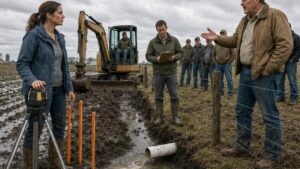
A tripod, receiver, measuring equipment, stakes, and a metal detector lay arranged inside.
Larry pointed to his folder.
“I’ve got the county copies.”
“I’ll take them.”
Andrew held up his newer survey.
“This is the one from closing.”
“I’ll take that too.”
Jeffrey collected both.
Then he looked from Larry to Andrew.
“Before I walk this line, here’s how this works. I don’t care who planted where. I don’t care who paid a contractor. I don’t care who remembers what his father said.”
Larry felt that one.
Jeffrey continued.
“I start with the record. I reconstruct what I can. Then I look for physical evidence.”
Andrew folded his arms.
“And if the old pin is gone?”
“Then I deal with what’s left.”
Larry looked toward the soybean field.
He knew exactly where he wanted Jeffrey to begin.
Jeffrey seemed to read it on his face.
“Don’t point.”
Larry lowered his hand before realizing he had raised it.
Jeffrey picked up his equipment and started walking.
Not toward Andrew’s cedar corner.
Not toward the place Larry’s father had shown him.
He walked away from both.
Chapter 5: Where the Metal Detector Finally Began to Sing
Jeffrey crossed the field in the wrong direction.
At least it looked wrong to Larry.
He moved south along the edge, stopping every so often to check the receiver mounted on his pole. He wrote something in his field book, walked another distance, then turned toward the county road.
Andrew watched from beside the unfinished fence.
“Where’s he going?”
Larry kept his eyes on Jeffrey.
“He told us not to help.”
“I asked a question.”
“And I don’t know.”
That was becoming a sentence Larry disliked saying.
Jeffrey spent nearly an hour on points that appeared to have nothing to do with the disputed corner.
He located one surviving monument near the road, measured from another beyond the Nelson drive, then returned toward the field.
Only then did he unfold the copies on his tailgate.
Larry and Andrew approached.
Jeffrey held down the corners with small pieces of equipment.
“Your recent survey,” he said, looking at Andrew, “appears to reconstruct this boundary using a later control monument.”
Andrew nodded. “That’s what Larry said the county record showed.”
“Sort of.”
Larry waited.
Jeffrey pointed to the older plat.
“This document calls directly to an iron pin at the corner.”
He shifted his finger to the later survey record.
“Years later, another survey used a different monument to rebuild part of the section geometry.”
“Why?” Larry asked.
“Could be the original wasn’t visible. Could be the surveyor didn’t recover it. Could be circumstances I’m not going to guess about.”
Andrew leaned over the documents.
“But that later monument is real.”
“Yes.”
“So why isn’t it good?”
“I didn’t say it isn’t.”
Jeffrey looked at both of them.
“This is what you keep wanting me to do. Pick one piece of evidence and declare a winner.”
Neither man spoke.
Jeffrey tapped the papers.
“Surveying doesn’t work that way.”
He folded the copies and returned them to the folder.
Then he took out the metal detector.
Larry’s pulse changed.
Andrew noticed.
“You think it’s still there.”
Larry looked at the ground.
“I think it might be.”
Jeffrey heard him.
“That’s all anybody gets to think right now.”
He walked back into the soybeans.
This time he followed a line neither owner had marked. It passed several feet from Andrew’s newest cedar post.
Larry wanted to say something.
He forced himself not to.
Jeffrey swept the detector slowly.
Nothing.
He moved several yards.
Nothing.
The machine gave a weak chirp near a piece of old fence wire buried under weeds. Jeffrey dug it out, tossed it aside, and continued.
Ten minutes became twenty.
Larry’s certainty began leaking away.
He could see his father in his mind, boot toe moving leaves, voice matter-of-fact.
Right down there.
But memory was not a coordinate.
Andrew shifted beside him.
“If he doesn’t find it, what happens?”
“I don’t know.”
“You’ve said that a lot today.”
Larry looked at him.
“So have you.”
Andrew almost replied, then stopped.
Jeffrey worked farther north.
The search arc was moving away from where Larry remembered the pin.
Larry’s hands tightened.
“Jeffrey.”
The surveyor did not look up.
Larry stopped himself.
A few minutes later Jeffrey turned back south and adjusted his path.
The detector swept over bare dirt between soybean plants.
A clean tone sounded.
Jeffrey stopped.
So did Larry.
The sound came again.
Stronger.
Jeffrey moved the detector in a small cross pattern.
A steady signal repeated beneath the soil.
Andrew stepped forward.
“Is that it?”
Jeffrey held up a hand without looking at him.
He marked the spot, then used a narrow shovel carefully around the signal.
Dark soil came up in small cuts.
Nothing appeared at first.
Then the shovel struck something with a dull metallic click.
Larry’s breath caught.
Jeffrey crouched and cleared soil by hand.
A rust-darkened piece of iron emerged from the earth.
It was ugly.
Small.
No dramatic marker. No bright cap. No engraved declaration of ownership.
Just old iron driven into Missouri ground.
Larry stared at it.
He had imagined this moment for two days as victory.
He had imagined looking at Andrew and saying nothing because nothing would need saying.
Instead all he felt was the strange weight of seeing something his father had talked about as casually as a gatepost.
It had been there.
Covered.
Forgotten.
But there.
Andrew came closer.
“That’s the pin?”
Jeffrey did not answer immediately.
He cleaned around it without disturbing its position, measured its diameter, then took photographs.
“It is an old iron monument,” he said.
“At the location on Larry’s plat?” Andrew asked.
“It is very close to where the record reconstruction put that called monument.”
Larry finally looked at Andrew.
Andrew’s face had gone pale.
“So he’s right.”
Jeffrey stood.
“I didn’t say that.”
Andrew stared at him.
“You just found the pin.”
“I found an iron monument consistent with the historic call.”
Larry almost laughed in disbelief.
“Jeffrey, come on.”
Jeffrey turned on him.
“No.”
The word was firm.
“This is exactly the point where both of you get yourselves in trouble.”
Larry’s satisfaction cooled.
Jeffrey pointed at the exposed iron.
“This matters. It matters a lot. But I still have to reconcile it with the deed descriptions, the later monument references, occupation evidence, and the newer survey.”
Andrew looked toward the cedar posts.
“But if that’s the original corner—”
“If.”
Jeffrey emphasized the word.
“I am not giving either of you permission to move anything today.”
Larry folded his arms.
For the second time, the proof he expected to end the conflict had merely advanced it.
Yet something fundamental had changed.
The old plat had described an object.
The county had recorded it.
Now iron existed in the earth exactly where the older evidence said iron should exist.
Andrew walked several steps away.
Nicole had arrived sometime during the search and stood near the lane.
Andrew went to her.
They spoke quietly.
Larry could not hear most of it, but he saw Nicole glance toward the exposed pin, then toward the partially built fence.
Jeffrey continued measuring.
Larry crouched beside him.
“My father showed me this.”
Jeffrey glanced up.
“This exact pin?”
“He showed me this corner.”
“That’s not the same answer.”
Larry looked at the rusted iron.
“No.”
Jeffrey wrote another number in his book.
“You understand why I’m hard on you about that?”
Larry did not answer.
Jeffrey sat back on his heels.
“Old knowledge is useful. Sometimes it’s the thing that saves the whole reconstruction. But if it isn’t documented so somebody else can follow it, it becomes a story.”
Larry looked at him.
“My father wasn’t telling stories.”
“I didn’t say he was wrong.”
That distinction landed harder than Larry expected.
Jeffrey stood and walked toward the newest cedar post.
He measured from the recovered iron monument to the line of posts.
Then he measured again.
Andrew returned.
“How far?”
Jeffrey checked the reading.
“I’m not giving you a final boundary distance until I’ve processed everything.”
“Is the fence over?”
Jeffrey paused.
“The posts are west of the line suggested by this monument and the historic calls.”
Andrew’s face tightened.
“By how much?”
“Roughly the amount Larry has been complaining about.”
Larry could have enjoyed that sentence.
Instead he watched Andrew look across the field at the posts he had paid to set.
Nicole stood behind him with one hand resting against her opposite arm.
No one looked triumphant.
Jeffrey packed part of his equipment.
“I’ll finish the calculations and compare the record chain.”
Andrew asked, “How long?”
“I’ll send both of you a draft.”
Larry pointed toward the modern survey.
“You said you saw why they might’ve ended up over here.”
Jeffrey nodded.
“What?”
Jeffrey reopened the newer record.
“This later control monument appears to have become the basis for reconstructing the corner after the original pin stopped being recovered.”
He traced the chain with a pencil.
“If that later reference was accepted without properly reconciling the original record call, a small displacement could carry forward.”
Andrew stared at the page.
“So one survey copied another mistake?”
“Maybe.”
“That’s unbelievable.”
“No,” Jeffrey said. “It’s actually very believable. That’s why you reconcile evidence instead of assuming newer means better or older means better.”
Larry looked at the rusted pin.
The answer was finally beginning to appear.
And it belonged completely to neither man’s version of the story.
Chapter 6: Being Right Was Not the Same as Ending It
The corrected draft put every disputed cedar post on Larry’s side of the boundary.
He read the measurements at his kitchen table on Monday morning.
Then he read them again.
Jeffrey had sent the same packet to Andrew.
The reconstructed line used the recovered iron monument, the historical calls, the deed descriptions, and the surrounding record evidence. A technical note explained the discrepancy with the recent survey: a later replacement reference appeared to have been carried forward without fully reconciling the original monument.
Not fraud.
Not a neighbor secretly moving lines.
Not even necessarily one careless act.
A mistake could become respectable if enough clean documents repeated it.
Larry set the pages down.
For several minutes he looked through the kitchen window toward the fields.
He had won the factual argument he had been carrying since the first cedar post appeared.
It did not feel the way he had expected.
Andrew arrived that afternoon.
Nicole came with him.
They sat at the same kitchen table where Larry had spread his father’s papers days before. Jeffrey joined by phone for the first part of the discussion, walking them through the draft.
Andrew asked the most questions.
Some were technical.
Some were the same question in different clothes.
“Is there any reasonable interpretation that leaves the fence where it is?”
Jeffrey answered plainly.
“Not based on the evidence I’ve reconciled.”
Andrew leaned back.
“So the survey we bought with was wrong.”
“I’d say its boundary reconstruction appears inconsistent with the controlling evidence I’ve recovered.”
Andrew rubbed his forehead.
Larry almost smiled at Jeffrey’s refusal to use simple words, but the look on Andrew’s face stopped him.
“What do we do now?” Nicole asked.
Jeffrey explained the practical steps.
A revised survey.
A boundary acknowledgment if both parties wanted the discrepancy documented clearly.
New monument references.
Recorded materials so future owners would not have to reconstruct the entire problem again.
When the call ended, nobody spoke immediately.
Andrew stared at the draft.
Finally he said, “Moving the fence is going to cost me.”
Larry waited.
“I know.”
“The contractor already charged for the first set.”
“I know.”
“I’ve got concrete work that has to shift too.”
Larry looked at him.
“Andrew, those posts are on my ground.”
“I understand what the paper says.”
“The paper and the pin.”
Andrew looked up sharply.
Nicole placed a hand on the table.
“Don’t.”
He turned toward her.
“I’m not starting anything.”
“You are.”
Andrew pushed his chair back slightly.
“I did what people tell you to do. I hired professionals. I got the survey before we bought. I checked the acreage. I asked questions.”
His voice was controlled, but Larry heard what had been underneath the boundary argument from the beginning.
Andrew continued.
“We sold our old place. We put most of what we’d planned to spend over the next few years into this one. Then the septic system wasn’t what we’d been told. The building needed work. Insurance came back different. Every time I turned around, there was another thing somebody supposedly checked.”
Nicole watched him quietly.
Andrew tapped the survey.
“This was the one thing I thought was settled.”
Larry said, “So you set the fence before we settled it.”
Andrew looked at him.
“Yes.”
There it was.
No excuse attached.
The room changed slightly.
Andrew lowered his eyes.
“When you told me the survey was wrong the first time, you gave me nothing except ‘your fellow better look again.'”
Larry remembered the conversation by the gate.
He had been dismissive because he had been certain.
Andrew continued.
“You acted like I was an idiot for believing the paperwork I paid for.”
“I didn’t call you an idiot.”
“You didn’t have to.”
Larry almost defended himself.
Then he remembered Jeffrey asking whether his father had shown him the exact pin.
Old knowledge was useful.
Undocumented knowledge became a story.
Larry looked toward the back room where the old LAND folder sat in the filing cabinet.
“I should’ve shown you the plat then.”
Andrew said nothing.
“I thought you ought to know enough to question it.”
“How would I?”
Larry had no good answer.
Andrew gave a short laugh without humor.
“That’s what I’ve been trying to tell you.”
Larry nodded slowly.
“I knew something you didn’t. Then I got mad at you for not knowing it.”
Nicole looked between them.
“That doesn’t make the fence okay.”
“No,” Larry said. “It doesn’t.”
Andrew’s mouth tightened.
“I’ll move it.”
The sentence was quiet.
Larry felt the urge to say, Good.
To let that be the moment.
Instead he asked, “All of it?”
“The section that’s wrong. I’ll have the contractor reset the line when the revised survey is finished.”
“And the concrete?”
“I’ll change the plan.”
The cost of those words was visible in his face.
Larry had wanted justice.
This was what practical justice looked like: labor repeated, money lost, schedules changed, and nobody standing in a field cheering.
Two days later they met at Jeffrey’s survey office.
The revised drawing lay across a large table.
Jeffrey showed them the recovered monument, measured references, adjoining calls, and the corrected boundary.
The iron pin was no longer merely Larry’s proof.
It was the common reference from which both properties could now be understood.
Andrew signed first.
Larry picked up the pen.
Before putting his name down, he stopped.
“One condition.”
Andrew looked tired immediately.
“What now?”
“Nothing moves.”
Andrew frowned. “You just said—”
“Not the fence.”
Larry touched the revised survey.
“This record.”
Jeffrey watched him.
Larry continued.
“I don’t want you keeping one copy and me keeping another and twenty years from now somebody finds half of one in a drawer.”
Nicole leaned forward.
“What do you want?”
“Everything recorded that can be recorded. Copies with both properties. Photographs of the recovered monument. Measurements to references that somebody can actually find. And whatever Jeffrey thinks the next owner needs to understand why the line is where it is.”
Andrew stared at him.
Larry added, “I’ll pay my part of that work.”
Andrew seemed more surprised by that than by the condition itself.
“You would?”
“I didn’t document it either.”
“The old records were yours.”
“Exactly.”
Larry looked at the drawing.
“I knew the history because my father told me. His father told him. That’s not much use to somebody buying the place next door.”
Jeffrey gave a small nod.
Andrew sat back.
For a long moment, he said nothing.
Then he reached for the pen again.
“Put it in.”
Larry signed beneath him.
The agreement did not make them friends.
It did not erase the threat Larry had made about blocking the lane or the posts Andrew had ordered into planted ground.
But when they stepped outside, Andrew stopped beside Larry’s pickup.
“I’ll call the contractor tomorrow.”
Larry nodded.
Andrew looked toward the folder visible on the bench seat through the window.
“You’re really going to stop carrying that old plat around in there?”
Larry glanced at the faded cloth tucked behind the seat.
For years, he had thought keeping it close meant he was protecting it.
Now he was beginning to understand the difference between keeping something and preserving it.
“When we’re done,” he said, “it’s going somewhere people can find it.”
Andrew nodded.
Then he walked toward his truck.
Larry remained beside his own, looking across the parking lot at two men leaving with the same corrected line on their papers.
For the first time, the boundary was no longer something only one of them had to believe.
Chapter 7: The Boundary Mark They Would Not Have to Guess Again
The first cedar post came out harder than it had gone in.
The contractor wrapped a chain low around it, eased the skid-steer backward, and stopped when the post leaned without lifting. The engine dropped to an idle. He reset the chain, pulled again, and this time the cedar broke free with a dark plug of Missouri soil packed around its base.
Larry stood at the edge of the soybean rows and watched the empty hole appear.
Three weeks earlier, that post had looked permanent.
Now it lay sideways in the grass.
Andrew stood near the trailer with a copy of Jeffrey’s revised survey folded in his back pocket. He had already paid for the first installation. He had paid to have the misplaced section removed. Before the week was over, he would pay again to have the line rebuilt where the corrected survey placed it.
He had not complained to Larry about the invoices.
That did not mean he was pleased.
“Want us to fill these as we go?” the contractor asked.
Larry looked at the holes running through the beans.
“Yes.”
Andrew nodded. “Do it.”
The contractor moved to the next post.
Larry had expected some satisfaction in watching them come out. Instead he found himself studying the damaged plants around each hole.
The beans would recover where they could.
Some would not.
That was the trouble with correcting a mistake. The line could be restored exactly, but the ground still remembered where somebody had dug.
Andrew walked over.
“Jeffrey marked the new alignment yesterday.”
Larry followed his gaze.
Small survey stakes ran along the corrected boundary. They were not dramatic. From twenty yards away, they nearly disappeared against the grass.
“Looks right,” Larry said.
Andrew gave him a sideways look.
“You saying that as a farmer or as a surveyor?”
Larry almost bristled.
Then he saw the faintest hint of humor in Andrew’s expression.
“As the man who’s going to let the surveyor be the surveyor from now on.”
Andrew nodded.
“Probably good for both of us.”
The next post came free.
By midmorning the contractor had removed the entire disputed section. The two-foot strip that had occupied nearly every conversation between the men for weeks looked ordinary again.
That, more than anything, surprised Larry.
No visible scar announced whose ground it was.
No line appeared in the soil.
Without stakes, surveys, memories, and recorded calls, it was simply earth running beneath grass and soybeans.
Jeffrey arrived before noon to verify the reset corner.
He carried a field tablet instead of the thick stack of paper he had brought during the original investigation. The old iron monument had been protected again after documentation, its position precisely measured to surrounding reference points.
Larry walked with him toward the corner.
Jeffrey stopped near the recovered monument and checked his measurements.
“The contractor can work from these stakes,” he said.
Andrew joined them.
“And nobody touches that iron?”
“Nobody needs to.”
Jeffrey looked at both men.
“That’s the point of documenting it properly.”
He showed them photographs of the monument before it had been covered again. Measurements accompanied each image. The revised survey tied the corner to additional permanent references so that a future surveyor would not have to depend on somebody remembering where an old farmer had once pointed with his boot.
Larry studied the photograph.
The rusted iron looked even smaller on the screen.
For weeks it had carried the weight of his entire argument.
Now it was becoming something else.
Not a weapon.
A reference.
The contractor began setting the corrected corner post.
Andrew watched for a moment, then surprised Larry by walking toward him.
“Need a hand?” the contractor asked.
Andrew took hold of the post.
“I can keep it straight.”
Larry said nothing.
Andrew braced the cedar while the contractor checked the position against the stakes. His boots sank slightly into the loose soil.
“Little toward you,” the contractor said.
Andrew shifted it.
“There.”
The post settled exactly on the corrected line.
Larry found himself thinking about how different the scene would have looked weeks earlier.
Andrew holding a cedar post would have been enough to make his blood rise.
Now Larry stepped closer and sighted down the line.
“Looks straight.”
Andrew kept both hands on the post.
“Careful. That’s how this whole thing started.”
Larry looked at him.
Andrew smiled once.
Larry did too.
It lasted only a second.
It was enough.
The work finished that afternoon.
The fence no longer crossed Larry’s soybean rows. Andrew’s planned improvements had been shifted to fit the corrected boundary. Neither man had received everything he wanted. Andrew had absorbed costs he believed he should never have faced. Larry had lost crop and time to a dispute he believed should never have existed.
But the line was correct.
And, more importantly now, it was understandable.
Two days later, a packet arrived from Jeffrey’s office.
Larry carried it into the farmhouse and spread its contents across the kitchen table.
There was the revised survey.
Certified copies of the older records.
The monument documentation.
Photographs.
Reference measurements.
A written explanation of the discrepancy that had caused the newer line to shift.
Copies had gone to Andrew and Nicole as well.
Larry read through the packet and then walked into the back room.
He opened the bottom drawer of the filing cabinet.
The old folder marked LAND was still there.
For decades, his family had treated it as sufficient.
A deed.
A plat.
An affidavit.
Notes understood by people who already knew the property.
Larry began removing everything.
He put the brittle originals into protective sleeves. He placed the certified county records behind them. Then he added Jeffrey’s corrected survey and the monument photographs.
At the front, he placed a plain typed page listing what the file contained and why it mattered.
He stopped halfway through.
His father would never have made such a page.
His father would have expected Larry to know.
And Larry had known.
That had almost been the problem.
He returned to the pickup.
The faded cloth bundle still sat behind the bench seat.
Larry pulled it out.
Dust marked the vinyl where it had rested.
He stood beside the open truck door, holding the cloth in both hands.
His father had kept documents there because the truck was always close. Larry had continued doing the same because changing the habit had seemed unnecessary.
For years, keeping the papers close had felt like stewardship.
But close was not the same as clear.
And inherited was not the same as preserved.
Larry carried the bundle inside.
He placed the 1953 plat with the rest of the records, then wrote across a fresh folder tab in black marker.
BOUNDARY — ORIGINAL AND CORRECTED RECORDS.
He slid the folder into the filing cabinet.
This time he did not put it in the bottom drawer.
He placed it at eye level.
That evening, Larry walked the field edge.
The corrected fence cast a thin shadow beside the soybeans. At the far corner, beneath ordinary soil, the old iron pin remained where it had been for generations.
No one could see it.
They did not need to.
Its position was measured now.
Photographed.
Recorded.
Explained.
Andrew was near his shed when Larry reached the end of the field. He raised one hand.
Larry returned the gesture.
They were not friends.
Perhaps they never would be.
But neither man had to guess where the other’s ground began.
Larry looked once more toward the corner.
His father had asked him to keep the farm together.
For years Larry had thought that meant refusing to surrender a single foot.
Now he understood there had been another part to the promise.
Leave behind enough truth that the next person would not have to fight to find it.
The story has ended.