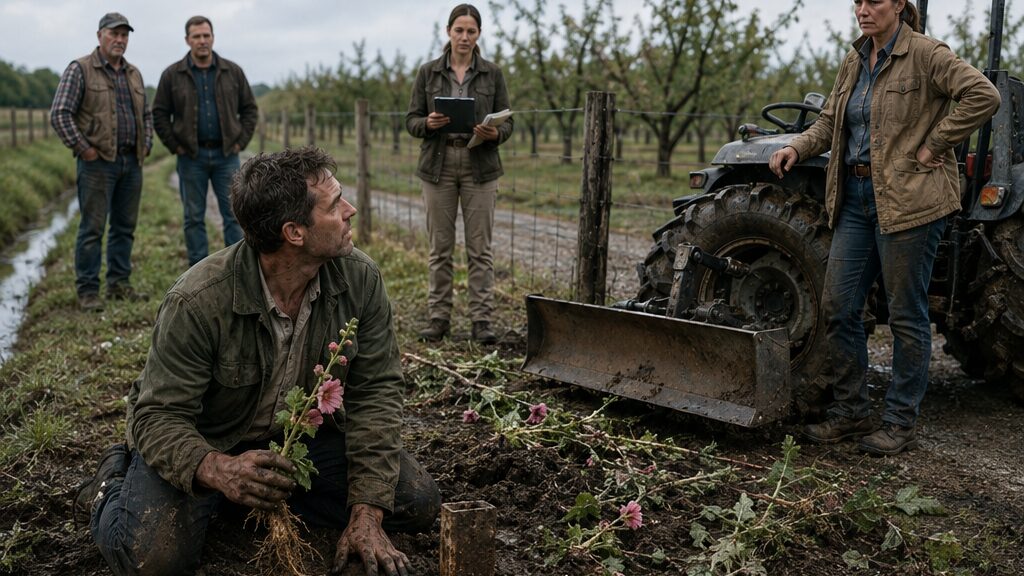
She Tore Out His Grandmother’s Flowers, Then Learned Why the County Had Marked Them
Chapter 1: The Morning Half the Boundary Flowers Vanished
The tractor blade rose with the last intact row of hollyhocks hanging from it by their roots.
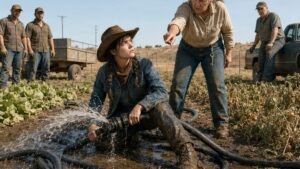
For one suspended second, Benjamin Harris saw the flowers the way his grandmother had always handled them in spring: tall pink stalks tied loosely to the fence with strips of old cotton, lower leaves dusted white from the lane, bees working the open cups. Then Patricia Clark tilted the hydraulic lever.
The blade shook.
Black soil scattered. Roots snapped. The flowers folded into the scraped ditch beside the fence.
“Shut it down.”
Benjamin’s voice barely carried over the compact tractor’s engine.
Patricia looked at him beneath the roll bar but did not move her hand from the controls.
He stepped through the orchard gate, one boot sinking into soil churned soft by the tires.
“I said shut it down.”
This time she killed the engine. The sudden silence exposed smaller sounds: a loose fence wire tapping a post, insects circling where the flowers had stood, the soft collapse of soil from the raised blade.
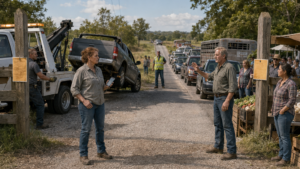
Two farmers had stopped their pickup on the access lane. Neither got out. They watched through the open windows with the guarded stillness of people who knew a private disagreement had already become public.
Patricia climbed down. She wore work gloves and an old canvas shirt that had belonged to her father. A preliminary parcel map was folded into her back pocket.
“I told you I was clearing this today.”
“You told me you wanted to discuss drainage.”
“I sent three letters.”
“You said the swale needed work.”
“It does.” She pointed toward the ruined strip. “Those weeds were growing in it.”
Benjamin stared at her.
“They were my grandmother’s.”
“I know whose flowers they were.”
The answer struck harder than ignorance would have. Patricia had grown up across the fence. She had eaten Elizabeth Harris’s apple cake at harvest suppers and carried jars of those same hollyhock seeds home for school projects.
Benjamin moved toward the tractor blade.
“Lower it.”
Patricia folded her arms. “I’m not putting them back.”
“I didn’t ask you to.”
He crouched beneath the steel edge. Most of the roots had been torn into pale strands. He found one crown still firm, with a short length of taproot and two crushed leaves attached. When he lifted it free, pink petals slid from the blade and landed across his knuckles.
Patricia watched him cradle it.
“You’re making this something it isn’t.”
“You came onto my side with a tractor.”
“That’s what you keep saying.”
“It’s where the fence has stood since before either of us was born.”
“A fence isn’t a survey.”
The farmers in the pickup shifted. Benjamin felt their attention move from Patricia’s tractor to the old wire line. A fence could mean ownership in local conversation for fifty years, right up until someone brought out a stamped map.
Patricia pulled the folded paper from her pocket and spread it across the tractor hood. A yellow line cut through a rectangle marked with parcel numbers. The line ran several feet inside Benjamin’s fence.
“This came from the probate survey,” she said. “The tax parcel puts the swale on my ground.”
“Preliminary survey.”
“It’s more than you have.”
He kept hold of the root. “You could have waited for the final pins.”
“I have waited. Since March.”
Benjamin recognized the dates written along the map’s edge. They matched the certified envelopes stacked unopened on the corner of his kitchen desk. He had assumed they concerned Patricia’s plan to sell the lower twenty acres. Every conversation since her return had eventually reached the same point: access, drainage, frontage, value.
“I called you,” she said.
“You left messages saying you needed the line cleared.”
“Because the lower field flooded twice.”
“The lower field has always held water.”
“Not up to the machine shed.”
Benjamin glanced downhill. From the orchard, the Clark acreage fell gradually toward a shallow basin. Robert Clark had planted corn there in dry years and soybeans in wet ones. After Robert died, the field had gone mostly unworked.
Patricia followed his gaze.
“The lender’s appraiser comes next week. I can’t show him a blocked drainage route and twenty acres going sour.”
“So you decided to destroy something you didn’t own.”
“I decided to maintain land the county record says is mine.”
She spoke without satisfaction. That almost made it worse. The removal was not an angry impulse to her. It was a task checked off before breakfast.
Benjamin stood. “You’re done here.”
“I’ve got another thirty feet.”
“You move that tractor, I call the sheriff.”
Patricia glanced toward the lane. One of the watching farmers looked down at his dashboard.
“You think grief makes the line yours,” she said quietly. “It doesn’t.”
His grip tightened around the root until wet soil pressed between his fingers.
He wanted to tell her Elizabeth had planted the first flowers after Benjamin’s mother left. That she had taught him to pinch dead blooms into paper sacks and save only the dark, full seeds. That during the last summer of her life, when she could no longer walk the length of the fence, she had made him promise never to let the line disappear.
But none of that would settle a parcel boundary.
Patricia must have seen the argument leave his face, because she reached for the tractor handhold.
Benjamin stepped between her and the wheel.
He did not touch her. He did not raise his voice.
“Get a final survey,” he said. “Bring the county. Bring whoever you need. Until then, that machine stays still.”
For several seconds they stood close enough to hear each other breathe.
Then Patricia pulled off one glove.
“You want the county?” she said. “Fine. But when they come, you’d better ask them about the drainage inspections you haven’t done.”
Benjamin’s expression changed before he could stop it.
Patricia noticed.
“What inspections?”
She folded the map again. “Open your mail.”
The words landed with the precision of something prepared.
She walked away from the tractor and toward her truck. Before climbing in, she turned back.
“You have until tomorrow to move anything you claim is yours from the disputed strip. After that, I’m following the map.”
The pickup on the lane rolled forward as soon as hers did. Neither farmer looked at Benjamin as they passed.
He remained beside the silent tractor, holding the damaged root.
Only after the vehicles disappeared did he kneel in the scraped earth.
He set the root in the shade of the fence and began searching for salvageable crowns. The blade had exposed layers that had not seen daylight in decades: pieces of old wire, fragments of limestone, a flattened glass bottle, dark bands of silt.
Near the place where the tallest flowers had grown, his fingers struck metal.
He cleared the soil with both hands.
At first he thought it was the top of a fence stake. Then he found a square shoulder beneath the rust and a narrow face stamped with shallow characters.
He spat on his thumb and rubbed away the dirt.
The marker leaned toward Patricia’s property, almost buried beneath the old flower roots. At its center was a county seal. Under it, a number remained legible.
PB-17.
Benjamin looked from the marker to the ruined strip, then toward the drainage swale descending between the two farms.
The flowers had not merely grown beside the marker.
Elizabeth had planted directly over it.
Chapter 2: The Marker Beneath Elizabeth’s Broken Garden
Rachel Miller identified the marker within ten seconds and refused to tell Benjamin it proved anything he wanted proved.
“It’s a pollinator-buffer monument,” she said, kneeling beside the scraped strip. “Older program. We stopped using this style about twelve years ago.”
Benjamin held the surviving hollyhock root in one hand. Its leaves had already begun to soften.
“So she destroyed a protected buffer.”
Rachel brushed dirt from the stamped number with the edge of a pen. “I said what the marker is. I did not say where the legal boundary falls, who currently owns the ground, or whether the agreement is active.”
Patricia stood beside the tractor with her arms folded. The stop-work notice Rachel had brought was clipped to a board under her elbow.
The two farmers from the access lane had returned, this time on foot. One pretended to examine the fence while the other stared openly at the county seal.
Benjamin photographed the marker.
“PB-17,” Rachel said. “I’ll check the archive.”
“You can’t tell her to stop until then?”
“I already did.”
Rachel rose and handed Patricia the notice.
Patricia read the first page. “Temporary disturbance suspension.”
“That means no more grading, digging, mowing, burning, spraying, or equipment traffic inside the flagged area.”
“You haven’t flagged anything.”
“I will.”
Patricia’s mouth tightened as Rachel pulled orange marking flags from her truck. The official paper had produced the reversal Benjamin thought he wanted. Patricia, who had arrived that morning giving orders from a tractor, now had to stand aside while county flags appeared around the torn flowers.
Yet Rachel placed those flags on both sides of the fence.
Benjamin pointed. “Why are you marking my orchard lane?”
“Because the buffer width may extend from the swale centerline, not the fence.”
“This is her disturbance.”
“It may also be your regulated area.”
Patricia gave a short laugh without humor.
Rachel turned on her. “A stop order is not a victory for either of you.”
The laughter stopped.
She photographed the exposed soil, the blade marks, the rusted marker, and the one root in Benjamin’s hand. Then she measured from the marker to the fence and from the fence to the deepest part of the swale.
“Take that root inside,” she told Benjamin. “Keep it damp, not drowned.”
He looked at her. “You remember my grandmother’s flowers?”
“Everybody remembers Elizabeth’s flowers.”
That was not the same as saying they belonged to him.
At the conservation office that afternoon, Rachel led them past framed photographs of restored creek banks and grazing fields. Benjamin carried the root wrapped in a wet dish towel inside a feed bucket. Patricia carried her parcel map.
The archive file for PB-17 was thinner than he expected.
Rachel set it on a conference table and opened the first folder. The top photograph showed Elizabeth fifteen years younger, standing beside newly planted hollyhocks. Robert Clark was visible behind her with one boot on a shovel. Between them ran the shallow drainage swale, freshly graded and lined with straw.
Benjamin pulled the photograph closer.
“He helped plant them.”
Patricia stared at her father’s face. “That doesn’t mean he gave away land.”
“No one said it did,” Rachel replied.
She turned over a program summary. The original enrollment described a shared pollinator strip intended to stabilize disturbed soil and slow agricultural runoff. Both parcel numbers appeared on the application.
Benjamin felt the first clean surge of vindication since the tractor blade had lifted the flowers.
“She knew,” he said. “Patricia saw the marker and kept digging.”
“I saw rust,” Patricia said. “The flowers covered it.”
“You dug around it.”
“I stopped when the blade hit metal.”
“You stopped because I came down the lane.”
Rachel placed a hand on the file. “The marker establishes conservation history. It does not establish criminal intent.”
Benjamin leaned back. “Then what does?”
“A completed inspection record. A current agreement. The survey attachment. Maintenance correspondence.”
“Good. Find those.”
Rachel’s gaze rested on him a moment longer than necessary.
She opened the second folder.
The early reports were signed every spring by Elizabeth. Notes described mowing dates, reseeding, erosion checks, and drainage-gate clearing. After Elizabeth’s death, Benjamin’s name replaced hers.
The first year held his signature.
The second year did too.
The following page was stamped MISSED INSPECTION.
So was the next.
Patricia slid the pages toward him. “Those the inspections I mentioned?”
Benjamin looked at Rachel. “Nobody came.”
“We mailed appointment requests.”
“I didn’t receive them.”
Patricia set three certified-mail receipts beside the file. “You signed for at least one.”
The room seemed to narrow around the paper.
He recognized his own handwriting. The signature was hurried, the B reduced to a vertical stroke, but it was his. He remembered the carrier catching him beside the cider shed during harvest. He had shoved the envelope into his jacket pocket and later placed it with the Clark letters on the kitchen desk.
Rachel continued through the file.
“The original agreement ran ten years. Elizabeth renewed once. Your renewal packet was opened, but the county never received the signed maintenance schedule.”
“Opened by who?”
“Administrative entry doesn’t say.”
“What does that mean for the protection?”
“It means the site may still be subject to restoration requirements because public funds paid for the original installation. It also means active program benefits may have lapsed.”
Patricia tapped the parcel map. “So he let it expire.”
“That is not the same as permission to excavate it.”
“But it isn’t what he said this morning.”
Benjamin turned to her. “I said they were my grandmother’s.”
“You said the county would prove I had no right to touch them.”
“I said you should have waited.”
“And you should have answered.”
Rachel removed the final sleeve from the file. It contained a cover sheet labeled BOUNDARY AND MAINTENANCE ATTACHMENT.
Behind it was nothing.
She checked the folder again.
“The map’s missing,” Benjamin said.
“The final recorded attachment is missing.”
“From the file?”
“Possibly never submitted. Possibly misfiled before digitization.”
Patricia unfolded her preliminary survey. “Then we use the parcel record.”
“Not for the conservation question,” Rachel said. “And not until a licensed surveyor locates the original monuments.”
Benjamin looked again at the photograph of Elizabeth and Robert. His grandmother stood on one side of the new flowers, Robert on the other. Neither appeared concerned about the fence.
“Why would both parcels be on the agreement?”
Rachel closed the folder. “That is what the missing attachment should explain.”
She issued two copies of the temporary order. Patricia signed hers with clipped, angry strokes. Benjamin signed beneath a list of required actions: preserve remaining vegetation, prevent additional erosion, grant site access, provide maintenance records.
When Patricia reached the door, she stopped.
“You got what you wanted,” she told him. “My tractor is parked. The lender’s inspection is delayed. Everyone on the road will know by supper.”
Benjamin glanced toward the notice in her hand. “You dug up the flowers.”
“Yes.” She opened the door. “And now they’ll also know why you didn’t want anyone checking under them.”
She left before he answered.
Rachel waited until the door closed.
“You came here expecting me to hand her a violation and send you home vindicated.”
“She ignored a marker.”
“You ignored letters.”
“That doesn’t make what she did right.”
“No. It makes the situation larger than what she did.”
Benjamin pushed the county photograph back across the table. “What happens next?”
“A site inspection, survey review, and drainage assessment. You’ll need your grandmother’s maintenance records if she kept private copies.”
“She kept everything.”
“Then find them.”
Rachel gathered the loose pages, but she left one sheet in front of him.
It was the renewal warning bearing his signature.
Below the delivery date, a county employee had written: No response. Second inspection missed. Drainage function unverified.
Benjamin remembered the heavy envelope in his jacket, the orchard crew waiting for him, a cider press belt slipping off its wheel. He had put the letter somewhere safe because he could not deal with one more demand that afternoon.
Safe had become unopened.
Unopened had become forgotten.
And forgotten now sat in front of him as proof.
Chapter 3: The Letters Benjamin Refused to Open
The flood photograph slid from Patricia’s first certified letter and landed faceup on Benjamin’s kitchen table.
A date was written across the bottom in blue ink: April 19, last year.
The image showed the Clark lower field under brown water. Only the top half of a fence post remained visible. Behind it, water reached the doors of Robert’s machine shed.
Benjamin turned the photograph over.
On the back Patricia had written: This came through the Harris swale after the drainage gate jammed. We need to inspect the line together before planting season.
He opened the second letter.
Another photograph, dated eleven months later, showed ruts cut through Patricia’s lower field by receding water. The accompanying note was shorter.
I cannot carry another season of this. Please call me.
The third envelope contained the preliminary parcel map and a proposed date for a joint survey. Benjamin remembered seeing the map through the clear address window and deciding it was part of Patricia’s sale pressure. He had placed all three letters beneath the county envelope without opening them.
On the windowsill, the surviving hollyhock root leaned inside a glass jar. He had added too much water. One bruised leaf hung over the rim, softening at the edge.
He poured half the water into the sink and wrapped the root crown with a damp cloth as Rachel had instructed.
The act felt absurdly careful after months of neglecting everything beneath the flowers.
At the feed store the following morning, conversation stopped when Benjamin entered.
The owner stood behind the counter weighing seed bags for a customer. One of the farmers who had watched the tractor confrontation examined a display of fence staples with exaggerated interest.
Benjamin placed two lengths of drainage chain and a can of penetrating oil on the counter.
“Gate stuck again?” the owner asked.
“Going to check it.”
The farmer by the staples turned one package over. “Patricia said the county shut down the whole line.”
“Temporarily.”
“Heard it was a protected garden.”
“It was enrolled in a buffer program.”
“Was?”
Benjamin met the farmer’s eyes.
The man put the staples back. “Just asking.”
“No, you’re repeating.”
The owner cleared his throat and wrote a total on a paper slip. “Rain’s supposed to come hard after lunch.”
Benjamin paid and carried the supplies out.
Behind him, the bell over the door rang before he reached his truck. The conversation resumed too softly for words to travel through the glass.
The rusted drainage gate sat where the orchard slope narrowed toward the disputed strip. Elizabeth had called it a gate, though it was really a steel control plate inside a concrete box. A chain lifted the plate to let runoff pass into the shared swale.
Benjamin removed the cover.
Mud packed the mechanism. The chain links were orange with rust. A branch had wedged beneath the plate, and a thick mat of leaves sealed the opening.
This had not happened in one week.
He sprayed the chain, hooked it to the truck’s tow point, and pulled gently. The links tightened but the plate did not rise.
Clouds gathered over the western fields before noon. By one, the orchard rows had darkened under fast rain.
Benjamin worked in a slicker with water running from his cuffs. He cleared leaves with a shovel and reached into the box until mud covered both arms. The seasonal worker helped for half an hour, then left to move empty bins from the lane.
The first surge arrived as a low, spreading sheet between the apple rows.
Water gathered at the control box and climbed the concrete walls. Benjamin pulled the chain again. Metal groaned. One link stretched, then snapped.
The loose chain struck the cover hard enough to dent it.
Water spilled over the box and raced toward the uprooted flower strip.
Benjamin followed it downhill.
The county flags bent in the storm. Muddy runoff crossed beneath the old fence and spread across Patricia’s ground exactly where the flowers had stood. Without the roots and stems, nothing slowed it. Soil peeled from the scraped strip in narrow brown ribbons.
Patricia’s truck appeared at the end of the lane.
She stopped outside the flagged area and stepped into the rain.
“You opened the gate?”
“It won’t open.”
She looked past him at the moving water. “That’s what I’ve been telling you.”
“I know.”
Her expression changed, not softening but losing the edge of expectation. She had come prepared to argue and found him admitting the point.
Together they watched runoff enter the Clark field.
“Your father never replaced the lower culvert,” Benjamin said.
“No. He couldn’t afford it after the hospital bills.”
“And I didn’t clear this plate.”
“No.”
The answer held no triumph.
Benjamin looked toward the missing hollyhocks. “The flowers slowed it.”
“For a while. Then they trapped debris.”
“You could have said that without tearing them out.”
“I did say it. In writing.”
Rain struck the brim of his cap. He had no answer that did not begin with his own refusal.
Patricia stepped closer to the control box but stayed outside the county flags.
“The appraiser canceled,” she said. “The lender moved me to a problem-property review.”
“That isn’t because of the stop order alone.”
“No. It’s because the field flooded twice, the title map doesn’t match the fence, and now there may be a conservation claim.”
Benjamin wiped water from his eyes. “Why didn’t Robert tell me the gate was getting this bad?”
“He thought you knew.”
“I didn’t.”
“He also thought Elizabeth had left you instructions.”
That caught him.
“What instructions?”
Patricia glanced toward the orchard house. “Ask her records.”
“You know something.”
“I know my father complained for years that the two of them never put anything where it belonged.”
“Anything like what?”
She looked at the water carrying exposed soil into her field.
“Fix the gate, Benjamin.”
Then she returned to her truck.
By evening, the rain had weakened. Benjamin managed to raise the plate six inches using a jack and a length of chain from the feed store. Water dropped through the opening with a hard sucking sound.
The flood eased, but the damage remained visible. A brown fan stretched across Patricia’s lower field. Near the fence, another section of the old flower bed had collapsed.
Back inside, Benjamin set the damaged root on the kitchen table. The single leaf looked worse than it had that morning.
He carried a box from the hall closet and opened it beneath the light.
Elizabeth’s farm records were organized by year in reused seed envelopes and narrow ledgers. She recorded frost dates, bloom counts, cider yields, fence repairs, and names of people who borrowed tools.
He found the county buffer enrollment under the year Robert had rebuilt the drainage swale.
The official forms matched Rachel’s archive copies. Behind them were Elizabeth’s handwritten pages.
June 8: Robert brought the small grader. Cut too deep near south apples. Water moved wrong after evening rain.
June 12: He apologized but would not let me pay for seed.
June 19: First pink row planted where repaired soil begins.
Benjamin turned the page.
A folded sketch showed the swale, the fence, and a broad line shaded with pink pencil. The pink crossed the drawn property division in several places.
In the margin, Elizabeth had written a note and underlined it twice.
Robert’s promise at the pink line. Both farms keep it open. Both families keep it planted.
Benjamin read the sentence again.
The flowers had not hidden a simple boundary.
They marked an agreement.
And one of the only two people who knew what Robert had promised was now dead, while the other had left Benjamin nothing but a pink line crossing land neither family could clearly claim.
Chapter 4: What the Pink Line Was Hiding
A folded drainage sketch slipped from Elizabeth’s seed ledger and struck the attic floor at Benjamin’s feet.
He picked it up by one corner. The paper had been creased into eighths and softened by years of handling. Across the center, a blue pencil line traced the old swale from the orchard slope toward the Clark lower field. A second line, drawn in pink, wandered over it.
Near the south apple rows, the blue line bent sharply.
Beside the bend, Elizabeth had written: Robert cut here before asking.
Benjamin carried the sketch downstairs with the ledger pressed under his arm. The surviving hollyhock root sat near the kitchen window, wrapped in damp cloth. Its remaining leaf had stopped drooping, though the stem still leaned toward the glass.
He spread the sketch beside Patricia’s flood photographs.
The first entries were plain.
May 27: Robert says lower field staying wet.
May 30: He wants straighter route.
June 3: Told him not through south roots.
Then the handwriting changed. The letters narrowed, as if Elizabeth had been trying to fit anger into a small space.
June 8: Grader came while I was in town. Channel cut too deep. Evening rain sent water through young apples.
Benjamin looked toward the orchard. The oldest surviving trees in the south rows bent slightly east, their trunks ridged from damage long healed.
The notebook did not say Robert had owned the drainage line. It said he had altered it.
The next morning, Benjamin took copies to the county archive. Rachel met him at a long table beneath fluorescent lights. A county surveyor joined them with rolled plats tucked under one arm.
The surveyor aligned Elizabeth’s sketch with an aerial photograph.
“This bend is still visible,” he said. “Faint, but it’s there.”
“Does it establish the property line?” Benjamin asked.
“No.”
“Does anything?”
“The original deed calls the boundary from a stone near the county road to an elm that no longer exists, then follows the natural drainage course south.”
Rachel tapped the sketch. “And the drainage course was changed.”
“More than once, from the look of it.”
Benjamin sat back. “So Patricia’s tax map could be following the altered channel.”
“Could be,” the surveyor said. “Or the fence could have drifted. Or both. We need field monuments.”
Rachel opened an archived microfilm index. Robert Clark’s name appeared beside a soil-stabilization reimbursement from the same year as the pink line.
“There should be supporting correspondence,” she said.
The archive box held receipts for seed, straw matting, culvert stone, and labor. The final item was an invoice for twelve bundles of pink hollyhock starts purchased by Elizabeth Harris.
On the back, in Elizabeth’s handwriting, were four words:
Half Robert. Half me.
Benjamin read them twice.
“The flowers weren’t planted after the dispute,” Rachel said. “They were part of the repair.”
“They marked where the soil had been rebuilt.”
“And possibly where both owners agreed to maintain it.”
“Possibly?”
“We still need the agreement.”
Benjamin left the office with copies of the records and drove directly to the Clark farm.
Patricia’s barn doors stood open. Inside, boxes had been arranged in rows beneath strips of masking tape: KEEP, AUCTION, HOUSE, RECORDS. A farm-equipment broker photographed an old drill near the back wall.
Patricia came outside before Benjamin reached the doors.
“You can’t walk through an active inventory.”
“I need Robert’s records.”
“So does the probate attorney.”
He held up Elizabeth’s sketch. “Your father cut the old channel through her orchard.”
Patricia’s face remained still, but she looked at the page before looking at him.
“You knew.”
“I knew they fought about drainage.”
“This says he used a grader while she was gone.”
“It says she believed he did.”
“There’s a county reimbursement under his name.”
“For repairing it.”
“After damaging it.”
Patricia moved between him and the barn entrance. “You didn’t come here for information. You came for something you can use against me.”
“I came because the flowers marked a repair both families were supposed to maintain.”
“Then why didn’t your family maintain it?”
The question stopped him.
Patricia lowered her voice. “My father spent years saying water from your orchard was filling his field. Elizabeth said the flowers and the gate would handle it. Then she died. You took over and stopped answering.”
“I didn’t know the arrangement.”
“You knew there was a drainage gate.”
“I didn’t know what the pink line meant.”
“And I didn’t know every flower she planted was supposed to outrank the county parcel map.”
Benjamin held out the sketch. “Robert’s letters may explain it.”
Patricia did not take the paper.
“So you do have them.”
She looked past him toward the lower field. Stakes with orange ribbons marked the edge of the acreage she hoped to sell.
“There are boxes of letters.”
“Rachel’s archive is missing the boundary attachment.”
“That’s not my problem.”
The phrase carried enough of the original confrontation that Patricia heard it herself. Her jaw tightened.
Benjamin stepped closer. “You tore out the only visible part of an agreement your father helped make. Now you’re withholding the rest.”
“I’m sorting through my father’s estate while a lender decides whether I get to keep any of it.”
“That doesn’t give you the right.”
“No. It gives me a deadline.”
The equipment broker emerged from the barn with his camera lowered. Patricia waited until he crossed to his truck.
“The lender moved the sale review up,” she said. “I have twelve days to show a marketable parcel or bring the loan current.”
Benjamin glanced at the labeled boxes.
“You’re selling Robert’s tools.”
“I’m selling what I can.”
“What happens if the buffer crosses the twenty acres?”
“The buyer lowers the offer or walks.”
“And if the drainage stays as it is?”
“The lender calls the note.”
Her answer was flat from repetition, not self-pity.
For the first time, Benjamin saw the conflict from where Patricia stood: not as one morning’s destruction, but as a narrowing corridor with debt at one end and flooded land at the other.
He still saw the tractor blade.
“Let Rachel review the letters,” he said.
“No.”
“Why?”
“Because my father is dead, and I’m not handing over every private apology he ever wrote so the county can build a case around him.”
“An apology for what?”
Patricia looked toward the barn again.
That was answer enough.
Benjamin folded the sketch. “If you hide evidence that affects the easement—”
“There is no recorded easement.”
“Not yet.”
“And there may never have been one.”
She went back inside and shut the smaller barn door behind her.
Benjamin remained in the yard until the equipment broker drove away. Through a gap in the boards, he saw Patricia moving between boxes. She took a bundle of envelopes from one marked RECORDS and carried them to a steel barrel outside the rear wall.
He walked around the barn but stopped before entering her property again.
Patricia struck a match.
A single empty envelope caught first, its corner curling black. She fed it into the barrel and watched until the flame consumed the address.
Then she opened another envelope, removed the letter, and read the first lines.
Her shoulders lowered.
For several seconds she stood motionless, holding the paper with both hands.
She folded the letter along its old creases, slipped it into her shirt pocket, and burned only the envelope.
Chapter 5: The Promise Neither Family Recorded
The first survey stake went through the center of the old flower bed.
The county surveyor drove the second twelve feet south, on Patricia’s side of the fence. The third landed inside Benjamin’s orchard lane. When the string was stretched between them, the legal boundary cut back and forth across the scraped earth as if it had no respect for either family’s certainty.
Benjamin stood beside Rachel with Elizabeth’s planting map under one arm.
Patricia arrived late, carrying a sealed plastic sleeve.
The two neighboring farmers waited near the lane again, this time invited as witnesses because both remembered the old swale before Robert changed it. Neither offered a useful measurement. One recalled the fence being “about where it is.” The other remembered Elizabeth planting flowers “on both sides, more or less.”
Rachel knelt beside the original marker.
“The survey confirms the pollinator strip crossed the parcel boundary,” she said. “Approximately forty-two percent on the Clark parcel, fifty-eight percent on the Harris parcel.”
Benjamin looked at Patricia. “That doesn’t excuse removing all of it.”
“No,” Rachel said. “It does not.”
Patricia’s hand tightened around the plastic sleeve.
Rachel continued. “But the active drainage corridor also crossed both parcels. Any restoration plan has to serve both functions.”
Benjamin unfolded Elizabeth’s map. Pink pencil shaded a band wider than the flowers had appeared aboveground. Some planting marks sat several feet beyond the fence.
“She planted across the line on purpose,” he said.
The surveyor nodded. “Looks that way.”
Benjamin had spent a week hoping the map would prove ownership. Instead, it proved intention.
Elizabeth had not used the flowers to declare where her land ended.
She had used them to show where responsibility began.
Rachel asked Patricia for the sleeve.
Patricia did not move.
“What is it?” Benjamin said.
“A letter.”
“From Robert?”
“Yes.”
“Why now?”
“Because the lender’s attorney asked whether I had knowledge of an unrecorded land-use agreement.” She looked at Rachel. “If I keep it, I could lose more than the sale.”
Rachel accepted the sleeve and removed the letter carefully. The paper was dated the same June as Elizabeth’s drainage entries.
She read silently at first. Then she looked at Patricia.
“Do you want to read it?”
“No.”
Rachel handed it to Benjamin.
Robert’s handwriting slanted hard to the right.
Elizabeth,
I should not have cut the channel while you were gone. I thought straightening it would pull water off my lower ground, but I sent the first storm through your young trees. I will pay half the repair and keep the lower gate clear. Plant whatever holds the bank. We can call the pink row the line until the county man finishes the papers.
Benjamin stopped.
Below that, Robert had added:
If our children take these farms, we make them sign it properly. Handshakes die with the people who made them.
The final sentence had been underlined once.
Benjamin lowered the page.
Patricia stared at the exposed strip, not at him.
“You knew what it said,” he said.
“I found it after you came to the barn.”
“You still hid it.”
“For three days.”
“You burned the envelope.”
“It had his return address and a note from the hospital on it. The letter is here.”
“You were going to sell without telling anyone.”
“I was trying to decide whether one mistake my father made thirty years ago should erase the only offer keeping the bank from taking the rest.”
Rachel took the letter back.
“Robert’s admission supports the history of a shared maintenance arrangement,” she said. “It does not, by itself, create a recorded easement.”
“What does?” Benjamin asked.
“A signed instrument, acknowledged and filed. We have no evidence that happened.”
“What about the county program?”
“Expired.”
“The marker?”
“Triggers review and possible restoration, not permanent ownership.”
“The reimbursement?”
“Establishes public investment.”
Benjamin heard each answer closing a door.
Patricia folded her arms. “So we restore what was on my side, clear the channel, and move on.”
“No,” Benjamin said. “You restore all of it.”
Rachel shook her head. “That is not administratively possible under the old plan.”
“Why not?”
“Because the old drainage route no longer functions. The gate is failing, the swale has shifted, and the flower strip trapped debris where the grade flattened. Restoring it exactly as it was would recreate the same problem.”
Benjamin looked at the bare soil. “Those flowers stood there fifteen years.”
“And the lower field flooded twice in the last two.”
Patricia said, “Finally.”
Rachel turned to her. “You are still responsible for unauthorized disturbance. The county will issue restoration costs once we determine the scope.”
Patricia’s mouth closed.
The surveyor unrolled a proposed corridor map across the hood of Rachel’s truck. A new swale would curve farther into Patricia’s parcel near the lower field, then cross Benjamin’s side near the orchard gate. The pollinator buffer would follow both banks.
“It’s wider than before,” Benjamin said.
“It has to carry stormwater without scouring,” Rachel replied.
“And the flowers?”
“Replanted where they stabilize the bank. Native grasses in the lowest channel.”
“Elizabeth planted hollyhocks.”
“Hollyhocks can be included. They cannot be the entire engineering plan.”
Benjamin stared at the map. The revised strip would preserve the pink line’s purpose, but not its shape. Several original planting spots would become open drainage. The tallest row, the one visible from Elizabeth’s kitchen, would move closer to Patricia’s field.
“I want the old layout restored,” he said.
Patricia exhaled sharply. “You just heard her.”
“I heard a county solution.”
“You asked for the county.”
“I asked them to stop you.”
“And now they’re telling you something you don’t like.”
Benjamin turned to Rachel. “What if I refuse the redesign?”
“Then the county can require erosion stabilization on the Harris portion. Patricia can stabilize hers separately, subject to the survey and drainage code.”
“That divides the buffer.”
“Yes.”
“And the water?”
“Each owner becomes responsible at the property line.”
The surveyor pointed to the map. “Practically, that means a transfer structure here. More concrete, more maintenance, less room for error.”
“How much?”
Rachel gave a range that made Benjamin look toward the orchard before he could stop himself.
Patricia noticed.
“So neither of us can afford to separate it,” she said.
“Not easily,” Rachel replied.
Benjamin picked up Elizabeth’s planting map. Pink marks crossed the legal line without hesitation.
“Robert said they would make us sign it.”
“They didn’t,” Patricia said.
“No.”
The failure belonged to the dead, but its cost had reached the living intact.
Rachel laid two forms on the truck hood.
“One is a temporary restoration order. It prevents further damage and requires immediate erosion control. The other begins a voluntary shared-easement process. Both owners must participate for the second one.”
Patricia looked at the signatures.
“How long?”
“Thirty to sixty days if the engineering review is simple.”
“I have less than two weeks.”
“The county cannot shorten title review for a private sale.”
Patricia closed her eyes briefly.
Benjamin saw the moment she reached a decision. It was not surrender. It was the hardening he had seen before she climbed onto the tractor.
“My buyer has another plan,” she said.
Rachel looked up. “What plan?”
“Subsurface tile across the lower twenty. They’ll take the parcel as-is if the conservation issue is confined to the marked strip.”
The surveyor frowned. “Tile could alter the shared drainage pattern.”
“They said they can permit it.”
Benjamin stepped toward her. “You’d bury the whole swale.”
“I’d sell land I can no longer carry.”
“And cut the water straight through.”
“Your orchard gets an outlet.”
“My orchard gets whatever they decide to send downstream.”
Patricia picked up her copy of the temporary order.
“The offer expires Friday,” she said. “Unless you have a way to pay my lender, restore your grandmother’s flowers, and fix thirty years of drainage in six days, I’m taking it.”
She walked back toward her truck.
The pink survey string moved in the wind between the stakes, crossing the torn bed from one farm to the other.
Chapter 6: The Offer That Would Save Only One Farm
Rachel placed two drainage plans on Benjamin’s kitchen table and tapped the cheaper one.
“This protects your orchard without requiring Patricia’s signature.”
Benjamin studied the heavy black line. The proposed berm ran along his property edge, directing orchard runoff south through a new culvert. At the boundary, the water discharged into Patricia’s lower field.
“What happens on her side?”
“That becomes her responsibility.”
“You mean it floods.”
“I mean the county can require your system to release at a lawful rate. We cannot make you solve conditions beyond your parcel without an agreement.”
The second plan curved across both farms, widened the swale, replaced the rusted gate, and restored the pollinator buffer along the full corridor.
Its estimated cost was nearly double.
Rachel pushed the first plan toward him.
“The lender said they would finance this one against your equipment lien.”
“They talked to you?”
“They returned my call after yours apparently went unanswered.”
Benjamin looked toward the desk where unopened mail had once accumulated.
Rachel saw him look.
“The first plan is legal,” she said. “It is also the reason shared drainage agreements exist. Water does not care where a parcel line is.”
He turned to the window.
The surviving hollyhock root sat in a clay pot now. A single new leaf had opened overnight, small and wrinkled but unmistakably green.
“What would Elizabeth choose?” Rachel asked.
“That isn’t your question to ask.”
“No. It’s yours.”
After she left, Benjamin carried the two plans to the orchard. The recent storm had cut a channel across the access lane deep enough to catch a truck tire. The seasonal worker had laid boards over it, but another hard rain would carry them away.
Benjamin spent the morning moving gravel by hand.
Near noon, he drove into town for a meeting with the agricultural lender. Through the office window, he could see the Clark farm’s auction notices spread across a folding table in the adjacent conference room.
Patricia stood with the equipment broker, writing lot numbers beside photographs of Robert’s machinery. The old drill, a grain wagon, two fuel tanks, and the compact tractor were listed.
The tractor blade still held a streak of dried orchard soil.
Patricia saw Benjamin looking.
She excused herself and came into the hall.
“You here about me?”
“My own loan.”
“For the berm?”
He did not answer.
She nodded as if he had.
“It makes sense,” she said. “You protect your trees. I handle my field.”
“You can’t handle the field if the buyer tiles it wrong.”
“That will be their engineer’s problem.”
“And everybody downhill.”
Patricia tucked a loose strand of hair behind one ear. She looked more tired than she had at the county review.
“The buyer raised the offer,” she said. “Enough to satisfy the lender and leave me the house and north pasture.”
“In exchange for the swale.”
“In exchange for acreage.”
“You know what they intend.”
“I know what the contract allows.”
Benjamin remembered her standing beside the steel barrel with Robert’s letter in her pocket. She had hidden the truth, but she had preserved it.
He wondered whether that was guilt or hope.
The lender called his name.
Inside the office, the first drainage plan lay atop his financial statement. If Benjamin signed, the loan would cover the berm, culvert, and lane repair. The orchard would survive the next storm. His payments would rise, but not beyond what a strong cider season could carry.
The lender slid a pen across the desk.
“This removes your dependence on the neighboring parcel.”
Benjamin looked at the discharge point marked at the edge of Patricia’s field.
It did not remove dependence.
It only removed his obligation to admit it.
“I need a day,” he said.
“You have until noon tomorrow. After that, the credit committee closes the file.”
Benjamin took the unsigned papers home.
The afternoon sky darkened before he reached the orchard. He hurried to move cider bins from the lane, but rain struck before the last stack was secured.
Water came down hard enough to erase the far rows.
The patched drainage gate held for twenty minutes. Then the temporary chain slipped from the jack assembly. The plate dropped shut.
Runoff backed into the orchard.
Benjamin drove the truck toward the south rows and felt the front wheel fall into the storm-cut lane. The axle struck gravel. Muddy water rushed around the tires.
He climbed out and watched another section of the access lane collapse.
The damage was on his land this time. No disputed flowers stood between him and the consequence. No tractor blade, no parcel map, no Patricia to accuse.
By nightfall, the rain had eased. He walked to the kitchen soaked through and found the clay pot on the floor.
Wind from the open window had knocked it down. Soil covered the tiles. The new hollyhock leaf lay bent but unbroken.
Benjamin repotted the root and set it on the table beside Elizabeth’s notebook.
Mud had dried along the leather cover. He turned through the pages looking for maintenance figures, anything that might reduce the shared-plan cost.
A narrow strip of paper slipped from the back binding.
Elizabeth’s handwriting filled only three lines.
Ben—
If you keep this place, keep the line useful, not sacred. Flowers can move. Water must. Promises have to be made again by the people still here.
He sat with the note beneath his hand.
Never let the line disappear.
He had remembered only those words because they had sounded like an order. He had built his idea of loyalty around them, guarding the visible row while the gate rusted shut beneath it.
But Elizabeth had not asked him to preserve a shape.
She had asked him to continue a duty.
At sunrise, Benjamin called the lender and declined the berm loan.
Then he called Rachel.
“I need the shared plan revised,” he said.
“Patricia has not agreed.”
“I know.”
“What are you changing?”
“My access lane can become part of the high bank. I can do the excavation with rented equipment and provide the orchard stone.”
“That lowers the cost, not enough.”
“I’ll accept the missed-inspection penalty.”
Rachel was silent.
“And I’ll put the full notebook into the county record,” he continued. “Not just the pages that help me.”
“That includes the entries about the gate.”
“Yes.”
“And the renewal warning.”
“Yes.”
“What do you want from Patricia?”
“Restoration materials, a formal easement, and time before she closes the sale.”
Rachel exhaled. “You are asking her to risk the buyer.”
“I’m giving her a plan that preserves land she can still sell.”
“Does it?”
“It can if the buffer is excluded from the development parcel.”
“That requires a new description.”
“Then we write one.”
By afternoon, Benjamin had marked a revised route on Elizabeth’s pink map. He moved the highest flower row toward Patricia’s side, left the deepest channel open, and placed the new control gate where both farms could reach it.
He copied the proposal neatly.
Then he carried the county plans, Elizabeth’s complete notebook, Robert’s letter copy, and the pot holding the surviving root across the lane to Patricia’s house.
Auction signs stood beside the porch.
Patricia opened the door but did not invite him inside.
Benjamin set the notebook on the railing.
“I was wrong to ignore your letters.”
Her expression did not change.
“I was wrong to let the gate fail,” he continued. “And I was wrong about the flowers.”
“You said I had no right to remove them.”
“You didn’t.”
“That part hasn’t changed.”
“No. But I thought putting them back exactly where they stood would fix what happened.”
He unfolded the revised plan.
“It won’t.”
Patricia looked down at the new swale line.
“The buyer won’t accept this.”
“They may if the buffer is excluded from the twenty acres.”
“They’ll lower the offer.”
“Probably.”
“And you expect me to take that loss.”
“I expect both of us to take one.”
Benjamin placed Elizabeth’s note on top of the plan.
Patricia read it without touching the paper.
Behind them, the auction sign shifted in the wind.
“The lender needs my answer tomorrow,” she said.
“So does Rachel.”
Patricia looked at the potted hollyhock, then at the notebook containing every mistake Benjamin had finally agreed to make public.
She did not say yes.
But she picked up the revised plan and carried it inside.
Chapter 7: Where the New Flowers Crossed the Line
Patricia arrived at the county signing carrying a cardboard box darkened along the bottom by old soil.
Benjamin noticed it before he saw the contract folder under her arm. She set the box on the conference table between them and folded back the top flaps.
Inside lay a dozen hollyhock root crowns.
Some were split. Others had dried to pale knots. Three still showed green at their centers.
Benjamin looked at her.
“I pulled them out of the spoil pile after you left,” Patricia said. “Before the rain.”
“You told me they were weeds.”
“I was angry.”
“That does not explain why you kept them.”
“No.” She touched one of the broken crowns without lifting it. “It doesn’t.”
Rachel Miller entered with the county surveyor and a stack of documents thick enough to require two binder clips. She stopped when she saw the box.
“Are those from the original strip?”
“What survived,” Patricia said.
Rachel examined the roots, then opened a restoration inventory form.
“They may not all take.”
“They should be given the chance,” Patricia replied.
Benjamin heard Elizabeth in the phrasing and wished he had not.
Rachel distributed the agreement.
The revised easement followed neither the old fence nor the legal boundary. It followed the land’s fall instead—crossing Patricia’s parcel near the lower field, bending through Benjamin’s storm-damaged lane, then widening around the new control gate.
The buyer had accepted a smaller development parcel. In return, Patricia had agreed to delay closing until the drainage work passed inspection. The reduced sale price would still satisfy the lender, but little would remain after fees and deferred taxes.
Benjamin had pledged orchard stone, equipment labor, and the northern edge of his access lane. He would also carry the county penalty for missed inspections.
Rachel turned to the compliance page.
“Before anyone signs, the violations need to be stated on the record.”
Patricia sat straighter.
Rachel read from the form. “Unauthorized vegetation removal and soil disturbance occurred on both parcels within the historical buffer review area. Responsibility for that action is assigned to Patricia Clark.”
Patricia did not argue.
“Restoration materials, including approved seed, erosion matting, and replacement plant stock, will be paid by Ms. Clark.”
Patricia initialed the line.
Rachel moved to the next section.
“Failure to maintain the drainage gate, two missed conservation inspections, and failure to respond to the renewal notice are assigned to Benjamin Harris.”
The words sounded harsher in the quiet room than they had in his kitchen.
One of the neighboring farmers waited against the back wall as a witness. The other stood beside him. Benjamin knew that by evening, the county’s findings would travel the same road Patricia’s stop order had traveled.
He signed beneath his violations.
Rachel looked at him. “You understand the penalty includes inspection fees and half the engineered gate replacement?”
“Yes.”
“And that the full maintenance notebook becomes part of the supporting county record?”
Benjamin placed Elizabeth’s ledger on the table.
“Yes.”
He had copied the private family entries that mattered to him and removed nothing from the original. Rachel would file the pages showing Robert’s mistake, Elizabeth’s informal agreement, and Benjamin’s own years of neglect together.
No one would be protected by selective memory.
Patricia opened her contract folder.
“The buyer wants written confirmation that the easement cannot be moved after closing.”
“It cannot be moved without approval from both affected owners and the county,” Rachel said.
“They also want no hollyhocks inside the tile-access zone.”
Benjamin looked at the revised planting plan. “That leaves forty feet without them.”
“It leaves the deepest part of the channel open,” Patricia said. “Like Rachel recommended.”
He almost objected from habit.
Then he saw the old pink map beneath the new plan. Elizabeth’s line had crossed land because water crossed land. It had never required flowers in every foot of soil.
“Native grasses there,” he said. “Hollyhocks on the banks.”
Patricia nodded once.
They signed.
There was no handshake afterward.
In July, the work began with the removal of the rusted gate.
Benjamin cut through its corroded chain while Patricia held the replacement assembly steady with the compact tractor. For the first two days, they spoke only in measurements.
“Six inches lower.”
“Stone goes on the east bank.”
“Not that load. Too much clay.”
The new swale widened through the scraped flower strip. Where the legal boundary crossed it, the surveyor installed permanent stakes low enough to avoid equipment but high enough to locate by hand.
Benjamin shaped the upper bank with the rented excavator. Patricia hauled away spoil and paid for erosion matting. Rachel inspected the grade after every major rain.
The first storm tested them before the planting was complete.
Benjamin stood beside the new control gate as orchard runoff entered the widened channel. Water moved through the open center without backing into the apple rows. At the bend, it slowed against stone and grasses instead of cutting toward Patricia’s shed.
Patricia watched from the opposite bank.
“It’s holding,” she said.
“For now.”
“You always answer good news that way?”
“Usually.”
She almost smiled, but the expression did not last.
The land sale closed three weeks later. The buyer took the lower acreage minus the shared easement. Patricia kept the farmhouse, north pasture, and barn. The auction still happened. Robert’s drill and grain wagon left on separate trailers.
When the compact tractor was called, Patricia removed its sale tag.
Benjamin saw her fold the tag and put it in her pocket.
“Changed your mind?”
“I need something to maintain the swale.”
The answer carried neither apology nor invitation.
It was enough.
They planted in early September.
Rachel supplied the approved native mix. Patricia brought the saved root crowns in the same cardboard box. Benjamin added seeds from Elizabeth’s labeled envelopes, though he kept some in reserve in case the first planting failed.
They worked from opposite ends until they met near PB-17.
The county marker had been cleaned and reset beside the new easement stake. It no longer hid beneath the flowers. Anyone who looked could see both the official number and the surveyed boundary.
Benjamin lifted the root he had saved in the clay pot.
By then it had grown four healthy leaves. Fine roots held the new soil together when he eased it free.
He began digging on his side of the stake.
Then he stopped.
The planting plan placed the strongest section of bank eighteen inches across the legal line, on Patricia’s parcel.
She noticed his hesitation.
“That’s where Rachel marked it.”
“I know.”
“You drew it there.”
“I know that too.”
Patricia took the shovel from his hand and pressed it into the designated spot. She opened a hole, then handed the shovel back.
Benjamin lowered Elizabeth’s surviving root into Patricia’s soil.
Together they pressed earth around it.
The root crowns from the box were divided across both banks. Some remained brittle and lifeless through autumn. Others sent out small leaves before the first frost.
No one tried to hide which ones had failed.
During winter, Benjamin and Patricia maintained separate lives. They exchanged gate readings after storms and signed the monthly inspection sheet kept in a weatherproof box beside the marker. Some days, the only evidence of cooperation was the second set of initials below his own.
The relationship did not become easy.
Patricia still believed Benjamin had ignored her because he considered her temporary. Benjamin still believed she had climbed onto the tractor because destruction was simpler than negotiation. Both beliefs contained truth.
In March, meltwater filled the swale.
The new gate opened on the first pull.
Benjamin found Patricia checking the lower channel with a measuring rod.
“Six inches below the warning mark,” she said.
He wrote the number on the inspection sheet.
At the edge of the bank, one of the saved root crowns had split open with green growth.
By late April, several plants had returned.
Not in the old straight row. Not where Elizabeth’s kitchen window had framed them. They rose in irregular groups along both sides of the drainage channel, mixed with grasses whose roots held the bank more firmly than hollyhocks alone ever could.
Benjamin stood beside the boundary stake one morning while bees moved through the lower leaves.
Patricia approached from her side carrying the inspection clipboard.
“There’s a bloom,” she said.
He looked where she pointed.
The first flower had opened directly above the surveyed boundary. Its stalk had grown from Patricia’s side, leaned across the metal stake, and unfolded one pink cup over Benjamin’s.
Neither of them moved it.
Patricia set the clipboard inside the weatherproof box.
“My father would have called that inconvenient.”
“My grandmother would have saved its seeds.”
Patricia looked at the flower.
“Those can both be true.”
Benjamin touched the edge of one petal, careful not to disturb the bee inside.
The line had not disappeared.
It had become visible for what it was: not a wall, not a possession, and not a promise the dead could keep for them.
It was a place where water crossed, roots held, and two living people had to choose—again and again—what they owed the ground on either side.
The story has ended.