The Vault Behind the Canvas: The Bound Patriarch of Greenwich High Society
CHAPTER 1: THE SPLINTERED INHERITANCE
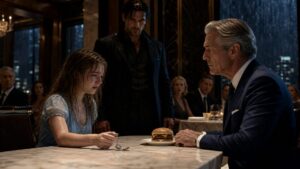
The violent autumn storm sweeping across Long Island Sound rattled the towering leaded glass windows of the grand dining hall, casting dark, watery shadows across thirty high-society guests seated beneath two-hundred-year-old crystal chandeliers. Tonight marked the silver anniversary of Vance Capital Management—a sprawling private equity and logistics behemoth controlling nine billion dollars in municipal municipal bonds, maritime shipping fleets, and offshore energy infrastructure. The air in the banquet hall smelled of roasted squab, vintage Bordeaux, beeswax candles, and the unmistakable, suffocating perfume of Greenwich old money: an expensive, armored veneer engineered to bury generational corruption beneath six layers of monogrammed Irish linen.
At the head of the banquet table sat Daniel Vance, forty-eight years old, looking every inch the ruthless corporate architect in a bespoke midnight-blue Brioni tuxedo. His salt-and-pepper hair was clipped with military precision, his cufflinks forged from ancient Roman gold coins. Beside him sat his wife, Claire, draped in an emerald silk evening gown that accentuated her pale, aristocratic posture. Her manicured fingers, glittering with ten-carat platinum diamond rings, laughed with orchestrated perfection at a state senator’s joke, but her eyes darted constantly toward the perimeter of the room like a trapped animal waiting for a snare to snap. Across from them stood Julian, Daniel’s elder brother, immaculate in a tailored charcoal-grey three-piece suit, sipping club soda with the detached, predatory calm of a grandmaster surveying a chessboard where every piece was already doomed.
And then there was Leo.
At twenty-four, Leo Vance was the conspicuous anomaly of the Vance dynasty. He sat at the far corner of the mahogany family table wearing dark denim, battered leather boots, and a heavy navy-blue merino wool crewneck sweater, his jaw clenched so hard the masseter muscles ached, his dark eyes burning with quiet, unadulterated contempt. While the rest of the room raised their crystal flutes to record-breaking quarterly yields and upcoming initial public offerings, Leo felt the cold, heavy weight of an antique iron object pressed against his ribs inside his jacket: a heavy, six-inch iron skeleton key delivered to his Manhattan loft three hours earlier inside an unsealed manila envelope.
Accompanying the key had been a single sentence typed on vintage onion-skin paper with a mechanical ribbon: The patriarch did not drown in Nantucket Sound. He is suffocating behind his own painted eyes.
Leo’s gaze drifted across the vast hall toward the arched double doors leading to the mansion’s private east wing. For five long years, the entire world—the press, the courts, Wall Street, and the extended family—had accepted the official narrative: that Arthur Vance, the tyrannical, untouchable founder of the firm, had perished when his sixty-foot sailing yacht broke apart during a surprise Category 3 hurricane off the shoals of Cape Cod. A closed-casket memorial service had been conducted at Trinity Church in Boston; black mourning flags had flown at half-mast above Vance Tower in Manhattan; and Daniel and Julian had smoothly assumed joint control of the family board.
“You haven’t touched your Dom Pérignon, Leo,” a low, cultured voice murmured directly beside his ear.
Leo turned his head slowly. Julian was standing just behind his chair, looking down with an expression of polite, fraternal concern that didn’t reach his cold grey eyes. The older man’s silver-rimmed spectacles caught the candlelight, obscuring his pupils in twin circles of white glare.
“I don’t have much of an appetite for funeral baked meats, Uncle Julian,” Leo replied, his voice laced with venomous irony. “Especially when the corpse seems to have left behind so many unpaid bills.”
Julian smiled faintly, his fingers resting lightly on Leo’s shoulder with practiced avuncular affection, yet his grip carried a subtle, warning pressure. “A cynic at twenty-four is a tragedy, my boy. Your father built this firm from the ashes of your grandfather’s financial recklessness. He saved this family from federal bankruptcy. Try to show some gratitude. Daniel has carried burdens and made sacrifices you cannot possibly fathom in your comfortable downtown studio.”
“Has he?” Leo challenged, his fingers deliberately sliding beneath his sweater to brush the cold iron key against his ribs. “Then why does Mother have Dr. Mercer deliver forty milligrams of intravenous lorazepam to the carriage house every Tuesday morning? Who are we drugging in this house, Julian? Which family friend is receiving forty milligrams of clinical sedatives every single week under an anonymous invoice?”
The polite smile on Julian’s face didn’t shatter—it crystallized into something razor-sharp, chilling, and ancient. He leaned down until his mouth was mere inches from Leo’s ear, his whisper completely swallowed by the sound of a guest clinking a silver spoon against a crystal flute to introduce the keynote toast.
“Curiosity in this family is an expensive, fatal hobby, Leo,” Julian murmured softly. “The last person who asked questions about the east wing ended up in an unmarked grave in New Bedford twenty-four years ago. Drink your champagne, smile for the Wall Street Journal photographers, and leave the ghosts where they belong. Some tombs are locked from the outside for a reason.”
Julian straightened his jacket, gave Leo a reassuring pat on the shoulder for the benefit of the watching guests, and glided back toward the head of the table.
Across the room, Daniel rose to deliver his address, clearing his throat beneath the applause. But as his father raised his crystal flute into the air, Leo noticed that Daniel’s right hand was trembling—a violent, rhythmic tremor that caused the golden champagne to spill over the crystal rim and stain the white linen. Daniel’s eyes didn’t look at the smiling faces of the board members; they were fixed in a daze of terror on the heavy oak doors of the private library at the end of the long gallery.
Leo pushed his chair back from the table. He didn’t say goodbye to his mother. He didn’t look at Julian. He slipped through the terrace French doors and stepped out into the freezing, rain-swept darkness of the courtyard, his boots crunching on the wet gravel as he headed toward the estate maintenance shed.
CHAPTER 2: THE WHISPERING GALLERY
The house was completely still, save for the rhythmic drumming of midnight rain against the slate shingles. In the east wing of the estate, the recessed halogen sconces had been dimmed to a pale, ghostly amber. Thick Persian runners muffled every footstep, but the air felt heavy, stagnant, smelling faintly of lemon wax, damp wool, and an underlying chemical sharpness that smelled unmistakably like pharmaceutical disinfectant.
Leo crept down the gallery in stocking feet, keeping his back pressed against the dark mahogany wainscoting. In his left hand he carried a small tactical flashlight; in his right, he gripped the heavy iron skeleton key he had received the night before.
Three hours earlier, from his vantage point behind the ornamental boxwoods in the courtyard, Leo had watched a horrifying ritual. He had seen his mother, Claire, walk through the back service entrance carrying a porcelain tray covered by a linen napkin. Behind her walked Dr. Mercer, carrying a black leather medical satchel. They had entered the private library, locked the double oak doors behind them, and remained inside for nearly forty minutes. When they emerged, Dr. Mercer was shaking his head, while Claire wiped her eyes with a lace handkerchief, hissing in an urgent, terrified whisper: “We cannot increase the dosage, Mercer! If his heart stops before the trust documents clear the probate court, the federal trustees will seize every dollar!”
Now, the library stood locked in darkness.
Leo approached the towering carved doors of the private library, his palm slick with cold perspiration. Every shadow cast by the wall sconces seemed to stretch like a grasping hand. He inserted the heavy iron key into the antique brass escutcheon. The tumblers shifted with a heavy, oiled click that echoed down the empty corridor like a gunshot in an empty cathedral.
Leo held his breath, waiting for security guards or guard dogs to swarm the hallway. Nothing stirred.
He pushed the heavy oak door open and slipped inside, closing it silently behind him.
The library was an immense, two-story room paneled in rich, polished Honduran mahogany. Floor-to-ceiling bookshelves lined with thousands of leather-bound volumes reached toward a coffered ceiling twenty feet above. In the center of the room stood an eight-foot executive desk carved from a single slab of black walnut, illuminated by the pale moonlight filtering through the clerestory windows.
Leo clicked on his flashlight, sweeping the narrow beam across the room.
Everything appeared undisturbed. The leather armchairs were pristine; the crystal decanter of twenty-year-old scotch sat untouched; the brass reading lamps were dark. But as Leo moved toward the central wall, his beam locked onto the dominant feature of the entire estate: a colossal oil portrait framed in heavy, ornate gilded timber.
The portrait depicted Arthur Vance at sixty, seated in a high-backed leather throne, wearing a tailored charcoal suit, his cold grey eyes staring out with tyrannical superiority, a heavy gold signet ring on his finger, his hand resting on a brass globe.
Leo walked up to the portrait. He shone the flashlight along the gilded frame.
There, embedded in the dark mahogany paneling directly beneath the lower left corner of the heavy wooden frame, was a faint scratch—fresh, unvarnished wood exposed by a recent mechanical impact. And as Leo leaned in closer, pressing his ear against the cold canvas of his grandfather’s painted chest, his blood turned to ice.
From deep inside the wall, muffled by layers of wood and plaster, came a faint, rhythmic sound.
A dull, metallic rattle. Followed by the wet, agonizing rasp of human breathing.
Leo stumbled backward, knocking against an antique side table. Someone was alive behind that canvas.
Footsteps echoed in the corridor outside. Heavy, purposeful steps approaching the library doors.
Leo sprinted across the Persian rug, slipped behind the heavy velvet window drapes near the terrace, and killed his flashlight just as the library door swung open.
Daniel and Julian entered, their faces illuminated by the green glow of a laptop screen.
“We have three days, Julian,” Daniel hissed, his voice raw with panic as he paced in front of the portrait. “The Securities and Exchange Commission has subpoenaed the original voting proxies. If Arthur doesn’t sign the power of attorney transfer by Friday morning, they will unseal the offshore accounts in Zurich. Everything goes down. The firm, the house, our names!”
“He will sign, Daniel,” Julian replied, his voice chillingly calm as he stood by the desk. “Claire will withhold his water tomorrow until the tremor stops. A dying man signs whatever you put in front of him. Stop losing your nerve. We’ve kept the old monster buried for five years. Three more days won’t break us.”
Leo huddled in the shadows behind the drapes, his fingernails digging into his palms until blood welled, his mind reeling with the monstrous reality.
His grandfather was not dead. He was being starved and tortured inside the walls of his own home.
CHAPTER 3: THE VAULT BEHIND THE CANVAS
The grandfather clock in the corner of the library chimed a single, hollow stroke, signaling the quarter-hour. Warm ambient light from the brass desk lamps cast deep amber shadows across the rich, polished mahogany bookshelves. Rain lashed the leaded glass windows, but inside the library, the air was suffocating, heavy with the impending doom of a dynastic implosion.
Standing near the massive executive desk was Daniel Vance, his tie loosened, his forehead beaded with a cold sheen of perspiration. Beside him stood Julian, dressed in his tailored grey three-piece suit, hands tucked into his trouser pockets, watching the mahogany door with the cold, patient stillness of an executioner. Claire sat in a wingback chair near the fireplace, clutching a crystal tumbler of straight vodka, her diamond rings clinking against the glass.
Suddenly, the library doors were kicked open with a thunderous crash that splintered the antique brass latch.
Daniel jerked around in alarm, knocking over a leather pen holder. “What the hell—?!”
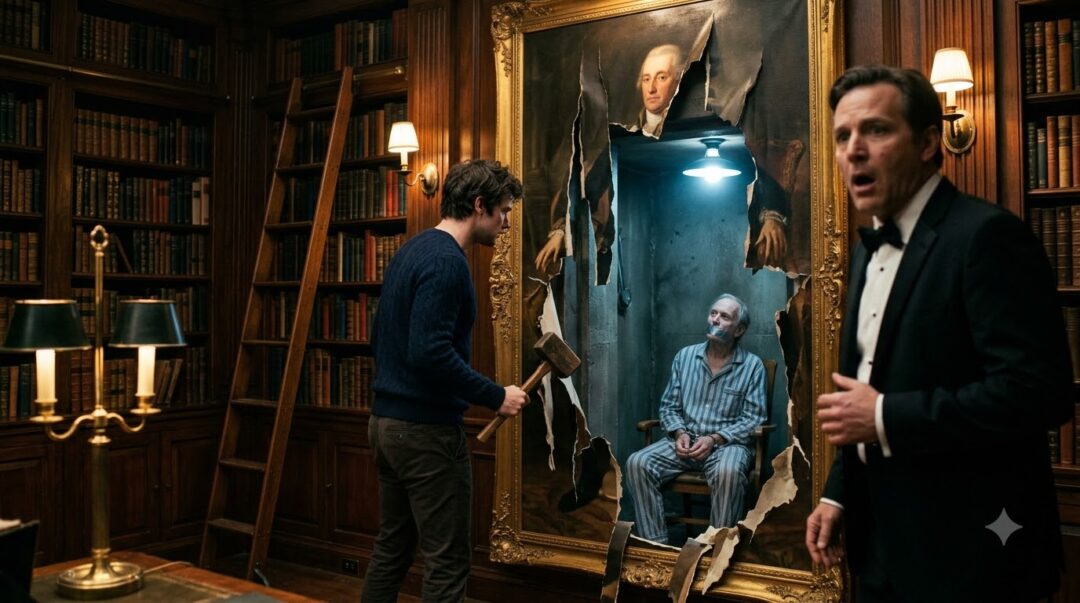
Charging into the stately library was Leo. He was breathing heavily, his navy blue sweater damp from the rain, his dark jeans spattered with mud. But what froze the room into absolute terror was what he held in both hands: a massive, forty-inch wooden framing mallet with a heavy hickory head, the kind used to drive timber spikes.
“Leo!” Daniel shouted, his voice cracking with panic as he stepped forward, his arms raised in a futile defensive gesture. “Leo, put that down! Have you lost your mind?!”
Leo didn’t speak. His dark eyes burned with an unhinged, lethal fury. He didn’t look at his father. He didn’t look at Julian. He charged straight toward the central wall, his boots pounding against the Persian rug, locking his vision onto the massive oil portrait of Arthur Vance.
With a guttural roar that tore from his chest, Leo swung the heavy wooden mallet with full, devastating force.
CRACK!
The heavy wooden head slammed into the lower left quadrant of the painting. The gilded frame splintered with a sound like a rifle shot. Gesso, flakes of antique oil paint, and torn linen fibers exploded into the air under the violent impact.
“Leo! Stop!” Claire screamed, jumping to her feet, her vodka glass shattering onto the floor. “For the love of God, Leo, stop!”
Leo didn’t hesitate. He ripped the mallet back and swung a second time, then a third, driving the hickory head repeatedly into the center of the canvas. The painted face of the patriarch buckled and punctured. With a violent tearing sound, the canvas ripped vertically from throat to hem, falling away in ragged, painted strips.
The family stood paralyzed in stunned, horrified silence.
Behind the torn canvas, where solid lath and plaster should have been, lay a concealed, heavy double-door panel constructed of reinforced dark oak, secured by an industrial magnetic keypad lock.
“Don’t open it,” Claire whispered off-camera, her hands clutching her throat, tears streaming down her terrified face. “Daniel… please… don’t open it…”
Leo ignored her. He took the claw of the mallet, jammed it into the gap between the oak doors, and levered his entire body weight against the wood. With a shrieking groan of stressed steel and tearing screws, the magnetic latch snapped.
The heavy wooden door creaked open on oiled hinges, revealing a pitch-black, windowless vault concealed inside the estate’s structural foundation. Warm library light spilled across the threshold, cutting through the dense, stale darkness within.
Behind Leo, Daniel, Julian, and Claire stood frozen, their faces pale as death.
Inside the hidden room, a single, dim atmospheric spotlight flickered to life on an automated motion sensor.
Sitting in the center of the concrete room, bound to a heavy wooden armchair, was an elderly man. He wore faded blue-and-white striped flannel pajamas, stained and frayed at the cuffs. His wrists were secured behind the chair with heavy stainless-steel handcuffs. His ankles were bound with industrial nylon zip-ties. And stretched tightly across his lower face, sealing his mouth from ear to ear, was a wide strip of silver duct tape.
Arthur Vance was emaciated, his skin the color of aged parchment, his white hair wild and matted. He was trembling violently, his sunken chest heaving in rapid, shallow gasps as he struggled to breathe through his nose, his cloudy grey eyes blinking in agony against the sudden glare of the light.
A low, ominous drone seemed to vibrate through the floorboards.
Leo stepped back, lowering the mallet, his chest heaving with horror.
Standing behind him, Daniel’s face froze in an expression of pure, unadulterated disbelief and cosmic terror. His eyes went wide, his jaw slacked open, all corporate arrogance shattered into dust. The blurred outlines of Claire and Julian stood behind him, equally paralyzed by the resurrection of their darkest secret.
Daniel’s lower lip trembled. He took a single, faltering step toward the open vault.
“Dad…?” Daniel whispered, his voice cracking into the suffocating silence.
Arthur Vance’s eyes slowly rolled up, locking onto his son. Beneath the silver duct tape, a muffled, agonizing groan tore from the old man’s throat.
CHAPTER 4: THE QUARANTINE OF VANCE MANOR
The heavy, suffocating scent of rubbing alcohol, stale human sweat, damp concrete, and twenty years of accumulated family betrayal hung thick in the cold air of the windowless vault. Leo knelt on the freezing stone floor beside the heavy wooden armchair, holding a pair of heavy industrial shears he had taken from the maintenance closet. His hands shook with such violent adrenaline that the steel blades chattered loudly against the reinforced nylon zip-ties binding the old man’s legs.
“Hold still, Grandfather,” Leo whispered, his voice trembling with a nauseating mixture of profound pity and visceral horror.
With two sharp, metallic snaps, the heavy zip-ties severed. Arthur Vance’s swollen, bruised ankles fell limp against the wooden rungs of the chair, his skin discolored in mottled shades of purple and slate-grey from years of restricted circulation. Next, Leo reached up to the old man’s face. His fingers were gentle as he caught the edge of the silver duct tape, carefully peeling it back from the cracked, bleeding skin of the patriarch’s mouth.
Arthur gasped—a raw, agonized sound that rattled deep within his bronchial tubes, sounding like dry autumn leaves being crushed beneath a heavy iron boot. He slumped forward over his lap, coughing violently, spit, phlegm, and bloody saliva dripping from his chin onto the stained fabric of his blue-and-white striped flannel pajamas.
Outside the threshold of the shattered portrait, in the warm, bright illumination of the library, absolute chaos reigned.
Claire had collapsed onto the velvet sofa in a state of unmitigated psychological shock. Her emerald silk dress was crumpled, her face buried deep in her hands, her ten-carat diamond rings tangled in her disheveled hair as she wept with jagged, breathless sobs that bordered on complete hysteria. Daniel stood with his palms pressed flat against the cold Verde antique marble mantelpiece, his back turned to the room, his forehead resting against the stone, his breath coming in short, ragged wheezes like a drowning man.
Julian, however, had already moved into cold, tactical crisis management.
Standing by the leaded bay windows overlooking the dark estate grounds, Julian spoke in a rapid, hushed, lethal cadence into his encrypted satellite phone. “I want the main perimeter gates locked down immediately. Cut the fiber-optic internet lines at the junction box and activate the signal jammers across the two-mile perimeter. If any domestic staff or kitchen workers attempt to leave their quarters tonight, detain them in the carriage house tack room. We have an acute, high-level psychiatric emergency involving a senior principal of the firm. Under no circumstances does anyone dial 911. If a single emergency vehicle approaches the gatehouse, turn them away at gunpoint.”
Leo stood up from the vault floor and stepped out into the library, his dark eyes blazing with incandescent fury. “You’re locking down the estate? Have you lost your mind, Julian? Look at him! He’s severely malnourished, he’s dehydrated, his wrists are lacerated to the bone from those steel cuffs! He needs an intensive care unit, not a private security blockade!”
Julian clicked the call end button, sliding the phone smoothly into the interior pocket of his tailored charcoal suit. He turned toward Leo, his features setting into a mask of chilling, patrician detachment that was far more terrifying than Daniel’s panic.
“If an ambulance enters those gates, Leo, the Connecticut State Police follow directly behind,” Julian said, his voice dropping into that measured, clinical register he used when executing corporate bankruptcies. “If the police cross this threshold, your father is arrested on federal charges of kidnapping, false imprisonment, and grand conspiracy. Your mother is arrested as an accessory before the fact. Vance Capital’s commercial paper collapses to zero within thirty seconds of market open tomorrow, and every bank account, trust fund, and physical asset this family owns will be frozen by the Department of Justice. Is that what you want, Leo? To spend the rest of your youth visiting your parents through bulletproof plexiglass in a federal correctional facility in Danbury?”
“They locked their own father in a concrete cage!” Leo shouted, his voice echoing violently off the high mahogany bookshelves. “They faked his death and chained him to a chair like an animal!”
“We didn’t lock him up to steal his money, Leo!” Daniel suddenly roared, spinning around from the fireplace. His face was blotched in violent crimson patches, his eyes wild, bloodshot, and flooded with tears. “We didn’t do this for the shares! We did it to keep you alive!”
The cavernous library fell into an instantaneous, dead silence. Even Claire’s breathless sobbing choked off mid-gasp.
Leo stared at his father, the breath freezing in his chest. “What did you just say?”
Daniel walked toward the vault with heavy, faltering steps, pointing a trembling, accusatory finger into the shadows where the emaciated old man sat trembling in his chair.
“Look at him, Leo! Look at the great, untouchable Arthur Vance!” Daniel let out a bitter, weeping laugh that bordered on complete madness. “Five years ago, Arthur didn’t drown on that boat. Arthur was preparing to flee the country because the Department of Justice had uncovered his offshore bribery network. But before he fled to Zurich, Arthur attempted to execute one final, monstrous purge. He drafted an irrevocable amendment to the family trust that stripped you of every dollar, dissolved your legal identity, and authorized private sanitarium goons to commit you to a locked psychiatric ward in Geneva under an assumed name!”
Leo shook his head, backing away, his chest heaving with confusion. “Why? Why would he do that to his own grandson? What did I ever do to him?!”
A dry, rattling chuckle—a sound like dry bone scraping on concrete—echoed from the doorway of the vault.
Arthur Vance was standing upright, supporting his frail, skeletal body by clutching the splintered oak doorframe with his bruised, trembling hands. His cloudy grey eyes were fixed squarely on Leo, burning with an unholy, ancient fire of unrepentant malice.
“Tell the boy, Daniel,” Arthur wheezed, fresh blood flecking his cracked lips as a wicked, toothless grin spread across his face. “Tell him who his mother was. Tell him why you spent twenty-four years lying to your own flesh and blood about the car wreck on Route 1.”
CHAPTER 5: SINS OF THE PATRIARCH
The slate-grey waters of Long Island Sound churned violently beneath a heavy, leaden November sky. Twenty miles east of the quarantined Greenwich estate, Leo stood inside a decaying, cedar-shingle boathouse perched precariously on the rocky bluffs of Guilford. The structure had belonged to Arthur Vance in the late 1990s, purchased under an anonymous offshore holding company to serve as a private, untraceable sanctuary during hostile corporate takeovers. The air inside was freezing, smelling of stagnant salt brine, creosote, rotting lobster netting, and ancient cedar damp.
Clutched tightly in Leo’s hand was a tarnished brass safe-deposit key that Arthur had sewn into the interior lining of his flannel pajamas—a key the old man had surrendered only after Leo had threatened to leave him alone in the estate library without medical attention while Daniel and Claire argued in the drawing room.
In the center of the warped plank floor lay a heavy iron storm hatch concealed beneath a rotted canvas tarpaulin.
Leo kicked the tarp aside, unlocked the corroded brass padlock, and hauled the heavy iron grating upward with both hands. A steep flight of concrete stairs descended into a dry, subterranean bunker built directly into the bedrock beneath the high-tide line.
Leo switched on his tactical flashlight and stepped down into the cold subterranean vault.
Resting on a stainless-steel workbench against the far wall sat a heavy, fireproof green-leather document lockbox, bearing the embossed gold seal of Arthur Vance’s personal Boston legal counsel.
Leo picked up a heavy rusted crowbar from the floor, wedged the beveled edge beneath the brass latch, and put his entire weight into the lever. With a loud, echoing snap that rang off the stone walls, the locking mechanism sheared away.
Leo pulled open the heavy steel lid. Inside lay three thick, legal-sized manila dossiers, sealed with crimson wax.
With trembling fingers, Leo ripped open the first dossier. His breath hitched in his throat as he pulled out a stack of yellowed glossy photographs and private investigative surveillance logs dated May 14, 2001.
The photographs captured a young woman in her early twenties, radiant and full of life, with long wavy chestnut hair, warm hazel eyes, and an effortless, luminous smile. She was seated on a wooden bench in Wooster Square Park in New Haven, laughing as she held an eleven-month-old infant wrapped in a powder-blue fleece blanket.
Beneath the photographs lay a signed, notarized memorandum typed on Arthur Vance’s executive stationery, accompanied by a carbon copy of a cashier’s check for five hundred thousand dollars drawn on an account in Nassau: Payee: Dr. Harold Finch, Private Clinic, Stamford. Service: Immediate relocation and permanent nondisclosure regarding Elena Rossi.
Leo’s chest tightened so violently that he could barely draw breath.
Elena Rossi was not an anonymous stranger. She was Arthur Vance’s personal executive assistant in the late 1990s—a brilliant, working-class graduate student from New Haven. She had fallen deeply in love with Daniel Vance when Daniel was a young, terrified vice president living in his father’s suffocating shadow. When Elena became pregnant with Leo, Daniel had defied the family for the first time in his life, begging Arthur for his blessing to marry her and step away from the corporate empire.
Arthur had viewed her pregnancy as a hostile invasion. To the tyrannical patriarch, the Vance bloodline was sacred corporate currency, meant to be merged with railroad or banking dynasties; a working-class Italian-American secretary was an intolerable contamination of the family brand.
Leo opened the second dossier. A wave of cold, nauseating horror washed over him.
It was an unredacted, certified accident investigation report from the Connecticut State Police, dated October 18, 2002. At 11:45 PM, Elena Rossi’s compact sedan had been struck broadside on Route 1 outside Greenwich by a heavy commercial flatbed truck. The truck driver had abandoned the running vehicle and vanished into the woods on foot; the flatbed had been reported stolen from a Vance Logistics shipping depot two hours before the collision. Elena Rossi had died of traumatic head injuries before paramedics arrived at the scene.
The one-year-old child in the rear child safety seat—Leo—had survived miraculously with nothing more than minor abrasions.
The realization struck Leo like a physical blow to the sternum. Daniel had suspected his father’s direct hand in the murder from the very night it happened. But paralyzed by cowardice, financially dependent, and terrorized by Arthur’s vast political influence, Daniel had made a monstrous, Faustian bargain: he agreed to marry Claire Sterling, claim Leo as his adopted son with a fabricated maternal backstory, and bury the truth forever.
Until five years ago.
Five years ago, Daniel had discovered the audio tape in a Swiss safety deposit box—a recorded conversation proving Arthur had paid the logistics manager two hundred thousand dollars to stage the “accident” on Route 1.
Daniel hadn’t faked Arthur’s death to steal the company. Daniel had abducted his own father, chained him behind the portrait of his own monstrous ego, and kept him alive in darkness as an act of agonizing, private retribution for the murder of the only woman Daniel had ever loved.
“Quite an educational reading session, isn’t it, Leo?”
A soft, cultured, terrifyingly familiar voice echoed down the concrete staircase.
Leo whipped around, shining his tactical flashlight beam toward the stairs.
Standing at the base of the concrete steps was Julian Vance. He was still wearing his impeccably tailored charcoal-grey three-piece suit, an elegant black cashmere overcoat draped across his broad shoulders. But in his right hand, held with casual, practiced familiarity, was a sleek black Glock 19 semi-automatic pistol fitted with an elongated cylindrical sound suppressor.
Julian smiled—a serene, gentle expression of absolute, unadulterated sociopathy.
“You really are your father’s son, Leo,” Julian murmured smoothly, taking a slow step forward. “Endlessly sentimental. Constantly searching for truth in damp basements. You found the dossiers. That saves me the tedious trouble of having my men tear up the floorboards.”
CHAPTER 6: THE ARCHITECT OF SHADOWS
The fifty-fourth-floor executive boardroom of Vance Tower offered a breathtaking view of the Manhattan skyline bathed in early morning winter sunlight. The room was the nerve center of nine billion dollars in global capital: an immense forty-foot table of polished white quartz, surrounding by twenty black leather executive chairs occupied by senior directors, institutional investment managers, and SEC legal observers.
At the head of the table stood Julian Vance. He was magnificent. Dressed in a brand-new charcoal suit with a silver silk tie, his hair brushed to perfection, he projected the supreme, unshakeable confidence of an emperor assuming his rightful crown.
“Ladies and gentlemen of the board,” Julian announced, his deep baritone commanding absolute silence. “Due to the unfortunate, acute medical incapacitation of my brother Daniel Vance—who suffered a catastrophic nervous breakdown at the Greenwich estate on Tuesday evening—I am exercising emergency proxy authority under Article Four of the Vance Trust charter. Today, we vote to permanently transfer voting control of Vance Capital to Julian Vance Holdings.”
He picked up a gold fountain pen, resting the nib on the unanimous consent decree.
The heavy double glass doors of the boardroom chimed softly as they slid open.
Julian didn’t look up. “We are in executive session. Security, clear the lobby.”
“Security has been relieved, Mr. Vance,” a cold, authoritative voice rang out across the quartz table.
Julian froze.
Walking into the boardroom was Special Agent Thomas Burke of the Federal Bureau of Investigation, followed by six armed agents in blue tactical jackets. And walking between them was Leo Vance, dressed in a sharp dark suit, his chin held high, holding a heavy digital audio recorder.
Beside Leo walked Daniel Vance, flanked by two uniformed Connecticut State Police troopers. Daniel looked broken, his face hollowed by grief and shame, but his eyes were clear, completely devoid of fear.
Julian slowly set down his gold pen, his smile hardening into a razor-thin sneer. “Daniel. How tragic. Escaping from private psychiatric care to disrupt a corporate vote. Agent, this man is mentally incompetent.”
“He’s competent enough to sign a federal cooperation agreement, Julian,” Agent Burke replied, stepping to the center of the quartz table and laying down an arrest warrant bearing the seal of the United States District Court for the Southern District of New York.
Agent Burke pressed play on the digital recorder.
Julian’s cultured, arrogant voice echoed through the boardroom speakers with horrifying clarity:
‘You really are your father’s son, Leo… You found the papers… Did you honestly think your father had the brains to plan that kidnapping five years ago? Daniel is a coward. I was the one who gave Daniel the blueprints for the hidden room behind the portrait. I was the one who supplied Dr. Mercer with the sedatives. And when the time was right, I was the one who mailed you that iron key and tipped you off about the portrait.’
On the recording, Leo’s voice asked: ‘Why? Why destroy your own brother?!’
Julian’s recorded laugh was chilling: ‘Because Daniel wouldn’t liquidate the trust, and Arthur wouldn’t die. By having you smash that canvas, Leo, I destroyed both of them in a single stroke. Daniel goes to prison for kidnapping Arthur. Arthur dies of exposure in that vault. And I inherit the entire nine-billion-dollar empire as the sole surviving, untainted heir.’
The recording clicked off.
The board members gasped in collective horror. Senior directors pushed their chairs back in disgust, recoiling from Julian as if he were a leper.
Julian didn’t shout. He didn’t plead. His grey eyes narrowed into cold, dead beads of hatred. He looked at Leo, then at Daniel, a slow, venomous smile spreading across his pale lips.
“You fools,” Julian whispered, his voice trembling with quiet rage. “You think you’ve won? You’ve destroyed the Vance name! Every newspaper in the world will carry this scandal tomorrow morning! You’ll be paupers by Friday!”
“The Vance name was poisoned twenty-five years ago when my mother was murdered on Route 1,” Leo said, walking toward his uncle until they were separated by only a foot of white quartz. “Today, we’re just burying the rot.”
Agent Burke stepped forward, twisting Julian’s arms behind his back. The heavy steel handcuffs ratcheted tight with three sharp clicks.
“Julian Vance, you are under arrest for conspiracy to commit murder, wire fraud, extortion, and obstruction of justice,” Agent Burke declared, reading him his rights as two agents hauled him toward the doors.
As Julian was dragged out of the boardroom, Daniel walked up to Leo. The father looked at the son he had lied to for twenty-four years, tears welling in his red-rimmed eyes.
“I’m sorry, Leo,” Daniel choked out, his voice cracking with unbearable remorse. “I was terrified of him. I wanted to protect you from the truth.”
Leo looked at his father. The rage that had fueled him for days had burned away, replaced by the profound, quiet weight of a man who had finally reclaimed his identity.
“You should have gone to the police twenty-four years ago, Dad,” Leo said softly, his voice firm and sorrowful. “You have to pay for what you did to Arthur. But when you get out… I’ll be waiting at the gates.”
Daniel nodded through his tears, bowing his head as the state troopers placed gentle hands on his shoulders, escorting him toward the elevator.
Twenty minutes later, Leo walked out of the revolving glass doors of Vance Tower onto Park Avenue.
The winter morning was brilliant, cold, and clear. Sunlight reflected off the glass canyons of Manhattan, while yellow cabs surged through the bustling avenues. Leo pulled the collar of his coat tight against the brisk wind, took a deep, clean breath of the city air, and looked up at the endless blue sky above.
For the first time in his life, he didn’t belong to a portrait.
He belonged to the truth.