They Tried to Drive His Dog Off the Farm, Then Learned Who Controlled the Only Water Line
Chapter 1: The Morning Patricia Ordered Ranger Off the Lane
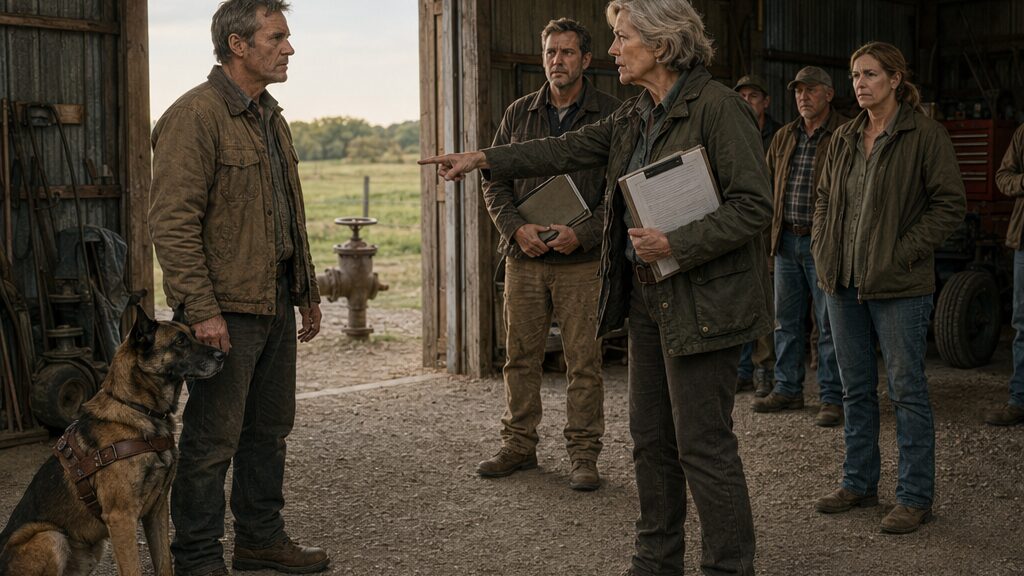
Patricia Hall pointed at Ranger before William Carter had both boots out of his truck.
“That dog does not come past this line.”
Her finger was aimed at the packed gravel between the cooperative equipment shed and the drainage ditch, as if there were an invisible boundary only she could see. Ranger stood beside William’s door, his worn leather harness snug across his chest, his head level and still.
Seven people had gathered for the Monday maintenance meeting. Nobody spoke.
William closed the truck door carefully.
“He’s working.”
“I know what you call him.” Patricia held a clipboard against her white work shirt. “The board adopted the animal restriction Friday. No unapproved animals in cooperative work areas.”
Ranger looked toward William when his breathing changed. William touched two fingers against the dog’s shoulder.
The pressure behind his ribs eased by a degree.
Across the lane, the equipment shed doors stood open. Coiled hose, pipe fittings, shovels, and a grease-stained workbench filled the dim interior. Beyond it, down the slope of William’s lower pasture, the top of an old iron water valve showed above the grass.
William had passed that valve every day for years without giving it much thought.
Patricia stepped closer.
“You can leave him in the truck.”
“No.”
The single word made several people look down.
Anna Mitchell stood near a stack of irrigation pipe. Her orchard began on the other side of the lower lane. She met William’s eyes for half a second, then busied herself with her gloves.
Patricia exhaled through her nose.
“This isn’t personal.”
William reached into the cab and pulled a folded card from the center console. He handed it to her.
Patricia glanced at it.
Ranger’s service documentation had been checked by the veterinarian, by the county animal-control office, and once by a deputy after a complaint two years earlier. William hated producing it. Every time he did, the card felt less like proof and more like a request for permission to need what he needed.
“He is a trained psychiatric service dog,” William said.
Patricia handed the card back.
“The cooperative rule is about safety and liability.”
“He’s been in this shed for four years.”
“And we’ve had three animal incidents this spring.”
“None were Ranger.”
A board member shifted beside the workbench.
Patricia’s jaw tightened.
William could see what she was protecting. Not merely the rule. The room.
She had run these meetings for six years. People brought her drainage complaints, road washouts, pump failures, arguments over fence posts, invoices nobody wanted to pay. Patricia had made herself into the person who always knew what happened next.
Backing down in front of everyone would cost her something.
William understood that.
It did not make her right.
“If I make one exception in the middle of a meeting,” Patricia said, “then every owner with a farm dog, hunting dog, or pet will tell me theirs is special.”
“He isn’t a pet.”
“Then submit an accommodation request.”
“I did. Last year.”
“That was before the new rule.”
Ranger leaned gently against William’s leg.
The smell of hot dust and machine oil drifted from the shed.
Scott Clark, the cooperative’s maintenance coordinator, emerged from behind a tractor tire with a wrench in one hand. He looked from William to Patricia.
“We doing the pump schedule or not?”
“We will,” Patricia said. “After this is resolved.”
William almost laughed.
Resolved meant he obeyed.
Patricia lifted a sheet from her clipboard.
“If you continue bringing the dog into restricted cooperative areas, the board can assess a daily compliance fee.”
“How much?”
“Seventy-five dollars.”
Someone behind William muttered something too low to make out.
Patricia continued.
“And if the violation remains unresolved, your non-emergency road-maintenance privileges can be suspended.”
That landed harder than the money.
The cooperative maintained the gravel lane used by William’s hay truck and livestock trailer. Without scheduled grading, spring ruts could turn the lower section into axle-deep mud. William owned his farm, but like everyone else along the ridge, he depended on shared arrangements that had accumulated over decades.
Patricia knew exactly where to press.
William looked around the group.
Nobody defended her.
Nobody defended him either.
Anna kept staring at her gloves.
Something old and mean shifted inside him.
After his farm accident, silence had been useful. Silence got him through crowded waiting rooms. Silence stopped strangers from asking why his hands sometimes shook when metal slammed unexpectedly. Silence kept him from explaining why Ranger slept beside the bedroom door.
But silence could harden.
He knew that.
He chose it anyway.
William folded Ranger’s documentation and put it back in his pocket.
“I’ll leave the meeting.”
Patricia’s shoulders loosened, just slightly.
“But I’m not leaving him in the truck.”
“That’s your choice.”
“Yes,” William said. “It is.”
He turned.
Ranger moved with him immediately.
At the edge of the shed, William stopped.
Through the open doors, sunlight caught the rusted wheel of the iron valve in the lower pasture. It was half swallowed by tall grass, its red paint long gone except for a few flakes under the rim.
Scott noticed where he was looking.
“You got a leak down there?” he asked.
William shook his head.
“Just thinking.”
Patricia called the meeting to order before he reached his truck.
He heard her voice behind him, firm and efficient, moving on to ditch clearing and pump inspection as though nothing important had happened.
That bothered him more than the fine.
At home, William made coffee and left it untouched on the kitchen table.
Ranger settled near his chair.
William opened the old metal document box he kept beneath the pantry shelf. Most of it was useless now: fertilizer receipts, equipment warranties, tax maps, handwritten notes from his father.
Near the bottom lay a thin folder labeled with the cooperative’s old name.
William pulled it free.
A yellowed receipt slipped onto the table.
He almost pushed it aside.
Then he saw his own signature.
Not from years ago.
From the previous January.
Beneath it was a short line identifying an annual payment from the cooperative for access across the lower pasture.
William read it twice.
Then he found another receipt.
And another.
One for every year he had owned the farm.
Ranger lifted his head.
William spread the papers across the table.
For the first time that morning, Patricia’s threat was no longer the thing occupying his mind.
The question was simpler.
What, exactly, had the cooperative been paying him to renew?
Chapter 2: The Strip of Ground Nobody Thought Mattered
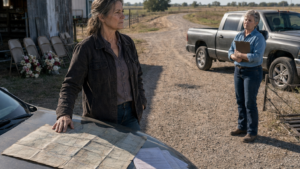
The line on the old plat map ended at William’s fence.
He leaned closer.
That could not be right.
A blue pencil mark traced the cooperative water line down from the pump station, along the shared road, then toward his lower pasture. At his northern boundary, the recorded line stopped.
But William knew the pipe did not.
He had watched Scott dig it up after a freeze six winters earlier.
It crossed nearly four hundred yards of William’s ground before continuing toward Anna Mitchell’s orchard.
William flattened the brittle paper with both palms.
Ranger lay beneath the kitchen window, watching him.
The annual receipts sat in a neat stack beside the map.
William found his deed next.
The legal description was dense, full of bearings and monuments that meant little until he matched them to the county plat. One narrow strip along the lower pasture had been reserved for temporary agricultural and utility access when the neighboring farms first organized their cooperative.
Temporary.
Not permanent.
He read that word three times.
By noon he was walking the pasture.
The grass along the lower strip grew thick around his boots. Ranger moved several feet ahead, then stopped where the old iron valve rose beside a weathered fence post.
William knelt.
Dirt packed the base. Rust covered the wheel.
He brushed away dead grass until the pipe housing was visible.
Years earlier, his father had told him not to bury that valve.
“Somebody always needs to find water in a hurry.”
William had assumed it belonged to the cooperative.
Now he put both hands on the wheel and pulled.
It resisted.
He shifted his weight and tried again.
The metal gave with a low groan.
Ranger’s ears rose.
William turned the wheel barely an inch, then returned it to its original position.
Water moved somewhere beneath his boots with a faint vibration.
The valve was real.
So was the line.
By two o’clock, William was at the county records office with the deed, the plat, and two annual receipts in a manila folder.
The clerk behind the counter listened without much reaction.
“I’m not asking what I can shut off,” William said. “I’m asking what they actually have recorded.”
“That’s a better question.”
She searched parcel records, scanned old filings, and disappeared into a back room.
William waited in a plastic chair.
Ranger lay beneath his knees.
A copy machine hummed somewhere behind the wall.
William felt foolish.
He imagined Patricia discovering that he had spent an afternoon chasing an old wording error. Maybe the cooperative had a permanent easement filed under an earlier parcel number. Maybe the receipts covered mowing or inspection. Maybe he was doing exactly what he hated—looking for a technicality because somebody had embarrassed him.
The clerk returned carrying three documents.
“I found the road easement,” she said. “Permanent, recorded.”
William nodded.
“And the water?”
She shook her head.
“I found permission agreements.”
“Annual?”
“Looks that way.”
She placed the oldest one in front of him.
The agreement predated William’s ownership. His father’s name appeared near the bottom.
It granted the cooperative permission to enter a defined corridor for inspection, repair, and maintenance of water infrastructure. Renewal was required each calendar year.
William looked at the filing date.
“Why would they do it this way?”
The clerk shrugged.
“Could’ve been temporary when they built it. Could’ve been nobody wanted to pay for a permanent easement. Could’ve been neighbors trusting neighbors.”
“And there’s nothing later?”
“Nothing I can find that converts it.”
William hesitated.
“What about communications?”
The clerk searched again.
That took longer.
A later amendment allowed conduit to be placed in the same corridor, provided it remained subject to the original access terms.
William sat back.
The room suddenly felt too small.
The clerk studied him.
“You having a dispute?”
“Maybe.”
“Then don’t assume these papers tell you what you’re entitled to do. They tell you what’s recorded. Those are different things.”
William appreciated that.
It was the first sensible sentence anyone had given him all day.
“I’m not planning to touch anything.”
“Good.”
She photocopied the filings.
Before leaving, William asked one more question.
“When does the current permission expire?”
The clerk checked the newest form.
“Last day of the month.”
William looked at the wall calendar.
Eighteen days.
Back at the farm, he laid the copies beside the old receipts.
Eighteen days.
For years, he had signed the renewal without reading it closely. Scott usually brought it by with the winter maintenance schedule. William signed, Scott took it back, and life continued.
The cooperative had not hidden the paperwork from him.
William had hidden its meaning from himself by assuming it did not matter.
That realization took some of the pleasure out of his discovery.
He had leverage.
But only because everyone—including him—had treated the arrangement as routine.
Ranger nudged his knee.
William scratched behind his ear.
“You know what I hate?”
Ranger stared at him.
“I hate that she made me want this to matter.”
A truck slowed outside.
William looked through the window.
It was Anna’s orchard pickup.
For a moment he thought she might turn in.
She did not.
She drove past.
The silence from Monday came back with uncomfortable clarity.
William returned to the table.
At five twenty, someone knocked on his front door.
A cooperative board member stood outside with an envelope.
“Patricia asked me to deliver this.”
William took it.
The board member glanced at Ranger behind him but said nothing.
William opened the envelope after the truck left.
The notice confirmed that his animal violation remained unresolved.
Beginning Wednesday morning, the daily fee would apply.
It also warned that continued noncompliance could affect optional cooperative services.
William read the notice once.
Then he placed it beside the annual access agreement.
Two pieces of paper.
One told him what the cooperative believed it could take from him.
The other told him what it needed from him in eighteen days.
He could have called Patricia that evening.
He could have told her exactly what he had found.
Instead, William folded both documents and put them back into the folder.
For the first time since the meeting, he knew something she did not.
And he decided to let Wednesday arrive before he said a word.
Chapter 3: One Question Changed the Whole Meeting
Patricia had written William’s name on the whiteboard before he arrived.
Beside it were three words:
ACCESS PRIVILEGE SUSPENSION.
William stopped just inside the equipment shed.
Ranger stopped with him.
Every folding chair was occupied.
The cooperative rarely drew more than eight people unless a road washed out or somebody wanted money spent. That evening there were nearly twenty.
Patricia stood at the workbench with her clipboard.
Her eyes moved immediately to Ranger.
“You were informed of the restriction.”
William took an empty chair near the open doors.
“I was.”
“And you brought him anyway.”
“Yes.”
A murmur moved through the shed.
Patricia waited for him to explain.
William did not.
The afternoon heat still clung to the metal roof. Beyond the doors, the lower pasture stretched toward the tree line. The old valve stood in the grass where the sinking sun caught the rim of its wheel.
Scott leaned against a cabinet near the back.
Anna sat two chairs away from William.
She gave him a small nod this time.
It was not support.
But it was not nothing.
Patricia called the meeting to order.
She moved quickly through road grading, culvert repairs, and a fuel invoice. Then she turned to William.
“The board has attempted to resolve this privately.”
William almost objected to the word privately, remembering Monday’s audience.
He let it pass.
“The animal restriction exists because the cooperative’s insurer identified uncontrolled animals in work zones as a liability exposure,” Patricia continued. “We cannot function if every member decides which rules apply to them.”
William raised one hand.
Patricia paused.
“Ranger is not an uncontrolled animal.”
“You’ve made that point.”
“And you’ve ignored it.”
A few people shifted.
Patricia’s face tightened.
“The issue tonight is your refusal to comply pending formal review.”
“How long does formal review take?”
“Thirty days.”
“My fines started today.”
“The fee schedule is separate.”
William nodded slowly.
There it was.
Rules layered over rules until the person beneath them disappeared.
Patricia asked the board for a motion authorizing suspension of William’s non-emergency road-maintenance privileges if Ranger continued entering restricted areas.
One board member made the motion.
Another seconded it.
William felt Ranger’s shoulder against his boot.
His heart beat hard once, then steadied.
He looked toward Scott.
“Can I ask a maintenance question before they vote?”
Patricia frowned.
“If it is relevant.”
“It might be.”
Scott straightened.
William spoke to him, not Patricia.
“Who signed permission the last time you crossed my lower pasture to work on the main irrigation line?”
The room became quiet enough that William heard a fly strike the window behind him.
Scott blinked.
“What?”
“The main line. Last repair.”
“I did the repair.”
“I know. Who signed the access?”
Scott glanced at Patricia.
She said, “The cooperative has utility access.”
“That wasn’t my question.”
William kept his eyes on Scott.
“Who signed it?”
Scott rubbed his jaw.
“You did.”
“When?”
“January.”
“Every year?”
Scott frowned harder.
“I guess so.”
Patricia stepped in.
“That is standard maintenance paperwork.”
William took a folded photocopy from his shirt pocket.
“County says it’s an annual permission agreement.”
Patricia stared at the paper but did not reach for it.
A board member asked, “Permission for what?”
“Entry across my lower pasture for inspection and repair.”
Patricia shook her head.
“The infrastructure easement predates William’s ownership.”
“The road easement does,” William said. “I found that.”
“And the utility corridor.”
“Show me.”
The words came out quieter than he intended.
They had more effect that way.
Patricia’s expression changed.
Not much.
But William saw it.
She looked toward the file cabinet.
Scott saw it too.
He moved across the shed, opened the cabinet, and pulled out a thick binder. He flipped through plastic sleeves, stopping twice to read labels.
“What year was the permanent easement recorded?” he asked Patricia.
“Before I chaired the board.”
“That’s not what he asked,” Anna said.
Heads turned toward her.
Anna looked as surprised as anyone that she had spoken.
Patricia’s voice cooled.
“We are not converting this meeting into a title search.”
William remained seated.
“No. We’re deciding whether you’re suspending my access while asking me to renew yours.”
That produced the first real reaction.
Someone whispered, “Renew?”
Scott stopped turning pages.
He pulled out a single sheet.
Then another.
He compared them.
William knew what he was seeing before Scott said anything.
“These are annual.”
Patricia walked toward him.
“Those are entry authorizations.”
“For the corridor?”
“Yes.”
Scott looked at William.
“Your dad signed the old ones?”
“According to the county.”
“And you sign now.”
“Yes.”
Anna leaned forward.
“What happens if he doesn’t?”
Patricia answered too quickly.
“Nothing happens automatically.”
William watched her.
The statement was technically careful.
Not reassuring.
Anna noticed.
“My orchard line crosses there, doesn’t it?”
Scott scratched the back of his neck.
“The main feed does.”
“How much of it?”
“Your irrigation connection comes off after the Carter pasture.”
Anna looked at William.
For the first time, the silence between them seemed to trouble her as much as it had troubled him.
A neighboring cattle farmer spoke from the back.
“My trough feed?”
Scott did not answer immediately.
Patricia slapped the binder closed.
“This speculation is exactly why property matters should be handled formally.”
William almost smiled.
Monday, procedure had belonged entirely to her.
Now procedure was an inconvenience.
He hated how satisfying that felt.
It was a small, sharp pleasure, and he recognized something ugly in it.
He let himself have it anyway.
Patricia returned to the workbench.
“The suspension motion remains before the board.”
Nobody moved.
The member who had made the motion stared at the floor.
Patricia looked around.
“We have a seconded motion.”
Anna spoke.
“I want to know whether suspending William creates a problem with our own access before I vote on anything.”
Several people nodded.
Patricia’s mouth became a thin line.
“This meeting is adjourned pending review.”
“You can’t adjourn just because you don’t like the question,” someone said.
Patricia gathered her papers.
William stood.
Ranger rose with him.
He did not announce what he intended to do. He did not threaten to refuse renewal. He did not tell the room that the current permission expired in seventeen days.
That silence felt different from Monday’s.
This time it gave him control.
Outside, dusk had settled over the lane.
William walked toward his truck.
Scott followed.
“William.”
He stopped.
Scott looked back at the shed to make sure nobody was close enough to hear.
“I need to check the as-builts tomorrow.”
“For what?”
“The water line isn’t the only thing in that strip.”
William waited.
Scott lowered his voice.
“The fiber conduit runs with it. Pump-control cable too, I think.”
William’s satisfaction faded.
“How many places depend on it?”
Scott looked toward Anna’s orchard, then farther up the ridge where barns, houses, and livestock fields disappeared into the evening.
“More than they know.”
Chapter 4: The Price of Moving Water Somewhere Else
“There is no cheap way around your pasture.”
The irrigation contractor said it before he had finished climbing out of his truck.
William stood beside the old iron valve with Ranger at his left knee. Scott had already driven three survey stakes into the grass, marking the corridor as it ran downhill from the pump station and across William’s ground.
The contractor unfolded a field map across his hood.
“You can move the water line,” he said. “Anything can be moved if somebody wants to pay for it. But you’re not sliding this twenty feet sideways.”
He traced the map with one thick finger.
“You’d have to come around the ridge, cross two drainage cuts, get permission from another owner, and rebuild the connection below the orchard.”
Scott asked, “Rough number?”
“Before I survey it properly?”
“Rough.”
The contractor named a figure.
Nobody spoke for several seconds.
William looked toward the ridge.
Patricia had spent Wednesday evening talking about rules as if the cooperative were a machine she could operate with a clipboard.
Now the machine had a price.
And the price was high enough to frighten people.
The contractor pointed at the ground again.
“That’s only water.”
Scott crouched near one of his stakes.
“The conduit is on the same trench.”
“What conduit?” William asked.
“Fiber.”
William looked at him.
Scott nodded toward the road.
“Most of the houses and farm offices farther up connect through it.”
“And the pump-control cable?”
“Same trench for most of this stretch.”
The contractor gave Scott a sideways look.
“You people put everything in one corridor?”
“It was cheaper.”
William almost said, It still is.
He stopped himself.
The pleasure he had felt in the shed returned, quieter but stronger. Every new fact seemed to strip another layer of certainty from Patricia’s position.
He could imagine her reading the estimates.
He could imagine the pause before she understood.
That image satisfied him more than it should have.
Scott drove another stake into the grass.
“Line turns here.”
The stake stood only yards from the old iron valve.
For years, that wheel had looked like scrap machinery his father had been too stubborn to remove.
Now every colored stake seemed to point back to it.
By Friday afternoon, they were standing in Anna Mitchell’s orchard.
The trees were heavy with early fruit, the leaves dusty along the lane. Anna had irrigation hose running between several rows.
She walked ahead of them until Scott pointed toward a valve box near the first row.
“Your feed comes off William’s corridor here.”
Anna folded her arms.
“How long could I go without it?”
Scott looked at the orchard.
“This time of year?”
“Yes.”
He hesitated.
“A few days without losing much, depending on heat.”
“And after that?”
“You’d start seeing stress.”
Anna’s face changed.
William noticed it because he had seen the same expression on people around injured livestock—the calculation between what had already happened and what might still be saved.
She looked at him.
“You’re really not going to renew?”
William kept his eyes on Scott’s map.
“I haven’t decided.”
“That’s not what people are saying.”
“What are people saying?”
“That you’re going to cut everybody off because Patricia went after Ranger.”
“I can’t cut anybody off.”
“You know what I mean.”
He did.
That irritated him.
“You were in the shed Monday.”
Anna went still.
“So were a lot of people.”
“You didn’t say anything.”
“No.”
“Wednesday either, until the water came up.”
Her mouth tightened.
“That’s fair.”
William had expected an excuse.
The fact that she did not give one left him with nowhere easy to put his anger.
Anna looked down the orchard rows.
“My trees don’t care whether Patricia was wrong.”
Neither did William’s cattle.
Neither did anybody’s pump.
That afternoon, Scott showed him the rest.
A neighboring cattle farmer depended on the cooperative feed for two automatic troughs. Another property used the same pump-control cable for a secondary well switch. The fiber contractor confirmed that rerouting the conduit would require trenching along the road shoulder and crossing a creek.
William listened.
Every dependency widened the circle.
By Saturday morning, the problem no longer looked like William versus Patricia.
It looked like a web.
And his pasture sat in the middle of it.
Scott met him at the old valve.
“You understand something,” he said. “Nobody’s asking you to sign today.”
“Feels like they are.”
“I’m telling you what the ground looks like.”
William nudged dirt from the valve housing with his boot.
“What would happen if the agreement expired?”
Scott considered the question carefully.
“We’d lose routine permission to enter.”
“The water keeps flowing.”
“Yes.”
“The fiber keeps working.”
“Yes.”
“So nobody wakes up dry.”
“Not because the paper expires.”
William looked at him.
“That matters.”
“It does.”
Scott rested both hands on his shovel.
“But something breaks eventually.”
William knew.
“That’s when it matters.”
“Yes.”
Neither man spoke for a while.
A hawk circled above the pasture.
Ranger sniffed along the fence, then came back and sat beside William.
The cooperative had treated William’s signature like a formality because nothing forced anyone to think about it.
Now everyone was thinking about it at once.
William returned home and spread the documents across his kitchen table.
The annual agreement waited at the center.
He could renew it exactly as before.
Patricia would probably retreat on Ranger once she understood the cost.
Maybe that should have been enough.
But he kept seeing Monday.
Patricia pointing.
Anna looking down.
The board preparing to vote.
His life reduced to an inconvenience that needed to be managed.
William took out a blank sheet of paper.
He wrote that he would not authorize automatic renewal under the existing terms.
Then he stopped.
Ranger lay beside the table.
William read the sentence again.
It was clean.
Reasonable.
Legally cautious.
It also felt good.
Too good.
He signed anyway.
On Monday, the cooperative would have notice that the old arrangement was ending.
William placed the letter in an envelope.
For the first time since Patricia had ordered Ranger off the lane, he was no longer wondering whether he had leverage.
He was wondering whether he had already started using it for the wrong reason.
Chapter 5: Patricia Finally Admitted What the Board Had Hidden
Patricia came to William’s farm alone.
No clipboard.
No board members.
No white cooperative truck behind her.
She parked beside his barn shortly after seven Monday morning and waited until William finished latching a gate before approaching.
Ranger stood beside him.
Patricia glanced at the dog but said nothing.
“I need ten minutes,” she said.
William wiped his hands on his jeans.
“You usually bring paperwork.”
“Not today.”
That was how he knew she was worried.
They went into the small farm office off the barn, where William kept feed records and equipment manuals. Patricia remained standing.
She set a brass key on the desk.
William recognized it immediately.
It matched the old iron valve lock.
“Where did you get that?”
“It’s been in the cooperative key box for years.”
“You’ve used it?”
“Maintenance has.”
“That wasn’t my question.”
Patricia looked at him.
“No. I haven’t.”
William picked up the key.
A small metal tag hung from it with a faded number.
“You know this doesn’t give you permission to enter.”
“I know that now.”
He set it back down.
The words now bothered him.
“When did you know before?”
Patricia’s expression hardened.
“This is exactly why I wanted to talk privately.”
“That doesn’t answer it.”
She took a breath.
“We knew there was a documentation problem.”
William leaned back against the desk.
“How long?”
“Not the way you’re thinking.”
“How long?”
Patricia looked toward the open office door. Ranger sat just outside it.
“Last winter.”
William said nothing.
“We were reviewing insurance coverage and cooperative debt,” she continued. “The insurer wanted proof of permanent access for critical infrastructure. We could document the road. We could document the pump property. The corridor through your parcel was different.”
“You found the annual agreements.”
“Yes.”
“And you didn’t tell me.”
“They weren’t secret.”
“That’s not what I said.”
Patricia pressed her lips together.
William could see how carefully she was choosing every answer.
“We believed,” she said, “that the annual forms reflected a long-standing access right that had simply never been consolidated into a modern easement.”
“Believed.”
“Yes.”
“Did anybody verify it?”
“We were working on it.”
William laughed once.
There was no humor in it.
“You were working on whether you had access to my land while fining me for bringing Ranger onto yours.”
“The shared lane is not mine.”
“You were sure acting like it was.”
Patricia’s cheeks colored.
“The cooperative has had four major disputes in eighteen months. Fence placement. Road damage. Irrigation priority. One member refused a maintenance assessment for six months. Another threatened to block a culvert crew. We have lenders asking questions, an insurer asking questions, and half the membership angry every time we spend money.”
“So you picked a fight with me.”
“I enforced a rule.”
“You enforced it after I showed you what Ranger was.”
Patricia looked toward the doorway again.
“He’s a service dog. I understand that.”
“You understood it Monday.”
Her silence answered him.
William felt his anger settle into something colder.
Until that moment, part of him had allowed for ignorance.
Bad judgment.
Pride.
Now he understood that Patricia had known enough to stop.
She simply had not wanted to do it in front of the room.
“Why didn’t you grant an exception while the board reviewed it?”
“Because the rule had just passed.”
“So?”
“If I announced the first exception at the first meeting, everyone would treat every rule after that as optional.”
William stared at her.
There it was.
Not hatred.
Not even cruelty in the simple sense.
Fear of losing control.
It almost made her easier to understand.
Almost.
“You thought my dog was cheaper than your authority.”
Patricia’s face changed.
“That’s not fair.”
“No. It isn’t.”
For several seconds, neither moved.
Then Patricia said, “Renew the access agreement.”
William looked at her.
“We’ll review the animal policy.”
“Review?”
“I can’t promise a board vote by myself.”
“You had no trouble starting fines.”
“I can recommend they be suspended.”
“Retracted.”
“I said suspended.”
William turned toward the window.
The old valve was hidden from there, but he could picture it.
Patricia continued.
“The cooperative cannot operate with this uncertainty.”
“Then tell them.”
“I intend to.”
“When?”
“At the next scheduled meeting.”
“Open meeting.”
She hesitated.
“Yes.”
“And tell them you knew the corridor was a problem before you tried to suspend my road privileges.”
Her jaw tightened.
“That is not the same issue.”
“It became the same issue when you used access against me.”
Patricia rubbed one hand over the other.
For the first time, William noticed how tired she looked.
Not defeated.
Tired.
“You think this is about my pride,” she said.
“Part of it is.”
“And you think yours has nothing to do with why we’re here?”
That landed.
William said nothing.
Patricia looked at the envelope containing his nonrenewal notice on the desk.
“You could have called me after you went to the county.”
“I could have.”
“You let us walk into Wednesday’s meeting blind.”
“Yes.”
“Why?”
He looked at Ranger.
The answer came too easily.
“Because I wanted you to feel what that was like.”
Patricia nodded once.
Not approving.
Recognizing.
“That’s what I thought.”
William disliked her most in that moment because she was right.
Patricia reached for the brass key, then stopped.
“You want me to apologize?”
He considered it.
“No.”
That surprised both of them.
“I want you to tell the truth in front of the same people you were willing to punish me in front of.”
“And then?”
“No automatic renewal.”
Her head snapped up.
“What do you want?”
“I don’t know yet.”
“You sent a nonrenewal without knowing what you want?”
“I know what I don’t want.”
Patricia stared at him.
“That isn’t governance.”
“No,” William said. “It’s my land.”
She picked up the key.
At the door she stopped beside Ranger.
The dog remained still.
Patricia looked down at the harness, then at William.
“I need the cooperative to survive this.”
“So do I.”
“You don’t sound like it.”
William opened the door wider.
“That’s why we need the meeting.”
Patricia left without another word.
That afternoon, William called the cooperative office.
He did not offer a price.
He did not offer renewal.
He asked for one thing.
A full membership meeting, open records on the corridor, the insurance review, and the animal-policy dispute discussed together.
The board member on the phone said Patricia had already requested the same meeting.
William looked through the kitchen window toward the lower pasture.
He had wanted to force her into the light.
Now she was walking there herself.
The question was whether she would tell the whole truth once everyone was watching.
Chapter 6: When the Pumps Stopped for Four Hours
Scott called at 4:37 Wednesday morning.
“The main pump is down.”
William was awake before the second ring finished.
Ranger lifted his head from beside the bedroom door.
“What happened?”
“Control fault. Maybe the relay, maybe the motor starter. I won’t know until I get inside.”
William swung his feet to the floor.
“Then get inside.”
Silence.
“William.”
He understood before Scott explained.
The old access agreement had expired at midnight.
The cooperative no longer had routine permission to bring a repair truck across the lower pasture.
“You’re asking me to authorize entry.”
“Yes.”
William stood.
“Emergency repair only.”
“That works.”
“Text me the crew names and equipment.”
“I will.”
“Gate will be open in twenty minutes.”
Scott exhaled.
“Thank you.”
William ended the call.
There was no satisfaction in it.
Not yet.
He dressed, clipped Ranger’s harness in place, and drove down to the lower gate.
The sky was still black above the pasture.
A faint red fault light blinked at the distant pump station.
William unlocked the gate.
By the time Scott arrived, two properties uphill had already called him about pressure dropping.
An irrigation contractor pulled in behind him with a service truck.
Patricia arrived three minutes later.
She stepped out before her truck had fully settled on the gravel.
“You authorized them?”
William held up the handwritten entry sheet.
“Emergency access. Limited to diagnosis and repair.”
Patricia stared at him.
“You could just renew.”
“We’re not doing this here.”
“If the pump is down—”
“The crew is already moving.”
Scott waved the contractor through.
Patricia followed William with her eyes.
He could see what she had expected.
A locked gate.
A refusal.
A crisis she could point to as proof that William had become dangerous to the cooperative.
Instead, the gate stood open.
Ranger sat beside it.
The contractor found the problem forty minutes later.
A failed control component had shut the main pump down automatically.
The replacement part was available at a supplier forty miles away.
That meant time.
By sunrise, pressure across the upper properties had fallen far enough for calls to multiply.
Anna arrived in her orchard truck just after six.
“How long?”
Scott answered from beneath the pump housing.
“Couple hours if the part is on the shelf.”
Anna looked toward William.
“You let them in?”
“Yes.”
She nodded.
It was such a small gesture that he nearly missed what it meant.
Patricia did not.
At seven fifteen, three cooperative members stood near the lane watching the repair.
One of them asked Patricia why the crew needed William’s permission.
Patricia said, “Because the access arrangement is being renegotiated.”
William could have corrected the softness of that sentence.
He chose not to.
Not yet.
The replacement component arrived shortly after eight.
Scott and the contractor installed it while William waited near the old valve.
The iron wheel was cool under his hand.
His father had once told him that water made enemies faster than fences did.
William had thought the old man was exaggerating.
Now every person on the ridge seemed aware of the same buried pipe.
Scott emerged from the pump housing.
“Ready to test.”
He looked at William.
“Valve.”
William put both hands on the iron wheel.
It resisted exactly as it had the first time.
He leaned into it.
The wheel turned.
Metal groaned.
Somewhere under the pasture, water surged through the line.
Ranger sat several feet away, watching him.
For one brief second, William understood why power could ruin people.
Everyone nearby was waiting on his hand.
He could close it.
He could open it.
He could make them feel what dependence meant.
The thought came cleanly enough to frighten him.
William opened the valve fully.
Scott checked the pressure gauge.
“Coming up.”
A few minutes later, Anna’s phone buzzed.
She glanced at the screen.
“Orchard controller is back.”
The neighboring cattle farmer called out from his truck that his trough pressure had returned.
Nobody applauded.
William was grateful for that.
The system had been down just under four hours.
Long enough to scare everyone.
Not long enough to cause damage.
Patricia approached after the contractors began packing.
“You made your point.”
William looked at her.
“I repaired the problem.”
“You know what I mean.”
“No. I don’t think you do.”
She folded her arms.
“You could have delayed access.”
“Yes.”
“But you didn’t.”
“No.”
A few cooperative members stood close enough to hear.
Patricia’s voice dropped.
“People were saying you wanted to hold the water hostage.”
William looked toward the open gate.
“Were you saying it?”
She did not answer.
That was enough.
He took the emergency entry sheet from his pocket.
“I signed this at four forty-eight.”
Patricia glanced at it.
“If I wanted to hurt the cooperative, Scott would still be outside my fence.”
Something shifted among the people behind her.
William did not press.
He did not need to.
Anna walked over.
Her face was tight with a kind of embarrassment he recognized.
“William.”
He waited.
“I should’ve said something Monday.”
Patricia looked away.
Anna continued.
“I told myself I wasn’t taking sides.”
William said nothing.
“I was.”
That surprised him.
Anna looked toward her orchard.
“I was taking the side that kept my water uncomplicated.”
The admission hurt less than William expected.
Maybe because it was honest.
“There are others who did the same,” she said.
“I figured.”
“No. I mean they were afraid Patricia could change maintenance priority. Road work. Water schedules. Nobody wanted to be next.”
Patricia turned back.
“I have never punished anyone for disagreeing with me.”
Anna met her eyes.
“You didn’t have to.”
The sentence landed harder than shouting would have.
Patricia looked around at the members gathered beside the road.
Nobody spoke for her.
This time the silence belonged to her.
William should have enjoyed it.
A week earlier, he would have.
Instead he looked at the old valve.
The wheel was open.
Water moved beneath his land toward people who had failed him, feared Patricia, depended on the system, and still had to wake tomorrow and work beside one another.
That was the part no deed could simplify.
Anna pulled out her phone.
“I’m calling for a membership vote.”
Patricia’s expression sharpened.
“On what?”
“Board authority. Enforcement procedure. The access agreement. All of it.”
“You can’t call a vote by yourself.”
“I don’t have to.”
She turned toward the people by the road.
“Who wants to sign the request?”
The neighboring cattle farmer stepped forward first.
Then another member.
Then another.
William watched signatures collect on the hood of Anna’s truck.
Patricia stood several feet away.
Nobody had removed her.
Nobody had forgiven William.
Nothing was solved.
But for the first time, the cooperative was no longer asking only what William would do with his leverage.
They were asking what kind of authority they wanted anyone to have.
Chapter 7: The Agreement Had to Protect More Than William
By the time the membership meeting started, three people had already asked William how much money he wanted.
The first asked beside the parking area.
The second asked while unfolding chairs.
The third leaned close enough that William could smell coffee on his breath.
“You could name your number now.”
William looked toward the open shed doors.
Ranger sat beside his chair.
Beyond the lane, the iron valve stood in the lower pasture with fresh survey paint around its base.
“I’m not naming a number.”
The man frowned as if William had misunderstood his own advantage.
Patricia stood at the workbench arranging documents into separate stacks. She had brought copies of the insurance review, the old annual access agreements, the animal policy, and the cooperative bylaws.
For once, nothing appeared to be hidden behind her clipboard.
Anna had obtained enough member signatures to force the vote. Every chair was occupied. Several people stood against the walls.
Scott remained near the file cabinet with a rolled utility map under one arm.
Patricia called the meeting to order.
No one interrupted.
She began with the corridor.
“The cooperative does not currently possess a recorded permanent utility easement across the Carter parcel.”
The sentence settled heavily across the room.
William watched faces turn toward him.
Patricia continued.
“For eighteen years, access has been renewed through annual agreements. During last winter’s insurance review, the board became aware that the arrangement might not provide the permanent access documentation the insurer requested.”
Anna spoke from the second row.
“Did the membership know?”
“No.”
“Did William know?”
Patricia hesitated.
“The agreements were signed by him.”
“That wasn’t my question.”
William glanced at Anna.
Patricia did not look at him.
“No. The board did not separately notify him that we were reviewing whether those agreements were sufficient.”
The room stirred.
A board member began explaining that no one had intended deception, but Patricia lifted a hand.
“We handled it poorly.”
The words came without drama.
They also came publicly.
William had demanded that much.
He expected satisfaction.
Instead he felt tired.
Patricia moved to the animal policy.
“The board also applied the new work-area restriction to William’s service dog without first establishing an accommodation procedure.”
She paused.
“That was my decision.”
William looked down at Ranger.
The dog was watching the open doors.
One of the members asked, “So what happens now?”
Patricia looked toward William.
He stood.
The room changed immediately.
William had spent days imagining that moment.
He had imagined telling them what rerouting would cost.
He had imagined reminding them who owned the ground.
He had imagined watching people who had once looked away now waiting for him to speak.
He found that he did not want any of those versions.
“I brought four things,” he said.
He laid several pages on the workbench.
“First, emergency access. If water, communications, or pump controls fail, crews get in. Nobody waits for an argument.”
Scott nodded.
“Second, any permanent access agreement has to say exactly where the corridor is, what can be placed in it, who repairs damage, and who pays.”
A few members leaned forward.
“Third, fines need written notice, a hearing date, and a way to appeal before they start multiplying.”
Patricia’s expression remained still.
“And fourth, working service animals are not pets for purposes of cooperative rules.”
Someone in the back said, “What about compensation?”
William looked toward him.
“We’ll discuss fair compensation for the land access.”
“How much?”
“After the rules are fixed.”
The room went quiet.
The neighboring cattle farmer gave a short laugh.
“Everybody thought you were about to bill us into the ground.”
“So did I,” Patricia said.
William looked at her.
There was no accusation in her tone.
That made the answer harder.
“I thought about it.”
Nobody laughed after that.
Anna raised her hand.
“I need to say something before we vote.”
Patricia nodded.
Anna stood.
“I stayed quiet when Patricia went after William because I was afraid.”
William shifted his weight.
Anna kept speaking.
“I was afraid my irrigation schedule would change. I was afraid road work near my orchard would somehow get pushed back. Nobody ever told me that would happen.”
She looked at Patricia.
“But I believed it might.”
Patricia’s face tightened.
Anna turned toward William.
“And I told myself that not saying anything meant I wasn’t involved.”
William said nothing.
“It did mean something,” Anna said. “It meant you stood there alone.”
The room remained silent.
This time the silence did not feel empty.
A board member cleared his throat.
“We need language that prevents any chair from controlling maintenance priority as retaliation.”
Scott unrolled the utility map.
“Then write maintenance priorities into the agreement. Emergency, agricultural risk, routine repair. In that order. Document every change.”
The meeting stopped being about personalities.
For almost two hours, they argued over clauses.
Who could authorize emergency entry?
Who paid if a contractor damaged crops?
How much notice was required for planned trenching?
Could the cooperative place new utilities in the corridor without William’s permission?
What happened if William sold the farm?
William rejected a provision that would have made him sole gatekeeper for emergency access.
A member stared at him.
“That gives up leverage.”
“That’s the point.”
Patricia looked at him across the workbench.
William could see she understood before anyone else did.
He was building something that would also limit him.
The old agreement had depended on trust and habit.
The new one would depend on boundaries.
By the time they reached the animal policy, the air inside the shed had gone stale.
The revised language was simple.
A trained service animal accompanying its handler could not be excluded from cooperative areas unless the animal created a specific, documented safety problem.
No blanket ban.
No thirty-day review while fines accumulated.
Patricia read the provision twice.
Then signed her initials beside it.
The vote on board authority came next.
The membership removed unilateral fine-setting power from the chair and required two board members plus written notice for non-emergency enforcement.
Patricia did not object.
Then came the vote on Patricia herself.
No one proposed expelling her from the cooperative.
But the chair position was opened.
When the ballots were counted, Patricia had lost it.
She remained seated.
William watched her absorb the result without expression.
He had expected that moment to feel like victory.
Instead he remembered her standing alone beside the pump while members signed Anna’s petition.
Power shifted faster than people admitted.
That was exactly why the rules mattered.
The final access agreement passed shortly before ten.
Scott placed the signature pages on the workbench.
William signed first.
Anna followed.
Then the board members.
Patricia stood before her turn came.
The room quieted.
She gathered her folder.
“Patricia,” one member said, “you still need to sign as a property member.”
“I know.”
She looked at the papers, then at William.
For a second, he thought she might say the thing he had stopped asking for.
She did not.
“I’ll sign the member copy tomorrow.”
Then she walked out.
The shed door remained open behind her.
William looked at the empty doorway.
He had the agreement.
Ranger had protection.
The fines were voided.
The corridor was recognized.
The chair could no longer punish anyone alone.
Everything he had demanded was sitting on the workbench in black ink.
And still, part of him watched the road where Patricia had disappeared and wondered why justice could be complete on paper and unfinished everywhere else.
Chapter 8: Ranger Crossed the Lane Without Anyone Looking Away
Ranger crossed the cooperative lane on a Thursday morning and nobody stopped him.
William noticed because he was prepared for someone to.
The habit had not left him yet.
Ranger walked beside his left leg past the equipment shed while Scott supervised a maintenance crew replacing a worn pipe fitting.
One worker looked down at the leather harness.
Then he stepped aside to make room.
That was all.
No clipboard.
No argument.
No one asking William to prove anything.
He kept walking.
Several weeks had passed since the vote.
The cooperative had a new chair, though William still thought of the place through Patricia’s old routines. Notices now arrived with appeal dates printed clearly at the bottom. Maintenance priorities were posted inside the shed. Emergency entry procedures were kept in a binder near the radio.
Patricia remained a member.
She attended meetings.
She spoke when drainage or road costs affected her property.
She no longer sat at the workbench.
William had not spoken to her since the night of the vote.
At first, that bothered him more than he wanted to admit.
He had told himself he did not need an apology.
Then he caught himself imagining one.
Not a dramatic apology.
Just a sentence.
I was wrong about Ranger.
Or maybe:
I shouldn’t have done that in front of everyone.
He disliked how often he rehearsed words Patricia had never offered.
Ranger stopped near the lower gate.
William followed his gaze.
Patricia was walking up the lane carrying a small box of irrigation fittings.
There was no easy way around one another.
William rested a hand on Ranger’s harness.
Patricia approached.
Her eyes went first to William, then to the dog.
Neither spoke.
Behind them, metal rang as Scott’s crew dropped a wrench onto the truck bed.
William felt Ranger’s body remain loose beneath his hand.
Patricia shifted the box against her hip.
Then she stepped off the center of the lane.
“Morning, William.”
“Morning.”
Her gaze dropped again.
“Morning, Ranger.”
The dog looked at her.
That was it.
No apology.
No explanation.
No acknowledgment of the morning she had pointed at him and ordered him away.
Patricia continued toward the shed.
William stayed where he was.
He had expected anger.
Instead he felt something smaller and stranger.
Relief, maybe.
Not because Patricia had repaired what she had done.
She had not.
But she had changed her behavior where it mattered.
She stepped aside.
She used Ranger’s name.
She obeyed rules that now limited her as much as anyone else.
It was not reconciliation.
William finally understood that he did not need to call it that.
Scott came down the slope carrying a bright lockout tag.
“We’re ready at the valve.”
William followed him into the lower pasture.
The old iron wheel had been cleaned but not repainted. Rust still marked the edges. The cooperative had installed a new hasp nearby for maintenance lockout procedures, but the agreement was explicit: the hardware did not transfer ownership.
Scott attached the tag.
“Looks more official than it used to.”
William ran his thumb across the rough iron.
“My father would hate that.”
Scott smiled.
“He’d probably complain about the tag costing six dollars.”
“Eight fifty.”
“Then he’d definitely complain.”
William turned the valve slowly.
Water pressed through the line beneath the pasture.
He could feel the vibration through the metal.
Once, the valve had been background.
Then it became leverage.
For a few dangerous days, William had let it become something else in his mind—a weapon he could hold over people until they understood what humiliation felt like.
Now it was a valve again.
Important.
Bounded.
Shared in use without being surrendered in ownership.
Ranger sat near the gate, watching him.
Anna’s truck appeared on the lane above the orchard.
She stopped beside the fence.
“Pressure test good?”
Scott checked the gauge.
“Good here.”
Anna looked toward William.
“Trees appreciate it.”
William gave her a nod.
She had apologized properly after the vote, privately, without excuses. Their relationship had not returned to what it had been before Monday because William realized there had never been much relationship to return to.
What they had now was more honest.
That seemed better.
Scott finished the test and collected his tools.
William remained by the valve.
From where he stood, he could see portions of several properties: Anna’s orchard rows, the cattle pasture beyond the creek, rooftops along the ridge, the cooperative shed.
All of them depended on things that crossed boundaries.
Water.
Roads.
Wires.
Trust.
Rules.
William had spent years assuming silence kept his life simpler.
Sometimes it did.
Sometimes it merely allowed other people to decide what his silence meant.
Ranger came down the slope and leaned lightly against his leg.
William rested a hand between the dog’s shoulders.
The leather harness was worn smooth where his fingers touched it most often.
He remembered Patricia saying every owner believed their animal was special.
She had been wrong about Ranger.
But William had been wrong about something too.
He had thought the neighbors’ silence meant they had already chosen Patricia.
Some had.
Some had been afraid.
Some had been selfish.
Some simply had not understood what was happening until the same machinery pointed toward them.
None of that erased Monday.
But it made the world more complicated than a line between enemies and allies.
William could live with complicated.
He walked back toward the lane.
At the lower gate, the new access notice sat inside a weatherproof holder. It listed emergency contacts, maintenance rules, and entry procedures.
Everything visible.
Everything agreed.
No one had to rely on William being generous.
No one had to rely on Patricia being reasonable.
That was better than trust pretending to be paperwork.
William opened the pasture gate.
Ranger passed through first.
Farther up the road, Patricia was helping carry pipe into the shed. She did not look toward him.
William did not need her to.
He left the gate open for Scott’s maintenance truck and listened to the steady movement of water under the ground.
Then he and Ranger walked home together.
The story has ended.