The Cedar Boathouse Key And The Landlord In Canvas Waders
CHAPTER 1: THE SPLINTERED CEDAR DOCK
The setting sun turned the snow-capped crests of the Sierra Nevada into jagged spires of burning copper and molten violet, casting long, bruised shadows across the sapphire expanse of Lake Tahoe’s Crystal Bay. Along the eastern shoreline of the four-hundred-acre Miller Peninsula, the evening air was thin, sweet, and crisp, smelling of ponderosa pine resin, cold granite stone, and mountain snowmelt. Lapping gently against the massive, water-smoothed boulders that guarded the cove, the crystalline lake water was so clear that sixty feet down, the white sand and submerged timber shelves looked like they rested beneath polished glass.
At the end of a sixty-foot private cedar pier, forty-five-year-old Owen Miller knelt beside an antique cast-iron mooring cleat. He wore faded canvas chest waders over a heavy woolen buffalo-plaid shirt, his leather work boots scuffed and soaked from wading the shallow shallows. His hands—broad, calloused, and scarred from decades of hand-carving cedar canoes and naval drafting—threaded a braided hemp line through the bow eyelet of an eighteen-foot mahogany skiff that had been crafted by his grandfather in 1952. Beside his knee rested a green plastic tackle box, its compartments filled with hand-tied deer-hair fishing flies, lead sinkers, and brass spinners.
The heavy, aggressive thud of rubber-soled boat shoes on the cedar planks shattered the mountain silence.
“Hey! You! River rat! Get your floating garbage off my dock!”
Bradley Thorne marched down the pier ramp like a feudal lord surveying a peasant invasion. At thirty-eight, Thorne was a venture capitalist from Silicon Valley whose cryptocurrency hedge fund had rewarded him with immense wealth and an absolute, toxic contempt for ordinary human beings. He wore pastel salmon-colored linen resort shorts, an unbuttoned white silk camp shirt that fluttered in the evening breeze, a gold Rolex Submariner, and polarized designer sunglasses. In his left hand, he held a high-capacity satellite smartphone; in his right, an open bottle of vintage Napa Cabernet.
Owen did not look up from his knot. With practiced, rhythmic efficiency, he formed a clean clove hitch over the iron horn, ensuring the skiff would have sufficient slack when the evening thermal winds began blowing off Mount Rose.
“The wind will shift out of the northwest in twenty minutes, sir,” Owen said softly. His voice was a calm, low, gravelly baritone that barely rose above the gentle lap of the water against the pilings. “The chop in the bay will reach three feet before twilight. I’m securing the lines to make sure the dock cleats don’t tear out of the stringers.”
“I don’t give a damn about the stringers!” Thorne barked, stepping directly into Owen’s workspace, his boat shoes stopping two inches from the plastic tackle box. His face was flushed with wine, heat, and manic arrogance. “I paid ten thousand dollars a week for this private rental estate! The broker guaranteed me exclusive, unencumbered access to this entire point! That means no local poachers, no rusty dinghies, and no bums in rubber overalls cluttering my panoramic sunset view!”
“This is not a public fishing boat, Mr. Thorne,” Owen replied evenly, rising slowly to his feet. Standing six feet one, broad-shouldered and lean as a mountain cougar, Owen towered over the tech investor. His cool gray eyes looked through Thorne’s sunglasses with quiet, unshakeable composure. “And this pier is a designated environmental monitoring station under state riparian law.”
“I don’t care about your little fish laws!” Thorne snarled.
Before Owen could step back, Thorne drew his right leg back and swung his heavy boat shoe in a vicious, sweeping kick.
The plastic tackle box was launched off the cedar decking.
It flew six feet through the air in a tumbling arc, striking the shallow water beside the shoreline reeds with a loud, heavy splash. The latch snapped open on impact, scattering dozens of colorful feathered flies, silver spoons, and spools of monofilament line across the green aquatic reeds.
Thorne leaned over the edge of the dock, lunging down to grab the braided mooring rope of the wooden skiff. With a furious jerk, he unhitched the line from the iron cleat and threw it violently back onto the wooden deck of the boat.
“There’s your garbage!” Thorne shouted, pointing an accusatory finger toward the main land bridge leading up to the multi-million-dollar timber-frame mansion perched atop the granite bluff. “Now climb in that tub and paddle across the bay before I call the Tahoe Harbor Patrol and have you thrown in the Washoe County lockup for felony trespassing!”
Owen looked down at his floating tackle box, then turned his gaze back to Thorne. There was no anger in Owen’s weathered face, only the cold, bottomless patience of the mountain stone beneath their feet.
“You should not have done that,” Owen said quietly.
“I’ll do whatever I want with my property!” Thorne mocked, pulling his phone up to film.
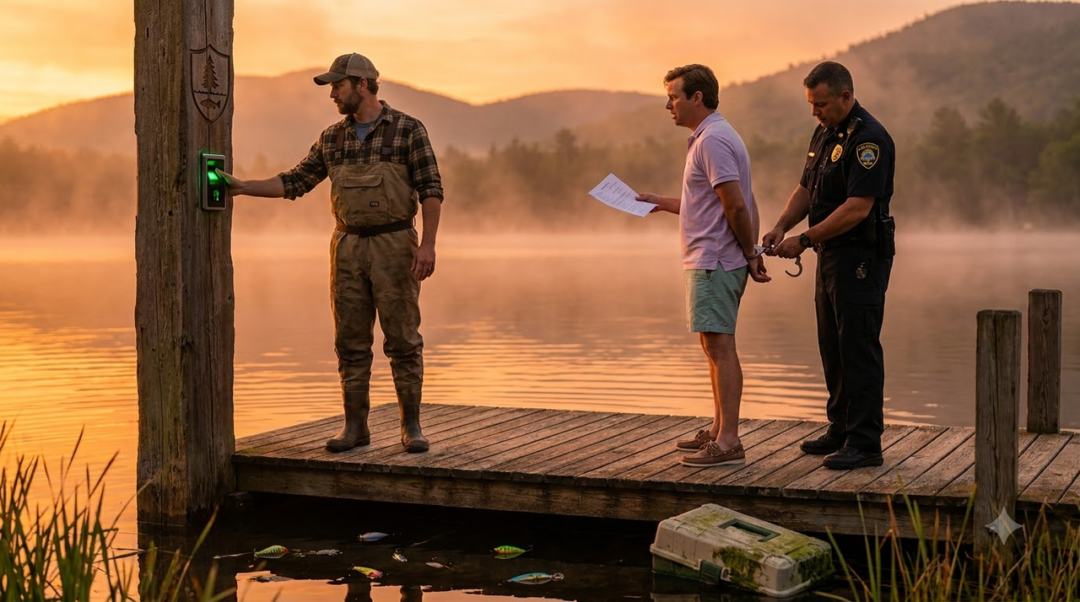
Without another word, Owen turned and walked toward the head of the pier, where a heavy, hand-forged wrought-iron security gate stood anchored to two massive granite pillars, barring access to the estate’s private timber boathouse. Mounted flush into the eastern stone pillar was a brushed-bronze housing containing a glowing green biometric fingerprint scanner. Beneath the scanner, deeply engraved in the bronze, was an official crest reading: MILLER PENINSULA TRUST – PRIVATE WILDLIFE CONSERVANCY – EST. 1888.
Owen placed his thumb flat against the optical glass plate.
BEEP-CHIME.
A crisp, high-frequency electronic tone sounded, and the heavy magnetic deadbolt within the stone pillar released with a heavy, pneumatic thud. The iron gate swung open effortlessly on oiled hinges.
Across the water, the low, throaty rumble of a twin-outboard marine engine echoed off the granite cliffs of Crystal Bay.
A twenty-eight-foot rigid-inflatable patrol boat belonging to the Lake Tahoe Harbor Patrol surged into the cove, its bow cutting a white rooster tail through the dark water. The patrol vessel slowed, its blue LED emergency beacon flashing against the cedar pilings as it pulled alongside the dock with practiced precision.
Officer Caleb Vance—a forty-two-year-old veteran marine patrolman in a crisp navy uniform with a gold brass badge gleaming against his tactical life vest—stepped onto the cedar pier, his hand resting calmly on his equipment belt.
Thorne turned with a victorious, arrogant bray of laughter. “Finally! Officer! You’re just in time! I caught this local squatter trespassing on my private pier! He refused to leave, threatened me, and broke into the utility gate! Arrest him and tow that wooden junk heap out of my cove right now!”
Officer Caleb Vance didn’t look at the skiff. He didn’t look at Thorne’s smartphone.
Instead, Officer Vance walked briskly down the cedar planks, stopped two feet in front of the man in the canvas waders, and touched the brim of his campaign hat in a crisp, deeply respectful salute.
“Evening, Mr. Miller,” Officer Vance said, his deep, official voice carrying across the quiet water. “Good to have you back from Alaska, sir. We received your automated sensor alert from the marine registry. Is there a problem on your peninsula?”
Thorne’s phone slipped in his grip, his jaw dropping so far that his lower teeth were visible. “Mr… Mr. Miller? Officer, what are you talking about? He’s a trespasser! I’m the tenant! I have a lease!”
Officer Vance turned his broad shoulders slowly toward Thorne, his face hardening like winter ice.
“Sir,” Officer Vance said, pulling a heavy aluminum citation ledger and a pair of hinged steel handcuffs from his tactical belt. “You don’t have a lease. You have an unauthorized, illegal commercial sublet. And you just assaulted Owen Miller—the deeded sole trustee and owner of this entire four-hundred-acre peninsula.”