He Blocked the Farm Mail Route for Months, So the Farmer Used the Same Rule Against Him
Chapter 1: The Orange Slips Beside the Cattle Gate
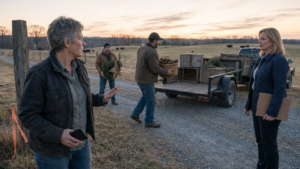
Donna Lee’s mail truck was stopped crooked in the county road when Matthew Baker came through the cattle gate.
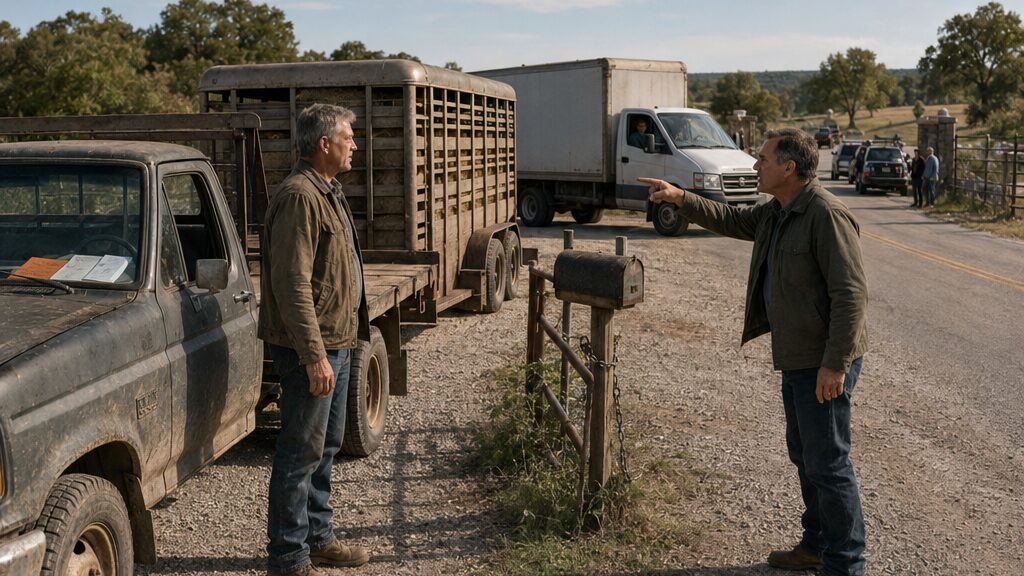
Her left wheels were nearly on the center line. Behind her, a dark pickup sat nose-in across the gravel turnout, close enough to Matthew’s mailbox that Donna could not pull alongside it without putting half her vehicle into traffic.
Matthew knew the pickup.
He did not know who owned it.
That had become a familiar distinction.
Across the fence, cars already lined Gary Thompson’s drive. A folding sign stood near the entrance to the renovated barn, its lettering turned away from Matthew. Somewhere beyond the trees, music thumped softly.
Donna lowered her window.
“Matthew.”
He walked toward her, wiping his hands on his jeans.
She held up two orange slips.
“I can’t deliver the packages again.”
Matthew looked at the pickup.
“There’s room.”
“For you on foot, maybe.”
A truck came around the bend behind her. Donna checked her mirror and pulled forward several feet.
“I’m not sitting here with traffic coming up behind me,” she said. “Not anymore.”
Matthew took the slips.
One corner was already bent from being handled.
“How many times?”
Donna gave him a look.
“You know how many.”
He did.
Three skipped deliveries in five weeks. Two on Fridays.
He slid the slips into his shirt pocket.
“I’ll handle it.”
“That’s what you said last time.”
The words were not accusing. That made them worse.
Donna eased away, accelerating slowly until the mail truck disappeared beyond the hill.
Matthew stood beside the mailbox.
The gravel turnout had been there longer than he had. His father used to swing stock trailers through it before backing into the farm lane. Feed trucks used it to straighten their angle. The veterinarian sometimes pulled partly onto it so traffic could pass.
For years, nobody thought much about the gravel.
Then Gary bought the adjoining parcel.
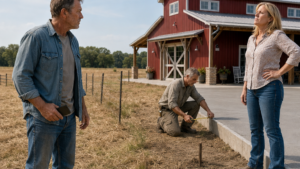
At first Matthew had been glad to see the old barn repaired instead of collapsing. Gary replaced the roof, painted the siding, cleaned brush from the fence line. He talked about hosting small family gatherings and seasonal dinners.
Small had become relative.
Matthew crossed to Gary’s drive.
Gary was near the barn speaking with a man carrying two folding chairs. He spotted Matthew and lifted a hand.
“Everything all right?”
Matthew pointed toward the road.
“That pickup needs moving.”
Gary glanced past him.
“Whose is it?”
“I figured you might know.”
Gary called toward the barn. No answer.
He shrugged.
“They’ll move eventually.”
“The mail carrier couldn’t get in.”
Gary’s expression shifted—not quite irritation, not quite amusement.
“The road’s public, Matthew.”
“I didn’t say it wasn’t.”
“That turnout’s not your private parking space.”
“I didn’t say that either.”
Gary folded his arms.
For a moment neither spoke.
Matthew felt the old pressure behind his ribs, the one that told him to finish the conversation before it turned into something larger.
He had known men who could turn six feet of dirt into thirty years of resentment.
He had lived with one.
“Just get it moved,” he said.
Gary sighed.
“All right.”
He walked toward the barn and shouted for someone to move a dark pickup.
That should have ended it.
Instead Gary turned back and said, “You know, I can’t control where every guest parks.”
Matthew looked at him.
“You can tell them where not to.”
Gary smiled without humor.
“They’re not blocking your driveway.”
“They’re blocking the turnout.”
“Which is public.”
Matthew felt himself wanting to say more.
He did not.
A few minutes later, a younger man jogged out, apologized to Gary, climbed into the pickup, and moved it farther down the road.
Gary lifted both hands as if presenting a solved problem.
“There.”
Matthew nodded.
“Thank you.”
He walked back across the road.
Behind him, Gary called, “We’ve got another event tomorrow, just so you know.”
Matthew stopped.
“How many?”
“Maybe forty.”
Matthew turned.
Gary had already started walking back toward the barn.
That evening Matthew placed the orange slips on the kitchen counter.
One was for a package Donna had tried to deliver that afternoon. The other had been left earlier in the week.
Sandra Roberts came through the back door carrying a folder of receipts.
She glanced at the slips.
“Again?”
“It’s handled.”
She set the folder down.
“You keep saying that.”
Matthew opened the refrigerator.
Sandra watched him take out a bottle of water.
“How many cars?”
“Doesn’t matter.”
“If they’re stopping deliveries, it matters.”
He twisted the cap.
“I talked to Gary.”
“And?”
“He moved one.”
Sandra waited.
Matthew took a drink.
“He’s got another gathering tomorrow.”
She leaned against the counter.
“You going to talk to him again?”
“I already did.”
“That wasn’t the question.”
Matthew put the bottle down harder than he intended.
“I’m not starting some neighbor war over gravel.”
Sandra’s face tightened.
“No one asked you to.”
The phone rang before he could answer.
Matthew picked it up.
The feed supplier’s number showed on the screen.
He answered.
The driver spoke quickly, apologetically. He had attempted the delivery late that afternoon but found vehicles crowded near the entrance. With the length of his truck and the bend in the road, he could not make the turn safely.
“So where’s the load?” Matthew asked.
“Back at the yard.”
Matthew looked through the kitchen window toward the darkening gate.
“When can you bring it?”
“Monday at the earliest.”
Matthew said nothing.
The driver added, “I wasn’t going to swing across traffic blind. Hope you understand.”
“I do.”
When the call ended, Sandra was still watching him.
Matthew looked down at the orange slips.
For the first time, they did not look like an inconvenience.
They looked like a record.
Chapter 2: The Delivery That Could Not Reach the Barn
The shipment was already fifty miles away by the time Matthew learned exactly what had happened.
He called the supplier shortly after seven Monday morning. The office confirmed that Friday’s load had been returned to the distribution yard after the driver failed to enter the farm safely.
Matthew stood inside the barn with the phone pressed to his ear.
A steer kicked the lower rail behind him.
“When can you get it back here?”
“Wednesday.”
“I was told Monday.”
“We had a route change.”
Matthew closed his eyes.
The missing load included mineral supplement and veterinary supplies he had expected to have through the weekend.
“How early Wednesday?”
“I can’t promise.”
He ended the call and stared at the feed bins.
He had enough to manage.
Barely.
That was the part that angered him.
Nothing had collapsed.
No animal was dying.
No truck had overturned.
Everything was simply harder than it should have been.
He drove to another farm supply store that morning and bought what he could in smaller quantities. The price was higher, but it would carry him until Wednesday.
When he returned, Sandra was at the kitchen table with a calculator, invoices, and three orange delivery slips arranged beside them.
Matthew stopped in the doorway.
“What are you doing?”
“Looking.”
“At what?”
She tapped the slips.
“The things you keep saying don’t matter.”
He set the bags he was carrying on the floor.
“I fixed the feed problem.”
“You bought emergency stock at retail.”
“It’ll do.”
“That’s not the same as fixing it.”
Matthew took off his cap and laid it on the table.
Sandra slid an invoice toward him.
“Redelivery charge from July.”
Another.
“Second delivery attempt in August.”
Another.
“Veterinary shipment held at the depot.”
Matthew frowned.
“That one wasn’t Gary.”
“No. But the driver noted restricted roadside access.”
He picked up the paper.
A short handwritten remark had been added near the bottom.
Access obstructed by parked vehicles.
Matthew read it twice.
Sandra said, “Why didn’t you save any of this?”
“I did save it.”
“You filed it.”
“That’s what records are for.”
“You filed it and forgot it.”
He looked at her.
Sandra’s voice sharpened.
“How long have you known this was costing the farm money?”
“It’s not much.”
“That isn’t an answer.”
Matthew pulled out a chair.
She had totaled the avoidable charges.
The amount was not catastrophic.
That somehow made it worse.
It was enough to matter, not enough to force action.
Exactly the kind of loss he was good at absorbing.
Sandra pointed toward the window.
“You’d raise hell if a supplier overcharged you half that.”
“That’s business.”
“This is business.”
“It’s Gary’s guests.”
“Blocking business.”
Matthew pushed the invoices together.
“I talked to him.”
“Once?”
“More than once.”
“What did you tell him?”
Matthew hesitated.
“That the turnout needed to stay clear.”
Sandra waited.
“That’s it?”
“What else was I supposed to say?”
“Maybe that mail is being skipped. Maybe that trucks can’t turn. Maybe that you’re paying for failed deliveries.”
“He knows cars are in the way.”
“He knows you’re annoyed.”
Matthew’s jaw tightened.
“There’s a difference?”
“Yes.”
The answer came too quickly.
Sandra stood.
“You think everyone is supposed to read the part you don’t say.”
Matthew looked away.
Outside, the gravel turnout sat empty.
On a Monday morning it looked ridiculous to call it a problem.
Just a widened patch beside a mailbox.
He had driven tractors through there since he was seventeen.
His father had once backed a livestock trailer through the same space with two inches to spare and then complained for an hour that Matthew had left a gate post crooked.
Matthew pushed the memory away.
Sandra gathered the invoices.
“You want this to stop?”
“Yes.”
“Then stop treating the whole thing like mentioning it twice should have solved it.”
She left the papers on the table.
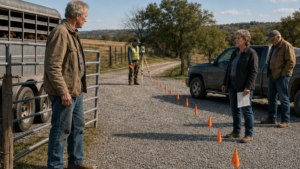
Later that afternoon, Matthew walked the turnout with a measuring tape.
From the mailbox to the edge of the ditch was wider than it looked. But the usable angle narrowed sharply near the cattle gate.
He pictured the feed truck coming from the south.
Long wheelbase.
Wide swing.
If two vehicles sat where Gary’s guests usually parked, the driver would have to cross the center line, then reverse against the bend.
Matthew took out his phone.
He photographed the approach from both directions.
Then the mailbox.
Then the gravel.
Then the gate.
A utility contractor’s van came by while he was standing there. The driver slowed, recognized Matthew, and rolled down his window.
“You surveying your kingdom?”
Matthew almost laughed.
“Something like that.”
The driver pointed toward Gary’s property.
“Busy over there lately.”
“That’s one word for it.”
“Good for him, I guess.”
Matthew nodded.
That was part of the trouble.
Gary had improved the place.
People liked the gatherings.
Local vendors were getting work.
Matthew did not want to be the man who complained because the farm next door was doing well.
He looked again at the turnout.
That was not what he was complaining about.
But perhaps Gary genuinely thought it was.
That evening Donna stopped at the box without trouble.
Matthew walked down before she pulled away.
“Can I ask you something?”
Donna rested one hand on the wheel.
“Depends.”
“If this keeps getting blocked, what happens?”
“I skip delivery if I can’t safely reach the box.”
“Can you cite them?”
Donna shook her head.
“I deliver mail. I don’t referee neighbors.”
“What about the road?”
“County question.”
Matthew nodded.
Donna studied him.
“You finally going to ask somebody?”
“Maybe.”
“Good.”
She drove on.
Matthew remained beside the mailbox.
The fading orange slips were on his kitchen table, tucked beneath bills and farm invoices.
He had spent weeks treating each one separately.
One missed package.
One delayed truck.
One annoying weekend.
Now he saw the pattern.
He raised his phone and took one final photograph of the turnout.
Then he went inside, opened his laptop, and searched the county assessor’s site.
Chapter 3: The Map That Did Not Prove Him Right
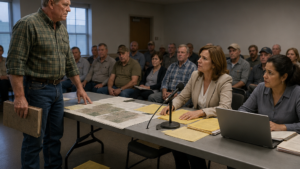
The county road clerk drew a blue circle around the gravel turnout and ruined Matthew’s argument in less than thirty seconds.
“This is the right-of-way line.”
Matthew leaned closer.
The printed parcel map lay between them beneath fluorescent lights.
The clerk traced the boundary again.
“Your deed line starts back here.”
The pencil stopped several feet inside what Matthew had always thought of as his roadside edge.
“And the turnout?”
“Inside county right-of-way.”
“All of it?”
“Looks that way.”
Matthew stared at the map.
He had come prepared.
Photographs.
Delivery slips.
Notes from the feed supplier.
Measurements.
He had expected complication.
He had not expected Gary to be right.
Not entirely.
But enough.
“So anybody can park there?”
The clerk set down the pencil.
“I didn’t say that.”
“You said it’s public.”
“Public right-of-way doesn’t mean do whatever you want.”
Matthew waited.
The clerk glanced at the photographs.
“Parking rules, obstruction rules, mail access—that gets more specific. But no, you don’t own that gravel.”
Matthew sat back.
The distinction felt both precise and useless.
“What can the county do?”
“About what?”
“Cars blocking the mailbox and making the farm entrance hard to use.”
The clerk looked at the images again.
“Depends on duration. Position. Whether they’re creating a traffic hazard.”
“So somebody comes out?”
“If there’s an active road hazard, maybe.”
“That isn’t what I asked.”
The clerk gave him a patient look.
“No. We don’t send somebody out every Saturday because neighbors disagree over where guests park.”
Matthew almost smiled.
At least the man was honest.
He gathered the papers.
Before he left, the clerk tapped the map.
“One thing.”
Matthew looked up.
“If trucks need that width to enter safely, document it.”
“I have.”
“Keep doing it.”
“Why?”
“Because the important question may not be who owns the gravel.”
Matthew looked at him.
“It may be whether the way it’s being used creates an access problem.”
That evening Matthew spread everything across the desk in the small farm office.
The parcel map.
Photographs.
Delivery records.
County road guidance.
Postal information.
One faded orange slip kept sliding between pages, so he used it as a bookmark.
He read until the words started repeating.
Public right-of-way.
Safe access.
Unobstructed approach.
Temporary parking.
Traffic hazard.
Nothing said what he wanted it to say.
Nothing gave him one clean sentence he could carry across the road and put in Gary’s hand.
You are wrong.
Move your people.
Problem solved.
Instead the rules were full of conditions.
The road was public.
Gary did not control it.
Neither did Matthew.
A vehicle might legally stand in one place and still create a problem depending on how it affected traffic.
The mailbox needed practical access, but Donna—not Matthew—decided whether she could safely approach it.
The turnout was not his property, yet his farm entrance depended on its geometry.
Matthew rubbed his eyes.
Sandra appeared in the doorway.
“Well?”
“He was right.”
Her eyebrows rose.
“Gary?”
“About the gravel.”
She stepped inside.
Matthew pushed the map toward her.
“County right-of-way.”
Sandra studied it.
“So that’s it?”
“I don’t know.”
“That sounds like you do.”
“He doesn’t own it either.”
“He never said he did.”
Matthew looked at her.
Sandra pulled out the other chair.
“What exactly did you want the map to prove?”
“That he couldn’t park people there.”
“Can he?”
“Sometimes.”
“That’s not the answer you wanted.”
“No.”
She glanced at the orange slip sticking from a stack of papers.
“What does the mail rule say?”
“That delivery can be skipped if access isn’t safe.”
“So Donna was right.”
“She usually is.”
“And the road?”
“Vehicles can use the right-of-way unless they’re violating parking or obstruction rules.”
Sandra looked back at the map.
“So there isn’t a rule that says Gary loses.”
Matthew leaned against the desk.
“No.”
“And there isn’t one that says you lose.”
He looked at her.
Sandra stood.
“That seems important.”
After she left, Matthew read the road guidance again.
He stopped on a paragraph he had already seen twice.
Temporary use of the right-of-way by farm equipment was permitted where otherwise lawful, provided the equipment did not create a prohibited hazard or remain beyond applicable limits.
Matthew read it slowly.
Then he looked at the parcel map.
Then at the photograph of the turnout.
The next image showed his cattle gate.
Another showed the angle a long truck needed to make the turn.
He opened a drawer and pulled out a notepad.
On one page he sketched the road.
On another, the turnout.
Then he drew his old flatbed.
The truck was shorter than the feed rig but long enough to occupy most of the useful gravel when paired with the stock trailer.
He stared at the sketch.
The thought arrived with enough clarity that he disliked it immediately.
Gary’s guests were not using Matthew’s property.
They were using public space.
Gary had said so himself.
Matthew could use the same space.
He sat back.
For the first time since this began, the problem did not look like something the county needed to solve.
It looked like something Gary might have to experience.
Chapter 4: Why Matthew Always Let Things Go
Sandra found Matthew in the hay shed with a tape measure, a notepad, and the old flatbed backed halfway out of its bay.
She stopped beside the door.
“Are you protecting the peace,” she asked, “or just postponing the fight?”
Matthew did not look up.
He hooked the tape to the trailer tongue and pulled it toward the rear axle.
“Morning to you too.”
“I’m serious.”
“I know.”
“That’s why you didn’t answer.”
He wrote down the measurement.
Sandra came farther into the shed.
On the workbench lay the county map, two printed pages of road guidance, and the faded orange delivery slips. Matthew had weighed the papers down with an old socket wrench.
She picked up one slip.
“You’re still carrying these around?”
“They’re records.”
“You called them scraps last week.”
He took the tape measure from the trailer.
“Things change.”
Sandra looked through the open shed doors toward the road.
“So what’s the plan?”
“There isn’t one.”
She gave him the kind of silence only family could make insulting.
Matthew sighed.
“I’m figuring out whether the truck and trailer fit legally in the turnout.”
“That sounds like a plan.”
“It’s information.”
“Same thing, with you.”
He walked to the flatbed’s cab and opened the door.
Sandra followed.
“Matthew.”
He stopped.
She held up the orange slip.
“You’ve been angry for two months.”
“I’m not angry.”
“You’re measuring a truck at seven in the morning because your neighbor annoys you.”
“He’s costing me deliveries.”
“Now you say that.”
Matthew turned toward her.
“What’s that supposed to mean?”
“It means you waited until you could prove the inconvenience on paper.”
“I wanted facts.”
“No. You wanted permission.”
That landed harder than he expected.
He shut the truck door.
Sandra lowered the slip.
“You always do this.”
“Do what?”
“Wait until there’s no chance anybody can say you started it.”
“That’s called being reasonable.”
“No. Sometimes it’s called being afraid.”
Matthew’s expression hardened.
“Careful.”
Sandra’s did too.
“There it is.”
He knew what she meant before she said anything else.
He looked away.
The hay shed smelled of dust, grease, and the sweet dry edge of last cutting. A stack of old farm ledgers sat on a shelf behind the workbench, their covers bowed with age.
Their father had kept everything.
Receipts. Fuel tickets. Handwritten fence measurements. Copies of letters he never mailed.
Especially anything involving land.
Sandra followed Matthew’s gaze.
“You remember the north access?”
“Don’t.”
“You remember.”
“I said don’t.”
Their father had argued for nearly a year with a cousin over an old machinery path across family ground. Six feet of dirt. Maybe eight.
At first it had been practical.
Then it became principle.
Then pride.
By the end, Matthew had taken sides only because he was tired of hearing about it.
He and his father had stopped speaking for months.
The path had eventually been rerouted.
No one won anything worth remembering.
Their father died three years later.
Matthew still remembered the wasted months better than the boundary itself.
Sandra set the orange slip beside the old ledgers.
“You think every disagreement over land turns into that.”
Matthew said nothing.
“You’ve spent years making sure you’re not him.”
“That’s not a bad thing.”
“No.”
She paused.
“But you went too far the other direction.”
Matthew looked at her.
Sandra tapped the delivery slip.
“Dad fought every inch like it was personal. You act like nothing is personal until it’s already hurting you.”
The words made him angry because they were close enough to true.
He picked up the county map and folded it.
“I’m not fighting Gary over ownership.”
“Good.”
“I know the turnout isn’t mine.”
“Also good.”
“And I’m not calling the sheriff. I’m not putting up signs. I’m not dragging the county into it.”
“I didn’t ask you to.”
Matthew shoved the folded map into his jacket pocket.
Sandra watched him.
“So what are you doing?”
He looked at the flatbed.
Then the stock trailer behind it.
“Showing him.”
Sandra’s eyebrows lifted.
“Showing him what?”
“What the space actually does.”
Before he could say more, the sound of tires on gravel came from outside.
A white utility van slowed near the road, then continued past.
Behind it, Gary’s pickup turned into the neighboring drive.
Gary got out carrying two cardboard boxes.
He saw Matthew near the shed and waved.
Matthew did not return it quickly enough.
Gary crossed toward the fence.
“Morning.”
Matthew stepped outside.
“Morning.”
Gary nodded toward the flatbed.
“Something break?”
“No.”
“Then you’re working early.”
Matthew glanced at the boxes.
“You hosting again?”
Gary hesitated, then smiled.
“Saturday.”
“How big?”
“Bigger than usual.”
Matthew waited.
Gary shifted the boxes against his hip.
“Maybe sixty. Could be a little more.”
“Vendor trucks?”
“Couple.”
Matthew nodded.
Gary studied him.
“Why?”
“The turnout needs to stay usable.”
There was no irritation in Gary’s face at first. Only weariness.
“We already covered this.”
“No. We covered one pickup.”
“It’s public space.”
“I know.”
Gary looked almost surprised.
“You checked?”
“Yes.”
Something in Gary relaxed.
“Well. Good.”
Matthew felt the exchange tilting toward exactly the wrong conclusion.
Gary added, “Then we understand each other.”
“No.”
Gary’s smile disappeared.
Matthew stepped closer to the fence.
“The fact that it’s public doesn’t mean blocking the turning space stops mattering.”
“No one is blocking your driveway.”
“Feed truck couldn’t get in Friday.”
Gary blinked.
“What?”
“It went back to the yard.”
“I didn’t know that.”
“You do now.”
Gary shifted the boxes again.
“Matthew, I’ll tell people to stay closer to my side.”
“That won’t fix the turn.”
“What do you want me to do? Put somebody out there with a flag?”
“I want the gravel clear when trucks need it.”
Gary’s jaw tightened.
“I’ve got a business to run.”
“So do I.”
The words sat between them.
For the first time, Matthew saw something beneath Gary’s defensiveness that was not simple entitlement.
Worry.
Not much.
Just enough.
Gary looked toward the renovated barn.
“These events are what pay for that place.”
Matthew said nothing.
Gary continued, quieter.
“I’m not throwing parties because I’m bored.”
Then his expression closed again.
“But I’m also not asking permission every time somebody parks on a county road.”
Matthew nodded once.
“I’m not asking you to.”
Gary looked at him as if waiting for the rest.
Matthew did not give it.
After Gary left, Sandra came out of the shed.
“You were almost clear.”
Matthew looked at her.
“Almost?”
“You told him the consequence.”
“Yes.”
“You still didn’t tell him what happens if he ignores it.”
Matthew turned toward the flatbed.
“I think he’s about to find out.”
That afternoon he drove the truck to the turnout when the road was empty.
He stopped short of the mailbox, got out, and checked the distance to the ditch.
Then he pulled forward six feet.
Back two.
Turned the wheels.
Got out again.
He marked the positions in his notebook.
With the stock trailer attached, the rig would take most of the usable width without crossing into Gary’s drive or blocking through traffic.
A farm vehicle.
On public right-of-way.
Temporarily stopped during legitimate work.
Matthew disliked how satisfying the geometry felt.
He backed the rig toward the barn again.
Before putting it away, he looked down the road toward Gary’s property.
Saturday’s event was two days away.
Matthew set the parking brake, climbed down, and walked back to the turnout with the tape measure one last time.
This time, he was not checking whether Gary was wrong.
He was checking exactly how far Matthew could go without becoming wrong himself.
Chapter 5: The Saturday Everyone Needed the Same Gravel
The first vendor truck arrived at twelve twenty-three and stopped in the middle of the county road.
Matthew heard its brakes from the lower pasture.
He rested the fence pliers on a post and looked toward the entrance.
The truck had come from the south, just as he expected.
A boxy delivery vehicle.
Long wheelbase.
Too wide to make the turn cleanly with Matthew’s flatbed and loaded stock trailer occupying the gravel turnout.
The driver tried once.
Then backed up.
A car behind him stopped.
Then another.
Matthew walked toward the gate.
His flatbed sat squarely where he had positioned it forty minutes earlier. The stock trailer was attached, two young cattle inside shifting occasionally against the rails. He had work to do that afternoon and had planned the move three days before Gary mentioned the event.
That part mattered.
At least Matthew kept telling himself it did.
Gary came jogging down his driveway.
He waved both arms toward the vendor.
“Back up. You’ve got room.”
The driver leaned out his window.
“Not with that rig there.”
Gary turned.
He saw Matthew.
For a second he simply stared.
Then he crossed the road.
“You need to move that.”
Matthew stopped beside the cattle gate.
“I’m working.”
“You’re blocking my entrance.”
“No.”
Gary pointed toward the vendor truck.
“He can’t get in.”
Matthew looked at the stalled vehicle.
“He can’t make the turn.”
“That is the same thing.”
Matthew glanced at the turnout.
“No. It isn’t.”
Gary stared at him.
Behind them, the vendor sounded a short impatient horn.
Gary lowered his voice.
“You did this on purpose.”
Matthew did not answer immediately.
One of the cattle in the trailer shifted again.
The metal floor gave a dull bang.
Matthew said, “I parked farm equipment in public right-of-way while I’m using it.”
Gary’s face changed.
He recognized the sentence.
“You’ve got to be kidding.”
“I checked.”
“With who?”
“County.”
“And they told you to block me?”
“No.”
Gary laughed once.
There was no humor in it.
“Then what exactly are you proving?”
Matthew looked toward the truck.
“Nothing yet.”
Gary stepped closer.
“You knew I had sixty people coming.”
“I knew you had an event.”
“You knew.”
“Yes.”
“And you chose today.”
“I had cattle scheduled to move.”
“You could move them tomorrow.”
Matthew met his eyes.
“That’s what people kept telling me about deliveries.”
Gary went still.
The vendor horn sounded again.
A second vehicle had approached from the north now, creating a narrow channel around the stopped truck.
Gary looked at the road.
Then back at Matthew.
“This is petty.”
Matthew felt the word hit because part of him had already used it on himself.
He said, “Maybe.”
That answer seemed to unsettle Gary more than denial would have.
“You admit it?”
“I admit I could have chosen a different day.”
Gary spread his hands.
“There you go.”
Matthew continued.
“So could your guests every weekend.”
Gary exhaled sharply.
“We are not doing this.”
“We’re already doing it.”
Gary walked back toward the vendor truck.
The driver tried another approach. He pulled wide, then stopped when his front tire neared the drainage ditch.
“No,” Matthew called.
The driver looked toward him.
“You’ll drop the rear wheel.”
Gary snapped, “He’s fine.”
Matthew shook his head.
The driver backed away.
“I’m not putting my truck in that ditch.”
Gary stood in the road with both hands on his hips.
Finally he pointed down the road.
“There’s another entrance past the barn. Come around.”
The driver nodded reluctantly and continued.
The backup cleared.
Matthew went back to the pasture.
For twenty minutes, nothing happened.
He nearly convinced himself the demonstration was over.
Then the first guests arrived.
Two cars pulled toward the turnout, saw the flatbed, slowed, and continued down the road.
Another stopped near Gary’s mailbox.
Gary walked over and pointed farther ahead.
By one fifteen, cars lined the shoulder nearly a hundred yards in both directions.
Matthew could see people walking toward the barn carrying wrapped gifts and jackets.
One woman stepped carefully around a muddy patch beside the ditch.
Another couple stood by their car looking confused until Gary waved them forward.
Matthew tightened wire on the fence.
The satisfaction came first.
Quiet.
Clean.
Almost mathematical.
A space Gary had treated as insignificant suddenly mattered because Gary needed it.
Then Matthew saw an older guest walking slowly from a distant parked car.
The man stopped halfway to the barn and rested one hand on a fence post.
Matthew’s satisfaction thinned.
This was not supposed to be about making strangers suffer.
He looked toward the stock trailer.
He could move it.
The cattle transfer could wait an hour.
Maybe two.
His hand went toward his truck keys.
Then Gary appeared again.
He crossed the road faster this time.
“You’ve made your point.”
Matthew kept the keys in his pocket.
“What point?”
“Don’t do that.”
“What?”
“Act like you don’t know.”
Matthew leaned against the gate.
Gary’s face was flushed now.
“My caterer had to unload from the back entrance. Guests are walking from half a mile down the road.”
“It’s not half a mile.”
“You know what I mean.”
Matthew did.
Gary pointed at the flatbed.
“Move it.”
“I’m not finished.”
“With what?”
“Farm work.”
Gary looked toward the trailer.
“The cattle have been sitting there an hour.”
“They’re fine.”
“This isn’t farm work. This is sabotage.”
The word carried farther than either man intended.
Two guests near Gary’s drive looked over.
Matthew felt heat rise in his face.
He kept his voice low.
“No.”
Gary stepped closer.
“You picked the biggest weekend I’ve had in months.”
“I didn’t know that.”
“You knew it was big.”
“Yes.”
“And you decided to teach me a lesson.”
Matthew looked at the line of parked cars.
“That wasn’t the first reason.”
“But it was a reason.”
Matthew did not answer.
Gary’s anger flickered into something else.
Not defeat.
Recognition.
He looked at the turnout, then at the road, then at the stock trailer.
“You really need this much room?”
Matthew followed his gaze.
“For the long trucks? Yes.”
Gary said nothing.
A delivery van slowed behind them.
Its driver pointed toward Gary’s property.
Gary raised one hand.
“Keep going. Second entrance.”
The van continued.
Gary watched it disappear.
Matthew said, “That’s what I’ve been trying to tell you.”
Gary turned back.
“No. You’ve been telling me you don’t like people parking there.”
“I told you the feed truck couldn’t get in.”
“Two days ago.”
“You knew about the mail.”
“You said the mailbox was blocked.”
“It was.”
Gary shook his head.
“You never said all this.”
Matthew almost argued.
Then Sandra’s voice came back to him.
You think everyone is supposed to read the part you don’t say.
He looked down.
Gary noticed.
For the first time all afternoon, neither man had an immediate answer.
Then a black SUV stopped in the road.
Its driver leaned on the horn.
Gary closed his eyes.
Matthew reached into his pocket.
His fingers touched the truck keys.
He could end it.
He could move.
Instead he looked at the stock trailer.
The cattle still needed transferring to the north pasture. The job was real.
So was the lesson.
He hated that the two things had become tangled.
“I’ll be done when I’m done,” Matthew said.
Gary stared at him.
Then he nodded once, tightly.
“Fine.”
He turned away.
Matthew watched him walk back toward the barn.
For the next hour, Gary directed every arriving vehicle himself.
He pointed guests down the shoulder.
Sent vendors to the secondary entrance.
Stopped one driver from backing across Matthew’s gate.
By three o’clock, he no longer looked angry so much as exhausted.
Matthew finished the cattle move at three twenty.
He returned with the empty trailer and found Gary standing beside the mailbox.
Matthew parked the rig in the farm lane instead of the turnout.
The gravel was open again.
Gary looked at the empty space.
Then at Matthew.
“You happy?”
Matthew shut off the engine.
“No.”
Gary seemed surprised.
Matthew climbed down.
He had imagined this moment several times.
Gary frustrated.
Gary inconvenienced.
Gary finally understanding.
In none of those versions had Matthew expected to feel this tired.
Gary looked toward the barn, where guests were still walking in from the road.
“You made the entire weekend harder than it had to be.”
Matthew closed the truck door.
Gary’s voice dropped.
“You made it almost impossible to run the place.”
Matthew looked at him.
The sentence sounded familiar.
Too familiar.
He said nothing.
Gary shook his head and walked away.
Matthew remained beside the open turnout.
The demonstration had worked.
That was the problem.
Now he had to decide what he actually wanted to do with the fact that it had.
Chapter 6: The Complaint Gary Finally Heard Himself Make
“You’re making it impossible for people to get in.”
Gary said it from the bottom step of Matthew’s porch just after seven that evening.
Matthew had been expecting him.
Not the exact sentence.
That part still caught him.
He stood in the doorway with three faded orange delivery slips in one hand. He had found them on the kitchen counter after supper and picked them up without thinking.
Gary noticed them immediately.
His face tightened.
“Seriously?”
Matthew looked down at the slips.
“No.”
He set them on the porch rail.
Gary folded his arms.
“Then what was today?”
Matthew stepped outside and pulled the door closed behind him.
Across the road, the barn lights glowed through the trees. The gathering was still going, though the traffic had thinned.
“You said it yourself.”
Gary’s jaw flexed.
“Said what?”
“That I made it impossible for people to get in.”
“So?”
“That’s what I’ve been trying to tell you.”
Gary stared at him.
Matthew continued before he could retreat into silence again.
“Donna couldn’t reach the box safely. Feed truck couldn’t turn. Vet delivery got held. I’ve paid redelivery fees because drivers couldn’t get through the turnout the way they needed to.”
Gary’s expression shifted.
“You never told me about fees.”
“No.”
“Or the vet delivery.”
“No.”
“Or any of that until this week.”
Matthew looked toward the yard.
“No.”
Gary gave a bitter little laugh.
“So I’m supposed to know it somehow?”
Matthew said nothing.
Gary took a step closer.
“You kept coming over saying the same thing. Keep the gravel clear. Don’t block the mailbox. Tell your people to move.”
“That should’ve been enough.”
“For what? To make me think you didn’t like cars near your place?”
Matthew looked at him.
Gary’s voice sharpened.
“That’s what I thought this was.”
“You thought I was being territorial.”
“Yes.”
Matthew almost objected.
Then remembered the county office.
The map.
The relief on Gary’s face when Matthew admitted the turnout was public.
Gary had thought he was defending himself against a man trying to claim land he did not own.
Matthew leaned against the porch post.
“You could’ve asked.”
Gary stared at him.
“So could you.”
That stopped him.
For several seconds, the only sound was insects in the grass and music drifting faintly from the neighboring barn.
Gary looked toward the orange slips on the rail.
“I thought you were trying to make some point about being here longer.”
“I wasn’t.”
“You sure?”
Matthew’s first instinct was anger.
Then honesty.
“Not completely.”
Gary looked back.
Matthew continued.
“I’ve used that turnout since before you bought the place. My father used it. Feed trucks have used it longer than that. So yeah, when your guests started filling it every weekend, part of me thought you should just know.”
“That’s exactly what I’m talking about.”
“I know.”
The admission changed the air between them.
Gary unfolded his arms.
Matthew rubbed one thumb along the porch post.
“I didn’t want another land fight.”
“Then today was an odd way to show it.”
Matthew almost smiled.
“Fair.”
Gary looked toward the road.
“My caterer charged extra tonight.”
Matthew glanced at him.
“For what?”
“Secondary unload. More labor.”
Matthew nodded.
“That sounds familiar.”
Gary gave him a hard look.
Matthew raised one hand.
“Sorry.”
“Are you?”
“Some.”
Gary shook his head.
Then, unexpectedly, he sat on the bottom porch step.
Matthew remained standing.
After a moment Gary said, “You know why I keep pushing these events?”
“Money.”
Gary looked over his shoulder.
“That obvious?”
“You said they pay for the barn.”
“They pay for more than the barn.”
Matthew waited.
Gary picked at a loose thread on his sleeve.
“When I bought the place, I thought I could renovate half of it myself.”
“That went well.”
Gary actually laughed.
“Yeah.”
The laugh faded.
“Roof was worse than the inspection said. Electric had to be redone. Septic had to be expanded. I borrowed more than I should have.”
Matthew said nothing.
Gary continued.
“If I cancel bookings or make the place difficult for vendors, people go somewhere else.”
“That doesn’t make the turnout yours.”
“I know that now.”
Matthew studied him.
Gary looked up.
“Don’t look so surprised.”
“I’m not.”
“You are.”
Matthew leaned against the post again.
“You’ve said ‘public road’ enough times that I figured you planned to put it on your tombstone.”
Gary looked back toward the barn.
“I thought I was protecting the business.”
“You were.”
“And making your business harder.”
“Yes.”
Gary nodded slowly.
There it was.
Not an apology.
Something more useful.
Recognition.
Matthew looked at the orange slips.
He picked them up.
Gary’s eyes followed.
Matthew could have handed them over.
Could have shown dates.
Could have listed every missed package.
Could have made the case airtight.
Instead he folded them once and put them in his pocket.
Gary noticed.
“You’re not going to show me?”
“You believe me?”
“Yes.”
“Then I don’t need to.”
Gary looked away.
Matthew walked down one step.
“Here’s what I want.”
Gary gave a tired sigh.
“All right.”
“On event days, nobody parks in the turnout itself.”
“That’s a lot of space to lose.”
“It’s turning space, not parking.”
Gary opened his mouth.
Matthew held up a hand.
“You can use the shoulder farther down. Your secondary entrance for vendors if you want. But the turnout stays open.”
Gary considered it.
“And your trucks?”
“If I know I’ve got a feed truck, vet rig, or stock trailer coming through during one of your events, I’ll tell you ahead of time.”
Gary frowned.
“You’d do that?”
“Yes.”
“What about days you don’t tell me?”
“Keep it open anyway.”
Gary almost smiled.
“Of course.”
Matthew looked toward the road.
“One more thing.”
Gary waited.
“If I’m moving cattle and need to occupy it temporarily, I’m going to.”
Gary rubbed his forehead.
“How temporarily?”
“Long enough to do the work.”
“Not six hours.”
“No.”
“Not because you’re mad.”
Matthew looked at him.
“No.”
Gary considered that longer than the other conditions.
Finally he stood.
“I’ve got another booking in three weeks.”
Matthew nodded.
Gary looked toward the barn, then back.
“I’ll think about it.”
“That’s all I’m asking tonight.”
Gary started down the path.
After several steps he stopped.
“You really had a feed truck turn around?”
“Yes.”
Gary shook his head once.
“I thought you were exaggerating.”
“I know.”
Gary continued toward the road.
Matthew watched until he crossed into his own drive.
Then he reached into his pocket and unfolded the orange slips.
For weeks they had felt like proof.
Tonight they felt like evidence of something else.
How long Matthew had waited to say plainly what mattered.
He went inside and placed them back on the kitchen counter.
Gary had three weeks before the next event.
So did Matthew.
Chapter 7: The Turnout Stayed Public, but the Boundary Changed
The first car appeared just after ten Saturday morning, slowed beside Matthew’s mailbox, and kept going.
Matthew stopped halfway through fastening a gate chain.
A second car followed.
Then a third.
None of them turned into the gravel turnout.
For three weeks, Matthew had wondered whether Gary’s answer would arrive as an argument, a lawyer’s letter, a complaint to the county, or simply another line of parked cars.
Instead, two temporary parking markers stood farther down Gary’s property, directing guests toward a mowed strip beyond the barn.
The turnout beside Matthew’s cattle gate was completely empty.
Matthew stared at it longer than he meant to.
Sandra’s truck rolled up the farm lane behind him.
She climbed out carrying a folder.
“You planning to work today?”
“I am working.”
“You’re watching gravel.”
“That too.”
She followed his gaze.
Another guest vehicle passed the turnout and continued toward Gary’s designated parking area.
Sandra smiled.
“Well.”
“Don’t.”
“I didn’t say anything.”
“You were about to.”
“I was about to say the system appears to be functioning.”
Matthew unhooked the gate.
“That sounds worse.”
Sandra walked beside him toward the barn.
“What did Gary say?”
“Nothing.”
“Nothing in three weeks?”
“Couple nods from across the road.”
“And you?”
“Same.”
Sandra gave him a sideways look.
“Very mature.”
Matthew ignored her.
He had expected the silence to bother him.
Instead, it felt different from the silence before.
Before, Matthew had been waiting for Gary to understand a problem Matthew had barely explained.
Now both men knew exactly what the problem was.
There was simply nothing to say until the arrangement was tested.
That test arrived before noon.
Matthew heard the feed truck before he saw it.
The diesel engine labored over the hill south of the farm, then the long white truck appeared around the bend.
At the same moment, three vehicles approached from the opposite direction.
Gary was standing near his drive speaking with a guest.
He looked toward the truck.
Matthew did too.
For half a second, nobody moved.
Then Gary raised one arm.
He stopped the first guest car before it reached the turnout.
The driver lowered a window.
Gary pointed toward the parking area behind the barn.
The guest waited.
The feed truck approached.
Its driver slowed, swung wide across the open gravel, and turned through Matthew’s cattle gate in one clean movement.
No reversing.
No horn.
No wheels near the ditch.
The truck disappeared up the farm lane.
Gary lowered his arm.
The waiting cars continued.
Matthew stood beside the fence.
Gary looked across the road.
Their eyes met.
Gary lifted two fingers from his side.
Not quite a wave.
Matthew nodded.
That was all.
Sandra had seen it from the barn doorway.
When Matthew walked back, she said, “You going to frame that moment?”
“No.”
“Shame.”
The feed driver climbed out beside the storage bins.
“Best turn I’ve had in here all season.”
Matthew looked toward the road.
“Good.”
The driver started unloading.
Matthew helped without mentioning why the entrance had suddenly become easier.
There was no need.
By midafternoon, more than forty cars had arrived at Gary’s property.
The turnout remained open.
Vendors used the secondary entrance.
Guests parked where Gary directed them.
Once, a pickup slowed as if its driver intended to pull beside Matthew’s mailbox. Gary walked into view before Matthew could react and pointed it farther down.
The pickup moved.
Matthew felt something inside him loosen.
Not victory.
Victory would have required Gary to lose.
This looked more like two operations finally learning where they touched.
Near four o’clock, Gary crossed the road.
Matthew was replacing a latch on the cattle gate.
Gary stopped several feet away.
“Got a minute?”
Matthew set down the wrench.
“Sure.”
Gary glanced toward the turnout.
“Seems to be working.”
“So far.”
“I had to move the guest parking.”
“I noticed.”
“People complained about the walk.”
Matthew waited.
Gary looked at him.
“I told them they’d survive.”
Matthew almost smiled.
Gary rubbed the back of his neck.
“I’ve got a question.”
“All right.”
“If you’re doing a big cattle move, can you tell me ahead of time?”
Matthew’s first reaction came quickly.
Why should I?
He felt it rise and then stop.
That was the old reflex wearing different clothes.
Gary continued.
“I’m not asking permission. I just don’t want a delivery truck meeting a stock trailer at the same time if I can schedule around it.”
Matthew nodded slowly.
“That’s reasonable.”
Gary seemed almost surprised by the answer.
Matthew added, “If I know ahead of time, I’ll tell you.”
“And feed deliveries?”
“Same, if they give me a window.”
Gary nodded.
“What about emergencies?”
“I’m not scheduling emergencies for your convenience.”
Gary laughed.
“Fair enough.”
For a few seconds they stood without speaking.
Then Gary looked toward the mailbox.
“You still have those orange slips?”
Matthew thought of them sitting under a stack of invoices in the kitchen.
“Somewhere.”
“You keeping them in case I forget?”
The question was light, but not entirely.
Matthew looked at the empty gravel.
“No.”
Gary studied him.
Then nodded once.
“Good.”
He turned toward his property.
Matthew called after him.
“Gary.”
Gary stopped.
Matthew hesitated.
Three weeks earlier, he would have let the moment go.
“Next time something I’m doing causes you trouble, tell me before you’re mad enough to block my driveway.”
Gary stared at him.
Then a smile appeared.
“That supposed to be an apology?”
“Closest you’re getting.”
“I’ll take it.”
He crossed the road.
The following Monday, Donna Lee pulled up to Matthew’s mailbox without slowing traffic behind her.
Matthew happened to be repairing fence nearby.
She placed several envelopes inside, then noticed something caught beneath the mailbox flag.
A faded orange delivery slip.
She pulled it free and held it up.
“You saving souvenirs?”
Matthew walked over.
“I thought I got all of those.”
Donna handed it to him.
“Guess not.”
He turned it over.
The date was nearly two months old.
For a moment he remembered exactly how he had felt when he received it: annoyed, inconvenienced, certain someone else should understand without being told precisely why.
Donna nodded toward Gary’s property.
“Parking looks better.”
“It is.”
“You solve it?”
Matthew looked across the road.
Gary was directing a utility van toward the secondary entrance while keeping the turnout open.
“We worked something out.”
Donna smiled.
“Imagine that.”
She drove away.
Matthew carried the orange slip back toward the farmhouse.
Inside, Sandra had left several farm invoices on the kitchen counter.
The other delivery slips were still underneath them.
Matthew pulled them out.
Four orange rectangles, faded at different rates.
For weeks he had kept them because they proved he had been wronged.
Then because he thought he might need them in an argument.
Now they proved something he did not particularly enjoy admitting.
A record could show what happened.
It could not say what he had failed to say.
Matthew gathered all five slips and carried them outside.
At the trash barrel beside the shed, he paused.
Across the pasture, Gary’s barn was visible beyond the fence.
The property line had not moved.
The county right-of-way had not moved.
The gravel turnout belonged to neither of them any more than it had three weeks earlier.
But the boundary around it had changed anyway.
Not a legal boundary.
A practical one.
Gary knew what Matthew needed.
Matthew knew what Gary needed.
And neither man had to pretend the other should simply understand.
Matthew dropped the orange slips into the barrel.
Then he went back to work.
The story has ended.