He Called His Neighbor a Thief Until the Missing Firewood Exposed What He Was Hiding
Chapter 1: The Morning Donald Called Him a Thief
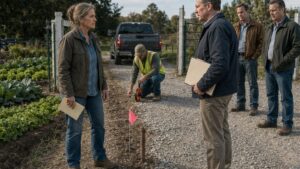
The oak round hit the gravel hard enough to split a crust of mud from its bark.
Donald Wright had kicked it from Jonathan Harris’s stack, straight across the orange survey stake that marked the edge of the farm lane.
“You gonna stand there and pretend that’s yours?”
Jonathan lowered the splitting maul but did not let go of it.
Donald stood ten feet away in a gray work jacket, jeans, and the yellow rubber boots he wore whenever the ground softened. He had the heavy, planted stance of a man expecting resistance and already angry that he had not received enough of it.
Behind Jonathan, split oak was stacked chest-high beneath the lean-to roof of the old equipment shed. Some pieces were pale where the grain had opened clean that morning. Others were darkened by two weeks of rain.
Jonathan looked at the round lying beyond the stake.
Then at Donald.
“What exactly are you asking?”
Donald gave a short laugh.
“I’m not asking. I’m telling you. That wood came off my side.”
Jonathan rested the maul head on the chopping block.
The boundary between their properties had never looked important enough to deserve a fight. An old fence line wandered along the rise. The gravel lane narrowed where Jonathan’s ground met Donald’s. There was a recorded access arrangement somewhere in the county files, left over from when both properties had been larger and worked differently.
For years, Donald had driven across the edge when the lower ground was wet. Jonathan had let him.
He had also let Donald move a gate once, cut brush once, and stack fence posts temporarily beside the lane.
Each time, Jonathan had told himself the same thing.
Neighbors did not need paperwork for every small kindness.
His father had believed that too.
Or Jonathan had chosen to remember it that way.
Donald stepped closer to the wood.
“You took eight, maybe ten rounds Tuesday night.”
Jonathan’s eyes moved back to him.
“Tuesday?”
“Don’t play games.”
“What time Tuesday?”
Donald’s jaw tightened.
“Late.”
“Late when?”
Donald stared at him as if precision itself were an insult.
“After ten. Before midnight. Doesn’t matter.”
It did, though Jonathan did not yet know why.
He had been asleep by ten-thirty Tuesday. The cattle had pushed a section of temporary fence down that afternoon, and he had spent three hours resetting posts before dark. He remembered warming soup, washing mud off his boots, and falling asleep in the chair before getting up to go to bed.
Donald pointed toward the stack.
“I know what was there. I know what’s gone.”
Jonathan studied him.
Donald’s lawn began just beyond the gravel turn. It was always cut even. The ditch along the roadside was cleared. The white posts near his drive had fresh paint every other spring. He cared about how things looked from the road.
Jonathan’s place looked worked because it was worked.
A tarp covered a hydraulic splitter beside the shed. Feed sacks were stacked by the barn door. Two worn fence panels leaned against an elm until Jonathan found time to repair them.
Donald had complained more than once that the property looked “temporary.”
Jonathan had never answered.
Now Donald glanced toward the county road.
“You think people don’t notice?”
“Notice what?”
“You hauling wood around. Selling some. Moving some. Nobody knows where half of it comes from.”
Jonathan’s grip tightened around the maul handle.
He had sold cordwood to Stephen Hall twice last winter. Stephen had picked it up in an old livestock trailer after dark both times because that was when he finished feeding.
It had never occurred to Jonathan that anyone cared.
Donald said, “Stephen’s seen it too.”
That landed differently.
Not because Jonathan believed Stephen had accused him. Stephen disliked conflict so much he would circle a field twice to avoid meeting two people arguing at a gate.
But Donald had used his name.
That meant the story had already left the boundary.
Jonathan set the maul against the chopping block.
“If you think I took something, come back when you know what you’re accusing me of.”
Donald’s face reddened.
“I know exactly what I’m accusing you of.”
He shoved a loose split with the toe of his yellow boot.
“You stole from me.”
Jonathan looked at the boot, then at Donald’s face.
Donald seemed to be waiting for shouting.
Jonathan did not give him any.
“I’ve got work.”
“That’s it?”
“That’s it.”
Donald stepped close enough that Jonathan could smell coffee on his breath.
“You’ve got until Friday.”
Jonathan almost smiled from disbelief.
“For what?”
“To put back what you took.”
“And if I don’t?”
Donald’s mouth hardened.
“Then everybody around here gets told what kind of man lives next door.”
Jonathan felt something small and old move in him.
Not fear.
The instinct to withdraw.
His father had spent the last years of his life settling arguments between relatives over equipment, grazing, fence maintenance, and who owed whom for diesel. After the funeral, Jonathan had promised himself the farm would never become another place where every conversation turned into a ledger.
He had confused that promise, more than once, with the idea that refusing a fight made a fight disappear.
Donald took Jonathan’s silence as weakness.
“I mean it.”
Jonathan nodded once.
“I heard you.”
Donald walked back across the narrow strip, stepping directly over the orange survey stake.
He did not look down.
By noon, Jonathan had nearly convinced himself to let the whole thing burn out.
He repaired a water trough valve, loaded hay into the north feeder, and cut another row of oak. The physical rhythm helped. Set the round. Split. Turn. Split again. Stack.
Things with clear edges were easier.
Near one, the rural mail carrier slowed at his drive and handed him two envelopes through the truck window.
“Everything all right?”
Jonathan looked at her.
“Why?”
She hesitated.
“Nothing. Just heard there was some trouble over wood.”
There it was.
Already.
“From who?”
She lifted one shoulder.
“People talk.”
Jonathan thanked her and watched the truck move on.
When he turned back toward the shed, a white sheet of paper fluttered against the weathered wooden door.
It had not been there ten minutes earlier.
Donald must have walked over through the field.
The paper was fixed with two staples.
Across the top, in thick black letters, was one word.
THEFT.
Below it was a short typed accusation demanding the return of wood by Friday.
No lawyer’s letterhead. No sheriff’s insignia. No county seal.
Just Donald’s accusation made to look official.
Jonathan tore it down.
For three seconds, he considered crumpling it.
Instead, he folded it once and carried it inside.
That annoyed him more than Donald’s shouting had.
Not the paper itself.
The fact that Donald knew Jonathan well enough to expect him to throw it away, say nothing, and get back to work.
At the kitchen table, Jonathan read the notice twice.
Tuesday night.
The same night Donald had named that morning.
Jonathan stared through the window toward the equipment shed.
A small black camera sat under the eave above the sliding door.
He had installed it in summer after fuel disappeared twice from the farm tank. The camera watched the shed entrance, part of the lane, and the near end of the wood stack.
Jonathan had stopped checking it weeks ago.
He stood so quickly the chair legs scraped across the floor.
For the first time that day, Donald’s exact certainty about Tuesday night no longer sounded like an accusation.
It sounded like knowledge.
Chapter 2: The Yellow Boots at Two in the Morning
The first thing Jonathan saw on the screen was his own wheelbarrow moving through the dark.
He stopped the video.
Rewound five seconds.
Played it again.
At 1:58 a.m., the wheelbarrow rolled into the camera’s field of view from behind the wood stack. Its left handle had a pale strip where Jonathan had wrapped it with tape two summers earlier.
He leaned closer to the laptop.
The picture was grainy but clear enough.
Someone was pushing it.
Jonathan paused again.
The figure wore a bulky jacket. The face was turned away.
Below the hem of the coat, the camera caught two bright shapes.
Yellow boots.
Jonathan sat back.
“No.”
The word came out quietly.
He did not want the footage to identify Donald.
That surprised him.
All afternoon he had been angry at the accusation. He had imagined the satisfaction of proving it false. But proof was one thing when it existed only in his mind. Seeing his neighbor in the dark beside the wood stack was something else.
He moved frame by frame.
The figure stopped at the stacked oak, chose two pieces, then three more, loaded the wheelbarrow, and pushed it toward the narrow boundary strip.
Not toward Donald’s driveway.
Across the grass beside the orange stake.
Jonathan rewound.
At one point the figure turned enough for the camera to catch the outline of a heavy mustache and the slope of his shoulders.
Still not enough for Jonathan.
He opened the previous night.
Nothing.
The night before that, at 2:11 a.m., the figure appeared again.
Same jacket.
Same boots.
Same wheelbarrow.
This time the man took fewer pieces.
Jonathan watched where he went.
Again, across the narrow strip.
Jonathan opened another date.
Three nights earlier.
2:06 a.m.
The same movement repeated.
Wood from Jonathan’s stack.
Into Jonathan’s wheelbarrow.
Across the same section of ground.
He stopped the footage and looked out through the shed window.
In daylight, the strip seemed too ordinary to carry any meaning.
Twenty feet of rough grass. A shallow rut where tires sometimes cut through in wet weather. The old wandering fence. Donald’s cleaner ground beyond.
Jonathan walked outside.
The air had cooled sharply. He went to the stack and studied the face of it.
Someone unfamiliar with firewood would have seen only hundreds of similar pieces.
Jonathan saw the pattern.
He stacked in alternating rows, bark side out on one layer and end grain out on the next. The camera showed the figure pulling pieces from the lower right corner, opening a hollow that Jonathan had later filled without noticing.
He crouched.
A round near the bottom had a wedge-shaped scar where his splitter had slipped.
He remembered cutting it.
He remembered the oak it came from too—a storm-damaged tree by the south pasture.
Donald had not taken wood that might have been confused at the boundary.
He had taken Jonathan’s wood from well inside Jonathan’s working area.
That should have been enough.
Jonathan found himself walking instead toward the orange survey stake.
The camera footage had bothered him for a reason he had not named.
Donald had a shorter route home.
From the stack, he could have pushed the wheelbarrow straight toward the road, then turned onto his own drive.
Instead, every recording showed him crossing the same narrow strip.
Jonathan stood with one boot beside the orange marker.
The grass there had been pressed flat.
Not once.
Repeatedly.
There were wheel tracks too shallow to notice unless he was looking for them.
He followed them until they disappeared near Donald’s fence.
The theft suddenly felt smaller than the path.
Back inside, Jonathan copied three clips to a drive and took still images from each.
He printed one.
The printer worked slowly, making the picture look almost harmless as it emerged.
A dark figure.
A wheelbarrow.
Yellow boots.
Jonathan set the photograph beside Donald’s notice.
Accuser and accused had traded places in less than a page of paper.
He should have felt satisfied.
Instead, he opened the county parcel website.
The site loaded badly on his old connection. He searched his property, then Donald’s.
Both parcels appeared.
Jonathan zoomed toward the shared edge.
The digital line did not perfectly match the old fence. That was not unusual. Online maps came with warnings for a reason.
But an annotation sat along the disputed strip.
Recorded access.
Jonathan had known about it for years without thinking much about its language.
His father had once told him that Donald’s previous owner used the lane seasonally when the lower pasture was too soft.
That was all Jonathan remembered.
He searched the county records index.
Several scanned references appeared.
One entry was recent.
Requested copy: updated parcel map.
Requester: Donald Wright.
Jonathan stared at the date.
Nine days before Donald accused him of stealing wood.
The timing drew a line through the whole week.
He opened another record, but the document itself required an office request.
Jonathan leaned back.
Maybe Donald was preparing to replace a fence.
Maybe he was dealing with insurance.
Maybe the map request meant nothing.
Jonathan had spent half his life avoiding conclusions that might start unnecessary trouble.
It was a habit that usually looked like fairness from the inside.
He glanced at the printed camera still.
There were times when refusing a conclusion did not make a man fair.
It only made him late.
His phone rang.
Stephen Hall.
Jonathan answered.
“Yeah?”
A pause.
“Donald been over there?”
Jonathan looked at the notice.
“He has.”
Another pause.
Stephen said, “He’s saying some things.”
“What things?”
“That you’ve been pulling wood off his side. That I’ve seen you hauling it.”
Jonathan’s jaw tightened.
“Did you tell him that?”
“No.”
“But you told him I sold you wood.”
“Last winter. He asked.”
Stephen sounded uncomfortable.
“I didn’t know what he was getting at.”
Jonathan said nothing.
Stephen added, “I’m not saying I believe him.”
“That’s not the same as telling him he’s wrong.”
Silence came through the line.
Jonathan regretted the sentence as soon as he said it, partly because it was unfair.
Stephen had not created this.
But Jonathan was beginning to hear his own life in the spaces where other men stayed quiet.
Stephen finally said, “You got proof?”
Jonathan looked at the yellow boots in the photograph.
“I’ve got enough to ask better questions.”
After the call, Jonathan returned to the county site.
Donald’s parcel-map request sat on the screen.
The wood explained the accusation.
It did not explain the map.
And it did not explain why Donald kept pushing the wheelbarrow across the same twenty feet of ground at two in the morning.
Chapter 3: The Photograph Donald Thought Could Be Anyone
Donald chose his audience carefully.
Two neighboring landowners were standing beside Jonathan’s hay wagon when he walked into the farmyard two mornings later.
Jonathan saw him coming before either neighbor did.
Gray jacket.
Jeans.
Yellow rubber boots.
The sight of the boots made the printed photograph inside Jonathan’s jacket feel heavier.
Donald did not greet anyone.
He pointed toward the wood stack.
“You planning to put it back today?”
One of the neighbors looked from Donald to Jonathan.
The other shifted his weight and studied the gravel.
Jonathan set down the ratchet strap he had been tightening.
“What night did I take it?”
Donald frowned.
“We’ve been through this.”
“I’m asking again.”
“You know when.”
“Say it.”
Donald glanced toward the neighbors.
Jonathan understood the calculation. Donald had expected denial, anger, maybe threats. A specific question in a calm voice was harder to use.
“Tuesday,” Donald said.
“What time?”
Donald’s face tightened.
“Late.”
“You told me after ten and before midnight.”
“That’s right.”
Jonathan nodded.
“And you’re certain?”
Donald gave a humorless laugh.
“I’m certain enough.”
The neighbor nearest the wagon cleared his throat.
“Maybe you two ought to—”
Donald cut him off.
“No. If somebody steals from you, you don’t whisper about it.”
Jonathan felt the old urge to end the scene.
Tell them all to leave.
Go back to work.
Let facts sort themselves out privately.
That was the easy version of dignity he had practiced for years—the kind that required him to absorb discomfort so nobody else had to.
Donald stepped toward the woodpile and kicked a loose split.
It rolled across the gravel and stopped inches from the orange stake.
“There. That’s what I’m talking about.”
Jonathan looked down at it.
Then he reached inside his jacket.
“Tuesday night,” he said. “After ten. Before midnight.”
Donald folded his arms.
“Yes.”
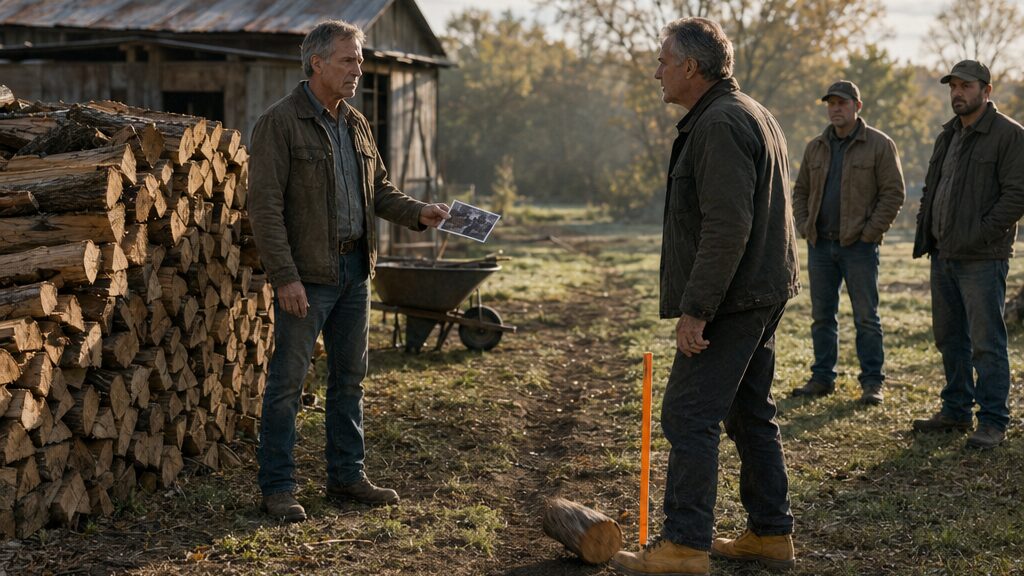
Jonathan held up the photograph.
“Then who’s this?”
For a moment nobody moved.
The image showed the edge of Jonathan’s shed and the wood stack under the security light. A dark figure pushed a wheelbarrow away from the oak.
The face was not clear.
The boots were.
Bright yellow.
Donald’s eyes found them immediately.
Jonathan saw the recognition before Donald hid it.
One neighbor leaned closer.
“That your wheelbarrow?”
Jonathan nodded.
Donald said, “That could be anybody.”
Jonathan turned the photograph slightly.
“Could.”
Donald looked relieved too quickly.
Jonathan continued.
“Except this was taken at two-oh-six Wednesday morning.”
The relief disappeared.
Jonathan took out a second still.
“And this one was Friday at two-eleven.”
Then a third.
“Sunday at one-fifty-eight.”
The second neighbor looked down at Donald’s boots.
Donald noticed.
His face went dark.
“You been filming my property?”
“No.”
“You point a camera at my place?”
“It points at my shed.”
“That line’s not where you think it is.”
Jonathan almost answered immediately.
Instead he watched Donald.
The accusation had shifted.
Not the wood.
The line.
“You said I stole from you Tuesday night,” Jonathan said.
“I said you’ve been taking what isn’t yours.”
“From where?”
Donald pointed toward the strip beside the stake.
“There.”
Jonathan looked at the two neighbors.
Neither seemed comfortable anymore.
Good, he thought, then disliked himself for thinking it.
He had not brought the photograph to embarrass Donald.
At least that was what he had told himself.
Yet there was satisfaction in the silence.
That mattered too.
Jonathan lowered the still.
“The camera shows you taking wood from my stack.”
Donald stepped forward.
“It shows somebody moving wood.”
“In your boots.”
“Half the county owns yellow boots.”
“With my wheelbarrow?”
Donald’s mouth worked before the answer came.
“You leave that thing outside.”
Jonathan nodded.
“That’s true.”
“And you sell wood.”
“That’s true too.”
One neighbor looked surprised.
Donald seized on it.
“See?”
Jonathan felt the scene slipping into exactly what Donald wanted: scattered facts without shape.
He turned to the neighbor.
“I sold Stephen Hall cordwood last winter. He picked it up here.”
Donald said, “At night.”
“After feeding.”
“Convenient.”
Jonathan ignored him.
The printed image trembled slightly in his hand. Not from fear. From anger he had kept compressed too long.
He lowered it.
“Donald, did you take wood from this stack?”
Donald stared at him.
“No.”
The answer came cleanly.
That was worse than Jonathan expected.
Not because he believed it.
Because Donald had been given a chance to step back privately inside a public moment, and he had chosen to keep going.
Jonathan put the photograph away.
“All right.”
Donald blinked.
“That it?”
“For the wood? For now.”
One of the neighbors said, “Jonathan, you’ve got him on camera.”
Jonathan looked toward the strip.
“No. I’ve got somebody on camera. Donald says it isn’t him.”
Donald’s mouth twitched, almost triumphant.
Then Jonathan added, “So I’ll figure out what matters more.”
Donald’s expression changed.
“What’s that supposed to mean?”
Jonathan walked toward the orange stake.
The others followed with their eyes.
He pointed to the flattened strip running from the wood stack toward Donald’s property.
“Why this way?”
Donald said nothing.
“Three nights,” Jonathan continued. “Same route. Whoever it was didn’t take the shortest way home. They crossed here.”
“That’s access.”
Jonathan looked back at him.
“Access to what?”
“My ground.”
“You just said this was yours?”
“It’s always been used.”
“That isn’t the same thing.”
Donald’s face reddened again, but the anger had changed character.
This was not the bluster of a man accusing someone of stealing firewood.
This was defensive.
“You don’t know what you’re talking about.”
“Probably not.”
Jonathan meant it.
The online parcel map had already shown him enough to know he did not understand the old arrangement.
Donald apparently understood that too.
“You’ve been acting like that strip’s yours for years,” Donald said.
Jonathan glanced at the stake.
“I’ve been acting like I didn’t care enough to argue.”
“Same difference after long enough.”
One neighbor murmured, “Not necessarily.”
Donald turned on him.
“You stay out of it.”
The neighbor raised both hands.
“I’m standing in his yard. Hard to pretend I’m not here.”
Jonathan felt the atmosphere tighten.
He did not want witnesses anymore.
He wanted clarity.
“Why did you request an updated parcel map?”
Donald went still.
It lasted less than a second.
But Jonathan saw it.
So did one of the neighbors.
Donald recovered.
“That’s my business.”
“It is.”
Jonathan nodded.
“But it’s interesting timing.”
Donald stepped closer.
“You’ve got a camera picture you think makes you clever. Fine. But if you’re going to start drawing lines, you better know what you’re drawing.”
Jonathan said nothing.
Donald pointed toward the lane.
“That strip has been used from my side longer than you’ve owned this place.”
“I inherited this place.”
“You know what I mean.”
“I know what you’re saying.”
“You let me cross it.”
“Yes.”
“You let the owner before me cross it.”
“My father did.”
Donald spread his hands.
“So don’t act shocked now.”
Jonathan looked at the orange stake and felt something unpleasant settle into place.
For years he had treated each small crossing as separate.
A wet spring.
A stuck trailer.
A brush pile.
A moved gate.
A favor.
Donald did not see separate favors.
He saw history.
Maybe paperwork saw something else entirely.
Jonathan gathered the photographs and tucked them back inside his jacket.
Donald mistook the motion for retreat.
His shoulders loosened.
Then he gave Jonathan a thin smile.
“You should read the old easement before you get proud.”
The yard went quiet.
Jonathan watched him walk back across the disputed strip.
Donald stepped over the orange stake exactly as he had before.
This time Jonathan did not see a man ignoring a marker.
He saw a man who believed the marker did not matter.
Chapter 4: The Easement Was Not What Either Man Claimed
“Both of you have been describing this wrong.”
Heather Lewis said it without looking up from the county record.
Jonathan sat across from her at a narrow desk in the records office, his jacket folded over one knee. Between them lay three copies of the same old easement, one handwritten transfer note, and a newer parcel map Heather had pulled from a cabinet in the back.
Jonathan leaned forward.
“Wrong how?”
Heather traced a line with the capped end of a pen.
“You keep calling this a boundary agreement.”
“That’s what my father called it.”
“And Donald calls it permanent access.”
“That’s what he told me.”
Heather finally looked at him.
“It’s neither.”
That stopped him.
The office around them was quiet except for a copier working somewhere behind a wall. Jonathan had expected to learn which one of them was right. He had not expected Heather to tell him they were both wrong.
She rotated the oldest document toward him.
“This was recorded thirty-seven years ago. It gives the owner of the Wright parcel seasonal access across a defined strip when the lower route is impassable.”
Jonathan read the typed language again.
Seasonal access.
Agricultural necessity.
Temporary passage.
The words looked more specific now that someone was saying them aloud.
“So he can cross.”
“Under conditions.”
“But he doesn’t own it.”
“No.”
“And he can’t just use it whenever he wants.”
Heather shook her head.
“Not from what’s recorded here.”
Jonathan looked at the map.
The orange survey stake on his land suddenly felt less like an opinion.
Heather added, “But before you get too comfortable, you’ve got a problem too.”
Jonathan looked up.
“What problem?”
“Use.”
“I let him cross.”
“Exactly.”
“That doesn’t make it his.”
“No. But repeated use creates arguments. Especially when nobody documents why it’s being allowed.”
Jonathan leaned back.
There it was again.
His own silence, appearing in another form.
He thought of years of small moments that had never seemed worth discussing. Donald cutting through when a culvert washed out. Donald dragging fence posts across the strip. Donald moving a trailer through during spring mud.
Jonathan had never written anything down.
Never said temporary.
Never said this one time.
Never even said ask first.
Heather tapped the map.
“If this stays neighbor-to-neighbor, you can probably fix it with a proper survey and a written use agreement. If it turns into a formal dispute, everybody starts paying people to argue over what they remember.”
Jonathan gave a tired smile.
“That sounds expensive.”
“It usually is.”
He looked down again.
“Donald said the strip had been used longer than I owned the farm.”
“It probably has.”
“So why isn’t that enough?”
Heather considered him for a moment.
“Because use isn’t ownership. Permission isn’t necessarily a permanent right. And a limited recorded easement isn’t the same as whatever people got used to doing afterward.”
Jonathan nodded slowly.
That was the small piece he had needed.
Not victory.
Shape.
A fact with edges.
Heather turned to her computer.
“There’s something else.”
She typed Donald’s name into the records system.
Jonathan watched a list of entries appear.
The request for the updated parcel map was there.
Heather clicked it.
“Requested nine days before your dispute?”
“Yes.”
She frowned.
“Did he tell you why?”
“No.”
She opened another screen.
Then another.
Jonathan noticed her expression change.
“What?”
Heather did not answer immediately.
She printed a page.
The printer beside her desk woke with a mechanical hum.
When the sheet emerged, she set it in front of Jonathan.
It was an application for a parcel split.
Donald Wright’s name appeared at the top.
Jonathan read it twice.
“He’s selling?”
“Looks like he’s trying to divide off the east portion.”
Jonathan pictured Donald’s property.
The polished lawn.
The lower acreage.
The narrow route that became soft after heavy rain.
Then the strip between their land.
“The piece he wants to sell needs access.”
Heather nodded cautiously.
“It has access on paper elsewhere. But whether that route works well year-round is another question.”
Jonathan looked at the easement again.
“And this strip makes the parcel easier to sell.”
“I didn’t say that.”
“You didn’t have to.”
Heather folded her hands.
“I’m going to be careful here. I can tell you what the records say. I can’t tell you what Donald intends.”
Jonathan appreciated that.
Intent was the part he had been trying to guess since the yellow boots appeared on his screen.
He slid the parcel-split application closer.
“Did he request the easement too?”
Heather searched again.
Her eyebrows lifted slightly.
“Yes.”
“When?”
She turned the screen.
Two days before the first night recorded by Jonathan’s camera.
The room seemed smaller.
Donald had pulled the parcel map.
Then the easement.
Then someone in Donald’s clothes had begun pushing Jonathan’s firewood repeatedly across the same strip.
Then Donald had accused Jonathan of theft.
Jonathan sat still.
The pattern no longer felt accidental.
Heather studied him.
“You all right?”
“Yeah.”
“You don’t look like it.”
“I’m thinking.”
“That can be dangerous around land records.”
Jonathan almost laughed.
Instead, he asked for copies.
By early afternoon he was back at the farm with the documents tucked inside a plain folder.
He did not go to Donald’s house.
That surprised him too.
Two days earlier he would have wanted to walk over immediately, put the parcel application in Donald’s hand, and watch him explain it.
Now Jonathan wanted to see the ground.
He started at the orange stake.
From there he followed the strip downhill.
The old fence drifted several feet off the surveyed line before curving back. The grass showed tire compression in places Jonathan had stopped noticing years ago.
Near Donald’s side, a pair of older ruts had hardened beneath weeds.
Jonathan stood in them.
He remembered Donald using that route with a feed trailer one wet March. Before that, Donald’s previous owner had occasionally hauled equipment through.
His father had allowed it.
Jonathan had continued it.
No one had treated it like a legal declaration.
But habits accumulated.
He looked back toward the firewood stack.
The route from the camera footage now made sense in a darker way.
If someone wanted photographs, tracks, or simply a history they could point to later, carrying things across the strip repeatedly made the use look ordinary.
Jonathan could not prove that was Donald’s purpose.
Not yet.
But he could no longer pretend the wood was the whole problem.
A truck slowed on the county road.
Donald’s.
It did not turn in.
Donald looked toward Jonathan, then toward the orange stake.
He kept driving.
Jonathan watched until the truck disappeared.
He returned to the house and laid the county records beside Donald’s theft notice.
The accusation suddenly looked less like anger.
More like pressure.
If Jonathan accepted the idea that wood had been taken from Donald’s side, he would also be accepting something about where Donald’s side began.
Jonathan had nearly done exactly that by refusing to argue.
Late that afternoon he called the county assessor’s office and asked what he needed to arrange a professional boundary marking before repairing fence.
Then he called Heather again.
“One question.”
“All right.”
“If Donald objects?”
“He can object to your interpretation. He can’t stop the county from showing what the recorded documents say.”
Jonathan looked toward the lane.
“And if I’ve been letting him cross for years?”
“That’s where this stops being simple.”
He expected as much.
Heather continued.
“But Jonathan?”
“Yeah?”
“The application he filed isn’t just a map request.”
Jonathan straightened.
“What do you mean?”
“The parcel split lists continued access assumptions.”
His hand tightened around the phone.
“Across my strip?”
“It references existing agricultural access. It doesn’t define it clearly.”
Jonathan closed his eyes for a second.
Donald had not merely been thinking about the boundary.
He had already put the idea into paperwork connected to a sale.
“How far along is it?”
“Not final.”
“Can I get a copy?”
“Yes.”
Heather paused.
“You should.”
An hour later the document arrived by email.
Jonathan opened it at the kitchen table.
There, buried beneath acreage measurements and parcel descriptions, was the line Heather had warned him about.
Existing agricultural access to remain available.
Jonathan read it once.
Then again.
Donald had not needed to move the survey stake.
He had been trying to make the old habit sound permanent.
Chapter 5: The Boundary Jonathan Let Slide for Years
The rusted gate hook came loose in Jonathan’s hand.
He stood beside the fence line holding it, dirt packed beneath his fingernails, while an old memory returned with embarrassing clarity.
Donald had installed it.
Not secretly.
With Jonathan standing right there.
Seven years earlier, Donald had needed to move a livestock trailer through the strip after spring rain made his lower entrance useless. The old gate had sagged. Donald had brought a hook, a length of chain, and a drill.
“You mind if I make this easier?” he had asked.
Jonathan had shrugged.
“Go ahead.”
That had been the entire agreement.
No date.
No limit.
No explanation.
Now the hook was red with rust, but the hole Donald drilled into the post remained clean enough to see.
Jonathan set the metal piece on the tailgate of his truck.
A small object.
A large mistake.
He spent the morning walking the fence with a notebook.
The list became longer than he expected.
Temporary gate moved five feet.
Brush cleared on Donald’s side, then partly on Jonathan’s.
Trailer crossings.
One winter hay delivery.
Fence posts stored beside the lane.
A drainage rut Donald filled without asking.
Each event had seemed harmless when it happened.
Most of them had been harmless.
That was what bothered Jonathan.
Donald had not begun by behaving like a man trying to take land.
He had behaved like a neighbor.
And Jonathan had behaved like one too.
The trouble was that neither man had ever marked the point where neighborliness ended and expectation began.
By noon Jonathan drove to the feed store for mineral blocks.
He almost turned around when he saw Stephen Hall’s pickup outside.
Avoiding the conversation would have been easy.
That recognition irritated him enough to make him park.
Inside, the feed-store owner was cutting twine from a pallet. Stephen stood near the counter with a paper cup of coffee.
He looked uncomfortable the moment Jonathan entered.
Jonathan paid for the mineral blocks first.
Then he turned.
“Stephen.”
“Jonathan.”
“You got a minute?”
Stephen glanced toward the feed-store owner.
“Outside might be better.”
They walked to the loading area.
Stephen leaned against his truck.
“I figured you’d come around eventually.”
“That makes one of us.”
Stephen winced.
Jonathan regretted the sharpness but did not take it back.
“You told Donald I sold you firewood.”
“Yes.”
“You told anybody else?”
Stephen looked down at his coffee.
“Not exactly.”
Jonathan waited.
Stephen sighed.
“He said you’d been hauling wood off the boundary. I said I’d bought wood from you before.”
“That’s not the same thing.”
“I know.”
“Did you tell him that?”
“No.”
Jonathan looked away.
Across the parking lot, a forklift backed out of a shed.
Its warning beep filled the silence between them.
Stephen said, “I didn’t want in the middle.”
Jonathan laughed once, without humor.
“Neither did I.”
Stephen looked at him.
Jonathan continued, “That’s part of why we’re here.”
Stephen’s expression shifted.
“I wasn’t trying to hurt you.”
“I know.”
“And when people asked, I didn’t say you stole anything.”
“What did you say?”
Stephen hesitated.
“I said I’d seen you moving wood before.”
Jonathan stared at him.
“That’s all it takes.”
Stephen nodded slowly.
“I see that now.”
The admission took some of Jonathan’s anger with it.
Not because it fixed anything.
Because Stephen was doing something Jonathan himself had avoided for years: naming his part without dressing it up.
Stephen asked, “You got something on Donald?”
Jonathan thought of the footage.
“The camera shows somebody taking my wood.”
“Somebody?”
“Donald says it isn’t him.”
Stephen rubbed the back of his neck.
“He still wearing those yellow boots?”
Jonathan gave him a look.
Stephen almost smiled, then stopped.
“What are you going to do?”
“Mark the boundary properly.”
“That’ll go over well.”
“It doesn’t have to go over well.”
Stephen studied him.
“That doesn’t sound like you.”
“No.”
Jonathan loaded the mineral blocks and drove home.
The county assessor had left a message while he was gone. Jonathan returned the call and arranged for the existing pins and recorded line to be located before he repaired the fence.
He expected relief.
Instead, he felt exposed.
Every official step made the conflict more real.
His father’s voice seemed to live in the habits of the place.
Don’t turn everything into a feud.
Jonathan had followed that advice so faithfully that he had never examined what it actually meant.
His father had settled disagreements.
Jonathan avoided them.
Those were not the same thing.
Near dusk, Jonathan drove two fresh fence posts into the ground well inside the recorded line, leaving the old uncertain section untouched until the markings were confirmed.
The old gray firewood from last year sat behind him. New oak rested beside it, pale and clean.
He had never noticed before how different the stacks looked.
One weathered by time.
One still raw.
His phone buzzed.
An email notification.
County land-use office.
Jonathan opened it.
Formal objection received regarding proposed fence work adjacent to recorded access.
Donald had filed it that afternoon.
Jonathan read the message standing beside the post driver.
Donald was no longer arguing in the yard.
He had made it official.
For several seconds Jonathan felt exactly what his old habits had always tried to prevent: the sense that a neighbor dispute had crossed into something larger, expensive, and difficult to undo.
His first instinct was to pull the new posts back out.
Wait.
Let the county calm things down.
Maybe talk to Donald after a week.
Jonathan stared at the two posts.
Then he thought of Donald’s typed theft notice.
The camera footage.
The parcel-split application.
Existing agricultural access to remain available.
If Jonathan backed away now, silence would become part of the record again.
He left the posts standing.
The next morning, a plain county vehicle stopped at the lane.
The assessor walked the line with Jonathan, checking measurements against the recorded points.
At one location, the orange stake was several inches from the actual pin beneath the soil.
Jonathan watched the metal detector sound.
The assessor dug carefully and exposed the old iron marker.
“There.”
Jonathan crouched beside it.
The pin was weathered but solid.
Donald’s tire tracks crossed directly over Jonathan’s side of the line.
Not by much.
Enough.
Jonathan did not feel triumphant.
He felt tired.
The assessor said, “This establishes the recorded boundary. Doesn’t answer every access question.”
“I know.”
“Donald’s objection means you may want the access terms clarified in writing before you rebuild anything that affects passage.”
Jonathan nodded.
The old version of him would have heard that as a reason to stop.
This time he heard it as instructions.
After the assessor left, Jonathan carried the rusted gate hook from his truck and set it beside the exposed iron pin.
Permission.
Boundary.
Two different things he had spent years treating as one.
His phone rang again.
Donald.
Jonathan answered.
“You dragging the county into this now?”
Jonathan looked at the pin.
“You already did.”
“I filed an objection because you’re trying to close access.”
“I’m trying to define it.”
“We never needed that before.”
Jonathan almost said, Exactly.
Instead he said, “We do now.”
“You want lawyers fighting over twenty feet of grass?”
“No.”
“Then leave it alone.”
Jonathan looked toward the woodpile.
“That’s what I’ve been doing.”
Donald was quiet.
Jonathan continued.
“It didn’t work.”
He ended the call before either of them turned it into another argument.
That afternoon Jonathan made three calls: one about the fence, one about drafting a limited access agreement, and one to Heather about attaching the correct map to it.
For the first time since Donald called him a thief, Jonathan stopped trying merely to defeat the accusation.
He began preparing to end the ambiguity that had made the accusation useful.
Chapter 6: What Donald Was Really Trying to Protect
The missing oak came back before sunrise.
Jonathan saw it from the kitchen window.
A crooked stack had appeared beside the lane near the orange stake, chest-high at one end and collapsing at the other. Several pieces still had the distinctive pale cuts from his splitter.
No note.
No knock on the door.
Just wood.
Jonathan put on his jacket and walked out.
The air smelled of damp leaves and cold soil.
He counted the pieces.
Not all of them were there.
Enough to make the message obvious.
Donald was returning what he still insisted he had never taken.
Jonathan crouched beside the stack.
One oak round had the wedge-shaped splitter scar he recognized from the camera footage.
He turned it over with both hands.
There was mud embedded in the bark.
A faint yellow smear marked one edge.
Jonathan stood.
Across the boundary, Donald’s truck was parked beside his shed.
Donald was outside.
Watching.
Jonathan left the wood where it was and walked toward the lane.
Donald met him halfway.
“You got your wood.”
“Some of it.”
Donald looked past him.
“You gonna count every stick?”
“Yes.”
Donald shook his head.
“That’s what this has become?”
“No.”
Jonathan pointed toward the orange stake.
“That’s what this has become.”
Donald’s expression hardened.
Jonathan had brought a folder under his arm.
Camera stills.
Parcel map.
Recorded easement.
Drafted access terms.
He did not open it yet.
Donald said, “I’m trying to end this.”
“So am I.”
“Then take the wood and stop messing with the access.”
There it was.
Jonathan let the sentence sit between them.
“You’re connecting the two.”
“I’m being practical.”
“You return what came from my property, and I pretend your access is whatever you say it is.”
Donald’s jaw tightened.
“You’ve let me use that strip for years.”
“I have.”
“So why change it now?”
Jonathan looked at him.
“Because now you’re trying to sell based on it.”
Donald’s face changed.
Not much.
Enough.
Jonathan took out the parcel-split application.
Donald did not reach for it.
“You went digging.”
“I went reading.”
“My property sale is none of your business.”
“Your sale isn’t.”
Jonathan tapped the line on the page.
“This is.”
Donald looked toward his house.
For the first time since the dispute began, he seemed older than angry.
“It’s just access language.”
“It’s vague access language.”
“You know what it means.”
“I know what you want it to mean.”
Donald’s eyes narrowed.
“You think I’m stealing twenty feet of grass?”
“I think you want whoever buys that parcel to believe they can use my ground whenever they need it.”
Donald stepped closer.
“You’ve never stopped me.”
Jonathan nodded.
“That’s my mistake.”
The answer seemed to unsettle Donald more than denial would have.
Jonathan continued.
“I should’ve put terms on it years ago.”
Donald looked away.
Movement near the house caught Jonathan’s eye.
Donald’s adult daughter came down the porch steps carrying a cardboard box. She stopped when she saw the two men.
Donald said sharply, “Not now.”
She ignored him.
“Did you give it back?”
Donald’s shoulders stiffened.
Jonathan looked at her.
She glanced at the wood stack.
“Most of it?”
Donald said, “Go inside.”
“I’m loading the office files.”
Jonathan said nothing.
Her eyes moved to the parcel-split application in his hand.
Understanding passed across her face.
“You told him?”
“No,” Jonathan said.
“I found it.”
Donald turned toward her.
“That’s enough.”
She set the box on the hood of Donald’s truck.
“He’s going to find out anyway.”
Donald’s voice dropped.
“Stay out of this.”
She looked tired rather than intimidated.
“You made everybody part of it when you started telling people he stole from you.”
Donald stared at her.
Jonathan felt suddenly intrusive.
This was no longer a boundary argument performed for neighbors.
It was something inside Donald’s household.
Jonathan started to step back.
Then Donald’s daughter said, “The sale has to go through.”
Donald closed his eyes briefly.
“Stop.”
She did.
But the sentence had already changed the ground beneath the conversation.
Jonathan looked at Donald.
“Why?”
Donald did not answer.
His daughter picked up the box again.
“The place costs more than it brings in now.”
Donald’s face went hard.
“That’s private.”
“Yes.”
She looked at Jonathan.
“And it doesn’t excuse what he did.”
Then she carried the box toward her vehicle.
Jonathan waited until she was out of hearing.
Donald stared at the lane.
“Taxes went up.”
Jonathan said nothing.
“Roof needed work. Lower field hasn’t paid for itself in years. I’m not losing the whole place because one piece sits wrong.”
The words came reluctantly.
Not confession.
Explanation.
Donald nodded toward the strip.
“That access makes the split clean.”
“For a buyer.”
“Yes.”
“And if I dispute it?”
Donald finally looked at him.
“Then they start asking questions. Appraisers start cutting value. Buyer starts wondering what else is wrong.”
Jonathan understood.
Not sympathy exactly.
Recognition.
Donald had convinced himself that Jonathan’s informal permission was something he had earned through years of use. Once money tightened, that belief became convenient. Then necessary.
And somewhere between necessary and threatened, Donald had decided pressure was justified.
Jonathan looked at the returned oak.
“Why the wood?”
Donald’s face closed again.
“You already decided that.”
“No. I know you moved it. I’m asking why.”
Donald said nothing for several seconds.
Then, “You started stacking closer to the strip.”
Jonathan waited.
“People see a woodpile, equipment, posts,” Donald said. “Starts looking like you’re taking that whole edge back.”
“It is my edge.”
“I know what the map says.”
“Then why accuse me?”
Donald kicked at the gravel.
“Because you’d back off.”
The simplicity of it landed harder than shouting would have.
Jonathan felt anger rise.
Not because Donald had fooled him.
Because Donald had understood him.
He had counted on Jonathan choosing quiet over conflict.
Donald added, “You always do.”
Jonathan looked at him for a long moment.
“That part’s over.”
Donald breathed out.
“All right. Fine. I brought the wood back.”
“Most of it.”
“I’ll pay for the rest.”
“And the accusation?”
Donald’s mouth tightened.
“What about it?”
“You told people I stole from you.”
“I was angry.”
“You printed a notice.”
Donald did not answer.
Jonathan opened the folder and removed the drafted agreement.
“This keeps the seasonal access you actually have.”
Donald did not take it.
“It defines when it can be used, what for, and where.”
“You want me asking permission every time?”
“For anything outside what’s recorded, yes.”
Donald laughed bitterly.
“So I return the wood and you tighten the rope.”
“No.”
Jonathan placed the pages on the hood of Donald’s truck.
“I’m putting the rope where it should’ve been years ago.”
Donald looked down at the agreement.
Then back at Jonathan.
“I’ll give you every stick back if you leave the access alone.”
Jonathan felt the temptation.
Take the easy victory.
Get the wood.
Get Donald off his back.
Let the strip stay vague.
It was exactly the bargain the old Jonathan would have accepted.
He shook his head.
“The wood and the boundary are separate.”
“They don’t have to be.”
“They do now.”
Donald’s expression hardened again.
“You trying to ruin my sale?”
“No.”
“Sure looks like it.”
“I’m trying to make sure your sale doesn’t sell something that isn’t yours.”
Donald stared at him.
Jonathan could have shown him the camera stills then.
Could have threatened the sheriff.
Could have promised to tell every person Donald had spoken to.
The thought carried a sharp satisfaction.
He let it pass.
“I’m not putting the footage online. I’m not going door to door.”
Donald’s eyes narrowed.
“Why not?”
“Because I want this finished.”
Jonathan tapped the agreement.
“Not performed.”
For the first time, Donald had no quick answer.
Jonathan turned toward home.
Behind him Donald called, “And if I don’t sign?”
Jonathan stopped.
He looked back at the returned firewood stacked awkwardly beside the orange marker.
“Then we let the county records, the survey, and whatever formal process comes next define it.”
Donald’s face tightened.
Jonathan added, “But I’m not leaving it vague again.”
He walked back across the line.
This time he did not step around the orange stake.
He stopped beside it, looked once at Donald, and then continued toward his farm while the drafted agreement remained on the hood of Donald’s truck.
Chapter 7: The Line They Finally Agreed to See
Donald arrived without the yellow boots.
That was the first thing Jonathan noticed.
He came up the shared lane just after eight wearing brown work shoes and carrying the folded access agreement Jonathan had left on his truck two days earlier.
He stopped beside the orange stake.
“I read it.”
Jonathan was repairing a hinge on the old gate. He set the wrench down.
“And?”
Donald held up the pages.
“You made this tighter than it needs to be.”
Jonathan wiped his hands on a rag.
“It says what the easement says.”
“It says I can use the strip when the lower route is impassable.”
“That’s what the recorded language says.”
“It says agricultural access.”
“Yes.”
“It says I notify you first.”
“For anything outside an emergency.”
Donald looked toward the lower field.
“You know how ridiculous that sounds? I’ve crossed here for years without calling anybody.”
Jonathan nodded.
“I know.”
Donald frowned, as if the agreement itself had been less irritating than Jonathan’s refusal to argue.
“You could leave that part the way it was.”
Jonathan looked at him.
“Like before?”
Donald did not answer immediately.
“Informal.”
“That’s what before was.”
“It worked.”
Jonathan glanced toward the awkward stack of returned firewood beside the lane.
“No. It lasted.”
Donald followed his eyes.
The distinction landed.
For a few seconds they stood without speaking.
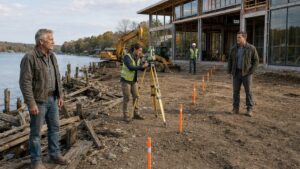
The county had marked the boundary two days earlier with fresh temporary flags. The line was not dramatic. No wall. No trench. No fence yet.
Just stakes, measurements, and the narrow certainty of where one parcel stopped and the other began.
Donald unfolded the agreement.
“What if the buyer needs regular access?”
“Then the buyer negotiates regular access.”
“With you.”
“With whoever owns my parcel.”
Donald shook his head.
“That uncertainty knocks value off mine.”
Jonathan picked up the wrench again, then set it back down without using it.
“I’m not going to make my land less certain so yours looks more certain.”
Donald’s jaw tightened.
Jonathan could see the argument forming.
For once, Donald let it go.
He looked at the document instead.
“I’ll sign the seasonal terms.”
Jonathan waited.
“But I want something from you.”
“What?”
Donald folded the papers once.
“You don’t take those camera pictures around town.”
Jonathan said nothing.
Donald continued.
“No feed store. No county meeting. No posting them anywhere.”
“You think that’s what I want?”
“I don’t know what you want.”
That was fair.
For several days Jonathan had not been entirely certain either.
There had been moments, especially after the theft notice appeared, when he imagined pinning Donald’s photograph beside the accusation and letting everybody draw their own conclusion.
He imagined the rural mail carrier seeing it.
Stephen.
The neighbors.
Every person Donald had spoken to.
There would have been satisfaction in that.
Maybe too much.
Jonathan said, “You told people I stole from you.”
Donald stared at the gravel.
“I know.”
“You used Stephen’s name to make it sound like he backed you.”
“I shouldn’t have.”
“You put a notice on my building.”
Donald’s shoulders lowered slightly.
“I know.”
Jonathan had been waiting for those words.
When they came, they did not feel nearly as powerful as he had expected.
He looked toward the wood.
“I’m not pretending none of that happened.”
Donald raised his eyes.
“What does that mean?”
“It means you correct it.”
“With who?”
“Anyone you told.”
Donald gave a bitter laugh.
“You want me driving house to house?”
“I want you to use the same effort correcting it that you used spreading it.”
Donald looked away.
Jonathan continued.
“And the missing wood.”
“I brought it back.”
“Most of it.”
Donald reached into his jacket pocket.
He took out an envelope.
“I counted what I couldn’t find.”
Jonathan did not reach for it.
“How much?”
“Four hundred.”
Jonathan almost smiled.
“That’s more than the missing pieces are worth.”
Donald shrugged.
“Then call the rest inconvenience.”
Jonathan took the envelope.
He did not open it.
Donald watched him.
“That enough?”
“For the wood.”
“And the pictures?”
Jonathan looked at the agreement in Donald’s hand.
“If you sign the actual access terms and withdraw your objection to the fence, I don’t have a reason to make a spectacle out of you.”
Donald’s face tightened at the word spectacle.
Jonathan recognized the old pride there.
But Donald nodded.
“All right.”
They drove separately to the county office that afternoon.
Heather Lewis met them at a counter near the records room. She read the final version carefully, checking the map attachment twice.
“This doesn’t change the existing easement,” she said. “It clarifies how you two are agreeing to handle use going forward.”
Donald leaned on the counter.
“And the parcel split?”
Heather looked at him.
“That gets reviewed on its own terms.”
Donald exhaled.
Jonathan noticed he looked tired.
Not defeated.
Just tired.
Heather pointed to the map.
“The temporary survey markers match the recorded boundary. Any fence work needs to respect the access corridor described here.”
Jonathan nodded.
Donald asked, “And if a buyer wants more?”
Heather slid the agreement back toward him.
“Then that’s a separate negotiation.”
Donald looked at Jonathan.
There it was one last time.
The invitation to keep things loose.
Make the uncertainty somebody else’s future problem.
Jonathan held his gaze.
“No.”
Donald gave a short nod.
Then he signed.
Jonathan signed after him.
Heather witnessed the signatures and made copies.
The whole thing took less than ten minutes.
Years of vague assumptions reduced to several pages and two names written in blue ink.
Outside the courthouse, Donald stopped beside Jonathan’s truck.
“I withdrew the objection this morning.”
Jonathan looked at him.
“And the theft story?”
Donald rubbed his jaw.
“Talked to Stephen.”
“That’s one.”
Donald’s eyes hardened briefly.
Then he nodded.
“I know.”
Jonathan opened his truck door.
Donald said, “You really weren’t going to post those pictures?”
Jonathan looked back at him.
“No.”
“Why?”
Jonathan considered giving him the easy answer.
Because I’m better than that.
He did not believe it.
Instead he said, “Because I came too close to enjoying it.”
Donald looked surprised.
Jonathan continued.
“That’s not how I want to settle things.”
Donald glanced toward the courthouse.
“You think this is settled?”
“The wood is.”
“The access?”
“It’s defined.”
“That’s not the same as settled.”
Jonathan nodded.
“No. But it’s a start.”
Donald stood there another second, then walked to his truck.
They did not shake hands.
Jonathan was glad.
A handshake would have made the moment cleaner than it was.
The following week, the fence repair began.
Jonathan set the new posts fully inside his recorded boundary, leaving the seasonal corridor unobstructed exactly as agreed.
Stephen Hall stopped by one afternoon while Jonathan was stretching wire.
He climbed out of his pickup holding two coffees.
“I talked to the feed-store owner.”
Jonathan took one.
“About what?”
Stephen gave him a look.
“You know what.”
Jonathan waited.
“I told him I never saw you take anything off Donald’s property. Told him I should’ve said that the first time Donald brought your name up.”
Jonathan nodded.
“Thank you.”
Stephen looked toward the new fence.
“You two done fighting?”
“I don’t know.”
Stephen laughed.
“Fair answer.”
He studied the markers.
“Looks different.”
Jonathan looked along the fence.
It did.
Not because the line had moved.
Because he had finally stopped pretending it did not matter.
The last of the returned firewood still sat near the orange stake.
That evening Jonathan moved it.
Piece by piece.
He could have used the tractor bucket, but he did not.
He carried each round to the stack beneath the shed roof and placed it with the rest.
Some pieces were damp.
Some had fresh scratches from being handled twice.
One still carried the faint yellow smear from Donald’s boot.
Jonathan turned that side inward.
By the time the light began to fade, the stack was straight again.
All of it rested fully inside Jonathan’s marked property.
He stood back and looked at the line of oak.
For years he had believed peace meant leaving enough space for everyone to do what they needed without forcing hard conversations.
Sometimes that was kindness.
Sometimes it was fear wearing work clothes.
He could see the difference now.
Across the boundary, Donald came out of his shed carrying a length of hose.
He noticed Jonathan.
Neither man waved.
Donald looked at the new fence, then at the marked access opening left exactly where the agreement required it.
After a moment, he gave one small nod.
Jonathan returned it.
That was all.
No apology big enough to erase the accusation.
No friendship restored overnight.
No cheering neighbors.
Just two men standing on opposite sides of a line they had finally agreed to see.
Jonathan picked up the final piece of oak from beside the orange stake.
He carried it to the stack and set it firmly in place.
The story has ended.