The Apron on the Champagne Table
Part I — The Doorway
Lena Vale should not have looked through the doorway, but the whole room had gone quiet for Adrian Cross, and her heart had never learned how to look away from him.
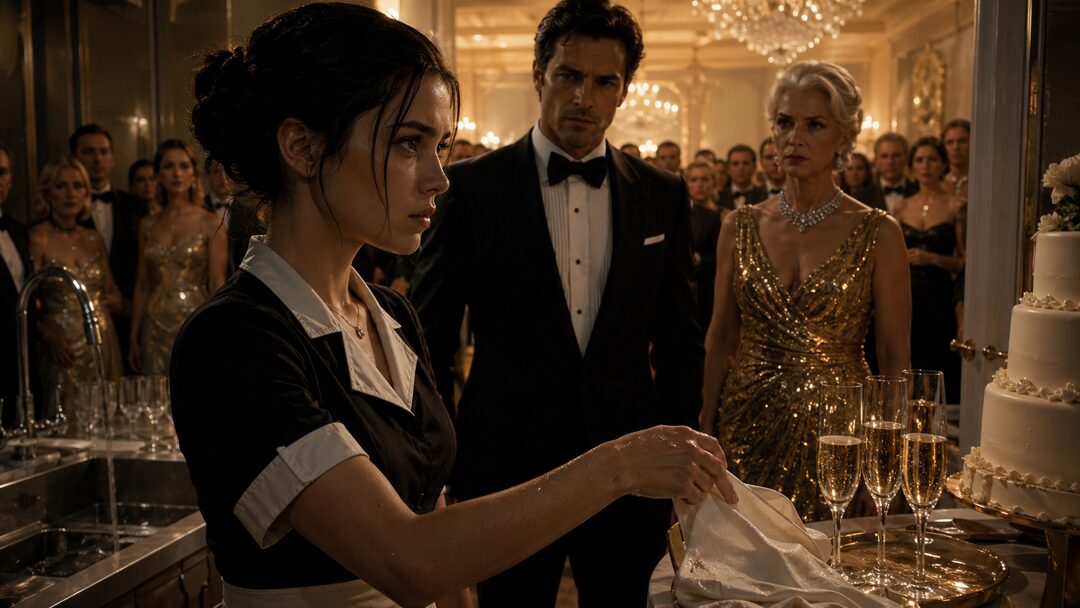
She stood at the stainless-steel sink with her sleeves pinned above her wrists, rinsing champagne flutes beneath a running tap. Water struck crystal in a bright, nervous rhythm. Beyond the service kitchen, through the open doorway, the Cross ballroom burned with chandeliers, gold walls, white flowers, and the kind of laughter people used when money had made them safe from ordinary shame.
Lena was not safe from shame.
She wore it neatly.
Black dress. White collar. White apron tied hard enough at the waist to leave a mark. Dark hair pinned tight. Small gold necklace hidden under her uniform where no one could see it.
Especially not Vivian Cross.
At the center of the ballroom, Adrian stood in a tuxedo beside Celeste Whitmore, whose pale silk gown made her look carved out of expensive light. Guests lifted their glasses. Someone said something about legacy. Someone else said something about two families becoming stronger together.
Lena turned a champagne flute in her wet hand until the rim caught the chandelier glow.
Adrian had told her three weeks ago there would be no engagement.
Not with Celeste.
Not with anyone.
He had said it in the back hallway outside the wine cellar, his forehead against Lena’s, one hand braced on the wall beside her head like he was holding up the whole house.
“I won’t do it,” he had whispered. “I swear to you.”
Lena had wanted to believe him badly enough to make it hurt.
Now he was smiling as Celeste’s father clapped him on the shoulder.
Now the house was applauding.
Now Lena was the girl in the kitchen again.
The tap kept running. She forgot to turn it off.
“Careful,” one of the junior servers murmured behind her. “You’ll crack that.”
Lena looked down.
Her fingers had tightened around the flute.
She loosened them immediately and set the glass on the drying rack. Her hands did not shake. She was proud of that. A person could lose many things and still keep the discipline of steady hands.
Then Adrian looked toward the doorway.
Not casually.
Not with the distracted glance of a man searching for a server.
He saw her.
For one suspended second, all the gold light of the ballroom seemed to narrow into his eyes. His smile vanished. His face changed with such force that Lena almost stepped back from the sink.
It was not indifference.
Indifference would have been kinder.
It was panic sharpened into anger.
Celeste was still speaking to him. Vivian stood nearby in a gold gown, diamonds at her throat, watching the room the way a queen watches a border. The guests were smiling, drinking, glowing.
Adrian left them.
He moved so suddenly that Celeste stopped mid-sentence. Heads turned as he crossed the ballroom, cutting through the expensive warmth toward the cold service doorway.
Lena’s fingers closed around the edge of the sink.
No. Not here.
He entered the kitchen with his tuxedo shoulders rigid and his jaw tight. Up close, he looked less like the heir of a hotel empire and more like a man walking into a fire he had set himself.
The server behind Lena slipped out of the room.
Adrian stopped an arm’s length from her.
The water ran between them.
“Take it off,” he said.
His voice was low. Too low for the ballroom to hear.
Lena went cold.
Her hand flew, not to her apron, but to the hidden chain beneath her collar.
The necklace.
A thin gold chain with a tiny oval pendant, warm from her skin. He had given it to her six months ago after midnight, parked behind a closed florist on West 11th Street. He had fastened it around her neck himself and kissed the clasp like a promise.
Then, two days later, he had said, “Don’t wear it where my mother can see.”
She had worn it anyway, hidden.
Every day.
Adrian’s eyes dropped to her hand at her throat. Pain moved through his face, quick and ugly.
“No,” he said. “The apron, Lena.”
She stared at him.
The word seemed louder than the running water.
“The apron?”
“Yes.”
Behind him, guests were gathering near the doorway. Not close enough to seem rude. Close enough to watch. Rich people knew how to make cruelty look like concern.
Lena looked past Adrian and saw Celeste at the edge of the ballroom, her silk dress pale against the gold. Her mouth was slightly open, not from shock exactly, but from the embarrassment of being publicly interrupted.
Vivian had not moved yet.
That was worse.
Vivian Cross was very still.
Lena faced Adrian again. “No.”
His eyes flickered.
“Lena.”
“No,” she repeated, quieter. “Not like this.”
Something broke in his expression, but not enough to soften him.
He stepped closer.
“You can hate me after,” he said. “But not in that.”
For a moment she did not understand.
Then she did.
He was not asking. He was staging.
He was turning the kitchen into a platform, the doorway into a frame, her uniform into evidence. He was choosing the moment. His moment.
Not hers.
Lena felt the heat of every gaze behind him. She felt the white apron against her waist, damp where the sink had splashed her. She felt the necklace hidden under her collar.
Love, she thought, could be another room you were not allowed to enter.
“Adrian,” she said, and his name came out almost gentle. “What have you done?”
His answer was swallowed by the sound of heels crossing marble.
Celeste had entered the corridor.
Part II — Staff
Celeste Whitmore knew how to arrive without hurrying. Even when humiliated, she moved as if the room had invited her.
She stopped just inside the service doorway, her pearl earrings catching the light. Her eyes went from Adrian to Lena, then to the wet sink, the dish towel, the apron strings tied at Lena’s waist.
Her smile was small and controlled.
“Adrian,” she said, “don’t make a scene over staff.”
The word did not strike loudly.
It slipped in clean.
Staff.
Lena had heard worse words. Girl. Help. Maid. Charity case. Vivian had never used those last two aloud, but the house had ways of saying things without language.
Still, staff landed differently from Celeste.
Because Celeste was not wrong.
That was what made it cut.
Lena was staff. She had been hired at nineteen through the Cross Foundation’s “private assistance” program after her mother died. Vivian herself had approved the arrangement. A room above the east garage. Tuition support if Lena kept her grades. Work hours arranged around nursing classes. “A generous situation,” the estate manager had called it.
Lena’s mother, Maria Vale, had once worked in this house too.
That was what they told her.
Your mother was loved here. Mrs. Cross has been very kind.
Lena had believed enough of it to come.
Or maybe she had wanted to see the house her mother had refused to describe without turning away.
The first night, Lena had stood in the service corridor and touched the wall, wondering if her mother’s hand had touched the same place. The house had smelled of lemon polish and old flowers. It felt less like employment than trespass.
Then Adrian had come home from London two years later for his father’s funeral.
He had found Lena in the library at midnight, replacing a vase of white roses.
“You’re the only person in this house who looks sad in the right way,” he had said.
She should have walked out.
Instead, she had asked, “What way is that?”
“Like you’re not performing it.”
That was how it started. Not with flowers or seduction. With grief recognizing grief across a room that belonged to neither of them.
Now Celeste’s word hung in the corridor.
Staff.
Adrian turned on her. “Don’t.”
Celeste’s eyes sharpened. “Don’t what? Acknowledge what everyone can see?”
Lena looked toward the ballroom. More guests had gathered. Their faces hovered behind shoulders and champagne glasses, curious and hungry despite their manners.
No one stepped away.
People loved a scandal when it happened to someone beneath them.
Adrian said, “Go back inside, Celeste.”
Her smile faded.
“You left me in the middle of our toast.”
“It wasn’t going to be our toast for much longer.”
The silence that followed seemed to move outward like a crack in ice.
Celeste’s face changed only a little. Her chin lifted. Her eyes shone with something hard and private.
“Is that what this is?” she asked. “You needed an audience to be cruel?”
Lena almost laughed.
Not because it was funny.
Because finally, someone else had named the shape of the thing.
Adrian glanced at Lena, and the guilt there was so naked it felt indecent.
“I needed the lie to stop,” he said.
“Then tell the truth in the room where you made the lie,” Celeste said. “Don’t drag a servant into it because you lack courage.”
A few months ago, Lena might have admired that sentence.
Tonight, it came too late and struck too low.
Adrian’s hand flexed at his side. “Do not call her that.”
Celeste looked at Lena then. Really looked.
For one second, Lena saw not contempt but calculation. A woman measuring another woman’s face and understanding with horror that she had not been losing to a fantasy. She had been losing to someone real.
“Fine,” Celeste said softly. “What should I call her?”
The answer came from behind her.
“Nothing.”
Vivian Cross stood in the doorway in gold.
The corridor seemed to bow around her.
She did not look angry. Vivian rarely wasted anger where witnesses could see it. Her silver-blonde hair was sculpted perfectly. Her diamond collar sat at her throat like a beautiful restraint. Her face was pale beneath flawless makeup.
She looked first at Adrian.
Then at Lena’s half-lifted hands near the apron strings.
Something flashed in her eyes so quickly Lena might have missed it if she had not spent years learning Vivian’s silences.
Fear.
Vivian Cross was afraid of an apron.
“Put that back on,” Vivian said.
Lena had not realized she had begun untying it.
Her fingers froze.
The left string hung loose.
Adrian went very still.
Vivian’s gaze stayed on Lena, not on him.
“Lena,” she said, voice smooth enough for company. “You are confused. Put it back on.”
Confused.
Not disobedient. Not inappropriate.
Confused.
The word was chosen carefully. It made Lena small. It made her emotional. It made anything she did next seem unstable before she had done it.
Adrian took one step forward.
“Mother.”
Vivian did not look at him. “You have embarrassed your fiancée enough.”
“I ended the engagement.”
This time the guests heard.
The reaction was not loud. A few gasps. A glass set down too fast. A man whispering, “Christ.” Celeste’s face went white, then still.
Lena should have felt relief.
She felt horror.
Because Adrian was not freeing her. Not really.
He had waited until the room was full, until Celeste was dressed for celebration, until Vivian had built the evening like a fortress around him. He had waited until Lena was trapped between a sink and a ballroom full of witnesses.
Then he had decided to be brave.
Vivian’s eyes finally went to him.
“If you say one more word,” she said, “you will destroy your father’s memory.”
Adrian laughed once. It was a terrible sound.
“No,” he said. “You did that when you made his daughter polish glasses for your guests.”
Lena heard the sentence before she understood it.
His daughter.
The water kept running.
No one moved.
Vivian’s face lost all its color.
Lena looked at Adrian, waiting for him to take it back. Waiting for some correction. Some cruel clarification.
He looked at her like an apology arriving years late.
And that was when she knew the sentence was true.
Part III — The File
For a moment, Lena was not in the service corridor anymore.
She was five years old, watching her mother fold a navy dress into a suitcase, crying without sound.
She was twelve, finding a photograph hidden behind the lining of a jewelry box: her mother younger, smiling beside a dark-haired man whose face had been scratched away with something sharp.
She was nineteen, sitting across from Vivian Cross in an office that smelled of roses, hearing, “Your mother was very dear to this household. We take care of our own.”
Our own.
Lena had thought it meant kindness.
Now the words turned inside her like glass.
She was Richard Cross’s daughter.
The late Richard Cross. Founder. Husband. Father. Portrait in the west hall. Name carved into hotels, charities, hospital wings. The man whose funeral had brought Adrian home.
The man whose house had hired her to wash glasses.
Lena’s hand found the edge of the sink again.
Adrian said her name.
She hated him for saying it softly.
“How long?” she asked.
His face changed.
That was answer enough.
Lena’s stomach dropped.
Vivian saw it too. Her mouth tightened, almost pleased.
“You see?” Vivian said. “He is not nearly as noble as he looks.”
Adrian turned on her. “Don’t use this.”
“Use what?” Vivian asked. “The truth? You seem fond of it tonight.”
Lena looked at him.
“How long, Adrian?”
The guests had pressed closer. No one pretended anymore. Even the waitstaff stood frozen near the kitchen walls, trays lowered, eyes wide.
Adrian swallowed.
“Six months.”
The number struck harder than the first reveal.
Six months.
Six months of his mouth on her shoulder. Six months of late-night calls. Six months of him saying, “Soon.” Six months of her wearing his necklace under a uniform in the house where he knew she had been buried alive.
Lena’s voice came out thin. “You knew.”
“I found a file in my father’s study,” he said. “Sealed. Legal letters. Payments to your mother. Vivian’s signatures after he died. I was trying to verify everything before I told you.”
“Before you told me what?” Lena asked. “My name?”
His mouth tightened.
She saw the wound land. She did not care.
Vivian stepped forward, composed now that Adrian’s guilt had given her somewhere to stand.
“You should know,” she said to Lena, “Richard left many messes behind. Your mother understood discretion better than he did.”
Lena flinched.
Adrian’s voice went low. “Do not talk about Maria.”
Vivian’s eyes cut to him. “You don’t even remember her.”
“I remember what you did.”
“What I did,” Vivian said, “was prevent a dead man’s weakness from devouring a living family.”
Lena stared at her.
“A living family,” she repeated.
Vivian’s gaze returned to her. For the first time, her face showed something close to feeling. Not regret. Not compassion. Something older and more bitter.
“Your mother was paid. Protected. Quietly helped.”
“She died owing medical bills,” Lena said.
“She refused help that came with terms.”
The room went colder.
There it was.
Terms.
Everything in this house came with terms.
A room above the garage. Terms.
Tuition. Terms.
A job. Terms.
Love. Terms.
Adrian’s eyes filled with something like shame. “Lena, I should have told you.”
She laughed then, one small broken sound.
“Yes.”
“I was trying to find the right time.”
“No,” she said. “You were trying to find the time when I’d still let you touch me after.”
His face broke.
The line silenced even Vivian.
Celeste stood near the doorway with one hand at her throat. Her humiliation had not vanished, but it had shifted. She was still the discarded fiancée, but she was no longer the center of the wound.
No one was.
The wound had roots under the whole house.
Vivian recovered first. She always did.
“There is one additional detail,” she said, and her voice was quiet enough to make everyone lean in despite themselves. “Since we are apparently vulgar tonight.”
Adrian stiffened.
“Don’t.”
Vivian looked at Lena.
“Adrian is not Richard’s blood. He was adopted as an infant. So if you are calculating scandal, do calculate accurately.”
Lena felt the room inhale.
Adrian said, “Mother.”
Vivian did not stop.
“Not blood,” she said. Her eyes moved between Adrian and Lena, sharp as a blade wrapped in silk. “Not clean either.”
The words did not make Lena ashamed.
That surprised her.
They made her tired.
Tired of rooms where other people named her before she could speak. Tired of secrets offered as mercy. Tired of being told which kinds of love counted as dirty only after powerful people had finished enjoying their silence.
Adrian reached for her.
Not fully. Just one hand lifting, instinctive, toward her shoulder.
She stepped back.
His hand remained in the air for half a second before he lowered it.
That small movement hurt more than his confession.
Because she knew that hand.
It had opened car doors for her. It had brushed snow from her hair. It had held the back of her neck while he whispered that he could breathe around her.
Now it looked like ownership.
Vivian saw Lena step away and understood the opportunity immediately.
“Good,” she said. “You are not foolish.”
Lena turned to her.
Vivian softened her voice.
That was when Lena knew the worst was coming.
Part IV — Arrangements
“Lena,” Vivian said, “this does not need to become uglier than it already is.”
The ballroom had gone silent enough that the running tap sounded obscene.
Vivian lifted one hand, not quite reaching for Lena. Her rings flashed.
“You have been placed in an impossible situation. I can acknowledge that. Your education can be fully funded. A residence can be arranged. A private settlement. Whatever is reasonable.”
Adrian made a sound of disgust. “Stop.”
Vivian did not look at him.
“It would be best,” she continued, “if you left tonight before the press is given a version of this that helps no one.”
A version.
Lena almost admired the phrase.
Even ruined, Vivian was editing.
Celeste’s voice came from the doorway, quiet and brittle.
“You should take it.”
Everyone looked at her.
For the first time all night, Celeste looked young. Not soft. Not kind. But young, and stripped of the future she had walked into the room expecting.
She met Lena’s eyes.
“Some doors only open once,” Celeste said.
Lena could not tell whether it was advice or insult.
Maybe both.
That was the cruelty of this world. Even the warnings came dressed as contempt.
Adrian stepped toward Lena again.
“Don’t listen to them.”
Lena looked at him, really looked.
Tall, beautiful, wrecked. Adrian Cross, who had burned his own engagement in front of two hundred people. Adrian, who had told the truth at last. Adrian, who had known her truth for six months and kept kissing her in the dark.
He wanted her to choose him because he had finally chosen her publicly.
But being chosen too late felt too much like being displayed.
He placed his hand on her shoulder.
The gesture was gentle.
The room understood it as a claim.
A murmur moved through the guests. Not loud. Not kind.
Lena felt the warmth of his palm through the black fabric of her uniform. Once, that warmth would have steadied her. In parked cars, in closed hallways, in the narrow pantry where he had whispered, “I’m not ashamed of you,” even as he kept the door locked.
Now it pinned her.
She stepped out from under his hand.
Adrian’s fingers fell open.
Lena untied the remaining apron string.
No one stopped her.
The knot gave way with a soft slip.
She pulled the apron over her head and held it in both hands. Without it, her black uniform looked incomplete, almost intimate. The damp mark at her waist showed where the sink had splashed her. The apron strings had left red lines over the fabric, and beneath the fabric, she knew, across her skin.
Vivian’s eyes fixed on the apron as if it were a weapon.
It was, Lena realized.
Not because Adrian had made it one.
Because Vivian had.
For five years, Lena had worn the Cross family’s lie around her waist.
She walked forward.
Not toward the service exit.
Toward the ballroom.
A server stepped aside. A guest did too. Then another. The crowd parted not out of respect, but out of instinctive fear of touching scandal.
The chandelier light struck her face.
It was too bright. The ballroom smelled of lilies, champagne, perfume, sugar. The engagement cake stood on a table near the center of the room, white tiers edged in gold leaf. Beside it, a silver bucket sweated around bottles of champagne.
Lena had polished those buckets that morning.
She had arranged the champagne flutes.
She had replaced one chipped plate so Vivian would not notice.
She stood beneath the chandelier, holding her apron, and for the first time that night the room had no idea what role to assign her.
Adrian followed two steps behind.
Vivian followed too, slower, every inch the hostess even now.
“Lena,” Vivian said, warning in the softness.
Lena turned.
Her voice, when it came, was steadier than she felt.
“You don’t get to dress me as help and pay me as a secret.”
No one breathed.
Vivian’s face did not change, but her eyes did.
Lena laid the apron on the champagne table beside the cake.
Not thrown. Not flung.
Placed.
That made it worse.
The white cloth spread against the polished wood, damp at the center, strings loose, small and ruinous among crystal and flowers.
There were objects a room could not recover from.
A bloody handkerchief.
A torn veil.
A servant’s apron beside an engagement cake.
Adrian moved to stand beside Lena.
“I choose her,” he said, voice rough. “All of you should know that.”
The words should have saved her.
Once, she had dreamed of them.
She had imagined him taking her hand in some sunlit room. Not this room. Never with witnesses hungry for damage. But somewhere honest. Somewhere he had not built the stage after hiding the script.
Lena turned to him.
“No.”
His face emptied.
She did not raise her voice.
“You chose the moment,” she said. “Not me.”
That was the sentence that broke him.
Not the accusation. Not the revelation. That.
Because it was true in a way no apology could touch.
Vivian inhaled softly behind them.
Celeste looked down.
Someone near the back began crying, or pretending not to.
Adrian opened his mouth, then closed it. For once, he understood that speaking would only take more from her.
Lena reached under her collar.
Her fingers closed around the necklace.
Not yet.
Not here.
She let it stay against her skin for one more minute. Not because it belonged to him. Because it had touched her through months when she had believed something beautiful might still be honest.
She turned from Adrian and faced the room.
“I am leaving,” she said.
No one asked where.
No one had the right.
Part V — Front Door
The Cross estate had seven service exits.
Lena knew them all.
The narrow door behind the laundry that stuck in winter. The garden passage near the staff lockers. The basement door where deliveries came in before sunrise. The side hall that opened near the garage rooms, where she had lived for five years above cars more expensive than her mother’s lifetime earnings.
She did not use any of them.
She walked through the ballroom, past the cake, past the champagne, past Celeste, past Vivian, past guests who stepped back as if truth might stain silk.
The front doors of the Cross estate were twice her height and carved dark as old money. She had polished their brass handles. She had opened them for florists, senators, hotel investors, bridesmaids, drunk cousins, and once for a bishop.
She had never walked through them as a guest.
She walked through them now as neither guest nor staff.
Just herself.
Cold morning air hit her face.
She had not realized how late it was. The sky over the estate was turning gray at the edges, and the long driveway gleamed from earlier rain. Behind her, the house still glowed, gold and enormous, like it had swallowed the sun and called it heritage.
Lena stopped at the top of the front steps.
For the first time all night, no one was watching her from the doorway.
Then she heard him.
“Lena.”
She closed her eyes.
She could have kept walking.
Maybe she should have.
But some pain deserved to be faced while it was still honest.
She turned.
Adrian stood a few feet behind her, tuxedo undone at the collar, hair no longer perfect, face stripped of every public role he had worn inside.
He looked younger in the cold.
Or maybe just less protected.
“I should have told you,” he said.
Lena said nothing.
“Before tonight,” he added. “Before I touched you. Before I loved you. Before I made you stand there.”
The apology did not fix anything.
But at least it knew where the wound was.
Lena’s hand went to the necklace.
His eyes followed the movement and flinched.
“I did love you,” he said.
She believed him.
That was the cruel part.
It would have been easier if all of him had been a lie. Easier to hate the whole memory, burn it clean, call herself foolish and be done.
But she remembered him sitting on the kitchen floor at two in the morning, eating toast because she had missed dinner during a double shift. She remembered him waiting outside her anatomy exam with coffee and a ridiculous bouquet from a gas station. She remembered him saying her mother’s name carefully after he first learned it, like it deserved gentleness.
Those things had happened.
So had the file.
So had the six months.
So had the apron.
“That’s the cruelest part,” Lena said. “I think you did.”
Adrian’s eyes shone.
She unclasped the necklace.
The cold touched the small place at her throat where it had rested for months.
She held it out to him.
He stared at it as if she had offered him back his own heart in a form too small to survive.
“Lena,” he whispered.
“Don’t make me carry it.”
He took the necklace because she left him no other choice.
Their fingers touched once.
No spark. No music. Just skin and cold and everything they could not undo.
Behind him, through the open front doors, Lena saw movement in the ballroom. Vivian stood near the champagne table, one hand resting on the back of a chair, staring at the apron as though it might rise and speak again.
Celeste passed her without a word. Her silk dress whispered against the floor. At the door, she paused and looked at Lena.
For a second, both women stood in the wreckage of what the Cross family had offered them.
Then Celeste gave the smallest nod.
Not forgiveness. Not friendship.
Recognition.
She descended the steps to a waiting car and disappeared inside.
Adrian remained.
“What will you do?” he asked.
Lena looked down the long driveway.
She had no bag. No coat. No plan beyond leaving by the door they had never meant for her.
But the fear in her chest was different now. It had space in it.
“I don’t know,” she said.
He nodded, broken by the answer and unable to improve it.
Lena stepped down one stair.
Then another.
At the bottom, she turned back once.
The house was still beautiful. That was another cruel thing. Its columns, its windows, its warm rooms and shining floors. A person could be wounded by beauty too, if it kept inviting you to mistake nearness for belonging.
Adrian stood at the top of the steps, the necklace closed in his fist.
Vivian was a gold shadow behind him.
The front doors stayed open.
Lena walked away before anyone could close them for her.