What She Left Behind
Part I — The Watch on the Glass
Ryan knew he did not belong the second the door opened.
Warm light spilled over him. So did the silence.
The store had been laughing before he stepped inside. Men in dark suits held champagne flutes beside glass cases full of diamonds. Women with soft coats and bright necklaces turned their heads all at once. Somewhere near the back, a pianist kept playing because rich places never let embarrassment stop the music.
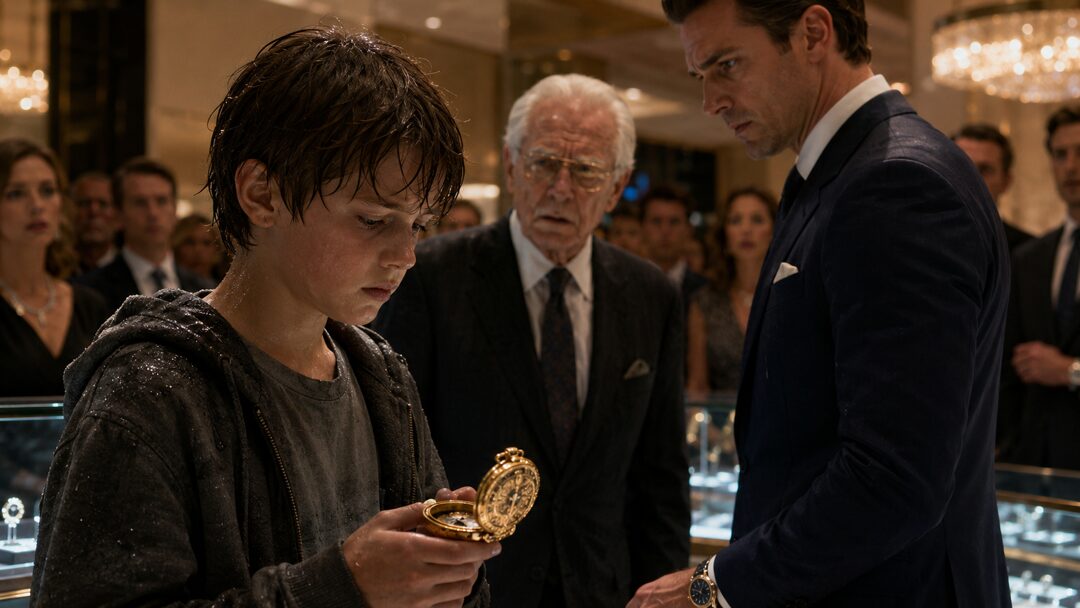
Ryan stood dripping on the marble floor in a faded gray T-shirt under an oversized hoodie, one sneaker untied, one hand closed around the only thing his mother had told him not to lose.
A woman near the entrance looked at him, then at the rainwater pooling under his shoes.
The clerk closest to him smiled the way adults smiled when they wanted a kid to leave without making a scene.
“Can I help you find your parents?”
Ryan swallowed.
“My mom’s not here.”
The woman’s smile thinned. “Then maybe you should wait outside.”
He almost did.
He thought of his mother’s hand on his wrist that morning, too light, too hot, her fingers shaking as she pressed the old gold pocket watch into his palm. He thought of the pharmacy receipt wrapped around it, the total circled twice in blue pen, as if circling it could make it smaller.
He thought of what she had said.
Not a pawnshop. Harrington & Sons. Ask for the old man if he’s still there.
So Ryan walked past the clerk.
The room noticed.
A man laughed once, quietly, as if Ryan were a misunderstanding someone else should correct. A woman pulled her purse closer to her side. The clerk followed him now, her heels clicking faster against the marble.
“Sir,” she called toward the counter, “I’m sorry, this young man just—”
Ryan reached the glass before his courage ran out.
Behind it stood an elderly man with white hair, gold-rimmed glasses, and a dark suit that looked older than some of the people in the room. A small silver nameplate near his hand read:
THOMAS HARRINGTON.
Ryan unwrapped the pharmacy receipt. The gold watch slid onto the glass with a soft, heavy sound.
The music seemed to grow thinner.
“My mom’s really sick,” Ryan said. His voice cracked, but he made himself keep going. “She told me to sell this. Is it worth enough to help her?”
No one laughed after that.
Thomas Harrington looked first at Ryan’s face. Then at the watch.
For a moment, he was only a jeweler. His hands moved with practiced care. He drew the watch closer, not touching it too quickly, as if valuable things deserved permission before being handled.
Then he saw the engraving.
His fingers stopped.
The clerk behind Ryan said, “Mr. Harrington, I can call someone if—”
Thomas lifted one hand, and she went silent.
He picked up the watch.
Ryan noticed then that the old man’s hands were steady until the watch was in them. Then the smallest tremor ran through his fingers.
Thomas turned it over.
The engraving was worn at the edges, but still clear.
Laura.
Ryan hated seeing his mother’s name in that room.
It looked too delicate there. Too polished. At home, her name was on pill bottles and late notices and the folded paper from his school that she kept forgetting to sign. Here it looked like something that belonged under glass.
Thomas pressed the latch.
The watch opened.
Inside the cover, tucked where the old lining had loosened, was the little school photograph Ryan thought his mother had thrown away. He was younger in it, maybe nine, with a crooked collar and hair sticking up in the back.
Thomas stared at the photo.
His face changed so completely that Ryan took a step back.
The old man did not gasp. He did not ask a question. His mouth simply parted, and all the color seemed to drain from him. Behind his glasses, his eyes filled so fast Ryan thought for one confused second that the lights had reflected off them.
One tear slipped down the deep line beside his nose.
Thomas looked from the photograph to Ryan.
“What’s your name?” he asked.
“Ryan.”
The old man closed his eyes.
The clerk whispered, “Mr. Harrington?”
Thomas opened them again, but now he was not looking at a customer.
He was looking at a door that had been locked for eighteen years.
“Where is your mother?” he asked.
Ryan’s fingers tightened around the pharmacy receipt. “Can you buy it or not?”
Thomas flinched as if the words had touched something raw.
Across the room, the party had stopped pretending not to listen.
The old man lowered his voice. “Ryan, I gave this watch to my daughter.”
Ryan’s stomach dropped.
Thomas looked at the engraving again.
“She disappeared eighteen years ago.”
The room went very still.
Ryan stared at him.
He had expected the watch to be fake. He had expected to be told it was not worth enough. He had expected to leave ashamed.
He had not expected an old man in a perfect suit to look at him like he had just come back from the dead.
“My mom didn’t disappear,” Ryan said.
The words came out sharper than he meant them.
Thomas’s face tightened.
Ryan snatched the pharmacy receipt off the counter, but Thomas kept the watch in both hands.
“She’s at home,” Ryan said. “And she needs help.”
Thomas looked toward the watching room, then back at Ryan.
That glance told Ryan more than the tear had.
The old man was afraid of them seeing.
Thomas came around the counter. “Come with me.”
Ryan did not move.
“Why?”
“Because we need to speak privately.”
Privately.
The word landed like a door closing.
Ryan glanced at the customers, at the clerk, at the soft coats and clean hands and lifted chins.
He understood then.
Whatever this was, they didn’t want it happening where people could see.
He looked back at Thomas.
“Is the watch fake?”
“No.”
“Then say it here.”
Thomas’s grip tightened around the watch.
Before he could answer, a smooth voice cut through the room.
“Thomas?”
A man in a navy suit stepped out from between two display cases. He was younger than Thomas, maybe forty, with perfect hair and a watch on his wrist that looked too expensive to tell ordinary time. His smile was calm.
Too calm.
“What’s going on?” the man asked.
Thomas turned.
The man’s eyes fell to the open pocket watch.
For one second, his smile disappeared.
Then it came back colder.
“Well,” he said softly. “That’s unexpected.”
Ryan looked from one man to the other.
The old man had recognized the watch with grief.
This man recognized it with fear.
Part II — The Private Room
Thomas led Ryan into a room behind a frosted glass door with gold lettering.
Private Consultation.
Ryan read the words twice.
He wanted to run. He also wanted to stay.
That was the worst part.
The room was smaller than the showroom but even cleaner, with a round table, leather chairs, and a tray of untouched water glasses. Thomas placed the watch in the center of the table as if it might explode.
Ryan sat only after Thomas did.
The man in the navy suit came in without being invited and closed the door behind him.
“Ryan,” Thomas said carefully, “this is Michael.”
Michael smiled at him.
It was not a mean smile. That made it worse.
“Hello, Ryan.”
Ryan said nothing.
Michael looked at the watch. “Where did you get this?”
“My mom gave it to me.”
“And your mother is?”
“Laura.”
The name changed the air.
Thomas gripped the edge of the table.
Michael looked down, almost politely, as if honoring someone at a dinner table.
“Laura,” he repeated.
Ryan hated the way he said it.
Like he had permission.
Thomas leaned forward. “Ryan, I need you to tell me exactly where she is.”
Ryan pulled the pharmacy receipt closer to him. “You didn’t answer me.”
“What?”
“Are you buying it?”
Thomas stared. “No.”
Ryan’s chest tightened.
Michael folded his hands. “Then perhaps we should slow down.”
“I don’t have time,” Ryan snapped. “My mom said this was worth something.”
“It is,” Thomas said.
“Then why won’t you buy it?”
“Because it belonged to her.”
“It belongs to us now.”
Thomas looked wounded by that, and Ryan was glad. Then he was ashamed of being glad.
Michael’s voice stayed gentle. “Ryan, sometimes old family pieces are complicated.”
Ryan turned on him. “Are you family?”
Michael paused.
Thomas answered before he could. “He is married to my younger daughter.”
Ryan saw something pass across Michael’s face.
Not guilt exactly.
Ownership.
“Emily,” Michael said. “She’ll want to know about this.”
“No,” Thomas said.
It was the first hard word Ryan had heard from him.
Michael lifted his eyebrows. “Thomas.”
“Not yet.”
Ryan looked between them.
“My mom told me to ask for the old man,” he said. “She didn’t say anything about you.”
Michael’s smile flickered.
Thomas’s voice softened. “She said that?”
Ryan nodded once.
Thomas looked down at the watch. “She remembered me that way.”
“Not nice,” Ryan said.
Thomas looked up.
Ryan did not know why he had said it. Maybe because the private room felt too clean, too careful, too full of people trying to make ugly things sound proper.
“She said if the old man was still there, he’d know what it was. She said don’t let them make you feel small.”
Thomas closed his eyes.
Michael’s face tightened. “Laura always had a way of making kindness sound like cruelty.”
Ryan turned to him slowly.
“My mom’s kind.”
“I didn’t say she wasn’t.”
“You said it like you knew her.”
Michael did not answer.
Thomas opened his eyes. “He did.”
The words fell hard.
Ryan’s skin went cold.
Michael gave Thomas a warning look. “This is not the time.”
“It became the time when her son walked into my store.”
Her son.
Ryan had heard adults say things about him all his life. Student. Tenant. Dependent. Kid. Problem.
No one in this room had called him that until now.
Her son.
He hated how much it helped.
Michael stood straighter. “There are guests outside. Reporters. Board members. People who have known this family for decades.”
Ryan laughed once, not because anything was funny.
“So?”
“So,” Michael said, lowering his voice, “a child appearing with a valuable item and a story no one can verify is delicate.”
Ryan went still.
Thomas’s chair scraped back. “Do not.”
Michael turned to him. “I’m protecting you.”
“No,” Ryan said.
Both men looked at him.
Ryan’s throat burned, but he kept his eyes on Michael. “You’re protecting yourself.”
For the first time, Michael’s calm slipped.
Only a little.
Enough.
Thomas looked at Ryan as if the boy had said something Laura would have said.
A knock came at the door.
It opened before anyone answered.
A woman stood there, pale beneath perfect makeup, one hand at her throat.
She had the same fine bones as the photograph Ryan had seen once in his mother’s shoebox before she took it away. Older, softer, more afraid.
“Michael,” she said. “People are asking what happened.”
Then she saw the watch.
Her face collapsed.
Thomas rose slowly.
“Emily.”
Emily’s eyes moved from the watch to Ryan.
For a second she looked like she might cry.
Then she whispered, “Oh no.”
Ryan understood something then, something no one had explained.
Everyone in that room knew his mother.
And no one had come looking.
Part III — The Life That Threw Her Away
Emily sat down because Thomas told her to, not because she wanted to.
Michael remained standing behind her chair, one hand resting lightly on the back of it. The gesture looked affectionate until Ryan saw Emily’s shoulders stiffen beneath it.
Thomas placed the open watch before her.
“Look at him,” he said.
Emily didn’t.
“Look.”
She did then.
Ryan’s school photograph stared up from the little gold frame, crooked and too bright under the overhead light.
Emily pressed her fingers to her mouth.
“He has her eyes,” she said.
Ryan recoiled from the tenderness in her voice. It sounded stolen.
Thomas’s voice was low. “You knew.”
Emily shook her head too fast. “No.”
Michael said, “Thomas, emotions are high. We should not start accusing—”
“You knew she had a child?”
“No,” Emily said. Tears filled her eyes. “Not then.”
“Then when?”
Emily looked at Michael.
He answered for her. “Years later. Rumors. Nothing certain.”
Ryan’s phone buzzed in his hoodie pocket.
He pulled it out so quickly the chair leg hit the floor. The screen showed Mrs. Alvarez from downstairs. She was staying with his mother until he got back.
He answered. “Hello?”
Her voice was tight. “Ryan, where are you?”
“At the store.”
“Your mother’s fever is worse. I called the clinic again, but they said if she gets confused or short of breath, I should—”
Ryan turned away from the table. “I’m coming.”
Thomas stepped toward him. “Ryan?”
Ryan ended the call and shoved the phone into his pocket.
“I need the watch back.”
Thomas reached for his wallet immediately. “I’ll help. Tell me what she needs. I’ll pay.”
Michael exhaled quietly, almost relieved. “Good. That’s sensible.”
Ryan looked at Thomas’s wallet, then at the watch.
“Are you buying it?”
“No,” Thomas said.
“Then why are you giving me money?”
Thomas faltered. “Because Laura is my daughter.”
Ryan’s eyes burned. “She was your daughter yesterday too.”
No one spoke.
Emily made a small sound.
Ryan picked up the watch. Thomas did not stop him.
“My mom said this was all she had left from the life that threw her away,” Ryan said.
Emily bent forward as if the words had hit her in the stomach.
Thomas stared at her.
“What does that mean?” he asked.
Emily shook her head. “Dad—”
“What does that mean?”
Michael’s hand tightened on the back of her chair. “It means Laura was angry. She left angry. People say things.”
Ryan looked at him. “She didn’t say it angry.”
Michael turned. “What?”
“She said it like she was tired.”
That silenced him.
Ryan remembered the morning in pieces: his mother sitting on the edge of the bed, the blinds half-broken, rain tapping the window, her hands too weak to close the watch’s clasp. She had made him repeat the address three times.
Fifth Avenue. Harrington & Sons. Ask for Thomas Harrington if they let you past the door.
“If they don’t,” she had said, breathing through the pain, “come home.”
“What if they ask where you are?”
“Tell them I’m not available.”
“Mom.”
“Ryan.”
Then she had gripped his wrist with the last of her strength.
“Do not beg from people who are ashamed of you.”
Now, standing in a room worth more than his whole building, Ryan finally understood why she had said it.
Thomas looked older than he had ten minutes ago.
“Laura came back,” he said.
Emily stared at the table.
Thomas turned fully toward her.
“She came back, didn’t she?”
Emily began crying silently.
Michael spoke first. “This is not helpful.”
Thomas did not look at him. “Emily.”
She shook her head. “I was twenty-two.”
“That is not an answer.”
“She came to the house,” Emily said.
The room shrank around the sentence.
Thomas gripped the edge of the table. “When?”
Emily wiped her cheek with the back of her hand, ruining a line of mascara. “After she left. Months after. Maybe seven. Maybe eight.”
Ryan held the watch so tightly the chain bit into his palm.
“She was…” Emily looked at him and could not finish.
Thomas did.
“Pregnant.”
Michael turned away.
Thomas stepped back as if someone had opened the floor beneath him.
“She asked for you,” Emily whispered. “She was soaked from the rain. She looked awful. She said she needed to talk to you.”
“Where was I?”
“At the store.”
“And you called me?”
Emily covered her face.
Thomas’s voice cracked. “Emily.”
“I told her you wouldn’t see her.”
Ryan stopped breathing.
Thomas stared at his younger daughter.
“You told Laura that?”
Emily’s hands dropped. “I was scared.”
“Of what?”
“Of her coming back!” Emily cried, too loud for the small room. “Of everything becoming about Laura again. It always was. Even when she was gone, she was the room everyone walked around.”
Michael’s jaw tightened. “Emily.”
“No.” She looked at Ryan now, and shame made her almost unrecognizable. “I told her Dad said not to come back. I told her she had made her choices.”
Thomas whispered, “You were my child.”
Emily flinched.
“So was she.”
No one moved.
Then Ryan looked at Michael.
“What did you do?”
Michael’s face went smooth again.
Too late.
Ryan had seen the fear underneath.
Thomas saw it too.
“Michael,” he said.
Michael adjusted his cuff. “Laura and I had a complicated history.”
“She was going to marry you,” Thomas said.
Ryan felt the room tilt.
Michael looked at Ryan then, and for the first time there was something like pity in his eyes.
Or maybe only memory.
“I cared about your mother,” he said.
Ryan hated him more for saying it softly.
“Don’t,” Ryan said.
Michael’s mouth closed.
Emily’s voice broke. “He gave her money.”
Thomas turned slowly.
“What?”
Michael did not deny it.
“She needed it,” he said. “She was alone. She had no plan.”
“You paid her to disappear,” Thomas said.
“I helped her leave.”
“You paid her to disappear.”
Michael’s calm sharpened. “And what would you have done, Thomas? Welcomed her back? Pregnant, unmarried, after the papers were already whispering? After she had humiliated you in front of half this city?”
Thomas’s face went white.
There it was.
The word Ryan’s mother had never used, but had carried anyway.
Humiliated.
Michael kept going because men like him always thought one more sentence could save them.
“I made the hard choice no one else wanted to make.”
Ryan stepped toward him.
“You made the easy one.”
Michael looked down at him.
Ryan lifted the watch between them.
“My mom kept this,” he said. “Not your money.”
Michael’s expression changed.
That one hurt him.
Good.
Part IV — The Offer
The party outside had grown restless.
Voices drifted through the frosted glass. A burst of laughter. A question too loud. The piano had stopped.
Michael heard it and found his footing again.
“We need to contain this,” he said.
Thomas stared at him as if seeing him for the first time. “Contain?”
“Yes. Before a private family matter becomes a public spectacle.”
Ryan almost laughed.
It was already a spectacle. He was the only one poor enough to be blamed for making it visible.
Michael reached into the inside pocket of his jacket and took out a checkbook.
Thomas’s voice turned dangerous. “Put that away.”
Michael ignored him.
He wrote quickly, smoothly, the way he did everything. Then he tore out the check and placed it on the table in front of Ryan.
Ryan looked down.
The number had too many zeroes.
His whole body wanted to reach for it.
That was the worst shame of all.
He saw rent. Medicine. Cabs. Groceries. A real doctor. His mother sitting up again. His mother sleeping without making that small tight sound in her throat.
Michael knew it.
“Take it,” he said. “Get your mother help. No one needs to be hurt further.”
Ryan did not touch the check.
Thomas looked at him, his eyes wet again. “Ryan, I will pay for whatever Laura needs.”
Michael’s voice remained soft. “He says that now. But you don’t know this family.”
Ryan looked at him.
Michael leaned closer.
“Your mother did.”
Emily whispered, “Stop.”
But Michael had found the child’s fear and pressed his thumb into it.
“You came here because she had nowhere else to send you,” he said. “That is a sad thing. But sadness does not make every story true.”
Ryan’s face burned.
Thomas slammed his hand on the table.
The sound cracked through the room.
“Enough.”
Michael straightened. “You are about to throw away seventy years of work because a boy walked in with a watch.”
“No,” Thomas said. “Because my grandson walked in with the truth.”
The word moved through the room like a struck bell.
Grandson.
Ryan felt it in his chest before he understood it.
Emily began crying again, quietly this time.
Michael looked toward the door. “Then say it outside. See what happens.”
Thomas turned to him.
Michael’s smile was gone.
“Say Laura’s name in front of the Whitmans. The Carters. The foundation board. Tell them your vanished daughter is alive, poor, and that this boy is yours. Tell them your perfect family paid her away. Tell them I was engaged to one daughter before I married the other.”
Emily stood so fast her chair nearly fell.
“Michael.”
He looked at her. “It is already happening.”
“No,” she said, voice shaking. “You are happening.”
For once, he had no answer.
Ryan’s phone buzzed again.
This time, he didn’t want to answer.
He did anyway.
Mrs. Alvarez was crying.
“Ryan, I called an ambulance. She was asking for you, then she didn’t know where she was. I’m sorry. I didn’t know what else to do.”
Ryan’s hand went numb around the phone.
“What place?”
She told him.
He repeated it once so he wouldn’t forget, then ended the call.
Thomas was beside him in an instant. “Where?”
Ryan stepped back.
It hurt Thomas. Ryan saw it.
He did not care.
“I don’t know what you are,” Ryan said. “Grandfather, rich man, stranger. I don’t know. But I know what he is.”
He pointed at Michael.
Michael’s face went still.
“And if taking money means letting him say my mom was nobody, I won’t.”
Thomas said, “It doesn’t.”
Ryan’s voice shook. “Then prove it.”
The room held its breath.
Ryan looked toward the frosted glass door, where shadows moved on the other side.
“Not in here.”
Thomas understood.
Fear passed over his face.
Not fear of Ryan.
Fear of what truth would cost.
For a moment, Ryan thought the old man would choose the room again. The private door. The careful voice. The cleanest version of shame.
Then Thomas picked up the watch.
“No,” Ryan said sharply.
Thomas held it out to him, open in his palm.
“Then you carry it.”
Ryan took it.
The old man adjusted his jacket, wiped his face once with his handkerchief, and opened the door.
The showroom turned toward them.
Every face.
Every glass.
Every polished surface reflecting Ryan back to himself, small and wet and shaking.
Michael moved past Thomas before anyone could speak.
“Ladies and gentlemen,” he said, with a smile that almost worked, “I apologize for the interruption. We’ve had a misunderstanding involving a valuable family item.”
Ryan froze.
Michael did not look at him.
“A young man appears to have come into possession of something that does not belong to him.”
The clerk gasped softly.
The customers leaned in.
Ryan felt the old shame rise up like water.
There it was. The story they would believe because it was easier.
Poor kid. Expensive watch. Confused claim.
Michael continued, “We are handling it privately and with compassion.”
Ryan opened the watch.
His fingers shook so badly he almost dropped it.
Thomas put a hand near his shoulder, not touching him.
Ryan lifted the photograph toward the room.
“My mom told me never to beg from people who were ashamed of her.”
The words were not loud.
They did not need to be.
They traveled anyway.
The room went silent in a different way now. Not bored. Not offended.
Caught.
Michael’s face hardened. “Ryan—”
Thomas stepped in front of him.
“No.”
One word. Final.
Thomas turned to the guests. He looked suddenly fragile beneath the chandeliers, but his voice carried.
“This is Ryan,” he said. “He is my grandson.”
A sound moved through the room.
Emily covered her mouth.
Michael looked away.
Thomas continued, and each word seemed to cost him more than the last.
“His mother is Laura Harrington. My daughter.”
A woman near the diamond cases whispered Laura’s name as if resurrecting gossip she had once enjoyed.
Thomas heard it.
His expression broke.
“For years,” he said, “I let this family name matter more than the people who carried it. I let silence pass for dignity. It was not dignity.”
He looked at Ryan then.
“It was cowardice.”
Ryan’s throat closed.
Thomas turned back to the room.
“No one stole that watch. No one is confused. No one will speak of my daughter or her son as if they are an embarrassment in their own family’s house.”
Michael said quietly, “You don’t know what you’re doing.”
Thomas did not turn.
“Yes,” he said. “That has been the problem for eighteen years.”
Then he looked at Ryan.
“Take me to her.”
Ryan wanted to hate him.
Part of him still did.
But the watch was open in his hand, his own small photograph staring up from the place where his mother had put him, hidden inside gold like a message no one had bothered to read.
Ryan closed it.
“Don’t make her forgive you,” he said.
Thomas nodded once.
“I won’t.”
Part V — The Door Outside
The hospital smelled like cold coffee, floor cleaner, and waiting.
Ryan walked faster than Thomas, because Thomas did not know the turns. He did not know the elevator that stuck on the third floor. He did not know the vending machine that kept taking dollar bills. He did not know Mrs. Alvarez, who stood outside the room clutching her rosary and crying when she saw Ryan.
He did not know anything that mattered yet.
But he followed.
Emily came too. Michael did not.
No one asked where he went.
At the nurses’ desk, Thomas gave his name and his card and spoke quietly. He did not ask what anything cost. He did not ask whether the watch was still for sale. He did not ask for proof.
For once, money moved without touching Ryan’s dignity.
That did not make it love.
But it made room for something else.
Laura was awake when Ryan entered.
Barely.
Her hair was tied back badly, and her face looked smaller against the pillow. Tubes ran from places Ryan refused to look at for long. But her eyes found him the second he stepped inside.
“There you are,” she whispered.
Ryan went to her so fast he almost tripped.
“I’m sorry,” he said into the blanket. “I went. I did what you said. But I—”
Her hand found his hair.
“You came back.”
That was all she needed first.
Then she saw the watch in his hand.
Then she saw the man standing in the doorway.
Laura went still.
Thomas Harrington did not enter.
He stood outside the room as if the threshold had become a judgment.
Laura looked at him for a long time.
Ryan had imagined this moment in the cab without meaning to. The old man rushing to her. His mother crying. Everyone hugging. The kind of ending people liked because it made the hard parts useful.
That did not happen.
Laura’s face did not soften.
“Dad,” she said.
The word was not forgiveness.
It was only recognition.
Thomas held the doorframe with one hand. “Laura.”
Emily stood behind him, trembling. “Laura, I—”
Laura’s eyes moved to her sister.
Emily stopped.
Good, Ryan thought.
Let silence do something for once.
Thomas’s voice broke. “I didn’t know you came back.”
Laura closed her eyes.
The room tightened around that one sentence.
When she opened them again, they were bright but dry.
“You didn’t ask enough questions.”
Thomas lowered his head.
“No.”
“I waited on the steps,” Laura said. Her voice was weak, but it did not shake. “It was raining. I remember being so angry that I still cared whether I looked terrible.”
Emily began to cry.
Laura looked at her. “Don’t make me comfort you.”
Emily pressed both hands over her mouth.
Thomas took one step in, then stopped himself.
Ryan saw it.
So did Laura.
That restraint mattered more than any apology he could have given.
“I paid the bills,” Thomas said quietly. “Not for the watch.”
Laura looked at Ryan.
Ryan nodded.
“He didn’t take it.”
Laura’s eyes moved back to Thomas.
Something passed through her then. Not relief. Not trust.
Maybe exhaustion meeting proof.
“You always knew how to pay for things,” she said.
Thomas accepted it.
“Yes.”
Ryan hated how much the sentence hurt him. He also loved his mother for saying it.
Thomas looked at the floor.
“I told them who you are.”
Laura’s breathing changed.
“In the store?”
“In the store.”
“In front of them?”
“Yes.”
The room went quiet.
Laura looked away toward the window, where the city lights blurred against the dark glass.
Ryan could not read her face.
Then she said, “That must have been difficult for you.”
Thomas flinched.
It was not cruel.
It was accurate.
He deserved accurate.
Ryan climbed carefully onto the edge of the bed. Laura shifted her hand so he could sit close without pulling anything.
He placed the pocket watch on the small table beside her water cup.
Not in Thomas’s hand.
Not in his own pocket.
Beside her.
Laura looked at it.
For a moment, she was not in the hospital room. She was somewhere older. Younger. Standing in rain with a baby no one had welcomed. Holding gold that could not warm her. Carrying a name that had locked its own door.
Then she touched the watch with two fingers.
“I was going to sell it myself,” she said.
Ryan looked at her. “Why didn’t you?”
Her mouth curved slightly, but it was not a smile.
“Because I was still angry enough to keep it.”
Thomas made a sound from the doorway.
Laura looked at him again.
“You can come tomorrow,” she said.
Thomas froze.
It was not come in.
It was not go away.
It was tomorrow.
For a man who had lost eighteen years, tomorrow was almost mercy.
He nodded, once, unable to speak.
Emily whispered, “Can I—”
Laura closed her eyes. “Not tonight.”
Emily folded around the answer.
Thomas stepped back from the doorway.
Ryan watched him go only as far as the chairs outside. He sat down slowly, hands clasped between his knees, still wearing the suit from the anniversary party, looking suddenly like an old man who had finally reached the place grief should have taken him years ago.
He did not try to enter again.
He waited.
Inside the room, Laura’s fingers found Ryan’s.
“You okay?” she whispered.
Ryan looked at the watch on the table. The gold case caught the dim light and held it.
“No,” he said.
His mother squeezed his hand.
“Me neither.”
That was the first honest thing anyone had said all night that did not ask for anything afterward.
Outside, Thomas bowed his head and stayed where he was.
Inside, Ryan sat beside his mother, guarding the quiet she had earned.
The watch ticked softly between them, no longer something to sell, no longer something to hide.
It did not fix the years.
It only proved they had happened.
And for that night, that was enough.