The Bell Rang Every Night Until the Farmer Asked Who Needed the Shortcut Most
Chapter 1: The Bell That Rang Beyond the Orchard
The brass bell rang three times at 2:13 in the morning, though the branches outside Raymond Hill’s bedroom window were perfectly still.
He opened his eyes before the third note died.
For several seconds, he remained beneath the quilt, listening. The farmhouse settled around him with its familiar dry clicks. The refrigerator motor hummed through the floorboards. Beyond the glass, forty acres of apple and pear trees stood under a moonless sky.
Then the floodlight at the south gate snapped on.
Raymond threw back the quilt and reached for his work pants. His knees protested as he pulled them over his long underwear, but he did not slow. The bell had rung on four nights that week. Each time, whoever crossed the lane had vanished before he reached the gate.
He took the flashlight from the kitchen hook and stepped outside.
Cold air bit the inside of his nose. The orchard smelled of damp leaves, turned soil, and bruised fruit left beneath the trees after harvest. He crossed the yard without turning on the porch light.
The south lane ran between the youngest pear rows and the irrigation ditch. Raymond had installed the bell on the gate himself: a heavy brass cup from his father’s old harness shed, connected by wire to a motion arm. Anything pushing through the gate after dark pulled the clapper against the metal. The floodlight came on at the same time.
It was not meant to wake the county.
It was meant to wake him.
The light still burned when he reached the first row. Beyond it, the gate stood partly open.
“Hold up,” Raymond called.
No answer came.
His flashlight beam slid across the grass, the ditch bank, and the wire fence beyond. For an instant he thought he saw movement near the lower pasture, but it disappeared behind the stand of bare cottonwoods.
He reached the gate and stopped.
The new chain hung from the post in two pieces.
The cut was bright and clean.
Raymond crouched slowly. Mud had been pressed flat beside the hinge, but most of the prints vanished at the edge of the irrigation ditch. Whoever had crossed knew where the gravel ended and the soft channel began. They had walked through the shallow water for nearly twenty yards, using the ditch to hide their tracks.
Nearly.
One narrow print remained beside the post. The heel was worn crooked. A triangular piece of tread was missing near the right edge.
Raymond held the flashlight over it until the details fixed themselves in his mind.
Behind him, the bell moved once in the cold, giving a small hollow knock.
He looked toward the lower boundary. On the far side of the cottonwoods lay Pamela Moore’s cattle property, though her farmhouse was nearly a mile uphill. The lower pasture had been quiet for months. No trucks. No cattle. No lights.
At least, none he had admitted seeing.
Raymond stood and examined the nearest pear tree. Its protective sleeve had been kicked loose. Two young branches were snapped, and a deep tire rut cut across the root line. Someone had crossed there before, not only on foot.
He replaced the sleeve and pressed soil around it with his boot.
The tree was three years old. Another two years before it produced enough fruit to matter. He had planted the row during the spring his wife began treatment, when the doctors still used words like manageable.
After she died, people had come with casseroles, folded cards, and advice. Sell the lower ten acres. Lease the packing shed. Let someone else manage the orchard.
Raymond had thanked them and locked the gate.
He returned to the house near three, set the severed chain on the kitchen table, and transferred the photographs from the trail camera to his laptop. Most showed only darkness and the burst of the floodlight. One captured a shoulder beneath a canvas coat. Another showed a gloved hand reaching toward the gate.
The face remained outside the frame.
A later image showed a second figure farther back, taller and heavier, carrying something long under one arm.
Raymond enlarged it until the pixels broke apart.
He closed the laptop without saving a print.
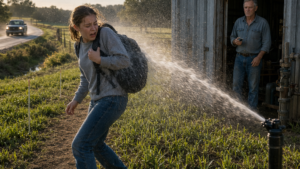
At dawn, he repaired the chain with a spare link and walked the young pear rows. Three more sleeves had been knocked loose. A section of irrigation pipe was bent where a wheel had crossed it. Water seeped into the lane, turning the soil black.
He was tightening the coupling when a truck came fast up the county road and braked beside the gate.
Pamela Moore stepped out before the engine stopped.
She wore an old green barn coat over a sweatshirt, her silver-blonde hair tied roughly behind her head. One rubber boot was caked with mud nearly to the calf.
“You need to take that thing down,” she said.
Raymond kept the wrench on the coupling. “Morning to you.”
“That bell. And the light.”
He glanced toward the gate. “They’re on my post.”
“They’re waking everybody up.”
“Everybody?”
“My cattle heard it clear up on the ridge.”
“You don’t have cattle in the lower pasture.”
Her mouth tightened. “Sound carries.”
Raymond turned the wrench another quarter turn. Water stopped dripping.
Pamela came closer. “It went off after two again.”
His hand became still on the tool.
“You keep careful hours,” he said.
“I was awake.”
“So was I.”
“That’s my point.”
Raymond rose. “Someone cut my chain.”
Pamela looked at the bright metal lying near the post, then toward the ditch. The glance lasted less than a second.
“Probably kids.”
“Kids who know my irrigation channel.”
“People have crossed that lane since before either of us owned anything.”
“People asked.”
“Not every time.”
“They did when my father was alive.”
Pamela folded her arms. “Your father understood that farms out here depend on each other.”
“My father also shut gates behind him.”
A truck passed on the county road. The driver lifted two fingers from the steering wheel, slowing just enough to look between them.
Pamela lowered her voice. “You’ve put a floodlight over a path people have used for forty years. You’ve hung a bell loud enough to scare stock. Now you’re taking pictures of anyone who comes near it.”
“I’m taking pictures of my gate.”
“You know what folks are saying?”
Raymond picked up the wrench.
“No,” he said. “But I expect you’ll tell me.”
“They’re saying you’ve decided the whole county is out to steal from you.”
He walked to the bent pipe and checked the clamp.
Pamela followed him. “You used to be reasonable.”
“Before what?”
The answer caught in her face. Before his wife died. Before the locked gates. Before he stopped attending cooperative suppers and stopped lending equipment without written return dates.
She chose another sentence.
“Before you started treating neighbors like trespassers.”
“The one who cut that chain made the choice.”
Pamela stared down at the remaining boot print. Her right foot shifted backward, leaving a fresh impression in the mud. The outer heel of her boot was worn smooth.
Raymond saw it.
She saw him see it.
Neither spoke.
From the gate, the brass bell reflected a thin strip of morning light.
Pamela stepped away first. “Take it down by tonight.”
“No.”
“Then I’ll bring it before the farm board.”
Raymond wiped the wrench on his coat. “Bring the chain too.”
Her cheeks reddened. “Six o’clock. Cooperative equipment bay.”
She climbed into her truck and slammed the door. Before pulling away, she leaned across the seat and called through the open passenger window.
“Everyone knows that lane is a shortcut, Raymond.”
He looked at the broken pear branches, the muddy ditch, and the track her boot had left beside the anonymous one.
“At two in the morning,” he said, “a shortcut ought to know whose land it crosses.”
Pamela drove off, throwing gravel against the gate.
The bell trembled once after she was gone.
Chapter 2: Everyone Called It a Harmless Shortcut
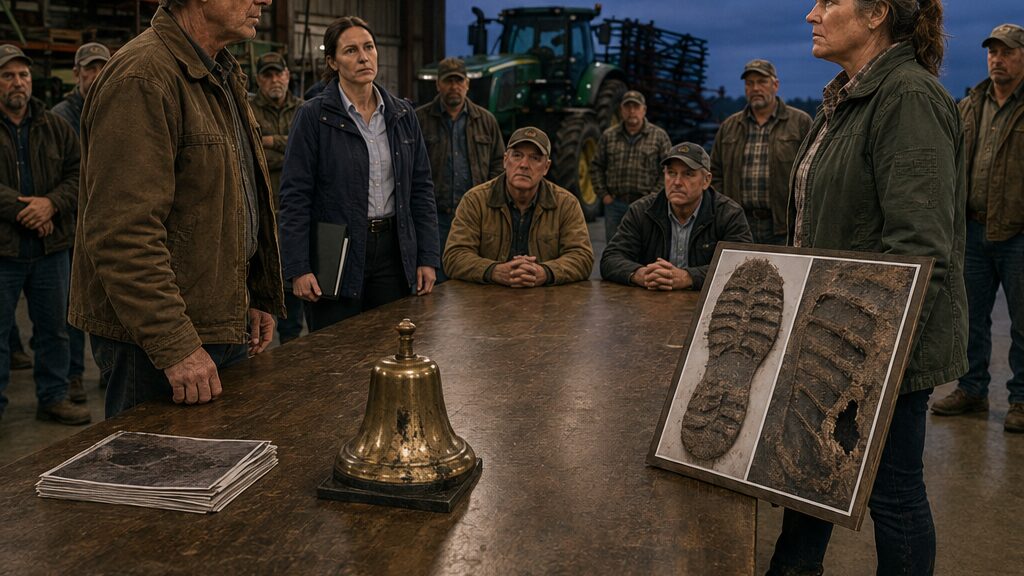
“A weapon against neighbors,” Pamela said, standing beneath the cooperative’s open equipment-bay lights. “That is what Raymond Hill has installed at the edge of his orchard.”
The brass bell sat on the folding table between her and Raymond, mud dried along its rim.
Nearly thirty people had come. Some leaned against feed pallets. Others sat in metal chairs set between a seed drill and a dismantled baler. The cooperative secretary kept minutes near the office door while two farm-board members faced the room.
Raymond stood alone beside the table.
Pamela had brought photographs of the floodlight shining across his gate. From the angle, the beam looked harsh enough to cover half the valley.
“It comes on without warning,” she continued. “The bell can be heard across multiple properties. We have livestock, families, workers starting before dawn. We cannot have one man deciding a traditional access lane is now some kind of trap.”
Murmurs moved through the bay.
Raymond recognized most of the voices even when he could not make out the words. He had repaired pumps for some of them, lent ladders to others, and attended their funerals and weddings before grief had made every crowded room feel like somewhere he had forgotten how to stand.
One board member adjusted his glasses. “Raymond, is the bell motion activated?”
“Yes.”
“And the light?”
“Yes.”
“How long has that been in place?”
“Eight days.”
Pamela laughed once without humor. “Eight nights of it going off.”
Raymond looked at her. “Not every night.”
“Most nights.”
Again, the room shifted.
The volunteer fire chief raised a hand. “That path has been there since I was a boy.”
“It’s a lane through my orchard,” Raymond said.
“Call it what you like. Folks have used it.”
“During daylight. With permission.”
Pamela turned toward the chairs. “That is not how his father handled it.”
The mention of his father moved through the gathering more effectively than any legal claim. Rural memory did not need paper to become authority. Enough people repeating the same version could make an old favor feel like a boundary stone.
Raymond unwrapped the bell’s pull wire from around its base.
“This doesn’t ring when someone walks the county road,” he said. “It doesn’t ring when a truck turns at Moore’s upper drive. It rings when my gate opens.”
A feed-store owner near the back spoke. “Could be deer pushing it.”
“Deer don’t use bolt cutters.”
Raymond placed the severed chain beside the bell.
The room quieted slightly.
Pamela’s expression did not change. “Nobody here approves of damaged property. But one cut chain doesn’t erase forty years of common use.”
Raymond looked at the board. “There has been no common use at two in the morning.”
Pamela spread her hands. “There. That’s what I mean. He talks like someone’s breaking into his house.”
“Someone keeps entering my land after two.”
A few people glanced toward Pamela.
She held Raymond’s gaze. “Maybe because that’s when they need to cross.”
“Who?”
“You’re the one with cameras.”
The board member sighed. “Do you have identifiable photographs?”
Raymond reached beneath the table and lifted a piece of foam board. Four images were clipped to it, each printed large enough for the room to see.
The first showed the gate under the floodlight at 2:07 a.m. A figure in a canvas coat had one hand on the chain.
The second showed a boot stepping beside the hinge.
The third showed the same tread farther down the lane.
The fourth showed a print near the fence separating Raymond’s orchard from Pamela’s lower pasture.
Pamela’s face lost color, though her voice remained steady.
“Those could belong to anybody.”
Raymond pointed to the heel in the third photograph. “Missing triangle on the outer tread.”
He did not look down immediately.
Other people did.
Pamela’s damaged right boot rested beneath the hem of her jeans. Mud filled most of the sole, but the missing triangular piece was visible from several feet away.
The cooperative bay became silent enough for the overhead heater to be heard ticking.
Raymond did not say her name.
He asked, “Why does the bell ring only after two, Pamela?”
She shifted her foot behind the other.
A board member leaned forward. “Pamela?”
Her chin rose. “I have crossed that lane.”
A burst of whispers followed.
She raised her voice over them. “So have plenty of people. That is the entire point.”
“Did you cut the chain?” Raymond asked.
“No.”
The answer came too quickly.
“Did you see who did?”
“No.”
“Then how did you know it rang last night?”
“I told you. I was awake.”
“At your house on the ridge?”
“Yes.”
“Nearly a mile away, with the windows shut?”
Pamela’s eyes sharpened. “You think catching my boot in mud proves you own the history of that lane?”
“No. It proves you crossed after telling everyone this was about other people.”
The feed-store owner looked away. The cooperative secretary stopped writing for a moment, pen held above the paper.
Pamela stepped toward the table. “You want honesty? Fine. The lower access has been bad since the creek came up. That lane saves nearly four miles. Your father never made us beg for every crossing.”
Raymond felt the folder beneath his hand.
Inside were three more photographs.
One showed Pamela carrying a red veterinary case.
Another showed a taller figure moving behind her with a gearbox housing under one arm.
The clearest image caught that figure turning toward the floodlight. The face was partly shadowed, but Raymond had recognized Nicholas Moore the moment he enlarged it.
Nicholas, who had not been seen in the county for nearly a year.
Raymond kept the folder closed.
One board member noticed. “Is that everything you have?”
“It’s enough for tonight.”
Pamela stared at the folder. Fear passed through her expression before hardening into anger.
“You drag me in front of people, put pictures of my boot on a board, and then decide what we’re allowed to know?”
“You brought me here.”
“That doesn’t give you the right to imply whatever suits you.”
“You implied I was imagining trespass.”
“I said you were turning a shared necessity into a personal grievance.”
Raymond’s fingers tightened on the folder.
He could have lifted the remaining photographs and ended the argument. He could have put Nicholas’s face before every lender, buyer, and neighbor in the bay. Pamela would have lost the room completely.
Instead, he slid the folder beneath the bell.
The restraint did not look generous.
It looked suspicious.
The volunteer fire chief frowned. “If there’s more evidence, Raymond, show it.”
“No.”
“Why not?”
“Because this meeting is about my gate.”
Pamela seized the opening. “Or because those pictures don’t prove what he wants everyone to think.”
A few heads nodded. The room’s certainty shifted again, not fully toward her, but away from him.
Raymond felt the familiar pressure to explain himself. He resisted it as he always did. Explanation invited questions. Questions invited concern. Concern became involvement, and involvement became people telling him what he should surrender for his own good.
The board member tapped the table. “We are not deciding guilt by photograph tonight. Pamela says there was an established access arrangement. Raymond says any access required permission. We need facts.”
The equipment-bay door rolled open behind the chairs.
A woman carrying a county satchel entered, removed her gloves, and approached the table. Raymond recognized Samantha Nelson from an irrigation dispute two years earlier.
The board member gestured toward her. “Ms. Nelson handles agricultural mediation for the county.”
Samantha looked from the broken chain to the bell, then to the photographs.
“I was asked to attend because this may involve an unrecorded farm-access claim,” she said. “If both parties agree, I’ll conduct a site inspection and check the county records before this becomes a civil filing.”
“My property lines are recorded,” Raymond said.
“Property lines and access rights are not always the same question.”
Pamela folded her arms again, confidence returning by degrees.
“My husband’s family used that lane for decades,” she said. “Raymond’s father gave his word.”
Raymond looked at her.
It was the first time she had called the arrangement a promise rather than a habit.
Samantha opened a notebook. “Who heard that agreement?”
Pamela answered without hesitation.
“Charles Hernandez surveyed both properties. He was there.”
At the back of the equipment bay, an older man who had been standing beside the seed pallets lowered his eyes.
Raymond had not noticed Charles come in.
Samantha turned toward him. “Mr. Hernandez?”
Charles removed his cap. “I heard something,” he said carefully.
“What exactly?”
Charles looked at Raymond, then at Pamela.
“It was a long time ago.”
“That isn’t an answer,” Raymond said.
“No,” Charles replied. “It isn’t.”
Samantha closed the notebook halfway. “We’ll meet at the south gate at nine Thursday morning. After that, I’ll examine the recorded deeds and survey notes.”
Pamela looked at Raymond as if the matter had already moved beyond his control.
Samantha added, “Until the inspection, nobody crosses that lane without written permission.”
Raymond gathered the photographs.
Pamela touched the bell with one finger, making the clapper strike softly.
“Your father knew what that road was for,” she said.
Raymond slipped the sealed folder beneath his arm.
He had entered the meeting certain that Pamela’s boot would settle the matter.
Instead, he left with the county coming onto his land, Charles avoiding his eyes, and an old promise rising from the past without a single word of it on paper.
Chapter 3: The Promise Nobody Put on Paper
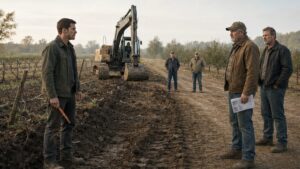
Samantha Nelson found the hoof marks before Raymond had finished unlocking the gate.
They crossed the muddy lane from Pamela’s boundary, passed beneath the new chain, and continued between the young pear trees.
“These are fresh,” she said.
Raymond crouched beside the nearest print. The edges were sharp, with damp soil still shining inside the crescent. “Sometime after midnight.”
“You checked the bell?”
“It never rang.”
Pamela stood on the other side of the gate with her hands in her coat pockets. “Maybe because nobody opened it.”
Raymond followed the tracks to a section of fence fifty yards east. The bottom wire had been lifted and tied to a post with baling twine. Several strands of pale cattle hair clung to the barbs.
Samantha photographed the opening.
“Were animals moved through here?” she asked.
Pamela stepped over the ditch. “Two heifers got out.”
“Into Raymond’s orchard?”
“They came back.”
“That wasn’t the question.”
Pamela looked toward the lower pasture. “Yes.”
Raymond examined the nearest pear trunk. The bark had been rubbed raw shoulder-high. One guard lay flattened in the mud.
“You could have called,” he said.
“At midnight?”
“You had no trouble coming to my gate at dawn.”
Pamela’s jaw tightened. “I handled my cattle.”
“Through my trees.”
Samantha raised a hand before either could continue. “We’re going to walk the claimed route from end to end. Then we’ll look at the damaged crossing Pamela reported. After that, records.”
The brass bell remained motionless above them. In daylight it looked smaller than it had beneath the cooperative lights, less like an accusation than an old piece of farm hardware.
They followed the lane south.
Raymond pointed out the irrigation ditch, the bent pipe, and the tire rut beside the pear row. Samantha measured the distance between the lane and the nearest trunks. At its narrowest point, less than nine feet separated the ditch from the tree guards.
“Could livestock pass without damage?” she asked.
“Not thirty head,” Raymond said.
Pamela looked at him sharply.
He had chosen the number deliberately.
Samantha noticed. “Why thirty?”
“Estimate.”
Pamela walked ahead.
Near the boundary, the lane descended toward the creek. Years earlier, gravel had continued across a shallow wooden bridge onto the Moore property. Now the bridge deck tilted into the water. One support had washed downstream, leaving twisted boards caught in willow roots.
Samantha stopped at the bank. “When did this happen?”
“Spring flood,” Pamela said.
“Why wasn’t it reported as an agricultural-access loss?”
“It’s a private bridge.”
“You’re claiming the loss created a need to cross another private property. That makes it relevant.”
Pamela scraped mud from her right boot against a stone. “We planned to rebuild.”
“With what?” Raymond asked.
She faced him. “You don’t know everything about my operation.”
“No. Just the parts that cross mine after dark.”
For a moment, something tired showed beneath her anger.
Then a pickup approached from the county road. Charles Hernandez parked beside the gate and walked down carrying a rolled survey map under one arm. He moved slowly, testing each patch of ground before putting weight on it.
Samantha greeted him and pointed toward the collapsed bridge. “Was this the original access?”
“One of them,” Charles said.
“One of how many?”
He looked uphill, orienting himself by fence lines that no longer matched the landscape he remembered.
“There was the upper drive to the Moore house. There was this crossing for stock and equipment. And there was a seasonal track through the Hill orchard.”
Pamela folded her arms. “There.”
Raymond said nothing.
Samantha unrolled the map on the hood of her county vehicle. The survey showed property boundaries, creek lines, and two access roads. No marked route crossed Raymond’s orchard.
“Was the seasonal track part of your survey?” she asked.
“No.”
“Why not?”
“Because it wasn’t an easement.”
Pamela’s expression changed. “You said Raymond’s father agreed.”
“He did.”
“To access.”
“To temporary access,” Charles said.
The creek moved noisily beneath the broken bridge.
Raymond watched Pamela absorb the distinction.
Charles tapped an area on the old map. “The Moore crossing washed out once before. Late eighties. Raymond’s father told Pamela’s husband they could use the orchard lane during wet months while we laid out a replacement route.”
“How long?” Samantha asked.
“Supposed to be one season.”
Pamela looked from Charles to Raymond. “They used it longer than that.”
“They did.”
“And nobody stopped them.”
Charles rubbed his thumb along the map edge. “The replacement route never got finished.”
“Because your markers ran through the north slope,” Pamela said. “It was too steep for loaded trailers.”
“We marked another option.”
“You marked stakes in a briar patch.”
“Your husband said he’d clear it.”
“He was trying to keep a farm running.”
“So was Raymond’s father.”
The old familiarity in their argument made Raymond feel as if he had entered a conversation that had been waiting decades to resume.
Samantha asked, “Did either family agree that orchard access would become permanent?”
Charles took off his cap.
“No.”
Pamela’s face hardened. “Did Raymond’s father ever close it?”
“No.”
“Did he ever require written permission?”
“Not that I know.”
She turned to Samantha. “That is the custom I’m talking about.”
Raymond looked down at the map. A temporary line had become invisible because nobody had wanted the trouble of drawing it properly. His father had been generous, but he had also postponed decisions when neighbors might take offense. Raymond remembered him saying that a gate left open once could be explained; a gate left open for years became somebody else’s memory of ownership.
At the county records office that afternoon, Samantha found no easement, license, maintenance agreement, or access notation attached to either deed.
Legally, Raymond’s claim appeared stronger.
Emotionally, it no longer felt simple.
Pamela sat across the records table, rubbing a dried patch of mud from her damaged boot.
“The bridge was usable until spring,” she said. “We weren’t crossing Raymond’s place every day.”
“Only after two?” he asked.
Her eyes lifted. “Sometimes work happens when it happens.”
“What work?”
She pushed back her chair. “You got what you wanted. No paper. No permanent right.”
“That isn’t what I asked.”
Samantha closed the deed book. “Pamela, if the lane is necessary for current operations, you need to state the necessity. Hiding it weakens your position.”
“My position is my concern.”
“Not when you seek access over someone else’s land.”
Pamela gathered her gloves. “People around here used to help before they demanded an application.”
Raymond felt the old instinct to let the accusation pass. He could have told Samantha about the veterinary case. He could have described the second figure in the photographs.
Instead, he said, “Help starts with asking.”
Pamela looked at him for a long moment.
“Sometimes asking costs more than you think,” she said.
She left without explaining.
Near dusk, Raymond drove the county road home. At the south gate, the bell hung silent. He stopped the truck and looked toward the Moore lower pasture.
The collapsed bridge was hidden by cottonwoods, but beyond them stood an equipment shed that had not been used openly since Pamela’s husband died. Raymond remembered Nicholas working there as a teenager, rebuilding carburetors on a door laid across two barrels. The boy had been quick with machinery and poor with people watching him do it.
Nicholas had left the county after a repair business failed. Later came stories of unpaid customers, a shouting match at an auction yard, and an ambulance outside a motel. Nothing confirmed. Everything repeated.
Raymond had seen a light in the lower shed three weeks earlier.
He had told himself it was Pamela checking a breaker.
That night, after locking the farmhouse, he walked to the pump house to inspect the pressure gauge. The orchard had gone dark around him. No wind moved the branches.
Across the boundary, a narrow strip of yellow light appeared beneath the lower shed door.
Then came the sharp metallic rhythm of a wrench striking steel.
Once.
Twice.
A pause.
Then three more blows.
Raymond stood beside the silent brass bell, staring toward a building everyone claimed was empty.
A shadow crossed the lit gap beneath the door.
It was too broad to be Pamela’s.
Chapter 4: The Son Who Came Home After Dark
Raymond reached the south gate just as a figure lifted both hands toward the brass bell.
The person had wrapped a folded feed sack around the cup and was tying it tight with baling twine. The floodlight had not yet triggered. Only the weak beam of Raymond’s flashlight crossed the gate.
“Leave it,” Raymond said.
The figure froze.
For a second, neither moved. Then the man lowered his hands and turned.
Nicholas Moore looked older than the photographs Raymond had kept beneath the bell at the cooperative meeting. His face was thinner, his beard uneven, and his shoulders filled a grease-stained canvas jacket that had once belonged to Pamela’s husband.
He glanced toward the ditch as if measuring whether he could disappear into it.
“Don’t,” Raymond said.
Nicholas gave a tired half-smile. “Wasn’t planning to run.”
“You were planning to silence my gate.”
“I was planning to keep it from waking half the valley.”
“It wakes me.”
“That’s the problem.”
Raymond stepped closer and cut the twine with his pocketknife. The feed sack slid from the brass and landed in the mud.
Nicholas rubbed his palms against his jeans. One hand trembled slightly before he pushed it into his coat pocket.
“You’re the second person in the photographs,” Raymond said.
Nicholas looked past him toward the dark orchard.
“You showed them?”
“Not those.”
“Why not?”
“I hadn’t decided what they meant.”
Nicholas let out a breath that was almost a laugh. “People usually decide before they take pictures.”
“Pamela did.”
The mention of his mother tightened his face.
From beyond the cottonwoods came the metallic strike Raymond had heard from his pump house. Nicholas had left a machine partly disassembled in the lower shed, and something inside it was settling as it cooled.
Raymond nodded toward the light beneath the door. “What are you repairing?”
“A transfer case.”
“For what?”
“The stock truck.”
“Pamela said that shed was empty.”
“She says a lot when she’s cornered.”
“And you let her.”
Nicholas looked down at the bell. “You don’t know what she’s carrying.”
“I know she carried a veterinary case through my orchard at two in the morning.”
His head came up.
Raymond had not meant to reveal that much. He saw immediately that Nicholas understood there were more photographs than the ones shown at the meeting.
“You kept those back,” Nicholas said.
“So far.”
“Because you felt sorry for us?”
“No.”
“Then why?”
Raymond considered the question. The easy answer would have been privacy. The honest one was less clean.
“I saw you come back three weeks ago,” he said.
Nicholas stared at him.
“You were behind the shed unloading parts from a borrowed pickup. I recognized the way you favor your left shoulder.”
“You didn’t say anything.”
“No.”
“You didn’t ask if we needed help.”
“No.”
Nicholas’s mouth hardened. “That sounds more like you.”
Raymond felt the words land where they were meant to. He could have answered sharply. Instead, he turned toward the lower pasture.
“Show me the truck.”
The shed smelled of diesel fuel, wet canvas, and old hay. A stock truck stood with its rear axle supported on blocks. Tools covered a bench improvised from a door laid across barrels, just as Raymond remembered from Nicholas’s teenage years.
A red veterinary case sat on the floor beside a box of injectable medicine. The transfer case was open on a tarp, gears arranged in careful rows.
“You rebuilt this?” Raymond asked.
“Trying to.”
“With used parts.”
“With the parts we have.”
The work was precise. The casing had been cleaned, the seals sorted, the damaged gear marked with chalk. Nicholas had always known how to make broken machinery confess what hurt.
Raymond crouched near the axle. “This bearing won’t hold a loaded truck.”
“It has to hold one trip.”
“That isn’t the same thing.”
“It’s the only trip that matters.”
Nicholas picked up a rag and wiped his hands.
“The cattle buyers are coming Friday,” he said. “If we miss the sale, the bank takes the operating line. If the bank does that, we can’t buy winter feed.”
Raymond stood. “The upper road reaches your barn.”
“Not the lower pasture. Not with the bridge gone.”
“Move the cattle uphill.”
“With what truck?”
“Walk them.”
“Across two miles of county road in the dark? Past the school turn?”
Raymond did not answer.
Nicholas leaned against the workbench. “Mom’s been carrying medicine down here because three cows came up sick. I’ve been bringing tools and parts. We used your ditch because the lower road is mud and the upper slope rolls anything heavier than a pickup.”
“You could have asked.”
Nicholas’s eyes sharpened. “She tried.”
“She told me to take down the bell.”
“Before that.”
“When?”
“Spring. After the flood.”
Raymond remembered Pamela’s truck at his upper drive one afternoon while he was spraying the pear rows. She had waited near the porch, then left before he finished the tank.
“She didn’t speak to me.”
“She said you looked at her from the tractor and kept driving.”
“I had chemical in the lines.”
“She thought you were refusing.”
“She could have waited.”
“She had spent the morning pulling fence posts out of the creek.”
Raymond looked toward the open shed door. The orchard bell was invisible beyond the cottonwoods, but he could almost feel its weight.
Nicholas continued more quietly. “By the time she came back, she’d convinced herself she shouldn’t have to ask. Dad used that lane. Grandpa used it. She remembered the favor and forgot the temporary part.”
“Charles remembered.”
“Charles remembers whatever hurts least after thirty years.”
Raymond walked to the red veterinary case. One bottle inside bore a veterinarian’s label dated the previous week.
“Why keep your return secret?”
Nicholas’s jaw worked before he answered.
“My shop failed.”
“I heard.”
“You heard pieces. That’s what people trade around here.”
“You left customers without repairs.”
“I left after I stopped sleeping and started taking jobs I couldn’t finish. Then I lost my temper at the auction yard. There was an ambulance. Nobody got hurt, but that part doesn’t travel as far.”
He turned the rag over in his hands.
“If the buyers hear I’m back and handling the equipment, they’ll wonder what else is wrong. If the bank hears the herd’s been sick and the bridge is gone, they’ll freeze us before the sale.”
“And Pamela decided attacking me would protect you.”
“She decided making the lane look public would make our use look ordinary.”
The anger Raymond had held since the first cut chain sharpened.
“She stood in front of the cooperative and called me unstable.”
Nicholas did not defend her.
“She knew about the damaged trees,” Raymond said.
“Yes.”
“She knew the chain was cut.”
Nicholas looked away.
“Did you cut it?”
“No.”
“Did she?”
A long pause settled between the machinery and the rain ticking against the shed roof.
Nicholas said, “You should ask her.”
“That answer protects nobody.”
“It protects me from lying.”
Raymond closed the veterinary case.
“I won’t promise silence.”
“I didn’t ask.”
“You came to muffle my bell.”
“I came because she plans to bring the herd through before sunrise.”
Raymond stared at him.
Nicholas continued before Raymond could speak. “Thirty head. Buyers load at seven. The upper truck is still apart, and the bridge won’t carry them. She thinks if the cattle are already at the gate, you won’t stop them.”
“She thinks wrong.”
“She thinks you won’t risk spooking a herd beside young trees.”
Outside, the distant bell gave one muffled, cloth-dampened knock. The feed sack had not fallen completely free.
Nicholas looked toward the sound.
“You have maybe three hours,” he said. “After that, it won’t be an argument anymore.”
Chapter 5: The Morning the Cattle Reached the Gate
Thirty cattle pressed against Raymond’s south gate before the sky began to lighten.
Their breath drifted white above their backs. Hooves churned Pamela’s side of the lane into a dark paste, and the weight of the herd pushed the wire fence inward with every restless shift.
The brass bell rang without pause.
Pamela stood near the lead animals with a sorting stick in one hand. Nicholas and the hired hand held the rear of the herd along the ditch. A stock trailer waited on Raymond’s county-road frontage beyond the orchard, positioned as if his permission had already been granted.
Raymond stopped ten feet inside the locked gate.
“You brought them anyway.”
Pamela did not look ashamed. She looked exhausted.
“The buyers load at seven.”
“That isn’t permission.”
“It’s necessity.”
“You had months to repair your bridge.”
“With what money?”
“You had two days after the inspection to ask plainly.”
“I knew your answer.”
“You knew the answer to a question you never asked.”
A red heifer shoved against another animal. The gate bowed, pulling the chain tight. The bell struck harder.
Nicholas moved along the herd, speaking low to settle them.
Pamela pointed toward the orchard lane. “They can pass single file. We’ll keep them off the trees.”
“The lane is nine feet wide at the ditch.”
“We’ve moved stock through narrower places.”
“On land prepared for cattle.”
The hired hand glanced toward the road. “We need to decide. They’re bunching.”
Pamela stepped closer to the gate. “Open it, Raymond.”
“No.”
Her face stiffened. “You would rather cost us the farm than let cattle walk a quarter mile.”
“I would rather you stop forcing your emergencies through my property.”
“This isn’t about your property anymore.”
Raymond looked at the chain, the bent posts, and the animals crowded behind them.
“That sentence is exactly why the gate stays closed.”
Pamela turned away sharply and raised the sorting stick. Nicholas caught her wrist before she struck the rail.
“Don’t push them,” he said.
“They need to move.”
“They’ve got nowhere to go.”
The bell’s constant hammering had begun to agitate the lead animals. Heads lifted. A black cow swung sideways, trapping a smaller heifer against the fence.
Raymond climbed onto the lower rail and reached for the bell wire. He disconnected the motion arm. The ringing stopped.
Silence did not calm the herd. The sudden absence of noise seemed to make them more alert.
A pale heifer near the fence lunged backward. The hired hand moved to block her, but another animal turned across the lane. Wire snapped from a post.
“Back them off,” Raymond said.
Pamela raised her voice. “Open the gate.”
“Back them off first.”
“There’s no room.”
The pale heifer broke through the sagging wire.
She plunged into the orchard.
Raymond saw her shoulder strike the first pear guard. Plastic cracked. She bounded between two young trees, trailing loose wire behind one hind leg.
Nicholas dropped the sorting stick and ran after her.
“Don’t chase!” Raymond shouted.
The heifer accelerated.
She veered toward the irrigation ditch, where the bank narrowed beside a row of three-year-old pears. If she caught the wire around a trunk, she could pull the tree down or break her own leg.
Raymond seized the bell’s loose pull rope.
He struck the brass cup once.
The sound carried ahead of the heifer.
She checked her stride and turned away from it.
Raymond moved along the row and rang again, not continuously but in measured blows, driving the sound from her left. Nicholas slowed behind her and spread his arms.
The heifer turned toward the gate.
“Open the side panel,” Raymond called.
Pamela stared at him.
“The side panel. Now.”
She pulled the retaining pin from the narrow service gate. Raymond rang the bell once more. The heifer moved away from the sound and slipped through the opening into the herd.
Nicholas caught the loose wire and freed it from her leg.
For several seconds, everyone stood breathing hard.
One pear tree leaned where its guard had been crushed. Another had lost a branch. The animal was uninjured.
Pamela placed both hands on the gate.
“Raymond.”
He looked at the herd. Several cows were already pressing toward the weak section of fence. Holding them there would cause more damage than letting them through. Sending them back along the washed-out lower track could put animals into the creek.
He hated that Pamela had counted on exactly this.
He unlocked the chain.
“Single file,” he said. “Nicholas at the front. You stay beside the ditch. No sticks unless one turns.”
Pamela exhaled.
“This does not establish access,” Raymond added.
“We can argue after the sale.”
“No. You can listen now. I am opening because an animal nearly got hurt. Not because you had a right to bring them here.”
The first cow entered the orchard.
Raymond walked beside the young pear row, holding the bell rope. Each time an animal drifted toward the trees, he gave the brass a controlled strike. The cattle began to treat the sound as a boundary, shifting away from it.
What had been built to expose hidden passage became a guide through visible danger.
The movement took forty minutes. Mud covered the lane. One irrigation marker snapped, but no more trees were struck.
At the road, buyers waited beside the stock trailer with coffee cups in gloved hands. They watched Pamela’s herd emerge through Raymond’s orchard without asking why.
The last cow passed the gate at 6:38.
Nicholas closed it behind her and held out the chain.
Raymond took it without speaking.
Pamela stood on the road between the cattle and the trailer. Her face had softened during the crossing, but when one of the buyers called that they needed paperwork, calculation returned to her eyes.
“You see?” she said loudly enough for the buyers and hired hand to hear. “The lane is necessary. It has always been necessary.”
Raymond stared at her.
Nicholas closed his eyes briefly.
Pamela continued, “He opened it because everyone knows that.”
The mercy Raymond had chosen was being turned into evidence before the mud had settled.
He wrapped the chain around the post.
“I opened it because you created a dangerous situation,” he said.
Pamela’s attention had already shifted toward the buyers.
“Call it what you want,” she replied. “The cattle crossed.”
By noon, the herd had sold.
By three, a written request from Pamela had reached the county office. It described the morning passage as proof of customary agricultural access and asked Samantha for an emergency order preserving the route.
Raymond read the copy at his kitchen table.
The brass bell sat beside the document, its rim marked where his hand had struck it to save the heifer.
At the bottom of Pamela’s statement was one sentence underlined in blue ink:
The landowner voluntarily opened the gate and supervised the crossing.
For the first time, Raymond understood that doing the decent thing had not ended the dispute.
It had cost him the cleanest argument he possessed.
Chapter 6: What Their Fathers Actually Agreed To
“If this reaches a judge,” Samantha Nelson said, “neither of you may control what happens next.”
The county mediation room was small enough that the repaired brass bell seemed out of place on the table. Raymond had replaced its bent clapper and cleaned most of the mud from the cup, though a dark line remained around the rim.
Pamela sat across from him with a folder of sale receipts and loan notices. Nicholas occupied a chair against the wall. Charles Hernandez stood beside an easel holding the old survey map.
Samantha placed two draft agreements between the farmers.
“One grants temporary emergency access through the orchard with county-defined limits,” she said. “The other closes the route while allowing Pamela to petition for a court-ordered easement. Neither option guarantees the result either of you wants.”
Pamela tapped Raymond’s written statement from cattle-sale morning.
“He opened the gate.”
“Under immediate livestock pressure,” Samantha said.
“He supervised the crossing.”
“To prevent damage.”
“Because the lane works.”
Raymond kept his hands beneath the table. The photographs lay in a sealed envelope inside his coat. Samantha had requested every image from the trail camera. He had brought them, but he had not decided how many should become part of the official record.
Samantha turned to him. “Your silence is no longer neutral. If you have evidence relevant to use of the lane, it must be disclosed.”
Raymond removed the envelope.
Nicholas looked at the floor.
Pamela watched Raymond’s hands. “Show all of it this time.”
He laid out the photographs one by one.
Pamela carrying the veterinary case.
Nicholas hauling the gearbox housing.
Both figures walking through the irrigation ditch.
Pamela reaching toward the chain on a different night.
The final photograph showed Nicholas beside the gate while Pamela held the bolt cutters.
Nobody spoke.
Pamela’s lips pressed together.
Samantha looked from the image to her. “You denied cutting the chain.”
“I said I didn’t approve of damage.”
“That is not what you were asked.”
Pamela leaned back. “I cut it.”
Nicholas lifted his head.
“She couldn’t get the medicine case over the fence,” he said.
Pamela turned on him. “You don’t need to explain for me.”
“No,” he replied. “You’ve explained enough for both of us.”
The words remained in the room.
Samantha marked something in her notes. “The unauthorized use and property damage are established. That weakens any request for equitable relief.”
Pamela’s face tightened. “And his opening the gate?”
“Still relevant. So is the historical arrangement.”
Charles cleared his throat.
He had brought a second map, hand-drawn on yellowing survey paper. He pinned it beside the recorded plat. A dotted line ran north of the creek, across the Moore slope, then curved toward the county road without entering Raymond’s orchard.
“This was the replacement route,” Charles said.
Pamela looked at the page. “That hill is too steep.”
“The first line was. We marked a second.”
He pointed to a gentler curve following the contour.
Raymond stepped closer. He remembered old cedar stakes in that area when he was young, half swallowed by blackberry canes.
Charles continued. “Raymond’s father allowed seasonal use of the orchard lane after the Moore bridge failed. The agreement was that access ended when this route was cleared.”
“Was that written?” Pamela asked.
“No.”
“Then we have your memory against mine.”
“We have my field notes.”
He unfolded a small notebook page protected inside clear plastic. The writing was faded but legible: temporary orchard crossing until north contour lane completed.
Pamela stared at it.
Samantha asked, “Why was the alternate route never completed?”
Charles replaced his cap on the table.
“Because both fathers kept postponing it. Pamela’s husband said harvest came first. Raymond’s father said one more wet season wouldn’t hurt. Then the bridge was repaired, and everyone stopped talking about the lane.”
“So the promise ended,” Raymond said.
“It should have.”
“Did my father ever say it ended?”
Charles looked at him. “Not directly.”
Pamela seized on the answer. “Then Raymond inherited the same obligation.”
Charles shook his head. “You inherited an unfinished decision. That isn’t the same as a permanent right.”
The distinction quieted her.
Samantha spread the draft agreements apart. “The custom existed. The permanent easement did not. Both sides have facts that could matter in court, and both have conduct that could hurt them.”
Pamela turned toward Raymond.
“You knew Nicholas was back before the meeting.”
It was not a question.
Raymond said, “Yes.”
Nicholas looked at him sharply, though Raymond had already admitted as much in the shed.
Pamela’s voice lowered. “You watched us struggle and said nothing.”
“You crossed my land and said nothing.”
“I came to your house in spring.”
“You left before I shut down the sprayer.”
“You looked straight at me.”
“I had chemicals moving through the boom.”
“You always have a reason not to answer.”
The accusation struck differently because it contained truth.
Raymond felt Samantha waiting, not for a legal response but for an honest one.
“I saw you,” he said. “I knew you wanted something. I kept driving.”
Pamela’s anger faltered.
“Why?”
“Because the last time people came to my house asking what I needed, they wanted me to sell pieces of the orchard. They called it help. After a while, every conversation sounded like someone preparing to take over.”
“This wasn’t about your wife.”
“No,” Raymond said. “But I made it about the same fear.”
Nicholas shifted in his chair.
Raymond touched the envelope of photographs. “Keeping these back felt like restraint. It also let me decide when everybody else got the truth.”
Pamela folded her hands around the edge of her folder. “Your silence forced me to make the problem public.”
“No. My silence gave you room. You chose what to put in it.”
She looked down.
For the first time, neither of them seemed able to place all blame across the table.
Samantha pushed the county draft toward the center. “Temporary access. Ninety days. Limited hours. Cost sharing. Then construction of the alternate route.”
Pamela read the first page. “This requires me to admit trespass and pay damages before access begins.”
“It requires accountability.”
“It also lets him shut the lane if he says I violated a condition.”
Raymond read the terms. County inspection before every suspension. Fixed crossing hours. No livestock without notice. It was orderly, balanced, and wrong.
It treated the conflict as if the county could define every future emergency. It also allowed access to continue without Pamela ever having to ask Raymond directly.
He pushed the draft away.
Samantha frowned. “You understand the alternative may be litigation.”
“I do.”
Pamela’s eyes narrowed. “So that’s it? You close the gate and let a judge sort it out?”
“No.”
Raymond picked up the bell. Its weight settled into his palm.
“I won’t sign this agreement.”
Nicholas stood from the wall. “Then what will you sign?”
Raymond looked at Pamela, then at the dotted contour line their fathers had abandoned.
“Nothing today.”
Samantha’s patience thinned. “Raymond, delaying has already created most of this problem.”
“I’m not delaying.”
He gathered the photographs but left copies of the chain-cutting image for the official file.
“I need one night.”
“For what?” Pamela asked.
“To decide what permission looks like when neither side gets to pretend it was never needed.”
Samantha studied him, then closed the county folder.
“Tomorrow at nine,” she said. “After that, I proceed with the formal options.”
Raymond lifted the repaired bell from the table.
Pamela watched him carry it toward the door.
“You’re going to close it permanently,” she said.
He stopped without turning.
“For years,” he replied, “you treated an open gate as an answer.”
Then he left to write a different one.
Chapter 7: A Gate That Opened Only by Agreement
Pamela stopped reading at the fourth paragraph.
“No,” she said.
They stood in the cooperative yard beside a folding table, one month after the cattle sale. The orchard bell rested near Raymond’s elbow, its brass polished but not bright. Beyond the open bay, a line of cedar stakes crossed the Moore north slope, marking the alternate route Charles had surveyed again.
Samantha Nelson held three copies of Raymond’s proposed agreement. Charles stood beside the marked map. Nicholas waited near the gate with a post-hole digger laid across his truck bed.
Pamela tapped the page.
“This says I acknowledge every unauthorized crossing.”
“It lists the dates shown in the photographs,” Raymond said.
“It calls them trespass.”
“They were.”
“It says I damaged the gate.”
“You cut the chain.”
“To carry medicine.”
“You had a phone.”
Her fingers tightened on the paper. “And if I sign, everyone who sees this will know our farm was in trouble.”
Samantha spoke before Raymond could answer. “The agreement is not public unless enforcement becomes necessary.”
“County records have a way of becoming public.”
“It is a private license reviewed through mediation.”
Pamela looked toward the cooperative office, where the secretary worked behind a window. She had spent years building a reputation that allowed her to buy feed on thirty-day terms and move cattle before checks cleared. In a small county, weakness could cost more than interest.
Raymond understood that.
He did not remove the paragraph.
Pamela turned the page. “Restricted to six in the morning through eight at night.”
“Except emergencies reported by phone.”
“No unscheduled livestock.”
“Correct.”
“Maximum six months.”
“Or until the north route passes county inspection, whichever comes first.”
“And I pay for the pear guards, irrigation marker, chain, and fence.”
“You damaged them.”
Her gaze lifted. “You’re charging me for the tree the heifer hit after you refused to open the gate.”
“I’m charging for the guard, not the tree.”
The distinction irritated her more than a larger demand might have. Raymond had calculated only direct repairs. No lost yield. No labor charge. No punishment hidden inside the numbers.
Pamela pushed the agreement across the table.
“You call this help?”
“No,” Raymond said. “I call it terms.”
Nicholas stepped away from his truck.
“I’ll do the repairs.”
Pamela turned. “Stay out of it.”
“I’m already in it.”
“You are not signing anything.”
“No. I’m building the alternate lane.”
Charles shifted beside the map. “That slope needs drainage before gravel.”
“I know.”
“You’ll need two culverts.”
“I found used pipe.”
Pamela stared at her son. “With what money?”
“I sold the remaining shop equipment.”
Her face changed.
Nicholas continued before she could object. “The lift, compressor, and diagnostic unit. A mechanic in the next county bought them.”
“You said those were stored.”
“They were.”
“For when you started again.”
“I’m not starting the same thing again.”
The cooperative yard went quiet.
Nicholas rested both hands on the truck bed. The tremor Raymond had seen in the shed was barely visible.
“I kept thinking if I repaired one more truck, paid one more customer back, and stayed out of sight long enough, I could return without anyone knowing I’d failed,” he said. “That’s why we moved tools after dark. That’s why Mom turned the lane into a public-right argument. If nobody had to ask, nobody had to explain.”
Pamela folded the agreement closed.
Nicholas looked at her. “It didn’t protect me. It made Raymond carry the lie.”
Raymond felt no satisfaction in hearing it. The sentence placed responsibility where it belonged, but it also left room for his part.
“I let the silence continue,” he said.
Pamela looked at him.
“You did more than that.”
“I know.”
“You watched us.”
“I did.”
“You could have spoken before the board.”
“I could have spoken before you called the bell a weapon.”
She looked down at the page again. “And now you want an admission.”
“I want the next crossing to mean something different from the last one.”
Samantha turned the agreement toward Pamela and indicated the final section.
The seasonal license did not create an easement. It ended automatically when the north route passed inspection. Pamela would provide notice before each livestock movement and close the gate behind every vehicle. Nicholas would repair the damaged fence and build the alternate access with Charles’s survey guidance. Raymond could suspend use for documented violations, but Samantha would review any disputed suspension.
One additional line appeared beneath those terms:
Permission must be requested and answered directly by the two landowners.
Pamela read it twice.
“You wrote this because of spring,” she said.
“Yes.”
“When I came to your house.”
“Yes.”
“You’ll answer next time?”
Raymond looked toward the orchard road beyond the county lane. “I’ll stop the tractor.”
Her expression remained guarded. “That isn’t an apology.”
“No.”
“Neither is this agreement.”
“No.”
For a moment, anger returned to her face. Then it faded into something less useful and more honest.
“I cut the chain,” she said.
The cooperative secretary looked up behind the window.
Pamela continued without raising her voice. “I crossed the orchard after dark. I brought medicine and parts through the ditch so the camera would not catch a clean track. I told the board the lane belonged to everyone because I did not want to admit I needed Raymond to open it.”
Samantha did not write immediately. She let the words remain spoken rather than turning them at once into record.
Pamela looked at Raymond. “I was wrong to damage the gate and wrong to use the room against you.”
Raymond waited for the apology to become qualified.
It did not.
He nodded once. “I should have answered when you came.”
Pamela’s mouth tightened, but she accepted the limited truth for what it was.
Nicholas picked up the post-hole digger. “Does that mean we can get to work?”
“It means she has to sign,” Raymond said.
Pamela gave him a long, tired look.
Then she signed.
The north route took four more weeks.
Nicholas repaired the orchard gate first. He replaced the cut chain, reset the leaning post, and installed a narrow service panel so a single animal could be redirected without opening the full gate. Charles marked the drainage grade across the slope while Raymond supplied two loads of discarded orchard stone for the roadbed.
Pamela paid the repair invoice in three installments. She never thanked Raymond for keeping the amount low, and he never mentioned that he had.
The brass bell remained on the south gate.
Nicholas added a small hand-operated latch to hold the clapper still during an authorized crossing. The first version slipped. Raymond sent him back to adjust it. The second worked.
By the time the alternate route passed inspection, winter had thinned the orchard to bare branches.
On the final morning of the temporary agreement, Pamela’s pickup stopped outside the south gate. She did not drive through.
Raymond was replacing a pear guard nearby. He straightened and waited.
Pamela stepped out, walked to the post, and looked at the bell. The new north route was already open. She had no practical reason to enter the orchard.
“I left a roll of fencing at the lower shed,” she said. “Nicholas needs it at the upper pasture.”
“The north road is closer.”
“Muddy at the last bend.”
Raymond looked at her boots. Both had new soles.
“Before eight?” he asked.
“I’ll be out in twenty minutes.”
She reached for the silence latch, then stopped.
Instead, Pamela took the bell’s rope in one hand and rang it once.
The note traveled between the bare trees, clear but not urgent.
It no longer sounded like an intrusion.
It sounded like someone standing outside a boundary and admitting it was there.
Raymond walked to the gate and removed the chain.
He did not tell her the past was settled. He did not say they were friends again. Pamela did not ask for either mercy.
She waited until he opened the gate.
Then she drove through slowly, keeping her tires centered on the lane.
When she passed him, she lowered the window.
“I’ll close it behind me.”
Raymond placed one hand on the repaired post.
“I know,” he said.
The story has ended.