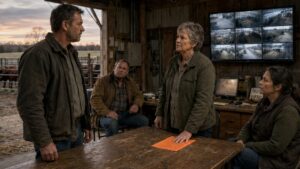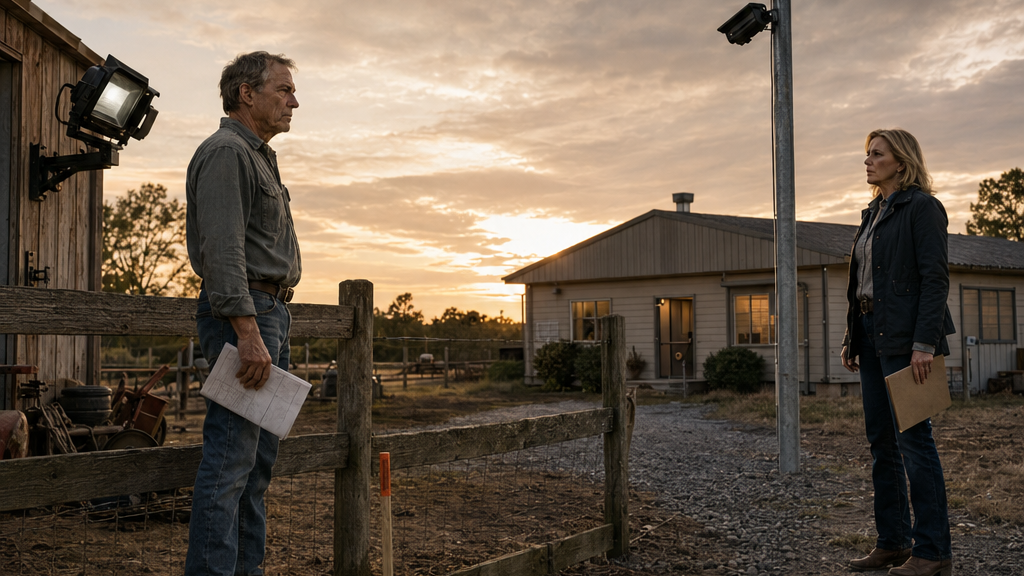
They Put Cameras Over His Farmyard—Then Learned Their Water Pumps Crossed His Land
Chapter 1: The Pole Above Christopher’s Equipment Yard
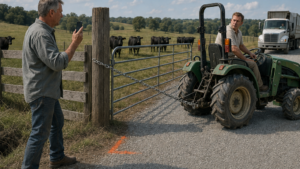
The camera head swung over Christopher Hill’s cattle gate before anyone bothered to tell him what it was for.
He was halfway across the equipment yard with a grease gun in one hand when the boom lift rose above the weathered fence line. A worker in a reflective vest guided a long aluminum pole upright on the other side of the boundary. Another man steadied it while a third bolted a black housing near the top.
Christopher stopped beside his tractor.
The pole was taller than the cottonwoods along the lane.
“What in the world?”
No one answered. The boom lift hummed higher.
Christopher set the grease gun on the tractor step and walked toward the gate. Gravel shifted under his boots. Between his fence and the association’s narrow service drive ran a pale strip of crushed stone that had been there longer than he could remember. His father had always called it the utility strip, though Christopher had never given it much thought.
The workers had parked beside it.
One of them glanced down.
“Morning.”
“What are you putting up?”
“Security system.”
Christopher looked past him toward the association pump house, a low metal-sided building fifty yards farther along the road.
“For what?”
The worker shrugged. “You’d have to ask the board.”
By the time Christopher reached the gate, the first camera was already attached.
Then came a second.
Then a third.
They were not fixed cameras pointing down at the service road. Each sat inside a motorized housing with a dark glass lens that could swivel independently.
Christopher rested both hands on the top rail.
“That thing see over my fence?”
The worker hesitated just long enough to answer the question.
“It has a pretty wide field of view.”
Christopher’s jaw tightened.
The association property sat beyond his eastern boundary, where a pump house, a small meeting room, and a gravel parking area served the scattered homes along the shared rural road. Christopher had lived beside it for twenty-six years. The arrangement had never been friendly exactly, but it had been workable.
A truck came in when a pump needed servicing. Board members met twice a month. Somebody replaced bulbs. Somebody checked the pressure tank.
Nobody watched his barn.
Until now.
He pulled out his phone and called Rachel Campbell.
She answered on the fourth ring.
“Christopher.”
“There’s a tower going up behind my equipment yard.”
“Security pole.”
“I gathered that.”
“We approved it last Thursday.”
“You approved cameras looking over my fence?”
“They’re not installed on your property.”
Christopher stared up at the nearest lens.
“That wasn’t my question.”
There was a pause.
Rachel’s voice remained controlled. “We’ve had theft complaints. Gate damage. Fuel siphoned. People cutting through after dark. The board approved upgraded coverage.”
“You’ve already got cameras.”
“Not enough.”
Christopher watched the workers attach wiring.
“Does one of those cover my barn?”
“The contractor designed the placement.”
“That’s still not an answer.”
“Christopher, if you had come to the meetings, you would have heard the discussion.”
That landed where she intended it to.
Two meeting notices had been taped to the mailbox board over the past month. Christopher had thrown both in the recycling bin.
He disliked association meetings. Too much talking, too little deciding. His land was not part of the association, though portions of the shared road and utility infrastructure touched his property under old agreements. He had spent years staying out of their arguments.
Rachel continued, “The pole is entirely on association land.”
Christopher looked at the fence line.
“I’ll check that.”
“You’re welcome to.”
He ended the call.
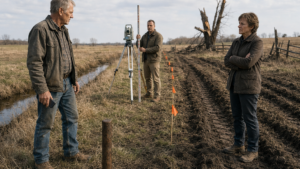
By noon he had stretched an old survey tape from the iron pin near the cattle gate to the second marker by the equipment shed. The workers watched him without comment.
The pole stood twenty-two inches beyond his property line.
Rachel had been right about that.
Christopher should have felt better.
Instead, he felt something colder.
A legal boundary was supposed to protect a man from what happened on the other side. But a camera did not care about twenty-two inches.
He walked back toward the barn.
Behind him, a motor whirred.
Christopher turned.
One of the black camera heads rotated.
Slowly.
Smoothly.
It moved past the service road, past the pump house driveway, and stopped facing directly into his equipment yard.
He stood still.
The lens stood still with him.
Christopher took three steps toward the barn.
The camera turned again.
Chapter 2: Security Was the Answer Everyone Gave
“You know I was one of the people who asked for more cameras.”
Maria Ramirez said it before Christopher had even finished closing his truck door.
She stood beside her mailbox at the end of the shared lane with a sack of feed balanced against one hip. Christopher had stopped because she waved him down. Now he wished she had waited another day.
“Why?”
“Because somebody cleaned out my tool shed in May.”
Christopher looked at her.
“Everything?”
“Battery saw, impact driver, two chargers, old generator. Took the fuel cans too.”
He had not heard about that.
Maria shifted the feed sack.
“And the Taylors had their gate chain cut. Somebody was driving through after midnight. So yes, I told Rachel we needed better coverage.”
Christopher glanced back up the road. From here the new pole rose above the trees like a misplaced utility mast.
“Did you ask for cameras over my barn?”
“No.”
“Did she tell you where they were going?”
Maria’s expression changed.
“She said near the pump house.”
“That’s not near the pump house. That’s near me.”
Maria followed his gaze.
From the road, the problem was easier to see. The pole stood beside the association service drive, but its height gave the cameras a clean view over Christopher’s fence.
“I thought they’d point at the road,” she said.
“So did I.”
Maria lowered the feed sack into the bed of her pickup.
“Have you talked to Rachel?”
“I called her.”
“That’s not what I asked.”
Christopher said nothing.
Maria shut the tailgate.
“That right there is part of your problem.”
“What is?”
“You think if you say less, people somehow understand more.”
Christopher gave her a look.
She shrugged. “I’ve known you fifteen years.”
He drove away before she could add anything else.
The comment stayed with him.
That afternoon he walked the association property from the public edge of the shared road.
Rachel’s security explanation made more sense than he wanted it to.
There were fresh gouges in one wooden gatepost where someone had pried at a chain. A fuel cabinet near the maintenance shed wore a new padlock. Tire tracks cut across the ditch where a vehicle had apparently turned around.
Then Christopher noticed the cameras.
Not the new ones.
The old ones.
One sat above the pump house door.
Another covered the gravel parking area.
A third faced the lane entrance.
Christopher stood beside the ditch, counting sightlines.
The pump house was already covered.
So was the meeting-room entrance.
So was almost every vehicle approaching from the road.
The new pole added something different.
Height.
From thirty feet up, it could see beyond the places the association actually owned.
Christopher returned home and sat at his kitchen table with a legal pad.
He drew three columns.
Road.
Association property.
His property.
Under the first two, he listed the things the cameras could reasonably protect.
Gate.
Parking lot.
Pump house.
Maintenance shed.
Under his own column he wrote:
Equipment barn.
Fuel tank.
Back porch.
Cattle working pen.
Then he stared at the list.
He did not object to security.
He objected to being included in it.
The next morning an association notice appeared at the mailbox cluster.
Christopher almost drove past.
Then he backed up.
The paper was inside a clear plastic sleeve. It described the new system as part of “community safety improvements” prompted by recent theft and vandalism. It mentioned insurance recommendations, blind spots, and the need for broader visual coverage.
Near the bottom was a sentence that bothered him more than the rest.
Residents and neighboring landowners are encouraged to cooperate with security measures serving the common area.
Christopher read it twice.
Neighboring landowners.
He folded his arms.
Rachel was already defining the disagreement before he had made one publicly. Anyone reading the notice could assume that objections came from people who did not care about theft.
He pulled out his phone, took a picture, then drove to the pump house again.
This time he brought binoculars.
He stood on the shoulder where no one could claim he was trespassing and traced each camera.
The old fixed unit over the pump-house door covered the entrance.
The parking camera covered vehicles.
The lane camera captured incoming traffic.
The new PTZ cameras could do all of that too.
But only the new cameras could look over his fence.
A white maintenance pickup came around the bend.
Eric Walker slowed when he saw Christopher.
“You bird-watching?”
“Something like that.”
Eric looked at the binoculars, then at the pole.
“I don’t set camera policy.”
“Didn’t ask.”
Eric rested an arm on the open window.
“You should come to the meeting Monday.”
“I’m not in the association.”
“You’re still part of the neighborhood.”
Christopher nearly replied, then stopped.
Maria’s words came back to him.
You think if you say less, people somehow understand more.
“I want the cameras masked off my property.”
“Tell Rachel.”
“I did.”
Eric gave a faint, tired smile.
“No. You told Rachel you were mad. That’s different.”
Before Christopher could answer, Eric drove on.
That evening Christopher walked the east side of his property.
The sunlight was low enough to catch every dip in the gravel strip beside the fence. It was a narrow band, maybe eight feet wide, running from the county road toward the pump house.
He remembered his father telling him not to build there.
Utility access.
That had been the explanation.
Christopher had been in his thirties then, too busy with cattle prices and broken balers to ask what utility.
Near the second fencepost he saw a faded orange cap almost buried in gravel.
He crouched and brushed dust away.
The plastic marker was cracked from years of sun.
Stamped into it were two barely legible words.
UNDERGROUND ELECTRIC.
Christopher looked toward the pump house.
Then back along the strip.
The marker line did not follow the association property.
It followed his.
Chapter 3: The Easement Beneath the Gravel
The blue line on the 2013 easement map crossed Christopher’s parcel before it crossed anything belonging to the association.
He leaned closer to the records-room counter.
“Can you enlarge that?”
The county clerk adjusted the scanner image.
The line sharpened.
It began near the county road, entered the northeast corner of Christopher’s acreage, followed the gravel strip behind his equipment yard, then curved toward the association pump house.
Christopher tapped the screen.
“That’s electrical?”
“According to the exhibit.”
“For the well?”
The clerk scrolled through the recorded pages.
“Let’s see.”
She read silently for several seconds.
“Electrical conduit and control wiring serving community water infrastructure, exterior lighting, and associated facilities.”
Christopher said nothing.
The clerk looked up.
“You want a certified copy?”
“Yes.”
“All of it?”
“All of it.”
While the printer worked, Christopher stood beside a metal shelf and remembered the day his father had signed something at the same courthouse.
Not this agreement. An earlier one.
Christopher had been twenty-three and impatient. There had been a road dispute with an adjoining owner, a handshake arrangement everybody assumed would last, and then a survey that proved assumptions were worthless.
A narrow piece of usable acreage had been lost in the settlement.
His father had come home from the lawyer’s office with a cardboard tube of plats under one arm.
Never let somebody tell you a line doesn’t matter because everybody knows where it is.
Christopher had remembered the lesson.
Maybe too well.
He had turned it into a habit of keeping distance rather than keeping conversation.
The clerk placed a thick packet on the counter.
“Some of the language has amendments.”
“Where?”
She pointed to a recording reference on page six.
Christopher paid for both documents.
At home, he cleared the kitchen table.
He moved the salt shaker, a stack of livestock invoices, and yesterday’s mail. Then he laid the easement flat and weighed the corners with coffee mugs.
The first pages were straightforward.
The association—or its predecessor—had permission to maintain underground electrical service across a defined strip of Christopher’s land.
Access was limited to inspection, repair, replacement, and necessary servicing.
Reasonable notice was required except in emergencies.
Surface disturbance had to be restored.
Nothing surprised him until he reached the utility exhibit.
There were four separate labels.
WELL PUMP FEED.
STORAGE TANK CONTROL.
LANE LIGHT CIRCUIT.
COMMON FACILITY SERVICE.
Christopher traced them with one finger.
The pump-house cameras were not the association’s only electrical concern.
Their water system relied on power routed under his land.
So did the tank controls.
So did lights along the shared lane.
The dependency was larger than he had imagined.
For several minutes, Christopher felt something dangerously close to satisfaction.
Rachel had emphasized that the new pole was technically outside his boundary.
Twenty-two inches.
Entirely legal.
Entirely association property.
Fine.
Now here was her infrastructure crossing nearly three hundred feet of his.
He leaned back.
“Interesting.”
But the feeling did not last.
A water pump was not a parking-lot fountain.
People depended on it.
Maria did.
Several older households up the lane did.
Christopher returned to the document.
He found the amendment the clerk had mentioned.
The language was denser, but one section had been underlined in faded blue ink years ago.
TERM AND REVIEW.
He read it twice.
The original access agreement had not granted unlimited administrative rights forever. Physical utility occupancy remained protected, but certain maintenance-access terms, surface use conditions, and associated permissions were subject to periodic review.
Christopher’s pulse changed.
He turned the page.
Notice requirements.
Renewal procedure.
Thirty-day review window.
The next scheduled review date sat near the bottom.
He checked the calendar hanging beside the refrigerator.
Then checked again.
Thirty-two days.
Christopher reached for a pencil.
The phone rang.
Rachel.
He let it ring until the answering machine picked up.
“Christopher, this is Rachel Campbell. I’d like you to attend Monday’s meeting so we can resolve the misunderstanding about the security equipment. The board does not believe the installation infringes on your property rights, but we’re willing to hear specific concerns.”
Christopher stared at the map while she spoke.
Not infringes on your property rights.
Technically, maybe she was right.
The pole did not cross his line.
The cameras were another question.
But now the entire argument looked different.
Rachel believed the boundary was the strongest fact in the dispute.
Christopher had just found another boundary buried underneath it.
He spread the survey map beside the easement exhibit and aligned the fence markers.
The blue utility route ran almost perfectly beneath the pale gravel strip outside his equipment yard.
He remembered dozens of maintenance trucks over the years.
Men opening panels.
Electricians tracing faults.
A trench repaired after a lightning strike.
He had never challenged any of it because none of it had interfered with his farm.
That had been cooperation.
Not surrender.
Christopher picked up the pencil and circled the review date.
For the first time since the camera pole had gone up, he no longer felt watched without options.
But the page in front of him carried a heavier question than the cameras ever had.
He could force Rachel to pay attention now.
The question was what kind of man he intended to be once she did.
Chapter 4: The Lights That Made the Point
The farm-supply truck backed toward Christopher’s equipment barn just after four in the afternoon, carrying two black LED work lights large enough to make the driver ask what he planned to illuminate.
Christopher signed the delivery slip.
“My side of the fence.”
The driver glanced toward the camera pole rising beyond the gravel strip.
“Looks like somebody already beat you to it.”
Christopher said nothing.
The licensed electrician arrived twenty minutes later with conduit, weatherproof boxes, and a compact lift. Christopher had already marked the mounting points on two steel posts beside the barn. Both were well inside his surveyed boundary.
Not close.
Not arguable.
He had measured twice.
The electrician followed Christopher to the fence line and looked across at the association property.
“You want these aimed there?”
“I want them aimed across my working yard.”
“That’ll put some spill on that building.”
“I know.”
The electrician studied him.
“Neighbors?”
“Association.”
That earned a slow nod.
“Then I’m going to document every angle.”
“Good.”
They worked without hurry.
Christopher helped run conduit while the electrician mounted the first light. By five-thirty, one black housing stood above the equipment shed roof, angled toward the cattle-working area and the eastern side of the yard.
The second post faced farther north.
The camera pole remained visible between them.
The setup looked almost ridiculous.
Three dark camera heads above the fence.
Two broad work lights facing back.
Christopher did not enjoy that part.
He had imagined he would.
For several days the thought of returning Rachel’s logic to her had felt clean.
Your equipment is legal on your property.
So is mine.
But standing beneath the lights, he could already see the trap in it. A man could be technically right and still spend his whole life making the other side miserable.
A white SUV turned into the association lot.
Rachel stepped out before it had fully stopped.
She crossed toward the fence with a folder tucked beneath one arm.
“What are you doing?”
Christopher was holding the end of a metal conduit.
“Installing lights.”
“I can see that.”
“Then we’re caught up.”
The electrician kept working.
Rachel looked at the mounting posts, then at the fixtures.
“Those are pointed toward association property.”
“They’re pointed across my yard.”
“They’re going to hit our building.”
Christopher set the conduit down.
“They’re entirely on my land.”
Her expression tightened.
“That isn’t the point.”
Christopher almost smiled.
Instead he walked to the corner post and pulled a folded survey copy from his back pocket.
“This is the line.”
“I know where the line is.”
“So do I.”
“Christopher.”
He handed her the paper.
The surveyed boundary ran several feet beyond both light posts.
Rachel barely looked at it.
“You’re doing this because of the cameras.”
“I’m doing it because I work after dark.”
“You’ve worked after dark for twenty years.”
“Now I want better lighting.”
Her eyes lifted to his.
The electrician stopped tightening a bracket.
For a moment nobody spoke.
Rachel lowered the survey.
“This is childish.”
Christopher felt the word hit harder than he expected.
He wanted to tell her that cameras over a man’s fence were childish too.
He wanted to mention the 2013 easement folded inside his kitchen drawer.
He wanted to ask if she had ever bothered to find out what ran underneath the gravel she kept driving across.
Instead he said, “Would you like the cameras lowered?”
Rachel exhaled.
“We’ve already been through this.”
“No. You told me the pole was legal.”
“It is.”
“Then these are legal.”
“That doesn’t mean they’re reasonable.”
Christopher looked at the camera above her shoulder.
“No.”
He took the survey back.
“It doesn’t.”
Rachel stared at him.
For the first time since the pole went up, she seemed to understand that he was not arguing about measurements anymore.
The electrician resumed work.
Rachel turned away.
“Don’t interfere with association operations.”
“I haven’t touched your property.”
“I’m serious.”
“So am I.”
She walked back toward her SUV.
Christopher watched her go and felt no victory.
Only momentum.
By sunset, the lights were connected.
The electrician handed him a small switch box mounted inside the barn entrance.
“We set the upper angle to keep the main beam on your side. There’ll still be spill.”
“How much?”
“You’ll see.”
Christopher waited until the electrician’s truck disappeared down the lane.
The yard had gone blue-gray with dusk.
Across the boundary, the association meeting-room windows glowed softly. The pump house light was already on.
Above it all, one of the PTZ cameras rotated.
Christopher put his hand on the switch.
For half a second he thought about leaving it off.
Then he flipped it.
White light poured across the equipment yard.
The tractor cast a hard shadow.
Fence boards sharpened into bright vertical lines.
The eastern edge of the cattle pen lit up like midday.
And beyond it, the association building turned stark and pale.
The spill washed across two meeting-room windows.
Not enough to blind anyone.
Enough to make the point.
Christopher stepped outside.
The camera pole stood directly between the two systems now.
A dark silhouette against the light.
An association pickup pulled into the lot.
Someone inside slowed.
Then stopped.
Christopher could see a figure lift a hand against the brightness.
He should have felt satisfied.
Instead he noticed how ugly the whole boundary had become.
A line that had once been nothing more than gravel, fence, and weeds now carried cameras, lights, survey stakes, legal copies, and resentment.
A truck door shut behind him.
Eric Walker came around the barn.
Christopher had not heard him arrive.
Eric looked at the lights.
Then at the camera pole.
“Well,” he said.
Christopher folded his arms.
“If you came to complain, Rachel already did.”
“I didn’t.”
Eric stared toward the association building.
“Those legal?”
“Licensed electrician. Surveyed boundary.”
“I figured.”
Christopher waited.
Eric shoved his hands into his jacket pockets.
“You pulled the county records yet?”
Christopher’s attention sharpened.
“What records?”
Eric looked at him.
“The original easement.”
Chapter 5: Eric Knew the Pole Was Too High
Eric arrived the next morning before the association office opened.
No white maintenance pickup.
No clipboard.
He came in an older truck Christopher had seen him use on weekends and parked beside the equipment shed instead of crossing the gravel strip.
That alone told Christopher the conversation was not official.
Christopher stepped out of the barn carrying a wrench.
“You’re early.”
“I didn’t want an audience.”
Christopher set the wrench on the workbench.
Eric stayed near the open door.
The camera pole was visible beyond him.
“You asked me about the easement.”
Eric nodded.
“You found it?”
“Yes.”
“All of it?”
“Enough.”
Eric looked toward the road.
Christopher waited.
Silence usually served him.
This morning it made Eric uncomfortable enough to continue.
“I told Rachel that pole was too high.”
Christopher’s face did not move.
“When?”
“Before they ordered it.”
“And?”
“She said the contractor wanted height to eliminate blind spots.”
“You told her it could see over my fence?”
“I said it probably would.”
“Probably?”
Eric rubbed the back of his neck.
“I didn’t stand here with a measuring tape.”
Christopher picked up the wrench again, then put it down.
“So she knew.”
“She knew there was a concern.”
“That’s not the same thing.”
“No.”
Eric finally met his eyes.
“That’s why I’m here.”
Christopher leaned against the workbench.
“Why didn’t you say something when they installed it?”
Eric’s mouth tightened.
“Because I work for the association.”
“You still could’ve said something.”
“I did. Inside the meeting.”
“To Rachel.”
“And the board.”
Christopher waited.
Eric looked irritated now, mostly with himself.
“We had three theft complaints in six weeks. Somebody cut the north gate. Insurance was asking what the association was doing about security. Rachel had people calling her every day.”
“So that makes my yard part of their coverage?”
“No.”
“Sounds like you’re defending her.”
“I’m telling you why she made the call.”
Christopher looked out toward the new lights.
The previous evening’s glare suddenly felt less satisfying.
He had built the argument in his mind as simple.
Rachel wanted control.
Rachel did not care about his privacy.
Rachel thought rules only applied in one direction.
Eric was offering something messier.
Pressure.
A rushed decision.
Warnings ignored, but not necessarily because she wanted to spy on him.
“She had an insurance review coming,” Eric continued. “Board wanted something they could point to and say they’d improved coverage. New pole was visible. Easy to explain.”
Christopher gave a short laugh.
“Visible.”
“Exactly.”
“And lowering the cameras wasn’t visible enough?”
Eric shrugged.
“Not to people who wanted action.”
Christopher crossed to the shed door.
Across the gravel strip, tire tracks ran toward the pump house.
Fresh ones.
A maintenance vehicle had crossed his land sometime that morning.
He pointed.
“Who went through there?”
“Well contractor.”
“For what?”
“Pressure check.”
“No notice.”
Eric followed his gaze.
“That’s another reason I asked about the easement.”
Christopher turned.
Eric took a breath.
“The board has been treating that access like it’s permanent and automatic.”
“It isn’t.”
“No.”
“You knew that?”
“I knew there were conditions. I didn’t know the review date until last month.”
Christopher stared at him.
“Rachel knows?”
“Yes.”
That answer changed the shape of the conversation.
“So the pole goes up a month before the easement review.”
Eric immediately shook his head.
“No.”
“You expect me to believe that’s coincidence?”
“Yes.”
“Why?”
“Because the security project started before anybody looked at the easement calendar.”
Christopher watched him closely.
“How do you know?”
“I was in both meetings.”
The answer came too quickly to be theatrical.
Christopher believed him.
He did not like believing him.
It removed the cleanest explanation.
Eric stepped closer to the workbench.
“Look, Rachel screwed up. She pushed the installation through. I told her the elevation could cause a privacy fight. She figured you’d complain, we’d adjust the software masking, and everybody would move on.”
“She figured I’d accept it.”
“She figured you wouldn’t come to a meeting.”
That one landed.
Christopher looked away.
Eric did not soften it.
“You haven’t shown up in years.”
“I’m not a member.”
“No. But you’re tied into half the infrastructure whether you like it or not.”
Christopher’s eyes narrowed.
“Half?”
Eric pointed toward the gravel strip.
“That conduit doesn’t just feed the pump motor.”
“I know.”
“Tank controls?”
“I saw it.”
“Lane lights?”
“Yes.”
Eric hesitated.
Christopher noticed.
“What else?”
“The emergency pressure relay.”
Christopher felt his irritation drain into attention.
“What does that serve?”
“If the main tank drops below the set level, it signals the backup cycle. Same control line.”
“And it crosses here.”
“Every inch from the county feed to the pump house.”
Christopher looked down at the gravel.
For years it had been the least interesting ground on the farm.
No crops.
No buildings.
Nothing but crushed stone and the occasional utility truck.
Now it seemed to carry the entire argument under his boots.
Eric said, “If there’s a fault, we may need access fast.”
“Emergency access is already protected.”
“Routine isn’t.”
“No.”
“The board will want that renewed clean.”
Christopher looked at him.
“And you’re here to ask me to sign?”
“No.”
“Then what?”
Eric stared toward the camera pole.
“To tell you not everybody over there thinks that thing belongs where it is.”
Christopher said nothing.
Eric moved toward his truck.
At the edge of the shed, he stopped.
“And for what it’s worth, those lights last night got the message across.”
Christopher glanced toward the black fixtures.
“That was the idea.”
“Yeah.”
Eric looked back.
“Just be careful the message doesn’t become the whole conversation.”
He drove away.
An hour later the mail carrier left a large envelope in Christopher’s roadside box.
The return address belonged to the rural property association.
Christopher opened it at the kitchen table.
Inside was a formal notice concerning the upcoming easement review.
The language was polite.
The request was not.
The association sought continued maintenance access under substantially the existing terms and asked Christopher to confirm renewal before the scheduled review date.
He read it twice.
Then he placed it beside the map.
Rachel had finally put the question in writing.
Now Christopher had to decide whether the answer was no.
Chapter 6: The Leverage He Could Not Use
“If you block routine access, I can still come through for an emergency.”
The well-service technician stood beside the open control cabinet with a meter hanging from one hand.
Christopher had asked him a narrow question.
The answer widened everything.
“What counts as an emergency?”
“No water. Pump failure. Tank fault. Anything threatening service.”
“And routine?”
“Testing. Relay replacement. Preventive work. Stuff you don’t want to wait on until it becomes an emergency.”
Christopher glanced toward the gravel strip.
The technician followed his eyes.
“That conduit under there is old.”
“How old?”
“Some of it predates the current agreement.”
Christopher looked back at him.
“So they need the access.”
“They need practical access.”
“That’s not what I asked.”
The technician gave him a cautious look.
“I don’t do land disputes.”
“Neither do I.”
The man almost smiled.
Christopher pointed toward the pump house.
“If I refused the renewal tomorrow, could you still keep water running?”
“For a while.”
“And after that?”
“If something failed and we couldn’t get permission except under emergency terms, everything gets slower and more expensive.”
“How many houses?”
The technician named a number.
Christopher’s expression changed.
He had known several properties used the community well.
He had not understood how completely some depended on it.
“No private wells?”
“Some do. Some don’t.”
Christopher thought of Maria’s place.
He had seen a pressure tank beside her shed years earlier but never asked where it drew from.
The technician closed the control cabinet.
“Whatever you decide, don’t turn water into the argument.”
Christopher bristled.
“I never said I would.”
“No.”
The man picked up his tools.
“But somebody asked me yesterday what happens if you deny access.”
“Who?”
The technician hesitated.
“Association office.”
Rachel.
Christopher watched him leave.
By noon, the formal easement notice lay open on his kitchen table beside the 2013 agreement.
He could mark it up.
Demand fees.
Narrow access.
Require advance notice.
Push the board hard enough that they would have no choice but to reconsider the camera pole.
Every legal advantage sat in front of him.
For the first time since the installation, he had more leverage than Rachel.
It felt worse than he expected.
A truck horn sounded at the gate.
Maria.
Christopher went outside.
She climbed from her pickup carrying an empty five-gallon water jug.
“You busy?”
“Depends.”
“That sounds friendly.”
She held up the jug.
“Pump pressure’s been acting strange.”
Christopher looked at it.
“You’re on the association well?”
Maria frowned.
“You didn’t know that?”
“No.”
“I’ve always been on it.”
He looked toward her property through the trees.
“What about that pressure tank by your shed?”
“Storage.”
Christopher rubbed his jaw.
Maria’s expression shifted.
“What?”
“Nothing.”
“That’s not true.”
He opened the gate.
They walked toward the barn.
Maria saw the easement papers through the kitchen window before he said anything.
“Rachel sent you the renewal?”
“This morning.”
Maria stopped.
“You’re not going to block it, are you?”
The question was immediate.
Too immediate.
Christopher looked at her.
“Is that what people are saying?”
“She told the board you hadn’t responded.”
“That’s different.”
“She thinks you’re getting ready to refuse.”
Christopher felt a sharp flare of anger.
“She thinks a lot of things without asking.”
Maria set the jug beside the barn wall.
“You don’t answer.”
“I shouldn’t have to explain myself every time they do something stupid.”
“No. But if you stay silent, people fill it in.”
Again.
The same criticism.
This time it hurt more because she was right.
Christopher looked toward the camera pole.
“I want that thing out of my yard.”
“It isn’t in your yard.”
“You know what I mean.”
“Yes.”
Maria folded her arms.
“And I agree.”
Christopher looked at her.
She continued, “I supported more security. I did not support cameras looking over your fence.”
“You said that already.”
“I’m saying something else now.”
She nodded toward the easement papers.
“Don’t make the water the price.”
Christopher’s voice hardened.
“I haven’t threatened anybody’s water.”
“Then tell them that.”
He turned away.
Maria picked up the jug.
“My mother uses that well when she stays with me. The couple past the bend doesn’t have another source. Neither do two houses near the north gate.”
Christopher stared at the gravel.
The strip suddenly looked less like leverage and more like a pipe running through people’s kitchens.
Maria stepped closer.
“You’ve got a real complaint. Keep it real.”
He looked at her.
“What would you do?”
“I’d make them fix the cameras.”
“They’ve already refused.”
“Then make the easement terms protect you.”
Christopher frowned.
“Not punish them. Protect you.”
Maria put the jug back into her truck.
“That seems like the difference.”
After she left, Christopher went inside and sat at the table.
He opened the renewal request.
For the first time, he read it without imagining Rachel’s name at the bottom.
He read it as a document governing pumps, tank controls, maintenance trucks, notice, restoration, and the ground beneath his farm.
He took a pencil.
Under routine access, he wrote:
Advance notice required.
Under surface disturbance:
Restore gravel and fencing.
Under associated equipment:
No new above-ground equipment affecting privacy without written approval.
He stopped.
Then he added:
Emergency access remains unrestricted as provided by existing agreement.
Christopher looked at the sentence for a long time.
The strongest weapon he had possessed was one he no longer intended to use.
That did not make him weak.
It made the remaining argument clearer.
The cameras could no longer hide behind the water.
By Thursday evening, Rachel had sent two emails and left one voicemail.
Christopher answered none of them.
Old habit.
By Friday morning, he knew that was becoming its own kind of mistake.
He was standing near the cattle gate when a white SUV turned onto the lane.
Rachel parked outside the property.
She stepped out carrying a folder in one hand.
In the other were two paper coffee cups.
Christopher stayed where he was.
Rachel walked to the gate.
She looked tired.
Not defeated.
Not apologetic.
Just tired.
She held up one of the coffees.
“I didn’t know how you take it.”
“Black.”
“That’s what I guessed.”
Christopher did not open the gate.
Rachel lowered the cup.
Between them, the gravel utility strip ran toward the pump house.
She looked down at it, then back at him.
“I think we need to talk about what happens to this easement.”
Christopher rested one hand on the top rail.
For once, he did not intend to answer with silence.
Chapter 7: What Rachel Asked for at the Gate
Rachel did not offer Christopher the coffee again.
She looked through the cattle gate at him and said, “Are you planning to shut off our access?”
Christopher kept one hand on the top rail.
“No.”
The answer came quickly enough that Rachel blinked.
“No?”
“I said no.”
Her shoulders lowered a fraction, but she did not look relieved.
“Then why haven’t you answered the renewal notice?”
Christopher glanced at the folder under her arm.
“Because I was deciding what I was willing to sign.”
Rachel shifted the coffee carrier to one hand.
“That’s different from what the board thinks.”
“I know.”
“What does the board think?”
“That I’m waiting until the last minute so I can hold the water system over your heads.”
Rachel did not deny it.
Christopher opened the gate.
“Come inside.”
She followed him across the yard.
The camera pole stood beyond the fence, black against the morning sky. One of its housings rotated toward the road, then paused.
Rachel noticed Christopher watching it.
Neither of them commented.
At the kitchen table, he moved the livestock invoices aside and spread out the easement agreement, the county survey, and his handwritten notes.
Rachel set the two coffees between them.
Christopher opened his.
Black.
She had guessed right.
Rachel sat opposite him.
“I need to be clear,” she said. “The association cannot agree to anything that risks emergency water access.”
“Neither can I.”
Her eyes narrowed slightly.
“Then what is this about?”
Christopher tapped the document.
“Routine access gets notice. Emergency access stays exactly as it is.”
Rachel leaned forward.
“And renewal?”
“I’ll renew it.”
For the second time that morning, he surprised her.
She sat back.
“Then what do you want?”
Christopher looked toward the kitchen window.
The top of the camera pole was visible above the barn roof.
“That.”
Rachel followed his gaze.
“We’ve already discussed the cameras.”
“No. You’ve explained why you installed them.”
“Because we had theft.”
“I know.”
“And vandalism.”
“I know that too.”
“Then you understand why the board—”
Christopher held up one hand.
“I understand why you wanted security.”
Rachel stopped.
“I understand Maria lost tools. I know about the north gate. I know your insurance review was coming.”
Something changed in her face at the mention of insurance.
Christopher saw it.
“Eric told you.”
“He told me enough.”
Rachel looked down at her coffee.
“You shouldn’t have put him in the middle.”
“I didn’t.”
“No?”
“He came to me.”
That silenced her.
Christopher waited, but this time he did not use silence to end the conversation. He used it to give her room to answer.
Rachel finally said, “The insurer didn’t order that pole.”
“I figured.”
“They wanted documented improvements. Lighting, access control, better coverage. We had residents calling every time somebody saw headlights after midnight. One board member wanted a gate across the entire road.”
Christopher grimaced.
“I stopped that.”
He looked at her.
Rachel continued, “The camera system was the quickest thing we could install without changing road access.”
“And Eric warned you.”
“Yes.”
The admission was quiet.
“He said the height might create a privacy problem. The contractor said they could software-mask private areas.”
“Did they?”
“Not before it went live.”
Christopher’s jaw tightened.
Rachel looked directly at him.
“That was my mistake.”
It was not an apology exactly.
But it was the first sentence she had spoken that did not hide behind the board.
Christopher slid the survey across the table.
“I don’t care if you watch your gate.”
Rachel studied the map.
“I don’t care if you watch the pump house. I don’t care if you record every vehicle that comes onto association property.”
He placed one finger on the line beside his equipment yard.
“But you don’t watch over that fence.”
Rachel tapped the paper.
“Masking can probably solve most of it.”
“Probably isn’t enough.”
“You want the cameras removed?”
“Lowered. Fixed limits on rotation. Permanent privacy masks for my property.”
“That requires a board vote.”
“Then vote.”
Rachel looked toward the handwritten easement conditions.
“And these?”
“Advance notice for routine entry. Restore anything you tear up. No new above-ground equipment tied to the easement without written approval if it affects my use of the land.”
Rachel read the last line twice.
“You’re connecting the camera dispute to utility access.”
“I’m connecting what crosses my land to how people treat my land.”
“That will sound like leverage.”
“It is leverage.”
She looked up.
Christopher did not look away.
“But the water isn’t.”
Rachel said nothing.
Christopher pulled the renewal notice toward himself.
“I was angry enough to think about refusing everything.”
Her expression sharpened.
“I didn’t.”
“Why not?”
“Because Maria gets her water from that system.”
Rachel’s face softened.
“So do people who never voted for your cameras. The technician told me what delayed access could mean if a control failed.”
He pushed the papers toward her.
“I’m not going to punish them to make you listen.”
Rachel sat very still.
For years Christopher had assumed people like her responded only to pressure. Perhaps some did. But saying the thing plainly felt harder than turning on the lights had.
He continued.
“I should’ve answered your calls.”
Rachel gave him a surprised look.
“I should’ve gone to at least one meeting. I’m not joining your association, and I don’t plan on making a hobby out of committees. But I let you decide what my silence meant.”
“That didn’t give us the right to aim cameras into your yard.”
“No.”
The word sat between them without argument.
Rachel picked up the survey.
“I can order the PTZ functions disabled temporarily.”
“Today?”
“I can recommend it today. Permanent changes require the board.”
“Lowering them?”
“Contractor can do that if the board approves the cost.”
Christopher almost laughed.
“You paid to put them up.”
“I know.”
Rachel took a sip of coffee that had probably gone cold.
“Some members are going to say you’re using the easement to get special treatment.”
“I’m asking them not to film my farm.”
“I know what you’re asking.”
“Then tell them.”
Rachel closed the folder.
“That means I have to tell them I approved the installation after Eric raised the sightline issue.”
“Yes.”
She gave him a dry look.
“You don’t make this easy.”
Christopher looked toward the window.
“Neither did the pole.”
A reluctant half-smile appeared and disappeared from her face.
She stood.
At the door, Rachel paused.
“I’ll call the contractor about shutting off the elevated cameras until the vote.”
Christopher nodded.
“And I’ll recommend the revised easement terms, with some legal cleanup.”
“Fine.”
She opened the door.
“Christopher?”
“Yes?”
“If we’d had this conversation three weeks ago, would you still have installed those lights?”
He looked across the yard at the two black fixtures.
“Probably not.”
Rachel nodded once.
“That makes two of us.”
An hour after she left, the highest camera rotated toward the road.
Then stopped.
It did not move again.
Chapter 8: The Line Both Sides Could See
Two weeks later, Christopher heard the hydraulic whine of a lift before he saw the association paperwork.
He stepped out of the barn and found Eric beside the fence while a contractor lowered the first camera housing.
Christopher walked over.
“Board vote already happen?”
“Last night.”
“And?”
Eric pointed upward.
“What does it look like?”
The original pole remained, but the three cameras were being remounted several feet lower. At the new height, Christopher’s wooden fence blocked most of the equipment yard from view.
A contractor called down to Eric.
“Mask zones are loaded.”
Eric looked at Christopher.
“You want to check?”
Christopher did.
They walked to the association meeting room, where a monitor displayed the three feeds.
The road was visible.
The pump-house entrance was visible.
The parking area was visible.
Along the western edge of the image, Christopher’s property appeared as a solid gray block.
No barn.
No cattle pen.
No back porch.
No equipment yard.
Christopher stared at it.
“That permanent?”
“Configuration is locked behind administrator access. Change requires board authorization under the new agreement.”
“The rotation limit?”
Eric moved the control.
The camera panned toward Christopher’s boundary, stopped before reaching the fence, and refused to move farther.
Christopher nodded.
“Good.”
Eric leaned against the desk.
“Rachel had a rough meeting.”
“I imagine.”
“Couple people thought you were getting special treatment.”
“I’m not surprised.”
“One wanted the easement renewed exactly as written before.”
Christopher looked at him.
“And Rachel?”
“Told them the old terms were loose because everybody had been cooperating for years.”
Eric gave him a small smile.
“Then she said cooperation works better when you don’t point cameras into the neighbor’s barn.”
Christopher looked back at the monitor.
He had expected satisfaction.
What he felt instead was quieter.
The board had not declared him right about everything.
Nobody had apologized publicly.
Nobody had been humiliated.
They had simply corrected something that should not have happened.
For once, that seemed sufficient.
Rachel arrived twenty minutes later with the final agreement.
They met beside the cattle gate rather than at Christopher’s kitchen table.
She handed him the packet.
“Board-approved.”
Christopher read the marked provisions.
Routine access required advance notice except when immediate service conditions made notice impractical.
Any disturbed gravel, fencing, or farm surface had to be restored.
Emergency access remained protected.
The association could maintain its existing buried electrical system.
Any new above-ground equipment placed in connection with the easement that materially affected Christopher’s privacy or use required written consent.
Attached to the agreement was a separate security plan describing the camera height, rotation restrictions, and privacy masking.
Christopher reached the signature page.
“You got all this through?”
“Five to two.”
“Who were the two?”
Rachel looked at him.
“You’re not in the association, remember?”
He almost smiled.
“Right.”
She held out a pen.
Christopher did not take it immediately.
Across the fence, the lowered cameras looked smaller.
Not harmless.
Just properly limited.
He signed.
Rachel countersigned beneath him.
“That’s thirty years of access settled,” she said.
“With review provisions.”
“With review provisions.”
He handed back the pen.
Rachel looked toward the black work lights on Christopher’s barn.
“What about those?”
Christopher followed her gaze.
“One stays.”
She raised an eyebrow.
“I actually work out there after dark.”
“And the other?”
Christopher looked at the second fixture.
“I don’t need it.”
That afternoon he called the electrician.
By Thursday, the northern light was gone.
The remaining fixture was angled downward across the equipment yard, where its beam ended well before the association building.
Christopher kept the switch.
He kept the surveyed posts.
He kept copies of every agreement in the steel file cabinet inside the farmhouse.
Cooperation, he had learned, did not require forgetting where the line was.
Not everybody approved.
Maria stopped by one afternoon with a bag of tomatoes and told him two residents were still complaining that he had forced the board into expensive changes.
Christopher put the tomatoes on the tailgate.
“Did they say I was wrong?”
“They said you were difficult.”
“That wasn’t my question.”
Maria laughed.
“No. They didn’t say you were wrong.”
She glanced toward the lowered cameras.
“For what it’s worth, I like them better this way.”
“You can still see the road?”
“Yep.”
“Pump house?”
“Yep.”
“Then they’re doing their job.”
Maria studied him.
“You going to start attending meetings now?”
“No.”
She shook her head.
“Of course not.”
Christopher picked up the tomatoes.
“I might read the notices.”
“That’s growth.”
“Don’t get carried away.”
After she left, he walked the gravel strip with a rake.
Several service vehicles and the contractor’s lift had left shallow grooves along its edge. The association had offered to send someone to repair them.
Christopher declined.
This part he wanted to do himself.
He brought a tractor bucket of fresh crushed stone from the pile behind the barn and spread it slowly over the utility route.
The old orange underground-electric marker still stood beside the fencepost.
He cleaned around it rather than burying it.
Near the cattle gate, the iron survey pin remained exposed.
Christopher left that too.
His father had believed lines mattered because memory changed and handshakes faded.
Christopher still believed that.
What he no longer believed was that every boundary had to become a wall.
As he raked the last ridge flat, a maintenance pickup approached from the road.
It stopped outside the gate.
Eric lowered the window.
“Routine pressure check tomorrow morning. Eight-thirty. Just giving notice.”
Christopher rested both hands on the rake.
“All right.”
“That work?”
“Works.”
Eric drove on.
Christopher looked down the fresh gravel strip.
Beneath it ran the conduit serving pumps, lights, tank controls, and houses beyond his fields.
Beside it stood his fence.
Above it, the cameras now stopped where they were supposed to stop.
Nothing about the place looked dramatic anymore.
That was the part Christopher liked best.
He smoothed the final patch of stone around the survey marker, leaving its rust-dark top plainly visible.
The line was still there.
Now both sides could see it.
The story has ended.