They Blocked His Harvest Truck at the Farm Road—Then the Old County Plat Changed Who Controlled the Gate
Chapter 1: The Harvest Truck Stopped at the Old Iron Gate
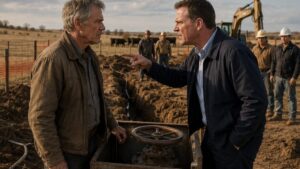
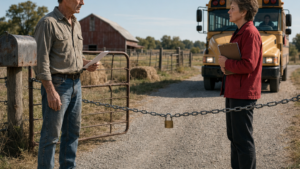
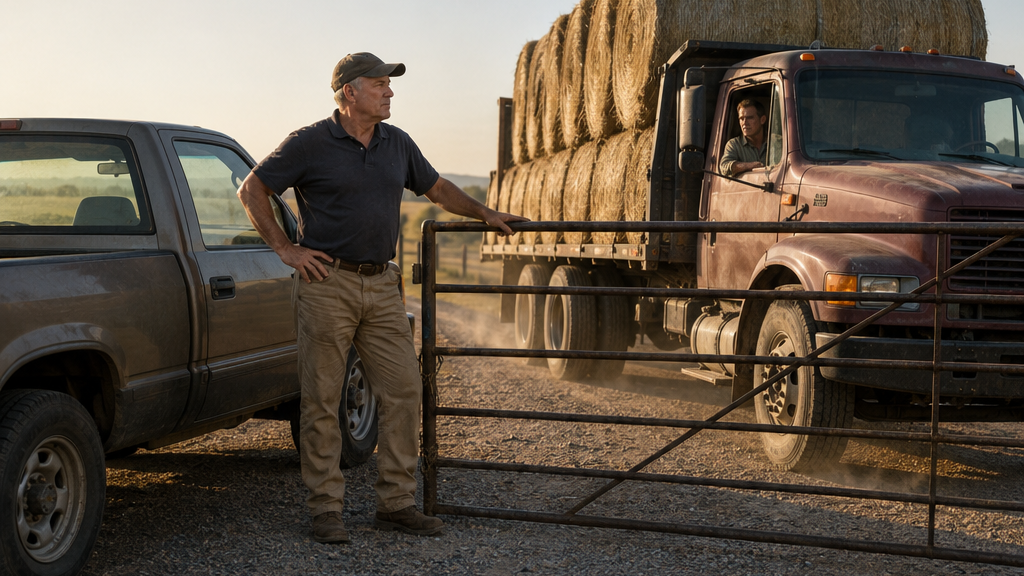
Dennis Roberts’s pickup was sideways across the gravel lane before Stephen Martin reached the old iron gate.
Stephen saw it from the cab of the hay truck and took his foot off the accelerator.
Behind him, twenty-four tightly packed round bales sat two rows high on the trailer, strapped down for the three-mile haul from the leased field to the north pasture. The contractor driving the second truck eased to a stop behind him. Dust drifted forward and settled against Stephen’s windshield.
Dennis stood beside his pickup with one hand resting on the open driver’s door.
The gate itself was shut.
Stephen checked the clock on the dash. 7:12.
He rolled down his window.
“Morning.”
Dennis did not answer the greeting.
“You can’t bring that through.”
Stephen looked at the gate, then at the load behind him.
“Why not?”
“Association rule. Heavy trucks need approval.”
“This is a farm road.”
“It’s a private lane.”
“I own the farm at the end of it.”
Dennis stepped closer. He was in his early sixties, square through the shoulders, with a ball cap faded almost gray above the bill. He had lived along the lane longer than Stephen had owned anything in his own name.
“Doesn’t matter who owns what past the gate,” Dennis said. “Anything over the weight limit needs ten business days’ notice.”
Stephen stared at him.
“Ten business days?”
“You got the packet.”
“I got a folder with mowing schedules and a phone list.”
“The vehicle policy was in it.”
Stephen glanced at the contractor’s truck in his mirror. The driver had shut off his engine.
The hay had been cut three days earlier, baled yesterday afternoon, and was supposed to be under cover before the heat built. Rain was not forecast, but Stephen had learned not to trust late-summer forecasts more than he had to.
“You knew I was moving hay today.”
“I knew you were cutting.”
“That usually leads to moving it.”
Dennis’s mouth tightened.
“You should’ve called.”
Stephen felt the first hard rise of anger behind his ribs.
He had returned to full-time work on the Martin acreage only months earlier, after buying out the last fractional share that had been tied up between relatives. Since then, every conversation seemed to contain some quiet test of whether he belonged there.
He reached into the passenger seat and pulled out a folded packet.
“This is the deed for the south parcel and the recorded access description.”
Dennis barely looked at it.
“Ownership isn’t the issue.”
“It is if you’re stopping me from reaching land I own.”
“No. The issue is road use.”
Stephen unfolded the first page and held it through the window.
“Show me where I agreed to ten days.”
Dennis did not take the paper.
“Everybody on this road follows it.”
“That’s not what I asked.”
The contractor behind them opened his door and climbed down. He stopped beside his cab, waiting.
Dennis noticed him.
“Your driver needs to turn around.”
“He’s not my driver. He’s a contractor I’m paying by the hour.”
“Then you probably shouldn’t keep him waiting.”
The sentence landed differently than Dennis seemed to intend.
Stephen turned off the truck.
The engine shuddered once and went silent.
“What are you doing?”
Stephen picked up his phone.
“Documenting the obstruction.”
Dennis gave a short laugh.
“You’re serious?”
Stephen photographed the closed gate. Then Dennis’s pickup. Then the loaded trailer and the road beyond it.
“Stephen.”
He took another photograph.
“I’m trying to keep this road from getting torn up.”
“It’s dry.”
“That’s not the point.”
“Then tell me the point in writing.”
Dennis stopped.
Stephen lowered the phone.
“You’re denying access to agricultural traffic on a road serving my property. Put the reason in writing and sign it.”
Dennis looked toward the contractor again.
“You trying to make a court case out of this?”
“I’m trying to know what you’re claiming.”
“I’m claiming the lane association has rules.”
“And I’m asking which recorded right gives the association authority to stop me.”
Dennis’s expression changed just slightly.
Not fear. Not yet.
Irritation sharpened by something more careful.
“You’ve been back out here five minutes and you already think you know how this works.”
“I grew up here.”
“You left.”
Stephen let the words sit.
There it was.
Not in the packet. Not in the rule.
Something older.
He folded the deed once.
“Have you ever read the recorded instrument that created this lane?”
Dennis stared at him.
“Don’t start playing lawyer.”
“I asked a question.”
“I’ve maintained this road for twenty years.”
“That wasn’t the question.”
A horn sounded once behind them.
The contractor raised both hands from beside his truck.
Stephen checked the time again.
7:31.
Every minute now had a price attached.
Dennis walked to his pickup and pulled a clipboard from the front seat.
“I’ll give you something in writing.”
“Good.”
He wrote against the truck door, pressing hard enough that Stephen could hear the pen scratching.
When he finished, he tore off the top sheet and brought it over.
The page carried the printed heading of the lane-maintenance association. Underneath, Dennis had written that Stephen Martin had been denied entry of a heavy commercial vehicle for failure to provide ten business days’ advance notice under the association’s vehicle policy.
Stephen read it twice.
“Sign it.”
Dennis’s jaw moved.
Then he signed.
Stephen folded the paper and slipped it into the deed packet.
“So now what?” Dennis asked.
“Now I turn around.”
“You could’ve saved yourself all this trouble by calling me.”
Stephen started the truck.
Dennis moved toward the gate but did not open it.
Stephen looked down at him through the window.
“No,” he said. “I could’ve saved myself trouble by asking permission. I’m not sure those are the same thing.”
He backed carefully until the contractor could clear the ditch and turn.
By 9:00, the hay trucks were parked in the equipment yard on the far side of town while Stephen arranged temporary storage.
At noon, the contractor texted him the revised charge.
Standby time had started the moment they stopped at the gate.
By the time Stephen finally got the hay unloaded through a different access point requiring a long detour, six hours had been lost.
That evening, the signed denial lay on his kitchen table beside the deed.
The association letterhead looked formal.
The signature looked confident.
Stephen looked from one to the other and realized he still had not seen the only thing that mattered.
Something showing Dennis had the right to close that gate.
Chapter 2: Ten Days’ Notice and Six Hours Lost
The hauling invoice arrived Sunday morning with a line Stephen had never seen on one before.
STANDBY — 6 HOURS.
He read the amount twice.
Then he set the invoice beside Dennis’s signed denial and the photographs from the gate.
The money irritated him less than the neatness of it.
Six hours could now be measured.
Not remembered. Not argued about.
Measured.
He spent Sunday afternoon going through the property papers he had received when the family acreage was consolidated. Deeds, tax maps, insurance schedules, fencing receipts, a soil report, an old survey copy.
Nothing mentioned ten days’ notice.
Nothing gave the lane association authority to approve agricultural traffic.
Monday morning he drove to the association’s small office in the back room of a farm-supply building.
Dennis was not there.
A board member handed Stephen a photocopied packet.
“Vehicle policy’s page four.”
Stephen read it at the counter.
Heavy commercial vehicles, construction vehicles, hauling equipment, and oversized deliveries required advance approval. Ten business days.
“Where’s the recorded agreement this comes from?”
The board member frowned.
“That is the agreement.”
“No. That’s a policy.”
“It’s what everybody follows.”
Stephen tapped the page.
“Where’s the document giving the association authority to enforce it?”
The man looked toward the closed office door.
“You’ll have to ask Dennis.”
“I did.”
“And?”
“He gave me another copy of the rule.”
Stephen left with the packet.
By noon he had emailed a written objection to the association, attached the deed, attached Dennis’s signed denial, attached the hauling invoice, and requested the recorded instrument establishing the association’s power to restrict access.
At 2:17, Dennis called.
Stephen almost let it go to voicemail.
Instead, he answered.
“I got your email,” Dennis said.
“Good.”
“You’re making this harder than it needs to be.”
“I asked for the document.”
“You don’t need a document every time somebody explains a rule to you.”
Stephen looked through his office window at two tractors parked under the equipment shed.
“I do when the rule stops me from using my own farm.”
“You’re new to the association.”
“I’m new to paying dues directly. The land isn’t new.”
“Everybody on this road follows the same rules.”
Dennis said it slowly, as though repetition could turn it into an answer.
Stephen leaned back.
“Then it should be easy to show me where they come from.”
A pause.
“You want to start your time back here fighting everybody?”
“I haven’t fought anybody.”
“You threatened records requests.”
“I requested a record.”
“You know what I mean.”
Stephen did.
That bothered him more than he wanted to admit.
He had spent years working outside the county, then returned after his father’s death with a private determination to make the acreage productive again. He had told himself he did not need anybody’s approval. He would read the documents, pay his bills, repair his fences, do the work.
Simple.
But rural roads were not simple. Neither were people who remembered what your family had done before you were old enough to notice.
Still, Dennis had blocked a truck.
“I’ll be at the county recorder tomorrow,” Stephen said.
“Go ahead.”
Dennis hung up.
That afternoon another envelope appeared in Stephen’s mailbox.
The association seal was printed at the top.
The letter warned him that any future heavy vehicle entering without advance approval could result in penalties under association policy.
Stephen photographed the envelope before opening it fully.
Then he laid it beside the invoice.
The following morning he drove to the county offices.
The recorder’s department occupied a low brick building attached to the courthouse annex. Inside, fluorescent lights buzzed above rows of cabinets and computer terminals.
Stephen gave the clerk the parcel number.
“I’m looking for the original access instrument for the lane coming off County Road 18.”
She typed for a while.
“Current deed?”
“I have it.”
“Association documents?”
“I have what they gave me. I’m looking for what existed before them.”
That got her attention.
She turned back to the screen.
“How old is the road?”
“Older than I am.”
“That helps less than you’d think.”
Stephen almost smiled.
She searched under subdivision references, then under adjoining parcels. After several minutes, she pointed at an entry.
“There’s an older plat book.”
“How old?”
“Eighties.”
“Can I see it?”
She disappeared through a door.
Stephen waited beside a counter scarred by years of elbows and document boxes.
He could have called Ruth.
The thought came and went.
His mother knew more about the farm’s practical history than anyone living, but asking her would mean admitting he did not know something that had happened practically under his own feet.
He hated that this mattered to him.
The clerk returned carrying a flat archival folder.
“This predates the lane association by quite a bit.”
She placed it carefully on the counter.
Inside was a large subdivision plat, the paper yellowed at the edges.
Stephen bent over it.
The farm parcels looked familiar.
The road did too.
But the labeling did not.
The clerk put a clear protective sheet over the plat.
“You’ll want to look at the recorded notes along the lower margin.”
Stephen followed her finger.
There, beside the original drawing of the lane, was a recording reference dated years before Dennis’s association had existed at all.
Chapter 3: The Plat Under the Recorder’s Glass
The lane association’s name appeared nowhere on the original access instrument.
Stephen checked twice.
Then a third time.
The clerk watched him from behind the counter.
“You find what you wanted?”
“I found something.”
“That usually means another question.”
He leaned closer to the protective glass.
The road was drawn as a narrow strip extending from County Road 18 across several parcels before branching toward the Martin acreage and two neighboring farms.
Beside it, the recorded language described perpetual ingress and egress for agricultural use and access to the benefited parcels.
Stephen read the sentence slowly.
“Can I get a certified copy of this?”
“Yes.”
“And the instrument referenced here?”
She followed the number he pointed to.
“That’ll be another file.”
While she retrieved it, Stephen stood looking at the plat.
The old iron gate was not shown.
There was no marked checkpoint.
No association boundary.
No approval station.
Just a road.
Access.
Agricultural use.
The satisfaction came quickly and cleanly.
Dennis had stopped a hay truck from using a lane specifically reserved for agricultural access.
Stephen could already picture the letter he would send.
One page.
Certified copy attached.
Withdrawal of the vehicle restriction requested immediately.
Reimbursement for standby charges.
Then the clerk returned with another folder.
“This may complicate it.”
Stephen looked up.
“How?”
“There’s a notation tied to the access language.”
She slid the document toward him.
It was not a prohibition.
It was a maintenance covenant.
The language was older and less tidy than the current association policy, but the meaning was clear enough. Owners benefiting from the lane were expected to participate in necessary maintenance, particularly when unusually heavy use caused measurable damage.
Stephen read the relevant paragraph again.
“Does this give anybody the right to block access?”
“I can’t give you legal advice.”
“I’m not asking you to.”
She nodded.
“No, I understand. I can tell you I don’t see language here saying advance approval is required.”
“But there is shared maintenance.”
“That’s what it appears to say.”
His clean victory became less clean.
Not because Dennis had been right to stop him.
He still saw nothing giving Dennis that power.
But the road was not merely an unrestricted strip of gravel serving individual farms.
It carried obligations in both directions.
Stephen requested certified copies of everything.
Back home, he spread the documents across the kitchen table.
The signed denial went on the left.
The plat in the center.
The maintenance covenant on the right.
He traced the lane with one finger.
At the road entrance on the modern aerial map sat the iron gate.
On the old plat there was nothing.
He searched association files online and found meeting minutes going back eleven years. Gravel purchases. Culvert work. Ditch clearing. Grading after storms.
Some years had detailed assessments.
Others simply listed “voluntary road contribution.”
Stephen made a column of dates.
Then another of amounts.
The association’s ten-day vehicle rule appeared much later than the original access covenant.
He found no recorded amendment attaching it to the land.
That evening he called the contractor who had hauled the hay.
“Did my load tear anything up Saturday?”
The man laughed.
“You never got through the gate.”
“On the detour.”
“Nothing I noticed.”
“If you had come down the shared lane, would that load have been unusual?”
“For a farm road?”
“Yes.”
“No.”
Stephen thanked him and hung up.
He should have felt better.
Instead, the maintenance language stayed in front of him.
Around eight, Ruth stopped by with a covered dish and found the dining end of the kitchen buried under records.
She set the dish on the counter.
“You look like your father when somebody sent him a tax notice.”
Stephen kept reading.
“That a compliment?”
“No.”
She came closer.
“What’s all this?”
“Road records.”
Her expression changed immediately.
“What happened?”
“Dennis blocked the hay trucks Saturday.”
“He what?”
“Ten-day approval rule.”
Ruth looked toward the window as though Dennis might somehow be standing outside it.
“You tell him whose ground you were trying to reach?”
“Showed him the deed.”
“And?”
“He said ownership wasn’t the issue.”
“That sounds like Dennis.”
Stephen slid the plat toward her.
“This is the original road instrument.”
She put on her reading glasses.
“County copy?”
“Certified.”
He tapped the access language.
“It says agricultural ingress and egress. No vehicle approval. No ten days. Association didn’t even exist when this was recorded.”
Ruth read it carefully.
“So you were right.”
“About access.”
She caught the qualification.
“What else?”
Stephen turned over the maintenance covenant.
“This.”
Ruth looked down.
For the first time since arriving, she became very still.
Stephen noticed.
“You’ve seen it?”
She did not answer immediately.
Her finger moved to the recording number at the top.
Then she sat.
“Where did you get this?”
“Recorder’s office.”
“I know where you got it.”
Her voice had changed.
“I’m asking why you went looking.”
“Because Dennis is acting like he owns the road.”
Ruth removed her glasses.
“He doesn’t.”
“Then what is it?”
She looked at the covenant number again.
Stephen waited.
Finally she said, “Dennis didn’t start this argument.”
Stephen said nothing.
Ruth rested both hands on the edge of the paper.
“Your father did.”
Chapter 4: What Stephen’s Father Never Paid
“Your father did.”
Stephen looked at Ruth across the kitchen table.
The words did not fit the story he had been building in his head.
Dennis had blocked the truck. Dennis had invented the ten-day rule. Dennis had signed the denial and threatened penalties. Stephen had the plat proving the lane existed for agricultural access long before the association.
That part was still true.
But Ruth was looking at the maintenance covenant as though it belonged to a different argument entirely.
“What did Dad start?”
Ruth folded her glasses and set them beside the paper.
“Not the gate. Not exactly.”
“Then what?”
“The paying.”
Stephen leaned back.
Ruth kept one hand on the old covenant.
“When your father and I first had cattle on the south place, the road was handled differently. Somebody ordered gravel when it got bad. Somebody else brought a tractor over and graded it. Bills got divided afterward.”
“That sounds organized.”
“It wasn’t.”
“Who decided what everybody owed?”
“Usually whoever had already paid.”
Stephen frowned.
“That’s not much of a system.”
“No. It wasn’t.”
Ruth looked toward the darkening window.
“One spring, after three straight weeks of rain, the lane got torn up almost to the base. A milk truck sank at the bend. Dennis and two others put several thousand dollars into stone and a culvert.”
“And Dad refused to pay?”
“He refused the amount.”
Stephen waited.
Ruth sighed.
“He said nobody had asked him before the work was ordered. He said Dennis couldn’t decide what his share was after the fact.”
“That doesn’t sound unreasonable.”
“No.”
Something in her answer stopped him.
“But?”
“But your father kept using the road.”
Stephen looked down at the covenant.
Ruth continued.
“He paid some years. Other years he didn’t. If Dennis sent a number your father thought was too high, he’d send back a smaller check. Sometimes nothing.”
“Why didn’t you tell me?”
“You didn’t ask.”
Stephen looked at her.
“That’s convenient.”
Ruth’s mouth tightened.
“You came back here determined not to need anyone. I wasn’t going to chase you down the lane with thirty years of arguments.”
He pushed the plat away.
“So Dennis thinks I owe him for Dad?”
“I don’t know what Dennis thinks.”
“You just said this started with Dad.”
“I said Dennis didn’t start it.”
That distinction irritated him because it mattered.
Ruth stood and went to the kitchen drawer where Stephen kept old farm papers he had not yet sorted. She pulled out a thin envelope, browned along the flap.
“I found this when we cleaned the desk after your father died.”
Inside were copies of handwritten assessments.
Gravel. Grading. Culvert pipe.
Some had check marks beside them.
Others had notes in his father’s handwriting.
NO AGREEMENT.
TOO HIGH.
ASK FIRST.
One invoice had never been opened.
Stephen ran his thumb along its edge.
“How much are we talking?”
“Over the years? I don’t know.”
“You kept the books.”
“Not those books.”
The answer came sharper than usual.
Ruth sat again.
“Your father and I argued about it. He thought if he gave Dennis an inch, Dennis would turn it into ownership. Dennis thought if he didn’t push, half the people on the road would let the other half pay.”
Stephen looked at the signed denial beside the old assessments.
Two men, decades apart, both convinced that yielding once would become yielding forever.
“Was the gate because of Dad?”
“Not just him.”
Ruth shook her head.
“There were three owners by then who were behind on road money. A timber crew came through one fall and left ruts deep enough to hold water. After that, Dennis started talking about controlling heavy traffic.”
“And people let him?”
“People were tired.”
That answer landed harder than Stephen expected.
Not agreement.
Exhaustion.
The next morning Stephen walked the shared lane instead of driving it.
He started at the iron gate.
Up close, the hinges showed several generations of repair. One post was newer than the other. Fresh gravel had been spread around the entrance, but farther in, the surface thinned along the shoulder where runoff cut shallow channels.
Near the bend, he found a patch where larger stone had been packed into a soft section.
Someone had paid for that.
He knew immediately how easy it would be to tell himself it had nothing to do with him.
His truck had not caused it.
His cattle had not caused it.
His father had not ordered the work.
The covenant, however, did not ask who felt responsible.
It described benefited owners.
A pickup came slowly around the bend.
Daniel Scott stopped beside Stephen and lowered his window.
“You inspecting us now?”
Stephen glanced at him.
“Apparently I’ve been doing it wrong.”
Daniel studied him.
“Ruth talk to you?”
“She did.”
“That explains your face.”
Stephen ignored that.
“Did you support Dennis’s truck rule?”
Daniel rested an arm on the window frame.
“For a while.”
“Why?”
“Because asking nice didn’t work.”
“For who?”
“Anybody.”
Stephen waited.
Daniel switched off the truck.
“Three years ago I paid almost half the gravel bill on this stretch because two owners said they were short and another one said his vehicles didn’t weigh enough to matter.”
“So Dennis made up a rule.”
“I didn’t say it was legal.”
“You supported it.”
“I supported not paying everybody else’s share.”
Stephen looked down the lane.
“Those aren’t the same thing.”
“No.”
Daniel’s answer came without defensiveness.
“That’s the problem.”
Stephen turned toward him.
“Why didn’t anybody record a real agreement?”
Daniel laughed once.
“You ever tried getting six landowners to agree on who owes what?”
“No.”
“You’re getting the introductory course.”
The humor faded.
“Dennis went too far blocking you. I told him that.”
“Did you?”
“Yes.”
“Before or after?”
Daniel looked at him.
“After.”
There it was.
Not betrayal exactly.
Something more ordinary.
A man choosing peace until the cost landed on someone else.
Stephen nodded.
“I have a feed delivery next week.”
Daniel’s expression changed.
“You give notice?”
“No.”
“You planning to?”
“No.”
“Then you’re going to force it.”
“I’m going to use the road.”
“That’s not all you’re doing.”
Stephen did not answer.
Daniel restarted the truck.
“Just remember this,” he said through the open window. “Being right about the gate doesn’t make the gravel free.”
He drove away.
That afternoon Stephen called the feed supplier and confirmed the delivery date.
Then he called a gravel company.
He asked for a price to repair the soft stretch near the bend and reinforce the shoulder closest to his fields.
He did not tell Dennis.
That was the old habit again: build the answer privately, show it when finished.
By evening, Stephen knew it was a mistake and made no move to correct it.
At 5:40, he found another association envelope in his mailbox.
This one was marked FINAL NOTICE.
He opened it standing beside the road.
Any unapproved heavy vehicle entering the shared lane, it said, would result in assessment of penalties and possible recovery of road damages.
The letter specifically referenced his scheduled feed delivery.
Stephen read that line twice.
Dennis somehow knew the date.
At the bottom, under the printed policy, was a handwritten sentence:
Approval has not been requested and will not be granted without compliance.
Stephen folded the notice.
Then he looked toward the iron gate.
The question was no longer whether he could prove Dennis wrong.
It was whether he was willing to force the proof while a loaded feed truck sat waiting on the other side.
Chapter 5: Three Trucks and One Authority Nobody Could Prove
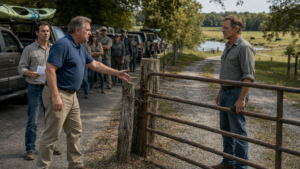
The feed truck arrived at 7:03 Tuesday morning.
Dennis Roberts was already standing beside the iron gate.
Stephen had expected him.
What he had not expected was Daniel Scott’s pickup parked fifty yards farther down the county road.
Daniel remained inside it.
Watching.
The feed truck slowed, air brakes hissing, and stopped behind Stephen’s pickup.
The driver leaned out.
“This the place?”
“Yes.”
Dennis stepped into the lane.
“Truck’s not coming through.”
Stephen walked toward him.
“Morning.”
“You got the notice.”
“I did.”
“And ignored it.”
“I read it.”
Dennis pointed toward the truck.
“You’re deliberately violating association policy.”
Stephen held a folder against his thigh.
“I’m bringing livestock feed to agricultural property through an agricultural-access road.”
“You don’t get to interpret everything yourself.”
“Neither do you.”
Dennis took a breath through his nose.
“Turn it around.”
Stephen opened the folder.
“Show me the recorded instrument giving you authority to order that.”
Dennis did not look at the paper.
“We’ve been through this.”
“No. We’ve been through your policy.”
Stephen removed the certified plat and held it where Dennis could see the county stamp.
“This is the access instrument.”
Dennis’s eyes moved to the document despite himself.
“It doesn’t mean what you think it means.”
“Then show me what does.”
“The association maintains the road.”
“I know.”
“Then you know heavy vehicles can be regulated.”
“Maintenance can be allocated. Damage can be charged if it’s actually caused. I have found nothing giving you a right to prohibit agricultural access.”
Behind them, the feed truck idled.
Dennis looked toward Daniel’s pickup.
Daniel did not move.
Stephen noticed.
So did Dennis.
“You brought an audience?”
“No.”
“You called him?”
“No.”
That answer seemed to irritate Dennis more.
Stephen stepped aside from the center of the lane.
“I’m taking responsibility for any measurable damage my delivery causes. I’ve photographed the road condition this morning.”
Dennis stared at him.
“You think that makes this okay?”
“I think the recorded access makes it okay.”
A long silence followed.
Then Dennis swung the gate open.
Not graciously.
Not in surrender.
He pulled it so hard the chain struck the metal post.
“Go ahead.”
Stephen signaled the driver.
The feed truck crawled through.
Its tires pressed into the gravel but did not sink. Stephen walked behind it past the entrance, photographing the surface.
As the rear axle cleared the gate, Dennis said, “This isn’t over.”
Stephen looked back.
“I know.”
Three days later, the hay-hauling contractor returned for another scheduled load.
Dennis did not block him.
Instead, an association notice appeared on Stephen’s gatepost that morning warning that all costs from unauthorized heavy traffic would be assessed to the responsible property owner.
Stephen photographed it.
The hay truck passed through.
At the soft bend, the driver slowed almost to walking speed.
Fresh white stakes had appeared along one shoulder.
Daniel stood by the fence.
“You marking damage?” Stephen asked.
“Marking where it always goes bad.”
Stephen looked at him.
Daniel nodded farther down the lane.
“You’ll see.”
Around ten, the third truck arrived.
A tandem-axle gravel truck.
Dennis came out of his driveway when he heard it.
For the first time, he looked genuinely confused.
“What’s that doing here?”
Stephen pointed toward the bend.
“Putting stone on the weak section.”
Dennis stared at him.
“Who ordered it?”
“I did.”
“Under whose authority?”
Stephen almost smiled.
“Mine. I’m paying the invoice.”
Dennis’s expression closed.
“You don’t just dump gravel wherever you want on a shared road.”
“The driver’s placing it on the existing traveled surface and shoulder. Same grade that’s already there.”
“Who told you what grade we use?”
“Supplier had your last order.”
That caught Dennis off guard.
The gravel truck rolled slowly toward them.
Stephen had already arranged for the work to avoid blocking the lane. The driver feathered stone into the thin stretch while Stephen and Daniel watched from the shoulder.
Daniel crouched and picked up a piece.
“Same limestone.”
Stephen nodded.
“Same size.”
Dennis said nothing.
For the first time since the dispute began, Stephen saw something other than anger in him.
Not gratitude.
Recognition, maybe.
Or annoyance that Stephen had stepped into the part of the problem Dennis considered his territory.
When the truck finished, Stephen took photographs and saved the invoice.
Daniel waited until Dennis walked away.
“You could’ve told him.”
“I could’ve.”
“Why didn’t you?”
Stephen looked at the fresh stone.
“Because he would’ve turned it into permission.”
“Maybe.”
Daniel kicked gravel from the edge back onto the road.
“Or maybe you wanted him to see you didn’t need him.”
Stephen did not answer.
That silence was answer enough.
Over the next week, the lane changed.
Not physically so much as socially.
Every heavy vehicle became a point of observation.
Dennis did not close the gate again, but he appeared when trucks arrived. One neighbor slowed to watch the hay trailer pass. Another asked Stephen whether the county had “taken over” the road.
“No,” Stephen said.
That rumor bothered him.
He had never claimed the road was public.
Only that the recorded agricultural access could not be vetoed by Dennis.
The distinction was already being lost.
Then Daniel stopped Stephen outside the equipment shed.
“You know what people are saying?”
“I’ve heard.”
“They think you’re trying to kill the association.”
“I’m not.”
“Dennis thinks you are.”
“Dennis thinks the association is him.”
Daniel looked toward the lane.
“He didn’t always.”
Stephen waited.
Daniel lowered his voice.
“There was an attorney involved before.”
“When?”
“Few years back. Different dispute.”
“What did the attorney say?”
“I never saw the letter.”
“Dennis did?”
Daniel nodded.
“He stopped talking about fines for a while afterward.”
Stephen felt something inside the conflict shift.
“Why didn’t you tell me this before?”
“Because I didn’t know what it said.”
“You knew it existed.”
“Yes.”
Again, the rural habit of knowing without saying.
Stephen was beginning to hate it partly because he recognized it in himself.
The certified letter arrived two days later.
It came from an attorney representing the lane-maintenance association.
Stephen opened it at the kitchen table.
The language was more polished than Dennis’s notices.
It demanded that he cease unauthorized heavy-vehicle activity, comply with association procedures, and preserve records relating to any road damage caused by his deliveries.
Stephen read every page.
Then he read the cited authorities.
Association policy.
Association bylaws.
Maintenance provisions.
No recorded language granting the power to deny agricultural access.
No amendment to the original access instrument.
No clause giving Dennis the right to close the gate.
Stephen placed the attorney’s letter beside the county plat.
Then he took out Daniel’s comment from memory.
An attorney had looked at this before.
He picked up his phone.
This time, instead of drafting another letter alone, he called the association office.
“I want the next board meeting opened to every owner on the lane.”
Dennis answered after a pause.
“For what purpose?”
“To settle what authority the association actually has.”
“You’ve got counsel’s letter.”
“I read it.”
“Then follow it.”
“It doesn’t cite a recorded right to block the road.”
Silence.
Stephen continued.
“And I want any prior legal advice concerning enforcement of the truck policy available at the meeting.”
Dennis said nothing for several seconds.
When he finally spoke, his voice had lost its usual certainty.
“You don’t know what you’re asking for.”
Stephen looked at the iron gate through the kitchen window.
“I think I do.”
Chapter 6: The Rule Dennis Knew Was Only a Custom
Dennis Roberts admitted it before Stephen had finished opening his folder.
“The association never owned the lane.”
No one in the machinery shed moved.
The meeting had barely started.
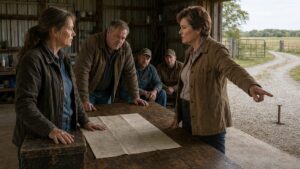
Six folding chairs faced an old workbench being used as a table. The air smelled of oil, dust, and dry hay. A fluorescent fixture hummed overhead. On the bench sat the county plat, Stephen’s invoices, the association policy packet, and the iron gate key.
Dennis stood behind them.
Stephen had expected denial.
He had prepared for it.
Instead, Dennis looked at the two neighboring landowners, then Daniel, then Stephen.
“We never claimed ownership.”
Stephen kept his hands on the folder.
“You claimed authority to deny access.”
“We claimed authority to manage traffic.”
“Based on what recorded instrument?”
Dennis’s jaw tightened.
“There isn’t one that says it the way you want it to.”
“That isn’t an answer.”
“It’s the answer.”
Stephen opened the certified plat.
“The access right predates this association. Agricultural ingress and egress. No advance approval.”
“I know what it says.”
The room went quiet again.
Stephen looked up.
“You knew?”
Dennis glanced toward the attorney seated against the side wall.
The attorney did not speak.
Dennis exhaled.
“A few years ago we asked about enforcement.”
Daniel shifted in his chair.
Stephen thought of what he had said beside the equipment shed.
“What were you told?”
“That the truck rule would be difficult to enforce as a prohibition.”
“Difficult?”
Dennis’s eyes hardened.
“That’s the wording I remember.”
The attorney finally spoke.
“The prior advice was more nuanced than that.”
Stephen turned.
“Does the association possess a recorded right to prevent agricultural access because ten business days’ notice wasn’t given?”
The attorney paused.
“No document I have reviewed grants that specific authority.”
The answer did not produce the satisfaction Stephen had expected.
It was too quiet.
Too close to what Dennis had already known.
Stephen looked back at him.
“You blocked me anyway.”
Dennis nodded once.
“Yes.”
“Why?”
For a moment Dennis appeared ready to retreat into policy language.
Then he put both palms on the workbench.
“Because the polite version stopped working.”
One of the neighboring owners shifted.
Dennis continued.
“You want the whole story? Fine. Eight years ago we spent nine thousand dollars rebuilding the lower bend. Three owners paid on time. Two paid part. One paid nothing.”
Stephen knew which category his father had sometimes occupied.
“Next year, culvert washed out. Same thing. Then timber trucks came through without anybody telling us. Tore the shoulder up. Owner said it wasn’t his responsibility because the trucks belonged to the logging company.”
His voice remained controlled, but the years underneath it were visible now.
“So we made a notice rule. Then somebody ignored that. We made it ten days. Somebody ignored that too. We started calling it approval because notice without consequences meant nothing.”
“You turned a maintenance problem into permission to use land,” Stephen said.
“I turned it into something people paid attention to.”
“And blocked lawful access.”
“Yes.”
The admission settled over the shed.
Dennis looked directly at Stephen.
“I shouldn’t have blocked your truck.”
It was not an apology exactly.
But it was the first sentence Dennis had spoken that did not defend the act.
Stephen could have stopped there.
He had the admission.
The attorney had confirmed the weakness.
His hauling invoice was in the folder.
Instead he took out the maintenance covenant.
“My father didn’t always pay.”
Ruth’s old envelope seemed heavier than paper in his memory.
Dennis looked surprised.
Stephen continued.
“He challenged assessments. Sometimes he sent less. Sometimes nothing.”
One neighboring owner looked at Dennis.
Dennis said, “That’s true.”
Stephen nodded.
“So my family benefited from road work other people paid for.”
Daniel leaned forward slightly.
Stephen hated the sentence.
That was part of why he needed to say it.
“But that still didn’t give you the right to close the gate.”
“No,” Dennis said.
“And my father being stubborn doesn’t make me responsible for whatever authority you invented afterward.”
“No.”
This time Dennis answered quickly.
The room’s balance changed.
Not toward Stephen.
Toward the problem.
Daniel spoke next.
“I supported the truck policy.”
One of the owners turned toward him.
Daniel shrugged.
“I was tired of paying more than my share.”
Stephen looked at him.
Daniel continued.
“I still am. But I don’t want Dennis deciding who gets through a gate.”
The second owner spoke from the end of the row.
“Then take the gate down.”
Dennis looked at him sharply.
“Absolutely not.”
“Why not? If you can’t control traffic, what’s the point?”
“Livestock. Trespass. People cutting through at night.”
“Leave it unlocked.”
“That’ll last until somebody forgets.”
“Then remove it.”
The argument caught quickly.
Within minutes, the original dispute had split into two camps.
One wanted Dennis’s authority restored in some softer form.
The other wanted the gate removed completely and the association stripped back to nothing more than a shared bank account.
Stephen watched the discussion become exactly what he had feared.
Winning the legal point had not created a workable road.
It had removed the false answer.
Dennis picked up the gate key from the workbench.
“If we don’t control entry, we’ll be fixing this road every six months.”
The owner at the end of the row stood.
“Then everybody fixes their own section.”
“That’s not how a shared lane works.”
“Neither is one man standing at the gate.”
Dennis’s hand closed around the key.
Stephen stood.
“Enough.”
The room quieted.
Not because he had authority.
Because he had not raised his voice once all evening.
Stephen placed three papers on the workbench.
The first was Dennis’s signed denial.
The second was the old maintenance covenant.
The third was Stephen’s gravel invoice.
“I’m not asking to eliminate maintenance obligations.”
Dennis looked at the invoice.
Stephen tapped it.
“I paid for the soft section my trucks use most.”
“I saw.”
“I should’ve told you first.”
Dennis looked up.
That admission cost Stephen almost as much as the one about his father.
“I didn’t,” Stephen continued, “because I thought telling you meant asking permission.”
Daniel watched him carefully.
“It doesn’t have to.”
Stephen turned toward the others.
“The access right is recorded. That shouldn’t depend on who’s chairman or who gets along with whom.”
He touched the covenant.
“The maintenance obligation is real too. That shouldn’t depend on who feels generous that year.”
One of the owners crossed his arms.
“So what are you proposing?”
“I’m not proposing Dennis’s rule.”
Dennis’s face tightened.
“And I’m not proposing tearing down the gate and pretending the road takes care of itself.”
Nobody spoke.
Stephen looked at the key in Dennis’s hand.
“We need something written that separates access from maintenance.”
“How?” Daniel asked.
“Emergency vehicles and agricultural access can’t be vetoed. Routine heavy users contribute based on actual use or documented damage. Planned construction traffic gives notice so people can prepare the road, but notice isn’t permission.”
Dennis stared at him.
“You think everybody’s going to sign that?”
“No.”
The answer surprised several people.
Stephen closed the folder.
“But I think everybody should have to say exactly which part they refuse.”
Dennis looked down at the key.
For twenty years, Stephen thought, that small piece of metal had become an answer to questions it had never been designed to settle.
Dennis set it back on the workbench.
Not handed over.
Not surrendered.
Just placed between them.
The owner at the end of the row said, “I still say take the gate out.”
Dennis started to answer.
Stephen cut in.
“No.”
Both men looked at him.
Stephen gathered the plat, the covenant, and his invoice into one stack.
“We’re not replacing one bad rule with no rule at all.”
He looked around the machinery shed.
“If we’re going to fix this, we write something everyone can read before the next truck reaches that gate.”
Chapter 7: The Gate Stayed Open Under Different Rules
Stephen placed his gravel invoice on the workbench beside Dennis’s original signed denial.
The two sheets looked almost absurd together.
One documented six hours lost because a truck had been stopped.
The other documented stone Stephen had paid to place on the same road Dennis had claimed he was protecting.
Between them lay the revised agreement.
Dennis read the first page without sitting down.
Three weeks had passed since the machinery-shed meeting. In that time, the owners had argued through two drafts, one attorney review, four sets of handwritten changes, and a Saturday morning inspection of every soft shoulder, culvert, and turnaround on the shared lane.
Nobody had gotten everything they wanted.
Stephen had begun to think that was probably why the document had a chance.
Daniel stood near the open shed door with his arms folded.
Ruth had stayed home. She had told Stephen the agreement belonged to the people using the road now, not to the people who had spent years arguing over what should have happened before.
Dennis tapped the paragraph concerning heavy agricultural traffic.
“You changed this again.”
“The attorney did.”
“It says advance notice when reasonably practical.”
“Yes.”
“That’s softer than what we discussed.”
“It’s supposed to be.”
Dennis looked up.
“What does that mean?”
“It means if I schedule a concrete truck three weeks ahead, I notify everybody. If I have cattle out and need a livestock trailer immediately, I don’t sit outside the gate for ten business days.”
“Nobody ever said ten days for an emergency.”
Stephen reached across the bench and tapped the old denial.
“You said ten days for hay.”
Dennis looked at the signature.
He did not argue.
The new agreement separated the issues that had been tangled together for years.
Recorded agricultural access could not be denied by the association or by an individual owner.
Emergency access could not be delayed.
Planned construction or unusually heavy commercial traffic required notice when practical, but notice did not create a veto.
Maintenance expenses would be documented.
Routine costs would be shared according to an agreed formula combining parcel use and expected traffic. Damage tied clearly to extraordinary use could be billed to the responsible owner, but not through a penalty invented after the fact.
And no single person controlled the gate.
Dennis turned another page.
“What about the key?”
Daniel pointed toward the paragraph.
“Multiple holders.”
“I can read.”
“Then why ask?”
Dennis gave him a look.
Daniel looked back.
Stephen kept quiet.
That, too, had changed.
A month earlier he would have filled every silence before someone else could define it for him. Now he waited.
Dennis put the document down.
“I still think this creates loopholes.”
“Probably,” Stephen said.
Dennis blinked.
“That doesn’t concern you?”
“It concerns me less than pretending we can write a rule that covers every truck for the next thirty years.”
One of the neighboring owners, seated on a folding chair, nodded.
Dennis noticed.
“So we just trust everybody?”
“No,” Stephen said. “We document what matters.”
He slid the gravel invoice forward.
“That’s mine.”
Dennis looked at the amount.
Stephen continued.
“I used the weak stretch more heavily this season. I ordered stone. I paid the bill. Under this agreement, I submit it to the group and we decide whether any portion qualifies as common maintenance.”
Dennis frowned.
“You already said you were paying it.”
“I am.”
“Then why submit it?”
“Because next time it might be your truck causing damage. Or Daniel’s. Or nobody’s. If we keep handling everything privately, we’ll end up right back here.”
Daniel looked toward the open gate visible beyond the shed.
Dennis did not.
He kept staring at the invoice.
“You sound like an association chairman.”
“No.”
Stephen answered too quickly, and Daniel laughed.
Even Dennis almost smiled.
Almost.
The attorney had recommended filing a memorandum of the agreement with the county so future owners could locate it easily alongside the older access documents. That mattered to Stephen more than he expected.
He had spent weeks discovering how much trouble could grow in the space between what everybody “knew” and what nobody had written clearly enough.
Dennis picked up the hauling invoice next.
The standby charge remained attached to it.
“I’ll reimburse this.”
Stephen looked at him.
Dennis kept his eyes on the paper.
“The six hours.”
Stephen said nothing.
“I shouldn’t have stopped you.”
The machinery shed went still.
This was closer to an apology than Dennis had come before.
Stephen waited.
Dennis added, “If you sign the maintenance agreement.”
There it was.
A condition.
Stephen felt the old instinct return instantly.
Take the money. Get the signature. Finish the fight.
He looked down at the reimbursement amount.
Then at Dennis.
“No.”
Dennis’s head lifted.
“No?”
“I’ll sign the agreement if the agreement is fair.”
“It is fair.”
“Then my reimbursement has nothing to do with it.”
Dennis’s expression hardened.
“You’re splitting hairs.”
“No. That’s how this started.”
Stephen slid the hauling invoice back toward him.
“You blocked my truck under a rule that didn’t give you that authority. If the association agrees I’m owed the documented cost, reimburse it. If not, don’t.”
“And you’ll still sign?”
“If we settle the agreement on its own terms.”
Daniel unfolded his arms.
The neighboring owners watched Dennis.
Stephen hated the pressure in the room.
He did not want to win because four people had stared Dennis into yielding.
So he pulled the agreement closer and turned it toward himself.
“I have one more change.”
Dennis looked suspicious.
“What?”
Stephen pointed at the enforcement section.
“No chairman can suspend access alone.”
“That’s already there.”
“Not clearly enough.”
He had handwritten a sentence beneath it.
Any temporary restriction beyond immediate safety measures required agreement from a majority of participating owners and could not interfere with recorded agricultural or emergency access.
Dennis read it.
“That makes it slow.”
“Yes.”
“Sometimes roads need decisions fast.”
“Then immediate safety measures are allowed. But nobody gets to decide somebody else loses access because they’re angry.”
Dennis looked at Stephen.
Stephen held his gaze.
Neither of them needed to say whose anger he meant.
Daniel came over and read the addition.
“I’m good with it.”
One owner nodded.
The other asked, “What happens if Dennis’s cattle get loose and he needs the gate shut?”
“Safety measure,” Stephen said. “Shut it.”
“And if somebody keeps leaving it open?”
“Then we deal with the person leaving it open. We don’t invent a truck ban.”
Dennis leaned both hands against the bench.
For several seconds he said nothing.
Then he took the pen.
He signed the revised agreement.
Not dramatically.
No one applauded.
He simply wrote his name on the line and pushed the document toward Daniel.
One by one, the others signed.
When Stephen’s turn came, he paused before writing.
He thought of his father’s notes.
NO AGREEMENT.
TOO HIGH.
ASK FIRST.
There had been truth in those objections.
There had also been damage in turning every disagreement into refusal.
Stephen signed.
The county filing took place two days later.
The clerk who had first brought out the old plat recognized him.
“You found your answer?”
“Part of it.”
She looked at the new memorandum.
“Looks like you found another question too.”
Stephen smiled.
“Several.”
She stamped the filing.
The sound was small.
Still, it felt more permanent than the old gate ever had.
Outside, Dennis stood near his pickup.
He had come separately.
Stephen handed him a copy.
Dennis folded it once.
“I put the reimbursement check in your mailbox.”
“Thank you.”
Dennis nodded toward the road.
“Grader’s coming Friday.”
“Need help?”
The question seemed to catch him off guard.
“Probably.”
“What time?”
“Seven.”
“I’ll be there.”
That Friday, Stephen spent half the morning moving stone with Daniel while Dennis ran the grader.
They argued twice over drainage and once over how much crown the upper stretch needed.
Nothing about it resembled reconciliation in the sentimental sense.
It resembled work.
Stephen preferred that.
Several more weeks passed before harvest slowed enough for him to haul another full hay load from the north field.
He reached the shared entrance shortly after sunrise.
The old iron gate stood ahead.
Closed.
For half a second, his hands tightened on the wheel.
Then he saw Dennis’s pickup parked off the lane instead of across it.
Dennis was beside the gate.
He lifted the latch and swung it open before Stephen stopped.
Stephen eased the truck forward.
When the cab came alongside him, he lowered the window.
Dennis looked up at the stacked bales.
“Road’s still soft past the second culvert.”
“I’ll slow down.”
“Trailer’s heavier than last time.”
“Four more bales.”
Dennis nodded.
Stephen waited for the rest.
There was none.
No clipboard.
No policy sheet.
No demand for notice.
Dennis stepped away from the gravel.
Stephen started forward, then stopped.
“You want me to close it behind me?”
Dennis glanced at the cattle pasture beyond the fence.
“Leave it open. Daniel’s bringing equipment through in twenty minutes.”
Stephen looked at the gate.
Months earlier it had felt like a boundary between belonging and permission.
Now it was simply a piece of farm hardware doing a job.
He eased the truck through.
In the mirror, Dennis did not stand in the road.
He moved to the shoulder and watched the trailer clear the post.
Stephen drove past the repaired bend, where fresh gravel held firm beneath the tires.
The county plat was filed away again.
The new agreement was too.
Neither document had made the neighbors like one another better.
They had done something more useful.
They had made it harder for any one of them to confuse being responsible for the road with owning everybody else’s right to use it.
Stephen reached the pasture entrance and turned toward the barn.
Behind him, the old iron gate remained open.
The story has ended.