The Flood Took Robert’s Workshop, but the Buried Creek Exposed Everyone’s Silence
Chapter 1: The Waterline Across the Walnut
A quarter-inch chisel floated past Robert Garcia with its ash handle pointing upward like a finger.
He watched it turn once in the brown water, strike the leg of his assembly bench, and disappear beneath a sheet of walnut veneer. The workshop floor lay somewhere below his knees. He could feel loose screws and wood scraps shift under his boots each time he moved.
From the ridge above the fence came a man’s laugh.
Robert looked up.
Jack Harris stood beside a white golf cart on the edge of the eighteenth fairway. His khaki pants were dry, his shoes clean, and one hand rested around a stainless travel cup. Behind him, the country club’s grass rose in smooth green tiers, barely disturbed by the storm.
Below him, Robert’s workshop looked as though someone had shaken it and filled it with river water.
“You ought to charge admission,” Jack called. “Closest thing this county has to an indoor lake.”
Robert reached down and caught the drifting chisel before it vanished again. He placed it on the highest corner of the bench, though the gesture was useless. The steel had already begun to darken.
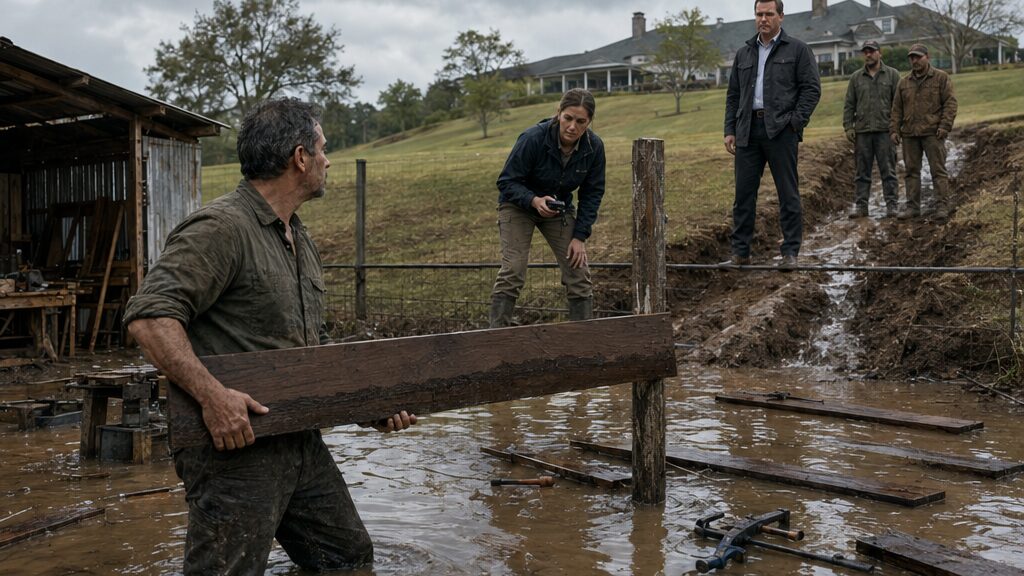
“Don’t move anything,” said the county inspector behind him.
The inspector stood at the workshop entrance in rubber boots, photographing the waterline on the posts. A drainage engineer Robert had not met was walking the fence with a measuring rod. Two club grounds workers waited near Jack’s cart, their faces turned toward the slope.
Robert looked at the west wall where forty-two rough-cut walnut boards had been stacked the evening before. He had spent eighteen months buying them in small batches, sorting each for grain and color. They were meant for a set of library cabinets commissioned by a customer two counties over.
Now half the stack floated.
The longest board drifted free and moved toward the open side of the shop. A black band crossed its face where the floodwater had soaked into the grain.
Jack leaned one elbow on the cart roof. “You put a building in a low spot, water finds it.”
“This water didn’t come from the creek bottom.”
“Water finds its level.”
Robert stepped carefully, pushing aside a floating drawer front. “The creek bottom is east. The current came from north.”
Jack’s smile thinned. “You’re standing in water, Robert. I’m not sure this is the moment to argue with gravity.”
The engineer stopped near the fence. She wore a county field jacket with the name C. Moore stitched above the pocket.
“Mr. Garcia,” she said, “show me what you mean.”
Robert lifted the long walnut board out of the water. It was heavier than it should have been. Muddy water streamed from its end and struck the submerged floor with soft, hollow taps.
He carried it toward the northwest corner.
Jack straightened. “That material needs to stay where it was found.”
“So does the waterline,” Robert said.
Near the corner post, buried beneath vines and silt, a square wooden stake protruded six inches from the ground. Robert scraped mud from its top with his thumb. Faded orange paint appeared.
He rested the walnut board horizontally against it.
The dark waterline on the board met a stain on the fence post, then continued toward a raw cut in the bank above. The cut was narrow but deep, its sides too straight to have been carved by runoff alone. Fresh clay showed beneath torn sod.
Catherine Moore crouched and sighted along the board.
“Hold it there.”
Robert did.
She took three photographs, then placed the measuring rod beside the stake. The county inspector joined her, squinting uphill.
Jack walked closer to the fence. “That ditch is routine maintenance.”
Catherine looked at him. “When was it opened?”
“I’d have to check.”
“Was there a permit?”
“It’s a surface swale. We maintain swales all over the course.”
Robert lowered the board. “That wasn’t there last week.”
Jack took a drink before answering. “You inspect our grounds now?”
“I see the ridge every day from this shop.”
“You also built into a drainage area.”
The inspector stopped taking photographs. “Is the workshop permitted?”
Robert felt the question before he understood its danger.
“My father built the first shed here. I expanded it.”
“That isn’t what I asked.”
“There’s a permit.”
Jack gave a small shrug. “The club’s records show repeated concerns about structures below the green.”
Robert turned toward him. “Your records?”
“Our attorney can send the county what we have.”
The workshop seemed quieter. Even the water had slowed, carrying sawdust in pale circles around Robert’s knees.
Catherine rose. “No equipment moves until I finish elevations. No boards, no machinery, no debris.”
“I have orders due,” Robert said.
“I understand.”
“No, you understand measurements.”
Her expression did not change. “Today, measurements are what keep one side from rewriting this tomorrow.”
Robert looked at the ruined walnut in his hands. The board had been worth several hundred dollars when dry. Now its ends were beginning to feather.
Jack stepped away from the fence. “We’ll cooperate fully. But if this structure is obstructing natural flow, the county should know before anybody starts assigning blame.”
Robert wanted to throw the board over the fence.
Instead, he placed it on two sawhorses above the water and aligned its stained edge with the mark on the post.
Catherine watched him. “How did you know that stake was there?”
Robert wiped mud from his palm onto his jeans.
“My father marked the property years ago.”
“What did the stake mark?”
“Boundary work.”
She glanced uphill toward the fresh trench. “Only boundary work?”
Robert bent to retrieve a floating carpenter’s square. “That’s what I remember.”
It was the first lie he told that morning, and it came out easily enough to frighten him.
By noon, the water had dropped three inches. The inspector placed red tape across the workshop entrance and issued an order forbidding cleanup until the site review was complete. Robert stood outside while his tools remained in the mud.
Jack drove away toward the clubhouse.
Catherine packed her measuring rod into the county truck. “I’ll request the drainage plans for the green.”
“You think the ditch did it?”
“I think water follows elevation. People decide the elevation.”
She closed the truck compartment. “Preserve every invoice and photograph. And don’t move that board.”
When the county vehicles left, one of the grounds workers remained behind. He was young, with wet cuffs and red clay on his boots. He glanced toward the ridge before walking to the fence.
Robert waited.
The worker kept his voice low. “That cut isn’t maintenance.”
“Who opened it?”
“I was on the machine.”
Robert stepped closer.
“We dug it three days ago,” the worker said. “The green kept holding water near the bunker.”
“Who told you to send it this direction?”
The worker looked toward the clubhouse, though it was hidden beyond the hill.
Then he backed away without answering.
Chapter 2: The Letter That Changed the Accusation
The attorney’s letter demanded that Robert demolish the workshop before the club would discuss the damage inside it.
He read the sentence twice at Ruth Jackson’s kitchen table, then set the page beside a warped block of walnut he had cut from the ruined stack. The sample had dried into a shallow curve. A black waterline ran through its grain like smoke trapped beneath glass.
Ruth stood at the sink with her arms folded.
“They flooded you,” she said, “and now they want you to tear down the evidence.”
“They say the building obstructed runoff.”
“They say whatever keeps them from writing a check.”
Robert turned to the second page. The letter cited an incomplete inspection record and warned that the county could condemn an unsafe structure. It also stated that the club reserved the right to recover costs caused by Robert’s interference with established drainage.
Two weeks earlier, Jack had laughed from the ridge.
Now the laughter had become letterhead.
Robert slid the pages back into their envelope. “I’m going to permitting.”
Ruth looked at the walnut block. “You should take somebody.”
“I know where the office is.”
“That isn’t what I meant.”
The county permitting office occupied the rear wing of an old courthouse annex. Robert sat beneath fluorescent lights while a clerk searched records on a computer that hummed louder than the room.
The clerk found the original permit for the shed, an addition request from eleven years earlier, and a hand-drawn floor plan bearing Robert’s signature. She printed each page.
“The final inspection isn’t here,” she said.
“Was it denied?”
“I didn’t say that.”
“Then what does missing mean?”
“It means missing.”
She checked a scanned index. “There’s a note that an inspector visited, but the signed page was never uploaded.”
“So the building is legal.”
“It means the permit was opened and work was inspected. I can’t certify final approval without the page.”
The answer gave him less relief than he had expected.
“Can the club force demolition?”
“The club can’t. The county can issue corrections if there are violations.”
“What violations?”
“We’d need the current dimensions, setbacks, electrical work, foundation—”
“The foundation’s been there since my father.”
“That doesn’t answer any of those.”
Robert gathered the papers. “Who asked for this review?”
The clerk hesitated, then turned the monitor slightly. A request had been entered the morning after the flood by an attorney representing Harris Ridge Country Club.
He stared at the date.
Jack had not waited for Robert’s damage claim. He had prepared the counterattack before the water fully receded.
At the temporary workspace behind Ruth’s machine shed, Robert spent the afternoon calling customers. He postponed two tables and canceled the library cabinets. The customer who had ordered them was polite until Robert mentioned that the walnut could not be replaced quickly.
“I can’t wait six months,” the customer said.
“I understand.”
“I paid the deposit because you said the stock was already there.”
“It was.”
There was a pause.
“Send me a refund schedule.”
Robert wrote the amount in a notebook. When he ended the call, he stared at his planer, salvaged but rusting along the cutter head. Every problem now had its own number.
Lost walnut. Damaged tools. Refunds. Cleanup. Structural review. Legal advice.
Ruth entered carrying another envelope.
“This came certified.”
Inside was a copy of an invoice Robert recognized before he read the date.
Harris Ridge Country Club.
Seven years earlier.
The work description was brief: repair of maintenance footbridge, replacement of timber retaining panels, access support near north drainage improvement.
At the bottom was Robert’s signature.
A handwritten project number appeared beside it.
Ruth read over his shoulder.
“What was the north drainage improvement?”
“Work near the green.”
“What kind of work?”
“I fixed a footbridge.”
“Near what?”
He closed the invoice.
Ruth took it from his hand and looked at the project number again. Her face changed—not with surprise, but recognition.
“Dad had this number on one of his maps.”
Robert turned away and began sorting clamps that did not need sorting.
“Which map?”
“The old lower-field survey. The one you said got lost after the estate sale.”
“It wasn’t an estate sale. We kept the land.”
“We sold equipment because you said we needed cash to keep the land.”
“We did.”
“And then you took club work.”
He set down the clamp. “I took every job I could get.”
Ruth held up the invoice. “Did you know they were changing the drainage?”
“I knew they were doing work.”
“That isn’t an answer.”
“It’s the answer I have.”
The next morning, Robert met Jack in a conference room at the clubhouse. The windows overlooked the eighteenth green, where grounds workers were repairing storm scars. The grass looked almost untouched.
Jack placed the invoice between them.
“We paid you to work in that area,” he said. “You had access. You signed the acknowledgment.”
“I repaired wood.”
“You worked beside the drainage project and raised no objection.”
“I wasn’t hired as an engineer.”
“No, but you’re now claiming the work was obviously dangerous.”
Robert saw the shape of the argument. If he had known, he had accepted it. If he had not known, he lacked the expertise to accuse them now.
Jack leaned back. “The board is willing to discuss a limited settlement once the county confirms your building status.”
“My damage claim is over sixty thousand dollars before tools.”
“The club did not purchase your inventory or choose its location.”
“You cut that trench.”
“We relieved standing water from the green during a storm cycle.”
“Three days before the storm.”
Jack’s jaw tightened. “Be careful with secondhand statements from employees who may not understand instructions.”
Robert looked through the window. The eighteenth green rose in a smooth crown, hiding everything beneath it.
“What was there before the green?” he asked.
Jack’s eyes moved toward the invoice.
“A farm, I suppose.”
“A creek.”
“You should speak to the county if you believe that.”
The words were meant as dismissal. Instead, they opened a door.
Robert returned to Ruth’s house after dark. She had spread an old cardboard file box across the table. Tax maps, photographs, and feed receipts covered the surface.
She slid the invoice beside a faded notebook page containing the same project number.
“I remember now,” she said. “Dad wrote it down when the survey stakes moved.”
Robert did not touch the page.
Ruth looked directly at him. “You remember too.”
Chapter 3: The Creek Beneath the Eighteenth Green
The records clerk found the survey in a cardboard tube filed under a parcel number that had not existed for twenty-six years.
She carried it to the counter with both hands.
“You’re lucky,” she said. “When the farm was divided, most of these were indexed under the new tracts. This one stayed with the original.”
Robert signed the handling form.
Ruth had not come with him. After recognizing the project number, she had asked him three times what he remembered about the moved stakes. He had answered with silence until she told him to leave her kitchen.
Now, as the clerk unrolled the survey beneath glass weights, he wished she were beside him and was relieved she was not.
The paper showed the Garcia acreage before the country club existed: pasture, a lower equipment shed, fence lines, a narrow creek, and a hatched drainage easement running from the northern ridge through the lower field.
The creek line curved beneath what was now the eighteenth green.
Robert leaned closer.
Small orange marks identified survey stakes. One sat near the northwest corner of his workshop—the same stake he had uncovered in the flood.
Catherine Moore arrived carrying a field notebook and a case of rolled plans. She studied the old survey without greeting him.
“Where did you get the project number?” she asked.
“Family records.”
“Which records?”
“My father’s notes.”
She placed a modern golf-course grading plan beside the survey. The scales differed, so she used a transparent overlay and aligned the county road, parcel corners, and two permanent monuments.
The old creek disappeared beneath the green, then reappeared beyond it only on paper. On the modern plan, fill elevations rose across the same corridor.
Catherine tapped the sheet. “This was not merely rerouted.”
“What was it?”
“Buried here. Constricted here. The permitted plan shows a culvert carrying flow southeast.”
Robert followed her finger. “That culvert doesn’t exist.”
“I haven’t found it.”
“What happens if they never installed it?”
“Water backs up until it finds another path.”
“The trench.”
“Possibly.”
The word irritated him. “You saw the cut.”
“I saw a cut. I have not established when every grade changed, who authorized it, or whether your structure affected the flood level.”
Robert stepped away from the counter.
Catherine looked at him. “You want me certain before the club’s attorney asks how I know.”
He returned to the map.
She traced the historic easement again. “This line is protected unless formally abandoned or relocated. I found no abandonment.”
“So they built over it illegally.”
“I found fill placed over the corridor without a recorded drainage modification. That is not yet the same as assigning all liability for your loss.”
It was enough to prove he had not imagined the water. It was not enough to save him.
They drove separately to the golf-course boundary. Catherine used a survey receiver to compare the historic elevations with the modern grade. Robert carried the old map in a protective sleeve.
At the fence, the eighteenth green appeared harmless. Golfers moved across it in bright shirts, stepping around a roped-off patch near the bunker. The fresh trench had been covered with straw, but its line remained visible.
Catherine walked the perimeter and marked points in her notebook.
Robert stood near the old stake. In the angled sunlight, the walnut board’s grain came back to him—the dark branching lines, splitting and joining like tributaries. He had spent his life reading wood that way, looking for the direction pressure would travel.
Land carried pressure too. It simply took longer to split.
Catherine stopped near a depression behind the green. “The fill is deeper than the approved plan.”
“How much deeper?”
“Enough that the historic channel cannot function as mapped.”
Robert looked toward the clubhouse. “Then Jack knew.”
“Someone knew fill was placed.”
“He manages operations.”
“That still isn’t proof he ordered it.”
Before Robert could answer, a club grounds worker approached from the service path. Not the young man who had spoken after the flood, but an older worker carrying irrigation flags.
“You need permission to be here,” he said.
Catherine showed her county identification. “I’m within the easement review area.”
The worker studied Robert. “Mr. Harris said all questions go through counsel.”
“Then don’t answer any,” Catherine said. “Just don’t disturb my markers.”
The worker left.
Robert watched him climb the hill. “They’re scared.”
“So are you.”
He turned toward her.
Catherine had opened a second document from the county file. “I found the access acknowledgment connected to the drainage project.”
She placed it on the hood of her truck.
Robert saw his signature at the bottom.
The page authorized temporary access across the Garcia parcel for work associated with the north drainage improvement. Above his signature, a diagram showed equipment entering near the old creek line.
The memory arrived with unwelcome clarity: orange stakes, a small excavator, Jack younger and less polished, promising the work would stop erosion near the green. Robert had been behind on property taxes. The club had offered him the footbridge repair and retaining-panel job. He had asked whether the creek would still carry water.
A contractor had said the engineers knew what they were doing.
Robert had signed.
Catherine pointed to a handwritten notation beside the diagram. “Your initials appear next to ‘field adjustment accepted.’”
“I didn’t approve engineering.”
“What did you accept?”
“Access. Timber work.”
“The club will say you accepted the relocation.”
“There was no relocation on this page.”
“The attorney will say the notation covered it.”
Robert picked up the document. His initials were unmistakable.
“I never agreed to bury the creek.”
“Did you see the stakes moved?”
He looked toward the fence.
Seven years earlier, he had noticed that the marked line no longer followed the low ground. He had thought of his father, who distrusted any plan that made water climb. He had also thought of the check waiting at the clubhouse and the tax notice folded in his truck.
He had finished the footbridge.
Catherine closed her notebook.
“Mr. Garcia, the old survey supports your claim that the drainage corridor existed. The field measurements support unauthorized fill. But this signature gives the club a different story.”
“It gives them a lie.”
“It gives them an argument.”
She held his gaze. “Why did you sign beside the buried creek?”
Chapter 4: What Robert Chose Not to Say
Ruth laid their father’s map over Robert’s invoice before he had taken off his coat.
The old paper covered half her kitchen table. Its corners had softened with age, and grease-dark fingerprints marked the lower edge. Robert’s invoice sat beneath it, visible through a tear near the fold. The same project number appeared in both places.
Ruth pressed one finger against it.
“Tell me you didn’t know.”
Robert remained by the door.
Outside, water dripped from the gutters into a metal pan. Each strike carried through the kitchen with the patience of a clock.
“I knew they were working near the creek.”
“That wasn’t my question.”
“It was seven years ago.”
“That doesn’t make it less true.”
He crossed the room and studied the map. Their father’s handwriting ran along the drainage line in blunt pencil: keep open through lower field. Below it, another note had been boxed twice.
If north bend is blocked, water takes the sheds.
Robert remembered his father drawing that box. The old man had been seated at the same table, rubbing his swollen knuckles and complaining that surveyors made lines look cleaner than land ever was.
Ruth tapped the note. “He told us exactly what would happen.”
“He told us plenty of things.”
“And you listened when it suited you.”
Robert pulled out a chair but did not sit. “We were behind on taxes. The tractor was gone. The roof leaked in three places.”
“So you let them bury the creek?”
“I repaired a bridge.”
“You signed access.”
“I needed the contract.”
Ruth’s expression tightened. “We needed the land.”
“That is why I took it.”
“No. You took it because you decided you were the only one allowed to save us.”
Robert looked toward the window. Beyond the glass, the lower pasture lay flattened and pale beneath drying silt. The workshop roof showed above the trees, but the walls were hidden.
“The club said they were improving erosion,” he said. “They had engineers. Plans. Equipment.”
“And the stakes?”
He said nothing.
Ruth leaned back slowly. “You saw them move.”
The orange survey stakes had once followed the lowest ground. Robert had noticed them shifted uphill when he arrived to replace retaining panels. He had asked a contractor about it.
Field adjustment, the man had said.
Robert had looked at the creek bed, then at the country club’s purchase order folded in his pocket. The check covered the overdue taxes and enough lumber to keep the shop running through winter.
“I thought the culvert would carry it,” he said.
“You thought staying quiet would carry it.”
The sentence landed harder because she did not raise her voice.
Ruth lifted the map and turned it toward him. “Dad walked this line with us every spring. He said water remembers where it belongs.”
“He also left us a farm with debt.”
Her hand stopped.
Robert regretted the words immediately, but pride kept him from taking them back.
Ruth folded the map once, carefully avoiding the brittle crease. “He left us land. Debt came with it. So did responsibility.”
“I kept it.”
“You kept the deed. You stopped letting anyone else decide what keeping it meant.”
Robert finally sat. On the table beside him lay the walnut sample from the legal letter, curved and darkened along the flood line.
Ruth picked it up.
“This split?”
He turned it over. A fine crack ran from one end through the stained grain.
“I thought I could save that piece.”
“You say that about everything.”
He took it from her, more sharply than he intended.
For a moment, neither spoke.
Then Ruth opened a drawer and removed an envelope containing several photographs. One showed their father standing near the old creek crossing. The channel was shallow, edged with reeds and stones. Behind him stood the lower equipment sheds—where Robert’s workshop now stood.
On the back, their father had written a date and one sentence.
Water reached the bottom hinge after north bank fill.
Robert read it again.
“That was before the club,” Ruth said. “A neighbor pushed soil into the bend. Dad made him remove it.”
“How do you remember all this?”
“Because he talked to me too.”
The accusation beneath the words was older than the flood.
Robert had taken control of the acreage after their father died, handling taxes, contracts, repairs, and every letter that came from the county. Ruth had allowed it at first. Later, when she questioned him, he treated questions as interference.
He had called that responsibility.
Now the map showed another name for it.
“I’ll tell Catherine,” he said.
“All of it?”
“I’ll explain what I signed.”
“And that you saw the stakes moved?”
He traced the crack in the walnut with his thumb.
“The club will use it against me.”
“They already are.”
“They could say I accepted the whole project. They could deny the damage claim. The insurance company could deny it too.”
Ruth pulled the map back toward herself. “Then maybe you lose money.”
“Easy for you to say.”
Her chair scraped the floor.
“The land is half mine.”
“The workshop isn’t.”
“The water didn’t stop at your workshop.”
Robert looked up.
She pointed toward the lower pasture. “The next cut sends it through the cattle fence. Another storm reaches the county road. You’re still talking like this is only about your walnut.”
“It is my business that was destroyed.”
“And your silence helped put it there.”
He stood so quickly the table shook.
Ruth did not step back.
Robert’s anger rose, found no clean target, and settled into shame.
“I was trying to keep the land,” he said.
“I know.”
The softness of her answer left him nowhere to hide.
Ruth gathered the survey and photographs. “I will not sign another complaint, settlement, or board filing unless you tell the truth in the record.”
“You’d walk away now?”
“I’m not walking away. I’m refusing to stand behind a version that makes you innocent and everybody else corrupt.”
The knock came before Robert could answer.
A delivery driver stood on the porch holding a thick envelope that required his signature.
The return address belonged to the club’s attorney.
Inside was a confidential settlement proposal. The club offered to pay for limited tool repair, partial material loss, and temporary storage. In return, Robert and Ruth would withdraw the drainage complaint, release all future claims, and acknowledge that the cause of flooding remained disputed.
The amount would not cover half the walnut.
It would, however, cover the customer refund and several months of payments.
Robert read the number twice.
Ruth stood across the table with their father’s map held against her chest.
The proposal expired in forty-eight hours.
Chapter 5: The Price of Keeping the Green Open
Before dawn, a tracked excavator came down the country club’s service road with mud packed beneath its blade.
Robert watched from behind the hedgerow as it passed under a security light. Straw clung to the tracks, the same pale straw spread over the fresh drainage cut above his workshop. A compact loader followed, carrying rolled erosion matting.
Neither machine appeared on the club’s public maintenance schedule Catherine had obtained.
Robert photographed them, but the light was too weak to show more than silhouettes.
A truck door closed behind him.
Jack Harris stepped out of a white pickup.
“You’re trespassing.”
“I’m standing on my side of the fence.”
“You’re photographing private operations before sunrise.”
Robert lowered the phone. “You’re moving equipment from the trench.”
“We’re preparing the grounds for the tournament.”
“With mud from the drainage cut.”
Jack approached the fence but did not cross it. Without the pressed shirt and polished shoes, he looked older. His club jacket was unzipped, and there were dark circles beneath his eyes.
“You received the offer,” Jack said.
“I did.”
“It is more than our insurers believe the club owes.”
“It asks me to say the cause is disputed.”
“It is disputed.”
“You know where the water came from.”
“I know the green was failing.”
The admission came so quietly Robert almost missed it.
Jack looked toward the service road. “We had water standing near the bunker for weeks. Members complained. The tournament committee said the course had to be playable.”
“So you cut a ditch.”
“I ordered standing water relieved.”
“Toward my property.”
“I ordered the crew to protect the green.”
“You didn’t ask where the water would go?”
Jack’s face hardened. “Every decision looks clean after something goes wrong.”
Robert thought of the moved stakes and the check he had needed seven years earlier.
“Who told you to deepen it?”
“No one.”
“Then it was your call.”
Jack gripped the fence wire. “Do you know what canceling this tournament costs? Seasonal workers lose hours. Suppliers lose orders. The club loses sponsors it may not get back. This place is not just men drinking on a hill.”
“And my shop isn’t just boards under a roof.”
“I know what your work is worth. I hired you.”
“Then why did you laugh?”
Jack released the fence.
For the first time, he looked embarrassed.
“Because you accused us in front of county staff before I knew what had happened.”
“You were standing dry while my tools floated past.”
“I was trying not to let you set the story.”
There it was. Not cruelty for its own sake, but fear wearing a grin.
It did not make the damage smaller.
At the emergency drainage-board meeting that afternoon, the chairs filled with farmers, club employees, nearby landowners, and two reporters from the county paper. Donald Mitchell sat at the board table in a pressed work shirt, turning a pen between thick fingers.
Catherine presented preliminary elevation findings. The historic channel existed. Fill obstructed it. The new trench increased the speed of runoff toward the Garcia parcel.
The club’s attorney objected to every conclusion.
“These are preliminary measurements,” he said. “The board cannot impose emergency action based on an incomplete historical record.”
Robert expected Donald to challenge him.
Instead, Donald adjusted his microphone.
“I move that the board postpone any restoration order until the evidentiary hearing.”
Robert stared at him.
The board chair asked for a second. Another member provided it.
During the recess, Robert found Donald beside the vending machines.
“You know what that water did.”
Donald fed a dollar bill into the machine and watched it reject the note.
“I know what a rushed order can do too.”
“To the club?”
“To everybody.”
Donald smoothed the bill and tried again. “They lease my north pasture for tournament parking. They buy hay from three farms on this road. Their kitchen buys produce locally. Grounds crews live here.”
“My business is local.”
“I didn’t say it wasn’t.”
“You just voted to leave the ditch open.”
“I voted to keep the board from issuing an order that gets overturned.”
The machine accepted the bill. Donald selected a bottle of water.
Robert stepped closer. “How much do they buy from you?”
Donald did not answer immediately.
“Enough,” he said.
The word carried more weight than a number.
Robert thought of the club’s check in his pocket seven years earlier. Donald saw the recognition.
“That is what I thought,” Donald said.
“You don’t get to compare us.”
“Why not?”
“Because my silence didn’t flood anyone then.”
“Not then.”
Robert’s anger stalled.
Donald opened the bottle. “You want this divided into honest farmers and rich club people. It isn’t. Half this road takes their money. The rest hopes to.”
“So we let them bury a creek?”
“No. We prove what happened in a way that holds.”
Catherine approached carrying a folder. “The board has scheduled the evidentiary hearing for next Thursday.”
“That fast?” Robert asked.
“The trench remains an active risk.”
Donald looked toward the meeting room. “Then bring everything.”
The settlement deadline expired that evening.
Robert sat at Ruth’s kitchen table with the proposal, the old invoice, and the ruined walnut estimate arranged in front of him. The club’s tournament-loss projection, attached to a board filing, estimated more than four hundred thousand dollars in direct and related revenue.
His ruined walnut had been valued at sixty-one thousand.
Both numbers were written on paper. Only one belonged to an institution people feared losing.
Ruth stood near the stove. “What are you going to do?”
Robert read the release clause again. Signing would keep the workshop from immediate collapse. It would also bury the creek a second time, this time beneath his name.
He took a pen.
Ruth did not move.
Across the first page, Robert wrote: Rejected.
Then he signed a request for a public evidentiary hearing and attached a statement promising to testify regarding his work on the earlier drainage project.
Ruth read the final line.
“You understand what that means?”
“Yes.”
“You will have to say why you stayed quiet.”
“I know.”
She placed their father’s map beside the filing.
Robert looked at the black waterline running through the warped walnut sample.
For years, he had believed silence kept damage contained.
Now he slid the hearing request into the envelope with his own signature facing upward.
Chapter 6: The Map on the Hearing Table
The club’s attorney displayed Robert’s signature before Robert had been sworn in.
An enlarged copy of the access acknowledgment stood on an easel beside the drainage-board table. His initials had been circled in red. Beneath them, the words field adjustment accepted appeared large enough to read from the back row.
Jack sat behind the attorney, hands folded.
Robert carried one walnut board into the hearing room.
The county inspector had released it from evidence that morning. It was six feet long, dry now but warped at one end. The dark flood line remained across its face.
Ruth unrolled their father’s survey on the presentation table. Catherine placed the modern grading plan beside it.
The board chair looked at the walnut. “Mr. Garcia, is that necessary?”
“Yes.”
The attorney smiled faintly. “We have no objection to demonstrative theater.”
Robert set the board down without answering.
The attorney began with the invoice. Robert confirmed he had repaired a footbridge and timber retaining panels for the club seven years earlier. He confirmed he had signed the access acknowledgment.
“You were present during the drainage work?”
“Some of it.”
“You observed grading activity?”
“Yes.”
“You accepted a field adjustment?”
“I initialed a note.”
“Because you accepted it.”
“Because the contractor told me it concerned equipment access.”
The attorney approached the easel. “Did anyone force you to sign?”
“No.”
“Did you file an objection?”
“No.”
“Did you notify the county that survey stakes had been moved?”
The room seemed to narrow around Robert.
“No.”
Behind him, a chair creaked.
The attorney turned toward the board. “Mr. Garcia watched the project, profited from the project, and remained silent for seven years. Only after his own improperly documented structure flooded did he decide the club’s work was unlawful.”
The board chair raised a hand. “Counsel, argument comes later.”
“I have no further questions.”
Robert remained seated at the witness table.
The chair asked whether he wished to clarify his testimony.
This was the place to explain the missing culvert. The new trench. The elevations. Catherine could do all of that better.
What only Robert could explain was the silence.
He placed both hands on the table.
“I saw the stakes moved,” he said.
Jack’s attorney looked up.
Robert heard Ruth breathe behind him.
“The original stakes followed the low ground near the creek. When I came back to finish the bridge, some had been moved uphill. I asked a contractor. He said it was a field adjustment.”
“Mr. Garcia,” the chair said, “are you stating that you knew the drainage line had changed?”
“I knew something had changed.”
“And you took no action?”
“No.”
“Why?”
Robert looked at the invoice projected on the wall.
“My property taxes were overdue. The club contract paid enough to keep the county from selling a lien. I told myself engineers had approved it. I told myself the culvert would carry the water. Mostly, I told myself it was not my problem unless it reached my land.”
The attorney rose. “This admission supports our position—”
“Sit down,” the chair said.
Robert continued before courage could turn back into calculation.
“My father had warned me that the north bend could not be blocked. I knew the ground. I knew water had crossed that lower field before. I signed anyway. I finished the job. Then I kept the paperwork where my sister would not ask about it.”
Ruth lowered her eyes.
Robert touched the walnut board.
“That does not mean I agreed to bury the creek. It means I was willing not to know exactly what I was helping.”
The room stayed quiet.
Catherine was called next.
She overlaid the historic survey and modern grading plan on the table. The original creek line passed beneath the eighteenth green. County files contained no approved abandonment and no recorded relocation. Field elevations showed fill above the protected corridor, while the culvert shown on an early plan had either never been installed or could not be located.
Then she placed the walnut board across the maps.
Its flood line intersected the projected path from the club’s new trench to Robert’s workshop.
“This board was documented at the northwest post before site disturbance,” she said. “The crest elevation is inconsistent with overflow originating solely from the eastern creek bottom. It is consistent with concentrated runoff entering from the north.”
The attorney questioned whether Robert’s workshop worsened the flooding.
“It likely slowed water after entry,” Catherine said.
“So it caused obstruction.”
“After concentrated flow reached it.”
“Would the damage have occurred without the structure?”
“Damage to this structure? Obviously not. Flooding of the lower parcel? Yes.”
The attorney shifted to Robert’s acknowledgment. “Does his signature legalize the field adjustment?”
“No.”
“Does it show consent?”
“To temporary access. The disputed notation is insufficient to replace county drainage approval.”
The small payoff moved through the room without applause. Robert saw it in Donald’s face: the signature mattered, but it did not erase the creek.
Then the hearing turned harder.
Catherine presented runoff estimates for neighboring parcels. Donald’s pasture, two vegetable fields, and a section of county road all depended on the same drainage corridor. Robert’s workshop had taken the first concentrated surge because it occupied the lowest improved site.
The board chair looked toward the landowners.
“How many of you knew work had altered the north drainage?”
No one answered.
Donald finally raised his hand.
“I knew the club had filled part of the wet ground,” he said. “I did not know the easement remained active.”
“Did you benefit financially from the club?”
“Yes.”
Another landowner admitted selling produce to the clubhouse. A third leased parking space during tournaments.
The clean division Robert had wanted disappeared in minutes.
Jack took the witness chair near the end of the afternoon.
He said the eighteenth green had suffered repeated standing water. The club faced cancellation of its largest annual tournament. Seasonal staffing and supplier contracts depended on the event.
“Did you order the trench deepened?” the board chair asked.
“Yes.”
“Did you obtain county approval?”
“I believed it was maintenance within existing grounds.”
“Were you warned runoff could move toward the Garcia parcel?”
Jack paused.
“A grounds supervisor said flow might increase downhill.”
“And you proceeded?”
“I believed the greater risk was losing the green.”
Robert watched him say it.
No sneer. No laughter. Just a choice spoken plainly after its consequences could no longer be controlled.
The board recessed for deliberation.
Robert waited in the hallway with Ruth. He expected her to speak about his confession.
Instead, she touched the warped end of the walnut board.
“Can that still be used?”
“Not for the cabinets.”
“That wasn’t what I asked.”
He looked at the dark line.
“Some of it.”
When the board returned, the chair stated that immediate restoration planning was justified, but liability would be divided after further cost review. The club bore primary responsibility for the unpermitted fill and recent trench. Robert’s prior silence and the workshop’s incomplete final inspection would remain relevant to compensation, not to whether the drainage corridor must be reopened.
Donald stared at the motion sheet.
The chair called for a vote authorizing Catherine to prepare an emergency restoration plan.
One member voted yes.
Another voted no.
Donald held the deciding vote.
He looked first at Jack, then at Robert, then at the map where the buried creek crossed every property line without regard for who had taken whose money.
Donald lifted his microphone.
“I vote yes,” he said. “Open the corridor.”
Chapter 7: The Creek Returns Through the Lower Field
Water moved through the reopened creek before the excavators finished removing the fill from the eighteenth green.
It came in a narrow brown ribbon at first, sliding between fresh stones and straw wattles laid along the restored channel. Robert stood at the lower crossing in rubber boots, watching the current pass the place where his workshop had flooded six months earlier.
Above him, machinery bit into the smooth rise of the golf course.
Each bucket lifted a dark layer of packed soil from what had once looked permanent. Beneath the green, the old channel emerged slowly—mud, gravel, buried roots, and the broken edge of a concrete collar where the missing culvert should have connected.
Catherine Moore stood on the opposite bank with a survey rod.
“Another two inches,” she called to the excavator operator. “Then stop and let it settle.”
The machine lowered its bucket.
Robert looked toward the rebuilt workshop. Its new foundation sat several feet farther south and eight inches higher than the old one. The county had approved the final inspection after he replaced the electrical panel and added flood vents along the lower wall.
The club had paid most of the rebuilding cost and a negotiated portion of his material losses. The insurance company covered several machines after subtracting depreciation. Robert absorbed the rest.
The settlement did not replace every board, every canceled order, or the months without income.
It kept the business alive.
Ruth came down the field carrying two paper cups of coffee.
“You’re standing where Catherine told everyone not to stand,” she said.
“I’m outside the flagged area.”
“You’re touching the flag.”
Robert stepped away from it.
She handed him a cup and watched water pass beneath the temporary footbridge. Reeds had already been planted along the new banks. In spring, the corridor would be fenced from livestock and protected from construction under a recorded agreement signed by every affected landowner.
Including Robert.
“It looks smaller than I remember,” Ruth said.
“It was always small until somebody stopped it.”
She glanced toward him. “That sounds like something Dad would have said.”
“He probably did.”
A pickup descended the service road and stopped near the workshop. Jack Harris got out alone.
No attorney followed him. No club cart waited on the ridge.
He wore work boots and an old jacket Robert had seen years earlier, before Jack began dressing like the clubhouse belonged to him.
Ruth studied him. “Do you want me to stay?”
“Yes.”
She nodded, though Robert knew she had expected the opposite answer.
Jack approached the creek and looked uphill at the excavators.
“They found the old culvert collar this morning,” he said.
“I saw.”
“The contractor thinks the pipe was never completed.”
“Catherine said the same.”
Jack placed his hands in his jacket pockets. “The board dismissed me from operations.”
Robert looked at him.
“Last month,” Jack added. “I’m consulting through the restoration period because I know the property.”
Ruth took a drink of coffee but said nothing.
Jack watched the water. “I could tell you the club pushed me. They did. I could tell you the tournament committee said cancellation would cost jobs. That was true too.”
He rubbed mud from one boot against the other.
“But the decision was mine.”
Robert waited.
“I knew the trench would push water downhill,” Jack said. “I told myself the storm would spread it across the field. I told myself your workshop had handled runoff before.”
“It hadn’t handled that.”
“No.”
The word settled between them.
Jack looked toward the new workshop. “The first time I saw the water, I knew we had caused at least part of it.”
“Then you laughed.”
“I thought if I acted uncertain, the county would start asking questions. If I acted confident, maybe you would doubt yourself.”
Robert remembered the clean shoes above the fence, the travel cup, the smile held too long.
“It worked for about ten minutes,” he said.
Jack gave a short breath that was not quite a laugh.
“I am not asking you to forgive it.”
“That’s good.”
Ruth shifted beside Robert, but did not interfere.
Jack looked at the current again. “The club approved the monitoring fund. Five years. Catherine will inspect after major storms.”
“And the lower parcels?”
“Protected under the recorded corridor.”
Robert nodded.
Jack turned to leave, then stopped. “For what it is worth, your walnut cabinets were the best work in that building.”
“It was not your building.”
“No,” Jack said. “That was part of the problem.”
He walked back to his truck.
Ruth watched until the vehicle disappeared beyond the service road.
“That was almost an apology,” she said.
“Almost.”
“Enough?”
Robert looked at the water.
“No. But enough to be true.”
The county held its final restoration meeting that afternoon. Catherine presented the monitoring plan, maintenance schedule, and cost allocation.
The club would pay the largest share. Robert would accept a smaller reduction in compensation because his workshop inspection had not been completed and because his silence had delayed scrutiny of the earlier project. Donald Mitchell and two other landowners would contribute through easement maintenance rather than direct payment.
No one left entirely satisfied.
Catherine appeared pleased by that.
“A drainage agreement that makes one person happy usually means someone else is taking the water,” she said.
When the chair asked whether the restored corridor could be narrowed near Robert’s workshop to create more usable space, Ruth turned on her microphone.
“No.”
Robert looked at her.
She unfolded their father’s old map.
“The corridor stays open at the surveyed width,” she said. “No sheds, storage, fencing, fill, or future expansion inside it.”
The chair looked at Robert. “You agree as co-owner?”
Six months earlier, he would have calculated the lost square footage first. He would have thought about lumber racks, vehicle access, and the inconvenience of asking Ruth before changing the property.
Now the creek moved beyond the meeting-room windows, invisible but no longer forgotten.
“I agree,” he said.
The recorded restriction passed without objection.
During winter, Robert rebuilt his work slowly. He replaced the planer last and kept the rusted cutter head mounted above the door. The customer who had ordered the library cabinets found another maker, but two new commissions came from people who had followed the hearing.
Robert declined more work than he accepted.
Ruth began handling the business accounts. The first time she questioned a purchase, Robert started to say he had already decided. Then he closed the ledger and turned it toward her.
Together they chose a cheaper machine.
From the ruined walnut stack, only four long boards dried without deep structural failure. Three had warped beyond cabinet use.
The fourth carried the flood line across its face but remained sound at the center.
Robert cut it into wide sections and built a table for the county meeting room.
He did not plane away the dark stain.
Under the tabletop, he joined the boards with braces shaped to follow the branching creek system. Ruth helped him trace the historic easement onto a paper copy of their father’s survey. Catherine supplied the modern restoration plan.
When the table was installed, Robert placed both maps beneath a sheet of glass.
The old creek line and the new protected corridor lay almost exactly on top of each other.
At the dedication, there were no speeches beyond the board chair thanking those who had completed the restoration. Jack did not attend. Donald stood near the doorway, hat in hand, and gave Robert a brief nod.
After everyone left, Ruth ran her fingers over the preserved waterline.
“You could have hidden this,” she said.
Robert adjusted one corner of the glass.
“I spent long enough hiding where the water had been.”
Outside, rain had begun tapping against the windows. Not a storm, only a steady spring rain.
Robert followed it with his eyes as it crossed the parking lot, entered the roadside ditch, and moved toward the lower fields.
For the first time in years, nobody had to pretend not to know where it was going.
The story has ended.