The Room That Went Quiet
Part I — The Blue Light
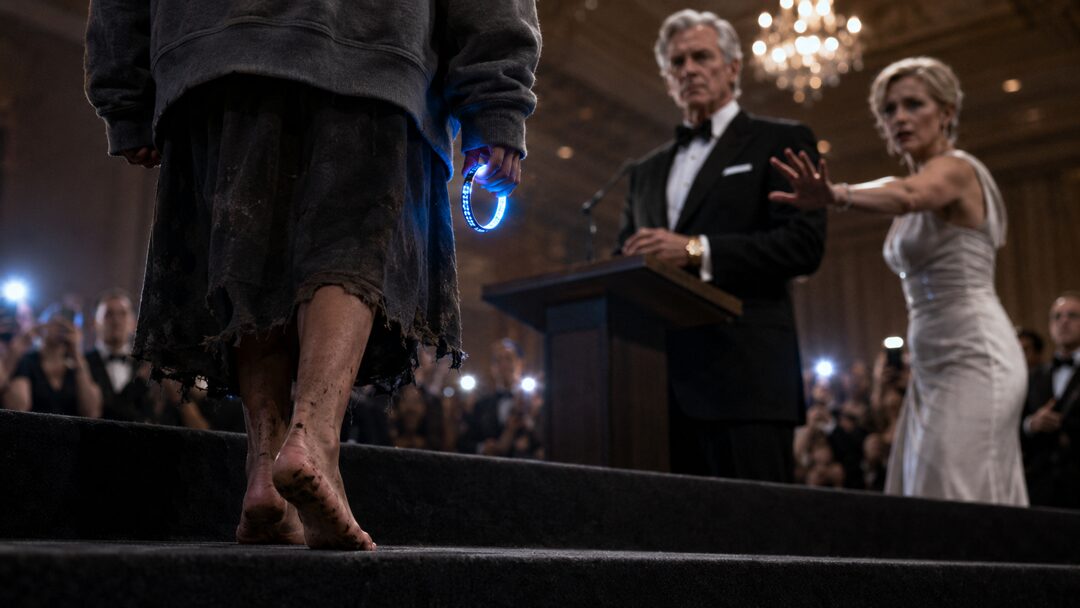
The first thing the guests noticed was not the dirt on the girl’s face, or the gray hoodie hanging from her shoulders, or the fact that she had no shoes.
It was that she walked like she belonged there.
Across the gold ballroom of the Willard Hotel, past the tables dressed in white linen and crystal, past women in diamonds and men in tuxedos, the girl moved in a straight line toward Senator Robert Hale.
No one stopped her at first.
People only turned.
A waiter froze with a tray of champagne tilted in his hand. A reporter lowered her phone. The string quartet kept playing for three more seconds, then the violinist faltered and silence spread outward from the center of the room.
Robert was seated at the front table beneath a banner that read:
THE HALE FOUNDATION: FORTY YEARS OF SERVICE
He had just finished laughing at something a donor said. He still had the smile on his face when he saw her.
Then the smile left him so completely it looked removed by hand.
The girl stopped in front of his table.
She was twelve, maybe. Small for her age. Soot marked one cheek. Her hair was tied back badly, as if someone had done it with shaking fingers. Around her wrist was a hospital bracelet, lit from within by a soft blue glow.
Robert stared at it.
His wife, Margaret, turned only halfway at first, with the irritated patience of a woman used to problems being moved before they became visible.
Then she saw the bracelet too.
The girl took it off and placed it on the tablecloth beside Robert’s untouched wineglass.
The blue light reflected in the silver fork.
“My mother said you would recognize me,” the girl said.
Nobody in the room breathed loudly enough to be blamed for it.
Robert’s hand went to his collar. His fingers tugged at the black bow tie he had worn perfectly for three hours.
“No,” he whispered.
The girl did not blink.
Robert leaned forward, close enough to read the name printed along the bracelet.
Emily Carter.
His face changed.
It was not shock. Not exactly.
It was recognition with nowhere to hide.
“No,” he said again, but weaker. “This can’t be true.”
Margaret stood.
She did it smoothly, without scraping her chair, without raising her voice, without losing her shape in the room. Her pearl earrings barely moved.
“Security,” she said.
Two men near the ballroom doors started forward.
The girl did not look at them. She looked only at Robert.
“If it can’t be true,” she asked, “then why did she send me here?”
That was when the phones came up.
Not all at once. Not dramatically. Quietly. Greedily.
Robert saw them. Margaret saw them too.
For the first time all evening, she looked less like a senator’s wife and more like someone who had just felt the floor shift under a house she built herself.
Robert pushed back from the table.
“We should talk somewhere private,” he said.
The girl looked around the ballroom, at the donors and lobbyists and reporters pretending not to lean closer.
“My mother said you would say that.”
A thin sound moved through the room. Not laughter. Not sympathy.
Recognition.
Robert flinched as if the sound had touched him.
Margaret stepped between them with a smile so controlled it seemed painful.
“Sweetheart,” she said, “you look exhausted. Let’s get you some help.”
The girl finally looked at her.
“My name is Sarah.”
Margaret’s smile stayed fixed.
“Of course.”
Robert reached for the glowing bracelet, but Sarah covered it with her hand.
“She said not to let you keep it unless you answered.”
Robert closed his eyes.
For one second, he was no longer the senior senator from Virginia, no longer the honored guest beneath the chandeliers, no longer the man whose name was printed on hospitals, shelters, schools, and campaign posters.
He was simply an old man looking at a child he should have known.
Then Margaret leaned close enough for only the front table to hear.
“Robert,” she said, “move her now.”
And he did.
Not because he wanted to.
Because he had been obeying that voice for twenty years.
Part II — Somewhere Private
The side corridor outside the ballroom was narrow and bright, lined with framed photographs of presidents, ambassadors, and men who had learned how to smile without giving anything away.
Sarah stood under one of those photographs while Robert shut the ballroom doors behind them.
The music started again inside.
That was worse than silence.
Margaret followed them out. So did a young aide in a dark suit, breathless and pale, already whispering into his phone.
Robert turned on him. “Daniel. Leave us.”
“Sir, we have press inside. If we don’t—”
“Leave us.”
The aide vanished toward the lobby.
Margaret folded her hands.
“Now,” she said gently, “tell us where your guardian is.”
Sarah held the bracelet against her chest.
“My mother.”
“Your mother is at the hospital?”
Sarah nodded.
Robert’s mouth moved around a word before he said it. “Emily.”
The name came out like something he had not allowed in his own house.
Sarah watched him carefully. “She said you would look like that.”
“Like what?”
“Like you were sorry someone noticed.”
Margaret’s eyes sharpened.
Robert swallowed. “Is she alive?”
“For now.”
The words landed without force, which somehow made them worse.
Robert took one step toward her. Sarah did not step back, but her shoulders tightened.
“What happened?” he asked.
“Our building caught fire.” She looked down at her feet, blackened along the soles from pavement, smoke, and whatever else she had crossed to get here. “Not all of it. Just enough.”
Margaret’s face changed at the word fire, but only briefly.
“What building?” she asked.
Sarah gave the address.
Robert did not know it.
Margaret did.
Her silence was too quick.
Sarah saw it.
“My mother said you would know the building,” Sarah said to Margaret. “She said maybe not by the people who lived there, but by the papers you signed.”
Margaret’s jaw tightened.
Robert turned toward his wife. “What papers?”
Margaret did not answer him. She looked at Sarah instead.
“You poor thing,” she said. “You must have misunderstood a great deal tonight.”
Sarah’s hand closed around the bracelet until the blue light leaked between her fingers.
“My mother said you would call me confused.”
Robert looked at Margaret then, really looked.
Margaret kept her voice soft. “She is a frightened child in a terrible situation. We are not going to conduct some public fantasy in a hallway.”
Sarah reached into the front pocket of her hoodie and pulled out a strip of folded cloth.
Inside was a gold watch.
Old. Heavy. Elegant. A blue stone set into the side of the crown.
Robert went still.
The corridor seemed to narrow around him.
Sarah held it out but did not let him take it.
“She said to find the man with the gold watch and the blue stone.”
Robert whispered, “Emily kept it.”
“She said you gave it to her the night you lied best.”
Margaret’s nostrils flared.
Robert stared at the watch as if it had traveled farther than Sarah had.
Years earlier, in a hotel room three floors above another ballroom, he had fastened that watch around Emily Carter’s wrist and told her he was going to leave his wife.
Emily had laughed softly, not because she believed him, but because she wanted to.
She had been twenty-seven then, playing piano in the lounge on weekends, wearing black dresses that looked expensive only in dim light. She had not asked him for anything at first. That had made giving feel noble.
Later, when she did ask, he learned the exact weight of his own cowardice.
Sarah wrapped the cloth around the watch again.
“My mom said if you pretended not to know me, I should show you that.”
Robert’s voice broke around the edge. “I didn’t know about you at first.”
Margaret turned to him fast.
Sarah caught the words.
“At first,” she repeated.
Robert looked at the floor.
That was the first answer she got from him.
It was not enough.
Inside the ballroom, applause rose. Someone had gone on with the program.
Margaret took a step closer to Sarah.
“Listen to me carefully,” she said. “Whatever your mother told you, this is not the place. We can arrange a car. We can arrange care. We can make sure you are safe tonight.”
Sarah looked up. “Safe where?”
Margaret’s smile was almost kind.
“Somewhere better than this hallway.”
“My mother said rich people always offer a room after they take a home.”
Robert looked at his wife again.
This time, she looked away.
Part III — What Emily Knew
Robert asked for the hospital name.
Sarah gave it.
He called the emergency desk himself, hands shaking so badly he had to start over twice. He used a voice people in Washington knew: calm, trained, official.
Then the nurse on the other end confirmed Emily Carter was in critical care.
Confirmed Sarah Carter had been listed as next of kin.
Confirmed an emergency contact had been entered into the file years earlier.
Robert Hale.
Robert lowered the phone.
Margaret’s face went very still.
Sarah saw enough.
“You were in the computer,” she said. “She told me.”
Robert looked at the bracelet. Its blue light pulsed gently, patient as a heartbeat.
“Emily never called me,” he said.
“She did.”
“No, I would have—”
“She did,” Sarah said again. “Maybe not where your wife could hear.”
Margaret’s voice cut in, colder now. “That is enough.”
“No,” Robert said.
It was the first time Sarah heard him speak to Margaret like that.
Margaret turned toward him slowly. “Excuse me?”
Robert did not look away from Sarah. “What building?”
Margaret said nothing.
Sarah answered. “The Carter House.”
Robert blinked. “That was condemned.”
“It had people in it.”
“It was unsafe.”
“It was home.”
The words were not loud. They were not polished. They made Robert look older.
Margaret stepped forward. “The Carter House relocation was handled lawfully through the foundation’s housing initiative. Every tenant was offered assistance.”
Sarah nodded as if she had been waiting for those exact words.
“My mother said you would say assistance.”
Margaret’s face hardened.
“She said assistance means they give you a phone number that doesn’t answer.”
Robert put a hand against the wall.
The Carter House.
He remembered a briefing folder. Photographs of cracked brick. A smiling architect. The promise of a new emergency family center bearing the Hale name.
He remembered signing the letter.
He remembered Margaret telling him it was clean.
He remembered not asking what clean meant.
Sarah lifted the bracelet.
“She didn’t send me for money.”
Margaret gave a small laugh. “Of course not.”
Sarah ignored her. “She sent me because tomorrow morning your foundation signs the papers. The building becomes yours all the way. She said if you sign before saying my name, then I was never a person. I was just something you stepped around.”
Robert’s face emptied.
Inside, the announcer’s voice boomed through the ballroom doors.
“And in just a few minutes, we’ll welcome Senator Hale to speak about the future of family protection in America.”
Applause followed.
Sarah looked toward the sound.
Then back at Robert.
“My mother said that part would be funny if it didn’t hurt.”
Robert shut his eyes.
Margaret moved fast. Not with her feet, but with her decision.
“Sarah,” she said, and this time she used the name as if it were a favor, “your mother is very ill. People who are very ill sometimes become confused about old relationships, old disappointments. I am sorry she placed this burden on you.”
Sarah looked at her for a long moment.
“You paid her to leave.”
Margaret did not move.
Robert turned. “What?”
Sarah reached into her hoodie again and pulled out a folded paper, soft at the edges from being handled too often.
Not a contract. Not the whole thing.
Just one page.
At the top: Hale Family Foundation Settlement Agreement.
Robert took it.
His eyes moved down the page, faster and faster.
Margaret’s name was not on it.
Of course it was not.
But the foundation’s lawyer was. The date was thirteen years earlier. The amount was large enough to look generous and small enough to be cruel.
Robert’s mouth opened.
Margaret said quietly, “You were running for Senate.”
He looked at her.
“She was pregnant,” he said.
“She was a threat.”
The corridor went silent.
Even Sarah seemed to stop breathing.
Margaret recovered first. “Do not look at me like that. You brought her into our life. You made promises with my name still on your door. I protected this family.”
Robert’s voice was almost nothing. “You hid my child.”
“I preserved your future.”
Sarah’s eyes moved between them.
There it was.
Not all of it, but enough.
Robert had not known in the beginning. Margaret had known before him. Emily had been paid to disappear, wrapped in papers, moved out of sight like a stain on expensive fabric.
But later, Robert had found out.
Sarah could see that too.
“How old was I?” she asked.
Robert looked at her.
“How old was I when you knew?”
He could not answer.
That was an answer.
Sarah nodded once, small and controlled.
“My mother said never let rich people see what they took from you.”
For the first time, her voice trembled.
Only once.
Then she swallowed it back.
Robert reached for her, then stopped because he had not earned the right.
“Sarah,” he said, “I loved your mother.”
Sarah looked at the gold watch in her hand.
“She said you loved her most when no one could see.”
Robert’s face twisted.
The line did not accuse him.
It remembered him.
That was worse.
Part IV — The Service Entrance
Daniel, the aide, returned at the end of the corridor.
“Senator,” he said carefully, “they’re ready for you.”
Robert looked as if he had forgotten there were other people in the world.
Margaret had not.
She stepped toward Daniel, lowered her voice, and began arranging survival.
“Hold the speech for three minutes. Tell them the senator had an urgent call. No one from the press leaves the ballroom. Have the side exit cleared.”
Sarah heard the words side exit and smiled without humor.
Margaret turned back to her.
“Sarah, I am going to be very direct with you now.”
“You weren’t before?”
Margaret’s eyes flashed. Then the smile returned.
“There is a car waiting downstairs. It will take you to the hospital. A private nurse will be arranged. A trust will be opened in your name by morning. You will have school, housing, medical care, everything your mother failed to secure for you.”
Robert said, “Margaret.”
She did not look at him.
Sarah asked, “What do I have to do?”
Margaret’s voice softened.
“Leave through the service entrance.”
There it was.
The whole family history in one sentence.
Robert made a sound under his breath.
Margaret continued, “No one needs to be hurt further tonight.”
Sarah looked toward the ballroom doors, where hundreds of people waited to stand for Robert Hale.
“No one?”
Margaret’s mouth tightened.
“You are young. You do not understand consequence.”
“I understand doors.”
Robert looked at her.
Sarah’s face was dirty, but her eyes were clear.
“There’s the front door,” she said. “That’s where people walk in when they’re expected. There’s the ballroom door. That’s where people walk in when they’re important. And there’s the service door. That’s where you send people when you want what they carried but not who they are.”
Margaret stared at her.
Robert whispered, “Sarah…”
She turned on him then. Not loudly. Not childishly.
“Don’t say my name like it fixes anything.”
He looked stricken.
Good, Sarah thought, and hated herself for needing it.
Inside the ballroom, the announcer began again.
“Ladies and gentlemen, please welcome a man whose life has been dedicated to protecting families…”
Applause rose huge and warm, filling the corridor.
Robert’s face folded inward.
Margaret seized the moment.
“Go,” she told him. “Now.”
Robert did not move.
Margaret leaned closer. Her voice dropped into something bare.
“If you do not walk back into that room, everything we built ends tonight.”
Robert looked at her.
“For who?”
The question surprised even him.
Margaret’s expression changed. For one second, Sarah saw the woman under the pearls: frightened, furious, humiliated long before this night. A wife who had been made a prop in her own marriage, then learned to become the hand that moved the props.
“For all of us,” Margaret said.
Sarah thought of Emily in a hospital bed, her voice thin but still exact.
He will want to do the right thing after the room is empty.
Sarah had sat beside her mother, holding the blue bracelet between them like a tiny lamp.
What if he doesn’t know me? Sarah had asked.
Emily had closed her eyes.
He will.
What if he says no?
Emily’s mouth had trembled once before she made it still.
Then ask him why I sent you.
Now Robert stood in the corridor, applause calling him back to the life that had survived everything by staying ahead of the truth.
“I can fix this,” he said.
Sarah looked at him.
“When?”
“After tonight.”
She almost laughed.
It came out smaller than that.
A breath.
“My mother said that too.”
Robert looked as if she had struck him.
“She said you always had a later.”
Margaret reached for Sarah’s arm.
Sarah pulled away.
The bracelet slipped from her hand and hit the carpet without a sound. The blue light glowed at their feet.
All three of them looked down.
Robert bent to pick it up.
Sarah got there first.
When she stood, the corridor had changed.
Not visibly. Nothing broke. No one shouted.
But power moved.
Sarah held the bracelet in one hand and the wrapped watch in the other.
Then she turned toward the ballroom.
Margaret stepped into her path.
“Do not make yourself a spectacle.”
Sarah looked up at her.
“You already did.”
Then she opened the ballroom doors.
Part V — The Name at the Microphone
The room rose for Robert Hale before realizing Robert was not the one entering.
The applause thinned.
Sarah walked through it.
Her bare feet made no sound on the polished floor. That made the room listen harder.
At the podium, the announcer froze with one hand still lifted toward the side doors. Behind him, a screen showed Robert’s face beside the words A LIFE OF SERVICE.
Robert followed Sarah into the ballroom.
Margaret came behind him, her white gown bright as bone under the chandeliers.
Every table turned.
The donors saw the girl again.
The reporters saw the senator behind her.
The phones rose higher.
Sarah climbed the three steps to the stage.
A man reached to stop her. Robert said, “Don’t.”
His voice carried.
That was the first crack.
Sarah stood at the microphone. It was too tall for her, so she pulled it down. The sound screeched once, making half the room wince.
Good, she thought.
Let them be uncomfortable.
She held up the bracelet. The blue light glowed against her dirty palm.
No one spoke.
Sarah had imagined this moment on the ride over in the back of a stranger’s delivery van, her mother’s watch pressed under her hoodie, smoke still in her hair. She had imagined yelling. She had imagined crying. She had imagined forgetting every word.
But standing there, looking at all those clean faces waiting to decide whether she was real, she felt her mother beside her more clearly than fear.
So she did not make a speech.
“My name is Sarah Carter,” she said.
The room held still.
“My mother is Emily Carter.”
Robert closed his eyes.
“Senator Hale is my father.”
A low sound moved through the ballroom.
Margaret stood at the foot of the stage, color rising along her throat.
Sarah kept going because if she stopped, they would take the silence and use it against her.
“He knew where we were when your foundation tore our building down.”
A woman gasped.
Someone whispered, “Oh my God.”
Daniel the aide stood near the wall, staring at Robert as if waiting for him to wake and deny the weather.
Robert stepped toward the stage.
Margaret grabbed his sleeve.
“Robert,” she said.
It was not warning now.
It was pleading.
He looked at her hand on his arm.
Then at Sarah.
Then at the blue bracelet.
Maybe he saw Emily’s wrist years ago, wearing the gold watch in the blue hotel light. Maybe he saw a younger version of himself choosing delay and calling it caution. Maybe he saw the child in front of him and understood, too late, that a hidden daughter does not stay hidden. She grows inside the shape of your absence.
Sarah did not ask him to love her.
She did not ask him to come home.
She only asked him to answer.
A reporter called from the back, “Senator Hale, is this true?”
Margaret’s hand tightened on his sleeve.
Robert pulled free.
He walked to the microphone beside Sarah.
For a moment, the old instinct moved across his face. The instinct that had won elections, calmed donors, outlasted hearings. The instinct to reshape truth into something survivable.
Sarah saw it.
So did Margaret.
So did everyone who had ever mistaken poise for honesty.
Robert put one hand on the podium.
He looked at the room that had loved him safely because it had never met his cost.
“Yes,” he said.
One word.
Not loud.
Enough.
The ballroom erupted, but not in one clean sound. It broke into pieces: questions, chairs, phones, Margaret saying his name, Daniel cursing softly, a donor demanding to know what was happening, someone already calling someone else.
Robert turned to Sarah.
Tears had gathered in his eyes.
“I’m sorry,” he said.
Sarah looked at him for a long second.
Then she stepped away from the microphone.
“No,” she said. “You’re late.”
She walked down the steps, past Margaret, past the donors who did not know whether to move aside or apologize for standing there at all.
This time, no one touched her.
At the ballroom doors, she stopped and looked back once.
Robert remained at the podium beneath his own smiling photograph.
Margaret stood below him in her white gown, no longer guarding the stage, no longer commanding the room, only watching the name she had tried to erase become the only name anyone would remember from that night.
Sarah left through the front doors.
Part VI — What Remained
By the time Robert reached the hospital, Emily Carter was already beyond hearing him.
He came without cameras. Without Margaret. Without the bow tie.
Sarah sat in a plastic chair outside the room wearing socks a nurse had found for her and sneakers half a size too big.
The watch lay in her lap, still wrapped in cloth.
The blue bracelet was around her wrist again.
Robert stopped a few feet away.
For once, he did not seem to know where powerful men were supposed to stand.
“Sarah,” he said.
She did not look up.
“Can I see her?”
Sarah held the watch tighter.
Through the glass panel, Emily was almost hidden by sheets and machines. Her dark hair lay against the pillow. One hand rested above the blanket, thin and still.
Sarah had gone in after the gala.
She had told her mother what happened, though the nurse said Emily might not understand.
Sarah told her anyway.
She told her about the stage. The microphone. The room going quiet.
She told her Robert said yes.
At that, Emily’s fingers had moved once against Sarah’s palm.
Maybe it was nothing.
Sarah chose to keep it.
Now Robert stood outside the door with the face of a man who had arrived at the end of a road and found it had closed years ago.
“Please,” he said.
Sarah looked up then.
His eyes were red. His hair had fallen out of its careful shape. He looked less like a senator than the photograph of one left in the rain.
A part of her wanted to let him in.
That was the part she hated most.
Not because it was weak.
Because it was young.
Because some hidden piece of her had walked into that ballroom not only to accuse him, but to be seen by him. To have him say her name and mean daughter. To have him look at her once with something other than fear.
But her mother had spent years being loved privately.
Sarah had seen what private love cost.
“No,” she said.
Robert’s face tightened.
“She asked for me.”
Sarah shook her head.
“She sent me to you. That’s different.”
He had no answer.
She stood, the oversized sneakers squeaking softly on the polished floor.
“You can stand there,” she said. “But you don’t get the room.”
Robert looked through the glass.
Emily did not move.
He placed one hand on the wall beside the door, not touching the handle.
Sarah went back inside.
Only after the door closed behind her did she cry.
Not loudly. Not for him. Not for the nurses. Not for the room.
She cried with her forehead pressed against her mother’s hand, the way she had wanted to cry in the ballroom and the corridor and the car and every place where someone might use her tears as proof she could be managed.
By morning, Robert Hale’s campaign had suspended all events.
By afternoon, the foundation postponed the signing.
By evening, Margaret Hale had left Washington for the family house in Virginia, where reporters gathered outside the gate and called her name into the trees.
Sarah did not watch the news.
A social worker offered. A nurse offered. Daniel, the aide, came once with an envelope and left when Sarah would not take it.
Three days later, the hospital gave Sarah a small cardboard box with her mother’s things.
A comb.
A cracked phone.
Two folded letters.
The gold watch with the blue stone.
Sarah sat on the edge of the bed in the temporary apartment arranged by people whose names she could not keep straight. The room smelled like new paint and donated blankets.
She took off the blue bracelet and placed it in the top drawer.
For a while, she stared at it glowing softly in the dark space.
Proof, her mother had called it.
But Sarah was tired of proof.
She closed the drawer.
Then she picked up the gold watch.
It was too heavy for her wrist. Too expensive for her life. Too full of promises that had arrived dressed as gifts and left dressed as excuses.
The social worker had said it might be worth a lot.
Sarah believed her.
She still did not sell it.
Not yet.
Maybe not ever.
At dusk, she put on the donated shoes and walked outside. The city moved around her with its black cars, stone buildings, lit windows, and flags snapping above doors she did not yet know how to enter.
In her pocket, the watch pressed against her palm.
She did not wear it.
She carried it.