The Room That Remembered Her
Part I — The Wrong Guest
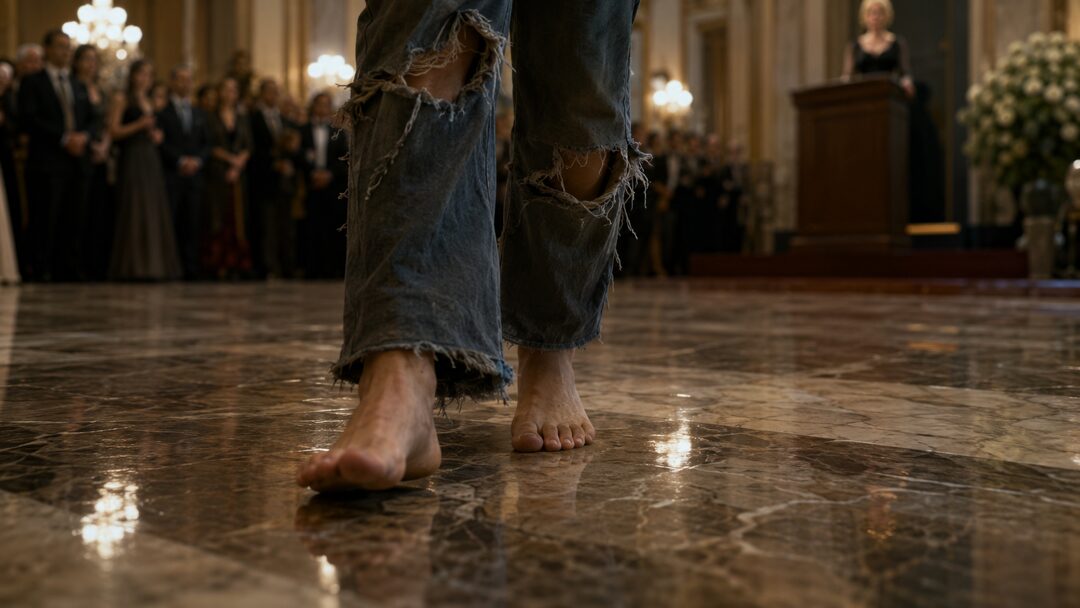
Emily reached the ballroom doors with no shoes, no invitation, and a heart-shaped locket warm in her fist.
The man checking names did not stop her at first. No one did. People in places like the Mayfield Hotel expected the wrong things to be handled before they reached the chandeliers. A barefoot girl in a torn gray hoodie did not belong among marble columns, gold railings, and women whose earrings looked heavier than anything Emily owned.
So she walked in.
The gala did not go silent all at once. Silence spread.
A waiter turned with a tray of champagne flutes and froze. A woman in a silver dress lowered her phone. Somewhere near the stage, a string quartet kept playing for three extra notes before the violinist noticed everyone staring.
Emily’s wet footprints marked the marble behind her.
On the wall above the stage, a portrait showed Senator Richard Sterling with his arm around three foster kids. He was smiling in the picture like kindness had been invented by his family.
Beneath it, in polished gold letters, was the name of the night.
The Sterling Foundation Presents: Home for Every Child.
Emily kept walking.
Her feet stung from the sidewalk outside. Her knees were bruised. Her hoodie hung off one shoulder. She had washed her face in the hotel bathroom, but soot still smudged her jaw where her sleeve had missed it.
No one asked if she was cold.
They asked with their faces who had failed to remove her.
At the center of the room stood Elizabeth Sterling.
Emily knew her from television.
Everyone did.
Elizabeth wore a black silk gown and a pearl necklace that sat perfectly at her throat. Her pale blond hair was pinned into a shape that did not move when she turned. She had the kind of face people trusted in charity commercials: soft mouth, careful eyes, practiced sorrow.
Emily stopped in front of her.
Elizabeth looked down.
For one second, something like recognition passed over her face.
Then it was gone.
“Who let her in?” Elizabeth said.
The words were quiet, but the room had become hungry for sound. Everyone heard.
Emily lifted her hand.
The locket hung from her fingers on a broken silver chain. Its heart-shaped face glowed faintly, not magic, not exactly, but warm from the little battery hidden inside it. The light had always been weak. In the ballroom, under all that crystal, it looked almost alive.
Elizabeth’s lips parted.
Emily’s voice shook once before it steadied.
“You told everyone you never stopped looking for me.”
A champagne glass broke somewhere behind her.
Senator Richard Sterling turned from a circle of donors near the stage.
He was taller than Emily expected. Broad-shouldered. Silver-haired. Old, but not soft. His tuxedo fit him like the room had been built around his body.
Then he saw the locket.
His face changed before he could stop it.
He reached for his collar as if the air had disappeared. His fingers fumbled under his bow tie, tugging at something half-hidden against his shirt studs.
A small gold charm slipped into view.
A heart.
The same shape.
The same hinge, bent at the left side.
Emily heard someone whisper, “Is that—”
A man stepped in front of her before the sentence could finish.
He was younger than Richard, but made of the same expensive lines. Dark suit. Dark hair. Tired eyes that looked at Emily too carefully. Daniel Sterling. The senator’s son. The one in the campaign ads with rolled-up sleeves and schoolchildren around a library table.
He bent slightly, blocking the nearest cameras with his back.
“Do not say another word in this room,” he whispered.
His voice was gentle.
That made it worse.
Emily looked past him at Elizabeth, who had not moved.
“I came home,” Emily said.
Daniel’s jaw tightened.
“No,” he said, so softly only she could hear. “You walked into a room that will eat you alive.”
Then he put one hand near her shoulder without touching her and guided her toward the side doors.
Behind them, the ballroom began to breathe again.
Not with relief.
With rumor.
Part II — The Hallway Behind the Gold
The service hallway smelled like bleach, wet coats, and expensive food waiting to become leftovers.
The door shut behind Emily, cutting off the chandeliers, the music, and the thousand glittering eyes. For a moment she could hear only her own breathing.
Then Elizabeth Sterling said, “This is absurd.”
She had followed them. So had Richard. So had two men with earpieces and one woman carrying a tablet like a weapon.
Emily backed against the wall.
Daniel noticed and quietly stepped between her and the others.
Again, protection.
Again, a wall.
“What is your name?” he asked.
Emily held the locket tighter.
“You know it.”
“I’m asking you.”
“Emily.”
Richard flinched.
Elizabeth did not.
“Emily what?” Daniel asked.
Emily swallowed. “I don’t know.”
Elizabeth gave a small laugh with no humor in it. “Then perhaps we should start with that.”
“I know who I am.”
“No,” Elizabeth said. “You know what someone told you.”
Emily looked at Richard’s collar. The gold heart had disappeared back beneath his bow tie. His hand still hovered there.
“She has no idea what she’s saying,” Richard said.
But he was not looking at her.
He was looking at the locket.
Emily opened her palm. The little heart flickered. Inside, under the cloudy plastic cover, were two scratched letters.
E.S.
“That was with me when they left me,” she said. “The woman at the home said it was probably junk. But I saw Mrs. Sterling on TV. She said her daughter would always have a place at her table.”
Elizabeth’s face tightened.
“I said many things tonight.”
“You said it every year,” Emily said. “At the gala. On the posters. In the video. You said you understood what it was to wait for a child.”
The woman with the tablet shifted.
Daniel glanced at her. “Leave.”
“Daniel—” Elizabeth began.
“Not you,” he said. “Her.”
The woman hesitated, then disappeared down the hallway.
Emily noticed that Daniel could make adults leave with one word.
She had never met anyone with that kind of power.
Elizabeth folded her hands. “Emily, I don’t know who has filled your head with this story, but you are clearly frightened. We can help you. That does not make you family.”
Emily’s throat burned.
“You said you never stopped looking.”
“That was not an invitation for a troubled runaway to enter a private event.”
The words landed clean and cold.
Troubled.
Runaway.
Private.
Emily had been many things in case files, but no one had ever called her private.
Daniel crouched slightly, bringing his face closer to hers. “Where did you come from tonight?”
“New Hope House.”
Richard closed his eyes.
Just once.
But Emily saw it.
Daniel did too.
His gaze snapped toward his father, then back to Emily’s locket. He reached out.
“May I?”
Emily pulled it away.
“No.”
“I won’t take it.”
“That’s what people say before they take things.”
Daniel did not argue. He only nodded.
That made her want to trust him.
She hated that.
Richard finally spoke. “This child needs to be returned to wherever she came from.”
Emily stared at him. “Returned?”
The word felt like a package label.
Elizabeth stepped closer. Her perfume was soft and expensive. “You entered a room full of cameras and powerful people. You don’t understand the damage a false claim can do.”
Emily looked at the closed ballroom door.
“False things don’t scare people that fast.”
For the first time, Elizabeth’s composure cracked.
Only a little.
Enough.
Daniel stood.
“We need to move her upstairs.”
“No,” Emily said.
“It’s not safe here.”
“It wasn’t safe there.”
No one asked where there was.
No one wanted the answer in a hallway behind a charity gala.
Daniel lowered his voice. “I’m not sending you away. I’m getting you out of the hallway.”
Emily looked from him to Elizabeth, then to Richard.
“Do you believe me?”
Daniel’s eyes moved to the locket.
To the broken hinge.
To his father’s collar.
“I believe,” he said, “that you should not be standing here alone.”
It was not enough.
But it was more than anyone else had given her.
So Emily followed him.
Part III — A Kind Room With a Locked Door
The suite upstairs was larger than the entire common room at New Hope House.
There was a bed with eight pillows. A sitting area with pale blue chairs. A bathroom with folded towels stacked like a display. A bowl of green apples sat on a glass table, each one polished until it looked unreal.
Daniel brought her a robe from the closet and a pair of black flats from hotel lost-and-found.
“They’re too big,” he said. “But better than nothing.”
Emily stared at them.
The shoes looked like something a grown woman had worn to an office and forgotten after a wedding. The left heel was scuffed. The right sole was peeling at the edge.
They were still the nicest shoes anyone had ever offered her.
“Why?” she asked.
Daniel stood near the door, his tie loosened. “Why what?”
“Why are you being nice if I’m lying?”
He looked tired then. Not old, not exactly. Just cornered.
“I didn’t say you were lying.”
“You didn’t say I wasn’t.”
Downstairs, applause came faintly through the floor.
Daniel looked toward the sound like it was a clock counting against him.
“I need to call someone,” he said.
“A lawyer?”
“Yes.”
“For me or for you?”
That stopped him.
“For the situation.”
Emily laughed once. It came out small and ugly.
“I’m a situation now.”
Daniel took the hit without defending himself. That made him more dangerous.
He handed her his phone. “The gala livestream is on here. Stay in this room. Don’t open the door unless it’s me.”
“Am I safe or trapped?”
He did not answer fast enough.
Emily took the phone anyway.
After he left, she put on the robe but not the shoes. The carpet felt strange under her feet, too soft to trust. She sat on the edge of the bed and watched the screen.
Elizabeth Sterling stood back in the ballroom beneath the portrait.
Her face was perfect again.
“Tonight,” Elizabeth told the crowd, “we were reminded that vulnerable children do not always arrive in ways that are convenient. Sometimes they arrive in crisis. Sometimes they arrive without language for their own fear.”
The audience murmured in sympathy.
Emily’s hands went cold.
Elizabeth continued, “The young girl many of you saw earlier is safe, and the foundation is making sure she receives proper care.”
Emily stared at the screen.
Proper care.
Not daughter.
Not Emily.
Not ours.
“She is one of many children failed by systems too overburdened to hold them,” Elizabeth said. “And that is exactly why we are here.”
The applause rose.
Emily dropped the phone on the bed as if it had burned her.
The door opened.
She jumped.
Daniel stepped in and saw her face.
“You watched.”
“She made me part of the speech.”
He closed the door behind him. “She’s trying to calm the room.”
“She called me a broken thing and they clapped.”
“That’s not what she said.”
“That’s what she meant.”
Daniel rubbed both hands over his face. For a second, the campaign version of him vanished. No smile. No polish. Just a man who knew a fire had started under his floorboards.
Emily stood.
“I want to go back down.”
“No.”
“You said you weren’t trapping me.”
“I said you weren’t safe.”
“You mean you aren’t.”
His eyes sharpened.
Good, Emily thought.
Let it hurt somewhere besides me.
Daniel crossed the room and picked up the flats. “Put these on.”
“No.”
“Emily.”
Her name in his mouth did something she did not want. It made her feel seen and handled at the same time.
“My feet bothered you downstairs,” she said.
“That isn’t fair.”
“Neither is watching me since I was three.”
Daniel went still.
The room seemed to tilt.
Emily had not known she was going to say it. The thought had been sitting in her since Richard closed his eyes at the name New Hope House.
Daniel’s silence answered before his mouth did.
She stepped back.
“You knew that place.”
He said nothing.
Emily’s heart beat so hard she felt the locket jump against her palm.
“You knew where I was.”
Daniel looked toward the windows, where D.C. glittered beyond the glass.
“I found paperwork,” he said finally.
The words did not fall.
They crawled.
“When?”
He did not turn around.
“Months ago.”
Emily’s fingers went numb around the locket.
Months.
Not tonight.
Not in the shock of a ballroom.
Months.
“You knew my name before I knew yours,” she said.
Daniel shut his eyes.
“I didn’t know what was true.”
“You knew enough not to ask me.”
“I was going to.”
“When?”
He turned then. “After my announcement. After we had a plan. After I could make sure you weren’t fed to reporters and opposition researchers and people who would turn your life into a headline.”
Emily heard the care in it.
She heard the cage too.
“You wanted to introduce me when I wouldn’t cost you anything.”
His face changed. “That’s not fair.”
“You keep saying that to the wrong person.”
A knock hit the door.
Not polite.
Commanding.
Daniel opened it before Emily could move.
Elizabeth stood there with Richard behind her. In her hand was a slim cream folder.
Emily looked at the folder and knew, with the awful instinct of children who have spent too much time around adults making decisions, that there was something about her inside it.
Elizabeth entered without asking.
“Daniel,” she said, “you need to stop improvising.”
Richard did not cross the threshold. He seemed afraid of the room.
Or of her.
Elizabeth placed the folder on the glass table.
Emily saw the top page.
Quarterly Child Welfare Summary: Emily S.
Her stomach dropped.
Daniel reached for the folder, but Emily was faster.
She grabbed it and backed away.
The first page had her height.
Her weight.
Her school.
A note about “difficulty with attachment.”
A note about “nighttime anxiety.”
A note about her tenth birthday: No family visitation requested.
The words blurred.
Not because she was crying.
Because her eyes refused them.
Elizabeth spoke carefully. “Those records are private.”
Emily looked up.
“You had reports.”
No one answered.
“You had reports,” she said again.
Richard’s face sagged, not with grief, but with age. “It was complicated.”
That was when Emily understood.
Not all at once.
All at once would have been kinder.
It came piece by piece.
The locket left with her.
The name New Hope House.
Elizabeth’s speech every year.
The annual fundraisers.
The posters with empty cradles, empty swings, empty chairs.
They had not lost her.
They had kept her at a distance and called the distance sorrow.
Emily looked at Elizabeth.
“You watched me grow up without you.”
Elizabeth’s mouth tightened. “We ensured you were provided for.”
“My shoes came from a lost-and-found box.”
“You have no idea what this family has carried.”
Emily laughed again, and this time it was almost soundless.
“You carried me like a story.”
Richard stepped inside at last.
“I loved your mother,” he said.
The room changed around the sentence. Even Daniel looked wounded by it.
Emily stared at him.
Her mother had been a name no one would give her. A blank space in forms. A reason people said, We don’t have that information, sweetheart.
Richard touched his collar.
“She worked for the campaign. It was before my first Senate run. I was not proud of the way things ended.”
“Richard,” Elizabeth warned.
He kept going, maybe because confession felt better to him than being caught.
“When she died, there were people advising us. There were legal matters. Timing. The press. The campaign—”
Emily interrupted him.
“I was three.”
Richard stopped.
Three was too small a number for politics to hide behind.
Elizabeth took over. “You were placed somewhere stable.”
“I was placed somewhere you could forget me.”
“No,” Elizabeth said. “Somewhere the world would not use you.”
Emily held up the report.
“The world did use me. You just got the money.”
Part IV — The Offer
The gala downstairs moved toward its shining center.
Emily could hear it through the floor: applause, music, a voice announcing donor names. The room beneath them was still praising the same people who stood upstairs deciding how much Emily’s silence might cost.
Elizabeth had called in another lawyer.
This one had soft hands, rimless glasses, and a voice built for making threats sound like favors.
He placed documents on the table.
Daniel stood by the window, refusing to sit. Richard sat heavily in one chair as if the room had finally become too large for him. Elizabeth remained standing.
Emily stayed barefoot beside the bed, the quarterly reports clutched to her chest.
The lawyer smiled at her like she was younger than twelve.
“This is not meant to frighten you, Emily.”
“Then why did you bring it?”
His smile thinned.
Daniel looked over. “Enough.”
The lawyer adjusted the papers. “The Sterling family is prepared to create a private trust for your education, housing, and long-term care. There will be independent representation. Testing can be arranged. Everything can be handled properly.”
Emily looked at Daniel.
“Properly means quietly.”
No one corrected her.
Elizabeth stepped forward. “You do not understand what this world will do to a girl like you.”
A girl like you.
Not my daughter.
Not family.
A girl like you.
Emily lowered the folder.
“What kind of girl is that?”
Elizabeth’s eyes flicked over the hoodie, the dirty hair, the bare feet. The glance was quick. Polite. Devastating.
“A young girl without protection,” she said.
Emily nodded slowly.
“And whose fault is that?”
Richard winced.
Daniel crossed the room. “Emily, listen to me.”
She hated how fast she turned toward him.
He saw it. That was the worst part. He saw the power he had.
“I’m not asking you to disappear,” he said. “I’m asking you to let me do this in a way that doesn’t destroy you.”
“You keep using me as the thing that breaks.”
“You don’t know reporters. You don’t know what people will say.”
“I know what people say when they think you can’t hear them.”
His face softened.
“Emily.”
“No.”
The word surprised them both.
She stepped away before the softness could reach her.
Daniel’s voice dropped. “I believe this could ruin you.”
There it was again.
Could.
Ruin.
You.
Emily looked at the glowing locket in her palm. Its light flickered weaker now. The little battery was nearly done.
Maybe that was right. Maybe proof was only bright until powerful people got it alone in a room.
She looked back at him.
“You don’t believe it would ruin me,” she said. “You believe I would ruin you.”
Daniel went pale.
Elizabeth said, “That is unfair.”
Emily smiled then. Not happily.
“You all love that word.”
A buzz came from the lawyer’s phone. He glanced down, then at Elizabeth.
“What?” she asked.
He angled the screen.
A photo had been posted online.
Blurry, but clear enough.
Emily in the ballroom. Her hoodie. Her raised hand. The glowing locket.
The caption was already spreading.
Who was the girl at the Sterling gala?
Elizabeth’s face did not move, but her fingers tightened around the back of the chair.
From downstairs came a swell of applause.
The lawyer cleared his throat. “The award segment is beginning in twelve minutes.”
Elizabeth looked at Richard, then Daniel, then Emily.
Her fear was finally visible.
Not fear for Emily.
Fear of the room returning to her with questions.
Richard rose. “I can say something measured.”
“No,” Elizabeth said sharply.
The tone showed more marriage than any affectionate word could have.
Richard stopped.
Daniel looked at Emily. “Please. Stay here until it’s over.”
“Until your mother gets her award?”
“It’s not that simple.”
“It is to me.”
He stepped closer. “If you go down there now, you can’t take it back.”
Emily thought of New Hope House.
The gray hallway. The locked pantry. The staff who changed every six months. The birthday cupcake with no candle because candles were considered a hazard. The file note that said No family visitation requested.
They had already taken so much from her before she knew there was anything to take back.
She walked to the table and picked up the black flats.
Daniel exhaled in relief.
Then Emily held the shoes in one hand instead of putting them on.
His face changed.
“Emily.”
She opened the door.
This time, no one moved fast enough to stop her.
Part V — The Place at the Table
The ballroom was brighter than before.
Or maybe Emily had changed.
The first time, the light had made her feel small and dirty. The second time, it showed her exactly what the room was made of: polished stone, rented flowers, expensive guilt, and people who only recognized suffering when it arrived in the proper costume.
She walked barefoot down the center aisle.
Again.
This time, she carried the shoes.
The wet marks from her first entrance had been mopped away. Of course they had. People like the Sterlings knew how to remove signs of discomfort before anyone important tripped over them.
But the guests remembered.
Whispers moved faster than music.
Elizabeth stood onstage beside a crystal award shaped like a rising flame. Behind her, the screen showed a photo montage: Elizabeth cutting ribbons, Elizabeth hugging children, Elizabeth standing beside empty chairs meant to symbolize those still waiting for homes.
She was mid-sentence.
“—for every child who waits in silence for someone to come back—”
Emily stepped onto the first stair.
The microphone caught Elizabeth’s breath.
Daniel reached the edge of the stage at the same moment Richard did. Two Sterling men moving to stop the same truth for different reasons.
Emily looked out at the ballroom.
A hundred phones were up now.
Good.
Let the room have eyes.
Elizabeth smiled for them. It was a miracle of control.
“Emily,” she said warmly, “sweetheart, this is not the time.”
Sweetheart.
The word almost worked.
For one dangerous second, Emily wanted to let it. She wanted to be small enough to be gathered up, quiet enough to be loved, grateful enough to be kept.
Then she saw the award in Elizabeth’s hand.
A flame.
For waiting children.
Emily opened the folder.
“My name is Emily,” she said.
Her voice shook.
Then it steadied.
“I was in third grade when this report said I stopped asking about family visits.”
Daniel took one step toward her.
She looked at him.
He stopped.
Emily read from the page.
“Height: four feet two inches. Weight: fifty-four pounds. Placement adjustment difficult. Birthday observed without outside contact.”
The room went silent in a new way.
Not shocked.
Listening.
Elizabeth whispered, “Don’t do this to yourself.”
Emily looked at her.
“You did it to me first.”
A sound moved through the crowd.
Emily turned the page.
“Age ten. Nighttime anxiety increased. No family visitation requested.”
She held up the paper.
“Who got this?”
No one answered.
She looked at Elizabeth.
“Who read this?”
Elizabeth’s face had gone white beneath the makeup.
Daniel came closer. “Emily, please.”
She turned to him fully.
The whole room watched.
“You knew my name before I knew yours.”
His face opened with pain. Real pain.
It did not save him.
Emily looked at the donors, the cameras, the women with pearls, the men with folded programs, the waiters pretending not to hear.
“They told me tonight they wanted to protect me,” she said. “But protection was just the word they used when they wanted me quiet.”
Richard stepped forward then.
Enough cameras turned that he could not retreat.
He reached into his collar.
Slowly, with a hand that trembled, he pulled out the gold heart charm.
There was no gasp this time.
Only the room leaning in.
Richard looked at Emily. For the first time that night, he seemed to see a person instead of a problem.
“That locket belonged to your mother,” he said.
The words struck Emily so hard she almost stepped back.
Her mother.
Not a file.
Not a blank.
A woman who had touched the same locket.
Richard continued, finding his rhythm because men like him always found rhythm when people listened.
“I made choices then that I believed were necessary. Painful choices. I told myself I was protecting my family, my work, the people depending on me. I have carried that pain for years.”
Emily stared at him.
He was turning again.
Even now.
Even here.
Turning cowardice into weight he had carried.
Elizabeth’s hand tightened on the crystal award.
Daniel looked sick.
Richard held out his hand. “Emily, I cannot undo the past. But you are a Sterling. If you will allow us, we can begin—”
“No.”
The word landed louder than any shout.
Richard’s hand stayed in the air.
Emily looked at him, then at Elizabeth, then at Daniel.
All of them had offered her something tonight.
A room.
Shoes.
Money.
A name.
Every gift had a string tied around her throat.
She walked to the podium.
The locket flickered in her hand one last time.
She placed it beside Elizabeth’s award.
The small plastic heart looked cheap against the crystal flame.
That made it truer.
“You can keep the story,” Emily said. “I’m taking my life back.”
Elizabeth’s face broke then.
Not fully.
Not beautifully.
Just enough for everyone to see that the woman on the stage had lost the right to decide what this night meant.
Emily turned.
Daniel stood near the stairs, blocking no one now.
For a moment, she thought he might say something that would make leaving harder.
He did not.
That was the kindest thing he had done all night.
Emily walked down the steps with the shoes in her hand.
No one stopped her.
No one clapped.
No one knew what applause would mean.
At the edge of the ballroom, a young hotel employee opened the door for her. He looked at her bare feet, then at her face, and did not ask a question.
Emily stepped through.
Behind her, the Sterling Foundation’s portrait still smiled above the room.
But the room had changed.
It remembered her now.
Part VI — Across the Street
Three weeks later, Emily sat on the front steps of a brick school with a math worksheet in her backpack and a court-appointed guardian waiting in a blue sedan at the curb.
Her life had not become simple.
People thought truth cleaned things.
It didn’t.
Truth opened doors, and behind those doors were meetings, forms, interviews, adults speaking gently because cameras had taught them how careful they needed to sound. The foundation was under investigation. Elizabeth had stepped down. Richard had stopped appearing on television. There were articles, comments, arguments, strangers who called Emily brave, strangers who said worse.
Daniel had withdrawn from his campaign.
Emily had read that part twice.
Then she had closed the article.
A chilly wind moved across the school steps. Emily adjusted the strap of her backpack and felt the rub of her new shoes against the back of her heel.
There was a thin raised line there now, left from the night she crossed the hotel sidewalk barefoot.
She touched it without thinking.
Across the street, Daniel Sterling stood beside a black car.
No suit today. No cameras. No aide whispering in his ear.
He looked younger without power around him.
And smaller.
He did not wave.
He did not cross.
For a moment, Emily remembered the suite upstairs. The robe. The shoes. His voice saying her name like he could make it safer by lowering it.
She remembered wanting to believe him.
That was the part no one would understand. Not the reporters. Not the lawyers. Not the people who turned her into a symbol online.
She had wanted him to be good.
Maybe he had wanted that too.
Daniel took one step forward, then stopped.
Emily’s guardian opened the car door and called her name.
Emily stood.
The locket was not around her neck anymore.
It had stayed on the podium beside Elizabeth’s award until someone from the court collected it as evidence. Later, they asked if she wanted it back.
Emily said not yet.
Some things were proof before they were comfort.
Across the street, Daniel lowered his eyes.
Emily did not hate him enough to feel free.
She did not forgive him enough to go back.
So she did the only thing that belonged completely to her.
She walked to the waiting car.
Her shoes fit.
They pinched a little at the heel, but they were hers, and she kept walking anyway.