The Last Note
Part I — The Girl in the Aisle
The first thing Daniel heard was not the wrong note, but the gasp that came before it.
He was halfway through the final movement of his charity premiere, seated beneath a white spotlight in the center of Bellmont Hall, when the audience shifted like a single embarrassed body. The chandeliers above them burned gold. The women wore silk. The men wore tuxedos. The cameras glided silently along the aisles, broadcasting the gala to donors across the country.
Then a small girl walked in from the back of the hall.
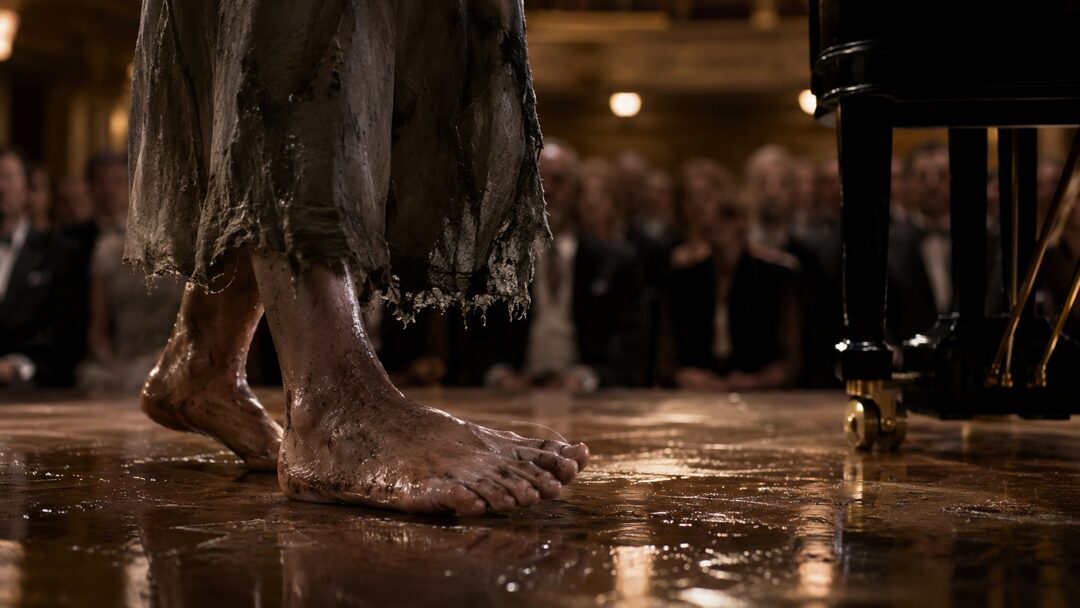
She was barefoot.
Rainwater dripped from the hem of her oversized gray hoodie. One sleeve hung past her hand. Her hair was tangled and dark with water, her face pale except where dirt had dried along her cheek. She came down the center aisle slowly, as if every step had been counted for her by someone who was no longer there.
Daniel’s hands kept moving.
That was what people praised him for: control. Even when the room changed, even when a patron coughed or a glass broke or a flashbulb cracked against the dark, Daniel could keep playing. His mother had trained that into him long before the world called it genius.
Never let the room see what moves you.
But the girl kept walking.
A woman in the second row drew her fur wrap tighter, as if poverty could spread by air. Someone whispered, “Where is security?” A man near the aisle lifted his program to block the sight of her.
In the front row, Rebecca stood.
She looked perfect, as she always did in public. White silk gown. Blonde bob tucked behind one ear. Diamonds bright enough to catch every camera angle. She had been smiling all evening with the serene authority of a woman already being photographed as Daniel’s future wife.
Now her smile hardened.
“Security,” she said, not loudly at first.
The girl did not stop.
Daniel’s left hand missed a fraction of a beat.
Only he heard it.
Rebecca turned toward the nearest usher. “Get that child out of here.”
The word child sounded less like a fact than an accusation.
The girl reached the first row. She glanced once at Rebecca, then past her, toward the stage. Her eyes were too still for her age. Not brave. Not calm. Something emptier than both.
Daniel stopped playing.
The silence arrived so fast it felt physical.
Every camera stayed on him.
The girl climbed the three shallow steps to the stage before anyone touched her. One of the security men moved in from the wing, but Daniel raised one hand without knowing he had done it.
The guard froze.
Rebecca’s voice cut through the hall. “Daniel, don’t indulge this. She’s ruining the broadcast.”
The girl stood beside the piano. Up close, Daniel could see that she was trembling. Not from fear alone. From cold. From exhaustion. From whatever road had brought her into this room.
She opened her fist.
A cheap silver locket lay in her palm, its chain knotted around her fingers.
Daniel looked at it, then at her.
“What’s your name?” he asked.
Her throat moved.
“Emily.”
The name did nothing to him. It should have done nothing.
Then she said, “My mother said you’d know the last note.”
The room seemed to lean forward.
Daniel felt Patricia before he saw her. His mother sat beside Rebecca in black velvet, silver hair pinned perfectly, pearl necklace resting against her throat. Her expression did not change.
But her gloved hand closed over the armrest.
Emily reached toward the piano. Her fingers were small, dirty beneath the nails, shaking so badly Daniel almost stopped her.
She pressed one key at the far end.
A single note rang through Bellmont Hall.
It was not beautiful by itself. It sounded bare. Almost wrong. A lonely sound with no beginning.
Daniel forgot the cameras.
He forgot the donors, the press, the woman in white standing below him, the mother who had built his life like a locked estate.
He was twenty-eight again, in a narrow apartment with peeling paint and a woman named Sarah laughing at him because he had written a lullaby with no child to sing it to.
“That ending is too sad,” Sarah had said.
“It isn’t the ending,” Daniel told her.
“Then finish it.”
“I will.”
He never had.
The last note was still vibrating when Emily looked up at him.
“Do you know it?” she asked.
Daniel opened his mouth.
Nothing came.
Rebecca climbed the stage steps, her heels sharp against the polished wood. “This is absurd,” she said, smiling now for the cameras. “Someone has clearly put her up to this.”
Emily flinched.
Rebecca noticed. She lowered her voice just enough to sound kind to the audience and cruel to the child.
“Sweetheart, who gave you that little performance?”
Daniel stood. “Rebecca.”
“No.” Her smile stayed in place. “No, Daniel. This is how these things start. A prop. A sob story. Some foster kid trained to cry on cue in front of wealthy people.”
A murmur moved through the audience.
Emily’s hand closed around the locket.
Daniel saw it then—not just fear in her face, but expectation cracking. She had believed the note would do something. Open a door. Change his eyes. Make him claim whatever her mother had promised he would recognize.
He did recognize it.
That was the worst part.
“Enough,” Daniel said.
Rebecca turned to him, satisfied for half a second, thinking he meant the girl.
Daniel looked at the security guard. “Take her backstage.”
Emily’s face went small.
“Gently,” he added.
But gently was still away.
Patricia rose from the front row with the smoothness of someone accepting responsibility before anyone else could mishandle it. “I’ll see that she’s fed,” she said. “Poor thing. Before she says anything else.”
Daniel looked at his mother.
For the first time that night, Patricia would not meet his eyes.
Emily did not fight as the guard led her toward the wing. She looked back only once.
Not at the audience.
At Daniel.
As if she had come all this way to be seen, and he had recognized her only enough to hide her.
Part II — The Locket
Backstage smelled of roses, dust, and expensive panic.
Staff members moved in tight circles. Someone asked whether the feed had cut. Someone else said the donors were texting. Rebecca demanded the media director. Patricia spoke quietly to an aide near the greenroom door.
Emily sat on a velvet chair too large for her, knees pulled to her chest, bare feet tucked beneath the torn hoodie. A plate of fruit and cookies sat untouched on the table beside her.
Daniel entered and closed the door behind him.
Emily looked at him with a child’s terrible directness.
“You didn’t finish it,” she said.
Daniel’s chest tightened. “Finish what?”
“The song.”
He sat across from her, slowly, as though any sudden movement might make her vanish.
“Who was your mother?”
Emily’s fingers went to the locket.
Daniel already knew the answer. He felt it waiting inside him, heavy and impossible. Still, he needed her to say it.
“Sarah.”
The name entered the room like a struck match.
Daniel looked down at his hands. They had played before presidents, kings, grieving families, opening nights, memorials, weddings. They had never felt useless before.
“Sarah what?” he asked.
Emily frowned, as if adults always needed too much proof. “Sarah Miller.”
For one foolish second, Daniel expected anger to come before grief. Sarah had left him. That was the story he had survived. Sarah had disappeared after the worst fight of his life, after his mother told him love was not enough to pay for failure, after his first foundation concert, after the newspapers began calling him America’s most valuable artist.
Sarah had chosen silence.
At least that was what he had been told until a barefoot child played the note he had never published.
“Where is she?” Daniel asked.
Emily’s mouth trembled once. She pressed it flat.
“She went away last night.”
Daniel went still.
“She told me if she didn’t wake up, I had to find you. She said no one would let me in unless I played it.” Emily swallowed. “She said you’d look at me.”
Daniel’s throat closed around something too large to name.
The door opened.
Rebecca entered first, followed by Patricia. Rebecca had changed her expression for the room. Less anger now. More concern. The version of concern wealthy people used when they wanted witnesses.
“Daniel,” she said. “You need to return to the stage. The longer you stay back here, the stranger this looks.”
“It is strange,” he said.
“That doesn’t mean it has to become damaging.”
Emily watched Rebecca the way children watch dogs that have already shown their teeth.
Patricia crossed to the table and lifted the plate. “Eat something, Emily.”
Emily shook her head.
Patricia smiled faintly. “No one is going to hurt you.”
Emily looked at Daniel.
The shame of that look went through him cleanly.
He said, “Tell me what happened after your mother gave you the locket.”
At the word locket, Rebecca’s eyes moved.
Patricia’s did not.
Emily clutched it tighter. “She said don’t let anyone take it.”
“No one will,” Daniel said.
Rebecca gave a short laugh. “Daniel, for God’s sake. We don’t even know where that came from.”
Emily slid off the chair and backed toward the wall.
Rebecca softened her voice. “I’m not going to steal your necklace.”
“Yes, you are,” Emily said.
The room went quiet.
Rebecca’s face did not change, but something colder stepped behind her eyes.
Daniel stood between them. “Rebecca, wait outside.”
“I’m your fiancée.”
“I know.”
“Then don’t speak to me like staff in front of a child who wandered in off the street.”
Emily whispered, “I didn’t wander.”
Everyone heard it.
Patricia set the plate down. “This is precisely why we need the proper authorities. The girl is confused, grieving, and being used by someone. We can handle this humanely without letting it become public theater.”
“It already became theater when Rebecca called her a prop on camera,” Daniel said.
Rebecca’s smile vanished. “I protected you.”
“No,” Emily said.
Rebecca looked at her.
Emily’s voice was small, but it carried. “You protected the room from me.”
For one second, Daniel saw Sarah in the child’s face. Not the eyes, exactly. The refusal. Sarah had been soft-spoken until someone mistook that for permission.
Patricia stepped forward. “Daniel, may I speak to you outside?”
“No.”
His mother’s gaze sharpened.
Daniel held out his hand to Emily. “May I see the locket?”
Emily looked at his hand for a long moment.
“Mom said only if you knew the note.”
“I knew it.”
“You didn’t say.”
The sentence landed harder than any accusation.
Daniel lowered his hand. “You’re right.”
Emily studied him. Then, slowly, she unknotted the chain and placed the locket in his palm.
It was cheap. Scratched. The hinge loose. Not the kind of thing Sarah would have worn when Daniel knew her, when she used to tease him for buying flowers from corner stores because roses from rich men looked guilty.
He opened it.
Inside was a tiny photograph, folded badly to fit the frame.
Sarah.
Older. Thinner. Beautiful in the way people become when life has taken too much but left the center intact. She was sitting in a hospital bed, wearing a paper bracelet on one wrist, smiling down at a bundle in her arms.
Daniel’s vision blurred.
Behind the photograph was a torn scrap of music paper.
He pulled it out with shaking fingers.
Four measures. His handwriting. The last bar of the lullaby.
The final note circled twice.
Under it, in Sarah’s hand, were six words:
If he denies it, play this.
Daniel sat down before his knees could fail him.
Rebecca turned away first. Patricia remained very still.
Emily watched his face.
“She didn’t lie?” she asked.
Daniel could barely speak.
“No,” he said. “She didn’t lie.”
Emily’s mouth opened around a breath she had been holding for longer than anyone in that room deserved.
Then Patricia said, “A photograph and a scrap of paper prove nothing.”
Daniel looked up.
His mother’s voice was calm. Too calm.
That was when he understood there had always been another room behind the room he lived in. And Patricia had kept the key.
Part III — The Version They Could Live With
Rebecca found Daniel in the narrow corridor behind the stage twenty minutes later, standing beneath a framed photograph of himself at seventeen.
In the picture, he looked severe and young, already famous enough to be lonely.
“You need to think before you destroy yourself,” she said.
He laughed once, without humor. “That’s what you came to say?”
“No. I came to say I’m sorry she lost her mother.”
Daniel looked at her.
Rebecca met his gaze, polished and unblinking. “I am. I’m not a monster.”
“Then stop acting like one.”
Her lips parted, not from hurt. From offense.
“You think kindness means letting a stranger walk into your life and claim a place no one prepared for her?” she asked. “You think love is just recognition?”
Daniel said nothing.
Rebecca stepped closer. “I knew about Sarah.”
The corridor seemed to narrow.
“What?”
“Not all of it. Enough. Your mother told me there had been someone before, someone unsuitable, someone who made you reckless.” She looked toward the closed greenroom door. “She said it was over.”
Daniel’s voice dropped. “Sarah was not an embarrassment.”
Rebecca’s eyes flashed.
“That is exactly what she was to your family,” she said. “And if you’re honest, that is how you let them treat her.”
He wanted to hate her for saying it.
He could not.
Rebecca softened then, and somehow that was worse. “Listen to me. There is a way to handle this without cruelty. We can place Emily somewhere safe. A private school. A trust. The best care. You can visit when things settle.”
“When what settles?”
“The story.”
“She’s not a story.”
“She became one the moment she walked onstage.”
Daniel turned away.
Rebecca touched his sleeve. “Men like you are allowed to have pasts, Daniel. They are not allowed to let the past drag mud across everything people came to admire.”
He looked down at her hand.
Rebecca removed it.
“What if she’s mine?” he asked.
The question hung between them. Not because either of them doubted it now. Because saying it had made a door appear.
Rebecca’s face changed for one second.
Not rage. Not jealousy.
Fear.
Then the perfect smile returned, faint and controlled.
“Then we protect her privately.”
“Privately means hidden.”
“Privately means safe.”
“No,” Daniel said. “Privately means convenient.”
Rebecca looked toward the greenroom. “That child humiliated me tonight.”
Daniel stared at her. “She’s six.”
“And already everyone in that hall is wondering whether I was standing beside a man with another life.” Her voice stayed low, but now it shook. “Do you know what that feels like?”
Daniel did know.
That was the problem. Everyone in his world had a public face to lose. Emily had arrived with nothing but a note, and somehow they all wanted her to pay for the embarrassment of being real.
The door at the end of the corridor opened.
Patricia stepped out.
“I need to speak with my son,” she said.
Rebecca looked between them and understood she had lost the moment, not the war.
“Don’t take too long,” she told Daniel. “The room is already writing its own version.”
After she left, Patricia adjusted one black glove finger by finger.
Daniel waited.
His mother said, “I did what you were too young to understand.”
There it was. No denial. No surprise. Only the old confidence of power.
Daniel felt colder than he had when Emily played the note.
“What did you do?”
Patricia’s face remained composed. “Sarah came to me after you had your first major patron meeting. She was emotional. Demanding. She said you had made promises.”
“I did.”
“You made childish promises in rented rooms.”
“I loved her.”
“You loved the idea of being loved by someone who needed nothing from your name because she had no idea what it cost.”
Daniel stepped closer. “What did you do?”
Patricia exhaled, almost bored by the mess of human feeling. “I gave her money. Enough to start over. More than enough. She accepted it.”
“You paid her to leave me.”
“I paid her not to ruin you.”
The words were so clean. So practiced.
Daniel thought of Emily’s bare feet on the stage.
“She had a child.”
“I did not know that then.”
“But you knew later.”
Patricia’s silence answered before she did.
Daniel’s hands curled.
Patricia reached into her clutch and removed an envelope. She did not hand it to him immediately.
“She sent letters,” Patricia said. “Years later. Unstable letters. Accusations. Pleas. Claims.”
Daniel could hear his own pulse.
“You kept them.”
“I handled them.”
“You kept them from me.”
“I protected your future.”
“You used my name?”
Patricia’s mouth tightened.
Daniel took the envelope.
Inside were copies of letters. Sarah’s handwriting grew less steady from page to page.
Daniel, she has your eyes.
Daniel, I don’t want your money. I want her to know she was not a mistake.
Daniel, your lawyer says you deny everything. Tell me that came from you, and I will never write again.
The last page was not a letter.
It was a legal notice bearing Daniel’s full name.
He had never seen it.
His signature sat at the bottom.
Not written by his hand, but close enough to pass through a system built to believe people like him.
Daniel looked at Patricia.
“You forged my name.”
Patricia’s expression finally shifted. A flicker of irritation, as if he had chosen the least important word.
“I preserved your life.”
“You stole mine.”
“No,” she snapped. “I gave it to you.”
The corridor went silent.
For the first time, Patricia looked almost old.
“You think the world loved you because you were brilliant?” she said. “The world loves brilliance when it is clean, Daniel. When it is presentable. When no hungry woman and inconvenient child are standing beside it asking for a share.”
His voice came out low. “She was my daughter.”
“She was a threat before she was anything else.”
Daniel stepped back as if his mother had touched him.
The greenroom door opened.
Emily stood there, locket hanging from both hands.
She had heard enough.
Not everything.
Enough.
“Did he say no?” she asked Patricia.
Patricia turned toward her with a tenderness so false it made Daniel sick. “This is adult business.”
Emily looked at Daniel instead.
“Did you say no to me?”
Daniel could have explained. He could have said forged letters, hidden proof, lawyers, reputation, I didn’t know, I would have come.
But Emily was six.
And she had already learned that adults used too many words when the truth was ugly.
“No,” Daniel said. “But I didn’t come.”
Emily nodded once, as if filing away the difference.
It did not seem to comfort her.
Part IV — The Morning Version
By sunrise, the story belonged to people who had never touched the piano, never seen the locket, never heard Sarah’s name.
A shaky clip of Emily walking down the aisle appeared first. Then Rebecca’s voice, bright and cold: Some foster kid trained to cry on cue.
By nine, the headlines softened Rebecca and sharpened Emily.
Gala Interrupted by Unknown Minor.
Young Girl Makes Claim at Bellmont Benefit.
Sources Say Famous Pianist Targeted During Live Event.
By ten, the word blackmail appeared.
Daniel saw it on a tablet in the hotel suite Patricia had insisted was “more discreet” than his apartment. Emily sat at the breakfast table in borrowed clothes, her hands folded around a glass of orange juice she had not drunk.
He moved the tablet away too late.
Emily had already seen her own face.
Not her name. Not yet. But enough.
The photograph showed her onstage, wet and small beneath the lights, mouth open as if she were begging.
She touched the screen with one finger.
“They made me look bad,” she said.
Daniel took the tablet and turned it facedown.
Emily looked at him. “Was I bad?”
“No.”
“Then why do they say that?”
He had no answer that a child should have to hear.
Rebecca entered without knocking.
She wore beige now, simple and tasteful, dressed for damage control. Behind her came two publicists, both silent, both carrying folders.
Daniel stood. “Get out.”
Rebecca ignored that. Her eyes found Emily, then moved away.
“This can still be contained,” she said. “But not if you keep reacting emotionally.”
Daniel laughed, sharp and ugly. “You leaked it.”
Rebecca’s face held. “The story was already out.”
“You gave it teeth.”
“I gave it direction.”
Emily looked from one adult to another.
Daniel stepped closer to Rebecca. “You called her unstable.”
“I said sources had concerns.”
“She’s sitting right there.”
Rebecca’s gaze flickered toward Emily. For a moment, shame almost reached her.
Almost.
Then she said, “And that is why someone in this room has to think beyond the next five minutes.”
Daniel stared at the woman he had planned to marry. He remembered dinners where she placed a hand over his when donors praised his discipline. He remembered the way she knew every room before entering it, every name, every pressure point. He had mistaken that for grace because it had benefited him.
Now he saw the machinery.
Patricia arrived moments later, composed as ever, carrying a small leather folder.
“Good,” she said. “Everyone is here.”
Daniel did not look at her. “No one invited you.”
“This family does not survive by invitation.”
Emily slipped off her chair and moved closer to the window.
Daniel noticed. So did Patricia.
His mother placed the folder on the table. “Tonight’s donor reception will proceed. You will appear briefly. You will express compassion for a troubled child. You will announce a private charitable arrangement. You will not confirm anything.”
Emily’s face emptied.
Daniel said, “She can hear you.”
Patricia glanced at Emily. “Then she should hear that arrangements are being made for her welfare.”
Emily’s voice was barely audible. “What’s welfare?”
No one answered quickly enough.
Rebecca recovered first. “It means people taking care of you.”
Emily looked at her. “Like hiding?”
Rebecca’s jaw tightened.
Daniel crossed to Emily and knelt in front of her. “No.”
Emily did not step into him. She did not touch him. She only looked at him as if she were learning the shape of his promises before deciding where to put them.
“You said that last night,” she said.
Daniel closed his eyes.
The sentence did not accuse him.
It remembered him.
Patricia opened the folder. “There is no proof that can survive public scrutiny.”
Daniel turned.
His mother continued, “A photograph. A sentimental paper. The word of a child who appeared in a disturbed state. If you force this, Daniel, you do not protect her. You make her a spectacle.”
Rebecca said softly, “That part is true.”
Emily looked down at her clean borrowed shoes. They were too big.
Daniel’s phone buzzed.
A message from his attorney. Then another.
The files had come through.
Copies of Sarah’s letters. The forged notice. Bank transfers from Patricia’s private account. A scanned hospital record listing Daniel as the father, crossed out in black ink and replaced with “unknown.”
Daniel read until the words blurred.
Sarah had tried.
Not once. Not dramatically.
Again and again, in the small humiliating ways the powerless try to reach the powerful.
Letters. Forms. Phone calls. A clinic note. A returned envelope marked undeliverable.
He looked at Patricia.
She looked back, still certain he would choose the life she had built because he had always chosen it before.
Rebecca saw the change first.
“Daniel,” she warned.
He picked up the tablet and turned it back on.
Emily’s photo filled the screen again.
He held it out to Rebecca. “Did you choose this picture?”
Rebecca did not answer.
Emily looked up.
Daniel asked again. “Did you?”
Rebecca’s silence became its own confession.
Emily’s voice came small and flat. “Are you ashamed because I was dirty?”
Daniel turned toward her.
The room stopped.
Emily was not crying. That made it worse.
“Or because I’m yours?”
No one moved.
Patricia closed the folder with a soft snap. “This is exactly why she should not be here.”
Daniel stood.
“No,” he said. “This is why she should be.”
Part V — The Song With an Ending
Bellmont Hall looked different the second night.
The gold was the same. The chandeliers were the same. The donors returned in darker clothes and brighter curiosity. The cameras had multiplied. Everyone came pretending concern and carrying appetite.
Daniel watched them from behind the curtain.
Emily stood beside him, holding the locket with both hands. Her borrowed dress was plain navy, chosen by a staff member who had cried while buttoning it and then pretended not to. Her hair had been brushed. Her face was clean.
She looked more like a child now.
Somehow that made the room more unforgivable.
Rebecca appeared near the stage entrance in a black dress. No white tonight. No bridal shine. Only controlled damage.
“You don’t have to do this this way,” she said.
Daniel looked at her.
“Yes,” he said. “I do.”
“You think public guilt makes you noble?”
“No.”
“Then what is this?”
He looked toward Emily. “Late.”
Rebecca’s expression shifted.
For the first time, she looked as if he had said something that reached past her armor.
Then Patricia arrived.
She did not look at Emily.
“Daniel,” she said, “if you step onto that stage with her, you will force me to protect the foundation.”
“You mean yourself.”
“I mean everything you are.”
Daniel shook his head. “No. You mean everything you made.”
Patricia’s face went cold.
“You will regret humiliating your own mother.”
Emily flinched at the word.
Daniel saw it.
So did Patricia.
That was the last mercy his mother lost.
Daniel took Emily’s hand.
She let him, but only barely. Her fingers stayed stiff inside his.
The host walked onstage, voice polished and trembling, and introduced Daniel with too many careful words. The applause was thick, uncertain, hungry.
Daniel led Emily into the light.
The hall changed.
Not loudly. Not at first.
A thousand tiny judgments passed through the air. Surprise. Recognition. Disapproval. Interest. Pity, which was only contempt wearing softer clothes.
Emily’s hand tried to pull back.
Daniel lowered his voice. “You don’t have to stay.”
She looked up at him. “Mom said play it.”
“All of it?”
Emily hesitated.
Then she nodded.
Daniel sat at the piano. The bench had room for two, but Emily did not sit beside him yet. She stood where she had stood the night before, just beyond the curve of the instrument, as if she remembered exactly where rejection had placed her.
Daniel adjusted the microphone.
For a moment, words tempted him. An explanation. A defense. A history arranged into something the room could understand.
But Sarah had not sent an essay.
She had sent a note.
He began to play.
The first measures were simple. Almost too simple for a hall that had paid to hear brilliance. A melody written in a cramped apartment by a young man who thought tenderness could be postponed without consequence.
Daniel saw Sarah at the window, barefoot on his floor, telling him the ending was too sad.
He saw himself laughing.
He saw every door he had not opened.
The room went still.
The lullaby grew, not grander, but deeper. A question repeating until it became a plea. His hands moved carefully, not with performance now, but with apology.
Emily stared at the keys.
When the final measure came, Daniel stopped.
The last note waited.
The whole hall felt it. The missing sound. The unfinished promise.
Daniel turned to Emily.
She looked at him, then at the audience. Her fingers tightened around the locket.
Rebecca stood near the wing, face unreadable.
Patricia sat in the front row, spine straight, pearls bright against black velvet.
Daniel moved slightly on the bench, making space.
Emily climbed up beside him.
The cameras moved closer.
She lifted her small hand.
For one second, Daniel thought she might not do it. He almost hoped she would not. The room did not deserve this much from her.
But Emily pressed the key.
The note rang through Bellmont Hall.
This time, it belonged.
Daniel leaned into the microphone.
“This song was written for Sarah Miller,” he said.
A sound moved through the audience.
Daniel continued before fear could dress itself as restraint.
“She was the woman I loved before I became the man this room knows. She tried to reach me for years. I did not know because the truth was kept from me.”
Patricia’s face did not move.
Daniel placed Sarah’s letters on the piano.
“These are copies of her letters. These are documents filed in my name without my knowledge. These are records showing that Emily is my daughter.”
The hall erupted.
Not in applause. In shock. In whispers. In the greedy rustle of a room realizing it had been present for history and disgrace at once.
Daniel did not look away from Emily.
“Last night,” he said, “she walked into this room with the only proof she had. A note her mother trusted me to recognize. I recognized it.”
His voice nearly broke.
“And I still let her be taken backstage.”
Emily looked down at the keys.
Daniel swallowed.
“That was my failure. Not hers.”
Rebecca closed her eyes.
Patricia stood.
For one second, Daniel thought his mother might speak. Defend herself. Deny it. Command the room back into its old shape.
Instead, she picked up her clutch and walked up the aisle.
No apology.
No collapse.
Only departure.
Rebecca watched her go. Then she looked at Daniel. Her hand moved to the engagement ring.
She removed it slowly, before the cameras could make her abandoned.
She set it on the edge of the piano as she passed.
“Your timing was always terrible,” she said quietly.
There was no smile now.
Daniel nodded. “I know.”
Rebecca left through the side door, graceful enough to make even retreat look chosen.
The room waited for something cleaner. An embrace. A sob. A little girl healed by music and a famous man’s regret.
Emily gave them nothing.
She slid off the bench and held the locket against her chest.
Daniel stood, but he did not reach for her.
Not this time.
Part VI — What Remained
After the cameras shut off, Bellmont Hall became only a room again.
Staff gathered wires. Donors avoided Daniel’s eyes. Someone cried in the second row and dabbed carefully beneath her lashes, as if moved by a wound she had helped make wider the night before.
Emily sat alone on the stage steps.
Daniel waited several feet away.
He was learning distance.
It felt like the first honest thing he had given her.
A woman from his legal team approached and began speaking about guardianship, filings, emergency arrangements. Daniel heard enough to answer, not enough to disappear into procedure. Procedure had already done too much in his name.
Emily opened the locket.
Inside, Sarah’s photograph bent slightly at the corner.
Daniel crouched, not too close.
“May I sit here?”
Emily looked at the space beside her.
Then she nodded once.
He sat on the step below, not beside her.
For a while, neither of them spoke.
The hall’s gold lights dimmed one by one. Without the crowd, the room seemed less powerful. Almost ashamed of itself.
Daniel said, “I’m going to find out where your mother is.”
Emily’s fingers tightened on the locket.
“And if you want,” he continued, “I’ll take you to see her.”
Emily looked at him for a long moment.
“You can come,” she said.
The answer hurt because it was not yes.
It was permission with a fence around it.
Daniel accepted it. “Thank you.”
She looked back at the piano.
“But don’t play unless I ask.”
He bowed his head.
“I won’t.”
Emily closed the locket.
Outside, beyond the side doors, reporters called his name. Inside, the stage held the echo of the song he should have finished years ago.
Daniel had imagined, in the weak part of himself, that truth might feel like rescue.
It did not.
Truth felt like a child sitting close enough to hear him breathe, but not close enough to trust him.
Emily stood and walked toward the exit.
After a moment, Daniel followed.
Not ahead of her.
Not carrying her.
Just behind, where she could see his shadow if she chose to look back.