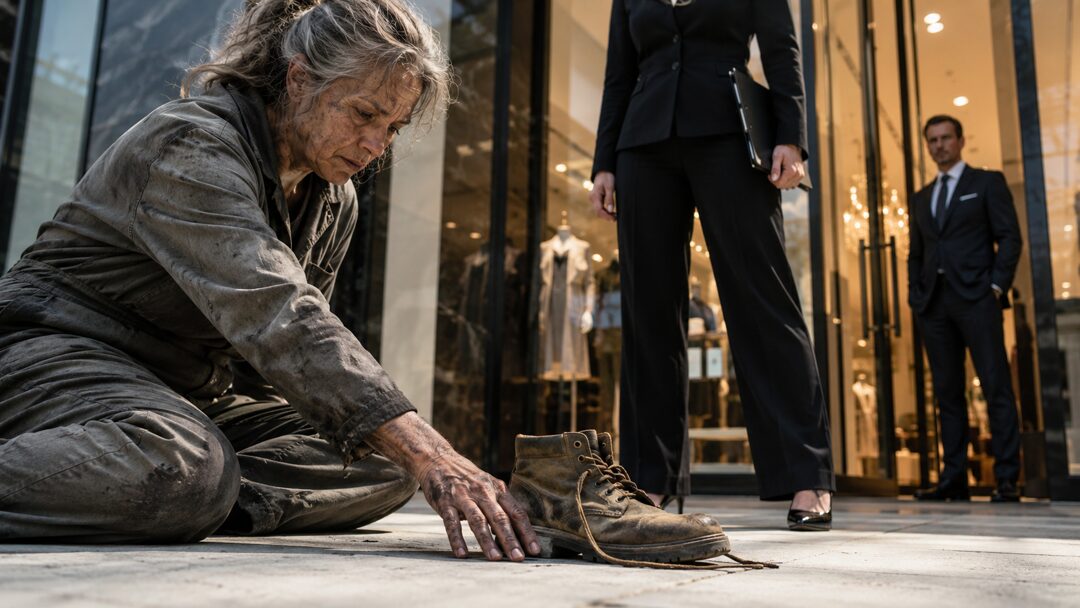
The Front Door
Part I — The Shoe Under Glass
Nancy had no business looking afraid inside a building she owned.
Still, she stood in the center of Mondor Fair with one hand wrapped around a mop handle, her gray-green jumpsuit damp at the knees, her work boots leaving faint half-moons on the marble floor. Above her, the chandeliers were still waking up. Around her, glass cases waited under soft gold light.
And in front of her, beneath a clear dome on a black velvet pedestal, stood the shoe.
A gold glitter stiletto.
One shoe only, tilted as if it knew people would stop breathing for it.
Nancy did.
She leaned closer, not touching the glass. Her graying hair had come loose from its ponytail. A dark blue shadow marked one cheek from where she had slipped on the basement stairs before dawn. Her hands smelled faintly of leather glue and shoe polish no matter how many times she washed them.
She had not meant to come upstairs.
That was what she told herself.
She had only meant to mop the small patch of water by the service corridor before Lisa arrived and complained to Emily again. She had only meant to keep the basement from becoming “a problem.” She had only meant to stay useful, quiet, out of sight.
Then she had seen the shoe through the dark storefront window.
For a moment, she was twenty-eight again, standing beside her husband in a narrow repair shop with a hand-painted sign, watching him hold up a pair of glittering gold heels like they were crown jewels.
“First client who doesn’t want a discount,” he had said, grinning.
Nancy had laughed so hard she dropped a box of heel taps.
The memory came back so sharply that she forgot the mop in her hand.
She forgot the bruise on her cheek.
She forgot that Emily had asked her, more than once, not to wander through the boutique before important meetings.
The glass doors behind her whispered open.
Nancy turned.
Daniel walked in first.
He wore a dark suit that probably cost more than her first month’s rent in this building. His hair was neat, his cufflinks silver, his face arranged in the relaxed expression of a man who had never had to hurry unless he wanted people to see him doing it.
Lisa followed half a step behind him in a black tailored suit, red lipstick perfect, name tag shining like a warning.
Both of them stopped when they saw Nancy.
The air changed at once.
Lisa’s eyes dropped to the mop. Then to Nancy’s boots. Then to the faint smear of water on the marble.
“Excuse me,” Lisa said.
Nancy stepped back. “I’m sorry. I was just—”
“You can’t be here.”
Daniel did not speak. He looked at Nancy the way people looked at a leak in a ceiling.
Not angry yet.
Simply calculating damage.
Lisa moved closer, her heels clicking with small, hard sounds. “The service entrance is downstairs.”
“I know where it is,” Nancy said softly.
Lisa’s eyes narrowed.
Nancy wished she had not said it. The sentence had come out with the wrong amount of truth.
Daniel glanced at the pedestal. “Is anything missing?”
“No,” Nancy said. “I didn’t touch it.”
“That wasn’t what I asked you,” he said.
The words were quiet. That made them worse.
Nancy looked back at the shoe. Under the glass, it glittered as if nothing ugly could happen near it.
“I only wanted to see it,” she said. “Years ago, my husband repaired a pair almost like that.”
Lisa gave a small smile. Not warm. Not amused.
A smile people used when they had already decided what you were.
“These are not for you,” Lisa said. “We maintain a certain standard. Please leave.”
Nancy’s hand tightened around the mop.
The sentence landed with a familiar weight. Not because she had heard those exact words before, but because the world had said versions of them to her all her life.
Not this table.
Not this room.
Not this elevator.
Not this dream, unless you enter through the back.
Daniel checked his watch. “Handle it before the luncheon.”
Lisa’s hand came down on Nancy’s shoulder.
Firm.
Public.
Nancy looked at the hand first. Then at Lisa.
“I can walk,” she said.
“I’m sure you can.”
Lisa guided her toward the front doors.
Not the service corridor.
The front.
Two associates arranging silk scarves paused behind a display. A deliveryman near the doorway looked away. Outside, people in clean coats and expensive shoes passed under the morning sun.
Nancy kept her head level.
She had signed the papers on this building twenty-two years ago at a folding table in the basement because the bank office had felt too grand. She had paid the mortgage with repaired soles, replaced zippers, cleaned handbags, late nights, and her husband’s laugh fading year by year after he got sick.
And still, she let herself be moved like dirt.
Because Emily had said this lease mattered.
Because Emily had said, Mom, please, just for a few months, let me handle the upstairs.
Because Emily had looked so tired when she said it.
At the glass doors, Lisa leaned close enough for only Nancy to hear.
“Next time, use the correct entrance.”
Nancy swallowed.
Then Lisa pushed open the door.
The sunlight hit too bright, too fast. Nancy’s loose boot caught on the metal threshold. The mop clattered. Her body lurched forward before she could stop herself.
She hit the sidewalk on one knee, then one hip, then both hands.
A small sound rose from the people outside.
Not concern.
Not outrage.
Just the sound of people noticing something embarrassing and not wanting it to become their problem.
Nancy stayed there for one breath too long.
Her right boot had slipped half off.
Behind her, Mondor Fair shone like a palace.
Part II — The Woman in the Beige Coat
Emily saw her mother on the ground before she saw anyone else.
That was not the part that shamed her.
The shame came half a second later, when her eyes moved past Nancy and searched the sidewalk.
Daniel’s investors.
The luncheon guests.
Someone with a phone.
Someone from the real-estate board.
Someone who would see the woman in the stained jumpsuit and know, without being told, that Emily had not been born into cream blouses and gold watches.
Her hand went first to the belt of her beige trench coat.
She straightened it.
Then she hated herself.
“Mom?”
Nancy looked up.
Her cheek had gone pale around the bruise. Her hands were flat on the pavement. One boot sat twisted beside her foot.
“Don’t make a scene, honey,” Nancy said.
That was the worst thing she could have said.
Because it was exactly what Emily had trained her to say.
Emily crossed the sidewalk and crouched beside her. She reached for Nancy’s arm, then paused when she saw a smear of polish on her sleeve.
The pause was tiny.
Nancy noticed.
So did Daniel.
He had come out behind Lisa, one hand in his pocket, expression smooth enough to pass for concern if no one looked too closely.
Lisa stood near the door, her face still composed, but her fingers had tightened around her clipboard.
Several people had stopped. A man in a navy coat pretended to read a message while watching. Two women near the curb whispered. A boutique associate hovered just inside the glass.
Emily rose slowly.
She looked at Lisa first.
Then Daniel.
Her voice, when it came, was calm enough to cut.
“Why is my mother on the ground?”
Lisa blinked.
Daniel’s eyes moved from Emily to Nancy, then back to Emily. Something in his face rearranged itself. Not guilt. Not yet.
Information.
“Emily,” he said, stepping closer. “There’s been a misunderstanding.”
Nancy reached for her boot.
Emily did not move.
Lisa cleared her throat. “She was inside before opening. Near the display. I thought—”
“You thought what?” Emily asked.
Lisa’s mouth tightened. “That she was not authorized to be here.”
“She’s my mother.”
“Yes, I understand that now.”
Daniel lifted one hand, gentle, practiced. “Let’s not turn this into something larger than it is. Mrs.—”
“Nancy,” Nancy said from the ground.
Emily flinched at the sound of her mother introducing herself like a stranger.
Daniel adjusted instantly. “Nancy. Of course. Let me have a car brought around. We can take you home through the rear entrance and make sure you’re comfortable.”
Nancy’s fingers closed around the boot.
“No, thank you.”
“It’s no trouble,” Daniel said.
“I said no.”
The sidewalk quieted.
Nancy pulled the boot toward her and tried to slide her foot in without making a spectacle of herself. Her hands trembled just enough for Emily to see.
Emily bent to help her.
This time she did not hesitate.
Lisa stepped forward, voice clipped. “There is also the matter of the display. She was near the stiletto. If she touched the glass, the piece will need to be reset before the luncheon.”
Emily looked at her.
Lisa kept going because fear often dressed itself as procedure.
“It’s a one-of-one item. We have standards to protect.”
The word hung there.
Standards.
Emily felt Daniel looking at her.
Not warning her.
Trusting her to understand the cost of this moment.
The lease extension was supposed to be announced today. Mondor Fair’s flagship expansion would put Emily’s name in front of every serious developer in the city. Daniel had told her she was brilliant. Elegant. Built for rooms like this.
He had also never been to the basement.
Not once.
Emily helped Nancy stand.
Her mother was shorter than she remembered in that moment, or maybe the boutique doors behind her were just too tall.
“Lisa,” Emily said, “apologize.”
Lisa’s face hardened. “If I overstepped—”
“No,” Emily said. “That’s not an apology.”
Daniel moved beside her. “Emily, we can handle this privately.”
Privately.
That was how everything had been handled.
The basement entrance.
The repair shop.
Nancy’s name absent from the investor packet.
The owner listed as Hillcrest Property Holdings instead of the woman who ate soup from a chipped mug beside a sewing machine below their feet.
Emily looked at her mother’s boot, then at the glass facade of Mondor Fair.
For one wild second she wanted to do what she had always done.
Smooth the scene.
Translate the hurt into business language.
Save the room.
Then Nancy touched her sleeve with two fingers and whispered, “It’s all right.”
Emily closed her eyes.
It was not all right.
It had not been all right for years.
“She owns this building,” Emily said.
Lisa went still.
Daniel’s face changed less dramatically. That was how Emily knew the words had landed harder.
He looked at Nancy again.
Not at the jumpsuit now.
Not at the boot.
At her.
“Nancy,” he said, warmer this time. “I wish I’d known.”
Nancy met his eyes.
“That would have changed your manners?”
No one spoke.
The question did not rise. It sat there, plain and heavy.
Daniel smiled, but there was less of him in it. “It would have changed how this was handled.”
“That’s not the same thing,” Nancy said.
Emily felt the sentence pass through her like a key turning in an old lock.
Then Nancy turned toward the doors.
“If I’m going back in,” she said, “I’m using the front.”
Part III — Standards
Inside Mondor Fair, the marble seemed brighter after the sidewalk.
The staff had assembled themselves behind counters and near display cases, faces stiff with the terror of people who had mistaken the floor for solid ground and heard it crack.
Lisa walked three steps behind Nancy now.
Daniel walked beside Emily.
That was his way. Never too far from the person whose decision mattered.
“Nancy,” he said, voice lowered, “I want you to know this does not reflect the values of Mondor Fair.”
Nancy looked at the gold heel under glass.
“Funny,” she said. “It sounded rehearsed.”
Lisa’s cheeks colored.
Emily should have felt vindicated.
Instead, her stomach turned.
Because it had sounded rehearsed.
Because Lisa had not invented that language alone.
Daniel touched Emily’s elbow lightly. “Can we speak?”
She knew that touch. It looked gentle from outside. It usually meant stop moving.
Emily let him draw her toward a side alcove near the silk scarves.
Nancy remained by the pedestal, her hands folded around the boot she had finally put back on.
Daniel’s voice dropped into the private tone he used when he wanted Emily to feel chosen.
“I can fix this,” he said.
“You should start with an apology.”
“I will. Publicly if needed. But not during the luncheon.”
Emily looked through the glass toward the sidewalk, where a few onlookers still lingered.
“You’re worried about the investors.”
“I’m worried about your mother becoming a story people laugh about.”
The line was soft.
That made it land deeper.
“She was already on the ground, Daniel.”
“And I’m trying to keep that from being the headline of her day.” His hand moved to her wrist, thumb brushing once over her pulse. “Let me protect both of you.”
Emily wanted, badly, to believe him.
That was the part of loving Daniel she hated most.
He could make control sound like shelter. He could make silence sound mature. He could make compromise feel like the adult version of love.
Behind him, Nancy turned slightly.
Emily saw her mother’s eyes.
She had heard enough.
Daniel followed Emily’s gaze and released her wrist.
“We announce the extension,” he said quietly. “Lisa apologizes privately. I’ll make sure she’s gone by the end of the week. Your mother is compensated. Everyone leaves with dignity.”
Emily almost laughed.
“Everyone?”
He held her stare. “Yes.”
“What about the basement?”
His expression barely shifted.
But it shifted.
Emily felt the blood drain from her face.
Daniel’s voice stayed even. “We were going to discuss timing after today.”
Nancy took one step toward them.
“What about the basement?” she asked.
Emily turned.
“Mom—”
Nancy looked at her daughter, not Daniel.
“What about my shop?”
Lisa, still too close, answered because fear had made her reckless.
“The lower level is being converted into a private client lounge,” she said. “That was part of the preliminary expansion packet.”
The room sharpened.
Emily could hear the faint hum of the lights.
Nancy’s hands went still.
“You signed that?” Nancy asked.
Emily’s mouth opened.
No answer came.
Daniel stepped in. “It was exploratory. Nothing final.”
Nancy did not look at him.
“Emily.”
“It was language,” Emily said. “Just draft language. I was going to talk to you.”
“What did it call the shop?”
Emily looked away.
That was answer enough.
Nancy’s voice remained quiet. “Say it.”
Emily’s throat closed.
Daniel said, “Nancy, this is not the right setting—”
“Say it,” Nancy repeated.
Emily forced the words out.
“Nonessential storage.”
Lisa lowered her eyes.
For once, she had the sense to be ashamed.
Nancy looked toward the service corridor door almost hidden behind a wall of mirrored panels.
For thirty-six years, that basement had smelled of leather, coffee, rainwater, and work. Emily had done homework on a stool beside the register. Her father had taught her to tie knots with waxed thread. Nancy had slept down there on a cot through the first winter after he died because she could not bear the apartment without him.
Nonessential storage.
Nancy nodded once.
Not in agreement.
In recognition.
“You didn’t just ask me to use the back door,” she said. “You asked me to become it.”
Emily took a step toward her. “Mom, I was trying to protect what you built.”
“No,” Nancy said. “You were trying to make it look like someone else built you.”
The words were not loud.
They did not need to be.
The luncheon guests began arriving then.
Men and women in tailored coats, clean perfume, low laughter. The boutique filled with the sound of money pretending not to make noise.
Daniel adjusted his jacket.
Emily saw him do it.
That small smooth motion.
The decision to continue.
He leaned close to her. “We can survive this if you keep steady.”
Emily stared at him.
“We?”
He gave her a look that once would have felt intimate.
Now it felt like a contract.
“You want a future in this world,” he said. “Do not burn it down because your mother had a difficult morning.”
Emily looked at Nancy.
Her mother’s face had not broken.
That was what broke Emily.
Part IV — The Luncheon
The luncheon began because rich people trusted schedules more than truth.
Champagne appeared. Silver trays moved. Someone unveiled white orchids near the central display. A photographer took careful shots that avoided the corner where Nancy stood in her stained jumpsuit with one hand on the glass case.
Daniel introduced Emily to investors as if nothing had happened.
“Our partner in the Hillcrest redevelopment,” he said, palm hovering near the small of her back. “Sharpest negotiator in the city.”
Emily smiled because her face knew how before her heart agreed.
Nancy watched from across the room.
Not accusing.
Worse.
Seeing.
Lisa moved through the crowd with perfect posture, but her hands shook when she adjusted name cards.
Near the pedestal, an older investor admired the gold stiletto.
“Stunning piece,” he said. “Bold choice for the reveal.”
Daniel smiled. “Luxury should feel impossible until it belongs to you.”
Nancy’s eyes moved to Emily.
Emily looked down at her champagne glass.
Impossible until it belongs to you.
Her father would have laughed at that. He used to say the finest shoes in the city were still useless if they pinched.
The investor turned to Lisa. “And the space looks flawless. No disruption from the lower levels?”
Lisa glanced at Daniel.
Daniel’s smile warned her not to stumble.
Lisa said, “We’ve taken care to maintain strict front-of-house standards for today.”
Emily felt the words coming before they arrived.
Lisa continued, “At Ms. Emily’s request.”
The room did not fall silent.
That would have been easier.
Instead, the room kept murmuring around the sentence, letting it sink privately into the people who understood it.
Nancy understood it.
Emily saw the final piece settle in her mother’s face.
Not shock.
Not anger.
A tired, terrible clarity.
Daniel took Emily’s elbow.
“Not now,” he said under his breath.
She pulled away.
Nancy walked toward the pedestal. Her boot made a dull sound on the marble with each step. People noticed her now. They noticed the jumpsuit, the old polish on her hands, the bruise she had stopped trying to hide.
They noticed because Daniel noticed.
Because status taught people where to look.
Nancy stopped before the glass dome.
“I’d like to see the shoe,” she said.
Lisa was beside her at once. “I’m sorry, but the piece is prepared for the formal reveal.”
Nancy looked at her.
“I didn’t ask to buy it.”
Lisa swallowed. “It’s not available to handle.”
Daniel moved in, smooth as closing doors. “Nancy, let’s step into my office.”
“No.”
The room quieted then.
Daniel’s smile remained, but his eyes hardened.
Emily had seen that look in negotiations. It meant he had decided the other person had mistaken politeness for weakness.
“Nancy,” he said, “I’m offering you a private apology and a generous resolution. Lisa’s employment here will be reviewed. Your daughter’s agreement will be protected. There is no need to embarrass anyone.”
Nancy turned to Emily.
“Is that what you want?”
Emily could not answer fast enough.
Daniel did it for her.
“She wants this day not to ruin years of work.”
Nancy nodded slowly. “I know.”
Emily heard the kindness in it.
That was almost unbearable.
Daniel lowered his voice, but not enough. “Emily, if we do this publicly, I will have to explain to the room that ownership interests were concealed during negotiation. That puts your position in question. It puts your judgment in question.”
The words entered the room like smoke.
Investors looked over now.
Lisa stopped breathing.
Emily stared at Daniel.
There it was.
Not shelter.
Leverage.
He reached for her hand. “Don’t make me do that.”
The sentence was tender enough to be ugly.
Emily thought of every dinner where Daniel had ordered wine she could not pronounce and smiled when she tried. Every time he had said he admired how far she had come. Every time he had kissed her forehead after calling her “almost too hungry for approval.”
She had mistaken being studied for being known.
Nancy moved closer to her.
“You don’t have to fix this for me,” Nancy said.
Emily looked at her mother’s stained hands.
Hands that had repaired other people’s finest shoes.
Hands that had signed tuition checks.
Hands Emily had hidden in investor rooms by calling the owner “the holding company.”
Emily’s voice came out rough.
“I’m not fixing it for you.”
Daniel’s expression warned her.
Emily stepped away from him.
“I’m fixing what I helped break.”
Part V — The Front Room
Emily walked to the pedestal before she could lose courage.
Lisa stepped in front of her. “Emily, please. The display has been calibrated.”
“It’s a shoe, Lisa.”
“It is a one-of-one Mondor Fair piece.”
“No,” Emily said. “It’s a test.”
The room held its breath.
Emily lifted the glass dome.
A small alarm chirped once, then stopped when Lisa, shaking, tapped a code into the display panel.
The gold stiletto sat in Emily’s hands with surprising weight.
Up close, it was not delicate. It had structure. Steel hidden under glitter. Balance disguised as beauty.
Emily carried it to Nancy.
Daniel’s voice cut through the room. “This is emotional and unprofessional.”
Emily stopped.
She turned back.
“You’re right,” she said. “It is emotional.”
A few people shifted.
Daniel’s jaw tightened.
Emily looked at the faces around her. Investors. Staff. Clients. The same sidewalk onlookers now visible beyond the glass doors. Everyone watching because people loved dignity most when they thought it might fail.
Then she looked at her mother.
“She taught me what real luxury means,” Emily said. “I forgot because I wanted people like you to think I was born already polished.”
Nancy closed her eyes.
Just once.
Emily went on before shame could choke her.
“My mother owns this building. She repaired shoes in the basement before any of you thought this address was elegant. She kept the lights on when my father got sick. She paid for my education with hands this store decided were too dirty to touch glass.”
Daniel stepped forward. “Emily.”
“No.”
The word surprised even her.
It was small.
It held.
Emily looked at the investors. “The original lease includes a conduct clause. Public behavior damaging the property’s reputation is grounds for termination.”
Daniel’s face went white beneath his composure.
“You wouldn’t,” he said.
Emily almost laughed again.
There it was. Not apology. Not regret.
Only surprise that she might choose the woman on the floor over the man at the table.
Nancy spoke then.
“She won’t,” she said.
Emily turned, startled.
Nancy took the shoe gently from her daughter’s hands.
“I will.”
Daniel looked at Nancy as if truly seeing her for the first time and finding, too late, that she had been standing on solid ground all along.
Lisa whispered, “Mrs. Hill—”
“Nancy,” Nancy said.
Lisa’s mouth closed.
Nancy sat on the low velvet bench beside the pedestal. Not because she was weak. Because she chose to.
Emily knelt before her.
The room went very still.
This was the moment that would be remembered wrong by people who needed it to be simple. They would say Emily saved her mother. They would say the rich woman revealed herself. They would say the rude manager got what she deserved.
But Emily knew the truth was uglier and better than that.
Her mother had not needed saving from poverty.
She had needed saving from being loved in secret.
Emily removed Nancy’s right boot.
The sock beneath was worn thin at the heel.
Nancy gave a small embarrassed breath.
Emily looked up at her.
“I’m sorry,” she said.
Nancy’s face did not soften.
Not yet.
Emily slipped the gold stiletto onto her mother’s foot.
The contrast was almost absurd: glittering heel, gray-green fabric, old sock, work-roughened skin, marble floor.
But Nancy stood.
One foot in a scuffed boot.
One foot in the gold shoe.
And somehow no one in the room could make it ridiculous.
She stood too straight for that.
Daniel looked around, searching for the person who would rescue the room for him.
No one moved.
Nancy faced him.
“You can remove your signage by the end of the month,” she said. “My attorney will send the notice this afternoon.”
Daniel’s mouth tightened. “Nancy, let’s not make a permanent decision in a temporary emotional state.”
Nancy looked at the glass cases, the chandeliers, the staff lined along the walls.
Then she looked back at him.
“This building survived grief, debt, winter pipes, and my husband dying in the room under your feet,” she said. “It will survive losing a store that teaches people to bow to shoes and step over women.”
No one spoke.
Daniel’s expression did not break. Men like him rarely broke where others could see. But something smaller happened.
He became ordinary.
Without the lease, without the room obeying him, without Emily at his side, he was just a man in an expensive suit who had mistaken polish for power.
He looked at Emily once.
She wanted it to hurt less than it did.
It did not.
He left through the front doors with the controlled pace of someone determined not to look dismissed.
Lisa remained where she was, eyes bright, clipboard clutched to her chest.
Nancy removed the gold heel and held it out to her.
Lisa stared at it.
“Put it in a box,” Nancy said.
Lisa took it with both hands.
For the first time all morning, she did not say anything about standards.
Part VI — Use the Front Door
The basement smelled the same.
Leather. Dust. Coffee. Rain caught in old walls.
Emily had not been down there in eight months.
She knew because the calendar above the repair counter still showed September, and because her mother had stopped asking after the third invitation she declined.
Nancy sat on the stool beside the workbench while Emily opened the first-aid kit from under the sink.
Neither of them spoke at first.
Above them, Mondor Fair continued its quiet collapse. Staff moved carefully. Guests left in pairs. Somewhere, Lisa was boxing the gold stiletto like evidence from a scene no one wanted to describe honestly.
Emily dampened a cotton pad.
Nancy let her touch the shadow on her cheek.
That permission felt larger than forgiveness.
“You should have told me you fell,” Emily said.
“You were busy.”
The words were not cruel.
That was why they hurt.
Emily dabbed gently. “I was ashamed.”
Nancy looked at her.
Emily did not look away.
“Not of you,” she said, then stopped. “No. That’s not true. I was ashamed of how they would see you. Which means I let them teach me to be ashamed of you.”
Nancy’s eyes lowered to her hands.
On the wall behind her, an old photograph sat in a wooden frame. Nancy and her husband stood in front of the original shop sign, both younger, both laughing. In her husband’s hand was a pair of gold heels, glitter catching the camera flash.
Emily stepped closer.
“I remember those,” she said.
“First real repair we ever got from someone upstairs,” Nancy said. “Your father said they were magic because they paid the electric bill.”
Emily smiled, then lost it.
“I called this place storage.”
“I heard.”
“I signed it.”
“I know.”
Emily set the cotton pad down.
The silence after that did not rush to comfort her.
Good, she thought.
Maybe comfort was not what she deserved first.
Nancy reached for the boxed gold stiletto on the counter. Lisa had brought it down herself, face pale, voice gone. Nancy had accepted it without victory.
Now she opened the lid.
The shoe glittered under the basement’s fluorescent light, less holy here, more real.
Nancy studied it for a long moment.
Then she closed the box.
Emily watched her mother write the date on a strip of masking tape and press it across the lid.
Not a trophy.
Not a keepsake.
A record.
“Are you keeping it?” Emily asked.
“For now.”
“What will you do with the space upstairs?”
Nancy looked around the basement shop.
The old machines. The rows of soles. The jars of buttons. The counter worn smooth where thousands of people had rested their elbows while asking if something broken could be made usable again.
“I don’t know yet,” she said.
Emily nodded.
For once, she did not offer a plan.
Nancy stood and walked toward the stairs. Her gait was uneven from the morning, but steady. At the bottom step, she paused.
Emily thought she might say it was all right.
She did not.
That would have been too easy.
“I loved you so much,” Nancy said, “I let you hide me.”
Emily’s breath caught.
Nancy looked back at her.
“That was my mistake too.”
The sentence opened something neither of them could close quickly.
Emily wanted to cross the room, hold her, promise things, ask for the kind of forgiveness that would make tomorrow simple.
Instead she stayed where she was.
“What do I do now?” she asked.
Nancy gave a tired little smile.
“Start smaller than a speech.”
Emily nodded, wiping at her face with the heel of her hand.
“Can I come by tomorrow?” she asked. “Before work. I can help open.”
Nancy looked up the stairwell toward the building she had spent years entering from the side.
Then she looked back at her daughter.
“Use the front door,” she said.
The next morning, the glass doors of the old boutique reflected the city in pale gold.
There was no Mondor Fair sign above them anymore.
Only faint outlines where the letters had been.
Emily arrived before eight in a plain coat, carrying two coffees and no folder.
For a moment, she stood outside with her hand near the handle, waiting for the old instinct to tell her she did not belong.
Then she opened the front door and stepped inside.