The Name She Waited For
Part I — The Rain at the Bellweather
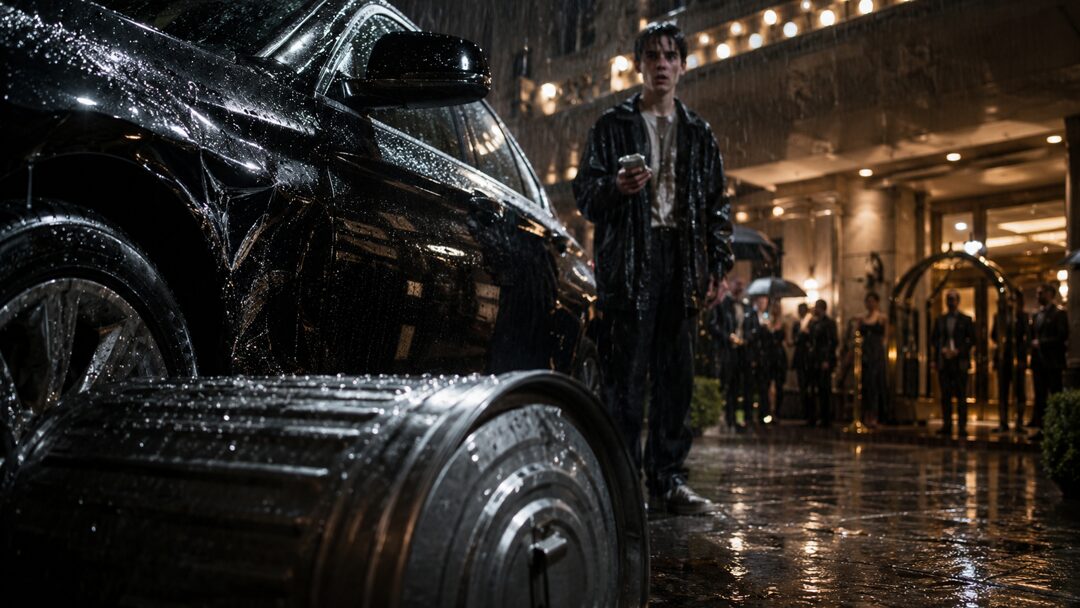
The trash can hit the side of the black Mercedes so hard that the whole hotel entrance went silent before the sound finished echoing.
A sheet of rainwater burst up from the curb and slapped across the car windows, silver under the gold lights of the Bellweather Hotel. People in tuxedos and evening gowns turned at once. A valet froze with an umbrella lifted over his head. Someone near the revolving doors gasped, then raised a phone.
Joshua Miller stood in the rain with both hands still clenched.
He was fourteen, thin as a question mark, his black jacket soaked through, his white shirt stuck to his chest. Dark hair clung to his forehead. Water ran down his face so fast it was impossible to tell what was rain and what wasn’t.
The rear door of the Mercedes flew open.
Cynthia Hayes stepped out like she had been dragged from a portrait. Black tailored coat. White silk blouse. Pearl earrings. Sleek bun untouched by the storm for one impossible second before the rain found her too. Her red lipstick made her anger look even sharper.
“Have you lost your mind?” she snapped.
Joshua stared at her.
Behind her, the Bellweather glowed with chandeliers and polished brass. A banner above the entrance read: Hayes Foundation Annual Benefit — For Every Child, A Home.
Joshua looked at the banner, then back at her.
“You left my mother in the rain,” he said. “You never looked back.”
The words did what the trash can had not.
They made Cynthia go still.
A man in a tuxedo near the door lowered his glass. Two women under one umbrella leaned closer to hear. The valet took one step back. Phones rose higher.
Cynthia’s face tightened. “I don’t know who you are.”
“Yes, you do.”
Security started moving in from beside the revolving doors.
Joshua reached into the inside pocket of his jacket. For a second Cynthia flinched, and the man beside her car lifted a hand as if preparing to shield her.
But Joshua only pulled out a photograph.
It was inside a wrinkled plastic sleeve, soft at the corners from being handled too many times. He held it with both wet hands, close enough for Cynthia to see.
The picture showed a much younger Cynthia standing at the Bellweather’s side service entrance, soaked in rain, her hair fallen loose around her face. She was holding a wrapped newborn against her chest.
Her expression in the photograph was not glamorous.
It was wrecked.
Joshua’s voice shook. “She said you were my real mother.”
The phones stopped feeling like phones. They felt like eyes.
Cynthia stared at the photograph.
The fury drained out of her so quickly that what remained looked worse. Recognition opened across her face, not gently, but like something splitting.
“No,” whispered someone in the crowd.
Joshua took a step closer.
“Say it.”
Cynthia’s mouth moved, but no sound came.
“Say who I am.”
A tall man with silver hair came out through the revolving doors. Robert Hayes did not rush. He never rushed. He adjusted his cuff once, glanced at the Mercedes, the crowd, the phones, the boy, and only then at his wife.
“Cynthia,” he said softly.
One word. A command hidden inside concern.
She blinked, as if waking.
Robert placed himself beside her, not touching her, but close enough to look like protection. His tuxedo was perfect. His calm was perfect. Even in the rain, he seemed less wet than everyone else.
“Son,” he said to Joshua, “you’re upset.”
“I’m not your son.”
“No,” Robert said, with a small, practiced sadness. “You’re a grieving young man causing a scene.”
Joshua’s fingers tightened around the photograph.
Cynthia looked at the photo again. Her eyes shone, but she did not reach for it.
Robert continued, “Let’s not make this worse in public.”
Joshua laughed once. It came out broken. “That’s what rich people call the truth?”
Cynthia finally spoke. Her voice was lower now.
“Come inside,” she said. “Please. Away from the cameras.”
Joshua shook his head.
“You don’t get me in a room and make me disappear again.”
A ripple moved through the crowd.
Robert’s jaw tightened for half a second. Then the smoothness returned.
“This isn’t the place,” he said.
Joshua looked straight at Cynthia. “It was the place when she had nowhere to go.”
Cynthia closed her eyes.
The rain made small dark spots on her silk blouse where her coat had fallen open. She looked suddenly human, and Joshua hated that it hurt to see it.
“My mom died this morning,” he said.
Cynthia opened her eyes.
“Karen Miller,” Joshua said. “You remember her, don’t you?”
Cynthia’s hand rose toward her throat.
Robert’s voice dropped. “Careful.”
Joshua heard it. So did Cynthia.
The boy lifted the photograph higher.
“She told me to bring you this. She told me you would know what it meant.”
Cynthia’s lips parted.
The crowd waited.
The hotel lights shone on her pearls, on the Mercedes, on the wet pavement, on the banner about children and homes.
At last Cynthia said, “I’m sorry for your loss.”
That was all.
No name. No truth. No mother.
Joshua stared at her like she had slapped him.
Robert gave a small nod to security.
Two men stepped toward Joshua.
He backed away before they could touch him, still holding the photograph against his chest.
Cynthia made the smallest movement forward.
Robert caught her wrist.
Not hard. Not visibly.
Just enough.
Joshua saw it.
He saw her let him.
Then he turned and ran into the rain.
Behind him, the cameras kept recording.
Part II — What Money Could Not Say
By morning, Joshua had seen himself from seven different angles.
The first video had three million views. The second had captions in red letters. The third slowed down the moment Cynthia’s face changed when she saw the photo.
People online called him brave, disturbed, planted, spoiled, heartbreaking, dangerous.
No one knew that he had slept on the floor beside the couch because Karen’s bed still smelled like her lotion and he couldn’t go near it.
No one knew that the photograph was under his pillow.
No one knew that the blue raincoat hanging on the bathroom door had been Karen’s last request too.
“Wear it when you go,” she had whispered the night before she died.
“I’m not wearing your coat,” Joshua had said.
Karen had smiled with her cracked lips. “Then carry it. You’re stubborn enough for both of us.”
He had not understood. Not then.
He understood a little more when there was a knock at the apartment door at ten in the morning.
Joshua looked through the peephole.
Cynthia Hayes stood in the hallway.
No pearls today. No lipstick. Her hair was pinned back, but not perfectly. She wore a gray coat and held a folder against her chest.
Behind her stood a man in a dark suit Joshua didn’t recognize.
Joshua opened the door only as far as the chain allowed.
Cynthia looked at the chain. Then at him.
“Joshua.”
His name in her mouth made his stomach turn.
“You didn’t say that last night.”
Her face tightened.
“I should have.”
“But you didn’t.”
The man behind her cleared his throat. Cynthia lifted one hand without looking back, and he fell silent.
“May I come in?” she asked.
Joshua looked past her. “Is he here to make sure you don’t say the wrong thing?”
The man stiffened.
Cynthia said, “He’s a lawyer.”
“Then no.”
She hesitated. Then turned. “Wait downstairs.”
“Mrs. Hayes—”
“Downstairs.”
For the first time, Joshua heard steel in her voice that was not aimed at him.
The lawyer left.
Joshua closed the door, slid off the chain, and opened it again.
Cynthia stepped inside.
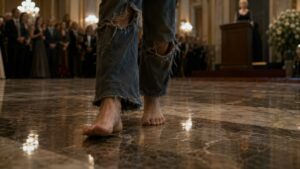
The apartment was too small for her. Or maybe it only felt that way because she belonged to rooms with marble floors and flowers taller than chairs.
Here there were pharmacy bags on the counter, folded blankets on the couch, a stack of unpaid bills held down by a chipped mug, and Karen’s blue raincoat hanging in the bathroom doorway like someone waiting to be asked in.
Cynthia saw it.
Her face changed.
“You remember it,” Joshua said.
She did not answer quickly enough.
Karen had taught him that silence was sometimes a confession that hadn’t dressed itself yet.
Cynthia placed the folder on the table. “I brought some things. Arrangements. Support. There’s money for the service, and for you. Legal help. A place to stay if you need—”
“I have a place.”
“Joshua—”
“You mean a better place.”
Her eyes flicked to the bills.
He hated her for seeing them. He hated himself for caring.
Cynthia sat at the kitchen table without being invited. Her hand hovered near a pill organizer with Karen’s initials written in black marker.
“Don’t touch that,” Joshua said.
She pulled her hand back.
For a moment, neither of them spoke.
Then Cynthia said, “Karen worked for me.”
Joshua’s throat tightened. “She told me.”
“She was my assistant before the foundation existed. Before all of this.” Cynthia looked around the apartment again, and there was something like shame in the way she did not let herself look away. “She was kind to me when no one else could afford to be.”
Joshua leaned against the counter.
“Then why did she end up here with me?”
Cynthia folded her hands.
“I was twenty-three,” she said. “I was engaged to Robert. His family had money, influence, expectations. I was pregnant before the wedding. His father said if anyone found out, I would be finished.”
“So they finished Karen instead.”
Cynthia flinched.
Good, Joshua thought.
Then he hated that too.
“Robert said we could fix it quietly,” she continued. “He said later there would be time. A proper home. A proper family. He said the baby would be cared for.”
“The baby,” Joshua repeated.
She looked at him then.
“You,” she said.
The word landed too late to be gentle.
Cynthia opened the folder. Inside were documents, a check, a business card, a funeral home brochure.
Joshua stared at the check.
It had more money written on it than Karen had earned in months.
“Was that how much I cost?” he asked.
Cynthia went pale.
“No.”
“How much did Karen cost?”
“Joshua—”
“You brought money to the place where she died.”
Cynthia’s eyes filled. “I brought what I could.”
“No,” he said. “You brought what you know how to use.”
The apartment seemed to shrink around them.
Cynthia pushed the check away from herself, as if it had burned her.
“I am sorry,” she said.
Joshua laughed under his breath. “In private.”
She closed her eyes.
He wanted her to deny it. He wanted her to get angry. He wanted her to give him something solid enough to push against.
Instead she opened her eyes and said, “Yes.”
That hurt more.
He turned away first.
On the refrigerator, under a magnet shaped like a strawberry, was Karen’s handwriting: Call pharmacy. Pay gas. Ask Josh about English paper.
Ask Josh.
Not Joshua.
Josh.
His mother had called him Josh when he was late, baby when he was sick, and Mr. Miller when he tried to act older than he was.
Cynthia had called him Joshua twice and made his name sound like a document.
He pulled open the drawer beneath the phone. He didn’t know why. Maybe because Karen had always hidden important things in ordinary places.
Coupons. Batteries. Takeout menus. A screwdriver.
And under all of it, an envelope.
His name was written on it in Karen’s careful hand.
Josh — after the photo.
Cynthia stood.
“Don’t,” Joshua said.
She stopped.
He opened the envelope with shaking fingers.
Inside was a folded page and a smaller photograph he had never seen.
The photo showed a playground fence.
On one side, a small boy in a red hoodie looked away from the camera, reaching for a ball.
On the other side, half-hidden behind a tree across the street, stood Cynthia Hayes.
Younger than now. Older than in the first photo.
Watching.
Joshua forgot how to breathe.
Cynthia saw the picture from across the room.
Her hand flew to her mouth.
Joshua unfolded the letter.
Karen’s handwriting blurred, then sharpened.
Josh, if you are reading this, then you know enough to ask the harder question.
She did come back once.
His hands began to tremble harder.
You were five. You were playing outside the school. She stood across the street for almost twenty minutes. She cried the whole time. I know because I was there too.
Joshua looked up.
Cynthia was crying silently now.
He read on.
I wanted to hate her for leaving again. Part of me did. But Robert had already made it clear that if she tried to claim you, the medical help would stop, the apartment would stop, and he would make sure no one believed me about anything. I was tired, Josh. I was scared. And I loved you more than I loved the truth.
The page shook.
That was my wrong. Not loving you. Never that. But waiting.
Joshua lowered the letter.
He looked at Cynthia.
“You came back.”
Her lips trembled. “Yes.”
“You saw me.”
“Yes.”
“And you still walked away.”
Cynthia’s face folded in on itself.
There were tears on her cheeks now, but Joshua did not move toward her.
“You didn’t forget me,” he said.
“No.”
The room went quiet.
Somewhere outside, a car hissed over wet pavement.
Joshua held up the schoolyard photo.
“You remembered,” he said, “and you still let me be nobody.”
Cynthia whispered, “I was afraid.”
Joshua nodded slowly.
He understood fear. Karen had been afraid of bills, doctors, winter, landlords, letters with red ink.
But she had never made him pay for it by being invisible.
“That must have been nice,” he said.
Cynthia looked at him through tears.
“What?”
“Having fear big enough that everyone else had to live inside it.”
She had no answer.
That was the first honest thing she gave him.
Part III — The Statement
Robert Hayes did not shout when he was cruel.
That made him harder to fight.
His voice came from Cynthia’s phone that evening while Joshua stood in the kitchen and she sat at Karen’s table like a woman waiting for a sentence.
“You should not still be there,” Robert said.
Cynthia had put him on speaker by accident or confession. Joshua couldn’t tell.
“I’m not leaving him alone,” she said.
“That is a sentimental position, not a practical one.”
Joshua looked at her.
She looked down.
Robert continued, “The board has agreed we need a public statement before this becomes uglier. We will express concern for the boy, emphasize his grief, and correct the false implications being circulated.”
Cynthia’s fingers tightened around the phone.
“What false implications?”
A pause.
Then Robert said, gently, “Cynthia.”
Joshua hated the way he said her name. Like she was a beautiful object that had rolled too close to the edge of a table.
Robert went on. “Karen Miller was a former employee with a complicated emotional history. We can say that without being unkind.”
Joshua’s skin went cold.
Cynthia said, “No.”
“It protects her memory.”
Joshua barked a laugh. “By making her sound unstable?”
Robert ignored him.
“Cynthia,” he said, “not every truth belongs in public.”
Joshua stepped closer to the phone. “That’s funny. You liked public when you had your name on banners.”
Silence.
Then Robert said, “Young man, grief is not permission to destroy people who tried to help you.”
Joshua grabbed the phone before Cynthia could stop him.
“You didn’t help me.”
“I helped preserve your future.”
“You erased it.”
Robert’s calm hardened. “You were given a home.”
“My mother gave me a home.”
“And yet here we are,” Robert said. “Her choices have brought you to this unfortunate moment.”
Joshua’s vision blurred red at the edges.
Cynthia stood. “Robert, stop.”
“You need to come home,” Robert said. “There is a trustee reception tomorrow afternoon. You will stand beside me. We will handle this with dignity.”
Joshua looked at Cynthia.
“With whose dignity?” he asked.
Her face was wet again, but this time she looked angry too.
Robert heard the silence.
“Cynthia,” he said, no longer gentle, “think carefully. You know what this family can survive. You also know what it will not carry.”
There it was.
Not a threat in the shape of a threat.
A door closing softly.
The call ended.
Cynthia took the phone back, but her hand shook.
Joshua picked up Karen’s letter from the table and folded it along its old creases.
“He’s going to call her crazy.”
Cynthia said nothing.
“He’s going to stand in a room full of people and make my mom the problem.”
“He won’t use that word.”
Joshua stared at her.
Cynthia looked ashamed before he even spoke.
“That’s what you care about?” he asked. “The word?”
She sank back into the chair.
Joshua took the blue raincoat from the bathroom doorway.
It was too small for him, but he held it like armor.
Cynthia looked at it.
“She wore that the night you were born,” she said.
Joshua’s hand tightened around the fabric.
Cynthia swallowed. “It was raining so hard the service entrance flooded. Karen wrapped you in towels from the hotel laundry because I couldn’t stop shaking.”
“Don’t make it pretty.”
“I’m not.”
“You are. You’re making it sad so it doesn’t have to be wrong.”
Cynthia closed her mouth.
The line stayed between them.
A truth neither could soften.
Joshua took the original photograph and slid it back into the plastic sleeve. Then he placed Karen’s letter behind it.
“What are you doing?” Cynthia asked.
“What she asked me to do.”
“Joshua, Robert will have security.”
“He had security last time.”
“This could hurt you.”
He looked at her.
“It already did.”
She stood, blocking the doorway without meaning to. Or maybe meaning to. There was still so much in her that reached for control before courage.
“Please,” she said. “Let me fix this another way.”
He almost laughed.
Another way meant private rooms. Quiet checks. Lawyers downstairs. Mothers who touched doorknobs but did not enter.
“No,” he said. “You can fix it in the room where he lies.”
Cynthia’s face went still.
“And if I can’t?” she whispered.
Joshua opened the door.
“Then I’ll know what your love is worth.”
He left before she could answer.
This time, she did not follow.
Part IV — The Room of Polished Glass
The Hayes Foundation held its damage-control reception in a room where everything reflected everything else.
Glass walls. Silver trays. White flowers. Donors with soft voices and sharp eyes. Reporters near the back pretending not to wait for blood in the water.
Joshua arrived in Karen’s blue raincoat.
It hung short on his arms and tight across his shoulders, but he wore it anyway. Underneath, the same white shirt. In his pocket, the photograph. In his other pocket, Karen’s letter.
The security guard at the entrance recognized him immediately.
“You can’t come in.”
Joshua looked past him.
Robert stood at a podium beneath the foundation seal, one hand resting on the edge like he owned not just the room, but the air in it.
Cynthia stood two steps behind him.
Black dress. Hair pinned. Face pale.
Robert had put her where everyone could see her and no one could reach her.
Joshua tried to step around the guard.
A hand closed around his arm.
Several people turned.
Phones appeared again.
Joshua did not pull away. He had learned the night before that force made rich people look calm and poor people look dangerous.
So he lifted his voice.
“Ask Mrs. Hayes why she won’t say my name.”
The room quieted by degrees.
Robert looked toward the entrance.
For one second, anger showed on his face. Then concern replaced it perfectly.
“Joshua,” he said into the microphone, as if they had been expecting him. “I’m glad you’re safe.”
That made the room murmur softly. Safe. The word made Joshua sound lost. Troubled. Handled.
Cynthia took one step forward.
Robert’s hand shifted slightly behind the podium.
She stopped.
Joshua saw it.
So did some of the cameras.
Robert continued, “This young man has suffered a tremendous personal loss. The foundation has offered resources, counseling, and private support. Unfortunately, grief can be manipulated, and misinformation can cause harm to innocent people.”
Joshua felt Karen’s raincoat heavy on his shoulders.
He reached into his pocket.
Robert’s eyes narrowed.
“Karen Miller,” Robert said, “was once connected to our family in a limited professional capacity. We remember her with compassion. But we must be careful not to confuse compassion with—”
“With what?” Joshua called.
Robert paused.
Joshua walked forward. No one stopped him this time. Maybe because the phones were up. Maybe because the room wanted the scene more than it wanted order.
“With truth?” Joshua asked.
Robert’s smile thinned. “With fantasy.”
The word landed.
Not loudly.
That was the worst part.
It made Karen small without raising its voice.
Joshua pulled out the photograph.
Cynthia’s hand went to her chest.
The room leaned toward the image without moving.
“This is fantasy?” Joshua asked.
Robert sighed like a disappointed father. “A photograph without context can wound many people.”
Joshua turned the plastic sleeve around so the front row could see it.
“Then give it context.”
The room was silent enough to hear rain tapping the glass walls.
Robert looked at Cynthia.
Everyone did.
She stood with her hands clasped so tightly her knuckles were white.
For a moment, Joshua saw the woman from the schoolyard photo. Not cold. Not safe. Not brave. Watching from across a distance she had chosen and hated and chosen again.
Robert spoke without the microphone.
“Cynthia.”
It was almost tender.
That was what made it cruel.
Cynthia looked at him.
Then she looked at Joshua.
He had imagined this moment a hundred different ways in the last twenty-four hours. In every version, he wanted her to run to him, to say his name, to make the room sorry.
But when her eyes met his, he understood something that made his chest ache.
He did not want to be rescued by another performance.
He wanted the truth to stand without begging.
Cynthia stepped toward the podium.
Robert turned slightly. “This is not wise.”
“No,” she said.
The word was quiet.
The room caught it anyway.
Cynthia took the microphone.
Robert’s hand hovered near hers, but he did not touch her. Too many cameras. Too much glass.
Cynthia looked out at the donors, the reporters, the trustees who had praised her every year for giving children what she had withheld from her own.
Then she looked at Joshua.
“His name is Joshua Miller,” she said. “And he is my son.”
The room changed shape around the sentence.
A woman near the flowers covered her mouth. A reporter straightened. Robert’s face went bloodless beneath the careful lighting.
Cynthia did not stop.
“Karen Miller did not invent this. She did not manipulate him. She did not steal anything from me.” Her voice trembled once, then steadied. “She took him because I let other people decide that my reputation mattered more than his life.”
Robert whispered, “Enough.”
Cynthia turned toward him.
“No. That word has belonged to you for fourteen years.”
Joshua’s throat tightened.
Cynthia held out her hand.
Not to Joshua.
To the photograph.
He hesitated.
Then he gave it to her.
Their fingers brushed.
It was nothing. It was almost everything.
Cynthia looked down at the picture of her younger self holding him in the rain.
“This was taken outside the Bellweather service entrance,” she said. “The night he was born. Karen was my assistant. She was pressured, paid, and threatened into silence by this family. And I let that silence protect me.”
Robert stepped away from the podium.
“You are unwell,” he said softly.
Cynthia smiled then, but it was not a kind smile.
“Careful, Robert. That line has been used enough.”
The room held its breath.
Cynthia turned back to the microphone.
“I cannot undo what I did. I cannot give Karen back her years. I cannot give Joshua back the name I kept from him.” She looked at him. “But I will not stand here and let the woman who raised him be made small so I can remain clean.”
Joshua looked down because he could not look at her anymore.
Karen’s blue raincoat smelled faintly of soap and old rain.
Robert left the stage.
No one followed him.
For the first time since Joshua had thrown the trash can, the room belonged to someone who did not own it.
Part V — The Back Row
Cynthia offered him everything two hours later.
Not at the podium. Not in front of cameras. Outside, under the hotel awning, while rain made the city shine and reporters shouted questions from behind a line of security.
“My home,” she said. “My name, if you want it. Whatever legal steps are needed. Whatever you need.”
Joshua stood with Karen’s raincoat folded over one arm.
The original photograph was back in his pocket. Cynthia had returned it without being asked.
That mattered.
Not enough to fix anything.
But enough that he noticed.
“What I need,” he said, “is for you to come tomorrow.”
Cynthia blinked. “Tomorrow?”
“My mom’s service.”
Her face softened with pain.
“Of course.”
“No,” Joshua said. “Not of course.”
She went still.
“You stand in the back,” he said. “You don’t sit where family sits. You don’t tell people you’re my mother. You don’t make it about being forgiven.”
Cynthia’s eyes filled again, but this time she did not look away.
“Then why do you want me there?”
Joshua swallowed.
Because Karen had waited.
Because the woman in the first photograph had held him like loss.
Because the woman in the second photograph had watched him through a fence and still walked away.
Because he was angry enough to never speak to her again and lonely enough to want her to deserve better than that.
He said only, “Because you owe her the truth without applause.”
Cynthia nodded once.
“I’ll be there.”
Joshua searched her face for the old escape. The private room. The careful wording. The door left half closed.
He didn’t see it.
He didn’t trust that either.
The next morning, it rained lightly.
Not the hard, dramatic rain of the Bellweather. Not the kind that splashed against luxury cars and made people raise phones.
This rain was thin and gray and ordinary.
The funeral home chapel smelled like lilies and carpet cleaner. Karen’s coworkers came. A neighbor brought a casserole Joshua would never eat. His English teacher stood near the aisle and cried quietly into a tissue.
Cynthia arrived ten minutes late.
Joshua saw her from the front row.
No pearls. No black silk. No umbrella.
She wore a plain dark coat, her hair loose at her shoulders, rain beading on the fabric. She stood at the back exactly where he had told her to stand.
People turned to look.
She did not move forward.
She did not hide.
When the service ended, Joshua stayed seated until everyone else had passed Karen’s picture. It showed her smiling in a grocery store aisle, holding up two boxes of cereal like choosing between them was the most serious decision in the world.
That was the picture Joshua had picked.
Not the tired ones. Not the sick ones.
The one where she was his mother in the middle of an ordinary Tuesday.
Outside, the cemetery grass was dark with rain.
Cynthia stood at the back during the burial too. Water dampened her hair. Mud touched the edges of her shoes. She did not seem to notice.
Joshua held the folded program until it bent in his hands.
When it was over, people hugged him carefully. Adults always hugged grieving kids like they were afraid sadness could break through skin.
Cynthia waited until everyone else had gone.
Joshua walked to her.
For a moment, neither spoke.
Then he pulled an envelope from inside his jacket.
Cynthia looked at it.
“What is this?”
“A copy.”
She opened it with unsteady hands.
Inside was a duplicate of the photograph: young Cynthia in the rain, holding him against her chest.
Her face crumpled.
Joshua kept the original in his pocket.
Cynthia understood. He could tell.
“You should have one,” he said. “But not that one.”
She nodded, pressing the copy to her coat.
“I knew this day would come,” she whispered.
The words were almost the same as the ones she had said outside the Mercedes, but now they had no crowd to soften them, no cameras to trap them, no Robert to control what they meant.
Joshua looked at the wet grass between them.
“You still came late.”
Cynthia closed her eyes.
The rain kept falling.
He thought she might reach for him. Part of him wanted her to. Part of him was ready to step back.
She did neither.
Instead she said, “May I come again someday?”
Joshua looked toward Karen’s picture near the grave, then at the woman who had given him life and not a place in it.
Someday was a dangerous word.
It asked for a door without promising what would walk through it.
“I don’t know,” he said.
Cynthia nodded as if that answer cost her exactly what it should.
Joshua turned to leave, then stopped.
“My name is Miller,” he said.
“I know.”
“No,” he said, looking back at her. “You need to know it like it matters.”
Cynthia held the copied photograph with both hands.
“Joshua Miller,” she said.
He waited.
The rain tapped softly on the paper program in his hand.
Then he walked away from her, across the wet grass, carrying the original photograph and the blue raincoat.
Behind him, Cynthia remained at the back.
Not forgiven.
Not erased.
Only standing where the truth had finally made room for her, too late to be a mother, and too late to pretend she had never been one.