The Key to the White Boat
Part I — The Boy on the Dock
Jonah Reyes ran barefoot down the polished dock of the Whitmore Yacht Club while men in white linen turned from their champagne and women in cream dresses lifted their phones, not to help him, but to decide whether he was worth recording.
Security saw him before the guests understood what was wrong.
“Hey,” one guard barked. “You can’t be here.”
Jonah kept running.
His cuffs were wet from the tidal flats. Mud had dried in gray streaks along his shins. His shirt hung too loose from one shoulder, and around his neck, bouncing hard against his chest, was an old brass key on a fraying black cord.
Beyond the dock rose the yacht.
It was three stories of polished white arrogance, all glass, chrome, and flower garlands. On the side, in gold letters bright enough to catch the evening sun, someone had painted its name:
Maribel II.
Jonah saw the name and almost stopped.
His mother had told him only once.
If the white boat ever comes back, find Captain Elias.
She had said it from a hospital bed six weeks before she died, her fingers thin around the same key now cutting into Jonah’s collarbone.
Not Mr. Whitmore. Not the rich one.
Captain Elias.
A guard stepped in front of him. Jonah ducked under his arm, slipped on the wet boards, caught himself with one hand, and kept moving. Laughter burst somewhere near the champagne bar, nervous and sharp, the kind adults used when they wanted a thing to become harmless.
“Is he with catering?” someone asked.
“He’s bleeding,” another voice said, but softly, as if concern might stain the party.
Jonah was not bleeding. The red on his knee was rust from the old boatyard gate he had climbed after the road had been blocked for the event.
He could hear music now. A string quartet hidden beneath the upper deck. The clink of glasses. The steady hush of money pretending it did not make noise.
At the base of the boarding stairs, a man in a navy blazer turned.
He was not dressed like the guests. His sleeves had gold captain’s stripes, but his hands were rough, sun-browned, and nicked at the knuckles. His hair was gray at the temples. His face had the tired stillness of someone who had spent his life reading water before it changed.
Jonah knew him from the photograph inside his mother’s shoebox.
Older now. Harder. But the same eyes.
“Captain Elias?” Jonah gasped.
The man froze.
Two guards seized Jonah from behind. One hand closed around his upper arm. Another caught the back of his shirt.
“Easy,” the captain said.
His voice was quiet, but both guards stopped.
Jonah twisted forward and yanked the cord over his head. The key swung between them, dull and old and ordinary-looking, except for the way Captain Elias Whitmore stared at it as if someone had opened a grave in his hands.
“My mom said to give you this,” Jonah said.
The music kept playing.
Above them, on the yacht’s main deck, Grant Whitmore lifted his champagne glass and smiled at two hundred people as if nothing in the world had ever arrived uninvited.
Part II — The Key No One Wanted Seen
Captain Elias took the key without touching Jonah’s fingers.
That was the first thing Jonah noticed.
He took the key like it might burn him.
The second thing Jonah noticed was the silence around them. Not full silence. Rich people did not go silent all at once. Their silence came disguised. A laugh dropped away. A fork paused against a plate. Someone lowered a glass but did not set it down.
Grant Whitmore noticed last, or pretended to.
He stood on the yacht beneath a canopy of white flowers, a tall man in a white suit so clean it looked untouched by weather. His hair was silver at the edges but styled back smoothly. His watch flashed whenever he moved his hand. Beside him stood Celeste Vale in a cream dress, elegant and still, wearing an engagement ring large enough to collect the sunset.
Grant looked down at the dock.
His smile did not vanish. It simply became work.
“Elias,” he called, warm enough for the guests to hear. “Everything all right?”
Captain Elias closed his fist around the key.
Jonah saw it then: the captain was afraid.
Not of Grant exactly.
Of what Grant would do to the shape of the moment.
“This boy was running toward the vessel,” one of the guards said. “We’ll remove him.”
“No,” Elias said.
The guard’s grip loosened from Jonah’s arm.
Grant came down the boarding stairs with the casual ease of a man who owned every board beneath him. His champagne glass remained in his left hand. He did not spill a drop.
The closer he came, the colder Jonah felt.
Grant looked at the boy’s wet cuffs, bare feet, dirty shirt. He did not look at the key.
Not yet.
“I’m sorry about the confusion,” Grant said to the nearby guests, his voice light, practiced, almost kind. “The marina has been under a lot of transition. Some of the local families are having a difficult time with the change.”
A few people nodded as if that explained Jonah.
As if he was not a person, but a weather condition.
Celeste had followed halfway down the stairs. She looked at Jonah longer than anyone else had. Not pity. Not quite. Something sharper. She was measuring the room around him, the way the guards stood too close, the way Grant’s smile landed everywhere except on the boy’s face.
Grant crouched slightly, lowering his voice but not enough.
“What’s your name?”
Jonah said nothing.
“We can have someone help you off the property,” Grant continued. “Get you some shoes. Something to eat. You don’t need to make a scene.”
Jonah looked past him to the yacht’s gold letters.
Maribel II.
“My mom said,” he said, forcing the words through his dry mouth, “if the white boat came back, I had to find Captain Elias.”
The captain flinched.
Grant’s smile thinned.
Celeste’s hand moved to the railing.
“Your mother?” Grant asked.
“Mara Reyes.”
The name fell between them.
Not loudly.
Not dramatically.
But the air changed.
Captain Elias looked down.
Grant did not.
For one second, his champagne glass trembled.
Then he smiled again.
“Mara,” Grant said. “Yes. I remember Mara. She worked around the old yards, didn’t she?”
Jonah stared at him.
His mother had taught him how to tell when adults were lying. Not by their words. By what their face tried too hard not to do.
Grant’s face did nothing.
That was the lie.
“She died,” Jonah said.
The dock seemed to tilt under him.
Six weeks was not long enough for the words to stop feeling like they belonged to someone else.
Celeste looked at Grant, waiting.
Grant’s expression softened in public.
“I’m very sorry to hear that,” he said. “Truly.”
He reached out as if to touch Jonah’s shoulder.
Jonah stepped back.
The guards shifted.
Captain Elias opened his hand. The brass key lay across his palm, dark at the teeth from age. Jonah saw the captain rub his thumb over a tiny stamped mark near the bow. An M, nearly worn away.
“Where did you get this?” Elias asked.
“My mom gave it to me.”
“When?”
“Before she died.”
Elias shut his eyes.
Grant saw the key then.
Not glanced. Saw.
All the color left his face.
Celeste saw that too.
And in that moment Jonah understood something small and terrible: the key had not brought him answers.
It had brought everyone fear.
Part III — Beneath the Party
Captain Elias pulled Jonah away before Grant could recover.
Not far. Just beneath the party deck, near the service corridor where the yacht’s shadow turned the evening blue and cold. Above them, applause rose as someone encouraged the guests to gather for the first toast.
Jonah could still see shoes on the upper deck: white loafers, jeweled sandals, polished heels. He could hear Grant’s voice climb back into warmth.
“Friends, family, partners—tonight is about legacy.”
Elias leaned against a bulkhead and looked at the key in his hand.
Jonah waited.
Adults always wanted children to speak first. It made the silence cheaper for them.
“My mom said you’d know what it opened,” Jonah said.
“I do.”
“What?”
Elias’s jaw tightened.
“An old cabin door.”
“Where?”
“On a boat that isn’t supposed to exist anymore.”
Jonah felt the first hard spark of anger in his chest.
“My mom wasn’t crazy.”
“I didn’t say she was.”
“People said things after she got sick.” Jonah swallowed. “They said she made stories up because she was mad about the boatyard closing. She wasn’t.”
Above them, Grant’s speech floated down through the music.
“This marina has always stood for family. For loyalty. For the people who preserve what matters.”
Elias looked up as if the words had struck him.
Jonah reached for the key.
Elias did not give it back.
“Did you know her?” Jonah asked.
The captain’s face moved, just once.
“Yes.”
“How?”
Elias took too long.
That was an answer.
Jonah’s mother had kept a shoebox beneath her bed. In it were bills, old photographs, a faded red scarf, and a picture of a younger Captain Elias standing beside a woman Jonah almost did not recognize as his mother because she was laughing.
Not smiling.
Laughing.
Like her body had once believed the world would give back what she gave it.
“She worked here,” Elias said finally.
“No. She lived here.”
Elias looked at him.
Jonah’s voice shook, but he did not stop.
“She said she lived on a boat called The Maribel. She said there was a little cabin with blue curtains and a stove that never lit right unless you kicked it twice. She said there was a man who could make coffee in a storm.”
Elias turned away.
“She told you that?”
“She told me everything except why nobody here knew us.”
The applause above swelled.
Someone laughed into a microphone.
Elias pressed the heel of his hand to his eye, then dropped it quickly, ashamed of even that much.
“She should have come to me,” he said.
“She did.”
The words hit harder than Jonah expected.
Elias went still.
“She came to the marina office when I was seven,” Jonah said. “I remember because it rained and she told me not to step in puddles because these people didn’t like mess. A woman at the desk said you weren’t available. Then a man came out and told her if she kept causing trouble, she’d lose the last month of severance.”
Elias’s face emptied.
“Who?”
Jonah looked up at the deck.
Grant’s white shoes moved near the rail.
“You know who.”
For a moment, Elias looked like he might walk straight through the wall of the yacht.
Then he did nothing.
That made Jonah angrier than if he had denied it.
“My mom said if they renamed the marina, they’d erase her.” Jonah reached for the key again. “So give it back.”
“Jonah—”
He froze.
Elias had said his name like he had known it before the dock.
“Why do you know my name?”
Elias did not answer fast enough.
Above them, Grant’s speech continued, smooth and shining.
“Tonight, with Celeste beside me, we honor not only what our families built, but what we are brave enough to build next.”
Jonah snatched the key from Elias’s hand.
Then he ran.
Part IV — Beside the Ring
Jonah reached the main deck before anyone expected him to try again.
He slipped past a waiter carrying oysters, ducked behind a woman in pearls, and came out beside the long white table where Grant and Celeste stood under the flowers. The guests turned, annoyed now. Not startled. Annoyed.
That hurt more.
Shock meant he had entered.
Annoyance meant they had decided where he belonged.
Grant saw him and lowered the microphone.
“Jonah,” he said, and the use of his name was worse than any insult.
Celeste looked at Grant.
“You know him?”
“No,” Grant said too quickly. “I know of him.”
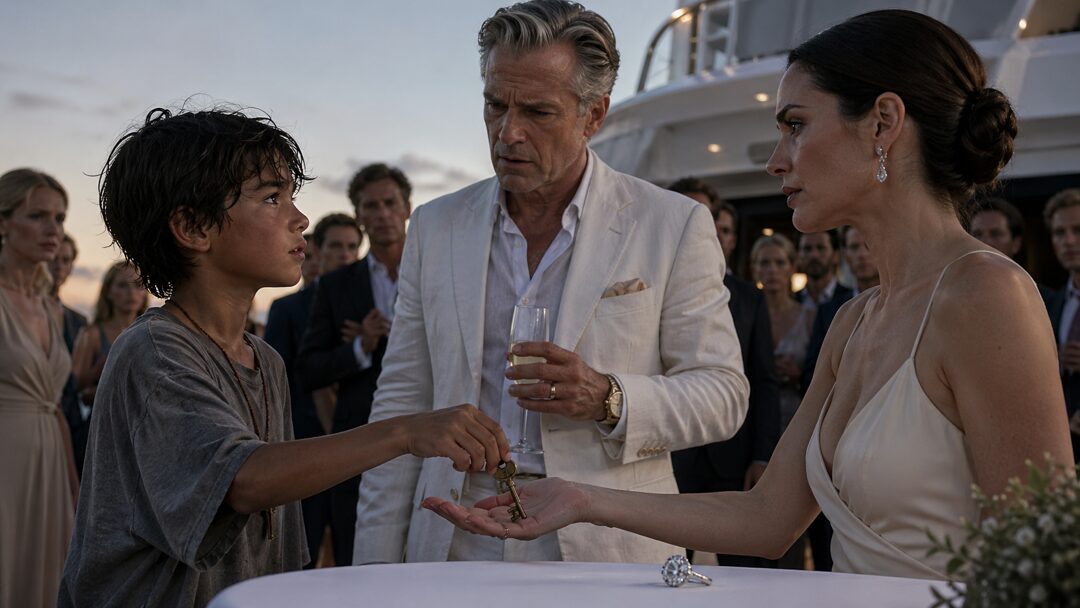
Jonah reached the table and set the key down.
It landed beside Celeste’s engagement ring, which she had removed for a moment to accept a toast and set on the linen next to her glass.
Brass beside diamond.
Old beside new.
Truth beside arrangement.
Every eye found it.
Grant did not move.
His face went pale in a way no smile could cover.
Celeste looked first at the key, then at Grant’s hand. His fingers had tightened so hard around the stem of his champagne glass that his knuckles had gone white.
“What is that?” she asked.
Grant inhaled.
“A misunderstanding.”
Jonah laughed once.
It came out ugly. Too adult for his own mouth.
“My mom died with that misunderstanding under her pillow.”
A woman near the table gasped. Someone whispered, “Who is this child?”
Celeste did not look away from Grant.
“What is the key?” she asked.
Grant’s voice dropped. “This is not the place.”
“That is not an answer.”
“It’s a private matter.”
Jonah reached for the key, but Grant caught his wrist.
Not hard enough to bruise.
Just hard enough to remind him who could.
The deck went very quiet.
Grant seemed to realize what everyone had seen. He released Jonah at once.
“Come with me,” Grant said softly. “Let’s not make this worse.”
“For who?” Jonah asked.
Grant’s eyes sharpened.
Celeste heard it.
So did Elias, who had reached the top of the stairs and stopped as if he had arrived at his own sentencing.
Grant put one hand lightly on Jonah’s shoulder and guided him toward the corridor. To the guests, it looked almost tender. A rich man helping a troubled boy.
Jonah knew better.
Kindness could be a hand on your shoulder that told you not to scream.
Inside the private passage, away from the music and flowers, Grant shut the door.
His smile disappeared.
He did not yell.
That was the frightening part.
“You’re grieving,” he said. “I understand that. Your mother had a hard life, and I’m sorry for it.”
“You knew her.”
“Everyone knew your mother.”
It was an answer designed to leave no fingerprints.
“Did you know she was sick?”
Grant looked at him then.
A flicker. Real pain, maybe. Or guilt doing an impression of it.
“I knew late.”
“You knew enough.”
Grant slipped one hand into his jacket and took out a card. Heavy paper. Embossed name. Phone number in black.
“I can help you,” he said. “Tuition. Housing. Whatever medical debt remains. You shouldn’t have to carry adult problems.”
“My mom’s dead.”
“Yes.”
“So medical debt is a weird thing to offer.”
Grant’s expression tightened.
Jonah did not know where the courage was coming from. Maybe from hunger. Maybe from fury. Maybe from the fact that there was no mother left to drag him away before people hurt him.
Grant crouched so they were eye level.
“Listen carefully. There are rooms you do not want to open. Not because you’re wrong. Because the truth does not feed you. It does not protect you. It does not bring her back.”
Jonah stared at him.
“That’s what rich people say when the truth protects them.”
For the first time, Grant looked wounded.
Not defeated.
Wounded.
As if Jonah had spoken in a voice he recognized.
The corridor door opened.
Celeste stood there.
Behind her, Elias.
Grant straightened.
“Celeste,” he said. “Please.”
She stepped inside and closed the door behind them.
No music reached them now.
Only the faint sound of water hitting the hull.
“Tell me what he has,” she said.
Grant rubbed a hand over his mouth.
“Not like this.”
“Then like what?”
He did not answer.
Elias did.
“The key belonged to The Maribel.”
Grant turned on him. “Don’t.”
Elias looked older than he had ten minutes before.
“Mara kept it.”
Celeste’s eyes moved between them.
“Mara Reyes?”
Grant said nothing.
Elias’s voice roughened.
“She worked the old yard. Lived aboard The Maribel. She was with Grant first.”
Celeste turned to Grant.
It was not jealousy yet.
It was humiliation arriving early, before the full pain.
Grant’s jaw clenched. “It was years before you.”
“And after?” Celeste asked.
Elias answered again.
“After, she was with me.”
Jonah stopped breathing.
The corridor seemed to narrow.
Elias looked at him then, and whatever he had been hiding cracked open enough for Jonah to see the shape of it.
“Mara was my family,” Elias said. “Before I had the courage to say it where anyone could hear.”
Grant’s face hardened.
“You don’t get to rewrite yourself as brave now.”
“No,” Elias said. “I don’t.”
Celeste’s voice came out low.
“And the boy?”
No one spoke.
Jonah looked at Grant first.
Then Elias.
That was the mistake all of them had let him make.
Elias stepped toward him, but Jonah stepped back.
“No,” Jonah said.
Elias’s eyes filled.
“Jonah—”
“No.”
The word was small. It still stopped him.
Grant exhaled as if a gun had misfired.
Celeste saw that too.
“Not Grant’s,” she said.
Elias shook his head.
“Mine.”
Jonah felt the floor move beneath him, though the yacht stayed still.
His whole life did not flash before him.
Only pieces.
His mother cutting his hair in the kitchen because salons were expensive.
His mother folding a man’s navy jacket into a box and saying some things were not trash just because they hurt.
His mother pausing whenever someone at the grocery store asked if Jonah looked like his father.
Captain Elias in a photograph, laughing with her beside an old white sailboat.
Not a stranger.
Never a stranger.
“You knew?” Jonah whispered.
Elias’s mouth opened.
Grant answered before him.
“We all knew enough.”
Celeste looked at Grant as if she no longer recognized the suit holding him together.
“What did your family do?”
Grant’s silence told the first truth.
Elias told the rest.
Part V — What Protection Cost
They did not tell it like a story.
Stories had beginnings people could trust.
This came out in broken pieces, each one worse because no one denied it.
Mara had worked at the old Whitmore boatyard before the club became private and clean and impossible to enter without a member card. She was twenty-four and sharp-mouthed and could repair a cracked hull faster than men who called her sweetheart.
Grant had wanted her when wanting her cost him nothing.
He took her sailing on The Maribel. Brought wine he did not drink. Promised things people like Grant could afford to mean only while alone.
Then his father began arranging a future.
Investors. A different fiancée. A family name polished for public use.
Mara disappeared from Grant’s evenings and reappeared in Elias’s days.
Elias loved her differently. Worse, maybe. More quietly. He helped fix the stove. Slept through storms on the narrow bench. Let her teach him how to live where nobody bowed.
When she became pregnant, Elias wanted to tell the family.
Mara did not.
Not because she was ashamed.
Because she knew them.
But the family found out anyway.
The Whitmores did not scream. They documented.
They cut Mara from payroll, bought out her mooring rights, and marked The Maribel for disposal. Grant signed off on the marina restructuring. Elias signed the termination addendum because his father said Mara would receive more severance if he did not make it ugly.
“I told myself I was protecting her,” Elias said.
Jonah stood very still.
People always said protection after the damage was done.
“What did she get?” Celeste asked.
Elias closed his eyes.
“Three months’ rent. A nondisclosure agreement she never honored because she never believed silence could be sold.”
Grant said, “It was more complicated than that.”
Celeste turned to him.
“You keep saying that as if complexity is innocence.”
Grant flinched.
Outside, someone knocked on the corridor door.
“Mr. Whitmore?” a staff member called. “Your father-in-law is asking if we should proceed.”
Grant looked relieved by the interruption.
That was when Celeste understood him.
He did love her. She saw that now, and it made everything worse. He loved her in the way men like him loved: sincerely, as long as love did not ask him to become smaller in public.
He reached for her hand.
She let him take it.
For one second, she hated herself for that.
“Celeste,” he said. “I should have told you. I know that.”
“Should have?”
“I was trying to protect our future.”
“Our future,” she repeated.
“Yes.”
“Or yours?”
He swallowed.
Her father opened the door without waiting.
Richard Vale entered with a smile that did not survive the room. He was a compact man in a pale gray suit, with eyes trained by decades of appraising land and people as if both could be rezoned.
He looked at Jonah last.
That told Jonah everything.
“Grant,” Richard said, “guests are noticing.”
“Give us a minute.”
“No. Minutes are what rumors use to grow teeth.” Richard glanced at Celeste. “Whatever this is, handle it after the announcement. We have signatures tomorrow.”
Celeste pulled her hand from Grant’s.
Richard’s eyes sharpened.
“Darling, not now.”
The words landed like a leash wrapped in velvet.
Jonah saw Celeste’s face change.
Not break.
Change.
Grant spoke quickly. “I’ll take care of it.”
Richard nodded toward Jonah. “The dock problem?”
Jonah’s ears went hot.
Not boy.
Not child.
Problem.
Elias stepped forward.
Grant lifted a hand. “Don’t.”
Richard looked at Elias with the mild contempt of a man who had learned family maps from bank documents.
“This is exactly why your brother runs the public side.”
Elias absorbed it.
Jonah saw he had practiced absorbing things.
Grant turned to Celeste. “Come back upstairs. Please. We can talk after.”
“After I stand beside you?”
“Yes.”
“After I smile?”
His eyes pleaded.
“Yes.”
“And if I ask you the truth upstairs?”
Grant’s voice softened.
“Please don’t turn pain into spectacle.”
Celeste stared at him.
There it was.
The sentence that dressed cowardice as tenderness.
She looked past Grant to Jonah.
He was twelve years old and standing barefoot in a corridor full of adults who had all found language for why his mother had to disappear.
Celeste removed her hand from her father’s reach.
“No,” she said. “Pain became spectacle when you invited two hundred people to applaud the boat that replaced her.”
Grant’s face went white.
Richard’s voice lowered. “Celeste.”
She did not look at him.
Above them, a bell chimed for the final toast.
The party was waiting.
So was the lie.
Part VI — The Toast
Grant returned to the deck because men like him knew how to survive damage: get to the microphone first.
He stood beneath the flowers with Celeste beside him, though she had not taken his arm. Elias stood at the edge of the crowd with Jonah. Security did not touch the boy now, but they watched him as if truth might run again.
The sunset had deepened. The yacht glowed white against the darkening bay.
Grant lifted his champagne glass.
“Thank you for your patience,” he said.
The crowd laughed lightly, grateful to be told the disturbance had a shape.
Grant smiled.
“Tonight has reminded me that legacy is not only about buildings, or vessels, or family names. It is about responsibility. There are people connected to this marina whose stories deserve care.”
Celeste turned her head slowly.
Grant did not look at her.
“In honor of Mara Reyes,” he continued, voice warm, devastatingly steady, “a former member of our marina community, the Whitmore Foundation will establish a scholarship fund for local children affected by redevelopment.”
The guests softened.
That was the worst part.
They liked him more for it.
A dead woman had become a sentence he could use.
Jonah moved before Elias could stop him.
Small bodies pass through crowds differently. Adults hesitate to block them when cameras are out.
He reached the front as the applause began.
“No,” Jonah said.
It was not loud enough.
So he said it again.
“No.”
The applause thinned.
Grant kept smiling.
“Jonah,” he said gently, “this is for your mother.”
Jonah climbed onto the lowest step of the platform. He took the key from his neck and held it in his fist.
“My mother said this key belonged to the person brave enough to open the door.”
He turned and walked to Celeste.
Grant’s smile finally died.
“Jonah,” he warned.
The boy placed the key in Celeste’s palm.
Her hand closed around it.
The diamond on her ring flashed from where it sat again on her finger, heavy and cold.
Celeste looked at the key, then at Grant.
“What door,” she asked, clear enough for the nearest microphone to catch, “did you lock her behind?”
The whole deck heard it.
A sound went through the guests. Not a gasp exactly. A shifting. The sound of people realizing they might be standing on the wrong side of a story.
Grant lowered his glass.
“Celeste.”
“No,” she said. “Answer him. Answer me.”
Elias stepped forward.
His face looked like a man walking into weather he had spent years watching from shore.
“Mara Reyes was not a community member,” Elias said.
Grant turned. “Elias, stop.”
Elias did not stop.
“She was my partner. She lived on The Maribel with me. Jonah is my son.”
The words did not explode.
They sank.
That was worse.
Jonah felt them go into the deck, the tables, the flowers, the phones lifted in manicured hands.
My son.
He had wanted the truth.
He had not known truth could arrive like a wound reopening in public.
Elias looked at him, but Jonah stared at the floor.
Grant set his glass on the table too hard.
“This family made mistakes,” Grant said, voice clipped now. “But everything done then was done to protect people from scandal and instability.”
Celeste let out a sound that was almost a laugh.
“Protect who?”
Grant looked at her.
Really looked.
For one naked second, the crowd vanished from his face, and she saw the man she had agreed to marry: frightened, proud, in love with her, and still choosing the room.
“Us,” he said.
That was his confession.
Not the whole truth.
Enough of it.
Celeste slid the engagement ring from her finger.
Grant reached for her.
“Don’t.”
She set the ring on the white tablecloth beside the brass key.
Diamond beside brass.
Future beside past.
A love bought bright beside a truth kept dull.
“I won’t be another door,” she said.
Grant’s hand moved too quickly then. Not to hurt her. To stop her leaving. To catch what was already gone.
His fingers struck the champagne flute.
It tipped.
For half a second, the glass flashed gold with sunset.
Then it hit the deck and shattered.
The sound was small.
Everyone heard it.
Celeste stepped around the broken glass.
Her father said her name.
She kept walking.
No speech.
No tears for the crowd.
Just a woman in cream leaving a white yacht while two powerful families watched their future go with her.
Jonah looked at the key on the table.
Elias picked it up and offered it to him.
Jonah did not take it.
“Not yet,” Jonah said.
And for once, Elias obeyed.
Part VII — What the Key Opened
By dawn, the flowers were coming down.
Workers moved quietly along the dock, stripping garlands from railings, folding chairs, sweeping glass from the deck of Maribel II. The yacht no longer looked like a dream. In morning light, it was only expensive.
Jonah sat on an overturned crate outside the old storage shed at the edge of the boatyard.
No one had asked him where he slept last night.
Maybe they were afraid of the answer.
Elias stood a few feet away with the key in his open palm.
He had not slept either. His navy blazer hung over one arm now. Without it, he looked less like a captain and more like a man who had been waiting twelve years to be judged by a child.
“This was salvaged before they scrapped her,” Elias said.
The shed door was warped, paint peeling in long curls. Behind it, set upright against the back wall, was a smaller door. White once, now yellowed. A brass lock sat below a porthole clouded with age.
The cabin door.
The Maribel had not survived.
But this had.
Jonah stepped closer.
His mother’s last weeks had smelled like antiseptic, orange peel, and the sea salt she kept in a jar because she said hospitals forgot what air was supposed to taste like. On the last clear day, she had pressed the key into his hand.
Don’t let them make me into nobody.
At the time, Jonah thought she meant Grant.
Now he knew she had meant all of them.
Elias held out the key.
Jonah took it.
Their fingers did not touch.
The lock resisted at first. Then turned.
The sound was plain. Metal answering metal.
Inside the small salvaged cabin space were boxes wrapped in canvas. Elias lifted the first one down, but Jonah opened it.
Not Elias.
Jonah.
The top held logbooks, their covers swollen from damp. Beneath them were photographs. Mara on the deck of The Maribel, hair blown wild. Mara painting blue curtains. Mara holding a chipped mug with both hands. Elias younger, asleep beside a toolbox. A red scarf tied to the rail.
At the bottom was a stack of letters folded but never mailed.
Jonah saw his name on one.
Not written after he was born.
Before.
For Jonah, when he is old enough to ask why the sea kept secrets.
He sat down on the shed floor.
Elias stayed standing.
Good, Jonah thought.
Let him stand.
Outside, the marina woke in pieces. Engines coughed. Gulls screamed over the dumpsters. Somewhere on the yacht club lawn, someone laughed too loudly while pretending nothing had changed.
Jonah unfolded the letter.
His mother’s handwriting leaned hard to the right, impatient even on paper.
You were wanted before you had a name.
Jonah stopped there.
The words blurred.
He pressed the page flat with both hands, angry at tears for making anything harder to read.
Elias took one step toward him, then stopped himself.
For that, Jonah was almost grateful.
Almost.
After a while, Jonah gathered the logbooks into one box and the photographs into another. Elias reached for the heavier one.
Jonah pulled it back.
Elias lowered his hand.
They stood facing each other in the little shed full of proof.
“I’m sorry,” Elias said.
Jonah looked at him.
The words were too small. Elias seemed to know it.
“I know,” he added. “That doesn’t fix anything.”
“No,” Jonah said.
Elias nodded once.
Jonah looked down at the box.
Then he pushed the heavier one toward him.
“You can carry that.”
Elias’s breath caught.
It was not forgiveness.
Jonah hoped he understood that.
They walked out together as the sun lifted over the bay. The old dock boards were damp beneath Jonah’s bare feet. Across the marina, workers removed the last white flowers from the yacht’s railing and dropped them into black trash bags.
The key hung around Jonah’s neck again.
It was heavier now.
Not because of what it opened.
Because of what it proved.
At the end of the dock, Elias slowed, waiting for Jonah to walk beside him.
Jonah did not.
Not yet.
He walked a few steps ahead, carrying his mother’s letters into the morning, while behind him the man who should have claimed him years ago carried the weight he was finally allowed to hold.