The Sound Inside the Metal
The Sound Inside the Metal
Part I — What the Noise Meant
By the time the man in the black suit started running toward him across the tarmac, Ren had already decided he would not move.
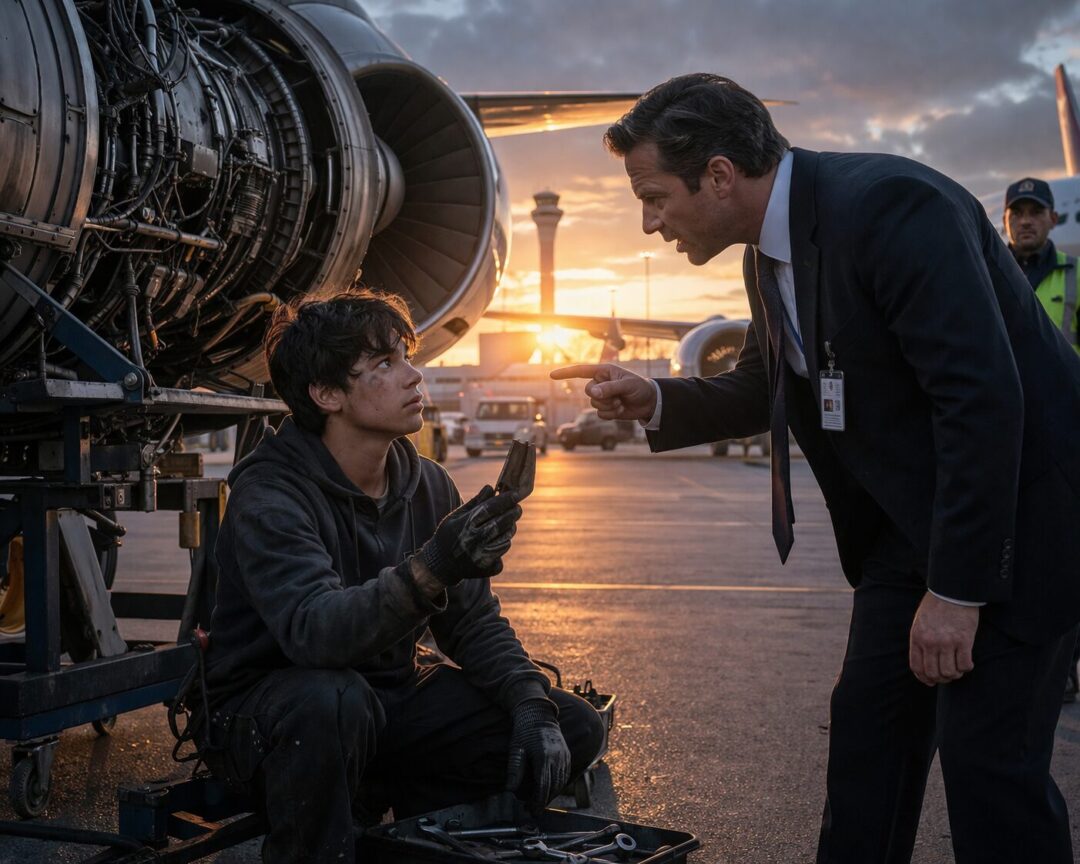
The sunrise over the airport came in thin bands of orange and pale gold, flattening the giant runway into long strips of light. Everything looked calm from a distance. From where Ren crouched beside the detached jet engine, nothing felt calm at all.
The machine sat on a low transport stand like some wounded animal pulled out of the sky and forced open under the morning air. Its metal skin still held the cold of the night. Ren’s gloved fingers were blackened with grease. There was a crack in the part resting in his palm, so fine that in dim light it disappeared. But once the sun caught it, it flashed like a knife line.
He heard the footsteps before he looked up.
Then the voice came, hard and furious, carrying over the wide empty apron.
“Who let you in here?”
Ren did not answer.
He knew that tone. He had known versions of it his whole life. Teachers who mistook silence for stupidity. Security guards who saw his secondhand clothes before they saw his face. Men who thought expertise had a uniform and an ID card clipped to a pressed shirt.
He rotated the damaged component slowly toward the light.
Behind him, the voice came closer.
“Step away. Now.”
Still Ren did not move.
It would have been easier to stand up and explain. Easier to raise both hands, apologize, say he was leaving. Easier to become harmless.
But harmless was how people kept missing things.
He had learned that from his father.
Years ago, before his father’s lungs gave out and before the hospital bills swallowed everything that hadn’t already been eaten by bad luck, there had been evenings in a one-room apartment where old radio parts, fans, broken drills, and discarded engine pieces lay spread across the kitchen table. His father never called it teaching. He simply fixed things with Ren nearby, and Ren learned the way children learn weather—by living inside it.
Listen first, his father used to say. A machine tells on itself before it breaks.
At ten, Ren could hear when the neighbor’s refrigerator compressor was failing.
At twelve, he could tell from the hallway when the mechanic downstairs had mounted a bent fan blade.
At fifteen, he could tell his father was getting worse from the sound of his breathing through the bedroom wall.
Some sounds stayed with you even after the people were gone.
Two days earlier, Ren had been outside the maintenance fence with a backpack full of bread and bottled water he was delivering to a friend working a dawn shift. He should never have been close enough to hear anything at all, but when the engine test cycle started, he froze in place.
The note had been wrong.
Not loud. Not dramatic. Just wrong.
A faint metallic irregularity under the main roar—something ticking where there should have been smooth force. Not constant. Intermittent. The kind of flaw most people ignored because it hid behind bigger sounds.
He had stood there until his friend came back and laughed at him for staring at the aircraft like it was speaking.
Maybe it was, Ren had thought.
He returned the next morning before sunrise and watched from farther off. He waited through the bustle of the first crews, through equipment carts and fuel checks and clipped conversations he wasn’t supposed to hear. He shouldn’t have made it onto the apron. He knew that. But airports, like most systems built by tired people, had seams.
And once he got close enough to the detached engine sitting alone on its stand, the uneasy certainty in his chest hardened into something worse.
He knew this sound.
Not from an aircraft. From his father’s hands holding a worn bearing housing under a naked bulb, telling him that tiny fractures killed big machines because pride always made people hear what they expected instead of what was there.
So Ren had crouched by the engine before dawn, pulse hammering, hands shaking once and then not at all.
Now the airport executive—because that was what the man in the suit clearly was—was almost on top of him.
Ren could feel the pressure of it before he felt the shadow.
He finally lifted his head.
The man looming over him was in his forties, maybe older, his hair clipped short and neat, gray threading the temples. His suit was too precise for the hour. Even his anger looked expensive. A visible badge flashed near his jacket, unreadable in the glare. Two maintenance workers had stopped behind him, far enough back to stay out of the center of the confrontation, close enough to witness it.
That, Ren thought, was the worst part.
People were always crueler when they had an audience.
The man pointed at the engine, then at Ren, as if the logic were self-evident.
“You don’t touch equipment on my apron.”
My apron. My authority. My judgment.
Ren saw all of it before the man said another word.
He also saw something else.
The man had not really looked at the part in Ren’s hand yet.
He had only looked at Ren.
So Ren lifted the damaged component between them and said, very quietly, “Then stop the flight.”
For the first time since he had started shouting, the man fell silent.
The sunrise wind moved across the open space between them. Somewhere far off, another engine coughed to life. The workers behind the suited man shifted, unsure whether to step in or vanish.
The silence widened.
And in that silence, for the first time, the man’s eyes left Ren’s face and dropped to the metal in his hand.
Part II — The Boy Beside the Engine
The crack was small enough to be denied.
That was what frightened Ren most.
Big damage made people act. Smoke, sparks, alarms—those were democratic. Anyone could understand them. But hairline fractures? Strange vibrations? Wrong notes under noise? Those belonged to a smaller, lonelier category of truth. The kind that demanded humility before they demanded urgency.
The man in the suit—his badge later told Ren his name was Callum Mercer—did not yet look humble.
He held out a hand. “Give me that.”
Ren tightened his grip instinctively.
Mercer’s jaw hardened.
The two men behind him took a half step forward, then stopped when Mercer lifted a hand without looking back. Even in anger, he wanted control more than chaos. Ren noticed details easily when he was afraid; it was one of the few advantages fear gave him.
Mercer crouched just enough to inspect the part without fully lowering himself into Ren’s world.
“What did you do?” he asked.
Ren looked at the open section of the engine casing, then back at him. “I took it out.”
Mercer’s face darkened.
For one terrible second, Ren thought he had lost him completely—that the man would only hear confession where there should have been warning.
Then Ren added, “It was already cracked.”
Something shifted.
Not belief. Not yet.
But a pause.
Mercer held out his hand again, less like a command this time and more like a demand from someone suddenly aware that he did not yet know enough.
Ren gave him the component.
Mercer turned it once, then twice. He looked at the edge where the fracture split the metal line. He looked back at the exposed section of the engine. He leaned closer. His immaculate trousers darkened at the knee when he went down another inch, then another.
One of the maintenance workers behind him breathed, “Sir—”
Mercer cut him off with a look.
The airport around them continued moving. Carts rolled in the distance. A service truck passed behind another aircraft. The sunrise widened and sharpened the world. But right there, around the detached engine and the teenage boy beside it, time drew inward.
Mercer held the part near the opening where it had come from.
The fit was exact.
Not theatrical. Not miraculous. Worse than that.
Plausible.
His expression changed so subtly that another person might have missed it. Ren did not. The anger didn’t vanish. It thinned. Under it, something rawer surfaced—calculation, shock, the first flicker of professional fear.
“How did you get this out?” Mercer asked.
“With a pry tool from the tray.” Ren nodded toward the cart. “It was already loose.”
Mercer followed his glance. The tool was there. Grease-streaked. Real.
The two silent workers were no longer looking at Ren as if he were trespassing trash. They were looking at Mercer.
That, more than anything, altered the shape of the morning.
Power disliked witnesses when power might be wrong.
Mercer studied the housing again. “Who are you?”
A simple question, but Ren felt it strike somewhere old and bruised inside him.
Who was he?
The answer changed depending on who was asking.
To the landlord, he was the late tenant’s son who was always one missed payment away from losing the room.
To school administrators, he was a quiet scholarship kid whose attendance had become “inconsistent” after his father got sick.
To the grocery clerk near his building, he was the boy who counted coins twice before buying batteries.
To people with uniforms and offices and easy certainty, he was usually a problem before he was a person.
So he answered the practical version.
“No one,” he said.
Mercer stared at him.
The words landed harder than Ren intended. He hadn’t meant them as self-pity. Only accuracy.
Mercer glanced at the component again. Then at Ren’s gloves. The grease on his cheek. The worn hoodie. The thinness in his wrists. The exhaustion beneath his eyes.
For the first time, Ren saw the man actually taking him in.
Not as an intruder.
As evidence.
There was danger in that too.
Mercer lowered himself into a full crouch at last. The gesture was small in theory. In practice, it changed the entire scene. He was no longer towering over the boy. He was beside him, in the cold wind, with metal between them and the morning opening across the tarmac.
The silence that followed felt different now.
Not punishment.
Consideration.
“How did you see that?” Mercer asked.
His voice had changed. Less edge. More weight.
Ren looked at the engine, then out toward the runway, where the light now glinted off distant aluminum skin.
“I didn’t,” he said.
Mercer frowned, not understanding.
Ren swallowed once. His throat felt dry. He had not slept much. He had not eaten since the night before. It suddenly seemed absurd that this entire airport, this giant organized machine of wealth and schedules and authority, had been rearranged for a moment by a boy who had climbed through a maintenance gap before dawn because a sound would not let him rest.
Then he said the truest thing he knew.
“You could hear it.”
Mercer did not move.
One of the workers behind him let out a breath, almost a laugh, almost disbelief, then seemed ashamed of the sound. The other man looked from the engine to Ren with a new, unsettled respect.
Mercer’s eyes remained on Ren.
It was not a heroic moment. Not in the way stories usually preferred. No music swelled. No one apologized cleanly. No crowd turned and clapped. Airports did not pause for revelation. They adjusted and kept moving.
But something undeniable had happened.
A man who had arrived certain of the hierarchy now had to inhabit a different truth.
This boy, this nobody in the worn hoodie, had heard what trained professionals had not.
And Mercer knew exactly how much that could cost if the flight had gone out.
He rose abruptly and barked orders behind him—fast, technical, efficient now, no longer performative. The workers scattered into motion. Radios came alive. Somewhere beyond Ren’s sightline, a chain reaction began.
Stop the flight.
Check the assembly.
Confirm the inspection trail.
Call the crew chief.
The airport’s machine had finally heard the warning.
Ren stayed crouched where he was for a few seconds longer, all his certainty draining out of him now that it no longer had to hold him upright. His hands had begun to tremble. His heart, which had behaved so well under accusation, had chosen this moment to turn wild.
Mercer looked back.
“Don’t go anywhere.”
It should have sounded like another command. It almost did.
But not quite.
Part III — What Men Miss
They kept him in a small operations room just off the maintenance corridor.
The coffee inside had gone bitter on the hot plate. Fluorescent lights hummed overhead. A glass wall looked out toward service vehicles and anonymous pieces of ground equipment. Somewhere nearby, telephones rang with the sharp, irritated rhythm of expensive disruptions.
Mercer had assigned someone to sit outside the door, though whether that was to guard Ren or protect him from everyone else, Ren could not tell.
He sat on the edge of a chair with his hands between his knees and tried not to look as tired as he felt.
The adrenaline was gone now, leaving only the ache beneath it.
The morning unfolded in fragments.
Two engineers came in and asked careful questions with the clipped precision of people trying not to expose how alarmed they really were. Where had he first heard it? What kind of irregularity? Had he touched anything else? Did he know what the part did?
Ren answered what he could.
When he didn’t know, he said so.
That seemed to impress them more than guessing would have.
Mercer was in and out of the room, carrying a pressure that reached ahead of him before he entered. Each time he returned, his face looked less angry and more tired. Once, Ren heard him through the partly open door speaking to someone in a voice stripped of all ceremony.
“No. I don’t care what the paperwork says. Check the whole line.”
Hours passed.
Someone brought Ren water. Later, a paper-wrapped sandwich.
He stared at it for a long moment before eating, embarrassed by how fast hunger overtook caution.
Near noon, Mercer came in alone and shut the door behind him.
For a second neither of them spoke.
Without the open tarmac and the immediate threat of failure between them, they seemed to belong to entirely different worlds again. Mercer, in his precise suit and polished shoes. Ren, in a borrowed room of fluorescent light, hoodie sleeves smudged black at the cuffs.
Mercer sat across from him.
“They confirmed the fracture,” he said.
Ren nodded once.
“And the wear pattern around it.” Mercer looked at him with a strange, restrained expression. “If the aircraft had gone out…”
He didn’t finish.
He didn’t need to.
Ren lowered his eyes to the paper cup in his hands.
Mercer exhaled slowly. “You should never have been on that apron.”
“There wasn’t time to convince anyone.”
“That doesn’t make it acceptable.”
Ren looked up then. “But it made you listen.”
The words slipped out before he could stop them.
Mercer absorbed the hit without flinching.
That surprised Ren most of all.
After a long pause, Mercer said, “Yes.”
No defense. No polished correction. Just that.
Yes.
Something in Ren, wound tight since dawn, loosened by a fraction.
Mercer leaned back. “Your father worked on engines?”
Ren’s grip tightened around the cup. “How do you know?”
“Because nobody hears something like that by accident.”
It was close enough to understanding that Ren did not bother denying it.
“He fixed anything people brought him,” Ren said quietly. “Mostly small work. Fans. compressors. old motor parts. Sometimes aircraft salvage, when someone could get him pieces cheap.” He looked at the table. “He said machines start telling the truth before they fail.”
Mercer was silent for a moment.
Then: “Is that where you learned?”
Ren let out a breath that was almost a laugh. “Mostly by being in the way.”
A small change passed over Mercer’s face. Not quite a smile. More like grief recognizing itself in another form.
He nodded once.
Later, Ren would understand that men like Mercer built themselves out of certainty because the systems they managed punished hesitation. Airports, hospitals, bridges, power grids—those worlds survived on confidence, procedure, hierarchy. But confidence had a dangerous cousin, and his name was assumption.
That morning on the tarmac, Mercer had looked at Ren and seen violation before he saw warning.
The worst part was that he had not been uniquely cruel.
He had only been ordinary.
By midafternoon, the consequences of the fracture had become official enough to be spoken aloud. The flight had been delayed. An internal review had begun. A crew chief had gone pale. Someone higher up wanted written timelines.
Mercer asked Ren for his full name at last.
“Ren Sato.”
He wrote it down carefully, as though it deserved care.
There were calls after that. Conversations. One with someone from airport security. One with a school administrator Mercer somehow reached before sunset. One with a mechanic training coordinator who came in skeptical and left curious.
Ren moved through the hours in a blur.
Nothing transformed all at once. There was no magical rescue waiting on the other side of being right. His rent was still overdue. His father was still gone. His life did not suddenly become easier because, for one morning, truth had beaten status in a race against time.
But doors, Ren learned, did not always open with drama.
Sometimes they unlocked one click at a time.
Part IV — The Thing That Changed
A week later, Ren stood in the same airport at almost the same hour.
The sunrise was thinner that morning, more silver than gold. The apron smelled of fuel and cold air. The detached engine was gone. The space where it had sat looked oddly blank, as if the morning itself had been edited.
He had been given a temporary visitor pass this time. The laminated badge hanging against his chest looked absurd on him. He kept touching it, not from pride but disbelief.
Mercer met him near a side entrance in shirtsleeves instead of a suit. He still carried authority the way some men carried height—it altered the air around them—but something in him had shifted. He no longer spoke to Ren as if the boy were a disruption requiring management.
He spoke as if Ren were already inside the conversation.
“The apprenticeship won’t solve everything,” Mercer said as they walked. “It’s part-time to start. Paid. Training hours built around school, if you go back.”
If you go back.
Mercer did not say when. He had learned, maybe, that people had whole wars happening offstage.
Ren kept his eyes forward. “Why are you doing this?”
Mercer was quiet for a few steps.
Then he said, “Because I almost sent a plane into the air while shouting at the person trying to stop me.”
The honesty of it made Ren glance over.
Mercer did not look away.
“And,” he added, “because talent is wasted every day for reasons that have nothing to do with talent.”
They reached a hangar threshold. Inside, mechanics were already moving under bright lights, tools flashing in deliberate hands. Voices overlapped. Machines waited in pieces to be understood.
Ren stood there a moment longer than necessary.
This, more than the operations room or the investigations or the formal words in emails someone had read aloud to him, felt like the actual turning point.
Not vindication.
Entry.
Mercer gestured him forward.
Ren hesitated only once. In the glass panel beside the hangar door, he caught his reflection—hoodie replaced by a plain work jacket too big in the shoulders, badge clipped crooked, hair still impossible, face still too young and too tired.
Not transformed.
Just seen.
He stepped inside.
Later, much later, after long days of work and study and mistakes and stubborn, hard-earned progress, there would be stories told about that morning. The executive who had stopped a flight. The hidden fracture. The boy who heard what others missed. People liked stories once the danger had passed. They polished them until the edges shone.
But the part Ren kept was smaller.
A sunrise. Cold metal in his hand. A man who came running in fury and left having learned to listen.
And one sentence, simple enough to sound like nothing, strong enough to change the course of a life.
You could hear it.
Years afterward, whenever Ren stood beside a machine and heard the first wrong note under the noise, he still thought of his father’s hands under that dim kitchen bulb. He thought of all the things people dismissed because they arrived in the wrong voice, the wrong clothes, the wrong age, the wrong body. He thought of how often the world confused authority with attention.
Then he listened harder.
Because some truths never shouted.
They only asked whether anyone was humble enough to hear them.