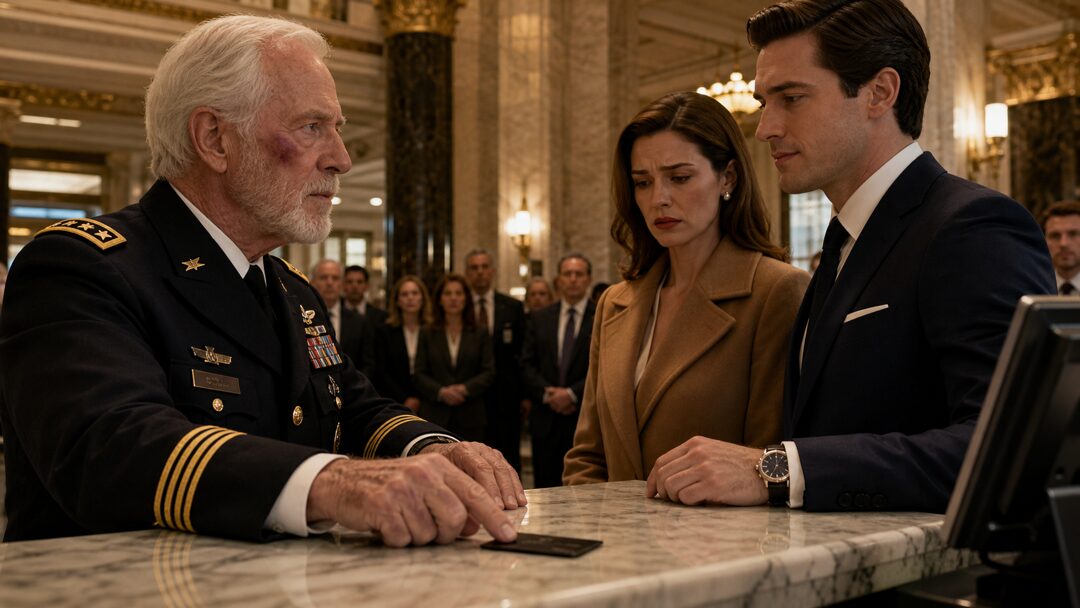
The Black Card on the Marble Counter
Part I — The Man They Asked to Leave
Robert Miller did not wait in line.
He came through the brass doors of Hamilton Trust wearing his old dress uniform, the one he had not worn since his wife’s funeral, with his medals pinned over a heart that had learned to keep beating after too many things were taken from it. His left cheek was bruised dark under the eye. His white beard had been trimmed with care, but one ribbon sat crooked because his hands had shaken in the cab.
The lobby went quiet before anyone told it to.
Robert walked past the leather chairs, past the flower arrangement large enough to feed a neighborhood, past a woman in pearls who pulled her purse closer when she saw the bruise. He stopped at the marble counter and placed a black card flat against it.
Not dropped.
Not tossed.
Placed.
Then he looked at the young teller and said, loud enough for the private offices to hear, “Get Daniel Carter.”
The teller blinked.
The card looked almost unreal under the bank lights. Matte black. No numbers on the front. Only a small silver crest and Robert’s name etched so faintly it seemed to appear only when the light shifted.
“Sir,” the teller said carefully, “do you have an appointment?”
“I have a deadline.”
“Mr. Carter is with a client.”
Robert pressed two fingers onto the card.
“Then interrupt him.”
The teller glanced at his uniform, then at the bruise, then at the security guard near the door. That glance traveled through Robert’s body like a familiar cold. He had seen it in airports, hospitals, restaurants, the grocery store when his hands forgot how to hold a carton steady. The look that said old man before it said veteran. Problem before person.
“I can help you with standard transactions,” the teller said.
“This isn’t standard.”
“Sir, if this is about a declined withdrawal—”
Robert leaned closer.
“This is about six men losing beds tonight because your bank froze money that does not belong to your branch director.”
A murmur passed through the lobby.
The teller stiffened. “Please lower your voice.”
Robert almost laughed. It came out as breath.
All his life people had asked him to lower something. Lower his weapon. Lower his expectations. Lower his grief into something easier to sit beside at dinner. Lower his voice when the truth made a room uncomfortable.
He straightened instead.
“Daniel Carter,” he said again.
The private office doors opened.
Daniel appeared with the calm of a man who had been expecting a mess and was pleased to find it on schedule. Navy suit. Smooth hair. White shirt. No tie, because men like Daniel believed removing one formal detail made them look approachable. His watch caught the light as he adjusted his cuff.
He did not look surprised to see Robert.
That was the first thing Robert hated.
Not the smile. Not the way Daniel scanned the lobby before looking at him. Not even the soft sigh, performed just loudly enough for the closest clients to hear.
It was that he had known.
Daniel crossed the polished floor with a kindness that had teeth.
“Robert,” he said. “You know Emily asked us not to let you upset yourself.”
There it was.
Not Mr. Miller.
Not Dad.
Robert.
The name landed in the lobby like a diagnosis.
The teller stepped back as if the situation had suddenly found its owner. Daniel rested one hand on the counter, keeping a careful distance from the black card.
Robert looked at his son-in-law and saw, not for the first time, the man Emily had mistaken for safety.
“Run the card,” Robert said.
Daniel’s smile tightened by one thread.
“I’m not going to embarrass you.”
“You already started.”
A man waiting near the investment desk turned his head. A woman stopped pretending to read the brochure in her hand.
Daniel lowered his voice. “This is not the way to handle this.”
Robert looked around at the white marble, the glass offices, the framed photographs of scholarship recipients and charity galas and veterans’ appreciation breakfasts.
“No,” he said. “This is exactly the place.”
Daniel’s eyes flicked briefly to the bruise.
“Did you fall again?”
Robert felt the room absorb that word.
Again.
A soft word. A useful word. A word that planted a story without having to prove it.
The truth was uglier and smaller. He had not fallen. He had slipped on the front step after sleeping two hours in his truck outside a shelter office because his debit cards stopped working and his daughter would not answer the phone. He had hit the rail hard enough to split the skin beneath his eye.
But Daniel did not need truth.
He needed shape.
Old man. Grief. Confusion. Fall.
Robert put his palm over the black card.
“Run it.”
Daniel glanced toward security and gave the smallest nod.
The guard did not move closer, not exactly.
But he stopped leaning against the wall.
Robert saw it.
So did everyone else.
Part II — Concern, Properly Dressed
Daniel had always known how to make cruelty sound like responsibility.
The first time Robert noticed it was at Emily’s wedding, three years earlier, when Daniel had touched the small of Emily’s back and told a guest, “She gets emotional about her mother, so I keep an eye on her.” He had said it smiling. Emily had smiled too, because people in expensive rooms trained themselves to accept possession as care when it came with a good suit.
Back then, Robert told himself he was being unfair.
A widower could be suspicious of any man who carried his daughter away.
Now Daniel stood across the counter inside Hamilton Trust, and Robert knew suspicion had been the part of him still trying to be polite.
“Let’s go into my office,” Daniel said.
“No.”
“Robert.”
“Run the card.”
Daniel’s mouth softened. “The account is under review.”
“The foundation account.”
“Yes.”
“Elizabeth’s foundation.”
Daniel’s eyes cooled at the mention of Robert’s wife. “The Miller Veterans Housing Foundation has been flagged for protective review after concerns from family.”
Family.
Robert looked toward the brass doors.
Emily was not there yet, but her absence was already in the room.
“What concerns?” Robert asked.
Daniel gave him the look he gave difficult clients, patient and faintly wounded. “This is exactly why I don’t want to discuss it publicly.”
“Because it’s private?”
“Because it’s painful.”
“For whom?”
Daniel leaned in. “For your daughter.”
Robert’s hand curled against the marble.
The old instinct rose in him, fast and dangerous. Not violence. Something older. The need to stand between his child and whatever had frightened her. Even now. Even after three months of missed calls, clipped texts, and one voicemail in which Emily said, Dad, please just let Daniel handle this.
Daniel knew that instinct. He used it like a key.
“She’s worried,” Daniel said. “We all are.”
Robert looked at the staff pretending not to listen.
“We?”
Daniel’s smile returned. “People who care about you.”
A laugh came from somewhere in Robert’s chest, dry as dust.
“If you cared about me, you wouldn’t have locked me out of my wife’s work.”
A young mother near the seating area shifted her sleeping child against her shoulder. Two men in suits paused by the elevators.
Daniel let the silence grow just long enough to make Robert look loud inside it.
Then he said, gently, “You’re wearing a military uniform in a bank lobby, demanding access to a restricted account, and you appear to be injured.”
Robert held his eyes.
“Say what you mean.”
“I mean you need help.”
“No. You mean you need witnesses.”
For the first time, Daniel’s expression cracked.
Only slightly.
Enough.
Robert saw the man under the polish, the man who had spent years learning that if he stood in the right room with the right watch, people would hear authority even when he spoke lies.
Daniel picked up the black card between two fingers.
“Where did you get this?”
The question was almost perfect. Not Is this yours? Not May I see identification? Just enough suspicion to make the nearest teller glance down.
Robert’s voice went quiet.
“My wife handed me that card in this building twelve years ago. Karen Wells opened the account herself.”
That name changed the air.
Daniel’s fingers stilled.
Karen Wells was not a teller. She was not a branch manager. She was regional compliance, private clients, legacy accounts. The sort of woman whose signature could turn a locked door into a wall.
Daniel recovered quickly. “Karen isn’t in today.”
“Call her.”
“I’m not going to call a regional executive because you refuse to accept—”
“Call her.”
The front doors opened behind them.
Robert did not turn at first. He knew the sound of Emily’s heels before he saw her. Quick. Controlled. Trying not to run.
Daniel looked past him, and something tender came over his face.
It was not tenderness.
It was ownership rearranging itself for an audience.
“Emily,” he said softly.
Robert turned.
His daughter stood just inside the lobby in a camel coat, pearl earrings, and the pale face of a woman who had already chosen fear and was hoping nobody would make her name it.
“Dad,” she said.
Not Daddy. Not the way she used to say it when she came home from college and dropped her laundry in the hallway.
Dad.
Careful. Public. Thin.
Robert felt something in him step backward, though his boots did not move.
Emily’s eyes went to his cheek.
“Oh my God,” she whispered. “What happened?”
Daniel answered before Robert could.
“He’s been agitated.”
Robert looked at her.
Emily did not correct him.
That hurt more than the bruise.
Part III — The Signature
“Come home with me,” Emily said.
Her voice was low, but the lobby had already learned how to listen.
Robert watched her hands. She was twisting her wedding ring, one slow turn, then another. She had done the same thing as a girl with the hem of her sweater when she had lied about breaking a vase.
“Home?” Robert asked.
“Dad, please.”
“Which home?”
She flinched.
Daniel stepped beside her, not touching, close enough to remind everyone she belonged under his shadow.
“Your house,” Emily said. “We can talk there.”
“You mean my house,” Robert said. “The house your mother paid off working night shifts at County General. The house you haven’t entered since Christmas because Daniel said grief was becoming my personality.”
Emily’s mouth opened.
Daniel’s hand found her back.
“There’s no need for that,” he said.
Robert looked at the hand.
Emily did not move away.
A small sound went through the room. Maybe someone inhaled. Maybe Robert imagined it. Public shame had a way of making even silence feel crowded.
He turned back to Daniel. “The grant closes at four.”
Daniel’s jaw tightened.
Emily looked confused. “What grant?”
Robert stared at her.
There it was. The second wound.
“You don’t know.”
“Dad—”
“You signed papers freezing the account, and you don’t know what the account was scheduled to pay?”
Daniel’s voice sharpened under the silk. “Robert, that is not accurate.”
Robert faced his daughter. “Four units opened at Mercer House. Transitional housing. Not shelters. Rooms with locks. Kitchens. A place a man can put his boots by the bed and know they’ll still be there in the morning.”
Emily swallowed.
“Three of them served,” Robert said. “One didn’t, but your mother said need didn’t have to prove itself with medals.”
He felt Elizabeth beside him then, not as memory exactly, but as pressure. His wife’s hand on his sleeve the day they opened the foundation account. Her voice: If we ever have enough, we make a door. Not a speech. A door.
The black card had been her idea.
“People respect a thing they don’t understand,” she had said, smiling as Karen Wells slid the card across the table. “Let them wonder.”
Now her card sat in Daniel’s hand.
Emily looked at her husband. “You said it was personal spending.”
Daniel sighed, hurt by the inconvenience of truth arriving too early.
“I said there were irregularities.”
“You said Dad was wiring money to people who were taking advantage of him.”
“He was moving large sums with no oversight.”
Robert stepped closer. “Foundation funds. For the grant.”
Daniel met his stare. “You were acting alone.”
“I am the trustee.”
“You are a grieving seventy-two-year-old man who has refused support.”
Robert smiled without warmth.
“There it is.”
Emily’s ring stopped turning.
Robert looked at her. “What did you sign?”
She went still.
Daniel said, “Emily, you don’t need to answer that here.”
Robert did not look away from his daughter.
“What did you sign?”
Emily’s eyes filled, but no tears fell. Tears would have been easier. Tears would have given Robert somewhere to put his anger.
“It was a concern form,” she said.
The lobby blurred at the edges.
“A competency concern?”
Daniel exhaled. “It’s a standard protective measure.”
Robert nodded slowly.
He felt the war in his body then, the old training: assess damage, locate exits, keep breathing. The bullet is not the only thing that enters you. Sometimes it is a sentence your child says in a bank.
“You signed to say I couldn’t be trusted with my own mind.”
Emily’s face broke. “No. I signed because I was scared.”
“Of me?”
“No.”
“Then of what?”
She looked at Daniel.
That was answer enough.
Daniel’s voice came in smooth. “She was scared for you. You stopped sleeping. You stopped answering questions. You were giving money away after Elizabeth died.”
“Her name was Mom when you needed sympathy at the funeral,” Robert said.
Daniel’s eyes flashed.
Emily whispered, “Dad, please don’t.”
Robert heard the plea beneath the plea.
Don’t make this public.
Don’t make me choose.
Don’t make me see what I did.
He looked at his daughter, dressed in the life Daniel had built around her like a glass case. He remembered Emily at eight years old, standing on his boots to dance in the kitchen while Elizabeth laughed from the stove. He remembered promising both of them that he would always be a safe place.
He had not known a safe place could be signed away with a pen.
“Run the card,” Robert said.
Daniel gave a small, almost pitying smile.
“Fine.”
One word.
But Emily’s face went white.
Part IV — The Terminal
The private-client terminal sat behind a half wall of frosted glass, near Daniel’s office. It was not meant for the main lobby. It was meant for quiet transfers, old money, family trusts, discreet panic.
Daniel led the way as if he were granting mercy.
Robert followed.
So did half the room, without moving more than a few inches. Heads turned. Chairs creaked. Phones appeared low in laps. The security guard came closer now, trying to look casual and failing.
Emily walked beside Daniel.
Robert walked alone.
At the terminal, Daniel held the black card up between two fingers again.
“Before I do this,” he said, “I want everyone here to understand that verification may not produce the outcome Robert expects.”
Robert said nothing.
Daniel glanced at Emily. “If this creates more confusion, we will handle it privately.”
Robert looked at him.
“You’re very afraid of private things becoming public.”
Daniel inserted the card.
The machine accepted it with a soft mechanical pull.
The sound was small.
It moved through Robert like a door locking or unlocking. He could not tell which.
Daniel’s fingers moved over the keypad. Employee code. Branch authorization. Client verification. He knew the system well. That had always been the danger. Daniel did not break windows. He found doors and convinced people they were safer closed.
The screen asked for secondary confirmation.
Daniel turned. “PIN?”
Robert gave it.
Emily looked sharply at him.
It was Elizabeth’s birthday.
Daniel entered the numbers.
The terminal paused.
A spinning icon appeared.
For several seconds, nothing happened.
Daniel’s smile began to return.
Robert heard someone behind him whisper, “Is that his son?”
“No,” another voice whispered. “Son-in-law.”
Emily’s hand rose to her throat.
The terminal chirped.
Daniel looked down.
His smile did not vanish at once.
It loosened, as if the muscles forgot their arrangement.
Then his face changed in pieces.
First the eyes.
Then the mouth.
Then the color under his skin.
“What is it?” Emily asked.
Daniel did not answer.
Robert leaned forward enough to see the first lines.
HAMILTON TRUST LEGACY CLIENT
MILLER VETERANS HOUSING FOUNDATION
SOLE LIVING TRUSTEE: ROBERT A. MILLER
FOUNDING TIER: PROTECTED REVIEW REQUIRED
Beneath that, a red notification pulsed.
UNAUTHORIZED INTERNAL REVIEW ACTIVITY DETECTED
REVIEW INITIATED BY: D. CARTER
PROXY ROUTING ATTEMPT FLAGGED
The lobby had gone so quiet Robert could hear the air system.
Daniel’s hand moved toward the screen, not touching it, as if he could cover the words by wanting to.
Robert looked at Emily.
She had read enough.
“Daniel?” she said.
Her voice was not loud, but it cut cleanly.
Daniel withdrew the card from the machine. Too fast.
Robert held out his hand.
Daniel did not give it back.
“Daniel,” Robert said.
The young branch director looked at the card as if it had betrayed him.
Then he smiled.
It was the worst smile yet, because it had no confidence left and still tried to command the room.
“There appears to be a technical discrepancy.”
Robert almost admired him.
Almost.
“A discrepancy?”
“Yes. This needs to be reviewed internally.”
“It was reviewed internally. That’s the problem.”
Daniel stepped closer, lowering his voice. “Robert, you need to stop.”
“For your sake?”
“For Emily’s.”
Emily looked at him.
Daniel turned to her, softening instantly. “This can still be contained.”
Contained.
Robert saw the word enter her.
Emily had built three years around containment. Contain Dad’s grief. Contain Daniel’s temper. Contain the awkwardness at dinners when Daniel corrected her in front of friends and then kissed her temple as if that made it love. Contain the money questions. Contain the way he called her dramatic whenever she came too close to truth.
Containment had a cost.
Today it had Robert’s name on it.
“I want Karen Wells,” Robert said.
Daniel’s nostrils flared. “Karen is unavailable.”
A woman’s voice came from behind them.
“No, Daniel. I’m not.”
Everyone turned.
Karen Wells stood near the edge of the lobby in a gray suit, reading glasses in one hand and a phone in the other. She was not tall, but authority made space for her. The teller who had first spoken to Robert looked as if she wanted the marble to open under her.
Karen’s eyes moved from Robert’s uniform to his bruise, then to Daniel holding the black card.
Her expression did not change.
That was how Robert knew she understood exactly how bad it was.
“Mr. Miller,” she said. “I’m sorry I was late.”
Daniel recovered first. “Karen, this is being handled.”
She looked at him.
“Clearly.”
Robert held out his hand again.
This time, Daniel returned the card.
Not because he wanted to.
Because Karen was watching.
The black card slid back into Robert’s palm, cool and hard as a verdict.
Part V — Read It Aloud
Karen stepped behind the terminal.
Daniel moved to block her view by half an inch. It was a small act. Desperate men often revealed themselves by the size of what they tried to control.
“Daniel,” she said, “move.”
He moved.
Karen inserted her executive key and brought the record back up. Her face remained still, but one hand tightened around the edge of the terminal.
“Release the Mercer House transfer,” Robert said.
Karen glanced at him.
“The grant window closes at four.”
“I understand.”
Daniel said, “There are legal implications—”
Karen cut him off. “There are always legal implications when a branch director places a protected foundation account under competency review using a family petition connected to his own household.”
The words landed hard.
Emily made a sound like she had been struck.
Daniel turned toward her. “Emily, listen to me.”
She stepped back.
Only one step.
But it was the first one Robert had seen her take away from him.
Daniel noticed too.
His voice dropped into something private and sharp. “If this goes forward, your name is on it.”
Emily froze.
“There it is,” Robert said.
Daniel ignored him. “You signed because you agreed there were concerns.”
“You told me he was giving money to strangers.”
“He was.”
“Veterans,” Robert said.
Daniel’s eyes stayed on Emily. “You want everyone here to know you helped question your father’s competency? You want that in a compliance record? In a hearing? In court?”
Emily’s face drained.
Robert saw the hook go in.
Shame. Reputation. The marriage. The house in Westbrook with the white kitchen and the neighbors who drank wine on Thursdays. Daniel had built Emily a life where nothing ugly was allowed to remain visible. He had also taught her that if ugliness appeared, it was probably her fault.
Daniel reached for her hand.
“Let me protect you,” he said.
Emily looked down at his hand.
For one painful second, Robert thought she would take it.
Then she looked at the bruise beneath her father’s eye.
Not glanced.
Looked.
“Did you know his cards were cut off?” she asked Daniel.
Daniel’s face hardened. “That’s not relevant.”
“Did you know he slept in his truck last night?”
Robert closed his eyes.
He had not wanted that in the room.
Daniel said nothing.
Emily’s voice shook. “Did you know?”
Daniel’s silence answered.
Emily pressed one hand against her mouth. Not to cry. To keep from being sick.
Robert felt no triumph in it.
A father should not have to be witnessed broken before his daughter believes he was harmed.
Karen spoke into the quiet.
“Mr. Carter, I need you to read the initiating note into the record.”
Daniel stared at her. “Absolutely not.”
Robert said, “Read it.”
“This is confidential.”
“You made my humiliation public. The truth can stand in the same room.”
The line moved through the lobby. Robert saw it reach people. The mother with the child. The man by the elevators. The teller with wet eyes now.
Daniel looked around and understood too late that the room had changed sides.
He turned to Karen. “This is a personnel matter.”
“It became a client harm matter the moment you acted on the account,” Karen said. “Read the note, or I will.”
Daniel’s lips parted.
No sound came.
Emily looked at him with a face Robert had never seen on her before. Not anger. Not sorrow.
Recognition.
“Read it,” she said.
Daniel turned to her as if she had betrayed him.
Maybe she had.
Maybe betrayal was not always leaving the lie.
Sometimes betrayal was staying in it too long.
Daniel looked back at the screen.
His voice, when it came, was thin.
“Internal review initiated following competency concern submitted by family member Emily Carter.”
Emily flinched but did not look away.
Daniel continued. “Client activity indicates possible grief-related financial vulnerability. Recommend temporary hold on Miller Veterans Housing Foundation disbursement pending transfer of oversight authority to approved family proxy.”
Karen said, “Keep reading.”
Daniel swallowed.
“Suggested proxy: Emily Carter, with financial administration support from spouse Daniel Carter.”
The lobby seemed to lean in.
Robert heard Emily’s breath catch.
There it was.
Not concern.
A route.
Not protection.
A door Daniel had tried to build through Robert’s daughter.
Karen took over the terminal. “And the system flag?”
Daniel’s mouth tightened.
“Read it,” Robert said.
Daniel’s eyes lifted.
For one second, all the polish burned away. What remained was not a monster. That would have been easier. It was a frightened, ambitious man who had convinced himself that if he could manage the story, he owned the truth.
“Unauthorized,” Daniel said. “Conflict of interest. Protected client override required.”
Robert nodded once.
“Release the funds.”
Karen began typing.
Daniel took a step toward her. “Karen—”
“Do not interfere.”
He stopped.
The terminal asked for confirmation. Karen entered her credentials. Another pause. Another small sound.
TRANSFER RELEASED.
Robert let out the breath he had been holding since dawn.
Four units. Four doors. Four men who would not have to sleep in a chair or under a bridge or in the back of a car while people argued over whether charity had been too emotional.
Elizabeth, he thought, we made the door.
Daniel stared at the screen like a man watching his own reflection turn against him.
Robert looked at him.
“You didn’t think I was weak,” he said. “You needed me to be.”
No one moved.
No one rescued Daniel from the sentence.
Part VI — The Key
Karen asked Daniel to surrender his access badge.
For the first time since Robert had known him, Daniel looked young.
Not innocent.
Just young.
He glanced at Emily, expecting the old arrangement to hold. His panic reached for her like a hand in the dark.
“Emily,” he said. “Don’t let them do this.”
She stood between her husband and her father, but not close to either one.
“What did you think would happen?” she asked.
Daniel’s face twisted. “I was trying to keep things from falling apart.”
“No,” she said. “You were deciding who had to fall.”
Karen signaled to another employee Robert had not noticed, a man from compliance or security, older than Daniel and careful in his movements. Daniel stepped back when the man approached.
“This is ridiculous,” Daniel said.
But the word had no room to grow.
Karen’s voice remained even. “You’ll come with me.”
Daniel looked once more at Emily.
This time, she looked away.
That was when Robert knew the marriage had broken.
Not ended. Broken. There was a difference. Broken things could remain in houses for years. They could sit across breakfast tables. They could smile in photographs. But they never again carried weight the same way.
Daniel walked toward the private offices with Karen beside him.
The lobby watched him go.
Robert did not.
He buttoned his coat slowly over his medals. His fingers still shook, but now no one mistook it for confusion. The teller who had first asked whether he had an appointment whispered, “Mr. Miller, I’m sorry.”
Robert looked at her.
She was young. Frightened. Following the shape power had given her.
He nodded once.
It was not forgiveness. It was not punishment.
It was all he had to spare.
Emily followed him toward the doors.
Outside, the city was cold and bright. Traffic moved without caring what had happened inside the marble building. A bus sighed at the curb. Somewhere, a siren rose and faded.
Robert stood on the bank steps, one hand on the rail.
Emily stopped beside him but did not touch him.
For a while, neither of them spoke.
Then she said, “Dad.”
The word came out smaller than before.
Robert looked at the street.
“I didn’t know everything,” she said.
“I believe you.”
Her shoulders shook once.
The kindness in that answer hurt her more than anger would have.
“But you knew enough,” he added.
Emily closed her eyes.
A tear slipped down, and this time she let it fall.
“I thought I was helping you.”
Robert nodded. “That’s what made it easy for him.”
She turned toward him. “Can you forgive me?”
There it was.
The question every wounded person is eventually handed like another burden.
Can you forgive me?
As if forgiveness were a door the injured must open quickly so everyone else can stop standing in the weather.
Robert reached into the inside pocket of his uniform jacket.
Emily watched his hand.
He took out a key.
It was brass, old, worn smooth at the edges. The key to the house on Alder Street. The house Elizabeth had filled with soup smells, old books, bad singing, and the kind of love that did not need witnesses.
Emily stared at it.
Robert placed it in her palm and folded her fingers around it.
“Your mother kept a bed made in your old room,” he said. “Even after you moved out. Even after you married him. She said people come home in their own time.”
Emily covered her mouth with her other hand.
Robert kept his hand over hers for one second longer.
Then he let go.
“You can come by,” he said, “when you’re ready to tell the truth without asking me to make it smaller.”
She looked at him through tears. “And if I’m too late?”
Robert looked back at the bank doors, at the reflection of himself in the glass: old uniform, bruised face, medals catching pale winter light. A man forced to prove what should have been remembered.
Then he looked at his daughter.
“You’re already late,” he said gently. “That doesn’t mean the door is locked.”
Emily bent over the key like it weighed more than her wedding ring.
Robert turned and walked down the steps.
His cheek ached. His knees hurt. His heart had not forgiven anyone.
But the funds were released.
Four doors would open before night.
Behind him, Emily stood outside Hamilton Trust with the old house key in her hand, crying without sound while the city moved around her.
Robert did not look back again.
He kept walking in his uniform, no longer asking the room to believe him.