The Name He Wouldn’t Say
Part I — The Child on the Lawn
Michael Whitman was halfway through thanking the people who had paid to believe in him when his son stepped onto the lawn.
No one called Joshua that, of course.
Not here.
At Whitmore House, where the columns were white and the windows shone like polished teeth, Joshua Parker was only Emily’s boy. The nurse’s child. The quiet little shadow who knew which staircases not to use when guests were visiting.
Emily saw him before Michael did.
She was standing behind Charles Whitman’s wheelchair, one hand resting lightly on the old governor’s shoulder, the other clenched so tightly around his folded blanket that her fingers had gone pale.
The lawn was full of donors, cameras, reporters, campaign staff, and women in pearls who smiled like they had never dropped anything breakable. A temporary stage had been built in front of the house. Blue banners moved in the mild wind.
WHITMAN FOR SENATE.
A FAMILY OF SERVICE.
A FUTURE WE CAN TRUST.
Michael looked perfect beneath them.
Navy suit. Silver tie. Smooth smile. Handsome in a way that made people forgive him before they knew what he had done.
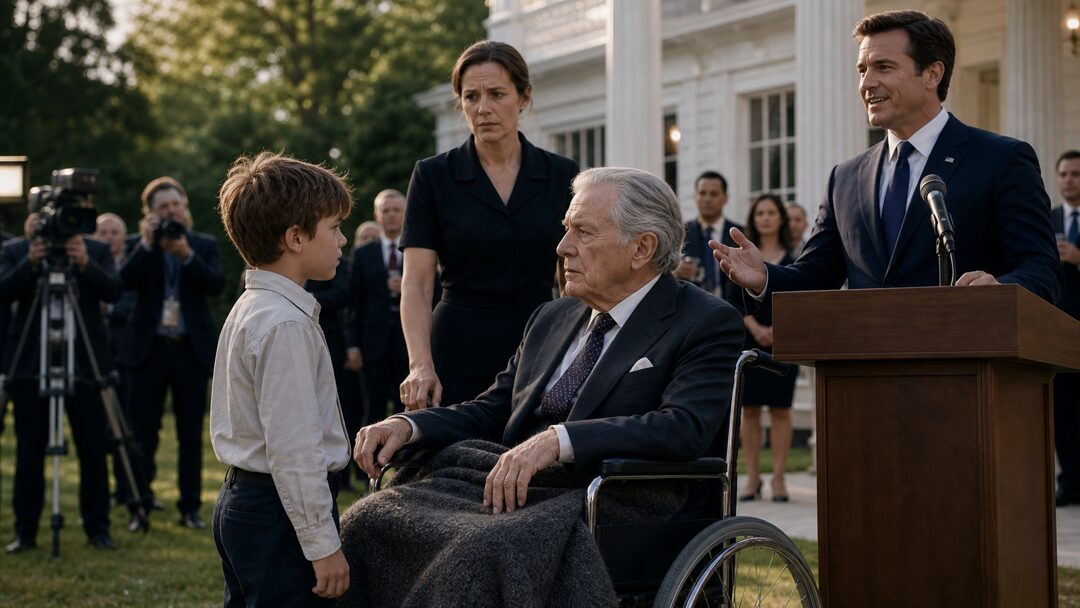
“And of course,” he said, turning just enough to gesture toward his father, “none of this would be possible without the man who taught me what public service means.”
Applause rose across the lawn.
Charles Whitman did not smile. He sat tall in his wheelchair, silver hair combed precisely back, jaw cleanly shaved, dark suit pressed sharp over a body that had betrayed him years ago. Even seated, he looked like someone people were used to obeying.
Michael let the applause swell, then softened his voice.
“And we are grateful, too, to Miss Parker, my father’s devoted nurse, who has given this family years of loyal care.”
The applause turned polite.
Emily lowered her eyes.
Miss Parker.
Not Emily.
Not the woman who had once waited for Michael behind the boathouse while summer rain struck the roof in silver sheets. Not the woman he had kissed with both hands in her hair and whispered, One day, I won’t have to hide you.
Not the mother of his child.
Just Miss Parker.
Charles’s shoulder tensed beneath her hand.
Emily felt it. That small tightening. That was all.
Then Joshua moved.
He slipped from the edge of the service path where she had told him to wait. His shirt was buttoned one hole wrong at the collar. His shoes were scuffed from climbing the stone steps he was not supposed to climb. He walked straight across the grass, small and serious, past the staff holding trays, past the campaign assistant who reached too late to stop him.
The crowd noticed before Michael did.
A murmur ran through them like wind through dry leaves.
Emily could not breathe.
“Joshua,” she whispered.
He did not turn.
Michael saw the movement then. His smile froze for half a second, no longer warm, no longer public. Then he recovered.
“Well,” he said into the microphone with a bright laugh, “it seems even the youngest members of our household want to join the campaign.”
A few people laughed.
Joshua kept walking until he stood directly in front of Charles’s wheelchair.
He looked up at the old man.
Charles’s hands closed around the arms of his chair.
For one awful moment, no one moved. Not the donors. Not the cameras. Not Michael. Not Emily.
Joshua’s voice was small, but the microphone stands caught enough of it to carry.
“Why won’t he say my name?”
The lawn went quiet.
Not silent. Worse than silent.
Listening.
Michael stepped down from the platform.
“Buddy,” he said, voice still soft enough to pass for kindness. “This isn’t the time.”
Joshua did not look at him.
He kept looking at Charles.
“Why does he only say Mom’s name when he wants her to bring medicine?”
Emily’s face burned.
A woman near the front turned to another woman and whispered behind her program.
Michael reached Joshua and placed a hand on his shoulder. It looked gentle from a distance. Emily knew the grip. It said stop.
“This is one of the staff children,” Michael said to the crowd, smiling wider now. “He’s very fond of my father.”
One of the staff children.
Emily heard something in herself crack, but she stayed still. She had learned years ago that motion could be used against her. Tears could be called instability. Anger could be called ingratitude. A mother’s dignity could be priced against school tuition.
Joshua finally turned toward Michael.
“I’m not one of the staff children.”
Michael’s fingers tightened.
Charles’s eyes closed.
And Emily knew, with the terrible clarity that arrives before disaster, that the boy had just said the one sentence no one in that house could survive unchanged.
Part II — Love in the Side Hall
They got Emily inside through the east door, away from the cameras.
Michael did not pull her hard. He was too trained for that. He guided her by the elbow, smiling at the campaign manager over his shoulder, murmuring, “Family moment, nothing to worry about.”
Family.
The word landed like a slap.
Joshua had been taken upstairs by one of the housekeepers. Emily had watched him look back once, confused by the sudden softness of strangers. Charles had been wheeled into the library without a word.
In the side hall, where portraits of dead Whitman men lined the walls, Michael let go of Emily’s arm.
Only then did his smile disappear.
“What were you thinking?” he asked.
Emily stared at him.
The hallway smelled of lemon polish and old money.
“What was I thinking?”
“You were supposed to keep him near the service path.”
“He’s eight.”
“He understands rules.”
“He understands being hidden.”
Michael exhaled through his nose, the way he did when he wanted to seem patient. It had once made Emily feel chosen, that restraint. As if his anger was an animal he caged for her sake.
Now she knew better.
“You know what today was,” he said. “You know what this campaign means.”
“I know exactly what it means.”
He stepped closer. Too close for staff. Not close enough for love.
“Emily.”
Her name in his mouth still had power. She hated that. Seven years of being corrected, postponed, placed in back rooms, and still one low syllable from him could pull a memory loose.
The boathouse.
Rain.
His thumb against her cheek.
I’m not ashamed of you. I’m trapped.
She had believed him then because she wanted to believe there was a difference.
Michael touched her arm.
“You know I’m protecting you.”
“No,” she said quietly. “You’re protecting yourself.”
His eyes flicked toward the closed library doors.
“My father pays for Joshua’s school. His doctor. Your room here. Your salary.”
“My salary?” She almost laughed. “Is that what we’re calling it?”
“That’s what the world will call it if you force this in public.”
There it was. Not anger. Not even threat.
Truth dressed as concern.
Emily looked past him at the library doors. They were not fully closed. Through the narrow seam, she could see Charles in his wheelchair by the window, his profile carved in shadow. He could hear them.
He did not turn.
Michael lowered his voice.
“Joshua doesn’t understand timing.”
“Children understand more than men who lie to them.”
“He is my son,” Michael said, and the words came so quickly, so sharply, Emily almost flinched.
Then he looked down, as if the sentence had escaped him.
Emily’s throat tightened.
“Say it outside.”
His jaw hardened.
“You know I can’t.”
“You won’t.”
“There is a campaign now.”
“There was always something. Your father’s health. Your family name. The donors. The papers. Your mother’s memory. Your timing.” She stepped back from him. “I have been waiting for your life to become safe enough for the truth.”
Michael’s face changed, not into cruelty, but injury. That was worse.
“You think I don’t love him?”
“I think love shouldn’t need a side entrance.”
He closed his eyes.
When he opened them, the campaign smile had returned, smaller and colder.
“You need to keep him upstairs tonight.”
“Why?”
“Donor dinner.”
She stared at him. “You’re still having it?”
“Of course we’re still having it. We can’t look rattled because a child had a moment.”
“A moment,” she repeated.
“Emily, please.”
That please had once been his most dangerous word. He used it like surrender while asking for obedience.
From the library, Charles’s wheelchair creaked.
Emily looked toward him again.
“Are you going to say anything?”
Charles did not meet her eyes.
Michael answered for him.
“My father has done more for you than anyone.”
Emily felt the humiliation settle. Not hot now. Cold.
“Yes,” she said. “That’s what makes it so expensive.”
She left him in the hall before her voice could break.
Upstairs, Joshua sat on the edge of his narrow bed, hands between his knees. The room had once been a sewing room. It still had hooks in the wall where thread racks had hung.
“Am I in trouble?” he asked.
Emily sat beside him.
She wanted to say no.
She wanted to say yes.
She wanted to say, You have been in trouble since before you were born, and none of it is your fault.
Instead, she fixed his crooked collar.
“You asked a hard question.”
His eyes searched her face.
“Did I ask it wrong?”
Emily pulled him close.
“No,” she said. “That was the problem.”
Part III — The Video
By morning, Whitmore House had turned embarrassment into schedule.
That was what powerful families did. They did not panic. They reorganized panic into meetings.
A campaign aide brought Emily a written instruction at breakfast.
She was not to appear at the evening donor event unless directly needed for Governor Whitman’s care.
Joshua was to remain upstairs.
The word upstairs had been underlined.
Emily folded the paper once, then again, then again, until it was too small to read.
At noon, she went to Charles’s study with his medication tray and found the door ajar. Inside, two campaign staffers stood before a laptop on the desk. Michael leaned against the mantel, arms folded, watching the screen.
Emily stopped before anyone saw her.
The video began with old footage of Charles in his prime: standing at a podium, hand lifted, voice strong enough to make people rise. Then came Michael as a boy beside him, blond hair wind-tossed at some county fair. Then Charles in his wheelchair, older, solemn, noble.
A narrator said, “The Whitman family has always believed service begins at home.”
Emily’s stomach tightened.
The screen changed.
There she was.
Not looking at the camera. Carrying groceries from the foundation pantry two years ago, Joshua beside her holding a paper bag too large for his arms.
The narrator continued, warm and clean.
“For families like Emily and her son, the Whitman Foundation has meant security, opportunity, and hope.”
Joshua’s face filled the screen.
He was smiling in the footage, one front tooth missing. His name did not appear.
Emily gripped the tray so hard the medicine cup rattled.
Michael turned at the sound.
For a second, guilt moved across his face.
Then it was gone.
“Emily.”
She stepped into the room.
“You filmed my son.”
“It’s foundation footage,” Michael said.
“You filmed my son and made him a charity case.”
One of the staffers shifted uncomfortably.
Michael glanced at them. “Give us a minute.”
They left too quickly.
The laptop remained open, Joshua’s paused face bright on the screen.
Emily set the tray down slowly.
“You won’t say his name, but you’ll use his face.”
Michael shut the laptop.
“That is not what this is.”
“What is it, then?”
“It’s a story about service.”
“No,” she said. “It’s a story about a family generous enough to feed a child and ashamed enough not to claim him.”
His expression hardened.
“You need to be careful.”
She smiled once, without humor.
“There he is.”
“Who?”
“The man who only loves me when no one is watching.”
Michael looked toward the door, then crossed to her.
“I never stopped loving you.”
The words should have been old by now. Worn out. Useless.
They still hurt.
He reached for her hand. She let him take it, not because she wanted to, but because memory was sometimes faster than dignity.
“I need one clean campaign season,” he said. “That’s all. After that, I can fix this.”
“You said that when Joshua was born.”
“I was twenty-four.”
“You said it when he started school.”
“My father had just had the stroke.”
“You said it last Christmas when he asked why your picture was in his classroom but not on our wall.”
Michael’s grip loosened.
Emily pulled her hand away.
“Every year you ask me to wait. Every year Joshua gets older inside your lie.”
His voice dropped.
“You think the world will be kind to him if this comes out now? They’ll tear him apart. They’ll call you names. They’ll dig through your life. They’ll say you trapped me.”
“They already call me Miss Parker like it’s a wall.”
“That wall pays for his future.”
Emily looked at the closed laptop.
“No,” she said. “It buys your silence from me.”
She took the medicine tray and left Michael standing beside his own paused campaign.
Charles was in the sunroom, not the study, staring out at the south lawn.
He looked smaller when he thought no one was watching.
Emily placed the tray on the table beside him.
“You knew.”
He did not ask what she meant.
“Yes.”
The word was quiet.
“And you allowed it.”
His hand twitched over the blanket.
“I allowed many things I thought I could control.”
“Don’t make it sound tragic. You traded my son’s name for a scholarship.”
Charles turned his head then. His eyes were still sharp, though the rest of him had softened with age and illness.
“I made sure he would never go without.”
“He goes without every day.”
“He has a roof. Education. Care.”
“He has a father who calls him staff.”
Charles flinched.
Emily saw it. She was glad.
“You think money is protection,” she said. “But safety without a name is just another kind of abandonment.”
For a moment, neither of them spoke.
Outside, workers tested speakers on the lawn. A burst of feedback cut the air, then vanished.
Charles looked toward the sound.
“When Michael told me about the pregnancy,” he said, “I was cruel.”
Emily waited.
“I told him he had already made one mistake and would not repair it by making another in public.”
Her eyes burned.
“You called us mistakes?”
“I called him weak.” Charles swallowed. “I told myself I was giving you something better than scandal.”
“You gave us rooms in a house where we could never walk through the front door.”
His face tightened with pain, but he did not defend himself.
Behind them, a floorboard creaked.
Emily turned.
Joshua stood in the doorway.
His face had gone very still.
Not shocked. Not crying.
Worse.
Listening like an adult.
“Joshua,” Emily said.
He looked at Charles.
“You’re my grandpa?”
The room seemed to lose all its air.
Charles’s mouth opened.
No words came.
Joshua looked at Emily.
“And Mr. Michael is my dad?”
Emily stepped toward him, but he backed away.
Not far.
Just enough.
It was the smallest distance in the world.
It broke her heart anyway.
Part IV — Say It Sitting Down
Joshua did not scream.
That frightened Emily most.
He let her sit with him that night, but he did not ask questions. He brushed his teeth. He changed into pajamas. He climbed into bed and stared at the ceiling while the donors arrived downstairs in black cars.
Music drifted up through the floor.
Laughter.
Glasses.
The sound of a house pretending nothing had happened.
At dawn, Emily woke to an empty bed.
She found Joshua on the lawn.
The morning was gray and soft. Staff were already assembling white chairs for the evening event. Men tested cables. A woman arranged flowers along the stage.
Charles sat near the gravel path in his wheelchair, wrapped in his dark blanket, watching the preparations like a king inspecting ruins.
Joshua stood before him.
Emily stopped behind the hedge before either of them saw her.
“If you’re my grandpa,” Joshua said, “why do you let him lie?”
Charles looked older than seventy-two.
“Your father—”
“Don’t call him that if he doesn’t call me anything.”
Charles closed his mouth.
The boy’s hands were shoved into his pockets. His shirt was wrinkled. One shoelace dragged in the damp grass.
Charles tried again.
“There are things children cannot understand.”
Joshua looked at him steadily.
“Do you understand them?”
The old man’s face changed.
Emily pressed a hand to her mouth.
Charles looked away first.
“I thought I did.”
Joshua watched him for a long moment. Then his eyes dropped to the wheelchair.
“Can you stand?”
The question was so plain that Charles almost smiled. Almost.
“No.”
“Not even a little?”
Charles looked down at his lap, at the legs that had once carried him through rallies, marches, debate stages, rooms that changed when he entered them.
“No,” he said. “Not the way you mean.”
Joshua nodded slowly.
Then he said, “Then say it sitting down.”
Charles looked at him.
Joshua’s voice did not rise.
“You don’t have to stand up if you can’t. You just have to say he’s lying.”
Emily stepped out from behind the hedge before Charles could answer.
“Joshua.”
The boy turned. His face was calm, but his eyes were red.
“Mom, did you make him be quiet?”
“No.”
“Did you?”
The question struck Charles harder than accusation.
He looked at Emily, and for the first time in years, she saw no governor in him. No family patriarch. No strategist.
Only an old man sitting in a chair he hated, surrounded by all the consequences he had outlived.
“No,” he said. “She did not.”
Joshua nodded once, as if that was all he needed.
Then he walked back toward the house.
Charles watched him go.
Emily waited until Joshua was inside before she spoke.
“You don’t get many more chances.”
Charles’s fingers curled into the blanket.
“I know.”
“No,” she said. “You know schedules. You know donors. You know damage. You don’t know what chances look like when they belong to a child.”
She left him there on the lawn.
By afternoon, she had packed two bags.
Not enough for a life. Enough to leave.
Joshua watched her fold his shirts.
“Where are we going?”
“Somewhere that has our name on the mailbox.”
“Will my school let me stay?”
“I don’t know yet.”
“Will he be mad?”
Emily paused.
She did not ask which he.
“Yes,” she said.
Joshua accepted this with the grim dignity of children who have learned adults can be dangerous when embarrassed.
She had just zipped the second bag when Michael entered without knocking.
He saw the bags.
For a moment, all the polish fell from him.
“No.”
Emily stood between him and Joshua.
“We’re leaving before the event.”
“You can’t.”
“I can.”
His gaze flicked to Joshua, then back to her.
“Not today.”
“Especially today.”
He stepped into the room and closed the door.
Joshua moved closer to Emily.
Michael noticed. Pain crossed his face, real and useless.
“Buddy,” he said.
Joshua looked at the floor.
Michael breathed in.
“Emily, send him downstairs.”
“No.”
His jaw worked.
“Fine.”
He came closer, voice low.
“Do you understand what happens if you walk out now? Reporters are everywhere. People saw him yesterday. They’ll follow you. They’ll make him a headline.”
“You should have thought of that before putting his face in your video.”
“I was trying to help.”
“You were trying to look kind.”
He flinched, then recovered.
“The foundation pays for his school.”
“I know.”
“His doctor.”
“I know.”
“His future.”
Emily looked at him for a long second.
“No. It pays for your permission to keep disappointing him.”
Michael’s face hardened in a way she had only seen twice before: once when his father had criticized him in front of donors, once when Emily had told him she was pregnant and refused to leave town.
“If you loved him,” he said, “you would endure one more night.”
There it was.
The cleanest cruelty.
Emily felt tired all the way through her bones.
Michael stepped closer and kissed her forehead.
It was the same place he had kissed when they were twenty-four and stupid with hope. The same place he had pressed his lips the night Joshua was born, while the baby slept and Charles’s lawyers waited downstairs.
For one second, Emily almost broke.
Then Joshua made a small sound behind her.
Not a sob.
A swallowed breath.
Emily stepped back from Michael.
“You always ask me to prove love by disappearing.”
Michael’s eyes shone, but his voice stayed steady.
“I am asking you to trust me.”
“No,” she said. “You are asking me to teach our son that being hidden is a privilege.”
He had no answer for that.
Or maybe he had too many.
Emily picked up the bags.
Michael did not stop her.
Not with his hands.
He was too much his father’s son for that.
Part V — The Attempt
They did not make it past the front hall.
A campaign aide blocked them by accident, carrying a headset and a clipboard. Then another staffer saw the bags. Then the campaign manager appeared, alarmed and smiling.
“Miss Parker,” she said, “Governor Whitman is asking for you on the lawn.”
Emily held Joshua’s hand.
“Tell him I’m not available.”
“He asked specifically.”
Michael came down the stairs behind her.
Of course he had followed.
The house seemed to hold its breath.
Emily looked toward the open front doors. Beyond them, the lawn was bright with chairs, lights, donors, cameras. The evening event had begun early. She could hear Michael’s recorded campaign music playing outside.
Joshua’s fingers tightened around hers.
“Mom?”
She should have gone out the side door.
She should have run.
Instead, she thought of Charles on the lawn at dawn, his face emptied by a child’s question.
Then she walked through the front doors.
Not the service hall.
Not the east entrance.
The front.
The lawn turned toward her.
It happened slowly and all at once: faces shifting, whispers beginning, cameras adjusting. Emily felt every eye on the black dress she had worn because it was the only one she owned that made her look less like staff and more like a woman who had decided to be seen.
Charles sat at the front near the stage. His aide stood behind him.
Michael moved quickly past Emily, stepping into his public self before anyone could see the private panic.
“Ladies and gentlemen,” he said into the microphone, voice smooth, “thank you for your patience. Before I speak, we’d like to share a short film about the work that has always been at the heart of the Whitman family.”
The screen lit up.
Emily stopped walking.
Joshua’s hand went cold in hers.
Charles turned his head toward the screen.
The video began exactly as she had seen it: Charles young and powerful, Michael young and golden, flags, crowds, handshakes, the family myth polished until it reflected nothing human.
Then Emily appeared.
Carrying groceries.
Then Joshua.
Missing tooth. Paper bag in his arms. Smiling because he had not known he was being collected for use.
The narrator’s voice rolled over the lawn.
“For families like Emily and her son, the Whitman Foundation has meant security, opportunity, and hope.”
Applause began before the video even ended.
Not cruel applause.
That was what made it unbearable.
They clapped because they thought they were admiring kindness.
Joshua stared at his own face on the screen.
“Mom,” he whispered, “why didn’t they put my name?”
Emily knelt beside him on the grass.
She did not care who saw.
“Because they were wrong.”
The applause faded.
Michael returned to the microphone. His smile was strained now.
“That,” he said, “is what service looks like when it begins at home.”
Charles’s voice cut through the air.
“No.”
It was not loud.
It did not need to be.
People near the front turned.
Michael froze.
Charles lifted one hand from the arm of his wheelchair.
“Bring me forward.”
His aide bent close. “Governor?”
“Now.”
The aide hesitated, then pushed the chair toward the stage.
A murmur spread through the donors.
Michael stepped away from the microphone.
“Dad,” he said softly, warning wrapped in concern.
Charles ignored him.
He stopped at the edge of the stage, close enough that everyone could see his face. Pale. Rigid. Set with the old stubbornness that had once made rooms go silent.
Emily rose slowly.
Joshua stood beside her, small as a question.
Charles looked at him.
Then at Emily.
Then at the crowd.
He placed both hands on the arms of his wheelchair.
Emily knew before he moved.
“No,” she breathed.
Charles pushed.
His shoulders shook with the effort. His hands gripped the polished wood. The blanket slid from his knees, exposing legs that trembled without obeying.
Gasps rippled across the lawn.
Michael moved toward him.
“Dad, stop.”
Charles pushed again.
His face tightened in pain. One foot shifted half an inch, useless and terrible. His body lifted barely from the chair before collapsing back.
Emily rushed forward.
“Governor—”
He turned his head toward her, eyes bright with pain.
“Do not hide what this costs.”
She stopped.
The sentence held her in place.
Charles tried again.
This time he rose just enough that the entire lawn saw the attempt. Not a triumph. Not a miracle. A broken, shaking inch of defiance.
His aide caught the chair from behind. Emily saw his knees buckle, saw his mouth twist, saw sweat break along his temple.
He could not stand.
But he had tried in front of them all.
He sank back into the wheelchair, breathing hard.
No one clapped.
No one whispered.
Michael looked stricken, furious, afraid.
Charles reached for the microphone.
His hand shook so badly that the aide had to guide it toward him.
Charles looked at the screen behind Michael, still frozen on Joshua’s face.
“That boy,” he said, voice rough, “is not a foundation story.”
Michael’s lips parted.
“Dad.”
Charles kept going.
“His name is Joshua Parker.”
Emily covered her mouth.
Joshua did not move.
“He is my grandson.”
The lawn changed.
Not loudly. Deeply.
Like something beneath the grass had split open.
A woman gasped. A reporter spoke urgently into his phone. The campaign manager went white.
Michael stood perfectly still.
Charles turned his head enough to see Emily.
“And Emily Parker is not merely my nurse. She is the woman this family asked to carry our shame so we could keep our name clean.”
Emily’s eyes filled before she could stop them.
Charles’s voice weakened, but he did not stop.
“We called it protection. It was cowardice.”
Michael stepped toward the microphone.
“That’s enough.”
Charles looked at his son.
The old governor’s face was drained, but his gaze was merciless.
“No. It was enough years ago.”
Michael stopped.
For the first time all day, the public smile did not return.
Charles looked back at Joshua.
“I should have said your name first.”
Joshua’s face crumpled.
Not all at once.
First his mouth tightened. Then his eyes filled. Then the tears came silently, sliding down his cheeks as he looked at the old man in the wheelchair who had finally told the truth and still could not make it clean.
Emily reached for him.
Joshua let her.
On the lawn of Whitmore House, beneath banners that promised trust, no one knew what to do with a child crying over a name he had finally been given.
Part VI — The Front Drive
The event did not end.
It broke apart.
Donors gathered in clusters. Reporters shouted questions. Campaign staff moved like people trying to collect spilled water with their hands.
Michael did not answer anyone.
He followed Emily and Joshua across the grass toward the front drive.
“Emily.”
She kept walking.
“Emily, stop.”
Joshua’s hand was in hers. The bags had been brought out by one of the housekeepers, who pressed them into Emily’s free hand without meeting her eyes.
“Please,” Michael said.
That stopped her.
Not because she believed the word anymore.
Because she wanted to hear what shape it would take this time.
Michael stood a few feet away, tie loosened, face stripped of its stage light.
“We can fix this,” he said.
Emily looked at him.
Behind him, Charles sat beneath the white columns, surrounded by aides and strangers, smaller than he had ever looked.
“Privately?” Emily asked.
Michael flinched.
“It doesn’t have to be ugly.”
“It was ugly when it was quiet.”
He swallowed.
“I love you.”
She believed him.
That was the cruelest part.
He did love her, in the damaged way he knew how. He loved the room where she waited. The boy when no cameras were near. The version of himself who came alive when he was not being watched.
But love that needed darkness had taught her son to lower his voice.
Emily adjusted the bag on her shoulder.
“You don’t get to call secrecy love anymore.”
Michael’s face folded around the sentence.
For a moment, he looked like the young man in the boathouse, wet from rain, terrified of wanting more than he was allowed to keep.
Then the moment passed.
He looked toward Joshua.
“Can I talk to him?”
Joshua stepped behind Emily without being told.
There was the answer.
Michael saw it.
Whatever he felt, he had to feel it standing there in the open, where everyone could see he had not been chosen.
Emily almost pitied him.
Almost.
Charles’s wheelchair rolled slowly over the gravel behind them. His aide stopped a respectful distance away.
Joshua turned.
The old man looked worse now. His skin was gray. His hands lay useless over the blanket. The attempt had taken something from him that he would not get back by morning.
He did not look at Michael.
He looked only at Joshua.
“I have no right to ask you for anything,” Charles said.
Joshua wiped his face with his sleeve.
Charles’s mouth trembled once.
“I should have said your name first.”
Joshua stared at him.
Then he asked, “Why didn’t you?”
Emily closed her eyes.
Charles took the question like a sentence.
“Because I was afraid people would think I was weak.”
Joshua looked confused.
“You were already in the chair.”
A sound moved through Charles that might have become a laugh if it had not hurt too much.
“Yes,” he said. “I was.”
Joshua’s tears started again, but he did not step forward.
He did not forgive.
He did not punish.
He only stood there, a child with a name too newly returned to feel like shelter.
Emily reached for him.
This time, he took her hand first.
She turned toward the front drive.
For years, she had left Whitmore House through side doors, kitchen doors, service paths lined with hedges meant to hide deliveries and mistakes. She had carried medicine through those doors. Laundry. Birthday cupcakes no one downstairs knew about. Her own pride, folded small.
Now she walked down the main drive with her son beside her.
Gravel shifted beneath their shoes.
Behind them, Michael said nothing.
Charles said nothing.
The house rose white and enormous against the evening sky, but for the first time, Emily did not feel small beneath it.
At the end of the drive, Joshua looked back once.
Charles was still by the columns, sitting very straight in his wheelchair.
Michael stood several feet away from him, close enough to be family, far enough to be alone.
Joshua’s fingers tightened around Emily’s.
“Mom,” he whispered.
“Yes?”
“Do I have to be a Whitman?”
Emily looked down at him.
His cheeks were wet. His collar was still buttoned wrong. He looked exhausted by truths that should have waited until he was older.
“No,” she said. “You only have to be Joshua.”
He nodded as if that answer hurt and helped at the same time.
Then they kept walking.
Not hidden.
Not healed.
But named.