The Room That Remembered
Part I — The White Dress
Robert Hale had just raised his glass to the future when the elevator doors opened and the girl stepped out.
For one second, the ballroom did not understand her.
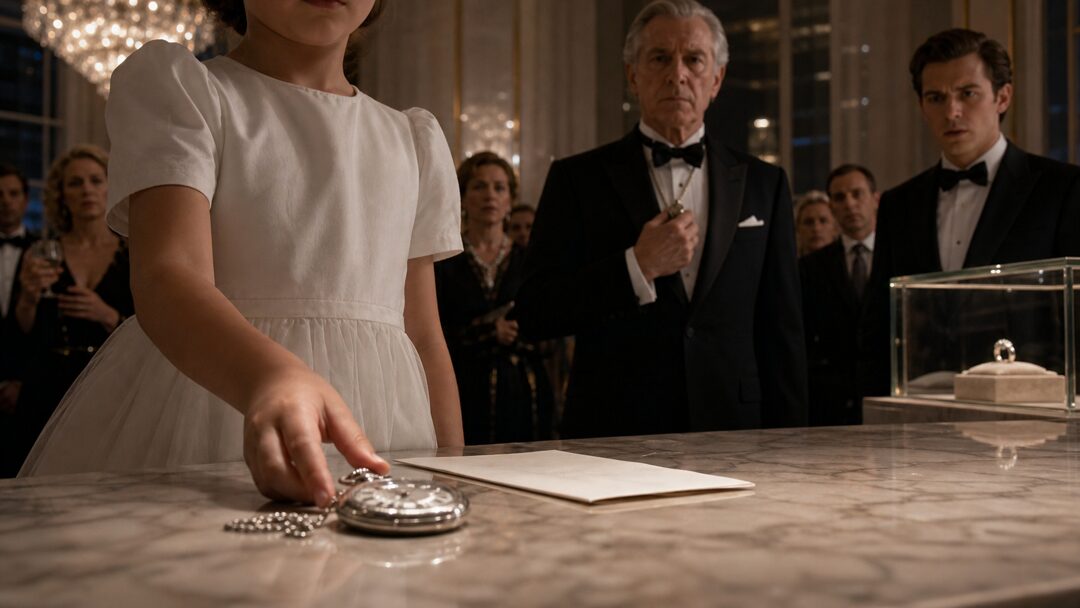
The room was all black tuxedos, ivory gowns, crystal stems, diamond wrists, and the clean silver glow of Manhattan through forty-seven stories of glass. Waiters moved between marble columns with trays of champagne. A string quartet played near the windows. Above everyone, a chandelier scattered light across the polished floor until even the shadows looked expensive.
And then there was Emily.
Twelve years old. Small. Alone.
Her white dress was too plain for the room, cotton instead of silk, with a hem that brushed her knees and sleeves that made her look younger than she was. Her dark hair had been pinned back too tightly, as if someone had done it with shaking hands. Her flats were worn at the toes.
Both her hands were wrapped around a silver pocket watch.
Robert stopped speaking.
The pause should have lasted only a breath. Men like Robert Hale built fortunes by never allowing silence to become visible. He had spent fifty-eight years learning how to smile through hostile boardrooms, family funerals, collapsing markets, and one marriage that had turned affection into strategy before the honeymoon was over.
But the girl’s eyes found his across the room.
Robert’s fingers closed around the stem of his glass so hard the champagne trembled.
His son Daniel stood beside him, handsome and stiff in his tailored tuxedo, waiting for the rest of the toast. Daniel’s fiancée, Ashley Morgan, smiled beneath the chandelier in an ivory gown that had been photographed from three angles before dinner. Her family stood near the front table, already glowing with the satisfaction of an alliance properly displayed.
Robert had been saying, “A family name is not simply inherited. It is built, protected, and handed forward to the children who will stand under it.”
Then Emily walked in.
No one stopped her at first. That was the strange part. Security had been trained to intercept intrusions before they became scenes, but she did not move like an intruder. She walked like someone expected.
The crowd opened in a narrow line before her.
Whispers gathered.
“Whose daughter is that?”
“Is she with the staff?”
“She looks like someone’s flower girl who got lost,” Ashley murmured, still smiling.
Daniel heard her. His smile stayed in place, but his eyes flicked toward his father.
Robert did not look at him.
Emily crossed the glass floor, past women in emeralds and men who owned buildings she would never enter again if she failed tonight. Her face was calm in the way children’s faces become calm when they have already cried elsewhere.
When she reached the marble table in front of Robert, she set down the silver watch.
The sound was small.
It carried anyway.
Robert looked at it, and all the color left his face.
Emily lifted her chin. “My mother said you would know what this means.”
No one moved.
Robert’s right hand went to his chest before he could stop it.
Under his shirt, beneath the black silk of his tuxedo, his fingers found the pendant he had worn for twelve years and hidden for twelve years longer.
Daniel saw the gesture.
So did Emily.
So did half the room.
Robert lowered his hand slowly, as if the movement had belonged to someone else.
“I’m afraid,” he said, with the gentle voice he used for donors, “you may have the wrong event.”
Emily looked at the watch, then back at him.
“No,” she said. “She said you’d say that first.”
Part II — The Watch on the Table
The first security guard reached Emily from behind, but Robert lifted one hand.
Not too fast. Not too sharp.
He knew the room was watching. He knew a grown man ordering a small girl removed from his son’s engagement gala would look worse than any lie he might tell for the next five minutes.
“Let’s not frighten her,” Robert said.
Emily did not turn around.
Daniel leaned toward his father. “Dad, who is she?”
Robert’s mouth moved before his eyes did. “I don’t know.”
The lie was clean.
Too clean.
Ashley’s smile had settled into something colder. Her father, Senator Charles Morgan, stood near the champagne tower with his wife’s hand resting tightly on his arm. He had the look of a man already calculating which guests had phones out.
Robert stepped closer to Emily. “What’s your name?”
She watched him as if the question cost him more than the answer cost her.
“Emily.”
A flicker passed through Robert’s face.
Daniel saw that too.
“Emily,” Robert repeated, softer than he meant to.
The girl pushed the watch toward him. “Open it.”
Robert did not touch it.
“Emily,” he said, “this is a private family event. If someone sent you here—”
“My mother sent me.”
That stopped him.
Not because of the words. Because of the way she said them. Not dramatic. Not pleading. Just certain, the way someone says a fact that will remain a fact even if powerful people dislike it.
Ashley stepped forward, graceful as a knife.
“Sweetheart,” she said, “maybe we can find whoever brought you and handle this away from the guests.”
Emily looked at Ashley’s diamonds, then at Ashley.
“My mother said people like him only tell the truth when leaving would cost more than staying.”
Ashley’s smile vanished for half a second.
A rustle moved through the room.
Robert bent his head toward Emily, lowering his voice. “You don’t understand what you’re doing.”
“I know exactly what room I’m in.”
The watch lay between them.
It was old, dented at one edge, bright where fingers had worried the silver over years. Robert recognized the scratch across the back. He recognized the chain, repaired with a mismatched link near the clasp. He recognized the weight of it without lifting it.
He had bought it from a street stall in Paris when he was twenty-eight and stupid enough to believe desire could outrun inheritance.
Laura had laughed when he gave it to her.
“What am I supposed to do with a man’s watch?” she had asked.
“Remind time who it belongs to,” he had said.
He had been the sort of young man who thought that was romantic.
Emily’s hand hovered near the lid. “If you won’t open it, I will.”
Robert’s voice sharpened. “Don’t.”
The word struck the room harder than he intended.
Daniel turned fully toward him now.
Ashley’s mother whispered, “Charles.”
Senator Morgan did not answer.
Emily opened the watch.
Inside was a small photograph, creased at the corners and protected behind cloudy glass. Robert was in it, younger, dark-haired, laughing at something outside the frame. Beside him stood a woman with windblown hair and one hand lifted to block the sun.
Laura.
The room did not know her name yet.
Robert did.
The inscription beneath the photo was so small that Emily had to tilt the watch toward the chandelier light.
“When they stop calling you mine,” she read, “this will remember.”
Robert closed his eyes.
Only for a moment.
But the room had already learned too much from his face.
Daniel took one step backward, as if the floor had shifted. “Dad?”
Robert opened his eyes and found the version of himself everyone trusted.
“This is someone I knew many years ago,” he said. “A troubled person. I’m sorry if she involved you in something you couldn’t possibly understand.”
Emily did not flinch.
“My mother died three weeks ago.”
The quartet stopped playing.
It was not planned. One violin simply fell silent, and the others followed, one by one, until the room was left with glass, breath, and the distant thrum of the city below.
Emily kept her hands folded in front of her.
“She left me a note,” she said. “It said to find you only when everyone was watching.”
Part III — What Laura Left
Robert had once believed that shame was a private sensation.
Heat in the face. Tightness in the chest. A room inside the body where no one else could enter.
He learned that night that shame could have witnesses.
Daniel stared at the photograph in the watch. He did not ask who Laura was again. He was afraid the answer had already started arranging itself around him.
Ashley touched his sleeve. “Daniel. We should step away.”
But Daniel did not move.
Robert reached for the watch, then stopped when Emily’s hand came down over it.
“Not yet,” she said.
His eyes flashed. “That belongs to me.”
“No,” Emily said. “You gave it away.”
A few people looked down, embarrassed by the intimacy of the sentence. Others leaned in. The wealthiest people in New York had a talent for pretending not to watch while missing nothing.
Robert lowered his voice. “Emily, whatever your mother told you, there are things adults say when they are hurt.”
“She told me you would make her sound crazy.”
“I did not say that.”
“You said troubled.”
The room tightened.
Ashley’s father finally stepped in. “Robert, perhaps we should continue this somewhere else.”
The word “we” had force behind it. Morgan money. Morgan access. Morgan newspapers that smiled politely until they didn’t.
Robert understood the command.
Emily understood it too.
She reached into the pocket of her dress and pulled out an envelope, folded until the edges had softened. Across the front, in narrow handwriting, was one name.
Robert.
He looked at the envelope as if it were alive.
“My mother’s name was Laura Bennett,” Emily said. “You met her before you married Patricia Hale. You asked her to marry you first.”
The first real gasp came from someone near the windows.
Daniel’s head turned slowly toward Robert.
Ashley’s hand dropped from Daniel’s sleeve.
Robert’s voice became careful. “Laura and I were young. We cared for each other. But it was complicated.”
Emily nodded once, as if she had expected the word.
“My mother said rich people call cruel things complicated so they don’t have to call them cruel.”
A woman near the champagne table covered her mouth.
Robert’s face hardened. Not because the sentence was false. Because it had Laura’s rhythm in it.
Laura had never shouted at him. That had been the worst part. She could undress his cowardice with one quiet line and leave him wishing she had thrown a glass instead.
Emily opened the envelope and removed the letter.
Robert moved then, fast enough that Daniel caught his arm.
“Dad.”
Robert froze.
Daniel looked at his hand around his father’s sleeve as though he had never touched him without permission before.
Emily unfolded the paper.
She did not read all of it. She read like someone carrying a match through a room full of silk.
“Robert,” she began, and for the first time, her voice shook.
Then she swallowed and started again.
“Robert, if Emily is standing in front of you, it means I am no longer able to keep your silence for you.”
Robert looked away.
Emily continued.
“You told me once that your father would come around. You told me your name could hold both families. Then your lawyers came. Then your mother came. Then your wife’s father came. Everyone came except you.”
The room had become still enough to hear a champagne bubble break in a glass.
Robert said, “Stop.”
Emily did not.
“You visited once after she was born. You held her for eleven minutes. I counted because I knew I would have to live on it.”
Daniel’s grip slipped from Robert’s sleeve.
Emily’s eyes lifted from the page.
Daniel whispered, “She’s yours?”
Robert said nothing.
That was the answer that broke the room.
Ashley took one step back from Daniel, not far, but enough for everyone to see the space open between them.
Senator Morgan’s face went blank in the way powerful men go blank when numbers start falling in their heads.
Robert’s lips parted, but Emily returned to the letter before he could repair anything.
“You said you would come back when the settlement was finished. You said Daniel would not lose his place. You said your family only needed time.”
Daniel made a sound then. Not a word. Something smaller.
Emily folded the letter halfway, fingers shaking now.
“She wrote that you sent money,” she said to Robert. “Every month. Through Mr. Walker on Fifty-Third Street. Enough for rent. Enough for school. Enough that you could tell yourself I was cared for.”
Robert’s voice was low. “I made sure you had what you needed.”
Emily looked at him.
“I needed a name.”
No one breathed.
“I needed my mother not to cry when school forms asked for my father. I needed her not to say, ‘Leave it blank, Em.’ I needed her not to fold your checks into the drawer like they were dirty.”
Robert flinched.
At last.
Ashley said softly, “Daniel, we need to go.”
But Daniel’s eyes were fixed on Emily. He was looking at a child and seeing the shape of his own life behind her.
His schools. His clubs. His summers in Maine. His first car. His name on plaques. His father beside him at every ceremony, one hand on his shoulder, presenting him to the world as proof that the Hale line was intact.
All those years, Emily had existed somewhere else.
Not because Robert didn’t know.
Because Robert knew and chose where to stand.
Part IV — The Offer
Robert did what he had always done when truth became too large for the room.
He made a smaller room.
“Emily,” he said, “come with me for a moment.”
She did not move.
“Please.”
That word changed something in her face. Not much. Enough.
Daniel saw it. The child wanted to go with him. That was the part that made Daniel ashamed before he knew what he had done wrong.
Robert turned to the guests with the wounded dignity of a man asking for privacy during a family emergency he still hoped to define himself.
“Ladies and gentlemen, I apologize. We’ll take a brief pause.”
No one believed it was brief.
No one left.
Emily followed Robert into the glass corridor outside the ballroom. The doors closed behind them, but not fully. Daniel stood near them, blocked by a marble column, close enough to hear if voices rose.
Ashley came after him.
“Daniel,” she said. “Do not make this worse.”
He did not answer.
Inside the corridor, Robert stopped by a wall of windows. The city glittered behind him, making him look less like a man than a portrait of one.
Emily held the watch against her chest.
For the first time all night, Robert looked at her without the room between them.
“You have her eyes,” he said.
Emily’s mouth tightened. That was almost the line she had wanted. Almost the tenderness she had imagined while sitting beside her mother’s bed, reading the envelope again and again after Laura’s breathing had gone quiet.
Almost was crueler than nothing.
Robert took a step closer.
“I am sorry,” he said.
Emily waited.
The words did not become anything else.
He reached into his jacket and pulled out a card. Cream stock. Embossed name. Private number. “I can help you.”
“My mother said you would say that too.”
“I can do more than send money now. School. A home. Whatever you need. I can have my attorneys draw up an acknowledgment.”
“An acknowledgment?”
His voice softened. “It would be sealed until the proper time.”
Emily stared at him.
The proper time.
A phrase so clean it had no fingerprints.
Robert leaned down slightly, not enough to be patronizing, enough to seem kind. “You’re young. You don’t understand what happens when a thing like this becomes public. People will follow you. They’ll say terrible things. They’ll use your mother’s name. They’ll use yours.”
“You mean they’ll use yours.”
Pain crossed his face. Real pain. That made it worse.
“I am trying to protect you.”
“My mother said protection is what powerful people call a locked door.”
Robert looked away.
Beyond the corridor doors, Daniel closed his eyes.
Ashley whispered, “This is insane.”
Daniel turned on her. “She’s twelve.”
Ashley’s face hardened, but her voice stayed low. “And there are two hundred people in that room, including three reporters pretending not to be reporters. My father has a Senate race next year. Your father has federal projects pending. This girl may be telling the truth, but she did not come here innocently.”
Daniel looked through the narrow gap in the doors.
Emily stood in her plain white dress beneath a gold wall sconce. She looked smaller without the ballroom around her. Smaller, and more breakable.
“No,” Daniel said. “She came because nobody would listen anywhere else.”
Ashley’s eyes flicked toward him.
“And what happens to us?”
There it was.
Not cruel. Not shallow.
Honest.
Daniel looked at the ring displayed inside the ballroom, resting beneath glass on a velvet stand, waiting for the formal announcement that would bind two families, two fortunes, two public myths.
He had told himself he loved Ashley.
Maybe he did, in the way men love women chosen for them so early they mistake arrangement for fate.
Inside the corridor, Robert’s voice dropped.
“I held you once,” he said.
Emily went still.
Robert’s face changed as he remembered. “You were so small. Laura put you in my arms and said, ‘Here. This is what your courage looks like.’”
Emily’s hands tightened around the watch.
“I told her I needed time,” he said.
“You didn’t come back.”
“No.”
“Why?”
He looked older than he had in the ballroom. “Because I was afraid.”
It was the first honest thing he had said.
Emily’s eyes filled, but she did not let the tears fall.
Robert saw them and reached for her shoulder.
She stepped back.
His hand stayed in the air.
“I can give you a life,” he said.
“I already had one.”
“I can make it easier.”
“You could have made hers easier.”
Silence.
Then Robert said, almost desperately, “Do you want to punish me?”
Emily’s answer came after a long breath.
“No. I wanted you to choose us without being forced.”
That sentence did what the letter had not.
It made Robert look ruined.
For one dangerous moment, Emily almost believed him. Almost believed that if she put the watch in his hand and followed him out a side door, he would become the man her mother had waited for. Almost believed a sealed document was better than no document. Almost believed a hidden father was better than the empty space she had grown up naming around.
Then she looked through the glass and saw the ballroom.
The guests waiting.
The chandeliers waiting.
Daniel waiting beside Ashley with his face turned toward the crack in the door.
And she understood what her mother had known.
Robert Hale could love privately forever.
Only witnesses could make him honest.
Emily wiped her cheek with the back of her hand before the tear could fall.
Then she turned and walked back into the ballroom.
Part V — Everyone Watching
The doors opened, and the room straightened as if Emily had pulled a string through every spine.
Robert followed her.
Not beside her.
Behind her.
That mattered.
Emily returned to the marble table. The watch still gleamed beneath the chandelier. The envelope lay beside it. The ring waited under glass a few feet away, brilliant and useless.
Daniel moved before anyone else did.
He stepped away from Ashley.
She caught his wrist. “Don’t.”
He looked down at her hand.
For a second, he was a boy again, waiting for someone older to tell him which choice would keep his life intact.
Then he gently removed her fingers.
“I have to hear this,” he said.
Ashley’s face changed. Not shattered. Not pleading. Something colder and sadder.
“You already have,” she said.
Emily unfolded the letter again, but this time she did not read from the beginning.
She placed it beside the open watch so the photograph faced the room.
Robert and Laura. Sunlight. Youth. A promise no one in that room had been asked to honor.
“My mother didn’t ask me to come here so you would take care of me,” Emily said.
Her voice was small, but the room had learned to listen.
“She said money can keep a person alive and still leave them unnamed.”
Robert whispered, “Emily.”
She looked at him then.
Not at the guests. Not at Daniel. Not at Ashley.
Only at Robert.
“Do you want me to leave because I’m lying,” she asked, “or because I’m yours?”
The sentence entered the room and stayed there.
Robert did not answer.
Not because he could not hear.
Because every possible answer had a cost.
If he said she was lying, the watch would remain. The letter would remain. His face, already ruined by recognition, would remain in the memory of everyone present.
If he said she was his, the Hale name would crack in public.
If he said nothing, the silence would answer for him.
Daniel walked to the velvet stand and lifted the glass case from the engagement ring.
Ashley said his name once.
“Daniel.”
He picked up the ring, held it for a moment, then set it down on the marble table beside the watch.
The sound was brighter than the watch had been.
“This announcement doesn’t continue,” Daniel said, “until he answers.”
Senator Morgan stepped forward. “Young man, think very carefully.”
Daniel looked at him, then at Robert.
“I am.”
Robert’s face twisted—not in anger, but in something worse. Grief with no honorable place to go.
“Daniel,” he said.
Daniel’s voice was unsteady. “Did you know?”
Robert looked at his son.
The chosen son.
The public son.
The son whose life had been built on a clear path because another child had been kept off it.
“Yes,” Robert said.
Ashley closed her eyes.
Daniel swallowed. “How long?”
Robert looked at Emily.
She did not help him.
“All along,” he said.
The words took the air out of the room.
Daniel laughed once, but it held no humor. “All along.”
Robert turned toward the guests. For the first time in decades, he had no prepared version of himself ready.
He looked at the men who had envied him, the women who had praised Patricia Hale’s poise before her passing, the Morgans who had agreed to join their daughter to his son because the Hale name was clean enough to stand beside theirs.
Then he looked at Emily.
Her white dress had become the brightest thing in the room.
“She is my daughter,” Robert said.
No one spoke.
He said it again, not louder, but clearer.
“Emily is my daughter.”
The room received the sentence like broken glass under silk.
Not loud.
Everywhere.
Emily did not smile.
That was what unsettled Robert most. Some childish part of him had believed the truth, once spoken, would transform him into the man he had failed to be. He had imagined—without admitting it—that confession might create a bridge wide enough for forgiveness to walk across.
But Emily only stood there, holding herself carefully.
Daniel’s hand rested near the ring. He did not pick it up again.
Ashley turned to her father.
Senator Morgan gave one short nod.
That was the end of the engagement before anyone said so.
Ashley removed the ring from the table herself. She did not throw it. She did not cry. She held it in her palm and looked at Daniel with a face that was almost kind.
“You chose late,” she said.
Daniel flinched.
Then she walked away with her family, her ivory gown moving through the crowd like a door closing.
Robert watched the Morgans leave.
For a moment, his old reflex returned. The damage. The calls. The headlines. The contracts. The board. The name.
Then Emily reached for the watch.
And Robert remembered there was a worse thing than losing a name.
There was keeping one by making someone else live without it.
Part VI — What Remained
The ballroom did not empty all at once.
It thinned.
First the people who wanted to pretend they had not witnessed anything. Then the people who wanted to call someone before pretending. Then the guests who took Robert’s hand too tightly and said nothing useful.
The chandelier kept shining.
The city kept glittering.
The watch remained on the marble table.
Daniel stood beside Emily, not close enough to claim comfort, not far enough to deny her. He looked like a man who had inherited a house and only now found the locked room beneath it.
“I’m sorry,” he said.
Emily looked at him.
“For what?”
He had no clean answer.
For having birthday parties with their father. For wearing the name without wondering who else it might fit. For wanting her to disappear for the first ten minutes because his life had been arranged around her absence.
“For not asking faster,” he said.
Emily accepted that with a small nod.
It was not forgiveness.
It was something more careful.
Robert approached them slowly. He had removed his bow tie. Without it, he looked less powerful and more tired, but Emily did not mistake tiredness for innocence.
He stopped an arm’s length away.
“Emily,” he said.
For the first time, he said her name in public without lowering his voice.
She looked up at him.
He took the pendant from around his neck.
The chain caught briefly on his collar. His hands were not steady.
When it came free, the pendant lay in his palm, silver and warm from his body. Emily had seen it only in glimpses all night, but now Robert opened it.
Inside was another tiny photograph.
Laura, younger than Emily had ever known her. Laura laughing, one shoulder turned toward the camera, hair loose, eyes bright with the kind of hope that made Emily angry for her.
Robert held it out.
“I wore this every day,” he said.
Emily stared at the pendant.
Then at him.
“That didn’t help her.”
The words landed softly.
Robert nodded.
“No,” he said. “It didn’t.”
He held the pendant out farther.
Emily did not take it at first.
For twelve years, that pendant had rested against Robert’s heart while Emily and her mother lived in apartments where the radiators clanged and the rent rose and Laura signed school forms with a smile that never reached her eyes.
For twelve years, Robert had carried memory and called it punishment.
Laura had carried consequence and called it morning.
Emily picked up the pocket watch from the table.
Robert looked at it, and something like longing broke through his face.
She placed it in his hand.
His fingers closed around it automatically.
Then she took the pendant from him.
Not gently.
Not cruelly.
Like someone collecting what had been kept in the wrong place.
Robert looked down at the watch. “Your mother kept it all this time?”
Emily nodded.
“She said it remembered better than people.”
Daniel turned away.
Robert’s eyes filled, but he did not ask Emily to comfort him. That was something, though not enough.
“What happens now?” he asked.
It was the wrong question, and all three of them knew it.
Emily slipped the pendant chain over her head. It hung too low against her white dress.
“I go home,” she said.
Robert looked toward the elevator, then back at her. “Can I—”
“No.”
He stopped.
The word was not loud. It did not need to be.
Daniel looked at Emily. “I’ll walk you down.”
She hesitated.
Then nodded.
Robert watched them cross the ballroom together: his son in a tuxedo made for a future that had just changed shape, and his daughter in a plain white dress no one in that room would ever again mistake for lost.
At the elevator, Emily paused.
For one moment, Robert thought she might turn back to him.
She did turn.
But not all the way.
“Her name was Laura Bennett,” Emily said.
Robert closed his hand around the watch.
“Yes,” he said.
Emily waited.
The room waited with her.
Robert lifted his head.
“Her name was Laura Bennett,” he said, louder. “And I loved her badly.”
No one corrected the sentence.
No one softened it.
Emily looked at him for one more second, as if deciding whether the truth was finally heavy enough to leave behind.
Then the elevator doors opened.
Daniel stepped in first. Emily followed.
As the doors began to close, Robert saw the pendant against her dress, bright under the chandelier.
He almost raised his hand.
He did not.
The doors sealed shut, carrying both his children down through the glittering height of the hotel, away from the room where his name had survived everything except being spoken honestly.
Robert remained beside the marble table with the watch in his palm.
Around him, the ballroom still shone.
But it no longer belonged to him in the same way.
Nothing did.