The Password He Didn’t Know
Part I — The Girl at the Glass Door
Nora Hale stepped in front of the richest man she had ever seen and held out a dead white phone like it was evidence, or a prayer, or the last thing keeping her from disappearing.
Rain slid down the glass entrance of the Grand Lydian Hotel behind her. Inside, chandeliers burned gold over people in black suits and pale dresses. Outside, the sidewalk shone with puddles and headlights. Two police SUVs idled at the curb, blue lights quiet but visible, as if even the rain had been told to behave.
The man stopped one step before he would have walked through her.
He was taller than he looked in photographs.
Cleaner, too.
Adrian Vale wore a dark raincoat, a gray sweater under it, and a watch that flashed when his hand tightened around the handle of his umbrella. His face was the kind Nora had seen in newspapers left on hospital chairs: calm, important, practiced. But when he looked at her, something small broke through that practice.
Just for a second.
Then it was gone.
Nora lifted the phone higher. Its screen was black. The crack near the corner had caught a bead of rain.
“My mom said you would know the password.”
Adrian did not take the phone.
The hotel doorman glanced over. A driver stood beside the open town car. Through the glass, guests were turning toward the entrance, drawn by the pause more than the girl.
Adrian’s eyes moved from Nora’s face to the phone, then behind her to the police SUVs.
“What did you say?” he asked.
His voice was soft enough to sound kind if a person didn’t listen closely.
“My mom said you would know it.” Nora swallowed. Her throat still hurt from crying in the hospital bathroom where nobody had known what to do with her. “It has a message. She told me if she didn’t come back, I had to find you.”
Adrian stared at her.
The rain made his hair darker at the temples. He had the same crease between his eyebrows as the photograph Nora had found inside her mother’s recipe box, the one tucked behind a folded envelope of cash that had never been enough for rent.
“What’s your mother’s name?”
Nora held the phone with both hands now. “Lena Hale.”
The name struck him. She saw it. His mouth moved, but no sound came out.
Then the glass door opened behind him.
A woman stepped into the hotel light as if she had been poured into it. Cream suit. Diamond earrings. Smooth dark hair. A smile that did not reach the corners of her eyes.
“Adrian?” she called.
The way she said his name made the doorman straighten.
Nora knew who she was without being told. Her face was on the engagement photos displayed inside the lobby. Celia March, daughter of Police Commissioner March, soon-to-be Mrs. Vale. Beautiful in the way expensive rooms were beautiful: polished so no fingerprints showed.
Adrian looked once at Celia.
That was when Nora understood something terrible.
He had been frightened before he was cruel.
“Who sent you?” he asked.
Nora blinked. “What?”
“Who brought you here?”
“No one.” Her fingers tightened around the phone. “My mom died this morning.”
The doorman looked away.
Celia’s smile did not change, but it became thinner.
“I just need the password,” Nora said. “Please. They’re taking me somewhere after this. I don’t know where. I just need to hear her.”
Adrian’s hand moved.
For one breath Nora thought he would take the phone. She thought he would say her mother’s name again, but properly this time, not like it had cut him. She thought maybe the photograph had not lied.
Then a police officer got out of one of the SUVs, laughing at something another man said.
Adrian’s hand stopped.
“I can’t help you,” he said.
Nora did not move.
“I’m sorry,” he added, and somehow that sounded worse.
He stepped around her.
She turned as he passed, still holding the phone toward him, still waiting for the part where adults remembered they were adults.
“Mr. Vale,” she said.
He kept walking.
Celia reached for his arm near the door. Her fingers settled there, white and perfect. They went inside together.
Nora stood under the hotel awning with the dead phone in her hands, rain touching the tips of her sneakers.
Behind the glass, the party swallowed him.
Part II — A Child in the Lobby
Nora followed before she could be brave enough to stop herself.
The hotel lobby was warm and bright, filled with flowers that smelled too clean to be real. At the far end, an enormous portrait of Adrian and Celia stood on an easel beneath silver letters.
ADRIAN & CELIA
A FUTURE BUILT TOGETHER
Nora almost laughed.
Her mother had always hated that kind of sentence.
“Everything sounds like a building brochure when rich people are scared of saying love,” Lena had once said, buttering toast at midnight because she’d come home late from cleaning offices and Nora had pretended not to be hungry.
Now Nora walked across marble in wet sneakers, leaving small dark prints behind her.
A security guard moved fast.
“Miss, you can’t come in here.”
“He knows my mom,” Nora said.
It came out louder than she meant.
The nearest guests turned.
Adrian, ten feet away, stopped beside Celia. He did not turn all the way around at first, only enough for Nora to see the side of his face.
The guard placed a careful hand between Nora and the room. Not touching her. Blocking her.
“He knew my mom,” Nora said again.
This time the lobby heard it.
Conversation thinned.
A woman in a silver dress lowered her champagne. A man near the flower table looked from Nora to Adrian, then to Celia, hungry for the kind of problem that could become a story by morning.
Celia stepped forward first.
Of course she did.
“Sweetheart,” she said, not warmly, not cruelly, but with the smoothness of someone wrapping a knife in cloth. “Are you lost?”
Nora looked past her at Adrian.
“My mom was Lena Hale.”
A small sound moved through the lobby. Not a gasp. Something more useful to rich people: a whisper with room to grow.
Celia’s hand returned to Adrian’s arm. This time Nora saw the pressure of her fingers.
Adrian cleared his throat.
“Lena worked for my company years ago,” he said.
Worked.
Nora felt the word settle over her mother like a cheap blanket.
Worked. Not laughed in your shirt. Not kept your photograph. Not told her daughter to find you when she was dying.
Celia smiled at the people watching. “There seems to be a misunderstanding. We’ll take care of it.”
The guard nodded.
Nora clutched the phone. “I just need him to open this.”
Celia’s eyes flicked to the phone.
For the first time, her smile faltered.
Only a little.
“Why don’t we get you somewhere warm?” Celia said.
“I’m not cold.”
“You’re soaked.”
“I’m not leaving without hearing my mom.”
Celia stepped closer, lowering her voice enough that only Nora could hear. “This room is not the place for grief.”
Nora looked at the champagne, the portraits, the white roses, the men laughing near the bar.
“Then why is everyone pretending it’s the place for love?”
Something in Celia’s face went still.
The guard guided Nora away from the lobby and down a narrow hall beside the elevators. Nora looked back once.
Adrian stood where she had left him, surrounded by people who were politely pretending not to stare.
His hand had gone to his chest, not over his heart exactly, but near it, as if something inside had started hurting at the wrong time.
Celia leaned toward him.
Nora couldn’t hear the words, but she saw Adrian’s jaw tighten.
Then the office door opened, and the lobby disappeared.
The room they put her in was small and beige, with a desk, two chairs, a printer, and a tray of hotel mints.
Nora sat with the phone in her lap.
It was heavier dead.
A hotel manager asked if she had a guardian to call. Nora said no. He asked if there was another family member. Nora said no again. He looked relieved when his own phone rang.
When he stepped out, Nora took the cheap charger from her hoodie pocket and tried to fit it into the damaged port. The cord bent wrong. The screen stayed black.
Her mother’s voice came back to her, not from the phone, but from the last night before the ambulance.
If I don’t come back, find Adrian Vale.
Nora had laughed then, because her mother had sounded too dramatic and too tired. “Like the hotel guy?”
“Not the hotel guy. The man.”
“What man?”
Lena had closed her eyes. Her skin had looked gray under the kitchen light. “The one who should have been brave.”
Nora had not understood.
Children rarely knew when a sentence was a door.
Now she sat in a hotel office with rain drying on her sleeves, trying to unlock the last room her mother had left her.
Outside the office, the party began to applaud.
Part III — The Woman Who Smiled
Celia came alone.
She closed the office door behind her and looked at Nora for a long moment, as if deciding whether the girl was dirt on a white carpet or a stain that might not come out.
Then she sat opposite her.
Up close, Celia was less perfect. Not uglier. Never that. But there was a tension around her mouth that photographs had missed.
“What is your name?” she asked.
“Nora.”
“Nora what?”
“Hale.”
Celia nodded, like the name had confirmed something she had already known and disliked. “How old are you?”
“Twelve.”
“That’s young to be wandering around downtown alone.”
“My mother died,” Nora said. “People keep acting like I chose a weird day.”
Celia’s eyes moved away first.
For a moment, Nora thought she might soften.
Instead, Celia opened her small cream purse and removed a card. “There’s a private children’s home outside the city. Clean rooms. Good staff. My father’s foundation funds it. I can make one call and have someone kind pick you up.”
“I don’t need a room.”
“You do, actually.”
“I need the password.”
Celia set the card on the desk between them. “You need someone to protect you.”
“From who?”
The question sat there.
Celia’s smile returned, smaller now. “From becoming a headline before you understand what that means.”
Nora held the phone against her stomach.
Celia saw it. “May I?”
“No.”
“I only want to see if it can be repaired.”
“No.”
The smile vanished.
Not all at once. Piece by piece.
“Nora,” Celia said, “if your mother wanted Adrian to know about you, she had twelve years.”
The words were quiet.
They still hit harder than shouting.
Nora looked down at her wet shoes. One lace had come undone. She wanted, stupidly, painfully, for her mother to appear and tie it. Lena had always tied double knots, even when Nora was old enough to do it herself.
“She told me to find him.”
“Then she waited until she no longer had to deal with the consequences.”
Nora’s eyes burned. She would not cry for Celia. She would not give this woman anything wet and easy to wipe away.
Celia leaned back.
Then, almost gently, she said, “Adrian’s father paid your mother to leave when she was pregnant.”
Nora’s stomach turned cold.
“Don’t lie.”
“I wish I had to.”
“My mom wouldn’t take money for me.”
“She refused the first offer. Then there were medical bills. Rent. Pressure. People with names like Vale don’t always threaten. Sometimes they simply make the world smaller until one option remains.”
Nora stared at her.
“My family helped keep it quiet,” Celia said. “My father was already close to the Vales. Adrian had a future. There were contracts, campaigns, donors. You were never supposed to walk into a hotel lobby.”
Something inside Nora shifted.
Not broke.
Shifted.
Breaking was loud. This was worse. This was a shelf inside her heart moving and revealing a room that had always been there.
“So he knew?” Nora asked.
Celia’s face changed. “I didn’t say that.”
“But you knew.”
“I knew there was a woman.”
“A person,” Nora said.
Celia’s jaw tightened.
“She was a person,” Nora repeated. “Her name was Lena.”
Celia stood. “Do not mistake being wounded for being powerful.”
Nora stood too, because sitting made her feel smaller.
“Do not mistake being pretty for being safe.”
The office went silent.
For one dangerous second, Celia looked young. Not twelve, not close. But young enough to be hurt.
Then she opened the door.
“Keep the phone,” she said. “But understand this: a dead screen proves nothing.”
After she left, Nora sat back down slowly.
Her hands were shaking. Not from fear now.
From anger.
The phone lay black in her lap, still holding everything and showing nothing.
Part IV — The Wrong Memories
Adrian came with a charger.
He did not knock like a man entering a room. He knocked like someone asking permission from a ghost.
Nora did not answer, but he opened the door anyway.
The party noise slipped in behind him, then disappeared as the door clicked shut.
He stood there with a white charging cable coiled in his palm. His raincoat was gone now. Without it, he looked less like the man from newspapers and more like someone who had aged quickly in the last half hour.
“I found one from the front desk,” he said.
Nora looked at the cable. “Celia already tried to buy it.”
His eyes closed briefly.
“She shouldn’t have come in here.”
“But she did.”
“I know.”
“No,” Nora said. “You keep saying that like it changes what happened.”
Adrian moved closer, slowly, and set the charger on the desk. “May I?”
Nora pushed the phone toward him, then pulled it back before he touched it.
The first time she had offered it, he had walked away.
She needed him to know she remembered.
Adrian understood. She could tell by the way his hand stayed still in midair before he lowered it.
“I’m sorry,” he said.
Nora looked at him. “Are you scared of me, or are you scared they’ll know me?”
The question landed hard enough to make him look away.
That was answer enough.
He took a breath. “I didn’t know about you.”
“My mom said you might say that.”
His face flinched.
“She said adults can say true things in cowardly ways.”
Adrian sat across from her, but not comfortably. His knees nearly touched the desk. The room was too small for his life.
“I loved your mother,” he said.
Nora hated him for using past tense.
The charger slid into the damaged port with effort. For a moment, nothing happened.
Then the phone flashed.
A battery icon appeared.
Nora leaned forward so fast the chair scraped.
The screen lit, then dimmed, showing a lock screen for less than two seconds.
A young woman smiled from the phone.
Dark hair. Tired eyes. A man’s oversized blue shirt slipping off one shoulder. Sunlight behind her. Laughing like someone had just said the one thing that could save the day.
Adrian made a sound.
Not a word.
Nora turned the phone away instinctively.
“You know that shirt,” she said.
He pressed his hand over his mouth.
“You know the picture.”
“Yes.”
“But you didn’t know me.”
The screen went black again.
Adrian lowered his hand. His eyes were wet, but Nora did not feel sorry for him. Grief looked different when it arrived late in an expensive suit.
“She kept that picture?” he asked.
Nora stared at him.
It amazed her, in a dull and awful way, that he could still be asking about himself.
“My mom is dead,” she said. “You can ask the phone questions after I hear her.”
Adrian bent his head.
For the first time, he looked ashamed without trying to look noble.
“My father told me she left,” he said. “He told me she took the money and didn’t want contact. I believed him because it was easier than asking why.”
Nora thought of Celia’s words.
People with names like Vale don’t always threaten.
“Did you look for her?”
Adrian did not answer quickly.
Again, answer enough.
A knock came at the door.
Celia opened it before anyone invited her.
“The commissioner is about to toast,” she said. Her voice was calm, but her eyes went to the phone first. “Everyone is waiting.”
Adrian stood. “Celia—”
“Not here.”
“It was Lena.”
“I know who it was.”
Nora looked between them.
There it was. Not surprise. Not confusion.
Knowledge.
Celia had known before the lobby. Maybe not everything. But enough.
Adrian saw Nora seeing it.
His shame changed shape.
Celia stepped aside, holding the door open like a command. “Come back to the room, Adrian.”
He looked at Nora.
For one breath she thought he might stay.
Then applause rose from the ballroom like a wave calling him back to shore.
“I’ll return,” he said.
Nora did not ask him to promise.
Promises, she had learned that day, were just sentences adults used before choosing themselves.
Adrian walked out.
Celia followed, but before the door closed, Nora heard her say, very softly, “If you make her real tonight, you lose more than me.”
The door shut.
The phone flickered again in Nora’s hands.
This time, it stayed lit long enough to show the password screen.
Nora stood.
Part V — Not the Place
The ballroom was not hard to find.
All Nora had to do was follow the sound of money congratulating itself.
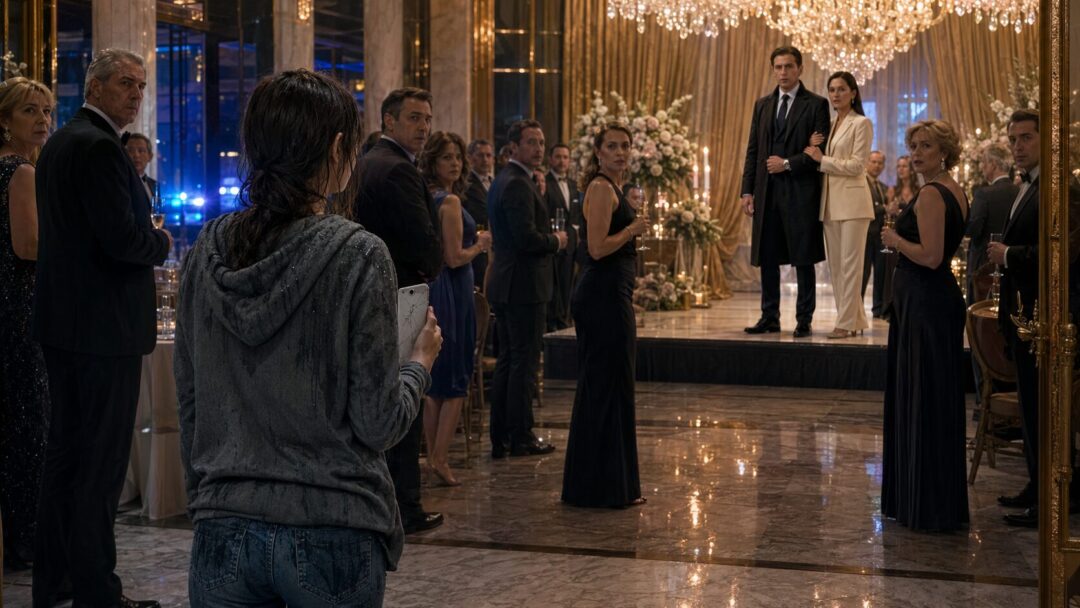
The doors were open. Light spilled into the hallway. A string quartet played near the windows, soft enough not to interrupt important voices. Waiters carried trays no one seemed hungry for. At the far end of the room, beneath white flowers and a silver arch, Commissioner March stood with a microphone.
Celia stood beside Adrian, one hand looped around his arm.
Nora stopped at the threshold.
Nobody had dressed for a child in a wet hoodie.
That was the first thing she noticed.
Every person in the ballroom seemed chosen for the room: silk, black wool, diamonds, cuff links, shoes that had never touched a bus floor. Nora looked down at her sneakers, still damp, and felt the old urge to apologize for existing near clean things.
Then she remembered Celia’s card on the desk.
A home outside the city.
Clean rooms.
Good staff.
Quiet disposal dressed as kindness.
Nora stepped inside.
“Adrian Vale,” the commissioner was saying, “is a man who understands the value of family, order, and responsibility.”
A few guests laughed softly, the way people laugh when power tells them what is funny.
Nora moved along the wall.
The phone was warm in her hand now. Alive, but barely. A black screen with white numbers waited for what only one person was supposed to know.
“More than a developer,” the commissioner continued, “Adrian builds trust. He builds futures.”
Adrian’s gaze shifted.
He saw her.
The room saw him see her.
That was the moment Nora understood how silence could become public.
Celia leaned close to Adrian without moving her smile.
“Do not make her real in this room.”
Nora could not hear it from where she stood.
But she read it on Celia’s mouth.
She had become good at reading what adults hoped children missed.
A guard approached her from the side.
“Miss,” he whispered, “you need to come with me.”
Nora shook her head.
The commissioner stopped speaking.
The string quartet faltered, then resumed, weaker.
Celia descended from the small platform, cream suit untouched by the world. She came toward Nora with all the room behind her.
“Sweetheart,” Celia said, loud enough for the closest tables to hear, “this is not the place.”
Nora held the phone tighter.
She thought of the hospital hallway. Not the place.
The lobby. Not the place.
The office. Not the place.
The whole life her mother had lived outside rooms like this. Never the place.
“Then where was the place?” Nora asked.
It was not loud.
It did not need to be.
The ballroom went still.
Someone near the back lifted a phone and began recording.
Celia’s face held, but only because it had been trained to.
Adrian stepped down from the platform.
Celia turned sharply. “Adrian.”
He stopped.
The old fear passed across his face, naked now. Nora saw him measure everything: the commissioner, the guests, Celia’s hand without him in it, the police waiting outside, the story already forming in other people’s mouths.
Then he looked at Nora.
Not the phone.
Nora.
He walked toward her.
Each step made the room more dangerous.
When he reached her, he did not stand over her. He lowered himself to one knee on the ballroom floor, in front of the guests, the flowers, the portrait, the commissioner, and the woman he was supposed to marry.
Nora took one step back before she could stop herself.
Adrian looked up at her.
“I should have taken it outside,” he said.
The line did not fix anything.
But it told the truth about the first wound.
Nora looked at his open hand. Then at his face.
Slowly, she gave him the phone.
Part VI — The Birthday
Adrian held the white phone like it might burn him.
The password screen glowed between them.
Celia stood a few feet away, her ring catching the chandelier light. Commissioner March watched from the platform, his face unreadable in the practiced way of men who had ended careers with fewer expressions.
Adrian typed six numbers.
The phone shook once.
Wrong password.
Nora knew before he said anything.
“Lena’s birthday,” he murmured.
Celia’s eyes sharpened.
Someone whispered.
Adrian tried again.
Wrong.
“The apartment,” he said, almost to himself. “West Mercer.”
Wrong.
The room was too quiet now. Even the rain against the windows seemed to be listening.
Adrian’s thumb hovered over the screen.
He knew her mother’s birthday.
He knew an apartment.
He knew the shape of an old life well enough to shame everyone around him.
But the phone would not open.
Nora felt something inside her grow very calm.
Not happy.
Not angry.
Calm in the way water gets flat before it freezes.
“Try my birthday,” she said.
Adrian looked up.
The room understood before he did.
His face emptied.
Nora waited.
One second.
Two.
Three.
He did not know it.
Celia’s mouth softened with relief so quick and ugly Nora almost missed it. Almost.
Adrian’s hand lowered.
“Nora,” he said.
She took the phone from him.
Her fingers did not shake now.
She entered the date herself.
August 14.
The phone opened.
For a moment, the screen showed her mother’s face again, young and laughing in the blue shirt. Then the notification appeared.
One saved voice message.
Nora pressed play.
At first there was only breathing.
Then Lena’s voice filled the ballroom, thin and tired and unmistakably alive in the way dead people can become when a machine remembers them.
“Baby,” Lena said, and Nora’s throat closed. “If you’re hearing this, I’m sorry. I wanted more time. Mothers always think they can make more by needing it badly enough.”
No one moved.
“I need you to listen carefully. Adrian may fail you first. He was trained to be afraid. That is not the same as not loving. But fear can hurt you just as much as hate if someone obeys it long enough.”
Adrian bowed his head.
Lena breathed in. The sound crackled.
“You are not a secret. You are not a mistake. You are not the bill anyone paid or the story anyone buried. You are my daughter. You were wanted every day I had you.”
Nora pressed the phone against her chest, but the message kept playing, her mother’s voice muffled against the hoodie.
“And Adrian, if you ever hear this, do not ask her to forgive you because you finally became brave where people could see. If you want to be her father, start by letting her be angry. Start by telling the truth when it costs you. Start by knowing that she owes you nothing.”
The message ended.
No one clapped.
No one whispered.
For once, the room had no use for performance.
Celia looked at Adrian. Something in her face was not only anger. There was humiliation there, yes, but also grief. Not for Nora. Not for Lena.
For the life in which she had been chosen cleanly.
She removed her engagement ring.
She did it slowly, because pride was the last thing she still controlled.
The ring landed in Adrian’s open palm with a small, bright sound.
“Congratulations,” she said. “You made her real.”
Adrian closed his hand around the ring, but his eyes stayed on Nora.
Commissioner March stepped down from the platform and walked past them without a word. The police detail outside began moving before he reached the doors.
The machinery was leaving.
The story was already out of its hands.
Adrian turned to Nora. “Let me take you home.”
Nora looked at him.
The word struck the wrong place.
“I don’t have one.”
His face folded around the sentence.
“Then let me start there,” he said.
She wanted, for one dangerous second, to believe him.
She wanted to be small enough for that to be enough.
Instead, she took the phone back from his hand.
“Not today.”
He nodded, but it hurt him.
Good, Nora thought.
Then hated herself for thinking it.
Then decided she was allowed.
Part VII — The Distance She Chose
Outside, the rain had thinned to mist.
The Grand Lydian glowed behind Nora as if nothing had happened inside it. Hotels were good at that. Wipe the marble. Replace the flowers. Smile at the next guest.
Nora sat beneath the glass awning where she had first waited, the white phone lit in her hands.
A woman from child services stood near the curb, speaking quietly into her own phone. She had kind eyes and tired shoes. Nora trusted the shoes more.
Adrian stood several feet away.
Not beside her.
Not behind her.
Where she could see him if she chose to look.
He had taken off his suit jacket and carried it over one arm. Without the stage, without Celia, without the commissioner’s approval hanging around him like armor, he looked less powerful.
Not harmless.
Just less protected.
Nora played the message again, but this time she held the phone to her ear so only she could hear.
Baby.
Her mother’s voice made the world narrow and bearable.
When it ended, Nora did not cry. She had cried enough in places that smelled like bleach and vending-machine coffee. She had cried into her mother’s sweater after the nurses told her there was nothing else they could do. She had cried so hard the first social worker had stopped asking questions and just sat beside her.
Here, under the hotel awning, she only breathed.
Adrian took one step forward.
Nora looked up.
He stopped.
That mattered more than any apology he had given.
“I’ll tell them,” he said. “All of it.”
Nora studied him. “Even if they hate you?”
“Yes.”
“Even if they say she trapped you?”
His jaw tightened. “Yes.”
“Even if they say I did?”
He looked sick.
“Yes,” he said. “Especially then.”
Nora believed that he meant it.
She did not yet know if he was strong enough to keep meaning it tomorrow.
Those were different things.
The social worker called her name gently.
Nora stood and slipped the phone into the front pocket of her gray hoodie. The weight of it rested against her stomach, warm now, alive now, hers.
Adrian looked at the pocket, then at her face.
For a second, he seemed about to ask for something. A hug. A promise. A chance to say daughter.
He asked for none of it.
Good, Nora thought again.
This time she did not hate herself.
She walked toward the curb.
After three steps, she heard him behind her.
Not close.
She turned.
Adrian had followed, but only to the edge of the awning. Rain misted his hair. He waited there, hands empty.
Nora looked at the space between them.
It was not forgiveness.
It was not punishment.
It was the first thing in her life that powerful adults had not decided for her.
“Stay there,” she said.
Adrian nodded.
Nora climbed into the waiting car.
Before the door closed, she looked back once.
He was still standing where she had told him to stand, under the glass entrance of the hotel, no longer walking away, no longer close enough to pretend the distance was gone.
Nora put one hand over the phone in her pocket.
For the first time all day, the screen was not black.
And for the first time all day, she did not hold it out to anyone.