The Morning Everything Changed
Part I — The Corner Table
Robert arrived before the rain became loud.
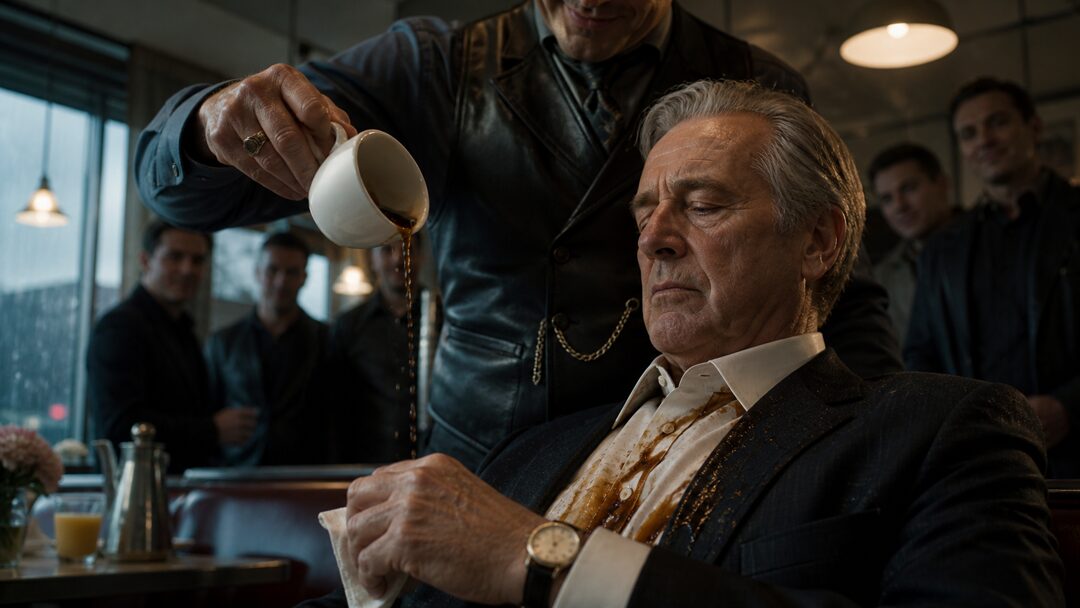
By the time Daniel noticed him, the windows of the roadside diner were streaked silver, the parking lot was filling with glossy cars, and Robert’s dark suit had already drawn a few curious glances from the breakfast crowd. He sat alone at the corner table, back straight, silver hair combed neatly, one hand resting beside an untouched cup of coffee.
He had dressed for his granddaughter’s engagement brunch.
Daniel dressed like he owned the room.
The leather riding vest came first, dark and expensive, patched with the name of a motorcycle club whose members did more charity galas than charity. Then the shoulders. Then the smile. Daniel had the kind of smile that made people forgive the warning signs because it arrived wrapped in money.
He stopped beside Robert’s table as if he had discovered an old stain on polished wood.
“Well,” Daniel said, loud enough for his friends to hear. “Look who came early.”
Robert looked up.
“Good morning, Daniel.”
The young men behind Daniel laughed before anything funny had happened. That was the privilege Daniel carried: people prepared their laughter in advance.
Daniel tilted his head. “You’re the old man from the corner table.”
Robert’s hand did not move.
“I believe I’m Emily’s grandfather.”
“Right.” Daniel smiled wider. “That too.”
A waitress near the counter froze with a coffee pot in her hand. Susan had reserved the private room for eleven. The engagement brunch was supposed to begin in forty minutes. Cream linen, gold-rimmed plates, little cards printed with Emily & Daniel in careful blue script.
Robert had not been invited by the printed cards.
Emily had texted him at dawn.
Please come. Mom says it’ll be complicated, but I want you there.
Daniel picked up Robert’s coffee cup.
“Careful,” one of his friends said, not because he meant it.
Daniel held the cup above Robert’s chest, studying him like a boy testing whether a dog would bite.
“You know,” Daniel said, “some rooms aren’t improved by everyone who enters them.”
Then he tipped the cup.
Coffee ran across Robert’s white shirt, down the lapel of his dark suit, and into his cuff.
For a second, no one breathed.
The sound came next: the wet patter of liquid hitting the floor, the clatter of a spoon knocked from the saucer, one shocked gasp near the register.
Then Daniel’s friends laughed.
Not loudly at first. They waited to see if it was safe.
Daniel made it safe.
“Oh,” he said, stepping back. “I’m sorry, sir.”
The word sir landed like a hand on the back of Robert’s neck.
Robert looked down at the spreading stain. It was dark and immediate, blooming over the shirt he had ironed himself that morning. He took a napkin from the dispenser. Folded it once. Pressed it to his cuff.
He did not stand.
He did not shout.
He did not call for help.
That, more than anything, seemed to irritate Daniel.
“You all right there?” Daniel asked.
Robert lifted his eyes.
“I’ve had worse mornings.”
The answer removed the laughter from the room one person at a time.
Daniel’s jaw tightened. He had expected outrage, trembling, maybe a frail old man’s messy pride. He had not expected control.
The bell above the diner door rang.
Susan came in under a cream coat, rain shining on her shoulders, phone pressed in one hand and a stack of seating cards in the other. Her hair was perfect in the way that meant it had been corrected three times in the car. She stopped when she saw Daniel standing over Robert.
Then she saw the suit.
Her face changed.
Not with anger.
With calculation.
“Dad,” she said softly.
Robert kept the napkin pressed to his cuff. “Susan.”
Daniel turned, all charm again. “Susan. Tiny accident.”
Susan’s eyes flicked from the coffee on Robert’s chest to the men behind Daniel, to the waitress, to the private room beyond the archway where flowers were being arranged.
Her lips parted.
For one thin second, Robert thought she might say the right thing.
Then Susan crossed the room quickly, crouched beside him, and whispered, “Please don’t make a scene.”
The rain hit the windows harder.
Robert looked at his daughter’s face. She had his eyes and her mother’s talent for turning fear into manners.
“A scene,” he repeated.
Susan’s smile tightened for the room. “Let’s get you cleaned up.”
Daniel watched them with the pleasure of a man finding out how cheaply loyalty could be bought.
Robert folded the stained napkin into a square and laid it beside his cup.
“No,” he said. “I’ll stay as I am.”
Susan’s fingers closed around the seating cards until the edges bent.
“Dad.”
His voice stayed quiet.
“I came for Emily.”
And across the diner, Daniel’s smile returned, colder this time, because he heard what Susan had not.
Robert had not said he came for the brunch.
He had said he came for the girl.
Part II — The Price of a Good Life
Emily arrived ten minutes later in a pale dress hidden under a raincoat, her hair damp at the ends, her engagement ring catching every dull bit of light in the diner.
She saw Daniel first.
That was the habit already.
Then she saw Robert.
Her face went white.
“Granddad.”
She moved toward him before Susan could stop her. Robert rose slowly, coffee stain dark across his chest, and Emily reached for his sleeve like she was five again and asking him not to leave after Sunday dinner.
“What happened?” she asked.
Daniel answered before Robert could.
“An accident, Em. Your grandfather and I were just getting acquainted.”
Emily looked at the cup, the floor, Daniel’s friends trying not to smile.
Her hand fell away from Robert’s sleeve.
Robert saw the moment she understood. He also saw the moment she decided not to understand it fully.
That was how bargains began.
Daniel stepped behind her and placed a hand at the small of her back. It was a polished gesture. Protective from a distance. Possessive up close.
“Don’t let it ruin the morning,” Daniel said into her hair. “Your grandfather’s tougher than he looks.”
Emily flinched at the word your, as though Daniel had placed Robert outside the circle of we.
Susan noticed the flinch. She noticed everything except what mattered.
“Emily,” she said brightly, “the florist is having trouble with the centerpieces.”
Emily did not move. “Granddad needs a dry shirt.”
“I’m fine,” Robert said.
“You’re not fine.”
Daniel laughed softly. “He said he’s fine. Let a man keep his pride.”
Robert looked at him.
Daniel’s smile did not drop. That was his gift. He could make cruelty look like confidence.
Susan touched Emily’s arm. “Sweetheart, guests are arriving soon. We can handle this quietly.”
Emily’s eyes filled with something too complicated to be tears. Shame, affection, fear, loyalty trying to survive in a room where everyone was pricing it.
Robert remembered her at eight years old, asleep on his sofa with a law book open over her knees because she had wanted to “work late” like him. He remembered Susan standing in his doorway, young and furious, saying, You never know when to stop being useful.
He had thought usefulness was love.
He had been wrong more than once.
Daniel leaned down, his mouth near Emily’s ear, but his eyes on Robert. “Maybe your grandfather would be more comfortable at home.”
Emily stiffened.
Robert heard the sentence beneath the sentence.
Send him away.
Susan heard it too. She turned toward Robert with a practiced look of concern.
“Dad, you know how these events are. Daniel’s parents are coming. His father’s partners. The press might even send someone from the society page.” She lowered her voice. “This is important.”
Robert took the old watch from his pocket and checked the time. He had worn it instead of the gold one Daniel’s family would have recognized from old boardroom photographs. This one had belonged to his wife, Mary’s father. Plain face. Leather strap. Honest weight.
“I know exactly how important it is.”
Susan’s nostrils flared. “Then help me.”
Daniel’s friends had drifted toward the counter, but not far enough to miss anything. The waitress had set down the coffee pot and was wiping the same clean spot with increasing desperation.
Emily whispered, “Mom, why wasn’t Granddad on the main seating list?”
Susan’s face hardened for half a second.
“Because your grandfather doesn’t enjoy crowds.”
Robert almost smiled.
There were lies that hid shame.
Then there were lies that taught the next generation where to stand.
Emily looked at Robert. “Is that true?”
Robert did not answer quickly enough.
Daniel did.
“Emily, baby, today isn’t about old family politics.”
Baby. In public. Soft enough to sound affectionate. Firm enough to close a door.
Emily’s mouth shut.
Robert watched the ring on her finger. Large, clear, cold. A diamond that looked less like a promise than a signature.
Daniel lifted her hand and kissed it for the room.
A few early guests near the private room smiled. They saw a handsome man loving his bride-to-be. They did not see his thumb pressing over the ring, pinning it in place.
Robert saw.
Susan saw too.
That was the worst part.
She saw, and she began arranging napkins.
“Dad,” Susan said, with that same bright panic, “come with me for a minute.”
Robert followed her past the counter, past framed photos of old local parades, toward the narrow hallway by the restrooms. He left the stained napkin on the table.
Daniel watched him leave it.
So did Emily.
The napkin sat there like a witness no one had agreed to call.
In the hallway, Susan turned on him.
“What are you doing?”
Robert looked down at his shirt. “Standing still, mostly.”
“This is not funny.”
“No.”
“You think you can sit there looking wounded and make everyone feel guilty?”
“Do they?”
Susan’s eyes flashed.
There she was. His daughter beneath the cream coat. The girl who used to come home from school furious because someone had mistaken her secondhand shoes for poverty instead of discipline.
“You always do this,” she said. “You say nothing, and somehow the silence becomes an accusation.”
Robert’s voice softened. “Susan.”
“No. Don’t.” She looked toward the dining room, where Daniel’s laughter rose and fell. “Daniel’s father is signing the papers this week. The investment saves my catering business. It saves this property. It gives Emily a house, security, a real place in a family that can protect her.”
Robert let that settle.
“A family like that?”
Her mouth trembled, but only once.
“You don’t know what it’s like to wake up every morning wondering which bill is going to finish you.”
“I know more than you think.”
“You know control,” she snapped. “You know trusts and signatures and waiting for people to come begging.”
The word signature hung between them.
Robert’s eyes narrowed slightly.
Susan realized she had said too much. Her hand went to her collar, smoothing what was not wrinkled.
He asked quietly, “What did Daniel tell you?”
“Nothing.”
“Susan.”
She looked away.
The private room doors opened. A burst of warm air, perfume, flowers, and polite voices reached the hallway.
Susan’s voice dropped.
“He had you looked into. That’s all.”
Robert did not move.
“He was worried,” she said quickly. “His father was worried. About old disputes. About the foundation. About whether you’d create problems.”
“And pouring coffee on me was his solution?”
Her eyes shone now.
“He wanted to know if you’d make a scene.”
Robert looked at his daughter as if the hallway had lengthened between them.
“And you knew.”
Susan’s silence answered before she did.
“He said if you reacted badly, it would prove you couldn’t be trusted near the brunch. Near Emily.” Her voice broke, then hardened again, because shame made her cruel. “I thought your pride could survive one uncomfortable morning.”
Robert’s hand closed around the watch in his pocket.
“My pride.”
“You’ve survived worse.”
Robert nodded once.
That was true.
It was also the smallest thing she could have said.
“You believed I was safe to sacrifice,” he said.
Susan flinched.
“Don’t make it sound like that.”
“What should I make it sound like?”
“Like a mother trying to keep her daughter from struggling the way I did.”
Robert looked toward the diner. Emily stood beside Daniel near the private room, smiling at a couple she clearly didn’t know, her shoulders too high.
“She is already struggling,” he said.
Susan followed his gaze, and for a moment her face collapsed with love. Then fear rebuilt it.
“Please,” she whispered. “For Emily.”
Robert’s answer came slowly.
“That is why I came.”
He walked back into the diner before Susan could decide whether that comforted her.
It should not have.
Part III — Front Entrance
Daniel was telling a story when Robert returned.
It involved a mountain road, a charity ride, and a man who had “forgotten his place” in a way Daniel’s friends found hilarious. Robert did not hear the details. He heard Emily laughing half a second late.
That was enough.
Daniel saw him approach and spread his arms.
“There he is. Cleaned up?”
Robert sat at the corner table again, the wet fabric pulling cold against his shirt.
“No.”
Daniel’s eyes flicked to Susan, returning behind him. Something passed between them. A check. A confirmation.
Robert took his phone from inside his suit jacket.
Daniel laughed. “Calling someone?”
“Yes.”
The room sharpened.
Susan stepped closer. “Dad.”
Robert ignored her and pressed one number.
The call connected on the second ring.
A man’s voice answered. “Sir?”
Robert watched Daniel watch him.
“Michael,” he said. “Bring the documents. Front entrance.”
Then he ended the call.
That was all.
For a moment, the diner held its breath again.
Then Daniel smiled.
“Oh, that was beautiful.” He clapped once, slowly. “That was almost cinematic.”
His friends relaxed. One of them laughed too loudly.
Susan’s face had gone still.
Emily looked from Robert to her mother. “What documents?”
Daniel slid into the booth across from Robert without being invited. The leather creaked. The smile stayed.
“Let me save everyone time,” he said. “Whatever old grudge you think you’re carrying, today is not the day. Emily deserves peace.”
Robert folded his hands.
“Does she?”
Daniel leaned forward.
“You know, my father respects history. He respects older men who helped build this town.” His voice dropped just enough to become private and public at once. “But nobody respects a man who uses family moments to feel powerful again.”
Robert looked at Daniel’s hand on the table. Broad. Clean nails. A silver signet ring with his family crest.
“Is that why you spilled the coffee?”
Daniel’s smile thinned.
“I said it was an accident.”
“No,” Robert said. “You said it loudly.”
Emily’s eyes lifted.
It was a small sentence.
It opened a large door.
The first black SUV appeared through the rain.
It rolled into the lot slowly, headlights blurred by water, tires hissing over wet asphalt. Then another turned in behind it. Then a third.
The laughter died without being asked.
Daniel did not look at the window at first. He looked at Robert, trying to measure whether the old man had expected this much effect.
Robert had.
Susan whispered, “Dad, what did you do?”
Robert did not answer.
Michael got out of the lead SUV under a black umbrella. He was younger than Robert by twenty years, wearing a dark coat and carrying a sealed leather portfolio. Two security men stepped out behind him. Not dramatic men. Not threatening men. Men who did not need to explain why they were there.
Daniel stood.
For the first time that morning, his height did not help him.
The diner door opened, and rain swept in with Michael.
“Mr. Hale,” Michael said.
Robert nodded.
Daniel’s face changed at the name.
Not fully.
Just enough.
Emily saw it.
Susan saw it.
Robert saw Daniel realize that the old man from the corner table had a last name his father had said with caution.
Michael placed the leather portfolio on Robert’s table.
“Your counsel is five minutes behind us,” he said. “Mr. Voss’s representatives are already aware we’re here.”
Daniel’s smile returned too quickly. “This is absurd.”
Robert opened the portfolio.
Inside were documents with colored tabs, signatures, foundation seals, emails printed and clipped behind legal summaries. None of it needed to be understood at a glance. It only needed to exist.
Daniel looked toward the private room.
Guests were arriving faster now. Coats being hung. Voices warming the space. Emily’s future displayed in flowers and glassware.
He lowered his voice.
“Do you have any idea what kind of morning this is for Emily?”
Robert looked at his granddaughter.
“Yes.”
Daniel stepped toward her and took her hand.
“Em,” he said, gentle now, wounded now, perfect now. “Your grandfather is trying to embarrass us.”
Emily swallowed.
Robert waited.
This was what he had come for. Not the documents. Not Daniel. Not the satisfaction of watching a bully discover a locked door.
He had come to see whether love could recognize him without proof.
Emily’s hand stayed in Daniel’s.
Susan moved beside her daughter. “Dad, please. Not here.”
Robert looked at both of them.
For one second, he almost closed the portfolio.
He had spent most of his life refusing to break things in public. Marriages, deals, family illusions. He had been paid to settle quietly. He had taught Susan that storms could be survived by shutting every window.
And here she was, asking him to shut another one while her daughter learned to breathe less.
Michael leaned down.
“Mr. Hale, Mr. Voss’s office just called. They’re requesting a private conversation before anything is said in the room.”
Daniel heard the name Voss and straightened.
“My father has nothing to discuss with him.”
Michael looked at Daniel with professional emptiness.
“Your father disagrees.”
That landed harder than any raised voice could have.
Daniel released Emily’s hand.
Only then did she look down at the place where his fingers had been.
Robert closed the portfolio halfway.
“Daniel,” he said, “you should call your father.”
Daniel’s cheeks reddened.
“You don’t tell me what to do.”
“No,” Robert said. “Apparently he does.”
The line was quiet.
It cut the room cleanly.
Daniel’s friends stared at their boots, their cups, the rain, anywhere else.
Susan pressed both hands against the back of a chair as if she had become suddenly tired.
Emily took one step away from Daniel.
It was not enough to be freedom.
But it was enough to be noticed.
Daniel noticed.
His face softened into something dangerous.
“Emily,” he said, “come here.”
She did not.
The private room doors opened again, and a woman inside called, “Susan? We’re ready whenever you are.”
Ready.
The word almost made Robert laugh.
No one in that diner was ready.
Part IV — The Room Prepared for Celebration
Daniel recovered the way men like him recover: by changing the audience.
He turned away from Robert, away from the portfolio, and walked into the private room with his smile restored. His friends followed at a distance, uncertain whether they were still part of a victory.
Emily stood frozen between the diner and the brunch.
Susan touched her shoulder. “Sweetheart, we need to go in.”
Emily stared at Robert’s stained shirt. “Did you know he would do that?”
Susan’s hand dropped.
Robert looked at his daughter.
Susan said, “Not exactly.”
Emily turned to her slowly.
“Not exactly?”
Susan’s lips moved, but the room beyond them was filling with guests, and the old reflex won again.
“Later.”
Emily gave a small, broken laugh.
“That’s what you always say when the truth is inconvenient.”
Susan flinched as if Emily had raised a hand.
Robert stood.
The stain had cooled against his skin. His jacket hung heavier now, one lapel darkened, one cuff marked. Michael moved as if to help him.
Robert shook his head.
He took the stained napkin from the table.
Then he walked toward the private room.
Susan caught his arm.
“Don’t do this to her.”
Robert looked at her hand on his sleeve. Her fingers were shaking.
“I’m not the one doing it.”
Inside the private room, the brunch had been arranged with the desperate elegance of people who needed photographs. White flowers. Gold chairs. A long table with crystal glasses catching gray morning light. At the far end, Daniel stood beside an older man in a charcoal suit—one of his father’s representatives, not his father himself. Powerful men often sent shadows before bodies.
Daniel put an arm around Emily the moment she entered.
She went stiff.
He smiled for the guests.
“Everyone,” Daniel said, voice smooth and full, “we’ve had a small family disturbance.”
A murmur passed through the room.
Robert stepped inside behind Emily.
Wet suit. Stained shirt. Napkin in hand.
Every eye found him.
Daniel sighed, regretful and kind. “Emily’s grandfather hasn’t been well.”
Susan closed her eyes.
Robert did not speak.
Daniel continued, warming to the performance. “We’re handling it privately. He’s confused about some old business matters, and unfortunately he chose this morning to—”
“Stop,” Emily said.
One word.
Not loud.
But it was hers.
Daniel’s arm tightened around her waist. “Em, I’m protecting you.”
She looked at his hand.
“No,” she said. “You’re holding me still.”
The room shifted again.
Daniel’s representative moved toward Michael, whispering urgently. Michael opened the portfolio and removed a set of documents clipped beneath a foundation seal.
Robert walked to the head of the long table.
He did not ask permission.
Guests moved their plates, their glasses, their phones.
Robert placed the documents in the center of the table.
The stained napkin went beside them.
Daniel laughed once. “This is insane.”
Robert looked at the room.
“I will be brief.”
Susan covered her mouth with one hand.
Daniel’s face hardened. “You don’t have standing here.”
Robert touched the top page.
“I am the trustee of the Hale Foundation land trust. The final transfer your father needs does not proceed without my signature.”
Silence.
Not the awkward kind.
The expensive kind.
The kind that knows money has just entered the room wearing another name.
Daniel’s representative stopped whispering.
Robert continued, his voice even. “That transfer has been presented to several people in this room as a redevelopment partnership. It is not. It is a method of covering debt, moving liability, and placing pressure on a marriage that should have had nothing to do with land.”
Daniel’s smile was gone now.
“Careful,” he said.
Robert looked at him. “I have been careful all my life. That is why you are hearing this from me and not from a court filing.”
The word court did what shouting could not.
Phones lowered.
Faces sharpened.
Susan whispered, “Dad…”
Robert did not look at her.
“Your family approached Susan’s catering business through a shell vendor. Advance payments. Inflated service agreements. Promises of future investment tied to Emily’s marriage timeline.” He turned one page. “Your father’s people were careless enough to put affection in writing as if it were collateral.”
Emily’s face drained.
She looked at Susan.
Susan shook her head, but not in denial.
In pleading.
Emily understood the difference.
“Mom,” she said, “what did you sign?”
Susan’s eyes filled. “I was trying to save us.”
Daniel seized on that.
“There it is,” he said, stepping forward. “She was trying to save you. All of you. And this old man wants to humiliate your mother because he can’t stand not being obeyed.”
Robert’s expression did not change.
But his hand moved once, toward the watch in his pocket.
Emily saw it.
She had seen that gesture before at funerals, at graduations, outside hospital rooms when her grandmother was still alive. Robert never touched the watch when he was angry.
Only when something hurt.
Daniel turned to the guests, voice rising. “You see what this is? He controls money. He controls signatures. He controls people by waiting until the worst possible moment to remind them they need him.”
There was enough truth in it to hurt.
Robert accepted that hurt without flinching.
“Yes,” he said.
The room went still.
Susan looked up.
Robert’s voice remained low. “I have controlled too much. I have mistaken silence for protection. I have let people believe I was absent because I did not know how to ask them to stay.”
Emily’s eyes shone.
“But this morning,” Robert said, looking at Daniel now, “you poured coffee over me because you believed everyone here would rather explain away cruelty than risk losing what your family promised.”
Daniel’s nostrils flared.
“And you were almost right.”
That sentence landed on Susan.
She bent as if it had weight.
Daniel reached for Emily again. “We’re leaving.”
Robert spoke before she could move.
“Emily.”
She turned.
He did not soften his voice. That would have made the moment smaller.
“Your inheritance is protected whether you marry him or not.”
Daniel froze.
Susan’s head snapped toward Robert.
Emily whispered, “What?”
Robert looked at his granddaughter, and for the first time that morning, the room seemed to fall away from him.
“I should have told you sooner. That is my fault. But no contract, no investment, no brunch, and no man in this room gets to decide whether you are safe.” He swallowed once. “You already are.”
Daniel laughed sharply. “That’s convenient.”
Robert did not look away from Emily.
“I will not bless a marriage that requires you to become smaller in order to be loved.”
Emily’s face broke.
Not dramatically.
Quietly.
Like a door opening in a house that had been locked for years.
Daniel stepped close to her, voice low enough to sound intimate and cruel enough to carry.
“Choose carefully.”
Susan moved too, panic taking her manners apart.
“Emily, please. Don’t throw away your life because of one ugly morning.”
Emily looked at her mother.
“One?”
Susan had no answer.
Daniel held out his hand.
“Give me your hand, Emily.”
That was when everyone saw the ring.
Heavy on her finger. Bright under the chandelier. A promise that had begun to look like a receipt.
Emily stared at it for a long moment.
Then she twisted it once.
It stuck.
Daniel’s face changed.
“Emily.”
She pulled harder.
The ring came free.
No one moved.
Emily walked to the table where the documents lay open, where the stained napkin sat folded in a square.
She placed the ring beside it.
Metal against paper.
Promise beside proof.
The sound was tiny.
It ended the morning anyway.
Part V — What Remained in the Rain
Daniel did not shout.
That would have cost him too much.
He looked at the ring, then at Emily, then at the watching room, and gathered his pride around him like a coat.
“You’ll regret this,” he said.
Emily’s voice shook.
“I already did.”
His face tightened.
For a second, the charm vanished completely, and what remained was not power but fear dressed as anger. Then his representative touched his sleeve and murmured something Robert could not hear.
Daniel looked toward the windows.
Three black SUVs waited in the rain.
For the first time all morning, they were not his symbols.
He walked out with his friends behind him, no laughter left among them. Their boots sounded too loud on the diner floor. The bell over the door rang when they left, bright and ridiculous.
Outside, Daniel paused under the awning and looked back once.
No one followed.
That was the part he would remember.
Inside the private room, guests began the soft shuffle of people who wanted to leave without being rude. Coats were gathered. Chairs scraped. Someone whispered into a phone. Someone else pretended not to.
Susan stood beside the table, staring at the ring as if it were a bill she could not pay.
Emily did not touch it again.
Robert gathered the documents, leaving the napkin where it was. Michael took the portfolio quietly.
“Sir,” he said, “the car is ready.”
Robert nodded.
Susan reached for him.
This time, he let her hand touch his sleeve.
“Dad,” she said.
Her voice was not polished now. It was smaller, almost young.
Robert waited.
Susan looked at the coffee stain. Her eyes filled and overflowed, one tear escaping before she could manage it back into dignity.
“I thought you could absorb it,” she whispered.
“I know.”
That hurt her more than anger would have.
“I was scared.”
“I know that too.”
“I’m sorry.”
Robert looked at his daughter for a long time. The private room smelled of coffee, rain, expensive flowers, and the kind of celebration that had turned into evidence.
“I believe you,” he said.
Susan’s face lifted with fragile hope.
Then he added, “I am not ready to forgive you today.”
The hope did not break loudly.
It just left.
Susan nodded once, because there was nothing else to arrange.
Emily stepped beside Robert. She had taken off the raincoat earlier, and now her pale dress looked too formal for the ruined room. Without the ring, her hand seemed bare and young.
“Can I come with you?” she asked.
Robert looked at her.
Not rescued.
Not triumphant.
Shaking, ashamed, free in the most frightening way.
“Yes,” he said.
Susan made a sound.
Emily turned to her mother.
For a moment, Robert thought Emily might say something final. Something sharp enough to balance all the years of being managed.
But she only said, “I need air.”
That was worse, somehow.
Because it was not punishment.
It was truth.
They walked through the diner together. The waitress stepped aside, eyes wet, hands folded around the coffee pot.
“I’m sorry,” she whispered to Robert.
He paused.
“You didn’t spill it.”
Her face crumpled.
Outside, rain softened the parking lot into reflections. Michael opened the rear door of the first SUV.
Emily climbed in first, then Robert. He moved carefully, one hand on the door frame, the stained cuff visible against the black paint.
For a while, neither of them spoke.
The diner blurred behind them. Through the window, Susan stood under the awning without an umbrella, cream coat darkening at the shoulders, watching the car that carried away both her father and her daughter.
Emily looked down at her empty hand.
“I loved him,” she said.
Robert nodded.
“I know.”
“I don’t know what that says about me.”
“It says you wanted to be chosen.”
Her mouth trembled.
“That sounds weak.”
“No,” Robert said. “It sounds human.”
She wiped her face with the back of her hand, then looked at his cuff.
“I should’ve said something sooner.”
Robert followed her gaze to the stain.
Brown had settled into the white fabric. No longer spreading. No longer hot. Just there.
“So should I,” he said.
The driver waited for instructions.
Robert looked once more at the diner. At Susan in the rain. At the private room windows glowing softly behind her. At the morning that had given him back his dignity and taken something else in payment.
Emily leaned her head against the seat, exhausted.
“Will it come out?” she asked.
Robert touched the cuff with his thumb.
The suit could be cleaned. The shirt could be replaced. The story would not.
“Some things don’t wash out,” he said. “You just stop pretending they were never spilled.”
Emily closed her eyes.
The SUV pulled away from the diner, carrying them into the rain, away from the flowers, the ring, the untouched brunch, and the woman standing beneath the awning with no one left to impress.
Robert did not hide the stain.
Not from Emily.
Not from himself.
Not anymore.