The Man in the White Shirt
The Man in the White Shirt
Part I — The Stain
By the time the iced coffee hit his chest, the whole café had gone silent.
It was not the kind of silence people chose. It was the kind that fell when something ugly happened so fast no one had time to look away first.
The drink spread across the front of the man’s white T-shirt in a dark, cold splash. It soaked through the cotton immediately, dripping down to the waistband of his faded jeans and splattering onto the polished marble floor of the hotel café. A woman near the window lowered her fork halfway to her mouth. A businessman with an open laptop stopped typing. One of the servers froze beside a table, still holding a pot of coffee, her face stiff with disbelief.
The man who had been hit did not move at first.
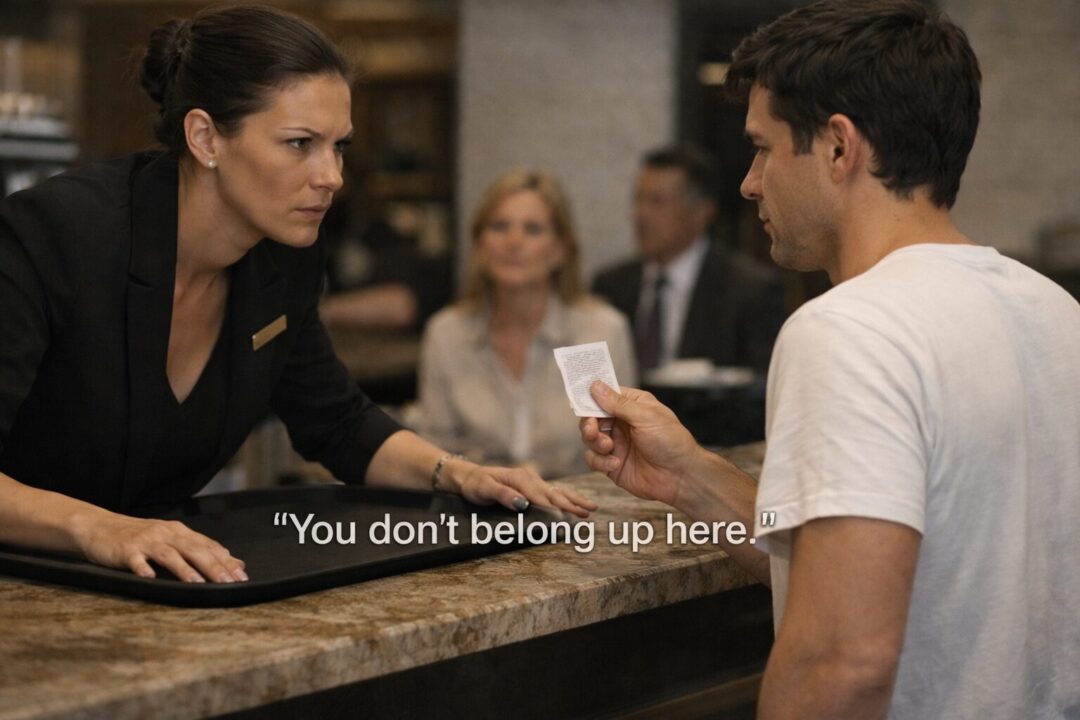
He stood on the customer side of the counter with one hand wrapped around a crumpled breakfast slip and the other hanging uselessly at his side, as if his body had not yet decided whether this was pain, shock, or humiliation. His hair was still damp from the rain outside. His sneakers were worn at the edges. In a room filled with tailored jackets, designer handbags, and polished leather shoes, he looked like the one person who did not belong.
That, apparently, had been enough for Marisol Kane.
Marisol was the breakfast supervisor, a woman in her early thirties with a sleek black blazer, a gold name pin, and the kind of posture that always seemed one breath away from an argument. She still stood behind the counter with her chin lifted, fingers tight around the empty plastic cup she had just hurled.
“You’re bothering my guests,” she said, each word clipped and cold. “I asked you to leave.”
The man looked down at the stain blooming over his shirt, then back at her.
For one strange second, his expression did not show anger. It showed something more dangerous than that.
Recognition.
As if this moment had confirmed something he had been trying not to believe since he walked into the hotel.
He swallowed, lifted the damp breakfast slip between two fingers, and said quietly, “You never even read it.”
Marisol laughed once under her breath. “I didn’t need to.”
But she had. That was the problem.
Or rather, she had looked at it just long enough to decide it did not matter.
The man had arrived twenty minutes earlier, wet from the drizzle outside, asking for a prepaid breakfast order and saying he was waiting for someone from upstairs. He had said it politely. Too politely, maybe. The kind of politeness people used when they were already being treated like a problem and were trying to avoid becoming one.
Marisol had seen the cheap clothes, the tired face, the scuffed shoes, and decided the rest of the story for herself.
Now the story sat all over his shirt.
He drew a slow breath. Around him, no one spoke.
And that was when a second man stepped into the doorway from the lobby and changed the meaning of everything.
He was tall, somewhere in his forties, in a dark tailored suit that looked expensive without trying to. He moved with the kind of contained authority that made people notice before they understood why. His hotel badge caught the light as he crossed the marble floor.
He took in the stained shirt, the wet floor, the breakfast slip, and finally Marisol’s face.
Then he looked at the soaked man and said, in a voice that was soft enough to make the silence sharper, “Mr. Vale?”
The man in the white shirt closed his eyes for a beat, as if he had been hoping this would not happen in front of witnesses.
When he opened them again, the humiliation in his face had settled into something steadier.
“Yes, Graham,” he said. “Good morning.”
Marisol’s fingers loosened around the cup.
Graham Mercer, general manager of the Ashcroft Hotel, did not look at her yet. His attention stayed on the young man at the counter, and in that single act of recognition, the air in the room shifted.
The young man was not who Marisol had assumed.
He was not lost.
He was not loitering.
And he was not powerless.
Part II — What Marisol Saw
Later, when staff whispered about the incident in service corridors and loading bays, everyone described it as if it had happened in one violent burst. But it had begun hours earlier, with exhaustion, resentment, and the quiet arrogance of someone who thought she had learned how the world worked.
Marisol had started her shift at five-thirty that morning.
The Ashcroft liked to pretend its breakfast service ran on grace and elegance, but what it really ran on was pressure. Pressure to keep wealthy guests happy. Pressure to smooth over complaints before they reached corporate. Pressure to maintain the illusion that luxury was effortless and that the people providing it were invisible unless needed.
Marisol had become good at that illusion. Better than most.
She had grown up in a neighborhood where polished places like the Ashcroft existed only on television. She had worked her way through community college, taken every bad shift no one else wanted, and built herself into a woman who belonged in expensive rooms by never once allowing herself to look uncertain in them.
That ambition had sharp edges.
It made her fast, observant, and efficient. It also made her ruthless in ways she barely noticed anymore.
She could read guests in seconds—who tipped, who complained, who expected apologies before they had earned them, who wanted discretion, who wanted to be admired. She trusted those judgments because they had helped her survive.
What she never admitted was how often those judgments slid into contempt.
Especially for people who reminded her of everything she had once been taught expensive places did not forgive.
So when the young man in the plain white shirt walked in through the side entrance instead of the lobby doors, she made a decision before he reached the counter.
He looked like trouble.
Not dangerous trouble, exactly. Worse. Embarrassing trouble. The kind that made affluent guests glance up from their cappuccinos and wonder whether standards were slipping.
He had rain on his shoulders and no jacket. No watch she could see. No room key in his hand. No polished confidence. Just a folded receipt and a calm voice.
“I’m here for the breakfast order,” he had said. “And I’m supposed to meet someone from upstairs.”
Marisol had looked at the slip, then at him.
“Are you a delivery driver?”
He blinked. “No.”
“Then I need you not to stand here blocking the counter.”
“I’m not blocking it.”
“Sir, this is for guests.”
His mouth tightened then, though he did not raise his voice. “I know.”
That had irritated her more than anger would have.
There was something about restraint that felt, to Marisol, like a challenge. As if a person who stayed calm while being dismissed believed he had the right to.
She asked for a room number. He said he was meeting someone from management. She asked for a name. He hesitated for only a second before saying he would rather wait. That sealed it for her.
A real guest, in her mind, would have led with credentials.
Someone who belonged would know how to prove it.
So she pressed harder. Her tone sharpened. He lifted the slip again. She cut him off. The guests noticed. Which made her feel watched. Which made her feel defensive. Which made her cruel.
By the time he said, “You’re making a mistake,” she wanted him gone more than she wanted to be right.
And when he still did not leave, she reached for the iced coffee beside the register and acted on the ugliest impulse in the room.
It happened before she could disguise it as policy.
Before she could turn it into customer management.
Before she could tell herself any clean lie.
She had wanted to humiliate him.
That was the truth.
And the truth was now standing in front of Graham Mercer with coffee dripping off his shirt.
Part III — The Name Behind the Slip
“Get me a towel,” Graham said at last.
No one moved.
Not because they had not heard him. Because everyone was looking at Marisol.
A server hurried off. Graham stepped closer to the young man. “Julian,” he said more quietly, “I’m sorry.”
The name landed like a dropped tray.
Julian Vale.
Marisol had heard it before, though never in person. The Ashcroft had one of those old-money ownership structures no employee fully understood, just enough family branches and private holdings to keep rumors alive. The chairman, Everett Vale, almost never came in, but his name lived in contracts, meetings, whispered warnings, and impossible standards.
Once, months ago, Marisol had heard that the chairman’s son might visit someday. Quietly, without media or ceremony. No one seemed to know when. Or why it mattered.
She had forgotten it within a week.
Now Graham Mercer was looking at the man she had drenched and calling him Julian.
Marisol felt the first clean edge of fear.
Julian gave a small, humorless smile. “You picked a great place for breakfast.”
Graham’s jaw tightened. “I can explain later.”
“No,” Julian said. “I think this already explained plenty.”
The towel arrived. Graham offered it, but Julian only used it to blot the coffee from his neck. He looked around the café—at the guests pretending not to listen, at the trembling server near the coffee station, at the stain spreading across the floor—and something in his face changed.
He was angry. Of course he was. But under the anger was disappointment so old it seemed to have arrived before he did.
Marisol heard herself say, “Sir, I didn’t know—”
Julian turned toward her then.
It was the first time he had looked at her without confusion.
Without appeal.
Without trying to convince her of anything.
“That’s exactly the problem,” he said.
There was no shouting in it. No grand performance. Somehow that made it hit harder.
Marisol straightened instinctively, clinging to the last shreds of professional posture. “You refused to identify yourself.”
Julian stared at her for a beat. “I said I was meeting management. I showed you the breakfast slip. I stood here and let you speak to me like I was beneath the room. What part of this required a drink in the face?”
Her mouth opened, then closed.
She had no answer that did not sound like what it was.
Graham spoke carefully. “Julian came because Mr. Vale wanted him to see the property before next quarter’s review. Quietly.”
The words struck harder than the name itself.
Next quarter’s review.
This was not some personal visit. This mattered. Operationally. Professionally. Permanently.
Marisol felt heat crawl up her throat.
Julian looked at the crumpled slip in his hand and smoothed it against the counter. It was, absurdly, just a breakfast order. A receipt for coffee, eggs, fruit, toast. Proof not of wealth, but of the simplest claim any customer could make: I belong here because I paid to be here.
He set it down between them.
“You didn’t need my name,” he said. “You just needed to treat me like a person.”
Around them, the silence deepened.
That was the moment Marisol realized the damage was beyond employment. Beyond discipline. What had shattered was the story she told herself about why she acted the way she did.
She had always believed her severity came from standards.
From pressure.
From knowing how quickly the wrong guest could complain and ruin someone’s week.
But none of that explained the look in her own hand when she threw the cup.
Cruelty did.
And now it had witnesses.
Part IV — The Cost of Being Seen
Graham cleared the café within minutes.
Guests were moved with apologies. Breakfast service shifted to the adjoining room. Someone from housekeeping came to mop the floor. Someone else brought Julian a clean shirt from the boutique downstairs, still folded in tissue paper.
Julian refused to put it on immediately.
Instead, he stood near the window with the stained white shirt clinging to him, looking out at the wet city street while Graham spoke in low, urgent tones into his phone.
Marisol remained by the counter because she could not think of anywhere else to stand.
No one told her to leave.
That was almost worse.
She had the strange sensation of being visible in a way she had avoided her entire adult life—not admired, not respected, not feared, but seen. Seen without the armor of professionalism. Seen as a woman who had humiliated someone weaker because she believed she could.
After a long minute, Julian turned away from the window.
Up close, he looked younger than she had first thought. Late twenties, maybe. There was nothing flashy about him. No expensive watch. No cultivated indifference. Just an intelligent face made older by restraint.
“Why’d you come in like that?” she asked before she could stop herself.
Graham shot her a warning look, but Julian answered.
“Like what?”
“Without…” She gestured vaguely, ashamed of the sentence already. “Without making it obvious.”
He gave a tired exhale. “Because I wanted to know whether people here treat everyone with dignity, or only the people who signal status correctly.”
Marisol felt the answer before he finished it.
This had been a test, though not in the official way she feared.
Not a trap.
A question.
And she had answered it in the ugliest possible language.
Julian looked down at the shirt, at the spreading brown stain that had begun to dry around the edges. “My father thinks the hotel runs on metrics,” he said. “Occupancy, reviews, margins, service speed. He’s not wrong. But places like this also run on instinct. On what employees do when no one important seems to be watching.”
Then he lifted his eyes to hers.
“You thought no one important was watching.”
Marisol could not hold the gaze.
For the first time in years, words deserted her.
She had spent so much of her life trying to outrun the embarrassment of where she came from that she had become someone who inflicted embarrassment on others first. It felt, suddenly, like standing in front of a mirror that did not flatter.
Graham approached with the boxed shirt. “There’s a private room upstairs,” he said to Julian. “Whenever you’re ready.”
Julian nodded but did not move.
“What happens now?” Marisol asked.
Graham answered before Julian could. “You’ll meet with HR.”
But Julian said, “That’s not really the question, is it?”
She looked at him.
He folded the towel once, neatly, and set it on the counter beside the receipt. “What happens now,” he said, “depends on whether this is the worst version of you, or the most honest one.”
The sentence landed somewhere deeper than fear.
Because a suspension, a termination, even a formal complaint—those were consequences. Understandable ones. Concrete. They lived in paperwork.
This was different.
This was a demand for self-recognition.
And it was terrible.
Part V — The White Shirt
Marisol was suspended that afternoon.
By the end of the week, she submitted a resignation before the review process could finish its full course. Some staff thought she was pushed. Others thought she ran. The truth was messier. She left because staying would have required a kind of honesty she had not yet learned how to survive.
Two months later, she took a management job at a smaller hotel near the river. No marble lobby. No polished mythology. Just regular travelers, tired families, and businesspeople who spilled their own coffee and laughed about it.
On her first morning there, a man in paint-splattered work pants approached the desk to ask where breakfast was being served. For one flicker of a second, an old reflex rose inside her—the instant ranking, the silent sorting.
She killed it before it finished forming.
“Second floor,” she said. “Would you like me to show you?”
The man smiled in surprise. “That’d be great.”
It was a small thing. So small no one else would have remembered it by lunch. But Marisol felt it like a hinge moving.
Not redemption. Not yet.
Just the beginning of a different habit.
As for Julian Vale, he returned to the Ashcroft three times before the quarter ended. Always dressed plainly. Always without announcement. The staff learned quickly that he paid more attention to unguarded moments than polished presentations. He noticed who listened, who snapped, who looked through people, who made room for them.
He was not sentimental about it.
But he was exact.
The breakfast supervisor position remained open for weeks. Then it was filled by a woman who had once worked banquets and had a way of speaking to both guests and dishwashers with the same level voice.
The first policy change Julian approved was small enough to seem ridiculous on paper: all front-of-house staff were to respond to confusion with assistance before suspicion.
Some executives rolled their eyes.
He did not care.
Months after the incident, the stained white shirt returned from the cleaners and was delivered to his office upstairs. The hotel’s service was excellent; they had managed to remove almost every trace of the coffee. Only a faint shadow remained if the fabric caught the light at the right angle.
Julian hung it in the back of his closet anyway.
Not because he wanted to remember the humiliation.
Because he wanted to remember what it had revealed.
There were easier ways to learn how a place worked. Audits. Reports. Numbers on a screen.
But none of them told the truth as quickly as standing in the room without your name attached.
Sometimes, late in the evening, when the lobby below glowed gold against the city rain, Julian would think about Marisol’s face in that moment after Graham said his name. Not with pleasure. Not even with anger anymore. Just with a complicated understanding.
Power did not only expose character.
It also invited performance.
Its absence exposed character faster.
On a wet autumn morning nearly a year later, Julian passed through the café and paused near the counter. The room was full but gentle in the way good places are: a server crouching to speak to an elderly guest without rushing, a hostess guiding in a tired family with two children, a businessman standing aside to let a housekeeper pass first.
Nothing dramatic.
No speeches.
No scenes.
Just dignity moving quietly through ordinary acts.
Julian ordered coffee and breakfast under no special name. When the tray arrived, he glanced down at the printed slip tucked neatly beneath the saucer.
For a moment, he saw again the dark splash spreading across white cotton, the silence, the receipt laid flat on stone, the sentence that had mattered more than all the titles in the building.
You didn’t need my name. You just needed to treat me like a person.
He picked up the cup and looked out at the rain streaking the glass.
Then he smiled, faintly, and finally took a sip.