The Meal She Wasn’t Supposed to Give
The Meal She Wasn’t Supposed to Give
Part I — The Box on the Floor
The boxed lunch hit the polished cafeteria floor with a wet, ugly smack.
For one stunned second, nobody moved.
The lid sprang open. Soup splashed across the tile in a pale arc. Rice scattered beneath office shoes. A plastic fork spun away and knocked against the leg of a chrome stool. The lunch rush, loud only a heartbeat earlier, collapsed into silence so sudden that Maren could hear the refrigeration unit humming behind the sandwich cooler.
Then Denise said, in a voice sharp enough to cut glass, “Who told you to give that to him?”
Maren stood frozen behind the hot-food counter, one hand still half-extended from where she had been passing the meal across. She felt every eye in the cafeteria slide toward her at once. Men in pressed shirts. Women with lanyards and coffee cups. Analysts, assistants, project leads, all pausing mid-bite and mid-conversation to stare.
On the other side of the counter, the man the meal had been meant for stood absolutely still.
He looked like he had walked in from another world.
Dust coated the shoulders of his faded work jacket. His reflective safety vest was streaked gray with concrete and grit. The knees of his pants were dark with dirt, and his boots were so heavily caked that they left pale prints on the glossy floor. He was older than Maren had first thought when he came in—a man in his fifties, maybe, with silver at his temples and a face lined by sun, fatigue, and the kind of quiet endurance that made youth feel like a separate country.
He had not asked for anything.
That was what made Denise’s question burn worse.
“I paid for it,” Maren said, though her voice came out thinner than she wanted. “Out of my own card. He—”
Denise turned toward her so fast that the heel of her pump clicked like a warning shot. “I did not ask if you paid for it.”
Maren swallowed.
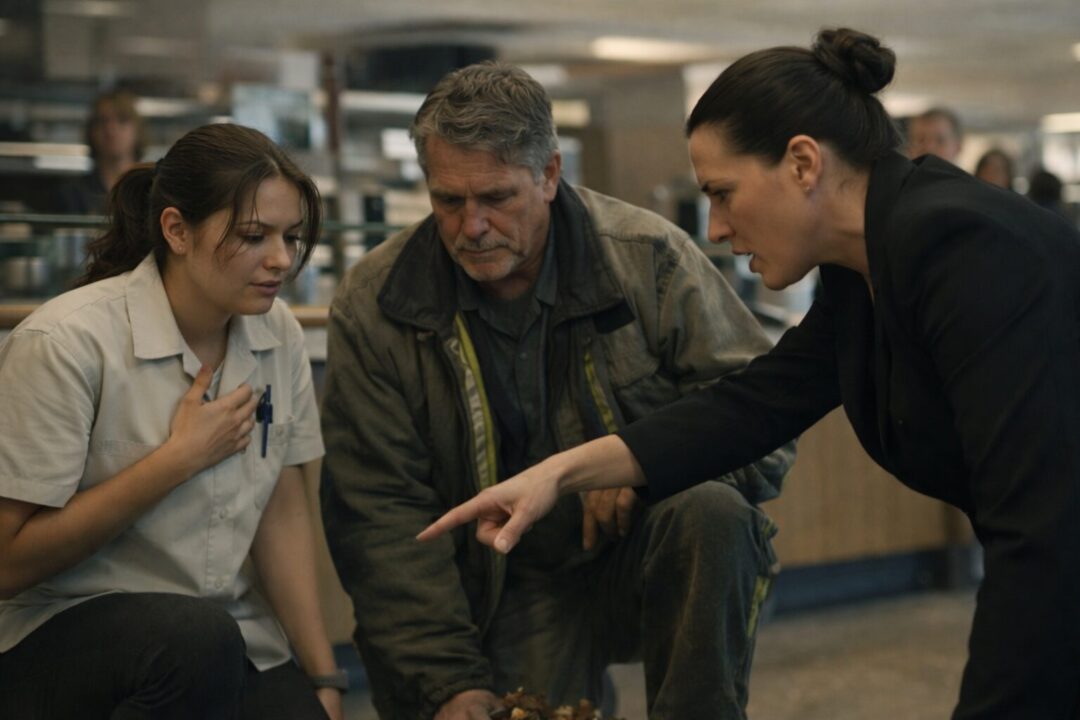
Denise looked immaculate, as always. Dark blazer tailored within an inch of kindness. Hair pinned into a severe knot. Supervisor radio clipped at her waist. Not a crease, not a hair out of place. She had a way of standing that made every room feel smaller for everyone else.
The man dipped his head, as if trying to make himself less of a problem. “It’s all right,” he said quietly. “I can go.”
The way he said it—low, steady, almost apologetic—made something in Maren twist.
He had come in twenty minutes earlier and stood near the back of the line, studying the menu as if translating it from another language. When she asked what he wanted, he had patted his pockets, then given her a small, embarrassed smile and said he was just looking. Up close, she had noticed the way his hands trembled very slightly from exhaustion. The dust under his fingernails. The shallow scrape along one knuckle. The look of somebody who had been running on coffee and duty for too long.
So she had rung up the lunch herself before he could protest.
That should have been the end of it.
Instead, Denise bent, picked up the ruined box, and dropped the remains into the trash can beside the counter with slow, deliberate contempt.
Then she faced the man.
“This cafeteria isn’t a shelter,” she said.
A few people shifted uncomfortably. Nobody spoke.
Maren’s face went hot. “Please don’t talk to him like that.”
Denise gave her a look of chilling disbelief, as if a cashier had just interrupted a board meeting.
“Then clean it up,” she said. “And next time remember what you’re paid for.”
The man crouched first.
Before Maren could grab a mop, he had already bent to gather the scattered plasticware and soggy napkins with large, work-worn hands. He moved carefully, like someone used to making as little trouble as possible. Maren came around the end of the counter and knelt beside him, ignoring the pulse hammering in her ears.
That was when she saw the badge.
It had skidded farther than the fork, landing near the leg of a nearby table. Thick dark lanyard. Metal-edged card holder. Not the flimsy visitor tag contractors sometimes wore. Something heavier. More official.
The man reached for it at the same time she noticed it.
For an instant their eyes met. Then he picked it up, wiped a streak of soup from the metal edge with his thumb, and slipped it into his jacket pocket.
No explanation. No hurry. Just one quiet, unreadable movement.
Behind them, Denise was still talking.
About standards. About policy. About setting a precedent. About people who took advantage if you gave them one inch.
Maren barely heard the words. She kept seeing the man’s face when he had said, I can go.
As if leaving hungry, in front of a room full of strangers, was the kinder option.
Part II — The Door at the End of the Hall
By noon, the cafeteria always felt like a temporary country with its own rules.
The executives from the upper floors came early and sat near the windows. Mid-level staff drifted in waves between meetings, phones in hand, talking in acronyms Maren had learned to nod through but never really understand. Contractors and facilities crews usually came late, when the line was short and nobody important was around to notice whether their boots tracked dust in from the loading entrance.
Denise noticed everything.
She had been hired six months earlier to “professionalize operations,” which in practice meant she inspected shirt collars, timed break lengths, and once wrote up a dishwasher for humming during service. She said standards were a form of respect. Maren had tried, at first, to believe that. But Denise’s standards only ever moved in one direction—downward. She saved her sharpest edge for the people who had the least room to answer back.
That morning had already been bad before the dusty man ever walked in.
One cook had called out sick. The card reader by register two was glitching again. A regional vice president had sent back a salad because the avocado looked “tired.” Denise had spent the first hour prowling behind the line, correcting posture and reminding everyone that “presentation starts with attitude.”
By eleven-thirty, Maren had a headache pressing behind her eyes.
Then she saw him standing under the menu board, reading it with an exhausted concentration that did not belong to lunch. He looked like a man trying to decide whether dignity was worth ten dollars and eighty cents.
“Can I get you something?” she asked.
He glanced at the prices, then at the tray stacks, then back at her. “Just looking.”
The lie was gentle.
She had met enough people in enough jobs to recognize hunger that wanted not to be seen. Her father had worn the same expression more than once during the years when work came and went and pride had to bridge the gap. He used to claim he had eaten already, then drink water slow at the kitchen table while making sure everyone else took seconds.
So Maren had made the choice before she could overthink it.
Turkey, soup, bread roll, bottled water.
When she reached for her card under the counter, she remembered her rent was due in four days. She remembered the student loan email she had not opened that morning. She remembered Denise’s face if she found out.
She paid anyway.
Now, kneeling on the floor beside the spilled lunch, Maren wondered if she had just set fire to the little job security she had.
The man placed the plastic fork into the trash and said under his breath, “You shouldn’t have to do this.”
“Neither should you,” she whispered back.
That was when Denise snapped, “Maren. Up.”
Maren looked over her shoulder but didn’t move.
Something changed in Denise’s expression. A slight tightening. She was not used to being ignored, even accidentally.
“Now,” Denise said.
The man rose first, slower this time. Up close, he was taller than he had seemed in line, broad through the shoulders even beneath the dust. Not bulky. Not theatrical. Just solid. Built by years of doing real work before most office lights had even flickered on.
He turned to Denise with a calm that felt more dangerous than anger.
“Is this how you run the place?” he asked.
Denise gave a clipped laugh. “Excuse me?”
“You heard me.”
Maren stared at him. The entire room seemed to lean forward at once.
Denise lifted her chin. “I run it by not allowing staff to hand out free meals to every person who wanders in looking for pity.”
The words landed hard enough that Maren felt them physically. Around the room, people looked down at their trays, at their screens, anywhere but at the scene they had become part of simply by witnessing it.
The man did not flinch.
He looked toward Maren instead. “Did she pay for it?”
“Yes,” Maren said before Denise could stop her.
He nodded once, as though confirming something to himself. Then he reached into his pocket and pulled out the badge holder.
Maren saw it clearly for the first time.
Dark lanyard. Gunmetal trim. Company crest embossed at the corner. Not the blue stripe of a contractor pass. Not the red stripe of security. Black. Executive access.
A hush moved through the room like a weather shift.
There was a secured door at the far end of the cafeteria, near the executive corridor. Most employees never used it. Denise sometimes glanced at it as if proximity alone mattered. It opened only for senior leadership, board members, and a handful of people Maren knew by rumor more than face.
The man walked toward it without hurry.
Each dusty bootstep on the tile sounded louder than the last.
Denise’s voice came out tight. “Sir, that area is restricted.”
He paused at the reader, looked back once, and said, “I know.”
Then he tapped the badge.
The light flashed green.
The lock clicked open.
No one in the cafeteria breathed.
Part III — The Quietest Kind of Power
Denise went pale first.
Not dramatically. Not enough for anyone to accuse her of losing control. Just a draining of certainty from her face, as if someone had reached in and unplugged the confidence she wore like a second skin.
The man did not go through the door.
He let it swing open behind him and turned back to the room instead.
In the silence, Maren became aware of absurd details. A spoon clinking against ceramic somewhere near the windows. Ice settling in a cup. The slow blink of the menu board above the grill station. She was still holding the damp edge of a paper napkin, and her knees hurt from the tile, but she barely felt it.
The man looked at Denise—not cruelly, not triumphantly, just directly.
“What’s your name?” he asked.
Denise swallowed. “Denise Harrow. Facilities dining supervisor.”
He nodded once. “I’m Orson Vale.”
It meant nothing to Maren for half a second.
Then everything rearranged itself.
She had seen the name on the wall in the lobby in brushed steel letters. Vale Innovations. On posters, in orientation slides, on the annual holiday bonus cards everyone joked were signed by a machine. Orson Vale: founder, still active, known for walking renovation sites himself, known for disappearing from formal events to talk to maintenance crews and loaders and line cooks.
Known, apparently, for showing up covered in construction dust and trying to buy lunch alone.
A sound escaped somebody near the beverage station. Not quite a gasp. More like a swallowed oath.
Denise blinked, then tried to recover the version of herself that always won. “Mr. Vale, I didn’t realize—”
“That’s the problem,” he said.
His voice never rose. It didn’t need to.
Maren had expected fury from a man like him, if he turned out to be someone like him. Public humiliation answered by public humiliation. A cinematic tearing down. Instead, Orson Vale’s disappointment settled over the room like weight.
“She paid for a meal with her own money,” he said, glancing toward Maren. “For a tired man who hadn’t asked for anything.”
Denise opened her mouth.
He cut her off with nothing but a look.
“And you chose,” he continued, “to throw it away. In front of her. In front of him. In front of everyone who works here.”
Denise’s posture stiffened, as if discipline itself might protect her. “I was enforcing policy.”
“No,” he said. “You were performing power.”
That line seemed to hit the entire cafeteria at once.
Maren felt it in the silence that followed. In the way a woman near the espresso station slowly lowered her phone. In the way a man in a charcoal suit stared at his untouched sandwich as if something in the room had shifted beneath him too.
Denise tried again, smaller now. “Standards matter.”
“They do,” Orson said. “That’s why this does.”
He walked back toward the spill, where soup still glistened faintly beneath the fluorescent lights despite Maren’s hurried wiping. Then, to her horror and everyone else’s, he crouched and picked up the fallen bread roll wrapper she had missed.
No one moved to stop him.
He straightened, dropped the wrapper in the trash, and looked at Denise again.
“Hand me your radio.”
For the first time since Maren had known her, Denise looked unprepared.
“Mr. Vale—”
“Now.”
The word was soft.
That made it final.
Denise unclipped the radio from her belt and placed it in his open hand. Her fingers trembled once against the plastic before she pulled away.
“Go home,” he said. “HR will contact you this afternoon.”
The room remained perfectly still as Denise stood there, stripped not just of authority but of the performance that had animated it. Without the radio, without the clipped certainty, she looked suddenly ordinary. Tired, even. Human in a way she had denied everyone else.
For a split second, Maren almost felt sorry for her.
Then she remembered the lunch box in the trash. The words This cafeteria isn’t a shelter. The way hunger had been treated like misconduct.
Denise turned and walked out through the main doors, past tables of silent witnesses. No one watched her leave with satisfaction exactly. Just with recognition.
When the doors shut behind her, the entire room exhaled.
Orson looked back at Maren.
She was still standing near the counter now, damp napkin in hand, apron smudged, face burning with a confusion so intense it bordered on pain.
“I’m sorry,” she said automatically.
He frowned, almost gently. “For what?”
Maren looked at the floor. “I don’t know. All of it.”
A few people in the room gave tiny, involuntary laughs at that—not mocking, just startled by the honesty of it.
Orson’s face softened.
“Don’t apologize for decency,” he said.
And just like that, the pressure behind her eyes broke.
Not into sobbing. Maren was too public for that, too wound tight. But tears stung anyway, and she blinked them back hard enough to hurt.
Orson glanced toward the line, which had not resumed. “Would somebody mind if service continued?”
That broke the spell.
Chairs scraped. Conversations restarted in cautious fragments. A few employees stepped aside to let others through. One of the cooks, who had watched the whole scene from the grill station with wide, silent eyes, quietly handed Maren a fresh soup container without being asked.
Orson turned back to her. “Can you make that lunch again?”
Maren nodded.
Then he added, “Make two.”
Part IV — What Stayed After
The second time, Maren built the meal with steadier hands.
Turkey sandwich. Soup. Bread roll. Water.
Then another exactly like it.
The line moved again, but different now. Slower. Quieter. A few people met her eyes when they reached the register. One woman in legal slid an extra twenty into the tip jar and said nothing. A man from IT cleared his throat and asked if the kitchen still had any more soup left “for whoever needs it.” The dishwasher, Luis, flashed her a quick grin from the back before disappearing through the swinging doors.
No speeches. No applause.
Just the small, awkward shape of a room recalibrating.
When Maren set the two fresh boxes on the counter, Orson was standing where he had first been when she noticed him—near the menu board, dust still on his shoulders, exhaustion still plain in his face. Founder or not, he looked like a man who had been working since dawn. Maybe longer.
She pushed the meals toward him.
He picked one up, then slid the other back across the counter.
“That one’s yours.”
Maren stared. “I’m on shift.”
He glanced around the cafeteria. “You think anyone’s going to stop you?”
A few nearby employees smiled into their cups.
For the first time that day, Maren laughed.
It came out small and shaky, but real.
She took the second box.
There was a side table near the service doors where staff usually stood for five stolen minutes between rushes. Orson carried his lunch there instead of using the executive corridor door now hanging half-open in the distance like a revealed secret. Maren joined him after Sam from the grill promised he had the line covered.
Up close, away from the spectacle, Orson seemed older. More tired. The silver at his temples caught the cafeteria lights. The skin at his hands was rougher than any executive’s had a right to be.
“You really do site visits dressed like that?” Maren asked.
A faint smile touched his mouth. “I was dressed like this because I was on a site.”
She nodded, suddenly embarrassed by how absurd the question sounded.
He unscrewed the water bottle and took a long drink before speaking again. “The north tower foundation pour started before sunrise. One of the crane teams got delayed. I walked the perimeter with the foreman, then cut through here on the way upstairs.”
“You were just going to eat lunch alone?”
“I was hoping to.”
Something in the way he said it made her understand that solitude was not loneliness in him. It was relief.
For a few minutes they ate in companionable quiet.
The soup had gone lukewarm, but neither of them seemed to care.
After a while, Orson said, “My father worked road crews.”
Maren looked up.
“He used to come home with concrete dust in his hair. My mother would make him leave his boots outside no matter the weather.” He turned the bottle slowly in his hands. “Some weeks were better than others. Some weren’t. But one thing I remember very clearly is how people looked at him when he walked into certain places wearing work clothes.”
Maren felt her throat tighten.
“I didn’t help him because of that,” she said softly.
“I know,” he replied. “That’s why it matters.”
The lunch rush ended. The room thinned. Meetings reclaimed people. Screens lit up again. But something subtle remained, like the air after a storm when the pressure has finally broken and everyone can breathe without knowing they were holding it.
By three o’clock, an email went out requesting interim supervisory coverage. Denise’s name was nowhere in it.
By five, Maren was called upstairs—not to HR, as she had feared, but to an office with floor-to-ceiling windows where a woman from operations thanked her for “professional conduct under pressure” in language so polished it barely fit the day. They asked whether she would consider training for a lead service role.
Maren nearly laughed from the shock of it.
That night, when she got home to her tiny apartment and dropped her shoes by the door, she sat on the edge of her bed for a long time without turning on the lights. Her feet ached. Her rent was still due. Her student loans still existed. Nothing magical had happened to the shape of her life.
And yet something had.
Not because the hungry man in the cafeteria turned out to be powerful.
That mattered, of course. It changed consequences. It changed who got exposed, who got protected, who had to answer for what had happened.
But the deeper thing had happened earlier, before the badge, before the door, before anyone in that room remembered how quickly status could reverse.
It had happened the moment she saw a tired stranger trying not to look hungry and decided his dignity was worth ten dollars and eighty cents.
The next morning, she came in early.
The floor shone. The register still glitched. Sam was already muttering about inventory. Luis was humming in the dish pit again, this time with nobody around to stop him.
On the counter near Maren’s station sat a plain white envelope with her name on it.
Inside was a handwritten note.
Kindness is not a policy violation. It’s a standard worth protecting.
There was no signature.
There didn’t need to be.
Maren folded the note once, then slid it carefully into the pocket of her apron.
By noon, the cafeteria was loud again. Trays clattered. Espresso hissed. Executives checked watches. Contractors came in from the loading side with dust on their boots and hunger in their faces.
This time, when one of them hesitated too long at the register, Maren didn’t have to wonder what decency looked like.
She already knew.
And somewhere in the building above her, behind glass and title and all the polished signals of importance, she knew there was at least one person who understood it too.
That didn’t fix everything.
But it stayed.
Like the memory of a meal restored.
Like a locked door opening.
Like the quiet, lasting proof that dignity, once defended in public, is hard to take away again.