The Room That Remembered Her
Part I — The Name Across the Room
Emily saw Daniel before he saw her.
That was the only mercy the evening gave her.
He stood beneath the largest chandelier in the ballroom, laughing softly at something the woman beside him had said. He wore a black tuxedo like it had been made around him. His hair was darker than she remembered, or maybe the lights just made everything look expensive. Beside him, Ashley stood in a white gown that turned every head without asking.
Emily lowered her eyes before Daniel’s gaze could move.
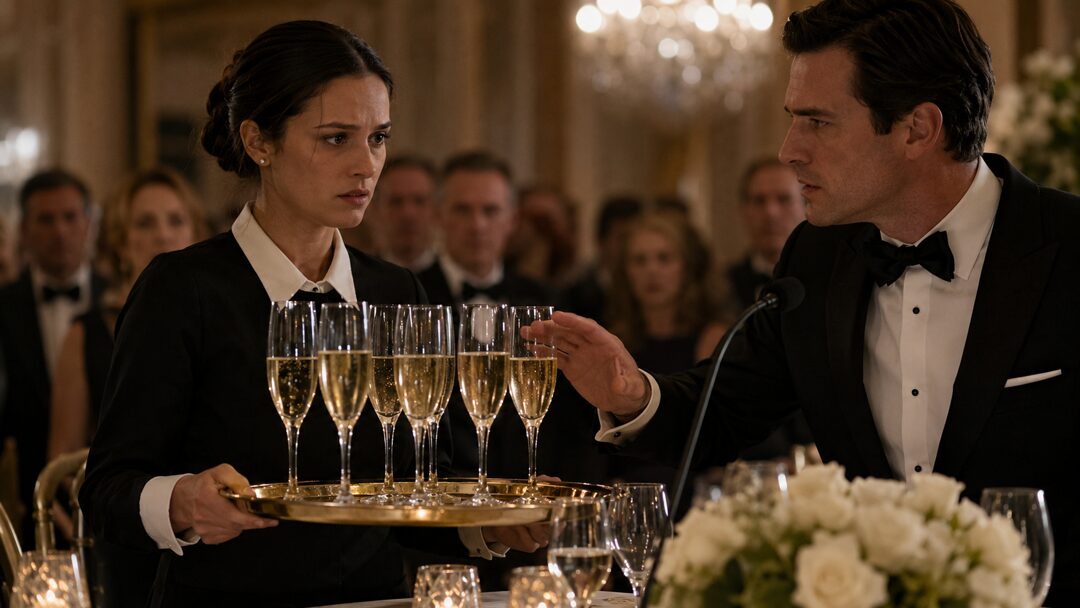
The gold tray in her hands carried twelve glasses of champagne. Her fingers were steady because they had learned to be. Her face was calm because faces could be trained. Only her pulse had no manners.
“Circle the west side first,” Rebecca had told her twenty minutes ago, not looking directly at her. “Don’t linger near the family tables.”
Rebecca had said family as if it meant Daniel’s family, not theirs.
Emily had almost refused the assignment when she saw the name on the event sheet: Whitmore Foundation Engagement Gala. But rent was due in four days, her catering manager had already warned her about missed shifts, and Rebecca had promised it was only “donor service.”
She had not said Daniel would be there.
She had not said Ashley would be wearing white.
She had not said Emily would be assigned to the table closest to the stage.
A guest reached for a glass. Emily tilted the tray with practiced grace. The woman took one without glancing at her face.
That was how rooms like this worked. Staff had hands, not histories.
Emily moved past white roses, silver place cards, candlelight, polished marble. She kept her gaze just below chin level, where no one could accuse her of staring and no one would notice she was avoiding someone.
Then a voice stopped her.
“Emily?”
The tray dipped.
Not enough for the glasses to fall. Enough for the champagne to tremble.
Daniel had said her name like a mistake and a memory at once.
The laughter around him softened, then thinned. Ashley’s smile remained in place for one perfect second too long.
Emily lifted her eyes.
Daniel was staring at her now. His face had lost its social polish. He looked, for one raw instant, not like the heir of a family foundation or the groom-to-be at a ballroom full of donors, but like the man who used to stand in her apartment doorway at midnight because he said it was the only place in the city where he could breathe.
She held out the tray.
“Champagne?” she asked.
It was the safest word in the room.
Daniel did not take a glass.
Ashley’s gaze moved from Daniel to Emily, then to the tray, then back to Daniel. Her smile sharpened at the corners.
“Daniel,” she said lightly, “do you know her?”
Emily’s fingers tightened under the tray.
Daniel stepped forward.
He should not have. That was the first thing Emily thought. Not: he still remembers me. Not: he looks sorry. Not even: why is he here with her?
Just: he should not have stepped forward.
Because in a room like this, movement was language. And Daniel had just told everyone to look.
“What are you doing here?” he asked.
Quiet enough to pretend he was being discreet.
Loud enough to make her feel like the interruption.
Emily kept the tray between them. “Working.”
Ashley looked at Daniel as if waiting for him to remember who he was supposed to be.
He blinked, then glanced around. The room had not gone silent, but it had become aware. Guests knew how to pretend not to watch. Wealth taught people that skill early.
Ashley’s voice stayed smooth. “Daniel?”
He opened his mouth.
Emily knew before he said it. She could feel him reaching for the door he had used before. The one marked privacy. The one he always closed from his side.
“She’s no one,” he said.
The words landed clean.
No stumble. No softness.
Then his face changed.
“Someone,” he corrected, too late. “Someone I used to know.”
Emily’s face did not move.
That was another thing she had learned: dignity was sometimes just the delay before pain showed.
A hand touched her elbow.
Rebecca appeared beside her in a black event dress, headset tucked behind one ear, a clipboard pressed against her ribs. She looked like management, not like a sister. She looked relieved to have arrived before Emily could become inconvenient.
“Emily,” Rebecca said, smiling for the room. “There you are. We need you back with service.”
Daniel’s eyes flicked to Rebecca.
Something passed between them.
Too fast. Too familiar.
Emily saw it anyway.
Rebecca’s fingers tightened on her arm. “Now.”
Ashley took a champagne glass from Emily’s tray.
“Thank you,” she said.
It sounded polite.
It felt like a dismissal.
Emily turned because the tray required balance and because her legs still obeyed her even when the rest of her did not.
Behind her, Daniel said her name again.
This time she did not stop.
Part II — Service Doors
The service hallway smelled like lemon cleaner, steam, and expensive food arranged by people who would not be allowed to eat it.
Rebecca pulled Emily behind a stack of linen carts.
“What was that?” she whispered.
Emily stared at her. “You tell me.”
Rebecca’s expression tightened. “Do not start.”
That was Rebecca’s favorite phrase. She had used it when their mother asked why bills kept disappearing from the kitchen drawer. She had used it when Emily cried for three days after Daniel stopped answering. She had used it when Daniel’s mother’s assistant delivered an envelope Rebecca said they should not return.
Do not start.
As if pain began when Emily named it.
“You knew he would be here,” Emily said.
“It is his engagement gala.”
“You told me it was a donor event.”
“It is both.”
Emily almost laughed. It came out as air. “You put me on his table.”
Rebecca looked away.
That was all Emily needed.
The hallway seemed to narrow around them.
“I checked the staff sheet ten minutes ago,” Emily said. “I was listed for back bar. Someone moved me.”
Rebecca’s face hardened with the tired impatience of someone who had already justified herself. “Mrs. Whitmore requested experienced staff near the stage. I submitted names. Yours was one of them.”
“One of them?”
“I did not think he would recognize you.”
Emily looked down at her plain black flats. At the hem of her catering skirt. At the white cuffs on her wrists.
“You didn’t think he would recognize me,” she repeated.
Rebecca’s mouth pressed thin. “I thought you could be professional.”
The word landed worse than Daniel’s.
Professional. Meaning silent. Grateful. Useful. Unwounded where anyone could see.
Before Emily could answer, a server pushed through the swinging door with an empty tray. Music swelled from the ballroom for one bright second, then cut off again.
Rebecca lowered her voice. “Listen to me. There are donors here who can change things for us. For Mom. For me. For you, if you would stop acting like every room owes you an apology.”
Emily stared at her sister.
Rebecca had always been the one who knew how to survive. She filled out forms. Negotiated late fees. Smiled at landlords. Called creditors by their first names. She could make a bad situation sound like a temporary inconvenience if she used the right tone.
But lately, survival had started to look like obedience.
“What did they promise you?” Emily asked.
Rebecca went still.
There it was. Not guilt. Calculation.
“Nothing is final,” Rebecca said.
Emily’s stomach dropped.
“What did they promise?”
“A position,” Rebecca snapped, then softened too quickly. “A real one. Program director. Benefits. Salary. Something steady.”
“With his family.”
“With the foundation.”
Emily could hear the difference Rebecca wanted there to be.
“And I was part of the interview?”
Rebecca looked offended. “Don’t be dramatic.”
“Was I?”
Rebecca’s silence answered.
Emily stepped back from her. “You put me in front of him to prove I wouldn’t make trouble.”
Rebecca’s face flickered. “I put you in a room where you could earn money for one night and leave.”
“No. You put me under a chandelier holding drinks for the man who pretended I did not exist.”
Rebecca’s eyes flashed. “He paid your rent for three months after you left.”
Emily felt the old heat rise behind her eyes.
“I never asked him to.”
“You took the money.”
“You told me it came from the emergency fund.”
Rebecca looked away again.
Emily leaned closer, her voice quiet. “That envelope was from him?”
Rebecca’s jaw worked.
For a moment, the hallway was full of all the things Rebecca had arranged and renamed.
Help. Protection. Practicality.
Emily had called them mercy because she had been too tired to check.
“You were falling apart,” Rebecca said. “Mom was getting worse. We needed money.”
“So you let me think he left with nothing.”
“He did leave.”
Emily shook her head. “And you helped him do it neatly.”
Rebecca’s face changed then, not into remorse, but into something older. Resentment, maybe. Exhaustion. The bitterness of someone who had watched Emily be loved by a man who could have solved everything and solved nothing.
“You think love is noble because you were the one being loved,” Rebecca said. “Some of us had to deal with what it cost.”
Emily stepped back as if her sister had raised a hand.
The ballroom door opened again.
A coordinator called, “Rebecca? They need you near the stage.”
Rebecca straightened instantly. Her event smile returned like a mask dropped into place.
She adjusted Emily’s sleeve.
The gesture was almost tender. That made it worse.
“Go back out,” Rebecca said. “Keep your head down. Finish the shift. Please.”
Emily looked toward the ballroom.
Through the door, she could see the edge of Ashley’s white gown and Daniel standing too close to the opening, as if he had followed but not dared to enter.
Rebecca noticed him too.
Her smile tightened.
Emily picked up a fresh tray.
This time, her hands did not shake because she was afraid.
They shook because she was beginning to understand.
Part III — What Could Be Fixed
Daniel found her near the east bar twenty minutes later.
Of course he waited until she was alone.
Emily was stacking empty glasses beside a silver ice bucket, listening to the speeches being tested on the microphone. Every few seconds, someone in the ballroom laughed too loudly. The room had returned to itself. Rich rooms were good at that. They swallowed discomfort quickly, as long as no one forced them to taste it.
“Emily.”
She did not turn. “You should go back.”
“I need to talk to you.”
“No. You want to.”
“That too.”
The honesty almost undid her. Almost.
She faced him.
Up close, Daniel looked less perfect. There were faint lines at the corners of his mouth. His eyes were tired. He still had that same way of looking at her as if the rest of the room had been poorly built around the wrong center.
Emily hated him for still knowing how to do that.
Ashley had status. Rebecca had strategy. Daniel had memory.
It was the most dangerous one.
“I looked for you,” he said.
Emily smiled once, without warmth. “That’s a generous way to describe silence.”
“I came to your apartment.”
“After how long?”
His jaw tightened. “Two weeks.”
“Three.”
“Your sister said you didn’t want to see me.”
Emily’s breath caught.
Daniel saw it. His face shifted.
“She said you needed distance,” he continued, slower now. “She said you were angry, that my mother had made things worse, and that if I had any decency I’d let you rebuild your life.”
Emily gripped the edge of the bar.
Rebecca’s voice came back: He chose what he was always going to choose.
Daniel took a step closer. “She also said you took the money.”
“I didn’t know it was from you.”
“What?”
“She told me it was from our emergency fund.”
Daniel closed his eyes.
For a second, the old Daniel was there—the one who looked ashamed before anyone accused him, the one who used to stand in Emily’s kitchen and ask if she had eaten because he had never learned how to ask if she was lonely.
Then he opened his eyes, and the old Daniel disappeared behind a man trained to manage damage.
“I should have pushed harder,” he said.
“Yes.”
“My mother threatened the foundation. My father threatened to cut me off. Rebecca was telling me you wanted out. Everything was—”
“Convenient,” Emily said.
His face went still.
She saw she had hit something true.
“Emily,” he said, voice low, “I was scared.”
She wanted that not to matter.
It did.
Because she remembered him at twenty-seven, sitting on the floor of her apartment, tie loosened, shoes still on, saying, “I don’t know who I am when everyone isn’t looking.”
She remembered believing that loving him in secret was temporary. A tunnel, not a home.
She remembered the night he said, “After the winter gala, I’ll tell them.”
He did not.
Instead, his mother visited Emily at the café where she used to work and explained, gently, that Daniel was under pressure, that Emily was young, that intense attachments could feel larger than they were. She never called Emily poor. She did not have to.
Two days later, Daniel stopped coming.
Three weeks after that, Rebecca handed Emily an envelope of cash and said, “Don’t make pride expensive.”
Now Daniel was standing in front of her with grief in his eyes, and Emily hated how much of her still wanted to be the person he regretted losing.
“I can fix this,” he said.
The words were soft.
Emily looked at him carefully.
There it was. The family language, wearing his mouth.
“What does that mean?”
“I can get you out of this job. Not just tonight. I know people. I can help with your mother’s care, your lease, whatever Rebecca has put you through.”
“Whatever Rebecca has put me through,” Emily repeated.
He heard himself then. Too late.
“I didn’t mean—”
“You always mean well when no one important is listening.”
He flinched.
Good, Emily thought.
Then hated herself for the satisfaction.
Daniel reached toward her but stopped before touching her. “I loved you.”
The hallway seemed to tilt.
Emily had imagined those words so many times they should have lost their power. They had not. They moved through her like a door opening onto a room she had boarded up badly.
She looked past him into the ballroom.
Ashley stood near the stage, watching them. Her white gown caught the light. Her face did not.
“You loved me where it cost you nothing,” Emily said.
Daniel looked like he wanted to deny it.
He did not.
A bell chimed softly from the ballroom. Staff began moving toward the doors. The next service wave was starting.
Daniel stepped aside, but his voice followed her.
“Wait for me after the toast.”
Emily lifted the tray.
“Don’t ask me to wait in hallways anymore.”
She walked back into the room before he could answer.
Ashley was waiting by the coatroom.
Not for Daniel.
For her.
Part IV — The Woman in White
Ashley did not raise her voice.
She did not need to.
Women like Ashley could cut quietly because people leaned in to hear them.
“Emily, isn’t it?” she said.
Emily kept her tray level. “Yes.”
Ashley glanced at the glasses. “You’re very good at holding things steady.”
It was almost a compliment.
Almost.
Emily moved to pass.
Ashley stepped slightly into her path, just enough that Emily would have to be rude to continue. Around them, guests drifted toward the ballroom for the toast. No one noticed the two women beside the coatroom doors. Or maybe they noticed and were too well-trained to show it.
“I know who you are,” Ashley said.
Emily’s grip tightened.
Ashley smiled faintly. “Not from Daniel. Don’t give him too much credit.”
Emily said nothing.
“His mother told me months ago,” Ashley continued. “There was a girl, she said. A difficult girl. A girl who might appear at some point and misunderstand the past.”
Emily felt the phrase settle on her skin.
A difficult girl.
A misunderstanding.
That was how rich families buried people without leaving dirt on their hands.
Ashley looked toward Daniel, who stood across the room speaking to an older man with silver hair and Daniel’s same controlled mouth.
“She said you had been emotional. That Daniel had been kind. That your sister had helped everyone reach a sensible arrangement.”
Emily’s throat tightened.
Ashley saw it. Her expression changed, not softening exactly, but sharpening in a different direction.
“You didn’t know.”
Emily hated that the question was not a question.
Ashley looked away first.
For the first time all night, something uncertain crossed her face.
“My father’s money is in this room,” Ashley said. “Daniel’s family name is on the invitations. Everyone here is congratulating a merger and calling it love.”
Emily studied her.
“You can leave,” she said.
Ashley laughed once. It had no humor in it. “Can I?”
The answer should have been yes. She was wearing diamonds. Her gown probably cost more than Emily made in six months. Her future was being toasted by men who did not know the names of their drivers.
But Emily looked at Ashley’s hand and saw how hard her fingers held the stem of her glass.
Status could be a cage if everyone admired the bars.
Ashley leaned closer.
“He does this,” she said. “He makes women feel like the only honest thing in his life, then lets other people clean up the honesty.”
Emily felt the sentence enter her like something cold.
Not because it was cruel.
Because it was accurate.
Ashley’s eyes shone, but nothing fell. “Don’t mistake me. I don’t like you.”
“I didn’t ask you to.”
“No. I imagine you’re tired of asking.”
Emily looked at her then.
For a second, the rivalry between them thinned. Not vanished. Not healed. Just thinned enough to show the machinery behind it.
Daniel had loved Emily in private.
He had chosen Ashley in public.
Both had been made to stand somewhere useful.
The microphone crackled.
A man’s voice filled the ballroom. “Ladies and gentlemen, if we could gather for a brief toast…”
Ashley inhaled.
The fiancée returned. Shoulders back. Smile measured. Chin lifted.
Before she walked away, she looked at Emily one more time.
“If he tells the truth tonight,” Ashley said, “make sure it’s not only his version.”
Then she crossed the ballroom in white.
Emily remained beside the coatroom with the tray in her hands and a strange, terrible calm moving through her.
Rebecca found her less than a minute later.
“Where have you been?” she hissed.
Emily looked at her sister. “Learning.”
Rebecca’s eyes narrowed. “You need to leave before the toast.”
“No.”
“Emily.”
“No.”
Panic cracked Rebecca’s professional face. “You do not understand what you’re risking.”
Emily almost smiled. “I understand better now.”
Rebecca reached for her arm. Emily stepped back.
That small refusal changed the air between them.
Rebecca lowered her voice. “Mrs. Whitmore is announcing my position tonight. If you make this ugly, it is gone. Everything is gone.”
“There it is,” Emily said softly.
Rebecca’s eyes flashed. “You think dignity pays rent?”
“No. But neither does selling mine.”
Rebecca looked as if Emily had slapped her.
Then, for one moment, she was not the woman with the headset and the clipboard. She was the girl who had learned to count grocery money at fourteen, who sat outside hospitals with vending machine coffee, who had never trusted romance because romance had never paid a bill.
“Mom needed stability,” Rebecca said.
“And you needed someone to owe you for it.”
Rebecca’s mouth opened, then closed.
A coordinator waved from the ballroom. “Emily, refill station at the stage. Now.”
Rebecca turned pale.
Emily understood.
The final placement. The last proof.
A server beside Daniel’s table. A familiar face holding champagne while Daniel’s father praised the foundation for helping women who had lost their way.
Rebecca whispered, “Please.”
It was the first honest word she had said all night.
Emily picked up a full tray.
“For once,” she said, “don’t ask me to disappear so you can feel safe.”
Then she walked toward the stage.
Part V — The Toast
Daniel’s father was already speaking when Emily reached the front of the ballroom.
Charles Whitmore had the kind of voice built for rooms that agreed with him. Warm, low, amused at the right moments. He stood beneath the chandelier with one hand in his pocket, as if generosity had relaxed him.
Daniel stood beside Ashley. Ashley’s face was perfect. Daniel’s was not.
Rebecca stood near the stage stairs, hands folded, waiting to be named.
Emily took her place beside the front table.
Guests reached for champagne without looking at her.
She moved automatically. Pour. Lift. Step. Smile.
Her hands were steady now.
That frightened her more than trembling had.
Charles raised his glass. “Tonight is, of course, about Daniel and Ashley. About families joining, futures beginning, and the kind of partnership that makes all of us believe in continuity.”
Soft laughter. A few nods.
Emily poured into Daniel’s glass.
He looked at her.
She did not look away.
Charles continued. “But this evening is also about the work that allows such futures to mean something. The Whitmore Foundation has always believed in guidance. In discipline. In gratitude. In helping young women from difficult circumstances understand that opportunity comes with responsibility.”
Emily felt the room shift around her, but no one else seemed to notice.
Rebecca did.
Her face had gone colorless.
Daniel set down his glass.
Ashley watched him.
Charles smiled toward Rebecca. “And few people understand that mission better than Rebecca, whose dedication has helped us reach women who might otherwise mistake pride for independence.”
The applause began.
Rebecca smiled because she had been trained by hunger to accept crumbs as banquets.
Emily saw her sister’s eyes shine.
Then Charles turned slightly, gesturing toward the staff moving along the front table.
“Many of the young people serving us tonight are examples of the kind of hard work and humility we hope to encourage. With the right guidance, lives can be redirected.”
There it was.
Not Emily’s name.
Something worse.
Her category.
Daniel’s face changed as he looked from his father to Emily to Rebecca. Understanding arrived visibly, and with it, shame.
Too late, Emily thought.
Always too late.
Daniel stepped forward.
“Dad,” he said.
The microphone caught it.
The applause faded unevenly.
Charles turned, still smiling. “Daniel?”
Daniel looked at Ashley. Then at Emily. Then at the room.
For one impossible moment, Emily thought he might finally do it cleanly.
“I need to say something,” Daniel said.
His voice shook.
The room sharpened.
Ashley’s hand moved to her ring.
Rebecca stared at Emily, pleading now, no mask left. Do not. Please do not. Not here.
Daniel swallowed. “Years ago, I made a mistake. I hurt someone I loved. I let my family, my fear, my obligations—”
Emily set the tray down on the edge of the table.
Not loudly.
But every glass touched gold at once, a bright small sound that cut through Daniel’s confession.
He stopped.
Emily looked at him with something almost like pity.
Even now, he had begun with himself.
His mistake. His burden. His love.
She stepped beside him, not behind him.
The guests stared openly now. No one was pretending anymore.
Emily did not reach for the microphone. She did not need the whole ballroom to hear every word. She only needed enough of them.
“I was not lost,” she said.
Daniel went still.
Emily looked at Charles Whitmore. Then at Rebecca. Then at Ashley, who watched with her chin lifted and her eyes bright.
“I was hidden,” Emily continued. “Then I was hired tonight to prove I would stay hidden.”
Silence moved across the room faster than applause had.
Rebecca’s face crumpled.
Charles’s smile disappeared.
Daniel whispered, “Emily.”
She turned to him.
“No,” she said. “Not now. Not when the room makes it noble.”
He looked wounded.
She let him.
For once, she did not rush to make his pain easier.
Charles stepped toward the microphone. “I think there has been some confusion—”
Ashley laughed softly.
It was the most dangerous sound in the room.
She removed her engagement ring.
Not dramatically. Not with a speech. She simply slid it from her finger and placed it beside Daniel’s untouched glass.
The tiny sound of metal against linen carried farther than it should have.
“There has,” Ashley said.
Daniel looked at her.
Ashley did not look back.
Rebecca moved toward Emily. “Em—”
Emily turned.
Her sister stopped as if there were a wall between them.
“You told me silence was protection,” Emily said. “It was only protection for people who were not me.”
Rebecca pressed a hand to her mouth.
Emily picked up the tray again.
One glass had tipped slightly, champagne sliding along the rim but not falling.
She steadied it.
Then she walked through the ballroom.
No one stopped her.
Not Daniel.
Not Rebecca.
Not Charles Whitmore.
The guests parted because scandal had finally given the server a shape they could see.
Emily hated that.
She also used it.
At the service doors, she heard Daniel call her name.
She kept walking.
Part VI — Outside the Bright Room
The hotel’s side entrance opened onto a narrow street where the city looked less impressed with itself.
Cold air touched Emily’s face. For the first time all night, she could breathe without smelling roses, perfume, and polished silver.
She stood under the awning in her catering uniform, holding nothing now. Her hands felt strange without the tray. Too light. Almost untrustworthy.
Behind her, the gala continued in broken pieces. Voices rose. Doors opened and closed. Someone from the event staff hurried past, whispering into a headset.
Emily stepped toward the curb.
“Emily.”
Daniel came through the side door without his jacket. He looked younger outside the ballroom. Less protected. Less powerful.
Still Daniel.
That was the trouble.
He stopped a few feet away, breathing hard. “I’m leaving.”
She said nothing.
“I mean it,” he said. “The foundation, the money, all of it. I’ll walk away. Tonight. I should have done it then, and I didn’t, but I can now.”
Emily looked at him.
There it was. The thing she had once wanted so badly she had mistaken wanting for destiny.
Daniel, choosing her in public.
Daniel, ashamed enough to be brave.
Daniel, finally arriving at the door after she had stopped living inside the room.
“You would leave everything now?” she asked.
“Yes.”
“Because they saw?”
His face tightened. “Because I saw.”
Emily almost closed her eyes.
That was nearly enough.
Nearly was dangerous.
Behind him, the side door opened again.
Rebecca stood there.
Her headset was gone. Her hair had loosened from its sleek twist. She looked older than thirty-two and younger than the woman who had ordered Emily back into service.
“They pulled the offer,” Rebecca said.
Daniel turned, but Rebecca was looking only at Emily.
Emily waited.
Rebecca’s lips trembled. “I thought if I got in, I could help us. I thought if I kept things quiet, it would stop following you.”
Emily believed part of that.
That was the cruelty of it.
Rebecca had not betrayed her because she hated her. She had betrayed her because she loved safety more than she loved Emily’s right to stand upright.
“I’m sorry,” Rebecca said.
Emily looked at her sister for a long moment.
She remembered Rebecca at sixteen, cutting her own dinner in half and pretending she was not hungry. Rebecca at twenty, sleeping in a chair beside their mother’s hospital bed. Rebecca at thirty-two, trading Emily’s name for a salary and calling it family.
“I know,” Emily said.
Hope flickered across Rebecca’s face.
Emily let it live for one second.
Then she said, “I can’t carry that for you tonight.”
Rebecca’s face folded inward.
She nodded once, because there was nothing else to do.
The side door opened behind her. Ashley stepped out.
She had changed nothing except her hand. The ring was gone.
She did not come close. She did not offer comfort. Emily was grateful for that.
Ashley looked at Daniel. “Your father is asking for you.”
Daniel did not move.
Ashley’s smile was small and tired. “Of course he is.”
Then she looked at Emily.
For the first time all night, there was no polished cruelty in her face. No rivalry either. Just recognition, bare and brief.
“You were right to say it your way,” Ashley said.
Emily nodded.
Ashley walked to a waiting car. No dramatic exit. No final speech. Just a woman in white stepping out of a story that had tried to make her decorative.
Rebecca went back inside without another word.
That left Daniel and Emily under the awning, with the city moving around them like ordinary life had not just split open.
Daniel took one step closer.
“Emily,” he said, and this time her name did not sound like shock. It sounded like a request.
She had loved him. That was the truth she would not cheapen by denying it.
She had loved his midnight honesty, his tired laugh, the way he remembered she hated orchids but liked cheap grocery-store daisies. She had loved the version of him that existed when no one powerful was watching.
But she had lived too long on versions.
“You don’t get to choose me after making me stand there alone,” she said.
“I know.”
“No,” Emily said. “You don’t. Not yet.”
He looked at her as if the words were worse because they were fair.
She took a breath.
“Being chosen after public shame is not the same as being cherished before it.”
Daniel’s eyes filled, but he did not ask her to comfort him.
That, at least, was new.
“What happens now?” he asked.
Emily looked past him, through the glass doors, where the ballroom still glittered as if light could deny everything said beneath it.
“I go home,” she said.
“Can I call you?”
She almost laughed. Not because it was funny.
Because once, she would have lived a week on that question.
“Not tonight.”
He nodded.
Emily stepped out from under the awning.
The cold air met her fully now. Her shoes hurt. Her uniform smelled faintly of champagne. Her sister was behind her. Daniel was behind her. The room that had finally seen her was behind her.
Ahead, the city did not know her name.
For the first time all evening, that felt like mercy instead of erasure.
Emily walked toward the corner alone, wounded and upright, carrying nothing in her hands.