What the Room Remembered
Part I — The Collar
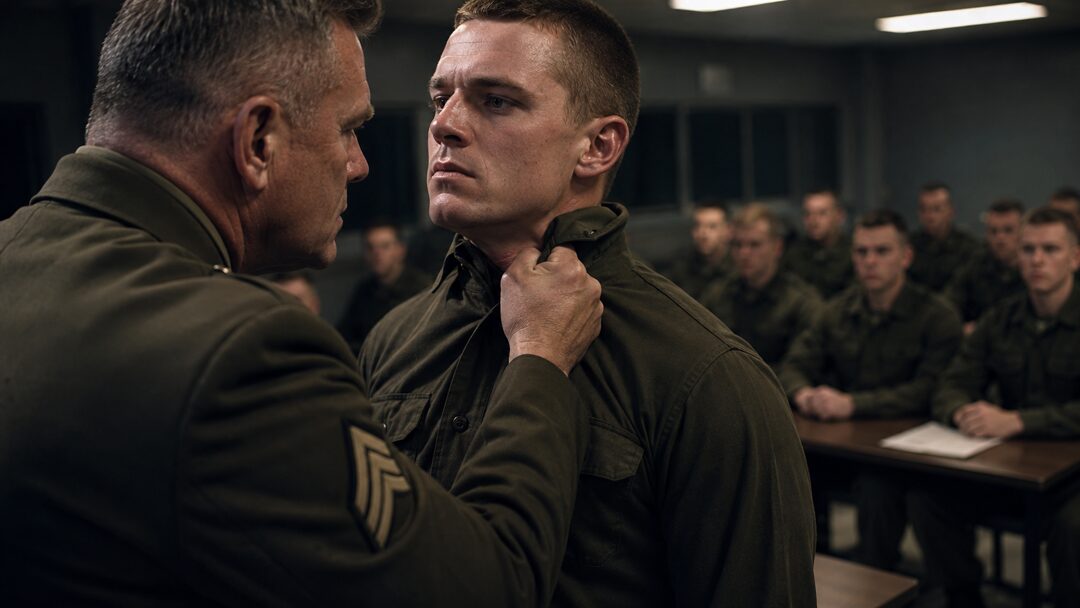
Sergeant Thomas Reed had Ryan Miller by the collar before anyone in the classroom understood that the quiet part was over.
The room went still so quickly that the fluorescent lights seemed louder. Twenty recruits sat frozen behind crooked desks. A field manual lay open on the tile near Ryan’s boot, its pages bent where it had fallen. Reed’s fist was twisted into the front of Ryan’s uniform, close enough to Ryan’s throat that every swallow pressed fabric into skin.
“Say it again,” Reed said.
Ryan did not move.
He could feel the hard shape in his right pocket. The cheap compass. Cracked edge. Tape wrapped twice around the side. It pressed against his thigh like a second pulse.
Reed leaned closer.
“Don’t look at the floor. Don’t look at them. Look at me and say it again.”
Ryan lifted his eyes.
Across the room, Emily Carter sat with both hands flat on her desk. Her dark hair was pulled tight at the back of her head. She looked calm in the way locked doors looked calm. Not empty. Not safe. Just shut.
Someone behind her breathed too loudly.
Reed heard it.
His eyes never left Ryan.
“Private Miller,” he said, voice low enough that it was worse than yelling, “you had a statement in front of you. You had a pen in your hand. You were asked to confirm what happened last night. And you said what?”
Ryan’s mouth was dry.
He had said it once already.
He had said it quietly, because quiet was the only thing he still trusted.
“The report is incomplete,” Ryan said.
Reed’s hand tightened.
A desk leg scraped half an inch as someone shifted and stopped.
“Incomplete,” Reed repeated.
Ryan said nothing.
“That’s a polished word,” Reed said. “That’s a word people use when they want to sound brave without paying for it.”
Ryan’s throat moved against the collar.
Reed felt it.
“You think you’re too clean to sign with the rest of us?”
“No, Sergeant.”
“You think everybody else in this room is just happy to bury what happened?”
“No, Sergeant.”
“You think Brooks gets more respect from your silence?”
The name hit the room harder than Reed’s hand had hit Ryan’s uniform.
Daniel Brooks.
Nobody looked at the empty desk two rows back. That was how Ryan knew everyone was thinking about it.
The desk still had Brooks’s pencil in the tray. Yellow, chewed at the end. Someone had placed it there that morning and nobody had touched it since.
Reed stepped closer until his boots nearly touched Ryan’s.
Ryan could smell coffee on him. Old coffee and starch and cold air from outside.
“Say it again,” Reed said.
Ryan’s jaw locked.
The compass in his pocket seemed to get heavier.
“The report is incomplete,” he said.
This time Reed shoved him backward one step.
Ryan caught himself before his heel struck the fallen manual. He did not raise his hands. He did not reach for Reed’s wrist. He did not blink when Reed came with him and kept the collar twisted in his fist.
That was the part that made the room hate him.
Not all at once. Not openly.
But Ryan felt it move through the desks like a draft.
If he had cried, they could have pitied him.
If he had shouted, they could have judged him.
If he had gone limp, they could have called him broken.
But he stood there looking pale and young and impossibly still, and that made him look like he knew something they did not.
Maybe he did.
Maybe that was the worst of it.
Reed’s face was close now, broad and hard, gray at the temples, scar along one knuckle where his fist bunched Ryan’s collar. His sleeves were perfectly creased. They always were. Reed looked like a man built out of corners.
“You want to be the conscience of this platoon?” Reed asked.
“No, Sergeant.”
“You want to be the hero?”
“No, Sergeant.”
“Then what do you want?”
Ryan almost answered.
He almost said, I want ten minutes back.
He almost said, I want Brooks to stop laughing in my head.
He almost said, I want him to be at that desk with the chewed pencil, pretending he isn’t scared like the rest of us.
Instead he said, “Permission to remain silent, Sergeant.”
For the first time, Reed’s expression changed.
Not much.
Just enough.
His eyes sharpened, like Ryan had finally stepped where Reed had been waiting for him to step.
“You already tried that,” Reed said.
Then he let go.
Ryan’s collar snapped back against his throat. The sudden freedom felt worse than the grip.
Reed turned to the room.
“Everyone out.”
No one moved.
Reed’s voice rose only one notch.
“Now.”
Chairs scraped. Boots struck tile. Recruits stood too quickly, gathered notebooks they had not read, moved toward the door without looking directly at Ryan. One by one they passed him. Some angry. Some afraid. Some relieved it was not them.
Emily was last.
She stopped beside him just long enough for him to hear her.
“You kept it,” she said.
Ryan’s hand almost went to his pocket.
Almost.
Emily looked at his face, then at the twisted collar, then walked out.
Reed waited until the door shut.
Only then did Ryan realize his hands were shaking.
Part II — The Paper
The statement had been three paragraphs long.
That was the insult of it.
Daniel Brooks had been reduced to three paragraphs, two signatures, and a blank line where Ryan’s name was supposed to go.
At 1840 hours, during a nighttime navigation exercise, Private Daniel Brooks separated from his assigned group after failing to follow established movement protocol.
At approximately 1925 hours, Private Brooks was located unresponsive.
Preliminary review indicates individual error and environmental stressors as contributing factors.
Ryan had read the third line three times.
Individual error.
Environmental stressors.
There had been no room on the page for Brooks’s smile, which was too big for his face when he was nervous. No room for the way he always volunteered first and regretted it second. No room for the joke he made whenever someone complained about the cold: “Character development, boys and girls.”
No room for what he had whispered in the dark.
Just give me a minute.
Ryan had held the pen over the signature line while Captain Ellis stood at the front of the classroom and explained that statements were not emotional documents. They were records.
“Read carefully,” Ellis had said. “Sign only if accurate.”
It should have been easy.
Most of the platoon signed.
Some signed fast, like speed could make them innocent. Some read every line, lips moving, and signed with faces emptied out. Emily took longer than anyone. Her pen did not move for nearly five minutes.
Ryan had watched her sign.
Then he looked down at his own page.
His signature line waited.
Reed stood by the back wall with his arms folded. Silent. Watching.
Ryan knew that look. Reed gave it during runs, during drills, during mistakes no one else noticed. He had a gift for seeing the smallest flinch and treating it like a confession.
Ryan put the pen down.
Captain Ellis looked up.
“Problem, Miller?”
The classroom seemed to lean toward him.
Ryan heard Brooks’s voice, light and strained, from the night before.
Don’t make it a thing.
Ryan looked at the paper.
“Incomplete, sir,” he said.
Captain Ellis frowned.
Reed did not move.
“In what way?”
Ryan had felt every eye in the room turn.
That was where he failed again.
He could have said it.
He could have named the moment.
He could have said Brooks was already stumbling before the split. Emily noticed. I noticed. He asked us not to call it in. I listened when I shouldn’t have.
Instead Ryan said, “It leaves things out.”
Captain Ellis waited.
Ryan added nothing.
Reed’s jaw shifted.
Captain Ellis asked, “Are you alleging false information?”
“No, sir.”
“Are you offering additional information?”
Ryan’s hand curled against his thigh, over the compass in his pocket.
“No, sir.”
A murmur moved through the room.
Captain Ellis’s face hardened, not cruelly. Procedurally. That was worse.
“Then you are refusing to sign without providing a correction?”
Ryan looked at the statement one more time.
Individual error.
Environmental stressors.
“Yes, sir.”
That was when Reed walked forward.
Not fast.
That was what everyone remembered later. He did not storm. He did not explode. He crossed the room with the measured steps of a man who had already decided where his hand would go.
Ryan stood because Reed’s eyes told him to stand.
Reed stopped in front of him.
For one second, Ryan thought the sergeant would speak.
Instead Reed grabbed his collar.
Now, alone in the classroom after everyone had gone, Ryan could still feel the shape of the grip.
Reed stood near the fallen manual, looking at him as if the silence between them had a rank.
“You know what half a truth does?” Reed asked.
Ryan kept his eyes forward.
“Yes, Sergeant.”
“No, you don’t.”
Ryan said nothing.
Reed bent, picked up the field manual, closed it, and set it on the nearest desk with too much care.
“You think I want you quiet?” Reed asked.
Ryan’s eyes moved to him.
Reed saw it.
“You think that’s what this is?”
Ryan did not answer.
Reed stepped closer, not touching him this time.
“Brooks is gone. The paper is not. That paper will keep talking long after every one of you moves on. So if you have something to put in it, put it in it.”
Ryan’s throat tightened.
“I don’t know how to say it.”
“That’s not the same as not knowing.”
The line landed too cleanly.
Ryan looked away before he could stop himself.
Reed’s voice dropped.
“There he is.”
Ryan looked back.
Reed’s face had no pity in it. Pity would have been easier. Pity lets you stay wounded without moving.
“You want to carry something, Miller? Carry it correctly.”
Ryan’s fingers brushed his pocket.
The compass edge pressed through the fabric.
Reed noticed.
Of course he noticed.
“What’s in your pocket?”
“Nothing, Sergeant.”
Reed stared at him.
Ryan heard himself breathing.
It was not nothing. It was worse than something.
It was proof that he had gone back.
It was proof that he had found Brooks after the searchlights, after the shouting, after Emily had stopped saying Ryan’s name and started saying nothing at all.
Reed did not ask again.
That was the first time Ryan understood the sergeant was not hunting for an answer.
He was waiting for Ryan to stop running from one.
Part III — The Compass
Brooks had bought the compass at a gas station outside Fort Clay.
It cost six dollars and came clipped to a keychain shaped like a trout.
“This is elite equipment,” Brooks had announced, holding it up in the barracks like a medal. “You people wouldn’t understand.”
Emily had looked at it once and said, “It points north if you don’t shake it.”
Brooks grinned.
“Exactly. So don’t shake it.”
Ryan had laughed because everyone laughed when Brooks wanted them to. It was one of his gifts. He could make fear feel like a group activity.
The compass cracked three days later when Brooks dropped his pack on it. He taped the edge with black electrical tape and said it had character now.
“It’s like me,” he told Ryan. “Technically functional.”
Ryan had said, “That’s generous.”
Brooks shoved him with one shoulder.
Ryan remembered that more clearly than he wanted to.
He remembered the warmth of it. The ordinary pressure of a friend who was alive and tired and trying too hard.
The night exercise began cold and wet. Not dramatic. Not cinematic. Just miserable in the way that made everyone meaner by degrees. Rain slipped down collars. Mud took bootprints and kept them. The trees beyond the training road became black shapes against a darker sky.
Reed had briefed them before they stepped off.
“You do not rise to the level of your pride,” he said. “You fall to the level of your habits. Build better habits.”
Brooks had whispered, “I have a habit of wanting a cheeseburger.”
Emily said, “Save your oxygen.”
Ryan smiled.
That was the last easy moment.
Their team moved out with a map, a route card, and enough confidence to get themselves in trouble. Emily tracked pace count. Ryan checked the azimuth. Brooks kept up for the first forty minutes, joking less as the rain thickened.
Then he stumbled.
Not a fall. Not enough to make it official. Just one boot catching on a root, one hand against a tree, one breath too sharp.
Emily saw it.
“You good?” she asked.
Brooks waved her off.
“Beautiful.”
Ryan watched him blink hard.
“You sure?” Ryan asked.
Brooks smiled without teeth.
“Don’t start mothering me, Miller.”
They kept moving.
That was the first minute Ryan wanted back.
Later, people would ask why he did not call it in then.
Because Brooks was still walking.
Because everybody was wet and tired.
Because no one wanted to be the recruit who could not handle a training course.
Because Ryan wanted to be loyal more than he wanted to be right.
The second stumble came near the low creek crossing.
Brooks went to one knee.
Emily stopped immediately.
“That’s enough,” she said.
Brooks looked up at her, rain running from his helmet strap. “Don’t.”
“Don’t what?”
“Don’t make it a thing.”
Ryan heard the strain under the joke. That thin place where pride and fear sounded almost the same.
Emily crouched.
“You’re not tracking right.”
“I’m tired.”
“You’re more than tired.”
Brooks looked at Ryan.
Not Emily.
Ryan.
That was the part Ryan could not forgive.
“Just give me a minute,” Brooks said. “Please.”
Please.
He said it quietly, so Emily would not hear the size of it.
But she did.
“Ryan,” she said.
He looked at her.
There was no panic in her face. That made it easier to ignore. Panic would have given him permission. Calm made it a choice.
“We call it in,” Emily said.
Brooks shook his head.
“I’m not getting recycled. I’m not going home because I got cold.”
“Nobody said home,” Emily said.
Brooks laughed once. It came out wrong.
“You don’t know that.”
Ryan should have reached for the radio.
Instead he said, “Five minutes.”
Emily stared at him.
Brooks closed his eyes in relief.
Five minutes became eight because time moved strangely in the rain. Brooks sat with his head bowed. Ryan stood above him, watching the trees, telling himself he was managing the situation. Emily checked the route card twice, then stopped pretending the problem was navigation.
“We’re calling,” she said.
This time Ryan did not argue.
He reached for the radio.
That was when Brooks stood too quickly.
“Fine,” Brooks said. “I’ll walk.”
He took three steps.
Emily said his name.
Brooks turned, angry and embarrassed, and for one second his face was not Brooks’s face. It was a face Ryan had seen in mirrors during training. A face saying: If I need help, then everything I built myself out of is gone.
Then the rain thickened.
Then their light caught empty trees.
Then Brooks was not where he had been.
People later called it separation, like the woods had politely made space between them.
It was not polite.
It was instant.
It was stupid.
It was forever.
They shouted until their voices cracked. Emily called it in. Ryan ran the wrong direction first. Then the right one. Then no direction at all.
The searchlights came later.
Reed came with them.
Ryan found the compass after they found Brooks.
Not in Brooks’s hand. Not somewhere meaningful. It lay half-sunk in mud near the base of a tree, trout keychain snapped off, tape peeling from the cracked edge.
Ryan picked it up before anyone told him not to.
The needle shook.
Then settled north.
Part IV — The Witness
Emily found Ryan behind the supply building after the classroom emptied.
He was sitting on the concrete step with his elbows on his knees, collar still crooked, compass in his palm.
He closed his fist around it when he heard her boots.
“Too late,” she said. “I already saw it.”
Ryan did not look up.
Emily stood in front of him, blocking the weak light from the side door.
“You planning to keep carrying that around until it answers you?”
He almost smiled.
It did not make it to his face.
“What do you want, Carter?”
“For you to stop acting like silence is a service.”
That got him to look up.
Her face was tired. Not soft. Tired.
“Reed put his hands on me in front of everyone,” Ryan said.
“I saw.”
“You got thoughts on that too?”
“Yes,” Emily said. “He was wrong.”
The answer was so clean it left Ryan nowhere to lean.
Then she added, “And you’re still hiding.”
Ryan looked away.
Emily sat beside him on the step, leaving a foot of space between them.
For a while neither spoke.
From the training field came the distant rhythm of another platoon calling cadence. Life continuing, because life was rude that way.
“I gave my statement,” Emily said.
Ryan’s fingers tightened around the compass.
“What did you say?”
“That the route should’ve been checked again when the weather shifted. That Brooks showed signs before he separated. That I told you we should call it in.”
Ryan closed his eyes.
There it was.
Not accusation. Worse.
Fact.
“Did you say I waited?”
“No.”
He opened his eyes.
Emily was looking straight ahead.
“Why?”
“Because that’s yours.”
The words went into him slowly.
He wanted her to hate him. Hate had a shape. Hate could be stood against.
This was harder.
“I should’ve called,” he said.
“Yes.”
No comfort. No delay.
Just yes.
Ryan let out a breath that shook once at the end.
“He asked me not to.”
“I know.”
“He was scared.”
“I know.”
“He looked at me like…” Ryan stopped.
Emily waited.
Like I was the kind of man who could save him from shame.
Like I wanted to be that man more than I wanted to save him.
Ryan opened his hand. The compass sat against his palm, ugly and small.
“He joked about this thing,” he said. “Said it still worked if you didn’t shake it.”
Emily’s mouth moved, almost a smile and not one.
“Brooks would trust a gas station compass and doubt a medic.”
Ryan gave a short laugh.
It hurt.
Then the silence returned.
Emily leaned forward, elbows on knees.
“You think Reed wants this buried?”
Ryan looked at her.
“That’s what this is, isn’t it?”
“No.”
Ryan frowned.
Emily turned to him.
“Reed was the one who pushed for the report to be reopened.”
The words did not fit.
Ryan stared at her.
“What?”
“I heard Ellis outside admin. Reed said the first draft was too clean.”
Ryan could still feel Reed’s fist at his throat.
“No.”
“Yes.”
“He grabbed me because I wouldn’t sign.”
“He grabbed you because you said just enough to sound righteous and not enough to be useful.”
Ryan stood.
Emily did not.
“Don’t,” he said.
She looked up at him.
“Don’t what?”
“Make him right.”
“I’m not.”
Ryan’s face burned.
“He doesn’t get to do that.”
“No,” Emily said. “He doesn’t.”
Ryan waited, breathing hard.
Emily’s voice stayed level.
“But wrong people can still see true things.”
That was the line he wanted to throw away.
It stayed.
The door behind them opened.
Captain Ellis stepped out, saw them, and paused.
“Miller,” he said. “Carter.”
They stood.
Ellis looked from Ryan to Emily, then to the compass half-hidden in Ryan’s hand. He did not ask about it.
“Formal interviews tomorrow,” Ellis said. “Both of you. Classroom three. 0900.”
Ryan nodded.
Ellis started to go back in, then stopped.
“Private Miller.”
“Yes, sir.”
“You’ll be offered an amended statement before your interview.”
Ryan understood.
A cleaner version.
A safer version.
Something between the three-paragraph lie and the whole ugly truth.
Ellis held his gaze.
“You should think carefully.”
“Yes, sir.”
The door shut.
Emily exhaled through her nose.
Ryan looked down at the compass.
The needle trembled slightly from his hand.
Emily saw it.
“You can sign the softer one,” she said.
Ryan looked at her.
“I’m not telling you what to do,” she said. “I’m telling you what it is.”
“What is it?”
“A way to keep your place.”
The concrete seemed colder under Ryan’s boots.
“And if I don’t?”
Emily stood.
“Then you stop being a witness.”
Ryan waited.
She looked at the compass in his hand.
“And you become part of the record.”
Part V — Say It Right
Classroom three looked smaller at 0900.
Maybe because no one was pretending it was a classroom anymore.
The desks had been pushed into rows along the walls. Three chairs sat at the front. Captain Ellis occupied the middle one with a folder open on his lap. A civilian investigator named Ms. Warren sat beside him, pen ready, face unreadable. A second officer Ryan did not know stood near the window.
The platoon had been called in, not all at once, but enough of them lined the back wall to make the room feel like the night after formation again.
Emily sat near the side.
Reed stood in the back corner.
He did not fold his arms.
He did not speak.
He did not touch Ryan.
That should have made it easier.
It did not.
Ryan stood before the chairs with the amended statement in his hand.
It was five paragraphs now.
Brooks was still mostly paper.
But the words were better.
Observed fatigue.
Possible confusion.
Route conditions degraded by weather.
Recommendation for further review.
There was even a line noting that team members disagreed about when to call in support.
It was not false.
That was the danger of it.
A soft truth can be more tempting than a lie.
Captain Ellis said, “Private Miller, you may sign the amended statement if you believe it accurately reflects your account. If not, you may provide a verbal statement.”
Ryan looked at the signature line.
His name would fit there easily.
Nine letters. One motion. A future preserved by ink.
Behind him, someone shifted.
Ryan did not look back.
He felt for the compass in his pocket.
For a second, he was in the rain again. Brooks on one knee. Emily saying his name. The radio waiting. Five minutes becoming eight.
Just give me a minute.
Reed’s voice came back too, from the classroom, from yesterday, from everywhere Ryan had tried not to hear it.
Say it again.
Ryan lowered the paper.
“I’ll give a statement, sir.”
The room changed.
Not loudly.
But it changed.
Ms. Warren’s pen moved.
Captain Ellis nodded once.
“Go ahead.”
Ryan’s first breath did not work.
He tried again.
“Private Brooks was not separated because he ignored procedure,” Ryan said. “Not at first.”
The pen scratched.
Ryan kept his eyes on the wall behind Captain Ellis.
“He was exhausted before he left the route. He stumbled twice. Private Carter noticed. I noticed.”
Emily did not move.
Reed did not move.
Ryan’s hand curled around the compass in his pocket.
“Private Carter said we should call it in. Brooks asked us not to. He said he just needed a minute.”
The room was completely silent now.
Not the silence of judgment.
Not yet.
Something sharper.
Ryan swallowed.
“I agreed to wait.”
Ms. Warren’s pen paused.
Ryan felt the words enter the room and find him guilty.
“I agreed,” he said again, before anyone asked. “It was my call in that moment. Carter objected. Brooks was scared he’d be recycled out of training. I knew that. I also knew he wasn’t right.”
His voice tried to thin out.
He did not let it.
“I waited because he asked me to. I waited because I didn’t want to be the one who made him feel weak. I waited because part of me believed needing help meant failing.”
He heard a chair creak behind him.
Still he did not turn.
“By the time we called, he had moved away from us. I don’t know if he meant to. I don’t know if he was confused. I only know that he was there, and then he wasn’t.”
Captain Ellis’s face had gone still.
Ms. Warren watched Ryan now, not her page.
Ryan continued.
“The original report makes it sound like Brooks failed alone. He didn’t.”
The words cost more as they came.
“He was proud. He was tired. He was scared. He wanted to belong here so badly that he treated asking for help like disappearing.”
Ryan’s throat tightened.
He paused.
No one interrupted.
That almost broke him.
He reached into his pocket and took out the compass.
The cracked plastic looked smaller in the daylight.
Ryan placed it on the table in front of the chairs.
It made almost no sound.
“This was his,” Ryan said. “I found it after.”
Ms. Warren looked at the compass, then at him.
Ryan pulled his hand back.
“It still points north if you don’t shake it,” he said.
Emily looked down.
For one dangerous second, Ryan could not speak.
Then he did.
“The report should include that the conditions were worse than expected. That the route check was not updated after the storm shifted. That Sergeant Reed had been pushing us hard, and we all understood what needing help would look like.”
At the back of the room, Reed lowered his eyes.
Only once.
Ryan saw it anyway.
“But it should also include me,” Ryan said. “Not as a witness. As part of what happened.”
Captain Ellis asked quietly, “Are you stating that your delay contributed to the outcome?”
There it was.
The line he had walked around for two days.
Ryan could sign nothing now.
He could save nothing by being careful.
“Yes, sir,” he said.
His voice was steady.
So he said it again.
“My delay contributed.”
No one breathed for a moment.
Then Ms. Warren wrote it down.
That was all.
No thunder. No release. No sudden forgiveness.
Just ink.
Ryan stood there while his worst truth became official.
And somehow, for the first time since the rain, his body belonged to him.
Part VI — What Stayed
The inquiry did not end that morning.
Nothing ended that cleanly.
Reed was removed from direct instruction pending review. The words moved through the platoon in pieces, whispered between bunks and outside the dining hall. Some recruits looked relieved. Some looked betrayed. Some looked at Ryan as if he had done something brave. Others looked at him as if he had made everyone less safe.
Ryan did not correct anyone.
Emily remained in training.
Ryan was held back from the next phase. Temporarily, Captain Ellis said. Pending final determination, he said. Neither phrase felt like mercy, but neither felt like exile.
Brooks’s desk was cleared by noon.
The pencil disappeared.
That bothered Ryan more than he expected.
He had thought the empty desk was cruel.
The clean one was worse.
Two days later, Ryan was told to report to admin. He gave another statement. Signed two forms. Answered questions that made simple things sound complicated and complicated things sound small.
When he stepped back into the hallway, Reed was there.
Not waiting, exactly.
Standing near the classroom door with a folder tucked under one arm, sleeves still creased, face still cut from the same hard weather.
Ryan stopped.
For a moment, the hallway became the classroom again.
Ryan felt the ghost of Reed’s fist in his collar. Felt the room watching. Felt the hard little compass in his pocket, though it was not there anymore. It had stayed with the inquiry file, sealed in a clear evidence bag beside a statement that finally had enough truth to hurt.
Reed looked at Ryan’s collar.
It had folded slightly under the edge of his jacket.
Ryan braced.
Reed stepped closer.
Not fast.
Ryan did not move.
Reed lifted one hand.
For half a second Ryan’s body remembered the grip before it happened.
But Reed did not grab him.
He straightened the collar with two fingers, careful at the throat, smoothing the fabric where it had once been twisted.
Then he let go.
“Hold it right,” Reed said.
There were a dozen things Ryan could have heard in that.
An order.
An apology.
A warning.
A burden.
Maybe Reed meant all of them. Maybe he meant none of them. Maybe men like Reed survived by letting gestures carry what their mouths could not.
Ryan looked at him.
Reed’s face gave nothing away.
But his hand stayed open at his side.
Not a fist.
Ryan nodded once.
“Yes, Sergeant.”
This time, the words did not feel like surrender.
Reed turned and walked down the hall.
Ryan stood outside classroom three until the sound of his boots faded.
Through the narrow window in the door, he could see the room inside. Desks reset. Manuals stacked. Fluorescent lights humming over everything as if rooms did not remember what happened inside them.
But Ryan remembered.
The collar.
The paper.
The compass.
Brooks laughing in the barracks, holding up six dollars of plastic like it could guide them anywhere.
Emily’s voice on the concrete step: That’s yours.
Reed’s hand, open at last.
Ryan touched his collar.
Then he walked back toward the platoon, slower than before, carrying less than he had carried yesterday and more than he had carried in his life.